In what order would the following outputs of the COBIT 5 Goals cascade mechanism be produced?
1. Enterprise Goals
2. Stakeholder needs
3 Enabler Goals
4. IT-related Goals
-
A
-
B
-
C
-
D
Reveal answer details
Close answer details
Correct answerA
ExplanationStakeholder needs (2) initiate the goals cascade by defining what the enterprise must satisfy. These needs are translated into enterprise goals (1), which are then mapped to IT-related goals (4). Finally, the IT-related goals are translated into enabler goals (3), identifying what the supporting enablers must achieve. This gives the required progression from stakeholder expectations to specific enabling outcomes.
What statement describes the main difference between Policies and Principles, as stated by COBIT 5?
-
A
Policies provide detailed guidance to influence decision making
-
B
Policies express the core values of the enterprise
-
C
Principles are designed to achieve the stated purpose
-
D
Principles are designed to provide detailed controls over regulatory requirements
Reveal answer details
Close answer details
Correct answerA
ExplanationPrinciples communicate the enterprise's core values in concise terms, whereas policies turn those values into more detailed guidance. Policies influence how decisions are made within defined circumstances and boundaries. This practical direction is the key distinction; principles do not provide detailed regulatory controls or prescriptive operating instructions.
An enterprise's business line managers have voiced concerns because the cost of governance-required improvements is perceived as too expensive. How can the IT governance team BEST address this concern?
-
A
Improve the communication of business benefits.
-
B
Involve business line managers in the improvement planning process.
-
C
Share the return on investment (ROI) analysis.
Reveal answer details
Close answer details
Correct answerC
ExplanationThe concern is specifically that the required improvements cost too much, so the response should address their economic value directly. Sharing the return on investment analysis relates the expected benefits to the required investment and gives business line managers a financial basis for assessing whether the improvements are worthwhile. General benefit communication is less directly tied to the cost objection.
What would be the PRIMARY reason for management to conduct a process capability assessment?
-
A
To better understand the current state as compared to the target
-
B
To better understand the cost of implementing the improved process
-
C
To better understand the current level of risk versus future risk
Reveal answer details
Close answer details
Correct answerA
ExplanationA process capability assessment establishes how well the process currently performs. Comparing that current state with the desired target reveals the capability gap and gives management a basis for selecting improvements. Implementation cost and changes in risk may inform later decisions, but neither is the primary purpose of measuring process capability.
Which of the following is a principle associated with the key components of a governance framework?
-
A
The interaction among key components will impede automation and should therefore be limited.
-
B
The relationships among key components should be identified to maximize consistency.
-
C
Key components should function independently to maintain integrity.
Reveal answer details
Close answer details
Correct answerB
ExplanationA governance framework operates as an integrated system, so the connections among its components must be explicit. Identifying those relationships shows how one component supports or depends on another and helps maximize consistency across the system. Treating components as independent or restricting their interaction would undermine that integration.
In the implementation model, when is IT governance implementation risk BEST managed?
-
A
Throughout the life cycle
-
B
During the planning phase
-
C
Just prior to operationalization
Reveal answer details
Close answer details
Correct answerA
ExplanationImplementation risk can arise and change during planning, execution, transition, and ongoing operation. Managing it throughout the life cycle allows risks to be identified, assessed, treated, and monitored as conditions evolve. Restricting risk work to planning or the point just before operationalization would leave later developments and earlier execution decisions insufficiently addressed.
What role does the Governing body play in the governance and management of enterprise IT?
-
A
Delegates and is accountable for the governance of enterprise IT
-
B
Operates, executes and reports to management
-
C
Instructs, aligns and monitors performance
-
D
Sets direction and is responsible to the Owners and stakeholders
Reveal answer details
Close answer details
Correct answerD
ExplanationThe governing body establishes direction for enterprise IT and remains responsible to owners and stakeholders for governance outcomes. Management acts within that direction by planning, building, running, and monitoring activities. Operational execution and reporting therefore belong below the governing body's direction-setting and accountability role.
Which of the following figures BEST illustrates the context of an enterprise governance of information and technology (EGIT) system? 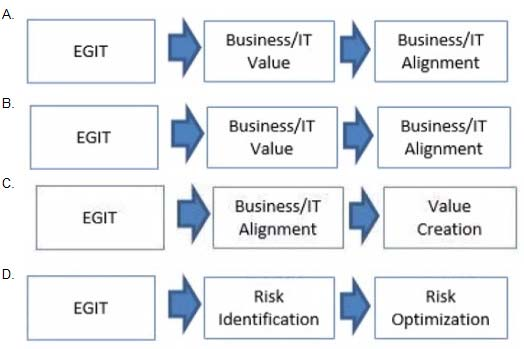
-
A
-
B
-
C
-
D
Reveal answer details
Close answer details
Correct answerC
ExplanationOption C places enterprise governance of information and technology in a sequence leading to Business/IT Alignment and then Value Creation. This captures the governing context: EGIT directs and monitors the use of information and technology so it aligns with enterprise needs, and that alignment supports the creation of value. Reversing those outcomes or substituting risk identification does not express the same relationship.
Which of the following is an IT implementation method design factor that focuses on software building, deployment and operations?
-
A
-
B
-
C
Reveal answer details
Close answer details
Correct answerC
ExplanationDevOps unifies software development and operational concerns across building, deployment, and ongoing operation. It promotes coordinated practices across the delivery lifecycle rather than treating development and operations as separate stages. Agile emphasizes iterative development, while the traditional method follows a more sequential lifecycle; neither name directly includes the combined development-and-operations focus.
Question 10
Single choice
Which of the following is an important principle of a proper governance framework?
-
A
The governance framework should be rigorous and focus exclusively on prioritized existing issues.
-
B
The governance framework should be based on a single relevant standard, framework or regulation.
-
C
The governance framework should allow for flexibility in addressing new issues.
Reveal answer details
Close answer details
Correct answerC
ExplanationA proper governance framework must remain open and flexible enough to address new issues as the enterprise, technology, and stakeholder needs change. A framework restricted to existing priorities would become less relevant when new risks or opportunities emerge. It should also draw from multiple appropriate standards and requirements rather than being constrained to a single source.
Question 11
Single choice
Which of the following roles should be involved when nominating key program roles to create the appropriate governance environment?
-
A
-
B
-
C
-
D
Reveal answer details
Close answer details
Correct answerD
ExplanationNominating key program roles shapes authority, accountability, and sponsorship for the governance environment. The board and executives should therefore be involved because they can appoint appropriate leadership, establish mandates, and ensure enterprise-wide commitment. IT, business, and human resources management may provide candidates or support, but they do not replace top-level governance authority.
Question 12
Single choice
Which of the following is a KEY consideration when finalizing a governance system design with competing priorities?
-
A
The enterprise should defer final design decisions to executive management to minimize conflicts among business stakeholders.
-
B
The enterprise should ensure all steps in the proposed workflow are applied when focusing on a very specific issue or initiative.
-
C
The enterprise should refer to the COBIT design workflow for universally applicable guidelines to resolve conflicting priorities.
-
D
The enterprise should be prepared to deviate from previously identified priorities with justified reasons.
Reveal answer details
Close answer details
Correct answerD
ExplanationDesign factors can produce competing priorities, so finalization requires informed judgment rather than mechanical application of every earlier result. The enterprise should be prepared to deviate from previously identified priorities when it has justified reasons and can explain the resulting design choice. This preserves responsiveness to the enterprise context while keeping exceptions deliberate and accountable.
Question 13
Single choice
Who is responsible for the oversight of structures and mechanisms that drive enterprise governance of information and technology (EGIT)?
-
A
Individual business units
-
B
-
C
Reveal answer details
Close answer details
Correct answerC
ExplanationThe board oversees the structures and mechanisms through which enterprise governance of information and technology operates. It evaluates stakeholder needs, sets direction, and monitors whether governance outcomes are achieved. Business units may execute activities, and regulators may impose requirements, but neither replaces the board's enterprise-level governance oversight.
Question 14
Single choice
Tailoring produces conflicting component arrangements and labels a low-priority objective as no longer part of COBIT. What should the design team do?
-
A
Accept both results because tailoring overrides the core COBIT model
-
B
Resolve conflicts while preserving core COBIT concepts
-
C
Increase every objective to the same priority and capability target
-
D
Discard all component variants and apply the unmodified reference model
Reveal answer details
Close answer details
Correct answerB
ExplanationTailoring adapts the governance system to enterprise needs, but it does not erase the core COBIT model or remove an objective merely because its priority is low. Conflicting component arrangements must be reconciled so the tailored design remains coherent. The team should therefore resolve the conflicts while preserving core COBIT concepts.
Question 15
Single choice
A governance program is on schedule, but employees are not adopting new decision rights and performance feedback shows weak outcomes. What response best supports sustainable implementation?
-
A
Close the program on schedule and address adoption afterward
-
B
Focus on change communications and suspend performance review
-
C
Continue delivery because technical completion establishes governance
-
D
Integrate program management, change enablement, and continual improvement
Reveal answer details
Close answer details
Correct answerD
ExplanationSchedule performance covers delivery, but weak adoption and weak outcomes show that delivery alone is insufficient. Program management coordinates the initiative, change enablement helps employees adopt the new decision rights, and continual improvement uses performance feedback to adjust the system. Integrating all three supports lasting implementation.
Question 16
Single choice
IT governance has been operating for three years and is satisfactorily achieving desired outcomes. What would be the PRIMARY purpose of reexamining the IT strategic plan?
-
A
To lower service delivery costs
-
B
To identify newly emerging risks
-
C
To assess improvement opportunities
Reveal answer details
Close answer details
Correct answerC
ExplanationBecause governance is already achieving its desired outcomes, reexamining the IT strategic plan should look beyond correcting failure and assess improvement opportunities. Changes in business needs, capabilities, and performance can reveal ways to increase value or refine direction. Lower costs or emerging risks may be individual findings, but neither captures the broader primary purpose.
Question 17
Single choice
Which of the following is the PRIMARY purpose of implementing an enterprise governance of information and technology (EGIT) system?
-
A
To document I&T business objectives and processes
-
B
To deliver stakeholder value from I&T-enabled investments
-
C
To comply with I&T regulatory requirements
Reveal answer details
Close answer details
Correct answerB
ExplanationThe central purpose of EGIT is to deliver stakeholder value from I&T-enabled investments. Governance directs and monitors I&T so benefits are realized while risk and resources are appropriately balanced. Documentation and regulatory compliance can be necessary parts of the system, but they are supporting requirements rather than the overarching reason for implementing it.
Question 18
Single choice
Which of the following is MOST critical to ensuring the objective of managed availability and capacity?
-
A
Identification of single points of failure
-
B
Allocation of budgets for business continuity
-
C
Future prediction of l&T resource requirements
Reveal answer details
Close answer details
Correct answerC
ExplanationManaged availability and capacity depends on anticipating future demand and determining the I&T resources required to meet it. Forecasting those requirements allows capacity to be adjusted before shortages degrade service availability or performance. Identifying single points of failure supports resilience, but it does not provide the demand-and-resource planning needed to manage overall capacity.
Question 19
Single choice
Which mechanism can define and implement policies within their span of control?
-
A
Organizational structures
-
B
-
C
-
D
Reveal answer details
Close answer details
Correct answerA
ExplanationOrganizational structures bring together defined authorities, responsibilities, and decision rights. Within their span of control, those structures can establish policies and ensure that the policies are implemented. Process practices perform work, while rules and norms influence behavior; neither has the same organizational authority described here.
Question 20
Single choice
Which COBIT domain of management objectives incorporates managed business process controls?
-
A
Build, Acquire and Implement (BAI)
-
B
Align, Plan and Organize (APO)
-
C
Deliver, Service and Support (DSS)
Reveal answer details
Close answer details
Correct answerC
ExplanationManaged business process controls belongs to the Deliver, Service and Support domain. These controls operate within delivered business services and processes to preserve the integrity of information and processing during day-to-day operations. The BAI domain concentrates on creating and implementing solutions, while APO establishes planning and organizational direction.
Question 21
Single choice
What Programme Management component in the implementation Life Cycle is linked to embedding the new approaches?
-
A
-
B
-
C
-
D
Reveal answer details
Close answer details
Correct answerA
ExplanationEmbedding new approaches means making changed ways of working part of normal enterprise operation so their intended value continues. The programme-management component associated with that stage is Realise benefits, because adoption must translate the implemented change into sustained outcomes. Planning and execution establish the change; benefit realization confirms its practical value.
Question 22
Single choice
Which "Role of IT" design factor is viewed as a driver for business process and service innovation?
-
A
-
B
-
C
Reveal answer details
Close answer details
Correct answerA
ExplanationTurnaround describes a role in which IT is a driver of business process and service innovation, even though current operations are not yet critically dependent on it. The enterprise uses technology to transform how it competes or operates. This innovation-driving purpose distinguishes turnaround from a role limited mainly to supporting existing activities.
Question 23
Single choice
What service capability is leveraged through processes to deliver internal and external services?
-
A
-
B
-
C
-
D
Reveal answer details
Close answer details
Correct answerB
ExplanationInformation is the service capability leveraged through processes for the delivery of internal and external services. Processes organize how information is obtained, transformed, and used so it can support service outcomes. Compliance is a requirement, efficiency is a performance quality, and policies provide direction; none is the service capability specified by this relationship.
Question 24
Single choice
Which of the following performance measures is used to assess a specific focus area?
-
A
-
B
-
C
Process capability rating
Reveal answer details
Close answer details
Correct answerA
ExplanationA maturity level assesses performance across a focus area, which consists of multiple relevant processes. It reflects the level collectively achieved by those processes rather than the capability of only one process. A process capability rating is process-specific, while a key goal indicator measures goal achievement instead of assigning focus-area maturity.
Question 25
Single choice
Which enabler describes an organized set of practices and activities?
-
A
Organizational Structures
-
B
Services, Infrastructure and Applications
-
C
Principles, Policies and Frameworks
-
D
Reveal answer details
Close answer details
Correct answerD
ExplanationProcesses are organized collections of practices and activities that take inputs, perform coordinated work, and produce outputs in support of objectives. Organizational structures define decision-making entities, and services, infrastructure, applications, principles, and policies supply other forms of capability or direction rather than the organized activity set itself.
Question 26
Single choice
Planned improvements have been executed in the COBIT implementation lifecycle. Which question should be answered next to confirm results before sustainment?
-
A
-
B
-
C
-
D
How do we sustain momentum?
Reveal answer details
Close answer details
Correct answerB
ExplanationExecution establishes that the planned improvements were performed, but it does not establish that they achieved the intended results. The next lifecycle question is therefore "Did it work?" This evaluation compares outcomes with expectations before the organization moves to sustaining momentum and embedding the changes.
Question 27
Single choice
Which of the following is based on generic components of a governance system but are tailored for a specific purpose or context within a focus area?
-
A
-
B
-
C
Reveal answer details
Close answer details
Correct answerB
ExplanationA focus area applies the general governance model to a particular topic, situation, or organizational context. The components adapted for that focus are variant components: they retain their basis in the generic components while being tailored to the specific purpose. Design factors influence tailoring, but they are not the tailored components themselves.
Question 28
Single choice
Which of the following must be done FIRST when implementing a culture and behavior governance component to ensure good governance and management of IT?
-
A
Define an approach for assessing the level of compliance.
-
B
Define a set of desirable or undesirable behaviors.
-
C
Determine the capability levels.
Reveal answer details
Close answer details
Correct answerB
ExplanationBehavior cannot be assessed or influenced until the enterprise defines what conduct it wants to promote and what conduct it wants to discourage. Establishing desirable and undesirable behaviors therefore comes first. Once that behavioral standard exists, the enterprise can design compliance assessments and other mechanisms around it.
Question 29
Single choice
Which principle is key for the governance and management of enterprise IT?
-
A
-
B
Insure Resource Optimization
-
C
Enabling a Holistic Approach
-
D
Reveal answer details
Close answer details
Correct answerC
ExplanationEnterprise IT governance depends on multiple interacting elements, including processes, structures, information, people, policies, culture and technology-related services. Enabling a holistic approach ensures these elements operate as a coordinated system. Managing one operational area or resource category alone cannot provide complete governance and management coverage.
Question 30
Single choice
One proposal maximizes expected benefits but creates unacceptable risk and excessive resource demand. Which basis best supports a value decision?
-
A
Balance benefits, risk, and resources according to stakeholder needs
-
B
Select the proposal with the greatest benefit regardless of other effects
-
C
Reject every proposal that introduces any new risk
-
D
Choose the proposal requiring the fewest resources
Reveal answer details
Close answer details
Correct answerA
ExplanationGovernance creates value by balancing three related dimensions: realizing benefits, optimizing risk, and optimizing resources. Maximizing only expected benefits would ignore the proposal's unacceptable exposure and excessive demand. A sound decision weighs all three dimensions according to stakeholder needs instead of optimizing one in isolation.
Question 31
Single choice
Which of the following is an element of governance?
-
A
Building plans to align with the direction set by the governance body
-
B
Monitoring activities designed to achieve enterprise objectives
-
C
Evaluating stakeholder needs to determine enterprise objectives
Reveal answer details
Close answer details
Correct answerC
ExplanationGovernance begins by evaluating stakeholder needs, conditions, and options so agreed enterprise objectives can be determined. The governance body then directs priorities and monitors performance against that direction. Building detailed plans to follow the direction is a management activity. Evaluation is therefore the element that establishes what governance should seek to achieve before execution is organized.
Question 32
Single choice
Which of the following COBIT 2019 publications includes a workflow for planning a tailored governance system for the enterprise?
-
A
COBIT 2019 Implementation Guide: Implementing and Optimizing an Information and Technology Governance Solution
-
B
COBIT 2019 Framework: Governance and Management Objectives
-
C
COBIT 2019 Design Guide: Designing an Information and Technology Governance Solution
Reveal answer details
Close answer details
Correct answerC
ExplanationPlanning a tailored governance system is a design activity because it requires evaluating the enterprise context and translating relevant design factors into governance priorities. The COBIT 2019 Design Guide is dedicated to designing an Information and Technology Governance Solution, so it contains the workflow serving that purpose.
Question 33
Single choice
When designing an IT governance system, the NEXT step after considering the enterprise's strategic business objectives is to assess:
-
A
the enterprise's risk profile.
-
B
the IT implementation method.
-
C
the role of IT within the enterprise.
Reveal answer details
Close answer details
Correct answerA
ExplanationStrategic business objectives establish what the enterprise intends to achieve. The next design consideration is its risk profile, because risk scenarios and their importance influence which governance and management objectives need greater priority. Implementation method and the role of IT are additional considerations, but they do not replace this next assessment.
Question 34
Single choice
Which of the following is an example of a focus area within COBIT?
-
A
Robotic process automation
-
B
-
C
Reveal answer details
Close answer details
Correct answerC
ExplanationDigital transformation is a focus area because it is a governance topic that can require a tailored collection of objectives, practices, components, and guidance. A focus area applies the core governance system to a particular subject or challenge without creating a separate framework. This allows transformation priorities to be addressed while retaining the common COBIT structure.
Question 35
Single choice
What enabler describes the key decision-making entities in an organization?
-
A
Organizational structures
-
B
-
C
People, skills and competencies
-
D
Principles, policies and frameworks
Reveal answer details
Close answer details
Correct answerA
ExplanationOrganizational structures describe committees, boards, roles and other entities that possess decision authority and accountability. They therefore identify where key organizational decisions are made. Processes define activities, people and competencies provide capability, and principles, policies and frameworks establish guidance and boundaries.
Question 36
Single choice
Ensuring the program team knows and understands the enterprise goals is a part of which of the following implementation phases?
-
A
-
B
-
C
-
D
Reveal answer details
Close answer details
Correct answerA
ExplanationThe current-state phase establishes the implementation team's common understanding of the enterprise, including its goals, conditions, and readiness for change. That shared baseline is needed before a target state or route can be designed, so ensuring that the team understands enterprise goals belongs under "Where are we now?"
Question 37
Single choice
Which process is included in the Build.
Acquire and Implement Process domain of the Management of Enterprise IT?
-
A
-
B
-
C
-
D
Manage Availability and Capacity
Reveal answer details
Close answer details
Correct answerD
ExplanationManage Availability and Capacity belongs to the Build, Acquire and Implement management domain because it addresses whether solutions and resources can provide the required availability and capacity. Manage Continuity and Manage Operations are service-delivery concerns, while Manage Risk belongs to planning and organization.
Question 38
Single choice
Why are the enabler dimensions important?
-
A
A link between Governance and Management is provided
-
B
They facilitate the planning, building, running and monitoring of an entity's IT
-
C
They allow an entity to manage its complex interactions
-
D
A link between COBIT 5 to other standards and framework is provided
Reveal answer details
Close answer details
Correct answerC
ExplanationEnablers do not operate independently; their dimensions provide a consistent way to examine stakeholders, goals, life cycles, good practices, and related measures. This makes complex interactions among enablers manageable as an integrated system. The dimensions therefore help the enterprise understand dependencies rather than merely linking named domains or frameworks.
Question 39
Single choice
Which of the following is MOST important to providing trust in operations, confidence in the achievement of enterprise objectives, and an adequate understanding of residual risk?
-
A
A continuity of operations response plan
-
B
A risk management framework
-
C
A managed system of internal controls
Reveal answer details
Close answer details
Correct answerC
ExplanationA managed system of internal controls provides an organized basis for directing, monitoring, and verifying operations. Effective controls support confidence that enterprise objectives are being pursued and make remaining exposure visible, enabling an adequate understanding of residual risk. A risk framework guides risk management, but controls provide the operational assurance described.
Question 40
Single choice
Which of the following stakeholders ensures the business case and program plan are realistic and achievable?
-
A
-
B
-
C
Chief information officer (CIO)
-
D
Reveal answer details
Close answer details
Correct answerD
ExplanationThe implementation team is positioned to test whether the planned work can actually be delivered. Its knowledge of implementation activities, dependencies, effort, and practical constraints allows it to confirm that the program plan is achievable and that the business case rests on realistic delivery assumptions.
Question 41
Single choice
A consultant tasked with facilitating an enterprise's COBIT implementation has met with the CEO and identified enterprise goals based on mission and vision. Which of the following roles is BEST suited to meet with the consultant to identify alignment goals?
-
A
-
B
Chief information officer
-
C
Reveal answer details
Close answer details
Correct answerB
ExplanationEnterprise goals express business priorities, while alignment goals express the I&T outcomes needed to support them. The chief information officer is best positioned to connect those enterprise goals with information and technology capabilities, services, and priorities. Risk and financial executives contribute specialized perspectives but do not own this overall I&T alignment.
Question 42
Single choice
COBIT defines stakeholder value creation as which of the following?
-
A
Realization of benefits at a controlled resource cost while controlling risk
-
B
Realization of benefits at an optimal resource cost while optimizing risk
-
C
Realization of benefits at a reduced resource cost while mitigating risk
Reveal answer details
Close answer details
Correct answerB
ExplanationStakeholder value is created by balancing three outcomes: realizing benefits, optimizing risk, and using resources at optimal cost. None of these is pursued in isolation or simply minimized. Reduced cost can undermine needed capability, and risk cannot always be eliminated; optimization seeks the appropriate balance for enterprise objectives and stakeholder needs.
Question 43
Single choice
A team reads only the process practices in a COBIT objective description. What else is needed for a complete interpretation of the objective?
-
A
Only the assigned process capability level and its rating
-
B
A replacement process selected from a specialized standard
-
C
Purpose, metrics, responsibilities, component guidance, and references
-
D
Enterprise organization charts, local procedures, capability targets, and budgets
Reveal answer details
Close answer details
Correct answerC
ExplanationProcess practices describe work to be performed, but an objective includes more than its activity list. Its purpose establishes the intended result, metrics indicate performance, responsibilities identify involvement, component guidance connects supporting elements, and references provide related direction. These elements together enable a complete interpretation.
Question 44
Single choice
Management is acquiring a solution, integrating it, and controlling its transition into use. Which management domain contains objectives with this purpose?
-
A
-
B
-
C
-
D
Reveal answer details
Close answer details
Correct answerB
ExplanationBAI covers building, acquiring, and implementing solutions, including their integration and transition into operational use. The activities in the scenario concern obtaining a solution and preparing it to become usable, so they fit this management domain rather than planning, service delivery, or performance monitoring.
Question 45
Single choice
Responsibility for developing an EGIT business case outline and details resides with which of the following?
-
A
IT managers and IT process owners
-
B
CIO and program steering committee
-
C
Board of directors and business executives
-
D
Risk and compliance function and IT audit
Reveal answer details
Close answer details
Correct answerB
ExplanationThe CIO and program steering committee are responsible for shaping and directing the EGIT implementation program, so they develop the business case outline and supporting details. The business case connects the proposed program with expected value, resources, and governance sponsorship. Other groups may review, approve, execute, or provide assurance, but they do not own its development.
Question 46
Single choice
The governing body evaluates stakeholder needs, sets priorities, and reviews performance against its direction. Which COBIT domain groups these responsibilities?
-
A
-
B
Monitor, Evaluate and Assess
-
C
Evaluate, Direct and Monitor
-
D
Deliver, Service and Support
Reveal answer details
Close answer details
Correct answerC
ExplanationEvaluate, Direct and Monitor groups the governing body's core responsibilities. It evaluates stakeholder needs and conditions, directs priorities and decision making, and monitors performance and conformance against that direction. The other domains organize management activities for planning, service delivery, or management-level monitoring rather than governing-body accountability.
Question 47
Single choice
Which of the following describes a specific governance topic, domain or issue that can be addressed by a collection of governance and management objectives and their components?
-
A
-
B
-
C
Reveal answer details
Close answer details
Correct answerB
ExplanationA focus area organizes guidance around a particular governance topic, domain, or issue. It brings together relevant governance and management objectives and their components so the topic can be addressed coherently. A design factor influences how a governance system is tailored, whereas components are the individual elements used within that system.
Question 48
Single choice
When tailoring the COBIT organizational structure, which of the following is the PRIMARY purpose for aligning role descriptions to the enterprise's business context, organization and operating environment?
-
A
Assigning levels of accountability and responsibility
-
B
Developing hierarchy and reporting structure
-
C
Preparing key goal areas and metrics for each role
Reveal answer details
Close answer details
Correct answerA
ExplanationTailored role descriptions must fit the enterprise's context so that levels of accountability and responsibility can be assigned to the people and structures that actually perform and own the work. This clarifies participation in governance and management activities. Reporting hierarchy and role metrics may support the structure, but they are not the primary purpose of aligning descriptions.
|