In order to best demonstrate the impact of clinical documentation on severity of illness and risk of mortality, which of the following examples is the most effective for physicians in a hospital?
-
A
The latest Medicare Provider and Analysis Review data
-
B
Emphasize the Medicare requirements for documentation
-
C
Examples from the hospital's actual cases
-
D
Explanations on how severity of illness and risk of mortality impact reimbursement
Reveal answer details
Close answer details
Correct answerC
ExplanationIn order to best demonstrate the impact of clinical documentation on severity of illness and risk of mortality, examples from the hospital's actual cases are the most effective for physicians in a hospital. Examples from the hospital's actual cases can show how specific documentation elements, such as diagnoses, procedures, complications, comorbidities, and present on admission indicators, can affect the severity of illness and risk of mortality scores of the patients, as well as the hospital's performance and reputation.
Examples from the hospital's actual cases can also provide feedback and education to the physicians on how to improve their documentation practices and standards.
References:
: (https://www.ahima.org/media/owmhxbv1/cdip_contentoutline_2023_final.pdf)
: (https://my.ahima.org/store/product?id=67077)
A 50-year-old with a history of stage II lung cancer is brought to the emergency department with severe dyspnea. The patient underwent the last round of chemotherapy 3 days ago. Vital signs reveal a temperature of 98.4, a heart rate of 98, a respiratory rate of 28, and a blood pressure of 124/82. O2 saturation on room air is 92%. The patient is 5'5"and weighs 98 lbs. The registered dietitian notes the patient is malnourished with BMI of 19. Chest x-ray reveals a large pleural effusion in the right lung. Thoracentesis is performed and 1000 cc serosanguinous fluid is removed. The admitting diagnosis is large right lung pleural effusion related to lung cancer stage II, documented multiple times. What post discharge query opportunity should be sent to the physician that will affect severity of illness (SOI)/risk of mortality (ROM)?
-
A
Query for protein calorie malnutrition
-
B
Query for malignant pleural effusion
-
C
Query for a diagnosis associated with the dietician's finding of malnutrition
-
D
Query if the malignant pleural effusion is the reason for admission
Reveal answer details
Close answer details
Correct answerB
ExplanationAccording to the AHIMA CDIP Exam Preparation Guide, a query is a communication tool or process used to clarify documentation in the health record for documentation integrity and accurate code assignment 1. A query should be clear, concise, and consistent, and should include relevant clinical indicators that support the query 1. A query should also provide multiple choice answer options that are supported by clinical indicators and include a non-leading query statement 2. In this case, the patient has a large right lung pleural effusion related to lung cancer stage II, which is documented multiple times. However, the documentation does not specify whether the pleural effusion is malignant or not. A malignant pleural effusion is a condition where cancer cells spread to the pleural space and cause fluid accumulation 3. A malignant pleural effusion is a major complication or comorbidity (MCC) that affects the severity of illness (SOI) and risk of mortality (ROM) of the patient, as well as the reimbursement and quality scores of the hospital 4. Therefore, a post discharge query opportunity should be sent to the physician to clarify whether the pleural effusion is malignant or not, based on the clinical indicators such as chest x-ray, thoracentesis, and fluid analysis. The query should provide answer options such as malignant pleural effusion, non-malignant pleural effusion, unable to determine, or other. The other options are not correct because they either do not affect the SOI/ROM of the patient (A and C), or they do not address the specificity of the diagnosis (D).
References:
CDIP Exam Preparation Guide - AHIMA Guidelines for Achieving a Compliant Query Practice (2019 Update) - AHIMA Malignant Pleural Effusion: Symptoms, Causes, Diagnosis & Treatment Q&A: Coding for malignant pleural effusions | ACDIS
Review the following query to determine if it is compliant: Dr. Jones, this patient had a sodium level of 126 on admission and was started on a 0.9% saline IV. Can you indicate what condition is being treated? Dehydration Hyponatremia Hypernatremia Chronic kidney disease (indicate stage) Other (please specify)
-
A
Yes, query is compliant as it offers the minimum number of multiple-choice answers ..
-
B
No, query is noncompliant as it does not provide the option of "unable to determine".
-
C
No, query is noncompliant as one of the multiple-choice options is clinically irrelevant.
-
D
Yes, query is compliant as it provides clinical indicators and several options for response.
Reveal answer details
Close answer details
Correct answerC
ExplanationA query is noncompliant if it includes options that are not supported by the clinical indicators or the patient's condition. In this case, hypernatremia is a condition of high sodium level, not low sodium level, and it is not consistent with the treatment of 0.9% saline IV. Therefore, it is a clinically irrelevant option that may confuse or mislead the provider. A compliant query should only include options that are reasonable and plausible based on the available documentation and evidence. (CDIP Exam Preparation Guide)
References:
CDIP Exam Content Outline1
CDIP Exam Preparation Guide2
AHIMA Practice Brief: Guidelines for Achieving a Compliant Query Practice3
Which of the following falls under the False Claims Act?
-
A
-
B
-
C
-
D
Reveal answer details
Close answer details
Correct answerB
ExplanationUnbundling services falls under the False Claims Act because it is a form of coding fraud that involves billing separately for components of a related group of procedures or tests that should be billed as a single code. For example, if a provider performs a comprehensive metabolic panel, which is a blood test that measures several components of the blood, such as glucose, electrolytes, and liver enzymes, and bills for each component individually instead of using the single code for the panel, that is unbundling. Unbundling services can result in overpayment by the government and can violate the False Claims Act, which prohibits submitting false or fraudulent claims for payment to the government, including the Medicare and Medicaid programs. Violators of the False Claims Act can face civil penalties of up to three times the amount of the false claim plus an additional $11,000 per claim 23.
References:
1: AHIMA CDIP Exam Prep, Fourth Edition, p. 133 4
2: Coding Fraud | VSG 5
3: False Claims Act | OIG 2
A hospital noticed a 30% denial rate in Medicare claims due to lack of clinical documentation, placing the hospital at risk of multiple Medicare violations. What step should the clinical documentation integrity (CDI) manager take to help avoid future Medicare violations?
-
A
Collaborate with physician advisor/champion and revenue cycle manager
-
B
Instruct the billing department to write off claims with insufficient documentation
-
C
Assign pre-billing claim review duties to physicians
-
D
Prevent submission of claims for improper documentation
Reveal answer details
Close answer details
Correct answerA
ExplanationThe step that the clinical documentation integrity (CDI) manager should take to help avoid future Medicare violations is to collaborate with physician advisor/champion and revenue cycle manager. The physician advisor/champion can help with educating and engaging the physicians on the importance and impact of clinical documentation on coding, reimbursement, quality measures, compliance, and patient care. The revenue cycle manager can help with analyzing and monitoring the denial trends and patterns, identifying and resolving the root causes of denials, implementing corrective actions and preventive measures, and ensuring timely and accurate claim submission and appeal processes.
References:
: (https://www.ahima.org/media/owmhxbv1/cdip_contentoutline_2023_final.pdf)
: (https://my.ahima.org/store/product?id=67077)
An 80-year-old male is admitted as an inpatient to the ICU with shortness of breath, productive yellow sputum, and a temperature of 101.2. CXR reveals bilateral pleural effusion and LLL pneumonia. Labs reveal a BUN of 42 and a creatinine level of 1.500. The patient is given Zithromax 500 mg. IV, NS IV, and Lasix 40 mg tabs 2x/day. The attending physician documents bilateral pleural effusion, LLL pneumonia, and kidney failure. Two days later, the renal consult documents AKI with acute tubular necrosis (ATN). The correct principal and secondary diagnoses are
-
A
PDx: AKI with ATN
SDx: LLL pneumonia, bilateral pleural effusion
-
B
PDx: LLL pneumonia
SDx: Bilateral pleural effusion, kidney failure
-
C
PDx: LLL pneumonia
SDx: AKI with ATN, bilateral pleural effusion
-
D
PDx: Bilateral pleural effusion
SDx: LLL pneumonia, kidney failure
Reveal answer details
Close answer details
Correct answerC
ExplanationAccording to the ICD-10-CM Official Guidelines for Coding and Reporting FY 2023, the principal diagnosis is defined as "the condition established after study to be chiefly responsible for occasioning the admission of the patient to the hospital for care"2. In this case, the patient was admitted with shortness of breath, productive yellow sputum, and a temperature of 101.2, which are signs and symptoms of pneumonia. The CXR confirmed the diagnosis of LLL pneumonia, which is a serious condition that requires inpatient care.
Therefore, LLL pneumonia is the principal diagnosis. The secondary diagnoses are defined as "all conditions that coexist at the time of admission, that develop subsequently, or that affect the treatment received and/or the length of stay"2. In this case, the patient had bilateral pleural effusion and kidney failure at the time of admission, which are coexisting conditions that affect the treatment received and/or the length of stay. The renal consult documented AKI with ATN, which is a more specific diagnosis than kidney failure and reflects the severity and etiology of the condition. Therefore, AKI with ATN and bilateral pleural effusion are secondary diagnoses.
References:
CDI Week 2020 Q&A: CDI and key performance indicators1 ICD-10-CM Official Guidelines for Coding and Reporting FY 20232
Which physician would best benefit from additional education for unanswered queries? 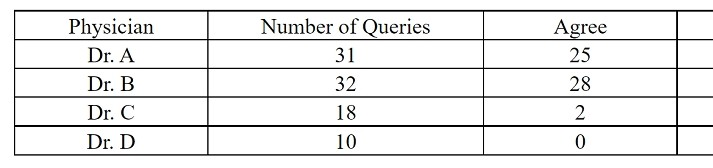
-
A
-
B
-
C
-
D
Reveal answer details
Close answer details
Correct answerD
ExplanationAccording to the Documentation Integrity Practitioner (CDIP? study guide, the physician with the highest number of unanswered queries would benefit from additional education. In this case, Dr. D has the highest number of unanswered queries with 9. Unanswered queries may indicate a lack of understanding, engagement, or compliance with the query process, which may affect the quality and accuracy of clinical documentation and coding 1. Therefore, Dr. D would best benefit from additional education for unanswered queries, such as the importance of timely and appropriate query responses, the impact of queries on severity of illness, risk of mortality, and reimbursement, and the best practices for a compliant query practice 2.
References:
Q&A: What to do with unanswered queries | ACDIS
Guidelines for Achieving a Compliant Query Practice (2019 Update) - AHIMA
Which of the following should be shared to ensure a clear sense of what clinical documentation integrity (CDI) is and the CDI practitioner's role within the organization?
-
A
-
B
-
C
-
D
Reveal answer details
Close answer details
Correct answerD
ExplanationSharing the mission of the CDI program should be done to ensure a clear sense of what CDI is and the CDI practitioner's role within the organization. The mission statement defines the purpose, goals, and values of the CDI program, and how it aligns with the organization's vision and strategy. The mission statement also communicates the benefits and expectations of the CDI program to various stakeholders, such as providers, executives, coders, quality staff, and patients. The mission statement can help establish the credibility, professionalism, and identity of the CDI practitioners, and guide their daily activities and decisions 2.
References:
1: AHIMA CDIP Exam Prep, Fourth Edition, p. 133 3
2: Mission CDI: Guiding goals, values,
and principles 1
The most beneficial step to identify post-discharge query opportunities that affect severity of illness, risk of mortality and case weight is to
-
A
look for documented conditions that have well supported accompanying clinical criteria
-
B
determine if only the treatment is documented and there is no diagnosis documented
-
C
watch for reportable conditions or conditions that are unambiguous or otherwise complete
-
D
identify normal diagnostic test results that may indicate a possible addition of a secondary diagnosis
Reveal answer details
Close answer details
Question 10
Single choice
Which member of the clinical documentation integrity (CDI) team can help provide peer-to-peer level of education on the importance of accurate documentation and query responses?
-
A
-
B
Physician advisor/champion
-
C
-
D
Reveal answer details
Close answer details
Correct answerB
ExplanationThe member of the clinical documentation integrity (CDI) team who can help provide peer-to-peer level of education on the importance of accurate documentation and query responses is the physician advisor/ champion. The physician advisor/champion is a physician who supports and advocates for the CDI program and its goals, and who can communicate effectively with other physicians about the clinical and financial implications of documentation quality and accuracy. The physician advisor/champion can also serve as a liaison between the CDI team and the medical staff, and help to resolve any issues or conflicts that may arise from the query process. The physician advisor/champion can also provide feedback and guidance to the CDI team on clinical matters and documentation standards. (CDIP Exam Preparation Guide)
References:
CDIP Exam Content Outline1
CDIP Exam Preparation Guide2
Question 11
Single choice
Collaboration between the physician advisor/champion and the clinical documentation integrity practitioners (CDIPs) would likely include
-
A
-
B
-
C
-
D
Reveal answer details
Close answer details
Correct answerC
ExplanationCollaboration between the physician advisor/champion and the clinical documentation integrity practitioners (CDIPs) would likely include educating physicians on the importance and impact of clinical documentation on coding, reimbursement, quality measures, compliance, and patient care. The physician advisor/champion can act as a liaison between the CDIPs and the medical staff, provide feedback and guidance on query development and resolution, and facilitate peer-to-peer education sessions on documentation best practices and standards6 References: 1:
https://www.ahima.org/media/owmhxbv1/cdip_contentoutline_2023_final.pdf
6:
https://my.ahima.org/store/product?id=67077
Question 12
Single choice
An increase in claim denials has prompted a clinical documentation integrity (CDI) manager to engage the CDI physician advisor/champion in an effort to avoid future denials. How does this strategy impact the goal?
-
A
The CDI manager will exclusively provide education.
-
B
Physicians will learn documentation integrity practices from peers.
-
C
Physicians can manage the documentation integrity process.
-
D
Clinicians will not require documentation integrity education.
Reveal answer details
Close answer details
Correct answerB
ExplanationEngaging the CDI physician advisor/champion in an effort to avoid future denials is a strategy that impacts the goal of improving documentation integrity by leveraging the influence and expertise of a physician leader who can educate, mentor, and advocate for other physicians on documentation best practices. The CDI physician advisor/champion can act as a liaison between the CDI team and the medical staff, provide feedback and guidance on complex or challenging cases, resolve conflicts or discrepancies in documentation, and promote a culture of collaboration and quality improvement. Physicians are more likely to learn and adopt documentation integrity practices from their peers who understand their clinical perspective and challenges, rather than from non-physician CDI staff or managers.
A. The CDI manager will exclusively provide education. This is incorrect because engaging the CDI
physician advisor/champion implies that the CDI manager will not be the sole source of education, but rather will partner with the physician leader to deliver effective and tailored education to the medical staff.
C. Physicians can manage the documentation integrity process. This is incorrect because engaging the
CDI physician advisor/champion does not mean that physicians will take over the responsibility of managing the documentation integrity process, which involves multiple stakeholders, such as CDI specialists, coders, quality analysts, and auditors. Rather, physicians will be more involved and supportive of the documentation integrity process as a result of the education and mentorship provided by the CDI physician advisor/champion. D. Clinicians will not require documentation integrity education. This is incorrect because engaging the CDI physician advisor/champion does not eliminate the need for documentation integrity education for clinicians, but rather enhances and facilitates it by using a peer-to-peer approach that can increase awareness, engagement, and compliance among physicians.
References:
CDIP Exam Preparation Guide, 2021 Edition. AHIMA Press. ISBN:
9781584268530
Q&A: Defining roles for physician advisor/champion | ACDIS Q&A: The Role of the Physician Advisor in
CDI | ACDIS The Role of a Physician Advisor - UASI Solutions
PA/NP in Physician Champion / Advisor Role -- ACDIS Forums
Question 13
Single choice
The BEST place for the provider to document a query response is which of the following?
-
A
-
B
The next progress note and the problem list
-
C
The next progress note and all subsequent notes including the discharge summary
-
D
An addendum to the history and physical
Reveal answer details
Close answer details
Correct answerB
ExplanationThe best place for the provider to document a query response is the next progress note and the problem list because this ensures that the query response is timely, consistent, and integrated into the health record. According to the AHIMA/ACDIS query practice brief1, the provider should document the query response in the health record as soon as possible after receiving the query, preferably in the next progress note. The provider should also update the problem list to reflect any new or revised diagnoses resulting from the query response. This helps to maintain an accurate and comprehensive list of the patient's current and chronic conditions, which can facilitate continuity of care, quality reporting, and reimbursement.
Documenting the query response in an addendum to the history and physical or only on the query form is not sufficient, as it may not capture the current status of the patient or be easily accessible to other providers or coders.
References:
CDIP?Exam Content Outline (https://www.ahima.org/media/1z0x0x1a/cdip-exam-content-outline.pdf)
Guidelines for Achieving a Compliant Query Practice--2022 Update1
Question 14
Single choice
A 75-year-old, diabetic patient with a history of osteoporosis, being treated with Fosamax, who sustained a femur fracture after falling down three stairs. The provider's documentation indicates to admit the patient for a traumatic femur fracture and an orthopedics consult is pending. The clinical documentation integrity practitioner (CDIP) decides to query for a possible link between osteoporosis and the femur fracture. Which of the following is the most compliant query based on the most recent AHIMA/ACDIS query practice brief?
-
A
Patient admitted for a femur fracture with a history of osteoporosis being treated with Fosamax. In your medical opinion, is this fracture consistent with an osteoporotic pathological fracture?
-
B
Patient admitted for a femur fracture with a history of osteoporosis being treated with Fosamax. Please clarify the cause of the femur fracture in your next note and/or the discharge summary.
-
C
Patient admitted for a femur fracture with a history of osteoporosis being treated with Fosamax. Could diabetes be a contributing factor in the femur fracture?
-
D
Patient admitted for a femur fracture with a history of osteoporosis being treated with Fosamax. Please document "femur fracture due to osteoporosis" in your next progress note to demonstrate a link between the two diagnoses.
Reveal answer details
Close answer details
Correct answerA
ExplanationThis query option is the most compliant based on the most recent AHIMA/ACDIS query practice brief because it meets the following criteria: It is based on clinical indicators in the health record that support a reasonable and logical connection between the conditions (femur fracture and osteoporosis). It is non-leading and non-suggestive, as it does not imply a specific answer or diagnosis, but rather asks for the provider's opinion based on their clinical judgment.
It is concise and clear, as it uses simple and direct language that avoids ambiguity or confusion.
It is relevant and specific, as it addresses a clinical issue that has an impact on patient care, quality reporting, and/or reimbursement. It is consistent with clinical documentation integrity (CDI) standards and guidelines, as it follows the AHIMA/ACDIS query practice brief recommendations for query format, content, delivery, and documentation.
References:
CDIP?Exam Content Outline (https://www.ahima.org/media/1z0x0x1a/cdip-exam-content-outline.pdf)
CDIP?Exam Preparation Guide (https://my.ahima.org/store/product?id=67077)
Guidelines for Achieving a Compliant Query Practice--2022 Update (https://acdis.org/resources/guidelines-achieving-compliant-query-practice%E2%80%942022-update)
Question 15
Single choice
A clinical documentation integrity practitioner (CDIP) generates a concurrent query and continues to follow
retrospectively; however, the coder releases the bill before the query is answered. The CDIP wonders if it is appropriate to re-bill the account if the physician answers the query after the bill has dropped. Which policy should the hospital follow to avoid a compliance risk?
-
A
A rebilling is permissible when queries are answered after the initial bill.
-
B
A post-bill query rarely occurs as a result of an audit or other internal monitor.
-
C
A second bill should not be submitted when the first bill was incomplete.
-
D
A post bill query is not appropriate when an error is found after an audit.
Reveal answer details
Close answer details
Correct answerA
ExplanationA rebilling is permissible when queries are answered after the initial bill, as long as the hospital follows the appropriate guidelines and procedures for rebilling, such as submitting a corrected claim within the timely filing limit, notifying the payer of the reason for rebilling, and documenting the query process and outcome in the health record. Rebilling may be necessary to ensure accurate coding and reporting of the patient's condition and treatment, as well as appropriate reimbursement and quality measures. [3][3] References: 1:
https://www.ahima.org/media/owmhxbv1/cdip_contentoutline_2023_final.pdf
[3][3]:
https://my.ahima.org/store/product?id=67077
Question 16
Single choice
Hospital-acquired condition pay provisions apply only to
-
A
inpatient prospective payment system hospitals
-
B
critical access hospitals
-
C
long-term acute care hospitals
-
D
inpatient psychiatric hospitals
Reveal answer details
Close answer details
Correct answerA
ExplanationHospital-acquired condition pay provisions apply only to inpatient prospective payment system hospitals because they are subject to the CMS policy that reduces payments for cases with conditions that were not present on admission. This policy is intended to encourage hospitals to improve the quality of care and prevent avoidable complications. Other types of hospitals, such as critical access hospitals, long-term acute care hospitals, and inpatient psychiatric hospitals, are not affected by this policy and are paid based on different methodologies. (CDIP Exam Preparation Guide) References: CDIP Exam Content Outline1 CDIP Exam Preparation Guide2
Hospital-Acquired Conditions (Present on Admission Indicator): Hospital ...3
Question 17
Single choice
A 56-year-old male patient complains of feeling fatigued, has nausea & vomiting, swelling in both legs.
Patient has history of chronic kidney disease (CKD) stage III, coronary artery disease (CAD) & hypertension (HTN). He is on Lisinopril. Vital signs: BP 160/80, P 84, R 20, T 100.OF. Labs: WBC 11.5 with 76% segs, GFR 45. CXR showed slight left lower lobe haziness. Patient was admitted for acute kidney injury (AKI) with acute tubular necrosis (ATN). He was scheduled for hemodialysis the next day.
Two days after admission patient started coughing, fever of 101.8F, CXR showed left lower lobe infiltrate, possible pneumonia. Attending physician documented that patient has pneumonia and ordered Rocephin IV. How should the clinical documentation integrity practitioner (CDIP) interact with the physician to clarify whether or not the pneumonia is a hospital-acquired condition (HAC)?
-
A
Dr. Adair, in your clinical opinion, do you think that the patient's acute kidney injury with ATN exacerbated the patient's pneumonia?
-
B
No need to query the physician because even if the pneumonia is considered a HAC and cannot be used as an MCC, ATN is also an MCC.
-
C
No need to interact with the physician because it is obvious the pneumonia developed after admission, therefore, not present on admission.
-
D
Dr. Adair, please indicate if the patient's pneumonia was present on admission (POA) based on the
initial chest x-ray?
Reveal answer details
Close answer details
Correct answerD
ExplanationThe clinical documentation integrity practitioner (CDIP) should interact with the physician to clarify whether or not the pneumonia is a hospital-acquired condition (HAC) by asking the physician to indicate if the pneumonia was present on admission (POA) based on the initial chest x-ray. This is because the POA status of a condition affects its coding, reporting, and reimbursement, and it is the responsibility of the physician to document the POA status of all diagnoses. The CDIP should not assume that the pneumonia developed after admission based on the timing of symptoms or treatment, as this may not reflect the true clinical picture. The CDIP should also not ask the physician about the causal relationship between the acute kidney injury and the pneumonia, as this is not relevant to the POA status. The CDIP should also not avoid querying the physician based on the presence of another MCC, as this may compromise the accuracy and completeness of documentation. (CDIP Exam Preparation Guide)
References:
CDIP Exam Content Outline
CDIP Exam Preparation Guide
Present on Admission Reporting Guidelines
Question 18
Single choice
A hospital is conducting a documentation integrity project for the purpose of reducing indiscriminate use of electronic copy and paste of patient information in records by physicians. Which data should be used to quantify the extent of the problem?
-
A
Percent of insurance billings denied due to lack of record documentation
-
B
Number of coder queries regarding inconsistent physician record documentation
-
C
Results of a survey of physicians that asks about documentation practices
-
D
Incidence of redundancies in physician notes in a sample of hospital admissions
Reveal answer details
Close answer details
Correct answerD
ExplanationExplanation: According to the AHIMA CDIP Exam Preparation Guide, a documentation integrity project is a systematic process of identifying, analyzing, and improving the quality and accuracy of clinical documentation in the health record 1. A documentation integrity project may have various purposes, such as enhancing patient safety, improving coding and reimbursement, or complying with regulatory standards 1. One of the common issues that may affect the quality and accuracy of clinical documentation is the indiscriminate use of electronic copy and paste of patient information in records by physicians 2.
Copy and paste is a function that allows physicians to duplicate existing text in the record and paste it in a new destination, which may save time and effort, but also may introduce errors, inconsistencies, or redundancies in the documentation 2. Therefore, to quantify the extent of the problem of copy and paste, the data that should be used is the incidence of redundancies in physician notes in a sample of hospital admissions. Redundancies are repeated or unnecessary information that may clutter the record and impair its readability and reliability 3. By measuring the frequency and types of redundancies in physician notes, the hospital can assess the impact of copy and paste on the documentation quality and identify areas for improvement. The other options are not correct because they do not directly measure the problem of copy and paste. The percent of insurance billings denied due to lack of record documentation may reflect other issues besides copy and paste, such as incomplete or inaccurate documentation, coding errors, or payer policies 4. The number of coder queries regarding inconsistent physician record documentation may indicate the presence of copy and paste, but it may also depend on other factors such as coder knowledge, query guidelines, or query response rate. The results of a survey of physicians that asks about documentation practices may provide some insight into the perceptions and attitudes of physicians regarding copy and paste, but it may not reflect the actual extent or impact of the problem on the documentation quality.
References:
CDIP Exam Preparation Guide - AHIMA Auditing Copy and Paste - AHIMA Copy/Paste: Prevalence, Problems, and Best Practices - AHIMA Documentation Denials: How to Avoid Them - AAPC
[Q&A: Querying for clinical validation | ACDIS]
Question 19
Single choice
A physician documented the specific site of the malignancy in the medical record documentation; however,
the coder is unable to locate a specific entry in the ICD-10-CM Alphabetical Index to match the specified diagnosis. Which abbreviation used in the Alphabetical Index will assist the coder in assigning the appropriate diagnosis code for the specified condition?
-
A
-
B
-
C
-
D
Reveal answer details
Close answer details
Correct answerD
ExplanationThe abbreviation NEC stands for "not elsewhere classified" and is used in the ICD-10-CM Alphabetical Index when a specific code is not available for a condition. The coder should use the NEC notation to locate the closest existing code that matches the documented diagnosis. For example, if the physician documented a malignant neoplasm of the left upper eyelid, but the Alphabetical Index only has an entry for malignant neoplasm of eyelid NEC, then the coder should use the code C44.10 (Unspecified malignant neoplasm of unspecified eyelid, including canthus) and assign a seventh character to specify laterality.
(CDIP Exam Preparation Guide)
References:
CDIP Exam Content Outline1
CDIP Exam Preparation Guide2
ICD-10-CM Official Guidelines for Coding and Reporting FY 20213
Question 20
Single choice
Which of the following individuals should the clinical documentation integrity (CDI) manager consult when developing query policy and procedures?
-
A
-
B
-
C
-
D
Reveal answer details
Close answer details
Correct answerA
ExplanationThe clinical documentation integrity (CDI) manager should consult the Chief Medical Officer when developing query policy and procedures because the Chief Medical Officer is responsible for overseeing the quality and safety of patient care, ensuring compliance with regulatory and accreditation standards, and providing leadership and guidance to the medical staff. The Chief Medical Officer can help to establish the goals, scope, and authority of the CDI program, as well as to support the query process and promote provider education and engagement. (CDIP Exam Preparation Guide) References: CDIP Exam Content Outline1 CDIP Exam Preparation Guide2
Question 21
Single choice
A 45-year-old female is admitted after sustaining a femur fracture. Orthopedics is consulted and performs an open reduction internal fixation (ORIF) of the femur without complication. Nursing documents the patient has a body mass index of 42 kg/m2. The clinical documentation integrity practitioner (CDIP) determines a query is needed to capture a diagnosis associated with the body mass index so it can be reported. Which of the following is the MOST compliant query based on the most recent AHIIMA/ACDIS query practice brief?
-
A
Nursing documents the BMI is 42 kg/m2. In order to capture a co-morbid condition (CC) to increase reimbursement, please add 'morbid obesity with BMI 42 kg/m2' to your next progress note.
-
B
Nursing documents the BMI is 42 kg/m2. To increase the severity of illness and risk of mortality, please add 'morbid obesity with BMI 42 kg/m2' to your next progress note.
-
C
Nursing documents the BMI is 42 kg/m2. Can you please clarify if the patient's morbid obesity was present on admission and add the diagnosis to future progress notes?
-
D
Nursing documents the BMI is 42 kg/m2. Please consider if any of the following diagnoses should be
added to the health record to support this finding: morbid obesity; obesity; other diagnosis (please
state)
Reveal answer details
Close answer details
Correct answerD
ExplanationExplanation: This is the most compliant query based on the most recent AHIMA/ACDIS query practice brief because it is non-leading, non-suggestive, and provides multiple options for the physician to choose from. It also does not imply any financial or quality implications for adding a diagnosis associated with the BMI.
References:
AHIMA/ACDIS. "Guidelines for Achieving a Compliant Query Practice (2019 Update)." Journal
of AHIMA 90, no. 2 (February 2019): 20-29.
|