A perfectly inelastic supply curve in a competitive market:
-
A
Means the equilibrium price must be zero.
-
B
Implies a vertical demand curve.
-
C
Exists when firms cannot vary input usage.
-
D
Says the market supply curve is horizontal.
Reveal answer details
Close answer details
Correct answerC
ExplanationChoice "c" is correct. Price elasticity of supply is calculated the same way as demand except that quantity supplied is measured:  Perfectly inelastic supply curves are also vertical representing that supply is insensitive to changes in price;
i.e., the quantity supplied will not change as price changes. Perfectly inelastic supply curves would exist if firms cannot vary input usage. Regardless of price, the firm has to use all inputs if it produces at all.
Choices "a", "b", and "d" are incorrect, as they are far-out distractors.
Barker Inc. has no capital rationing constraint and is analyzing many independent investment alternatives.
Barker should accept all investment proposals:
-
A
If debt financing is available for them.
-
B
That have positive cash flows.
-
C
That provide returns greater than the after-tax cost of debt.
-
D
That have a positive net present value.
Reveal answer details
Close answer details
Correct answerD
ExplanationChoice "d" is correct. Accept all investment alternatives that have a positive net present value (NPV). A positive NPV means the return on the investment exceeds the hurdle rate (the minimum acceptable rate of return).
Choice "a" is incorrect. The cost of debt financing is a factor in determining the hurdle rate.
Choice "b" is incorrect. The cash flow may be positive but the return on investment may be unacceptable.
Choice "c" is incorrect. The cost of debt financing is a factor in determining the hurdle rate.
For what purpose will a stockholder of a publicly held corporation be permitted to file a stockholders' derivative suit in the name of the corporation?
-
A
To compel payment of a properly declared dividend.
-
B
To enforce a right to inspect corporate records.
-
C
To compel dissolution of the corporation.
-
D
To recover damages from corporate management for an ultra vires management act.
Reveal answer details
Close answer details
Correct answerD
ExplanationChoice "d" is correct. A derivative action is an action by a stockholder in the name of the corporation to recover damages or to seek some other remedy on behalf of the corporation when the corporation does not enforce its own rights. Such actions are often brought when the directors or officers have breached their duty to the corporation and have refused to sue themselves. An ultra vires act is an act outside of a director's or an officer's scope of authority and thus is a breach of duty to the corporation.
Choices "a", "b", and "c" are incorrect, because these would all be causes of action against the corporate directors or officers on behalf of the stockholder to recover damages or seek some other remedy against the corporate directors or officers on behalf of the stockholder, not on behalf of the corporation.
An increase in the minimum wage will benefit specific economic wage groups as outlined below: I. Employees at the minimum wage rate who remain employed will benefit, since they will receive more
money.
II. Many of the unskilled could lose their jobs. There would be fewer jobs for the currently unemployed such as less educated and untrained personnel (e.g., teenagers) who will have more difficulty finding work as firms reduce their labor force and pursue more efficiency.
-
A
-
B
-
C
-
D
Reveal answer details
Close answer details
Correct answerA
ExplanationChoice "a" is correct. Only I.
Choices "b", "c", and "d" are incorrect, since II is a disadvantage - not a benefit.
Food Corp. owned a restaurant called The Ambers. The corporation president, T.J. Jones, hired a contractor to make repairs at the restaurant, signing the contract, "T.J. Jones for The Ambers." Two invoices for restaurant repairs were paid by Food Corp. with corporate checks. Upon presenting the final invoice, the contractor was told that it would not be paiD. The contractor sued Food Corp. Which of the following statements is correct regarding the liability of Food Corp.
?
-
A
It is not liable because Jones is liable.
-
B
It is not liable because the corporation was an undisclosed principal.
-
C
It is liable because Jones is not liable.
-
D
It is liable because Jones had authority to make the contract.
Reveal answer details
Close answer details
Correct answerD
ExplanationChoice "d" is correct. Where an agent enters into a contract on behalf of a principal and discloses the existence and identity of the principal and acts with authority, the principal is liable and the agent is not liable. Here, Jones signed the contract with an indication that he was signing for the corporation. The president of a corporation is an agent of the corporation and has apparent authority to enter contracts that appear to be within the ordinary scope of the corporation's business. The restaurant repairs here appear to be with the scope of Food Corp.'s business. Therefore, Food Corp. will be bound because Jones had at least apparent authority.
Choice "a" is incorrect, per the rule stated above.
Choice "b" is incorrect. The president signed as acting on behalf of the corporation, thus disclosing the principal.
Choice "c" is incorrect, per the rule stated above.
Why would a firm generally choose to finance temporary assets with short-term debt?
-
A
Matching the maturities of assets and liabilities reduces risk.
-
B
Short-term interest rates have traditionally been more stable than long-term interest rates.
-
C
A firm that borrows heavily long term is more apt to be unable to repay the debt than a firm that
borrows heavily short term.
-
D
Financing requirements remain constant.
Reveal answer details
Close answer details
Correct answerA
ExplanationChoice "a" is correct. Matching the maturities of current assets with liabilities as they come due is designed to ensure liquidity and reduce risk of cash shortages. Temporary assets (such as inventories, generally, and seasonal inventories, specifically) might be financed with short term debt such that the earnings from the sales of those temporary assets could be used to liquidate the related obligations as they come due and ensure that cash is available to meet cash flow requirements.
Choice "b" is incorrect. Interest rate risks would likely motivate a firm to use longer term financing than short-term financing. Choice "c" is incorrect. Matching cash inflows with cash outflows are more influential in determining a firm's ability to repay debt rather than the length of the obligation. Choice "d" is incorrect.
Long-term rather than short-term debt promotes consistent finance charges. The requirements for financing itself are driven by business practice, not by the maturity of financial instruments used.
In which stage of supply chain management will management move away from simple consolidation of its operations to an internally-integrated supply chain, which all work together towards the main business issue of the cost of customer service?
-
A
-
B
-
C
-
D
Supply chain communities.
Reveal answer details
Close answer details
Correct answerB
ExplanationChoice "b" is correct. In the integrated enterprise stage of supply chain management, the firm's management will move away from simple consolidation of its operations to an internally-integrated supply chain, which all work together towards the main business issue of the cost of customer service.
Choice "a" is incorrect. In the cross-functional teams stage of supply chain management, the firm's management will turn its attention to consolidation of the various departments that make up operations in order to solve the firm's problems, and the focus will be on customer service.
Choice "c" is incorrect. In the extended supply chain stage of supply chain management, integration moves external to the firm to involve those outside the firm who are able to work as a unified team in an attempt to
obtain slow, profitable growth. Choice "d" is incorrect. In the supply chain communities stage of supply chain management, the extended supply chain forms a single competitive entity with a synchronized supply chain and a complex system of networks.
Doug was the sole general partner in Heavy Foot, Limited Partnership. While driving to work one morning, Doug died in a car accident. The limited partnership:
-
A
Continues to exist as it was before Doug's death.
-
B
Dissolves by operation of law as a result of Doug's death.
-
C
Dissolves only by attaining a judicial decree.
-
D
Converts to a general partnership and all former limited partners become general partners.
Reveal answer details
Close answer details
Correct answerB
ExplanationChoice "b" is correct.
Rule: The death of a general partner will by operation of law, dissolve the limited partnership. Because the dissolution is by operation of law, there is no requirement to attain a judicial decree. Remaining limited partners do not automatically become general partners as a result of the death of the general partner.
Choices "a", "c", and "d" are incorrect, per the above rule.
Which of the following is not a typical characteristic of a just-in-time (JIT) production environment?
-
A
-
B
Insignificant setup times and costs.
-
C
-
D
Balanced and level workloads.
Reveal answer details
Close answer details
Correct answerC
ExplanationChoice "c" is correct. Just-in-time has the goal to minimize the level of inventory carried. Typical characteristics include lot sizes equal to one, insignificant set-up times and costs, and balanced and level workloads. In a just-in-time environment, the flow of goods is controlled by a "pull" approach, where an item is produced only when it is needed down the line, and not a "push-through" system.
Choices "a", "b", and "d" are incorrect based on the above Explanation.
Question 10
Single choice
A company enters into an agreement with a firm who will factor the company's accounts receivable. The factor agrees to buy the company's receivables, which average $100,000 per month and have an average collection period of 30 days. The factor will advance up to 80 percent of the face value of receivables at an annual rate of 10 percent and charge a fee of 2 percent on all receivables purchased. The controller of the company estimates that the company would save $18,000 in collection expenses over the year.
Fees and interest are not deducted in advance.
Assuming a 360-day year, what is the annual cost of financing?
-
A
-
B
-
C
-
D
Reveal answer details
Close answer details
Correct answerD
ExplanationChoice "d" is correct. 17.5% annual cost of financing. 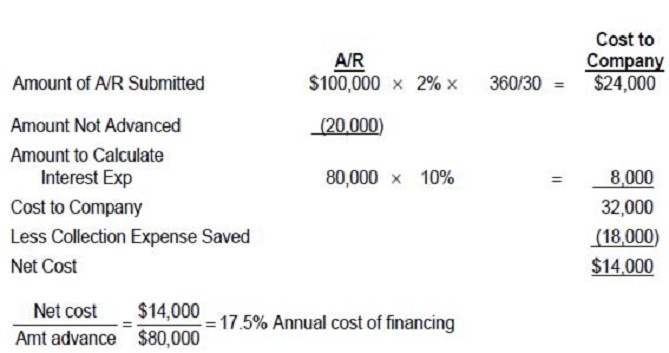
Question 11
Single choice
If an economy is currently experiencing both full employment and price stability, a major tax reduction will probably cause:
-
A
An increase in the unemployment rate.
-
B
An acceleration in the inflation rate, unless government expenditures are also reduced.
-
C
No change in real GDP or the price level.
-
D
A decrease in consumption.
Reveal answer details
Close answer details
Correct answerB
Explanation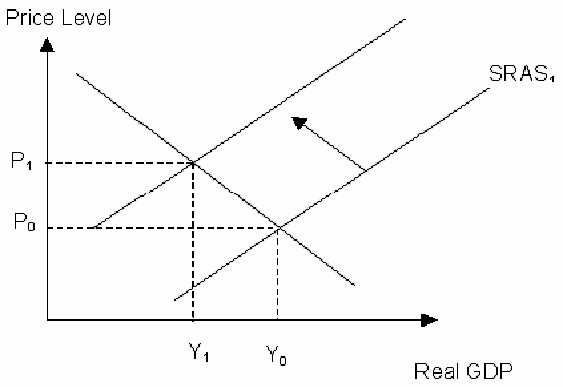 Choice "b" is correct. A tax cut shifts the aggregate demand curve to the right causing the price level and therefore the inflation rate to rise.
Choice "a" is incorrect. The unemployment rate would fall, not rise.
Choice "c" is incorrect. The price level would rise, not remain unchanged.
Choice "d" is incorrect. Consumption would rise as disposable income rises, not fall.
Question 12
Single choice
Colt Inc. is planning to use retained earnings to finance anticipated capital expenditures. The beta coefficient for Colt's stock is 1.15, the risk-free rate of interest is 8.5 percent, and the market return is estimated at 12.4%. If a new issue of common stock was used in this model, the flotation costs would be 7%. By using the Capital Asset Pricing Model equation C = R + B (M - R), the cost of using retained earnings to finance the capital expenditures is:
-
A
-
B
-
C
-
D
Reveal answer details
Close answer details
Correct answerB
ExplanationChoice "b" is correct. The capital asset pricing model (CAPM) is: 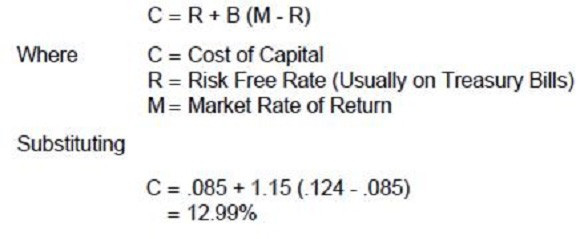
Question 13
Single choice
Locke and Vorst were general partners in a kitchen equipment business. On behalf of the partnership, Locke contracted to purchase 15 stoves from Gage. Unknown to Gage, Locke was not authorized by the partnership agreement to make such contracts. Vorst refused to allow the partnership to accept delivery of the stoves and Gage sought to enforce the contract. Gage will:
-
A
Lose, because Locke's action was not authorized by the partnership agreement.
-
B
Lose, because Locke was not an agent of the partnership.
-
C
Win, because Locke had express authority to bind the partnership.
-
D
Win, because Locke had apparent authority to bind the partnership.
Reveal answer details
Close answer details
Correct answerD
ExplanationChoice "d" is correct. Every partner is an agent of the partnership and has apparent authority to bind the partnership to contracts that appear to carry on in the usual way the business of the partnership. It would be usual for a partner in a kitchen equipment business to have authority to purchase stoves. Thus, Gage will win because of Locke's apparent authority.
Choice "a" is incorrect. Every partner is an agent for his partnership and has apparent authority to bind the partnership to contracts that appear to carry on in the usual way the business of the partnership.
Choice "b" is incorrect. Every partner is an agent of the partnership.
Choice "c" is incorrect. Locke did not have express authority to purchase the stoves. The facts state that Locke was not authorized to purchase the stoves and thus lacked express authority.
Question 14
Single choice
When the federal government imposes health and safety regulations on certain products, one of the most likely results is:
-
A
Greater consumption of the product.
-
B
Lower prices for the product.
-
C
Higher prices for the product.
-
D
Increased supply of the product.
Reveal answer details
Close answer details
Correct answerC
ExplanationChoice "c" is correct. One of the consequences of greater government regulation of certain products is the resulting higher cost to the consumer when the government imposes health and safety regulations on certain products it is likely that expenses will increase and that the added costs will be passed on to consumers in terms of higher prices. The total output for the product may decrease.
Choice "a" is incorrect. Since the price goes up, consumption will decrease.
Choice "b" is incorrect. The price can be expected to increase (see choice "c" Explanation above).
Choice "d" is incorrect. Since the price goes up, supply goes down.
Question 15
Single choice
When the supply of and demand for a good both increase:
-
A
Equilibrium price will increase.
-
B
Equilibrium price will decrease.
-
C
Equilibrium price may increase, decrease, or remain unchanged.
-
D
Equilibrium quantity may increase, decrease, or remain unchanged.
Reveal answer details
Close answer details
Correct answerC
Explanation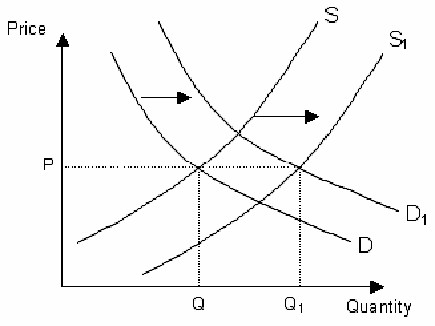 Choice "c" is correct. When the supply of and demand for a good both increase, equilibrium quantity increases. However, the impact on price is indeterminate. If demand and supply increase by the same amount, price will remain unchanged (as illustrated above). However, if demand increases by more than supply, price will increase. Conversely, if supply increases by more than demand, price will decrease.
Choices "a" and "b" are incorrect, since the impact on price is indeterminate.
Choice "d" is incorrect, since equilibrium quantity will increase.
Question 16
Single choice
Which one of the following financial instruments generally provides the largest source of short-term credit for small firms?
-
A
-
B
-
C
-
D
Reveal answer details
Close answer details
Correct answerC
ExplanationChoice "c" is correct. Trade credit generally provides the largest source of short-term credit for small firms.
Choices "a", "b", and "d" are incorrect, per the above Explanation.
Question 17
Single choice
Universal Industries limits its operations to exports to foreign countries. What can be said about Universal's exposures to exchange rate risk?
-
A
Universal is subject to potential transaction, economic and translation exposures to exchange rate risk.
-
B
Universal is subject to potential transaction and economic exposures to exchange rate risk.
-
C
Universal is subject to economic and translation exposures to exchange rate risk.
-
D
Universal is subject transaction and translation exposures to exchange rate risk.
Reveal answer details
Close answer details
Correct answerB
ExplanationChoice "b" is correct. Universal is subject to transaction risks associated with settlement of export transactions and is subject to economic risks associated with the satisfaction of domestic expenses denominated in domestic currencies with imported revenues denominated in a foreign currency. No translation exposure exists since there is no foreign investment or subsidiary.
Choices "a", "c", and "d" are incorrect, per the above Explanation.
Question 18
Single choice
Government price regulations in competitive markets that set maximum or ceiling prices below the equilibrium price will in the short run:
-
A
Cause demand to increase.
-
B
Cause supply to increase.
-
C
Create shortages of that product.
-
D
Produce a surplus of the product.
Reveal answer details
Close answer details
Correct answerC
Explanation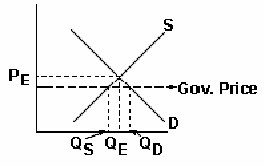 Choice "c" is correct. Government price regulations in competitive markets that set maximum or ceiling prices below the equilibrium price will create shortages of that product in the short run because quantity supplied will be less than quantity demanded at that price.
Choice "a" is incorrect. Quantity demand will increase at the lower price.
Choice "b" is incorrect. Quantity supplied will decrease at the lower price.
Choice "d" is incorrect. A price set below the market's equilibrium price causes shortages, not surpluses, per the graph above.
Question 19
Single choice
Lark, a partner in DSJ, a general partnership, wishes to withdraw from the partnership and sell Lark's interest to Ward. All of the other partners in DSJ have agreed to admit Ward as a partner and to hold Lark harmless for the past, present, and future liabilities of DSJ. As a result of Lark's withdrawal and Ward's admission to the partnership, Ward:
-
A
Acquired only the right to receive Ward's share of DSJ profits.
-
B
Has the right to participate in DSJ's management.
-
C
Is personally liable for partnership liabilities arising before and after being admitted as a partner.
-
D
Must contribute cash or property to DSJ to be admitted with the same rights as the other partners.
Reveal answer details
Close answer details
Correct answerB
ExplanationChoice "b" is correct. The general rule is that the mere assignment of a partner's interest does not make the assignee a partner. One may become a partner only with the consent of all other partners. Here, all other partner's consented to Ward's becoming a partner. Thus, Ward is a partner with full rights to participate in management.
Choice "a" is incorrect. The general rule is that the mere assignment of a partner's interest does not make the assignee a partner. One may become a partner only with the consent of all other partners.
Here, all other partner's consented to Ward's becoming a partner. Thus, Ward is a partner with full partner rights.
Choice "c" is incorrect. An incoming partner is not liable for debts that the partnership incurred before admission beyond the incoming partner's contribution, but is fully liable for debts incurred after becoming a partner. Choice "d" is incorrect. A partnership is a consensual relationship; there is no requirement of a
contribution to become a partner.
Question 20
Single choice
The key difference between strategic goals and tactical goals is that tactical goals are:
-
A
-
B
Developed by top management.
-
C
Concerned with issues other than profit.
-
D
Reveal answer details
Close answer details
Correct answerD
ExplanationChoice "d" is correct. Tactical goals are the means for attaining strategic goals and are short-term in nature. Strategic goals are overall objectives and relatively long-term.
Choice "a" is incorrect. Both strategic and tactical goals are usually attainable.
Choice "b" is incorrect. Development of all goals are best accomplished with the involvement of employees at all levels.
Choice "c" is incorrect. Tactical goals are the means for achieving strategic goals. Both are concerned with profit and other issues.
Question 21
Single choice
When a worker quits work to stay at home with the children, it is an example of:
-
A
-
B
-
C
-
D
Not counted in unemployment figures.
Reveal answer details
Close answer details
Correct answerD
ExplanationChoice "d" is correct. Unemployment only tallies workers actively seeking employment; it does not count retirees or stay-at-home parents.
Choice "a" is incorrect. Frictional unemployment describes workers who leave work voluntarily to seek a better position.
Choice "b" is incorrect. Structural unemployment describes workers whose skills are no longer needed.
Choice "c" is incorrect. Cyclical unemployment describes workers unemployed due to the business cycle.
Question 22
Single choice
Which one of the following represents methods for converting accounts receivable to cash?
-
A
Trade discounts, collection agencies, and credit approval.
-
B
Factoring, pledging, and electronic funds transfers.
-
C
Cash discounts, collection agencies, and electronic funds transfers.
-
D
Trade discounts, cash discounts, and electronic funds transfers.
Reveal answer details
Close answer details
Correct answerC
ExplanationChoice "c" is correct. The following are methods of converting accounts receivable (AR) into cash: 1. Collection agencies - used to collect overdue AR.
2. Factoring AR - selling AR to a factor for cash.
3. Cash discounts - offering cash discounts to customers for paying AR quickly (or paying at all).
For example: 2/10, net 30.
4. Electronic fund transfers - a method of payment, which electronically transfers funds between banks. Therefore, only choice "c" matches the above list.
Choice "a" is incorrect. Trade discounts offer discounts on future merchandise purchases offered to trade customers. These discounts do not turn AR into cash.
Choice "b" is incorrect. Pledging AR as collateral on a loan does not convert AR into cash.
Choice "d" is incorrect, per choice for "a" above.
Question 23
Single choice
A basic determinant of the elasticity of demand for a normal good is the:
-
A
Length of time producers have to respond to market changes.
-
B
Number of substitutes available for the product.
-
C
Number of sellers of the product.
-
D
Number of complements available for the product.
Reveal answer details
Close answer details
Correct answerB
ExplanationChoice "b" is correct. The change in demand for a product, based upon a given change in that product's price, is dependent on whether or not other (presumably cheaper) goods can be substituted for the product. Choice "a" is incorrect. The elasticity of supply (not demand) would take into account the response time producers might have to market changes.
Choice "c" is incorrect. The number of sellers is irrelevant when calculating the elasticity of demand.
Choice "d" is incorrect. A complement good's demand is the same as the primary good. For example, an increase in the demand for a given food would cause the demand for its complement to also increase.
The increased demand of the complement is irrelevant when calculating the elasticity of demand.
Question 24
Single choice
Which one of the following provides a spontaneous source of financing for a firm?
-
A
-
B
-
C
-
D
Reveal answer details
Close answer details
Correct answerA
ExplanationChoice "a" is correct. Accounts payable provide a spontaneous source of financing for a firm.
Choice "b" is incorrect. Accounts receivable take time to factor.
Choices "c" and "d" are incorrect.
Each of the following take time to issue:
C. Debentures. D. Preferred stock.
Question 25
Single choice
A company has two divisions. Division A has operating income of $500 and total assets of $1,000. Division B has operating income of $400 and total assets of $1,600. The required rate of return for the company is 10%.
The company's residual income would be which of the following amounts?
-
A
-
B
-
C
-
D
Reveal answer details
Close answer details
Correct answerC
ExplanationChoice "c" is correct. Residual income is the difference between net income and the required return. The required return is net book value (total assets) times the hurdle rate (required rate of return). The calculations are as follows:  Choice "a" is incorrect. Residual income would certainly not be $0 in this question because the operating income is greater than the required return for both Division A and Division B.
Choice "b" is incorrect. The $260 is the total required return, not the total residual income.
Choice "d" is incorrect. The $900 is the total operating income, not the total residual income.
Question 26
Single choice
Which of the following statements is correct with respect to the differences and similarities between a corporation and a limited partnership?
-
A
Stockholders may be entitled to vote on corporate matters but limited partners are prohibited from voting on any partnership matters.
-
B
Stock of a corporation may be subject to the registration requirements of the federal securities laws but limited partnership interests are automatically exempt from those requirements.
-
C
Directors owe fiduciary duties to the corporation and limited partners owe such duties to the partnership.
-
D
A corporation and a limited partnership may be created only under a state statute and each must file a copy of its organizational document with the proper governmental body.
Reveal answer details
Close answer details
Correct answerD
ExplanationChoice "d" is correct. Both a limited partnership and a corporation:
1. Can only be created by statute, and 2. Each must file a copy of its certificate with the proper state agency.
Choice "a" is incorrect. There are instances in which limited partners do vote on certain partnership matters (e.g., approve new general or limited partners).
Choice "b" is incorrect. Limited partnership interests are not automatically exempt from the federal securities laws.
Choice "c" is incorrect. Limited partners do not owe a fiduciary duty to the limited partnership.
Question 27
Single choice
In evaluating a capital budget project, the use of the net present value model is generally not affected by the:
-
A
Method of funding the project.
-
B
Initial cost of the project.
-
C
Amount of added working capital needed for operations during the term of the project.
-
D
Amount of the project's associated depreciation tax allowance.
Reveal answer details
Close answer details
Correct answerA
ExplanationChoice "a" is correct. The method of funding the project has no effect on the net present value model. NPV uses a hurdle rate to discount cash flows. If the NPV is positive, the project is acceptable. The method of financing the project, and the cost, are independent of the process of screening the project for acceptability.
Choice "b" is incorrect. The initial cost is one of the most important items in the calculation of NPV.
Choice "c" is incorrect. Added working capital requirements and salvage value affect cash flow. All cash flows are used in the NPV model. Choice "d" is incorrect. The tax depreciation allowance will provide a "tax shield" or tax savings that impacts cash flow and must be considered in NPV analysis.
Question 28
Single choice
An increase (shift right) in aggregate demand causes:
-
A
An increase in the price level and a decrease in real GDP.
-
B
A decrease in the price level and an increase in real GDP.
-
C
An increase in the price level and an increase in real GDP.
-
D
A decrease in the price level and a decrease in real GDP.
Reveal answer details
Close answer details
Correct answerA
Explanation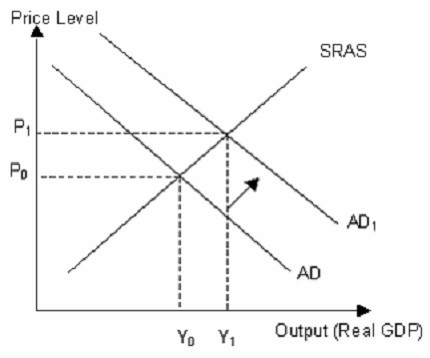 Choice "c" is correct. As shown above, an increase in aggregate demand causes the equilibrium price level to rise and equilibrium output (real GDP) to increase.
Choice "a" is incorrect. As shown above, equilibrium output increases, not decreases.
Choice "b" is incorrect. As shown above, the equilibrium price level increases, not decreases.
Choice "d" is incorrect. As shown above, the equilibrium price level increases, not decreases.
Question 29
Single choice
As a company becomes more conservative with respect to working capital policy, it would tend to have a (n):
-
A
Increase in the ratio of current liabilities to noncurrent liabilities.
-
B
Decrease in the operating cycle.
-
C
Decrease in the quick ratio.
-
D
Increase in the ratio of current assets to noncurrent assets.
Reveal answer details
Close answer details
Correct answerD
ExplanationRULE: Working capital policy is deemed to be more conservative as an increasing portion of an organization's long-term assets, permanent current assets, and temporary current assets are funded by long-term financing. Choice "d" is correct. An increase in the ratio of current assets to non-current assets would be indicative of an increasingly conservative working capital policy. With no other information, an increase in current assets would indicate that a growing percentage of current assets are financed by non current liabilities and that, nominally, the absolute amount of working capital and the current ratio is improving. Choice "a" is incorrect. An increase in the ratio of current liabilities to noncurrent liabilities would indicate that an increasing portion of our assets are funded by current liabilities, a more aggressive approach to working capital management. Choice "b" is incorrect. A decrease in the operating cycle implies that the time to convert inventory into sales (receivables) and receivables into cash has decreased. Assuming no change in liabilities or sales, a decreased operating cycle infers declining current asset balances, greater funding of assets by current liabilities and a more aggressive rather than conservative working capital policy. Choice "c" is incorrect. A decrease in the quick ratio would indicate that either temporary current assets are decreasing (and are therefore increasingly funded by current liabilities, indicating a more aggressive working capital policy) or that current liabilities are increasing, signaling a decrease in the amount of noncurrent liabilities used to fund temporary current assets, a sign of an increasingly aggressive working capital policy.
Question 30
Single choice
Assume the following facts about Martin Corporation: - The long-term debt was originally issued at par ($1,000/bond) and is currently trading at $1,250 per bond.
- Martin Corporation can now issue debt at 150 basis points over U.S. treasury bonds.
- The current risk-free rate (U.S. treasury bonds) is 7 percent.
- Martin's common stock is currently selling at $32 per share.
- The expected market return is currently 15 percent.
- The beta value for Martin is 1.25.
- Martin's effective corporate income tax rate is 40 percent. Based on these assumptions, what is the current net after-tax cost of debt for Martin Corporation?
-
A
-
B
-
C
-
D
Reveal answer details
Close answer details
Correct answerC
ExplanationChoice "c" is correct. 5.1 percent current net cost of debt.
The fact pattern states that debt can be currently secured at 150 basis points above the Treasury bond rate. A basis point is equal to 1/100 of 1% (1% of 1%).
Applying the decimals, it's: 150 basis points x 1/100 of 1% (or .0001) this yields .015 or 1.5% Add the additional basis points converted to percentage (1.5%) to the Treasury bond rate of 7% to arrive at the pre-tax debt cost of 8.5%. Apply 1 - tax rate to arrive at the current net cost of debt as follows: 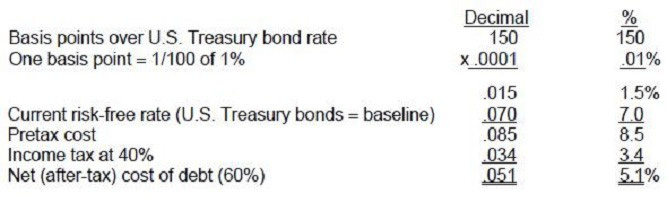
Question 31
Single choice
To decrease the money supply, the Fed might:
-
A
Sell government securities on the open market.
-
B
Buy government securities on the open market.
-
C
Decrease the required reserve ratio.
-
D
Reveal answer details
Close answer details
Correct answerA
ExplanationChoice "a" is correct. To decrease the money supply, the Fed can: (1) sell government securities in the open market, (2) increase the discount rate, and (3) increase the required reserve ratio.
Choice "b" is incorrect. The Fed should sell (not buy) securities on the open market.
Choice "c" is incorrect. The Fed should increase (not decrease) the required reserve ratio.
Choice "d" is incorrect. The Fed should increase (not decrease) the discount rate.
Question 32
Single choice
Which of the following transactions does not change the current ratio and does not change the total current assets?
-
A
A cash advance is made to a divisional office.
-
B
A cash dividend is declared.
-
C
Short-term notes payable are retired with cash.
-
D
Equipment is purchased with a three-year note and a 10 percent cash down payment.
Reveal answer details
Close answer details
Correct answerA
ExplanationChoice "a" is correct. This does not change the current ratio because the reduction of cash is offset by an increase in accounts receivable. Choice "b" is incorrect. A cash dividend increases current liabilities without increasing current assets. Although current assets remain unchanged (until the payment happens), the current ratio will change. Choice "c" is incorrect. Cash is reduced and current liabilities are reduced.
Total current assets will change (they will be reduced). Choice "d" is incorrect. The payment of cash reduces current assets. Long-term assets are increased, as well as long-term and short-term liabilities.
The current ratio is reduced.
Question 33
Single choice
Which one of the following statements pertaining to the return on investment (ROI) as a performance measurement is incorrect?
-
A
When the average age of assets differs substantially across segments of a business, the use of ROI may not be appropriate.
-
B
ROI relies on financial measures that are capable of being independently verified while other forms of performance measures are subject to manipulation.
-
C
The use of ROI may lead managers to reject capital investment projects that can be justified by using
discounted cash flow models.
-
D
The use of ROI can make it undesirable for a skillful manager to take on trouble-shooting assignments such as those involving turning around unprofitable divisions.
Reveal answer details
Close answer details
Correct answerB
ExplanationChoice "b" is correct. ROI is no more and no less capable of being independently verified or manipulated than other performance measure. Choice "a" is incorrect. Old fixed assets may be undervalued and make comparison with a segment with newer assets inappropriate.
Choice "c" is incorrect. Investment projects with positive present value may be rejected because ROI is too low.
Choice "d" is incorrect. Turning around an unprofitable division would be good for the company but would probably lower a manager's ROI.
Question 34
Single choice
Suppose the equilibrium wage for low skilled workers in California is $6.00 an hour.
If the government increases the minimum wage to $7.00 an hour, what would be the effect on the market for low skilled labor?
-
A
An excess demand for labor would result.
-
B
An excess supply of labor would result.
-
C
The demand for labor would decrease.
-
D
The supply of labor would increase.
Reveal answer details
Close answer details
Correct answerB
ExplanationChoice "b" is correct. A minimum wage that is set above the equilibrium wage will result in an excess supply (or surplus) of labor. 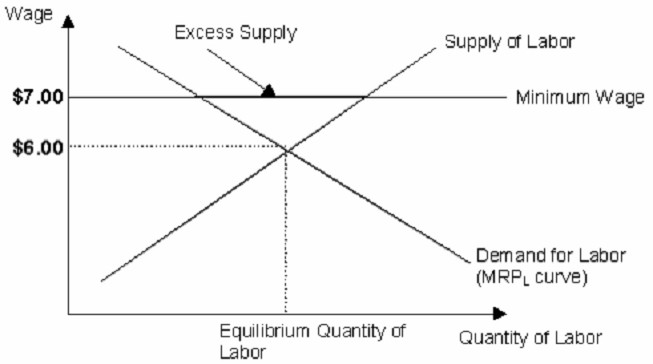 Choice "a" is incorrect, since the quantity demanded of labor at $7 is less than the quantity supplied, implying an excess supply not an excess demand. Choice "c" is incorrect. An increase in the minimum wage causes a decrease in quantity demanded of labor, not a decrease in the demand (shift in demand) for labor.
Choice "d" is incorrect, per the above Explanation.
Question 35
Single choice
In a competitive market an increase in the minimum wage will likely have the following effects:
-
A
The general (or aggregate) demand for labor will increase; however, the quantity demanded will remain
unchanged.
-
B
The general (or aggregate) supply of labor will increase; however, the quantity supplied will remain
unchanged.
-
C
The general (or aggregate) demand for labor will remain unchanged; however, the quantity demanded
will decrease.
-
D
The general (or aggregate) supply of labor will remain unchanged; however, the quantity supplied will
decrease.
Reveal answer details
Close answer details
Correct answerC
ExplanationChoice "c" is correct. The general (or aggregate) demand for labor will remain unchanged; however, the quantity demanded will decrease.
Choice "a" is incorrect, per Explanation for choice "c" above.
Choices "b" and "d" are incorrect. The general (or aggregate) supply of labor will remain unchanged;
however, the quantity supplied will increase.
Question 36
Single choice
By using the discounted cash flow model, estimate the cost of equity capital for a firm with a stock price of $30.00, an estimated dividend at the end of the first year of $3.00 per share, and an expected growth rate of 10 percent.
-
A
-
B
-
C
-
D
Reveal answer details
Close answer details
Correct answerD
Explanation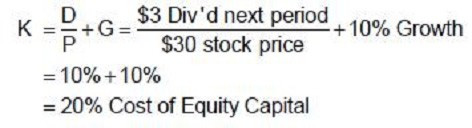 Choice "d" is correct. 20.0 percent cost of equity capital by using the discounted cash flow model.
Question 37
Single choice
An advantage of the net present value method over the internal rate of return model in discounted cash flow analysis is that the net present value method:
-
A
Computes a desired rate of return for capital projects.
-
B
Can be used when there is no constant rate of return required for each year of the project.
-
C
Uses a discount rate that equates the discounted cash inflows with the outflows.
-
D
Uses discounted cash flows whereas the internal rate of return model does not.
Reveal answer details
Close answer details
Correct answerB
ExplanationChoice "b" is correct. When using the net present value method of capital budgeting, different hurdle rates can be used for each year of the project.
Choice "a" is incorrect. The desired rate of return for capital projects is established by management.
Choice "c" is incorrect. The internal rate of return determines the discount rate that will equate the discounted cash inflows with the outflows, thus resulting in no gain or loss (breakeven). Choice "d" is incorrect. Both the net present value method and the internal rate of return model are discounted cash flow methods.
Question 38
Single choice
If a firm's credit terms require payment within 45 days but allow a discount of 2 percent if paid within 15 days (using a 360 day year), the approximate cost/benefit of the trade credit terms is:
-
A
-
B
-
C
-
D
Reveal answer details
Close answer details
Correct answerC
ExplanationChoice "c" is correct. The formula for computing the cost/benefit for trade discounts is: 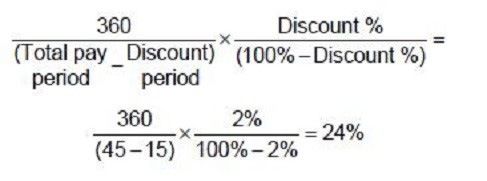 Choice is 24% ("c").
Choices "a", "b", and "d" are incorrect, per the above calculations.
Question 39
Single choice
Newman Products has received proposals from several banks to establish a lockbox system to speed up receipts. Newman receives an average of 700 checks per day averaging $1,800 each, and its cost of short-term funds is 7 percent per year.
Assuming that all proposals will produce equivalent processing results and using a 360-day year, which one of the following proposals is optimal for Newman?
-
A
A flat fee of $125,000 per year.
-
B
A fee of 0.03 percent of the amount collected.
-
C
A compensating balance of $1,750,000.
-
D
A fee of $0.35 per check plus 0.01 percent of the amount collected.
Reveal answer details
Close answer details
Correct answerC
ExplanationChoice "c" is correct. The optimal proposal is that which has the lowest cost for Newman. 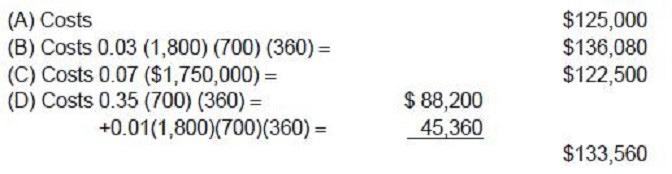 Thus, the lowest cost is "c" at $122,500.
Choices "a", "b", and "d" are incorrect, per the above calculations/Explanation.
Question 40
Single choice
In 1992, Anchor, Chain, and Hook created ACH Associates, a general partnership. The partners orally agreed that they would work full time for the partnership and would distribute profits based on their capital
contributions. Anchor contributed $5,000; Chain $10,000; and Hook $15,000. For the year ended
December 31, 1993, ACH Associates had profits of $60,000 that were distributed to the partners. During 1994, ACH Associates was operating at a loss. In September 1994, the partnership dissolved.
In October 1994, Hook contracted in writing with Ace Automobile Co. to purchase a car for the partnership.
Hook had previously purchased cars from Ace Automobile Co. for use by ACH Associates partners. ACH Associates did not honor the contract with Ace Automobile Co. and Ace Automobile Co. sued the partnership and the individual partners.
-
A
The ACH Associates oral partnership agreement was valid.
-
B
The ACH Associates oral partnership agreement was invalid because the partnership lasted for more than one year.
Reveal answer details
Close answer details
Correct answerA
ExplanationChoice "a" is correct. A partnership agreement does not have to be in writing to be valid. If the partners want to enforce an agreement to be partners for more than one year, that agreement must be in writing, but merely having the partnership last for more than one year does not make an oral partnership agreement invalid.
Question 41
Single choice
When applying value chain analysis, a firm asks it accounting department to perform an analysis of the sources of profits and costs of activities that exist within the firm.
The firm is performing which form of value chain analysis?
-
A
Internal differentiation analysis.
-
B
-
C
Vertical linkage analysis.
-
D
Reveal answer details
Close answer details
Correct answerB
ExplanationChoice "b" is correct. Internal costs analysis includes analyzing the internal value-creating ability of a firm, so the sources of profit and costs of the internal activities of the firm must be analyzed.
Choices "a", "c", and "d" are incorrect, per the above Explanation.
Question 42
Single choice
All of the following are complementary goods, except:
-
A
-
B
-
C
Cameras and rolls of film.
-
D
VCRs and video cassettes.
Reveal answer details
Close answer details
Correct answerA
ExplanationChoice "a" is correct. Margarine and butter are substitute goods. If the price of one goes up, demand for the substitute increases. Choices "b", "c", and "d" are incorrect. They are complements. Two goods are complements if they are used together or their demand curves move together (breakfast cereal and milk, e.g., or tennis balls and tennis racquets). Thus, if the price of one complement goes up, demand for the
other good goes down.
Question 43
Single choice
Under monopolistic competition, strategic plans focus on:
-
A
Profitability from production levels that maximize profits.
-
B
Maintaining the market share and being responsive to market conditions related to sales price.
-
C
Maintaining the market share and planning for enhanced product differentiation.
-
D
Maintaining the market share, ensuring product differentiation, and adapting to price changes or required changes in production volume.
Reveal answer details
Close answer details
Correct answerC
ExplanationChoice "c" is correct. Under monopolistic competition, strategic plans include maintaining the market share (as with pure competition), but they also likely include plans for enhanced product differentiation and allocation of resources to advertising, product research, etc. Choices "a", "b", and "d" are incorrect because they are characteristics of other types of market structures.
Question 44
Single choice
A change in credit policy has caused an increase in sales, an increase in discounts taken, a decrease in the amount of bad debts, and a decrease in the investment in accounts receivable. Based upon this information, the company's:
-
A
Average collection period has decreased.
-
B
Percentage discount offered has decreased.
-
C
Accounts receivable turnover has decreased.
-
D
Working capital has increased.
Reveal answer details
Close answer details
Correct answerA
ExplanationChoice "a" is correct. Average collection period has decreased due to a change in credit policy that has caused: 1. Increase in sales,
2. Increase in discounts taken,
3. Decrease in the amount of bad debt; and 4. Decrease in the investment in accounts receivable Choice "b" is incorrect. Percentage discount offered has probably increased, as discounts taken has increased.
Choice "c" is incorrect. Accounts receivable turnover has increased, as sales are up and accounts receivable are down.
Choice "d" is incorrect. Change in gross profit and working capital is not determinable from these facts.
Question 45
Single choice
Which of the following statements is true regarding the payback method?
-
A
It does not consider the time value of money.
-
B
It is the time required to recover the investment and earn a profit.
-
C
It is a measure of how profitable one investment project is compared to another.
-
D
The salvage value of old equipment is ignored in the event of equipment replacement.
Reveal answer details
Close answer details
Correct answerA
ExplanationChoice "a" is correct. The payback method determines the number of years that it will take for a company to recoup or be paid back for its investment. The payback method does not consider the time value of money. Choice "b" is incorrect. The payback method determines the number of years that it will take for a company to recoup or be paid back for its investment. Although the payback method focuses on liquidity and measures risk, project cash flows after the initial investment are not considered; thus, profitability is
ignored.
Choice "c" is incorrect. The payback method determines the number of years that it will take for a company to recoup or be paid back for its investment. Although the payback method focuses on liquidity and measures risk, project cash flows after the initial investment are not considered; thus, profitability is
ignored.
Choice "d" is incorrect. Salvage value is specifically considered as part of payback computations because it contributes to the incoming cash flow when the asset is sold.
Question 46
Single choice
In competitive markets, an increase in demand for a product causes a(n):
-
A
Increase in product supply.
-
B
Reduction in purchases by consumers.
-
C
Reduction in the number of buyers of the product.
-
D
Increase in the price of the product.
Reveal answer details
Close answer details
Correct answerD
ExplanationRule of economic reasoning: "Draw the graph!" 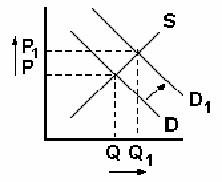 Choice "d" is correct. When demand increases and supply has not increased (as implied by the question), suppliers will raise the price of the product and more product will be bought (but the supply curve does not change). Because consumers are demanding more product than is available, they are "willing" to pay a higher price.
Choice "a" is incorrect. Although buyers would pay higher prices and purchase more products, the supply
"curve" has not changed. Therefore, the quantity supplied remains the same.
Choice "b" is incorrect. Because consumer demand has increased (not decreased).
Choice "c" is incorrect. An increase in demand has an indeterminate (and irrelevant) impact on the number of buyers. For example, there could be the same number of buyers in the market, but that each demands a higher quality.
Question 47
Single choice
A company has daily cash receipts of $150,000. The treasurer of the company has investigated a lockbox service whereby the bank that offers this service will reduce the company's collection time by four days at a monthly fee of $2,500. If money market rates average four percent during the year, the additional annual income (loss) from using the lockbox service would be:
-
A
-
B
-
C
-
D
Reveal answer details
Close answer details
Correct answerB
ExplanationChoice "b" is correct. $(6,000). A company's decision to commit to a lockbox plan is an example of marginal analysis. In other words, do the marginal benefits exceed the marginal costs of the plan? 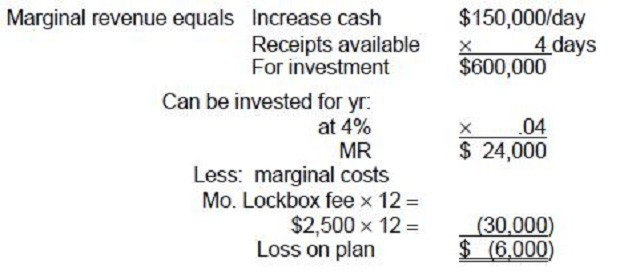 Choices "a", "c", and "d" are incorrect, per the above calculation.
Question 48
Single choice
The term underwriting spread refers to the:
-
A
Commission percentage an investment banker receives for underwriting a security lease.
-
B
Discount investment bankers receive on securities they purchase from the issuing company.
-
C
Difference between the price the investment banker pays for a new security issue and the price at which the securities are resold.
-
D
Commission a broker receives for either buying or selling a security on behalf of an investor.
Reveal answer details
Close answer details
Correct answerC
ExplanationChoice "c" is correct. Investment bankers are paid their fees partly by being allowed to purchase the new securities they are underwriting for a discount and then reselling those securities on the market. This is known as the underwriting spread.
Choices "a" and "d" are incorrect, as both of these describe either fees or commissions and not an underwriting spread.
Choice "b" is incorrect. The underwriting spread is the difference between the discount price paid and the resale price.
Question 49
Single choice
On dissolution of a general partnership, distributions will be made on account of: I. Partners' capital accounts.
II. Amounts owed partners with respect to profits.
III. Amounts owed partners for loans to the partnership. In the following order:
-
A
-
B
-
C
-
D
Reveal answer details
Close answer details
Correct answerA
ExplanationChoice "a" is correct.
Rule: On dissolution of a general partnership the "order of distribution" would be as follows: III. General partner loans.
I. Partners' capital accounts.
II. General partners' profits.
Choices "b", "c", and "d" are incorrect, per the above rule.
Question 50
Single choice
A member of a limited liability company may generally do all of the following, except:
-
A
Transfer his membership in the company without the consent of the other members.
-
B
Participate in the management of the company absent an agreement to the contrary.
-
C
-
D
Order office supplies for the company.
Reveal answer details
Close answer details
Correct answerA
ExplanationChoice "a" is correct. The transfer of a member interest requires the consent of the other members.
Members may not assign their interest without the other members' consent. Choice "b" is incorrect. Unless the members have agreed to operate as a manager managed limited liability company, all members have the power to participate in management. Choice "c" is incorrect. Members in a limited liability company all have limited personal liability. Choice "d" is incorrect. Unless otherwise agreed, members have the right to manage the every day operations of a limited liability company. This can include the ordering of office supplies.
Question 51
Single choice
In a member managed LLC, the apparent authority of a member to bind the LLC in dealing with third parties:
-
A
Would permit a member to submit a claim against the LLC to arbitration.
-
B
Must be derived from the express powers and purposes contained in the operating agreement.
-
C
Will be effectively limited by a formal resolution of the members of which third parties are aware.
-
D
Will be effectively limited by a formal resolution of the members of which third parties are unaware.
Reveal answer details
Close answer details
Correct answerC
ExplanationChoice "c" is correct. This is really an agency question on apparent authority. Apparent authority is authority that a third party reasonably believes an agent has. If the third party is aware of a restriction on the agent's authority, the third party cannot reasonably believe that the agent has the restricted authority.
Choice "a" is incorrect. Submitting a claim to arbitration is an extraordinary act and so is not within a member's apparent authority. Choice "b" is incorrect. Apparent authority is derived from what the reasonable person believes is the authority of a member, not the express powers and purposes contained in the operating agreement. Choice "d" is incorrect. A formal resolution of the members will not be effective to destroy apparent authority if third parties are unaware of the resolution.
Question 52
Single choice
Carr Corp. declared a 7% stock dividend on its common stock. The dividend:
-
A
Must be registered with the SEC pursuant to the Securities Act of 1933.
-
B
Is includable in the gross income of the recipient taxpayers in the year of receipt.
-
C
Has no effect on Carr's earnings and profits for federal income tax purposes.
-
D
Requires a vote of Carr's stockholders.
Reveal answer details
Close answer details
Correct answerC
ExplanationChoice "c" is correct. A stock dividend means that the corporation issues its existing shareholders more stock. In essence, the corporation is merely diluting the proportional ownership interest of existing shares.
This has no effect on the corporation's earnings and profits for federal income tax purposes.
Choice "a" is incorrect. There is no requirement that stock dividends be registered with the SEC because no "sale" is involved. Choice "b" is incorrect. The receipt of a stock dividend is not the recognition of income. It merely divides the stockholders' current ownership interests into more pieces; it does not
increase proportional ownership interest in the corporation. Choice "d" is incorrect. The issuance of dividends, including stock dividends, is at the directors' discretion; shareholders do not vote on dividends.
Question 53
Single choice
Of the following items, the one item that would not be considered in evaluating the adequacy of the budgeted annual operating income for a company is:
-
A
-
B
Long-range profit objectives.
-
C
Industry average for earnings on sales.
-
D
Reveal answer details
Close answer details
Correct answerD
ExplanationChoice "d" is correct. In evaluating the adequacy of the budgeted annual operating income, you would not use the internal rate of return calculation. The internal rate of return is used for capital budgeting. Choices
"a", "b", and "c" are incorrect. Return on assets, long range profit objectives, industry average for earnings on sales, and earnings per share [not mentioned as an option] are all measures for evaluating the adequacy of the budgeted annual operating income.
Question 54
Single choice
Hedgehog International owes 500,000 local currency units to its foreign supplier in 90 days. The current spot rate of the local currency unit is $.60. Hedgehog purchases a call option to buy the local currency unit in 90 days for $.61 for a premium of $.005. The exchange rate for the local currency increases to $.63 in 90 days. What will Hedgehog do on the payables' settlement date?
-
A
Hedgehog will exercise its option and settle the payables with proceeds from the option contract at a gain.
-
B
Hedgehog will not exercise the option and settle the payables after purchase of the local currency unit at the spot rate.
-
C
Hedgehog will be indifferent as to whether it exercises the option or not.
-
D
Hedgehog will sell the option at the settlement date and use its proceeds along with local currency units purchased at the spot rate to satisfy the amount payable.
Reveal answer details
Close answer details
Correct answerA
ExplanationChoice "a" is correct. Hedgehog will exercise its option and liquidate the payables associated with the proceeds. The exercise of the option represents a less costly alternative than acquisition of proceeds at the spot rate at the time the payables are due. The net impact of exercise of the option is computed as follows:  The premium is a sunk cost and is irrelevant to the decision. Note that the premium is a factor in determining the net gain (loss) but not in deciding whether to exercise the option.
Choices "b", "c", and "d" are incorrect, per computation above.
Question 55
Single choice
Williams, Inc. is interested in measuring its overall cost of capital and has gathered the following data.
Under the terms described below, the company can sell unlimited amounts of all instruments. - Williams can raise cash by selling $1,000, 8 percent, 20-year bonds with annual interest payments.
In selling the issue, an average premium of $30 per bond would be received, and the firm must pay floatation costs of $30 per bond. The after-tax cost of funds is estimated to be 4.8 percent.
- Williams can sell 8 percent preferred stock at par value, $105 per share. The cost of issuing and selling
the preferred stock is expected to be $5 per share.
- Williams' common stock is currently selling for $100 per share. The firm expects to pay cash dividends of
$7 per share next year, and the dividends are expected to remain constant. The stock will have to be underpriced by $3 per share, and floatation costs are expected to amount to $5 per share.
- Williams expects to have available $100,000 of retained earnings in the coming year; once these retained
earnings are exhausted, the firm will use new common stock as the form of common stock equity financing.
- Williams' preferred capital structure is:
Long-term debt 30%
Preferred stock 20
Common stock 50 If Williams, Inc. needs a total of $200,000, the firm's weighted-average cost of capital would be closest to:
-
A
-
B
-
C
-
D
Reveal answer details
Close answer details
Correct answerB
ExplanationChoice "b" is correct. 6.6%. Williams' after tax cost of debt is 4.8% and cost of preferred stock is 8.4% ($105/share less issue costs of $5/share). The cost of equity (as calculated in a prior question) is 7.0%.
This question pertains to the manner in which changes in the required amount of capital will impact the weighted average cost of capital governed by the target capital structure. The rates are given, and you must derive the weights. The company needs a total of $200,000. The question gives you the amount of Retained Earnings at $100,000, the source of 7% dividend payments on common shares. If all that is needed is $200,000, then, by definition, the target capital structure is "priced out" as shown with 7% common equity of $100,000 being equal to 50% of the target capital structure totaling $200,000 without any modification: 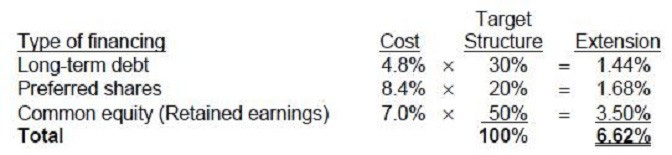 Choices "a", "c", and "d" are incorrect, per the above Explanation.
Question 56
Single choice
Assume that each day a company writes and receives checks totaling $10,000.
If it takes five days for the checks to clear and be deducted from the company's account, and only four days for the deposits to clear, what is the float?
-
A
-
B
-
C
-
D
Reveal answer details
Close answer details
Correct answerA
ExplanationChoice "a" is correct. $10,000. Float is the difference between the balance of checks outstanding, which have not cleared the bank and deposits made but which have not yet cleared the bank here.  Choices "b", "c", and "d" are incorrect, per the above calculation.
Question 57
Single choice
A stockholder's right to inspect books and records of a corporation will be properly denied if the purpose of the inspection is to:
-
A
Commence a stockholder's derivative suit.
-
B
Obtain stockholder names for a retail mailing list.
-
C
Solicit stockholders to vote for a change in the board of directors.
-
D
Investigate possible management misconduct.
Reveal answer details
Close answer details
Correct answerB
ExplanationChoice "b" is correct. In general, a shareholder has a right to inspect the books and records of a corporation for purposes related to the stockholder's interest in the corporation. This right will be denied where the purpose is not reasonably related to their status as a shareholder. Obtaining stockholder names to create a retail mailing list is a personal purpose.
Choices "a", "c", and "d" are incorrect. The following reasons for shareholders to inspect the books of the corporation are reasonably related to their status as shareholders: A. To commence a stockholder's derivative suit.
C. To solicit stockholders to vote for a change in the board of directors.
D. To investigate possible management misconduct.
Question 58
Single choice
Which of the following is not an external factor that directly affects the competitive environment of the firm?
-
A
Barriers to market entry.
-
B
Bargaining power of suppliers.
-
C
-
D
Existence of substitute products.
Reveal answer details
Close answer details
Correct answerC
ExplanationChoice "c" is correct. Political issues are external factors that affect the overall industry, not simply the competitive environment of the firm.
Choices "a", "b", and "d" are incorrect, as all of these factors directly affect the competitive environment of the firm.
Question 59
Single choice
In 1990, Amber Corp., a closely held corporation, was formed by Adams, Frank, and Berg as incorporators and stockholders. Adams, Frank, and Berg executed a written voting agreement which provided that they would vote for each other as directors and officers. In 1994, stock in the corporation was offered to the public. This resulted in an additional 300 stockholders. After the offering, Adams holds 25%, Frank holds 15%, and Berg holds 15% of all issued and outstanding stock. Adams, Frank, and Berg have been directors and officers of the corporation since the corporation was formed. Regular meetings of the board of directors and annual stockholders meetings have been held. For this question refer to the formation of Amber Corp. and the rights and duties of its stockholders, directors, and officers. Amber Corp.'s directors are elected by its:
-
A
-
B
-
C
Reveal answer details
Close answer details
Correct answerC
ExplanationChoice "c" is correct. Directors are elected by the stockholders.
Question 60
Single choice
If a nation has superior conditions in which to grow coffee beans and firms are able to grow them at very low costs, which of the four major factors that Michael Porter has indicated impact the global competitive environment would allow this nation to fare better with respect to global competitive advantage?
-
A
Conditions of the factors of production.
-
B
Conditions of domestic demand.
-
C
Related and supporting industries.
-
D
Firm strategy, structure, and rivalry.
Reveal answer details
Close answer details
Correct answerA
ExplanationChoice "a" is correct. If a nation has a strong set of factors of production (such as low cost, high quality raw material inputs), that are required in a given industry, it will fare better with regard to competitive advantage. Choice "b" is incorrect. Conditions of domestic demand relate to the nation's domestic demand for the product, which is directly related to the ability of the nation to fare better with regard to competitive advantage. Choice "c" is incorrect. The factor of related and supporting industries deals with whether there are suppliers of material inputs that exist within a nation or whether there are rival firms who are competitive in the international environment, both of which would increase the nation's competitive advantage.
Choice "d" is incorrect. The factor of firm strategy, structure, and rivalry relates to the practices of a nation with respect to how the companies are managed and organized, long with the laws of the nation that regulate the formation of the companies, and how intense the rivalry is with respect to competing firms in the nation.
Question 61
Single choice
Capital budgeting decisions include all but which of the following?
-
A
Selecting among long-term investment alternatives.
-
B
Financing short-term working capital needs.
-
C
Making investments that produce returns over a long period of time.
-
D
Financing large expenditures.
Reveal answer details
Close answer details
Correct answerB
ExplanationChoice "b" is correct. Capital budgeting decisions do not include the financing of short-term working capital needs, which are more operational in nature.
Choices "a", "c", and "d" are incorrect, as these are all types of capital budgeting decisions.
Question 62
Single choice
The amount of inventory that a company would tend to hold in safety stock would increase as the:
-
A
Cost of carrying inventory decreases.
-
B
Variability of sales decreases.
-
C
Costs of running out of stock decreases.
-
D
Length of time that goods are in transit decreases.
Reveal answer details
Close answer details
Correct answerA
ExplanationChoice "a" is correct. As the cost of carrying inventory decreases, safety stock would tend to increase to reduce the risk of stock outs. Choice "b" is incorrect. As sales become more predictable (sales variability decreases), less (not more) safety stock would be needed because the risk of stock outs would have decreased.
Choice "c" is incorrect. If the cost of stock outs decrease, safety stock would decrease.
Choice "d" is incorrect. If lead-time decreases, safety stock would decrease.
Question 63
Single choice
Economic theory identifies two basic types of goods: inferior goods and superior goods. As consumer income rises, a lower percentage of earnings are expended on inferior goods while a higher percentage of earnings are spent on superior goods. Overall strategies for achieving organizational missions would most likely match with types of goods as follows:
-
A
Cost leadership strategies for superior goods, differentiation strategies for inferior goods.
-
B
Cost leadership strategies for inferior goods, differentiation strategies for superior goods.
-
C
Cost leadership strategies would most likely be used for both inferior and superior goods.
-
D
Differentiation strategies would most likely be used for both inferior and superior goods.
Reveal answer details
Close answer details
Correct answerB
ExplanationRule: Overall strategies are divided into two different types that are defined as follows: Cost leadership: Organization seeks to capture market share through maintaining the lowest cost.
Differentiation: Organization seeks to capture market share by demonstrating product value.
Choice "b" is correct. Organizations that sell economically inferior goods (necessities such as cotton swabs, light bulbs, etc.) are more likely to posture themselves as cost leaders than organizations that sell economically superior goods (luxuries such as cruise packages, fine china, jewelry, etc.) who will likely seek to differentiate the value of their product as part of their strategy. Choice "a" is incorrect. Economically inferior products would likely be associated with cost leadership, not differentiation while economically superior products would likely be associated with differentiation. Choice "c" is incorrect. Economically inferior products would likely be associated with cost leadership, not differentiation while economically superior products would likely be associated with differentiation. Choice "d" is incorrect. Economically inferior products would likely be associated with cost leadership, not differentiation while economically superior products would likely be associated with differentiation.
Question 64
Single choice
The trough of a business cycle is generally characterized by:
-
A
Shortages of essential raw materials and rising costs.
-
B
Increasing purchasing power and increasing capital investments.
-
C
Unused productive capacity and an unwillingness to risk investments.
-
D
Declining purchasing power and unused productive capacity.
Reveal answer details
Close answer details
Correct answerC
ExplanationChoice "c" is correct. The trough of a business cycle is an economic low point with no positive indicators for the future. It is characterized by unused productive capacity and an unwillingness to risk new investments.
Choice "a" is incorrect. Shortages may occur during a peak.
Choice "b" is incorrect. Increasing purchasing power and increasing capital investments come with recovery.
Choice "d" is incorrect. Declining purchasing power comes with inflation; unlikely in a trough.
Question 65
Single choice
All of the following are inventory carrying costs, except:
-
A
-
B
Opportunity cost on inventory investment.
-
C
Obsolescence and spoilage.
-
D
Reveal answer details
Close answer details
Correct answerD
ExplanationChoice "d" is correct. Inspections. Inspections are part of order costs, not carrying costs.
Choices "a" and "c" are incorrect. Inventory carrying costs include all costs associated with warehousing (storing) inventory (e.g., storage, insurance, obsolescence, and spoilage associated with holding inventory). Choice "b" is incorrect. The economic cost of holding inventory includes the implicit (opportunity) cost of foregoing a return on the money invested in inventory.
Question 66
Single choice
Which of the following statements is correct if there is an increase in the resources available within an economy?
-
A
More goods and services will be produced in the economy.
-
B
The economy will be capable of producing more goods and services.
-
C
The standard of living in the economy will rise.
-
D
The technological efficiency of the economy will improve.
Reveal answer details
Close answer details
Correct answerB
ExplanationChoice "b" is correct. If there is an increase in the resources available in an economy, the economy will be capable of producing more goods and services. This increase is really an increase in the long-run aggregate supply (potential GDP). On the aggregate supply and demand chart, the long-run aggregate supply line (LRAS) is the vertical line that represents the potential or equilibrium level of output. If that line shifts to the right, then the economy is capable of expanding, but it will not automatically expand just because the line shifts to the right.
Choice "a" is incorrect. Just because there is an increase in the resources available in an economy, it does not mean that more goods and services will automatically be produced. There would have to be increased demand (a shift upward in the aggregate demand line) for more goods and services to actually be produced.
Choice "c" is incorrect. If there is an increase in the resources available in an economy, the standard of living in the economy will not necessarily rise. It could rise, but it will not necessarily do that. Choice "d" is incorrect. If there is an increase in the resources available in an economy, the technological efficiency of the economy will not automatically improve. This statement is backwards. An increase in technological efficiency of an economy will normally increase the resources available in the economy by increasing productivity.
Question 67
Single choice
Managers are often engaged in decision-making. There are numerous logical steps to reach a decision.
The step least likely to used by a manager for decision-making would be:
-
A
-
B
Establishment of a strategic vision.
-
C
-
D
Identifying alternative courses of action.
Reveal answer details
Close answer details
Correct answerB
ExplanationChoice "b" is correct. Establishing a strategic vision is not normally included as part of the logical steps to reach a decision. Although decision-making techniques are incorporated as part of establishing a strategic vision and consideration of strategic issues is important, the process of deriving the vision is not considered part of the decision-making process.
Choice "a" is incorrect. Obtaining information as a basis for selecting between alternatives is generally viewed as a critical part of decision-making. Choice "c" is incorrect. Selecting alternatives is a specific decision-making action that is generally included as one of the steps identified in decision-making. Choice
"d" is incorrect. Identifying alternative courses of action from which to choose is a decision-making process that is generally included as one of the steps identified in decision-making.
Question 68
Single choice
Jeb, a member in J & S LLC, sold his interest in the LLC to Chris without obtaining the other members' consent. Absent an agreement to the contrary, Chris: I. May participate in the management of J & S.
II. May receive Jeb's share of J & S's profits.
III. Is not entitled to anything since Jeb did not obtain the other members' consent.
-
A
-
B
-
C
-
D
Reveal answer details
Close answer details
Correct answerC
ExplanationChoice "c" is correct. Absent an agreement to the contrary, if a member in the LLC sells his interest in an LLC without obtaining the other members' consent, the assignee is only entitled to receive the assignor's share of profits. Choices "a", "b", and "d" are incorrect, because, absent an agreement to the contrary, although a member of an LLC is allowed to assign his interest in profits and losses, an assignee of a membership interest may not participate in the management of the LLC.
Question 69
Single choice
Jackson Distributors sells to retail stores on credit terms of 2/10, net 30. Daily sales average 150 units at a price of $300 each. Assuming that all sales are on credit and 60 percent of customers take the discount and pay on Day 10 while the rest of the customers pay on Day 30, the amount of Jackson's accounts receivable is:
-
A
-
B
-
C
-
D
Reveal answer details
Close answer details
Correct answerC
ExplanationChoice "c" is correct. $810,000 accounts receivable. 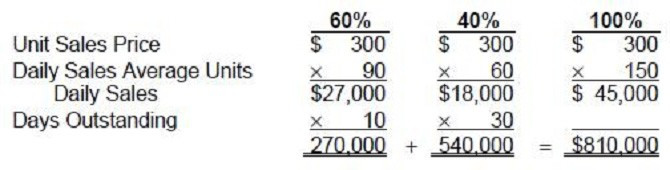 Choices "a", "b", and "d" are incorrect, per the above calculation.
Question 70
Single choice
Acorn Corp. wants to acquire the entire business of Trend Corp. Which of the following methods of business combination will best satisfy Acorn's objectives without requiring the approval of the shareholders of either corporation?
-
A
A merger of Trend into Acorn, whereby Trend shareholders receive cash or Acorn shares.
-
B
A sale of all the assets of Trend, outside the regular course of business, to Acorn, for cash.
-
C
An acquisition of all the shares of Trend through a compulsory share exchange for Acorn shares.
-
D
A cash tender offer, whereby Acorn acquires at least 90% of Trend's shares, followed by a short-form merger of Trend into Acorn.
Reveal answer details
Close answer details
Correct answerD
ExplanationChoice "d" is correct. A parent corporation owning 90% or more of a subsidiary may merge the subsidiary (short form merger) into the parent without the approval of the shareholders of either corporation or the approval of the subsidiary's board.
Choices "a", "b", and "c" all require at least one of the corporations to follow the general procedure for fundamental corporate changes (i.e., board resolution notice, approval by majority shares, and filing).
Question 71
Single choice
Generally, a corporation's articles of incorporation must include all of the following, except the:
-
A
Name of the corporation's registered agent.
-
B
Name of each incorporator.
-
C
Number of authorized shares.
-
D
Reveal answer details
Close answer details
Correct answerD
ExplanationChoice "d" is correct. A corporation's articles of incorporation need not contain any information regarding quorum requirements. Choices "a", "b", and "c" are incorrect because under the Revised Model Business Corporations Act a corporation's articles of incorporation must include: (1) The name of the corporation, (2) The name and address of the corporation's registered agent, (3) The names and addresses of each of the incorporators, and (4) The number of shares authorized to be issued.
Question 72
Single choice
An increase in the price of crude oil will have what affect on the equilibrium price and quantity of gasoline?
-
A
Price will fall and quantity will rise.
-
B
Price will rise and quantity will fall.
-
C
Price will fall and quantity will fall.
-
D
Price will rise and quantity will rise.
Reveal answer details
Close answer details
Correct answerB
ExplanationChoice "b" is correct. Crude oil is an input to the production of gasoline. When the price of an input increases, supply shifts left, causing equilibrium price to rise and equilibrium quantity to fall. Choice "a" is incorrect, since price will rise and quantity will fall.
Choice "c" is incorrect, since price will rise.
Choice "d" is incorrect, since quantity will fall.
Question 73
Single choice
Monopolistic competition is characterized by:
-
A
A relatively large group of sellers who produce differentiated products.
-
B
A relatively small group of sellers who produce differentiated products.
-
C
One or two companies producing similar products.
-
D
A relatively large group of sellers who produce a homogeneous product.
Reveal answer details
Close answer details
Correct answerA
ExplanationChoice "a" is correct. Monopolistic competition is characterized by a relatively large number of sellers who produce differentiated products. There are few barriers to entry and firms exert some influence over the price and the market. Best examples are brand name consumer products.
Choice "b" is incorrect. Relatively few sellers with differentiated products would indicate an oligopoly.
Choice "c" is incorrect. One company would be a monopoly, two an oligopoly.
Choice "d" is incorrect. A relatively large number of sellers and a standardized product indicates perfect competition.
Question 74
Single choice
Smith and James were partners in S and J Partnership. The partnership agreement stated that all profits and losses were allocated 60 percent to Smith and 40 percent to James. The partners decided to terminate and wind up the partnership.
The following was the balance sheet for S and J on the day of the windup: 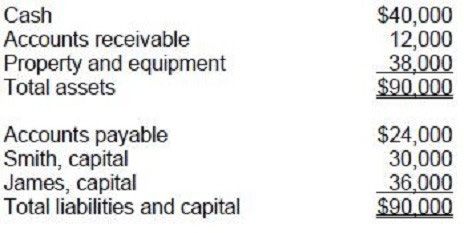 Of the total accounts receivable, $10,000 was collected and the remainder was written off as bad debt. All liabilities of S and J were paid by the partnership. The property and equipment are sold for $32,000.
Under the Uniform Partnership Act, what amount of cash was distributed to Smith?
-
A
-
B
-
C
-
D
Reveal answer details
Close answer details
Correct answerA
ExplanationChoice "a" is correct. Upon termination of the partnership creditors are paid first. After payment of creditors, each partner is deemed to have an account that is charged or credited an amount equal to the partner's contribution plus or minus the partner's share of any profits or losses.
The agreement between Smith and James was that profits and losses would be allocated 60% to Smith and 40% to James. The partnership had $82,000 in assets ($40,000 in cash, $10,000 from accounts receivable, and $32,000 from property and equipment). The partnership had $90,000 in liabilities and capital. Of the $82,000 in assets, $24,000 is paid first to creditors. This leaves a balance of $58,000. Smith contributed $30,000 in capital and James contributed $36,000 in capital. With $66,000 owed in capital and only $58,000 available, there is a deficit of $8,000. By agreement, Smith is responsible for 60% of the $8,000 deficit or $4,800. Smith would be credited an amount equal to his capital ($30,000) minus his share of the loss ($4,800) or $25,200. Only choice "a" reflects this amount.
Choices "b", "c", and "d" are incorrect, per the above calculation.
Question 75
Single choice
What is the effect when a foreign competitor's currency becomes weaker compared to the U.S.
dollar?
-
A
The foreign company will have an advantage in the U.S. market.
-
B
The foreign company will be disadvantaged in the U.S. market.
-
C
The fluctuation in the foreign currency's exchange rate has no effect on the U.S. company's sales or cost of goods sold.
-
D
It is better for the U.S. company when the value of the U.S. dollar strengthens.
Reveal answer details
Close answer details
Correct answerA
ExplanationChoice "a" is correct. As a foreign competitor's currency becomes weaker compared to the U.S. dollar, the product becomes less expensive in U.S. dollars. The less expensive product will have the advantage in the U.S. market. Choice "b" is incorrect. As a foreign competitor's currency becomes weaker compared to the U.S. dollar, the product becomes less expensive in U.S. dollars. The less expensive product will have the advantage in the U.S. market, not a disadvantage.
Choice "c" is incorrect. Foreign currency exchange rates impact both sales and possibly cost of goods sold of a competing domestic company. Sales within U.S. markets will deteriorate as the currency of foreign competitors deteriorates and makes the domestic company's goods more expensive. As a foreign competitor's currency appreciates, sales within U.S. markets by a domestic company should also increase as goods manufactured in the U.S. become less expensive. Cost of goods sold may fluctuate if foreign suppliers are used.
Choice "d" is incorrect. It is better for a U.S. company when the value of the U.S. dollar weakens, not strengthens. A weak U.S. dollar makes domestic goods relatively less expensive that imported goods.
Question 76
Single choice
Considering the SCOR Model of supply chain operations, which of the following key management processes does managing accounts receivable and collections from customers fall into?
-
A
-
B
-
C
-
D
Reveal answer details
Close answer details
Correct answerD
ExplanationChoice "d" is correct. The "deliver" process encompasses all the activities of getting the finished product into the hands of the ultimate consumers to meet their planned demand. Managing accounts receivable and collections from customers falls into the "deliver" process.
Choices "a", "b", and "c" are incorrect, per the above Explanation.
Question 77
Single choice
The working capital financing policy that subjects the firm to the greatest risk of being unable to meet the firm's maturing obligations is the policy that finances:
-
A
Fluctuating current assets with long-term debt.
-
B
Permanent current assets with long-term debt.
-
C
Permanent current assets with short-term debt.
-
D
Fluctuating current assets with short-term debt.
Reveal answer details
Close answer details
Correct answerC
ExplanationChoice "c" is correct. The working capital financing policy that finances permanent current assets with short-term debt subjects the firm to the greatest risk of being unable to meet the firm's maturing obligations. Choices "a" and "b" are incorrect because the use of long-term debt financing produces the smallest risk of being unable to meet maturing obligations. Choice "d" is incorrect because, although financing fluctuating current assets with short-term debt exposes the firm to some risk, it is not the greatest or the smallest.
Question 78
Single choice
Under the Revised Uniform Partnership Act, which of the following have the right to inspect partnership books and records?
-
A
-
B
-
C
-
D
Transferees of partners' interests.
Reveal answer details
Close answer details
Correct answerC
ExplanationChoice "c" is correct. Every partner in a partnership - whether active or inactive - has the right to inspect the partnership's books and records. Choice "a" is incorrect. Only a partner has a right to inspect the partnership's books and records; an employee of the partnership has no such right. Choice "b" is incorrect.
Only current partners have a right to inspect the partnership's books and records; former partners do not have such a right. Choice "d" is incorrect. Only partners have a right to inspect a partnership's books and records. A transferee of a partner's interest has only the partner's right to distributions.
Question 79
Single choice
Which one of the following statements is most correct if a seller extends credit to a purchaser for a period of time longer than the purchaser's operating cycle? The seller:
-
A
Will have a lower level of accounts receivable than those companies whose credit period is shorter than the purchaser's operating cycle.
-
B
Is, in effect, financing more than just the purchaser's inventory needs.
-
C
Is, in effect, financing the purchaser's long-term assets.
-
D
Has no need for a stated discount rate or credit period.
Reveal answer details
Close answer details
Correct answerB
ExplanationChoice "b" is correct. If a seller extends credit to a purchaser for a period of time longer than the purchaser's operating cycle, the seller is, in effect, financing more than just the purchaser's inventory needs. Choice "a" is incorrect. Accounts receivable would be higher than those companies whose credit period is shorter than the purchaser's operating cycle.
Choice "c" is incorrect. Seller is financing the purchaser, but not necessarily long-term assets.
Choice "d" is incorrect. It is appropriate for the seller to have stated policies for discount rate and credit periods.
Question 80
Single choice
Which of the following statements describes the same characteristic for both an S corporation and a C corporation?
-
A
Both corporations can have more than 100 shareholders.
-
B
Both corporations have the disadvantage of double taxation.
-
C
Shareholders can contribute property into a corporation without being taxed.
-
D
Shareholders can be either citizens of the United States or foreign countries.
Reveal answer details
Close answer details
Correct answerC
ExplanationChoice "c" is correct. Either entity's shareholders may contribute property to the corporations without being taxed and may contribute such property as an exchange for stock as appraised by the directors. Choice "a" is incorrect. An S corporation may not have more than 100 shareholders, although a C corporation may have as many shareholders as desired.
Choice "b" is incorrect. Only the C corporation is subject to the double taxation disadvantage. Choice "d" is incorrect. Only an S corporation is prohibited from having foreign country shareholders.
|