Preview real exam questions, verified answers and available explanations before choosing a study plan.
Question 1
Drag & drop
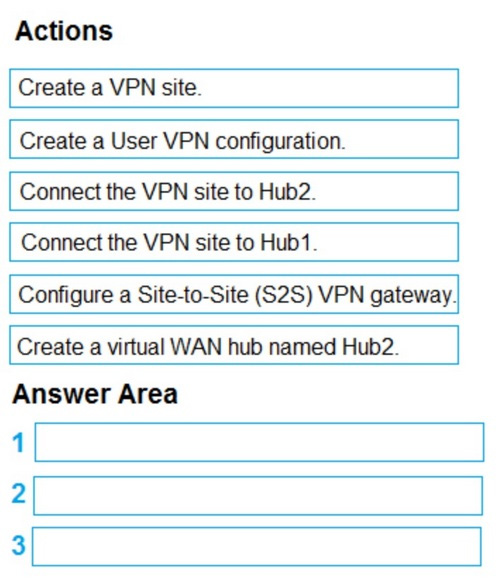
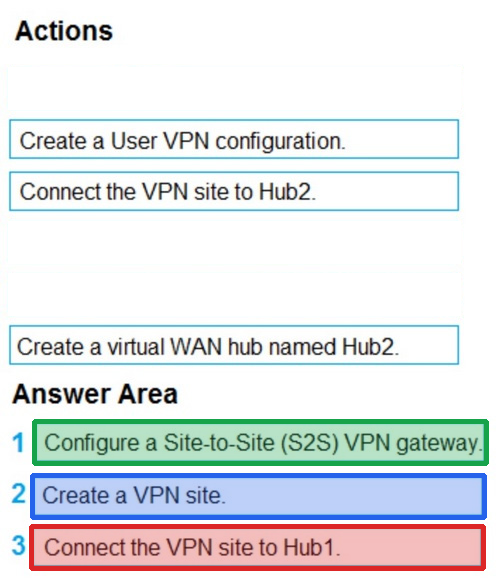
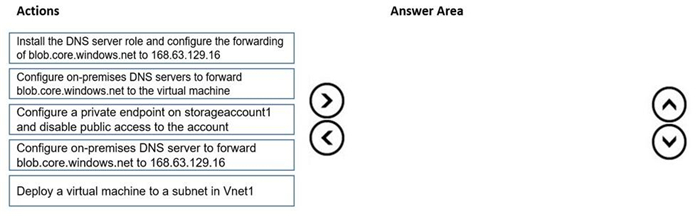
DRAG DROP
You have an on-premises network.
You have an Azure subscription that contains a virtual network named VNet1. VNet1 is connected to an Azure Virtual WAN hub named Hub1. You need to enable connectivity between the on-premises network and VNet1 by using Hub1.
Which three actions should you perform in sequence? To answer, move the appropriate actions from the list of actions to the answer area and arrange them in the correct order.
Reveal answer detailsClose answer details
Question 2
Single choice
You have an Azure subscription that contains an Azure Front Door Premium profile named AFD1 and an Azure Web Application Firewall (WAF) policy named WAF1. AFD1 is associated with WAF1.
You need to configure a rate limit for incoming requests to AFD1.
Solution: You modify the policy settings of WAF1.
Does this meet the goal?
A
Yes
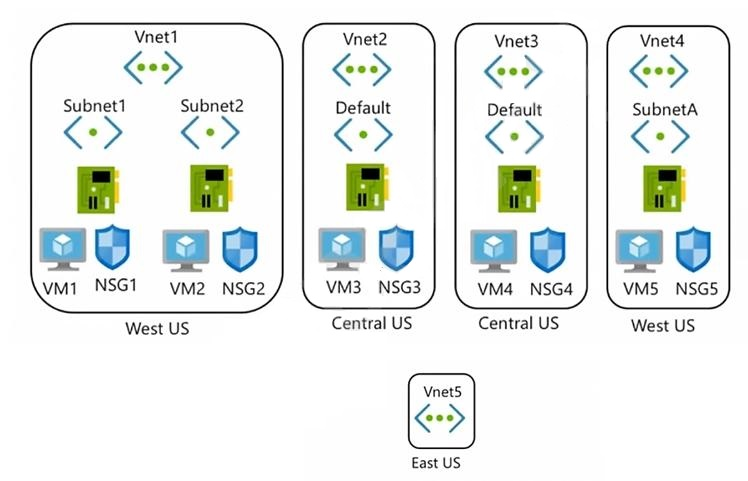
B
No
Reveal answer detailsClose answer details
Correct answerB
Explanation
WAF policy settings control policy-wide behavior such as its operating state and mode; they do not define a per-client request threshold. Rate limiting is implemented through a custom rule that evaluates request rates and applies an action when the threshold is exceeded. Modifying only the policy settings therefore does not meet the goal.
Question 3
Multiple choice
You have an Azure virtual network named Vnet1.
You need to ensure that the virtual machines in Vnet1 can access only the Azure SQL resources in the East US Azure region. The virtual machines must be prevented from accessing any Azure Storage resources.
Which two outbound network security group (NSG) rules should you create? Each correct answer presents part of the solution.
NOTE: Each correct selection is worth one point.
A
a deny rule that has a source of VirtualNetwork and a destination of Sql
B
an allow rule that has the IP address range of Vnet1 as the source and destination of Sql.EastUS
C
a deny rule that has a source of VirtualNetwork and a destination of 168.63.129.0/24
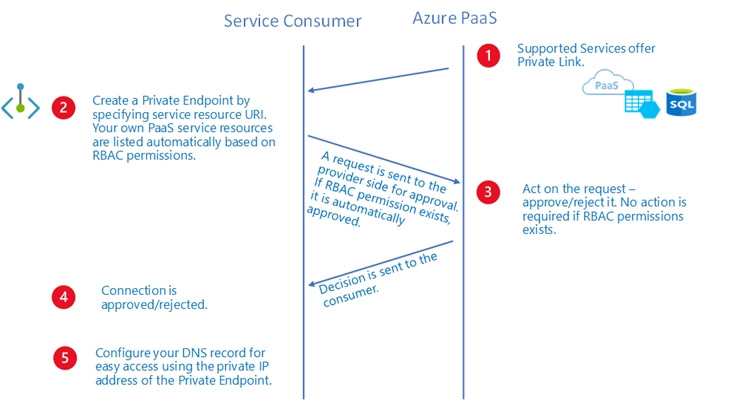
D
a deny rule that has the IP address range of Vnet1 as the source and destination of Storage
Reveal answer detailsClose answer details
Correct answersB, D
Explanation
The allow rule uses Vnet1's address range as the source and Sql.EastUS as the destination, permitting access specifically to Azure SQL in East US. The separate deny rule uses the same source scope and Storage as the destination, preventing access to Azure Storage. Rule priorities must place these explicit controls appropriately so the required SQL traffic is allowed and Storage traffic is denied.
Question 4
Single choice
You have an Azure Virtual Desktop deployment that has 500 session hosts.
All outbound traffic to the internet uses a NAT gateway.
Some users report that they cannot access internet resources during peak hours.
In Azure Monitor, you discover many failed SNAT connections.
You need to increase the available SNAT connections.
What should you do?
A
Bind the NAT gateway to another subnet.
B
Add a public IP address.
C
Deploy Azure Standard Load Balancer that has outbound rules.
Reveal answer detailsClose answer details
Correct answerB
Explanation
A NAT gateway allocates its available SNAT connections from the ports associated with its public IP resources. Adding another public IP address expands that SNAT port pool, allowing more simultaneous outbound flows during peak usage. Binding the gateway to another subnet does not increase the port capacity available to the existing session hosts.
Question 5
Hotspot
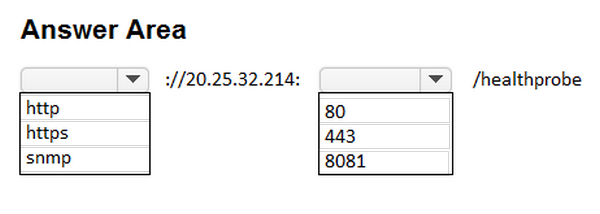
HOTSPOT
You have an Azure subscription that contains a virtual network gateway named VNetGwy1. VNetGwy1 has a public IP address of 20.25.32.214.
You need to query the health probe of VNetGwy1,
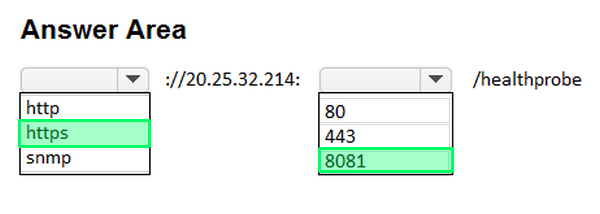
How should you complete the URI? To answer, select the appropriate options in the answer area.
NOTE: Each correct selection is worth one point.
Reveal answer detailsClose answer details
Explanation
Box 1: https: Verify the Azure gateway health probe Open health probe by browsing to the following URL:
https://<YourVirtualNetworkGatewayIP>:8081/healthprobe For Active/Acive gateways use the following to check the second public IP: https://<YourVirtualNetworkGatewayIP2>:8083/healthprobe
You need to monitor the latency between your on-premises network and the Azure virtual machines.
What should you use?
A
Service Map
B
Connection troubleshoot
C
Network Performance Monitor
D
Effective routes
Reveal answer detailsClose answer details
Correct answerC
Explanation
Network Performance Monitor measures network performance across hybrid paths, including the connection between an on-premises network and Azure virtual machines. It can track latency over time instead of performing only a single connection test. Effective routes describe routing decisions, while Service Map describes dependencies rather than the end-to-end network latency requirement.
Question 7
Single choice
Your company has offices in New York and Amsterdam. The company has an Azure subscription. Both offices connect to Azure by using a Site-to-Site VPN connection.
The office in Amsterdam uses resources in the North Europe Azure region. The office in New York uses resources in the East US Azure region.
You need to implement ExpressRoute circuits to connect each office to the nearest Azure region. Once the ExpressRoute circuits are connected, the on-premises computers in the Amsterdam office must be able to connect to the on-premises servers in the New York office by using the ExpressRoute circuits.
Which ExpressRoute option should you use?
A
ExpressRoute FastPath
B
ExpressRoute Global Reach
C
ExpressRoute Direct
D
ExpressRoute Local
Reveal answer detailsClose answer details
Correct answerB
Explanation
Each office will have its own ExpressRoute circuit to a nearby Azure region, but ordinary circuit connectivity does not create a path between the two on-premises sites. ExpressRoute Global Reach connects the private peering of the circuits, allowing the Amsterdam and New York on-premises networks to communicate through Microsoft's network. The other options do not join the sites.
Question 8
Drag & drop
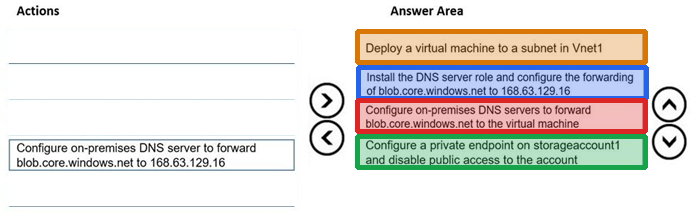
DRAG DROP
You have an Azure virtual network named Vnet1 that connects to an on-premises network.
You have an Azure Storage account named storageaccount1 that contains blob storage.
You need to configure a private endpoint for the blob storage. The solution must meet the following requirements:
Ensure that all on-premises users can access storageaccount1 through the private endpoint. Prevent access to storageaccount1 from being interrupted.
Which four actions should you perform in sequence? To answer, move the appropriate actions from the list of actions to the answer area and arrange them in the correct order.
Reveal answer detailsClose answer details
Question 9
Single choice
You have an Azure subscription that contains an instance of Azure Firewall Standard named AzFW1.
You plan to enable the following:
1. TLS inspection 2. Threat intelligence 3. A network intrusion detection and prevention system (IDPS)
What can you enable by using AzFW1?
A
TLS inspection only
B
threat intelligence only
C
TLS inspection and the IDPS only
D
threat intelligence and the IDPS only
E
TLS inspection, threat intelligence, and the IDPS
Reveal answer detailsClose answer details
Correct answerB
Explanation
Azure Firewall Standard supports threat intelligence filtering, so AzFW1 can use that feature without changing tiers. TLS inspection and the network intrusion detection and prevention system are Premium capabilities. Because AzFW1 is Standard, those two features cannot be enabled on the existing instance, leaving threat intelligence as the only listed supported capability.
Question 10
Single choice
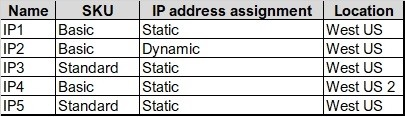
You have an Azure subscription that contains the public IPv4 addresses shown in the following table.
You plan to create a load balancer named LB1 that will have the following settings:
Name: LB1 Location: West US Type: Public SKU: Standard
Which public IPv4 addresses can be used by LB1?
A
IP1, IP3, IP4, and IP5 only
B
IP3 only
C
IP1 and IP3 only
D
IP2 only
E
IP1, IP2, IP3, IP4, and IP5
F
IP3 and IP5 only
Reveal answer detailsClose answer details
Correct answerF
Explanation
A Standard public load balancer must use a Standard SKU public IP address in the load balancer's region, and that address must use static assignment. IP3 and IP5 satisfy all three conditions: both are Standard, static, and located in West US. IP1 is Basic, IP2 is Basic and dynamic, and IP4 is both Basic and in West US 2.
Question 11
Single choice
You have an Azure subscription that contains the resources shown in the following table.
You need to configure a solution to meet the following requirements;
1. App1 must be assigned a private endpoint 2. Access to App1 from the internet must be routed via FD1.
What should you configure on FD1?
A
a rule that has the route configuration override action
B
a route that redirects traffic
C
an origin that enables the Azure Private Link service
D
a security policy that redirects traffic
Reveal answer detailsClose answer details
Correct answerC
Explanation
FD1 must connect privately to App1 while remaining the internet-facing entry point. Configuring an origin with Azure Private Link enabled makes Front Door send origin traffic to App1 through its private connectivity path. Routes select and forward requests to that origin, but a redirect or security policy would not establish the private origin connection.
Question 12
Single choice
You have an on-premises network named Site1.
You have an Azure subscription that contains a storage account named storage1 and a virtual network named VNet1.
VNet1 contains a subnet named Subnet1. A private endpoint for storage1 is connected to Subnet1 Site1 is connected to VNet1 by using a Site-to-Site (S2S) VPN.
You need to control access to storage1 from Site1 by using network security groups (NSGs).
What should you do first?
A
Associate a route table with Subnet1.
B
Associate a NAT gateway with Subnet1.
C
Configure a network policy for private endpoints on Subnet1.
D
Create a subnet delegation on Subnet1.
Reveal answer detailsClose answer details
Correct answerC
Explanation
NSG processing for traffic addressed to a private endpoint requires private endpoint network policies on its subnet. Configuring that policy on Subnet1 allows NSG rules to control connections arriving from Site1 over the VPN. A route table, NAT gateway, or subnet delegation does not first enable NSG enforcement for the endpoint.
Question 13
Hotspot
HOTSPOT
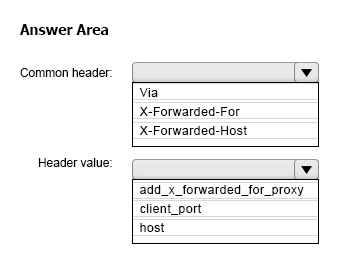
You have an Azure application gateway.
You need to create a rewrite rule that will remove the origin port from the HTTP header of incoming requests that are being forwarded to the backend pool.
How should you configure each setting? To answer, select the appropriate options in the answer area.
NOTE: Each correct selection is worth one point.
Reveal answer detailsClose answer details
Explanation
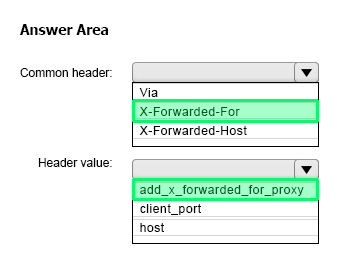
The X-Forwarded-For client request header field with the client_ip variable (see explanation later in this table) appended to it in the format IP1, IP2, IP3, and so on. If the X-Forwarded-For field isn't in the client request header, the add_x_forwarded_for_proxy variable is equal to the $client_ip variable. This variable is particularly useful when you want to rewrite the X-Forwarded-For header set by Application Gateway so that the header contains only the IP address without the port information.
Azure gateway resources require a dedicated subnet with the exact name GatewaySubnet. Create that subnet inside VNET2 and assign an address range large enough for both the VPN gateway and the ExpressRoute gateway; a /27 or larger range provides the planned gateway capacity. Preparing this reserved subnet is the virtual-network change required before the two gateway resources can be deployed.
Question 15
Single choice
You have 10 Azure App Service instances. Each instance hosts the same web app. Each instance is in a different Azure region.
You need to configure Azure Traffic Manager to direct users to the instance that has the lowest latency.
Which routing method should you use?
A
geographic
B
weighted
C
performance
D
priority
Reveal answer detailsClose answer details
Correct answerC
Explanation
The performance routing method directs a DNS query to the available endpoint expected to provide the lowest network latency for that user. This matches the requirement to choose among identical App Service deployments in ten regions by latency. Geographic routing follows location mappings, weighted routing follows configured proportions, and priority routing implements ordered failover.
Question 16
Single choice
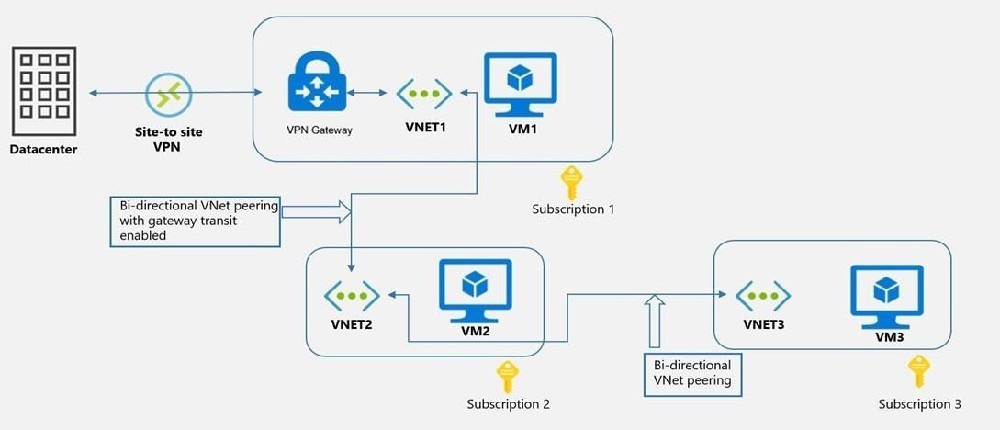
You have an Azure environment as shown below.
You need to find to which environments/virtual machines that VM2 can communicate?
A
VM1 Only
B
VM1 and VM3 Only
C
The on-premise datacenter and VM1 only
D
The on-premise datacenter, VM1 and VM3 only
Reveal answer detailsClose answer details
Correct answerD
Explanation
VM2 has a direct peering path to VM1 through the bidirectional VNet1-VNet2 peering. Gateway transit on that peering lets VNet2 use VNet1's VPN gateway, extending VM2's reach to the on-premise datacenter. VM2 also has a separate bidirectional peering between VNet2 and VNet3, which provides a direct path to VM3 without relying on transitive peering.
Question 17
Single choice
Your company has two on-premises sites in New York and Los Angeles.
Your company has Azure virtual networks in the East US Azure region and the West US Azure region.
Each on-premises site has Azure ExpressRoute circuits to both regions.
You need to recommend a solution that meets the following requirements:
Outbound traffic to the Internet from workloads hosted on the virtual networks must be routed through the closest available on-premises site.
If an on-premises site fails, traffic from the workloads on the virtual networks to the Internet must reroute automatically to the other site.
What should you include in the recommendation for automatic routing configuration following a failover?
A
Host Standby Routing Protocol (HSRP)
B
Border Gateway Protocol (BGP)
C
Virtual Router Redundancy Protocol (VRRP)
Reveal answer detailsClose answer details
Correct answerB
Explanation
Border Gateway Protocol exchanges reachability information over the ExpressRoute connections and can prefer the path to the closest on-premises site. If that site fails, its routes are withdrawn and BGP selects the remaining advertised path through the other site. HSRP and VRRP provide local first-hop gateway redundancy rather than routing between these sites and Azure regions.
Question 18
Hotspot
HOTSPOT
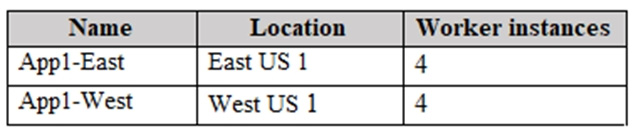
You have an Azure subscription that contains an app named App1. App1 is deployed to the Azure App Service apps shown in the following table.
You need to publish App1 by using Azure Front Door. The solution must ensure that all the requests to App1 are load balanced between all the available worker instances.
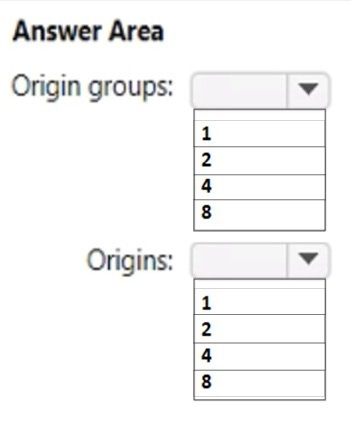
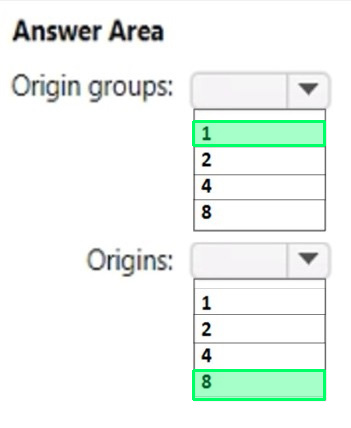
What is the minimum number of origin groups and origins that you should configure? To answer, select the appropriate options in the answer area.
NOTE: Each correct selection is worth one point.
Reveal answer detailsClose answer details
Explanation
Box 1: 1 How many origins and origin groups should I create? An origin group represents a set of origins that are functionally able to serve the same kinds of requests. You should use a separate origin group for each distinct application or workload.
For example, suppose you host an application on Azure App Service. The way that you configure Front Door depends on how many application instances you deploy:
* Multi-region active/passive deployment: Create a single origin group. Within that origin group, create an origin for each of the App Service apps. Configure each origin's priority to ensure that the primary application has a higher priority than the secondary application.
* Multi-region active/active deployment: Create a single origin group. Within that origin group, create an origin for each of the App Service apps. Configure each origin's priority to be the same. Configure each origin's weight to set the proportion of requests that should go to that origin.
* Single-region deployment: Create a single origin group.
Box 2: 8 Within an origin group, create an origin for each distinct server or service instance that can serve requests.
Note: Origin An origin refers to the application deployment that Azure Front Door retrieves contents from when caching isn't enabled or when a cache gets missed. Azure Front Door supports origins hosted in Azure and applications hosted in your on-premises datacenter or with another cloud provider. An origin shouldn't be confused with your database tier or storage tier. The origin should be viewed as the endpoint for your application backend.
Origin group An origin group in Azure Front Door refers to a set of origins that receives similar traffic for their application. You can define the origin group as a logical grouping of your application instances across the world that receives the same traffic and responds with an expected behavior. These origins can be deployed across different regions or within the same region. All origins can be deployed in an Active/Active or Active/Passive configuration.
An origin group defines how origins get evaluated by health probes. It also defines the load balancing method between them.
You have an Azure subscription. The subscription contains a locally-redundant storage 1LRS) account named stoiage1 that is deployed to the US East Azure region and has a Microsoft Storage service endpoint.
You set Redundancy for storage 1 to Read-access geo-redundant storage (RA-GRS)
You need to ensure that the contents of storage1 will be accessible by using a service endpoint in a paired region.
The solution must minimize administrative effort What should you do first?
A
Create an object replication rule for storage1.
B
From storage1. select Secure transfer required.
C
Create a service endpoint policy.
D
Delete the existing service endpoint.
Reveal answer detailsClose answer details
Correct answerD
Explanation
The existing Microsoft.Storage service endpoint is regional. Access through a service endpoint to the read-access geo-redundant secondary requires the global storage endpoint configuration, and the regional and global storage endpoint types cannot remain configured together on the subnet. Delete the existing endpoint first, then configure the required global endpoint.
Question 20
Hotspot
HOTSPOT
You have an Azure subscription that contains 200 virtual machines
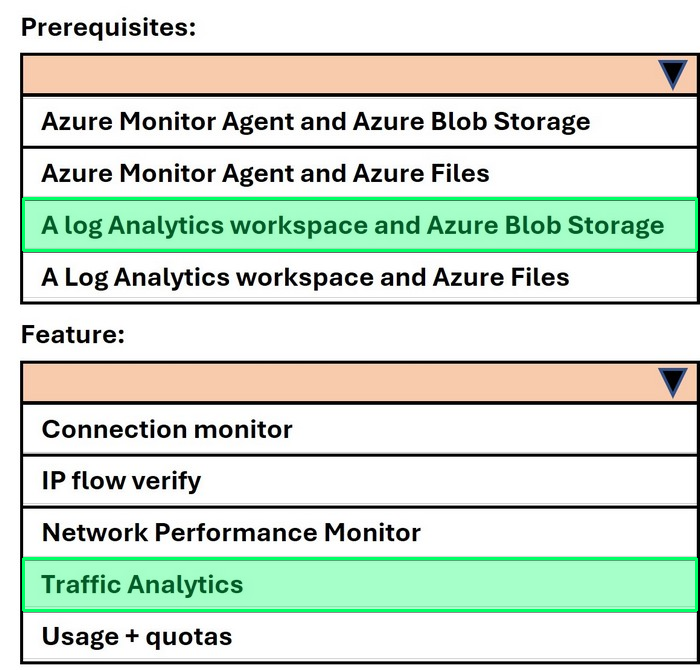
You need to use Azure Network Watcher to identify which virtual machines generate the most network traffic. The solution must minimize administrative effort.
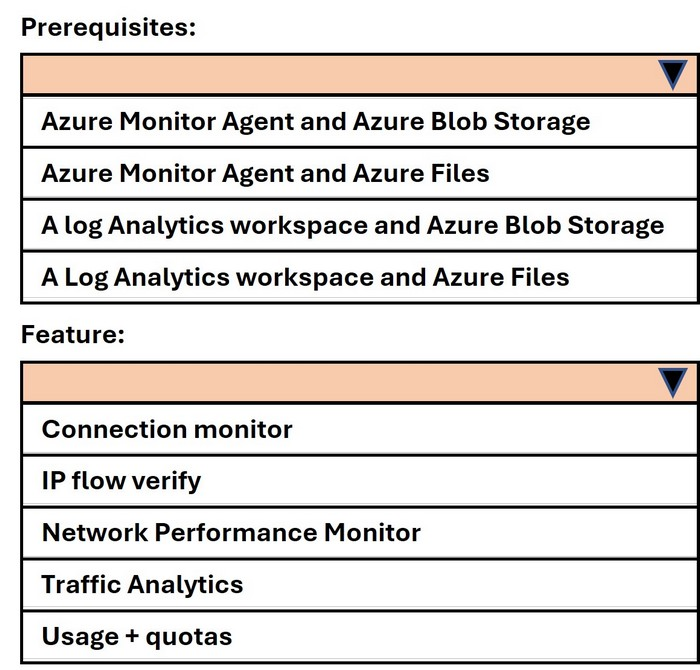
Which prerequisites should you deploy for Network Watcher, and which Network Watcher feature should you use to identify the virtual machines? To answer, select the appropriate options in the answer area.
NOTE: Each correct selection is worth one point.
Reveal answer detailsClose answer details
Question 21
Single choice
You are planning an Azure Point-to-Site (P2S) VPN that will use OpenVPN.
Users will authenticate by using an on-premises Active Directory domain.
Which additional service should you deploy to support the VPN authentication?
A
an Azure key vault
B
a RADIUS server
C
a certification authority
D
Azure Active Directory (Azure AD) Application Proxy
Reveal answer detailsClose answer details
Correct answerB
Explanation
A RADIUS server can validate VPN credentials against the on-premises Active Directory domain and return the authentication result to the Point-to-Site VPN gateway. This provides the required bridge between OpenVPN authentication and the existing domain identities. A certification authority would support certificate authentication, not authentication with Active Directory credentials.
Question 22
Single choice
Note: This question is part ofa series of questions that present the same scenario. Each question in the series contains a unique solution that might meet the stated goals. Some question sets might have more than one correct solution, while others might not have a correct solution.
After you answer a question in this section, you will NOT be able to return to it. As a result, these questions will not appear in the review screen. You have two Azure virtual networks named Vnet1 and Vnet2.
You have a Windows 10 device named Client1 that connects to Vnet1 by using a Point-to-Site (P2S) IKEv2 VPN.
You implement virtual network peering between Vnet1 and Vnet2. Vnet1 allows gateway transit. Vnet2 can use the remote gateway.
You discover that Client1 cannot communicate with Vnet2.
You need to ensure that Client1 can communicate with Vnet2.
Solution: You enable BGP on the gateway of Vnet1.
Does this meet the goal?
A
Yes
B
No
Reveal answer detailsClose answer details
Correct answerB
Explanation
Gateway transit is already configured for the peering, but Client1 must also have a route for Vnet2 in its Point-to-Site configuration. Enabling BGP on the Vnet1 gateway does not update the routes in the configuration already installed on the client. Consequently, this change alone does not enable Client1 to reach Vnet2.
Question 23
Single choice
You have an Azure environment.
You are planning to deploy an Azure Firewall in a subscription named Subscription1.
What is the name of the subnet that must be created?
A
Default
B
DMZsubnet
C
AzureFirewallSubnet
D
FirewallSubnet
Reveal answer detailsClose answer details
Correct answerC
Explanation
Azure Firewall must be deployed in a dedicated subnet whose reserved name is exactly AzureFirewallSubnet. The service uses that subnet for its firewall instances and network interfaces. Generic names such as Default, DMZsubnet, or FirewallSubnet do not satisfy the naming requirement for an Azure Firewall deployment.
Question 24
Single choice
You have an on-premises datacenter named DC1 that contains two routers.
You have an Azure subscription. The subscription contains a virtual network named VNet1 and a zone-redundant ExpressRoute virtual network gateway named GW1 that uses the ErGw3Az SKU. GW1 is attached to VNet1.
DC1 is connected to VNet1 by using an ExpressRoute Standard circuit named Circuit1. The DC1 routers are configured as endpoints for Circuit1. Circuit1 traffic traverses two physical links.
During a link outage, the connection takes three minutes to fail over.
You need to ensure that failovers between the links take less than one second.
What should you do?
A
For Circuit1, select FastPath.
B
On the routers, configure Bidirectional Forwarding Detection (BFD).
C
For GW1, change SKU to UltraPerformance.
D
For GW1, set Active-active mode to Enabled.
Reveal answer detailsClose answer details
Correct answerB
Explanation
Bidirectional Forwarding Detection runs between the routers to detect forwarding-path failures much faster than normal routing-protocol timeout intervals. Configuring BFD on the DC1 routers enables rapid withdrawal and use of the surviving ExpressRoute link, meeting the subsecond failover requirement. FastPath changes data forwarding, not link-failure detection.
Question 25
Single choice
You have an Azure subscription that contains the resources shown in the following table.
You need to ensure that VM1 and VM2 can connect only to storage1. The solution must meet the following requirements:
1. Prevent VM1 and VM2 from accessing any other storage accounts. 2. Ensure that storage1 is accessible from the internet.
What should you use?
A
a network security group (NSG)
B
a private endpoint
C
a private link
D
a service endpoint policy
Reveal answer detailsClose answer details
Correct answerD
Explanation
A service endpoint policy can restrict traffic from Subnet1 to specifically authorized Azure Storage resources, so VM1 and VM2 can be limited to storage1 instead of reaching every storage account. The storage account can retain its public endpoint and remain internet-accessible. A private endpoint would instead introduce private access and would not satisfy that public-access condition by itself.
Case study
Case Study 1
Overview
Litware, Inc. is a financial company that has a main datacenter in Boston and 20 branch offices across the United States. Users have Android, iOS, and Windows 10 devices.
Existing Environment
Hybrid Environment
The on-premises network contains an Active Directory forest named litwareinc.com that syncs to an Azure Active Directory (Azure AD) tenant named litwareinc.com by using Azure AD Connect.
All offices connect to a virtual network named Vnet1 by using a Site-to-Site VPN connection.
Azure Environment
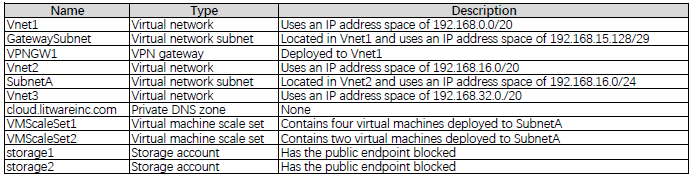
Litware has an Azure subscription named Sub1 that is linked to the litwareinc.com Azure AD tenant. Sub1 contains resources in the East US Azure region as shown in the following table.
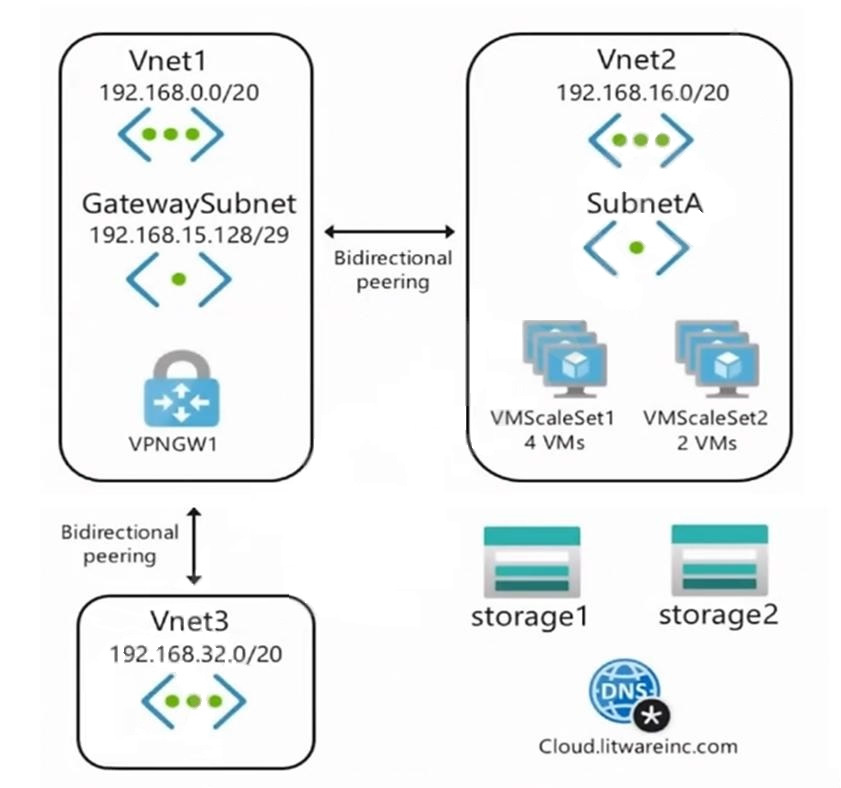
A diagram of the resource in the East US Azure region is shown in the Network Diagram exhibit.
There is bidirectional peering between Vnet1 and Vnet2. There is bidirectional peering between Vnet1 and Vnet3. Currently, Vnet2 and Vnet3 cannot communicate directly.
Azure Environment Diagram
Requirements
Business Requirements
Litware wants to minimize costs whenever possible, as long as all other requirements are met.
Virtual Networking Requirements
Litware identifies the following virtual networking requirements:
1. Direct the default route of 0.0.0.0/0 on Vnet2 and Vnet3 to the Boston datacenter over an ExpressRoute circuit. 2. Ensure that the records in the cloud.litwareinc.com can be resolved from the on-premises locations. 3. Automatically register the DNS names of Azure virtual machines to the cloud.litwareinc.com zone. 4. Minimize the size of the subnets allocated to platform-managed services. 5. Allow traffic from VMScaleSet1 to VMScaleSet2 on the TCP port 443 only.
Hybrid Networking Requirements
Litware identifies the following hybrid networking requirements:
1. Users must be able to connect to Vnet1 by using a Point-to-Site (P2S) VPN when working remotely. Connections must be authenticated by Azure AD. 2. Latency of the traffic between the Boston datacenter and all the virtual networks must be minimized. 3. The Boston datacenter must connect to the Azure virtual networks by using an ExpressRoute FastPath connection. 4. Traffic between Vnet2 and Vnet3 must be routed through Vnet1.
PaaS Networking Requirements
Litware identifies the following networking requirements for platform as a service (PaaS):
1. The storage1 account must be accessible from all on-premises locations without exposing the public endpoint of storage1. 2. The storage2 account must be accessible from Vnet2 and Vnet3 without exposing the public endpoint of storage2.
Question 26
Testlet 1Hotspot
HOTSPOT
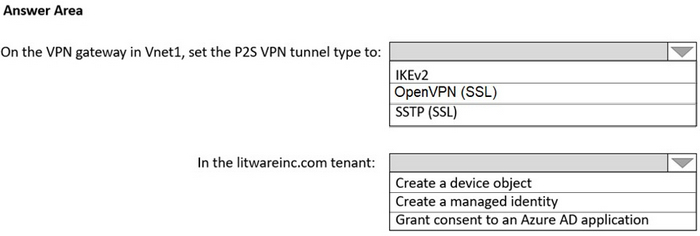
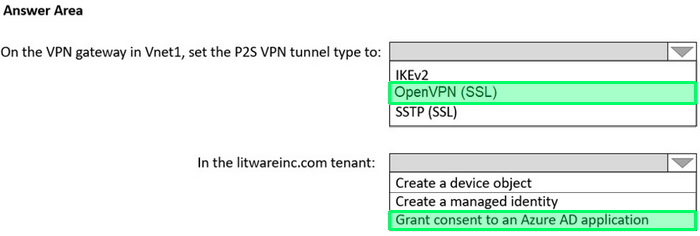
You need to implement a P2S VPN for the users in the branch office. The solution must meet the hybrid networking requirements.
What should you do? To answer, select the appropriate options in the answer area.
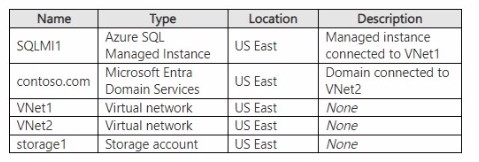
You have an Azure subscription that contains the resources shown in the following table.
You need to ensure that network traffic is routed over the Azure backbone network for the following scenarios:
1. Traffic from SQIMI1 to storage1 2. Traffic from domain joined servers on VNet2 to storage1
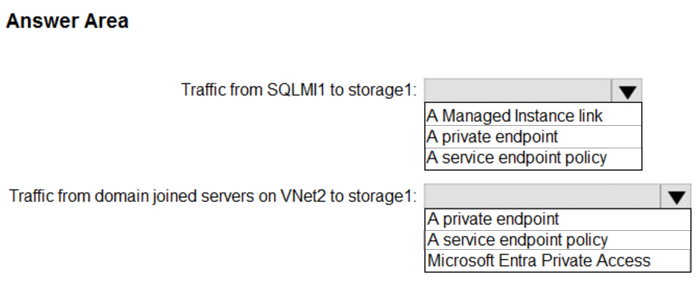
The solution must minimize costs.
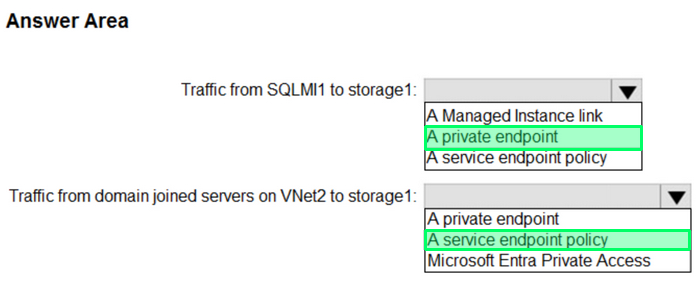
What should you configure for each scenario? To answer, select the appropriate options in the answer area.
NOTE: Each correct selection is worth one point.
Reveal answer detailsClose answer details
Explanation
Box 1: A private endpoint Traffic from SQLMIT to storage1
Private endpoints A private endpoint is an optional fixed IP address in another virtual network that conducts traffic to your SQL managed instance. One Azure SQL Managed Instance can have multiple private endpoints in multiple virtual networks. Private endpoints allow TDS traffic only to reach SQL Managed Instance on port 1433 and can't be used for integration scenarios, such as failover groups, Managed Instance link, and other similar technologies.
When connecting to a private endpoint, always use the domain name since connecting to Azure SQL Managed Instance via its IP address isn't supported yet.
Private Link is Azure technology that makes Azure SQL Managed Instance available in a virtual network of your choice. A network administrator can establish a private endpoint to Azure SQL Managed Instance in their virtual network, while the SQL administrator chooses to accept or reject the endpoint before it becomes active. Private endpoints establish secure, isolated connectivity between a service and multiple virtual networks without exposing your service's entire network infrastructure.
Box 2: A service endpoint policy Traffic from domain joined servers on VNet2 to storage
Virtual network service endpoint policies for Azure Storage Virtual Network service endpoint policies allow you to filter egress virtual network traffic to Azure Storage accounts over service endpoint, and allow data exfiltration to only specific Azure Storage accounts. Endpoint policies provide granular access control for virtual network traffic to Azure Storage when connecting over service endpoint.
Incorrect: * Microsoft Entra Private Access Microsoft Entra Private Access unlocks the ability to specify the fully qualified domain names (FQDNs) and IP addresses that you consider private or internal, so you can manage how your organization accesses them. With Private Access, you can modernize how your organization's users access private apps and resources. Remote workers don't need to use a VPN to access these resources if they have the Global Secure Access Client installed. The client quietly and seamlessly connects them to the resources they need.
Private Access provides two ways to configure the private resources that you want to tunnel through the service. You can configure Quick Access, which is the primary group of FQDNs and IP addresses that you want to secure. You can also configure a Global Secure Access app for per-app access, which allows you to specify a subset of private resources that you want to secure. The Global Secure Access app provides a granular approach to securing your private resources.
1. Minimize the IP address space required to deploy platform-managed resources to the virtual networks. 2. From SpokeVNet, resolve name resolution requests for the azure.proseware.com namespace and the corp.proseware.com namespace by using PRDNS1. 3. Whenever possible, minimize administrative effort.
Question 28
Testlet 4Single choice
You need to configure APPGW1 to support end-to-end encryption. The solution must meet the security requirements.
What should you do?
A
From the SSL settings, upload a TLS client certificate that is issued by the internal root CA and includes the full certificate chain.
B
From the Backend settings, upload a wildcard TLS certificate that has a private key issued by the internal root CA.
C
From the Backend settings, upload the internal root CA certificate.
D
From the SSL settings, upload a TLS client certificate that is issued by the internal root CA.
Reveal answer detailsClose answer details
Correct answerC
Explanation
For end-to-end encryption, APPGW1 must establish TLS to the backend and validate the certificate presented by that backend. Uploading the internal root CA certificate in Backend settings establishes the required trust for certificates issued by that CA. A client certificate belongs to client authentication, while uploading a wildcard certificate with its private key does not configure trust in the backend's certificate chain.
Question 29
Single choice
You have an Azure subscription that contains the following resources:
A virtual network named Vnet1
A subnet named Subnet1 in Vnet1
A virtual machine named VM1 that connects to Subnet1
Three storage accounts named storage1, storage2, and storage3
You need to ensure that VM1 can access storage1. VM1 must be prevented from accessing any other storage accounts.
To achieve the requirement, you configure the firewall on storage1 to only accept connections from Vnet1.
Did you achieve the requirement?
A
Yes
B
No
Reveal answer detailsClose answer details
Correct answerB
Explanation
Restricting the firewall on storage1 controls which networks may connect inbound to storage1. It does not stop VM1 from initiating connections to storage2 or storage3, because their firewall settings and the subnet's outbound policy remain unchanged. The solution therefore permits storage1 access but fails to enforce the required prohibition against every other storage account.
Question 30
Hotspot
HOTSPOT
Your on-premises network contains a VPN device.
You have an Azure subscription that contains a virtual network and a virtual network gateway.
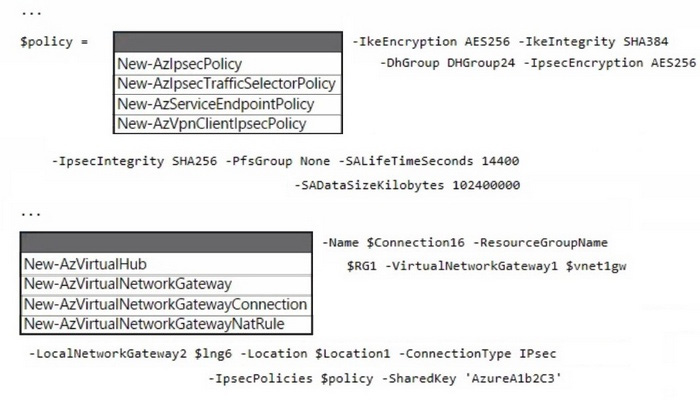
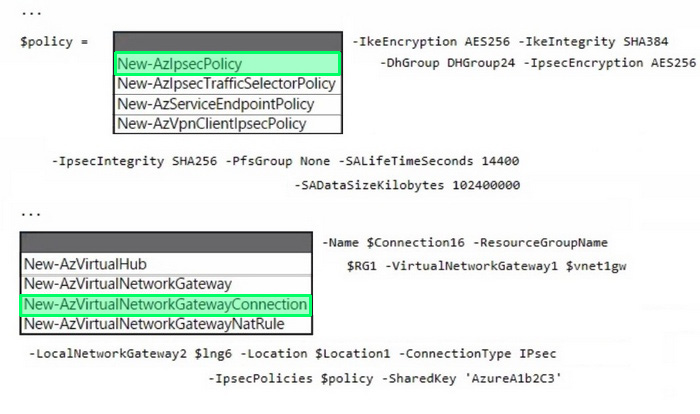
You need to create a Site-to-Site VPN connection that has a custom cryptographic policy.
How should you complete the PowerShell script? To answer, select the appropriate options in the answer area.
NOTE: Each correct selection is worth one point.
Reveal answer detailsClose answer details
Explanation
Box 1: New-AzIpsecPolicy
Configure IPsec/IKE policy for S2S (Site-to-Site) VPN or VNet-to-VNet connections.
Create an S2S VPN connection with an IPsec/IKE policy
1. Create an IPsec/IKE policy
The following sample script creates an IPsec/IKE policy with the following algorithms and parameters:
You have an on-premises datacenter and an Azure subscription.
You plan to implement ExpressRoute FastPath.
You need to create an ExpressRoute gateway. The solution must minimize downtime if a single Azure datacenter fails.
Which SKU should you use?
A
ErGw1AZ
B
High performance
C
Ultra performance
D
ErGw3AZ
E
ErGw2AZ
Reveal answer detailsClose answer details
Correct answerD
Explanation
ExpressRoute FastPath requires a gateway SKU that supports the feature, while resilience to a single datacenter failure requires a zone-redundant SKU. ErGw3AZ combines the necessary FastPath-capable capacity with availability-zone deployment. The non-AZ performance SKUs do not meet the stated zone-resiliency requirement.
Question 32
Hotspot
HOTSPOT
You have an on-premises datacenter.
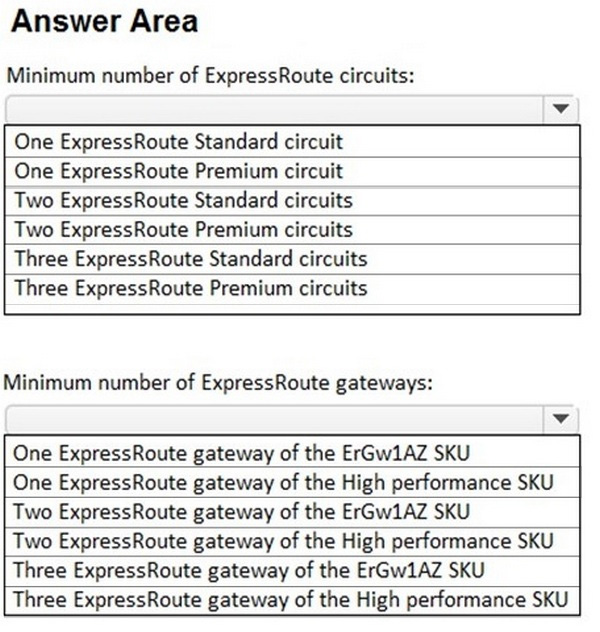
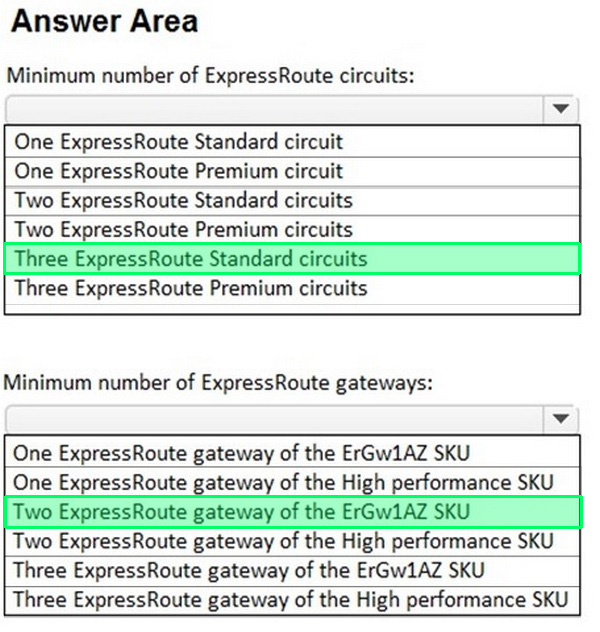
You have an Azure subscription that contains 10 virtual machines and a virtual network named VNet1 in the East US Azure region. The virtual machines are connected to VNet1 and replicate across three availability zones.
You need to connect the datacenter to VNet1 by using ExpressRoute. The solution must meet the following requirements:
1. Maintain connectivity to the virtual machines if two availability zones fail. 2. Support 1000-Mbps connections. 3. Minimize costs.
What should you include in the solution? To answer, select the appropriate options in the answer area.
NOTE: Each correct selection is worth one point.
Reveal answer detailsClose answer details
Explanation
Box 1: Three ExpressRoute Standard circuits
Maintain connectivity to the virtual machines if two availability zones fail. Support 1000-Mbps connections. Minimize costs.
An Availability Zone in an Azure region is a combination of a fault domain and an update domain. If you opt for a zone-redundant Azure IaaS deployment, you may also want to configure zone-redundant virtual network gateways that terminate ExpressRoute private peering.
Incorrect:
Premium is not required.
1000 Mbps is supported by ExpressRoute Standard.
Note: Connectivity for an ExpressRoute circuit is limited to a single geopolitical region. Connectivity can be expanded across geopolitical regions by enabling the ExpressRoute Premium add-on.
Box 2: One ExpressRoute gateway of the ErGw1Az SKU
Zone-redundant gateways
To automatically deploy your virtual network gateway across availability zones, you can use a zone-redundant ExpressRoute virtual network gateway. Zone-redundant ExpressRoute gateway instances are distributed across multiple availability zones and provide resiliency against a zone-level failure.
Feature support by gateway SKU
The ErGw1Az SKU supports up to 1,000 Mbps and is the lowest-cost availability zone-enabled ExpressRoute gateway SKU that meets the 1000-Mbps requirement.
If the Azure portal does not load successfully in the browser, press CTRL-K to reload the portal in a new browser tab.
The following information is for technical support purposes only: Lab Instance: 12345678
Question 33
Testlet 5Lab simulation
Simulation
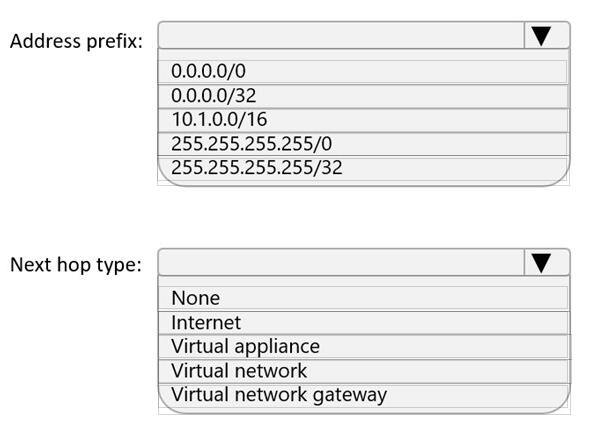
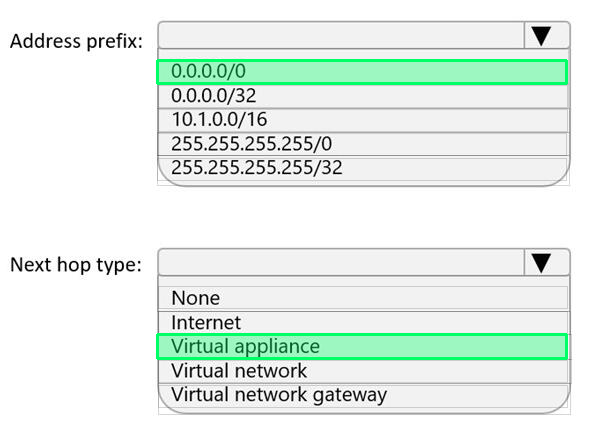
You plan to deploy an appliance to subnet3-2. The appliance will perform packet inspection and will have an IP address of 10.3.2.100.
You need to ensure that all traffic to the internet from subnet3-1 is forwarded to the appliance for inspection.
To complete this task, sign in to the Azure portal.
Reveal model answerClose model answer
Create a route table with a route for 0.0.0.0/0, set Next hop type to Virtual appliance and Next hop address to 10.3.2.100, and associate the route table with subnet3-1.
Explanation
The internet destination is represented by the default prefix 0.0.0.0/0. A route for that prefix with Virtual appliance as the next-hop type and 10.3.2.100 as the next-hop address redirects internet-bound packets to the inspection appliance. Associating the route table with subnet3-1 applies the route to traffic leaving that source subnet.
Question 34
Single choice
You have two Azure subscriptions named Sub1 and Sub2. Sub1 contains a virtual machine named VM1.
You plan to make VM1 available to the resources in Sub2 by using Azure Private Link.
You need to ensure that the private link service can be configured to provide access to VM1.
What should you configure in Sub1 first?
A
a service endpoint
B
an Azure Private DNS zone
C
a private endpoint
D
an Azure load balancer
Reveal answer detailsClose answer details
Correct answerD
Explanation
An Azure Private Link service publishes a service through the frontend configuration of an Azure load balancer. VM1 must therefore first be placed behind that load balancer in Sub1, after which the Private Link service can expose the frontend to private endpoints in Sub2. DNS zones and private endpoints are consumer-side components, not the service foundation.
Question 35
Hotspot
HOTSPOT
You have an Azure subscription that contains an app named Appl. App1 is hosted on the Azure App Service instances shown in the following table.
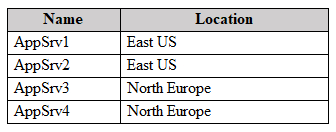
You need to implement Azure Traffic Manager to meet the following requirements:
1. App1 traffic must be assigned equally to each App Service instance in each Azure region. 2. App1 traffic from North Europe must be routed to the Appl instances in the North Europe region. 3. App1 traffic from North America must be routed to the Appl instances in the East US Azure region. 4. If an App Service instance fails, all the traffic for that instance must be routed to the remaining instances in the same region.
How should you configure the Traffic Manager profiles? To answer, select the appropriate options in the answer area.
NOTE: Each correct selection is worth one point.
Reveal answer detailsClose answer details
Explanation
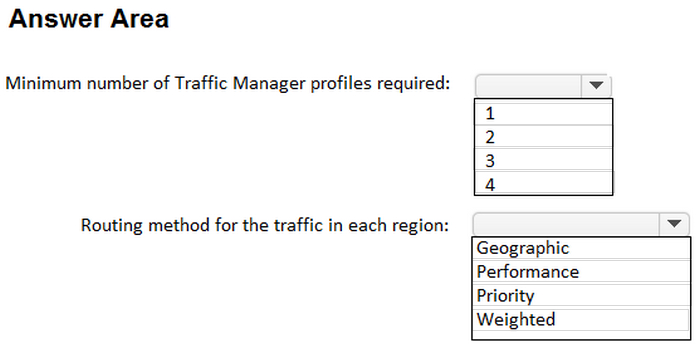
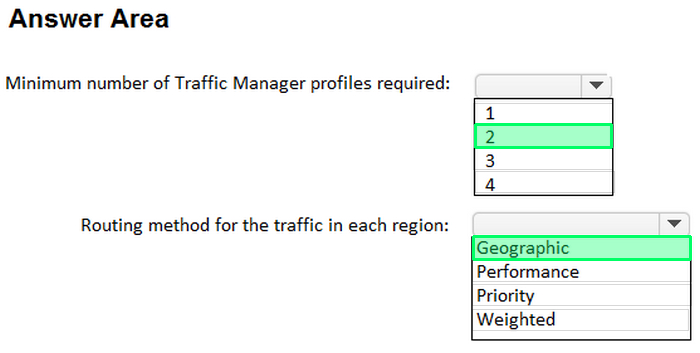
Box 1: 2 Need one profile for each region.
Note: Azure Traffic Manager supports six traffic-routing methods to determine how to route network traffic to the various service endpoints. For any profile, Traffic Manager applies the traffic-routing method associated to it to each DNS query it receives. The traffic-routing method determines which endpoint is returned in the DNS response.
Box 2: Geographic The following traffic routing methods are available in Traffic Manager:
* Geographic: Select Geographic routing to direct users to specific endpoints (Azure, External, or Nested) based on where their DNS queries originate from geographically. With this routing method, it enables you to be in compliance with scenarios such as data sovereignty mandates, localization of content & user experience and measuring traffic from different regions.
* Priority: Select Priority routing when you want to have a primary service endpoint for all traffic. You can provide multiple backup endpoints in case the primary or one of the backup endpoints is unavailable.
* Weighted: Select Weighted routing when you want to distribute traffic across a set of endpoints based on their weight. Set the weight the same to distribute evenly across all endpoints.
* Performance: Select Performance routing when you have endpoints in different geographic locations and you want end users to use the "closest" endpoint for the lowest network latency.
You have an Azure subscription that contains an Azure Front Door Premium profile named AFD1 and an Azure Web Application Firewall (WAF) policy named WAF1. AFD1 is associated with WAF1.
You need to configure a rate limit for incoming requests to AFD1.
Solution: You add a rule to the rule set of AFD1.
Does this meet the goal?
A
Yes
B
No
Reveal answer detailsClose answer details
Correct answerB
Explanation
An AFD1 rule-set rule modifies request or response processing and routing behavior; it is not the WAF control that counts incoming requests against a threshold. Rate limiting must be defined as a custom rule in the associated WAF policy. Adding a rule only to the Front Door rule set therefore does not meet the goal.
Question 37
Single choice
You have an internal Basic Azure Load Balancer named LB1 that has two frontend IP addresses. The backend pool of LB1 contains two Azure virtual machines named VM1 and VM2.
You need to configure the rules on LB1 as shown in the following table.
What should you do for each rule?
A
Enable Floating IP.
B
Disable Floating IP.
C
Set Session persistence to Enabled.
D
Set Session persistence to Disabled.
Reveal answer detailsClose answer details
Correct answerA
Explanation
Both rules use backend port 80 for the same VM network interfaces while presenting different frontend IP addresses. Enabling Floating IP permits that backend port to participate in rules for the separate frontend addresses without rewriting the destination to a conflicting backend configuration. Session persistence controls how repeated client flows are distributed and does not enable this frontend-IP and backend-port arrangement.
Question 38
Drag & drop
DRAG DROP
You have an Azure subscription that contains an Azure Firewall Premium policy named FWP1.
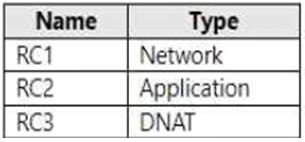
To FWP1, you plan to add the rule collections shown in the following table.
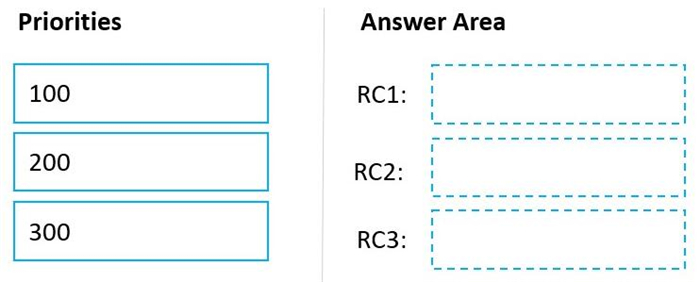
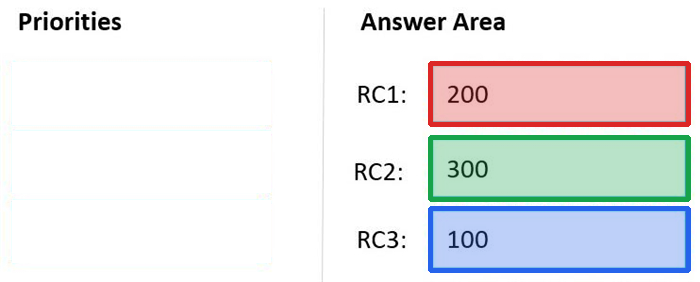
Which priority should you assign to each rule collection? To answer, drag the appropriate priority values to the correct rule collections. Each value may be used once, more than once, or not at all. You may need to drag the split bar between panes or scroll to view content.
NOTE: Each correct selection is worth one point.
Reveal answer detailsClose answer details
Explanation
Box 1: 200 RC1 Network
Rule collection groups A rule collection group is used to group rule collections. They're the first unit to be processed by the Azure Firewall and they follow a priority order based on values. There are three default rule collection groups, and their priority values are preset by design. They're processed in the following order:
* Default Network rule collection group Priority: 200
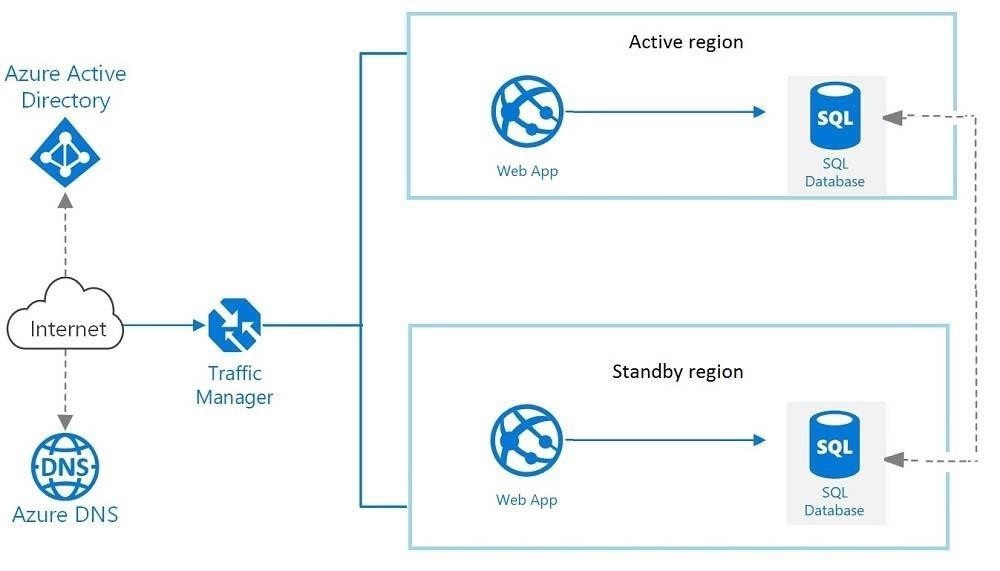
You have an application deployed in to two Azure app services as shown below.
You need to control the threshold for failing over the front end to the standby region.
What should you configure?
A
An application Insights availability test
B
Azure SQL Database failover groups
C
Connection Monitor in Azure Network Watcher
D
Endpoint monitor settings in Traffic Manager
Reveal answer detailsClose answer details
Correct answerD
Explanation
Traffic Manager decides whether an endpoint remains eligible by probing it and evaluating the configured endpoint monitoring behavior. Its endpoint monitor settings control the health-check parameters and failure threshold that trigger removal of the active endpoint and use of the standby region. SQL failover groups govern the database tier, not front-end Traffic Manager failover.
Question 40
Single choice
You have an on-premises datacenter in Seattle.
You have an Azure subscription that contains an Azure Network Watcher resource in the West US 2 Azure region.
You need to document network latency between the on-premises datacenter and the West US 2 region and between the on-premises datacenter and the East US 2 public Azure region. The solution must minimize administrative effort.
What should you do first?
A
Run the Get-AzNetworkWatcherConnectionMonitor cmdlet.
B
Run the Get-AzNetworkWatcherReachabilityProvidersList cmdlet.
C
Create a Network Watcher resource in the East US 2 region.
D
Create a Connection Monitor resource in the West US 2 region.
Reveal answer detailsClose answer details
Correct answerB
Explanation
The reachability report workflow requires a supported provider and location to be identified before latency measurements are requested. Get-AzNetworkWatcherReachabilityProvidersList returns the available providers and geographic locations that can be used for the Seattle source. Those values can then be used to generate reports comparing the on-premises location with West US 2 and East US 2 without deploying another Network Watcher resource.
Question 41
Single choice
Note: This question is part of a series of questions that present the same scenario. Each question in the series contains a unique solution that might meet the stated goals. Some question sets might have more than one correct solution, while others might not have a correct solution.
After you answer a question in this section, you will NOT be able to return to it. As a result, these questions will not appear in the review screen.
You have two Azure virtual networks named Vnet1 and Vnet2.
You have a Windows 10 device named Client1 that connects to Vnet1 by using a Point-to-Site (P2S) IKEv2 VPN.
You implement virtual network peering between Vnet1 and Vnet2. Vnet1 allows gateway transit. Vnet2 can use the remote gateway.
You discover that Client1 cannot communicate with Vnet2.
You need to ensure that Client1 can communicate with Vnet2.
Solution: You reset the gateway of Vnet1.
Does this meet the goal?
A
Yes
B
No
Reveal answer detailsClose answer details
Correct answerB
Explanation
Resetting the Vnet1 gateway restarts the gateway but does not add Vnet2's address space to the routes used by Client1. The Point-to-Site client configuration predates the peering change, so the client still lacks the route needed to send Vnet2 traffic through the VPN. A gateway reset therefore does not meet the communication requirement.
Question 42
Multiple choice
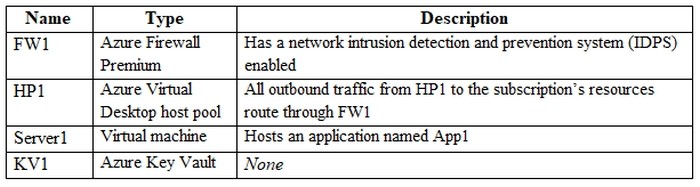
You have an Azure subscription that contains the resources shown in the following table.
Users on HP1 connect to App1 by using a URL of https://app1.contoso.com.
You need to ensure that the IDPS on FW1 can identify security threats in the connections from HP1 to Server1.
Which two actions should you perform? Each correct answer presents part of the solution.
NOTE: Each correct selection is worth one point.
A
Enable TLS inspection for FW1.
B
Import a server certificate to KV1.
C
Enable threat intelligence for FW1.
D
Add an application group to HP1.
E
Add a secured virtual network to FW1.
Reveal answer detailsClose answer details
Correct answersA, B
Explanation
Traffic from HP1 to App1 uses HTTPS, so the payload is encrypted and cannot be fully inspected by IDPS unless TLS inspection is enabled on FW1. Azure Firewall Premium TLS inspection requires a certificate stored in Azure Key Vault. FW1 uses this certificate to decrypt outbound TLS traffic, inspect the unencrypted content for threats with IDPS, and then re-encrypt the traffic before forwarding it to Server1.
Question 43
Single choice
You need to validate outbound connectivity from an Azure virtual machine to an external host.
What should you use?
A
Connection Troubleshoot
B
Next hop
C
NSG flow logs
D
Traffic Analytics
Reveal answer detailsClose answer details
Correct answerA
Explanation
Connection Troubleshoot performs an on-demand connectivity test from the virtual machine to a specified destination and port. It can determine whether the external host is reachable and report network conditions that prevent the outbound connection. Next hop only identifies a routing target, while flow logs and Traffic Analytics analyze recorded traffic rather than directly validating the requested connection.
Question 44
Hotspot
HOTSPOT
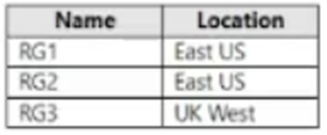
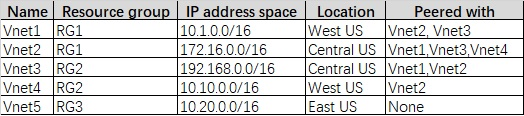
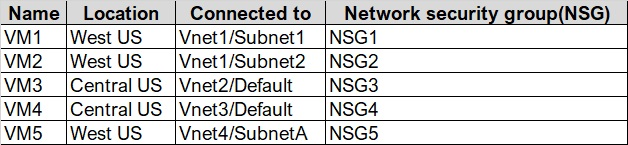
You have an Azure subscription that contains the resource groups shown in the following table.
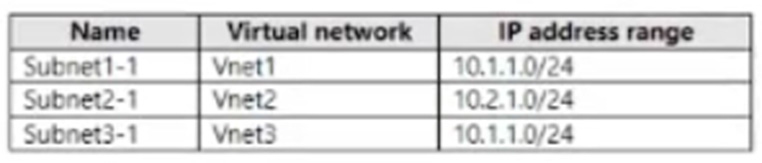
You have the virtual networks shown in the following table.
You have the subnets shown in the following table.
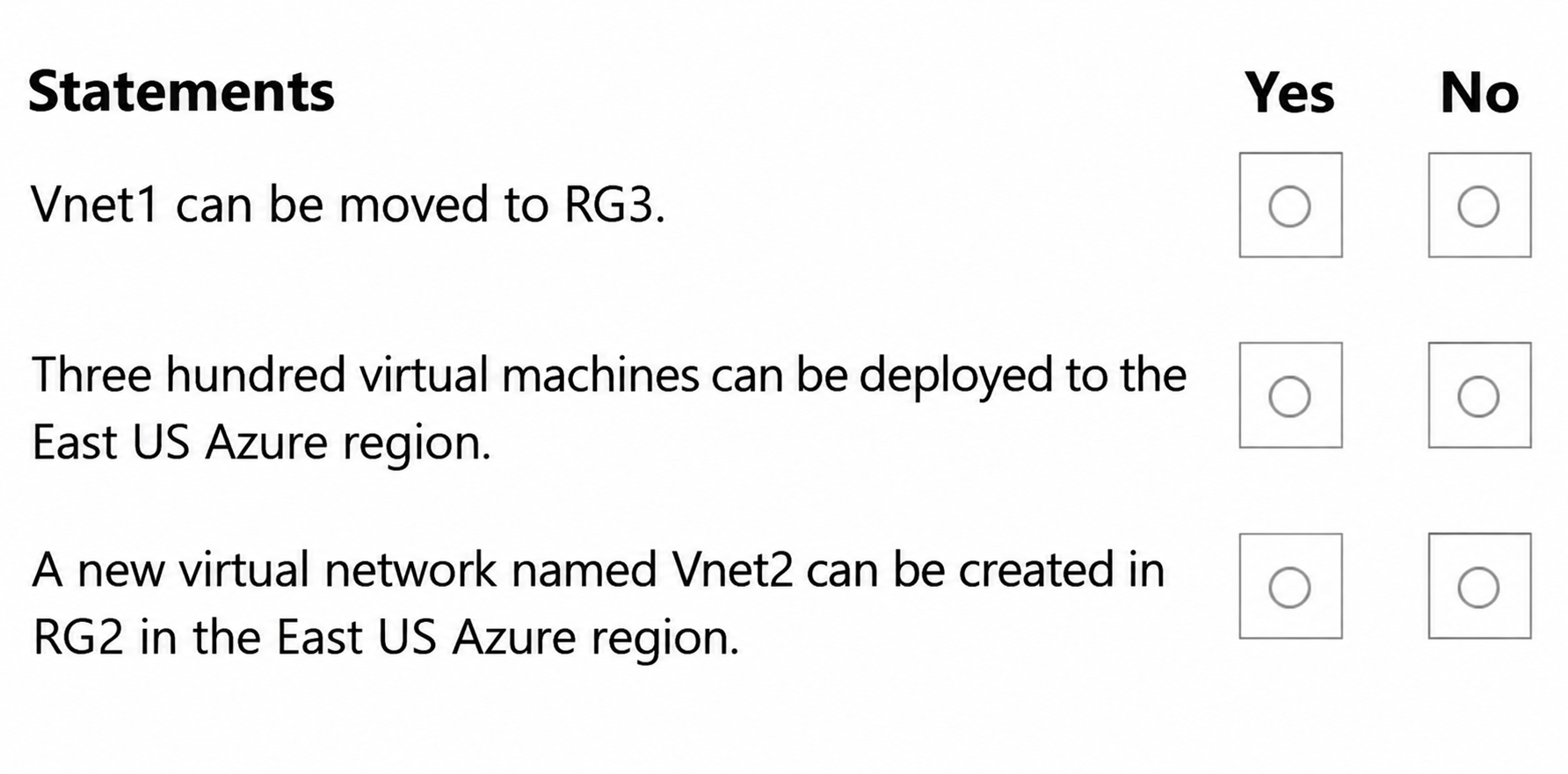
For each of the following statements, select Yes if the statement is true. Otherwise, select No.
NOTE: Each correct selection is worth one point.
Reveal answer detailsClose answer details
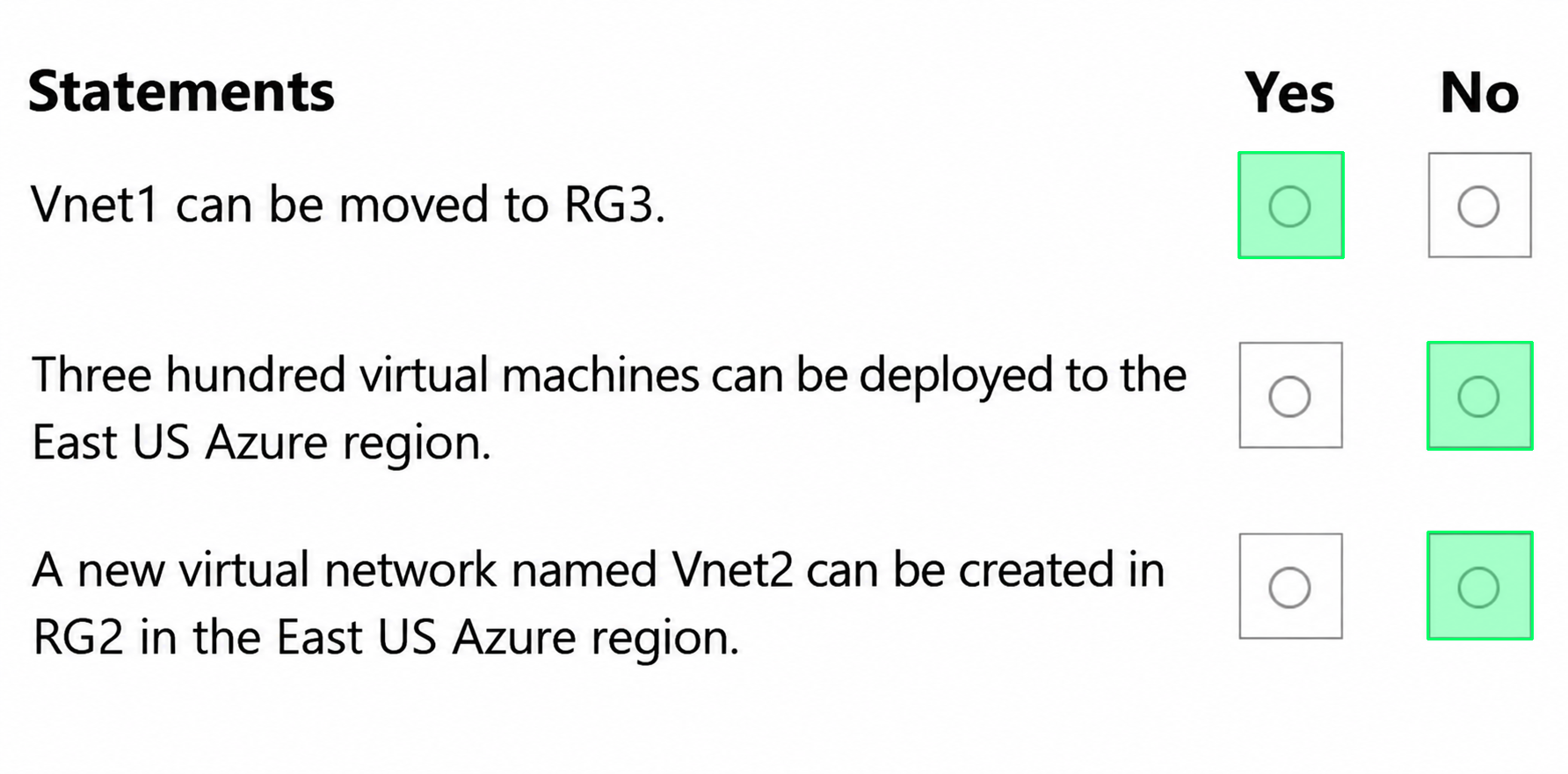
Explanation
Box 1: Yes Move an Azure virtual network to another region by using Azure PowerShell. There are various scenarios for moving an existing Azure virtual network from one region to another. For example, you might want to create a virtual network with the same configuration for testing and availability as your existing virtual network. Or you might want to move a production virtual network to another region as part of your disaster recovery planning.
You can use an Azure Resource Manager template to complete the move of the virtual network to another region. You do this by exporting the virtual network to a template, modifying the parameters to match the destination region, and then deploying the template to the new region.
Move networking resources to new resource group or subscription. You can move virtual networks and other networking resources to a new resource group or Azure subscription. Azure Resource Mover helps you move Azure resources between Azure regions.
All Azure resources are created in an Azure region and subscription. A resource can only be created in a virtual network that exists in the same region and subscription as the resource.
Note: VNet1 is in East US. Vnet1 is in RG1. RG1 is in East US. RG3 is in UK West.
Box 2: No VNet1 is the only virtual network in East US. Vnet1 has one subnet Subnet1-1 with IP address range 10.1.1.0/24. This address range has only 256 unique IP addresses.
Box 3: No RG2 already has a VNET named Vnet2.
Scope All Azure resource types have a scope that defines the level of that resource and that the resource names must be unique. A resource must have a unique name within its scope.
For example, a virtual network has a resource group scope, which means that there can be only one network named vnet-prod-westus-001 in a given resource group. Other resource groups could have their own virtual network named vnet-prod-westus-001.
You have an Azure subscription that contains a virtual network named VNet1. VNet1 contains a subnet named Subnet1.
You plan to add a private endpoint to Subnet1.
You need to ensure that you can route traffic between the private endpoint and the Azure Private Link service by using a user-defined route.
What should you do first on Subnet1?
A
Enable network policy.
B
Enable delegation.
C
Create a service endpoint.
D
Provision a Standard Azure load balancer.
Reveal answer detailsClose answer details
Correct answerA
Explanation
User-defined routes can govern private endpoint traffic only when private endpoint network policies are enabled for the subnet. Enabling the network policy on Subnet1 allows the routing policy to be evaluated for traffic between the endpoint and the Private Link service. Delegation and service endpoints do not enable that UDR processing.
Question 46
Single choice
You have an Azure subscription that contains the resources shown in the following table.
You test DDoSplan1 by running a simulation that targets IP1.
You need to review the DDoS Protection mitigation reports.
What should you use?
A
DDos protection plan in the Azure portal
B
Log Analytics
C
Microsoft Defender for Cloud
D
Azure Monitor Network Insights
Reveal answer detailsClose answer details
Correct answerB
Explanation
DDoS Protection mitigation reports are emitted as diagnostic data for the protected public IP resource. Sending that diagnostic category to a Log Analytics workspace makes the simulation's mitigation reports available for querying and review. The protection plan defines coverage, while Log Analytics is the destination used to examine the generated report records.
Case study
Case Study 5
SIMULATION
SIMULATION
Username and password
Use the following login credentials as needed:
To enter your username, place your cursor in the Sign in box and click on the username below.
To enter your password, place your cursor in the Enter password box and click on the password below.
If the Azure portal does not load successfully in the browser, press CTRL-K to reload the portal in a new browser tab.
The following information is for technical support purposes only: Lab Instance: 12345678
Question 47
Testlet 5Lab simulation
Simulation
You need to ensure that connections to the storage12345678 storage account can be made by using an IP address in the 10.1.1.0/24 range and the name storage12345678.privatelink.blob.core.windows.net.
To complete this task, sign in to the Azure portal.
Reveal model answerClose model answer
Create a private endpoint for storage12345678, select the blob subresource, and place it in the subnet whose address range is 10.1.1.0/24. Enable private DNS integration by creating or using the private DNS zone privatelink.blob.core.windows.net and linking it to the virtual network; ensure the zone contains an A record named storage12345678 for the private endpoint IP.
Explanation
The private endpoint assigns the storage account's blob service an address from the 10.1.1.0/24 subnet. The privatelink.blob.core.windows.net private DNS zone supplies the required private name resolution, while its virtual network link makes that resolution available to clients in the network. An A record named storage12345678 maps the requested name to the endpoint's private IP address.
Question 48
Hotspot
HOTSPOT
You have an Azure subscription that contains multiple virtual machines in two Azure regions.
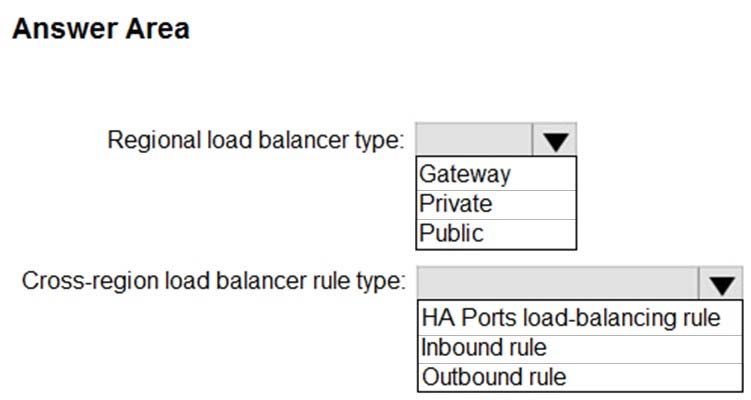
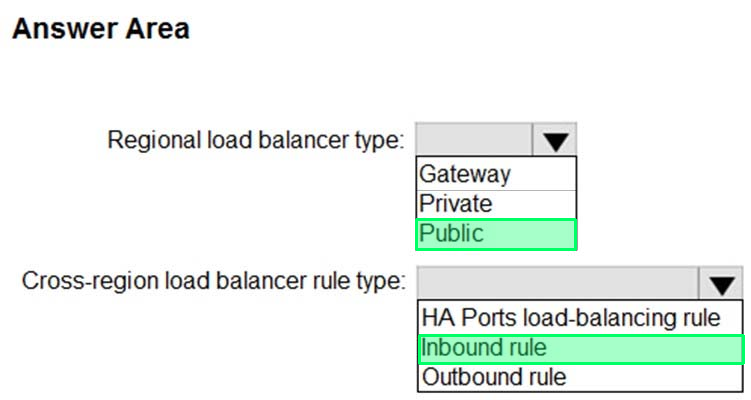
You need to load balance network traffic across the virtual machines by using a cross-region load balancer solution.
Which type of load balancer should you deploy to each region, and which type of rule should you configure for the cross-region load balancer? To answer, select the appropriate options in the answer area.
NOTE: Each correct answer is worth one point.
Reveal answer detailsClose answer details
Case study
Case Study 2
Overview
Contoso, Ltd. is a consulting company that has a main office in San Francisco and a branch office in Dallas.
Contoso recently purchased an Azure subscription and is performing its first pilot project in Azure.
Existing Environment
Azure Network Infrastructure
Contoso has an Azure Active Directory (Azure AD) tenant named contoso.com.
The Azure subscription contains the virtual networks shown in the following table.
Vnet1 contains a virtual network gateway named GW1.
Azure Virtual Machines
The Azure subscription contains virtual machines that run Windows Server 2019 as shown in the following table.
The NSGs are associated to the network interfaces on the virtual machines. Each NSG has one custom security rule that allows RDP connections from the internet. The firewall on each virtual machine allows ICMP traffic.
An application security group named ASG1 is associated to the network interface of VM1.
Azure Network Infrastructure Diagram
Azure Private DNS Zones
The Azure subscription contains the Azure private DNS zones shown in the following table.
Zone1.contoso.com has the virtual network links shown in the following table.
Other Azure Resources
The Azure subscription contains additional resources as shown in the following table.
Requirements
Virtual Network Requirements
Contoso has the following virtual network requirements:
Create a virtual network named Vnet6 in West US that will contain the following resources and configurations: - Two container groups that connect to Vnet6 - Three virtual machines that connect to Vnet6 - Allow VPN connections to be established to Vnet6 - Allow the resources in Vnet6 to access KeyVault1, DB1, and Vnet1 over the Microsoft backbone network. The virtual machines in Vnet4 and Vnet5 must be able to communicate over the Microsoft backbone network. A virtual machine named VM-Analyze will be deployed to Subnet1. VM-Analyze must inspect the outbound network traffic from Subnet2 to the internet.
Network Security Requirements
Contoso has the following network security requirements:
1. Configure Azure Active Directory (Azure AD) authentication for Point-to-Site (P2S) VPN users. 2. Enable NSG flow logs for NSG3 and NSG4. 3. Create an NSG named NSG10 that will be associated to Vnet1/Subnet1 and will have the custom inbound security rules shown in the following table.
Create an NSG named NSG11 that will be associated to Vnet1/Subnet2 and will have the custom outbound security rules shown in the following table.
Question 49
Testlet 2Hotspot
HOTSPOT
You are implementing the virtual network requirements for VM-Analyze.
What should you include in a custom route that is linked to Subnet2? To answer, select the appropriate options in the answer area.
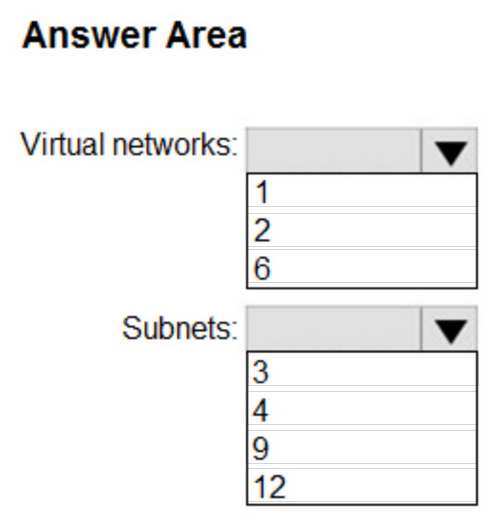
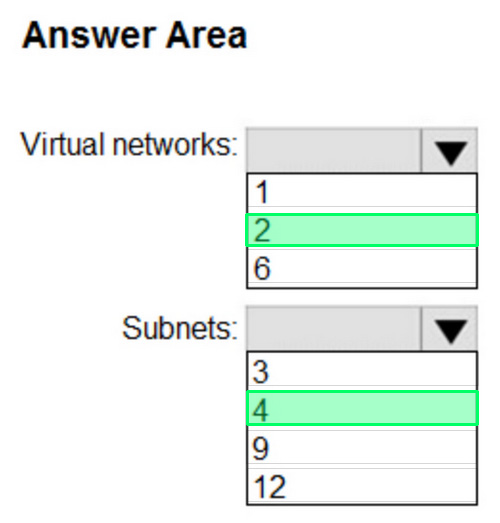
You need to perform the following actions in the East US Azure region of each subscription:
1. Deploy 50 virtual machines to availability zone 1. 2. Deploy 50 virtual machines to availability zone 2. 3. Deploy 50 virtual machines to availability zone 3.
What is the minimum number of virtual networks and /25 subnets you should create? To answer, select the appropriate options in the answer area.
NOTE: Each correct selection is worth one point.
Reveal answer detailsClose answer details
Question 51
Single choice
You have an Azure subscription that contains a user named Admin1 and a resource group named RG1.
RG1 contains an Azure Network Watcher instance named NW1.
You need to ensure that Admin1 can place a lock on NW1. The solution must use the principle of least privilege.
Which role should you assign to Admin1?
A
User Access Administrator
B
Network Contributor
C
Resource Policy Contributor
D
Monitoring Contributor
Reveal answer detailsClose answer details
Correct answerA
Explanation
Placing a resource lock requires permission for the lock operations under authorization. User Access Administrator includes the authorization-management capability needed to create or manage such locks and is the least-privileged listed role that supplies it. Network Contributor and Monitoring Contributor manage their service resources, while Resource Policy Contributor manages policy-related configuration.
Question 52
Hotspot
HOTSPOT
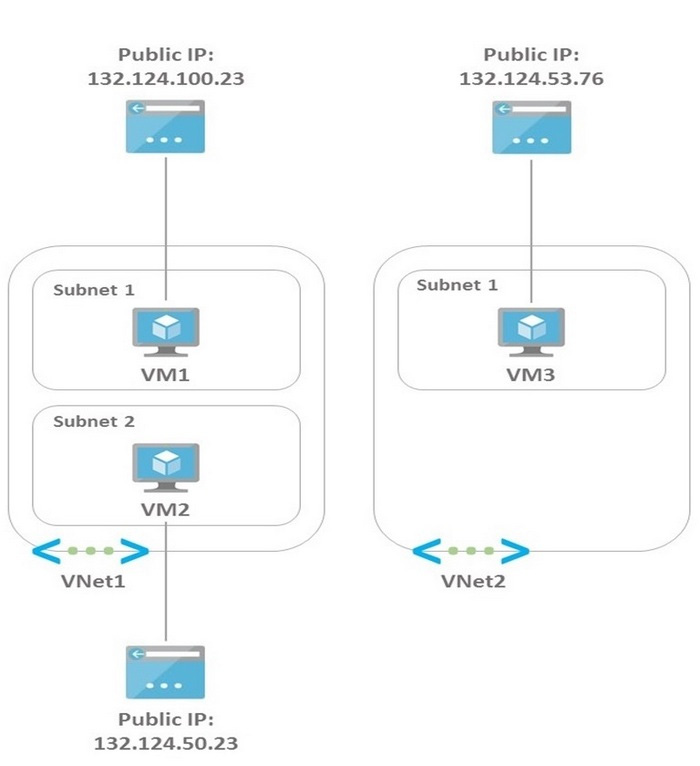
You have the Azure environment shown in the Azure Environment exhibit.
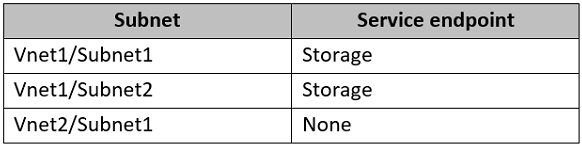
The settings for each subnet are shown in the following table.
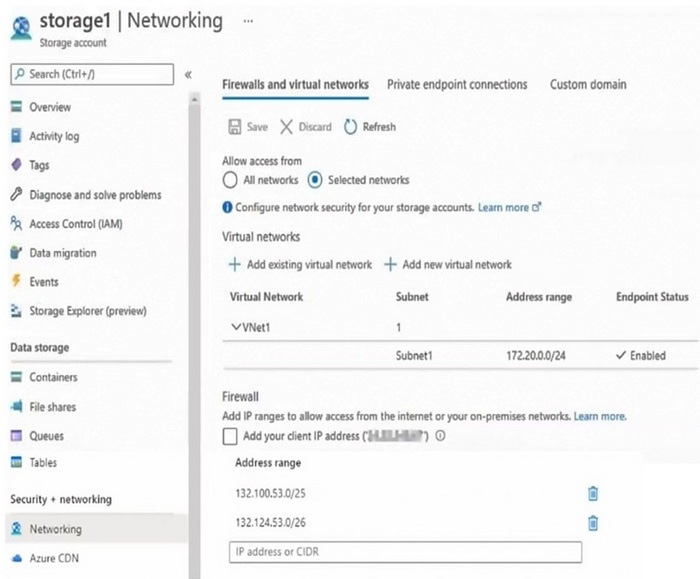
The Firewalls and virtual networks settings for storage1 are configured as shown in the Storage1 exhibit.
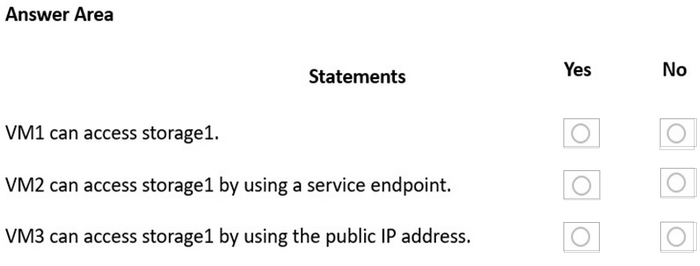
For each of the following statements, select Yes if the statement is true. Otherwise, select No.
NOTE: Each correct selection is worth one point.
Reveal answer detailsClose answer details
Explanation
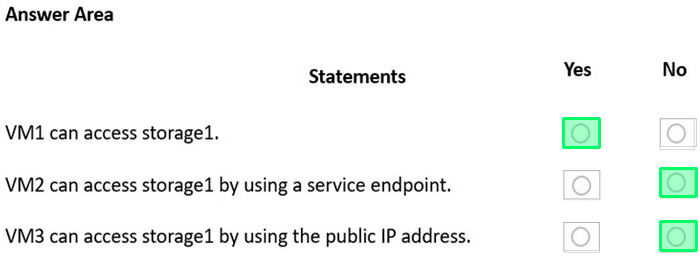
Box 1: Yes The firewall allows VNet1\Subnet1 through the service endpoint.
Box 2: No The firewall does not allow VNet1\Subnet2 through the service endpoint.
Box 3: No The firewall allows 132.124.53.0/26 which means it allows all IP addresses between 132.124.53.0 and 132.124.53.63. The public IP of VM3 is 132.124.53.76 which is outside the allowed range.
Case study
Case Study 5
SIMULATION
SIMULATION
Username and password
Use the following login credentials as needed:
To enter your username, place your cursor in the Sign in box and click on the username below.
To enter your password, place your cursor in the Enter password box and click on the password below.
If the Azure portal does not load successfully in the browser, press CTRL-K to reload the portal in a new browser tab.
The following information is for technical support purposes only: Lab Instance: 12345678
Question 53
Testlet 5Lab simulation
Simulation
You need to ensure that the owner of VNET3 receives an alert if an administrative operation is performed in the virtual network.
To complete this task, sign in to the Azure portal.
Reveal model answerClose model answer
Create an activity log alert scoped to VNET3 for the Administrative event category, and configure an action group to notify the Azure Resource Manager Owner role.
Explanation
Administrative changes to VNET3 are recorded as activity log events, so an activity log alert must be scoped to that virtual network and filtered to the Administrative category. When a matching operation occurs, the alert invokes its action group. Configuring that group to notify the Azure Resource Manager Owner role directs the notification to the resource owner without hard-coding one person's address.
Question 54
Single choice
Which one of the following priority levels is highest for a security rule in Azure Firewall?
A
0
B
100
C
1000
Reveal answer detailsClose answer details
Correct answerB
Explanation
Azure Firewall priorities use lower numeric values as higher precedence, and 100 is the highest permitted priority value for this rule configuration. Assigning 100 therefore causes the security rule to be considered before rules configured with larger permitted priority numbers, which is the required ordering behavior.
Question 55
Multiple choice
Which of the following statements are true with respect to Azure Firewall?
A
Azure firewall replaces Network Security groups
B
Azure firewall is a stateless service
C
Used to inspect inbound internet traffic only
D
Azure Firewall provides inbound protection for non-HTTP/S protocols
E
Forced tunneling is supported in Azure Firewall
Reveal answer detailsClose answer details
Correct answersD, E
Explanation
Azure Firewall can protect inbound connections for protocols beyond HTTP and HTTPS by applying network and NAT processing to supported TCP and UDP traffic. It also supports forced tunneling, which directs internet-bound traffic through a designated path for inspection or further processing. These capabilities are compatible with its role as a stateful service alongside, rather than as a replacement for, network security groups.
Question 56
Drag & drop
DRAG DROP
You have an on-premises network.
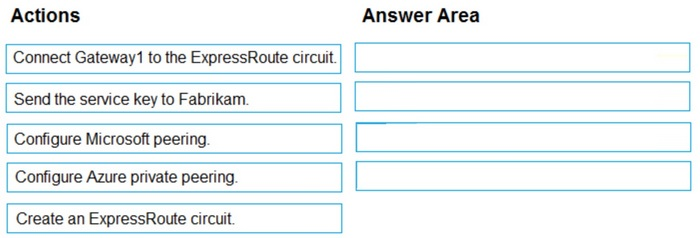
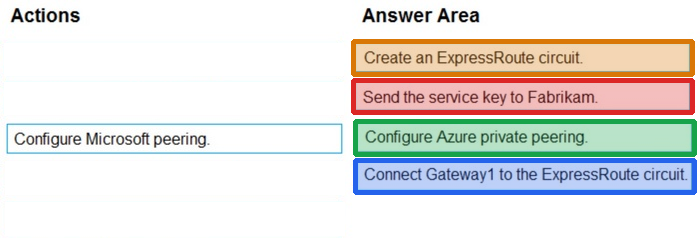
You have an Azure subscription that contains a virtual network named VNet1. VNet1 contains an ExpressRoute gateway named Gateway1.
You need to implement an ExpressRoute solution from a third-party provider named Fabrikam, Inc. The solution must ensure that devices on the on-premises network can connect to the Azure resources on VNet1.
Which four actions should you perform in sequence? To answer, move the appropriate actions from the list of actions to the answer area and arrange them in the correct order.
Reveal answer detailsClose answer details
Question 57
Multiple choice
You have a hub-and-spoke topology. The topology includes multiple on-premises locations that connect to a hub virtual network in Azure via ExpressRoute circuits.
You have an Azure Application Gateway named GW1 that provides a single point of ingress from the internet.
You plan to migrate the hub-and-spoke topology to Azure Virtual WAN.
You need to identify which changes must be applied to the existing topology. The solution must ensure that you maintain a single point of ingress from the internet.
Which three changes should you include in the solution? Each correct answer presents part of the solution.
NOTE: Each correct selection is worth one point.
A
Add user-defined routes.
B
Add virtual network peerings.
C
Replace the user-defined routes used by the current topology.
D
Create virtual network connections.
E
Remove the existing virtual network peerings.
F
Redeploy GW1.
Reveal answer detailsClose answer details
Correct answersD, E, F
Explanation
Azure Virtual WAN attaches spoke virtual networks to a virtual hub through virtual network connections, so those connections must be created. The existing spoke peerings belong to the former hub-and-spoke design and must be removed when the spokes move to the virtual hub. GW1 must be redeployed in the resulting connected topology so it can remain the single internet ingress point.
Question 58
Hotspot
HOTSPOT
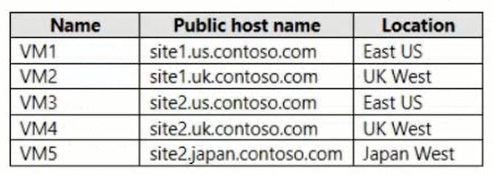
You have an Azure subscription. The subscription contains virtual machines that host websites as shown in the following table.
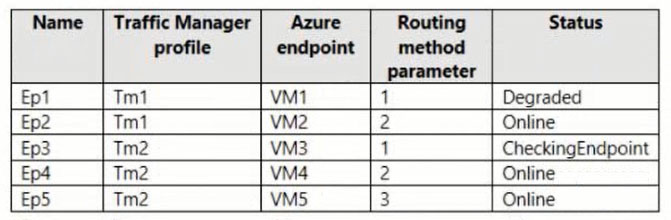
You have the Azure Traffic Manager profiles shown in the following table.
You have the endpoints shown in the following table.
For each of the following statements, select Yes if the statement is true. Otherwise, select No.
NOTE: Each correct selection is worth one point.
Reveal answer detailsClose answer details
Explanation
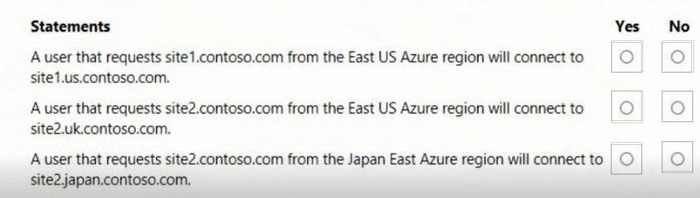
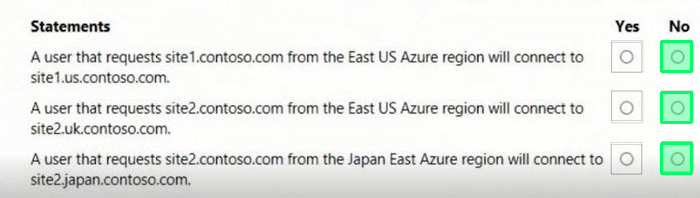
Box 1: No VM1, which is hosting site1.contoso.com, is located in East US. The VM1 endpoint status is degraded. Endpoint monitoring health checks are failing. The endpoint isn't included in DNS responses and doesn't receive traffic. When an endpoint has a Degraded status, it's no longer returned in response to DNS queries. Instead, an alternative endpoint is chosen and returned. The traffic-routing method configured in the profile determines how the alternative endpoint is chosen.
Priority. Endpoints form a prioritized list. The first available endpoint on the list is always returned. If an endpoint status is Degraded, then the next available endpoint is returned.
The user will connect to site2.us.contoso.com instead.
Box 2: No VM3, which is hosting site2.contoso.com, is located in in East US. The VM3 endpoint status is CheckingEndpoint. The endpoint is monitored, but the results of the first probe haven't been received yet. CheckingEndpoint is a temporary state that usually occurs immediately after adding or enabling an endpoint in the profile. An endpoint in this state is included in DNS responses and can receive traffic. User will connect to site2.contoso.com, not to site2.uk.contoso.com
Box 3: No VM3, which is hosting site2.contoso.com, is located in in East US. The VM1 endpoint status is CheckingEndpoint, which is OK (see above). User will connect to site2.contoso.com, not to site2.japan.contoso.com
You have two Azure virtual networks named VNet1 and VNet2.
VNet1 contains an Azure virtual machine named VM1.
VNet2 contains an Azure virtual machine named VM2.
VM1 hosts a frontend application that connects to VM2 to retrieve data. Users report that the frontend application is slower than usual. You need to view the average round-trip time (RTT) of the packets from VM1 to VM2.
Which Azure Network Watcher feature should you use?
A
IP flow verify
B
Connection troubleshoot
C
Connection monitor
D
NSG flow logs
Reveal answer detailsClose answer details
Correct answerC
Explanation
Connection monitor continuously observes connectivity between configured source and destination endpoints and records performance measurements such as round-trip time. Configuring VM1 as the source and VM2 as the destination provides the average RTT needed to investigate the slowdown. IP flow verify checks security rules, while NSG flow logs record flow metadata rather than directly monitoring RTT.
Question 60
Hotspot
HOTSPOT
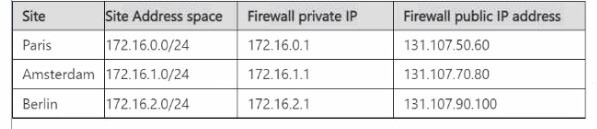
You have an on-premises network that includes the sites shown in the following table.
Each site is connected to the Internet by a firewall. All sites are connected to an SD-WAN. Each site is configured to propagate routes by using BGP.
You have an Azure subscription that includes a virtual network named Vnet1 that contains a Virtual Network Gateway named Gateway 1.
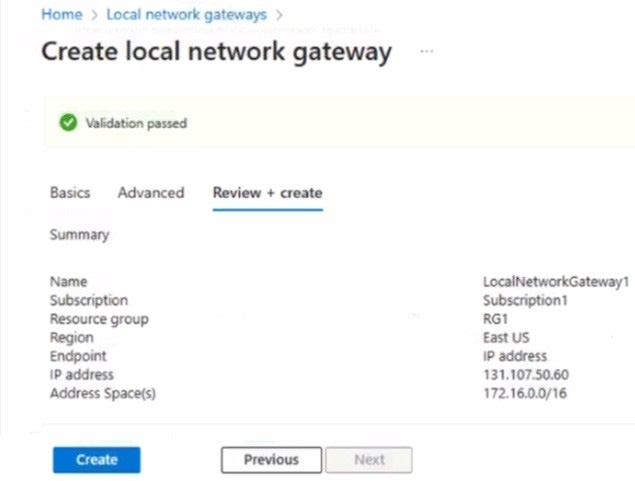
You create a local network gateway with the configuration shown in the gateway exhibit (Click the Gateway tab.)
You create a Site-to-Site (S2S) connection with the configuration shown in connection exhibit. (Click the Connection tab)
For each of the following statements, select Yes if the statement is true Otherwise, select No.
NOTE: Each correct selection is worth one point.
Reveal answer detailsClose answer details
Question 61
Single choice
You have an Azure subscription mat contains tour virtual networks named VNet1, VNet2, VNet3, and VNet4.
You plan to deploy a hub and spoke topology by using virtual network peering.
You need to configure VNet1 as the hub network. The solution must meet the following requirements:
1. Support transitive routing between spokes. 2. Maximize network throughput.
What should you include in the solution?
A
Azure VPN Gateway
B
Azure Route Server
C
Azure Private Link
D
Azure Firewall
Reveal answer detailsClose answer details
Correct answerD
Explanation
Virtual network peering alone is not transitive, so direct spoke-to-spoke forwarding requires a routing component in the hub. Azure Firewall can serve as that hub routing point when user-defined routes direct spoke traffic through it. This provides transitive spoke connectivity without sending the traffic through a VPN gateway.
Question 62
Single choice
You have the on-premises networks shown in the following table.
You have an Azure subscription that contains an Azure virtual WAN named VWAN1 and a virtual network named VNet1. VWAN is connected to the on-premises networks and VNet1 in a full mesh topology. The virtual hub routing preference for VWAN1 is AS Path.
You need to route traffic from VNet1 to 10.61.1.5.
Which path will be used?
A
the VPN connection to Branch1
B
the VPN connection to Branch2
C
the ExpressRoute connection to Branch2
D
the ExpressRoute connection to Branch3
Reveal answer detailsClose answer details
Correct answerD
Explanation
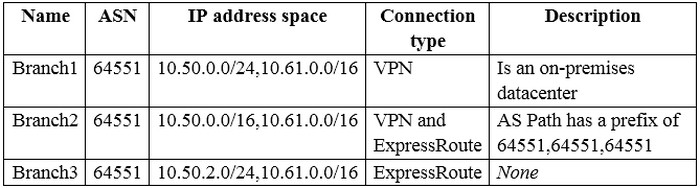
The destination 10.61.1.5 matches the 10.61.0.0/16 route advertised by all three branches. Branch2 is less preferred because its AS path is prepended with repeated occurrences of 64551. Branch1 and Branch3 have shorter paths, and the ExpressRoute path is preferred for the remaining tie, selecting the connection to Branch3.
Question 63
Hotspot
HOTSPOT
You have an Azure subscription that is linked to a Microsoft Entra tenant. The subscription contains a virtual network named VNet1, a storage account named storage1, an Azure App Service app named App1, and an Azure SQL database named DB1. VNet1 contains two subnets named Subnet1 and Subnet2. Subnet1 and Subnet2 each has a subnet mask of 255.255.255.224.
You plan to perform the following actions:
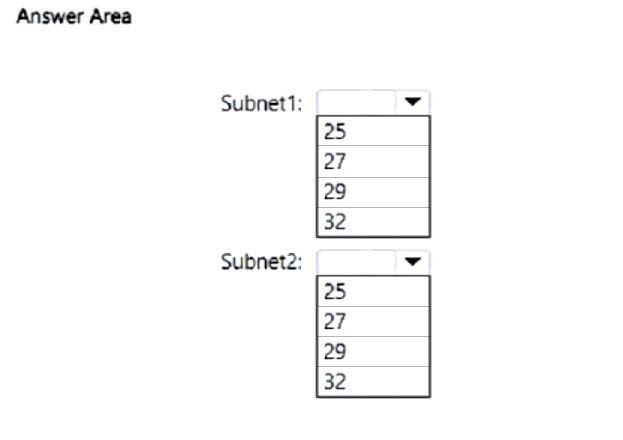
On Subnet1, configure a service endpoint to connect to storage1 and a service endpoint to connect to the Microsoft Entra tenant. On Subnet2, configure a private endpoint to connect to App1 and a private endpoint to connect to DB1.
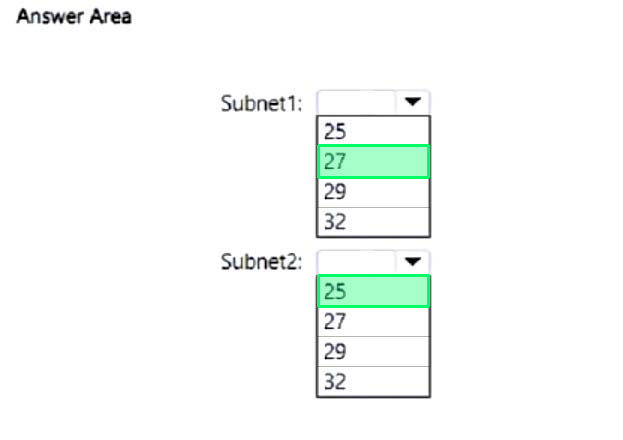
How many IP addresses will be available on each subnet once the planned actions are complete? To answer, select the appropriate options in the answer area.
NOTE: Each correct selection is worth one point.
Reveal answer detailsClose answer details
Explanation
Box 1: 27
On Subnet1, configure a service endpoint to connect to storage1 and a service endpoint to connect to the Microsoft Entra tenant.
Service endpoints does not consume IP addresses in the subnet of a virtual network. Five IP addresses are used by Azure.
Remaining: 32-5 -> 27
Note: Azure reserves five IP addresses within each subnet. Factor in those addresses when you're sizing virtual networks and encompassed subnets.
Note 2: Virtual Network (VNet) service endpoint provides secure and direct connectivity to Azure services over an optimized route over the Azure backbone network. Endpoints allow you to secure your critical Azure service resources to only your virtual networks. Service Endpoints enables private IP addresses in the VNet to reach the endpoint of an Azure service without needing a public IP address on the VNet.
Box 2: 25
On Subnet2, configure a private endpoint to connect to App1 and a private endpoint to connect to DB1.
Two private endpoints IP addresses will be used. Five IP addresses are used by Azure. Remaining: 32-2-5 -> 25
Note: A private endpoint is a network interface that uses a private IP address from your virtual network. This network interface connects you privately and securely to a service that's powered by Azure Private Link. By enabling a private endpoint, you're bringing the service into your virtual network.
The service could be an Azure service such as: Azure Storage Azure Cosmos DB Azure SQL Database Your own service, using Private Link service.
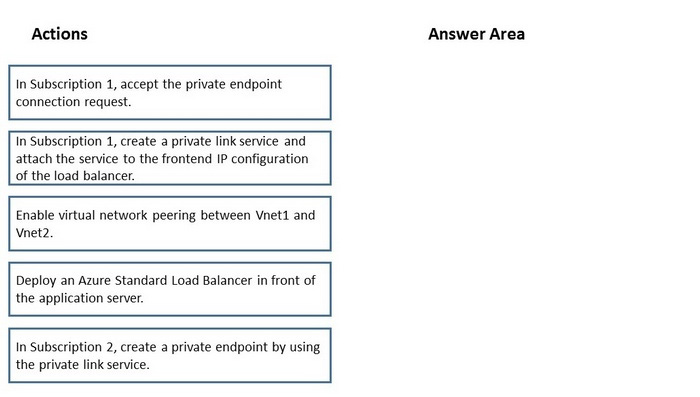
You have two Azure subscriptions named Subscnption1 and Subscription2. Subscription1 contains a virtual network named Vnet1. Vnet1 contains an application server. Subscription2 contains a virtual network named Vnet2.
You need to provide the virtual machines in Vnet2 with access to the application server in Vnet1 by using a private endpoint.
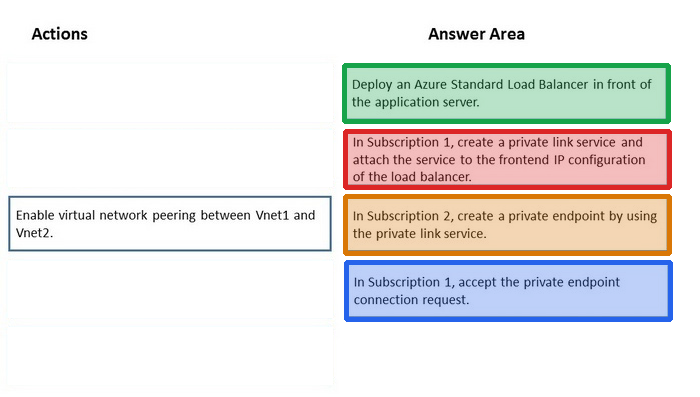
Which four actions should you perform in sequence? To answer, move the appropriate actions from the list of actions to the answer area and arrange them in the correct order.
Reveal answer detailsClose answer details
Explanation
Step 1: Deploy an Azure Load Balancer in front of the application server Configure your application to run behind a standard load balancer in your virtual network.
Step 2: In Subscription 1, create a private link service and attach the service to the frontend IP configuration of the load balancer.
Create a Private Link Service referencing the load balancer above.
Step 3: In Subscription 2, create a private endpoint by using the private link service. Private Link service can be accessed from approved private endpoints in any public region. The private endpoint can be reached from the same virtual network, regionally peered VNets, globally peered VNets and on premises using private VPN or ExpressRoute connections.
Step 4: In Subscription1, accept the private endpoint connection request. Network connections can be initiated only by clients that are connecting to the private endpoint.
Not: Incorrect: Enable virtual network peering between Vnet1 and Vnet2.
If the Azure portal does not load successfully in the browser, press CTRL-K to reload the portal in a new browser tab.
The following information is for technical support purposes only: Lab Instance: 12345678
Question 65
Testlet 5Lab simulation
Simulation
You plan to manage the public DNS records for a domain named fabrikam.com by using an Azure solution.
You need to ensure that wvw.fabrikam.com resolves to 131.107.2.50.
To complete this task, sign in to the Azure portal.
Reveal model answerClose model answer
Create an Azure public DNS zone named fabrikam.com and add an A record named wvw with IP address 131.107.2.50. Delegate fabrikam.com to the Azure DNS name servers if it is not already delegated.
Explanation
An A record provides the required direct mapping from a host name to an IPv4 address. In the fabrikam.com public DNS zone, a record named wvw forms wvw.fabrikam.com and maps it to 131.107.2.50. The domain must also be delegated to the Azure DNS name servers when that delegation is not already present, so public DNS queries reach the zone containing the record.
Question 66
Hotspot
HOTSPOT
You have an Azure subscription that contains a virtual network named VNet1. VNet1 contains the resources shown in the following table.
You need to publish App1 by using AG1 and a URL of https://app1.contoso.com. The solution must meet the following requirements:
1. TLS connections must terminate on AG1. 2. Minimize the number of targets in the backend pool of AG1. 3. Minimize the number of deployed copies of the SSL certificate of App1.
How many locations should you import to the certificate, and how many targets should you add to the
backend pool of AG1? To answer, select the appropriate options in the answer area.
NOTE: Each correct selection is worth one point.
Reveal answer detailsClose answer details
MICROSOFT
Designing and Implementing Microsoft Azure Networking Solutions
You have an Azure subscription that contains a virtual network named VNet1. VNet1 is connected to an Azure Virtual WAN hub named Hub1. You need to enable connectivity between the on-premises network and VNet1 by using Hub1.
Which three actions should you perform in sequence? To answer, move the appropriate actions from the list of actions to the answer area and arrange them in the correct order.
Correct Answer:
QUESTION 2
You have an Azure subscription that contains an Azure Front Door Premium profile named AFD1 and an Azure Web Application Firewall (WAF) policy named WAF1. AFD1 is associated with WAF1.
You need to configure a rate limit for incoming requests to AFD1.
Solution: You modify the policy settings of WAF1.
Does this meet the goal?
A.
Yes
B.
No
Correct Answer: B
Explanation
Explanation/Reference:
WAF policy settings control policy-wide behavior such as its operating state and mode; they do not define a per-client request threshold. Rate limiting is implemented through a custom rule that evaluates request rates and applies an action when the threshold is exceeded. Modifying only the policy settings therefore does not meet the goal.
QUESTION 3
You have an Azure virtual network named Vnet1.
You need to ensure that the virtual machines in Vnet1 can access only the Azure SQL resources in the East US Azure region. The virtual machines must be prevented from accessing any Azure Storage resources.
Which two outbound network security group (NSG) rules should you create? Each correct answer presents part of the solution.
NOTE: Each correct selection is worth one point.
A.
a deny rule that has a source of VirtualNetwork and a destination of Sql
B.
an allow rule that has the IP address range of Vnet1 as the source and destination of Sql.EastUS
C.
a deny rule that has a source of VirtualNetwork and a destination of 168.63.129.0/24
D.
a deny rule that has the IP address range of Vnet1 as the source and destination of Storage
Correct Answer: BD
Explanation
Explanation/Reference:
The allow rule uses Vnet1's address range as the source and Sql.EastUS as the destination, permitting access specifically to Azure SQL in East US. The separate deny rule uses the same source scope and Storage as the destination, preventing access to Azure Storage. Rule priorities must place these explicit controls appropriately so the required SQL traffic is allowed and Storage traffic is denied.
QUESTION 4
You have an Azure Virtual Desktop deployment that has 500 session hosts.
All outbound traffic to the internet uses a NAT gateway.
Some users report that they cannot access internet resources during peak hours.
In Azure Monitor, you discover many failed SNAT connections.
You need to increase the available SNAT connections.
What should you do?
A.
Bind the NAT gateway to another subnet.
B.
Add a public IP address.
C.
Deploy Azure Standard Load Balancer that has outbound rules.
Correct Answer: B
Explanation
Explanation/Reference:
A NAT gateway allocates its available SNAT connections from the ports associated with its public IP resources. Adding another public IP address expands that SNAT port pool, allowing more simultaneous outbound flows during peak usage. Binding the gateway to another subnet does not increase the port capacity available to the existing session hosts.
QUESTION 5
HOTSPOT
You have an Azure subscription that contains a virtual network gateway named VNetGwy1. VNetGwy1 has a public IP address of 20.25.32.214.
You need to query the health probe of VNetGwy1,
How should you complete the URI? To answer, select the appropriate options in the answer area.
NOTE: Each correct selection is worth one point.
Correct Answer:
Explanation
Explanation/Reference:
Box 1: https: Verify the Azure gateway health probe Open health probe by browsing to the following URL:
https://<YourVirtualNetworkGatewayIP>:8081/healthprobe For Active/Acive gateways use the following to check the second public IP: https://<YourVirtualNetworkGatewayIP2>:8083/healthprobe
You need to monitor the latency between your on-premises network and the Azure virtual machines.
What should you use?
A.
Service Map
B.
Connection troubleshoot
C.
Network Performance Monitor
D.
Effective routes
Correct Answer: C
Explanation
Explanation/Reference:
Network Performance Monitor measures network performance across hybrid paths, including the connection between an on-premises network and Azure virtual machines. It can track latency over time instead of performing only a single connection test. Effective routes describe routing decisions, while Service Map describes dependencies rather than the end-to-end network latency requirement.
QUESTION 7
Your company has offices in New York and Amsterdam. The company has an Azure subscription. Both offices connect to Azure by using a Site-to-Site VPN connection.
The office in Amsterdam uses resources in the North Europe Azure region. The office in New York uses resources in the East US Azure region.
You need to implement ExpressRoute circuits to connect each office to the nearest Azure region. Once the ExpressRoute circuits are connected, the on-premises computers in the Amsterdam office must be able to connect to the on-premises servers in the New York office by using the ExpressRoute circuits.
Which ExpressRoute option should you use?
A.
ExpressRoute FastPath
B.
ExpressRoute Global Reach
C.
ExpressRoute Direct
D.
ExpressRoute Local
Correct Answer: B
Explanation
Explanation/Reference:
Each office will have its own ExpressRoute circuit to a nearby Azure region, but ordinary circuit connectivity does not create a path between the two on-premises sites. ExpressRoute Global Reach connects the private peering of the circuits, allowing the Amsterdam and New York on-premises networks to communicate through Microsoft's network. The other options do not join the sites.
QUESTION 8
DRAG DROP
You have an Azure virtual network named Vnet1 that connects to an on-premises network.
You have an Azure Storage account named storageaccount1 that contains blob storage.
You need to configure a private endpoint for the blob storage. The solution must meet the following requirements:
Ensure that all on-premises users can access storageaccount1 through the private endpoint. Prevent access to storageaccount1 from being interrupted.
Which four actions should you perform in sequence? To answer, move the appropriate actions from the list of actions to the answer area and arrange them in the correct order.
Correct Answer:
QUESTION 9
You have an Azure subscription that contains an instance of Azure Firewall Standard named AzFW1.
You plan to enable the following:
1. TLS inspection 2. Threat intelligence 3. A network intrusion detection and prevention system (IDPS)
What can you enable by using AzFW1?
A.
TLS inspection only
B.
threat intelligence only
C.
TLS inspection and the IDPS only
D.
threat intelligence and the IDPS only
E.
TLS inspection, threat intelligence, and the IDPS
Correct Answer: B
Explanation
Explanation/Reference:
Azure Firewall Standard supports threat intelligence filtering, so AzFW1 can use that feature without changing tiers. TLS inspection and the network intrusion detection and prevention system are Premium capabilities. Because AzFW1 is Standard, those two features cannot be enabled on the existing instance, leaving threat intelligence as the only listed supported capability.
QUESTION 10
You have an Azure subscription that contains the public IPv4 addresses shown in the following table.
You plan to create a load balancer named LB1 that will have the following settings:
Name: LB1 Location: West US Type: Public SKU: Standard
Which public IPv4 addresses can be used by LB1?
A.
IP1, IP3, IP4, and IP5 only
B.
IP3 only
C.
IP1 and IP3 only
D.
IP2 only
E.
IP1, IP2, IP3, IP4, and IP5
F.
IP3 and IP5 only
Correct Answer: F
Explanation
Explanation/Reference:
A Standard public load balancer must use a Standard SKU public IP address in the load balancer's region, and that address must use static assignment. IP3 and IP5 satisfy all three conditions: both are Standard, static, and located in West US. IP1 is Basic, IP2 is Basic and dynamic, and IP4 is both Basic and in West US 2.
QUESTION 11
You have an Azure subscription that contains the resources shown in the following table.
You need to configure a solution to meet the following requirements;
1. App1 must be assigned a private endpoint 2. Access to App1 from the internet must be routed via FD1.
What should you configure on FD1?
A.
a rule that has the route configuration override action
B.
a route that redirects traffic
C.
an origin that enables the Azure Private Link service
D.
a security policy that redirects traffic
Correct Answer: C
Explanation
Explanation/Reference:
FD1 must connect privately to App1 while remaining the internet-facing entry point. Configuring an origin with Azure Private Link enabled makes Front Door send origin traffic to App1 through its private connectivity path. Routes select and forward requests to that origin, but a redirect or security policy would not establish the private origin connection.
QUESTION 12
You have an on-premises network named Site1.
You have an Azure subscription that contains a storage account named storage1 and a virtual network named VNet1.
VNet1 contains a subnet named Subnet1. A private endpoint for storage1 is connected to Subnet1 Site1 is connected to VNet1 by using a Site-to-Site (S2S) VPN.
You need to control access to storage1 from Site1 by using network security groups (NSGs).
What should you do first?
A.
Associate a route table with Subnet1.
B.
Associate a NAT gateway with Subnet1.
C.
Configure a network policy for private endpoints on Subnet1.
D.
Create a subnet delegation on Subnet1.
Correct Answer: C
Explanation
Explanation/Reference:
NSG processing for traffic addressed to a private endpoint requires private endpoint network policies on its subnet. Configuring that policy on Subnet1 allows NSG rules to control connections arriving from Site1 over the VPN. A route table, NAT gateway, or subnet delegation does not first enable NSG enforcement for the endpoint.
QUESTION 13
HOTSPOT
You have an Azure application gateway.
You need to create a rewrite rule that will remove the origin port from the HTTP header of incoming requests that are being forwarded to the backend pool.
How should you configure each setting? To answer, select the appropriate options in the answer area.
NOTE: Each correct selection is worth one point.
Correct Answer:
Explanation
Explanation/Reference:
The X-Forwarded-For client request header field with the client_ip variable (see explanation later in this table) appended to it in the format IP1, IP2, IP3, and so on. If the X-Forwarded-For field isn't in the client request header, the add_x_forwarded_for_proxy variable is equal to the $client_ip variable. This variable is particularly useful when you want to rewrite the X-Forwarded-For header set by Application Gateway so that the header contains only the IP address without the port information.
Azure gateway resources require a dedicated subnet with the exact name GatewaySubnet. Create that subnet inside VNET2 and assign an address range large enough for both the VPN gateway and the ExpressRoute gateway; a /27 or larger range provides the planned gateway capacity. Preparing this reserved subnet is the virtual-network change required before the two gateway resources can be deployed.
QUESTION 15
You have 10 Azure App Service instances. Each instance hosts the same web app. Each instance is in a different Azure region.
You need to configure Azure Traffic Manager to direct users to the instance that has the lowest latency.
Which routing method should you use?
A.
geographic
B.
weighted
C.
performance
D.
priority
Correct Answer: C
Explanation
Explanation/Reference:
The performance routing method directs a DNS query to the available endpoint expected to provide the lowest network latency for that user. This matches the requirement to choose among identical App Service deployments in ten regions by latency. Geographic routing follows location mappings, weighted routing follows configured proportions, and priority routing implements ordered failover.
QUESTION 16
You have an Azure environment as shown below.
You need to find to which environments/virtual machines that VM2 can communicate?
A.
VM1 Only
B.
VM1 and VM3 Only
C.
The on-premise datacenter and VM1 only
D.
The on-premise datacenter, VM1 and VM3 only
Correct Answer: D
Explanation
Explanation/Reference:
VM2 has a direct peering path to VM1 through the bidirectional VNet1-VNet2 peering. Gateway transit on that peering lets VNet2 use VNet1's VPN gateway, extending VM2's reach to the on-premise datacenter. VM2 also has a separate bidirectional peering between VNet2 and VNet3, which provides a direct path to VM3 without relying on transitive peering.
QUESTION 17
Your company has two on-premises sites in New York and Los Angeles.
Your company has Azure virtual networks in the East US Azure region and the West US Azure region.
Each on-premises site has Azure ExpressRoute circuits to both regions.
You need to recommend a solution that meets the following requirements:
Outbound traffic to the Internet from workloads hosted on the virtual networks must be routed through the closest available on-premises site.
If an on-premises site fails, traffic from the workloads on the virtual networks to the Internet must reroute automatically to the other site.
What should you include in the recommendation for automatic routing configuration following a failover?
A.
Host Standby Routing Protocol (HSRP)
B.
Border Gateway Protocol (BGP)
C.
Virtual Router Redundancy Protocol (VRRP)
Correct Answer: B
Explanation
Explanation/Reference:
Border Gateway Protocol exchanges reachability information over the ExpressRoute connections and can prefer the path to the closest on-premises site. If that site fails, its routes are withdrawn and BGP selects the remaining advertised path through the other site. HSRP and VRRP provide local first-hop gateway redundancy rather than routing between these sites and Azure regions.
QUESTION 18
HOTSPOT
You have an Azure subscription that contains an app named App1. App1 is deployed to the Azure App Service apps shown in the following table.
You need to publish App1 by using Azure Front Door. The solution must ensure that all the requests to App1 are load balanced between all the available worker instances.
What is the minimum number of origin groups and origins that you should configure? To answer, select the appropriate options in the answer area.
NOTE: Each correct selection is worth one point.
Correct Answer:
Explanation
Explanation/Reference:
Box 1: 1 How many origins and origin groups should I create? An origin group represents a set of origins that are functionally able to serve the same kinds of requests. You should use a separate origin group for each distinct application or workload.
For example, suppose you host an application on Azure App Service. The way that you configure Front Door depends on how many application instances you deploy:
* Multi-region active/passive deployment: Create a single origin group. Within that origin group, create an origin for each of the App Service apps. Configure each origin's priority to ensure that the primary application has a higher priority than the secondary application.
* Multi-region active/active deployment: Create a single origin group. Within that origin group, create an origin for each of the App Service apps. Configure each origin's priority to be the same. Configure each origin's weight to set the proportion of requests that should go to that origin.
* Single-region deployment: Create a single origin group.
Box 2: 8 Within an origin group, create an origin for each distinct server or service instance that can serve requests.
Note: Origin An origin refers to the application deployment that Azure Front Door retrieves contents from when caching isn't enabled or when a cache gets missed. Azure Front Door supports origins hosted in Azure and applications hosted in your on-premises datacenter or with another cloud provider. An origin shouldn't be confused with your database tier or storage tier. The origin should be viewed as the endpoint for your application backend.
Origin group An origin group in Azure Front Door refers to a set of origins that receives similar traffic for their application. You can define the origin group as a logical grouping of your application instances across the world that receives the same traffic and responds with an expected behavior. These origins can be deployed across different regions or within the same region. All origins can be deployed in an Active/Active or Active/Passive configuration.
An origin group defines how origins get evaluated by health probes. It also defines the load balancing method between them.
You have an Azure subscription. The subscription contains a locally-redundant storage 1LRS) account named stoiage1 that is deployed to the US East Azure region and has a Microsoft Storage service endpoint.
You set Redundancy for storage 1 to Read-access geo-redundant storage (RA-GRS)
You need to ensure that the contents of storage1 will be accessible by using a service endpoint in a paired region.
The solution must minimize administrative effort What should you do first?
A.
Create an object replication rule for storage1.
B.
From storage1. select Secure transfer required.
C.
Create a service endpoint policy.
D.
Delete the existing service endpoint.
Correct Answer: D
Explanation
Explanation/Reference:
The existing Microsoft.Storage service endpoint is regional. Access through a service endpoint to the read-access geo-redundant secondary requires the global storage endpoint configuration, and the regional and global storage endpoint types cannot remain configured together on the subnet. Delete the existing endpoint first, then configure the required global endpoint.
QUESTION 20
HOTSPOT
You have an Azure subscription that contains 200 virtual machines
You need to use Azure Network Watcher to identify which virtual machines generate the most network traffic. The solution must minimize administrative effort.
Which prerequisites should you deploy for Network Watcher, and which Network Watcher feature should you use to identify the virtual machines? To answer, select the appropriate options in the answer area.
NOTE: Each correct selection is worth one point.
Correct Answer:
QUESTION 21
You are planning an Azure Point-to-Site (P2S) VPN that will use OpenVPN.
Users will authenticate by using an on-premises Active Directory domain.
Which additional service should you deploy to support the VPN authentication?
A.
an Azure key vault
B.
a RADIUS server
C.
a certification authority
D.
Azure Active Directory (Azure AD) Application Proxy
Correct Answer: B
Explanation
Explanation/Reference:
A RADIUS server can validate VPN credentials against the on-premises Active Directory domain and return the authentication result to the Point-to-Site VPN gateway. This provides the required bridge between OpenVPN authentication and the existing domain identities. A certification authority would support certificate authentication, not authentication with Active Directory credentials.
QUESTION 22
Note: This question is part ofa series of questions that present the same scenario. Each question in the series contains a unique solution that might meet the stated goals. Some question sets might have more than one correct solution, while others might not have a correct solution.
After you answer a question in this section, you will NOT be able to return to it. As a result, these questions will not appear in the review screen. You have two Azure virtual networks named Vnet1 and Vnet2.
You have a Windows 10 device named Client1 that connects to Vnet1 by using a Point-to-Site (P2S) IKEv2 VPN.
You implement virtual network peering between Vnet1 and Vnet2. Vnet1 allows gateway transit. Vnet2 can use the remote gateway.
You discover that Client1 cannot communicate with Vnet2.
You need to ensure that Client1 can communicate with Vnet2.
Solution: You enable BGP on the gateway of Vnet1.
Does this meet the goal?
A.
Yes
B.
No
Correct Answer: B
Explanation
Explanation/Reference:
Gateway transit is already configured for the peering, but Client1 must also have a route for Vnet2 in its Point-to-Site configuration. Enabling BGP on the Vnet1 gateway does not update the routes in the configuration already installed on the client. Consequently, this change alone does not enable Client1 to reach Vnet2.
QUESTION 23
You have an Azure environment.
You are planning to deploy an Azure Firewall in a subscription named Subscription1.
What is the name of the subnet that must be created?
A.
Default
B.
DMZsubnet
C.
AzureFirewallSubnet
D.
FirewallSubnet
Correct Answer: C
Explanation
Explanation/Reference:
Azure Firewall must be deployed in a dedicated subnet whose reserved name is exactly AzureFirewallSubnet. The service uses that subnet for its firewall instances and network interfaces. Generic names such as Default, DMZsubnet, or FirewallSubnet do not satisfy the naming requirement for an Azure Firewall deployment.
QUESTION 24
You have an on-premises datacenter named DC1 that contains two routers.
You have an Azure subscription. The subscription contains a virtual network named VNet1 and a zone-redundant ExpressRoute virtual network gateway named GW1 that uses the ErGw3Az SKU. GW1 is attached to VNet1.
DC1 is connected to VNet1 by using an ExpressRoute Standard circuit named Circuit1. The DC1 routers are configured as endpoints for Circuit1. Circuit1 traffic traverses two physical links.
During a link outage, the connection takes three minutes to fail over.
You need to ensure that failovers between the links take less than one second.
What should you do?
A.
For Circuit1, select FastPath.
B.
On the routers, configure Bidirectional Forwarding Detection (BFD).
C.
For GW1, change SKU to UltraPerformance.
D.
For GW1, set Active-active mode to Enabled.
Correct Answer: B
Explanation
Explanation/Reference:
Bidirectional Forwarding Detection runs between the routers to detect forwarding-path failures much faster than normal routing-protocol timeout intervals. Configuring BFD on the DC1 routers enables rapid withdrawal and use of the surviving ExpressRoute link, meeting the subsecond failover requirement. FastPath changes data forwarding, not link-failure detection.
QUESTION 25
You have an Azure subscription that contains the resources shown in the following table.
You need to ensure that VM1 and VM2 can connect only to storage1. The solution must meet the following requirements:
1. Prevent VM1 and VM2 from accessing any other storage accounts. 2. Ensure that storage1 is accessible from the internet.
What should you use?
A.
a network security group (NSG)
B.
a private endpoint
C.
a private link
D.
a service endpoint policy
Correct Answer: D
Explanation
Explanation/Reference:
A service endpoint policy can restrict traffic from Subnet1 to specifically authorized Azure Storage resources, so VM1 and VM2 can be limited to storage1 instead of reaching every storage account. The storage account can retain its public endpoint and remain internet-accessible. A private endpoint would instead introduce private access and would not satisfy that public-access condition by itself.
Case Study 1
Case Study Questions
Overview
Litware, Inc. is a financial company that has a main datacenter in Boston and 20 branch offices across the United States. Users have Android, iOS, and Windows 10 devices.
Existing Environment
Hybrid Environment
The on-premises network contains an Active Directory forest named litwareinc.com that syncs to an Azure Active Directory (Azure AD) tenant named litwareinc.com by using Azure AD Connect.
All offices connect to a virtual network named Vnet1 by using a Site-to-Site VPN connection.
Azure Environment
Litware has an Azure subscription named Sub1 that is linked to the litwareinc.com Azure AD tenant. Sub1 contains resources in the East US Azure region as shown in the following table.
A diagram of the resource in the East US Azure region is shown in the Network Diagram exhibit.
There is bidirectional peering between Vnet1 and Vnet2. There is bidirectional peering between Vnet1 and Vnet3. Currently, Vnet2 and Vnet3 cannot communicate directly.
Azure Environment Diagram
Requirements
Business Requirements
Litware wants to minimize costs whenever possible, as long as all other requirements are met.
Virtual Networking Requirements
Litware identifies the following virtual networking requirements:
1. Direct the default route of 0.0.0.0/0 on Vnet2 and Vnet3 to the Boston datacenter over an ExpressRoute circuit. 2. Ensure that the records in the cloud.litwareinc.com can be resolved from the on-premises locations. 3. Automatically register the DNS names of Azure virtual machines to the cloud.litwareinc.com zone. 4. Minimize the size of the subnets allocated to platform-managed services. 5. Allow traffic from VMScaleSet1 to VMScaleSet2 on the TCP port 443 only.
Hybrid Networking Requirements
Litware identifies the following hybrid networking requirements:
1. Users must be able to connect to Vnet1 by using a Point-to-Site (P2S) VPN when working remotely. Connections must be authenticated by Azure AD. 2. Latency of the traffic between the Boston datacenter and all the virtual networks must be minimized. 3. The Boston datacenter must connect to the Azure virtual networks by using an ExpressRoute FastPath connection. 4. Traffic between Vnet2 and Vnet3 must be routed through Vnet1.
PaaS Networking Requirements
Litware identifies the following networking requirements for platform as a service (PaaS):
1. The storage1 account must be accessible from all on-premises locations without exposing the public endpoint of storage1. 2. The storage2 account must be accessible from Vnet2 and Vnet3 without exposing the public endpoint of storage2.
QUESTION 26
HOTSPOT
You need to implement a P2S VPN for the users in the branch office. The solution must meet the hybrid networking requirements.
What should you do? To answer, select the appropriate options in the answer area.
You have an Azure subscription that contains the resources shown in the following table.
You need to ensure that network traffic is routed over the Azure backbone network for the following scenarios:
1. Traffic from SQIMI1 to storage1 2. Traffic from domain joined servers on VNet2 to storage1
The solution must minimize costs.
What should you configure for each scenario? To answer, select the appropriate options in the answer area.
NOTE: Each correct selection is worth one point.
Correct Answer:
Explanation
Explanation/Reference:
Box 1: A private endpoint Traffic from SQLMIT to storage1
Private endpoints A private endpoint is an optional fixed IP address in another virtual network that conducts traffic to your SQL managed instance. One Azure SQL Managed Instance can have multiple private endpoints in multiple virtual networks. Private endpoints allow TDS traffic only to reach SQL Managed Instance on port 1433 and can't be used for integration scenarios, such as failover groups, Managed Instance link, and other similar technologies.
When connecting to a private endpoint, always use the domain name since connecting to Azure SQL Managed Instance via its IP address isn't supported yet.
Private Link is Azure technology that makes Azure SQL Managed Instance available in a virtual network of your choice. A network administrator can establish a private endpoint to Azure SQL Managed Instance in their virtual network, while the SQL administrator chooses to accept or reject the endpoint before it becomes active. Private endpoints establish secure, isolated connectivity between a service and multiple virtual networks without exposing your service's entire network infrastructure.
Box 2: A service endpoint policy Traffic from domain joined servers on VNet2 to storage
Virtual network service endpoint policies for Azure Storage Virtual Network service endpoint policies allow you to filter egress virtual network traffic to Azure Storage accounts over service endpoint, and allow data exfiltration to only specific Azure Storage accounts. Endpoint policies provide granular access control for virtual network traffic to Azure Storage when connecting over service endpoint.
Incorrect: * Microsoft Entra Private Access Microsoft Entra Private Access unlocks the ability to specify the fully qualified domain names (FQDNs) and IP addresses that you consider private or internal, so you can manage how your organization accesses them. With Private Access, you can modernize how your organization's users access private apps and resources. Remote workers don't need to use a VPN to access these resources if they have the Global Secure Access Client installed. The client quietly and seamlessly connects them to the resources they need.
Private Access provides two ways to configure the private resources that you want to tunnel through the service. You can configure Quick Access, which is the primary group of FQDNs and IP addresses that you want to secure. You can also configure a Global Secure Access app for per-app access, which allows you to specify a subset of private resources that you want to secure. The Global Secure Access app provides a granular approach to securing your private resources.
1. Minimize the IP address space required to deploy platform-managed resources to the virtual networks. 2. From SpokeVNet, resolve name resolution requests for the azure.proseware.com namespace and the corp.proseware.com namespace by using PRDNS1. 3. Whenever possible, minimize administrative effort.
QUESTION 28
You need to configure APPGW1 to support end-to-end encryption. The solution must meet the security requirements.
What should you do?
A.
From the SSL settings, upload a TLS client certificate that is issued by the internal root CA and includes the full certificate chain.
B.
From the Backend settings, upload a wildcard TLS certificate that has a private key issued by the internal root CA.
C.
From the Backend settings, upload the internal root CA certificate.
D.
From the SSL settings, upload a TLS client certificate that is issued by the internal root CA.
Correct Answer: C
Explanation
Explanation/Reference:
For end-to-end encryption, APPGW1 must establish TLS to the backend and validate the certificate presented by that backend. Uploading the internal root CA certificate in Backend settings establishes the required trust for certificates issued by that CA. A client certificate belongs to client authentication, while uploading a wildcard certificate with its private key does not configure trust in the backend's certificate chain.
QUESTION 29
You have an Azure subscription that contains the following resources:
A virtual network named Vnet1
A subnet named Subnet1 in Vnet1
A virtual machine named VM1 that connects to Subnet1
Three storage accounts named storage1, storage2, and storage3
You need to ensure that VM1 can access storage1. VM1 must be prevented from accessing any other storage accounts.
To achieve the requirement, you configure the firewall on storage1 to only accept connections from Vnet1.
Did you achieve the requirement?
A.
Yes
B.
No
Correct Answer: B
Explanation
Explanation/Reference:
Restricting the firewall on storage1 controls which networks may connect inbound to storage1. It does not stop VM1 from initiating connections to storage2 or storage3, because their firewall settings and the subnet's outbound policy remain unchanged. The solution therefore permits storage1 access but fails to enforce the required prohibition against every other storage account.
QUESTION 30
HOTSPOT
Your on-premises network contains a VPN device.
You have an Azure subscription that contains a virtual network and a virtual network gateway.
You need to create a Site-to-Site VPN connection that has a custom cryptographic policy.
How should you complete the PowerShell script? To answer, select the appropriate options in the answer area.
NOTE: Each correct selection is worth one point.
Correct Answer:
Explanation
Explanation/Reference:
Box 1: New-AzIpsecPolicy
Configure IPsec/IKE policy for S2S (Site-to-Site) VPN or VNet-to-VNet connections.
Create an S2S VPN connection with an IPsec/IKE policy
1. Create an IPsec/IKE policy
The following sample script creates an IPsec/IKE policy with the following algorithms and parameters:
You have an on-premises datacenter and an Azure subscription.
You plan to implement ExpressRoute FastPath.
You need to create an ExpressRoute gateway. The solution must minimize downtime if a single Azure datacenter fails.
Which SKU should you use?
A.
ErGw1AZ
B.
High performance
C.
Ultra performance
D.
ErGw3AZ
E.
ErGw2AZ
Correct Answer: D
Explanation
Explanation/Reference:
ExpressRoute FastPath requires a gateway SKU that supports the feature, while resilience to a single datacenter failure requires a zone-redundant SKU. ErGw3AZ combines the necessary FastPath-capable capacity with availability-zone deployment. The non-AZ performance SKUs do not meet the stated zone-resiliency requirement.
QUESTION 32
HOTSPOT
You have an on-premises datacenter.
You have an Azure subscription that contains 10 virtual machines and a virtual network named VNet1 in the East US Azure region. The virtual machines are connected to VNet1 and replicate across three availability zones.
You need to connect the datacenter to VNet1 by using ExpressRoute. The solution must meet the following requirements:
1. Maintain connectivity to the virtual machines if two availability zones fail. 2. Support 1000-Mbps connections. 3. Minimize costs.
What should you include in the solution? To answer, select the appropriate options in the answer area.
NOTE: Each correct selection is worth one point.
Correct Answer:
Explanation
Explanation/Reference:
Box 1: Three ExpressRoute Standard circuits
Maintain connectivity to the virtual machines if two availability zones fail. Support 1000-Mbps connections. Minimize costs.
An Availability Zone in an Azure region is a combination of a fault domain and an update domain. If you opt for a zone-redundant Azure IaaS deployment, you may also want to configure zone-redundant virtual network gateways that terminate ExpressRoute private peering.
Incorrect:
Premium is not required.
1000 Mbps is supported by ExpressRoute Standard.
Note: Connectivity for an ExpressRoute circuit is limited to a single geopolitical region. Connectivity can be expanded across geopolitical regions by enabling the ExpressRoute Premium add-on.
Box 2: One ExpressRoute gateway of the ErGw1Az SKU
Zone-redundant gateways
To automatically deploy your virtual network gateway across availability zones, you can use a zone-redundant ExpressRoute virtual network gateway. Zone-redundant ExpressRoute gateway instances are distributed across multiple availability zones and provide resiliency against a zone-level failure.
Feature support by gateway SKU
The ErGw1Az SKU supports up to 1,000 Mbps and is the lowest-cost availability zone-enabled ExpressRoute gateway SKU that meets the 1000-Mbps requirement.
If the Azure portal does not load successfully in the browser, press CTRL-K to reload the portal in a new browser tab.
The following information is for technical support purposes only: Lab Instance: 12345678
QUESTION 33
Simulation
You plan to deploy an appliance to subnet3-2. The appliance will perform packet inspection and will have an IP address of 10.3.2.100.
You need to ensure that all traffic to the internet from subnet3-1 is forwarded to the appliance for inspection.
To complete this task, sign in to the Azure portal.
Correct Answer:
Create a route table with a route for 0.0.0.0/0, set Next hop type to Virtual appliance and Next hop address to 10.3.2.100, and associate the route table with subnet3-1.
Explanation
Explanation/Reference:
The internet destination is represented by the default prefix 0.0.0.0/0. A route for that prefix with Virtual appliance as the next-hop type and 10.3.2.100 as the next-hop address redirects internet-bound packets to the inspection appliance. Associating the route table with subnet3-1 applies the route to traffic leaving that source subnet.
QUESTION 34
You have two Azure subscriptions named Sub1 and Sub2. Sub1 contains a virtual machine named VM1.
You plan to make VM1 available to the resources in Sub2 by using Azure Private Link.
You need to ensure that the private link service can be configured to provide access to VM1.
What should you configure in Sub1 first?
A.
a service endpoint
B.
an Azure Private DNS zone
C.
a private endpoint
D.
an Azure load balancer
Correct Answer: D
Explanation
Explanation/Reference:
An Azure Private Link service publishes a service through the frontend configuration of an Azure load balancer. VM1 must therefore first be placed behind that load balancer in Sub1, after which the Private Link service can expose the frontend to private endpoints in Sub2. DNS zones and private endpoints are consumer-side components, not the service foundation.
QUESTION 35
HOTSPOT
You have an Azure subscription that contains an app named Appl. App1 is hosted on the Azure App Service instances shown in the following table.
You need to implement Azure Traffic Manager to meet the following requirements:
1. App1 traffic must be assigned equally to each App Service instance in each Azure region. 2. App1 traffic from North Europe must be routed to the Appl instances in the North Europe region. 3. App1 traffic from North America must be routed to the Appl instances in the East US Azure region. 4. If an App Service instance fails, all the traffic for that instance must be routed to the remaining instances in the same region.
How should you configure the Traffic Manager profiles? To answer, select the appropriate options in the answer area.
NOTE: Each correct selection is worth one point.
Correct Answer:
Explanation
Explanation/Reference:
Box 1: 2 Need one profile for each region.
Note: Azure Traffic Manager supports six traffic-routing methods to determine how to route network traffic to the various service endpoints. For any profile, Traffic Manager applies the traffic-routing method associated to it to each DNS query it receives. The traffic-routing method determines which endpoint is returned in the DNS response.
Box 2: Geographic The following traffic routing methods are available in Traffic Manager:
* Geographic: Select Geographic routing to direct users to specific endpoints (Azure, External, or Nested) based on where their DNS queries originate from geographically. With this routing method, it enables you to be in compliance with scenarios such as data sovereignty mandates, localization of content & user experience and measuring traffic from different regions.
* Priority: Select Priority routing when you want to have a primary service endpoint for all traffic. You can provide multiple backup endpoints in case the primary or one of the backup endpoints is unavailable.
* Weighted: Select Weighted routing when you want to distribute traffic across a set of endpoints based on their weight. Set the weight the same to distribute evenly across all endpoints.
* Performance: Select Performance routing when you have endpoints in different geographic locations and you want end users to use the "closest" endpoint for the lowest network latency.
You have an Azure subscription that contains an Azure Front Door Premium profile named AFD1 and an Azure Web Application Firewall (WAF) policy named WAF1. AFD1 is associated with WAF1.
You need to configure a rate limit for incoming requests to AFD1.
Solution: You add a rule to the rule set of AFD1.
Does this meet the goal?
A.
Yes
B.
No
Correct Answer: B
Explanation
Explanation/Reference:
An AFD1 rule-set rule modifies request or response processing and routing behavior; it is not the WAF control that counts incoming requests against a threshold. Rate limiting must be defined as a custom rule in the associated WAF policy. Adding a rule only to the Front Door rule set therefore does not meet the goal.
QUESTION 37
You have an internal Basic Azure Load Balancer named LB1 that has two frontend IP addresses. The backend pool of LB1 contains two Azure virtual machines named VM1 and VM2.
You need to configure the rules on LB1 as shown in the following table.
What should you do for each rule?
A.
Enable Floating IP.
B.
Disable Floating IP.
C.
Set Session persistence to Enabled.
D.
Set Session persistence to Disabled.
Correct Answer: A
Explanation
Explanation/Reference:
Both rules use backend port 80 for the same VM network interfaces while presenting different frontend IP addresses. Enabling Floating IP permits that backend port to participate in rules for the separate frontend addresses without rewriting the destination to a conflicting backend configuration. Session persistence controls how repeated client flows are distributed and does not enable this frontend-IP and backend-port arrangement.
QUESTION 38
DRAG DROP
You have an Azure subscription that contains an Azure Firewall Premium policy named FWP1.
To FWP1, you plan to add the rule collections shown in the following table.
Which priority should you assign to each rule collection? To answer, drag the appropriate priority values to the correct rule collections. Each value may be used once, more than once, or not at all. You may need to drag the split bar between panes or scroll to view content.
NOTE: Each correct selection is worth one point.
Correct Answer:
Explanation
Explanation/Reference:
Box 1: 200 RC1 Network
Rule collection groups A rule collection group is used to group rule collections. They're the first unit to be processed by the Azure Firewall and they follow a priority order based on values. There are three default rule collection groups, and their priority values are preset by design. They're processed in the following order:
* Default Network rule collection group Priority: 200
You have an application deployed in to two Azure app services as shown below.
You need to control the threshold for failing over the front end to the standby region.
What should you configure?
A.
An application Insights availability test
B.
Azure SQL Database failover groups
C.
Connection Monitor in Azure Network Watcher
D.
Endpoint monitor settings in Traffic Manager
Correct Answer: D
Explanation
Explanation/Reference:
Traffic Manager decides whether an endpoint remains eligible by probing it and evaluating the configured endpoint monitoring behavior. Its endpoint monitor settings control the health-check parameters and failure threshold that trigger removal of the active endpoint and use of the standby region. SQL failover groups govern the database tier, not front-end Traffic Manager failover.
QUESTION 40
You have an on-premises datacenter in Seattle.
You have an Azure subscription that contains an Azure Network Watcher resource in the West US 2 Azure region.
You need to document network latency between the on-premises datacenter and the West US 2 region and between the on-premises datacenter and the East US 2 public Azure region. The solution must minimize administrative effort.
What should you do first?
A.
Run the Get-AzNetworkWatcherConnectionMonitor cmdlet.
B.
Run the Get-AzNetworkWatcherReachabilityProvidersList cmdlet.
C.
Create a Network Watcher resource in the East US 2 region.
D.
Create a Connection Monitor resource in the West US 2 region.
Correct Answer: B
Explanation
Explanation/Reference:
The reachability report workflow requires a supported provider and location to be identified before latency measurements are requested. Get-AzNetworkWatcherReachabilityProvidersList returns the available providers and geographic locations that can be used for the Seattle source. Those values can then be used to generate reports comparing the on-premises location with West US 2 and East US 2 without deploying another Network Watcher resource.
QUESTION 41
Note: This question is part of a series of questions that present the same scenario. Each question in the series contains a unique solution that might meet the stated goals. Some question sets might have more than one correct solution, while others might not have a correct solution.
After you answer a question in this section, you will NOT be able to return to it. As a result, these questions will not appear in the review screen.
You have two Azure virtual networks named Vnet1 and Vnet2.
You have a Windows 10 device named Client1 that connects to Vnet1 by using a Point-to-Site (P2S) IKEv2 VPN.
You implement virtual network peering between Vnet1 and Vnet2. Vnet1 allows gateway transit. Vnet2 can use the remote gateway.
You discover that Client1 cannot communicate with Vnet2.
You need to ensure that Client1 can communicate with Vnet2.
Solution: You reset the gateway of Vnet1.
Does this meet the goal?
A.
Yes
B.
No
Correct Answer: B
Explanation
Explanation/Reference:
Resetting the Vnet1 gateway restarts the gateway but does not add Vnet2's address space to the routes used by Client1. The Point-to-Site client configuration predates the peering change, so the client still lacks the route needed to send Vnet2 traffic through the VPN. A gateway reset therefore does not meet the communication requirement.
QUESTION 42
You have an Azure subscription that contains the resources shown in the following table.
Users on HP1 connect to App1 by using a URL of https://app1.contoso.com.
You need to ensure that the IDPS on FW1 can identify security threats in the connections from HP1 to Server1.
Which two actions should you perform? Each correct answer presents part of the solution.
NOTE: Each correct selection is worth one point.
A.
Enable TLS inspection for FW1.
B.
Import a server certificate to KV1.
C.
Enable threat intelligence for FW1.
D.
Add an application group to HP1.
E.
Add a secured virtual network to FW1.
Correct Answer: AB
Explanation
Explanation/Reference:
Traffic from HP1 to App1 uses HTTPS, so the payload is encrypted and cannot be fully inspected by IDPS unless TLS inspection is enabled on FW1. Azure Firewall Premium TLS inspection requires a certificate stored in Azure Key Vault. FW1 uses this certificate to decrypt outbound TLS traffic, inspect the unencrypted content for threats with IDPS, and then re-encrypt the traffic before forwarding it to Server1.
QUESTION 43
You need to validate outbound connectivity from an Azure virtual machine to an external host.
What should you use?
A.
Connection Troubleshoot
B.
Next hop
C.
NSG flow logs
D.
Traffic Analytics
Correct Answer: A
Explanation
Explanation/Reference:
Connection Troubleshoot performs an on-demand connectivity test from the virtual machine to a specified destination and port. It can determine whether the external host is reachable and report network conditions that prevent the outbound connection. Next hop only identifies a routing target, while flow logs and Traffic Analytics analyze recorded traffic rather than directly validating the requested connection.
QUESTION 44
HOTSPOT
You have an Azure subscription that contains the resource groups shown in the following table.
You have the virtual networks shown in the following table.
You have the subnets shown in the following table.
For each of the following statements, select Yes if the statement is true. Otherwise, select No.
NOTE: Each correct selection is worth one point.
Correct Answer:
Explanation
Explanation/Reference:
Box 1: Yes Move an Azure virtual network to another region by using Azure PowerShell. There are various scenarios for moving an existing Azure virtual network from one region to another. For example, you might want to create a virtual network with the same configuration for testing and availability as your existing virtual network. Or you might want to move a production virtual network to another region as part of your disaster recovery planning.
You can use an Azure Resource Manager template to complete the move of the virtual network to another region. You do this by exporting the virtual network to a template, modifying the parameters to match the destination region, and then deploying the template to the new region.
Move networking resources to new resource group or subscription. You can move virtual networks and other networking resources to a new resource group or Azure subscription. Azure Resource Mover helps you move Azure resources between Azure regions.
All Azure resources are created in an Azure region and subscription. A resource can only be created in a virtual network that exists in the same region and subscription as the resource.
Note: VNet1 is in East US. Vnet1 is in RG1. RG1 is in East US. RG3 is in UK West.
Box 2: No VNet1 is the only virtual network in East US. Vnet1 has one subnet Subnet1-1 with IP address range 10.1.1.0/24. This address range has only 256 unique IP addresses.
Box 3: No RG2 already has a VNET named Vnet2.
Scope All Azure resource types have a scope that defines the level of that resource and that the resource names must be unique. A resource must have a unique name within its scope.
For example, a virtual network has a resource group scope, which means that there can be only one network named vnet-prod-westus-001 in a given resource group. Other resource groups could have their own virtual network named vnet-prod-westus-001.
You have an Azure subscription that contains a virtual network named VNet1. VNet1 contains a subnet named Subnet1.
You plan to add a private endpoint to Subnet1.
You need to ensure that you can route traffic between the private endpoint and the Azure Private Link service by using a user-defined route.
What should you do first on Subnet1?
A.
Enable network policy.
B.
Enable delegation.
C.
Create a service endpoint.
D.
Provision a Standard Azure load balancer.
Correct Answer: A
Explanation
Explanation/Reference:
User-defined routes can govern private endpoint traffic only when private endpoint network policies are enabled for the subnet. Enabling the network policy on Subnet1 allows the routing policy to be evaluated for traffic between the endpoint and the Private Link service. Delegation and service endpoints do not enable that UDR processing.
QUESTION 46
You have an Azure subscription that contains the resources shown in the following table.
You test DDoSplan1 by running a simulation that targets IP1.
You need to review the DDoS Protection mitigation reports.
What should you use?
A.
DDos protection plan in the Azure portal
B.
Log Analytics
C.
Microsoft Defender for Cloud
D.
Azure Monitor Network Insights
Correct Answer: B
Explanation
Explanation/Reference:
DDoS Protection mitigation reports are emitted as diagnostic data for the protected public IP resource. Sending that diagnostic category to a Log Analytics workspace makes the simulation's mitigation reports available for querying and review. The protection plan defines coverage, while Log Analytics is the destination used to examine the generated report records.
Case Study 5
Case Study Questions
SIMULATION
SIMULATION
Username and password
Use the following login credentials as needed:
To enter your username, place your cursor in the Sign in box and click on the username below.
To enter your password, place your cursor in the Enter password box and click on the password below.
If the Azure portal does not load successfully in the browser, press CTRL-K to reload the portal in a new browser tab.
The following information is for technical support purposes only: Lab Instance: 12345678
QUESTION 47
Simulation
You need to ensure that connections to the storage12345678 storage account can be made by using an IP address in the 10.1.1.0/24 range and the name storage12345678.privatelink.blob.core.windows.net.
To complete this task, sign in to the Azure portal.
Correct Answer:
Create a private endpoint for storage12345678, select the blob subresource, and place it in the subnet whose address range is 10.1.1.0/24. Enable private DNS integration by creating or using the private DNS zone privatelink.blob.core.windows.net and linking it to the virtual network; ensure the zone contains an A record named storage12345678 for the private endpoint IP.
Explanation
Explanation/Reference:
The private endpoint assigns the storage account's blob service an address from the 10.1.1.0/24 subnet. The privatelink.blob.core.windows.net private DNS zone supplies the required private name resolution, while its virtual network link makes that resolution available to clients in the network. An A record named storage12345678 maps the requested name to the endpoint's private IP address.
QUESTION 48
HOTSPOT
You have an Azure subscription that contains multiple virtual machines in two Azure regions.
You need to load balance network traffic across the virtual machines by using a cross-region load balancer solution.
Which type of load balancer should you deploy to each region, and which type of rule should you configure for the cross-region load balancer? To answer, select the appropriate options in the answer area.
NOTE: Each correct answer is worth one point.
Correct Answer:
Case Study 2
Case Study Questions
Overview
Contoso, Ltd. is a consulting company that has a main office in San Francisco and a branch office in Dallas.
Contoso recently purchased an Azure subscription and is performing its first pilot project in Azure.
Existing Environment
Azure Network Infrastructure
Contoso has an Azure Active Directory (Azure AD) tenant named contoso.com.
The Azure subscription contains the virtual networks shown in the following table.
Vnet1 contains a virtual network gateway named GW1.
Azure Virtual Machines
The Azure subscription contains virtual machines that run Windows Server 2019 as shown in the following table.
The NSGs are associated to the network interfaces on the virtual machines. Each NSG has one custom security rule that allows RDP connections from the internet. The firewall on each virtual machine allows ICMP traffic.
An application security group named ASG1 is associated to the network interface of VM1.
Azure Network Infrastructure Diagram
Azure Private DNS Zones
The Azure subscription contains the Azure private DNS zones shown in the following table.
Zone1.contoso.com has the virtual network links shown in the following table.
Other Azure Resources
The Azure subscription contains additional resources as shown in the following table.
Requirements
Virtual Network Requirements
Contoso has the following virtual network requirements:
Create a virtual network named Vnet6 in West US that will contain the following resources and configurations: - Two container groups that connect to Vnet6 - Three virtual machines that connect to Vnet6 - Allow VPN connections to be established to Vnet6 - Allow the resources in Vnet6 to access KeyVault1, DB1, and Vnet1 over the Microsoft backbone network. The virtual machines in Vnet4 and Vnet5 must be able to communicate over the Microsoft backbone network. A virtual machine named VM-Analyze will be deployed to Subnet1. VM-Analyze must inspect the outbound network traffic from Subnet2 to the internet.
Network Security Requirements
Contoso has the following network security requirements:
1. Configure Azure Active Directory (Azure AD) authentication for Point-to-Site (P2S) VPN users. 2. Enable NSG flow logs for NSG3 and NSG4. 3. Create an NSG named NSG10 that will be associated to Vnet1/Subnet1 and will have the custom inbound security rules shown in the following table.
Create an NSG named NSG11 that will be associated to Vnet1/Subnet2 and will have the custom outbound security rules shown in the following table.
QUESTION 49
HOTSPOT
You are implementing the virtual network requirements for VM-Analyze.
What should you include in a custom route that is linked to Subnet2? To answer, select the appropriate options in the answer area.
You need to perform the following actions in the East US Azure region of each subscription:
1. Deploy 50 virtual machines to availability zone 1. 2. Deploy 50 virtual machines to availability zone 2. 3. Deploy 50 virtual machines to availability zone 3.
What is the minimum number of virtual networks and /25 subnets you should create? To answer, select the appropriate options in the answer area.
NOTE: Each correct selection is worth one point.
Correct Answer:
QUESTION 51
You have an Azure subscription that contains a user named Admin1 and a resource group named RG1.
RG1 contains an Azure Network Watcher instance named NW1.
You need to ensure that Admin1 can place a lock on NW1. The solution must use the principle of least privilege.
Which role should you assign to Admin1?
A.
User Access Administrator
B.
Network Contributor
C.
Resource Policy Contributor
D.
Monitoring Contributor
Correct Answer: A
Explanation
Explanation/Reference:
Placing a resource lock requires permission for the lock operations under authorization. User Access Administrator includes the authorization-management capability needed to create or manage such locks and is the least-privileged listed role that supplies it. Network Contributor and Monitoring Contributor manage their service resources, while Resource Policy Contributor manages policy-related configuration.
QUESTION 52
HOTSPOT
You have the Azure environment shown in the Azure Environment exhibit.
The settings for each subnet are shown in the following table.
The Firewalls and virtual networks settings for storage1 are configured as shown in the Storage1 exhibit.
For each of the following statements, select Yes if the statement is true. Otherwise, select No.
NOTE: Each correct selection is worth one point.
Correct Answer:
Explanation
Explanation/Reference:
Box 1: Yes The firewall allows VNet1\Subnet1 through the service endpoint.
Box 2: No The firewall does not allow VNet1\Subnet2 through the service endpoint.
Box 3: No The firewall allows 132.124.53.0/26 which means it allows all IP addresses between 132.124.53.0 and 132.124.53.63. The public IP of VM3 is 132.124.53.76 which is outside the allowed range.
Case Study 5
Case Study Questions
SIMULATION
SIMULATION
Username and password
Use the following login credentials as needed:
To enter your username, place your cursor in the Sign in box and click on the username below.
To enter your password, place your cursor in the Enter password box and click on the password below.
If the Azure portal does not load successfully in the browser, press CTRL-K to reload the portal in a new browser tab.
The following information is for technical support purposes only: Lab Instance: 12345678
QUESTION 53
Simulation
You need to ensure that the owner of VNET3 receives an alert if an administrative operation is performed in the virtual network.
To complete this task, sign in to the Azure portal.
Correct Answer:
Create an activity log alert scoped to VNET3 for the Administrative event category, and configure an action group to notify the Azure Resource Manager Owner role.
Explanation
Explanation/Reference:
Administrative changes to VNET3 are recorded as activity log events, so an activity log alert must be scoped to that virtual network and filtered to the Administrative category. When a matching operation occurs, the alert invokes its action group. Configuring that group to notify the Azure Resource Manager Owner role directs the notification to the resource owner without hard-coding one person's address.
QUESTION 54
Which one of the following priority levels is highest for a security rule in Azure Firewall?
A.
0
B.
100
C.
1000
Correct Answer: B
Explanation
Explanation/Reference:
Azure Firewall priorities use lower numeric values as higher precedence, and 100 is the highest permitted priority value for this rule configuration. Assigning 100 therefore causes the security rule to be considered before rules configured with larger permitted priority numbers, which is the required ordering behavior.
QUESTION 55
Which of the following statements are true with respect to Azure Firewall?
A.
Azure firewall replaces Network Security groups
B.
Azure firewall is a stateless service
C.
Used to inspect inbound internet traffic only
D.
Azure Firewall provides inbound protection for non-HTTP/S protocols
E.
Forced tunneling is supported in Azure Firewall
Correct Answer: DE
Explanation
Explanation/Reference:
Azure Firewall can protect inbound connections for protocols beyond HTTP and HTTPS by applying network and NAT processing to supported TCP and UDP traffic. It also supports forced tunneling, which directs internet-bound traffic through a designated path for inspection or further processing. These capabilities are compatible with its role as a stateful service alongside, rather than as a replacement for, network security groups.
QUESTION 56
DRAG DROP
You have an on-premises network.
You have an Azure subscription that contains a virtual network named VNet1. VNet1 contains an ExpressRoute gateway named Gateway1.
You need to implement an ExpressRoute solution from a third-party provider named Fabrikam, Inc. The solution must ensure that devices on the on-premises network can connect to the Azure resources on VNet1.
Which four actions should you perform in sequence? To answer, move the appropriate actions from the list of actions to the answer area and arrange them in the correct order.
Correct Answer:
QUESTION 57
You have a hub-and-spoke topology. The topology includes multiple on-premises locations that connect to a hub virtual network in Azure via ExpressRoute circuits.
You have an Azure Application Gateway named GW1 that provides a single point of ingress from the internet.
You plan to migrate the hub-and-spoke topology to Azure Virtual WAN.
You need to identify which changes must be applied to the existing topology. The solution must ensure that you maintain a single point of ingress from the internet.
Which three changes should you include in the solution? Each correct answer presents part of the solution.
NOTE: Each correct selection is worth one point.
A.
Add user-defined routes.
B.
Add virtual network peerings.
C.
Replace the user-defined routes used by the current topology.
D.
Create virtual network connections.
E.
Remove the existing virtual network peerings.
F.
Redeploy GW1.
Correct Answer: DEF
Explanation
Explanation/Reference:
Azure Virtual WAN attaches spoke virtual networks to a virtual hub through virtual network connections, so those connections must be created. The existing spoke peerings belong to the former hub-and-spoke design and must be removed when the spokes move to the virtual hub. GW1 must be redeployed in the resulting connected topology so it can remain the single internet ingress point.
QUESTION 58
HOTSPOT
You have an Azure subscription. The subscription contains virtual machines that host websites as shown in the following table.
You have the Azure Traffic Manager profiles shown in the following table.
You have the endpoints shown in the following table.
For each of the following statements, select Yes if the statement is true. Otherwise, select No.
NOTE: Each correct selection is worth one point.
Correct Answer:
Explanation
Explanation/Reference:
Box 1: No VM1, which is hosting site1.contoso.com, is located in East US. The VM1 endpoint status is degraded. Endpoint monitoring health checks are failing. The endpoint isn't included in DNS responses and doesn't receive traffic. When an endpoint has a Degraded status, it's no longer returned in response to DNS queries. Instead, an alternative endpoint is chosen and returned. The traffic-routing method configured in the profile determines how the alternative endpoint is chosen.
Priority. Endpoints form a prioritized list. The first available endpoint on the list is always returned. If an endpoint status is Degraded, then the next available endpoint is returned.
The user will connect to site2.us.contoso.com instead.
Box 2: No VM3, which is hosting site2.contoso.com, is located in in East US. The VM3 endpoint status is CheckingEndpoint. The endpoint is monitored, but the results of the first probe haven't been received yet. CheckingEndpoint is a temporary state that usually occurs immediately after adding or enabling an endpoint in the profile. An endpoint in this state is included in DNS responses and can receive traffic. User will connect to site2.contoso.com, not to site2.uk.contoso.com
Box 3: No VM3, which is hosting site2.contoso.com, is located in in East US. The VM1 endpoint status is CheckingEndpoint, which is OK (see above). User will connect to site2.contoso.com, not to site2.japan.contoso.com
You have two Azure virtual networks named VNet1 and VNet2.
VNet1 contains an Azure virtual machine named VM1.
VNet2 contains an Azure virtual machine named VM2.
VM1 hosts a frontend application that connects to VM2 to retrieve data. Users report that the frontend application is slower than usual. You need to view the average round-trip time (RTT) of the packets from VM1 to VM2.
Which Azure Network Watcher feature should you use?
A.
IP flow verify
B.
Connection troubleshoot
C.
Connection monitor
D.
NSG flow logs
Correct Answer: C
Explanation
Explanation/Reference:
Connection monitor continuously observes connectivity between configured source and destination endpoints and records performance measurements such as round-trip time. Configuring VM1 as the source and VM2 as the destination provides the average RTT needed to investigate the slowdown. IP flow verify checks security rules, while NSG flow logs record flow metadata rather than directly monitoring RTT.
QUESTION 60
HOTSPOT
You have an on-premises network that includes the sites shown in the following table.
Each site is connected to the Internet by a firewall. All sites are connected to an SD-WAN. Each site is configured to propagate routes by using BGP.
You have an Azure subscription that includes a virtual network named Vnet1 that contains a Virtual Network Gateway named Gateway 1.
You create a local network gateway with the configuration shown in the gateway exhibit (Click the Gateway tab.)
You create a Site-to-Site (S2S) connection with the configuration shown in connection exhibit. (Click the Connection tab)
For each of the following statements, select Yes if the statement is true Otherwise, select No.
NOTE: Each correct selection is worth one point.
Correct Answer:
QUESTION 61
You have an Azure subscription mat contains tour virtual networks named VNet1, VNet2, VNet3, and VNet4.
You plan to deploy a hub and spoke topology by using virtual network peering.
You need to configure VNet1 as the hub network. The solution must meet the following requirements:
1. Support transitive routing between spokes. 2. Maximize network throughput.
What should you include in the solution?
A.
Azure VPN Gateway
B.
Azure Route Server
C.
Azure Private Link
D.
Azure Firewall
Correct Answer: D
Explanation
Explanation/Reference:
Virtual network peering alone is not transitive, so direct spoke-to-spoke forwarding requires a routing component in the hub. Azure Firewall can serve as that hub routing point when user-defined routes direct spoke traffic through it. This provides transitive spoke connectivity without sending the traffic through a VPN gateway.
QUESTION 62
You have the on-premises networks shown in the following table.
You have an Azure subscription that contains an Azure virtual WAN named VWAN1 and a virtual network named VNet1. VWAN is connected to the on-premises networks and VNet1 in a full mesh topology. The virtual hub routing preference for VWAN1 is AS Path.
You need to route traffic from VNet1 to 10.61.1.5.
Which path will be used?
A.
the VPN connection to Branch1
B.
the VPN connection to Branch2
C.
the ExpressRoute connection to Branch2
D.
the ExpressRoute connection to Branch3
Correct Answer: D
Explanation
Explanation/Reference:
The destination 10.61.1.5 matches the 10.61.0.0/16 route advertised by all three branches. Branch2 is less preferred because its AS path is prepended with repeated occurrences of 64551. Branch1 and Branch3 have shorter paths, and the ExpressRoute path is preferred for the remaining tie, selecting the connection to Branch3.
QUESTION 63
HOTSPOT
You have an Azure subscription that is linked to a Microsoft Entra tenant. The subscription contains a virtual network named VNet1, a storage account named storage1, an Azure App Service app named App1, and an Azure SQL database named DB1. VNet1 contains two subnets named Subnet1 and Subnet2. Subnet1 and Subnet2 each has a subnet mask of 255.255.255.224.
You plan to perform the following actions:
On Subnet1, configure a service endpoint to connect to storage1 and a service endpoint to connect to the Microsoft Entra tenant. On Subnet2, configure a private endpoint to connect to App1 and a private endpoint to connect to DB1.
How many IP addresses will be available on each subnet once the planned actions are complete? To answer, select the appropriate options in the answer area.
NOTE: Each correct selection is worth one point.
Correct Answer:
Explanation
Explanation/Reference:
Box 1: 27
On Subnet1, configure a service endpoint to connect to storage1 and a service endpoint to connect to the Microsoft Entra tenant.
Service endpoints does not consume IP addresses in the subnet of a virtual network. Five IP addresses are used by Azure.
Remaining: 32-5 -> 27
Note: Azure reserves five IP addresses within each subnet. Factor in those addresses when you're sizing virtual networks and encompassed subnets.
Note 2: Virtual Network (VNet) service endpoint provides secure and direct connectivity to Azure services over an optimized route over the Azure backbone network. Endpoints allow you to secure your critical Azure service resources to only your virtual networks. Service Endpoints enables private IP addresses in the VNet to reach the endpoint of an Azure service without needing a public IP address on the VNet.
Box 2: 25
On Subnet2, configure a private endpoint to connect to App1 and a private endpoint to connect to DB1.
Two private endpoints IP addresses will be used. Five IP addresses are used by Azure. Remaining: 32-2-5 -> 25
Note: A private endpoint is a network interface that uses a private IP address from your virtual network. This network interface connects you privately and securely to a service that's powered by Azure Private Link. By enabling a private endpoint, you're bringing the service into your virtual network.
The service could be an Azure service such as: Azure Storage Azure Cosmos DB Azure SQL Database Your own service, using Private Link service.
You have two Azure subscriptions named Subscnption1 and Subscription2. Subscription1 contains a virtual network named Vnet1. Vnet1 contains an application server. Subscription2 contains a virtual network named Vnet2.
You need to provide the virtual machines in Vnet2 with access to the application server in Vnet1 by using a private endpoint.
Which four actions should you perform in sequence? To answer, move the appropriate actions from the list of actions to the answer area and arrange them in the correct order.
Correct Answer:
Explanation
Explanation/Reference:
Step 1: Deploy an Azure Load Balancer in front of the application server Configure your application to run behind a standard load balancer in your virtual network.
Step 2: In Subscription 1, create a private link service and attach the service to the frontend IP configuration of the load balancer.
Create a Private Link Service referencing the load balancer above.
Step 3: In Subscription 2, create a private endpoint by using the private link service. Private Link service can be accessed from approved private endpoints in any public region. The private endpoint can be reached from the same virtual network, regionally peered VNets, globally peered VNets and on premises using private VPN or ExpressRoute connections.
Step 4: In Subscription1, accept the private endpoint connection request. Network connections can be initiated only by clients that are connecting to the private endpoint.
Not: Incorrect: Enable virtual network peering between Vnet1 and Vnet2.
If the Azure portal does not load successfully in the browser, press CTRL-K to reload the portal in a new browser tab.
The following information is for technical support purposes only: Lab Instance: 12345678
QUESTION 65
Simulation
You plan to manage the public DNS records for a domain named fabrikam.com by using an Azure solution.
You need to ensure that wvw.fabrikam.com resolves to 131.107.2.50.
To complete this task, sign in to the Azure portal.
Correct Answer:
Create an Azure public DNS zone named fabrikam.com and add an A record named wvw with IP address 131.107.2.50. Delegate fabrikam.com to the Azure DNS name servers if it is not already delegated.
Explanation
Explanation/Reference:
An A record provides the required direct mapping from a host name to an IPv4 address. In the fabrikam.com public DNS zone, a record named wvw forms wvw.fabrikam.com and maps it to 131.107.2.50. The domain must also be delegated to the Azure DNS name servers when that delegation is not already present, so public DNS queries reach the zone containing the record.
QUESTION 66
HOTSPOT
You have an Azure subscription that contains a virtual network named VNet1. VNet1 contains the resources shown in the following table.
You need to publish App1 by using AG1 and a URL of https://app1.contoso.com. The solution must meet the following requirements:
1. TLS connections must terminate on AG1. 2. Minimize the number of targets in the backend pool of AG1. 3. Minimize the number of deployed copies of the SSL certificate of App1.
How many locations should you import to the certificate, and how many targets should you add to the
backend pool of AG1? To answer, select the appropriate options in the answer area.