Preview real exam questions, verified answers and available explanations before choosing a study plan.
Question 1
Single choice
Your company deploys several virtual machines on-premises and to Azure. ExpressRoute is deployed and configured for on-premises to Azure connectivity.
Several virtual machines exhibit network connectivity issues.
You need to analyze the network traffic to identify whether packets are being allowed or denied from the Azure virtual machines to the on-premises virtual machines.
Solution: Use Azure Advisor.
Does this meet the goal?
A
Yes
B
No
Reveal answer detailsClose answer details
Correct answerB
Explanation
Instead use Azure Network Watcher IP Flow Verify, which allows you to detect traffic filtering issues at a VM level.
Note: IP flow verify checks if a packet is allowed or denied to or from a virtual machine. The information consists of direction, protocol, local IP, remote IP, local port, and remote port. If the packet is denied by a security group, the name of the rule that denied the packet is returned. While any source or destination IP can be chosen, IP flow verify helps administrators quickly diagnose connectivity issues from or to the internet and from or to the on-premises environment.
A company plans to implement an HTTP-based API to support a web app. The web app allows customers to check the status of their orders.
The API must meet the following requirements:
1. Implement Azure Functions 2. Provide public read-only operations 3. Do not allow write operations
4. You need to recommend configuration options.
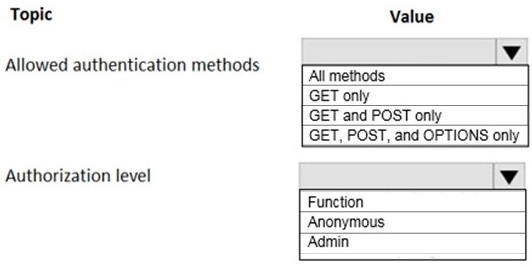
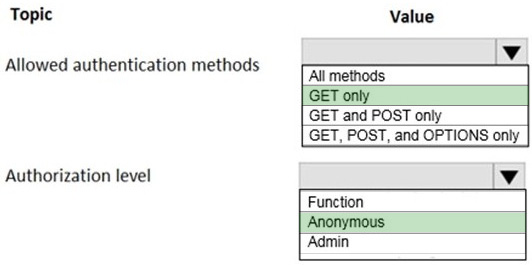
What should you recommend? To answer, configure the appropriate options in the dialog box in the answer area.
NOTE: Each correct selection is worth one point.
Reveal answer detailsClose answer details
Explanation
Allowed authentication methods: GET only
Authorization level: Anonymous The option is Allow Anonymous requests. This option turns on authentication and authorization in App Service, but defers authorization decisions to your application code. For authenticated requests, App Service also passes along authentication information in the HTTP headers.
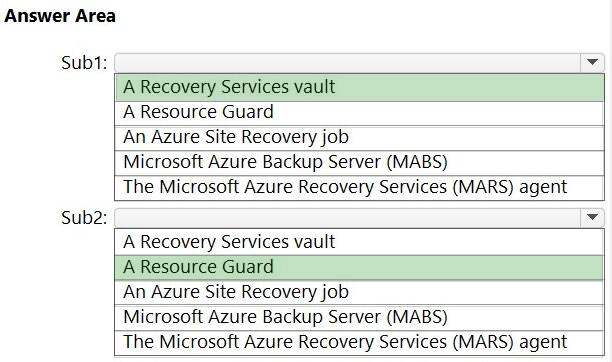
This option provides more flexibility in handling anonymous requests.
You have an Azure logic app named App1 and an Azure Service Bus queue named Queue1.
You need to ensure that App1 can read messages from Queue1. App1 must authenticate by using Azure Active Directory (Azure AD).
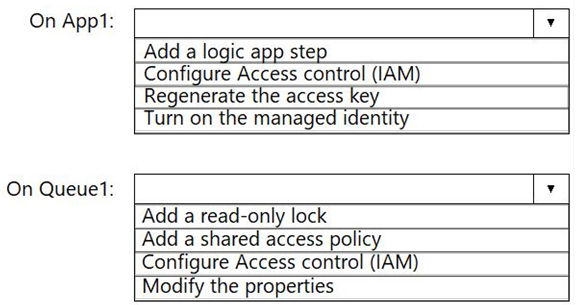
What should you do? To answer, select the appropriate options in the answer area.
NOTE: Each correct selection is worth one point.
Reveal answer detailsClose answer details
Explanation
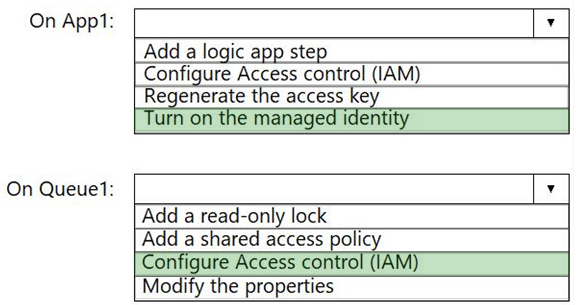
On App1: Turn on the managed identity To use Service Bus with managed identities, you need to assign the identity the role and the appropriate scope. The procedure in this section uses a simple application that runs under a managed identity and accesses Service Bus resources.
Once the application is created, follow these steps: Go to Settings and select Identity. Select the Status to be On. Select Save to save the setting.
On Queue1: Configure Access Control (IAM) Azure Active Directory (Azure AD) authorizes access rights to secured resources through role-based access control (RBAC). Azure Service Bus defines a set of built-in RBAC roles that encompass common sets of permissions used to access Service Bus entities and you can also define custom roles for accessing the data.
Assign RBAC roles using the Azure portal
In the Azure portal, navigate to your Service Bus namespace. Select Access Control (IAM) on the left menu to display access control settings for the namespace. If you need to create a Service Bus namespace. Select the Role assignments tab to see the list of role assignments. Select the Add button on the toolbar and then select Add role assignment.
You plan to deploy an app named App1 that will be hosted on multiple virtual machines. App1 requires a service-level agreement (SLA) of 99.99%.
You need to recommend a high-availability solution for the virtual machines.
What should you include in the recommendation?
A
application groups
B
availability zones
C
availability sets
D
Azure Site Recovery
Reveal answer detailsClose answer details
Correct answerB
Question 5
Single choice
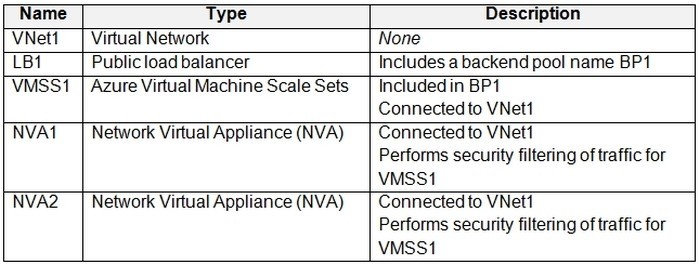
You have an Azure subscription that contains the resources shown in the following table.
You need to recommend a load balancing solution that will distribute incoming traffic for VMSS1 across NVA1 and NVA2. The solution must minimize administrative effort.
What should you include in the recommendation?
A
Gateway Load Balancer
B
Azure Front Door
C
Azure Application Gateway
D
Azure Traffic Manager
Reveal answer detailsClose answer details
Correct answerA
Explanation
Gateway Load Balancer is a fully managed service enabling you to deploy, scale, and enhance the availability of third party network virtual appliances (NVAs) in Azure. You can add your favorite third party appliance whether it's a firewall, inline DDoS appliance, deep packet inspection system, or even your own custom appliance into the network path transparently ?all with a single action.
Note: This question is part of a series of questions that present the same scenario. Each question in the series contains a unique solution that might meet the stated goals. Some question sets might have more than one correct solution, while others might not have a correct solution.
After you answer a question in this section, you will NOT be able to return to it. As a result, these questions will not appear in the review screen.
Your company plans to deploy various Azure App Service instances that will use Azure SQL databases. The App Service instances will be deployed at the same time as the Azure SQL databases.
The company has a regulatory requirement to deploy the App Service instances only to specific Azure regions. The resources for the App Service instances must reside in the same region.
You need to recommend a solution to meet the regulatory requirement.
Solution: You recommend creating resource groups based on locations and implementing resource locks on the resource groups.
Does this meet the goal?
A
Yes
B
No
Reveal answer detailsClose answer details
Correct answerB
Explanation
Resource locks are not used for compliance purposes. Resource locks prevent changes from being made to resources.
Your company has 20 web APIs that were developed in-house.
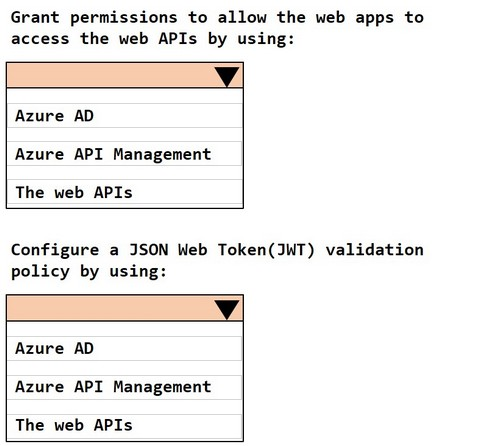
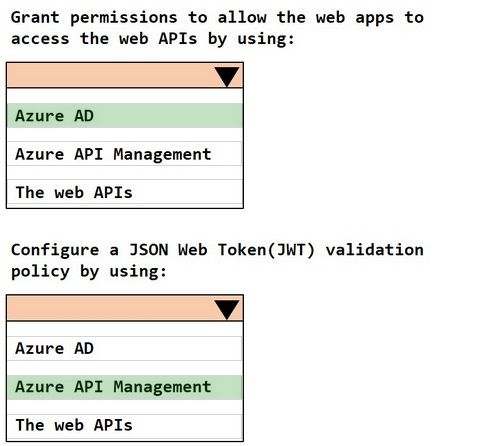
The company is developing 10 web apps that will use the web APIs. The web apps and the APIs are registered in the company s Azure AD tenant. The web APIs are published by using Azure API Management.
You need to recommend a solution to block unauthorized requests originating from the web apps from reaching the web APIs. The solution must meet the following requirements:
1. Use Azure AD-generated claims. 2. Minimize configuration and management effort
What should you include in the recommendation? To answer, select the appropriate options in the answer area. NOTE: Each correct selection is worth one point.
NOTE: Each correct selection is worth one point.
Reveal answer detailsClose answer details
Question 8
Drag & drop
DRAG DROP
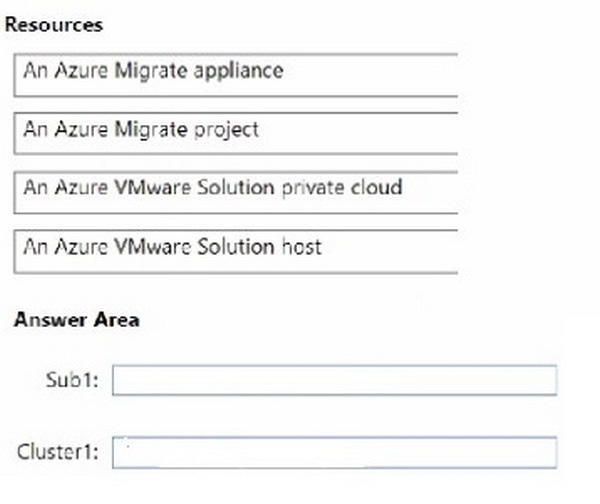
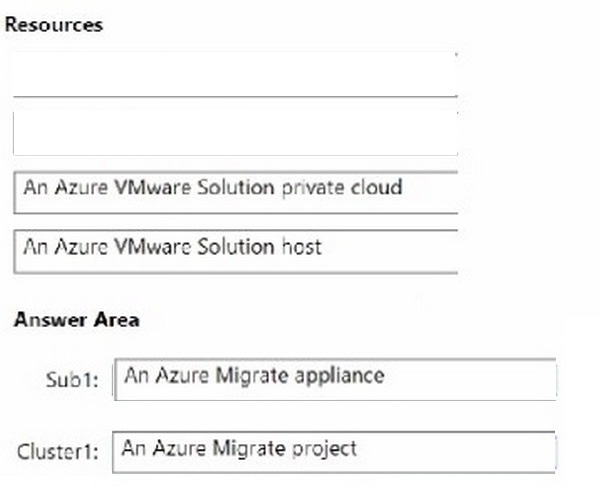
You have an on-premises datacenter named Site1. Site1 contains a VMware vSphere cluster named Cluster1 that hosts 100 virtual machines. Cluster1 is managed by using VMware vCenter.
You have an Azure subscription named Sub1.
You plan to migrate the virtual machines from Cluster1 to Sub1.
You need to identify which resources are required to run the virtual machines in Azure. The solution must minimize administrative effort.
What should you configure? To answer, drag the appropriate resources to the correct targets. Each resource may be used once, more than once, or not at all. You may need to drag the split bar between panes or scroll to view content.
NOTE: Each correct selection is worth one point.
Reveal answer detailsClose answer details
Question 9
Single choice
You need to recommend an Azure Storage solution that meets the following requirements:
1. The storage must support 1 PB of data. 2. The data must be stored in blob storage. 3. The storage must support three levels of subfolders. 4. The storage must support access control lists (ACLs).
What should you include in the recommendation?
A
a premium storage account that is configured for block blobs
B
a general purpose v2 storage account that has hierarchical namespace enabled
C
a premium storage account that is configured for page blobs
D
a premium storage account that is configured for files shares and supports large file shares
Reveal answer detailsClose answer details
Correct answerB
Explanation
Microsoft recommends that you use a GPv2 storage account for most scenarios. It supports up to 5 PB, and blob storage including Data Lake storage.
Note: A key mechanism that allows Azure Data Lake Storage Gen2 to provide file system performance at object storage scale and prices is the addition of a hierarchical namespace. This allows the collection of objects/files within an account to be organized into a hierarchy of directories and nested subdirectories in the same way that the file system on your computer is organized. With a hierarchical namespace enabled, a storage account becomes capable of providing the scalability and cost-effectiveness of object storage, with file system semantics that are familiar to analytics engines and frameworks.
HABInsurance is an insurance company that operates in three states and provides home, auto, and boat insurance. The company has a head office and three regional offices.
Existing Environment:
HABInsurance hosts its primary workloads in an on-premises datacenter located at the head office. The regional offices connect to the datacenter over VPN connections via the internet.
Network The on-premises datacenter uses a flat network topology. All servers are deployed in a single subnet. Internet access is provided through a centralized firewall. There is no existing ExpressRoute connection.
Identity HABInsurance has two Active Directory forests: main.habinsurance.com and region.habinsurance.com. Some users exist in both forests, but there is no trust relationship between the forests.
Applications The company's primary internal system is the Insurance Processing System (IPS). IPS is an ASP.NET application written in C# and hosted on IIS servers running Windows Server in the on-premises datacenter.
IPS has a three-tier architecture: Web tier hosted on IIS servers Business logic API tier hosted on IIS servers Data tier hosted on database servers
The application has the following characteristics: The web and API tiers are stateless Session state is stored in the database tier The application supports horizontal scaling The application currently uses Windows authentication internally
Data platform Customer data is stored in a Microsoft SQL Server database named IPSCustomers. The database size is approximately 500 GB and is expected to grow by 20 percent annually. Workload patterns vary significantly during the day.
Insurance forms and documents are stored in a MongoDB database. The application uses MongoDB APIs and drivers extensively. The company requires minimal code changes during migration.
File storage The company stores approximately 10 TB of Human Resources (HR) data on a NAS device at the head office. The data is accessed by using the SMB protocol and NTFS permissions must be preserved. Users in regional offices frequently access this data.
Requirements
General HABInsurance plans to migrate its workloads to Azure. The company has purchased an Azure subscription. The solution must minimize administrative overhead and support future scalability.
Identity requirements The company must implement a hybrid identity solution that integrates with Microsoft Entra ID. All users must have a single identity across both forests. The solution must support synchronization of both forests to Microsoft Entra ID. The company plans to use administrative units to delegate management. Users must be able to access Microsoft 365 services by using the same credentials as on-premises resources.
Application requirements The IPS application must be migrated to Azure with minimal code changes. The web and API tiers must automatically scale based on CPU utilization. The compute platform must provide an SLA of at least 99.95 percent. The solution must support future migration to containers.
The company plans to implement a customer self-service portal and expose selected APIs securely to external users.
Data requirements
SQL database The IPSCustomers database must be migrated to a fully managed Azure database service. The solution must support independent scaling of compute and storage. The solution must support variable workloads and optimize cost during periods of low usage. The solution must minimize downtime during scaling operations. The solution must support automated backups and high availability.
Document database Insurance forms and documents must be migrated to an Azure service that supports MongoDB APIs. The solution must require minimal application changes. The solution must support global distribution in the future.
File storage HR data must be migrated to Azure. The solution must support SMB access and preserve NTFS permissions. The solution must allow hybrid access from on-premises and Azure. The solution must support efficient initial data transfer of 10 TB.
Networking requirements The company plans to establish secure connectivity between the on-premises datacenter and Azure. The solution must support private access to Azure PaaS services. The company may implement ExpressRoute in the future.
Security requirements
The company plans to integrate internal and third-party applications with Microsoft Entra ID. Users must be able to grant consent to applications, but administrative approval must be required for high-privilege permissions. The solution must support conditional access policies.
High availability and disaster recovery requirements The IPS application must be highly available within a region. The company plans to deploy IPS to multiple Azure regions in the future. The solution must ensure application availability during regional outages. The solution must minimize performance impact for users accessing the application globally.
Question 11
Testlet 4Single choice
A company has an on-premises file server cbflserver that runs Windows Server 2019.
Windows Admin Center manages this server. The company owns an Azure subscription.
You need to provide an Azure solution to prevent data loss if the file server fails.
Solution: You decide to create an Azure Recovery Services vault. You then decide to install the Azure Backup agent and then schedule the backup.
Would this meet the requirement?
A
Yes
B
No
Reveal answer detailsClose answer details
Correct answerA
Question 12
Single choice
You have an Azure subscription that contains 1,000 resources.
You need to generate compliance reports for the subscription. The solution must ensure that the resources can be grouped by department.
What should you use to organize the resources?
A
application groups and quotas
B
Azure Policy and tags
C
administrative units and Azure Lighthouse
D
resource groups and role assignments
Reveal answer detailsClose answer details
Correct answerB
Explanation
Compliance Report using Azure Policy Azure Policy is a powerful tool for Azure Governance. With Azure Policy we can define rules for all Azure Subscriptions the we manage. We can use this rules for simple limitation actions, like permitting only specific VM Series and Sizes that can be created and also more complex rule sets that helps you standardize the whole Azure deployment.
Enforce tags for resource creation So, why tags? Why we need to add tags to all Azure resources? The Microsoft Azure environments are getting bigger and bigger and managed by multiple people and teams. That makes it difficult to understand who created a resource and what is the purpose of that resource. Another critical matter that we need tags is Cost Management. At the Azure Cost Management Portal, we can sort and arrange the resource cost using the Tags. This way we can provide an expense dashboard with the actual cost of the resources per department, project or whatever tags we have added to the Resource.
You have an on-premises file server that stores 2 TB of data files.
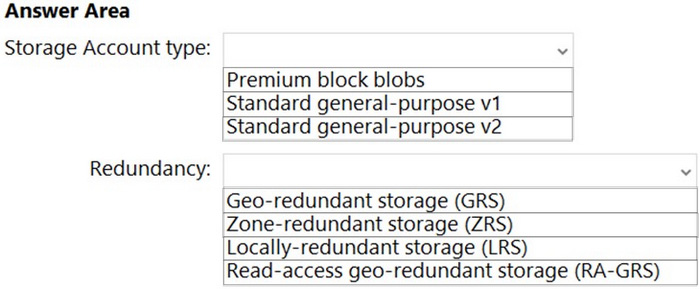
You plan to move the data files to Azure Blob Storage In the West Europe Azure region,
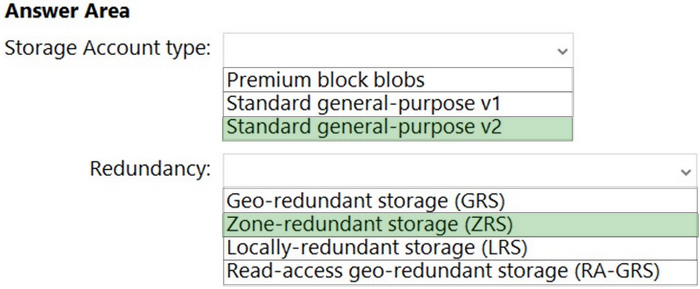
You need to recommend a storage account type to store the data files and a replication solution for the storage account. The solution must meet the following requirements:
1. Be available if a single Azure datacenter fails. 2. Support storage tiers. 3. Minimize cost.
What should you recommend? To answer, select the appropriate options in the answer area.
Data must be available if a single Azure datacenter fails. It means the storage account must support ZRS replication. Also, solution should support storage tiers. Only General-purpose V2 supports ZRS and storage tiers.
Litware has 10 Azure subscriptions that are linked to the Litware.com tenant and five Azure subscriptions that are linked to the dev.litware.com tenant. All the subscriptions are in an Enterprise Agreement (EA).
The litware.com tenant contains a custom Azure role-based access control (Azure RBAC) role named Role1 that grants the DataActions read permission to the blobs and files in Azure Storage.
On-Premises Environment
The on-premises network of Litware contains the resources shown in the following table.
Network Environment
Litware has ExpressRoute connectivity to Azure.
Planned Changes and Requirements
Litware plans to implement the following changes:
1. Migrate DB1 and DB2 to Azure. 2. Migrate App1 to Azure virtual machines. 3. Migrate the external storage used by App1 to Azure Storage. 4. Deploy the Azure virtual machines that will host App1 to Azure dedicated hosts.
Authentication and Authorization Requirements
Litware identifies the following authentication and authorization requirements:
Only users that manage the production environment by using the Azure portal must connect from a hybrid Azure AD-joined device and authenticate by using Azure Multi-Factor Authentication (MFA). The Network Contributor built-in RBAC role must be used to grant permissions to the network administrators for all the virtual networks in all the Azure subscriptions. To access the resources in Azure, App1 must use the managed identity of the virtual machines that will host the app. RBAC roles must be applied at the highest level possible.
Resiliency Requirements
Litware identifies the following resiliency requirements:
Once migrated to Azure, DB1 and DB2 must meet the following requirements: - Maintain availability if two availability zones in the local Azure region fail. - Fail over automatically. - Minimize I/O latency. App1 must meet the following requirements: - Be hosted in an Azure region that supports availability zones. - Be hosted on Azure virtual machines that support automatic scaling. - Maintain availability if two availability zones in the local Azure region fail.
Security and Compliance Requirements
Litware identifies the following security and compliance requirements:
1. Once App1 is migrated to Azure, you must ensure that new data can be written to the app, and the modification of new and existing data is prevented for a period of three years. 2. On-premises users and services must be able to access the Azure Storage account that will host the data in App1. 3. Access to the public endpoint of the Azure Storage account that will host the App1 data must be prevented. 4. All Azure SQL databases in the production environment must have Transparent Data Encryption (TDE) enabled. 5. App1 must NOT share physical hardware with other workloads.
Business Requirements
Litware identifies the following business requirements:
You plan to migrate App1 to Azure. The solution must meet the authentication and authorization requirements.
Which type of endpoint should App1 use to obtain an access token?
A
Azure Instance Metadata Service (IMDS)
B
Azure AD
C
Azure Service Management
D
Microsoft identity platform
Reveal answer detailsClose answer details
Correct answerD
Explanation
Scenario: To access the resources in Azure, App1 must use the managed identity of the virtual machines that will host the app.
Managed identities provide an identity for applications to use when connecting to resources that support Azure Active Directory (Azure AD) authentication. Applications may use the managed identity to obtain Azure AD tokens.
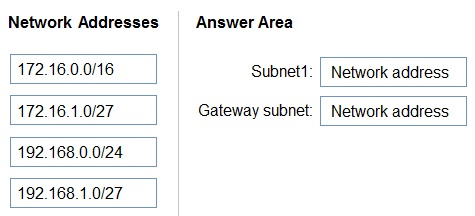
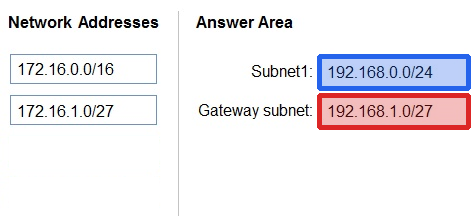
You have an on-premises network that uses an IP address space of 172.16.0.0/16. You plan to deploy 25 virtual machines to a new Azure subscription. You identify the following technical requirements:
1. All Azure virtual machines must be placed on the same subnet named Subnet1. 2. All the Azure virtual machines must be able to communicate with all on-premises servers. 3. The servers must be able to communicate between the on-premises network and Azure by using a site-
to-site VPN.
You need to recommend a subnet design that meets the technical requirements.
What should you include in the recommendation? To answer, drag the appropriate network addresses to the correct subnets. Each network address may be used once, more than once, or not at all. You may need to drag the split bar between panes or scroll to view content
NOTE: Each correct selection is worth one point.
Reveal answer detailsClose answer details
Question 16
Single choice
You plan to migrate on-premises MySQL databases to Azure Database for MySQL Flexible Server.
You need to recommend a solution for the Azure Database for MySQL Flexible Server configuration. The solution must meet the following requirements:
1. The databases must be accessible if a datacenter fails. 2. Costs must be minimized.
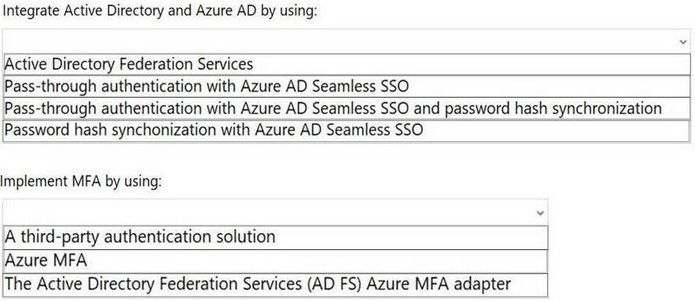
You need to design an authentication solution that will integrate on-premises Active Directory and Azure Active Directory (Azure AD). The solution must meet the following requirements:
1. Active Directory users must not be able to sign in to Azure AD-integrated apps outside of the sign-in hours configured in the Active Directory user accounts. 2. Active Directory users must authenticate by using multi-factor authentication (MFA) when they sign in to Azure AD-integrated apps. 3. Administrators must be able to obtain Azure AD-generated reports that list the Active Directory users who have leaked credentials. 4. The infrastructure required to implement and maintain the solution must be minimized.
What should you include in the solution? To answer, select the appropriate options in the answer area.
NOTE: Each correct selection is worth one point.
Reveal answer detailsClose answer details
Explanation
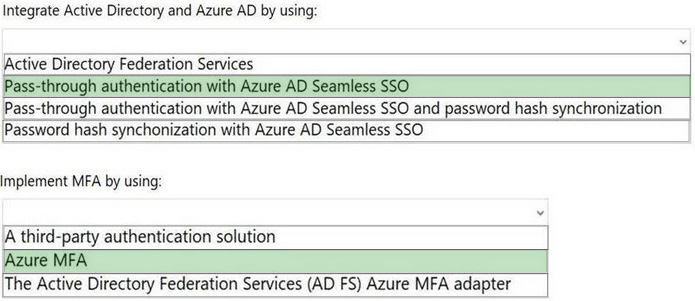
Box 1: Pass-through Authentication with Azure AD Seamless SSO Azure AD Seamless SSO versus Active Directory Federation Services Companies with a security requirement to immediately enforce on-premises user account states, password policies, and sign-in hours might use Azure AD Pass-through Authentication. You can combine Pass-through Authentication with the Seamless Single Sign-On feature.
Note: Azure AD supports the following authentication methods for hybrid identity solutions. Azure AD password hash synchronization Azure AD Pass-through Authentication
Box 2: Azure MFA One key benefit with Azure AD Pass-through Authentication is that it works seamlessly with Azure MFA.
You have an Azure subscription. The subscription contains virtual machines that run Windows Server.
You are designing a disaster recovery solution that will immediately deploy a new virtual machine when an existing virtual machine fails. The solution must meet the following requirements:
New virtual machines must be deployed with all the required configurations in place.
Virtual machine deployments must use an infrastructure as code (IaC) methodology.
New virtual machines must be created by using standard Microsoft disk images.
New virtual machines must be authorized by virtual machine administrators.
Virtual machine deployments must be managed by using CI/CD pipelines.
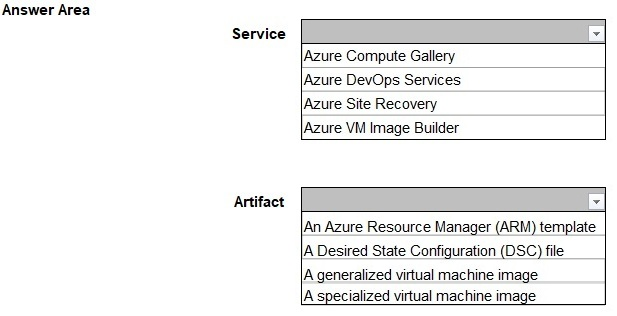
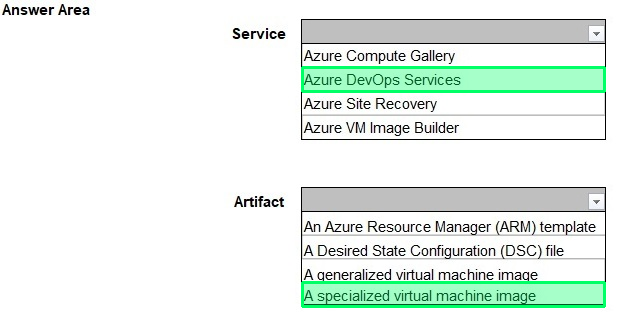
You need to recommend which service to use to manage the virtual machine deployment process and which artifact to use to create each virtual machine.
What should you recommend? To answer, select the appropriate options in the answer area.
NOTE: Each correct selection is worth one point.
Reveal answer detailsClose answer details
Question 19
Hotspot
HOTSPOT
You have an Azure subscription that contains a resource group named RG1.
You have a group named Group1 that is assigned the Contributor role for RG1.
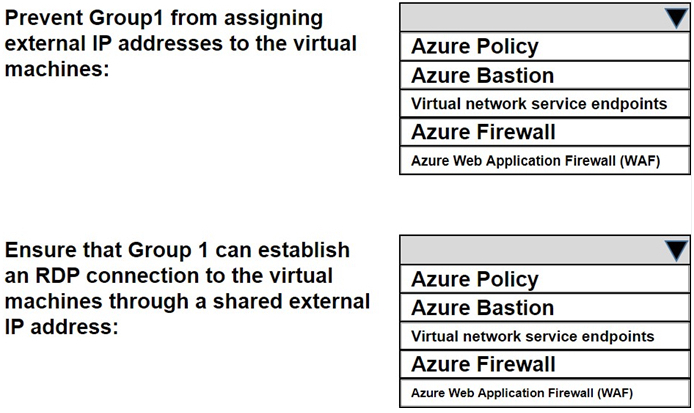
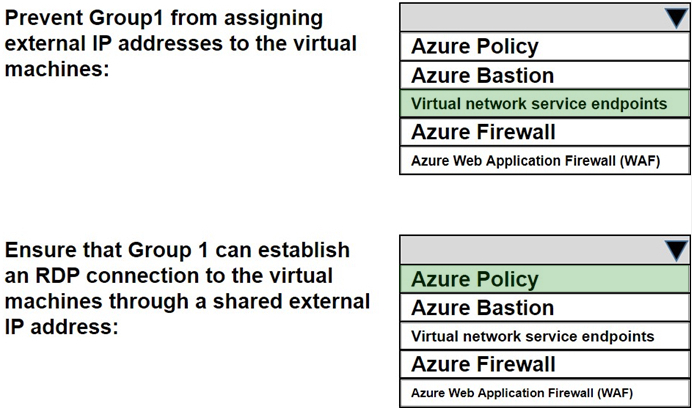
You need to enhance security for the virtual machines in RG1 to meet the following requirements: 1. Prevent Group1 from assigning external IP addresses to the virtual machines. 2. Ensure that Group1 can establish an RDP connection to the virtual machines through a shared external IP address.
What should you use to meet each requirement? To answer, select the appropriate options in the answer area.
NOTE: Each correct selection is worth one point.
Reveal answer detailsClose answer details
Question 20
Single choice
You are designing a microservices architecture that will support a web application.
The solution must meet the following requirements:
1. Allow independent upgrades to each microservice 2. Deploy the solution on-premises and to Azure 3. Set policies for performing automatic repairs to the microservices 4. Support low-latency and hyper-scale operations
Your on-premises network contains 100 virtual machines that run Windows Server 2019.
You have an Azure subscription that contains an Azure Log Analytics workspace named Workspace1.
You need to collect errors from the Windows event logs on the virtual machines.
Which two actions should you perform' Each correct answer presents part of the solution.
NOTE: Each correct selection is worth one point.
A
Configure the Data Collection settings for Workspace1.
B
Deploy the Microsoft Monitoring Agent
C
Create an Azure Event Grid domain
D
Create an Azure Sentinel workspace.
E
Configure Windows Event Forwarding on the virtual machines
Reveal answer detailsClose answer details
Correct answersA, B
Explanation
The Azure Log Analytics agent collects telemetry from Windows and Linux virtual machines in any cloud, on-premises machines, and those monitored by System Center Operations Manager and sends it collected data to your Log Analytics workspace in Azure Monitor.
Note: You may also see the Log Analytics agent referred to as the Microsoft Monitoring Agent (MMA) or OMS Linux agent. Data is collected using the Log Analytics agent, which reads various security-related configurations and event logs from the machine and copies the data to your workspace for analysis.
You manage an application instance. The application consumes data from multiple databases. Application code references database tables by using a combination of the server, database, and table name.
You need to migrate the application data to Azure.
To which two Azure services could you migrate the application to achieve the goal? Each correct answer presents a complete solution.
NOTE: Each correct selection is worth one point.
A
Azure SQL Managed Instance
B
Azure SQL Database
C
SQL Server on an Azure virtual machine
D
SQL Server Stretch Database
Reveal answer detailsClose answer details
Correct answersA, C
Case study
Case Study 4
Overview
HABInsurance is an insurance company that operates in three states and provides home, auto, and boat insurance. The company has a head office and three regional offices.
Existing Environment:
HABInsurance hosts its primary workloads in an on-premises datacenter located at the head office. The regional offices connect to the datacenter over VPN connections via the internet.
Network The on-premises datacenter uses a flat network topology. All servers are deployed in a single subnet. Internet access is provided through a centralized firewall. There is no existing ExpressRoute connection.
Identity HABInsurance has two Active Directory forests: main.habinsurance.com and region.habinsurance.com. Some users exist in both forests, but there is no trust relationship between the forests.
Applications The company's primary internal system is the Insurance Processing System (IPS). IPS is an ASP.NET application written in C# and hosted on IIS servers running Windows Server in the on-premises datacenter.
IPS has a three-tier architecture: Web tier hosted on IIS servers Business logic API tier hosted on IIS servers Data tier hosted on database servers
The application has the following characteristics: The web and API tiers are stateless Session state is stored in the database tier The application supports horizontal scaling The application currently uses Windows authentication internally
Data platform Customer data is stored in a Microsoft SQL Server database named IPSCustomers. The database size is approximately 500 GB and is expected to grow by 20 percent annually. Workload patterns vary significantly during the day.
Insurance forms and documents are stored in a MongoDB database. The application uses MongoDB APIs and drivers extensively. The company requires minimal code changes during migration.
File storage The company stores approximately 10 TB of Human Resources (HR) data on a NAS device at the head office. The data is accessed by using the SMB protocol and NTFS permissions must be preserved. Users in regional offices frequently access this data.
Requirements
General HABInsurance plans to migrate its workloads to Azure. The company has purchased an Azure subscription. The solution must minimize administrative overhead and support future scalability.
Identity requirements The company must implement a hybrid identity solution that integrates with Microsoft Entra ID. All users must have a single identity across both forests. The solution must support synchronization of both forests to Microsoft Entra ID. The company plans to use administrative units to delegate management. Users must be able to access Microsoft 365 services by using the same credentials as on-premises resources.
Application requirements The IPS application must be migrated to Azure with minimal code changes. The web and API tiers must automatically scale based on CPU utilization. The compute platform must provide an SLA of at least 99.95 percent. The solution must support future migration to containers.
The company plans to implement a customer self-service portal and expose selected APIs securely to external users.
Data requirements
SQL database The IPSCustomers database must be migrated to a fully managed Azure database service. The solution must support independent scaling of compute and storage. The solution must support variable workloads and optimize cost during periods of low usage. The solution must minimize downtime during scaling operations. The solution must support automated backups and high availability.
Document database Insurance forms and documents must be migrated to an Azure service that supports MongoDB APIs. The solution must require minimal application changes. The solution must support global distribution in the future.
File storage HR data must be migrated to Azure. The solution must support SMB access and preserve NTFS permissions. The solution must allow hybrid access from on-premises and Azure. The solution must support efficient initial data transfer of 10 TB.
Networking requirements The company plans to establish secure connectivity between the on-premises datacenter and Azure. The solution must support private access to Azure PaaS services. The company may implement ExpressRoute in the future.
Security requirements
The company plans to integrate internal and third-party applications with Microsoft Entra ID. Users must be able to grant consent to applications, but administrative approval must be required for high-privilege permissions. The solution must support conditional access policies.
High availability and disaster recovery requirements The IPS application must be highly available within a region. The company plans to deploy IPS to multiple Azure regions in the future. The solution must ensure application availability during regional outages. The solution must minimize performance impact for users accessing the application globally.
Question 23
Testlet 4Single choice
A company is planning on deploying an application onto Azure. The application will be based on the .Net core programming language. The application would be hosted using Azure Web apps. Below is part of the various requirements for the application
Give the ability to correlate Azure resource usage and the performance data with the actual application configuration and performance data Give the ability to visualize the relationships between application components Give the ability to track requests and exceptions to specific lines of code from within the application Give the ability to actually analyse how uses return to an application and see how often they only select a particular drop-down value
Which of the following service would be best suited for fulfilling the requirement of "Give the ability to correlate Azure resource usage and the performance data with the actual application configuration and performance data" ?
A
Azure Application Insights
B
Azure Service Map
C
Azure Log Analytics
D
Azure Activity Log
Reveal answer detailsClose answer details
Correct answerC
Question 24
Multiple choice
You are designing an Azure web app that will use Azure Active Directory (Azure AD) for authentication.
You need to recommend a solution to provide users from multiple Azure AD tenants with access to App1.
The solution must ensure that the users use Azure Multi-Factor Authentication (MFA) when they connect to App1.
Which two types of objects should you include in the recommendation? Each correct answer presents part of the solution.
NOTE: Each correct selection is world one point
A
Azure AD conditional access policies
B
Azure AD managed identities
C
an Identity Experience Framework policy
D
an Azure application security group
E
a Microsoft Intune app protection policy
F
Azure AD guest accounts
Reveal answer detailsClose answer details
Correct answersA, C
Explanation
Option A: The Conditional Access feature in Azure Active Directory (Azure AD) offers one of several ways that you can use to secure your app and protect a service. Conditional Access enables developers and enterprise customers to protect services in a multitude of ways including: 1. Multi-factor authentication 2. Allowing only Intune enrolled devices to access specific services 3. Restricting user locations and IP ranges
Option B: Conditional Access policies are powerful tools, we recommend excluding the following accounts from your policy: Service accounts and service principals.If your organization has these accounts in use in scripts or code, consider replacing them with managed identities.
Incorrect Answers: Option E: Application security groups enable you to configure network security as a natural extension of an application's structure, allowing you to group virtual machines and define network security policies based on those groups
Fabrikam, Inc. is an engineering company that has offices throughout Europe. The company has a main office in London and three branch offices in Amsterdam, Berlin, and Rome.
Existing Environment: Active Directory Environment
The network contains two Active Directory forests named corp.fabrikam.com and rd.fabrikam.com. There are no trust relationships between the forests.
Corp.fabrikam.com is a production forest that contains identities used for internal user and computer authentication.
Rd.fabrikam.com is used by the research and development (R&D) department only. The R&D department is restricted to using on-premises resources only.
Existing Environment: Network Infrastructure
Each office contains at least one domain controller from the corp.fabrikam.com domain. The main office contains all the domain controllers for the rd.fabrikam.com forest.
All the offices have a high-speed connection to the internet.
An existing application named WebApp1 is hosted in the data center of the London office. WebApp1 is used by customers to place and track orders. WebApp1 has a web tier that uses Microsoft Internet information Services (IIS) and a database tier that runs Microsoft SQL Server 2016. The web tier and the database tier are deployed to virtual machines that run on Hyper-V.
The IT department currently uses a separate Hyper-V environment to test updates to WebApp1.
Fabrikam purchases all Microsoft licenses through a Microsoft Enterprise Agreement that includes Software Assurance.
Existing Environment: Problem Statements
The use of WebApp1 is unpredictable. At peak times, users often report delays. At other times, many resources for WebApp1 are underutilized.
Requirements: Planned Changes
Fabrikam plans to move most of its production workloads to Azure during the next few years, including virtual machines that rely on Active Directory for authentication.
As one of its first projects, the company plans to establish a hybrid identity model, facilitating an upcoming Microsoft 365 deployment.
All R&D operations will remain on-premises.
Fabrikam plans to migrate the production and test instances of WebApp1 to Azure.
Requirements: Technical Requirements
Fabrikam identifies the following technical requirements:
1. Website content must be easily updated from a single point. 2. User input must be minimized when provisioning new web app instances. 3. Whenever possible, existing on-premises licenses must be used to reduce cost. 4. Users must always authenticate by using their corp.fabrikam.com UPN identity. 5. Any new deployments to Azure must be redundant in case an Azure region fails. 6. Whenever possible, solutions must be deployed to Azure by using the Standard pricing tier of Azure App Service. 7. An email distribution group named IT Support must be notified of any issues relating to the directory synchronization services. 8. In the event that a link fails between Azure and the on-premises network, ensure that the virtual machines hosted in Azure can authenticate to Active Directory. 9. Directory synchronization between Azure Active Directory (Azure AD) and corp.fabrikam.com must not be affected by a link failure between Azure and the on-premises network.
Requirements: Database Requirements
Fabrikam identifies the following database requirements:
1. Database metrics for the production instance of WebApp1 must be available for analysis so that database administrators can optimize the performance settings. 2. To avoid disrupting customer access, database downtime must be minimized when databases are migrated. 3. Database backups must be retained for a minimum of seven years to meet compliance requirements.
Requirements: Security Requirements
Fabrikam identifies the following security requirements:
1. Company information including policies, templates, and data must be inaccessible to anyone outside the company. 2. Users on the on-premises network must be able to authenticate to corp.fabrikam.com if an internet link fails. 3. Administrators must be able authenticate to the Azure portal by using their corp.fabrikam.com credentials. 4. All administrative access to the Azure portal must be secured by using multi-factor authentication (MFA). 5. The testing of WebApp1 updates must not be visible to anyone outside the company.
Question 25
Testlet 2Single choice
You need to recommend a data storage strategy for WebApp1.
What should you include in in the recommendation?
A
an Azure SQL Database elastic pool
B
a vCore-based Azure SQL database
C
an Azure virtual machine that runs SQL Server
D
a fixed-size DTU AzureSQL database.
Reveal answer detailsClose answer details
Correct answerB
Question 26
Single choice
You have a Microsoft Entra tenant named contoso.com.
You have a partner organization that has a Microsoft Entra tenant named fabrikam.com.
You plan to provide the users in fabrikam.com with access to the resources in contoso.com by using access packages.
You need to ensure that contoso.com users assigned the Access package assignment manager role can only assign access packages to the fabrikam.com users.
What should you do first in the Microsoft Entra admin center?
A
From the Entitlement management settings in Identity Governance, create a new connected organization.
B
From the Cross-tenant access settings in External Identities, create a new organization.
C
From the Cross-tenant synchronization settings, create a new configuration.
D
From the All identity providers settings in External Identities, create a new SAML/WS Fed IdP identity provider.
Reveal answer detailsClose answer details
Correct answerA
Question 27
Hotspot
HOTSPOT
You have the Azure subscriptions shown in the following table.
Contoso.onmicrosft.com contains a user named User1.
You need to deploy a solution to protect against ransomware attacks. The solution must meet the following requirements:
1. Ensure that all the resources in Sub1 are backed up by using Azure Backup. 2. Require that User1 first be assigned a role for Sub2 before the user can make major changes to the backup configuration.
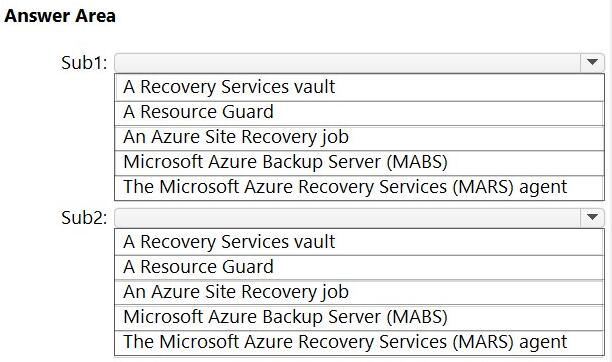
What should you create in each subscription? To answer, select the appropriate options in the answer area.
NOTE: Each correct selection is worth one point.
Reveal answer detailsClose answer details
Explanation
Box 1: A Recovery Services vault Ensure that all the resources in Sub1 are backed up by using Azure Backup.
A Recovery Services vault is an entity that stores the backups and recovery points created over time. The Recovery Services vault also contains the backup policies that are associated with the protected virtual machines.
Azure Backup automatically handles storage for the vault.
Box 2: A Resource Guard Require that User1 first be assigned a role for Sub2 before the user can make major changes to the backup configuration.
A Resource Guard is an Azure resource that can be created in the same subscription, a different subscription in the same Azure AD tenant, or even a subscription in a different Azure AD tenant! When associated to an RSV (Recovery Service Vault), a user looking to make risky modifications to it (such as removing soft delete) must have permissions on BOTH the Resource Guard and the RSV. This means it can support separate authorization boundaries at the subscription level or even completely separate identity and authentication boundaries at the tenant.
You are designing an order processing system in Azure that will contain the Azure resources shown in the following table.
The order processing system will have the following transaction flow:
1. A customer will place an order by using App1. 2. When the order is received, App1 will generate a message to check for product availability at vendor 1 and vendor 2. 3. An integration component will process the message, and then trigger either Function1 or Function2 depending on the type of order. 4. Once a vendor confirms the product availability, a status message for App1 will be generated by Function1 or Function2. 5. All the steps of the transaction will be logged to storage1.
Which type of resource should you recommend for the integration component?
Which type of resource should you recommend for the integration component?
A
an Azure Data Factory pipeline
B
an Azure Service Bus queue
C
an Azure Event Grid domain
D
an Azure Event Hubs capture
Reveal answer detailsClose answer details
Correct answerA
Explanation
A data factory can have one or more pipelines. A pipeline is a logical grouping of activities that together perform a task. The activities in a pipeline define actions to perform on your data. Data Factory has three groupings of activities: data movement activities, data transformation activities, and control activities. Azure Functions is now integrated with Azure Data Factory, allowing you to run an Azure function as a step in your data factory pipelines.
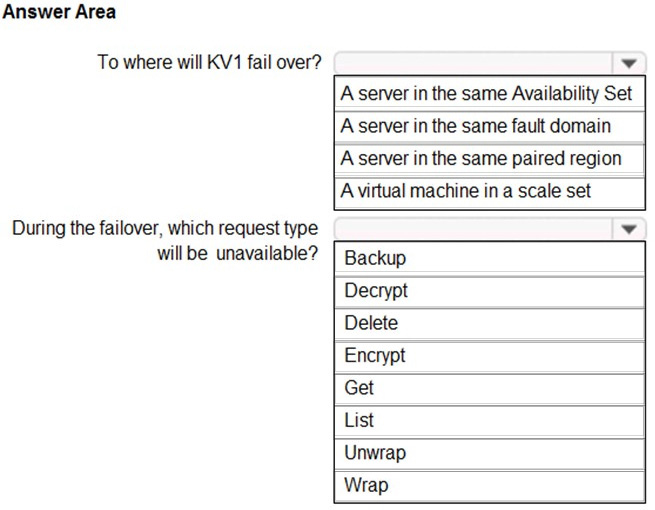
You have an Azure web app named App1 and an Azure key vault named KV1.
App1 stores database connection strings in KV1.
App1 performs the following types of requests to KV1:
Get List Wrap Delete Unwrap Backup Decrypt Encrypt
You are evaluating the continuity of service for App1.
You need to identify the following if the Azure region that hosts KV1 becomes unavailable:
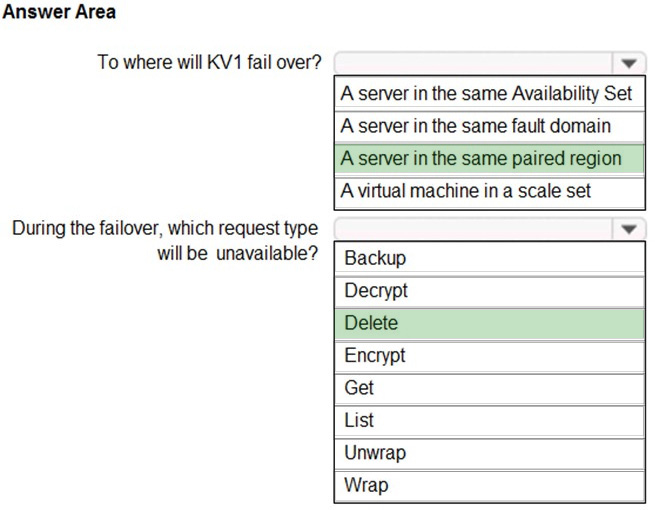
To where will KV1 fail over? During the failover, which request type will be unavailable?
What should you identify? To answer, select the appropriate options in the answer area.
NOTE: Each correct selection is worth one point.
Reveal answer detailsClose answer details
Explanation
Box 1: A server in the same paired region The contents of your key vault are replicated within the region and to a secondary region at least 150 miles away, but within the same geography to maintain high durability of your keys and secrets.
Box 2: Delete During failover, your key vault is in read-only mode. Requests that are supported in this mode are: List certificates Get certificates List secrets Get secrets List keys Get (properties of) keys Encrypt Decrypt Wrap Unwrap Verify Sign Backup
Your company plans to deploy various Azure App Service instances that will use Azure SQL databases. The App Service instances will be deployed at the same time as the Azure SQL databases.
The company has a regulatory requirement to deploy the App Service instances only to specific Azure regions. The resources for the App Service instances must reside in the same region.
You need to recommend a solution to meet the regulatory requirement.
Solution: You recommend using the Regulatory compliance dashboard in Microsoft Defender for Cloud.
Does this meet the goal?
A
Yes
B
No
Reveal answer detailsClose answer details
Correct answerB
Question 31
Hotspot
HOTSPOT
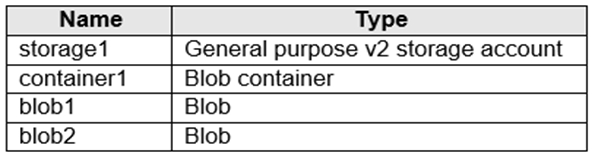
You have an Azure subscription that contains the resources shown in the following table.
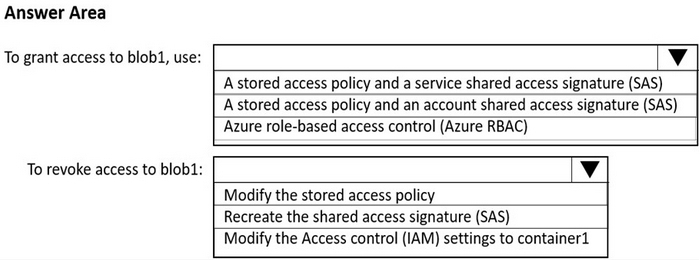
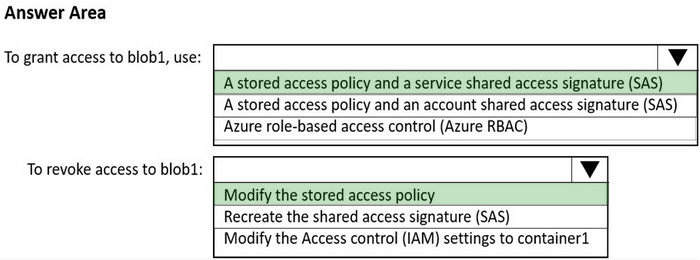
You need to recommend an authorization mechanism for controlling access to blob1. The solution must ensure that access to blob1 can be configured without affecting the other resources in storage1.
What should you recommend? To answer, select the appropriate options in the answer area.
Reveal answer detailsClose answer details
Explanation
Box 1: A stored access policy and a service shared access signature (SAS) A stored access policy provides an additional level of control over service-level shared access signatures (SAS) on the server side. Establishing a stored access policy serves to group shared access signatures and to provide additional restrictions for signatures that are bound by the policy.
The following storage resources support stored access policies: 1. Blob containers 2. File shares 3. Queues 4. Tables
Box 2: Modify the stored access signature (SAS) You can use a stored access policy to change the start time, expiry time, or permissions for a signature, or to revoke it after it has been issued.
You have an on-premises network and an Azure subscription. The on-premises network has several branch offices.
A branch office in Toronto contains a virtual machine named VM1 that is configured as a file server. Users access the shared files on VM1 from all the offices.
You need to recommend a solution to ensure that the users can access the shares files as quickly as possible if the Toronto branch office is inaccessible.
What should you include in the recommendation?
A
a Recovery Services vault and Azure Backup
B
an Azure file share and Azure File Sync
C
Azure blob containers and Azure File Sync
D
a Recovery Services vault and Windows Server Backup
Reveal answer detailsClose answer details
Correct answerB
Explanation
Use Azure File Sync to centralize your organization's file shares in Azure Files, while keeping the flexibility, performance, and compatibility of an on-premises file server. Azure File Sync transforms Windows Server into a quick cache of your Azure file share.
You need an Azure file share in the same region that you want to deploy Azure File Sync.
Note: This question is part of a series of questions that present the same scenario. Each question in the series contains a unique solution that might meet the stated goals. Some question sets might have more than one correct solution, while others might not have a correct solution.
After you answer a question in this section, you will NOT be able to return to it. As a result, these questions will not appear in the review screen.
Your company has deployed several virtual machines (VMs) on-premises and to Azure. Azure ExpressRoute has been deployed and configured for on-premises to Azure connectivity.
Several VMs are exhibiting network connectivity issues.
You need to analyze the network traffic to determine whether packets are being allowed or denied to the VMs.
Solution: Install and configure the Microsoft Monitoring Agent and the Dependency Agent on all VMs. Use the Wire Data solution in Azure Monitor to analyze the network traffic.
Does the solution meet the goal?
A
Yes
B
No
Reveal answer detailsClose answer details
Correct answerB
Explanation
Instead use Azure Network Watcher to run IP flow verify to analyze the network traffic.
Note: Wire Data looks at network data at the application level, not down at the TCP transport layer. The solution doesn't look at individual ACKs and SYNs.
You need to recommend a solution to generate a monthly report of all the new Azure Resource Manager
resource deployment in your subscription.
What should you include in the recommendation?
A
Azure Activity Log
B
Azure Monitor action groups
C
Azure Advisor
D
Azure Monitor metrics
Reveal answer detailsClose answer details
Correct answerA
Question 35
Drag & drop
DRAG DROP
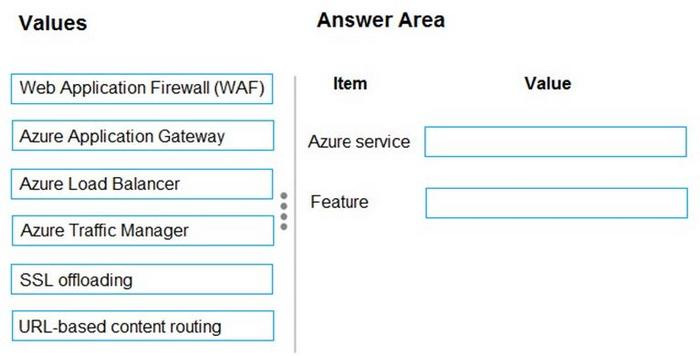
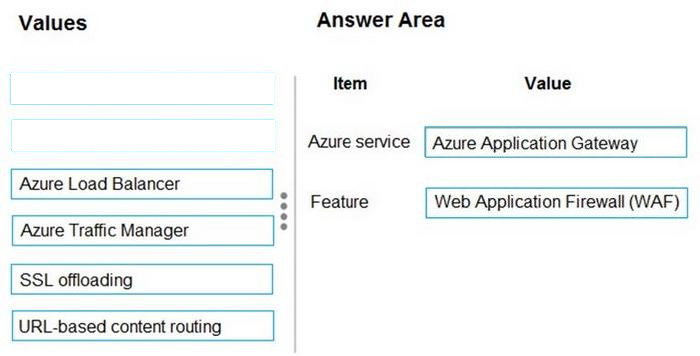
A company has an existing web application that runs on virtual machines (VMs) in Azure.
You need to ensure that the application is protected from SQL injection attempts and uses a layer-7 load balancer. The solution must minimize disruption to the code for the existing web application.
What should you recommend? To answer, drag the appropriate values to the correct items. Each value may be used once, more than once, or not at all. You may need to drag the split bar between panes or scroll to view content.
NOTE: Each correct selection is worth one point.
Reveal answer detailsClose answer details
Explanation
Box 1: Azure Application Gateway Azure Application Gateway provides an application delivery controller (ADC) as a service. It offers various layer 7 load-balancing capabilities for your applications.
Box 2: Web Application Firwewall (WAF) Application Gateway web application firewall (WAF) protects web applications from common vulnerabilities and exploits.
This is done through rules that are defined based on the OWASP core rule sets 3.0 or 2.2.9. There are rules that detects SQL injection attacks.
You have 100 Microsoft SQL Server Integration Services (SSIS) packages that are configured to use 10 on-premises SQL Server databases as their destinations.
You plan to migrate the 10 on-premises databases to Azure SQL Database.
You need to recommend a solution to host the SSIS packages in Azure. The solution must ensure that the packages can target the SQL Database instances as their destinations.
Quote from that page "Azure SQL Database and SQL Server databases in an Azure Virtual Machine. DMS is the recommended method of migration for your enterprise workloads. If you use SQL Server Integration Services (SSIS) on your SQL Server on premises, DMS does not yet support migrating SSIS catalog (SSISDB) that stores SSIS packages, but you can provision Azure-SSIS Integration Runtime (IR) in Azure Data Factory (ADF) that will create a new SSISDB in a managed instance and then you can redeploy your packages to it, see Create Azure-SSIS IR in ADF. To learn more about this scenario and configuration steps for DMS, see Migrate your onpremises database to managed instance using DMS." https://docs.microsoft.com/en-us/azure/data-factory/how-to-migrate-ssis-job-ssms
Question 37
Single choice
You have an Azure subscription that contains an Azure SQL database.
You plan to use Azure reservations on the Azure SQL database.
To which resource type will the reservation discount be applied?
A
vCore compute
B
DTU compute
C
Storage
D
License
Reveal answer detailsClose answer details
Correct answerA
Explanation
Quantity: The amount of compute resources being purchased within the capacity reservation. The quantity is a number of vCores in the selected Azure region and Performance tier that are being reserved and will get the billing discount. For example, if you run or plan to run multiple databases with the total compute capacity of Gen5 16 vCores in the East US region, then you would specify the quantity as 16 to maximize the benefit for all the databases.
Syslog is an event logging protocol that is common to Linux. Applications will send messages that may be stored on the local machine or delivered to a Syslog collector. When the Log Analytics agent for Linux is installed, it configures the local Syslog daemon to forward messages to the agent. The agent then sends the message to Azure Monitor where a corresponding record is created.
Your network contains an on-premises Active Directory forest.
You discover that when users change jobs within your company, the membership of the user groups are not being updated. As a result, the users can access resources that are no longer relevant to their job.
You plan to integrate Active Directory and Azure Active Directory (Azure AD) by using Azure AD Connect. You need to recommend a solution to ensure that group owners are emailed monthly about the group memberships they manage.
You plan to deploy an Azure Databricks Data Science & Engineering workspace and ingest data into the workspace.
Where should you persist the ingested data?
A
Azure Files
B
Azure Data Lake
C
Azure SQL Database
D
Azure Cosmos DB
Reveal answer detailsClose answer details
Correct answerB
Explanation
The Azure Databricks Data Science & Engineering data lands in a data lake for long term persisted storage, in Azure Blob Storage or Azure Data Lake Storage.
You have an Azure Storage v2 account named storage1.
You plan to archive data to storage1.
You need to ensure that the archived data cannot be deleted for five years. The solution must prevent
administrators from deleting the data.
What should you do?
A
You create an Azure Blob storage container, and you configure a legal hold access policy.
B
You create a file share and snapshots.
C
You create a file share, and you configure an access policy.
D
You create an Azure Blob storage container, and you configure a time-based retention policy and lock the policy.
Reveal answer detailsClose answer details
Correct answerD
Explanation
Time-based retention policy support: Users can set policies to store data for a specified interval. When a time-based retention policy is set, blobs can be created and read, but not modified or deleted. After the retention period has expired, blobs can be deleted but not overwritten.
Note: Immutable storage for Azure Blob storage enables users to store business-critical data objects in a WORM (Write Once, Read Many) state. This state makes the data non-erasable and non-modifiable for a user-specified interval. For the duration of the retention interval, blobs can be created and read, but cannot be modified or deleted. Immutable storage is available for general-purpose v2 and Blob storage accounts in all Azure regions.
You plan to deploy an app that will use an Azure Storage account.
You need to deploy the storage account. The solution must meet the following requirements:
1. Store the data of multiple users. 2. Encrypt each user's data by using a separate key. 3. Encrypt all the data in the storage account by using Microsoft keys or customer-managed keys.
What should you deploy?
A
files in a general purpose v2 storage account.
B
blobs in an Azure Data Lake Storage Gen2 account.
C
files in a premium file share storage account.
D
blobs in a general purpose v2 storage account
Reveal answer detailsClose answer details
Correct answerB
Question 45
Single choice
You need to deploy resources to host a stateless web app in an Azure subscription. The solution must meet the following requirements:
1. Provide access to the full .NET framework. 2. Provide redundancy if an Azure region fails. 3. Grant administrators access to the operating system to install custom application dependencies.
Solution: You deploy a Azure virtual machine scale set that uses autoscaling.
Does this meet the goal?
A
Yes
B
No
Reveal answer detailsClose answer details
Correct answerB
Explanation
Instead, you should deploy two Azure virtual machines to two Azure regions, and you create a Traffic Manager profile.
Question 46
Single choice
Your company has offices in North America and Europe.
You plan to migrate to Azure.
You need to recommend a networking solution for the new Azure infrastructure. The solution must meet the following requirements:
The Point-to-Site (P2S) VPN connections of mobile users must connect automatically to the closest Azure region. The offices in each region must connect to their local Azure region by using an ExpressRoute circuit. Transitive routing between virtual networks and on-premises networks must be supported. The network traffic between virtual networks must be filtered by using FQDNs.
What should you include in the recommendation?
A
Azure Virtual WAN with a secured virtual hub
B
virtual network peering and application security groups
C
virtual network gateways and network security groups (NSGs)
D
Azure Route Server and Azure Network Function Manager
Reveal answer detailsClose answer details
Correct answerC
Explanation
Network security groups A fully qualified domain name (FQDN) represents a domain name of a host or IP address(es). You can use FQDNs in network rules based on DNS resolution in Azure Firewall and Firewall policy. This capability allows you to filter outbound traffic with any TCP/UDP protocol (including NTP, SSH, RDP, and more).
Use FQDN filtering in network rules A fully qualified domain name (FQDN) represents a domain name of a host or IP address(es). You can use FQDNs in network rules based on DNS resolution in Azure Firewall and Firewall policy. This capability allows you to filter outbound traffic with any TCP/UDP protocol (including NTP, SSH, RDP, and more).
Virtual network gateways VPN gateways. A VPN gateway is a specific type of virtual network gateway that is used to send traffic between an Azure virtual network and an on-premises location over the public internet. You can also use a VPN gateway to send traffic between Azure virtual networks. Each virtual network can have at most one VPN gateway.
Virtual network gateways support Point-to-Site (P2S) VPN connections.
Gateway transit Virtual network peering and VPN Gateways can also coexist via gateway transit
Gateway transit enables you to use a peered virtual network's gateway for connecting to on-premises, instead of creating a new gateway for connectivity. As you increase your workloads in Azure, you need to scale your networks across regions and virtual networks to keep up with the growth. Gateway transit allows you to share an ExpressRoute or VPN gateway with all peered virtual networks and lets you manage the connectivity in one place. Sharing enables cost-savings and reduction in management overhead.
Incorrect: Not D: Azure Route Server and Azure Network Function Manager do not support FQDNs filtering.
Note: Azure Route Server Azure Route Server simplifies dynamic routing between your network virtual appliance (NVA) and your virtual network. It allows you to exchange routing information directly through Border Gateway Protocol (BGP) routing protocol between any NVA that supports the BGP routing protocol and the Azure Software Defined Network (SDN) in the Azure Virtual Network (VNet) without the need to manually configure or maintain route tables. Azure Route Server is a fully managed service and is configured with high availability.
Note: Number of routes that Azure Route Server can advertise to ExpressRoute or VPN gateway: 200
Azure Network Function Manager Azure Network Function Manager offers an Azure Marketplace experience for deploying network functions such as mobile packet core, SD-WAN edge, and VPN services to your Azure Stack Edge device running in your on-premises environment. You can now rapidly deploy a private mobile network service or SD-WAN solution on your edge device directly from the Azure management portal
You are developing an app that will read activity logs for an Azure subscription by using Azure Functions.
You need to recommend an authentication solution for Azure Functions. The solution must minimize administrative effort.
What should you include in the recommendation?
A
an enterprise application in Azure AD
B
system-assigned managed identities
C
shared access signatures (SAS)
D
application registration in Azure AD
Reveal answer detailsClose answer details
Correct answerB
Explanation
Azure App Service provides built-in authentication and authorization capabilities (sometimes referred to as "Easy Auth"), so you can sign in users and access data by writing minimal or no code in your web app, RESTful API, and mobile back end, and also Azure Functions.
Azure App Service provides built-in authentication and authorization capabilities (sometimes referred to as "Easy Auth"), so you can sign in users and access data by writing minimal or no code in your web app, RESTful API, and mobile back end, and also Azure Functions. Microsoft Identity Platform Facebook Google Twitter Any OpenID Connect provider
Note: A managed identity from Azure Active Directory (Azure AD) allows your app to easily access other Azure AD-protected resources such as Azure Key Vault. The identity is managed by the Azure platform and does not require you to provision or rotate any secrets. For more about managed identities in Azure AD, see Managed identities for Azure resources.
Your application can be granted two types of identities:
A system-assigned identity is tied to your application and is deleted if your app is deleted. An app can only have one system-assigned identity. A user-assigned identity is a standalone Azure resource that can be assigned to your app. An app can have multiple user-assigned identities.
You have an Azure subscription that contains 50 Azure SQL databases.
You create an Azure Resource Manager (ARM) template named Template1 that enables Transparent Data Encryption (TDE).
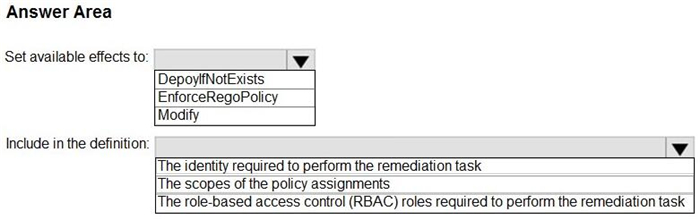
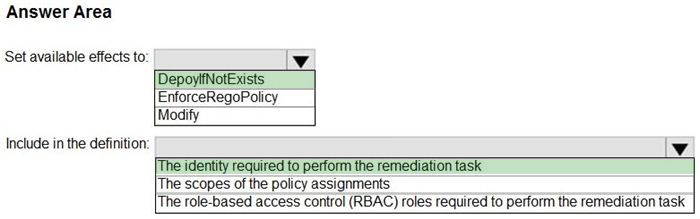
You need to create an Azure Policy definition named Policy1 that will use Template1 to enable TDE for any noncompliant Azure SQL databases.
How should you configure Policy1? To answer, select the appropriate options in the answer area.
NOTE: Each correct selection is worth one point.
Reveal answer detailsClose answer details
Explanation
Box 1: DeployIfNotExists DeployIfNotExists Similar to AuditIfNotExists, a DeployIfNotExists policy definition executes a template deployment when the condition is met.
DeployIfNotExists evaluation DeployIfNotExists runs after a configurable delay when a Resource Provider handles a create or update subscription or resource request and has returned a success status code. A template deployment occurs if there are no related resources or if the resources defined by ExistenceCondition don't evaluate to true. The duration of the deployment depends on the complexity of resources included in the template.
During an evaluation cycle, policy definitions with a DeployIfNotExists effect that match resources are marked as non-compliant, but no action is taken on that resource.
Incorrect: EnforceRegoPolicy No such thing in this context.
Modify Modify is used to add, update, or remove properties or tags on a subscription or resource during creation or update. A common example is updating tags on resources such as costCenter.
Modify evaluation Modify evaluates before the request gets processed by a Resource Provider during the creation or updating of a resource. The Modify operations are applied to the request content when the if condition of the policy rule is met. Each Modify operation can specify a condition that determines when it's applied. Operations with false condition evaluations are skipped.
Box 2: The identity required to perform the remediation task Policy assignments with effect set as DeployIfNotExists require a managed identity to do remediation.
Note: Each policy definition in Azure Policy has a single effect. That effect determines what happens when the policy rule is evaluated to match. The effects behave differently if they are for a new resource, an updated resource, or an existing resource.
These effects are currently supported in a policy definition:
You have an on-premises network to which you deploy a virtual appliance.
You plan to deploy several Azure virtual machines and connect the on-premises network to Azure by using a Site-to-Site connection.
All network traffic that will be directed from the Azure virtual machines to a specific subnet must flow through the virtual appliance.
You need to recommend solutions to manage network traffic.
Which two options should you recommend? Each correct answer presents a complete solution.
A
Configure Azure Traffic Manager.
B
Implement an Azure virtual network.
C
Implement Azure ExpressRoute.
D
Configure a routing table.
Reveal answer detailsClose answer details
Correct answersC, D
Explanation
Connectivity can be from an any-to-any (IP VPN) network, a point-to-point Ethernet network, or a virtual cross-connection through a connectivity provider at a co-location facility. ExpressRoute connections do not go over the public Internet. This allows ExpressRoute connections to offer more reliability, faster speeds, lower latencies, and higher security than typical connections over the Internet.
Your company has an on-premises Hyper-V cluster that contains 20 virtual machines. Some of the virtual machines are based on Windows and some in Linux. You have to migrate the virtual machines onto Azure.
You have to recommend a solution that would be used to replicate the disks of the virtual machines to Azure. The solution needs to ensure that the virtual machines remain available when the migration of the disks is in progress. You decide to create an Azure storage account and then run AzCopy Would this fulfill the requirement?
A
Yes
B
No
Reveal answer detailsClose answer details
Correct answerB
Question 51
Single choice
Your company has the infrastructure shown in the following table.
The on-premises Active Directory domain syncs to Azure Active Directory (Azure AD).
Server1 runs an application named Appl that uses LDAP queries to verify user identities in the on-premises Active Directory domain.
You plan to migrate Server1 to a virtual machine in Subscription1.
A company security policy states that the virtual machines and services deployed to Subscription1 must be prevented from accessing the on-premises network.
You need to recommend a solution to ensure that App1 continues to function after the migration. The solution must meet the security policy.
What should you include in the recommendation?
A
Azure AD Domain Services (Azure AD DS)
B
an Azure VPN gateway
C
the Active Directory Domain Services role on a virtual machine
D
Azure AD Application Proxy
Reveal answer detailsClose answer details
Correct answerA
Explanation
Azure Active Directory Domain Services (Azure AD DS) provides managed domain services such as domain join, group policy, lightweight directory access protocol (LDAP), and Kerberos/NTLM authentication Azure AD Domain Services (Azure AD DS)-This one could work since AAD DS will bring in the existing accounts from Azure AD which in turn are synchronised from on-premise AD over AD connect. However, you would probably need to reconfigure the app and update the LDAP connection Azure Active Directory (Azure AD) supports LDAP Authentication via Azure AD Domain Services (AD DS).
You have an Azure Cosmos DB account named Account1. Account1 includes a database named DB1 that contains a container named Container1. The partition key for Container1 is set to /city.
You plan to change the partition key for Container1.
What should you do first?
A
Delete Container1.
B
Create a new Azure Cosmos DB account.
C
Implement the Azure Cosmos DB.NET.SDK.
D
Regenerate the keys for Account1.
Reveal answer detailsClose answer details
Correct answerB
Explanation
The Change Feed Processor and Bulk Executor Library, in Azure Cosmos DB can be leveraged to achieve a live migration of your data from one container to another. This allows you to re-distribute your data to match the desired new partition key scheme, and make the relevant application changes afterwards, thus achieving the effect of "updating your partition key".
You are designing an app that will be hosted on Azure virtual machines that run Ubuntu.
The app will use a third-party email service to send email messages to users. The thirdparty email service requires that the app authenticate by using an API key.
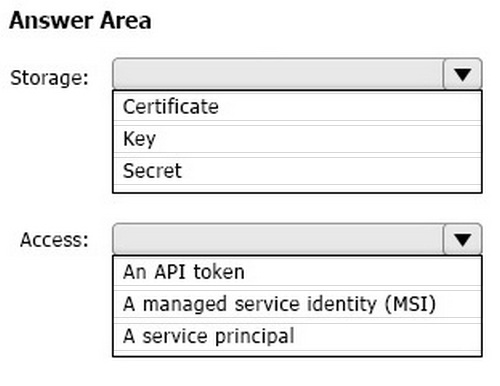
You need to recommend an Azure Key Vault solution for storing and accessing the API key. The solution must minimize administrative effort.
What should you recommend using to store and access the key? To answer, select the appropriate options in the answer area.
NOTE: Each correct selection is worth one point.
Reveal answer detailsClose answer details
Explanation
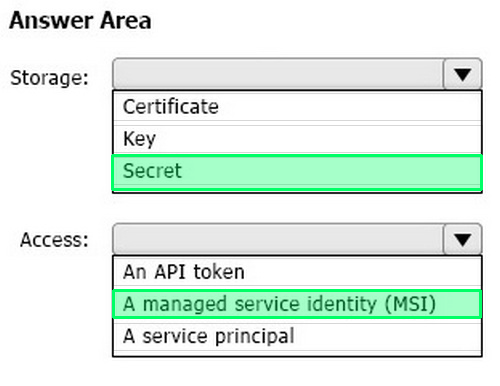
1. Storage: Secret. API keys are typically stored as secrets in Azure Key Vault. The key vault can store and manage secrets like API keys, passwords, or database connection strings.
2. Access: A managed service identity (MSI). A managed service identity (MSI) is used to give your VM access to the key vault. The advantage of using MSI is that you do not have to manage credentials yourself. Azure takes care of rolling the credentials and ensuring their lifecycle. The application running on your VM can use its managed service identity to get a token to Azure AD, and then use that token to authenticate to Azure Key Vault.
Question 54
Single choice
You need to recommend a solution to deploy containers that run an application. The application has two tiers.
Each tier is implemented as a separate Docker Linux-based image.
The solution must meet the following requirements:
1. The front-end tier must be accessible by using a public IP address on port 80. 2. The backend tier must be accessible by using port 8080 from the front-end tier only. 3. Both containers must be able to access the same Azure file share. 4. If a container fails, the application must restart automatically. 5. Costs must be minimized.
What should you recommend using to host the application?
A
Azure Kubernetes Service (AKS)
B
Azure Service Fabric
C
Azure Container instances
D
Azure Container registries
Reveal answer detailsClose answer details
Correct answerC
Explanation
Azure Container Instances enables a layered approach to orchestration, providing all of the scheduling and management capabilities required to run a single container, while allowing orchestrator platforms to manage multi-container tasks on top of it.
Because the underlying infrastructure for container instances is managed by Azure, an orchestrator platform does not need to concern itself with finding an appropriate host machine on which to run a single container.
Azure Container Instances can schedule both Windows and Linux containers with the same API.
Orchestration of container instances exclusively Because they start quickly and bill by the second, an environment based exclusively on Azure Container Instances offers the fastest way to get started and to deal with highly variable workloads.
You plan to deploy an application that will run at a Linux-based Docker container You need to recommend a solution to host the application in Azure. The solution must meet the following requirements:
1. Support a custom domain name and an associated SSL certificate. 2. Scale-out automatically based on demand 3. Minimize administrative effort and costs.
What should you Include in the recommendation?
A
Azure Container instances
B
Azure Kubemetes Service (AKS)
C
Azure App Service
D
an Azure virtual machine
Reveal answer detailsClose answer details
Correct answerC
Explanation
App Service not only adds the power of Microsoft Azure to your application, such as security, load balancing, autoscaling, and automated management. You can also take advantage of its DevOps capabilities, such as continuous deployment from Azure DevOps, GitHub, Docker Hub, and other sources, package management, staging environments, custom domain, and TLS/SSL certificates.
Key features of App Service include: 1. Containerization and Docker - Dockerize your app and host a custom Windows or Linux container in App Service. 2. Scale up or out manually or automatically. Host your apps anywhere in Microsoft's global datacenter infrastructure, and the App Service SLA promises high availability. App Service can also host web apps natively on Linux for supported application stacks. It can also run custom Linux containers (also known as Web App for Containers).
You need to migrate the solution to Azure. The solution must support Hadoop Distributed
File System (HDFS).
What should you use?
A
Azure Data Lake Storage Gen2
B
Azure NetApp Files
C
Azure Data Share
D
Azure Table storage
Reveal answer detailsClose answer details
Correct answerA
Case study
Case Study 4
Overview
HABInsurance is an insurance company that operates in three states and provides home, auto, and boat insurance. The company has a head office and three regional offices.
Existing Environment:
HABInsurance hosts its primary workloads in an on-premises datacenter located at the head office. The regional offices connect to the datacenter over VPN connections via the internet.
Network The on-premises datacenter uses a flat network topology. All servers are deployed in a single subnet. Internet access is provided through a centralized firewall. There is no existing ExpressRoute connection.
Identity HABInsurance has two Active Directory forests: main.habinsurance.com and region.habinsurance.com. Some users exist in both forests, but there is no trust relationship between the forests.
Applications The company's primary internal system is the Insurance Processing System (IPS). IPS is an ASP.NET application written in C# and hosted on IIS servers running Windows Server in the on-premises datacenter.
IPS has a three-tier architecture: Web tier hosted on IIS servers Business logic API tier hosted on IIS servers Data tier hosted on database servers
The application has the following characteristics: The web and API tiers are stateless Session state is stored in the database tier The application supports horizontal scaling The application currently uses Windows authentication internally
Data platform Customer data is stored in a Microsoft SQL Server database named IPSCustomers. The database size is approximately 500 GB and is expected to grow by 20 percent annually. Workload patterns vary significantly during the day.
Insurance forms and documents are stored in a MongoDB database. The application uses MongoDB APIs and drivers extensively. The company requires minimal code changes during migration.
File storage The company stores approximately 10 TB of Human Resources (HR) data on a NAS device at the head office. The data is accessed by using the SMB protocol and NTFS permissions must be preserved. Users in regional offices frequently access this data.
Requirements
General HABInsurance plans to migrate its workloads to Azure. The company has purchased an Azure subscription. The solution must minimize administrative overhead and support future scalability.
Identity requirements The company must implement a hybrid identity solution that integrates with Microsoft Entra ID. All users must have a single identity across both forests. The solution must support synchronization of both forests to Microsoft Entra ID. The company plans to use administrative units to delegate management. Users must be able to access Microsoft 365 services by using the same credentials as on-premises resources.
Application requirements The IPS application must be migrated to Azure with minimal code changes. The web and API tiers must automatically scale based on CPU utilization. The compute platform must provide an SLA of at least 99.95 percent. The solution must support future migration to containers.
The company plans to implement a customer self-service portal and expose selected APIs securely to external users.
Data requirements
SQL database The IPSCustomers database must be migrated to a fully managed Azure database service. The solution must support independent scaling of compute and storage. The solution must support variable workloads and optimize cost during periods of low usage. The solution must minimize downtime during scaling operations. The solution must support automated backups and high availability.
Document database Insurance forms and documents must be migrated to an Azure service that supports MongoDB APIs. The solution must require minimal application changes. The solution must support global distribution in the future.
File storage HR data must be migrated to Azure. The solution must support SMB access and preserve NTFS permissions. The solution must allow hybrid access from on-premises and Azure. The solution must support efficient initial data transfer of 10 TB.
Networking requirements The company plans to establish secure connectivity between the on-premises datacenter and Azure. The solution must support private access to Azure PaaS services. The company may implement ExpressRoute in the future.
Security requirements
The company plans to integrate internal and third-party applications with Microsoft Entra ID. Users must be able to grant consent to applications, but administrative approval must be required for high-privilege permissions. The solution must support conditional access policies.
High availability and disaster recovery requirements The IPS application must be highly available within a region. The company plans to deploy IPS to multiple Azure regions in the future. The solution must ensure application availability during regional outages. The solution must minimize performance impact for users accessing the application globally.
Question 57
Testlet 4Single choice
A company has an on-premises file server cbflserver that runs Windows Server 2019.
Windows Admin Center manages this server. The company owns an Azure subscription.
You need to provide an Azure solution to prevent data loss if the file server fails.
Solution: You decide to register Windows Admin Center in Azure and then configure Azure Backup.
Would this meet the requirement?
A
Yes
B
No
Reveal answer detailsClose answer details
Correct answerA
Question 58
Single choice
A company needs a datastore created in Azure for an application. Below are the key requirements for the data store.
1. Ability to store JSON based items 2. Ability to use SQL like queries on the datastore 3. Ability to provide low latency access to data items
Which of the following would you consider as the data store?
A
Azure BLOB storage
B
Azure CosmosDB
C
Azure HDInsight
D
Azure Redis
Reveal answer detailsClose answer details
Correct answerB
Question 59
Single choice
Your company has the divisions shown in the following table.
Sub1 contains an Azure App Service web app named App1. App1 uses Azure AD for single-tenant user authentication. Users from contoso.com can authenticate to App1.
You need to recommend a solution to enable users in the fabrikam.com tenant to authenticate to App1.
What should you recommend?
A
Configure Azure AD join.
B
Configure Azure AD Identity Protection.
C
Configure a Conditional Access policy.
D
Configure Supported account types in the application registration and update the sign-in endpoint.
Reveal answer detailsClose answer details
Correct answerD
Explanation
Identity and account types for single-and multi-tenant apps You, as a developer, can choose if your app allows only users from your Azure Active Directory (Azure AD) tenant, any Azure AD tenant, or users with personal Microsoft accounts. You can configure your app to be either single tenant or multitenant during app registration in Azure.
Note: A required part of application registration in Azure AD is your selection of supported account types. While IT Pros in administrator roles decide who can consent to apps in their tenant, you, as a developer, specify who can use your app based on account type. When a tenant doesn't allow you to register your application in Azure AD, administrators will provide you with a way to communicate those details to them through another mechanism.
You'll choose from the following supported account type options when registering your application.
Accounts in this organizational directory only (O365 only - Single tenant) Accounts in any organizational directory (Any Azure AD directory - Multitenant) Accounts in any organizational directory (Any Azure AD directory - Multitenant) and personal Microsoft accounts (e.g. Skype, Xbox) Personal Microsoft accounts only
Incorrect: Configure Azure AD join. Azure AD joined devices are signed in to using an organizational Azure AD account. Access to resources can be controlled based on Azure AD account and Conditional Access policies applied to the device.
Configure Azure AD Identity Protection Identity Protection allows organizations to accomplish three key tasks: Automate the detection and remediation of identity-based risks. Investigate risks using data in the portal. Export risk detection data to other tools.
Litware has 10 Azure subscriptions that are linked to the Litware.com tenant and five Azure subscriptions that are linked to the dev.litware.com tenant. All the subscriptions are in an Enterprise Agreement (EA).
The litware.com tenant contains a custom Azure role-based access control (Azure RBAC) role named Role1 that grants the DataActions read permission to the blobs and files in Azure Storage.
On-Premises Environment
The on-premises network of Litware contains the resources shown in the following table.
Network Environment
Litware has ExpressRoute connectivity to Azure.
Planned Changes and Requirements
Litware plans to implement the following changes:
1. Migrate DB1 and DB2 to Azure. 2. Migrate App1 to Azure virtual machines. 3. Migrate the external storage used by App1 to Azure Storage. 4. Deploy the Azure virtual machines that will host App1 to Azure dedicated hosts.
Authentication and Authorization Requirements
Litware identifies the following authentication and authorization requirements:
Only users that manage the production environment by using the Azure portal must connect from a hybrid Azure AD-joined device and authenticate by using Azure Multi-Factor Authentication (MFA). The Network Contributor built-in RBAC role must be used to grant permissions to the network administrators for all the virtual networks in all the Azure subscriptions. To access the resources in Azure, App1 must use the managed identity of the virtual machines that will host the app. RBAC roles must be applied at the highest level possible.
Resiliency Requirements
Litware identifies the following resiliency requirements:
Once migrated to Azure, DB1 and DB2 must meet the following requirements: - Maintain availability if two availability zones in the local Azure region fail. - Fail over automatically. - Minimize I/O latency. App1 must meet the following requirements: - Be hosted in an Azure region that supports availability zones. - Be hosted on Azure virtual machines that support automatic scaling. - Maintain availability if two availability zones in the local Azure region fail.
Security and Compliance Requirements
Litware identifies the following security and compliance requirements:
1. Once App1 is migrated to Azure, you must ensure that new data can be written to the app, and the modification of new and existing data is prevented for a period of three years. 2. On-premises users and services must be able to access the Azure Storage account that will host the data in App1. 3. Access to the public endpoint of the Azure Storage account that will host the App1 data must be prevented. 4. All Azure SQL databases in the production environment must have Transparent Data Encryption (TDE) enabled. 5. App1 must NOT share physical hardware with other workloads.
Business Requirements
Litware identifies the following business requirements:
After you migrate App1 to Azure, you need to enforce the data modification requirements to meet the security and compliance requirements.
What should you do?
A
Create an access policy for the blob service.
B
Implement Azure resource locks.
C
Create Azure RBAC assignments.
D
Modify the access level of the blob service.
Reveal answer detailsClose answer details
Correct answerA
Explanation
Scenario: Once App1 is migrated to Azure, you must ensure that new data can be written to the app, and the modification of new and existing data is prevented for a period of three years. As an administrator, you can lock a subscription, resource group, or resource to prevent other users in your organization from accidentally deleting or modifying critical resources. The lock overrides any permissions the user might have.
Your company deploys several virtual machines on-premises and to Azure. ExpressRoute is deployed and configured for on-premises to Azure connectivity.
Several virtual machines exhibit network connectivity issues.
You need to analyze the network traffic to identify whether packets are being allowed or denied from the Azure virtual machines to the on-premises virtual machines.
Solution: Use Azure Advisor.
Does this meet the goal?
A.
Yes
B.
No
Correct Answer: B
Explanation
Explanation/Reference:
Instead use Azure Network Watcher IP Flow Verify, which allows you to detect traffic filtering issues at a VM level.
Note: IP flow verify checks if a packet is allowed or denied to or from a virtual machine. The information consists of direction, protocol, local IP, remote IP, local port, and remote port. If the packet is denied by a security group, the name of the rule that denied the packet is returned. While any source or destination IP can be chosen, IP flow verify helps administrators quickly diagnose connectivity issues from or to the internet and from or to the on-premises environment.
A company plans to implement an HTTP-based API to support a web app. The web app allows customers to check the status of their orders.
The API must meet the following requirements:
1. Implement Azure Functions 2. Provide public read-only operations 3. Do not allow write operations
4. You need to recommend configuration options.
What should you recommend? To answer, configure the appropriate options in the dialog box in the answer area.
NOTE: Each correct selection is worth one point.
Correct Answer:
Explanation
Explanation/Reference:
Allowed authentication methods: GET only
Authorization level: Anonymous The option is Allow Anonymous requests. This option turns on authentication and authorization in App Service, but defers authorization decisions to your application code. For authenticated requests, App Service also passes along authentication information in the HTTP headers.
This option provides more flexibility in handling anonymous requests.
You have an Azure logic app named App1 and an Azure Service Bus queue named Queue1.
You need to ensure that App1 can read messages from Queue1. App1 must authenticate by using Azure Active Directory (Azure AD).
What should you do? To answer, select the appropriate options in the answer area.
NOTE: Each correct selection is worth one point.
Correct Answer:
Explanation
Explanation/Reference:
On App1: Turn on the managed identity To use Service Bus with managed identities, you need to assign the identity the role and the appropriate scope. The procedure in this section uses a simple application that runs under a managed identity and accesses Service Bus resources.
Once the application is created, follow these steps: Go to Settings and select Identity. Select the Status to be On. Select Save to save the setting.
On Queue1: Configure Access Control (IAM) Azure Active Directory (Azure AD) authorizes access rights to secured resources through role-based access control (RBAC). Azure Service Bus defines a set of built-in RBAC roles that encompass common sets of permissions used to access Service Bus entities and you can also define custom roles for accessing the data.
Assign RBAC roles using the Azure portal
In the Azure portal, navigate to your Service Bus namespace. Select Access Control (IAM) on the left menu to display access control settings for the namespace. If you need to create a Service Bus namespace. Select the Role assignments tab to see the list of role assignments. Select the Add button on the toolbar and then select Add role assignment.
You plan to deploy an app named App1 that will be hosted on multiple virtual machines. App1 requires a service-level agreement (SLA) of 99.99%.
You need to recommend a high-availability solution for the virtual machines.
What should you include in the recommendation?
A.
application groups
B.
availability zones
C.
availability sets
D.
Azure Site Recovery
Correct Answer: B
QUESTION 5
You have an Azure subscription that contains the resources shown in the following table.
You need to recommend a load balancing solution that will distribute incoming traffic for VMSS1 across NVA1 and NVA2. The solution must minimize administrative effort.
What should you include in the recommendation?
A.
Gateway Load Balancer
B.
Azure Front Door
C.
Azure Application Gateway
D.
Azure Traffic Manager
Correct Answer: A
Explanation
Explanation/Reference:
Gateway Load Balancer is a fully managed service enabling you to deploy, scale, and enhance the availability of third party network virtual appliances (NVAs) in Azure. You can add your favorite third party appliance whether it's a firewall, inline DDoS appliance, deep packet inspection system, or even your own custom appliance into the network path transparently ?all with a single action.
Note: This question is part of a series of questions that present the same scenario. Each question in the series contains a unique solution that might meet the stated goals. Some question sets might have more than one correct solution, while others might not have a correct solution.
After you answer a question in this section, you will NOT be able to return to it. As a result, these questions will not appear in the review screen.
Your company plans to deploy various Azure App Service instances that will use Azure SQL databases. The App Service instances will be deployed at the same time as the Azure SQL databases.
The company has a regulatory requirement to deploy the App Service instances only to specific Azure regions. The resources for the App Service instances must reside in the same region.
You need to recommend a solution to meet the regulatory requirement.
Solution: You recommend creating resource groups based on locations and implementing resource locks on the resource groups.
Does this meet the goal?
A.
Yes
B.
No
Correct Answer: B
Explanation
Explanation/Reference:
Resource locks are not used for compliance purposes. Resource locks prevent changes from being made to resources.
Your company has 20 web APIs that were developed in-house.
The company is developing 10 web apps that will use the web APIs. The web apps and the APIs are registered in the company s Azure AD tenant. The web APIs are published by using Azure API Management.
You need to recommend a solution to block unauthorized requests originating from the web apps from reaching the web APIs. The solution must meet the following requirements:
1. Use Azure AD-generated claims. 2. Minimize configuration and management effort
What should you include in the recommendation? To answer, select the appropriate options in the answer area. NOTE: Each correct selection is worth one point.
NOTE: Each correct selection is worth one point.
Correct Answer:
QUESTION 8
DRAG DROP
You have an on-premises datacenter named Site1. Site1 contains a VMware vSphere cluster named Cluster1 that hosts 100 virtual machines. Cluster1 is managed by using VMware vCenter.
You have an Azure subscription named Sub1.
You plan to migrate the virtual machines from Cluster1 to Sub1.
You need to identify which resources are required to run the virtual machines in Azure. The solution must minimize administrative effort.
What should you configure? To answer, drag the appropriate resources to the correct targets. Each resource may be used once, more than once, or not at all. You may need to drag the split bar between panes or scroll to view content.
NOTE: Each correct selection is worth one point.
Correct Answer:
QUESTION 9
You need to recommend an Azure Storage solution that meets the following requirements:
1. The storage must support 1 PB of data. 2. The data must be stored in blob storage. 3. The storage must support three levels of subfolders. 4. The storage must support access control lists (ACLs).
What should you include in the recommendation?
A.
a premium storage account that is configured for block blobs
B.
a general purpose v2 storage account that has hierarchical namespace enabled
C.
a premium storage account that is configured for page blobs
D.
a premium storage account that is configured for files shares and supports large file shares
Correct Answer: B
Explanation
Explanation/Reference:
Microsoft recommends that you use a GPv2 storage account for most scenarios. It supports up to 5 PB, and blob storage including Data Lake storage.
Note: A key mechanism that allows Azure Data Lake Storage Gen2 to provide file system performance at object storage scale and prices is the addition of a hierarchical namespace. This allows the collection of objects/files within an account to be organized into a hierarchy of directories and nested subdirectories in the same way that the file system on your computer is organized. With a hierarchical namespace enabled, a storage account becomes capable of providing the scalability and cost-effectiveness of object storage, with file system semantics that are familiar to analytics engines and frameworks.
HABInsurance is an insurance company that operates in three states and provides home, auto, and boat insurance. The company has a head office and three regional offices.
Existing Environment:
HABInsurance hosts its primary workloads in an on-premises datacenter located at the head office. The regional offices connect to the datacenter over VPN connections via the internet.
Network The on-premises datacenter uses a flat network topology. All servers are deployed in a single subnet. Internet access is provided through a centralized firewall. There is no existing ExpressRoute connection.
Identity HABInsurance has two Active Directory forests: main.habinsurance.com and region.habinsurance.com. Some users exist in both forests, but there is no trust relationship between the forests.
Applications The company's primary internal system is the Insurance Processing System (IPS). IPS is an ASP.NET application written in C# and hosted on IIS servers running Windows Server in the on-premises datacenter.
IPS has a three-tier architecture: Web tier hosted on IIS servers Business logic API tier hosted on IIS servers Data tier hosted on database servers
The application has the following characteristics: The web and API tiers are stateless Session state is stored in the database tier The application supports horizontal scaling The application currently uses Windows authentication internally
Data platform Customer data is stored in a Microsoft SQL Server database named IPSCustomers. The database size is approximately 500 GB and is expected to grow by 20 percent annually. Workload patterns vary significantly during the day.
Insurance forms and documents are stored in a MongoDB database. The application uses MongoDB APIs and drivers extensively. The company requires minimal code changes during migration.
File storage The company stores approximately 10 TB of Human Resources (HR) data on a NAS device at the head office. The data is accessed by using the SMB protocol and NTFS permissions must be preserved. Users in regional offices frequently access this data.
Requirements
General HABInsurance plans to migrate its workloads to Azure. The company has purchased an Azure subscription. The solution must minimize administrative overhead and support future scalability.
Identity requirements The company must implement a hybrid identity solution that integrates with Microsoft Entra ID. All users must have a single identity across both forests. The solution must support synchronization of both forests to Microsoft Entra ID. The company plans to use administrative units to delegate management. Users must be able to access Microsoft 365 services by using the same credentials as on-premises resources.
Application requirements The IPS application must be migrated to Azure with minimal code changes. The web and API tiers must automatically scale based on CPU utilization. The compute platform must provide an SLA of at least 99.95 percent. The solution must support future migration to containers.
The company plans to implement a customer self-service portal and expose selected APIs securely to external users.
Data requirements
SQL database The IPSCustomers database must be migrated to a fully managed Azure database service. The solution must support independent scaling of compute and storage. The solution must support variable workloads and optimize cost during periods of low usage. The solution must minimize downtime during scaling operations. The solution must support automated backups and high availability.
Document database Insurance forms and documents must be migrated to an Azure service that supports MongoDB APIs. The solution must require minimal application changes. The solution must support global distribution in the future.
File storage HR data must be migrated to Azure. The solution must support SMB access and preserve NTFS permissions. The solution must allow hybrid access from on-premises and Azure. The solution must support efficient initial data transfer of 10 TB.
Networking requirements The company plans to establish secure connectivity between the on-premises datacenter and Azure. The solution must support private access to Azure PaaS services. The company may implement ExpressRoute in the future.
Security requirements
The company plans to integrate internal and third-party applications with Microsoft Entra ID. Users must be able to grant consent to applications, but administrative approval must be required for high-privilege permissions. The solution must support conditional access policies.
High availability and disaster recovery requirements The IPS application must be highly available within a region. The company plans to deploy IPS to multiple Azure regions in the future. The solution must ensure application availability during regional outages. The solution must minimize performance impact for users accessing the application globally.
QUESTION 11
A company has an on-premises file server cbflserver that runs Windows Server 2019.
Windows Admin Center manages this server. The company owns an Azure subscription.
You need to provide an Azure solution to prevent data loss if the file server fails.
Solution: You decide to create an Azure Recovery Services vault. You then decide to install the Azure Backup agent and then schedule the backup.
Would this meet the requirement?
A.
Yes
B.
No
Correct Answer: A
QUESTION 12
You have an Azure subscription that contains 1,000 resources.
You need to generate compliance reports for the subscription. The solution must ensure that the resources can be grouped by department.
What should you use to organize the resources?
A.
application groups and quotas
B.
Azure Policy and tags
C.
administrative units and Azure Lighthouse
D.
resource groups and role assignments
Correct Answer: B
Explanation
Explanation/Reference:
Compliance Report using Azure Policy Azure Policy is a powerful tool for Azure Governance. With Azure Policy we can define rules for all Azure Subscriptions the we manage. We can use this rules for simple limitation actions, like permitting only specific VM Series and Sizes that can be created and also more complex rule sets that helps you standardize the whole Azure deployment.
Enforce tags for resource creation So, why tags? Why we need to add tags to all Azure resources? The Microsoft Azure environments are getting bigger and bigger and managed by multiple people and teams. That makes it difficult to understand who created a resource and what is the purpose of that resource. Another critical matter that we need tags is Cost Management. At the Azure Cost Management Portal, we can sort and arrange the resource cost using the Tags. This way we can provide an expense dashboard with the actual cost of the resources per department, project or whatever tags we have added to the Resource.
You have an on-premises file server that stores 2 TB of data files.
You plan to move the data files to Azure Blob Storage In the West Europe Azure region,
You need to recommend a storage account type to store the data files and a replication solution for the storage account. The solution must meet the following requirements:
1. Be available if a single Azure datacenter fails. 2. Support storage tiers. 3. Minimize cost.
What should you recommend? To answer, select the appropriate options in the answer area.
Data must be available if a single Azure datacenter fails. It means the storage account must support ZRS replication. Also, solution should support storage tiers. Only General-purpose V2 supports ZRS and storage tiers.
Litware has 10 Azure subscriptions that are linked to the Litware.com tenant and five Azure subscriptions that are linked to the dev.litware.com tenant. All the subscriptions are in an Enterprise Agreement (EA).
The litware.com tenant contains a custom Azure role-based access control (Azure RBAC) role named Role1 that grants the DataActions read permission to the blobs and files in Azure Storage.
On-Premises Environment
The on-premises network of Litware contains the resources shown in the following table.
Network Environment
Litware has ExpressRoute connectivity to Azure.
Planned Changes and Requirements
Litware plans to implement the following changes:
1. Migrate DB1 and DB2 to Azure. 2. Migrate App1 to Azure virtual machines. 3. Migrate the external storage used by App1 to Azure Storage. 4. Deploy the Azure virtual machines that will host App1 to Azure dedicated hosts.
Authentication and Authorization Requirements
Litware identifies the following authentication and authorization requirements:
Only users that manage the production environment by using the Azure portal must connect from a hybrid Azure AD-joined device and authenticate by using Azure Multi-Factor Authentication (MFA). The Network Contributor built-in RBAC role must be used to grant permissions to the network administrators for all the virtual networks in all the Azure subscriptions. To access the resources in Azure, App1 must use the managed identity of the virtual machines that will host the app. RBAC roles must be applied at the highest level possible.
Resiliency Requirements
Litware identifies the following resiliency requirements:
Once migrated to Azure, DB1 and DB2 must meet the following requirements: - Maintain availability if two availability zones in the local Azure region fail. - Fail over automatically. - Minimize I/O latency. App1 must meet the following requirements: - Be hosted in an Azure region that supports availability zones. - Be hosted on Azure virtual machines that support automatic scaling. - Maintain availability if two availability zones in the local Azure region fail.
Security and Compliance Requirements
Litware identifies the following security and compliance requirements:
1. Once App1 is migrated to Azure, you must ensure that new data can be written to the app, and the modification of new and existing data is prevented for a period of three years. 2. On-premises users and services must be able to access the Azure Storage account that will host the data in App1. 3. Access to the public endpoint of the Azure Storage account that will host the App1 data must be prevented. 4. All Azure SQL databases in the production environment must have Transparent Data Encryption (TDE) enabled. 5. App1 must NOT share physical hardware with other workloads.
Business Requirements
Litware identifies the following business requirements:
You plan to migrate App1 to Azure. The solution must meet the authentication and authorization requirements.
Which type of endpoint should App1 use to obtain an access token?
A.
Azure Instance Metadata Service (IMDS)
B.
Azure AD
C.
Azure Service Management
D.
Microsoft identity platform
Correct Answer: D
Explanation
Explanation/Reference:
Scenario: To access the resources in Azure, App1 must use the managed identity of the virtual machines that will host the app.
Managed identities provide an identity for applications to use when connecting to resources that support Azure Active Directory (Azure AD) authentication. Applications may use the managed identity to obtain Azure AD tokens.
You have an on-premises network that uses an IP address space of 172.16.0.0/16. You plan to deploy 25 virtual machines to a new Azure subscription. You identify the following technical requirements:
1. All Azure virtual machines must be placed on the same subnet named Subnet1. 2. All the Azure virtual machines must be able to communicate with all on-premises servers. 3. The servers must be able to communicate between the on-premises network and Azure by using a site-
to-site VPN.
You need to recommend a subnet design that meets the technical requirements.
What should you include in the recommendation? To answer, drag the appropriate network addresses to the correct subnets. Each network address may be used once, more than once, or not at all. You may need to drag the split bar between panes or scroll to view content
NOTE: Each correct selection is worth one point.
Correct Answer:
QUESTION 16
You plan to migrate on-premises MySQL databases to Azure Database for MySQL Flexible Server.
You need to recommend a solution for the Azure Database for MySQL Flexible Server configuration. The solution must meet the following requirements:
1. The databases must be accessible if a datacenter fails. 2. Costs must be minimized.
You need to design an authentication solution that will integrate on-premises Active Directory and Azure Active Directory (Azure AD). The solution must meet the following requirements:
1. Active Directory users must not be able to sign in to Azure AD-integrated apps outside of the sign-in hours configured in the Active Directory user accounts. 2. Active Directory users must authenticate by using multi-factor authentication (MFA) when they sign in to Azure AD-integrated apps. 3. Administrators must be able to obtain Azure AD-generated reports that list the Active Directory users who have leaked credentials. 4. The infrastructure required to implement and maintain the solution must be minimized.
What should you include in the solution? To answer, select the appropriate options in the answer area.
NOTE: Each correct selection is worth one point.
Correct Answer:
Explanation
Explanation/Reference:
Box 1: Pass-through Authentication with Azure AD Seamless SSO Azure AD Seamless SSO versus Active Directory Federation Services Companies with a security requirement to immediately enforce on-premises user account states, password policies, and sign-in hours might use Azure AD Pass-through Authentication. You can combine Pass-through Authentication with the Seamless Single Sign-On feature.
Note: Azure AD supports the following authentication methods for hybrid identity solutions. Azure AD password hash synchronization Azure AD Pass-through Authentication
Box 2: Azure MFA One key benefit with Azure AD Pass-through Authentication is that it works seamlessly with Azure MFA.
You have an Azure subscription. The subscription contains virtual machines that run Windows Server.
You are designing a disaster recovery solution that will immediately deploy a new virtual machine when an existing virtual machine fails. The solution must meet the following requirements:
New virtual machines must be deployed with all the required configurations in place.
Virtual machine deployments must use an infrastructure as code (IaC) methodology.
New virtual machines must be created by using standard Microsoft disk images.
New virtual machines must be authorized by virtual machine administrators.
Virtual machine deployments must be managed by using CI/CD pipelines.
You need to recommend which service to use to manage the virtual machine deployment process and which artifact to use to create each virtual machine.
What should you recommend? To answer, select the appropriate options in the answer area.
NOTE: Each correct selection is worth one point.
Correct Answer:
QUESTION 19
HOTSPOT
You have an Azure subscription that contains a resource group named RG1.
You have a group named Group1 that is assigned the Contributor role for RG1.
You need to enhance security for the virtual machines in RG1 to meet the following requirements: 1. Prevent Group1 from assigning external IP addresses to the virtual machines. 2. Ensure that Group1 can establish an RDP connection to the virtual machines through a shared external IP address.
What should you use to meet each requirement? To answer, select the appropriate options in the answer area.
NOTE: Each correct selection is worth one point.
Correct Answer:
QUESTION 20
You are designing a microservices architecture that will support a web application.
The solution must meet the following requirements:
1. Allow independent upgrades to each microservice 2. Deploy the solution on-premises and to Azure 3. Set policies for performing automatic repairs to the microservices 4. Support low-latency and hyper-scale operations
Your on-premises network contains 100 virtual machines that run Windows Server 2019.
You have an Azure subscription that contains an Azure Log Analytics workspace named Workspace1.
You need to collect errors from the Windows event logs on the virtual machines.
Which two actions should you perform' Each correct answer presents part of the solution.
NOTE: Each correct selection is worth one point.
A.
Configure the Data Collection settings for Workspace1.
B.
Deploy the Microsoft Monitoring Agent
C.
Create an Azure Event Grid domain
D.
Create an Azure Sentinel workspace.
E.
Configure Windows Event Forwarding on the virtual machines
Correct Answer: AB
Explanation
Explanation/Reference:
The Azure Log Analytics agent collects telemetry from Windows and Linux virtual machines in any cloud, on-premises machines, and those monitored by System Center Operations Manager and sends it collected data to your Log Analytics workspace in Azure Monitor.
Note: You may also see the Log Analytics agent referred to as the Microsoft Monitoring Agent (MMA) or OMS Linux agent. Data is collected using the Log Analytics agent, which reads various security-related configurations and event logs from the machine and copies the data to your workspace for analysis.
You manage an application instance. The application consumes data from multiple databases. Application code references database tables by using a combination of the server, database, and table name.
You need to migrate the application data to Azure.
To which two Azure services could you migrate the application to achieve the goal? Each correct answer presents a complete solution.
NOTE: Each correct selection is worth one point.
A.
Azure SQL Managed Instance
B.
Azure SQL Database
C.
SQL Server on an Azure virtual machine
D.
SQL Server Stretch Database
Correct Answer: AC
Case Study 4
Case Study Questions
Overview
HABInsurance is an insurance company that operates in three states and provides home, auto, and boat insurance. The company has a head office and three regional offices.
Existing Environment:
HABInsurance hosts its primary workloads in an on-premises datacenter located at the head office. The regional offices connect to the datacenter over VPN connections via the internet.
Network The on-premises datacenter uses a flat network topology. All servers are deployed in a single subnet. Internet access is provided through a centralized firewall. There is no existing ExpressRoute connection.
Identity HABInsurance has two Active Directory forests: main.habinsurance.com and region.habinsurance.com. Some users exist in both forests, but there is no trust relationship between the forests.
Applications The company's primary internal system is the Insurance Processing System (IPS). IPS is an ASP.NET application written in C# and hosted on IIS servers running Windows Server in the on-premises datacenter.
IPS has a three-tier architecture: Web tier hosted on IIS servers Business logic API tier hosted on IIS servers Data tier hosted on database servers
The application has the following characteristics: The web and API tiers are stateless Session state is stored in the database tier The application supports horizontal scaling The application currently uses Windows authentication internally
Data platform Customer data is stored in a Microsoft SQL Server database named IPSCustomers. The database size is approximately 500 GB and is expected to grow by 20 percent annually. Workload patterns vary significantly during the day.
Insurance forms and documents are stored in a MongoDB database. The application uses MongoDB APIs and drivers extensively. The company requires minimal code changes during migration.
File storage The company stores approximately 10 TB of Human Resources (HR) data on a NAS device at the head office. The data is accessed by using the SMB protocol and NTFS permissions must be preserved. Users in regional offices frequently access this data.
Requirements
General HABInsurance plans to migrate its workloads to Azure. The company has purchased an Azure subscription. The solution must minimize administrative overhead and support future scalability.
Identity requirements The company must implement a hybrid identity solution that integrates with Microsoft Entra ID. All users must have a single identity across both forests. The solution must support synchronization of both forests to Microsoft Entra ID. The company plans to use administrative units to delegate management. Users must be able to access Microsoft 365 services by using the same credentials as on-premises resources.
Application requirements The IPS application must be migrated to Azure with minimal code changes. The web and API tiers must automatically scale based on CPU utilization. The compute platform must provide an SLA of at least 99.95 percent. The solution must support future migration to containers.
The company plans to implement a customer self-service portal and expose selected APIs securely to external users.
Data requirements
SQL database The IPSCustomers database must be migrated to a fully managed Azure database service. The solution must support independent scaling of compute and storage. The solution must support variable workloads and optimize cost during periods of low usage. The solution must minimize downtime during scaling operations. The solution must support automated backups and high availability.
Document database Insurance forms and documents must be migrated to an Azure service that supports MongoDB APIs. The solution must require minimal application changes. The solution must support global distribution in the future.
File storage HR data must be migrated to Azure. The solution must support SMB access and preserve NTFS permissions. The solution must allow hybrid access from on-premises and Azure. The solution must support efficient initial data transfer of 10 TB.
Networking requirements The company plans to establish secure connectivity between the on-premises datacenter and Azure. The solution must support private access to Azure PaaS services. The company may implement ExpressRoute in the future.
Security requirements
The company plans to integrate internal and third-party applications with Microsoft Entra ID. Users must be able to grant consent to applications, but administrative approval must be required for high-privilege permissions. The solution must support conditional access policies.
High availability and disaster recovery requirements The IPS application must be highly available within a region. The company plans to deploy IPS to multiple Azure regions in the future. The solution must ensure application availability during regional outages. The solution must minimize performance impact for users accessing the application globally.
QUESTION 23
A company is planning on deploying an application onto Azure. The application will be based on the .Net core programming language. The application would be hosted using Azure Web apps. Below is part of the various requirements for the application
Give the ability to correlate Azure resource usage and the performance data with the actual application configuration and performance data Give the ability to visualize the relationships between application components Give the ability to track requests and exceptions to specific lines of code from within the application Give the ability to actually analyse how uses return to an application and see how often they only select a particular drop-down value
Which of the following service would be best suited for fulfilling the requirement of "Give the ability to correlate Azure resource usage and the performance data with the actual application configuration and performance data" ?
A.
Azure Application Insights
B.
Azure Service Map
C.
Azure Log Analytics
D.
Azure Activity Log
Correct Answer: C
QUESTION 24
You are designing an Azure web app that will use Azure Active Directory (Azure AD) for authentication.
You need to recommend a solution to provide users from multiple Azure AD tenants with access to App1.
The solution must ensure that the users use Azure Multi-Factor Authentication (MFA) when they connect to App1.
Which two types of objects should you include in the recommendation? Each correct answer presents part of the solution.
NOTE: Each correct selection is world one point
A.
Azure AD conditional access policies
B.
Azure AD managed identities
C.
an Identity Experience Framework policy
D.
an Azure application security group
E.
a Microsoft Intune app protection policy
F.
Azure AD guest accounts
Correct Answer: AC
Explanation
Explanation/Reference:
Option A: The Conditional Access feature in Azure Active Directory (Azure AD) offers one of several ways that you can use to secure your app and protect a service. Conditional Access enables developers and enterprise customers to protect services in a multitude of ways including: 1. Multi-factor authentication 2. Allowing only Intune enrolled devices to access specific services 3. Restricting user locations and IP ranges
Option B: Conditional Access policies are powerful tools, we recommend excluding the following accounts from your policy: Service accounts and service principals.If your organization has these accounts in use in scripts or code, consider replacing them with managed identities.
Incorrect Answers: Option E: Application security groups enable you to configure network security as a natural extension of an application's structure, allowing you to group virtual machines and define network security policies based on those groups
Fabrikam, Inc. is an engineering company that has offices throughout Europe. The company has a main office in London and three branch offices in Amsterdam, Berlin, and Rome.
Existing Environment: Active Directory Environment
The network contains two Active Directory forests named corp.fabrikam.com and rd.fabrikam.com. There are no trust relationships between the forests.
Corp.fabrikam.com is a production forest that contains identities used for internal user and computer authentication.
Rd.fabrikam.com is used by the research and development (R&D) department only. The R&D department is restricted to using on-premises resources only.
Existing Environment: Network Infrastructure
Each office contains at least one domain controller from the corp.fabrikam.com domain. The main office contains all the domain controllers for the rd.fabrikam.com forest.
All the offices have a high-speed connection to the internet.
An existing application named WebApp1 is hosted in the data center of the London office. WebApp1 is used by customers to place and track orders. WebApp1 has a web tier that uses Microsoft Internet information Services (IIS) and a database tier that runs Microsoft SQL Server 2016. The web tier and the database tier are deployed to virtual machines that run on Hyper-V.
The IT department currently uses a separate Hyper-V environment to test updates to WebApp1.
Fabrikam purchases all Microsoft licenses through a Microsoft Enterprise Agreement that includes Software Assurance.
Existing Environment: Problem Statements
The use of WebApp1 is unpredictable. At peak times, users often report delays. At other times, many resources for WebApp1 are underutilized.
Requirements: Planned Changes
Fabrikam plans to move most of its production workloads to Azure during the next few years, including virtual machines that rely on Active Directory for authentication.
As one of its first projects, the company plans to establish a hybrid identity model, facilitating an upcoming Microsoft 365 deployment.
All R&D operations will remain on-premises.
Fabrikam plans to migrate the production and test instances of WebApp1 to Azure.
Requirements: Technical Requirements
Fabrikam identifies the following technical requirements:
1. Website content must be easily updated from a single point. 2. User input must be minimized when provisioning new web app instances. 3. Whenever possible, existing on-premises licenses must be used to reduce cost. 4. Users must always authenticate by using their corp.fabrikam.com UPN identity. 5. Any new deployments to Azure must be redundant in case an Azure region fails. 6. Whenever possible, solutions must be deployed to Azure by using the Standard pricing tier of Azure App Service. 7. An email distribution group named IT Support must be notified of any issues relating to the directory synchronization services. 8. In the event that a link fails between Azure and the on-premises network, ensure that the virtual machines hosted in Azure can authenticate to Active Directory. 9. Directory synchronization between Azure Active Directory (Azure AD) and corp.fabrikam.com must not be affected by a link failure between Azure and the on-premises network.
Requirements: Database Requirements
Fabrikam identifies the following database requirements:
1. Database metrics for the production instance of WebApp1 must be available for analysis so that database administrators can optimize the performance settings. 2. To avoid disrupting customer access, database downtime must be minimized when databases are migrated. 3. Database backups must be retained for a minimum of seven years to meet compliance requirements.
Requirements: Security Requirements
Fabrikam identifies the following security requirements:
1. Company information including policies, templates, and data must be inaccessible to anyone outside the company. 2. Users on the on-premises network must be able to authenticate to corp.fabrikam.com if an internet link fails. 3. Administrators must be able authenticate to the Azure portal by using their corp.fabrikam.com credentials. 4. All administrative access to the Azure portal must be secured by using multi-factor authentication (MFA). 5. The testing of WebApp1 updates must not be visible to anyone outside the company.
QUESTION 25
You need to recommend a data storage strategy for WebApp1.
What should you include in in the recommendation?
A.
an Azure SQL Database elastic pool
B.
a vCore-based Azure SQL database
C.
an Azure virtual machine that runs SQL Server
D.
a fixed-size DTU AzureSQL database.
Correct Answer: B
QUESTION 26
You have a Microsoft Entra tenant named contoso.com.
You have a partner organization that has a Microsoft Entra tenant named fabrikam.com.
You plan to provide the users in fabrikam.com with access to the resources in contoso.com by using access packages.
You need to ensure that contoso.com users assigned the Access package assignment manager role can only assign access packages to the fabrikam.com users.
What should you do first in the Microsoft Entra admin center?
A.
From the Entitlement management settings in Identity Governance, create a new connected organization.
B.
From the Cross-tenant access settings in External Identities, create a new organization.
C.
From the Cross-tenant synchronization settings, create a new configuration.
D.
From the All identity providers settings in External Identities, create a new SAML/WS Fed IdP identity provider.
Correct Answer: A
QUESTION 27
HOTSPOT
You have the Azure subscriptions shown in the following table.
Contoso.onmicrosft.com contains a user named User1.
You need to deploy a solution to protect against ransomware attacks. The solution must meet the following requirements:
1. Ensure that all the resources in Sub1 are backed up by using Azure Backup. 2. Require that User1 first be assigned a role for Sub2 before the user can make major changes to the backup configuration.
What should you create in each subscription? To answer, select the appropriate options in the answer area.
NOTE: Each correct selection is worth one point.
Correct Answer:
Explanation
Explanation/Reference:
Box 1: A Recovery Services vault Ensure that all the resources in Sub1 are backed up by using Azure Backup.
A Recovery Services vault is an entity that stores the backups and recovery points created over time. The Recovery Services vault also contains the backup policies that are associated with the protected virtual machines.
Azure Backup automatically handles storage for the vault.
Box 2: A Resource Guard Require that User1 first be assigned a role for Sub2 before the user can make major changes to the backup configuration.
A Resource Guard is an Azure resource that can be created in the same subscription, a different subscription in the same Azure AD tenant, or even a subscription in a different Azure AD tenant! When associated to an RSV (Recovery Service Vault), a user looking to make risky modifications to it (such as removing soft delete) must have permissions on BOTH the Resource Guard and the RSV. This means it can support separate authorization boundaries at the subscription level or even completely separate identity and authentication boundaries at the tenant.
You are designing an order processing system in Azure that will contain the Azure resources shown in the following table.
The order processing system will have the following transaction flow:
1. A customer will place an order by using App1. 2. When the order is received, App1 will generate a message to check for product availability at vendor 1 and vendor 2. 3. An integration component will process the message, and then trigger either Function1 or Function2 depending on the type of order. 4. Once a vendor confirms the product availability, a status message for App1 will be generated by Function1 or Function2. 5. All the steps of the transaction will be logged to storage1.
Which type of resource should you recommend for the integration component?
Which type of resource should you recommend for the integration component?
A.
an Azure Data Factory pipeline
B.
an Azure Service Bus queue
C.
an Azure Event Grid domain
D.
an Azure Event Hubs capture
Correct Answer: A
Explanation
Explanation/Reference:
A data factory can have one or more pipelines. A pipeline is a logical grouping of activities that together perform a task. The activities in a pipeline define actions to perform on your data. Data Factory has three groupings of activities: data movement activities, data transformation activities, and control activities. Azure Functions is now integrated with Azure Data Factory, allowing you to run an Azure function as a step in your data factory pipelines.
You have an Azure web app named App1 and an Azure key vault named KV1.
App1 stores database connection strings in KV1.
App1 performs the following types of requests to KV1:
Get List Wrap Delete Unwrap Backup Decrypt Encrypt
You are evaluating the continuity of service for App1.
You need to identify the following if the Azure region that hosts KV1 becomes unavailable:
To where will KV1 fail over? During the failover, which request type will be unavailable?
What should you identify? To answer, select the appropriate options in the answer area.
NOTE: Each correct selection is worth one point.
Correct Answer:
Explanation
Explanation/Reference:
Box 1: A server in the same paired region The contents of your key vault are replicated within the region and to a secondary region at least 150 miles away, but within the same geography to maintain high durability of your keys and secrets.
Box 2: Delete During failover, your key vault is in read-only mode. Requests that are supported in this mode are: List certificates Get certificates List secrets Get secrets List keys Get (properties of) keys Encrypt Decrypt Wrap Unwrap Verify Sign Backup
Your company plans to deploy various Azure App Service instances that will use Azure SQL databases. The App Service instances will be deployed at the same time as the Azure SQL databases.
The company has a regulatory requirement to deploy the App Service instances only to specific Azure regions. The resources for the App Service instances must reside in the same region.
You need to recommend a solution to meet the regulatory requirement.
Solution: You recommend using the Regulatory compliance dashboard in Microsoft Defender for Cloud.
Does this meet the goal?
A.
Yes
B.
No
Correct Answer: B
QUESTION 31
HOTSPOT
You have an Azure subscription that contains the resources shown in the following table.
You need to recommend an authorization mechanism for controlling access to blob1. The solution must ensure that access to blob1 can be configured without affecting the other resources in storage1.
What should you recommend? To answer, select the appropriate options in the answer area.
Correct Answer:
Explanation
Explanation/Reference:
Box 1: A stored access policy and a service shared access signature (SAS) A stored access policy provides an additional level of control over service-level shared access signatures (SAS) on the server side. Establishing a stored access policy serves to group shared access signatures and to provide additional restrictions for signatures that are bound by the policy.
The following storage resources support stored access policies: 1. Blob containers 2. File shares 3. Queues 4. Tables
Box 2: Modify the stored access signature (SAS) You can use a stored access policy to change the start time, expiry time, or permissions for a signature, or to revoke it after it has been issued.
You have an on-premises network and an Azure subscription. The on-premises network has several branch offices.
A branch office in Toronto contains a virtual machine named VM1 that is configured as a file server. Users access the shared files on VM1 from all the offices.
You need to recommend a solution to ensure that the users can access the shares files as quickly as possible if the Toronto branch office is inaccessible.
What should you include in the recommendation?
A.
a Recovery Services vault and Azure Backup
B.
an Azure file share and Azure File Sync
C.
Azure blob containers and Azure File Sync
D.
a Recovery Services vault and Windows Server Backup
Correct Answer: B
Explanation
Explanation/Reference:
Use Azure File Sync to centralize your organization's file shares in Azure Files, while keeping the flexibility, performance, and compatibility of an on-premises file server. Azure File Sync transforms Windows Server into a quick cache of your Azure file share.
You need an Azure file share in the same region that you want to deploy Azure File Sync.
Note: This question is part of a series of questions that present the same scenario. Each question in the series contains a unique solution that might meet the stated goals. Some question sets might have more than one correct solution, while others might not have a correct solution.
After you answer a question in this section, you will NOT be able to return to it. As a result, these questions will not appear in the review screen.
Your company has deployed several virtual machines (VMs) on-premises and to Azure. Azure ExpressRoute has been deployed and configured for on-premises to Azure connectivity.
Several VMs are exhibiting network connectivity issues.
You need to analyze the network traffic to determine whether packets are being allowed or denied to the VMs.
Solution: Install and configure the Microsoft Monitoring Agent and the Dependency Agent on all VMs. Use the Wire Data solution in Azure Monitor to analyze the network traffic.
Does the solution meet the goal?
A.
Yes
B.
No
Correct Answer: B
Explanation
Explanation/Reference:
Instead use Azure Network Watcher to run IP flow verify to analyze the network traffic.
Note: Wire Data looks at network data at the application level, not down at the TCP transport layer. The solution doesn't look at individual ACKs and SYNs.
You need to recommend a solution to generate a monthly report of all the new Azure Resource Manager
resource deployment in your subscription.
What should you include in the recommendation?
A.
Azure Activity Log
B.
Azure Monitor action groups
C.
Azure Advisor
D.
Azure Monitor metrics
Correct Answer: A
QUESTION 35
DRAG DROP
A company has an existing web application that runs on virtual machines (VMs) in Azure.
You need to ensure that the application is protected from SQL injection attempts and uses a layer-7 load balancer. The solution must minimize disruption to the code for the existing web application.
What should you recommend? To answer, drag the appropriate values to the correct items. Each value may be used once, more than once, or not at all. You may need to drag the split bar between panes or scroll to view content.
NOTE: Each correct selection is worth one point.
Correct Answer:
Explanation
Explanation/Reference:
Box 1: Azure Application Gateway Azure Application Gateway provides an application delivery controller (ADC) as a service. It offers various layer 7 load-balancing capabilities for your applications.
Box 2: Web Application Firwewall (WAF) Application Gateway web application firewall (WAF) protects web applications from common vulnerabilities and exploits.
This is done through rules that are defined based on the OWASP core rule sets 3.0 or 2.2.9. There are rules that detects SQL injection attacks.
You have 100 Microsoft SQL Server Integration Services (SSIS) packages that are configured to use 10 on-premises SQL Server databases as their destinations.
You plan to migrate the 10 on-premises databases to Azure SQL Database.
You need to recommend a solution to host the SSIS packages in Azure. The solution must ensure that the packages can target the SQL Database instances as their destinations.
Quote from that page "Azure SQL Database and SQL Server databases in an Azure Virtual Machine. DMS is the recommended method of migration for your enterprise workloads. If you use SQL Server Integration Services (SSIS) on your SQL Server on premises, DMS does not yet support migrating SSIS catalog (SSISDB) that stores SSIS packages, but you can provision Azure-SSIS Integration Runtime (IR) in Azure Data Factory (ADF) that will create a new SSISDB in a managed instance and then you can redeploy your packages to it, see Create Azure-SSIS IR in ADF. To learn more about this scenario and configuration steps for DMS, see Migrate your onpremises database to managed instance using DMS." https://docs.microsoft.com/en-us/azure/data-factory/how-to-migrate-ssis-job-ssms
QUESTION 37
You have an Azure subscription that contains an Azure SQL database.
You plan to use Azure reservations on the Azure SQL database.
To which resource type will the reservation discount be applied?
A.
vCore compute
B.
DTU compute
C.
Storage
D.
License
Correct Answer: A
Explanation
Explanation/Reference:
Quantity: The amount of compute resources being purchased within the capacity reservation. The quantity is a number of vCores in the selected Azure region and Performance tier that are being reserved and will get the billing discount. For example, if you run or plan to run multiple databases with the total compute capacity of Gen5 16 vCores in the East US region, then you would specify the quantity as 16 to maximize the benefit for all the databases.
Syslog is an event logging protocol that is common to Linux. Applications will send messages that may be stored on the local machine or delivered to a Syslog collector. When the Log Analytics agent for Linux is installed, it configures the local Syslog daemon to forward messages to the agent. The agent then sends the message to Azure Monitor where a corresponding record is created.
Your network contains an on-premises Active Directory forest.
You discover that when users change jobs within your company, the membership of the user groups are not being updated. As a result, the users can access resources that are no longer relevant to their job.
You plan to integrate Active Directory and Azure Active Directory (Azure AD) by using Azure AD Connect. You need to recommend a solution to ensure that group owners are emailed monthly about the group memberships they manage.
You plan to deploy an Azure Databricks Data Science & Engineering workspace and ingest data into the workspace.
Where should you persist the ingested data?
A.
Azure Files
B.
Azure Data Lake
C.
Azure SQL Database
D.
Azure Cosmos DB
Correct Answer: B
Explanation
Explanation/Reference:
The Azure Databricks Data Science & Engineering data lands in a data lake for long term persisted storage, in Azure Blob Storage or Azure Data Lake Storage.
You have an Azure Storage v2 account named storage1.
You plan to archive data to storage1.
You need to ensure that the archived data cannot be deleted for five years. The solution must prevent
administrators from deleting the data.
What should you do?
A.
You create an Azure Blob storage container, and you configure a legal hold access policy.
B.
You create a file share and snapshots.
C.
You create a file share, and you configure an access policy.
D.
You create an Azure Blob storage container, and you configure a time-based retention policy and lock the policy.
Correct Answer: D
Explanation
Explanation/Reference:
Time-based retention policy support: Users can set policies to store data for a specified interval. When a time-based retention policy is set, blobs can be created and read, but not modified or deleted. After the retention period has expired, blobs can be deleted but not overwritten.
Note: Immutable storage for Azure Blob storage enables users to store business-critical data objects in a WORM (Write Once, Read Many) state. This state makes the data non-erasable and non-modifiable for a user-specified interval. For the duration of the retention interval, blobs can be created and read, but cannot be modified or deleted. Immutable storage is available for general-purpose v2 and Blob storage accounts in all Azure regions.
You plan to deploy an app that will use an Azure Storage account.
You need to deploy the storage account. The solution must meet the following requirements:
1. Store the data of multiple users. 2. Encrypt each user's data by using a separate key. 3. Encrypt all the data in the storage account by using Microsoft keys or customer-managed keys.
What should you deploy?
A.
files in a general purpose v2 storage account.
B.
blobs in an Azure Data Lake Storage Gen2 account.
C.
files in a premium file share storage account.
D.
blobs in a general purpose v2 storage account
Correct Answer: B
QUESTION 45
You need to deploy resources to host a stateless web app in an Azure subscription. The solution must meet the following requirements:
1. Provide access to the full .NET framework. 2. Provide redundancy if an Azure region fails. 3. Grant administrators access to the operating system to install custom application dependencies.
Solution: You deploy a Azure virtual machine scale set that uses autoscaling.
Does this meet the goal?
A.
Yes
B.
No
Correct Answer: B
Explanation
Explanation/Reference:
Instead, you should deploy two Azure virtual machines to two Azure regions, and you create a Traffic Manager profile.
QUESTION 46
Your company has offices in North America and Europe.
You plan to migrate to Azure.
You need to recommend a networking solution for the new Azure infrastructure. The solution must meet the following requirements:
The Point-to-Site (P2S) VPN connections of mobile users must connect automatically to the closest Azure region. The offices in each region must connect to their local Azure region by using an ExpressRoute circuit. Transitive routing between virtual networks and on-premises networks must be supported. The network traffic between virtual networks must be filtered by using FQDNs.
What should you include in the recommendation?
A.
Azure Virtual WAN with a secured virtual hub
B.
virtual network peering and application security groups
C.
virtual network gateways and network security groups (NSGs)
D.
Azure Route Server and Azure Network Function Manager
Correct Answer: C
Explanation
Explanation/Reference:
Network security groups A fully qualified domain name (FQDN) represents a domain name of a host or IP address(es). You can use FQDNs in network rules based on DNS resolution in Azure Firewall and Firewall policy. This capability allows you to filter outbound traffic with any TCP/UDP protocol (including NTP, SSH, RDP, and more).
Use FQDN filtering in network rules A fully qualified domain name (FQDN) represents a domain name of a host or IP address(es). You can use FQDNs in network rules based on DNS resolution in Azure Firewall and Firewall policy. This capability allows you to filter outbound traffic with any TCP/UDP protocol (including NTP, SSH, RDP, and more).
Virtual network gateways VPN gateways. A VPN gateway is a specific type of virtual network gateway that is used to send traffic between an Azure virtual network and an on-premises location over the public internet. You can also use a VPN gateway to send traffic between Azure virtual networks. Each virtual network can have at most one VPN gateway.
Virtual network gateways support Point-to-Site (P2S) VPN connections.
Gateway transit Virtual network peering and VPN Gateways can also coexist via gateway transit
Gateway transit enables you to use a peered virtual network's gateway for connecting to on-premises, instead of creating a new gateway for connectivity. As you increase your workloads in Azure, you need to scale your networks across regions and virtual networks to keep up with the growth. Gateway transit allows you to share an ExpressRoute or VPN gateway with all peered virtual networks and lets you manage the connectivity in one place. Sharing enables cost-savings and reduction in management overhead.
Incorrect: Not D: Azure Route Server and Azure Network Function Manager do not support FQDNs filtering.
Note: Azure Route Server Azure Route Server simplifies dynamic routing between your network virtual appliance (NVA) and your virtual network. It allows you to exchange routing information directly through Border Gateway Protocol (BGP) routing protocol between any NVA that supports the BGP routing protocol and the Azure Software Defined Network (SDN) in the Azure Virtual Network (VNet) without the need to manually configure or maintain route tables. Azure Route Server is a fully managed service and is configured with high availability.
Note: Number of routes that Azure Route Server can advertise to ExpressRoute or VPN gateway: 200
Azure Network Function Manager Azure Network Function Manager offers an Azure Marketplace experience for deploying network functions such as mobile packet core, SD-WAN edge, and VPN services to your Azure Stack Edge device running in your on-premises environment. You can now rapidly deploy a private mobile network service or SD-WAN solution on your edge device directly from the Azure management portal
You are developing an app that will read activity logs for an Azure subscription by using Azure Functions.
You need to recommend an authentication solution for Azure Functions. The solution must minimize administrative effort.
What should you include in the recommendation?
A.
an enterprise application in Azure AD
B.
system-assigned managed identities
C.
shared access signatures (SAS)
D.
application registration in Azure AD
Correct Answer: B
Explanation
Explanation/Reference:
Azure App Service provides built-in authentication and authorization capabilities (sometimes referred to as "Easy Auth"), so you can sign in users and access data by writing minimal or no code in your web app, RESTful API, and mobile back end, and also Azure Functions.
Azure App Service provides built-in authentication and authorization capabilities (sometimes referred to as "Easy Auth"), so you can sign in users and access data by writing minimal or no code in your web app, RESTful API, and mobile back end, and also Azure Functions. Microsoft Identity Platform Facebook Google Twitter Any OpenID Connect provider
Note: A managed identity from Azure Active Directory (Azure AD) allows your app to easily access other Azure AD-protected resources such as Azure Key Vault. The identity is managed by the Azure platform and does not require you to provision or rotate any secrets. For more about managed identities in Azure AD, see Managed identities for Azure resources.
Your application can be granted two types of identities:
A system-assigned identity is tied to your application and is deleted if your app is deleted. An app can only have one system-assigned identity. A user-assigned identity is a standalone Azure resource that can be assigned to your app. An app can have multiple user-assigned identities.
You have an Azure subscription that contains 50 Azure SQL databases.
You create an Azure Resource Manager (ARM) template named Template1 that enables Transparent Data Encryption (TDE).
You need to create an Azure Policy definition named Policy1 that will use Template1 to enable TDE for any noncompliant Azure SQL databases.
How should you configure Policy1? To answer, select the appropriate options in the answer area.
NOTE: Each correct selection is worth one point.
Correct Answer:
Explanation
Explanation/Reference:
Box 1: DeployIfNotExists DeployIfNotExists Similar to AuditIfNotExists, a DeployIfNotExists policy definition executes a template deployment when the condition is met.
DeployIfNotExists evaluation DeployIfNotExists runs after a configurable delay when a Resource Provider handles a create or update subscription or resource request and has returned a success status code. A template deployment occurs if there are no related resources or if the resources defined by ExistenceCondition don't evaluate to true. The duration of the deployment depends on the complexity of resources included in the template.
During an evaluation cycle, policy definitions with a DeployIfNotExists effect that match resources are marked as non-compliant, but no action is taken on that resource.
Incorrect: EnforceRegoPolicy No such thing in this context.
Modify Modify is used to add, update, or remove properties or tags on a subscription or resource during creation or update. A common example is updating tags on resources such as costCenter.
Modify evaluation Modify evaluates before the request gets processed by a Resource Provider during the creation or updating of a resource. The Modify operations are applied to the request content when the if condition of the policy rule is met. Each Modify operation can specify a condition that determines when it's applied. Operations with false condition evaluations are skipped.
Box 2: The identity required to perform the remediation task Policy assignments with effect set as DeployIfNotExists require a managed identity to do remediation.
Note: Each policy definition in Azure Policy has a single effect. That effect determines what happens when the policy rule is evaluated to match. The effects behave differently if they are for a new resource, an updated resource, or an existing resource.
These effects are currently supported in a policy definition:
You have an on-premises network to which you deploy a virtual appliance.
You plan to deploy several Azure virtual machines and connect the on-premises network to Azure by using a Site-to-Site connection.
All network traffic that will be directed from the Azure virtual machines to a specific subnet must flow through the virtual appliance.
You need to recommend solutions to manage network traffic.
Which two options should you recommend? Each correct answer presents a complete solution.
A.
Configure Azure Traffic Manager.
B.
Implement an Azure virtual network.
C.
Implement Azure ExpressRoute.
D.
Configure a routing table.
Correct Answer: CD
Explanation
Explanation/Reference:
Connectivity can be from an any-to-any (IP VPN) network, a point-to-point Ethernet network, or a virtual cross-connection through a connectivity provider at a co-location facility. ExpressRoute connections do not go over the public Internet. This allows ExpressRoute connections to offer more reliability, faster speeds, lower latencies, and higher security than typical connections over the Internet.
Your company has an on-premises Hyper-V cluster that contains 20 virtual machines. Some of the virtual machines are based on Windows and some in Linux. You have to migrate the virtual machines onto Azure.
You have to recommend a solution that would be used to replicate the disks of the virtual machines to Azure. The solution needs to ensure that the virtual machines remain available when the migration of the disks is in progress. You decide to create an Azure storage account and then run AzCopy Would this fulfill the requirement?
A.
Yes
B.
No
Correct Answer: B
QUESTION 51
Your company has the infrastructure shown in the following table.
The on-premises Active Directory domain syncs to Azure Active Directory (Azure AD).
Server1 runs an application named Appl that uses LDAP queries to verify user identities in the on-premises Active Directory domain.
You plan to migrate Server1 to a virtual machine in Subscription1.
A company security policy states that the virtual machines and services deployed to Subscription1 must be prevented from accessing the on-premises network.
You need to recommend a solution to ensure that App1 continues to function after the migration. The solution must meet the security policy.
What should you include in the recommendation?
A.
Azure AD Domain Services (Azure AD DS)
B.
an Azure VPN gateway
C.
the Active Directory Domain Services role on a virtual machine
D.
Azure AD Application Proxy
Correct Answer: A
Explanation
Explanation/Reference:
Azure Active Directory Domain Services (Azure AD DS) provides managed domain services such as domain join, group policy, lightweight directory access protocol (LDAP), and Kerberos/NTLM authentication Azure AD Domain Services (Azure AD DS)-This one could work since AAD DS will bring in the existing accounts from Azure AD which in turn are synchronised from on-premise AD over AD connect. However, you would probably need to reconfigure the app and update the LDAP connection Azure Active Directory (Azure AD) supports LDAP Authentication via Azure AD Domain Services (AD DS).
You have an Azure Cosmos DB account named Account1. Account1 includes a database named DB1 that contains a container named Container1. The partition key for Container1 is set to /city.
You plan to change the partition key for Container1.
What should you do first?
A.
Delete Container1.
B.
Create a new Azure Cosmos DB account.
C.
Implement the Azure Cosmos DB.NET.SDK.
D.
Regenerate the keys for Account1.
Correct Answer: B
Explanation
Explanation/Reference:
The Change Feed Processor and Bulk Executor Library, in Azure Cosmos DB can be leveraged to achieve a live migration of your data from one container to another. This allows you to re-distribute your data to match the desired new partition key scheme, and make the relevant application changes afterwards, thus achieving the effect of "updating your partition key".
You are designing an app that will be hosted on Azure virtual machines that run Ubuntu.
The app will use a third-party email service to send email messages to users. The thirdparty email service requires that the app authenticate by using an API key.
You need to recommend an Azure Key Vault solution for storing and accessing the API key. The solution must minimize administrative effort.
What should you recommend using to store and access the key? To answer, select the appropriate options in the answer area.
NOTE: Each correct selection is worth one point.
Correct Answer:
Explanation
Explanation/Reference:
1. Storage: Secret. API keys are typically stored as secrets in Azure Key Vault. The key vault can store and manage secrets like API keys, passwords, or database connection strings.
2. Access: A managed service identity (MSI). A managed service identity (MSI) is used to give your VM access to the key vault. The advantage of using MSI is that you do not have to manage credentials yourself. Azure takes care of rolling the credentials and ensuring their lifecycle. The application running on your VM can use its managed service identity to get a token to Azure AD, and then use that token to authenticate to Azure Key Vault.
QUESTION 54
You need to recommend a solution to deploy containers that run an application. The application has two tiers.
Each tier is implemented as a separate Docker Linux-based image.
The solution must meet the following requirements:
1. The front-end tier must be accessible by using a public IP address on port 80. 2. The backend tier must be accessible by using port 8080 from the front-end tier only. 3. Both containers must be able to access the same Azure file share. 4. If a container fails, the application must restart automatically. 5. Costs must be minimized.
What should you recommend using to host the application?
A.
Azure Kubernetes Service (AKS)
B.
Azure Service Fabric
C.
Azure Container instances
D.
Azure Container registries
Correct Answer: C
Explanation
Explanation/Reference:
Azure Container Instances enables a layered approach to orchestration, providing all of the scheduling and management capabilities required to run a single container, while allowing orchestrator platforms to manage multi-container tasks on top of it.
Because the underlying infrastructure for container instances is managed by Azure, an orchestrator platform does not need to concern itself with finding an appropriate host machine on which to run a single container.
Azure Container Instances can schedule both Windows and Linux containers with the same API.
Orchestration of container instances exclusively Because they start quickly and bill by the second, an environment based exclusively on Azure Container Instances offers the fastest way to get started and to deal with highly variable workloads.
You plan to deploy an application that will run at a Linux-based Docker container You need to recommend a solution to host the application in Azure. The solution must meet the following requirements:
1. Support a custom domain name and an associated SSL certificate. 2. Scale-out automatically based on demand 3. Minimize administrative effort and costs.
What should you Include in the recommendation?
A.
Azure Container instances
B.
Azure Kubemetes Service (AKS)
C.
Azure App Service
D.
an Azure virtual machine
Correct Answer: C
Explanation
Explanation/Reference:
App Service not only adds the power of Microsoft Azure to your application, such as security, load balancing, autoscaling, and automated management. You can also take advantage of its DevOps capabilities, such as continuous deployment from Azure DevOps, GitHub, Docker Hub, and other sources, package management, staging environments, custom domain, and TLS/SSL certificates.
Key features of App Service include: 1. Containerization and Docker - Dockerize your app and host a custom Windows or Linux container in App Service. 2. Scale up or out manually or automatically. Host your apps anywhere in Microsoft's global datacenter infrastructure, and the App Service SLA promises high availability. App Service can also host web apps natively on Linux for supported application stacks. It can also run custom Linux containers (also known as Web App for Containers).
You need to migrate the solution to Azure. The solution must support Hadoop Distributed
File System (HDFS).
What should you use?
A.
Azure Data Lake Storage Gen2
B.
Azure NetApp Files
C.
Azure Data Share
D.
Azure Table storage
Correct Answer: A
Case Study 4
Case Study Questions
Overview
HABInsurance is an insurance company that operates in three states and provides home, auto, and boat insurance. The company has a head office and three regional offices.
Existing Environment:
HABInsurance hosts its primary workloads in an on-premises datacenter located at the head office. The regional offices connect to the datacenter over VPN connections via the internet.
Network The on-premises datacenter uses a flat network topology. All servers are deployed in a single subnet. Internet access is provided through a centralized firewall. There is no existing ExpressRoute connection.
Identity HABInsurance has two Active Directory forests: main.habinsurance.com and region.habinsurance.com. Some users exist in both forests, but there is no trust relationship between the forests.
Applications The company's primary internal system is the Insurance Processing System (IPS). IPS is an ASP.NET application written in C# and hosted on IIS servers running Windows Server in the on-premises datacenter.
IPS has a three-tier architecture: Web tier hosted on IIS servers Business logic API tier hosted on IIS servers Data tier hosted on database servers
The application has the following characteristics: The web and API tiers are stateless Session state is stored in the database tier The application supports horizontal scaling The application currently uses Windows authentication internally
Data platform Customer data is stored in a Microsoft SQL Server database named IPSCustomers. The database size is approximately 500 GB and is expected to grow by 20 percent annually. Workload patterns vary significantly during the day.
Insurance forms and documents are stored in a MongoDB database. The application uses MongoDB APIs and drivers extensively. The company requires minimal code changes during migration.
File storage The company stores approximately 10 TB of Human Resources (HR) data on a NAS device at the head office. The data is accessed by using the SMB protocol and NTFS permissions must be preserved. Users in regional offices frequently access this data.
Requirements
General HABInsurance plans to migrate its workloads to Azure. The company has purchased an Azure subscription. The solution must minimize administrative overhead and support future scalability.
Identity requirements The company must implement a hybrid identity solution that integrates with Microsoft Entra ID. All users must have a single identity across both forests. The solution must support synchronization of both forests to Microsoft Entra ID. The company plans to use administrative units to delegate management. Users must be able to access Microsoft 365 services by using the same credentials as on-premises resources.
Application requirements The IPS application must be migrated to Azure with minimal code changes. The web and API tiers must automatically scale based on CPU utilization. The compute platform must provide an SLA of at least 99.95 percent. The solution must support future migration to containers.
The company plans to implement a customer self-service portal and expose selected APIs securely to external users.
Data requirements
SQL database The IPSCustomers database must be migrated to a fully managed Azure database service. The solution must support independent scaling of compute and storage. The solution must support variable workloads and optimize cost during periods of low usage. The solution must minimize downtime during scaling operations. The solution must support automated backups and high availability.
Document database Insurance forms and documents must be migrated to an Azure service that supports MongoDB APIs. The solution must require minimal application changes. The solution must support global distribution in the future.
File storage HR data must be migrated to Azure. The solution must support SMB access and preserve NTFS permissions. The solution must allow hybrid access from on-premises and Azure. The solution must support efficient initial data transfer of 10 TB.
Networking requirements The company plans to establish secure connectivity between the on-premises datacenter and Azure. The solution must support private access to Azure PaaS services. The company may implement ExpressRoute in the future.
Security requirements
The company plans to integrate internal and third-party applications with Microsoft Entra ID. Users must be able to grant consent to applications, but administrative approval must be required for high-privilege permissions. The solution must support conditional access policies.
High availability and disaster recovery requirements The IPS application must be highly available within a region. The company plans to deploy IPS to multiple Azure regions in the future. The solution must ensure application availability during regional outages. The solution must minimize performance impact for users accessing the application globally.
QUESTION 57
A company has an on-premises file server cbflserver that runs Windows Server 2019.
Windows Admin Center manages this server. The company owns an Azure subscription.
You need to provide an Azure solution to prevent data loss if the file server fails.
Solution: You decide to register Windows Admin Center in Azure and then configure Azure Backup.
Would this meet the requirement?
A.
Yes
B.
No
Correct Answer: A
QUESTION 58
A company needs a datastore created in Azure for an application. Below are the key requirements for the data store.
1. Ability to store JSON based items 2. Ability to use SQL like queries on the datastore 3. Ability to provide low latency access to data items
Which of the following would you consider as the data store?
A.
Azure BLOB storage
B.
Azure CosmosDB
C.
Azure HDInsight
D.
Azure Redis
Correct Answer: B
QUESTION 59
Your company has the divisions shown in the following table.
Sub1 contains an Azure App Service web app named App1. App1 uses Azure AD for single-tenant user authentication. Users from contoso.com can authenticate to App1.
You need to recommend a solution to enable users in the fabrikam.com tenant to authenticate to App1.
What should you recommend?
A.
Configure Azure AD join.
B.
Configure Azure AD Identity Protection.
C.
Configure a Conditional Access policy.
D.
Configure Supported account types in the application registration and update the sign-in endpoint.
Correct Answer: D
Explanation
Explanation/Reference:
Identity and account types for single-and multi-tenant apps You, as a developer, can choose if your app allows only users from your Azure Active Directory (Azure AD) tenant, any Azure AD tenant, or users with personal Microsoft accounts. You can configure your app to be either single tenant or multitenant during app registration in Azure.
Note: A required part of application registration in Azure AD is your selection of supported account types. While IT Pros in administrator roles decide who can consent to apps in their tenant, you, as a developer, specify who can use your app based on account type. When a tenant doesn't allow you to register your application in Azure AD, administrators will provide you with a way to communicate those details to them through another mechanism.
You'll choose from the following supported account type options when registering your application.
Accounts in this organizational directory only (O365 only - Single tenant) Accounts in any organizational directory (Any Azure AD directory - Multitenant) Accounts in any organizational directory (Any Azure AD directory - Multitenant) and personal Microsoft accounts (e.g. Skype, Xbox) Personal Microsoft accounts only
Incorrect: Configure Azure AD join. Azure AD joined devices are signed in to using an organizational Azure AD account. Access to resources can be controlled based on Azure AD account and Conditional Access policies applied to the device.
Configure Azure AD Identity Protection Identity Protection allows organizations to accomplish three key tasks: Automate the detection and remediation of identity-based risks. Investigate risks using data in the portal. Export risk detection data to other tools.
Litware has 10 Azure subscriptions that are linked to the Litware.com tenant and five Azure subscriptions that are linked to the dev.litware.com tenant. All the subscriptions are in an Enterprise Agreement (EA).
The litware.com tenant contains a custom Azure role-based access control (Azure RBAC) role named Role1 that grants the DataActions read permission to the blobs and files in Azure Storage.
On-Premises Environment
The on-premises network of Litware contains the resources shown in the following table.
Network Environment
Litware has ExpressRoute connectivity to Azure.
Planned Changes and Requirements
Litware plans to implement the following changes:
1. Migrate DB1 and DB2 to Azure. 2. Migrate App1 to Azure virtual machines. 3. Migrate the external storage used by App1 to Azure Storage. 4. Deploy the Azure virtual machines that will host App1 to Azure dedicated hosts.
Authentication and Authorization Requirements
Litware identifies the following authentication and authorization requirements:
Only users that manage the production environment by using the Azure portal must connect from a hybrid Azure AD-joined device and authenticate by using Azure Multi-Factor Authentication (MFA). The Network Contributor built-in RBAC role must be used to grant permissions to the network administrators for all the virtual networks in all the Azure subscriptions. To access the resources in Azure, App1 must use the managed identity of the virtual machines that will host the app. RBAC roles must be applied at the highest level possible.
Resiliency Requirements
Litware identifies the following resiliency requirements:
Once migrated to Azure, DB1 and DB2 must meet the following requirements: - Maintain availability if two availability zones in the local Azure region fail. - Fail over automatically. - Minimize I/O latency. App1 must meet the following requirements: - Be hosted in an Azure region that supports availability zones. - Be hosted on Azure virtual machines that support automatic scaling. - Maintain availability if two availability zones in the local Azure region fail.
Security and Compliance Requirements
Litware identifies the following security and compliance requirements:
1. Once App1 is migrated to Azure, you must ensure that new data can be written to the app, and the modification of new and existing data is prevented for a period of three years. 2. On-premises users and services must be able to access the Azure Storage account that will host the data in App1. 3. Access to the public endpoint of the Azure Storage account that will host the App1 data must be prevented. 4. All Azure SQL databases in the production environment must have Transparent Data Encryption (TDE) enabled. 5. App1 must NOT share physical hardware with other workloads.
Business Requirements
Litware identifies the following business requirements:
After you migrate App1 to Azure, you need to enforce the data modification requirements to meet the security and compliance requirements.
What should you do?
A.
Create an access policy for the blob service.
B.
Implement Azure resource locks.
C.
Create Azure RBAC assignments.
D.
Modify the access level of the blob service.
Correct Answer: A
Explanation
Explanation/Reference:
Scenario: Once App1 is migrated to Azure, you must ensure that new data can be written to the app, and the modification of new and existing data is prevented for a period of three years. As an administrator, you can lock a subscription, resource group, or resource to prevent other users in your organization from accidentally deleting or modifying critical resources. The lock overrides any permissions the user might have.