Testlet 3
Single choice
What should you do to meet the user profile requirements?
Reveal answer details Close answer details
Correct answerD
Microsoft · AZ-140
Preview real exam questions, verified answers and available explanations before choosing a study plan.
|
Case study Case Study 3Overview Existing Environment Virtual Machines Cloud Services  Both subscriptions ate linked to the Microsoft Entra tenant. Requirements Performance Requirements Application Requirements Disaster Recovery Requirements Security Requirements Networking Requirements
Testlet 3
Single choice
What should you do to meet the user profile requirements? Reveal answer details Close answer detailsCorrect answerD
Drag & drop
DRAG DROP You have an Azure Virtual Desktop deployment that contains a host pool named Pool1. Pool1 contains session hosts that run a line-of-business (LOB) app named App1. You have an Azure Compute Gallery that contains the following image: 1. Image definition: Image1 Image version 1.1.1 was used to deploy all the current session hosts. You plan to deploy a new virtual machine named VM1 as a source for a new image version that will contain an update for App1. Which four actions should you perform in sequence? To answer, move the appropriate actions from the list of actions to the answer area and arrange them in the correct order. 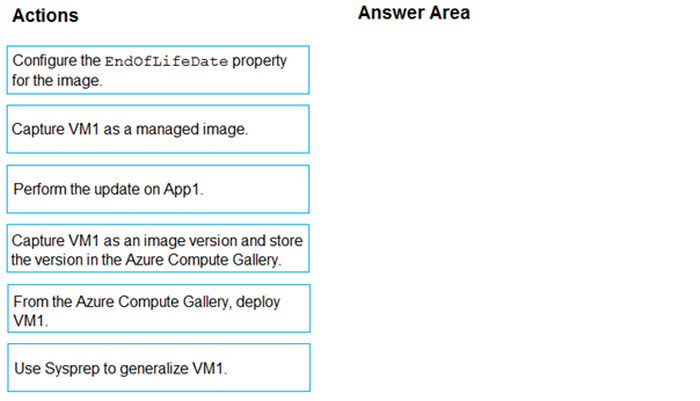 Reveal answer details Close answer details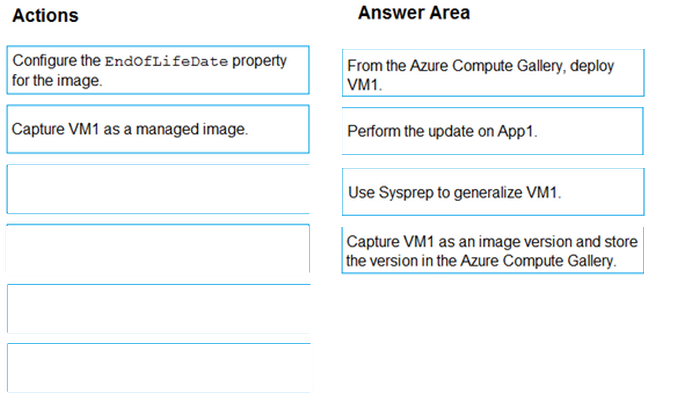
Hotspot
HOTSPOT You have an Azure subscription that contains a user named User1 and an Azure Virtual Desktop host pool named Pool1. Pool1 contains the session hosts shown in the following table.  You have the devices shown in the following table. 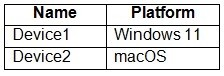 For each of the following statements, select Yes if the statement is true. Otherwise, select No. NOTE: Each correct selection is worth one point. 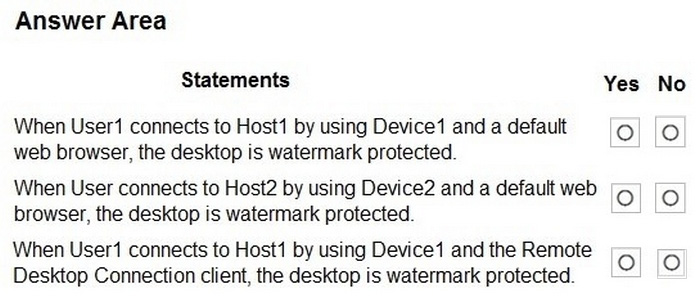 Reveal answer details Close answer details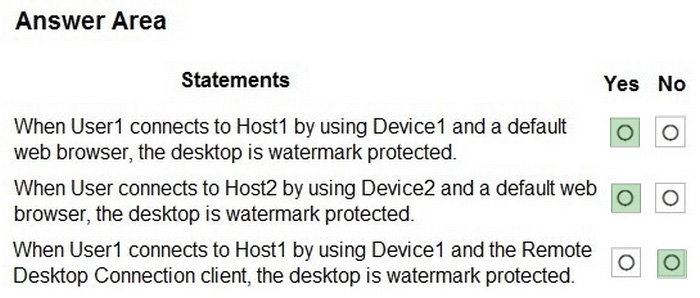 Explanation 1. When User1 connects to Host1 by using Device1 and a default web browser, the desktop is watermark protected - YES 2. When User connects to Host2 by using Device2 and a default web browser, the desktop is watermark protected - YES 3. When User1 connects to Host1 by using Device1 and the Remote Desktop Connection client, the desktop is watermark protected - NO
Multiple choice
You have an Azure Virtual Desktop deployment that contains a host pool named Pool1. Pool1 contains three session hosts. You need to implement a private endpoint connection for Pool. Which two actions should you perform? Each correct answer presents part of the solution. NOTE: Each correct selection is worth one point. Reveal answer details Close answer detailsCorrect answersC, D Explanation Azure Private Link with Azure Virtual Desktop (C) Enable Private Link with Azure Virtual Desktop on a subscription (D) Connections to host pools [See step 6 below] Here's how to create a private endpoint for the connection sub-resource for connections to a host pool using the Azure portal. 1. Sign in to the Azure portal.
Hotspot
HOTSPOT You have an Azure Virtual Desktop deployment that contains a host pool named Pool1. Pool1 contains a session host named Computer1 that runs Windows 11 Enterprise multi-session. You plan to manage the user profiles of Computer1 by using FSLogix. You need to use Local Group Policy Editor to configure FSLogix on Computer1 by using the English (United States) version of fslogix.admx and To which folder on Computer1 should you copy the files? To answer, select the appropriate options in the answer area. NOTE: Each correct selection is worth one point. 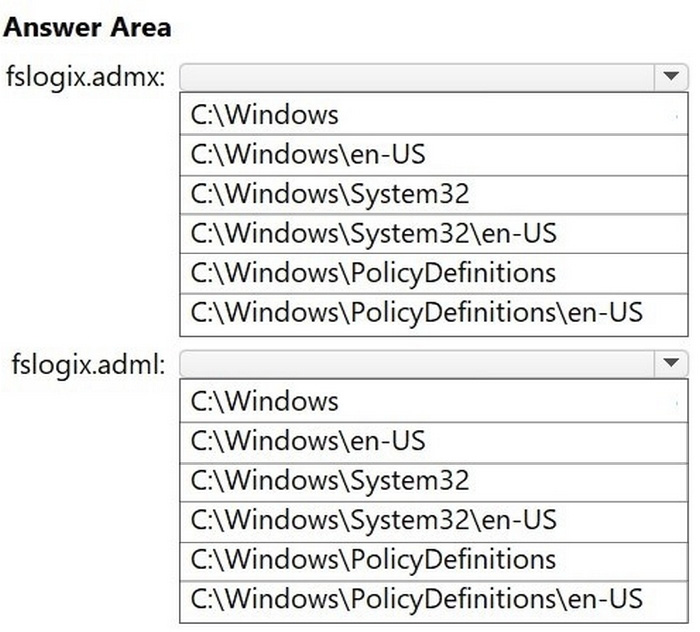 Reveal answer details Close answer details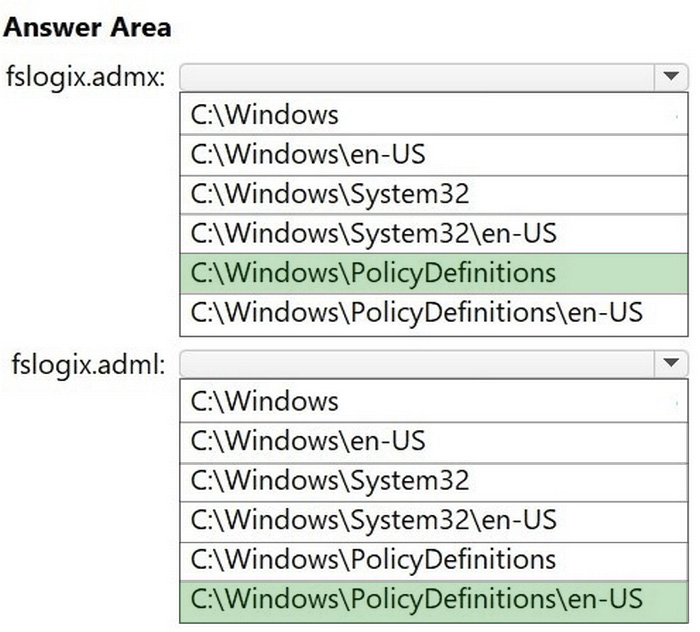 Explanation Box 1: C:\Windows\policyDefinitions The fslogix.admx file, which contains language-neutral Group Policy settings, should be copied to the % systemroot%\\policyDefinitions folder. Box 2: C:\Windows\policyDefinitions\en-US The corresponding fslogix.adml file, which contains the language-specific settings, should be copied to the %systemroot%\\policyDefinitions[MUIculture] folder. For example, the English language-specific file should be copied to %systemroot%\\policyDefinitions\\en-US. These locations allow the Group Policy Management tool to correctly load and use the FSLogix settings when configuring user profiles in Azure Virtual Desktop. References:
Single choice
Note: This question is part of a series of questions that present the same scenario. Each question in the series contains a unique solution that might meet the stated goals. Some question sets might have more than one correct solution, while others might not have a correct solution. After you answer a question in this section, you will NOT be able to return to it. As a result, these questions will not appear in the review screen. You have the following: 1. A Microsoft 365 E5 tenant The Azure Virtual Desktop deployment contains personal desktops that are hybrid joined to the on-premises domain and enrolled in Microsoft Intune. You need to configure the security settings for the Microsoft Edge browsers on the personal desktops. Solution: You create and configure a Group Policy Object (GPO) in the on-premises domain. Does this meet the goal? Reveal answer details Close answer detailsCorrect answerA Explanation References:
Hotspot
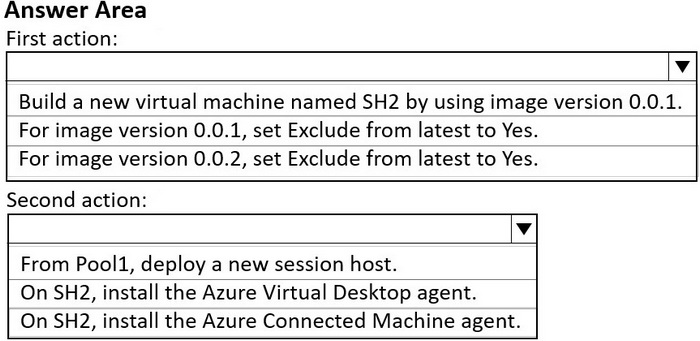
HOTSPOT You have an Azure Virtual Desktop host pool named Pool1. You have an Azure Compute Gallery that contains an image. The image contains the resources shown in the following table. 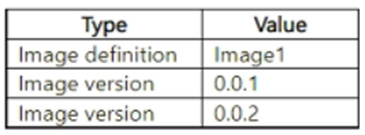 Pool1 contains a single session host named SH1. You need to deploy a new session host named SH2 that will be used to perform troubleshooting. The solution must meet the following requirements: 1. SH2 must use image version 0.0.1. Which two actions should you perform in order? To answer, select the appropriate options in the answer area. NOTE: Each correct selection is worth one point.
Reveal answer details Close answer details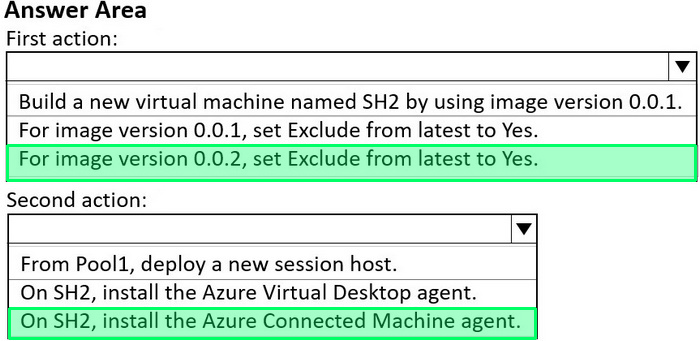 Explanation Box 1: For image version 0.0.2, set Exclude from latest to Yes. Note: Gallery Image Versions - Get Definitions include * excludeFromLatest boolean If set to true, Virtual Machines deployed from the latest version of the Image Definition won't use this Image Version. Box 2: On SH2, install the Azure Connected Machine agent Second action Register session hosts to a host pool
Hotspot
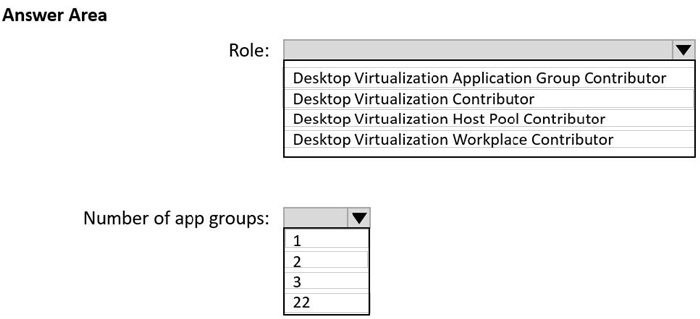
HOTSPOT You have an Azure subscription that contains a user named User1. The subscription uses the Azure Virtual Desktop host pools shown in the following table.  You need to ensure that User1 can create RemoteApp app groups that will be used to stream a suite of custom apps from the host pools. The solution must meet the following requirements: The apps must be available to the users in all the pools. Which role should you assign to User1, and what is the minimum number of app groups that User1 should create? To answer, select the appropriate options in the answer area. NOTE: Each correct selection is worth one point.
Reveal answer details Close answer details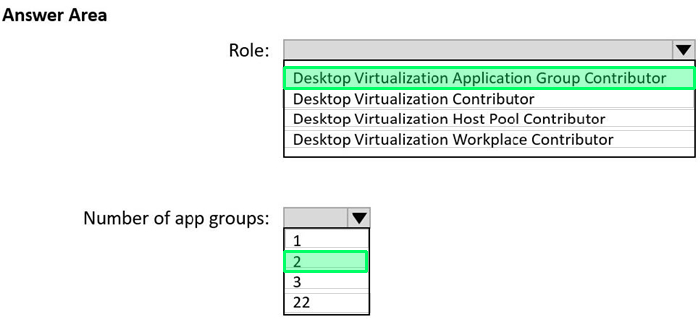
Single choice
You have an Azure subscription named Sub1 that contains a virtual network named VNet1. Sub1 has an Azure Virtual Desktop deployment that contains a host pool named Pool1. Pool1 contains 10 session hosts that are connected to VNet1. You need to add a private endpoint connection to Pool1. What should you do first? Reveal answer details Close answer detailsCorrect answerB Explanation Enable Private Link with Azure Virtual Desktop on a subscription
Single choice
You have an Azure subscription and an Azure Virtual Desktop deployment. The subscription contains the storage locations shown in the following table. 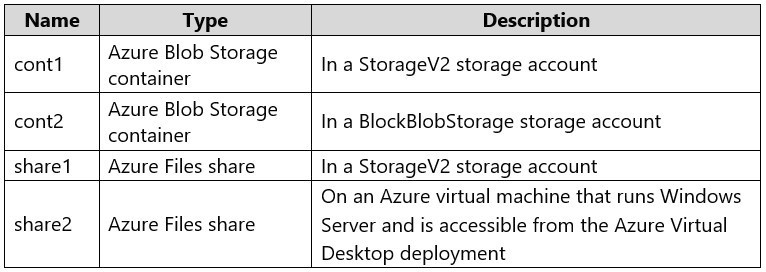 You plan to use app attach to deploy an image named App1.vhdx. You need to copy App1.vhdx to a storage location. To which locations can you copy App1. Reveal answer details Close answer detailsCorrect answerB Explanation App attach requires that your application images are stored on an SMB file share [not cont1, not cont2], which is then mounted on each session host during sign-in. App attach doesn't have dependencies on the type of storage fabric the file share uses. We recommend using Azure Files as it's compatible with Microsoft Entra ID or Active Directory Domain Services, and offers great value between cost and management overhead. You can also use Azure NetApp Files, but that requires your session hosts to be joined to Active Directory Domain Services. References:
Single choice
Note: This question is part of a series of questions that present the same scenario. Each question in the series contains a unique solution that might meet the stated goals. Some question sets might have more than one correct solution, while others might not have a correct solution. After you answer a question in this section, you will NOT be able to return to it. As a result, these questions will not appear in the review screen. You have an Azure Virtual Desktop host pool named Pool1 that is integrated with a Microsoft Entra Domain Services managed domain. You need to configure idle session timeout settings for users that connect to the session hosts in Pool1. Solution: From a Microsoft Entra joined computer, you modify the AADDC Computers GPO settings. Does this meet the goal? Reveal answer details Close answer detailsCorrect answerA
Single choice
You have an Azure Virtual Desktop personal host pool named Pool1 that contains 20 Azure AD-joined session hosts. You need to ensure that only approved virtual machine extensions are installed on the Pool 1 session hosts. The solution must minimize administrative effort. What should you use? Reveal answer details Close answer detailsCorrect answerB Explanation Azure Policy allows you to create and apply policies that enforce specific rules and conditions on your Azure resources, including virtual machines and extensions. You can define custom policies or use built-in policies to control what extensions can be installed on virtual machines. This minimizes administrative effort as you can centrally manage and enforce these policies across your environment without relying on manual configurations or individual host-based solutions like Group Policy.
Single choice
Note: This question is part of a series of questions that present the same scenario. Each question in the series contains a unique solution that might meet the stated goals. Some question sets might have more than one correct solution, while others might not have a correct solution. After you answer a question in this section, you will NOT be able to return to it. As a result, these questions will not appear in the review screen. You have an Azure Virtual Desktop host pool that runs Windows 10 Enterprise multi-session. User sessions are load-balanced between the session hosts. Idle session timeout is 30 minutes. You plan to shut down a session host named Host1 to perform routine maintenance. You need to prevent new user sessions to Host1 without disconnecting active user sessions. Solution: From the host pool, you remove Host1 from the session host list. Does this meet the goal? Reveal answer details Close answer detailsCorrect answerB Explanation References:
Single choice
You have an Azure Virtual Desktop deployment. You need to create a host pool. The solution must ensure that during periods of low CPU usage, credits can be accumulated, and then used to raise performance above the purchased baseline during periods of high CPU usage. Which virtual machine series should you specify when you create the pool? Reveal answer details Close answer detailsCorrect answerD Explanation References:
Single choice
You have an Azure subscription that contains an Azure Virtual Desktop host pool. The host pool uses FSLogix profile containers. You need to create a configuration file to prevent specific folders from syncing to the FSLogix profile containers when a user signs out. How should you name the file? Reveal answer details Close answer detailsCorrect answerA
Single choice
Note: This section contains one or more sets of questions with the same scenario and problem. Each question presents a unique solution to the problem. You must determine whether the solution meets the stated goals. More than one solution in the set might solve the problem. It is also possible that none of the solutions in the set solve the problem. After you answer a question in this section, you will NOT be able to return. As a result, these questions do not appear on the Review Screen. You have an Azure subscription named Sub1 that contains the resources shown in the following table.  You have a user named Admin1 that is assigned the Desktop Virtualization Contributor role for Sub1. You need to ensure that Admin1 can assign Scaling1 to Pool1. Solution: You assign the Azure Virtual Desktop service principal the Owner role for Sub1. Does this meet the goal? Reveal answer details Close answer detailsCorrect answerB Explanation * You assign Admin1 the Owner role for Sub1. Incorrect: Note: Prerequisites * You must grant Azure Virtual Desktop access to manage the power state of your session host VMs. You must have the Microsoft.Authorization/roleAssignments/write permission on your subscriptions in order to assign the role-based access control (RBAC) role for the Azure Virtual Desktop service principal on those subscriptions. This is part of User Access Administrator and Owner built in roles. * Etc
Hotspot
HOTSPOT You have an Azure subscription named Sub1 that contains a resource group named RG1. RG1 contains an Azure Virtual Desktop deployment. The deployment contains a host pool named Pool1. You plan to configure Pool1 to meet the following requirements: 1. Session hosts must start automatically as user demand increases. What should you configure, and which role should you assign to the Azure Virtual Desktop service principal? To answer, select the appropriate options in the answer area. NOTE: Each correct selection is worth one point. 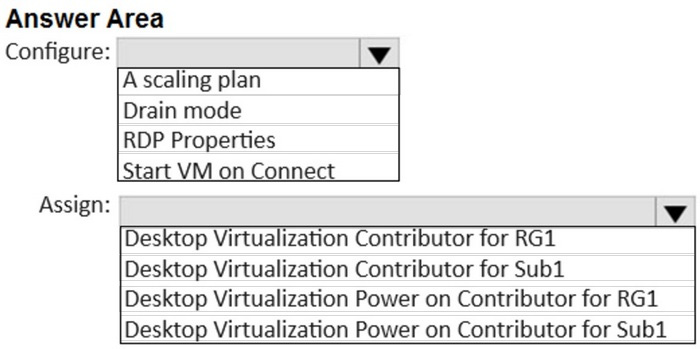 Reveal answer details Close answer details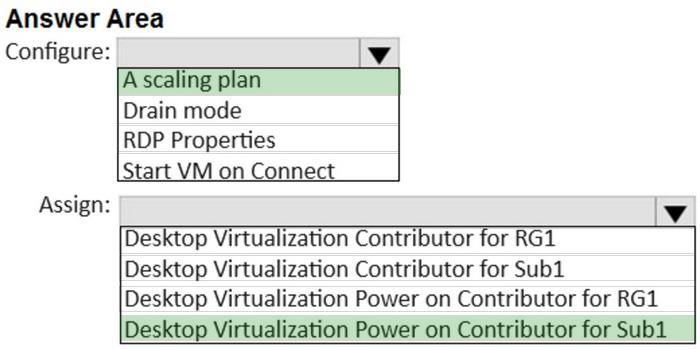
Single choice
You have an Azure Virtual Desktop deployment that contains a host pool named Pool1. All the session hosts in Pool are Microsoft Entra joined. You have 50 users that will access the deployment by using devices that run Linux. You need to ensure that the users can sign in to the deployment. Which custom RDP property should you configure? Reveal answer details Close answer detailsCorrect answerA Explanation Azure Virtual Desktop, Supported RDP properties * targetisaadjoined Syntax: targetisaadjoined:i:<value> Incorrect: Not D:
Hotspot
HOTSPOT You have an Azure Virtual Desktop deployment that contains a host pool named HostPool1. You plan to deploy session hosts to HostPool1 as shown in the following table.  Each session host must support up to 15 concurrent users. You need to recommend which operating system version to deploy from Azure Marketplace to the session hosts. What should you recommend for each session host? To answer, select the appropriate options in the answer area. 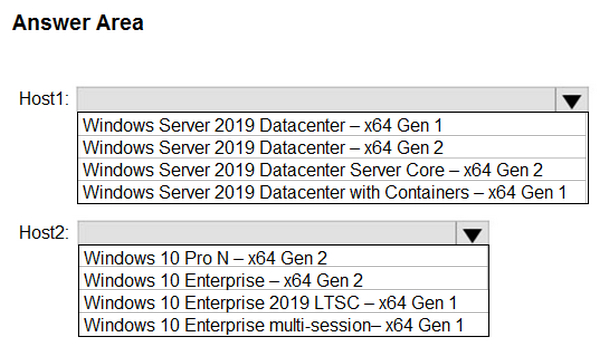 Reveal answer details Close answer details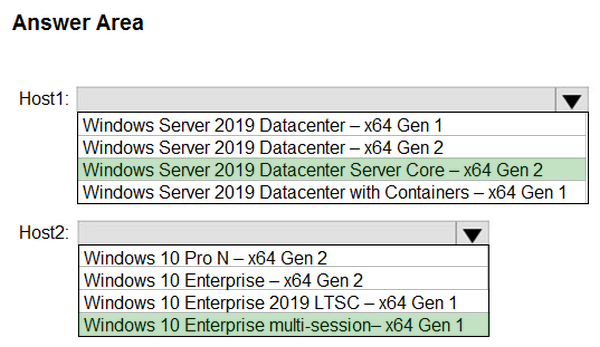
Hotspot
HOTSPOT You have an Azure subscription named Subscription1 that contains the users shown in the following table. 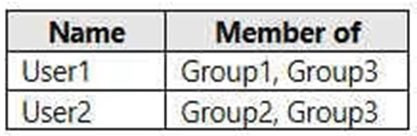 Subscription1 contains the Azure Virtual Desktop host pools shown in the following table.  Subscription1 contains the Azure Virtual Desktop application groups shown in the following table.  You perform the role assignments shown in the following table. 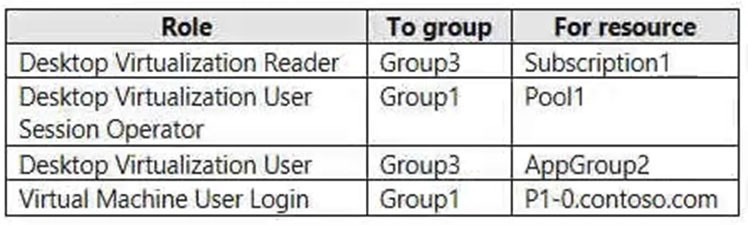 For each of the following statements, select Yes if the statement is true. Otherwise, select No. NOTE: Each correct selection is worth one point. 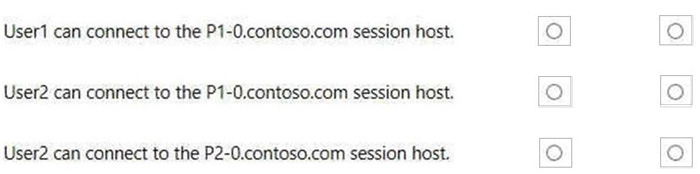 Reveal answer details Close answer details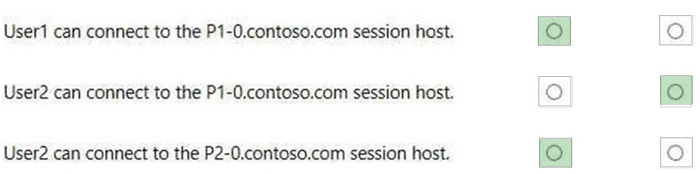
Single choice
Your network contains an on-premises Active Directory domain named contoso.com. You have an Azure subscription that contains the resources shown in the following table. 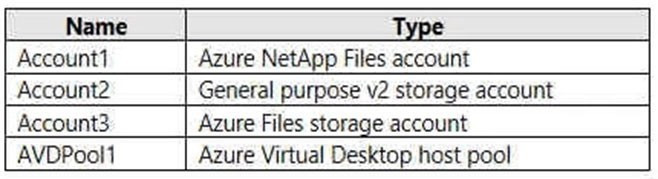 You need to create a share that will host FSLogix profiles for AVDPool1. The solution must meet the following requirements: 1. Maximize read and write performance for the profiles. Which account should you use to host the share? Reveal answer details Close answer detailsCorrect answerA Explanation You can create FSLogix profile containers using Azure NetApp Files, an easy-to-use Azure native platform service that helps customers quickly and reliably provision enterprise-grade SMB volumes for their Azure Virtual Desktop environments. References:
Single choice
You have an Azure subscription that contains an Azure Virtual Desktop deployment. The deployment contains a host pool named Pool. Users access the deployment by using the Windows client for Azure Virtual Desktop. You need to ensure that the users must reauthenticate every eight hours. The solution must minimize administrative effort. What should you do? Reveal answer details Close answer detailsCorrect answerA Explanation First create a Conditional Access policy Configure sign-in frequency 1. Open the policy you created previously.
Single choice
You deploy an Azure Virtual Desktop session host pool. You need to provide a group of pilot user's access to the virtual machines in the pool. What should you do? Reveal answer details Close answer detailsCorrect answerD Explanation References:
Hotspot
HOTSPOT You have an Azure Virtual Desktop deployment. You have a Microsoft Entra tenant that contains the users shown in the following table. 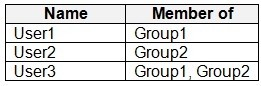 The users have smart devices that have the Microsoft Authenticator app installed. You create a Conditional Access policy that has the following settings: 1. Name: CAPolicy1 Users or workload identities: Group1 You configure the Microsoft Authenticator settings as shown in the following exhibit. 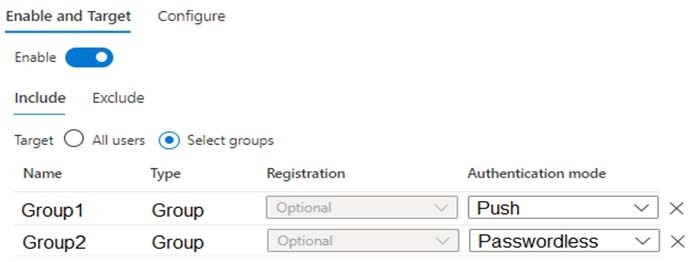 For each of the following statements, select Yes if the statement is true. Otherwise, select No. NOTE: Each correct selection is worth one point. 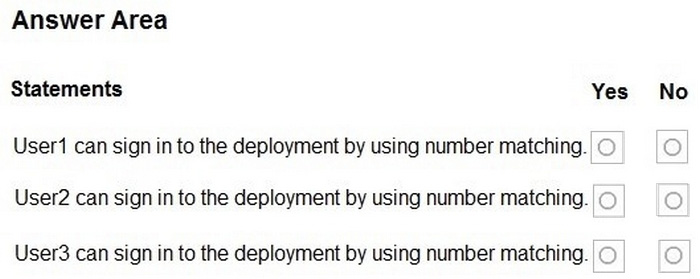 Reveal answer details Close answer details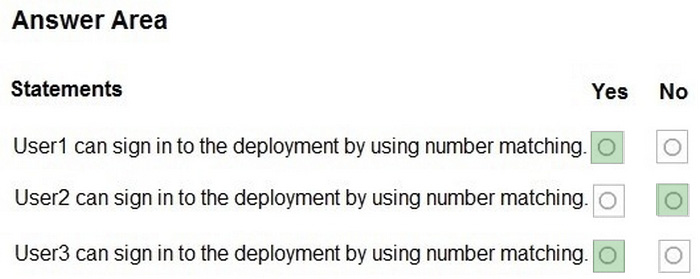 Explanation Box 1: Yes Note: Microsoft Authenticator settings: Number matching works in multifactor authentication push notifications for Authenticator - Authentication methods policy Box 2: No User2 is member of Group2. Box 3: Yes Yes - User3 can sign in to the deployment by using number matching. User3 is member of both Group1 and Group2. References:
Single choice
Note: This section contains one or more sets of questions with the same scenario and problem. Each question presents a unique solution to the problem. You must determine whether the solution meets the stated goals. More than one solution in the set might solve the problem. It is also possible that none of the solutions in the set solve the problem. After you answer a question in this section, you will NOT be able to return. As a result, these questions do not appear on the Review Screen. You have an Azure subscription named Sub1 that contains the resources shown in the following table.  You have a user named Admin1 that is assigned the Desktop Virtualization Contributor role for Sub1. You need to ensure that Admin1 can assign Scaling1 to Pool1. Solution: You assign Admin1 the Owner role for Sub1. Does this meet the goal? Reveal answer details Close answer detailsCorrect answerA Explanation * You assign Admin1 the Owner role for Sub1. Incorrect: * You assign the Azure Virtual Desktop service principal the Owner role for Sub1. Prerequisites * You must grant Azure Virtual Desktop access to manage the power state of your session host VMs. You must have the Microsoft.Authorization/roleAssignments/write permission on your subscriptions in order to assign the role-based access control (RBAC) role for the Azure Virtual Desktop service principal on those subscriptions. This is part of User Access Administrator and Owner built in roles. * Etc
Single choice
You have a Microsoft 365 E5 subscription. You have an Azure subscription. You plan to deploy the Azure Virtual Desktop host pools shown in the following table. 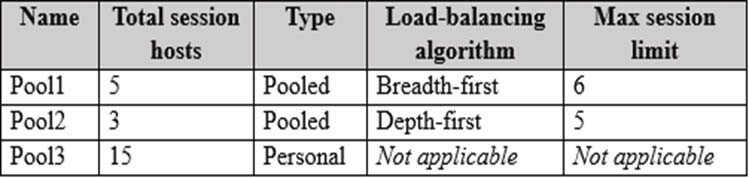 What is the maximum number of users that can connect simultaneously to the Azure Virtual Desktop deployment? Reveal answer details Close answer detailsCorrect answerD Explanation Pool1: 5 x 6 -> 30 Note: Personal, where each session host is assigned to an individual user. Personal host pools provide dedicated desktops to end-users that optimize environments for performance and data separation. Pooled, where user sessions can be load balanced to any session host in the host pool. There can be multiple different users on a single session host at the same time. Pooled host pools provide a shared remote experience to end-users, which ensures lower costs and greater efficiency. References:
Hotspot
HOTSPOT You have a Windows Virtual Desktop deployment. You plan to create the host pools shown in the following table. 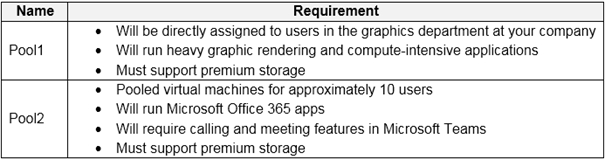 You need to recommend the virtual machine size for each host pool. The solution must minimize costs. Which size should you recommend for each pool? To answer, select the appropriate options in the answer area. NOTE: Each correct selection is worth one point. 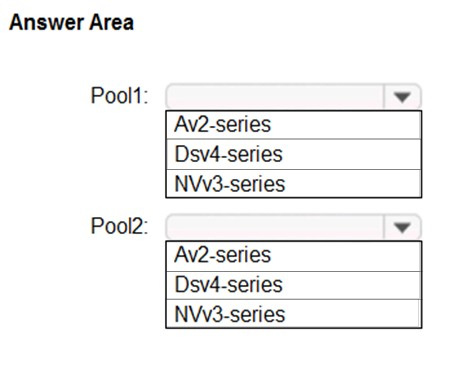 Reveal answer details Close answer details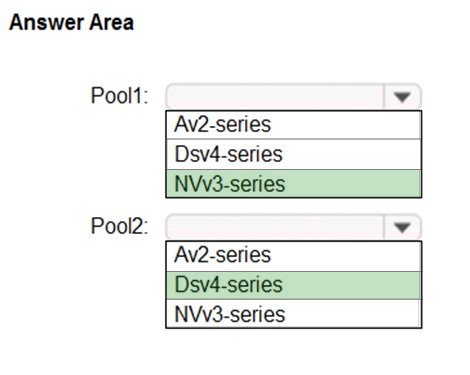 Explanation References:
Single choice
You have an Azure Virtual Desktop host pool named Pool1. All the session hosts in Pool1 are assigned You need to ensure that administrators can connect remotely to the session hosts. The solution must ensure that the administrators can connect to the session hosts by using Azure Command-Line Interface (CLI) and the Remote Desktop client for Windows. What should you include in the solution? Reveal answer details Close answer detailsCorrect answerC Explanation Azure Bastion is a new fully platform-managed PaaS service you provision inside your virtual network. It provides secure and seamless RDP/SSH connectivity to your VMs directly in the Azure portal over SSL.
Hotspot
HOTSPOT You have an Azure Virtual Desktop deployment. You are configuring the outbound firewall settings for the host pool. Which outbound URL and outbound port should you configure to ensure that the host machines maintain Windows activation? To answer, select the appropriate options in the answer area. NOTE: Each correct selection is worth one point. 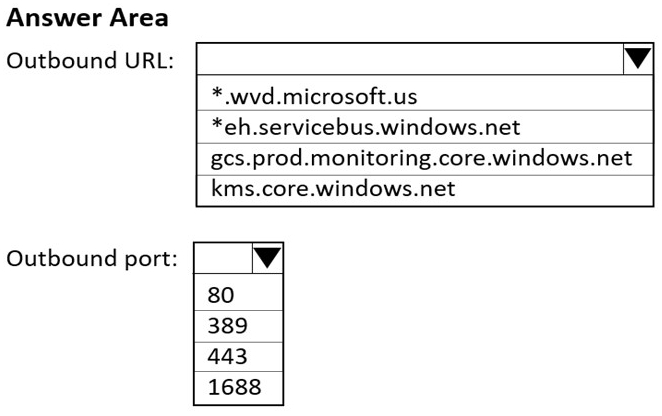 Reveal answer details Close answer details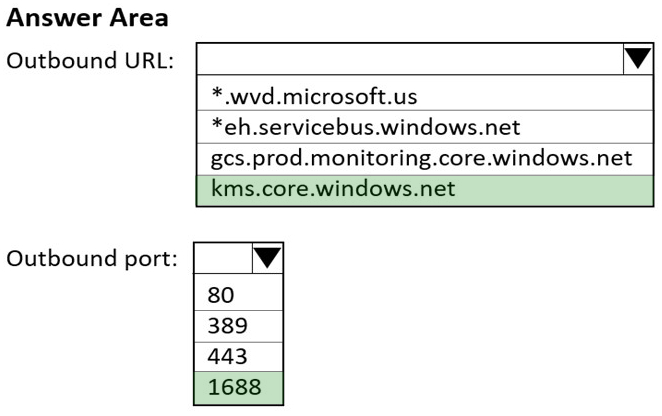 Explanation References:
Single choice
You have an Azure Virtual Desktop deployment. In Azure Advisor, you discover the following recommendation related to Azure Virtual Desktop: 1. Impact: Medium What can you validate by implementing the recommendations? Reveal answer details Close answer detailsCorrect answerD Explanation Validation environment affects the deployment of the AVD Agent software, and causes preview versions to get deployed rather than the typical monthly general releases.
Multiple choice
You have an Azure Virtual Desktop deployment. You plan to deploy Update Management to manage automated updates for server-based session hosts. You need to configure the prerequisites for Update Management. Which two actions should you perform? Each correct answer presents part of the solution. NOTE: Each correct selection is worth one point. Reveal answer details Close answer detailsCorrect answersA, B Explanation Azure Automation update management. https://learn.microsoft.com/en-us/azure/automation/update-management/enable-from-vm
Single choice
You have an Azure Virtual Desktop deployment. You plan to use FSLogix profile containers. You need to recommend a solution that will be used to store the containers. The solution must meet the following requirements: 1. The containers must be stored on solid-state drives (SSDs) What should you recommend? Reveal answer details Close answer detailsCorrect answerD Explanation Azure Files integration with Azure Active Directory Domain Service FSLogix profile containers' performance and features take advantage of the cloud. On August 7th, 2019, Microsoft Azure Files announced the general availability of Azure Files authentication with Azure Active Directory Domain Service (Azure AD DS). By addressing both cost and administrative overhead, Azure Files with Azure AD DS Authentication is a premium solution for user profiles in the Azure Virtual Desktop service. References:
Hotspot
HOTSPOT You have an Azure Virtual Desktop host pool named Pool1 and an Azure Storage account named storage1. Pool1 and storage1 are in the same Azure region. The current network utilization of the session hosts during peak hours is 95%. You plan to use FSLogix profile containers stored in storage1 for users that connect to Pool1. You need to configure the session hosts and storage1 to minimize network latency when loading and updating profiles. What should you do? To answer, select the appropriate options in the answer area. NOTE: Each correct selection is worth one point. 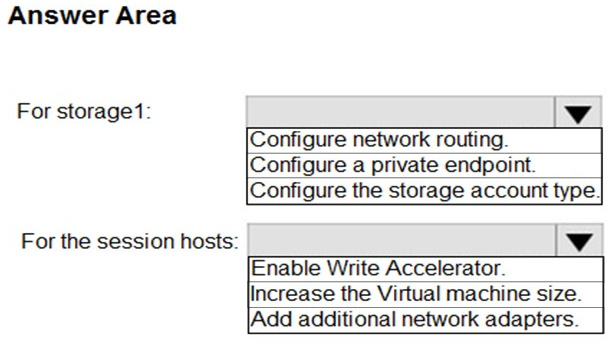 Reveal answer details Close answer details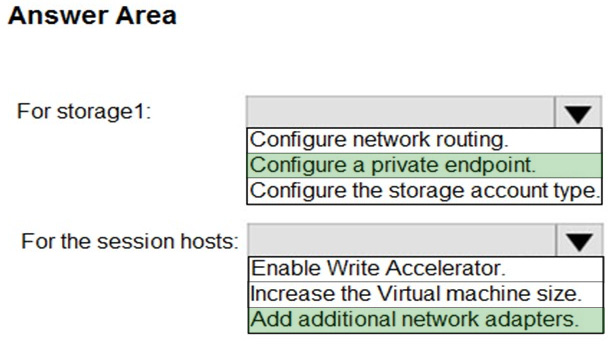 Explanation References:
Single choice
You have an Azure AD tenant that contains a resource group named RG1. RG1 contains the resources shown in the following table. 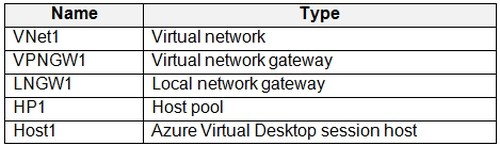 Your on-premises network has an IP address range of 192.168.10.0/24. Users on Host1 can successfully connect to the resources on the network. You add a new on-premises network that has an IP address range of 192.168.11.0/24 and contains a subnet. The subnet contains an application server named App1. Users report that Host1 cannot connect to App1. You need to ensure that the users on Host1 can access App1. What should you modify? Reveal answer details Close answer detailsCorrect answerC
Single choice
You have an Azure Virtual Desktop deployment that contains a host pool. The pool has the following settings: 1. Resource group: RG1 The deployment contains the workspaces shown in the following table. 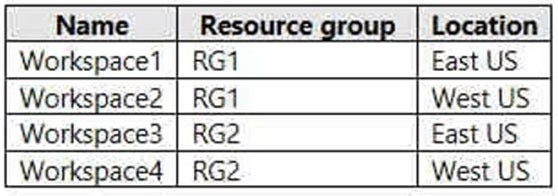 For Pool1, you plan to create a RemoteApp application group named AppGroup1. In which workspaces can you register AppGroup1? Reveal answer details Close answer detailsCorrect answerB Explanation You can only register the app group to workspaces created in the same location as the host pool. Also. if you've previously registered another app group from the same host pool as your new app group to a workspace, it will be selected and you can't edit it. All app groups from a host pool must be registered to the same workspace.
Single choice
Note: This question is part of a series of questions that present the same scenario. Each question in the series contains a unique solution that might meet the stated goals. Some question sets might have more than one correct solution, while others might not have a correct solution. After you answer a question in this section, you will NOT be able to return to it. As a result, these questions will not appear in the review screen. You have an Azure Virtual Desktop host pool that contains five session hosts. The session hosts run Windows 10 Enterprise multi-session. You need to prevent users from accessing the internet from Azure Virtual Desktop sessions. The session hosts must be allowed to access all the required Microsoft services. Solution: You configure rules in the network security group (NSG) linked to the subnet of the session hosts. Does this meet the goal? Reveal answer details Close answer detailsCorrect answerA Explanation References:
Single choice
You have a Microsoft Entra tenant named contoso.com and an Azure virtual network named VNET1. You deploy a Microsoft Entra Domain Services managed domain named litwareinc.com to VNET1. You plan to deploy an Azure Virtual Desktop host pool named Pool1 to VNET1. You need to ensure that you can deploy Windows 10 Enterprise session hosts to Pool1. What should you do first? Reveal answer details Close answer detailsCorrect answerB Explanation Windows 8.1 Professional cannot connect to Azure Virtual Desktop using the modern Remote Desktop client. Microsoft has specific requirements for connecting to Azure Virtual Desktop: The modern Remote Desktop client, which is required for Azure Virtual Desktop, is supported on Windows 10 and later versions. Windows 8.1 reached its end of support on January 10, 2023, and is no longer officially supported for new features or connections to modern cloud services like Azure Virtual Desktop.
Hotspot
HOTSPOT Your on-premises network contains an Active Directory domain named contoso.com that syncs with Azure You deploy an Azure Virtual Desktop pooled host pool named HostPool1 that contains five hybrid-joined session hosts. You need to ensure that all the user sessions of HostPool1 meet the following requirements: 1. Users must use roaming user profiles. The solution must minimize administrative effort. What should you use to meet each requirement? To answer, select the appropriate options in the answer area. NOTE: Each correct selection is worth one point. 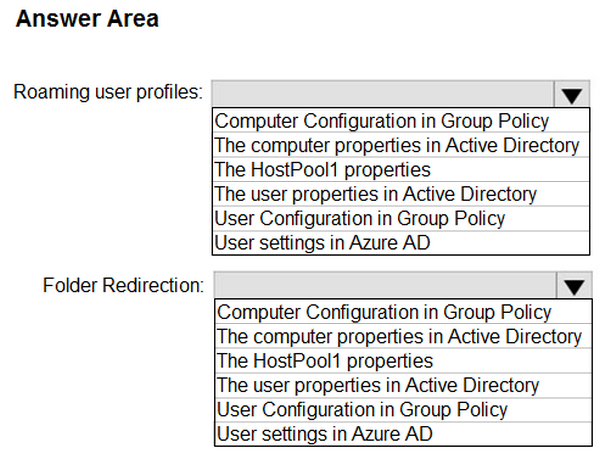 Reveal answer details Close answer details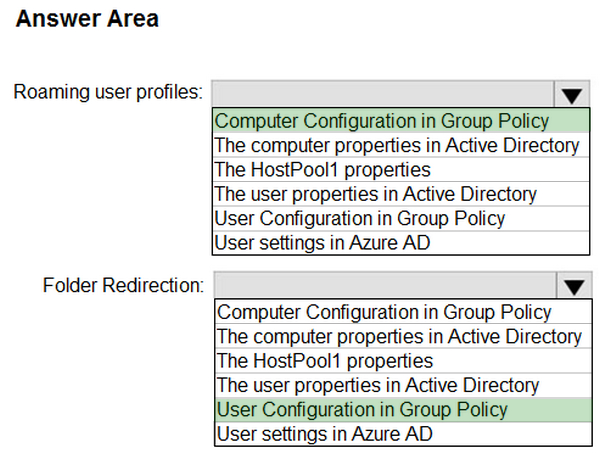 Explanation Roaming user profiles: Computer configuration in Group Policy Folder Redirection: User Configuration in Group Policy
Single choice
You have an Azure Virtual Desktop deployment in the East US Azure region and a disaster recovery location in the West US Azure region. You need to recommend a disaster recovery solution that meets the following requirements: 1. Controlled failover and failback tests between the two regions must be performed every six months. What should you recommend? Reveal answer details Close answer detailsCorrect answerC Explanation Multiregion Business Continuity and Disaster Recovery (BCDR) for Azure Virtual Desktop Active-Active vs. Active-Passive For each single Virtual Desktop host pool, you can base your BCDR strategy on an active-active or active-passive model. This scenario assumes that the same set of users in one geographic location is served by a specific host pool. Active-Passive The amount of compute resources active in the secondary region is reduced compared to the primary region, depending on the budget available. You can use automatic scaling to provide more compute capacity, but it requires more time, and Azure capacity isn't guaranteed. *-> This configuration provides higher RTO when compared to the active-active approach, but it's less You need administrator intervention to execute a failover procedure if there's an Azure outage. The secondary host pool doesn't normally provide the user access to Virtual Desktop resources. Etc. Active-Active This configuration provides almost zero RTO, and RPO has an extra cost. You don't require an administrator to intervene or fail over. During normal operations, the secondary host pool provides the user with Virtual Desktop resources. Each host pool has its own storage accounts (at least one) for persistent user profiles. Etc.
Hotspot
HOTSPOT You have an Azure Virtual Desktop deployment that contains the session hosts shown in the following table.  You have the users shows in the following table. 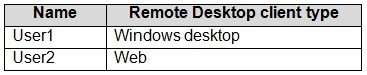 Users connect to Azure from the locations shown in the following table. 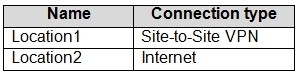 For each of the following statements, select Yes if the statement is true. Otherwise, select No. NOTE: Each correct selection is worth one point. 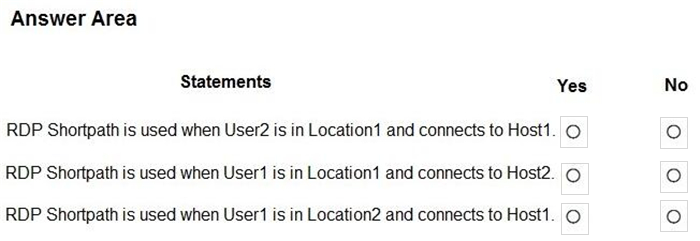 Reveal answer details Close answer details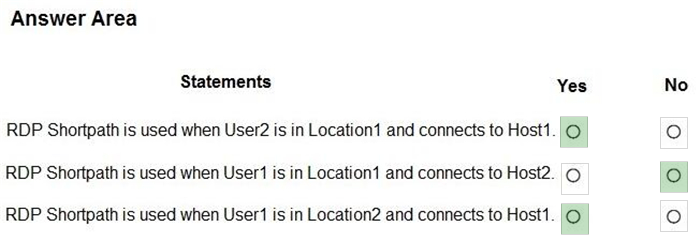
Single choice
You have an Azure Virtual Desktop deployment. You have a RemoteApp named App1. You discover that from the Save As dialog box of App1, users can run executable applications other than App1 on the session hosts. You need to ensure that the users can run only published applications on the session hosts. What should you do? Reveal answer details Close answer detailsCorrect answerD Explanation References:
Single choice
You have an Azure Virtual Desktop deployment that contains five session hosts. You have users that work from offices in Seattle and Vancouver. The users connect to the session hosts over the internet. You need to ensure that the users can connect to the session hosts from only the Seattle and Vancouver offices. What should you use? Reveal answer details Close answer detailsCorrect answerA Explanation Conditional Access: Network assignment Incorrect: Case study Case Study 1Overview Contoso, Ltd. is a law firm that has a main office in Montreal and branch offices in Paris and Seattle. The Seattle branch office opened recently. Contoso has an Azure subscription and uses Microsoft 365. Existing Infrastructure. Active Directory The network contains an on-premises Active Directory domain named contoso.com and an Azure Active Directory (Azure AD) tenant. One of the domain controllers runs as an Azure virtual machine and connects to a virtual network named VNET1. All internal name resolution is provided by DNS server that run on the domain controllers. The on-premises Active Directory domain contains the organizational units (OUs) shown in the following table. 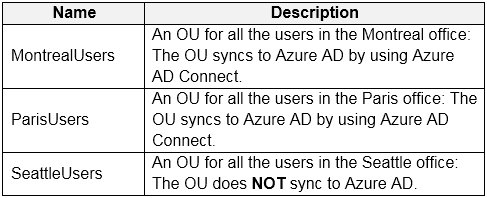 The on-premises Active Directory domain contains the users shown in the following table. 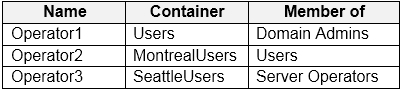 The Azure AD tenant contains the cloud-only users shown in the following table. 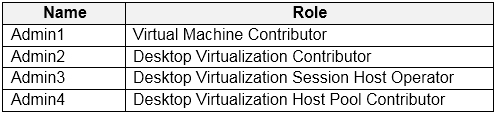 Existing Infrastructure. Network Infrastructure All the Azure virtual networks are peered. The on-premises network connects to the virtual networks. All servers run Windows Server 2019. All laptops and desktop computers run Windows 10 Enterprise. Since users often work on confidential documents, all the users use their computer as a client for connecting to Remote Desktop Services (RDS). In the West US Azure region, you have the storage accounts shown in the following table. 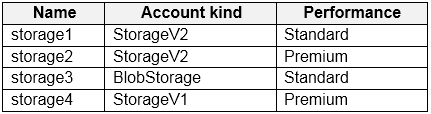 Existing Infrastructure. Remote Desktop Infrastructure Contoso has a Remote Desktop infrastructure shown in the following table. 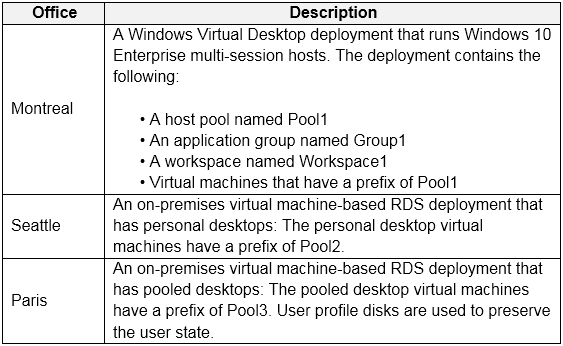 Requirements. Planned Changes Contoso plans to implement the following changes: 1. Implement FSLogix profile containers for the Paris offices. Requirements. Pool4 Configuration Pool4 will have the following settings: 1. Host pool type: Pooled Requirements. Technical Requirements Contoso identifies the following technical requirements: 1. Before migrating the RDS deployment in the Seattle office, obtain the recommended deployment configuration based on the current RDS utilization.
Testlet 1
Single choice
You need to configure the virtual machines that have the Pool1 prefix. The solution must meet the technical requirements. What should you use? Reveal answer details Close answer detailsCorrect answerD Explanation "This scenario is the default configuration when you first deploy Start/Stop VMs during off-hours. For example, you can configure the feature to stop all VMs across a subscription when you leave work in the evening, and start them in the morning when you are back in the office."
Single choice
You have an Azure Virtual Desktop deployment that contains a host pool named Pool1. Pool1 contains session hosts that are deployed to a resource group named RG1 and connected to a virtual network subnet named Subnet1. You create a virtual machine named VM1 that has the following configurations: 1. Is connected to a subnet named Subnet2 You plan to use VM1 to create an image for deploying new session hosts. You need to ensure that you can deploy multiple session hosts by using the gold image. What should you do before you capture the image? Reveal answer details Close answer detailsCorrect answerB Explanation Take the final snapshot. Run sysprep Reboot once Remove any user profiles
Single choice
You have an Azure Virtual Desktop deployment that contains an Azure compute gallery. The Azure compute gallery contains an image definition named Definitions Definitionl contains the following image versions: 1. 1.0.0 You need to ensure that when a virtual machine is created from the Azure compute gallery, the 1.1.0 image version is used by default. What should you do? Reveal answer details Close answer detailsCorrect answerB Explanation Exclude from latest. You can keep a version from being used as the latest image version. Case study Case Study 2Overview Litware, Inc. is a pharmaceutical company that has a main office in Boston, United States, and a remote office in Chennai, India. Existing Environment. Identity Environment The network contains an on-premises Active Directory domain named litware.com that syncs to an Azure Active Directory (Azure AD) tenant named litware.com. The Azure AD tenant contains the users shown in the following table.  All users are registered for Azure Multi-Factor Authentication (MFA). Existing Environment. Cloud Services Litware has a Microsoft 365 E5 subscription associated to the Azure AD tenant. All users are assigned Microsoft 365 Enterprise E5 licenses. Litware has an Azure subscription associated to the Azure AD tenant. The subscription contains the resources shown in the following table.  Litware uses custom virtual machine images and custom scripts to automatically provision Azure virtual machines and join the virtual machines to the on-premises Active Directory domain. Network and DNS The offices connect to each other by using a WAN link. Each office connects directly to the internet. All DNS queries for internet hosts are resolved by using DNS servers in the Boston office, which point to root servers on the internet. The Chennai office has caching-only DNS servers that forward queries to the DNS servers in the Boston office. Requirements. Planned Changes Litware plans to implement the following changes: 1. Deploy Windows Virtual Desktop environments to the East US Azure region for the users in the Boston office and to the South India Azure region for the users in the Chennai office. Requirements. Performance Requirements Litware identifies the following performance requirements: 1. Minimize network latency of the Windows Virtual Desktop connections from the Boston and Chennai offices. Requirements. Authentication Requirements Litware identifies the following authentication requirements: 1. Enforce Azure MFA when accessing Windows Virtual Desktop apps. Requirements. Security Requirements Litware identifies the following security requirements: 1. Explicitly allow traffic between the Windows Virtual Desktop session hosts and Microsoft 365. Requirements. Deployment Requirements Litware identifies the following deployment requirements: 1. Use PowerShell to generate the token used to add the virtual machines as session hosts to a Windows User Profile Requirements Litware identifies the following user profile requirements: 1. In storage1, store user profiles for the Boston office users.
Testlet 2
Hotspot
HOTSPOT You need to recommend a DNS infrastructure that meets the performance requirements. What should you recommend? To answer, select the appropriate options in the answer area. NOTE: Each correct selection is worth one point. 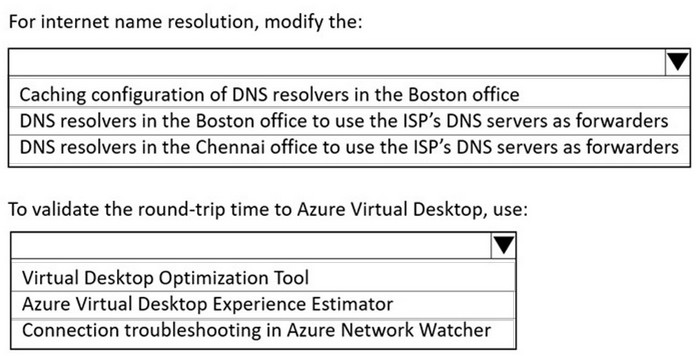 Reveal answer details Close answer details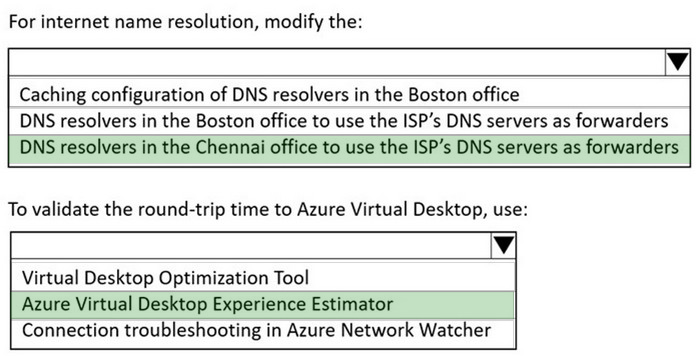 Explanation References:
Single choice
You have an Azure subscription that contains an Azure Virtual Desktop deployment and the storage accounts shown in the following table. 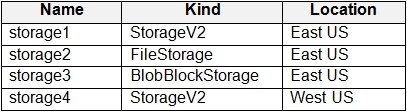 You plan to deploy a host pool named Pool1 to the East US Azure region. Pool1 will use FSLogix Profile Containers and Office Containers. Which storage accounts can Pool1 use? Reveal answer details Close answer detailsCorrect answerB Explanation Storage1 (StorageV2): Supports SMB.
Single choice
You have an Azure Virtual Desktop deployment. You plan to deploy a host pool named Pool1 that will contain 10 session hosts. The session hosts will use MSIX app attach. Which directory service supports MSIX app attach? Reveal answer details Close answer detailsCorrect answerB Explanation MSIX app attach is supported only with Active Directory Domain Services (AD DS).
Hotspot
HOTSPOT You have an Azure Virtual Desktop deployment that contains a host pool named Pool. You have a virtual machine named Server1 that runs Windows Server. You need to add Server1 to Pool1. Which role service should you install on Server first, and which value should you provide during the installation of the Azure Virtual Desktop agent? To answer, select the appropriate options in the answer area. NOTE: Each correct selection is worth one point. 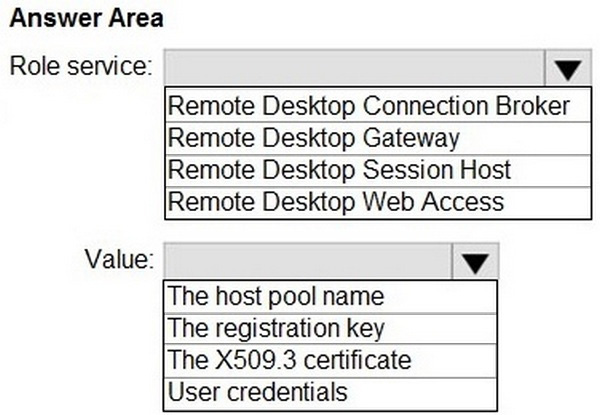 Reveal answer details Close answer details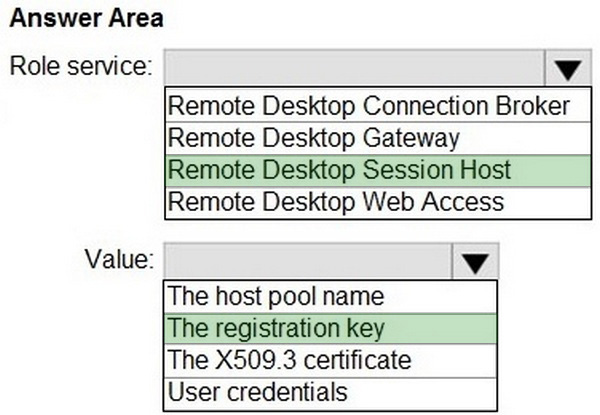 Explanation Box 1: Remote Desktop Session Host Register session hosts to a host pool If your virtual machines are running a Windows Server OS, you need to install the Remote Desktop Session Host role and then restart the virtual machine. Box 2: The registration key Value To register session hosts to a host pool, you need to install the Azure Virtual Desktop Agent and the Azure Virtual Desktop Agent Bootloader on each virtual machine and use the registration key that you generated.
Single choice
You have an Azure Virtual Desktop deployment that contains a host pool. The host pool contains 100 session hosts that run Windows 10 on general-purpose virtual machines. You plan to implement Quality of Service (QoS) for the deployment. What should you do first? Reveal answer details Close answer detailsCorrect answerC Explanation RDP Shortpath for Azure Virtual Desktop Using RDP Shortpath has the following key benefits: * Using URCP to enhance UDP achieves the best performance by dynamically learning network parameters and providing the protocol with a rate control mechanism. * The removal of extra relay points reduces round-trip time, which improves connection reliability and user experience with latency-sensitive applications and input methods. In addition, for managed networks: *-> RDP Shortpath brings support for configuring Quality of Service (QoS) priority for RDP connections through Differentiated Services Code Point (DSCP) marks. * The RDP Shortpath transport allows limiting outbound network traffic by specifying a throttle rate for each Case study Case Study 3Overview Existing Environment Virtual Machines Cloud Services Both subscriptions ate linked to the Microsoft Entra tenant. Requirements Performance Requirements Application Requirements Disaster Recovery Requirements Security Requirements Networking Requirements
Testlet 3
Hotspot
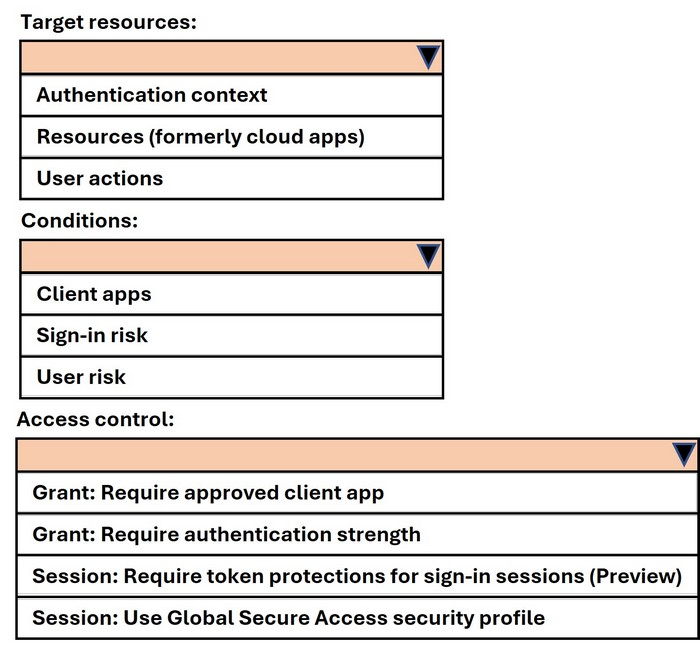
HOTSPOT You need to create a Conditional Access policy to meet the security require-ments. How should you configure the policy? To answer, select the appropriate options in the answer area.
Reveal answer details Close answer details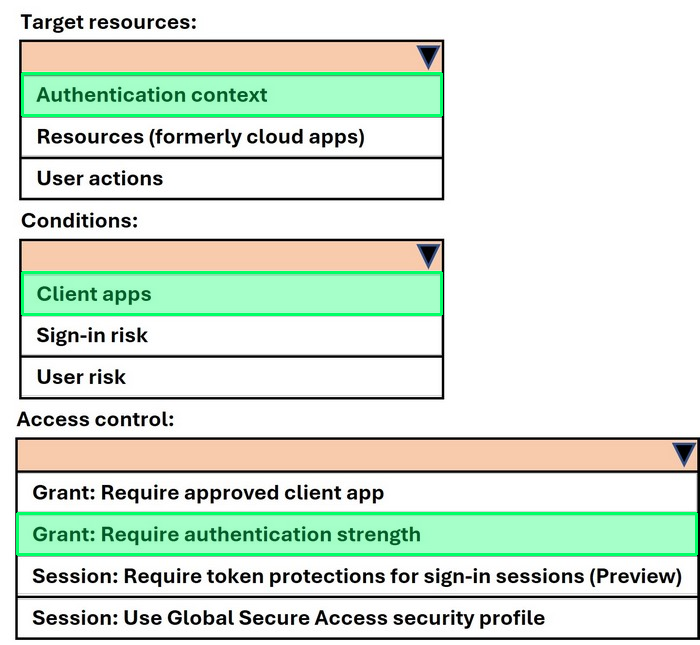 Explanation Northwind Traders identifies the following security requirements: Box 1: Authentication context * Authentication context Incorrect: Targeting specific applications: * User actions Register security information Box 2: Client apps Client apps The Configure toggle when set to Yes applies to checked items, when set to No it applies to all client apps, including modern and legacy authentication clients. * Modern authentication clients * Legacy authentication clients These conditions are commonly used to: Require a managed device Block legacy authentication Block web applications but allow mobile or desktop apps Box 3: Grant: Require authentication strength Require authentication strength can be used to require Microsoft Authenticator (Phone Sign-in) Incorrect: References:
Drag & drop
DRAG DROP You have an Azure Virtual Desktop deployment. You plan to use Azure NetApp Files to store FSLogix profile containers. You need to configure an Azure Azure NetApp Files account. Which three actions should you perform in sequence? To answer, move the appropriate actions from the list of actions to the answer area and arrange them in the correct order. 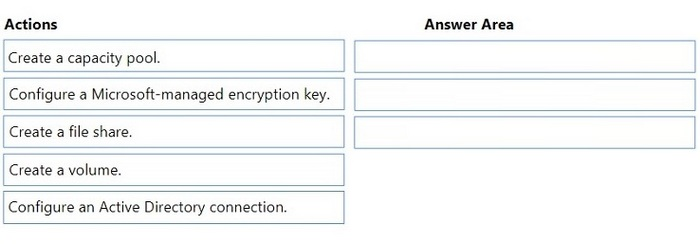 Reveal answer details Close answer details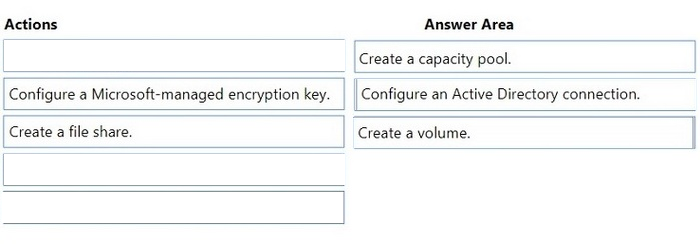 Explanation Step 1: Create a capacity pool Azure Virtual Desktop, Create a profile container with Azure NetApp Files Prerequisites [Skip] Set up and configure Azure Virtual Desktop Provision an Azure Virtual Desktop host pool Set up your Azure NetApp Files account [Skip] Create a capacity pool [Step 1] Step 2: Configure an Active Directory connection Join an Active Directory connection [Step 2] Step 3: Create a volume Create a new volume [Step 3] Case study Case Study 1Overview Contoso, Ltd. is a law firm that has a main office in Montreal and branch offices in Paris and Seattle. The Seattle branch office opened recently. Contoso has an Azure subscription and uses Microsoft 365. Existing Infrastructure. Active Directory The network contains an on-premises Active Directory domain named contoso.com and an Azure Active Directory (Azure AD) tenant. One of the domain controllers runs as an Azure virtual machine and connects to a virtual network named VNET1. All internal name resolution is provided by DNS server that run on the domain controllers. The on-premises Active Directory domain contains the organizational units (OUs) shown in the following table. The on-premises Active Directory domain contains the users shown in the following table. The Azure AD tenant contains the cloud-only users shown in the following table. Existing Infrastructure. Network Infrastructure All the Azure virtual networks are peered. The on-premises network connects to the virtual networks. All servers run Windows Server 2019. All laptops and desktop computers run Windows 10 Enterprise. Since users often work on confidential documents, all the users use their computer as a client for connecting to Remote Desktop Services (RDS). In the West US Azure region, you have the storage accounts shown in the following table. Existing Infrastructure. Remote Desktop Infrastructure Contoso has a Remote Desktop infrastructure shown in the following table. Requirements. Planned Changes Contoso plans to implement the following changes: 1. Implement FSLogix profile containers for the Paris offices. Requirements. Pool4 Configuration Pool4 will have the following settings: 1. Host pool type: Pooled Requirements. Technical Requirements Contoso identifies the following technical requirements: 1. Before migrating the RDS deployment in the Seattle office, obtain the recommended deployment configuration based on the current RDS utilization.
Testlet 1
Single choice
Which setting should you modify for VNET4 before you can deploy Pool4? Reveal answer details Close answer detailsCorrect answerC Explanation DNS should be configured to use an Active Directory Domain Controller. |