Preview real exam questions, verified answers and available explanations before choosing a study plan.
Question 1
Single choice
You plan to automate a deployment of SAP NetWeave on Azure virtual machines by using Azure Resource Manager templates. The database tier will consist of two instances of an Azure Marketplace Microsoft SQL Server 2017 virtual machine image that each has 8 TB of RAM.
Which task should you include in the templates used to deploy the SQL Server virtual machines?
A
Enable buffer pool extensions in SQL Server.
B
Enable read caching on the disks used to store the SQL Server database log files.
C
Run the SQL Server setup and specify the /ACTION=REBUILDDATABASE and /SQLCOLLATION switches.
D
Run the SQL Server setup and specify the /ACTION-INSTALL and /SQLMAXMEMORY switches.
Reveal answer detailsClose answer details
Correct answerD
Question 2
Single choice
You plan to deploy an SAP production landscape that uses SAP HANA databases on Azure.
You need to configure the storage infrastructure to support the SAP HANA deployment
The solution must meet the SAP issued requirements for data throughput and I/O.
How should you configure the storage?
A
RAID1
B
RAID5
C
RAID0
D
RAID6
Reveal answer detailsClose answer details
Correct answerB
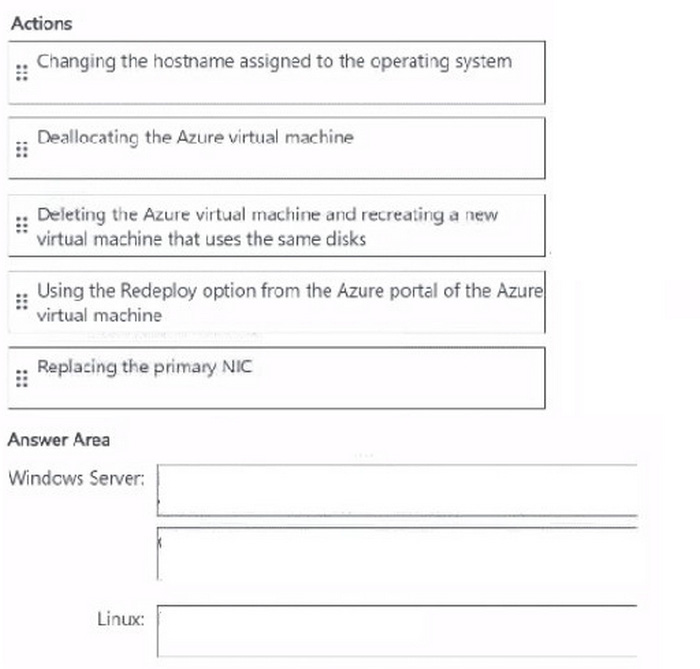
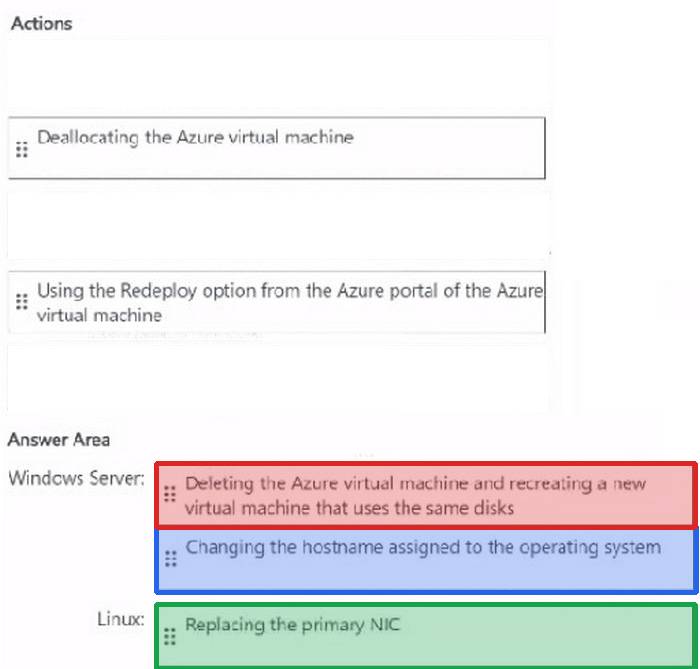
Question 3
Single choice
You deploy an SAP environment on Azure.
Your company has a Service Level Agreement (SLA) of 99.99% for SAP.
You implement Azure Availability Zones that have the following components:
1. Redundant SAP application servers 2. ASCS/ERS instances that use a failover cluster 3. Database high availability that has a primary instance and a secondary instance
You need to validate the high availability configuration of the ASCS/ERS cluster.
What should you use?
A
SAP Web Dispatcher
B
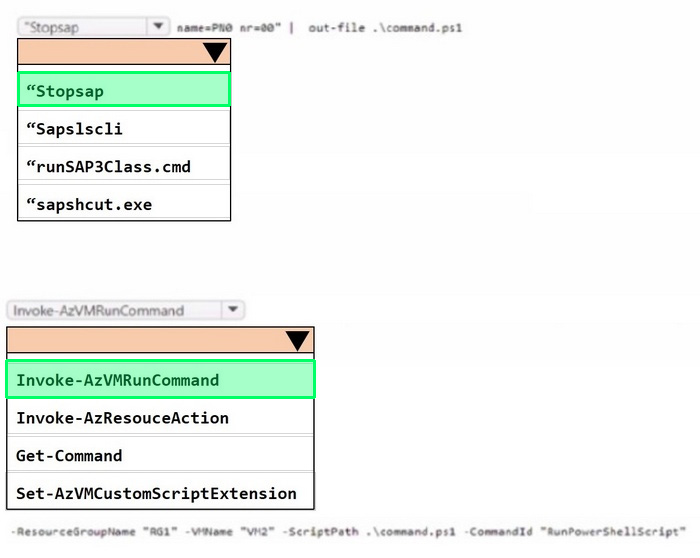
Azure Traffic Manager
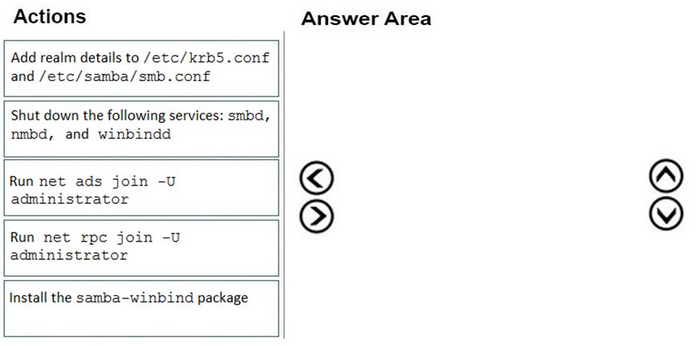
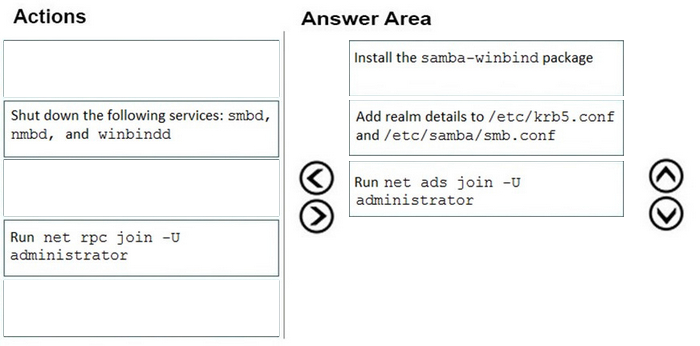
C
SAPControl
D
SAP Solution Manager
Reveal answer detailsClose answer details
Correct answerB
Explanation
https://documentation.suse.com/sbp/all/pdf/SAP_NW740_SLE12_SetupGuide_color_en.pd f
Question 4
Single choice
You plan to deploy an SAP landscape that will have virtual machines deployed to multiple Azure regions.
You need to ensure that the virtual machines can communicate across the regions.
What should you configure?
A
virtual network peering in Azure
B
Azure Bastion hosts
C
local network gateways
D
Azure Relay
Reveal answer detailsClose answer details
Correct answerA
Explanation
Depending on the rules and restrictions you want to apply between the different virtual networks hosting VMs of different SAP systems, you should peer those virtual network
Note: Virtual network peering enables you to seamlessly connect two or more Virtual Networks in Azure. The virtual networks appear as one for connectivity purposes. The traffic between virtual machines in peered virtual networks uses the Microsoft backbone infrastructure. Like traffic between virtual machines in the same network, traffic is routed through Microsoft's private network only.
Azure supports the following types of peering:
Virtual network peering: Connect virtual networks within the same Azure region. Global virtual network peering: Connecting virtual networks across Azure regions.
Incorrect Answers: B: Azure Bastion is a fully managed service that provides more secure and seamless Remote Desktop Protocol (RDP) and Secure Shell Protocol (SSH) access to virtual machines (VMs) without any exposure through public IP addresses.
D: The Azure Relay service enables you to securely expose services that run in your corporate network to the public cloud. You can do so without opening a port on your firewall, or making intrusive changes to your corporate network infrastructure.
You have an SAP landscape on Azure that contains the virtual machines shown in the following table.
You need to ensure that the Application Server role is available if a single Azure datacenter fails.
What should you include in the solution?
A
a local network gateway
B
Azure Load Balancer Standard
C
Azure Virtual WAN
D
Azure Active Directory (Azure AD) Application Proxy
Reveal answer detailsClose answer details
Correct answerB
Explanation
For the load balancers of the failover clusters of SAP Central Services and the DBMS layer, you need to use the Standard SKU Azure Load Balancer. The Basic Load Balancer won't work across zones.
Note: The DBMS also is a single point of contact in an SAP system. You need to protect it by using a high-availability solution. The following figure shows a SQL Server AlwaysOn high-availability solution in Azure, with Windows Server Failover Clustering and the Azure internal load balancer.
Incorrect Answers: C: Azure Virtual WAN is a networking service that brings many networking, security, and routing functionalities together to provide a single operational interface.
D: Application Proxy is recommended for giving remote users access to internal resources. Application Proxy replaces the need for a VPN or reverse proxy for these remote access use cases.
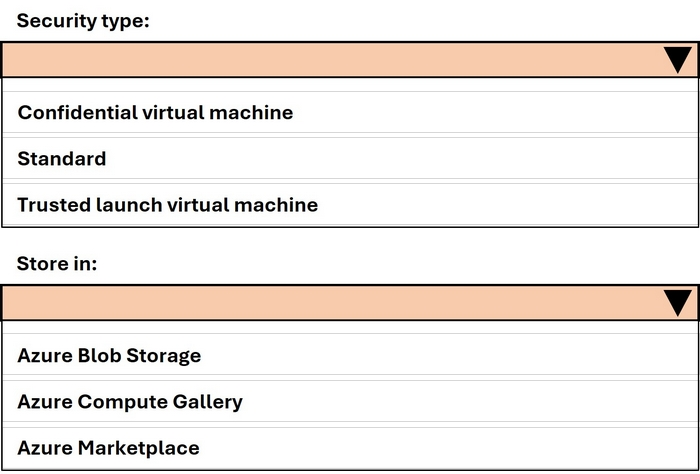
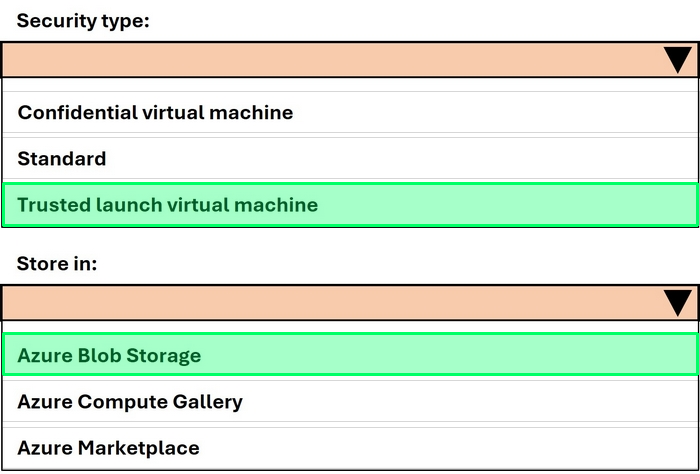
You plan to deploy an SAP landscape by using Azure Center for SAP solutions.
You need to use custom virtual machine images for the deployment.
To what should you set Security type for the virtual machines, and where should you store the custom images? To answer, select the appropriate options in the answer area,
NOTE: Each correct selection is worth one point.
Reveal answer detailsClose answer details
Question 7
Single choice
You are designing an SAP production landscape on Azure.
The landscape must ensure service availability in the event of an Azure datacenter failure
What should you include in the design?
A
an availability zone
B
an availability set
C
a fusion group
D
a proximity placement group
Reveal answer detailsClose answer details
Correct answerA
Question 8
Single choice
You have an on-premises SAP NetWeaver development landscape that contains the resources shown in the following table.
You have a 500-Mbps ExpressRoute circuit between the on-premises environment and a virtual network.
You plan to migrate the landscape to Azure.
What should you include in the solution?
A
Azure Data Box
B
Microsoft System Center 2019 - Data Protection Manager (DPM 2019)
C
Azure Site Recovery
D
Azure Backup Server
Reveal answer detailsClose answer details
Correct answerC
Explanation
Simplify cloud migration by using Site Recovery to migrate your SAP deployment to Azure.
Incorrect Answers: A: Not necessary with the fast ExpressRoute circuit. Data Box devices easily move data to Azure when busy networks aren't an option. Move large amounts of data to Azure when you're limited by time, network availability, or costs, using common copy tools such as Robocopy. All data is AES-encrypted, and the devices are wiped clean after upload, in accordance with NIST Special Publication 800-88 revision 1 standards.
You recently migrated an SAP HANA environment to Azure.
You plan to back up SAP HANA databases to disk on the virtual machines, and then move the backup files to Azure Blob storage for retention.
Which command should you run to move the backups to the Blob storage?
A
robocopy
B
backint
C
azcopy
D
scp
Reveal answer detailsClose answer details
Correct answerC
Explanation
To store directories and files on Azure storage, one could use CLI or PowerShell. There is also a ready-to-use utility, AzCopy, for copying data to Azure storage.
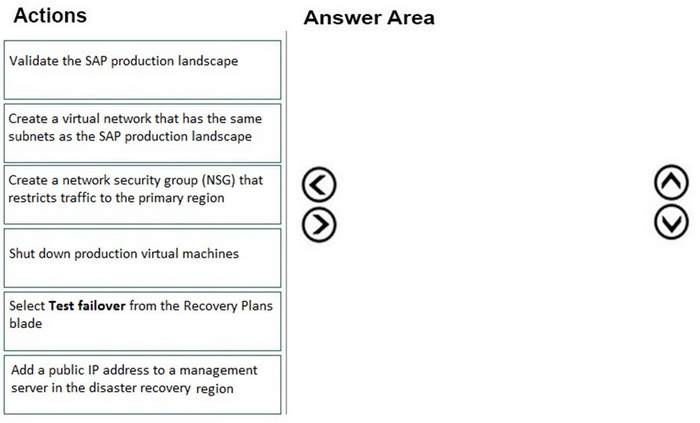
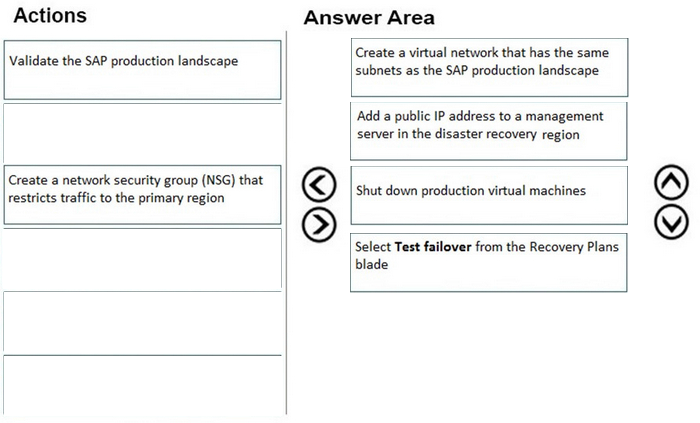
You use Azure Site Recovery to protect an SAP production landscape.
You need to validate whether you can recover the landscape in the event of a failure. The solution must minimize the impact on the landscape.
Which four actions should you perform in sequence? To answer, move the appropriate actions from the list of actions to the answer area and arrange them in the correct order.
Reveal answer detailsClose answer details
Explanation
Step 1: Create a virtual network... We recommended that for test failover, you choose a network that's isolated from the production recovery site network specific in the Compute and Network settings for each VM. By default, when you create an Azure virtual network, it is isolated from other networks. The test network should mimic your production network:
The test network should have same number of subnets as your production network. Subnets should have the same names. The test network should use the same IP address range.
Step 2: Add a public IP address... Because Site Recovery does not replicate the cloud witness, we recommend that you deploy the cloud witness in the disaster recovery region.
Step 3: Shut down production virtual machines Make sure that the primary VM is shut down when you run the test failover. Otherwise there will be two VMs with the same identity, running in the same network at the same time. This can lead to unexpected consequences.
Step 4: Select Test failover from the Recovery Plans blade
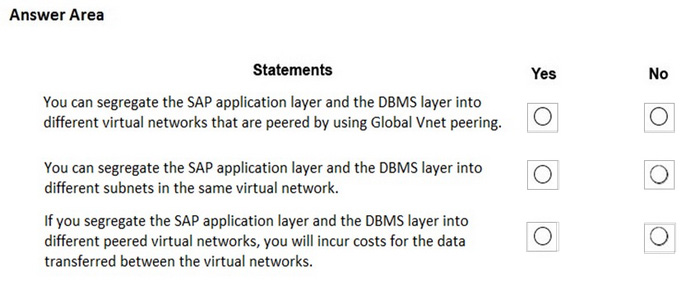
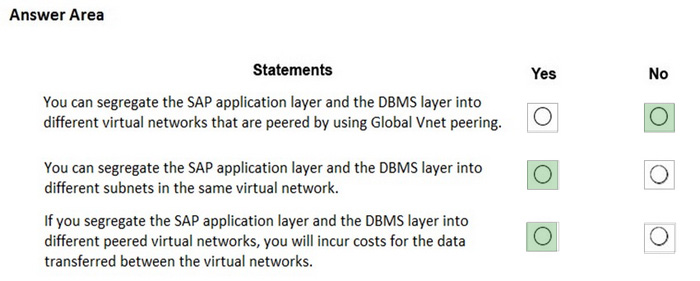
You are planning the Azure network infrastructure for an SAP environment.
For each of the following statements, select Yes if the statement is true. Otherwise, select No.
NOTE: Each correct selection is worth one point.
Reveal answer detailsClose answer details
Explanation
Box 1: NO
Box 2: Yes
Box 3: Yes Be aware that network traffic between two peered Azure virtual networks is subject to transfer costs. Huge data volume that consists of many terabytes is exchanged between the SAP application layer and the DBMS layer. You can accumulate substantial costs if the SAP application layer and DBMS layer are segregated between two peered Azure virtual networks.
You have an Azure subscription that contains an SAP HANA on Azure (Large Instances) deployment. The deployment is forecasted to require an additional 256 GB of storage.
What is the minimum amount of additional storage you can allocate?
A
256 GB
B
512 GB
C
1TB
D
2 TB
Reveal answer detailsClose answer details
Correct answerA
Question 13
Hotspot
HOTSPOT
For each of the following statements, select Yes if the statement is true. Otherwise, select No.
NOTE: Each correct selection is worth one point.
Reveal answer detailsClose answer details
Question 14
Hotspot
HOTSPOT
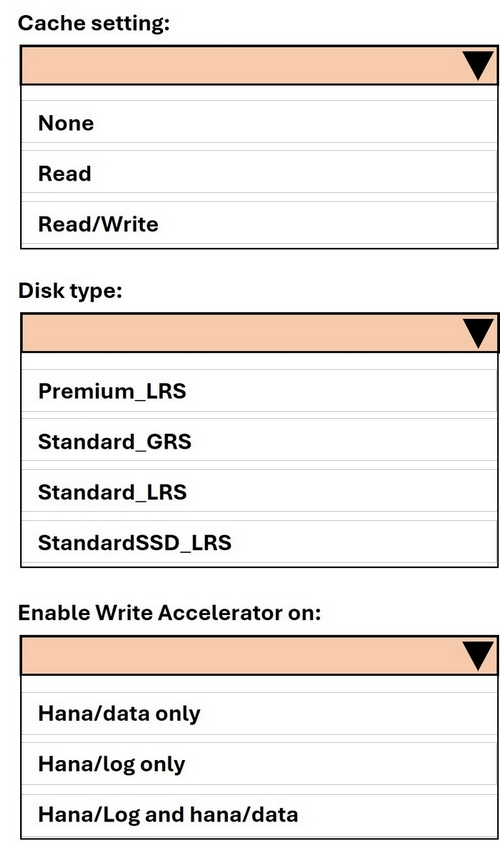
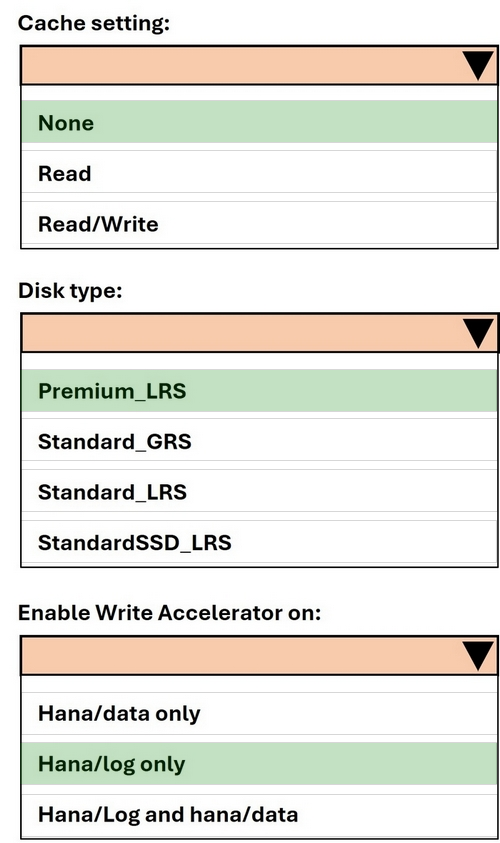
You plan to deploy SAP HANA to an Azure virtual machine for a production landscape.
You need to stripe multiple disks together by using the HANA indexserver.
How should you configure the Azure disks? To answer, select the appropriate options in the answer area.
NOTE: Each correct selection is worth one point.
Reveal answer detailsClose answer details
Question 15
Multiple choice
You have an SAP production landscape on Azure that contains the virtual machines shown in the following table.
VM1 cannot connect to an employee self-service application hosted on VM2.
You need to identify what is causing the issue.
Which two options in Azure Network Watcher should you use? Each correct answer presents part of the solution.
NOTE: Each correct selection is worth one point
A
Connection troubeshoot
B
Connection monitor
C
IP flow verify
D
Network Performance Monitor
Reveal answer detailsClose answer details
Correct answersA, C
Question 16
Hotspot
HOTSPOT
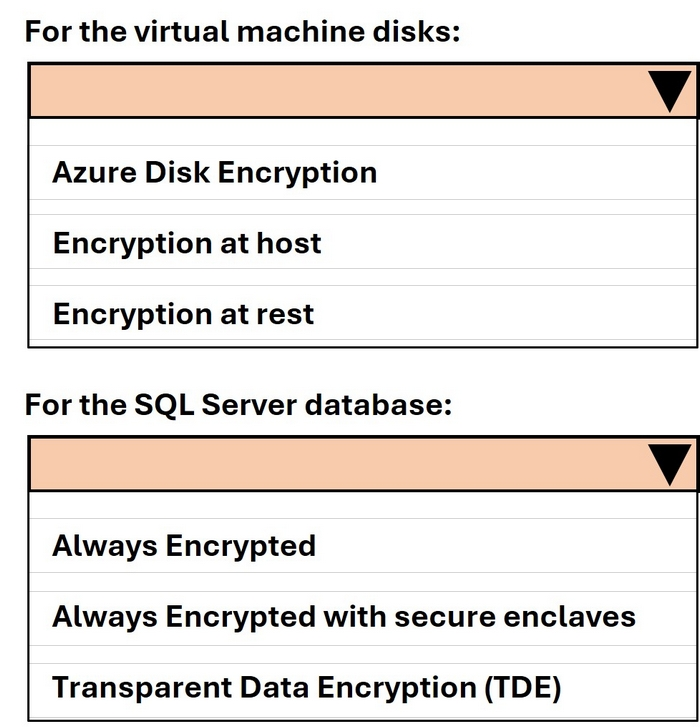
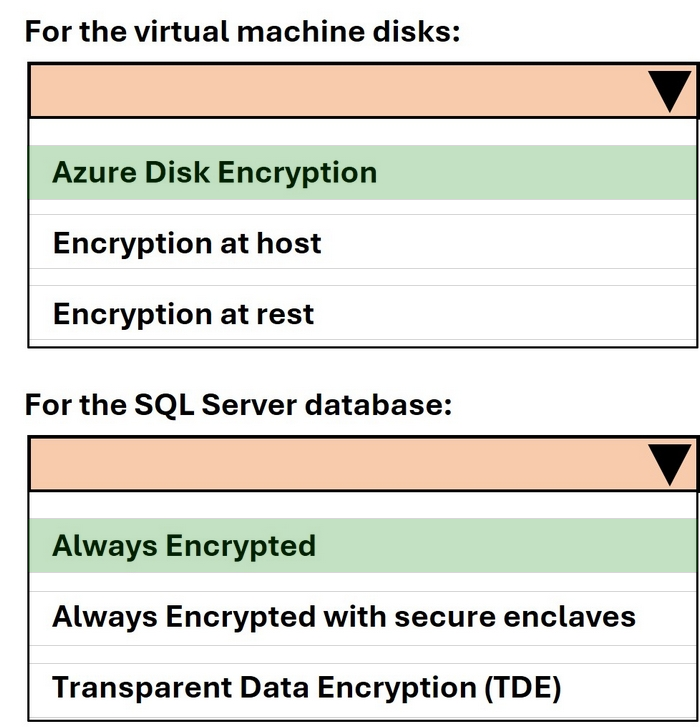
You have an Azure subscription. The subscription contains two virtual machines named SQL1 and SQL2 that host a Microsoft SQL Server 2019 Always On availability group named AOG1.
You plan to deploy an SAP NetWeaver system that will have a database tier hosted on AOG1.
You need to encrypt the Azure virtual machine disks and the SQL Server database.
The solution must meet the following requirements:
1. The operating system disk, data disk, and the temporary disk of the virtual machines must be encrypted. 2. SQL Server encryption keys must be stored on-premises.
Which type of encryption should you use? To answer, select the appropriate options in the answer area.
NOTE: Each correct selection is worth one point.
Reveal answer detailsClose answer details
Question 17
Hotspot
HOTSPOT
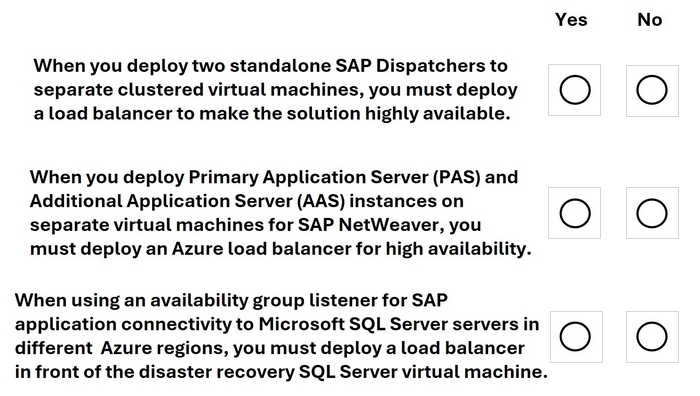
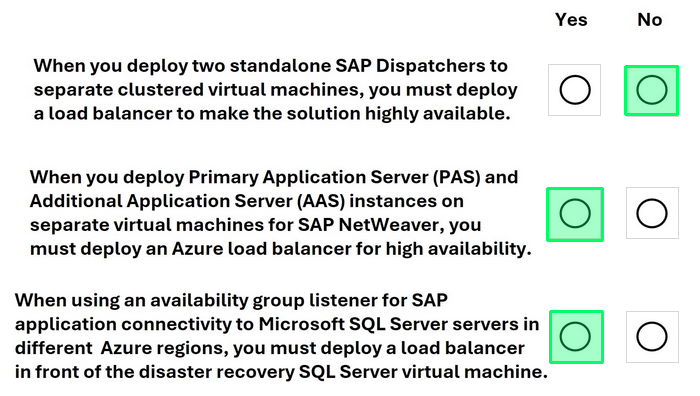
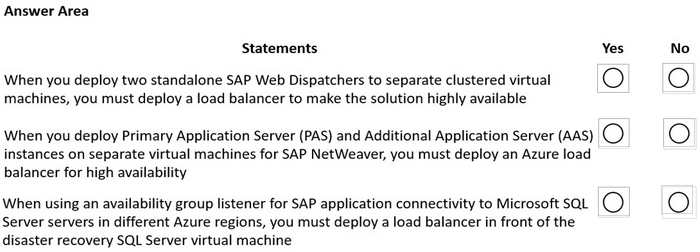
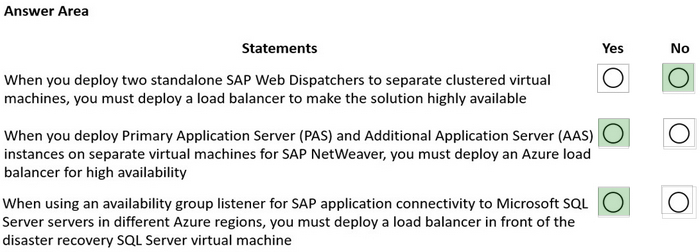
For each of the following statements, select Yes if the statement is true. Otherwise, select No.
NOTE: Each correct selection is worth one point.
Reveal answer detailsClose answer details
Explanation
Box 1: No Load balancers. Load balancers are used to distribute traffic to virtual machines in the application-tier subnet. For high availability, use the built-in SAP Web Dispatcher, Azure Load Balancer, or network appliances. Your choice depends on the traffic type (like HTTP or SAP GUI) or the required network services, like Secure Sockets Layer (SSL) termination.
Box 2: Yes Availability group listener SAP application SQL server load balancer disaster recovery
You have an on-premises SAP landscape and a hybrid Microsoft Entra tenant.
You plan to enable Microsoft Entra authentication for SAP NetWeaver.
What should you configure first in Microsoft Entra ID?
A
a service principal
B
a user flow
C
a Microsoft Entra Application Proxy
D
a conditional access policy
Reveal answer detailsClose answer details
Correct answerC
Question 19
Hotspot
HOTSPOT
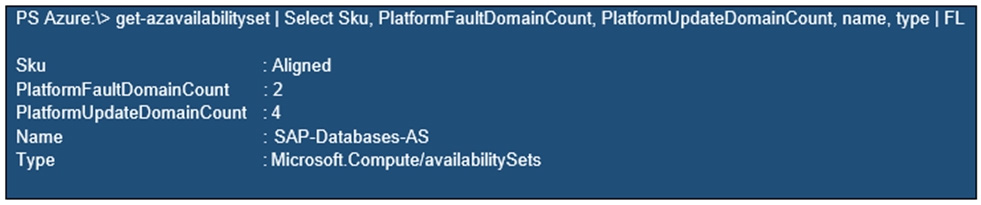
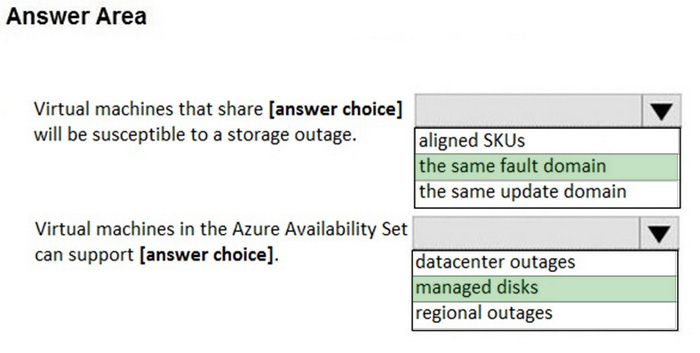
You have an Azure Availability Set that is configured as shown in the following exhibit.
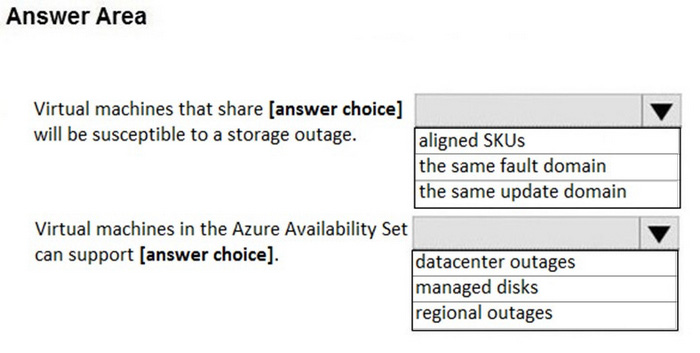
Use the drop-down menus to select the answer choice that completes each statement based on the information presented in the graphic.
NOTE: Each correct selection is worth one point.
Reveal answer detailsClose answer details
Explanation
Box 1: the same fault domain Fault domains define the group of virtual machines that share a common power source and network switch. If a storage fault domain fails due to hardware or software failure, only the VM instance with disks on the storage fault domain fails.
Box 2: managed disks Managed disks provide better reliability for Availability Sets by ensuring that the disks of VMs in an Availability Set are sufficiently isolated from each other to avoid single points of failure. It does this by automatically placing the disks in different storage fault domains (storage clusters) and aligning them with the VM fault domain.
Your company has an SAP environment that contains the following components:
SAP systems based on SAP HANA and SAP Adaptive Server Enterprise (SAP ASE) that run on SUSE Linux Enterprise Server 12 (SLES 12) Multiple SAP applications
The company plans to migrate all the applications to Azure.
You need to get a comprehensive list of all the applications that are part of the SAP environment.
What should you use?
A
the SAP license information
B
the SAP Solution Manager
C
the data volume management report
D
the network inventory and locations
Reveal answer detailsClose answer details
Correct answerB
Explanation
The SAP Solution Manager is a centralized robust application management and administration solution used to implement, support, operate and monitor your SAP enterprise solutions, SAP Solution Manager is a platform providing integrated content, tools, methodologies and access to SAP systems.
Incorrect Answers: C: Data volume management is a framework that helps the solution operations team of an SAP-centric solution to balance the need of business' access to a wealth of data and IT efforts to monitor and control data growth and to minimize data volume.
You have an SAP production landscape that uses SAP HANA databases on Azure.
You need to deploy a disaster recovery solution to the SAP HANA databases. The solution must meet the following requirements:
1. Support failover between Azure regions. 2. Minimize data loss in the event of a failover.
What should you deploy?
A
Azure Site Recovery
B
Always On availability group
C
HANA system replication that uses asynchronous replication
D
HANA system replication that uses synchronous replication
Reveal answer detailsClose answer details
Correct answerC
Question 22
Hotspot
HOTSPOT
You have an on-premises datacenter.
You have an Azure subscription named Sub1 that contains a virtual network named VNet1.
The datacenter is connected to VNet1 by using an ExpressRoute circuit.
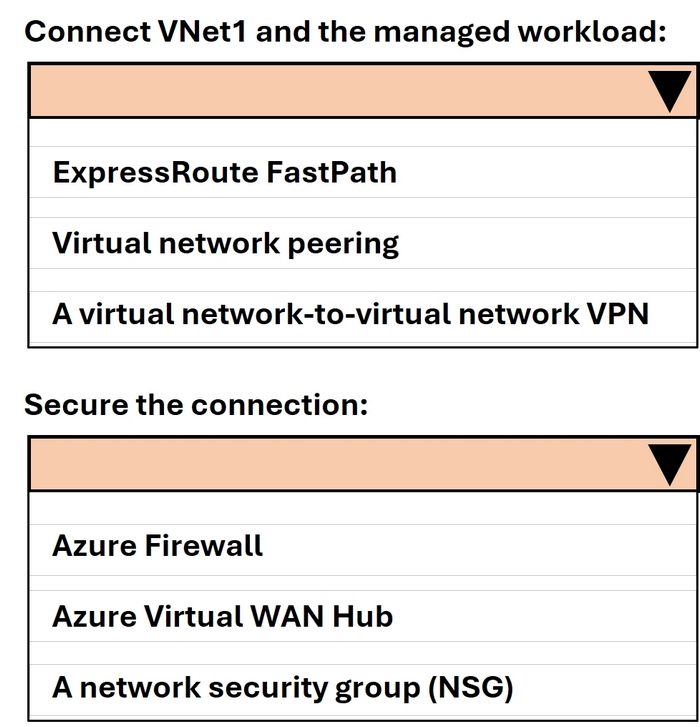
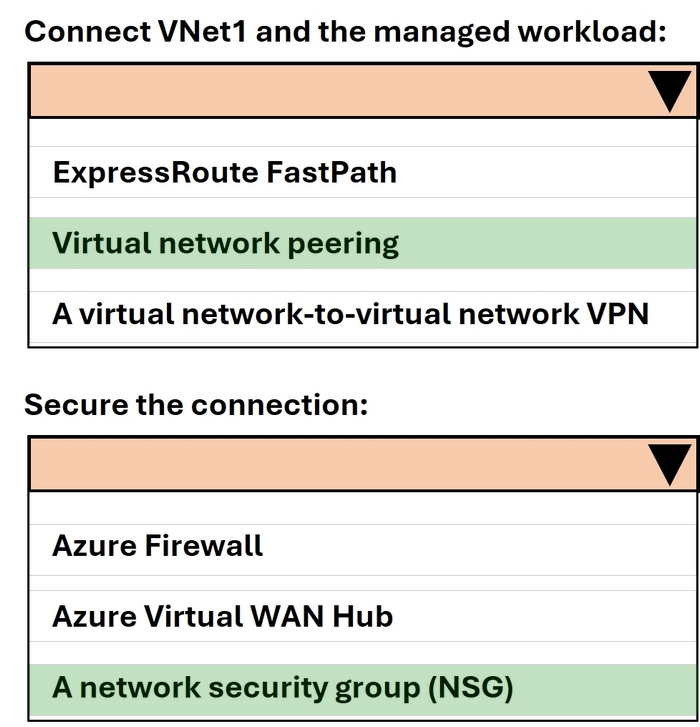
You have an SAP RISE managed workload.
You need to integrate Sub1 with the managed workload.
The solution must meet the following requirements:
1. Minimize latency between the managed workload and the datacenter. 2. Restrict the network ports that can be used between the managed workload and VNet1. 3. Minimize costs.
What should you use to connect VNet1 and the managed workload, and what should you use to secure the connection? To answer, select the appropriate options in the answer area.
Reveal answer detailsClose answer details
Question 23
Single choice
You plan to deploy an SAP environment on Azure.
You plan to store all SAP connection strings securely in Azure Key Vault without storing credentials on the Azure virtual machines that host SAP.
What should you configure to allow the virtual machines to access the key vault?
A
Azure Active Directory (Azure AD) Privilege Identity Manager (PIM)
B
role-based access control (RBAC)
C
a Managed Service Identity (MSI)
D
the Custom Script Extension
Reveal answer detailsClose answer details
Correct answerC
Explanation
To reference a credential stored in Azure Key Vault, you need to: 1. Retrieve data factory managed identity 2. Grant the managed identity access to your Azure Key Vault 3. Create a linked service pointing to your Azure Key Vault. 4. Create data store linked service, inside which reference the corresponding secret stored in key vault.
You plan to migrate an on-premises SAP development system to Azure.
Before the migration, you need to check the usage of the source system hardware, such as CPU, memory, network, etc.
Which transaction should you run from SAP GUI?
A
SM51
B
DB01
C
DB12
D
ST06
Reveal answer detailsClose answer details
Correct answerD
Explanation
ST06 is a transaction code used for Operating System Monitor in SAP. SAP transaction ST06 (Operating System Monitor) is classified in the Basis Component module under application component Operating System Monitors and runs Monitoring Operating System program RSHOST05 upon execution.
Incorrect Answers: A: Transaction code SM51 is to display list of active application servers that have registered in the SAP message server.
B: DB01 is a transaction code used for Analyze Exclusive Lockwaits in SAP.
C: Transaction code DB12 is to collects and presents information that is necessary to monitor database backups.
You estimate that the database will be 1.8 TB in three years.
You need to ensure that the deployment supports 60,000 IOPS. The solution must minimize costs and provide the lowest latency possible.
Which type of disk should you use?
A
Standard HDD
B
Premium SSD
C
Ultra disk
D
Standard SSD
Reveal answer detailsClose answer details
Correct answerC
Question 26
Hotspot
HOTSPOT
You have an Azure subscription named Sub! that contains a Microsoft Sentinel workspace named Workspace1.
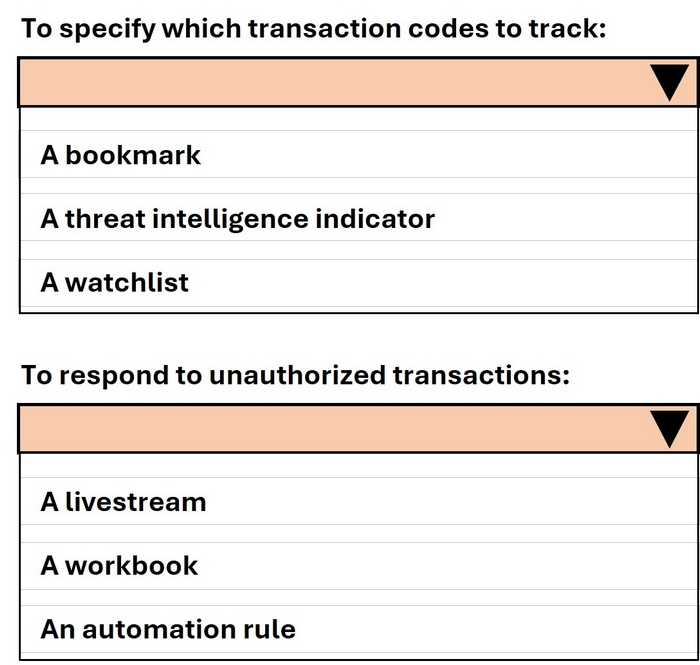
You have an SAP RISE managed workload that is integrated with Sub1.
You need to implement the Microsoft Sentinel solution for SAP applications in Workspace1.
The solution must meet the following requirements:
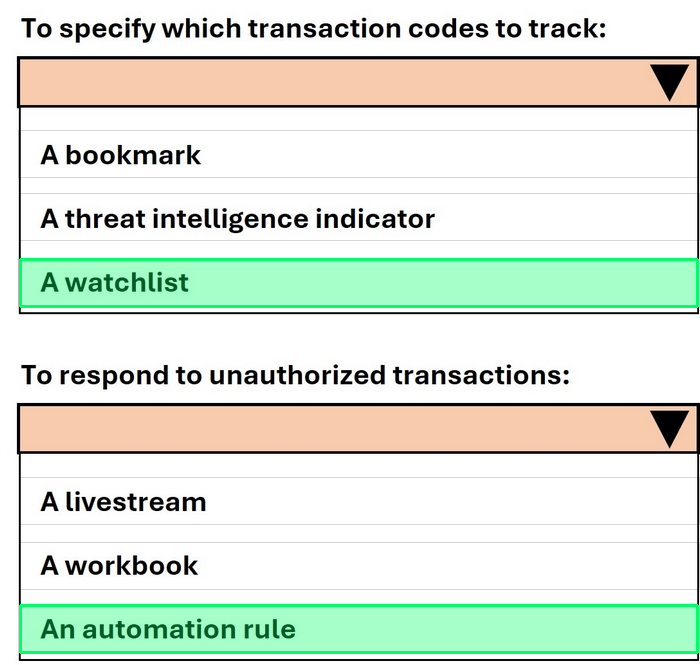
1. Generate an incident based on transaction codes when a sensitive SAP transaction is executed by an unauthorized user. 2. When an incident is generated, send a notification to a designated Microsoft Teams channel. 3. Minimize administrative effort.
What should you include in the solution? To answer, select the appropriate options in the answer area. NOTE: Each correct selection is worth one point.
Reveal answer detailsClose answer details
Question 27
Single choice
You have an SAP production landscape in Azure.
You plan to migrate the landscape to an SAP RISE managed workload.
Which task will be the sole responsibility of the SAP vendor after the migration?
A
configuring security monitoring in Microsoft Sentinel
B
sizing the Azure resources that host the landscape
C
implementing single sign-on (SSO)
D
configuring virtual network peering
Reveal answer detailsClose answer details
Correct answerB
Question 28
Hotspot
HOTSPOT
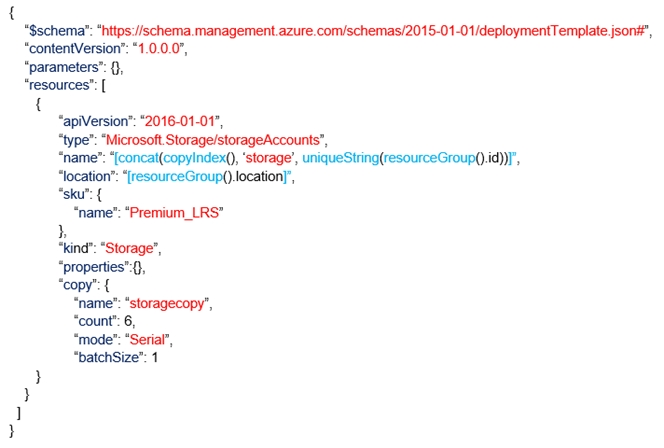
You have the following Azure Resource Manager template.
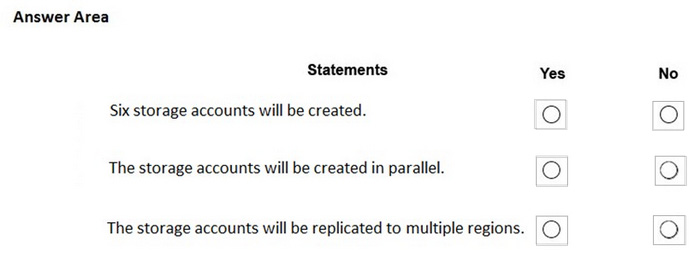
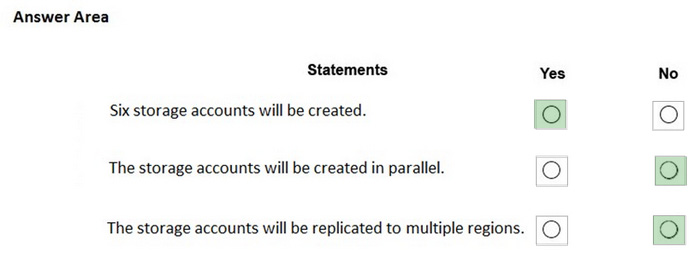
For each of the following statements, select Yes if the statement is true. Otherwise, select No.
You have an SAP environment that is managed by using VMware vCenter.
You plan to migrate the SAP environment to Azure.
You need to gather information to identify which compute resources are required in Azure.
What should you use to gather the information?
A
Azure Migrate and SAP EarlyWatch Alert reports
B
Azure Site Recovery and SAP Quick Sizer
C
SAP Quick Sizer and SAP HANA system replication
D
Azure Site Recovery Deployment Planner and SAP HANA Cockpit
Reveal answer detailsClose answer details
Correct answerA
Explanation
Azure Migrate is a Microsoft service that helps an enterprise assess how its on-premises workloads will perform, and how much they will cost to host, in the Azure public cloud. An enterprise can use Azure Migrate to discover information about the VMware VMs running within its own data center, including CPU and memory usage, as well as performance history.
SAP EarlyWatch Alert (EWA) is a monitoring service for SAP customers, to monitor SAP systems in the solution landscape.
Incorrect Answers: D: SAP HANA Cockpit is an administrative tool with a web interface for a correspondingly named database engine, a part of SAP ERP software. It allows both offline and cloud operations for managing databases, References: https://searchcloudcomputing.techtarget.com/definition/Azure-Migrate
Question 30
Single choice
Your on-premises network is connected to an SAP HANA deployment in the East US Azure region.
The deployment uses the Standard SKU of an ExpressRoute gateway.
You need to implement ExpressRoute FastPath. The solution must meet the following requirements:
1. Hybrid connectivity must be maintained if a single datacenter fails in the East US region. 2. Hybnd connectivity costs must be minimized.
Which ExpressRoute gateway SKU should you use?
A
ErGwIAz
B
High Performance
C
Ultra Performance
D
ErGw3Az
Reveal answer detailsClose answer details
Correct answerD
Question 31
Drag & drop
DRAG DROP
You have an on-premises SAP NetWeaver-based ABAP deployment hosted on servers that run Windows Server or Linux.
You plan to migrate the deployment to Azure.
What will invalidate the existing NetWeaver ABAP licenses for each operating system once the servers are migrated to Azure? To answer, drag the appropriate actions to the correct operating systems. Each action may be used once, more than once, or not at all. You may need to drag the split bar between panes or scroll to view content
NOTE: Each correct selection is worth one point.
Reveal answer detailsClose answer details
Question 32
Hotspot
HOTSPOT
You have an SAP development landscape on Azure.
For each of the following statements, select Yes if the statement is true. Otherwise, select No.
NOTE: Each correct selection is worth one point.
Reveal answer detailsClose answer details
Question 33
Single choice
You have an Azure subscription. The subscription contains a virtual machine named VM1 that runs SUSE Linux Enterprise Server (SLES) and was created by using an Azure Marketplace image.
You plan to deploy four virtual machines based on VM1 that will have the SAP Web Dispatcher role.
You need to create a generalized image of VM1.
What should you do first?
A
Install the Custom Script Extension.
B
Run sysprep.
C
Install the Azure Linux VM agent.
D
Run waagent,
Reveal answer detailsClose answer details
Correct answerD
Question 34
Hotspot
HOTSPOT
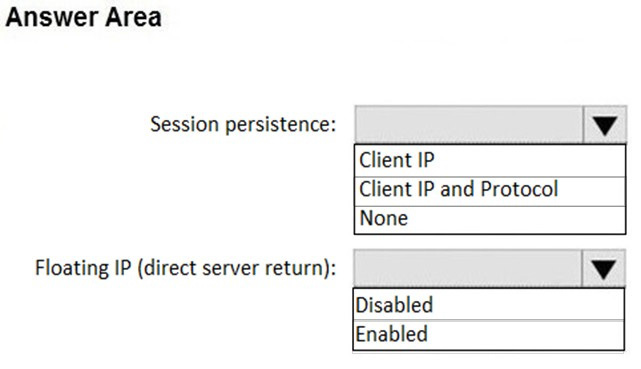
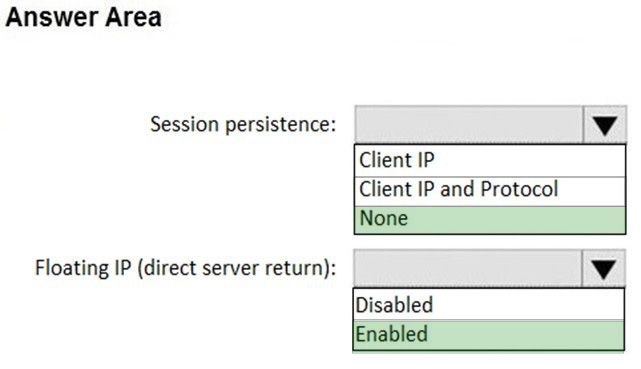
You plan to deploy a highly available ASCS instance to SUSE Linux Enterprise Server (SLES) virtual machines in Azure.
You are configuring an internal Azure Standard Load Balancer for the ASCS instance.
How should you configure the internal Standard Load Balancer? To answer, select the appropriate options in the answer area.
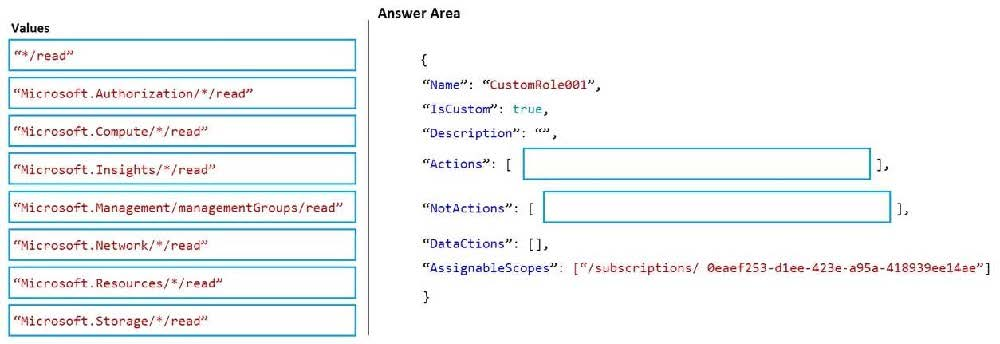
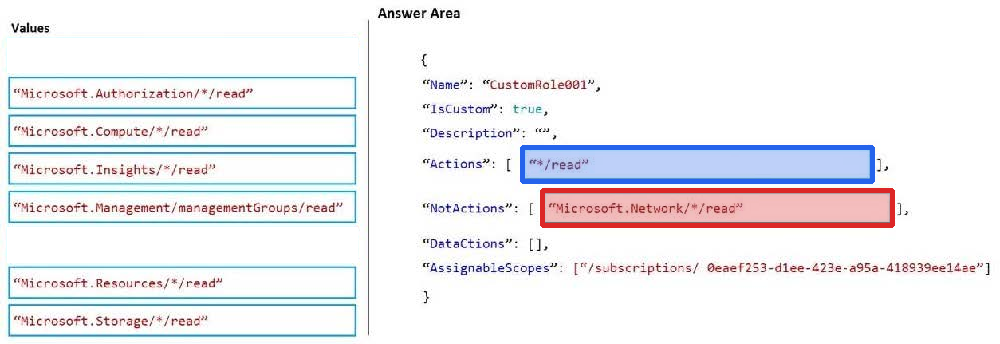
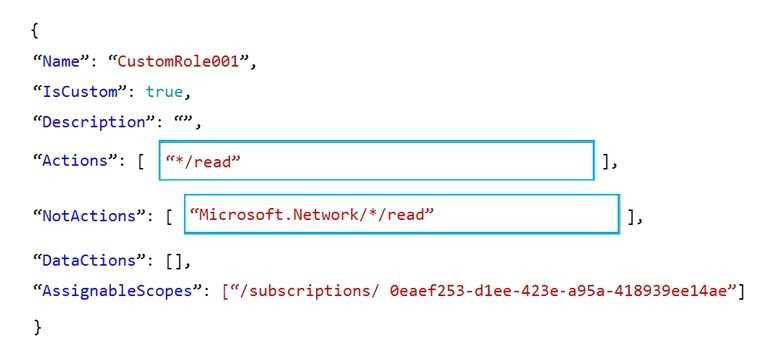
You need to grant an SAP administrator read-only access to the Azure subscription. The SAP administrator must be prevented from viewing network information. How should you configure the role-based access control (RBAC) role definition? To answer, drag the appropriate values to the correct
targets. Each value may be used once, more than once, or not at all. You may need to drag the split bar between panes or scroll to view content. NOTE: Each correct selection is worth one point.
Reveal answer detailsClose answer details
Explanation
Question 36
Single choice
You need direct connectivity from an on-premises network to SAP HANA (Large Instances). The solution must meet the following requirements:
1. Minimize administrative effort. 2. Provide the highest level of resiliency.
Express Route Global Reach Microsoft introduced a new functionality called ExpressRoute Global Reach. Global Reach can be used for HANA Large Instances in two scenarios: Enable direct access from on-premises to your HANA Large Instance units deployed in different regions Enable direct communication between your HANA Large Instance units deployed in different regions Direct Access from on-premises In the Azure regions where Global Reach is offered, you can request enabling the Global Reach functionality for your ExpressRoute circuit that connects your on-premises network to the Azure virtual network that connects to your HANA Large Instance units as well.
Question 37
Drag & drop
DRAG DROP
You have an SAP environment on Azure.
You use Azure Recovery Services to back up an SAP application server.
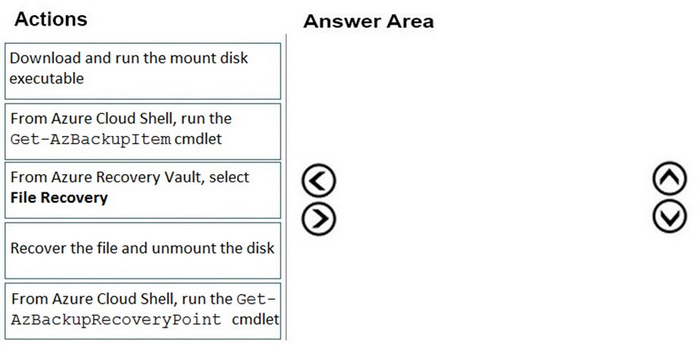
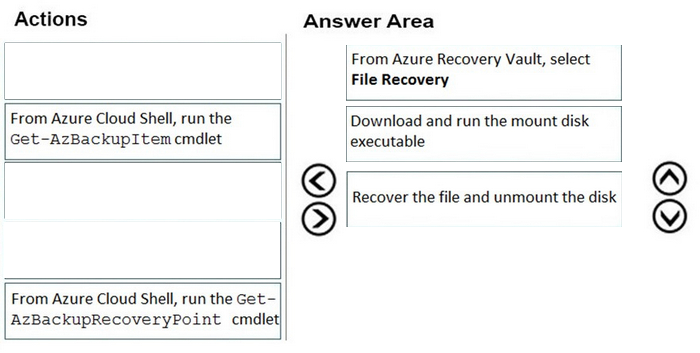
You need to test the restoration process of a file on the server.
Which three actions should you perform in sequence? To answer, move the appropriate actions from the list of actions to the answer area and arrange them in the correct order.
Reveal answer detailsClose answer details
Explanation
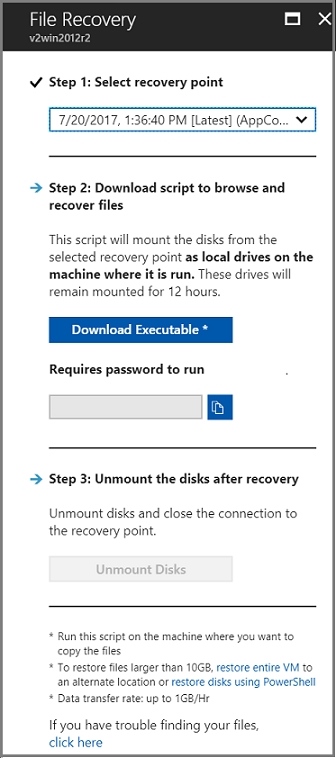
Step 1: From Azure Recover Vault, select File Recovery To restore files or folders from the recovery point, go to the virtual machine and choose the desired recovery point.
Step 2: Download and run the mount disk executable
Step 3: recover the file and unmount the disk
Question 38
Drag & drop
DRAG DROP
You have an Azure subscription.
You plan to deploy a SAP NetWeaver landscape that will use SQL Server on Azure virtual machines. The solution must meet the following requirements:
1. The SAP application and database tiers must reside in the same Azure zone. 2. The application tier in the Azure virtual machines must belong to the same Availability Set.
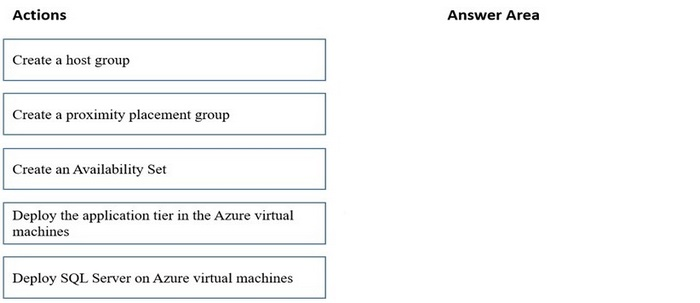
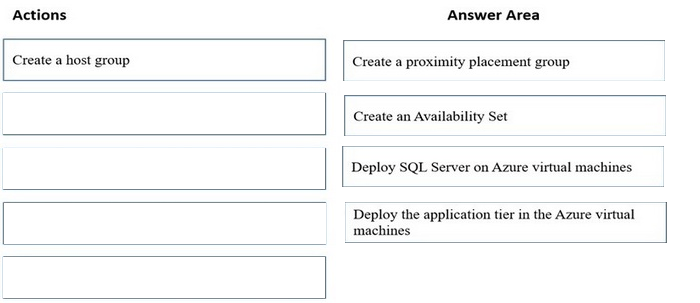
Which four actions should you perform in sequence? To answer, move the appropriate actions from the list of actions to the answer area and arrange them in the correct order.
NOTE: More than one order of answer choices is correct. You will receive credit for any of the correct orders you select.
Reveal answer detailsClose answer details
Explanation
Step 1: Create a proximity placement group A proximity placement group is a logical grouping of Azure resources within the same Azure data center in order to reduce latency.
Step 2: Create an Availability Set Create an availability set that references the Azure proximity group. By adding the availability sets to proximity placement groups, the network latencies are considerably reduced, thereby improving the overall performance.
Step 3: Deploy SQL Server on Azure Virtual machines
Step 4: Deploy the application tier in the Azure virtual machines Deploy the application layer VMs by referencing the availability set and the proximity placement group.
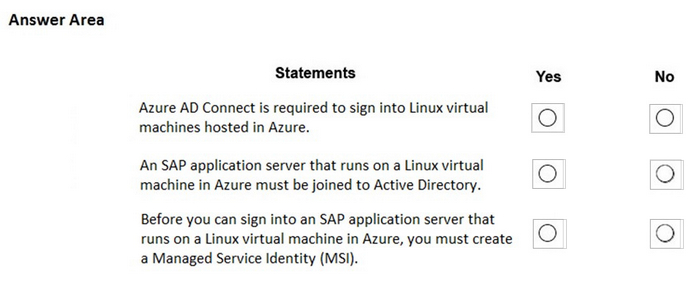
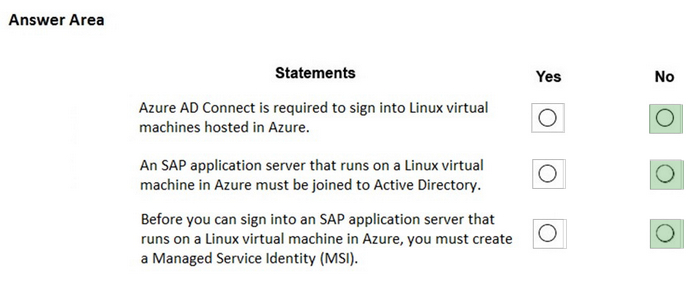
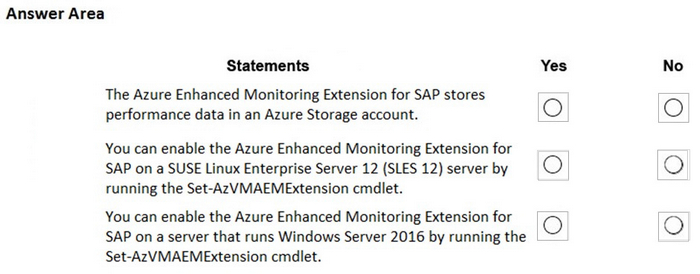
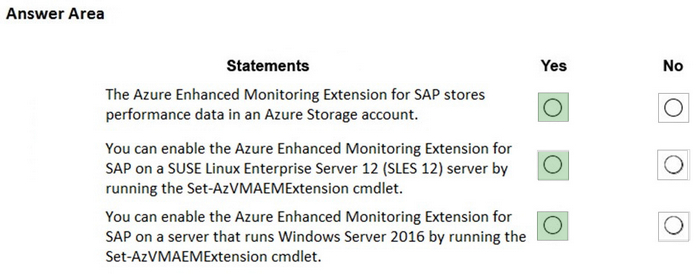
For each of the following statements, select Yes if the statement is true. Otherwise, select No.
NOTE: Each correct selection is worth one point.
Reveal answer detailsClose answer details
Explanation
Box 1: Yes The SAP Azure Enhanced Monitoring Extension builds on top of the Azure Diagnostic extension, which stores its data in an Azure Storage account that you specify.
Box 2: Yes The Set-AzVMAEMExtension cmdlet updates the configuration of a virtual machine to enable or update the support for monitoring for SAP systems that are installed on the virtual machine. The cmdlet installs the Azure Enhanced Monitoring (AEM) extension that collects the performance data and makes it discoverable for the SAP system. The -OSType specifies the OS. Either Windows or Linux.
Contoso, Ltd. is a manufacturing company that has 15,000 employees.
The company uses SAP for sales and manufacturing.
Contoso has sales offices in New York and London and manufacturing facilities in Boston and Seattle.
Existing Environment
Active Directory
The network contains an on-premises Active Directory domain named ad.contoso.com. User email addresses use a domain name of contoso.com.
SAP Environment
The current SAP environment contains the following components:
1. SAP Solution Manager 2. SAP ERP Central Component (SAP ECC) 3. SAP Supply Chain Management (SAP SCM) 4. SAP application servers that run Windows Server 2008 R2 5. SAP HANA database servers that run SUSE Linux Enterprise Server 12 (SLES 12)
Problem Statements
Contoso identifies the following issues in its current environment:
1. The SAP HANA environment lacks adequate resources. 2. The Windows servers are nearing the end of support. 3. The datacenters are at maximum capacity.
Requirements
Planned Changes
Contoso identifies the following planned changes:
1. Deploy Azure Virtual WAN. 2. Migrate the application servers to Windows Server 2016. 3. Deploy ExpressRoute connections to all of the offices and manufacturing facilities. 4. Deploy SAP landscapes to Azure for development, quality assurance, and production.
All resources for the production landscape will be in a resource group named SAPProduction.
Business goals
Contoso identifies the following business goals:
1. Minimize costs whenever possible. 2. Migrate SAP to Azure without causing downtime. 3. Ensure that all SAP deployments to Azure are supported by SAP. 4. Ensure that all the production databases can withstand the failure of an Azure region. 5. Ensure that all the production application servers can restore daily backups from the last 21 days.
Technical Requirements
Contoso identifies the following technical requirements:
1. Inspect all web queries. 2. Deploy an SAP HANA cluster to two datacenters. 3. Minimize the bandwidth used for database synchronization. 4. Use Active Directory accounts to administer Azure resources. 5. Ensure that each production application server has four 1-TB data disks. 6. Ensure that an application server can be restored from a backup created during the last five days within 15 minutes. 7. Implement an approval process to ensure that an SAP administrator is notified before another administrator attempts to make changes to the Azure virtual machines that host SAP.
It is estimated that during the migration, the bandwidth required between Azure and the New York office will be 1 Gbps. After the migration, a traffic burst of up to 3 Gbps will occur.
Proposed Backup Policy
An Azure administrator proposes the backup policy shown in the following exhibit.
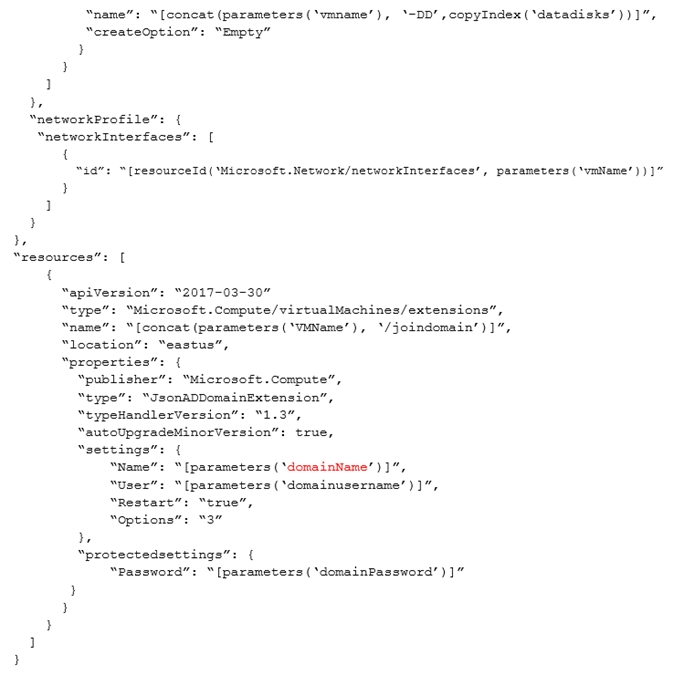
Azure Resource Manager Template
An Azure administrator provides you with the Azure Resource Manager template that will be used to provision the production application servers.
Question 41
Testlet 2Hotspot
HOTSPOT
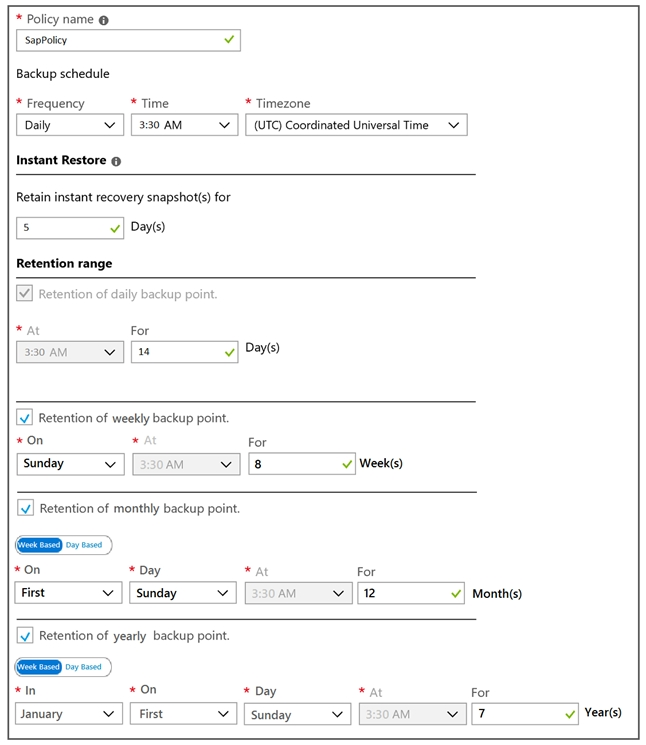
You are evaluating the proposed backup policy.
For each of the following statements, select Yes if the statement is true. otherwise, select No.
NOTE: Each correct selection is worth one point.
Reveal answer detailsClose answer details
Explanation
Box 1: Yes Scenario: Technical requirements: Ensure that an application server can be restored from a backup created during the last five days within 15 minutes.
Instant Restore has 'The instance recovery snapshot(s) for 5 Day(s)'.
Box 2: No Scenario: Ensure that all the production application servers can restore daily backups from the last 21 days.
The Retention of daily backup point is set to for 14 days only.
You have an SAP production landscape on Azure that contains the resources shown in the following table.
You need to stop the SAP services so that you can perform monthly maintenance.
Which command should you run from the Azure Cloud Shell? To answer, select the appropriate options in the answer area
NOTE: Each correct selection is worth one point.
Reveal answer detailsClose answer details
Question 43
Drag & drop
DRAG DROP
Your on-premises network contains an Active Directory domain.
You have an SAP environment on Azure that runs on SUSE Linux Enterprise Server (SLES) servers.
You configure the SLES servers to use domain controllers as their NTP servers and their DNS servers.
You need to join the SLES servers to the Active Directory domain.
Which three actions should you perform in sequence? To answer, move the appropriate actions from the list of actions to the answer area and arrange them in the correct order.
Reveal answer detailsClose answer details
Explanation
Step 1: Install the samba-winbind package Install samba-winbind
Step 2: Add realm details to /etc/krb5.conf and /etc/samba/smb.conf Edit files - best way to do this is to use yast on test machine and copy files from it In following examples you need to replace EXAMPLE/EXAMPLE.COM/.example.com with your values/ settings /etc/samba/smb.conf [global] workgroup = EXAMPLE usershare allow guests = NO #disallow guests from sharing idmap gid = 10000-20000 idmap uid = 10000-20000 kerberos method = secrets and keytab realm = EXAMPLE.COM security = ADS template homedir = /home/%D/%U template shell = /bin/bash winbind offline logon = yes winbind refresh tickets = yes
You plan to automate a deployment of SAP NetWeave on Azure virtual machines by using Azure Resource Manager templates. The database tier will consist of two instances of an Azure Marketplace Microsoft SQL Server 2017 virtual machine image that each has 8 TB of RAM.
Which task should you include in the templates used to deploy the SQL Server virtual machines?
A.
Enable buffer pool extensions in SQL Server.
B.
Enable read caching on the disks used to store the SQL Server database log files.
C.
Run the SQL Server setup and specify the /ACTION=REBUILDDATABASE and /SQLCOLLATION switches.
D.
Run the SQL Server setup and specify the /ACTION-INSTALL and /SQLMAXMEMORY switches.
Correct Answer: D
QUESTION 2
You plan to deploy an SAP production landscape that uses SAP HANA databases on Azure.
You need to configure the storage infrastructure to support the SAP HANA deployment
The solution must meet the SAP issued requirements for data throughput and I/O.
How should you configure the storage?
A.
RAID1
B.
RAID5
C.
RAID0
D.
RAID6
Correct Answer: B
QUESTION 3
You deploy an SAP environment on Azure.
Your company has a Service Level Agreement (SLA) of 99.99% for SAP.
You implement Azure Availability Zones that have the following components:
1. Redundant SAP application servers 2. ASCS/ERS instances that use a failover cluster 3. Database high availability that has a primary instance and a secondary instance
You need to validate the high availability configuration of the ASCS/ERS cluster.
What should you use?
A.
SAP Web Dispatcher
B.
Azure Traffic Manager
C.
SAPControl
D.
SAP Solution Manager
Correct Answer: B
Explanation
Explanation/Reference:
https://documentation.suse.com/sbp/all/pdf/SAP_NW740_SLE12_SetupGuide_color_en.pd f
QUESTION 4
You plan to deploy an SAP landscape that will have virtual machines deployed to multiple Azure regions.
You need to ensure that the virtual machines can communicate across the regions.
What should you configure?
A.
virtual network peering in Azure
B.
Azure Bastion hosts
C.
local network gateways
D.
Azure Relay
Correct Answer: A
Explanation
Explanation/Reference:
Depending on the rules and restrictions you want to apply between the different virtual networks hosting VMs of different SAP systems, you should peer those virtual network
Note: Virtual network peering enables you to seamlessly connect two or more Virtual Networks in Azure. The virtual networks appear as one for connectivity purposes. The traffic between virtual machines in peered virtual networks uses the Microsoft backbone infrastructure. Like traffic between virtual machines in the same network, traffic is routed through Microsoft's private network only.
Azure supports the following types of peering:
Virtual network peering: Connect virtual networks within the same Azure region. Global virtual network peering: Connecting virtual networks across Azure regions.
Incorrect Answers: B: Azure Bastion is a fully managed service that provides more secure and seamless Remote Desktop Protocol (RDP) and Secure Shell Protocol (SSH) access to virtual machines (VMs) without any exposure through public IP addresses.
D: The Azure Relay service enables you to securely expose services that run in your corporate network to the public cloud. You can do so without opening a port on your firewall, or making intrusive changes to your corporate network infrastructure.
You have an SAP landscape on Azure that contains the virtual machines shown in the following table.
You need to ensure that the Application Server role is available if a single Azure datacenter fails.
What should you include in the solution?
A.
a local network gateway
B.
Azure Load Balancer Standard
C.
Azure Virtual WAN
D.
Azure Active Directory (Azure AD) Application Proxy
Correct Answer: B
Explanation
Explanation/Reference:
For the load balancers of the failover clusters of SAP Central Services and the DBMS layer, you need to use the Standard SKU Azure Load Balancer. The Basic Load Balancer won't work across zones.
Note: The DBMS also is a single point of contact in an SAP system. You need to protect it by using a high-availability solution. The following figure shows a SQL Server AlwaysOn high-availability solution in Azure, with Windows Server Failover Clustering and the Azure internal load balancer.
Incorrect Answers: C: Azure Virtual WAN is a networking service that brings many networking, security, and routing functionalities together to provide a single operational interface.
D: Application Proxy is recommended for giving remote users access to internal resources. Application Proxy replaces the need for a VPN or reverse proxy for these remote access use cases.
You plan to deploy an SAP landscape by using Azure Center for SAP solutions.
You need to use custom virtual machine images for the deployment.
To what should you set Security type for the virtual machines, and where should you store the custom images? To answer, select the appropriate options in the answer area,
NOTE: Each correct selection is worth one point.
Correct Answer:
QUESTION 7
You are designing an SAP production landscape on Azure.
The landscape must ensure service availability in the event of an Azure datacenter failure
What should you include in the design?
A.
an availability zone
B.
an availability set
C.
a fusion group
D.
a proximity placement group
Correct Answer: A
QUESTION 8
You have an on-premises SAP NetWeaver development landscape that contains the resources shown in the following table.
You have a 500-Mbps ExpressRoute circuit between the on-premises environment and a virtual network.
You plan to migrate the landscape to Azure.
What should you include in the solution?
A.
Azure Data Box
B.
Microsoft System Center 2019 - Data Protection Manager (DPM 2019)
C.
Azure Site Recovery
D.
Azure Backup Server
Correct Answer: C
Explanation
Explanation/Reference:
Simplify cloud migration by using Site Recovery to migrate your SAP deployment to Azure.
Incorrect Answers: A: Not necessary with the fast ExpressRoute circuit. Data Box devices easily move data to Azure when busy networks aren't an option. Move large amounts of data to Azure when you're limited by time, network availability, or costs, using common copy tools such as Robocopy. All data is AES-encrypted, and the devices are wiped clean after upload, in accordance with NIST Special Publication 800-88 revision 1 standards.
You recently migrated an SAP HANA environment to Azure.
You plan to back up SAP HANA databases to disk on the virtual machines, and then move the backup files to Azure Blob storage for retention.
Which command should you run to move the backups to the Blob storage?
A.
robocopy
B.
backint
C.
azcopy
D.
scp
Correct Answer: C
Explanation
Explanation/Reference:
To store directories and files on Azure storage, one could use CLI or PowerShell. There is also a ready-to-use utility, AzCopy, for copying data to Azure storage.
You use Azure Site Recovery to protect an SAP production landscape.
You need to validate whether you can recover the landscape in the event of a failure. The solution must minimize the impact on the landscape.
Which four actions should you perform in sequence? To answer, move the appropriate actions from the list of actions to the answer area and arrange them in the correct order.
Correct Answer:
Explanation
Explanation/Reference:
Step 1: Create a virtual network... We recommended that for test failover, you choose a network that's isolated from the production recovery site network specific in the Compute and Network settings for each VM. By default, when you create an Azure virtual network, it is isolated from other networks. The test network should mimic your production network:
The test network should have same number of subnets as your production network. Subnets should have the same names. The test network should use the same IP address range.
Step 2: Add a public IP address... Because Site Recovery does not replicate the cloud witness, we recommend that you deploy the cloud witness in the disaster recovery region.
Step 3: Shut down production virtual machines Make sure that the primary VM is shut down when you run the test failover. Otherwise there will be two VMs with the same identity, running in the same network at the same time. This can lead to unexpected consequences.
Step 4: Select Test failover from the Recovery Plans blade
You are planning the Azure network infrastructure for an SAP environment.
For each of the following statements, select Yes if the statement is true. Otherwise, select No.
NOTE: Each correct selection is worth one point.
Correct Answer:
Explanation
Explanation/Reference:
Box 1: NO
Box 2: Yes
Box 3: Yes Be aware that network traffic between two peered Azure virtual networks is subject to transfer costs. Huge data volume that consists of many terabytes is exchanged between the SAP application layer and the DBMS layer. You can accumulate substantial costs if the SAP application layer and DBMS layer are segregated between two peered Azure virtual networks.
You have an Azure subscription that contains an SAP HANA on Azure (Large Instances) deployment. The deployment is forecasted to require an additional 256 GB of storage.
What is the minimum amount of additional storage you can allocate?
A.
256 GB
B.
512 GB
C.
1TB
D.
2 TB
Correct Answer: A
QUESTION 13
HOTSPOT
For each of the following statements, select Yes if the statement is true. Otherwise, select No.
NOTE: Each correct selection is worth one point.
Correct Answer:
QUESTION 14
HOTSPOT
You plan to deploy SAP HANA to an Azure virtual machine for a production landscape.
You need to stripe multiple disks together by using the HANA indexserver.
How should you configure the Azure disks? To answer, select the appropriate options in the answer area.
NOTE: Each correct selection is worth one point.
Correct Answer:
QUESTION 15
You have an SAP production landscape on Azure that contains the virtual machines shown in the following table.
VM1 cannot connect to an employee self-service application hosted on VM2.
You need to identify what is causing the issue.
Which two options in Azure Network Watcher should you use? Each correct answer presents part of the solution.
NOTE: Each correct selection is worth one point
A.
Connection troubeshoot
B.
Connection monitor
C.
IP flow verify
D.
Network Performance Monitor
Correct Answer: AC
QUESTION 16
HOTSPOT
You have an Azure subscription. The subscription contains two virtual machines named SQL1 and SQL2 that host a Microsoft SQL Server 2019 Always On availability group named AOG1.
You plan to deploy an SAP NetWeaver system that will have a database tier hosted on AOG1.
You need to encrypt the Azure virtual machine disks and the SQL Server database.
The solution must meet the following requirements:
1. The operating system disk, data disk, and the temporary disk of the virtual machines must be encrypted. 2. SQL Server encryption keys must be stored on-premises.
Which type of encryption should you use? To answer, select the appropriate options in the answer area.
NOTE: Each correct selection is worth one point.
Correct Answer:
QUESTION 17
HOTSPOT
For each of the following statements, select Yes if the statement is true. Otherwise, select No.
NOTE: Each correct selection is worth one point.
Correct Answer:
Explanation
Explanation/Reference:
Box 1: No Load balancers. Load balancers are used to distribute traffic to virtual machines in the application-tier subnet. For high availability, use the built-in SAP Web Dispatcher, Azure Load Balancer, or network appliances. Your choice depends on the traffic type (like HTTP or SAP GUI) or the required network services, like Secure Sockets Layer (SSL) termination.
Box 2: Yes Availability group listener SAP application SQL server load balancer disaster recovery
You have an on-premises SAP landscape and a hybrid Microsoft Entra tenant.
You plan to enable Microsoft Entra authentication for SAP NetWeaver.
What should you configure first in Microsoft Entra ID?
A.
a service principal
B.
a user flow
C.
a Microsoft Entra Application Proxy
D.
a conditional access policy
Correct Answer: C
QUESTION 19
HOTSPOT
You have an Azure Availability Set that is configured as shown in the following exhibit.
Use the drop-down menus to select the answer choice that completes each statement based on the information presented in the graphic.
NOTE: Each correct selection is worth one point.
Correct Answer:
Explanation
Explanation/Reference:
Box 1: the same fault domain Fault domains define the group of virtual machines that share a common power source and network switch. If a storage fault domain fails due to hardware or software failure, only the VM instance with disks on the storage fault domain fails.
Box 2: managed disks Managed disks provide better reliability for Availability Sets by ensuring that the disks of VMs in an Availability Set are sufficiently isolated from each other to avoid single points of failure. It does this by automatically placing the disks in different storage fault domains (storage clusters) and aligning them with the VM fault domain.
Your company has an SAP environment that contains the following components:
SAP systems based on SAP HANA and SAP Adaptive Server Enterprise (SAP ASE) that run on SUSE Linux Enterprise Server 12 (SLES 12) Multiple SAP applications
The company plans to migrate all the applications to Azure.
You need to get a comprehensive list of all the applications that are part of the SAP environment.
What should you use?
A.
the SAP license information
B.
the SAP Solution Manager
C.
the data volume management report
D.
the network inventory and locations
Correct Answer: B
Explanation
Explanation/Reference:
The SAP Solution Manager is a centralized robust application management and administration solution used to implement, support, operate and monitor your SAP enterprise solutions, SAP Solution Manager is a platform providing integrated content, tools, methodologies and access to SAP systems.
Incorrect Answers: C: Data volume management is a framework that helps the solution operations team of an SAP-centric solution to balance the need of business' access to a wealth of data and IT efforts to monitor and control data growth and to minimize data volume.
You have an SAP production landscape that uses SAP HANA databases on Azure.
You need to deploy a disaster recovery solution to the SAP HANA databases. The solution must meet the following requirements:
1. Support failover between Azure regions. 2. Minimize data loss in the event of a failover.
What should you deploy?
A.
Azure Site Recovery
B.
Always On availability group
C.
HANA system replication that uses asynchronous replication
D.
HANA system replication that uses synchronous replication
Correct Answer: C
QUESTION 22
HOTSPOT
You have an on-premises datacenter.
You have an Azure subscription named Sub1 that contains a virtual network named VNet1.
The datacenter is connected to VNet1 by using an ExpressRoute circuit.
You have an SAP RISE managed workload.
You need to integrate Sub1 with the managed workload.
The solution must meet the following requirements:
1. Minimize latency between the managed workload and the datacenter. 2. Restrict the network ports that can be used between the managed workload and VNet1. 3. Minimize costs.
What should you use to connect VNet1 and the managed workload, and what should you use to secure the connection? To answer, select the appropriate options in the answer area.
Correct Answer:
QUESTION 23
You plan to deploy an SAP environment on Azure.
You plan to store all SAP connection strings securely in Azure Key Vault without storing credentials on the Azure virtual machines that host SAP.
What should you configure to allow the virtual machines to access the key vault?
A.
Azure Active Directory (Azure AD) Privilege Identity Manager (PIM)
B.
role-based access control (RBAC)
C.
a Managed Service Identity (MSI)
D.
the Custom Script Extension
Correct Answer: C
Explanation
Explanation/Reference:
To reference a credential stored in Azure Key Vault, you need to: 1. Retrieve data factory managed identity 2. Grant the managed identity access to your Azure Key Vault 3. Create a linked service pointing to your Azure Key Vault. 4. Create data store linked service, inside which reference the corresponding secret stored in key vault.
You plan to migrate an on-premises SAP development system to Azure.
Before the migration, you need to check the usage of the source system hardware, such as CPU, memory, network, etc.
Which transaction should you run from SAP GUI?
A.
SM51
B.
DB01
C.
DB12
D.
ST06
Correct Answer: D
Explanation
Explanation/Reference:
ST06 is a transaction code used for Operating System Monitor in SAP. SAP transaction ST06 (Operating System Monitor) is classified in the Basis Component module under application component Operating System Monitors and runs Monitoring Operating System program RSHOST05 upon execution.
Incorrect Answers: A: Transaction code SM51 is to display list of active application servers that have registered in the SAP message server.
B: DB01 is a transaction code used for Analyze Exclusive Lockwaits in SAP.
C: Transaction code DB12 is to collects and presents information that is necessary to monitor database backups.
You estimate that the database will be 1.8 TB in three years.
You need to ensure that the deployment supports 60,000 IOPS. The solution must minimize costs and provide the lowest latency possible.
Which type of disk should you use?
A.
Standard HDD
B.
Premium SSD
C.
Ultra disk
D.
Standard SSD
Correct Answer: C
QUESTION 26
HOTSPOT
You have an Azure subscription named Sub! that contains a Microsoft Sentinel workspace named Workspace1.
You have an SAP RISE managed workload that is integrated with Sub1.
You need to implement the Microsoft Sentinel solution for SAP applications in Workspace1.
The solution must meet the following requirements:
1. Generate an incident based on transaction codes when a sensitive SAP transaction is executed by an unauthorized user. 2. When an incident is generated, send a notification to a designated Microsoft Teams channel. 3. Minimize administrative effort.
What should you include in the solution? To answer, select the appropriate options in the answer area. NOTE: Each correct selection is worth one point.
Correct Answer:
QUESTION 27
You have an SAP production landscape in Azure.
You plan to migrate the landscape to an SAP RISE managed workload.
Which task will be the sole responsibility of the SAP vendor after the migration?
A.
configuring security monitoring in Microsoft Sentinel
B.
sizing the Azure resources that host the landscape
C.
implementing single sign-on (SSO)
D.
configuring virtual network peering
Correct Answer: B
QUESTION 28
HOTSPOT
You have the following Azure Resource Manager template.
For each of the following statements, select Yes if the statement is true. Otherwise, select No.
You have an SAP environment that is managed by using VMware vCenter.
You plan to migrate the SAP environment to Azure.
You need to gather information to identify which compute resources are required in Azure.
What should you use to gather the information?
A.
Azure Migrate and SAP EarlyWatch Alert reports
B.
Azure Site Recovery and SAP Quick Sizer
C.
SAP Quick Sizer and SAP HANA system replication
D.
Azure Site Recovery Deployment Planner and SAP HANA Cockpit
Correct Answer: A
Explanation
Explanation/Reference:
Azure Migrate is a Microsoft service that helps an enterprise assess how its on-premises workloads will perform, and how much they will cost to host, in the Azure public cloud. An enterprise can use Azure Migrate to discover information about the VMware VMs running within its own data center, including CPU and memory usage, as well as performance history.
SAP EarlyWatch Alert (EWA) is a monitoring service for SAP customers, to monitor SAP systems in the solution landscape.
Incorrect Answers: D: SAP HANA Cockpit is an administrative tool with a web interface for a correspondingly named database engine, a part of SAP ERP software. It allows both offline and cloud operations for managing databases, References: https://searchcloudcomputing.techtarget.com/definition/Azure-Migrate
QUESTION 30
Your on-premises network is connected to an SAP HANA deployment in the East US Azure region.
The deployment uses the Standard SKU of an ExpressRoute gateway.
You need to implement ExpressRoute FastPath. The solution must meet the following requirements:
1. Hybrid connectivity must be maintained if a single datacenter fails in the East US region. 2. Hybnd connectivity costs must be minimized.
Which ExpressRoute gateway SKU should you use?
A.
ErGwIAz
B.
High Performance
C.
Ultra Performance
D.
ErGw3Az
Correct Answer: D
QUESTION 31
DRAG DROP
You have an on-premises SAP NetWeaver-based ABAP deployment hosted on servers that run Windows Server or Linux.
You plan to migrate the deployment to Azure.
What will invalidate the existing NetWeaver ABAP licenses for each operating system once the servers are migrated to Azure? To answer, drag the appropriate actions to the correct operating systems. Each action may be used once, more than once, or not at all. You may need to drag the split bar between panes or scroll to view content
NOTE: Each correct selection is worth one point.
Correct Answer:
QUESTION 32
HOTSPOT
You have an SAP development landscape on Azure.
For each of the following statements, select Yes if the statement is true. Otherwise, select No.
NOTE: Each correct selection is worth one point.
Correct Answer:
QUESTION 33
You have an Azure subscription. The subscription contains a virtual machine named VM1 that runs SUSE Linux Enterprise Server (SLES) and was created by using an Azure Marketplace image.
You plan to deploy four virtual machines based on VM1 that will have the SAP Web Dispatcher role.
You need to create a generalized image of VM1.
What should you do first?
A.
Install the Custom Script Extension.
B.
Run sysprep.
C.
Install the Azure Linux VM agent.
D.
Run waagent,
Correct Answer: D
QUESTION 34
HOTSPOT
You plan to deploy a highly available ASCS instance to SUSE Linux Enterprise Server (SLES) virtual machines in Azure.
You are configuring an internal Azure Standard Load Balancer for the ASCS instance.
How should you configure the internal Standard Load Balancer? To answer, select the appropriate options in the answer area.
You need to grant an SAP administrator read-only access to the Azure subscription. The SAP administrator must be prevented from viewing network information. How should you configure the role-based access control (RBAC) role definition? To answer, drag the appropriate values to the correct
targets. Each value may be used once, more than once, or not at all. You may need to drag the split bar between panes or scroll to view content. NOTE: Each correct selection is worth one point.
Correct Answer:
Explanation
Explanation/Reference:
QUESTION 36
You need direct connectivity from an on-premises network to SAP HANA (Large Instances). The solution must meet the following requirements:
1. Minimize administrative effort. 2. Provide the highest level of resiliency.
Express Route Global Reach Microsoft introduced a new functionality called ExpressRoute Global Reach. Global Reach can be used for HANA Large Instances in two scenarios: Enable direct access from on-premises to your HANA Large Instance units deployed in different regions Enable direct communication between your HANA Large Instance units deployed in different regions Direct Access from on-premises In the Azure regions where Global Reach is offered, you can request enabling the Global Reach functionality for your ExpressRoute circuit that connects your on-premises network to the Azure virtual network that connects to your HANA Large Instance units as well.
QUESTION 37
DRAG DROP
You have an SAP environment on Azure.
You use Azure Recovery Services to back up an SAP application server.
You need to test the restoration process of a file on the server.
Which three actions should you perform in sequence? To answer, move the appropriate actions from the list of actions to the answer area and arrange them in the correct order.
Correct Answer:
Explanation
Explanation/Reference:
Step 1: From Azure Recover Vault, select File Recovery To restore files or folders from the recovery point, go to the virtual machine and choose the desired recovery point.
Step 2: Download and run the mount disk executable
Step 3: recover the file and unmount the disk
QUESTION 38
DRAG DROP
You have an Azure subscription.
You plan to deploy a SAP NetWeaver landscape that will use SQL Server on Azure virtual machines. The solution must meet the following requirements:
1. The SAP application and database tiers must reside in the same Azure zone. 2. The application tier in the Azure virtual machines must belong to the same Availability Set.
Which four actions should you perform in sequence? To answer, move the appropriate actions from the list of actions to the answer area and arrange them in the correct order.
NOTE: More than one order of answer choices is correct. You will receive credit for any of the correct orders you select.
Correct Answer:
Explanation
Explanation/Reference:
Step 1: Create a proximity placement group A proximity placement group is a logical grouping of Azure resources within the same Azure data center in order to reduce latency.
Step 2: Create an Availability Set Create an availability set that references the Azure proximity group. By adding the availability sets to proximity placement groups, the network latencies are considerably reduced, thereby improving the overall performance.
Step 3: Deploy SQL Server on Azure Virtual machines
Step 4: Deploy the application tier in the Azure virtual machines Deploy the application layer VMs by referencing the availability set and the proximity placement group.
For each of the following statements, select Yes if the statement is true. Otherwise, select No.
NOTE: Each correct selection is worth one point.
Correct Answer:
Explanation
Explanation/Reference:
Box 1: Yes The SAP Azure Enhanced Monitoring Extension builds on top of the Azure Diagnostic extension, which stores its data in an Azure Storage account that you specify.
Box 2: Yes The Set-AzVMAEMExtension cmdlet updates the configuration of a virtual machine to enable or update the support for monitoring for SAP systems that are installed on the virtual machine. The cmdlet installs the Azure Enhanced Monitoring (AEM) extension that collects the performance data and makes it discoverable for the SAP system. The -OSType specifies the OS. Either Windows or Linux.
Contoso, Ltd. is a manufacturing company that has 15,000 employees.
The company uses SAP for sales and manufacturing.
Contoso has sales offices in New York and London and manufacturing facilities in Boston and Seattle.
Existing Environment
Active Directory
The network contains an on-premises Active Directory domain named ad.contoso.com. User email addresses use a domain name of contoso.com.
SAP Environment
The current SAP environment contains the following components:
1. SAP Solution Manager 2. SAP ERP Central Component (SAP ECC) 3. SAP Supply Chain Management (SAP SCM) 4. SAP application servers that run Windows Server 2008 R2 5. SAP HANA database servers that run SUSE Linux Enterprise Server 12 (SLES 12)
Problem Statements
Contoso identifies the following issues in its current environment:
1. The SAP HANA environment lacks adequate resources. 2. The Windows servers are nearing the end of support. 3. The datacenters are at maximum capacity.
Requirements
Planned Changes
Contoso identifies the following planned changes:
1. Deploy Azure Virtual WAN. 2. Migrate the application servers to Windows Server 2016. 3. Deploy ExpressRoute connections to all of the offices and manufacturing facilities. 4. Deploy SAP landscapes to Azure for development, quality assurance, and production.
All resources for the production landscape will be in a resource group named SAPProduction.
Business goals
Contoso identifies the following business goals:
1. Minimize costs whenever possible. 2. Migrate SAP to Azure without causing downtime. 3. Ensure that all SAP deployments to Azure are supported by SAP. 4. Ensure that all the production databases can withstand the failure of an Azure region. 5. Ensure that all the production application servers can restore daily backups from the last 21 days.
Technical Requirements
Contoso identifies the following technical requirements:
1. Inspect all web queries. 2. Deploy an SAP HANA cluster to two datacenters. 3. Minimize the bandwidth used for database synchronization. 4. Use Active Directory accounts to administer Azure resources. 5. Ensure that each production application server has four 1-TB data disks. 6. Ensure that an application server can be restored from a backup created during the last five days within 15 minutes. 7. Implement an approval process to ensure that an SAP administrator is notified before another administrator attempts to make changes to the Azure virtual machines that host SAP.
It is estimated that during the migration, the bandwidth required between Azure and the New York office will be 1 Gbps. After the migration, a traffic burst of up to 3 Gbps will occur.
Proposed Backup Policy
An Azure administrator proposes the backup policy shown in the following exhibit.
Azure Resource Manager Template
An Azure administrator provides you with the Azure Resource Manager template that will be used to provision the production application servers.
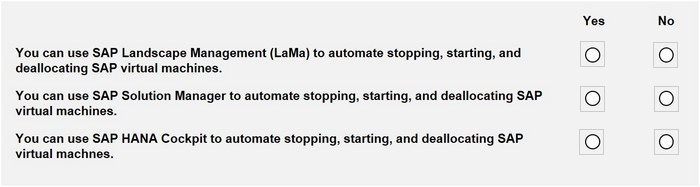
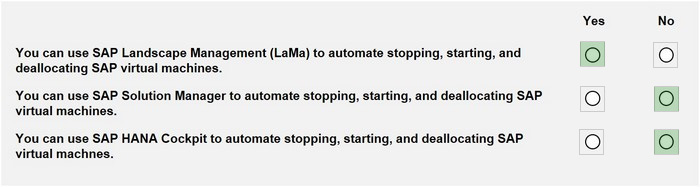
QUESTION 41
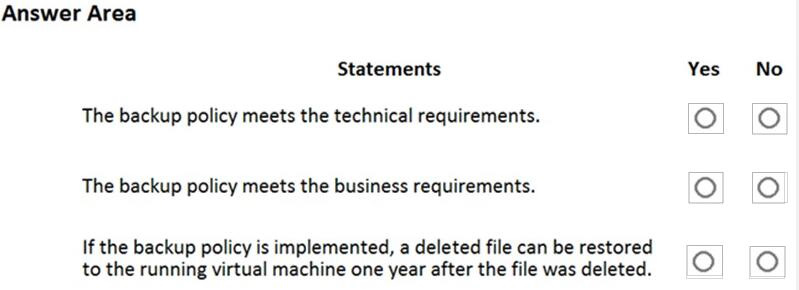
HOTSPOT
You are evaluating the proposed backup policy.
For each of the following statements, select Yes if the statement is true. otherwise, select No.
NOTE: Each correct selection is worth one point.
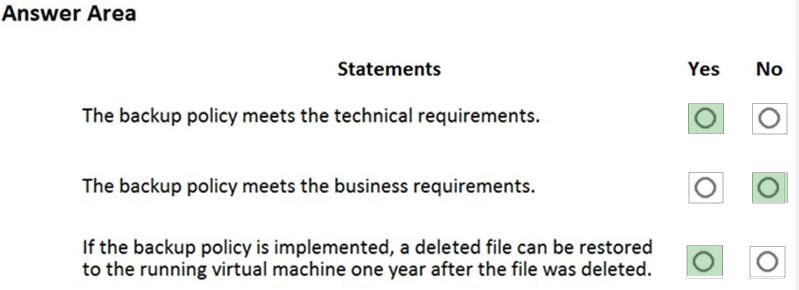
Correct Answer:
Explanation
Explanation/Reference:
Box 1: Yes Scenario: Technical requirements: Ensure that an application server can be restored from a backup created during the last five days within 15 minutes.
Instant Restore has 'The instance recovery snapshot(s) for 5 Day(s)'.
Box 2: No Scenario: Ensure that all the production application servers can restore daily backups from the last 21 days.
The Retention of daily backup point is set to for 14 days only.
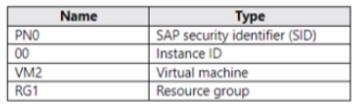
You have an SAP production landscape on Azure that contains the resources shown in the following table.
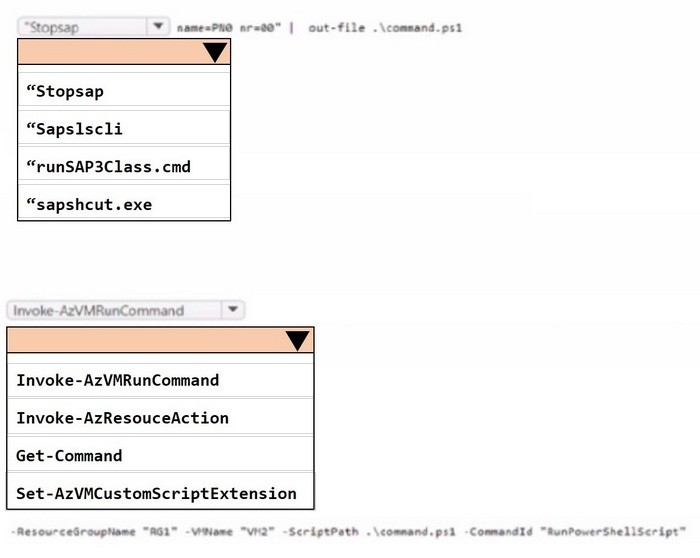
You need to stop the SAP services so that you can perform monthly maintenance.
Which command should you run from the Azure Cloud Shell? To answer, select the appropriate options in the answer area
NOTE: Each correct selection is worth one point.
Correct Answer:
QUESTION 43
DRAG DROP
Your on-premises network contains an Active Directory domain.
You have an SAP environment on Azure that runs on SUSE Linux Enterprise Server (SLES) servers.
You configure the SLES servers to use domain controllers as their NTP servers and their DNS servers.
You need to join the SLES servers to the Active Directory domain.
Which three actions should you perform in sequence? To answer, move the appropriate actions from the list of actions to the answer area and arrange them in the correct order.
Correct Answer:
Explanation
Explanation/Reference:
Step 1: Install the samba-winbind package Install samba-winbind
Step 2: Add realm details to /etc/krb5.conf and /etc/samba/smb.conf Edit files - best way to do this is to use yast on test machine and copy files from it In following examples you need to replace EXAMPLE/EXAMPLE.COM/.example.com with your values/ settings /etc/samba/smb.conf [global] workgroup = EXAMPLE usershare allow guests = NO #disallow guests from sharing idmap gid = 10000-20000 idmap uid = 10000-20000 kerberos method = secrets and keytab realm = EXAMPLE.COM security = ADS template homedir = /home/%D/%U template shell = /bin/bash winbind offline logon = yes winbind refresh tickets = yes