Testlet 2
Single choice
Which blade should you instruct the finance department auditors to use?
Reveal answer details Close answer details
Correct answerD
Microsoft · AZ-104
Preview real exam questions, verified answers and available explanations before choosing a study plan.
|
Case study Case Study 2Humongous Insurance Overview Existing Environment Active Directory Environment Network Infrastructure Active Directory Issue Licensing Issue Requirements Planned Azure AD Infrastructure Planned Azure Networking Infrastructure You plan to enable peering between Paris-VNet and AllOffices-VNet. You will enable the Use remote gateways setting for the Paris-VNet peerings. Planned Azure Computer Infrastructure Department Requirements -During the testing phase, auditors in the finance department must be able to review all Azure costs from the past week. Authentication Requirements
Testlet 2
Single choice
Which blade should you instruct the finance department auditors to use? Reveal answer details Close answer detailsCorrect answerD
Single choice
You have an on-premises network that contains a database server named dbserver1. You have an Azure subscription. You plan to deploy three Azure virtual machines. Each virtual machine will be deployed to a separate availability zone. You need to configure an Azure VPN gateway for a site-to-site VPN. The solution must ensure that the virtual machines can connect to dbserver1. Which type of public IP address SKU and assignment should you use for the gateway? Reveal answer details Close answer detailsCorrect answerB Explanation - a standard SKU and a static IP address assignment When availability zones are in scope for the gateway scenario, the public IP used with the VPN gateway must be a Standard SKU and must be Static. This aligns with zone-aware/zone-redundant requirements and is the supported pairing for resilient gateway deployments. Why the other choices are not correct: Microsoft Exam Tips: Summary: AZ-104 Exam Objective Hierarchy: 4.0 Implement and manage virtual networking 4.1 Configure and manage virtual networks in Azure
Single choice
Note: This question is part of a series of questions that present the same scenario. Each question in the series contains a unique solution that might meet the stated goals. Some question sets might have more than one correct solution, while others might not have a correct solution. After you answer a question in this section, you will NOT be able to return to it. As a result, these questions will not appear in the review screen. You have an Azure subscription that contains the virtual machines shown in the following table.  You deploy a load balancer that has the following configurations: You need to ensure that you can add VM1 and VM2 to the backend pool of LB1. Solution: You disassociate the public IP address from the network interface of VM2. Does this meet the goal? Reveal answer details Close answer detailsCorrect answerA Explanation Yes This solution meets the goal. You need to add VM1 and VM2 to the backend pool of LB1 (Internal, Standard SKU). VM2 currently has a Basic public IP SKU. Disassociating the Basic public IP from VM2's NIC removes an SKU mismatch/ compatibility blocker that can prevent backend pool association with Standard load-balancing components. Why "No" is incorrect: Microsoft Exam Tips: Summary: AZ-104 Exam Objective Hierarchy:
Hotspot
HOTSPOT You have an Azure subscription that contains an Azure Storage account storageaccount1. You export storage account as an Azure Resource Manager template. The template contains the following sections. 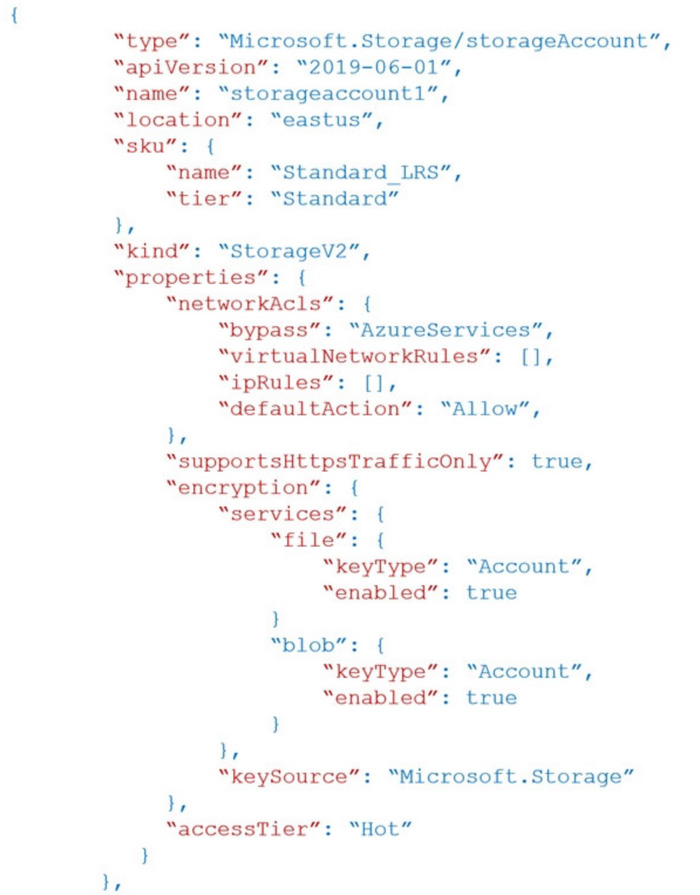 For each of the following statements, select Yes if the statement is true. Otherwise, select No. NOTE: Each correct selection is worth one point. 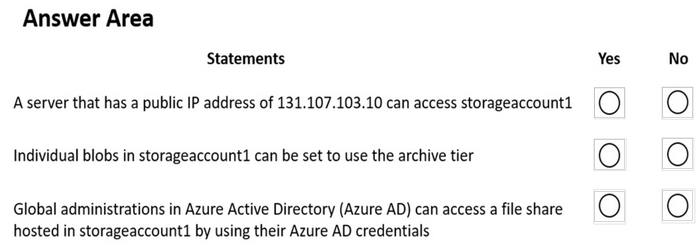 Reveal answer details Close answer details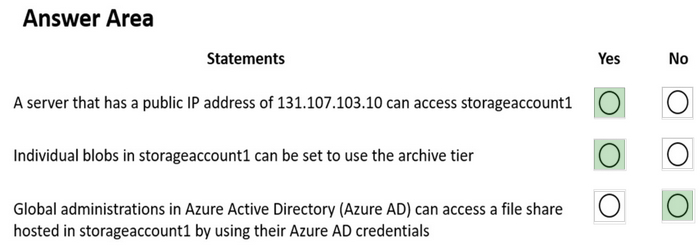 Explanation Statement 1: Yes Why this is correct: Exam Tips: AZ-104 Exam Objective Hierarchy 2.3.1 Configure Azure Files
Hotspot
HOTSPOT You have an Azure subscription. The subscription contains a virtual machine that runs Windows 10. You need to join the virtual machine to an Active Directory domain. How should you complete the Azure Resource Manager (ARM) template? To answer, select the appropriate options in the answer area. NOTE: Bach correct selection is worth one point. 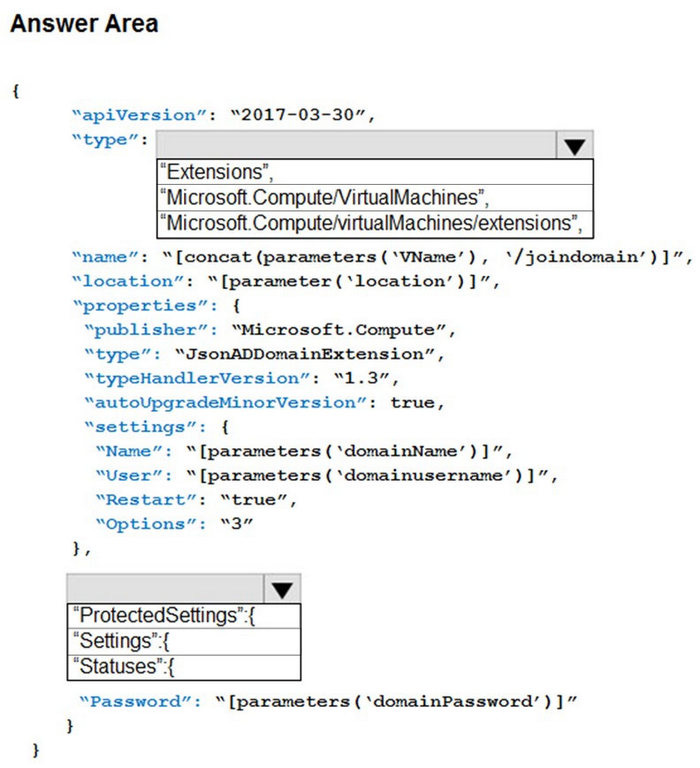 Reveal answer details Close answer details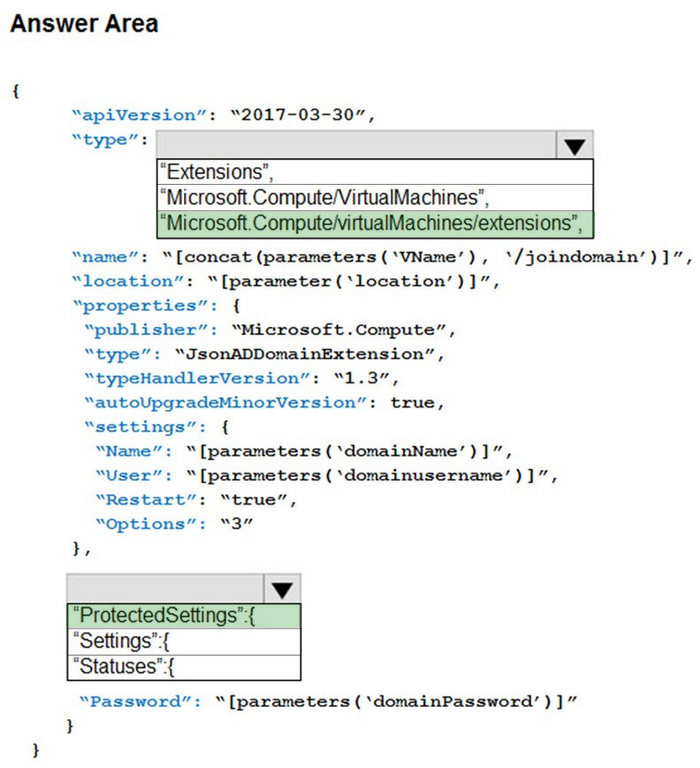 Explanation Type: Microsoft.Compute/virtualMachines/extensions Why this is correct: Why the other options are incorrect: Exam Tips: AZ-104 Exam Objective Hierarchy
Hotspot
HOTSPOT You have an Azure subscription. The subscription contains a storage account named storage1 that has the lifecycle management rules shown in the following table.  On June 1, you store two blobs in storage1 as shown in the following table. 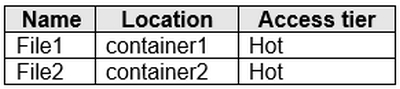 For each of the following statements, select Yes if the statement is true. Otherwise, select No. NOTE: Each correct selection is worth one point. 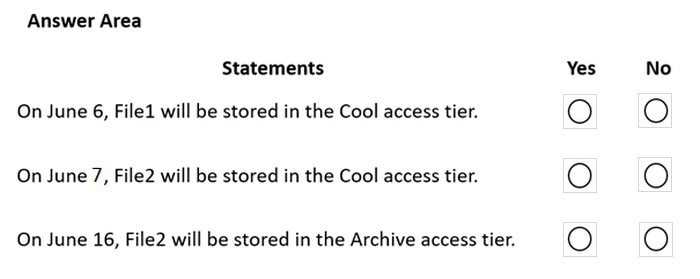 Reveal answer details Close answer details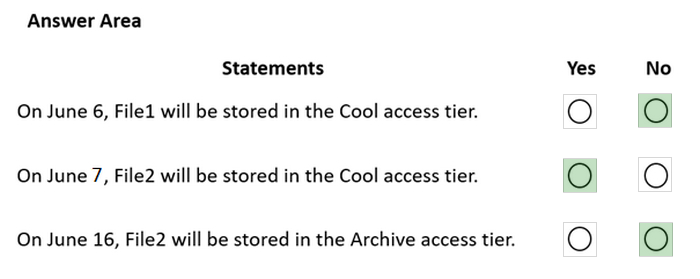 Explanation Scenario: Evaluate Blob lifecycle rules and determine which statements are true on specific dates (June 6, June 7, June 16). Selected values On June 6, File1 will be stored in the Cool access tier. No On June 7, File2 will be stored in the Cool access tier. Yes On June 16, File2 will be stored in the Archive access tier. No Lifecycle conditions use "daysAfter...GreaterThan" semantics (that is, "more than N days"), so a 5-day rule does not trigger exactly on day 5 but only after it has been exceeded. Rule2 (all blobs, >5 days since last Watch for "greater than" vs. "greater than or equal to" wording in lifecycle conditions; Azure uses "greater than." If multiple rules apply, the earliest threshold action typically happens first; later thresholds will not 2.0 Implement and manage storage (15-20%) 2.3 Configure Azure Files and Azure Blob Storage
Drag & drop
DRAG DROP You have an Azure subscription that contains virtual machine named VM1. You need to back up VM. The solution must ensure that backups are stored across three availability zones in the primary region. Which three actions should you perform in sequence? To answer, move the appropriate actions from the list of actions to the answer area and arrange them in the correct order. 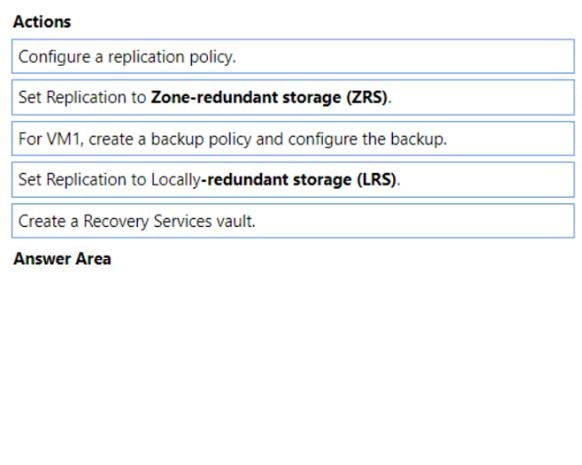 Reveal answer details Close answer details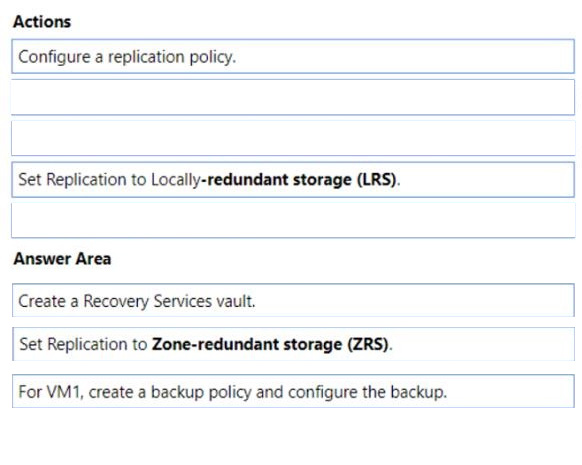 Explanation Step 1: Create a Recovery Services vault. Goal: Back up VM1 and ensure the backup data is stored across availability zones in the primary region. Step 1: Create a Recovery Services vault. Step 2: Set replication to Zone-redundant storage (ZRS). Step 3: Create a backup policy and configure backup for VM1. Why other actions are not selected: Microsoft Exam Tips: Summary: AZ-104 Exam Objective Hierarchy:
Multiple choice
You have an Azure subscription. Users access the resources in the subscription from either home or from customer sites. From home, users must establish a point-to-site VPN to access the Azure resources. The users on the customer sites access the Azure resources by using site-to-site VPNs. You have a line-of-business-app named App1 that runs on several Azure virtual machine. The virtual What are two possible Azure services that you can use? Each correct answer presents a complete solution. NOTE: Each correct selection is worth one point. Reveal answer details Close answer detailsCorrect answersD, E Explanation - an internal load balancer Users reach App1 from home and customer sites by using point-to-site and site-to-site VPNs. That means the application can be published on a private IP inside the virtual network and still be reachable to users over the VPN connections. You need to spread client connections across multiple Azure VMs running Windows Server 2016. Both selected services provide a complete load-balancing solution for this scenario: - an internal load balancer: - an Azure Application Gateway: Why the other options are not correct: - a public load balancer: - Traffic Manager: - an Azure Content Delivery Network (CDN): Microsoft Exam Tips: - DNS-based services (Traffic Manager) are commonly tested distractors when the requirement is connection distribution inside a region/VNet rather than global endpoint selection. Summary: AZ-104 Exam Objective Alignment (Hierarchy) 4.0 Implement and manage virtual networking 4.3 Configure name resolution and load balancing 4.3.2 Configure an internal or public load balancer
Single choice
You have an Azure subscription named Subscription1. Subscription1 contains the resource groups in the following table. 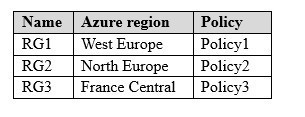 RG1 has a web app named WebApp1. WebApp1 is located in West Europe. You move WebApp1 to RG2. What is the effect of the move? Reveal answer details Close answer detailsCorrect answerC Explanation The App Service plan to WebApp1 remains to West Europe. Policy2 applies to WebApp1. Moving a resource between resource groups does not change the resource's region. WebApp1 remains in West Europe, and its App Service plan location remains West Europe as well. However, governance controls (like Azure Policy) are evaluated based on scope. Once WebApp1 is moved into RG2, the policies assigned to RG2 (Policy2) become applicable at that new scope (subject to inheritance/exemptions). Therefore, the App Service plan remains in West Europe and Policy2 applies after the move. Why other selections are incorrect: Microsoft Exam Tips: Summary: AZ-104 Exam Objective Hierarchy:
Single choice
Note: This question is part of a series of questions that present the same scenario. Each question in the series contains a unique solution that might meet the stated goals. Some question sets might have more than one correct solution, while others might not have a correct solution. After you answer a question in this section, you will NOT be able to return to it. As a result, these questions will not appear in the review screen. You have an Azure subscription named Subscription1. Subscription1 contains a resource group named RG1. RG1 contains resources that were deployed by using templates. You need to view the date and time when the resources were created in RG1. Solution: From the Subscriptions blade, you select the subscription, and then click Programmatic deployment. Does this meet the goal? Reveal answer details Close answer detailsCorrect answerB Explanation No The goal is to view the date and time the resources were created in RG1. Since the resources were deployed by using templates, the most direct place to see the deployment timestamps (and drill into operations that show what was created) is the Resource group (RG1) > Deployments blade. The proposed solution navigates to: Subscription > Programmatic deployment That view is centered on subscription-level deployment artifacts and does not reliably provide the creation date and time for the specific resources in RG1 in the same way that RG-scoped Deployments does. What would meet the goal: Go to RG1 > Deployments. Select the relevant deployment to view the timestamp and deployment operations (which reflect the resource creation actions). Microsoft Exam Tips: Summary: AZ-104 Exam Objective Hierarchy: 1. On the Azure portal menu, select Monitor, or search for and select Monitor from any page 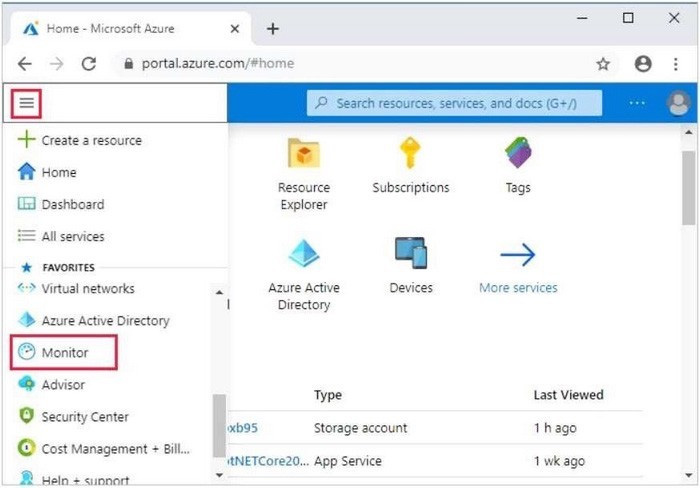 2. Select Activity Log. 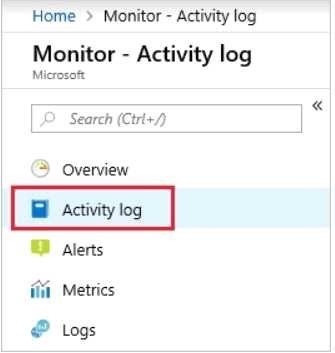 3. You see a summary of recent operations. A default set of filters is applied to the operations. Notice the information on the summary includes who started the action and when it happened. 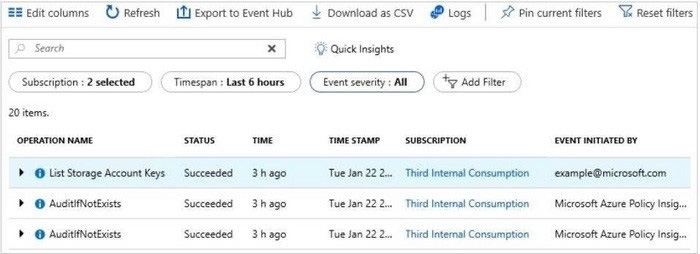 References:
Hotspot
HOTSPOT You have the following custom role-based access control (RBAC) role.  For each of the following statements, select Yes if the statement is true. Otherwise, select No. NOTE: Each correct selection is worth one point. 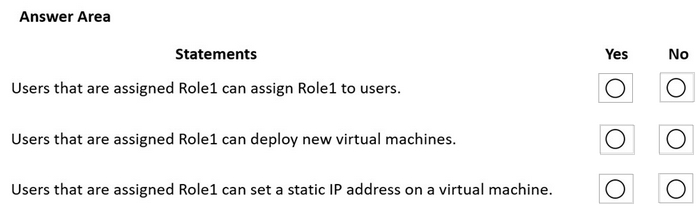 Reveal answer details Close answer details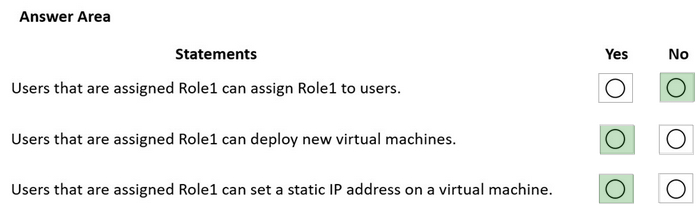 Explanation 1) Users that are assigned Role1 can assign Role1 to users. - No 2) Users that are assigned Role1 can deploy new virtual machines. - Yes Why these are correct: AZ-104 Exam Objective Hierarchy
Single choice
You are the global administrator for an Azure Active Directory (Azure AD) tenet named adatum.com. You need to enable two-step verification for Azure users. What should you do? Reveal answer details Close answer detailsCorrect answerA Explanation Create a sign-in risk policy in Azure AD Identity Protection "Two-step verification" in Microsoft Entra context generally refers to requiring an additional verification method (MFA). Among the provided options, Azure AD (Microsoft Entra) Identity Protection sign-in risk policy is the one that can enforce additional verification controls (such as requiring MFA) based on risk conditions. The other choices (PIM, Identity Hub, Security Center policy) do not directly enable two-step verification for users. Why other selections are incorrect: Microsoft Exam Tips: Summary: AZ-104 Exam Objective Hierarchy:
Hotspot
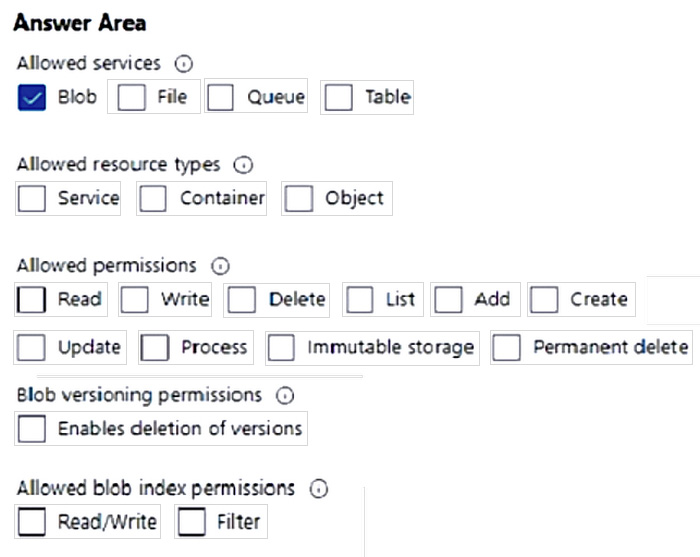
HOTSPOT You have an Azure subscription that contains a storage account named storage1. The storage1 account contains blobs in a container named container1. You plan to share access to storage1. You need to generate a shared access signature (SAS). The solution must meet the following requirements: Which three settings should you enable? To answer, select the appropriate settings in the answer area.
Reveal answer details Close answer details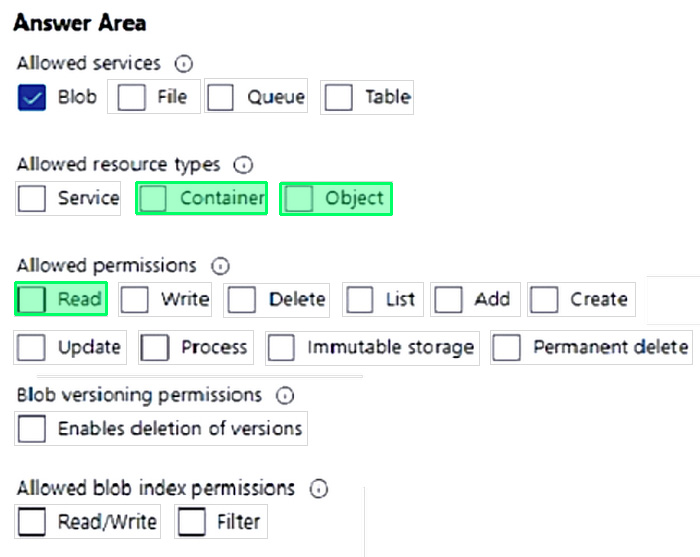 Explanation Scenario (condensed): Create a SAS for storage1 / container 1. Requirements: SAS can only be used to enumerate and download blobs in container1 Use least privilege Prompt: Which THREE settings should you enable? Answer (as shown in your screenshot/key): Allowed resource types: Container Allowed resource types: Object Allowed permissions: Read Why these are correct: Container + Object scope the SAS to container-level and object (blob) operations. Read permits downloading blob content (least privilege for download). Important technical note (about the word "enumerate"): Microsoft's definitions separate "Read" and "List." "Enumerate/list blobs" typically requires the "List" permission in addition to "Read." Your exam item limits you to THREE selections, and your screenshot highlights Container + Object + Case study Case Study 2Humongous Insurance Overview Existing Environment Active Directory Environment Network Infrastructure Active Directory Issue Licensing Issue Requirements Planned Azure AD Infrastructure Planned Azure Networking Infrastructure You plan to enable peering between Paris-VNet and AllOffices-VNet. You will enable the Use remote gateways setting for the Paris-VNet peerings. Planned Azure Computer Infrastructure Department Requirements -During the testing phase, auditors in the finance department must be able to review all Azure costs from the past week. Authentication Requirements
Testlet 2
Hotspot
HOTSPOT You are evaluating the name resolution for the virtual machines after the planned implementation of the Azure networking infrastructure. For each of the following statements, select Yes if the statement is true. Otherwise, select No. 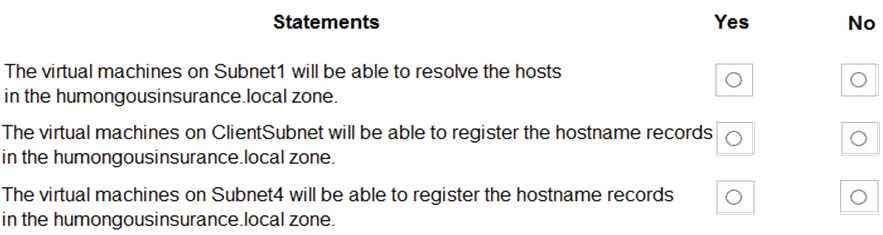 Reveal answer details Close answer details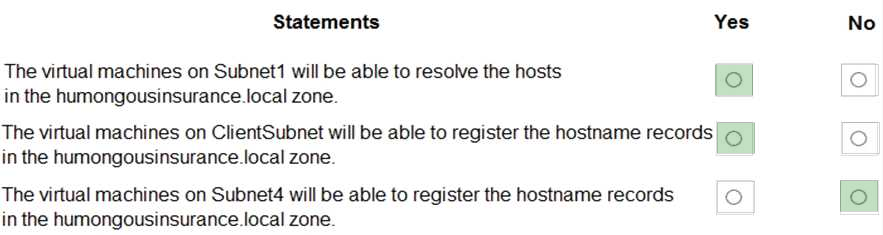 Explanation Statement 1: Yes Statement 2: Yes Statement 3: No
Single choice
You have an Azure Active Directory (Azure AD) tenant named contoso.com that has a security group named Group1. Group1 is configured for assigned membership. Group1 has 50 members, including 20 guest users. You need to recommend a solution for evaluating the membership of Group1. The solution must meet the following requirements: What should you include in the recommendation? Reveal answer details Close answer detailsCorrect answerC Explanation Create an access review. The requirements describe a periodic, automated membership attestation where each member can confirm they still need access, and non-responders (or users who say "no") are automatically removed. Microsoft Exam Tips: Summary: AZ-104 Exam Objective Hierarchy:
Hotspot
HOTSPOT You have an Azure subscription. You need to deploy a virtual machine by using an Azure Resource Manager (ARM) template. How should you complete the template? To answer, select the appropriate options in the answer area. NOTE: Each correct selection is worth one point. 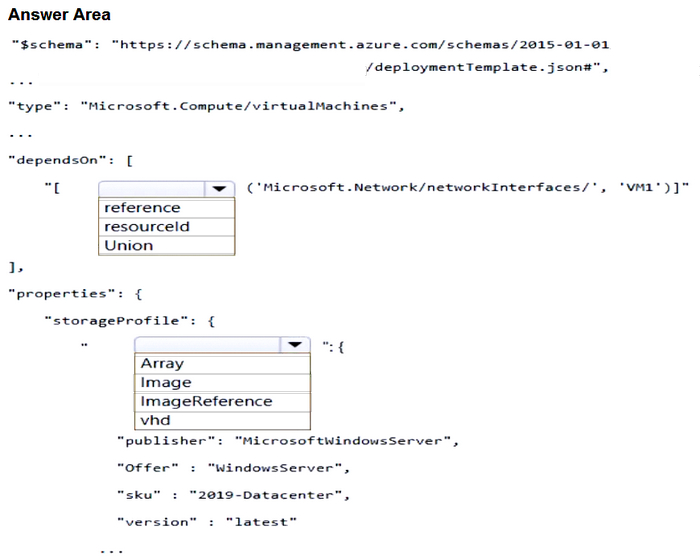 Reveal answer details Close answer details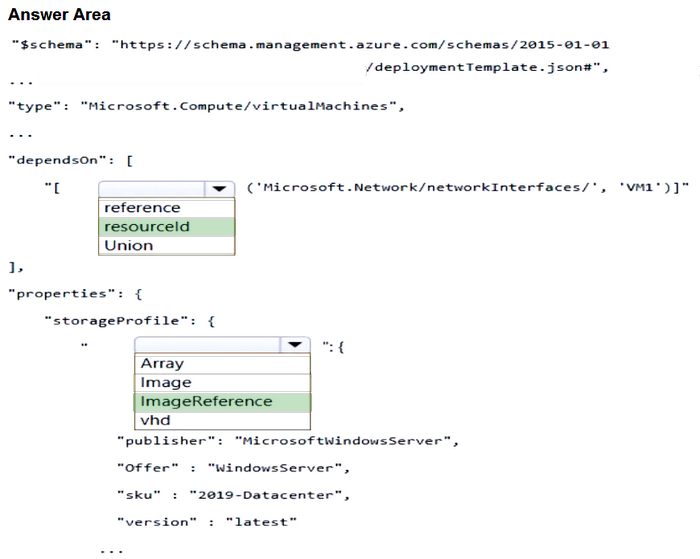 Explanation dependsOn: resourceId Why this is correct: Why the other option is incorrect: Exam Tips: Summary: AZ-104 Exam Objective Hierarchy:
Single choice
You have a hybrid infrastructure that contains an Azure Active Directory (Azure AD) tenant named contoso.onmicrosoft.com. The tenant contains the users shown in the following table. 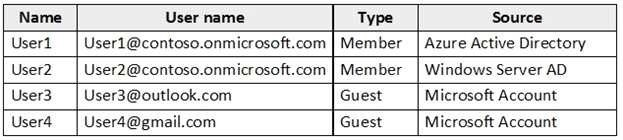 You plan to share a cloud resource to the All Users group. You need to ensure that User1, User2, User3, and User4 can connect successfully to the cloud resource. What should you do first? Reveal answer details Close answer detailsCorrect answerC Explanation Modify the Directory-wide Groups settings. You are granting access by assigning permissions to the built-in "All Users" group. User1 and User2 are members, but User3 and User4 are guests. If your tenant is configured so that guest accounts are not included (or not eligible) for the "All Users" group, then assigning access to "All Users" will not grant access to the guest users. Updating the directory-wide group settings is the first step that ensures the "All Users" group behavior aligns with the intended Why the other options are not the best first step Create a member account for User4: Create a member account for User3: Modify the External collaboration settings: Exam objective hierarchy 1.0 Manage Azure identities and governance 1.1 Manage Microsoft Entra users and groups
Single choice
You have an Azure subscription named Subscription1. Subscription1 contains the resource groups in the following table. RG1 has a web app named WebApp1. WebApp1 is located in West Europe. You move WebApp1 to RG2. What is the effect of the move? Reveal answer details Close answer detailsCorrect answerA Explanation The App Serviceplan for WebApp1 remains in WestEurope. Policy2 applies to WebApp1. Moving a web app to a different resource group does not change its region; the underlying App Service plan remains in the same location. After the move, Azure Policy assignment evaluation is based on the new scope (RG2), so Policy2 applies (assuming Policy2 is assigned to RG2). Why the other choices are not correct: Microsoft Exam Tips: Summary: AZ-104 Exam Objective Hierarchy:
Single choice
You have an Azure subscription named Subscription1 that contains an Azure virtual machine named VM1. VM1 runs services that will be used to deploy resources to RG1. You need to ensure that a service running on VM1 can manage the resources in RG1 by using the identity of VM1. What should you do first? Reveal answer details Close answer detailsCorrect answerA Explanation From the Azure portal, modify the Managed Identity settings of VM1 This is the correct first step. To allow a service running on VM1 to manage resources in RG1 using the identity of VM1, you must use a system-assigned managed identity (or user-assigned, but the question implies VM1's identity). The sequence is: 1) Enable the managed identity on VM1 (Identity blade / Managed Identity settings). Because the question asks what you do first, enabling the managed identity on the VM is the first required step. Why the other selections are not correct: Microsoft Exam Tips: Summary: AZ-104 Exam Objective Hierarchy: 1.2.2 Assign roles at different scopes
Hotspot
HOTSPOT You plan to deploy Azure Databricks to support a machine learning application. Data engineers will mount an Azure Data Lake Storage account to the Databricks file system. Permissions to folders are granted directly to the data engineers. You need to recommend a design for the planned Databrick deployment. The solution must meet the following requirements: Ensure that the data engineers can only access folders to which they have permissions. What should you include in the recommendation? To answer, select the appropriate options in the answer area. NOTE: Each correct selection is worth one point. 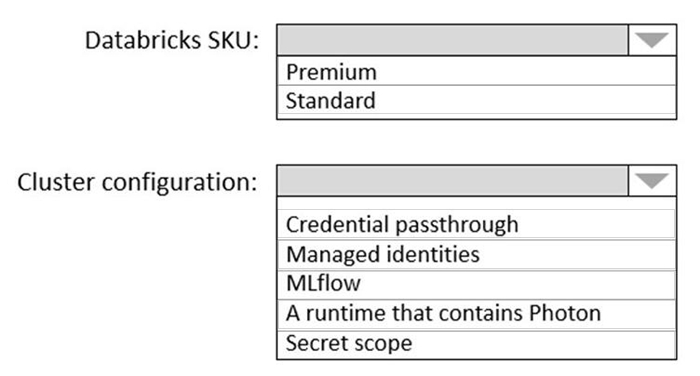 Reveal answer details Close answer details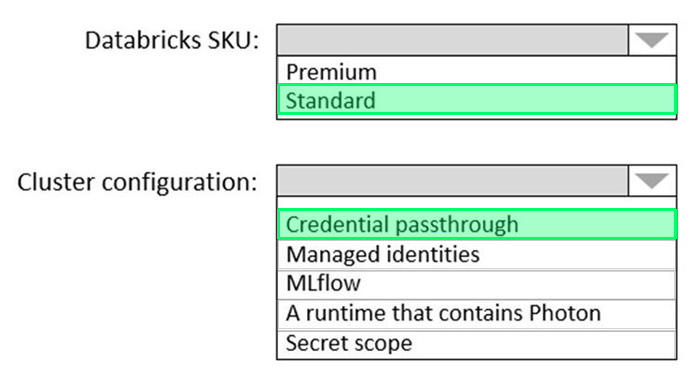 Explanation Databricks SKU: Premium Why this is correct: Why the other options are incorrect: Exam Tips: Summary: AZ-104 Exam Objective Hierarchy:
Single choice
You have an Azure subscription that contains a Standard SKU Azure container registry named ContReg1. You need to ensure that ContReg1 supports geo-replication. What should you do first for ContReg1? Reveal answer details Close answer detailsCorrect answerE Explanation Upgrade the SKU. - Geo-replication for Azure Container Registry is a Premium-tier capability. Why the other options are incorrect: Microsoft Exam Tips: Summary: AZ-104 Exam Objective Hierarchy:
Single choice
You have five Azure virtual machines that run Windows Server 2016. The virtual machines are configured as web servers. You have an Azure load balancer named LB1 that provides load balancing services for the virtual machines. What should you configure? Reveal answer details Close answer detailsCorrect answerA Explanation Session persistence to Client IP and protocol To ensure a visitor is consistently serviced by the same backend web server (session affinity), you configure Azure Load Balancer "Session persistence" using the 3-tuple option: Client IP and protocol. This pins successive requests from the same client IP and protocol combination to the same backend instance. Why other selections are not correct: Microsoft Exam Tips: Summary: AZ-104 Exam Objective Hierarchy:
Single choice
Your company has an Azure Active Directory (Azure AD) tenant that is configured for hybrid coexistence with the on-premises Active Directory domain. You plan to deploy several new virtual machines (VMs) in Azure. The VMs will have the same operating system and custom software requirements. You configure a reference VM in the on-premise virtual environment. You then generalize the VM to create an image. You need to upload the image to Azure to ensure that it is available for selection when you create the new Azure VMs. Which PowerShell cmdlets should you use? Reveal answer details Close answer detailsCorrect answerB Explanation Add-AzVhd To use a generalized on-prem VHD as the basis for Azure VM creation, you must first upload the VHD to Azure Storage. Add-AzVhd is the Azure PowerShell cmdlet used to upload a VHD to a storage account, which is a prerequisite step before you can reference it to create an image/VM in Azure. Why the other choices are not correct: Microsoft Exam Tips: Summary: AZ-104 Exam Objective Hierarchy:
Hotspot
HOTSPOT You have Azure subscriptions named Subscription1 and Subscription2. Subscription1 has following resource groups:  RG1 includes a web app named App1 in the West Europe location. Subscription2 contains the following resource groups:  For each of the following statements, select Yes if the statement is true. Otherwise, select No. NOTE: Each correct selection is worth one point. 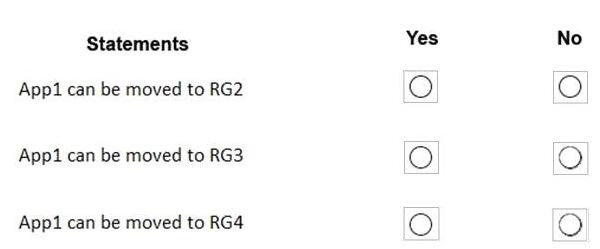 Reveal answer details Close answer details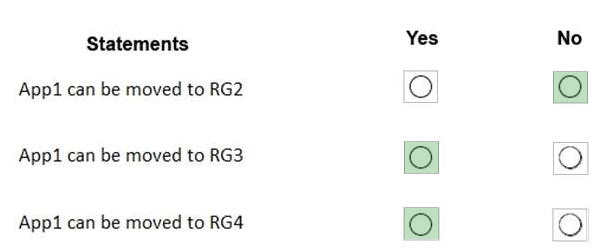 Explanation App1 can be moved to RG2: No You're moving an Azure resource (App1) between resource groups/subscriptions. The key constraint here is the resource lock applied to the destination resource group. Why "App1 can be moved to RG2" = No RG2 has a ReadOnly lock. A ReadOnly lock blocks write operations and, importantly, prevents moving resources into or out of a locked scope. Therefore, App1 cannot be moved into RG2 while that ReadOnly lock is in place. Why "App1 can be moved to RG3" = Yes RG3 has a Delete (CanNotDelete) lock. A CanNotDelete lock prevents deletions, but still allows changes (write operations) that don't delete the resource. Since a move is not a delete operation, the lock type itself does not block the move (assuming the Why "App1 can be moved to RG4" = Yes RG4 has no lock. With no lock-based restriction, the move is allowed (again assuming the resource type supports move). Microsoft Exam Tips: Summary: AZ-104 Exam Objective Hierarchy: 1.0 - Manage Azure identities and governance (20-25%) 1.3 - Manage Azure subscriptions and governance
Hotspot
HOTSPOT You have an Azure subscription that contains an Azure Directory (Azure AD) tenant named contoso.com. 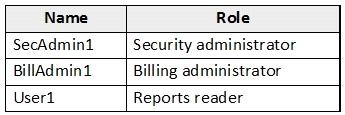 You enable self-service password reset (SSPR) for all users and configure SSPR to have the following authentication methods: 1. Number of methods required to reset: 2 You select the following security questions: 1. What is your favorite food? For each of the following statements, select Yes if the statement is true. Otherwise, select No. NOTE: Each correct selection is worth one point. 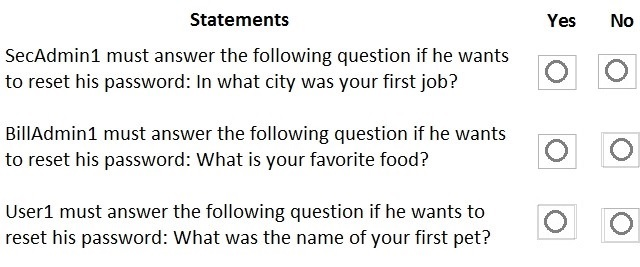 Reveal answer details Close answer details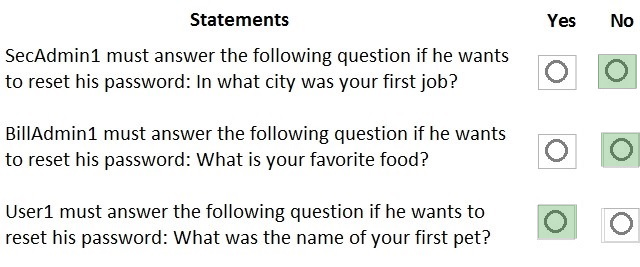 Explanation SecAdmin1 must answer the following question if he wants to reset his password: "In what city was your first job?": No BillAdmin1 must answer the following question if he wants to reset his password: "What is your favorite food?": No User1 must answer the following question if he wants to reset his password: "What was the name of your first pet?": Yes This question is testing how SSPR security questions work and (critically) who is allowed to use them. Key rule: Apply that to the users: Microsoft Exam Tips: Summary: AZ-104 Exam Objective Hierarchy:
Single choice
You have an Azure virtual machine named VM1 that runs Windows Server 2019. You sign in to VM1 as a user named User1 and perform the following actions: 1. Create files on drive C. You plan to redeploy VM1. Which changes will be lost after you redeploy VM1? Reveal answer details Close answer detailsCorrect answerC Explanation the new files on drive D On Azure Windows VMs, drive D is commonly the temporary disk (local ephemeral storage). When you redeploy a VM (host move), the temporary disk can be reinitialized and data on it can be lost. Therefore, files created on drive D are the changes most likely to be lost after redeploy. Why the other selections are not correct: Microsoft Exam Tips: Summary: AZ-104 Exam Objective Hierarchy: (Note: Only a partial hierarchy is available in this chat. Mapping below is best-fit.) 3.0 Deploy and manage Azure compute resources 3.2 Create and configure virtual machines 3.2.x Manage virtual machine disks (temporary vs managed disks) Case study Case Study 1Overview Litware, Inc. is a consulting company that has a main office in Montreal and two branch offices in Seattle and New York. The Montreal office has 2,000 employees. The Seattle office has 1,000 employees. The New York office has 200 employees. All the resources used by Litware are hosted on-premises. Litware creates a new Azure subscription. The Azure Active Directory (Azure AD) tenant uses a domain named litware.onmicrosoft.com. The tenant uses the P1 pricing tier. Existing Environment The network contains an Active Directory forest named litware.com. All domain controllers are configured as DNS servers and host the litware.com DNS zone. Litware has finance, human resources, sales, research, and information technology departments. Each department has an organizational unit (OU) that contains all the accounts of that respective department. All the user accounts have the department attribute set to their respective department. New users are added frequently. Litware.com contains a user named User1. All the offices connect by using private connections. Litware has data centers in the Montreal and Seattle offices. Each office has a firewall that can be configured as a VPN device. All infrastructure servers are virtualized. The virtualization environment contains the servers in the following table.  Litware uses two web applications named App1 and App2. Each instance on each web application requires 1 GB of memory. The Azure subscription contains the resources in the following table. 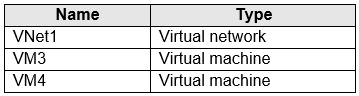 The network security team implements several network security groups (NSGs) Requirements Planned Changes Litware plans to implement the following changes: 1. Deploy Azure ExpressRoute to the Montreal office. Technical Requirements Litware must meet the following technical requirements: 1. Ensure that WebApp1 can adjust the number of instances automatically based on the load and can scale up to five instances.
Testlet 1
Hotspot
HOTSPOT You need to implement Role1. Which command should you run before you create Role1? To answer, select the appropriate options in the answer area. NOTE: Each correct selection is worth one point. 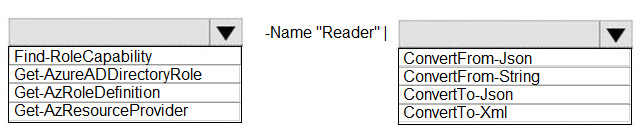 Reveal answer details Close answer details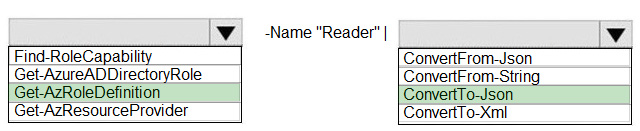 Explanation In Azure PowerShell, Get-AzRoleDefinition retrieves role definitions (built-in or custom). Piping the result to ConvertTo-Json outputs the role definition in JSON format, which is commonly used as a starting point for custom roles. AZ-104 Exam Objective Hierarchy (Mapped to this question) 1.0 Manage Azure identities and governance (20-25%) 1.2 Manage access to Azure resources 1.2.1 Manage built-in Azure roles 1.2.2 Assign roles at different scopes
Hotspot
HOTSPOT You have an Azure subscription named Subscription1 that contains the resources shown in the following table. 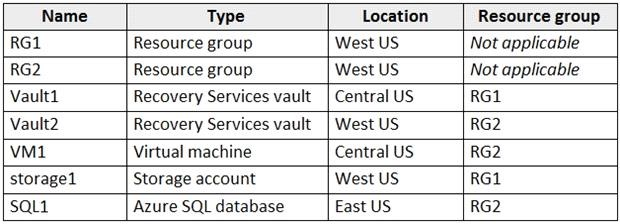 In storage1, you create a blob container named blob1 and a file share named share1. Which resources can be backed up to Vault1 and Vault2? To answer, select the appropriate options in the answer area. NOTE: Each correct selection is worth one point. 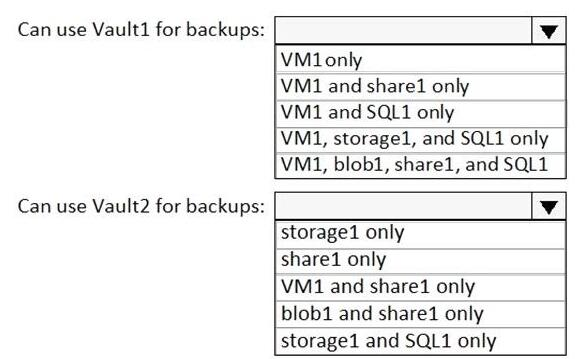 Reveal answer details Close answer details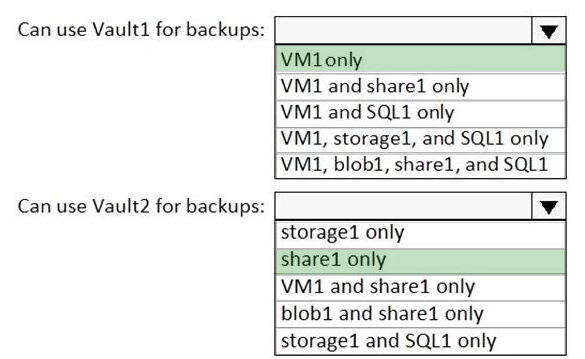 Explanation Box 1 (Can use Vault1 for backups): VM1 only Key rule: For Azure Backup using a Recovery Services vault, the vault must be in the SAME REGION as the protected data source. Given resources/regions: Therefore: - Vault2 (West US) can back up: - If the question shows multiple regions, expect "only items in the same region as the vault" to be the Summary: AZ-104 Exam Objective Hierarchy: 5 Monitor and maintain Azure resources (10-15%)
Single choice
You have a .NET Core application running in Azure App Services. You are expecting a huge influx of traffic to your application in the coming days. When your application experiences this spike in traffic, you want to detect any anomalies such as request errors or failed queries immediately. What service can you use to assure that you know about these types of errors related to your . Reveal answer details Close answer detailsCorrect answerD Explanation Live Metrics Stream in Application Insights Live Metrics Stream provides near real-time telemetry (including request rate, failures, and dependency calls) so you can detect request errors and failed requests immediately during a traffic spike. That matches the requirement for immediate anomaly detection. Why the other selections are not correct: Microsoft Exam Tips: Summary: AZ-104 Exam Objective Hierarchy:
Hotspot
HOTSPOT You have an Azure AD tenant named adatum.com that contains the groups shown in the following table. 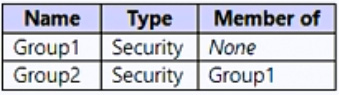 Adatum.com contains the users shown in the following table. 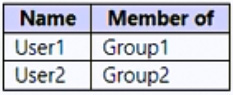 You assign an Azure Active Directory Premium P2 license to Group1 as shown in the following exhibit. 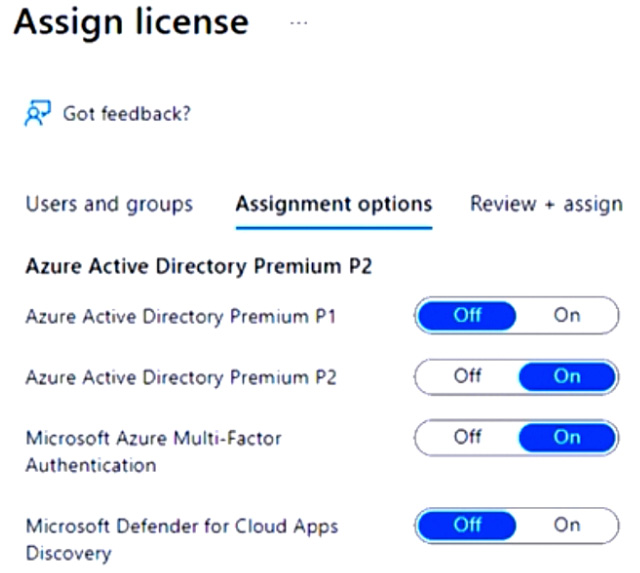 Group2 is NOT directly assigned a license. For each of the following statements, select Yes if the statement is true. Otherwise, select No. NOTE: Each correct selection is worth one point 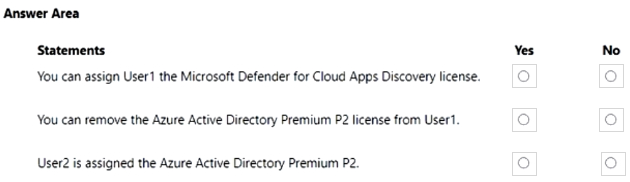 Reveal answer details Close answer details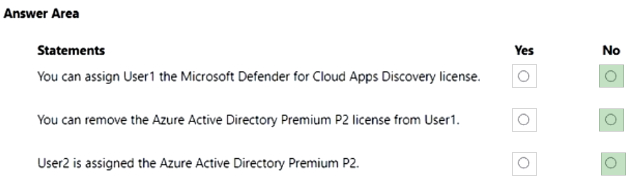 Explanation You can assign User1 the Microsoft Defender for Cloud Apps Discovery license. -> No Why this is correct: Why the other options are incorrect: Exam Tips: AZ-104 Exam Objective Hierarchy:
Single choice
You have an Azure subscription that contains a virtual machine named VM1. VM1 hosts a line-of-business application that is available 24 hours a day. VM1 has one network interface and one managed disk. VM1 uses the D4s v3 size. 1. Change the size to D8s v3. Which change will cause downtime for VM1? Reveal answer details Close answer detailsCorrect answerD Explanation Change the size to D8s v3. The change that will cause downtime is the one that requires a VM restart (or stop/deallocate) to apply. Why the correct selection is correct: Why the other selections are incorrect: Microsoft Exam Tips: Summary: AZ-104 Exam Objective Hierarchy:
Single choice
You have an Azure subscription that contains two peered virtual networks named VNet1 and VNet2. VNet1 has a VPN gateway that uses static routing. The on-premises network has a VPN connection that uses the VPN gateway of VNet1. You need to configure access for users on the on-premises network to connect to a virtual machine on VNet2. The solution must minimize costs. Which type of connectivity should you use? Reveal answer details Close answer detailsCorrect answerB Explanation service chaining and user-defined routes (UDRs) To extend on-premises connectivity (terminating on the VPN gateway in VNet1) to workloads in a peered VNet (VNet2) while minimizing cost, you use hub-and-spoke style transit so the spoke can leverage the hub's connectivity. In exam phrasing, "service chaining + UDRs" aligns to routing/transit through the hub rather than deploying additional cost-bearing components (like new ExpressRoute circuits). Why other selections are not correct: - Azure Application Gateway: is for HTTP(S) L7 load balancing, not network transit from on-prem to a Microsoft Exam Tips: Summary: AZ-104 Exam Objective Hierarchy:
Drag & drop
DRAG DROP You have downloaded an Azure Resource Manager (ARM) template to deploy numerous virtual machines (VMs). The ARM template is based on a current VM, but must be adapted to reference an administrative password. You need to make sure that the password cannot be stored in plain text. You are preparing to create the necessary components to achieve your goal. Which of the following should you create to achieve your goal? Answer by dragging the correct option from the list to the answer area. 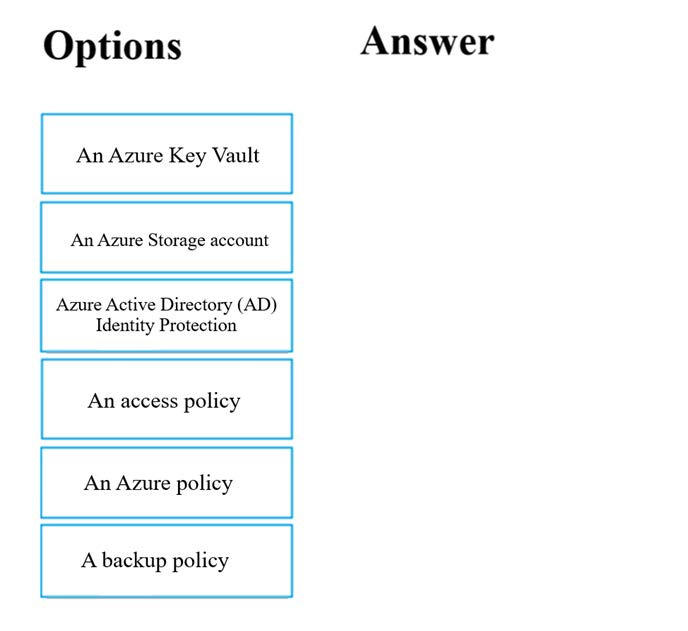 Reveal answer details Close answer details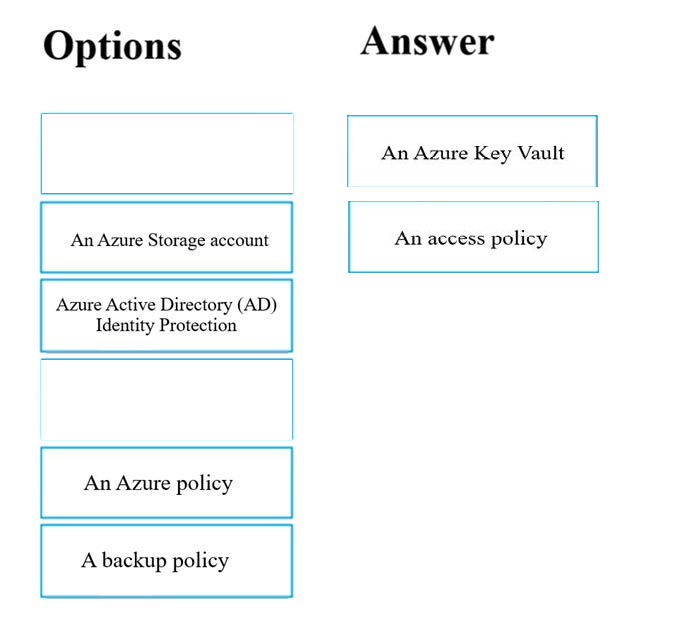 Explanation Box 1: An Azure Key Vault The ARM template must reference an administrative password securely. Best practice is to store the password as a secret in Azure Key Vault and allow the deployment engine (ARM) to retrieve it during deployment. Why these selections are correct: Why the other options are not correct: Microsoft Exam Tips: Summary: AZ-104 Exam Objective Hierarchy:
Single choice
You have an Azure subscription that contains a virtual machine named VM1. VM1 hosts a line-of-business application that is available 24 hours a day. VM1 has one network interface and one managed disk. VM1 uses the D4s v3 size. You plan to make the following changes to VM1: 1. Change the size to D8s v3. 3. Add the Puppet Agent extension. Which change will cause downtime for VM1? Reveal answer details Close answer detailsCorrect answerC Explanation Change the size to D8s v3 Resizing a VM (changing its size/SKU) causes the VM to restart, which is downtime for an always-on application. Adding a managed disk and adding extensions/configuration management can typically be performed without requiring the VM to be deallocated in the same way resizing does (though extensions may cause transient workload impact, they are not generally treated as the mandatory restart/downtime operation in AZ-104). :contentReference[oaicite:27]{index=27} Why the other selections are not correct: Microsoft Exam Tips: Summary: AZ-104 Exam Objective Hierarchy:
Single choice
You have an on-premises server that contains a folder named D:\Folder1. You need to copy the contents of D:\Folder1 to the public container in an Azure Storage account named contosodata. Which command should you run? Reveal answer details Close answer detailsCorrect answerC Explanation azcopy copy D:\folder1 You are copying the contents of a local folder (D:\Folder1) to a blob container (public) in an Azure Storage account. Why this answer is correct: Why the other choices are not correct: `start-batch` is for copying multiple blobs (storage-to-storage), not uploading a local folder from a drive Note (real-world execution): Microsoft Exam Tips: Summary: AZ-104 Exam Objective Hierarchy:
Single choice
You have an Active Directory domain named contoso.com that contains the objects shown in the following table. 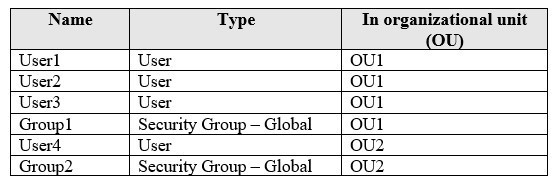 The groups have the memberships shown in the following table. 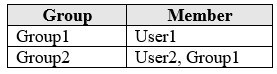 OU1 and OU2 are synced to Azure Active Directory (Azure AD). Which objects are in Azure AD? Reveal answer details Close answer detailsCorrect answerA Explanation User4 and Group2 only You removed OU1 from synchronization scope and then ran a sync. With Microsoft Entra Connect, when an object is filtered out of scope (for example, by domain/OU filtering) and you apply the change correctly, Entra Connect will remove (delete) the previously synchronized objects that are now out of scope in Microsoft Entra ID. Given the table: After OU1 is excluded and synchronization runs, only the objects that remain in scope (OU2) will remain in Microsoft Entra ID: Group membership does not "preserve" out-of-scope objects: Even though Group2 previously contained members from OU1 (User2 and Group1), those OU1 objects are out of scope and are removed from Microsoft Entra ID during the cleanup. Group2 can still exist, but the out-of-scope members will not remain in the directory. Why the other selections are not correct: Microsoft Exam Tips: Summary: AZ-104 Exam Objective Hierarchy:
Single choice
Note: This question is part of a series of questions that present the same scenario. Each question in the series contains a unique solution that might meet the stated goals. Some question sets might have more than one correct solution, while others might not have a correct solution. After you answer a question in this section, you will NOT be able to return to it. As a result, these questions will not appear in the review screen. You have an Azure virtual machine named VM1. VM1 was deployed by using a custom Azure Resource Manager template named ARM1.json. You receive a notification that VM1 will be affected by maintenance. You need to move VM1 to a different host immediately. Solution: From the Overview blade, you move the virtual machine to a different subscription. Does this meet the goal? Reveal answer details Close answer detailsCorrect answerB Explanation No The proposed action (moving the virtual machine to a different subscription) is a management-scope move and does not directly perform an immediate host migration to avoid maintenance impact. Redeploy is the operation that migrates the VM to a new Azure host. Therefore, this does not meet the goal. Why the other selection is incorrect: Microsoft Exam Tips: Summary: AZ-104 Exam Objective Hierarchy:
Single choice
You have an Azure subscription named Subscription1 that contains a virtual network named VNet1. Subscription1 has a user named User1. User1 has the following roles: 1. Reader 3. Security Reader You need to ensure that User1 can assign the Reader role for VNet1 to other users. What should you do? Reveal answer details Close answer detailsCorrect answerD Explanation Assign User1 the User Access Administrator role for VNet1 The requirement is for User1 to be able to assign the Reader role for VNet1 to other users. Assigning RBAC roles requires permission to create role assignments (for example, `Microsoft.Authorization/ roleAssignments/write`) at the appropriate scope. Microsoft documents that Owner and User Access Why other selections are incorrect: Microsoft Exam Tips: Summary: AZ-104 Exam Objective Hierarchy:
Single choice
Note: The question is included in a number of questions that depicts the identical set-up. However, every question has a distinctive result. Establish if the solution satisfies the requirements. Your company has an Azure Active Directory (Azure AD) tenant named weyland.com that is configured for hybrid coexistence with the on-premises Active Directory domain. You have a server named DirSync1 that is configured as a DirSync server. You create a new user account in the on-premise Active Directory. You now need to replicate the user information to Azure AD immediately. Solution: You use Active Directory Sites and Services to force replication of the Global Catalog on a domain controller. Does the solution meet the goal? Reveal answer details Close answer detailsCorrect answerB Explanation No Forcing on-premises Active Directory replication (for example, via AD Sites and Services / Global Catalog replication) only affects replication between on-prem domain controllers. It does not trigger Microsoft Entra Connect (DirSync) to synchronize changes from on-premises AD to Microsoft Entra ID. Therefore, this solution does not meet the goal of replicating user information to Azure AD immediately. Microsoft Exam Tips: Summary: AZ-104 Exam Objective Hierarchy:
Hotspot
HOTSPOT You have an Azure subscription that contains the resource groups shown in the following table. 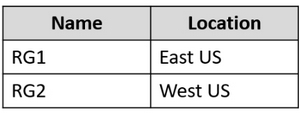 You create the following Azure Resource Manager (ARM) template named deploy.json. 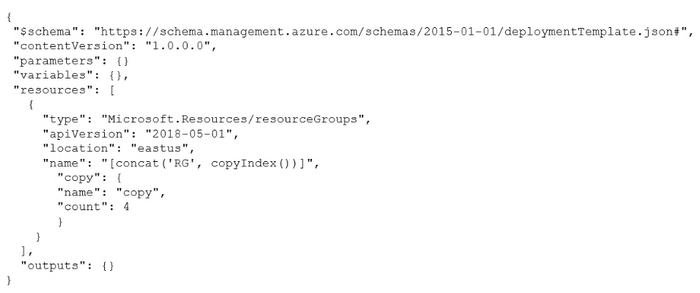 You deploy the template by running the following cmdlet: New-AzSubscriptionDeployment -Location <location> -TemplateFile deploy.json For each of the following statements, select Yes if the statement is true. Otherwise, select No. NOTE: Each correct selection is worth one point. 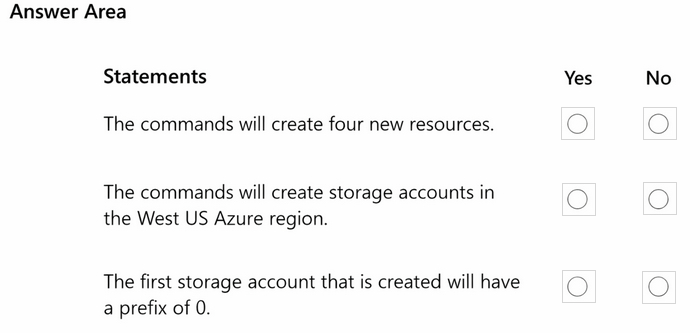 Reveal answer details Close answer details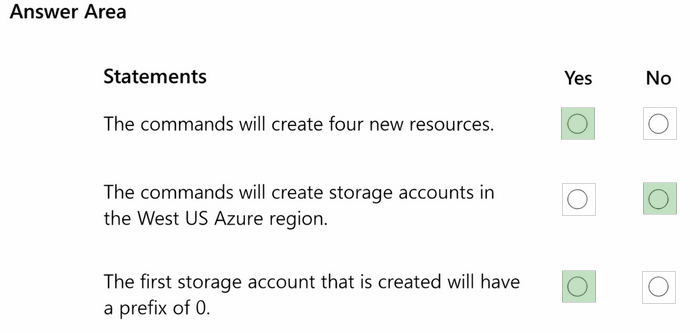
Single choice
Note: This question is part of a series of questions that present the same scenario. Each question in the series contains a unique solution that might meet the stated goals. Some question sets might have more than one correct solution, while others might not have a correct solution. After you answer a question in this section, you will NOT be able to return to it. As a result, these questions will not appear in the review screen. You have an Azure subscription that contains the following users in an Azure Active Directory tenant 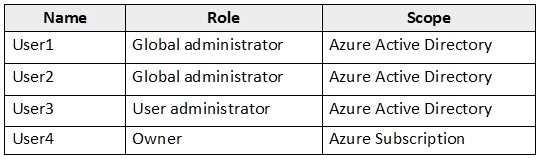 User1 creates a new Azure Active Directory tenant named external.contoso.onmicrosoft.com. You need to create new user accounts in external.contoso.onmicrosoft.com. Solution: You instruct User2 to create the user accounts. Does that meet the goal? Reveal answer details Close answer detailsCorrect answerB Explanation No User1 created a NEW Azure Active Directory (Microsoft Entra ID) tenant: Admin roles shown in the scenario (for User2: Global administrator in "Azure Active Directory") apply to the ORIGINAL tenant (contoso.onmicrosoft.com), not automatically to the newly created tenant. Therefore, instructing User2 to create user accounts in the NEW tenant does not meet the goal unless User2 is first added to the new tenant and granted the necessary permissions there. What would be required to make it work - Add/invite User2 into external.contoso.onmicrosoft.com, then Exam Tips: Summary: EXAM OBJECTIVE ALIGNMENT (Hierarchy)
Single choice
You have an Azure subscription that contains the resources shown in the following table. 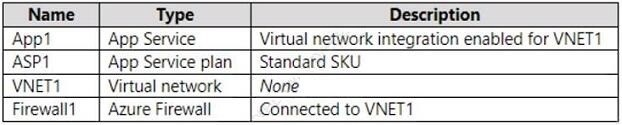 You need to manage outbound traffic from VNET1 by using Firewall1. What should you do first? Reveal answer details Close answer detailsCorrect answerC Explanation Create a route table. To manage outbound traffic from VNET1 through Azure Firewall, you must force egress to the firewall by using user-defined routes (UDRs). The first step is to create a route table, add routes (commonly 0.0.0.0/0) with next hop type Virtual appliance pointing to the firewall's private IP, and then associate the route table to the appropriate subnet(s). Without the route table/UDR, traffic will not be steered to Firewall1 for policy enforcement. Why other selections are not correct: - Configure Hybrid Connection Manager: App Service connectivity feature; unrelated to VNet egress Microsoft Exam Tips: Summary: AZ-104 Exam Objective Hierarchy:
Hotspot
HOTSPOT You have an Azure Storage account named contoso2024 that contains the resources shown in the following table. 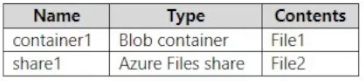 You have users that have permissions for contoso2024 as shown in the following table. 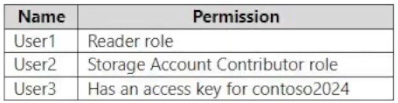 The contoso2024 account is configured as shown in the following exhibit. 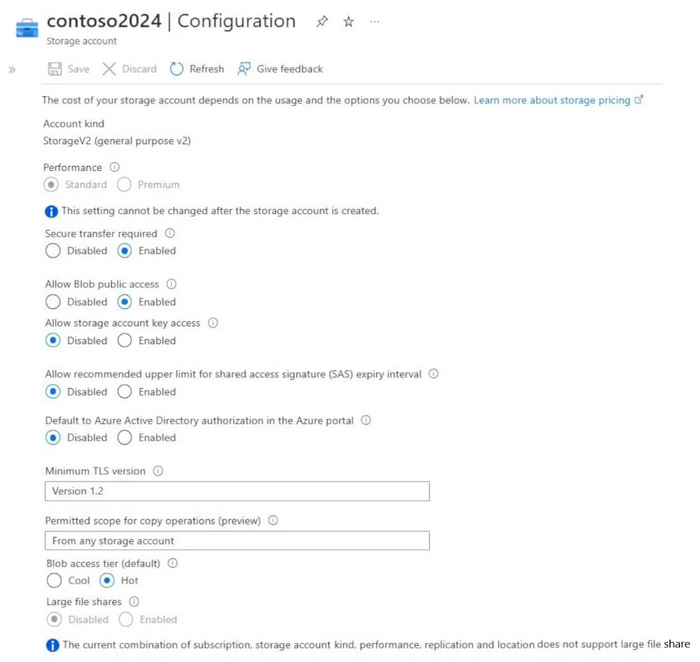 For each of the following statements, select Yes if the statement is true. Otherwise, select No. NOTE: Each correct selection is worth one point. 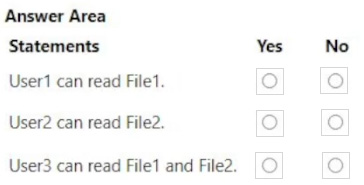 Reveal answer details Close answer details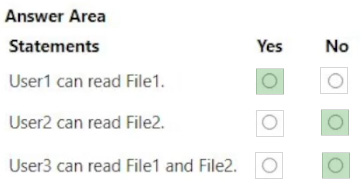 Explanation Scenario summary (from exhibit): Storage account contoso2024 contains container1 (Blob) with File1 and share1 (Azure Files) with File2. User1 can read File1: No Reader and Storage Account Contributor are management-plane (Azure Resource Manager) roles and do not grant storage data-plane read permissions to blobs or files. Shared Key disabled: "Azure Storage rejects all subsequent requests ... authorized with the account access keys or shared access signatures (SAS)." 2.0 Implement and manage storage (15-20%) 2.1 Configure access to storage
Single choice
You have a Basic App Service plan named ASP1 that hosts an Azure App Service named App1. You need to configure a custom domain and enable backups for App1. What should you do first? Reveal answer details Close answer detailsCorrect answerB Explanation Scale up ASP1. You must enable backups and configure a custom domain. In exam contexts, App Service backup/restore features are tied to having an appropriate App Service plan tier that supports backup capabilities. Why the other selections are incorrect: Microsoft Exam Tips: Summary: AZ-104 Exam Objective Hierarchy: Basic App service plan does not support backup/restore. 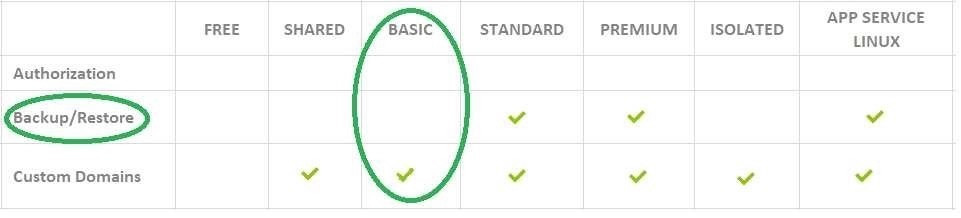 The Backup and Restore feature requires the App Service plan to be in the Standard, Premium or Isolated tier. Since in question it is mentioned as a Basic service plan app so at first you need to do it to Scale up the service plan so that backup can be enabled on App1. Scale up: Get more CPU, memory, disk space, and extra features like dedicated virtual machines (VMs), custom domains and certificates, staging slots, autoscaling, and more. You scale up by changing the pricing tier of the App Service plan that your app belongs to. 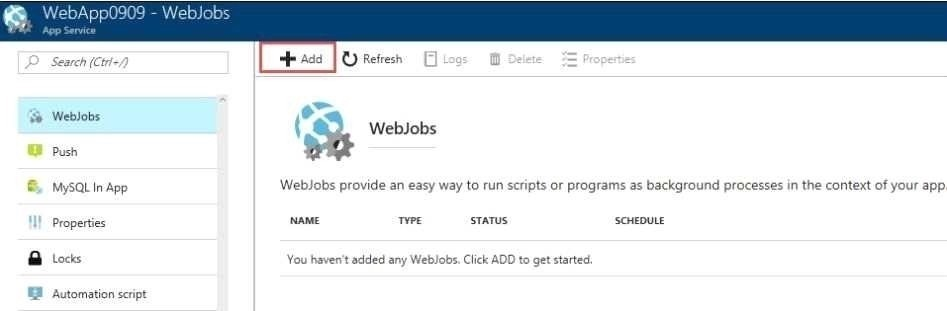 Scale out ASP1 : Incorrect 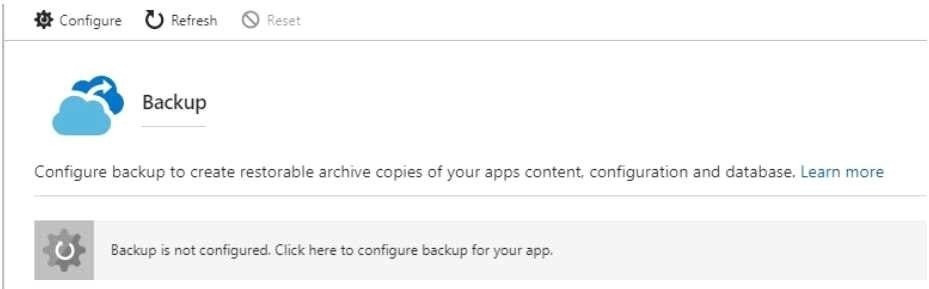 References:
Hotspot
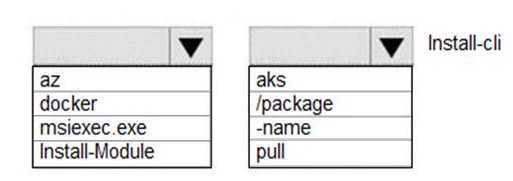
HOTSPOT You have an Azure Kubernetes Service (AKS) cluster named AKS1 and a computer named Computer1 that runs Windows 10. Computer1 that has the Azure CLI installed. You need to install the kubectl client on Computer1. Which command should you run? To answer, select the appropriate options in the answer area. NOTE: Each correct selection is worth one point.
Reveal answer details Close answer details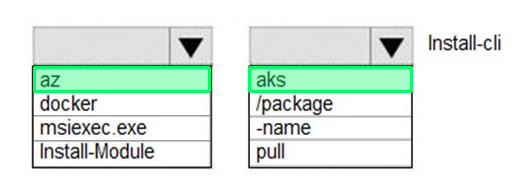 Explanation First dropdown: az Why this is correct: Why the other options are incorrect: Exam Tips: AZ-104 Exam Objective Hierarchy
Hotspot
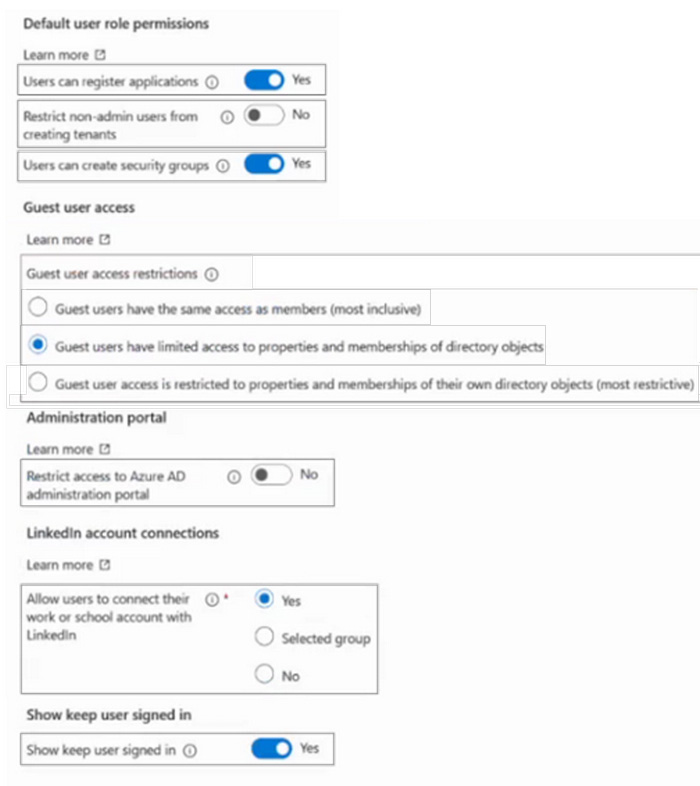
HOTSPOT You have an Azure AD tenant. You need to modify the Default user role permissions settings for the tenant. The solution must meet the following requirements: 1. Standard users must be prevented from creating new service principals. Which two settings should you modify? To answer, select the appropriate settings in the answer area. NOTE: Each correct answer is worth one point.
Reveal answer details Close answer details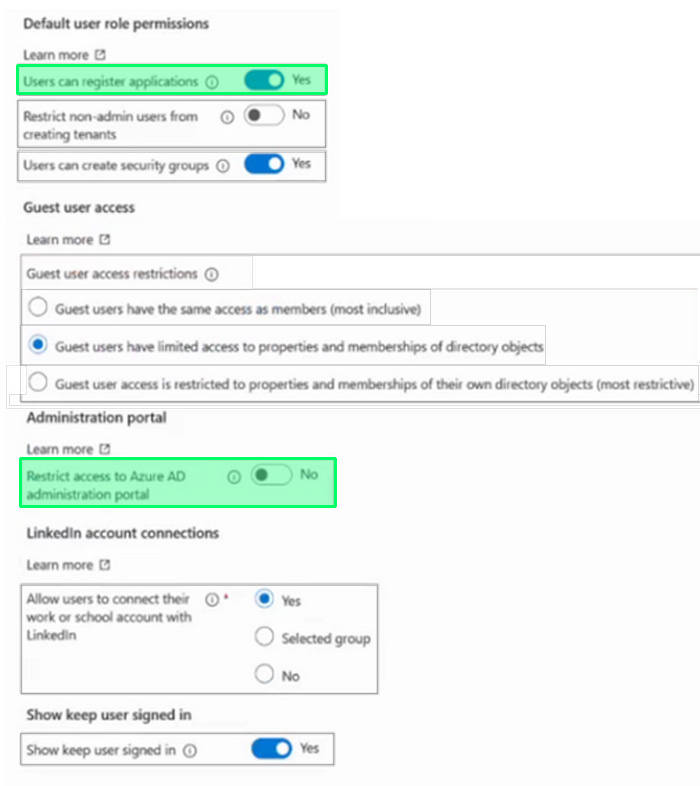 Explanation The screenshot shows the current state, not the desired final state. Users can register applications: change from Yes -> No Rationale: Setting "Register applications" to No prevents users from creating application registrations. Restrict access to Microsoft Entra administration portal: change from No -> Yes Excerpts: AZ-104 Exam Objective Hierarchy
Single choice
You have an Azure Active Directory (Azure AD) tenant named contosocloud.onmicrosoft.com. Your company has a public DNS zone for contoso.com. You add contoso.com as a custom domain name to Azure AD. You need to ensure that Azure can verify the domain name. Which type of DNS record should you create? Reveal answer details Close answer detailsCorrect answerB Explanation TXT or MX To verify a custom domain name in Microsoft Entra ID, you must prove domain ownership by creating a DNS record that Microsoft can query publicly. Microsoft Entra domain verification supports creating either: - a TXT record, or After you add the required TXT or MX record to the public DNS zone for contoso.com, Microsoft Entra can verify the domain by detecting that record. Why the other options are not correct: - PTR: - NSEC3: - RRSIG: Exam Tips: Summary: AZ-104 Exam Objective Alignment (Hierarchy) 1.0 Manage Azure identities and governance 1.1 Manage Microsoft Entra users and groups 1.1.2 Manage user and group properties 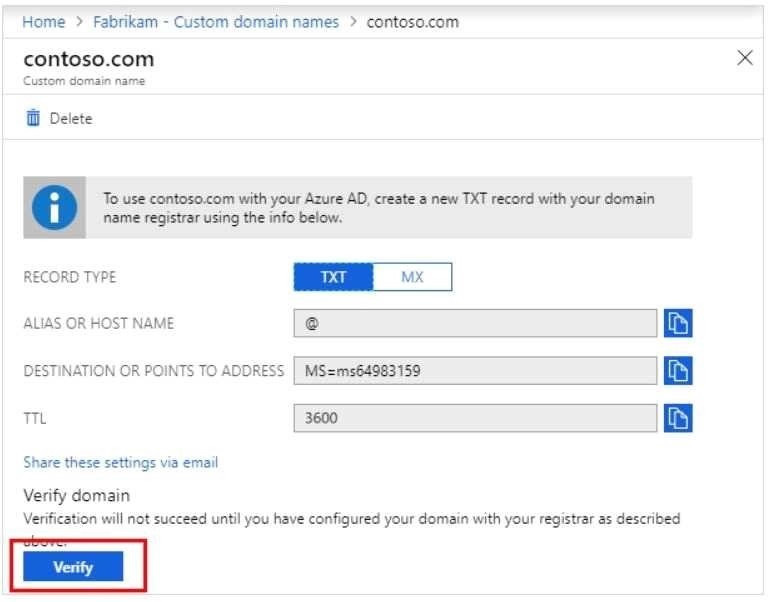
Single choice
You have an Azure Active Directory (Azure AD) tenant named contoso.onmicrosoft.com. You hire a temporary vendor. The vendor uses a Microsoft account that has a sign-in of [email protected]. You need to ensure that the vendor can authenticate to the tenant by using [email protected]. What should you do? Reveal answer details Close answer detailsCorrect answerD Explanation From the Azure portal, add a new guest user, and then specify [email protected] as the email address. A vendor using a Microsoft account ([email protected]) should be onboarded to the tenant using Microsoft Entra B2B by inviting them as a guest user. Adding a guest user with that email address enables authentication to your tenant using that external identity. Why the other options are not correct: Microsoft Exam Tips: Summary: AZ-104 Exam Objective Hierarchy:
Single choice
You have two Azure virtual machines named VM1 and VM2 that run Windows Server. The virtual machines are in a subnet named Subnet1. Subnet1 is in a virtual network named VNet1. You need to prevent VM1 from accessing VM2 on port 3389. What should you do? Reveal answer details Close answer detailsCorrect answerA Explanation Create a network security group (NSG) that has an outbound security rule to deny destination port 3389 and apply the NSG to the network interface of VM1. To prevent VM1 initiating RDP connections to VM2 on TCP 3389, you block the outbound traffic from VM1 where the destination port is 3389. Applying the NSG at the NIC of VM1 scopes the restriction precisely to Why other selections are not correct: Microsoft Exam Tips: Summary: AZ-104 Exam Objective Hierarchy:
Single choice
You have an app named App1 that runs on two Azure virtual machines named VM1 and VM2. You plan to implement an Azure Availability Set for App1. The solution must ensure that App1 is available during planned maintenance of the hardware hosting VM1 and VM2. What should you include in the Availability Set? Reveal answer details Close answer detailsCorrect answerD Explanation two update domains Planned maintenance (platform updates) is sequenced by update domains so that Azure does not restart all VMs in the availability set at the same time. With two VMs (VM1 and VM2), configuring two update domains ensures the VMs are placed into different update domains so only one VM is restarted at a time during planned maintenance. Why the other choices are not correct: one update domain: Both VMs could be restarted together during planned maintenance (no rolling restart protection). two fault domains / one fault domain: Fault domains protect primarily against unplanned hardware, network, or power failures (rack-level issues), not the sequencing of planned maintenance reboots. Microsoft Exam Tips: Summary: AZ-104 Exam Objective Hierarchy:
Single choice
You have an Azure Kubernetes Service (AKS) cluster that uses Azure CNI. You need to ensure that pods can resolve and reach an Azure Storage account that is exposed through a Private Endpoint in the same virtual network. Reveal answer details Close answer detailsCorrect answerA Explanation Create a Private DNS zone for privatelink.blob.core.windows.net and link it to the virtual network The AKS cluster uses Azure CNI and must resolve/reach a Storage account exposed via a Private Endpoint in the same VNet. For Private Endpoints, name resolution must return the private IP of the endpoint. The standard pattern is: 1) Create the matching Private DNS zone (for Blob: `privatelink.blob.core.windows.net`) 2) Link it to the VNet so resources in that VNet (including AKS nodes/pods via CNI) resolve the storage Why the other selections are not correct: Microsoft Exam Tips: Summary: AZ-104 Exam Objective Hierarchy:
Hotspot
HOTSPOT You have an Azure subscription that contains a storage account named storage1. The storage1 account contains a container named container1. You create a blob lifecycle rule named rule1. You need to configure rule1 to automatically move blobs that were NOT updated for 45 days from contained to the Cool access tier. How should you complete the rule? To answer, select the appropriate options in the answer area. NOTE: Each correct selection is worth one point. 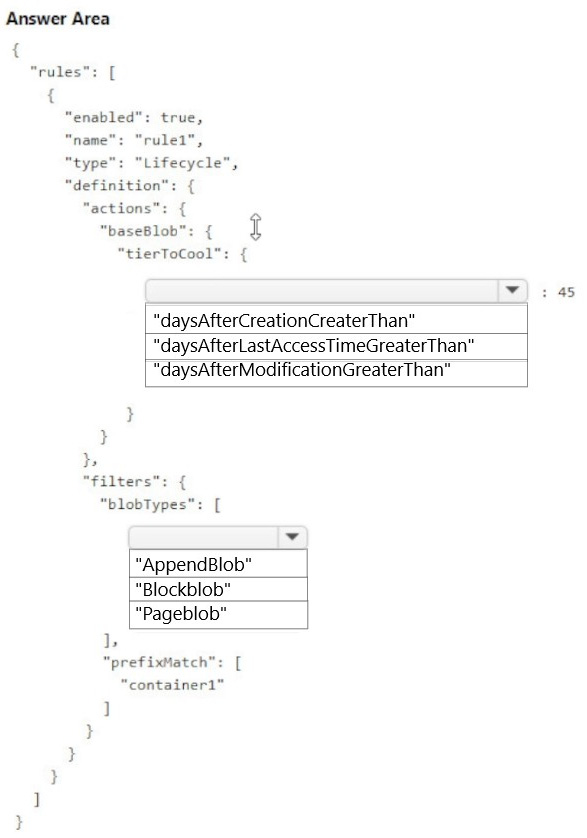 Reveal answer details Close answer details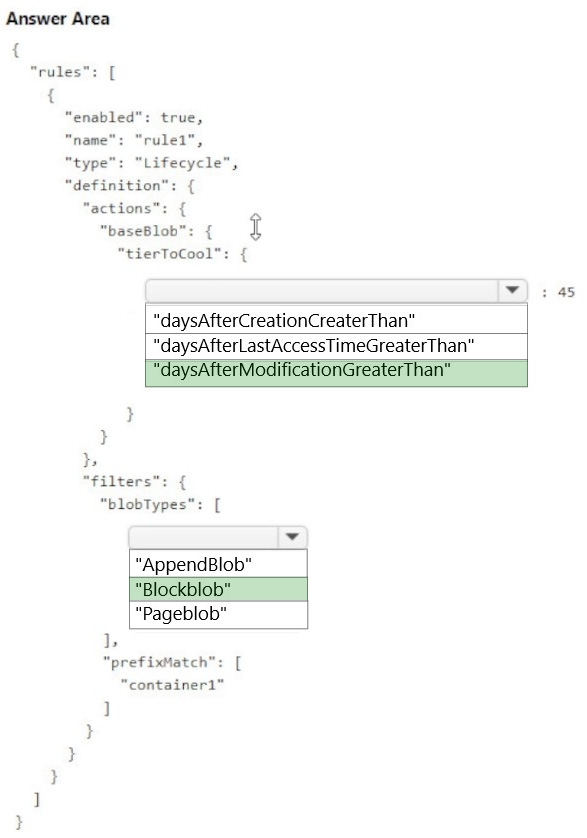 Explanation Property: daysAfterModificationGreaterThan Why this is correct: - "NOT updated for 45 days" maps to last-modified time, which corresponds to Why the other options are incorrect: Exam Tips: Summary: AZ-104 Exam Objective Hierarchy:
Single choice
Note: This question is part of a series of questions that present the same scenario. Each question in the series contains a unique solution that might meet the stated goals. You have an Azure Active Directory (Azure AD) tenant named contoso.com. You have a CSV file that contains the names and email addresses of 500 external users. You need to create a guest user account in contoso.com for each of the 500 external users. Solution: You create a PowerShell script that runs the New-MgInvitation cmdlet for each external user. Does this meet the goal? Reveal answer details Close answer detailsCorrect answerA Explanation Yes New-MgInvitation is specifically meant to invite external users to your tenant (B2B). It creates/uses a guest user object and sends an invitation email so the external users can redeem the invitation and access resources as guests. Therefore, using New-MgInvitation for each external user meets the goal of creating guest user accounts for the 500 external users. Why the other option is not correct: Microsoft Exam Tips: Summary: AZ-104 Exam Objective Hierarchy:
Single choice
You have an Azure policy as shown in the following exhibit: 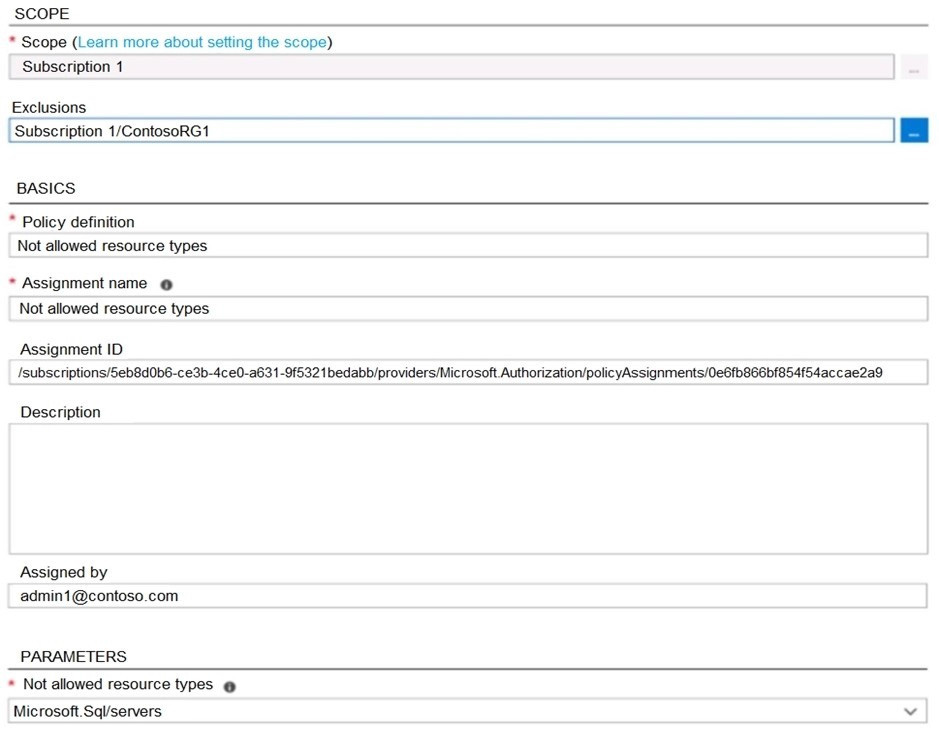 What is the effect of the policy? Reveal answer details Close answer detailsCorrect answerA Explanation You can create Azure SQL servers in ContosoRG1 only. The exhibit shows an Azure Policy assignment using the built-in "Not allowed resource types" policy with the parameter set to deny the resource type Microsoft.Sql/servers (Azure SQL logical servers). - Because the assignment scope is Subscription1, the deny effect applies across the subscription. Therefore, creating Azure SQL servers is blocked everywhere in Subscription1 except in ContosoRG1, where the exclusion allows the deployment. Why the other answer texts are not correct: - "You are prevented from creating Azure SQL servers anywhere in Subscription 1." - "You are prevented from creating Azure SQL Servers in ContosoRG1 only." - "You can create Azure SQL servers in any resource group within Subscription 1." Exam Tips: Summary: AZ-104 Exam Objective Alignment (Hierarchy) 1.0 Manage Azure identities and governance 1.3 Manage Azure subscriptions and governance 1.3.1 Implement and manage Azure Policy
Hotspot
HOTSPOT You have an Azure subscription that contains a virtual network named VNET in the East Us 2 region. A network interface named VM1-NI is connected to VNET1. You successfully deploy the following Azure Resource Manager template.' 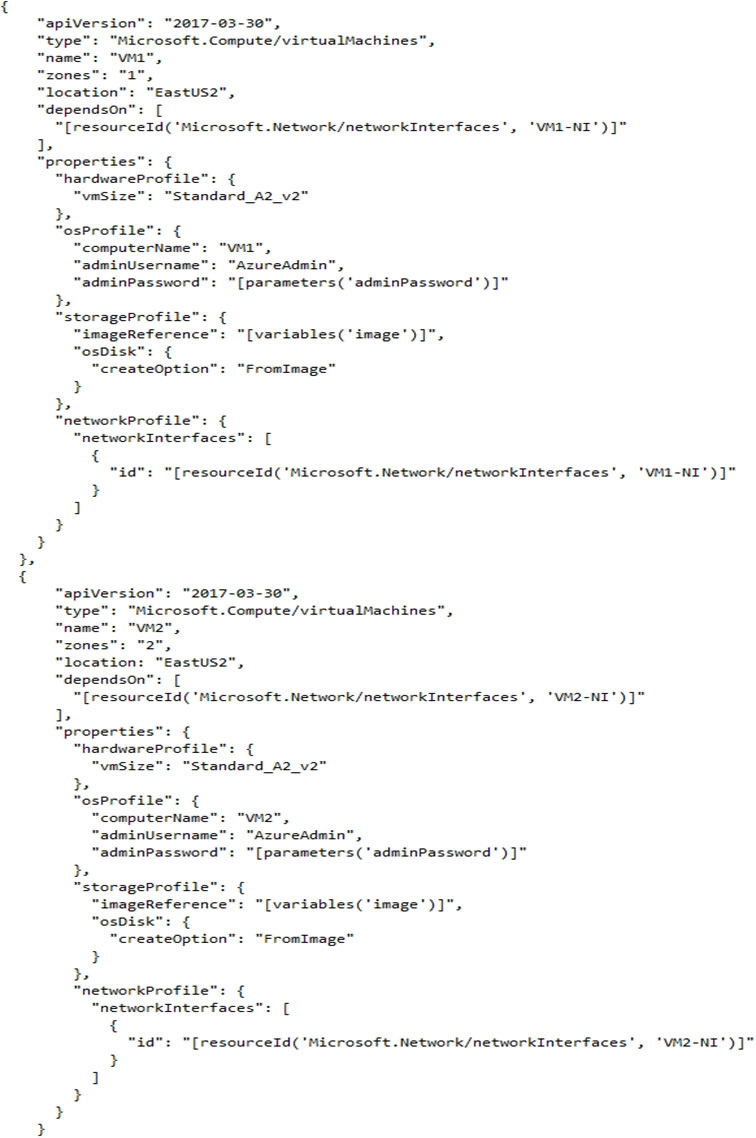 For each of the following statements, select Yes if the statement is true. Otherwise, select No. NOTE: Each correct selection is worth one point. 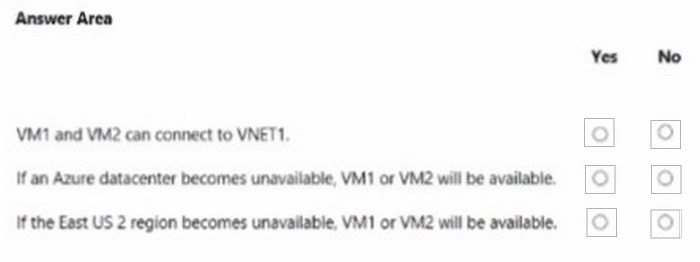 Reveal answer details Close answer details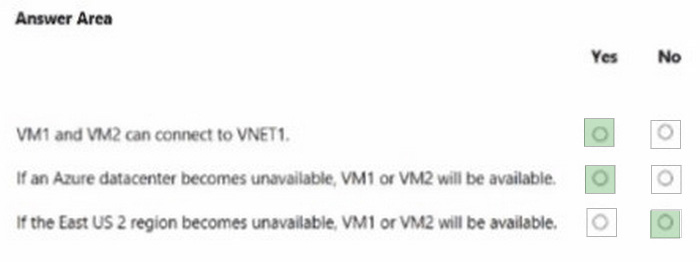 Explanation VM1 and VM2 can connect to VNET1. - Yes Why: AZ-104 Exam Objective Hierarchy (map for this question) 3.0 Deploy and manage Azure compute resources 4.0 Configure and manage virtual networking
Single choice
You have an Azure Active Directory (Azure AD) tenant that contains 5,000 user accounts. You create a new user account named AdminUser1. You need to assign the User administrator administrative role to AdminUser1. What should you do from the user account properties? Reveal answer details Close answer detailsCorrect answerA Explanation From the Directory roles blade, modify the directory role. You need to assign the User Administrator directory role to AdminUser1. In Microsoft Entra ID, directory roles (admin roles) are assigned from Entra ID > Roles & admins (the Directory roles blade) or from the Official-source excerpt (Microsoft Learn): "Browse to Entra ID > Roles & admins ... Select the desired role ... Select Add assignments ..." Why the other options are not correct: From the Groups blade, invite the user account to a new group. From the Licenses blade, assign a new license. Microsoft Exam Tips: Follow least-privilege principles: assign only the admin role required (here, User Administrator). In real environments, prefer Privileged Identity Management (PIM) or role-assignable groups to reduce standing privilege. Summary: AZ-104 Exam Objective Hierarchy:
Single choice
You have an Azure virtual machine named VM1. You use Azure Backup to create a backup of VM1 named Backup1. After creating Backup1, you perform the following changes to VM1: 1. Modify the size of VM1. An administrator uses the Replace existing option to restore VM1 from Backup1. You need to ensure that all the changes to VM1 are restored. Which change should you perform again? Reveal answer details Close answer detailsCorrect answerD Explanation Copy Budget.xls to Data. Using Azure Backup "Replace existing" restores the VM disk content back to the selected restore point. Why other selections are not correct (in the context of what "Replace existing" impacts): Microsoft Exam Tips: - File operations performed after the last backup generally must be re-applied after an in-place disk Summary: AZ-104 Exam Objective Hierarchy:
Single choice
You have an Azure subscription. All users are enabled for multi-factor authentication (MFA). You need to ensure that the users can lock out their own account if they receive an unsolicited MFA request from Azure. Which MFA settings should you configure? Reveal answer details Close answer detailsCorrect answerD Explanation Fraud alert "Fraud alert" (report suspicious activity) enables users to report unexpected MFA prompts and can block/ flag the account depending on configuration. This aligns with the requirement that users can lock out their account when they receive an unsolicited MFA request. Why the other choices are not correct: Microsoft Exam Tips: Summary: AZ-104 Exam Objective Hierarchy:
Multiple choice
You have an Azure subscription that contains a storage account named account1. You plan to upload the disk files of a virtual machine to account1 from your on-premises network. The on-premises network uses a public IP address space of 131.107.1.0/24. You plan to use the disk files to provision an Azure virtual machine named VM1. VM1 will be attached to a virtual network named VNet1. VNet1 uses an IP address space of 192.168.0.0/24. You need to configure account1 to meet the following requirements: 1. Ensure that you can upload the disk files to account1. Which two actions should you perform? Each correct answer presents part of the solution. NOTE: Each correct selection is worth one point. Reveal answer details Close answer detailsCorrect answersA, B Explanation - From the Firewalls and virtual networks blade of account1, add the 131.107.1.0/24 IP address range. You must restrict access to the storage account so that: How the selected actions meet the requirements: - Select Selected networks: - Add the 131.107.1.0/24 IP address range: - VM1 can attach the disks: Why the other options are not correct: - Add VNet1 from the Firewalls and virtual networks blade: - Select Allow trusted Microsoft services to access this storage account: - From the Service endpoints blade of VNet1, add a service endpoint: Exam Tips: Summary: AZ-104 Exam Objective Alignment (Hierarchy) 2.0 Implement and manage storage 2.1 Configure access to storage 2.1.1 Configure Azure Storage firewalls and virtual networks
Single choice
You have an Azure virtual machine named VM1. The network interface for VM1 is configured as shown in the exhibit. (Click the Exhibit tab.) You deploy a web server on VM1, and then created a secure website that is accessible by using the HTTPS protocol. VM1 is used as a web server only. You need to ensure that users can connect to the website from the internet. What should you do? Reveal answer details Close answer detailsCorrect answerD
Single choice
You have an Azure subscription that contains two peered virtual networks named VNet1 and VNet2. You have a Network Virtual Appliance (NVA) named NetVA1. You need to ensure that the traffic from VNet1 to VNet2 is inspected by using NetVA1. What should you use? Reveal answer details Close answer detailsCorrect answerB Explanation a route table that has custom routes To force traffic from VNet1 to VNet2 through a Network Virtual Appliance (NVA), you must override the system routes by using a route table (UDR). You create a custom route for the VNet2 address space and set the next hop type to a **Virtual appliance** (the NVA's IP). This ensures the packet path is steered through NetVA1 for inspection instead of taking the default peering path. Why the other choices are not correct: Microsoft Exam Tips: Summary: AZ-104 Exam Objective Hierarchy:
Single choice
You have an Azure subscription. You are deploying an Azure Kubernetes Service (AKS) cluster that will contain multiple pods. The pods will use kubernet networking. You need to restrict network traffic between the pods. What should you configure on the AKS cluster? Reveal answer details Close answer detailsCorrect answerB Explanation the Calico network policy To restrict pod-to-pod traffic in AKS using kubenet networking, you enable and use Calico network policies. Why other selections are not correct: Microsoft Exam Tips: Summary: AZ-104 Exam Objective Hierarchy:
Single choice
Note: This question is part of a series of questions that present the same scenario. Each question in the series contains a unique solution that might meet the stated goals. Some question sets might have more than one correct solution, while others might not have a correct solution. After you answer a question in this section, you will NOT be able to return to it. As a result, these questions will not appear in the review screen. You need to ensure that an Azure Active Directory (Azure AD) user named Admin1 is assigned the required role to enable Traffic Analytics for an Azure subscription. Solution: You assign the Reader role at the subscription level to Admin1. Does this meet the goal? Reveal answer details Close answer detailsCorrect answerB Explanation No Reader is a read-only role and does not provide the write permissions needed to enable or configure Network Watcher capabilities such as Traffic Analytics. Network Watcher capabilities require roles like Owner, Contributor, or Network Contributor (or a custom role with required actions). :contentReference Why the other selection is not correct: Microsoft Exam Tips: Summary: AZ-104 Exam Objective Hierarchy:
Single choice
You plan to create the Azure web apps shown in the following table. 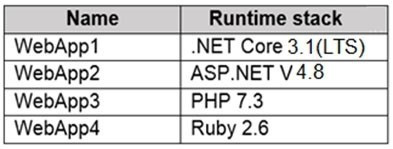 What is the minimum number of App Service plans you should create for the web apps? Reveal answer details Close answer detailsCorrect answerB Explanation App Service plans are OS-specific (Windows vs. Linux). You can run multiple apps with different runtime stacks in the same plan only if they are compatible with the plan's OS and region. Given the table: To minimize plans: - Put the Ruby app in one Linux plan. Why the other selections are incorrect: Microsoft Exam Tips: Summary: AZ-104 Exam Objective Hierarchy:
Single choice
Note: This question is part of a series of questions that present the same scenario. Each question in the series contains a unique solution that might meet the stated goals. Some question sets might have more than one correct solution, while others might not have a correct solution. After you answer a question in this section, you will NOT be able to return to it. As a result, these questions will not appear in the review screen. You have an Azure subscription named Subscription1. Subscription1 contains a resource group named RG1. RG1 contains resources that were deployed by using templates. You need to view the date and time when the resources were created in RG1. Solution: From the RG1 blade, you click Deployments. Does this meet the goal? Reveal answer details Close answer detailsCorrect answerA Explanation Yes - this meets the goal. Why: Why the alternative approach (Subscription > Programmatic deployment) is not the best fit: Microsoft Exam Tips: Summary: AZ-104 Exam Objective Hierarchy: 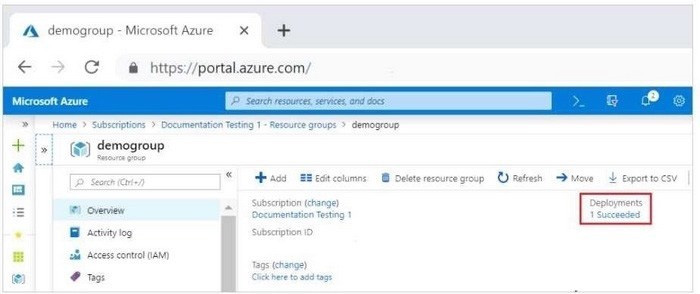 Select one of the deployments from the deployment history. 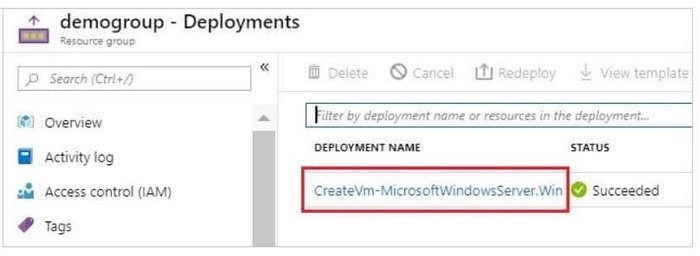 You will see a history of deployment for the resource group, including the correlation ID. 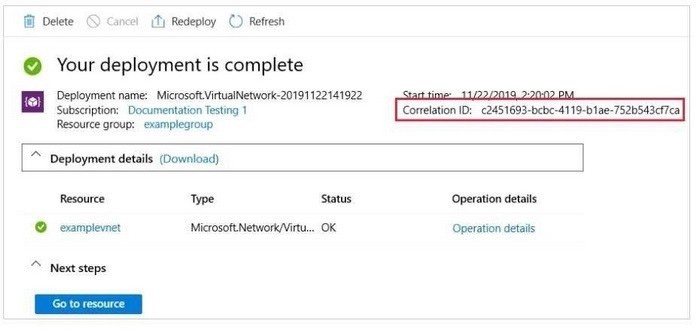
Hotspot
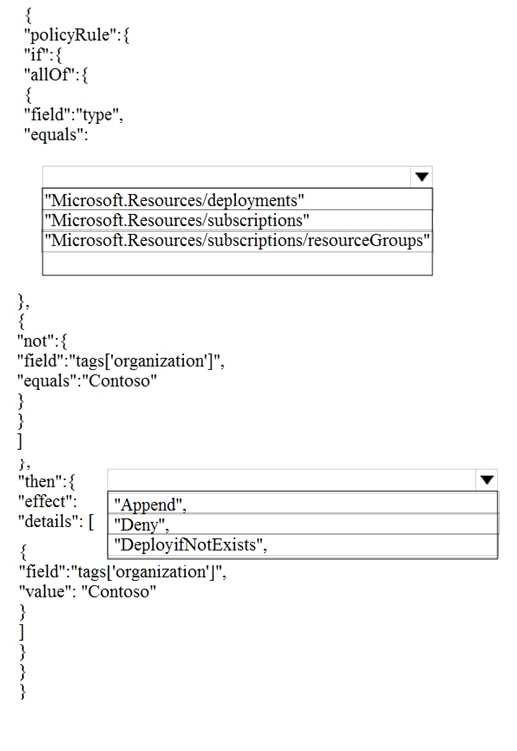
HOTSPOT You have an Azure subscription. You need to implement a custom policy that meet the following requirements: Ensures that each new resource group in the subscription has a tag named organization set to a value of Contoso. How should you complete the policy? To answer, select the appropriate options in the answers area.
Reveal answer details Close answer details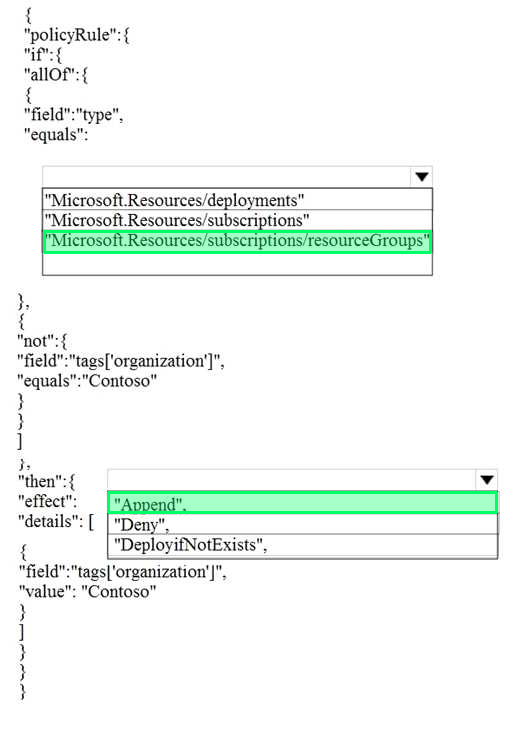 Explanation Resource type: Microsoft.Resources/subscriptions/resourceGroups Why this is correct: Why the other options are incorrect: Exam Tips: AZ-104 Exam Objective Hierarchy
Single choice
Note: This question is part of a series of questions that present the same scenario. Each question in the series contains a unique solution that might meet the stated goals. Some question sets might have more than one correct solution, while others might not have a correct solution. After you answer a question in this section, you will NOT be able to return to it. As a result, these questions will not appear in the review screen. You deploy an Azure Kubernetes Service (AKS) cluster named AKS1. You need to deploy a YAML file to AKS1. Solution: From Azure CLI, you run azcopy. Does this meet the goal? Reveal answer details Close answer detailsCorrect answerB Explanation No AzCopy is a command-line utility for transferring data to/from Azure Storage (blobs/files). It is not used for deploying Kubernetes YAML manifests to an AKS cluster. Therefore, running azcopy does not meet the goal of deploying a YAML file to AKS. Why the alternative is not correct: Microsoft Exam Tips: Summary: AZ-104 Exam Objective Hierarchy:
Hotspot
HOTSPOT You have an Azure subscription that contains the resources shown in the following table.  VMSS1 is set to VM (virtual machines) orchestration mode. You need to deploy a new Azure virtual machine named VM1, and then add VM1 to VMSS1. Which resource group and location should you use to deploy VM1? To answer, select the appropriate options in the answer area. NOTE: Each correct selection is worth one point. 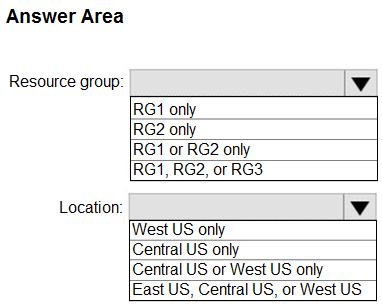 Reveal answer details Close answer details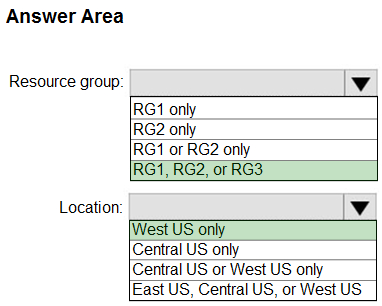 Explanation Resource group: RG1, RG2, or RG3 Why this is correct: Why the other options are incorrect: Exam Tips: Summary: AZ-104 Exam Objective Hierarchy:
Hotspot
HOTSPOT You have an Azure subscription named Sub1 that contains the resources shown in the following table. 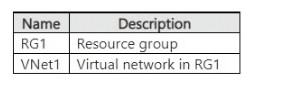 The subscription contains the users shown in the following table. 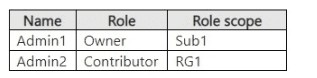 You have the following Bicep file named Deploy.bicep. 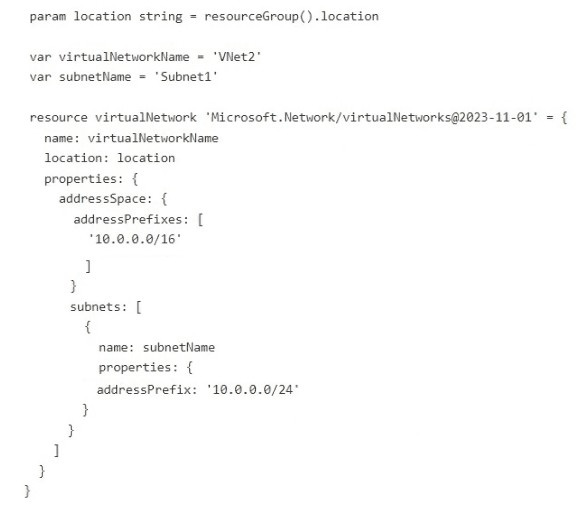 You run the following command.  For each of the following statements, select Yes if the statement is true. Otherwise, select No. NOTE: Each correct selection is worth one point. 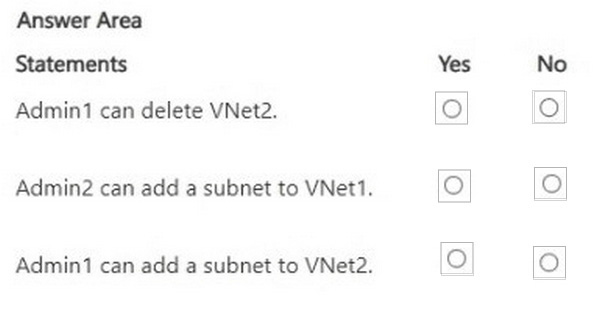 Reveal answer details Close answer details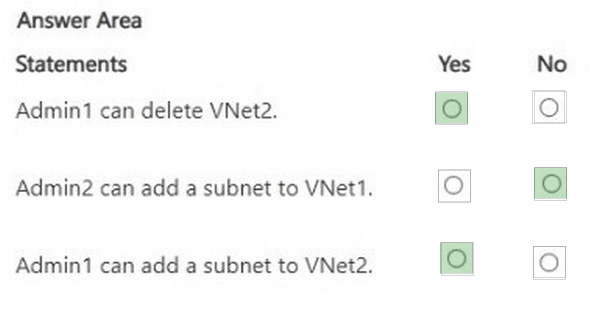 Explanation Admin1 can delete VNet2. - Yes Admin2 can add a subnet to VNet1. - No Why: AZ-104 Exam Objective Hierarchy (map for this question) 1.0 Manage Azure identities and governance 1.2 Manage access to Azure resources 1.2.1 Manage built-in Azure roles 1.2.2 Assign roles at different scopes 1.3 Manage Azure subscriptions and governance
Single choice
You have an Azure virtual network named VNet1 that contains the following settings: 1. IPv4 address space: 172.16.10.0/24 3. Subnet address range: 172.16.10.0/25 What is the maximum number of virtual machines that can connect to Subnet1? Reveal answer details Close answer detailsCorrect answerC Explanation A /25 subnet has 128 total IPv4 addresses. Azure reserves 5 addresses in every subnet (first 4 and last 1). 128 - 5 = 123 usable IP addresses (and thus up to 123 VM NIC private IPs, assuming one IP per VM NIC). Why other selections are not correct: Microsoft Exam Tips: Summary: AZ-104 Exam Objective Hierarchy: Case study Case Study 2Humongous Insurance Overview Existing Environment Active Directory Environment Network Infrastructure Active Directory Issue Licensing Issue Requirements Planned Azure AD Infrastructure Planned Azure Networking Infrastructure You plan to enable peering between Paris-VNet and AllOffices-VNet. You will enable the Use remote gateways setting for the Paris-VNet peerings. Planned Azure Computer Infrastructure Department Requirements -During the testing phase, auditors in the finance department must be able to review all Azure costs from the past week. Authentication Requirements
Testlet 2
Single choice
Which blade should you instruct the finance department auditors to use? Reveal answer details Close answer detailsCorrect answerC Explanation Cost analysis: Correct Option In cost analysis blade of Azure, you can see all the detail for custom time span. You can use this to determine expenditure of last few day, weeks, and month. Below options are available in Cost analysis blade for filtering information by time span: last 7 days , last 30 days, and custom date range. Choosing the first option (last 7 days) auditors can view the costs by time span. Cost analysis shows data for the current month by default. Use the date selector to switch to common date ranges quickly. Examples include the last seven days, the last month, the current year, or a custom date range. Pay-as-you-go subscriptions also include date ranges based on your billing period, which isn't bound to the calendar month, like the current billing period or last invoice. Use the <PREVIOUS and 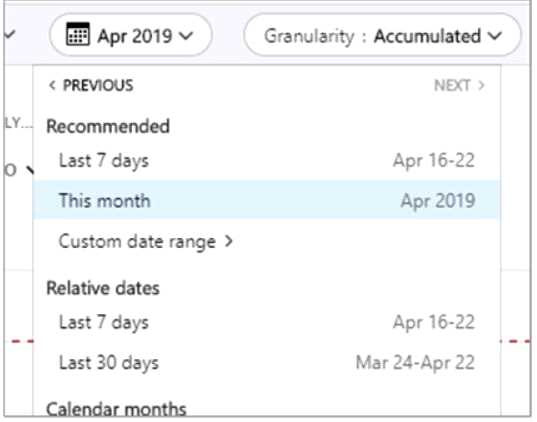 Invoice: Incorrect Option Invoices can only be used for past billing periods not for current billing period, i.e. if your requirement is to know the last week's cost then that also not filled by invoices because Azure generates invoice at the end of the month. Even though Invoices have custom timespan, but when you put in dates for a week, the pane would be empty. 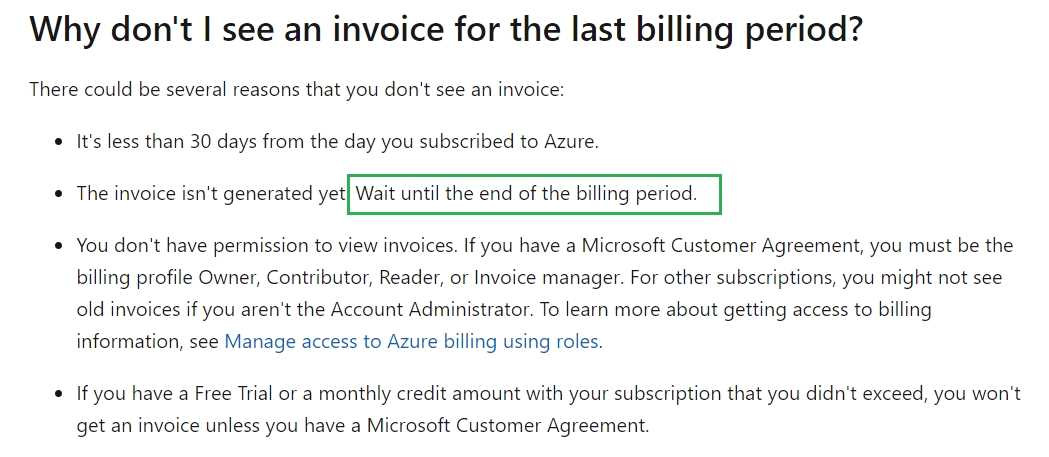 Resource Provider: Incorrect Option When deploying resources, you frequently need to retrieve information about the resource providers and types. For example, if you want to store keys and secrets, you work with the Microsoft.KeyVault resource provider. This resource provider offers a resource type called vaults for creating the key vault. This is not useful for reviewing all Azure costs from the past week which is required for audit. Payment method: Incorrect Option Payment methods is not useful for reviewing all Azure costs from the past week which is required for audit. References:
Single choice
You have an Azure subscription that contains an Azure container registry named ContReg1. You enable the Admin user for ContReg1. Which username can you use to sign in to ContReg1? Reveal answer details Close answer detailsCorrect answerD Explanation ContReg1 When the Admin user is enabled on an Azure Container Registry (ACR), the registry provides admin credentials where the username is the registry name. Therefore, the username used to sign in is ContReg1. Why the other options are not correct: Microsoft Exam Tips: Summary: AZ-104 Exam Objective Hierarchy:
Single choice
You have an Azure virtual machine named VM1. The network interface for VM1 is configured as shown in the exhibit. (Click the Exhibit tab.) 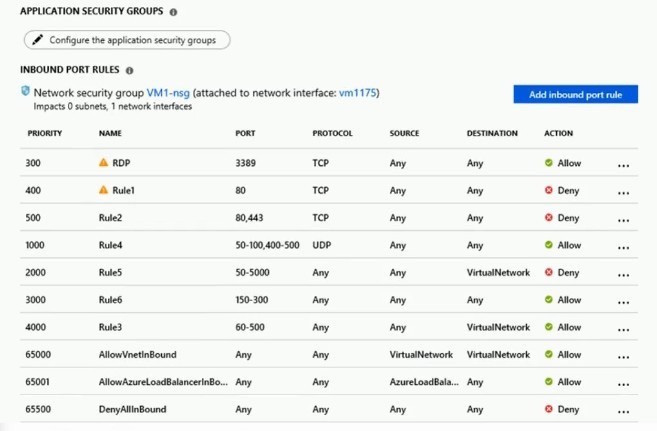 You deploy a web server on VM1, and then create a secure website that is accessible by using the HTTPS protocol VM1 is used as a web server only. You need to ensure that users can connect to the website from the Internet. What should you do? Reveal answer details Close answer detailsCorrect answerA Explanation Change the priority of Rule3 to 450. Goal: Allow inbound HTTPS (TCP/443) from the Internet to VM1. From the exhibit: There is a deny rule at priority 500 for TCP ports 80 and 443 (this blocks HTTPS). Rule3 is an allow rule for ports 6000-7000 with protocol Any, source Any, destination VirtualNetwork, currently at priority 4000. NSG evaluation is priority-based: lower numbers are evaluated first, and once a match occurs, processing stops. If Rule3 is moved to priority 450: It will be evaluated before the deny rule at priority 500. TCP/443 matches Rule3 (443 is within 6000-7000; protocol Any includes TCP; source Any includes Destination VirtualNetwork matches the VM's private IP because VirtualNetwork represents the virtual network address space (and related connected address spaces). Therefore, HTTPS (TCP/443) will be allowed before the deny rule at 500 can block it, meeting the goal. Why the other options do not meet the goal: Changing the priority of Rule6 to 100 will not help because Rule6 only covers ports 15000-16000, which does not include 443. Deleting the TCP 80 deny rule does not remove the TCP 443 deny rule at priority 500, so HTTPS remains blocked. Creating a new allow rule at priority 501 would still be evaluated after the deny rule at 500, so it would not take effect. Least-privilege note (why this is better than allowing Rule5): Another available option would effectively allow a much larger port range (50000-60000). Changing Rule3 is the narrower change (6000-7000) and reduces the incremental attack surface compared to allowing thousands of ports. Microsoft Exam Tips: Summary: AZ-104 Exam Objective Hierarchy:
Single choice
You have an Azure subscription named Subscription1 that contains a virtual network named VNet1. VNet1 is in a resource group named RG1. Subscription1 has a user named User1. User1 has the following roles: 1. Reader You need to ensure that User1 can assign the Reader role for VNet1 to other users. What should you do? Reveal answer details Close answer detailsCorrect answerC Explanation Assign User1 the Owner role for VNet1. Assigning Azure RBAC roles requires permission to create role assignments at the target scope (Microsoft.Authorization/roleAssignments/write). The Owner role includes full management permissions for resources at scope, including the ability to assign roles. Therefore, giving User1 the Owner role on the VNet1 resource enables User1 to assign the Reader role for VNet1 to other users. Other existing roles listed (Reader, Security Admin, Security Reader) do not grant permission to assign Azure RBAC roles for Azure resources. In practice, assign User Access Administrator at the VNet1 scope to allow role assignment with fewer permissions than Owner. Microsoft Exam Tips: Summary: AZ-104 Exam Objective Hierarchy:
Single choice
Your company has a main office in London that contains 100 client computers. Three years ago, you migrated to Azure Active Directory (Azure AD). The company's security policy states that all personal devices and corporate-owned devices must be registered or joined to Azure AD. A remote user named User1 is unable to join a personal device to Azure AD from a home network. You verify that User1 was able to join devices to Azure AD in the past. You need to ensure that User1 can join the device to Azure AD. What should you do? Reveal answer details Close answer detailsCorrect answerB Explanation From the Device settings blade, modify the Maximum number of devices per user setting. User1 was able to join devices in the past but cannot now. A common cause is hitting the device quota (maximum number of Microsoft Entra joined/registered devices per user). When a user reaches this limit, they can't add more devices until devices are removed or the limit is increased. Updating Maximum number of devices per user directly addresses that failure mode. Why other selections are incorrect: Microsoft Exam Tips: Summary: AZ-104 Exam Objective Hierarchy:
Single choice
You have a Recovery Services vault named RSV1. RSV1 has a backup policy that retains instant snapshots for five days and daily backup for 14 days. RSV1 performs daily backups of VM1. VM1 hosts a static website that was updated eight days ago. You need to recover VM1 to a point eight days ago. The solution must minimize downtime. What should you do first? Reveal answer details Close answer detailsCorrect answerB Explanation Restore VM1 by using the Replace existing restore configuration option. To recover VM1 to a point eight days ago, you restore from an available recovery point in the Recovery Services vault. Using Replace existing restores the backed-up VM disks back onto the existing VM (in-place restore), returning the VM to the selected point in time. Why other selections are not correct: Microsoft Exam Tips: Summary: AZ-104 Exam Objective Hierarchy:
Hotspot
HOTSPOT You have Azure virtual machines that run Windows Server 2019 and are configured as shown in the following table.  You create a private Azure DNS zone named adatum.com. You configure the adatum.com zone to allow auto registration from VNET1. Which A records will be added to the adatum.com zone for each virtual machine? To answer, select the appropriate options in the answer area. NOTE: Each correct selection is worth one point. 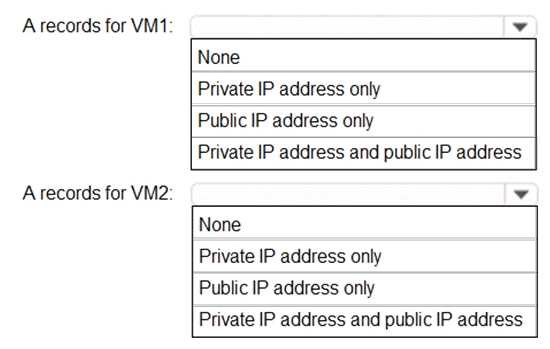 Reveal answer details Close answer details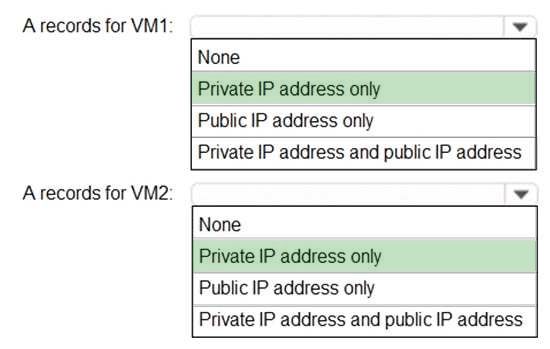 Explanation Box 1: A records for VM1: Private IP address only You configured a private Azure DNS zone (adatum.com) and enabled auto-registration from VNET1. Why the other options are not correct: Microsoft Exam Tips: Summary: AZ-104 Exam Objective Hierarchy:
Single choice
You have an Azure subscription that contains the virtual networks shown in the following table. 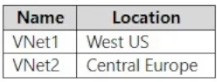 You need to ensure that all the traffic between VNet1 and VNet2 traverses the Microsoft backbone network. What should you configure? Reveal answer details Close answer detailsCorrect answerB Explanation peering To ensure traffic between two Azure virtual networks stays on the Microsoft backbone (and not the public internet), you configure virtual network peering. VNet peering enables private connectivity between Why the other options are not correct: Microsoft Exam Tips: Summary: AZ-104 Exam Objective Hierarchy:
Hotspot
HOTSPOT You have an Azure subscription that contains an Azure Backup vault named Backup1, a Recovery Services vault named Recovery1, and the resources shown in the following table. 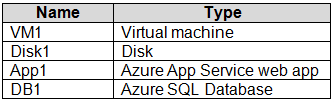 You plan to back up the resources. Which resource can be backed up to Backup1, and which resource can be backed up to Recovery1? To answer, select the appropriate options in the answer area. NOTE: Each correct selection is worth one point. 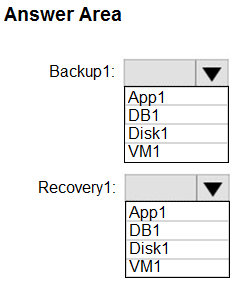 Reveal answer details Close answer details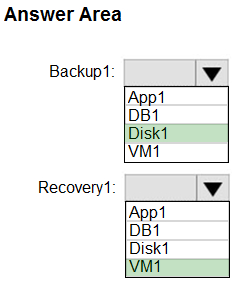 Explanation Backup1 (Backup vault): Disk1 A Backup vault is used for newer Azure Backup scenarios such as Azure Disk Backup (and other modern workloads supported by Backup vaults). 5.0 Monitor and maintain Azure resources (10-15%) 5.2 Implement backup and recovery 5.2.1 Create a Recovery Services vault 5.2.3 Create and configure a backup policy 5.2.4 Perform backup and restore operations by using Azure Backup
Single choice
You have an Azure App Service app named App1 that contains two running instances. You have an autoscale rule configured as shown in the following exhibit. 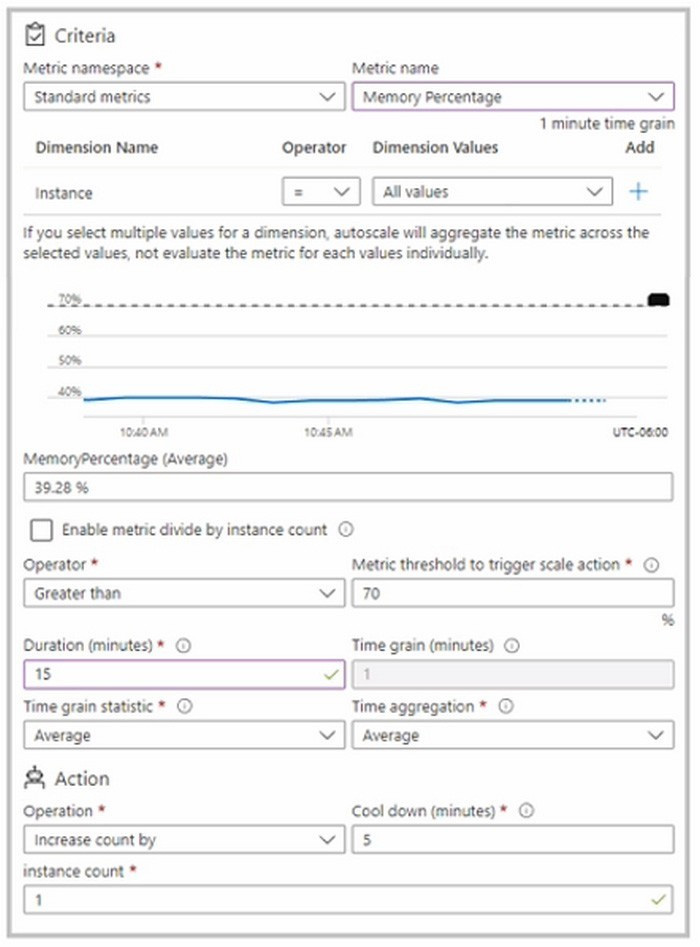 For the Instance limits scale condition setting, you set Maximum to 5. During a 30-minute period, App1 uses 80 percent of the available memory. What is the maximum number of instances for App1 during the 30-minute period? Reveal answer details Close answer detailsCorrect answerD Explanation The autoscale rule scales out by 1 when the memory threshold is exceeded for the configured evaluation window, and it can continue scaling out after cooldown until it hits the instance maximum. Since the maximum is set to 5 and the memory condition remains high for the entire 30-minute period, autoscale can increase the instance count up to the configured maximum. Why the other choices are not correct: Microsoft Exam Tips: Summary: AZ-104 Exam Objective Hierarchy:
Single choice
You have an Azure subscription that contains a virtual machine named VM1. You plan to deploy an Azure Monitor alert rule that will trigger an alert when CPU usage on VM1 exceeds You need to ensure that the alert rule sends an email message to two users named User1 and User2. What should you create for Azure Monitor? Reveal answer details Close answer detailsCorrect answerA Explanation an action group To ensure a metric alert sends email to specific users, Azure Monitor uses an action group as the notification/action target. You configure the alert rule to use the action group, and the action group contains the email receivers (User1 and User2). Why other selections are not correct: Microsoft Exam Tips: Summary: AZ-104 Exam Objective Hierarchy:
Single choice
You have an Azure subscription named Subscription1 that contains an Azure virtual network named VM1. VM1 is in a resource group named RG1. VM1 runs services that will be used to deploy resources to RG1. You need to ensure that a service running on VM1 can manage the resources in RG1 by using the identity of VM1. What should you do first? Reveal answer details Close answer detailsCorrect answerC Explanation From the Azure portal, modify the value of the Managed Service Identity option for VM1. You need a service running on VM1 to manage resources in RG1 using VM1's identity. The "identity of the VM" in Azure for this purpose is a managed identity (system-assigned managed identity). Why the correct selection is correct: Why the other selections are incorrect: Microsoft Exam Tips: Summary: AZ-104 Exam Objective Hierarchy:
Single choice
You have an Azure subscription that contains 10 network security groups (NSGs), 10 virtual machines, and a Log Analytics workspace named Workspace1. Each NSG is connected to a virtual machine. You need to configure an Azure Monitor Network Insights alert that will be triggered when suspicious network traffic is detected. What should you do first? Reveal answer details Close answer detailsCorrect answerD Explanation Configure NSG flow logs Azure Monitor Network Insights detections for suspicious network traffic rely on visibility into network flows. Why other selections are not correct: Microsoft Exam Tips: Summary: AZ-104 Exam Objective Hierarchy: 5.1.6 Use Azure Network Watcher and Connection Monitor
Single choice
You have an Azure subscription that contains a virtual machine named VM1 and an Azure key vault named KV1. You need to configure encryption for VM1. The solution must meet the following requirements: 1. Store and use the encryption key in KV1. Which encryption method should you use? Reveal answer details Close answer detailsCorrect answerC Explanation Azure Disk Encryption Azure Disk Encryption (ADE) uses BitLocker/DM-Crypt at the VM (guest) level and integrates with Azure Why the other options are not correct: Microsoft Exam Tips: Summary: AZ-104 Exam Objective Hierarchy:
Hotspot
HOTSPOT You have an Azure Storage account named storage1. You have an Azure Service app named App1 and an app named App2 that runs in an Azure container instance. Each app uses a managed identity. You need to ensure that App1 and App2 can read blobs from storage1. The solution must meet the following requirements: 1. Minimize the number of secrets used. What should you configure in storage1 for each app? To answer, select the appropriate options in the answer area. NOTE: Each correct selection is worth one point.
Reveal answer details Close answer details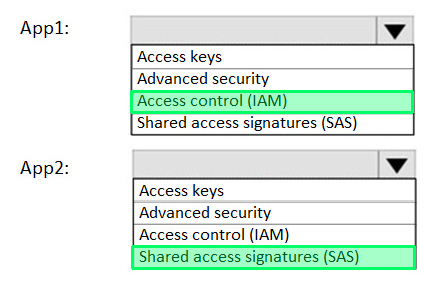 Explanation App1: Access control (IAM) Why this is correct: Exam Tips: AZ-104 Exam Objective Hierarchy 2.1.2 Create and use shared access signatures (SAS)
Single choice
You have an Azure subscription that contains the resources shown in the following table.  The Not allowed resource types Azure policy is assigned to RG1 and uses the following parameters: 1. Microsoft.Network/virtualNetworks In RG1, you need to create a new virtual machine named VM2, and then connect VM2 to VNET1. What should you do first? Reveal answer details Close answer detailsCorrect answerC Explanation Remove Microsoft.Compute/virtualMachines from the policy. The policy blocks creation of both virtual networks and virtual machines in RG1. You already have VNET1, and you need to create VM2 and connect it to VNET1. Therefore, the first step is to allow VM creation by removing Microsoft.Compute/virtualMachines from the "not allowed resource types" policy assignment/ parameters. You do not need to allow new VNets. Why the other selections are not correct: Microsoft Exam Tips: Summary: AZ-104 Exam Objective Hierarchy:
Single choice
You have a general-purpose v1 Azure Storage account named storage1 that uses locally-redundant storage (LRS). You need to ensure that the data in the storage account is protected if a zone fails. The solution must minimize costs and administrative effort. What should you do first? Reveal answer details Close answer detailsCorrect answerC Explanation Upgrade the account to general-purpose v2. You have a general-purpose v1 storage account using LRS. Requirement: protect data if a zone fails, To use zone-redundant patterns (for example, ZRS where supported), you commonly need the account to be StorageV2 (general-purpose v2). The correct first step is to upgrade to general-purpose v2, and then (as a follow-on step) adjust replication to a zone-redundant option if available/appropriate. Why the other options are not correct: Microsoft Exam Tips: Summary: AZ-104 Exam Objective Hierarchy:
Hotspot
HOTSPOT You have an Azure subscription that contains the hierarchy shown in the following exhibit. 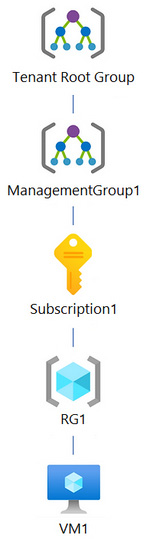 You create an Azure Policy definition named Policy1. To which Azure resources can you assign Policy and which Azure resources can you specify as exclusions from Policy1? To answer, select the appropriate options in the answer NOTE Each correct selection is worth one point.
Reveal answer details Close answer details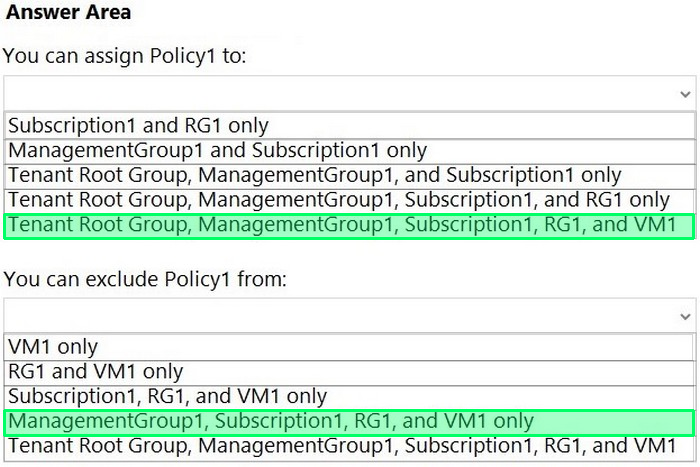 Explanation Assign Policy1 to: Tenant Root Group, ManagementGroup1, Subscription1, RG1, and VM1 only Exclude Policy1 from: ManagementGroup1, Subscription1, RG1, and VM1 only Why this is correct: Why the other options are not correct: Exam Tips: AZ-104 Exam Objective Hierarchy 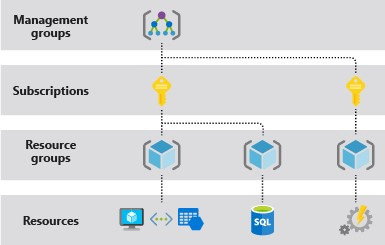 Box 2: ManagementGroup1, Subscription1, RG1, and VM1 References:
Single choice
You plan to deploy a public Standard Load Balancer in Azure. Which public IP address SKU must you use for the load balancer frontend? Reveal answer details Close answer detailsCorrect answerB Explanation Standard SKU public IP address A public Standard Load Balancer frontend requires a Standard SKU public IP address. This is the supported and expected pairing for Standard SKU load balancing. Why other selections are not correct: Microsoft Exam Tips: Summary: AZ-104 Exam Objective Hierarchy: 4.3.2 Configure an internal or public load balancer
Hotspot
HOTSPOT You have an Azure Active Directory (Azure AD) tenant named adatum.com. Adatum.com contains the groups in the following table. 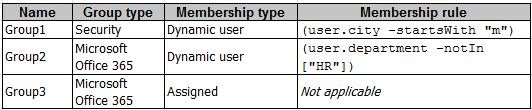 You create two user accounts that are configured as shown in the following table.  To which groups do User1 and User2 belong? To answer. select the appropriate options in the answer area. NOTE: Each correct selection is worth one point.
Reveal answer details Close answer details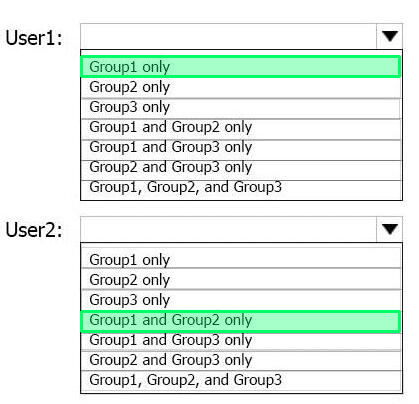 Explanation User1: Group1 only Why: Group1 (Security | Dynamic user) Group2 (Microsoft 365 | Dynamic user) Group3 (Microsoft 365 | Assigned) Why the other answer choices are incorrect: Microsoft Exam Tips: Summary: AZ-104 Exam Objective Hierarchy:
Single choice
Note: This question is part of a series of questions that present the same scenario. Each question in the series contains a unique solution that might meet the stated goals. Some question sets might have more than one correct solution, while others might not have a correct solution. After you answer a question in this section, you will NOT be able to return to it. As a result, these questions will not appear in the review screen. You have an Azure virtual machine named VM1. VM1 was deployed by using a custom Azure Resource Manager template named ARM1.json. You receive a notification that VM1 will be affected by maintenance. You need to move VM1 to a different host immediately. Solution: From the VM1 Redeploy + reapply blade, you select Redeploy. Does this meet the goal? Reveal answer details Close answer detailsCorrect answerA Explanation Yes Selecting **Redeploy** for a VM forces Azure to shut down the VM and move it to a new node, which satisfies the requirement to move the VM to a different host immediately. Microsoft Exam Tips: Summary: AZ-104 Exam Objectives: 3.0 Deploy and manage Azure compute resources 3.2 Create and configure virtual machines 3.2.3 Move a virtual machine to another resource group, subscription, or region
Hotspot
HOTSPOT Your network contains an Active Directory domain named adatum.com and an Azure Active Directory Adatum.com contains the user accounts in the following table. 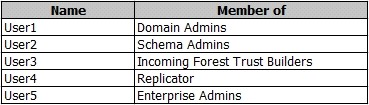 Adatum.onmicrosoft.com contains the user accounts in the following table. 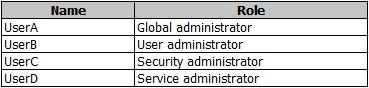 You need to implement Azure AD Connect. The solution must follow the principle of least privilege. Which user accounts should you use? To answer, select the appropriate options in the answer area. NOTE: Each correct selection is worth one point. 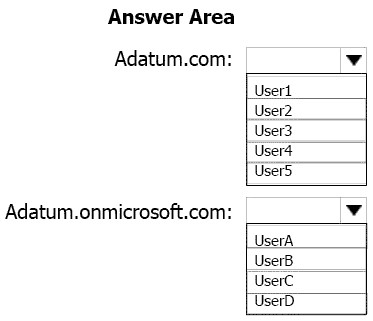 Reveal answer details Close answer details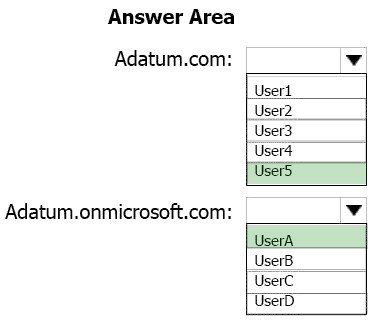 Explanation adatum.com account: User5 Why this is correct: Why the other options are incorrect: Exam Tips: AZ-104 Exam Objective Hierarchy
Hotspot
HOTSPOT You need to create a bar chart that shows the number of distinct computers that have sent heartbeats each week. How should you complete the Log Analytics query? To answer, select the appropriate options in the answer area. NOTE; Each correct selection is worth one
Reveal answer details Close answer details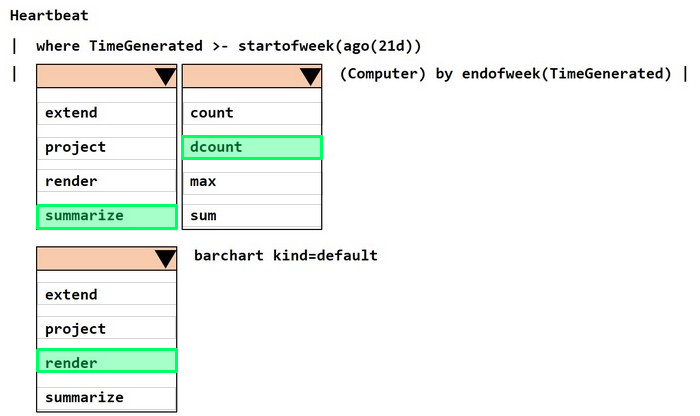 Explanation Operator (aggregation): summarize Why this is correct: Why the other options are incorrect: Exam Tips: Summary: AZ-104 Exam Objective Hierarchy:
Single choice
You create an Azure VM named VM1 that runs Windows Server 2019. VM1 is configured as shown in the exhibit. (Click the Exhibit tab.) 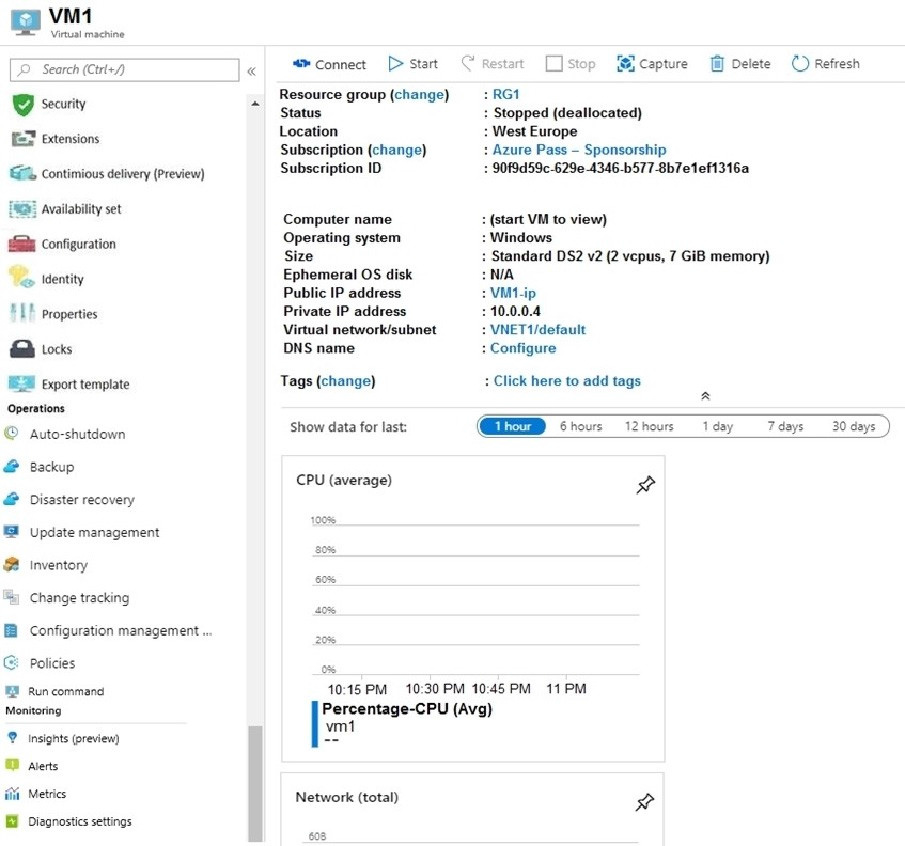 You need to enable Desired State Configuration for VM1. What should you do first? Reveal answer details Close answer detailsCorrect answerB Explanation Start VM1. VM1 is currently in a Stopped (deallocated) state. Enabling Desired State Configuration (DSC) for an Azure VM relies on the VM's guest agent/extension mechanism to install and run the DSC components. 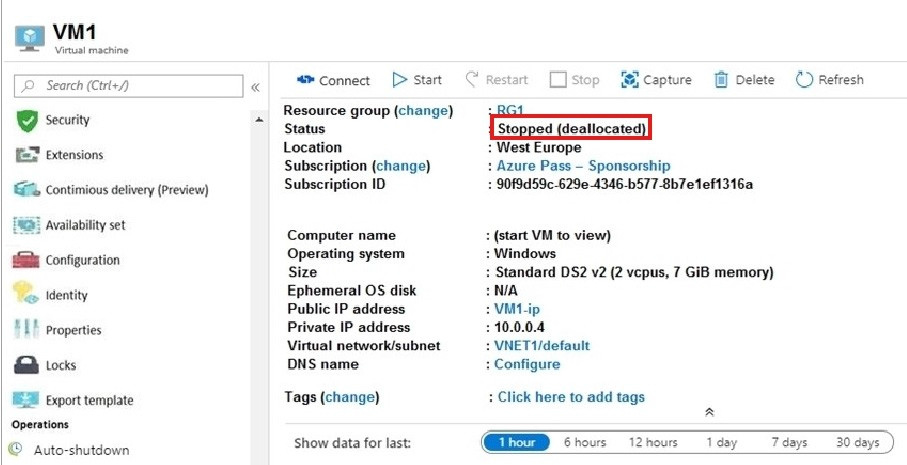 Exam Tips: Summary: Exam Objective Alignment (Hierarchy)
Single choice
Note: This question is part of a series of questions that present the same scenario. Each question in the series contains a unique solution that might meet the stated goals. Some question sets might have more than one correct solution, while others might not have a correct solution. After you answer a question in this section, you will NOT be able to return to it. As a result, these questions will not appear in the review screen. You have an Azure container registry named Registry1 that contains an image named image1. You receive an error message when you attempt to deploy a container instance by using image1. You need to be able to deploy a container instance by using image1. Solution: You select Use dedicated data endpoint for Registry1. Does this meet the goal? Reveal answer details Close answer detailsCorrect answerB Explanation No Selecting "Use dedicated data endpoint" for an Azure Container Registry does not address the root requirement for Azure Container Instances (ACI) to successfully pull an image from the registry. Dedicated data endpoints are a networking/configuration option for registry data-plane access patterns, but they do not, by themselves, provide ACI with valid authentication/authorization to pull images. To deploy a container instance from an ACR image, you must ensure the container group has permission to pull from the registry (for example, by providing credentials or using an identity with pull permissions). Microsoft Exam Tips: Summary: AZ-104 Exam Objective Hierarchy:
Single choice
Note: The question is included in a number of questions that depicts the identical set-up. However, every question has a distinctive result. Establish if the solution satisfies the requirements. Your company has an azure subscription that includes a storage account, a resource group, a blob container and a file share. A colleague named Jon Ross makes use of a solitary Azure Resource Manager (ARM) template to deploy a virtual machine and an additional Azure Storage account. You want to review the ARM template that was used by Jon Ross. Solution: You access the Virtual Machine blade. Does the solution meet the goal? Reveal answer details Close answer detailsCorrect answerB Explanation No To review the ARM template used for a deployment in Azure, you typically access the deployment history and export/view the template from the deployment (commonly from the resource group's deployments area, or via the export template workflow). Accessing the Virtual Machine blade is not the correct place to retrieve the ARM template that was used in a resource group deployment. Therefore, this solution does not meet the goal. Microsoft Exam Tips: Summary: AZ-104 Exam Objective Hierarchy:
Multiple choice
You are deploying a containerized web application in Azure. When deploying the web app, which of the following are valid container image sources? Reveal answer details Close answer detailsCorrect answersB, C Explanation Docker hub For Azure App Service custom containers, common supported registry sources include Docker Hub and Azure Container Registry (ACR). These are explicitly called out as primary registry options in App Service container deployment guidance. Why the other options are not correct: Microsoft Exam Tips: - AZ-104: For App Service containers, expect "Docker Hub" and "ACR" as canonical image sources. Summary: AZ-104 Exam Objective Hierarchy:
Single choice
Note: This question is part of a series of questions that present the same scenario. Each question in the series contains a unique solution that might meet the stated goals. Some question sets might have more than one correct solution, while others might not have a correct solution. After you answer a question in this section, you will NOT be able to return to it. As a result, these questions will not appear in the review screen. You have an Azure subscription that contains 10 virtual networks. The virtual networks are hosted in separate resource groups. Another administrator plans to create several network security groups (NSGs) in the subscription. You need to ensure that when an NSG is created, it automatically blocks TCP port 8080 between the virtual networks. Solution: You assign a built-in policy definition to the subscription. Does this meet the goal? Reveal answer details Close answer detailsCorrect answerB Explanation No The proposed solution is too vague to guarantee the outcome. Simply "assign a built-in policy definition" does not inherently ensure that all new NSGs will include a deny rule for TCP/8080 between VNets-unless a specific built-in policy exists that enforces exactly that rule. In practice, implementing a very specific security rule requirement often requires a custom policy definition (or verifying that a suitable built-in definition exists and matches the intended rule logic). Without that specificity, the goal is not assured. Microsoft Exam Tips: Summary: AZ-104 Exam Objective Hierarchy:
Hotspot
HOTSPOT You plan to deploy an Azure container instance by using the following Azure Resource Manager template. 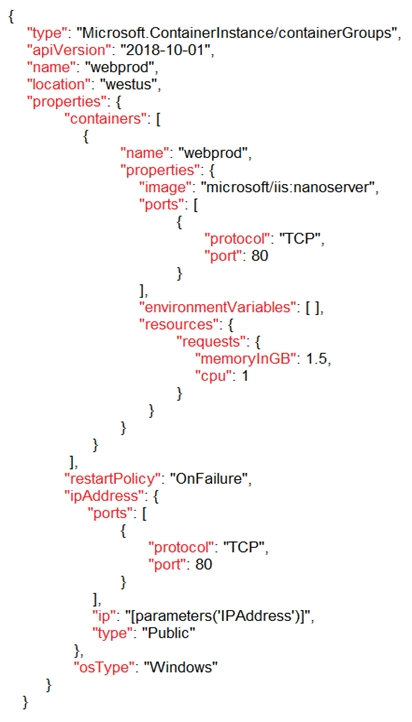 Use the drop-down menus to select the answer choice that completes each statement based on the information presented in the template.
Reveal answer details Close answer details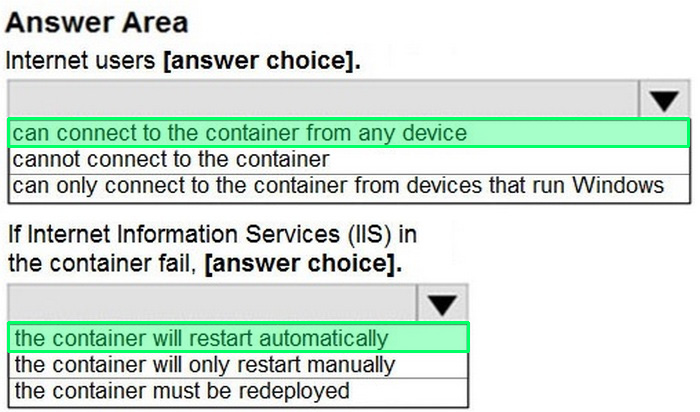 Explanation Internet users: can connect to the container from any device From the ARM template: - restartPolicy = "OnFailure" So: Microsoft Exam Tips: Summary: AZ-104 Exam Objective Hierarchy:
Hotspot
HOTSPOT You have an Azure subscription. You plan to deploy a storage account named storage1 by using the following Azure Resource Manager (ARM) template. 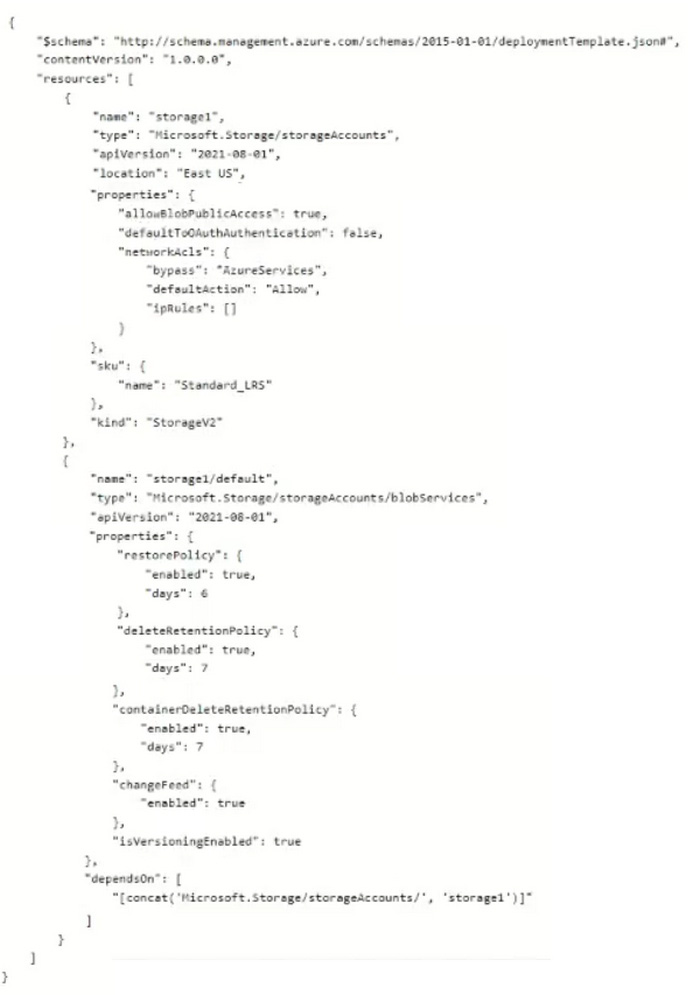 For each of the following statements, select Yes if the statement is hue. Otherwise, select No. NOTE: Each correct selection is worth one point. 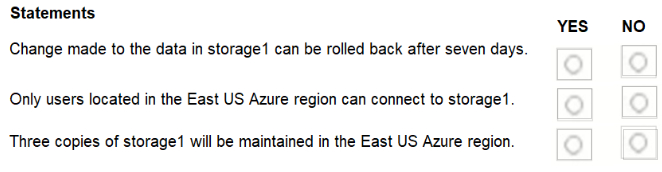 Reveal answer details Close answer details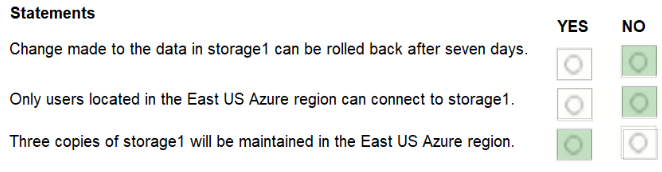 Explanation Change made to the data in storage1 can be rolled back after seven days: No Why this is correct: Why the other options are incorrect: Exam Tips: AZ-104 Exam Objective Hierarchy: |