You are hosting an application from Compute Engine virtual machines (VMs) in us-central1-a. You want to adjust your design to support the failure of a single Compute Engine zone, eliminate downtime, and minimize cost. What should you do?
-
A
- Create Compute Engine resources in us-central1-b.
- Balance the load across both us-central1-a and us-central1-b.
-
B
- Create a Managed Instance Group and specify us-central1-a as the zone.
- Configure the Health Check with a short Health Interval.
-
C
- Create an HTTP(S) Load Balancer.
- Create one or more global forwarding rules to direct traffic to your VMs.
-
D
- Perform regular backups of your application.
- Create a Cloud Monitoring Alert and be notified if your application becomes unavailable.
- Restore from backups when notified.
Reveal answer details
Close answer details
Correct answerA
ExplanationResources confined to us-central1-a cannot continue serving if that zone fails. Create Compute Engine resources in us-central1-b and balance traffic across both zones, so the second zone can serve requests when the first is unavailable. This adds only the zonal redundancy required for a single-zone failure, avoiding the cost and complexity of a broader disaster-recovery design.
You are building an application that stores relational data from users. Users across the globe will use this application. Your CTO is concerned about the scaling requirements because the size of the user base is unknown. You need to implement a database solution that can scale with your user growth with minimum configuration changes. Which storage solution should you use?
-
A
-
B
-
C
-
D
Reveal answer details
Close answer details
Correct answerB
ExplanationCloud Spanner provides a relational database model while addressing growth across a global user base. Its design supports scaling the database as demand increases without requiring the application to move from a conventional relational model to a document or key-value model. That combination matches both the relational-data requirement and the unknown worldwide scaling requirement.
Your customer has implemented a solution that uses Cloud Spanner and notices some read latency-related performance issues on one table. This table is accessed only by their users using a primary key.
The table schema is shown below. 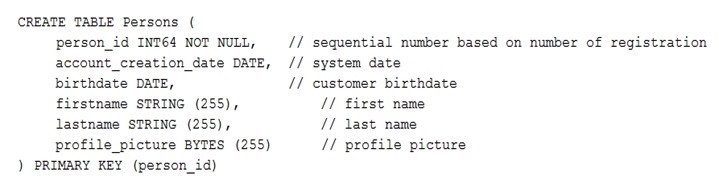 You want to resolve the issue. What should you do? 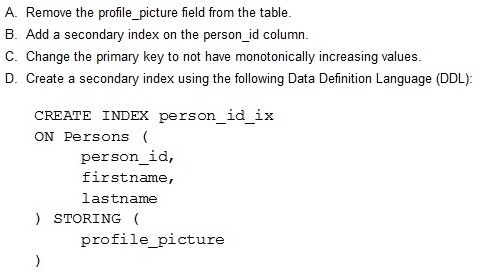
-
A
-
B
-
C
-
D
Reveal answer details
Close answer details
Correct answerC
ExplanationThe person_id is described as a sequential registration number and is the table's primary key. Monotonically increasing primary-key values direct new rows toward the same end of the key space, creating concentrated access. Option C changes the primary key to non-monotonically increasing values, distributing activity and addressing the table's latency issue.
You are working in a team that has developed a new application that needs to be deployed on Kubernetes.
The production application is business critical and should be optimized for reliability. You need to provision a Kubernetes cluster and want to follow Google-recommended practices. What should you do?
-
A
Create a GKE Autopilot cluster. Enroll the cluster in the rapid release channel.
-
B
Create a GKE Autopilot cluster. Enroll the cluster in the stable release channel.
-
C
Create a zonal GKE standard cluster. Enroll the cluster in the stable release channel.
-
D
Create a regional GKE standard cluster. Enroll the cluster in the rapid release channel.
Reveal answer details
Close answer details
Correct answerB
ExplanationCreate a GKE Autopilot cluster to reduce node and infrastructure administration while using a managed Kubernetes operating model. Enroll the cluster in the stable release channel because the production application is business critical and prioritizes reliability over receiving changes rapidly. Together, Autopilot and the stable channel meet the operational and release-stability requirements.
Your developers have created an application that needs to be able to make calls to Cloud Storage and BigQuery. The code is going to run inside a container and will run on Kubernetes Engine and on-premises. What's the best way for them to authenticate to the Google Cloud services?
-
A
Create a service account, grant it the least viable privileges to the required services, generate and download a key. Use the key to authenticate inside the application.
-
B
Use the default service account for App Engine which already has the required permissions.
-
C
Use the default service account for Compute Engine which already has the required permissions.
-
D
Create a service account, with editor permissions, generate and download a key. Use the key to authenticate inside the application.
Reveal answer details
Close answer details
Correct answerA
ExplanationBecause the container must run both on Kubernetes Engine and on-premises, it cannot depend on a service account that exists only as an attached identity in one hosting environment. A dedicated service account and key provide portable authentication. Granting only the least viable privileges for Cloud Storage and BigQuery limits what those credentials can do if exposed.
Your team uses a third-party monitoring solution. They've asked you to deploy it to the nodes in your Kubernetes Engine Cluster. What's the best way to do that?
-
A
Deploy the monitoring pod as a DaemonSet.
-
B
Deploy the monitoring pod as a Deployment.
-
C
Use Deployment Manager to deploy the monitoring solution.
-
D
Connect to each node via SSH and install the monitoring solution.
Reveal answer details
Close answer details
Correct answerA
ExplanationNode monitoring requires an instance of the monitoring Pod on each cluster node. A DaemonSet expresses exactly that scheduling rule, maintaining a Pod on every eligible node and placing one on newly added nodes automatically. A Deployment maintains a requested replica count but does not inherently map one monitoring Pod to every node.
You are managing the security configuration of your company's Google Cloud organization. The Operations team needs specific permissions on both a Google Kubernetes Engine (GKE) cluster and a Cloud SQL instance. Two predefined Identity and Access Management (IAM) roles exist that contain a subset of the permissions needed by the team. You need to configure the necessary IAM permissions for this team while following Google-recommended practices. What should you do?
-
A
Create a custom IAM role that combines the permissions from the two relevant predefined roles.
-
B
Grant the team the two predefined IAM roles.
-
C
Create a custom IAM role that includes only the required permissions from the predefined roles.
-
D
Grant the team the IAM roles of Kubernetes Engine Admin and Cloud SQL Admin.
Reveal answer details
Close answer details
Correct answerB
ExplanationGrant the team the two relevant predefined IAM roles. IAM permissions are additive, so the team receives the required GKE and Cloud SQL capabilities represented by the two roles. Reusing predefined roles avoids maintaining a custom role, while broad administrator roles would grant permissions beyond the specified operational need.
You are developing a new web application that will be deployed on Google Cloud Platform. As part of your release cycle, you want to test updates to your application on a small portion of real user traffic. The majority of the users should still be directed towards a stable version of your application. What should you do?
-
A
Deploy me application on App Engine For each update, create a new version of the same service Configure traffic splitting to send a small percentage of traffic to the new version
-
B
Deploy the application on App Engine For each update, create a new service Configure traffic splitting to send a small percentage of traffic to the new service.
-
C
Deploy the application on Kubernetes Engine For a new release, update the deployment to use the new version
-
D
Deploy the application on Kubernetes Engine For a now release, create a new deployment for the new version Update the service e to use the now deployment.
Reveal answer details
Close answer details
Correct answerA
ExplanationDeploy the application on App Engine and create each update as a new version of the same service. Configure traffic splitting so only a small percentage reaches the new version while most requests continue to the stable version. Version-level splitting provides the gradual real-traffic test directly; creating another service would change the application's service boundary rather than simply releasing a version.
Question 9
Multiple choice
Your boss has asked you to set up the CFO as a user inside Google Cloud. Before walking away, she said, "And obviously you know which role to assign him."
Which role was she likely talking about, and why is it obvious?
(Select one role and one reason)
-
A
Reason: This role will ensure the CFO has full access to the project.
-
B
Role: Billing Account Viewer
-
C
Reason: This role will ensure the CFO has access to view the spending data;
-
D
-
E
Role: Billing Account Admin
-
F
Reason:: This role will ensure the CFO can perform any billing task that they may need.
Reveal answer details
Close answer details
Correct answersB, C
ExplanationThe Billing Account Viewer role gives the CFO read-only visibility into billing information. That access lets the CFO view spending data needed for financial oversight without granting permission to change billing settings or perform every billing task. The role and the spending-data reason therefore form a least-privilege pairing for this user.
Question 10
Single choice
Your development team needs a new Jenkins server for their project. You need to deploy the server using the fewest steps possible. What should you do?
-
A
Download and deploy the Jenkins Java WAR to App Engine Standard.
-
B
Create a new Compute Engine instance and install Jenkins through the command line interface.
-
C
Create a Kubernetes cluster on Compute Engine and create a deployment with the Jenkins Docker image.
-
D
Use GCP Marketplace to launch the Jenkins solution.
Reveal answer details
Close answer details
Correct answerD
ExplanationGCP Marketplace provides a prepared Jenkins solution that can be launched with its required infrastructure and software configuration already packaged. Using it removes the manual steps of creating a VM, installing Jenkins, or building and operating a Kubernetes cluster. It therefore satisfies the request to deploy a new Jenkins server with the fewest steps while retaining a ready-to-use server deployment.
Question 11
Single choice
Your team is developing a product catalog that allows end users to search and filter. The full catalog of products consists of about 500 products. The team doesn't have any experience with SQL, or schema migrations, so they're considering a NoSQL option. Which database service would work best?
-
A
-
B
-
C
-
D
Reveal answer details
Close answer details
Correct answerD
ExplanationCloud Datastore fits a small searchable catalog without requiring the team to design and migrate a relational SQL schema. It stores product records as entities and supports queries over their properties, so the application can implement its search and filtering needs while using the requested NoSQL approach.
Question 12
Single choice
Your company is moving its continuous integration and delivery (CI/CD) pipeline to Compute Engine instances. The pipeline will manage the entire cloud infrastructure through code. How can you ensure that the pipeline has appropriate permissions while your system is following security best practices?
-
A
Add a step for human approval to the CI/CD pipeline before the execution of the infrastructure provisioning.
Use the human approvals IAM account for the provisioning.
-
B
Attach a single service account to the compute instances.
Add minimal rights to the service account.
Allow the service account to impersonate a Cloud Identity user with elevated permissions to create, update, or delete resources.
-
C
Attach a single service account to the compute instances.
Add all required Identity and Access Management (IAM) permissions to this service account to create, update, or delete resources
-
D
Create multiple service accounts, one for each pipeline with the appropriate minimal Identity and Access Management (IAM) permissions.
Use a secret manager service to store the key files of the service accounts.
Allow the CI/CD pipeline to request the appropriate secrets during the execution of the pipeline.
Reveal answer details
Close answer details
Correct answerC
ExplanationAttach a single service account to the Compute Engine instances that run the pipeline, then grant it all required IAM permissions to create, update, or delete the infrastructure it manages. The workload uses the attached identity without shared user credentials or downloaded keys. Keeping the permission set limited to required provisioning actions applies least privilege while still allowing full pipeline automation.
Question 13
Single choice
You're deploying an application to a Compute Engine instance, and it's going to need to make calls to read from Cloud Storage and Bigtable. You want to make sure you're following the principle of least privilege. What's the easiest way to ensure the code can authenticate to the required Google Cloud APIs?
-
A
Create a new user account with the required roles. Store the credentials in Cloud Key Management Service and download them to the instance in code.
-
B
Use the default Compute Engine service account and set its scopes. Let the code find the default
service account using "Application Default Credentials".
-
C
Create a new service account and key with the required limited permissions. Set the instance to use the new service account. Edit the code to use the service account key.
-
D
Register the application with the Binary Registration Service and apply the required roles.
Reveal answer details
Close answer details
Correct answerB
ExplanationThe instance can present its default Compute Engine service account to Google Cloud APIs, while access scopes limit which API requests its credentials may authorize. Application Default Credentials lets the code discover those attached credentials automatically. This avoids distributing a user credential or embedding and managing a downloaded service account key in the application.
Question 14
Single choice
You want to deploy SAP HANA workloads on Compute Engine. The installation requires high-performance data storage, with input/output operations per second (IOPS) frequently exceeding 200,000. Your solution must also ensure the data persists through instance restarts. What should you do?
-
A
Use Hyperdisk Extreme disks for the application data.
-
B
Use in-memory RAM disks for the application data.
-
C
Use Local SSD disks for the application data.
-
D
Use Hyperdisk Throughput disks for the application data.
Reveal answer details
Close answer details
Correct answerA
ExplanationHyperdisk Extreme is persistent block storage designed for workloads that require very high IOPS, matching the SAP HANA requirement that frequently exceeds 200,000 IOPS. Because the application data resides on a persistent disk rather than guest memory or instance-local temporary storage, it remains available through Compute Engine instance restarts.
Question 15
Single choice
You have 32 GB of data in a single file that you need to upload to a Nearline Storage bucket. The WAN connection you are using is rated at 1 Gbps, and you are the only one on the connection. You want to use as much of the rated 1 Gbps as possible to transfer the file rapidly. How should you upload the file?
-
A
Use the GCP Console to transfer the file instead of gsutil.
-
B
Enable parallel composite uploads using gsutil on the file transfer.
-
C
Decrease the TCP window size on the machine initiating the transfer.
-
D
Change the storage class of the bucket from Nearline to Multi-Regional.
Reveal answer details
Close answer details
Correct answerB
ExplanationEnable parallel composite uploads in gsutil for the 32 GB file. The transfer is divided into components that can be uploaded concurrently and then composed into the final object, allowing a single large upload to use more of the available WAN bandwidth. Changing the bucket's storage class or reducing the TCP window does not create this parallel transfer behavior.
Question 16
Single choice
A member of the finance team informed you that one of the projects is using the old billing account. What steps should you take to resolve the problem?
-
A
Go to the Project page; expand the Billing tile; select the Billing Account option; select the correct billing
account and save.
-
B
Go to the Billing page; view the list of projects; find the project in question and select Change billing
account; select the correct billing account and save.
-
C
Delete the project and recreate it with the correct billing account.
-
D
Submit a support ticket requesting the change.
Reveal answer details
Close answer details
Correct answerB
ExplanationBilling relationships are managed from the Billing page, where the finance administrator can view the list of linked projects and find the project in question. Selecting Change billing account, choosing the correct account, and saving updates where that project's future charges are assigned. The project and its resources remain intact, so deletion or a support request is unnecessary.
Question 17
Single choice
Your company is migrating its workloads to Google Cloud due to an expiring data center contract. The on-premises environment and Google Cloud are not connected. You have decided to follow a lift-and-shift approach, and you plan to modernize the workloads in a future project. Several old applications connect to each other through hard-coded internal IP addresses. You want to migrate these workloads quickly without modifying the application code. You also want to maintain all functionality. What should you do?
-
A
Migrate your DNS server first. Configure Cloud DNS with a forwarding zone to your migrated DNS server. Then migrate all other workloads with ephemeral internal IP addresses.
-
B
Create a VPC with non-overlapping CIDR ranges compared to your on-premises network. When migrating individual workloads, assign each workload a new static internal IP address.
-
C
Create a VPC with the same CIDR ranges as your on-premises network. When migrating individual workloads, assign each workload the same static internal IP address.
-
D
Migrate all workloads to a single VPC subnet. Configure Cloud NAT for the subnet and manually assign a static IP address to the Cloud NAT gateway.
Reveal answer details
Close answer details
Correct answerC
ExplanationThe legacy applications depend on their existing hard-coded internal IP addresses, so changing addresses would break communication without code changes. Because the environments are not connected, create a VPC with the same CIDR ranges and assign every migrated workload the same static internal IP address. This preserves the applications' addressing relationships during lift-and-shift.
Question 18
Single choice
You are managing several Google Cloud Platform (GCP) projects and need access to all logs for the past 60 days. You want to be able to explore and quickly analyze the log contents. You want to follow Google-recommended practices to obtain the combined logs for all projects. What should you do?
-
A
Navigate to Stackdriver Logging and select resource.labels.project_id="*"
-
B
Create a Stackdriver Logging Export with a Sink destination to a BigQuery dataset. Configure the table expiration to 60 days.
-
C
Create a Stackdriver Logging Export with a Sink destination to Cloud Storage. Create a lifecycle rule to
delete objects after 60 days.
-
D
Configure a Cloud Scheduler job to read from Stackdriver and store the logs in BigQuery. Configure the table expiration to 60 days.
Reveal answer details
Close answer details
Correct answerB
ExplanationCreate a Stackdriver Logging export with a sink destination to a BigQuery dataset and route the projects' logs into it. BigQuery supports interactive exploration and analysis of the combined records. Setting table expiration to 60 days automatically enforces the requested history window without a separate cleanup process.
Question 19
Single choice
You are using the gcloud container clusters create app-cluster command to deploy a Google Kubernetes Engine (GKE) cluster in a new Google Cloud project. The command fails with the following error: ERROR: (gcloud.container.clusters.create) ResponseError: code=403, message=Kubernetes Engine API has not been used in the project before or it is disabled. You need to resolve the issue. What should you do?
-
A
Rerun the command with the --enable-autoprovisioning flag.
-
B
Disable the "Require enabling Workload Identity Federation for GKE" organization policy, and then run the cluster creation command again.
-
C
Add the Kubernetes Engine Admin IAM role to your user account, and then run the cluster creation command again.
-
D
Run the gcloud services enable container.googleapis.com command, and then run the cluster creation command again.
Reveal answer details
Close answer details
Correct answerD
ExplanationThe 403 message explicitly states that the Kubernetes Engine API is disabled or has never been used in the project. Run gcloud services enable container.googleapis.com to enable that service, then retry the cluster creation command. Cluster flags and IAM changes do not address an API that is unavailable at the project level.
Question 20
Single choice
You are configuring Cloud DNS. You want !to create DNS records to point home.mydomain.com, mydomain.com. and www.mydomain.com to the IP address of your Google Cloud load balancer. What should you do?
-
A
Create one CNAME record to point mydomain.com to the load balancer, and create two A records to point WWW and HOME lo mydomain.com respectively.
-
B
Create one CNAME record to point mydomain.com to the load balancer, and create two AAAA records to point WWW and HOME to mydomain.com respectively.
-
C
Create one A record to point mydomain.com to the load balancer, and create two CNAME records to point WWW and HOME to mydomain.com respectively.
-
D
Create one A record to point mydomain.com lo the load balancer, and create two NS records to point WWW and HOME to mydomain.com respectively.
Reveal answer details
Close answer details
Correct answerC
ExplanationCreate one A record to point mydomain.com directly to the load balancer's IP address. Then create CNAME records that make the HOME and WWW names aliases of mydomain.com. The apex name therefore resolves through its address record, while both subdomain names follow the canonical name to the same destination.
Question 21
Single choice
You are deploying an application to Cloud Run. Your application requires the use of an API that runs on Google Kubernetes Engine (GKE). You need to ensure that your Cloud Run service can privately reach the API on GKE, and you want to follow Google-recommended practices. What should you do?
-
A
Deploy an ingress resource on the GKE cluster to expose the API to the internet. Use Cloud Armor to filter for IP addresses that can connect to the API. On the Cloud Run service, configure the application to fetch its public IP address and update the Cloud Armor policy on startup to allow this IP address to call the API on ports 80 and 443.
-
B
Create an ingress firewall rule on the VPC to allow connections from 0.0.0.0/0 on ports 80 and 443.
-
C
Create an egress firewall rule on the VPC to allow connections to 0.0.0.0/ on ports 80 and 443.
-
D
Deploy an internal Application Load Balancer to expose the API on GKE to the VPC. Configure Cloud DNS with the IP address of the internal Application Load Balancer. Deploy a Serverless VPC Access connector to allow the Cloud Run service to call the API through the FQDN on Cloud DNS.
Reveal answer details
Close answer details
Correct answerD
ExplanationAn internal Application Load Balancer exposes the GKE API privately within the VPC, and Cloud DNS gives that internal address an FQDN. A Serverless VPC Access connector provides the Cloud Run service with a path into the VPC, allowing it to call the API through the private name without exposing the GKE endpoint to the internet.
Question 22
Single choice
Your team is building a website that handles votes from a large user population. The incoming votes will arrive at various rates. You want to optimize the storage and processing of the votes. What should you do?
-
A
Save the incoming votes to Firestore. Use Cloud Scheduler to trigger a Cloud Functions instance to periodically process the votes.
-
B
Use a dedicated instance to process the incoming votes. Send the votes directly to this instance.
-
C
Save the incoming votes to a JSON file on Cloud Storage. Process the votes in a batch at the end of the day.
-
D
Save the incoming votes to Pub/Sub. Use the Pub/Sub topic to trigger a Cloud Functions instance to process the votes.
Reveal answer details
Close answer details
Correct answerD
ExplanationPub/Sub decouples vote ingestion from vote processing, so bursts can be accepted without requiring the processor to handle every vote immediately. Publishing each vote to a topic can trigger a Cloud Functions instance for asynchronous processing, allowing processing capacity to respond to varying arrival rates.
Question 23
Single choice
Your company has developed a new application that consists of multiple microservices. You want to deploy the application to Google Kubernetes Engine (GKE), and you want to ensure that the cluster can scale as more applications are deployed in the future. You want to avoid manual intervention when each new application is deployed. What should you do?
-
A
Deploy the application on GKE, and add a HorizontalPodAutoscaler to the deployment.
-
B
Deploy the application on GKE, and add a VerticalPodAutoscaler to the deployment.
-
C
Create a GKE cluster with autoscaling enabled on the node pool. Set a minimum and maximum for the size of the node pool.
-
D
Create a separate node pool for each application, and deploy each application to its dedicated node pool.
Reveal answer details
Close answer details
Correct answerC
ExplanationGKE cluster autoscaling automatically adjusts the number of nodes in a node pool according to workload resource demands. Setting minimum and maximum node counts allows the cluster to add capacity as additional applications are deployed and remove unnecessary capacity when demand decreases. This provides infrastructure-level scaling without requiring manual node provisioning whenever a new workload is introduced.
Question 24
Single choice
You have experimented with Google Cloud using your own credit card and expensed the costs to your company. Your company wants to streamline the billing process and charge the costs of your projects to their monthly invoice. What should you do?
-
A
Grant the financial team the IAM role of "Billing Account User" on the billing account linked to your credit card.
-
B
Set up BigQuery billing export and grant your financial department IAM access to query the data.
-
C
Create a ticket with Google Billing Support to ask them to send the invoice to your company.
-
D
Change the billing account of your projects to the billing account of your company.
Reveal answer details
Close answer details
Correct answerD
ExplanationA project's charges are applied to the billing account linked to that project. Change the billing account of your projects from the personal card-backed account to the company's billing account, so future costs appear on the company's monthly invoice. Granting billing access or exporting cost data changes visibility and permissions but does not move the projects' charges to the company invoice.
Question 25
Single choice
You built an application on your development laptop that uses Google Cloud services. Your application uses Application Default Credentials for authentication and works fine on your development laptop. You want to migrate this application to a Compute Engine virtual machine (VM) and set up authentication using Google-recommended practices and minimal changes. What should you do?
-
A
Assign appropriate access for Google services to the service account used by the Compute Engine VM.
-
B
Create a service account with appropriate access for Google services, and configure the application to use this account.
-
C
Store credentials for service accounts with appropriate access for Google services in a config file, and deploy this config file with your application.
-
D
Store credentials for your user account with appropriate access for Google services in a config file, and deploy this config file with your application.
Reveal answer details
Close answer details
Correct answerA
ExplanationApplication Default Credentials on a Compute Engine VM can use the service account attached to that VM. Assign the required Google service access to the VM's service account, and the application can continue using its existing authentication flow. This avoids deploying user credentials or service account key files and requires no application-level credential change.
Question 26
Single choice
Your coworker has helped you set up several configurations for gcloud. You've noticed that you're running commands against the wrong project. Being new to the company, you haven't yet memorized any of the projects.
With the fewest steps possible, what's the fastest way to switch to the correct configuration?
-
A
Run gcloud configurations list followed by gcloud configurations activate .
-
B
Run gcloud config list followed by gcloud config activate.
-
C
Run gcloud config configurations list followed by gcloud config configurations activate.
-
D
Re-authenticate with the gcloud auth login command and select the correct configurations on login.
Reveal answer details
Close answer details
Correct answerC
ExplanationThe project is already associated with one of the prepared Cloud SDK configurations, so no new authentication or manual project lookup is needed. Run gcloud config configurations list to identify the available configurations, followed by gcloud config configurations activate for the correct one. Activation switches the configuration used by later commands.
Question 27
Single choice
You need to grant access for three users so that they can view and edit table data on a Cloud Spanner instance. What should you do?
-
A
Run gcloud iam roles describe roles/spanner.databaseUser. Add the users to the role.
-
B
Run gcloud iam roles describe roles/spanner.databaseUser. Add the users to a new group. Add the group to the role.
-
C
Run gcloud iam roles describe roles/spanner.viewer - -project my-project. Add the users to the role.
-
D
Run gcloud iam roles describe roles/spanner.viewer - -project my-project. Add the users to a new group. Add the group to the role.
Reveal answer details
Close answer details
Correct answerB
ExplanationThe roles/spanner.databaseUser role supplies the database access needed to view and edit table data. Run gcloud iam roles describe roles/spanner.databaseUser to review that role, create a new group containing the three users, and grant the IAM role to the group. Group-based assignment centralizes membership changes instead of maintaining separate bindings for each user.
Question 28
Single choice
Every employee of your company has a Google account. Your operational team needs to manage a large number of instances on Compute Engine. Each member of this team needs only administrative access to the servers. Your security team wants to ensure that the deployment of credentials is operationally efficient and must be able to determine who accessed a given instance. What should you do?
-
A
Generate a new SSH key pair. Give the private key to each member of your team. Configure the public key in the metadata of each instance.
-
B
Ask each member of the team to generate a new SSH key pair and to send you their public key. Use a configuration management tool to deploy those keys on each instance.
-
C
Ask each member of the team to generate a new SSH key pair and to add the public key to their Google account. Grant the "compute.osAdminLogin" role to the Google group corresponding to this team.
-
D
Generate a new SSH key pair. Give the private key to each member of your team. Configure the public key as a project-wide public SSH key in your Cloud Platform project and allow project-wide public SSH keys on each instance.
Reveal answer details
Close answer details
Correct answerC
ExplanationEach administrator should use an individual SSH key associated with their Google account, preserving a distinct identity instead of sharing one private key. Granting compute.osAdminLogin to the team's Google group provides the required administrative server access and makes membership manageable centrally. Individual identity-based login also allows access activity to be attributed to the employee who connected.
Question 29
Single choice
You have a workload running on Compute Engine that is critical to your business. You want to ensure that the data on the boot disk of this workload is backed up regularly. You need to be able to restore a backup as quickly as possible in case of disaster. You also want older backups to be cleaned automatically to save on cost. You want to follow Google-recommended practices. What should you do?
-
A
Create a Cloud Function to create an instance template.
-
B
Create a snapshot schedule for the disk using the desired interval.
-
C
Create a cron job to create a new disk from the disk using gcloud.
-
D
Create a Cloud Task to create an image and export it to Cloud Storage.
Reveal answer details
Close answer details
Correct answerB
ExplanationA snapshot schedule creates boot-disk snapshots automatically at the desired interval and supports retention settings that remove older snapshots. These snapshots provide disk-level recovery for restoring the workload after a disaster. The managed schedule covers both recurring backup and automatic cleanup without custom jobs or functions.
Question 30
Single choice
Your team maintains the infrastructure for your organization. The current infrastructure requires changes.
You need to share your proposed changes with the rest of the team. You want to follow Google's recommended best practices. What should you do?
-
A
Use Deployment Manager templates to describe the proposed changes and store them in a Cloud Storage bucket.
-
B
Use Deployment Manager templates to describe the proposed changes and store them in Cloud Source Repositories.
-
C
Apply the change in a development environment, run gcloud compute instances list, and then save the output in a shared Storage bucket.
-
D
Apply the change in a development environment, run gcloud compute instances list, and then save the output in Cloud Source Repositories.
Reveal answer details
Close answer details
Correct answerB
ExplanationDeployment Manager templates describe proposed infrastructure changes as declarative code, making the intended state reviewable before it is applied. Store those templates in Cloud Source Repositories so the team can share, version, compare, and review each proposed change. A resource listing captures only observed resources and does not describe the infrastructure definition that should produce them.
Question 31
Single choice
You are deploying an application to a Compute Engine VM in a managed instance group. The application must be running at all times, but only a single instance of the VM should run per GCP project. How should you configure the instance group?
-
A
Set autoscaling to On, set the minimum number of instances to 1, and then set the maximum number of instances to 1.
-
B
Set autoscaling to Off, set the minimum number of instances to 1, and then set the maximum number of instances to 1.
-
C
Set autoscaling to On, set the minimum number of instances to 1, and then set the maximum number of instances to 2.
-
D
Set autoscaling to Off, set the minimum number of instances to 1, and then set the maximum number of instances to 2.
Reveal answer details
Close answer details
Correct answerA
ExplanationTurn autoscaling on and set both the minimum and maximum number of instances to 1. The minimum preserves one running instance as the group's required capacity, and the maximum prevents the group from scaling beyond that single instance. Together, these bounds maintain the application's availability while enforcing the per-project limit of exactly one VM.
Question 32
Single choice
Your company is running a critical workload on a single Compute Engine VM instance. Your company's disaster recovery policies require you to back up the entire instance's disk data every day. The backups must be retained for 7 days. You must configure a backup solution that complies with your company's security policies and requires minimal setup and configuration. What should you do?
-
A
Configure the instance to use persistent disk asynchronous replication.
-
B
Configure daily scheduled persistent disk snapshots with a retention period of 7 days.
-
C
Configure Cloud Scheduler to trigger a Cloud Function each day that creates a new machine image and deletes machine images that are older than 7 days.
-
D
Configure a bash script using gsutil to run daily through a cron job. Copy the disk's files to a Cloud Storage bucket with archive storage class and an object lifecycle rule to delete the objects after 7 days.
Reveal answer details
Close answer details
Correct answerB
ExplanationA persistent disk snapshot schedule directly automates a daily backup of the VM's disk data. Setting its retention period to seven days causes expired snapshots to be removed according to the required window. This managed configuration meets both timing requirements with less setup than building and maintaining custom scheduling and deletion code.
Question 33
Single choice
You have a managed instance group composed of preemptible VMs. All of the VMs keep deleting and recreating themselves every minute. What is a possible cause of this behavior?
-
A
Your zonal capacity is limited, causing all preemptible VMs to be shutdown torecover capacity. Try deploying your group to another zone.
-
B
You have hit your instance quota for the region.
-
C
Your managed instance group's VMs are toggled to only last 1 minute inpreemptible settings.
-
D
Your managed instance group's health check is repeatedly failing, either to amisconfigured health check or misconfigured firewall rules not allowing the healthcheck to access the instance
Reveal answer details
Close answer details
Correct answerD
ExplanationA managed instance group's autohealing behavior replaces instances that repeatedly fail its health check. A misconfigured check, or firewall rules that block health-check traffic, can therefore make healthy workloads appear unhealthy and produce a continuous delete-and-recreate cycle at roughly the health-check interval.
Question 34
Multiple choice
You just installed the Google Cloud CLI on your new corporate laptop. You need to list the existing instances of your company on Google Cloud. What must you do before you run the gcloud compute instances list command? (Choose 2 answers)
-
A
Run gcloud auth login, enter your login credentials in the dialog window, and paste the received login token to gcloud CLI.
-
B
Create a Google Cloud service account, and download the service account key. Place the key file in a folder on your machine where gcloud CLI can find it.
-
C
Download your Cloud Identity user account key. Place the key file in a folder on your machine where gcloud CLI can find it.
-
D
Run gcloud config set compute/zone $my_zone to set the default zone for gcloud CLI.
-
E
Run gcloud config set project $my_project to set the default project for gcloud CLI.
Reveal answer details
Close answer details
Correct answersA, E
ExplanationFirst run gcloud auth login so the CLI has user credentials with which to authenticate requests. Then set the project with gcloud config set project $my_project so the instances command operates against the intended company project. A default zone is unnecessary because listing can cover the project's instances.
Question 35
Single choice
Your team has created 4 projects, one for each distinct application. You have a single budget for all of these projects. What is the best way to pay for all of these projects?
-
A
Create a Billing Account for each project.
-
B
Use an invoiced account, which will pay for all projects inside a Google Cloud account.
-
C
Use a single Billing Account linked to all 4 projects.
-
D
Use a single Billing Account linked to the Google Cloud account.
Reveal answer details
Close answer details
Correct answerC
ExplanationA billing account can be associated with multiple projects, so all 4 projects can charge their usage to one shared payer. Linking each project to the same Billing Account matches the company's single budget and provides centralized billing. Creating one account per project would fragment payment management, while linking is performed at the project level rather than merely at an overall cloud account.
Question 36
Single choice
You work for a financial services company that operates as a stock market broker. Your company is planning to migrate to Google Cloud. You need to plan the network design in Google Cloud. Your design must: 1. Minimize the latency between all production systems.
2. Minimize costs related to your development environment. What should you do?
-
A
Create a VPC in the Standard Tier and one in the Premium Tier. Deploy production workloads in the Standard Tier and development workloads in the Premium Tier.
-
B
Create a VPC in the Standard Tier and one in the Premium Tier. Deploy development workloads in the Standard Tier and production workloads in the Premium Tier.
-
C
Create a VPC in the Premium Tier, and deploy both production and development workloads on this
VPC.
-
D
Create a VPC in the Standard Tier, and deploy both production and development workloads on this
VPC.
Reveal answer details
Close answer details
Correct answerB
ExplanationCreate one VPC using Standard Tier and another using Premium Tier. Place development workloads in the Standard Tier to minimize networking costs where latency is less critical. Place production workloads in the Premium Tier so their traffic uses the higher-performance network path, addressing the requirement to minimize production latency.
Question 37
Single choice
Your company has an internal application for managing transactional orders. The application is used exclusively by employees in a single physical location. The application requires strong consistency, fast queries, and ACID guarantees for multi-table transactional updates. The first version of the application is implemented in PostgreSQL, and you want to display it to the cloud with minimal code changes. Which database is most appropriate for this application?
-
A
-
B
-
C
-
D
Reveal answer details
Close answer details
Correct answerB
ExplanationThe application already uses PostgreSQL and depends on relational tables, strong consistency, fast queries, and ACID multi-table transactions. Cloud SQL provides a managed relational database compatible with that existing PostgreSQL design, enabling migration with minimal code changes. A globally distributed database is unnecessary for employees at one location, while analytics and nonrelational stores do not match the transactional model.
Question 38
Single choice
You want to deploy a new containerized application into Google Cloud by using a Kubernetes manifest.
You want to have full control over the Kubernetes deployment, and at the same time, you want to minimize configuring infrastructure. What should you do?
-
A
Deploy the application on GKE Autopilot.
-
B
Deploy the application on Cloud Run.
-
C
Deploy the application on GKE Standard.
-
D
Deploy the application on Cloud Functions.
Reveal answer details
Close answer details
Correct answerA
ExplanationGKE Autopilot accepts Kubernetes manifests and preserves control over Kubernetes workload objects such as Deployments and Services. At the same time, it manages the cluster's underlying node infrastructure and capacity. This meets the Kubernetes deployment requirement while minimizing the infrastructure configuration assigned to the team.
Question 39
Single choice
You have a website hosted on App Engine standard environment. You want 1% of your users to see a new test version of the website. You want to minimize complexity. What should you do?
-
A
Deploy the new version in the same application and use the --migrate option.
-
B
Deploy the new version in the same application and use the --splits option to give a weight of 99 to the current version and a weight of 1 to the new version.
-
C
Create a new App Engine application in the same project. Deploy the new version in that application.
Use the App Engine library to proxy 1% of the requests to the new version.
-
D
Create a new App Engine application in the same project. Deploy the new version in that application.
Configure your network load balancer to send 1% of the traffic to that new application.
Reveal answer details
Close answer details
Correct answerB
ExplanationDeploy the new version in the same App Engine application and use the --splits option with weight 99 for the current version and weight 1 for the new version. App Engine traffic splitting directly sends the required small share to the test version while retaining the stable version for nearly all users, without introducing another application or a separate proxy layer.
Question 40
Single choice
Your company requires all developers to have the same permissions, regardless of the Google Cloud project they are working on. Your company's security policy also restricts developer permissions to Compute Engine, Cloud Functions, and Cloud SQL. You want to implement the security policy with minimal effort. What should you do?
-
A
Create a custom role with Compute Engine, Cloud Functions, and Cloud SQL permissions in one project within the Google Cloud organization.
Copy the role across all projects created within the organization with the gcloud iam roles copy command.
Assign the role to developers in those projects.
-
B
Add all developers to a Google group in Google Groups for Workspace.
Assign the predefined role of Compute Admin to the Google group at the Google Cloud organization level.
-
C
Add all developers to a Google group in Cloud Identity.
Assign predefined roles for Compute Engine, Cloud Functions, and Cloud SQL permissions to the Google group for each project in the Google Cloud organization.
-
D
Add all developers to a Google group in Cloud Identity.
Create a custom role with Compute Engine, Cloud Functions, and Cloud SQL permissions at the Google Cloud organization level.
Assign the custom role to the Google group.
Reveal answer details
Close answer details
Correct answerD
ExplanationAdd all developers to a Google group in Cloud Identity so membership and access can be managed once. Create a custom role at the Google Cloud organization level containing only the required Compute Engine, Cloud Functions, and Cloud SQL permissions, then assign it to that group. Organization-level definition and assignment provide consistent inherited access across projects without copying roles repeatedly.
Question 41
Single choice
You are developing an internet of things (IoT) application that captures sensor data from multiple devices that have already been set up. You need to identify the global data storage product your company should use to store this data. You must ensure that the storage solution you choose meets your requirements of sub-millisecond latency. What should you do?
-
A
Store the IoT data in Spanner. Use caches to speed up the process and avoid latencies.
-
B
Store the IoT data in Bigtable.
-
C
Capture IoT data in BigQuery datasets.
-
D
Store the IoT data in Cloud Storage. Implement caching by using Cloud CDN.
Reveal answer details
Close answer details
Correct answerB
ExplanationBigtable is designed for large volumes of keyed data that require very low-latency reads and writes at scale. Sensor measurements from many IoT devices fit this access pattern, so storing the IoT data in Bigtable directly addresses the sub-millisecond latency requirement without adding a separate cache to another database.
Question 42
Single choice
Your company's developers use an automation that you recently built to provision Linux VMs in Compute Engine within a Google Cloud project to perform various tasks. You need to manage the Linux account lifecycle and access for these users. You want to follow Google-recommended practices to simplify access management while minimizing operational costs. What should you do?
-
A
Enable OS Login for all VMs. Use IAM roles to grant user permissions.
-
B
Require your developers to create public SSH keys. Write custom startup scripts to update user permissions.
-
C
Require your developers to create public SSH keys. Make the owner of the public key the root user.
-
D
Enable OS Login for all VMs. Write custom startup scripts to update user permissions.
Reveal answer details
Close answer details
Correct answerA
ExplanationEnable OS Login on all VMs and use IAM roles to grant the developers their Linux access permissions. OS Login centralizes account and SSH authorization around each developer's managed identity, so access can be added or revoked through IAM. This removes the need to distribute keys or maintain custom startup scripts on automated VM deployments.
Question 43
Single choice
Your company runs its Linux workloads on Compute Engine instances. Your company will be working with a new operations partner that does not use Google Accounts. You need to grant access to the instances to your operations partner so they can maintain the installed tooling. What should you do?
-
A
Enable Cloud IAP for the Compute Engine instances, and add the operations partner as a Cloud IAP Tunnel User.
-
B
Tag all the instances with the same network tag. Create a firewall rule in the VPC to grant TCP access on port 22 for traffic from the operations partner to instances with the network tag.
-
C
Set up Cloud VPN between your Google Cloud VPC and the internal network of the operations partner.
-
D
Ask the operations partner to generate SSH key pairs, and add the public keys to the VM instances.
Reveal answer details
Close answer details
Correct answerD
ExplanationSSH authentication does not require the operations partner to have Google Accounts. Each partner user can generate an SSH key pair, keep the private key, and have the corresponding public key added to the VM instances. The instances can then authenticate maintenance sessions by possession of the private keys. Firewall rules or VPN connectivity alone do not establish user authentication.
Question 44
Single choice
Your company uses Pub/Sub for event-driven workloads. You have a subscription named email-updates attached to the new-orders topic. You need to fetch and acknowledge waiting messages from this subscription. What should you do?
-
A
Use the gcloud pubsub subscriptions seek email-updates command.
-
B
Use the gcloud pubsub topics describe new-orders command.
-
C
Use the gcloud pubsub subscriptions pull email-updates --auto-ack command.
-
D
Use the gcloud pubsub topics list-subscriptions new-orders --filter="email-command.updates"
Reveal answer details
Close answer details
Correct answerC
ExplanationThe waiting messages belong to the email-updates subscription, so the operation must act on that subscription rather than merely inspect the new-orders topic. The subscriptions pull command retrieves available messages, and the --auto-ack flag acknowledges the messages after they are returned, completing both required actions in one command.
Question 45
Single choice
Your company set up a complex organizational structure on Google Could Platform. The structure includes hundreds of folders and projects. Only a few team members should be able to view the hierarchical structure. You need to assign minimum permissions to these team members and you want to follow Google-recommended practices. What should you do?
-
A
Add the users to roles/browser role.
-
B
Add the users to roles/iam.roleViewer role.
-
C
Add the users to a group, and add this group to roles/browser role.
-
D
Add the users to a group, and add this group to roles/iam.roleViewer role.
Reveal answer details
Close answer details
Correct answerC
ExplanationThe roles/browser role provides the limited ability to browse the organization's resource hierarchy, including folders and projects, without granting resource-management access. Add the users to a group and grant that group the Browser role. This applies least privilege while making access for the small team easy to manage.
Question 46
Single choice
You need to create a custom IAM role for use with a GCP service. All permissions in the role must be suitable for production use. You also want to clearly share with your organization the status of the custom role. This will be the first version of the custom role. What should you do?
-
A
Use permissions in your role that use the `supported' support level for role permissions. Set the role
stage to ALPHA while testing the role permissions.
-
B
Use permissions in your role that use the `supported' support level for role permissions. Set the role
stage to BETA while testing the role permissions.
-
C
Use permissions in your role that use the `testing' support level for role permissions. Set the role stage
to ALPHA while testing the role permissions.
-
D
Use permissions in your role that use the `testing' support level for role permissions. Set the role stage
to BETA while testing the role permissions.
Reveal answer details
Close answer details
Correct answerA
ExplanationUse permissions in your role that have the supported support level, because every included permission must be suitable for production use. Set the role stage to ALPHA while testing this first version. The permission support level describes production suitability, while the role stage communicates the custom role's current release status.
Question 47
Single choice
You need to set a budget alert for use of Compute Engineer services on one of the three Google Cloud Platform projects that you manage. All three projects are linked to a single billing account. What should you do?
-
A
Verify that you are the project billing administrator. Select the associated billing account and create a budget and alert for the appropriate project.
-
B
Verify that you are the project billing administrator. Select the associated billing account and create a budget and a custom alert.
-
C
Verify that you are the project administrator. Select the associated billing account and create a budget for the appropriate project.
-
D
Verify that you are project administrator. Select the associated billing account and create a budget and a custom alert.
Reveal answer details
Close answer details
Correct answerA
ExplanationVerify that you are the project billing administrator, select the associated billing account, and create a budget and alert scoped to the appropriate project. Scoping is essential because all three projects share one account; it ensures the threshold tracks the intended project's service spending rather than the entire billing account.
Question 48
Single choice
You've just enabled an API for the developers. A couple of minutes later, one of the developers pastes a screenshot into Slack. The screenshot indicates that the API isn't enabled. You can see that the project ID is correct. What is the most likely reason for this error?
-
A
The API hasn't completed the process to become fully enabled yet.
-
B
The developer is using the wrong project.
-
C
The developer didn't run the gcloud refresh api command.
-
D
The developer is trying to use the wrong API.
Reveal answer details
Close answer details
Correct answerA
ExplanationEnabling an API is not necessarily visible to every request immediately because the enablement operation can still be completing across the service. The project ID has already been checked, and only a couple of minutes have passed, so the developer can encounter an API-not-enabled response during that interval. Once the process has completed and the API is fully enabled, requests in that project can use it.
Question 49
Single choice
Your company is active in the European Economic Area (EEA), and will adopt Google Cloud for its workloads. Projects are currently structured within different folders. You need to ensure any resources that will be deployed are using Google Cloud locations within the EEA by using the Organization Policy Service resource locations constraint. What should you do?
-
A
Configure the policy at the folder level, and add all allowed locations to the policy.
-
B
Configure the policy at the organization level, and add all allowed locations to the policy.
-
C
Configure the policy at the folder level, and add all disallowed locations to the policy.
-
D
Configure the policy at the organization level, and add all disallowed locations to the policy.
Reveal answer details
Close answer details
Correct answerB
ExplanationBecause projects exist under different folders, configuring the resource locations policy at the organization level applies one inherited restriction across the entire hierarchy. Add the allowed EEA locations to that policy so descendant projects can deploy only in the approved set. A folder-level policy would require separate configuration for each folder and could leave other branches uncovered.
Question 50
Single choice
Your company uses Google Kubernetes Engine (GKE) for all application deployments. Your team needs to provision and manage other Google Cloud resources using the same declarative approach and tooling as your application deployments. What should you do?
-
A
Use the Google Cloud console to provision and manage Google Cloud resources.
-
B
Write shell scripts using gcloud commands to provision and manage Google Cloud resources.
-
C
Create Terraform configurations for your Google Cloud resources, and store the state file in a Cloud Storage bucket.
-
D
Install Config Connector in a GKE cluster, and define your Google Cloud resources as custom resources in Kubernetes manifests.
Reveal answer details
Close answer details
Correct answerD
ExplanationConfig Connector extends Kubernetes with custom resources that represent Google Cloud resources. After installing it in the GKE cluster, the team can define infrastructure in Kubernetes manifests and manage it through the same declarative workflow used for applications. This keeps both application and cloud-resource definitions within Kubernetes tooling.
Question 51
Single choice
You need to set up permissions for a set of Compute Engine instances to enable them to write data into a particular Cloud Storage bucket. You want to follow Google-recommended practices. What should you do?
-
A
Create a service account with an access scope. Use the access scope `https://www.googleapis.com/auth/devstorage.write_only'.
-
B
Create a service account with an access scope. Use the access scope `https://www.googleapis.com/auth/cloud-platform'.
-
C
Create a service account and add it to the IAM role `storage.objectCreator' for that bucket.
-
D
Create a service account and add it to the IAM role `storage.objectAdmin' for that bucket.
Reveal answer details
Close answer details
Correct answerC
ExplanationGrant the instances' service account the storage.objectCreator IAM role on the particular bucket. That role provides the required ability to create objects while keeping the permission scoped to the target bucket. A broader objectAdmin role would grant unnecessary object-management capabilities, while access scopes alone do not express the bucket-level IAM grant required here.
Question 52
Single choice
Your company has multiple projects linked to a single billing account in Google Cloud. You need to visualize the costs with specific metrics that should be dynamically calculated based on company-specific criteria. You want to automate the process. What should you do?
-
A
In the Google Cloud console, visualize the costs related to the projects in the Reports section.
-
B
In the Google Cloud console, visualize the costs related to the projects in the Cost breakdown section.
-
C
In the Google Cloud console, use the export functionality of the Cost table. Create a Looker Studiodashboard on top of the CSV export.
-
D
Configure Cloud Billing data export to BigOuery for the billing account. Create a Looker Studio dashboard on top of the BigOuery export.
Reveal answer details
Close answer details
Correct answerD
ExplanationConfigure Cloud Billing data export to BigQuery for the shared billing account, then build the Looker Studio dashboard over that export. The recurring export supplies structured billing records across the linked projects, while BigQuery can calculate company-specific metrics dynamically without repeated manual CSV exports.
Question 53
Single choice
You are monitoring an application and receive user feedback that a specific error is spiking. You notice that the error is caused by a Service Account having insufficient permissions. You are able to solve the problem but want to be notified if the problem recurs. What should you do?
-
A
In the Log Viewer, filter the logs on severity `Error' and the name of the Service Account.
-
B
Create a sink to BigQuery to export all the logs. Create a Data Studio dashboard on the exported logs.
-
C
Create a custom log-based metrics for the specific error to be used in an Alerting Policy.
-
D
Grant Project Owner access to the Service Account.
Reveal answer details
Close answer details
Correct answerC
ExplanationA custom log-based metric converts occurrences of the specific insufficient-permissions error into a measurable time series. Use that metric in an Alerting Policy so a recurrence triggers a notification instead of requiring someone to inspect filtered logs manually. Exporting all logs and building a dashboard adds processing but does not itself provide the focused recurrence alert.
Question 54
Single choice
You have an application that reads data from a Pub/Sub topic. During local development, you authenticated using your personal credentials to test the application. You now want to deploy the application to Vertex AI and have created a new service account to be used as the application's identity. You need to ensure that the deployed application can still access the Pub/Sub topic. What should you do?
-
A
Grant the relevant IAM roles to the service account used as your agent identity.
-
B
Generate a JSON private key for the service account, and upload the key as Vertex AI metadata.
-
C
Extract your access token by using the gcloud auth print-access-token command, and store it with the application.
-
D
Create a secret in Secret Manager to store your personal credentials, and configure the application's authentication code to use this secret.
Reveal answer details
Close answer details
Correct answerA
ExplanationAfter deployment, the application uses its configured service account as the agent identity rather than the developer's personal credentials. Grant that service account the relevant IAM roles needed to access the Pub/Sub topic. Runtime authentication can then use the managed identity, avoiding uploaded private keys, copied access tokens, and stored personal credentials.
Question 55
Single choice
You deployed a new application inside your Google Kubernetes Engine cluster using the YAML file specified below. 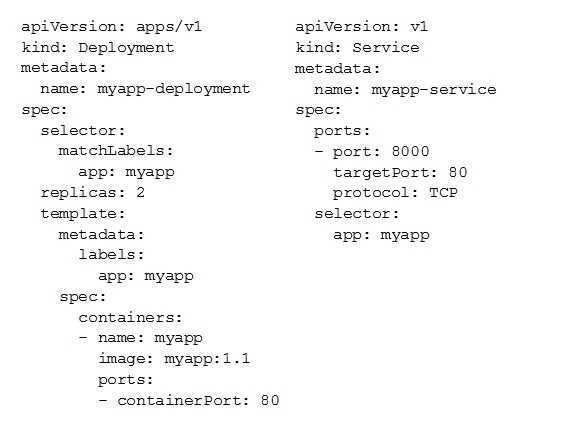 You check the status of the deployed pods and notice that one of them is still in PENDING status:  You want to find out why the pod is stuck in pending status. What should you do?
-
A
Review details of the myapp-service Service object and check for error messages.
-
B
Review details of the myapp-deployment Deployment object and check for error messages.
-
C
Review details of myapp-deployment-58ddbbb995-lp86m Pod and check for warning messages.
-
D
View logs of the container in myapp-deployment-58ddbbb995-lp86m pod and check for warning messages.
Reveal answer details
Close answer details
Correct answerC
ExplanationReview the details of the myapp-deployment-58ddbbb995-lp86m Pod and inspect its warning messages and events. Pending means this specific Pod has not reached the running state, so its scheduling or startup reason is recorded on the Pod. Container logs are not the primary diagnostic when the container has not started, and the Service or Deployment does not provide the Pod-specific event trail.
Question 56
Multiple choice
Your company implemented BigQuery as an enterprise data warehouse. Users from multiple business units run queries on this data warehouse. However, you notice that query costs for BigQuery are very high, and you need to control costs. Which two methods should you use? (Choose two.)
-
A
Split the users from business units to multiple projects.
-
B
Apply a user-or project-level custom query quota for BigQuery data warehouse.
-
C
Create separate copies of your BigQuery data warehouse for each business unit.
-
D
Split your BigQuery data warehouse into multiple data warehouses for each business unit.
-
E
Change your BigQuery query model from on-demand to flat rate. Apply the appropriate number of slots to each Project.
Reveal answer details
Close answer details
Correct answersB, E
ExplanationA user- or project-level custom query quota places a direct consumption limit on each business unit, preventing uncontrolled on-demand query usage. Changing the BigQuery query model from on-demand to flat rate makes query capacity predictable, and assigning the appropriate number of slots to each project divides that capacity among the units.
Question 57
Single choice
Your finance team wants to view the billing report for your projects. You want to make sure that the finance team does not get additional permissions to the project. What should you do?
-
A
Add the group for the finance team to roles/billing user role.
-
B
Add the group for the finance team to roles/billing admin role.
-
C
Add the group for the finance team to roles/billing viewer role.
-
D
Add the group for the finance team to roles/billing project/Manager role.
Reveal answer details
Close answer details
Correct answerC
ExplanationThe finance team needs read access to billing reports, not permission to attach billing accounts, change billing configuration, or administer projects. Granting the group the roles/billing.viewer role provides billing visibility while respecting least privilege and avoids adding unrelated permissions to the projects themselves.
Question 58
Single choice
You are migrating your on-premises workload to Google Cloud. Your company is implementing its Cloud Billing configuration and requires access to a granular breakdown of its Google Cloud costs. You need to ensure that the Cloud Billing datasets are available in BigQuery so you can conduct a detailed analysis of costs. What should you do?
-
A
Enable Cloud Billing data export to BigQuery when you create a Cloud Billing account.
-
B
Enable Cloud Billing on the project, and link a Cloud Billing account. Then view the billing data table in the BigQuery dataset.
-
C
Create a Cloud Billing account. Enable the BigQuery Data Transfer Service API to export pricing data.
-
D
Enable the BigQuery API, and ensure that the BigQuery User IAM role is selected. Change the BigQuery dataset to select a data location.
Reveal answer details
Close answer details
Correct answerA
ExplanationWhen you create the Cloud Billing account, enable its billing data export to BigQuery. This configuration sends the granular billing data into BigQuery datasets, where the company can query and analyze detailed costs. Merely linking billing to a project or enabling BigQuery-related APIs does not configure the required billing export.
Question 59
Single choice
You manage an App Engine Service that aggregates and visualizes data from BigQuery. The application is deployed with the default App Engine Service account. The data that needs to be visualized resides in a different project managed by another team. You do not have access to this project, but you want your application to be able to read data from the BigQuery dataset. What should you do?
-
A
Ask the other team to grant your default App Engine Service account the role of BigQuery Job User.
-
B
Ask the other team to grant your default App Engine Service account the role of BigQuery Data Viewer.
-
C
In Cloud IAM of your project, ensure that the default App Engine service account has the role of BigQuery Data Viewer.
-
D
In Cloud IAM of your project, grant a newly created service account from the other team the role of BigQuery Job User in your project.
Reveal answer details
Close answer details
Correct answerB
ExplanationThe dataset belongs to the other team's project, so access must be granted on the resource that contains the data. Ask that team to grant your default App Engine service account the BigQuery Data Viewer role. That role supplies read access to the dataset, while granting a role only in your own project would not authorize reads from their project.
Question 60
Single choice
You need to deploy an application, which is packaged in a container image, in a new project. The application exposes an HTTP endpoint and receives very few requests per day. You want to minimize costs. What should you do?
-
A
Deploy the container on Cloud Run.
-
B
Deploy the container on Cloud Run on GKE.
-
C
Deploy the container on App Engine Flexible.
-
D
Deploy the container on Google Kubernetes Engine, with cluster autoscaling and horizontal pod autoscaling enabled.
Reveal answer details
Close answer details
Correct answerA
ExplanationDeploy the container on Cloud Run. The application already exposes an HTTP endpoint, matching Cloud Run's request-driven container model, and the very low request rate favors a service that does not require a continuously managed cluster or VM-based environment. Cloud Run on GKE, App Engine Flexible, and GKE would introduce infrastructure beyond what this small workload needs.
Question 61
Single choice
Your organization has strict requirements to control access to Google Cloud projects. You need to enable your Site Reliability Engineers (SREs) to approve requests from the Google Cloud support team when an SRE opens a support case.
You want to follow Google-recommended practices. What should you do?
-
A
Add your SREs to roles/iam.roleAdmin role.
-
B
Add your SREs to roles/accessapproval approver role.
-
C
Add your SREs to a group and then add this group to roles/iam roleAdmin role.
-
D
Add your SREs to a group and then add this group to roles/accessapproval approver role.
Reveal answer details
Close answer details
Correct answerD
ExplanationAccess Approval decisions require the roles/accessapproval.approver role, so the SREs need that role rather than IAM role-administration privileges. Add the SREs to a group and grant the group roles/accessapproval.approver. Group-based assignment keeps approval access consistent and simplifies membership changes.
Question 62
Single choice
You need to produce a list of the enabled Google Cloud Platform APIs for a GCP project using the gcloud command line in the Cloud Shell. The project name is my-project. What should you do?
-
A
Run gcloud projects list to get the project ID, and then run gcloud services list --project <project ID>.
-
B
Run gcloud init to set the current project to my-project, and then run gcloud services list --available.
-
C
Run gcloud info to view the account value, and then run gcloud services list --account <Account>.
-
D
Run gcloud projects describe <project ID> to verify the project value, and then run gcloud services list
--available.
Reveal answer details
Close answer details
Correct answerA
ExplanationFirst run gcloud projects list to get the project ID for my-project. Then run gcloud services list with the --project flag set to that ID; without --available, the command lists services enabled for the specified project. The --available form lists services that could be enabled, while account information does not identify the project's enabled API set.
Question 63
Single choice
You created a Google Cloud Platform project with an App Engine application inside the project. You initially configured the application to be served from the us-central region. Now you want the application to be served from the asia- northeast1 region. What should you do?
-
A
Change the default region property setting in the existing GCP project to asia-northeast1.
-
B
Change the region property setting in the existing App Engine application from us-central to asia- northeast1.
-
C
Create a second App Engine application in the existing GCP project and specify asia-northeast1 as the region to serve your application.
-
D
Create a new GCP project and create an App Engine application inside this new project. Specify asia- northeast1 as the region to serve your application.
Reveal answer details
Close answer details
Correct answerD
ExplanationAn App Engine application's serving region is chosen when that application is created and cannot be changed afterward. A project also contains only one App Engine application, so a second application in the existing project cannot supply a different region. Create a new GCP project, create its App Engine application in asia-northeast1, and deploy the workload there.
Question 64
Single choice
You are building a product on top of Google Kubernetes Engine (GKE). You have a single GKE cluster.
For each of your customers, a Pod is running in that cluster, and your customers can run arbitrary code inside their Pod. You want to maximize the isolation between your customers' Pods. What should you do?
-
A
Use Binary Authorization and whitelist only the container images used by your customers' Pods.
-
B
Use the Container Analysis API to detect vulnerabilities in the containers used by your customers'
Pods.
-
C
Create a GKE node pool with a sandbox type configured to gvisor. Add the parameter runtimeClassName: gvisor to the specification of your customers' Pods.
-
D
Use the cos_containerd image for your GKE nodes. Add a nodeSelector with the value cloud.google.com/gke-os-distribution: cos_containerd to the specification of your customers' Pods.
Reveal answer details
Close answer details
Correct answerC
ExplanationCreate a GKE node pool with its sandbox type configured to gVisor, then set runtimeClassName: gvisor in each customer's Pod specification. The sandbox adds an isolation boundary between arbitrary container code and the node kernel. Image authorization, vulnerability scanning, and a node OS choice do not provide that runtime sandbox boundary.
Question 65
Single choice
Users of your application are complaining of slowness when loading the application. You realize the slowness is because the App Engine deployment serving the application is deployed in us-central whereas all users of this application are closest to europe-west3. You want to change the region of the App Engine application to europe-west3 to minimize latency. What's the best way to change the App Engine region?
-
A
Create a new project and create an App Engine instance in europe-west3
-
B
Use the gcloud app region set command and supply the name of the new region.
-
C
From the console, under the App Engine page, click edit, and change the region drop-down.
-
D
Contact Google Cloud Support and request the change.
Reveal answer details
Close answer details
Correct answerA
ExplanationAn App Engine application's region cannot be changed after the application is created in its project. To place the service in europe-west3, create a new project and initialize App Engine there, then deploy the application to that project. Editing the existing application or issuing a region-setting command cannot relocate it.
Question 66
Single choice
You need to migrate invoice documents stored on-premises to Cloud Storage. The documents have the following storage requirements: Documents must be kept for five years. Up to five revisions of the same invoice document must be stored, to allow for corrections. Documents older than 365 days should be moved to lower cost storage tiers. You want to follow Google-recommended practices to minimize your operational and development costs. What should you do?
-
A
Enable retention policies on the bucket, and use Cloud Scheduler to invoke a Cloud Function to move or delete your documents based on their metadata.
-
B
Enable retention policies on the bucket, use lifecycle rules to change the storage classes of the objects, set the number of versions, and delete old files.
-
C
Enable object versioning on the bucket, and use Cloud Scheduler to invoke a Cloud Functions instance to move or delete your documents based on their metadata.
-
D
Enable object versioning on the bucket, use lifecycle conditions to change the storage class of the objects, set the number of versions, and delete old files.
Reveal answer details
Close answer details
Correct answerD
ExplanationObject versioning preserves successive revisions of an invoice, allowing lifecycle logic to retain up to the required five versions. Lifecycle conditions can transition objects older than 365 days to a lower-cost storage class and delete versions or files only when the configured age and count rules permit it. These native controls avoid scheduled custom code while enforcing the storage lifecycle.
Question 67
Single choice
You've just created a new Google Cloud account. You're eager to start working with resources such as App Engine and Cloud Storage. However, you know that resources have requirements. Which of the following is required by Google Cloud in order to enable and use resources?
-
A
-
B
-
C
-
D
Reveal answer details
Close answer details
Correct answerC
ExplanationA Project is the resource container in which services such as App Engine and Cloud Storage are enabled and used. It provides the scope for creating and managing those resources, so one is required before work can begin. An Organization and Folder are higher-level hierarchy elements, while a Stackdriver account is not the required resource container.
Question 68
Single choice
You will have several applications running on different Compute Engine instances in the same project. You want to specify at a more granular level the service account each instance uses when calling Google Cloud APIs. What should you do?
-
A
When creating the instances, specify a Service Account for each instance.
-
B
When creating the instances, assign the name of each Service Account as instance metadata.
-
C
After starting the instances, use gcloud compute instances update to specify a Service Account for each instance.
-
D
After starting the instances, use gcloud compute instances update to assign the name of the relevant Service Account as instance metadata.
Reveal answer details
Close answer details
Correct answerA
ExplanationWhen creating each instance, specify the service account that represents the application running on that instance. This associates API calls from each VM with the intended identity and permits granular IAM grants per application. Storing a service account name as metadata does not attach that identity, and choosing the accounts during creation avoids a later instance update.
Question 69
Single choice
You are a Google Cloud organization policy administrator for your company that operates in a regulated industry. You need to enforce a policy that restricts all new location-based Google Cloud resources to the australia-southeast1 and australia-southeast2 regions only. You want to ensure that this policy requires minimal configuration. What should you do?
-
A
Create a custom organization policy that uses the resource.location == 'australia- southeast1' || resource.location == 'australia-southeast2' Common Expression Language (CEL) condition.
-
B
Modify the gcp.resourceLocations list constraint by adding in:australia-locations to the allowed_values list.
-
C
Modify the gcp.resourceLocations list constraint by adding in:australia-locations to the denied_values list.
-
D
Create a custom organization policy that uses the resource.location.startsWith ('australia') Common Expression Language (CEL) condition.
Reveal answer details
Close answer details
Correct answerB
ExplanationThe gcp.resourceLocations list constraint directly governs where location-based resources may be created. Adding in:australia-locations to allowed_values permits the predefined Australian location group and rejects locations outside it. Using the existing value group keeps the policy concise and avoids maintaining a custom CEL condition for the two Australian regions.
Question 70
Single choice
You assist different engineering teams in deploying their infrastructure on Google Cloud. Your company has defined certain practices required for all workloads. You need to provide the engineering teams with a solution that enables teams to deploy their infrastructure independently without having to know all implementation details of the company's required practices. What should you do?
-
A
Configure organization policies to enforce your company's required practices. Ask the teams to provision their infrastructure by using the Google Cloud console.
-
B
Create a service account per team, and grant the service account the Project Editor role. Ask the teams to provision their infrastructure through the Google Cloud CLI (gcloud CL), while impersonating
their dedicated service account.
-
C
Write Terraform modules for each component that are compliant with the company's required practices, and ask teams to implement their infrastructure through these modules.
-
D
Provide training for all engineering teams you work with to understand the company's required practices. Allow the engineering teams to provision the infrastructure to best meet their needs.
Reveal answer details
Close answer details
Correct answerC
ExplanationWrite Terraform modules for each infrastructure component with the company's required practices encoded in their configuration. Engineering teams can compose and deploy these modules independently while approved implementation details remain reusable and hidden behind module inputs. Updating the shared modules also provides a controlled way to evolve those practices.
|