You are a snowflake architect in an organization. The business team came to to deploy an use case which requires you to load some data which they can visualize through tableau. Everyday new data comes in and the old data is no longer required. What type of table you will use in this case to optimize cost
-
A
-
B
-
C
Reveal answer details
Close answer details
Correct answerA
ExplanationA transient table is a type of table in Snowflake that does not have a Fail-safe period and can have a Time Travel retention period of either 0 or 1 day. Transient tables are suitable for temporary or intermediate data that can be easily reproduced or replicated 1.
A temporary table is a type of table in Snowflake that is automatically dropped when the session ends or the current user logs out. Temporary tables do not incur any storage costs, but they are not visible to other users or sessions 2. A permanent table is a type of table in Snowflake that has a Fail-safe period and a Time Travel retention period of up to 90 days. Permanent tables are suitable for persistent and durable data that needs to be protected from accidental or malicious deletion 3.
In this case, the use case requires loading some data that can be visualized through Tableau. The data is updated every day and the old data is no longer required. Therefore, the best type of table to use in this case to optimize cost is a transient table, because it does not incur any Fail-safe costs and it can have a short Time Travel retention period of 0 or 1 day. This way, the data can be loaded and queried by Tableau, and then deleted or overwritten without incurring any unnecessary storage costs.
References:
: Transient Tables : Temporary Tables : Understanding & Using Time Travel
The following DDL command was used to create a task based on a stream: 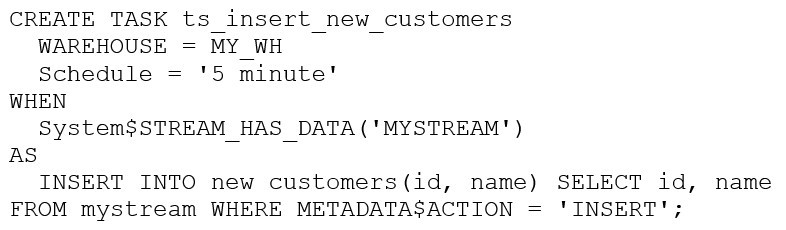 Assuming MY_WH is set to auto_suspend ?
60 and used exclusively for this task, which statement is true?
-
A
The warehouse MY_WH will be made active every five minutes to check the stream.
-
B
The warehouse MY_WH will only be active when there are results in the stream.
-
C
The warehouse MY_WH will never suspend.
-
D
The warehouse MY_WH will automatically resize to accommodate the size of the stream.
Reveal answer details
Close answer details
Correct answerB
ExplanationExplanation: The warehouse MY_WH will only be active when there are results in the stream. This is because the task is created based on a stream, which means that the task will only be executed when there are new data in the stream. Additionally, the warehouse is set to auto_suspend - 60, which means that the warehouse will automatically suspend after 60 seconds of inactivity. Therefore, the warehouse will only be active when there are results in the stream.
References:
[CREATE TASK | Snowflake Documentation]
[Using Streams and Tasks | Snowflake Documentation] [CREATE WAREHOUSE | Snowflake
Documentation]
Question 3
Multiple choice
How do Snowflake databases that are created from shares differ from standard databases that are not created from shares? (Choose three.)
-
A
Shared databases are read-only.
-
B
Shared databases must be refreshed in order for new data to be visible.
-
C
Shared databases cannot be cloned.
-
D
Shared databases are not supported by Time Travel.
-
E
Shared databases will have the PUBLIC or INFORMATION_SCHEMA schemas without explicitly granting these schemas to the share.
-
F
Shared databases can also be created as transient databases.
Reveal answer details
Close answer details
Correct answersA, C, D
ExplanationExplanation: According to the SnowPro Advanced: Architect documents and learning resources, the ways that Snowflake databases that are created from shares differ from standard databases that are not created from shares are: Shared databases are read-only. This means that the data consumers who access the shared databases cannot modify or delete the data or the objects in the databases. The data providers who share the databases have full control over the data and the objects, and can grant or revoke privileges on them 1.
Shared databases cannot be cloned. This means that the data consumers who access the shared databases cannot create a copy of the databases or the objects in the databases. The data providers who share the databases can clone the databases or the objects, but the clones are not automatically shared 2.
Shared databases are not supported by Time Travel. This means that the data consumers who access the shared databases cannot use the AS OF clause to query historical data or restore deleted data. The data providers who share the databases can use Time Travel on the databases or the objects, but the historical data is not visible to the data consumers 3.
The other options are incorrect because they are not ways that Snowflake databases that are created from shares differ from standard databases that are not created from shares. Option B is incorrectbecause shared databases do not need to be refreshed in order for new data to be visible. The data consumers who access the shared databases can see the latest data as soon as the data providers update the data 1.
Option E is incorrect because shared databases will not have the PUBLIC or INFORMATION_SCHEMA schemas without explicitly granting these schemas to the share. The data consumers who access the shared databases can only see the objects that the data providers grant to the share, and the PUBLIC and INFORMATION_SCHEMA schemas are not granted by default 4.
Option F is incorrect because shared databases cannot be created as transient databases. Transient databases are databases that do not support Time Travel or Fail-safe, and can be dropped without affecting the retention period of the data.
Shared databases are always created as permanent databases, regardless of the type of the source database 5.
References:
Introduction to Secure Data Sharing | Snowflake Documentation, Cloning Objects
| Snowflake Documentation, Time Travel | Snowflake Documentation, Working with Shares | Snowflake
Documentation, CREATE DATABASE | Snowflake Documentation
Question 4
Multiple choice
A company wants to deploy its Snowflake accounts inside its corporate network with no visibility on the internet. The company is using a VPN infrastructure and Virtual Desktop Infrastructure (VDI) for its Snowflake users. The company also wants to re-use the login credentials set up for the VDI to eliminate redundancy when managing logins. What Snowflake functionality should be used to meet these requirements? (Choose two.)
-
A
Set up replication to allow users to connect from outside the company VPN.
-
B
Provision a unique company Tri-Secret Secure key.
-
C
Use private connectivity from a cloud provider.
-
D
Set up SSO for federated authentication.
-
E
Use a proxy Snowflake account outside the VPN, enabling client redirect for user logins.
Reveal answer details
Close answer details
Correct answersC, D
ExplanationExplanation: According to the SnowPro Advanced: Architect documents and learning resources, the Snowflake functionality that should be used to meet these requirements are: Use private connectivity from a cloud provider. This feature allows customers to connect to Snowflake from their own private network without exposing their data to the public Internet. Snowflake integrates with AWS PrivateLink, Azure Private Link, and Google Cloud Private Service Connect to offer private connectivity from customers' VPCs or VNets to Snowflake endpoints. Customers can control how traffic reaches the Snowflake endpoint and avoid the need for proxies or public IP addresses 123.
Set up SSO for federated authentication. This feature allows customers to use their existing identity provider (IdP) to authenticate users for SSO access to Snowflake. Snowflake supports most SAML 2.0- compliant vendors as an IdP, including Okta, Microsoft AD FS, Google G Suite, Microsoft Azure Active Directory, OneLogin, Ping Identity, and PingOne. By setting up SSO for federated authentication, customers can leverage their existing user credentials and profile information, and provide stronger security than username/password authentication 4.
The other options are incorrect because they do not meet the requirements or are not feasible. Option A is incorrect because setting up replication does not allow users to connect from outside the company VPN.
Replication is a feature of Snowflake that enables copying databases across accounts in different regions and cloud platforms. Replication does not affect the connectivity or visibility of the accounts 5.
Option B is incorrect because provisioning a unique company Tri-Secret Secure key does not affect the network or authentication requirements. Tri-Secret Secure is a feature of Snowflake that allows customers to manage their own encryption keys for data at rest in Snowflake, using a combination of three secrets: a master key, a service key, and a security password. Tri-Secret Secure provides an additional layer of security and control over the data encryption and decryption process, but it does not enable private connectivity or SSO6.
Option E is incorrect because using a proxy Snowflake account outside the VPN, enabling client redirect for user logins, is not a supported or recommended way of meeting the requirements. Client redirect is a feature of Snowflake that allows customers to connect to a different Snowflake account than the one specified in the connection string. This feature is useful for scenarios such as cross-region failover, data sharing, and account migration, but it does not provide private connectivity or SSO7.
References:
AWS PrivateLink & Snowflake | Snowflake Documentation, Azure Private Link & Snowflake | Snowflake
Documentation, Google Cloud Private Service Connect & Snowflake | Snowflake Documentation, Overview of Federated Authentication and SSO | Snowflake Documentation, Replicating Databases
Across Multiple Accounts | Snowflake Documentation, Tri-Secret Secure | Snowflake Documentation, Redirecting Client Connections | Snowflake Documentation
Question 5
Multiple choice
Following objects can be cloned in snowflake: (Choose three.)
-
A
-
B
-
C
-
D
-
E
Reveal answer details
Close answer details
Correct answersA, B, D
ExplanationSnowflake supports cloning of various objects, such as databases, schemas, tables, stages, file formats, sequences, streams, tasks, and roles. Cloning creates a copy of an existing object in the system without copying the data or metadata. Cloning is also known as zero-copy cloning 1. Among the objects listed in the question, the following ones can be cloned in Snowflake: The following objects listed in the question cannot be cloned in Snowflake:
References:
: Cloning Considerations : CREATE TABLE ... CLONE : CREATE EXTERNAL TABLE ...
CLONE : Temporary Tables : Internal Stages
How can an Architect enable optimal clustering to enhance performance for different access paths on a given table?
-
A
Create multiple clustering keys for a table.
-
B
Create multiple materialized views with different cluster keys.
-
C
Create super projections that will automatically create clustering.
-
D
Create a clustering key that contains all columns used in the access paths.
Reveal answer details
Close answer details
Correct answerB
ExplanationExplanation: According to the SnowPro Advanced: Architect documents and learning resources, the best way to enable optimal clustering to enhance performance for different access paths on a given table is to create multiple materialized views with different cluster keys. A materialized view is a pre-computed result set that is derived from a query on one or more base tables. A materialized view can be clustered by specifying a clustering key, which is a subset of columns or expressions that determines how the data in the materialized view is co-located in micro-partitions. By creating multiple materialized views with different cluster keys, an Architect can optimize the performance of queries that use different access paths on the same base table. For example, if a base table has columns A, B, C, and D, and there are queries that filter on A and B, or on C and D, or on A and C, the Architect can create three materialized views, each with a different cluster key: (A, B), (C, D), and (A, C). This way, each query can leverage the optimal clustering of the corresponding materialized view and achieve faster scan efficiency and better compression.
References:
Snowflake Documentation: Materialized Views Snowflake Learning: Materialized Views (https://www.snowflake.com/blog/using-materialized-views-to-solve-multi-clustering-performance-problems/)
Question 7
Multiple choice
Which of the following are characteristics of how row access policies can be applied to external tables? (Choose three.)
-
A
An external table can be created with a row access policy, and the policy can be applied to the VALUE column.
-
B
A row access policy can be applied to the VALUE column of an existing external table.
-
C
A row access policy cannot be directly added to a virtual column of an external table.
-
D
External tables are supported as mapping tables in a row access policy.
-
E
While cloning a database, both the row access policy and the external table will be cloned.
-
F
A row access policy cannot be applied to a view created on top of an external table.
Reveal answer details
Close answer details
Correct answersA, B, C
ExplanationExplanation: These three statements are true according to the Snowflake documentation and the web search results. A row access policy is a feature that allows filtering rows based on user-defined conditions.
A row access policy can be applied to an external table, which is a table that reads data from external files in a stage. However, there are some limitations and considerations for using row access policies with external tables. An external table can be created with a row access policy by using the WITH ROW ACCESS POLICY clause in the CREATE EXTERNAL TABLE statement. The policy can be applied to the VALUE column, which is the column that contains the raw data from the external files in a VARIANT data type 1. A row access policy can also be applied to the VALUE column of an existing external table by using the ALTER TABLE statement with the SET ROW ACCESS POLICY clause 2.
A row access policy cannot be directly added to a virtual column of an external table. A virtual column is a column that is derived from the VALUE column using an expression. To apply a row access policy to a virtual column, the policy must be applied to the VALUE column and the expression must be repeated in the policy definition 3.
External tables are not supported as mapping tables in a row access policy. A mapping table is a table that is used to determine the access rights of users or roles based on some criteria. Snowflake does not support using an external table as a mapping table because it may cause performance issues or errors 4.
While cloning a database, Snowflake clones the row access policy, but not the external table. Therefore, the policy in the cloned database refers to a table that is not present in the cloned database. To avoid this issue, the external table must be manually cloned or recreated in the cloned database 4. A row access policy can be applied to a view created on top of an external table. The policy can be applied to the view itself or to the underlying external table. However, if the policy is applied to the view, the view must be a secure view, which is a view that hides the underlying data and the view definition from unauthorized users 5.
References:
CREATE EXTERNAL TABLE | Snowflake Documentation
ALTER EXTERNAL TABLE | Snowflake Documentation
Understanding Row Access Policies | Snowflake Documentation Snowflake Data Governance: Row
Access Policy Overview Secure Views | Snowflake Documentation
Question 8
Multiple choice
Which statements describe characteristics of the use of materialized views in Snowflake? (Choose two.)
-
A
They can include ORDER BY clauses.
-
B
They cannot include nested subqueries.
-
C
They can include context functions, such as CURRENT_TIME().
-
D
They can support MIN and MAX aggregates.
-
E
They can support inner joins, but not outer joins.
Reveal answer details
Close answer details
Correct answersB, D
ExplanationExplanation: According to the Snowflake documentation, materialized views have some limitations on the query specification that defines them. One of these limitations is that they cannot include nested subqueries, such as subqueries in the FROM clause or scalar subqueries in the SELECT list. Another limitation is that they cannot include ORDER BY clauses, context functions (such as CURRENT_TIME()), or outer joins. However, materialized views can support MIN and MAX aggregates, as well as other aggregate functions, such as SUM, COUNT, and AVG.
References:
Limitations on Creating Materialized Views | Snowflake Documentation Working with Materialized Views |
Snowflake Documentation
Question 9
Multiple choice
An Architect needs to allow a user to create a database from an inbound share. To meet this requirement, the user's role must have which privileges? (Choose two.)
-
A
-
B
-
C
-
D
-
E
Reveal answer details
Close answer details
Correct answersC, E
ExplanationExplanation: According to the Snowflake documentation, to create a database from an inbound share, the user's role must have the following privileges: The CREATE DATABASE privilege on the current account. This privilege allows the user to create a new database in the account 1. The IMPORT DATABASE privilege on the share. This privilege allows the user to import a database from the share into the account 2. The other privileges listed are not relevant for this requirement. The IMPORT SHARE privilege is used to import a share into the account, not a database 3.
The IMPORT PRIVILEGES privilege is used to import the privileges granted on the shared objects, not the objects themselves 2. The CREATE SHARE privilege is used to create a share to provide data to other accounts, not to consume data from other accounts 4.
References:
CREATE DATABASE | Snowflake Documentation
Importing Data from a Share | Snowflake Documentation Importing a Share | Snowflake Documentation
CREATE SHARE | Snowflake Documentation
Question 10
Single choice
A media company needs a data pipeline that will ingest customer review data into a Snowflake table, and apply some transformations. The company also needs to use Amazon Comprehend to do sentiment analysis and make the de-identified final data set available publicly for advertising companies who use different cloud providers in different regions. The data pipeline needs to run continuously ang efficiently as new records arrive in the object storage leveraging event notifications. Also, the operational complexity, maintenance of the infrastructure, including platform upgrades and security, and the development effort should be minimal. Which design will meet these requirements?
-
A
Ingest the data using COPY INTO and use streams and tasks to orchestrate transformations. Export the data into Amazon S3 to do model inference with Amazon Comprehend and ingest the data back into a Snowflake table. Then create a listing in the Snowflake Marketplace to make the data available to other companies.
-
B
Ingest the data using Snowpipe and use streams and tasks to orchestrate transformations. Create an external function to do model inference with Amazon Comprehend and write the final records to a Snowflake table. Then create a listing in the Snowflake Marketplace to make the data available to other companies.
-
C
Ingest the data into Snowflake using Amazon EMR and PySpark using the Snowflake Spark connector.
Apply transformations using another Spark job. Develop a python program to do model inference by leveraging the Amazon Comprehend text analysis API.
Then write the results to a Snowflake table and create a listing in the Snowflake Marketplace to make the data available to other companies.
-
D
Ingest the data using Snowpipe and use streams and tasks to orchestrate transformations. Export the data into Amazon S3 to do model inference with Amazon Comprehend and ingest the data back into a Snowflake table. Then create a listing in the Snowflake Marketplace to make the data available to other companies.
Reveal answer details
Close answer details
Correct answerB
ExplanationExplanation: This design meets all the requirements for the data pipeline. Snowpipe is a feature that enables continuous data loading into Snowflake from object storage using event notifications. It is efficient, scalable, and serverless, meaning it does not require any infrastructure or maintenance from the user.
Streams and tasks are features that enable automated data pipelines within Snowflake, using change data capture and scheduled execution. They are also efficient, scalable, and serverless, and they simplify the data transformation process. External functions are functions that can invoke external services or APIs from within Snowflake. They can be used to integrate with Amazon Comprehend and perform sentiment analysis on the data. The results can be written back to a Snowflake table using standard SQL commands.
Snowflake Marketplace is a platform that allows data providers to share data with data consumers across different accounts, regions, and cloud platforms. It is a secure and easy way to make data publicly available to other companies.
References:
Snowpipe Overview | Snowflake Documentation
Introduction to Data Pipelines | Snowflake Documentation External Functions Overview | Snowflake
Documentation Snowflake Data Marketplace Overview | Snowflake Documentation
|