Preview real exam questions, verified answers and available explanations before choosing a study plan.
Question 1
Drag & drop
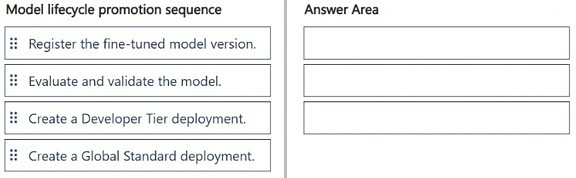
DRAG DROP
You complete the fine-tuning of a generative model in Microsoft Foundry. The fine-tuned model now appears as a new model variant in your development environment.
The deployment process must ensure that proper validation and control is maintained.
You need to promote the fine-tuned model from development to production.
Which three actions should you perform in sequence? To answer, move the appropriate actions from the list of actions to the answer area and arrange them in the correct order.
Reveal answer detailsClose answer details
Explanation
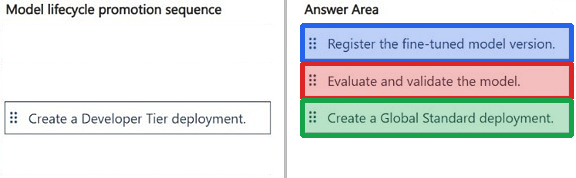
Step 1: Register the fine-tuned model version. If Using Microsoft Azure AI Foundry
Microsoft Azure AI Foundry manages fine-tuned generative models using a centralized registry, cloud evaluation metrics, and secure gateway deployments.
1. Register the Fine-Tuned Model Variant Capture Artifacts: Ensure your successful fine-tuning job is officially registered in your project's model catalog. Create a Asset Version: Save the specific iteration with strict version tags (e.g., v1.0.0-gold) to serve as an immutable reference asset.
Step 2: Evaluate and validate the model.
2. Evaluate for Production Readiness Run Evaluation Pipelines: Navigate to the Evaluation tab to execute automated testing using a golden dataset (a ground-truth reference dataset).Assess Generative Metrics: Measure quality parameters like groundedness, relevance, coherence, and fluency.
Validate Safety Boundaries: Run built-in evaluations for content safety, checking for leaks of personally identifiable information (PII) or harmful content generation.
Step 3: Create a Global Standard deployment 3. Promote fine-tuned models to production in Microsoft Foundry by using the promote feature in the AI Foundry SDK, or by manually recreating the agent configuration in a production-isolated project. Deploy to the Global Standard Tier for your production environment, as it includes strict SLAs, data residency guarantees, and quota limits required for live traffic.
An organization runs a customer-facing generative AI application built by using Microsoft Foundry. The application uses multiple prompts linked to multiple workflows to generate responses in production.
The application occasionally returns incomplete responses. The model call succeeds, but the final message sometimes stops early.
The issue cannot be reproduced reliably in development.
You need to identify where and why response generation is terminating early in production.
Which approach should you use?
A
Run a pre-release evaluation workflow to score groundedness and relevance on a test dataset.
B
Enable tracing and logging so that each workflow can be inspected.
C
Increase max_tokens and temperature to reduce the chance of early termination.
D
Replace the deployed model with a smaller model to reduce variability across responses.
Reveal answer detailsClose answer details
Correct answerB
Explanation
Tracing preserves the sequence of operations across the prompts, model call, and linked workflows, while structured logging records the relevant state and completion details at each step. This makes it possible to locate the exact production stage where output stops and distinguish workflow termination from a successful model invocation. Offline quality scoring would not diagnose an intermittent execution path.
Question 3
Drag & drop
DRAG DROP
A team deploys a classification model to production and scores incoming customer data daily.
After several weeks, business stakeholders report unexpected changes in prediction behavior, even though the endpoint remains healthy.
You need to determine whether data drift is occurring and if it is, identify the appropriate actions.
Which action should you perform for each observed signal? To answer, move the appropriate actions to the correct observed signals. You may use each action once, more than once, or not at all. You may need to move the split bar between panes or scroll to view content.
NOTE: Each correct selection is worth one point.
Reveal answer detailsClose answer details
Explanation
Box 1: Analyze dataset drift metrics Input feature distributions differ from training data.
The direct action you must take when input feature distributions differ from the training data is to retrain the model using the updated data distribution.
This scenario describes a classic case of data drift (also known as covariate shift). While the endpoint infrastructure remains perfectly healthy, the statistical properties of the production data have shifted away from the baseline training data, leading to a degradation in predictive behavior.
Box 2: Analyze dataset drift metrics
Model accuracy drops without code changes. You should analyze dataset drift metrics to identify why the model accuracy dropped without any changes to the code. In production machine learning, dataset drift occurs when the statistical properties of the input data change over time. Even if your Azure Machine Learning endpoint remains perfectly healthy and functional, changes in the real-world data distribution will cause the model's predictive performance to degrade. This phenomenon is often referred to as data drift or concept drift.
Box 3: Investigate scaling and infrastructure metrics Endpoint latency increases under load.
You should immediately investigate infrastructure metrics, as latency spikes under load typically indicate resource exhaustion.
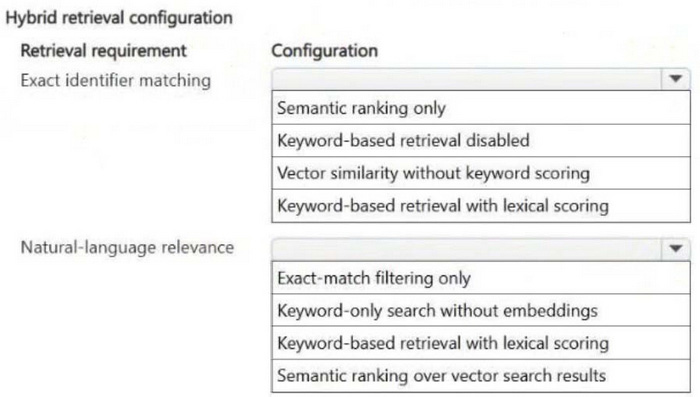
You manage a Retrieval-Augmented Generation (RAG) system that uses Azure AI Search to retrieve documents from an indexed knowledge base.
The system must support the following retrieval requirements:
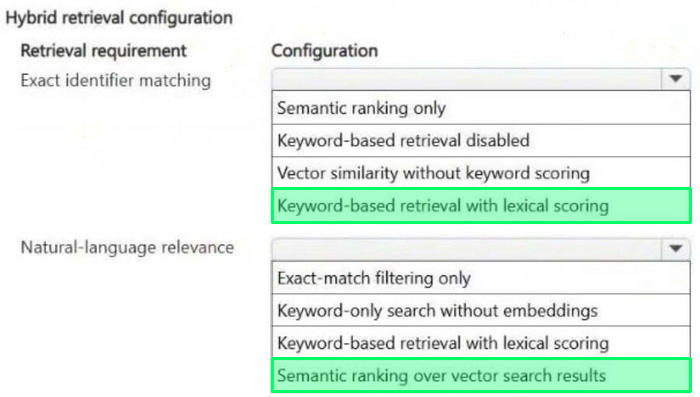
1. Queries that include exact policy identifiers must return matching documents even when semantic similarity is low. 2. Natural-language questions must prioritize semantically relevant documents even when keywords are not an exact match.
You need to configure the retrieval approach to meet the requirements.
How should you configure the retrieval behavior for each requirement? To answer, select the appropriate
options in the answer area.
NOTE: Each correct selection is worth one point.
Reveal answer detailsClose answer details
Explanation
The image maps exact identifier matching to keyword-style retrieval and natural-language relevance to semantic or vector retrieval. Hybrid search combines these approaches so identifiers can be matched precisely while conceptual queries still retrieve relevant passages. Other single-mode retrieval choices would miss one side of the requirement and reduce RAG quality.
Question 5
Drag & drop
DRAG DROP
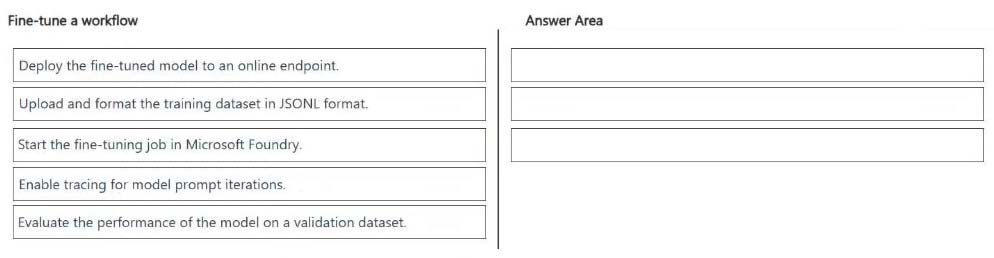
You are fine-tuning an LLM base model by using Microsoft Foundry. You have a labeled dataset of customer emails.
You need to improve task-specific prediction accuracy so that the model can be tested and deployed later.
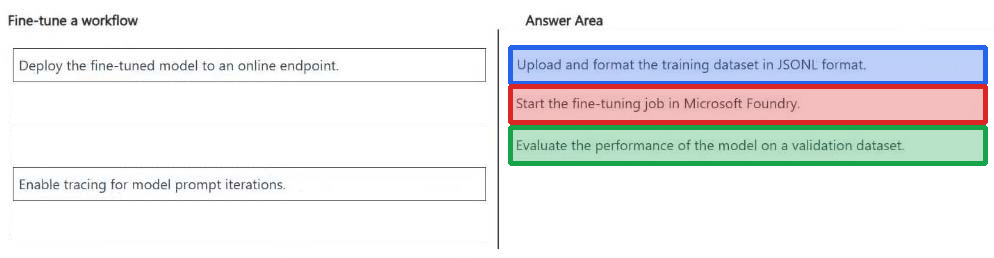
Which three actions should you perform in sequence? To answer, move the appropriate actions from the list of actions to the answer area and arrange them in the correct order.
Reveal answer detailsClose answer details
Explanation
Step 1: Upload and format the training dataset in JSON format. Upload and Format Training Data (JSONL) You need to format your labeled emails so the model can learn from them.
Format Requirements: In Microsoft Foundry, training and validation files must be prepared in a JSONL (JSON Lines) format.
Structure: Each line should represent a single conversation or input-output pair. For email tasks (like classification, summarization, or routing), this usually consists of a messages array.
Step 2: Start the fine-tuning jobs in Microsoft Foundry. Start Supervised Fine-Tuning (SFT) Jobs
Once your data is uploaded to a private Azure storage account or directly through the UI, you will initiate the training process.
Technique: Choose Supervised Fine-Tuning (SFT). SFT is designed for teaching models specific tasks (like specific tone alignment or labeling) on labeled data.
Execution: Through the Azure AI Foundry Model Catalog, select your base model (e.g., GPT-4o-mini or Llama Scout), upload your train/validation JSONL files, and submit the job.
Experimentation: Foundry also supports hyperparameter settings (like learning rates and batch sizes) which you can tweak if needed.
Step 3: Evaluate the performance of the model on a validation dataset. Evaluate and Deploy
Fine-tuning is an iterative process. Before deploying to a production environment, you must evaluate the model to ensure it meets your specific task accuracy goals.
Evaluation: Use Foundry's built-in evaluation tools and your validation dataset to benchmark the fine-tuned student model against the baseline base model.
Deployment: Once task-specific prediction accuracy is confirmed using validation metrics, you can host and deploy the model directly on Azure AI Foundry for your applications to consume.
You have several machine learning models registered in an Azure Machine Learning workspace.
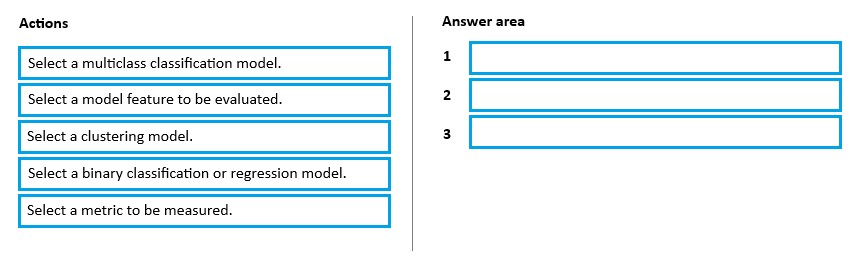
You must use the Fairlearn dashboard to assess fairness in a selected model.
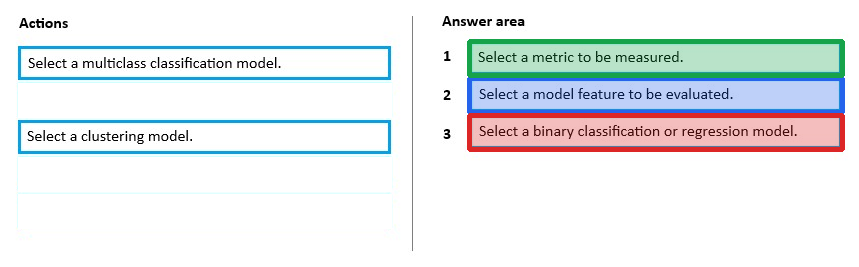
Which three actions should you perform in sequence? To answer, move the appropriate actions from the list of actions to the answer area and arrange them in the correct order.
Reveal answer detailsClose answer details
Explanation
Step 1: Select a metric to measured You need to choose a baseline performance or fairness metric (such as accuracy rate, precision, or demographic parity) along which the dashboard evaluates the model's overall behavior and cross-group disparities.
Step 2: Select a model feature to evaluated You must specify a sensitive feature (such as age, gender, or race) to split the data into different subgroups and evaluate potential disparities across them.
Step 3: Select a binary classification or regression model The Fairlearn package is specifically designed to assess and mitigate unfairness in binary classification and regression tasks. It does not natively support clustering or multiclass models for group fairness assessments in this wizard.
You use Azure Machine Learning to implement hyperparameter tuning for an Azure ML Python SDK v2- based model training.
Training runs must terminate when the primary metric is lowered by 25 percent or more compared to the best performing run.
You need to configure an early termination policy to terminate training jobs.
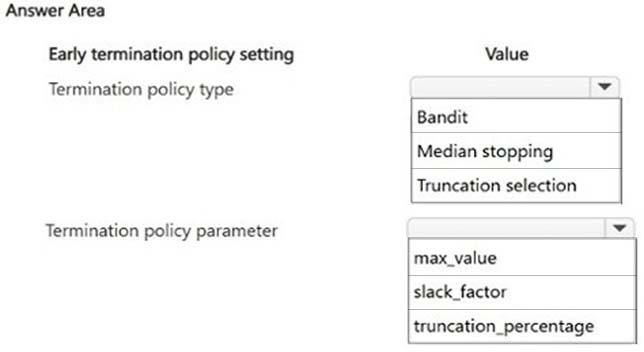
Which values should you use? To answer, select the appropriate options in the answer area. NOTE: Each correct selection is worth one point. Hot Area:
Reveal answer detailsClose answer details
Explanation
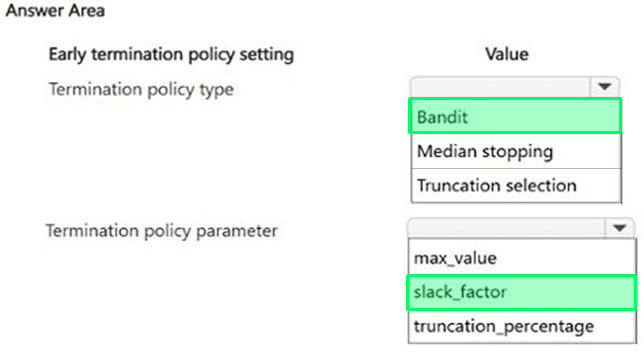
Box 1: Bandit The Bandit policy is the best termination policy type for this requirement.
Within Azure Machine Learning (Python SDK v2), a Bandit Policy terminates ongoing training runs if the primary performance metric drops below a specified threshold relative to the top-performing run to date.
Box 2: slack_factor To achieve this configuration, you should define the slack_factor parameter.
In the Azure Machine Learning Python SDK v2, the BanditPolicy class allows you to specify a drop-off threshold using either a relative ratio or an absolute value:
slack_factor: Specifies the allowable slack as a ratio or percentage relative to the best performing run. slack_amount: Specifies the allowable slack as an absolute distance or amount.Because your threshold requirement states that the primary metric cannot drop by a relative percentage (25% or more compared to the best run), you must use the ratio-based parameter. To configure a 25% allowable drop, you would set the slack_factor to 0.25.
You need to refine a GPT-5 model so that its performance and behavior align with the technical and business requirements of Fabrikam Inc.
Which two Foundry strategies should you apply? Each correct answer presents a complete solution. Choose two.
NOTE: Each correct selection is worth one point.
A
Supervised fine-tuning
B
Evaluations
C
Guardrails
D
Synthetic data generation
Reveal answer detailsClose answer details
Correct answersA, B
Explanation
Evaluations measure the model's current performance and behavior against Fabrikam's technical and business criteria, exposing the gaps that need correction. Supervised fine-tuning then uses curated input-output examples to adjust the model toward the required responses. Repeating the evaluations after tuning verifies whether that behavioral refinement achieved the intended alignment.
Question 9
Single choice
Note: This question is part of a series of questions that present the same scenario. Each question in the series contains a unique solution that might meet the stated goals. Some question sets might have more than one correct solution, while others might not have a correct solution.
After you answer a question in this section, you will NOT be able to return to it. As a result, these questions will not appear on the review screen.
An organization provisions Azure Machine Learning workspaces for development, test, and production environments.
Each environment must be deployed consistently and updated through source control. The deployment process must be automated, repeatable, and auditable.
You need to deploy Azure Machine Learning resources in a consistent and controlled manner.
Solution: Clone an existing Azure Machine Learning workspace to create additional environments.
Does the solution meet the goal?
A
Yes
B
No
Reveal answer detailsClose answer details
Correct answerB
Explanation
Cloning an existing workspace copies a current resource state, but it does not establish a versioned declaration that can be reviewed and reapplied consistently. Subsequent updates across development, test, and production would still lack an automated source-controlled deployment process. Consequently, cloning does not satisfy the repeatability and auditability requirements.
Question 10
Drag & drop
DRAG DROP
A company plans to deploy a foundation model in Microsoft Foundry.
The mode must support the following workloads:
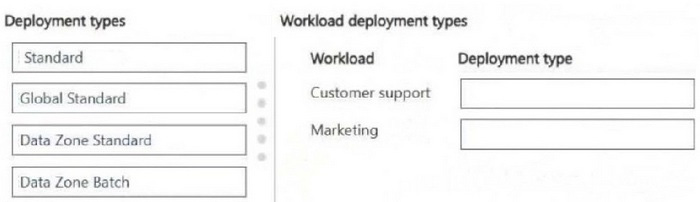
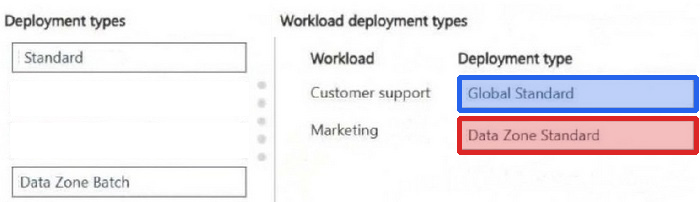
1. A customer support workload used across multiple regions 2. A marketing workload that must remain within a specific region due to data residency requirements.
You need to select the deployment type.
Which deployment type should you use for each workload? To answer, move the appropriate deployment types to the correct requirements. You may use each deployment type once, more than once, or not at all. You may need to move the split bar between panes or scroll to view content.
NOTE: Each correct selection is worth one point.
Reveal answer detailsClose answer details
Explanation
The deployment image maps the multi-region customer support workload to a global deployment type and the data-residency marketing workload to a regional deployment type. Global deployment supports broad availability, while a regional deployment keeps processing within the chosen region. Other deployment choices would either over-constrain the global workload or violate the residency requirement.
Question 11
Hotspot
HOTSPOT
You manage an Azure Machine Learning workspace named workspace1 by using the Python SDK v2.
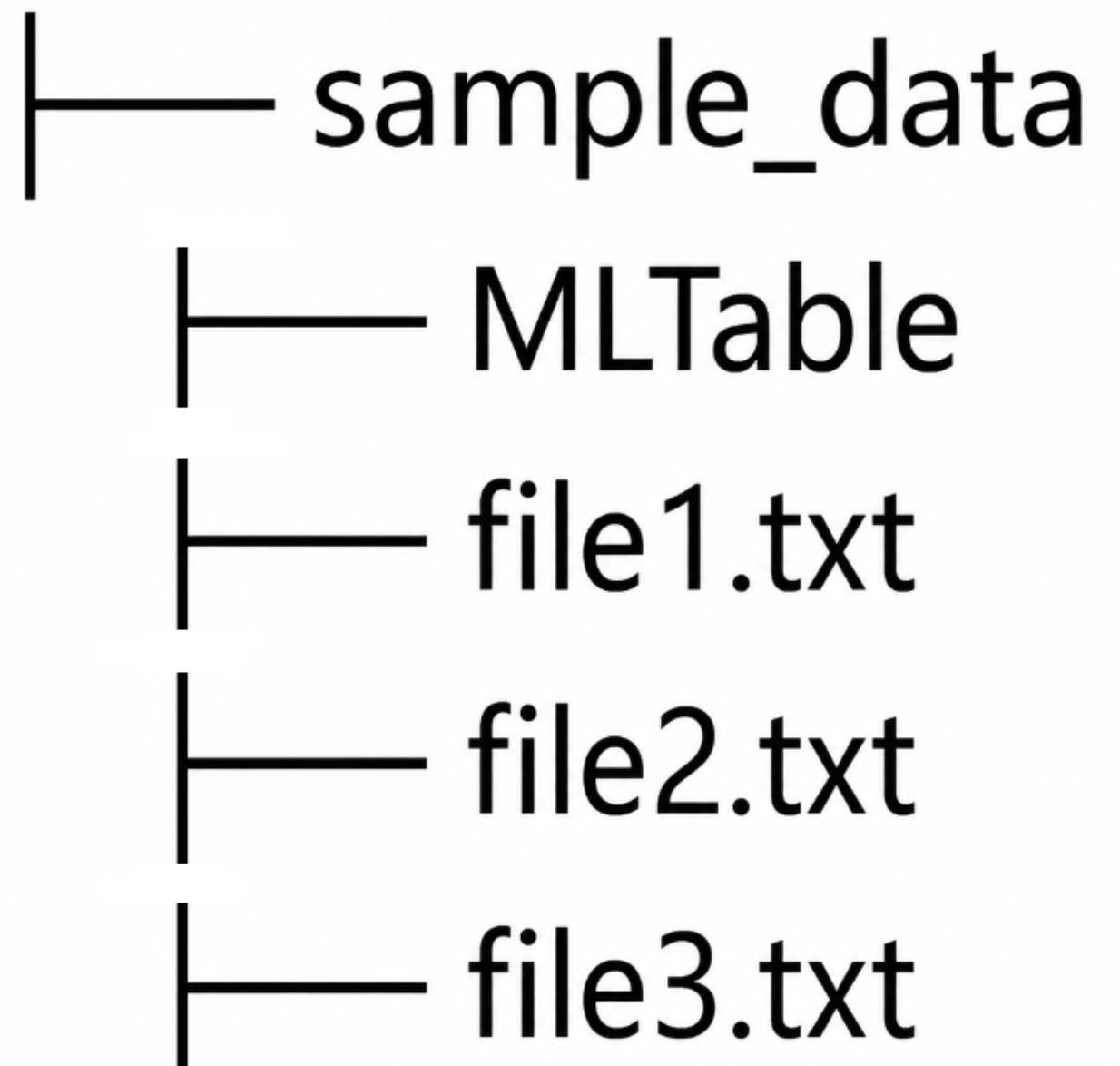
The default datastore of workspace1 contains a folder named sample_data. The folder structure contains the following content:
You write Python SDK v2 code to materialize the data from the files in the sample_data folder into a Pandas data frame.
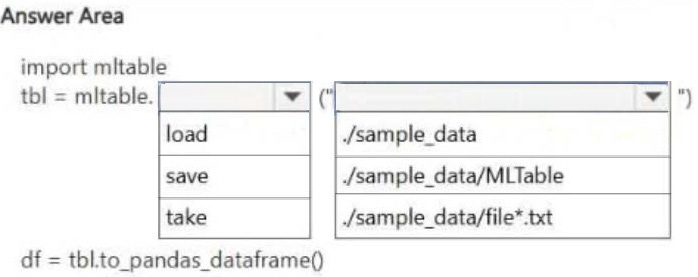
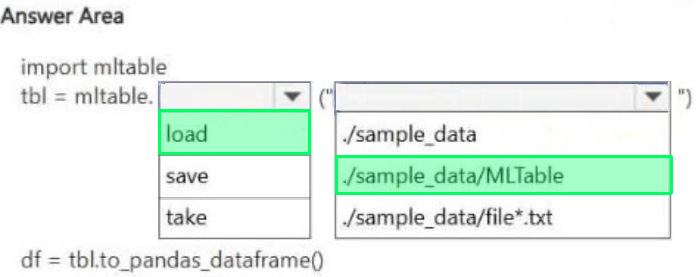
You need to complete the Python SDK v2 code to use the MLTable folder as the materialization blueprint.
How should you complete the code? To answer, select the appropriate options in the answer area.
NOTE: Each correct selection is worth one point
Reveal answer detailsClose answer details
Explanation
The answer uses the MLTable folder rather than an individual text file. In Azure Machine Learning, an MLTable is loaded from the folder that contains the MLTable metadata, so the path should target the sample_data directory. Other paths would either point to raw files or wildcard file matches and would not load the table definition required by the requirement.
Question 12
Single choice
You manage an Azure Machine Learning workspace. You have a folder that contains a CSV file. The folder is registered as a folder data asset.
You plan to use the folder data asset for data wrangling during interactive development.
You need to access and load the folder data asset into a Pandas data frame.
Which method should you use to achieve this goal?
A
mltable.load()
B
mltable.from_delimited_files()
C
mltable.from_parquet_files()
D
mltable.from_delta_lake()
Reveal answer detailsClose answer details
Correct answerB
Explanation
A CSV file is delimited data, so mltable.from_delimited_files() creates an MLTable definition from the file path or files contained in the registered folder. That table can then be materialized as a Pandas data frame during interactive work. The parquet and Delta Lake methods expect different storage formats, while mltable.load() loads an existing MLTable definition.
Question 13
Single choice
An Azure Machine Learning workspace contains multiple registered versions of a model that is used in production.
An older model version must no longer be deployable, but it must remain available for compliance review and potential rollback.
You need to change the state of the model version to meet the requirements.
What should you do?
A
Archive the training dataset for the model version.
B
Delete the model version.
C
Archive the model version.
D
Unregister the model version.
Reveal answer detailsClose answer details
Correct answerC
Explanation
Archiving the model version changes its lifecycle state so it is not offered for ordinary new deployment use, while retaining the registered version and its history. That preservation satisfies compliance review and keeps the version available if rollback is required. Deleting or unregistering it would conflict with the requirement to retain it.
Question 14
Single choice
An Azure Machine Learning workspace processes sensitive training data. The workspace must NOT be accessible from the public internet.
You need to restrict network access.
Which configuration should you implement?
A
Azure Firewall rules
B
Private endpoints
C
Network security groups
D
Service endpoints
Reveal answer detailsClose answer details
Correct answerB
Explanation
Private endpoints give the Azure Machine Learning workspace a private network path instead of exposing workspace access through the public internet. Clients can reach the workspace through private addressing within the configured network. Firewall rules, network security groups, and service endpoints alone do not replace the workspace's public access path with a private endpoint.
Question 15
Single choice
You manage a Microsoft Foundry project. You build a multi-turn chatbot application.
You plan to filter your traces to identify issues while observing how the application is responding.
The solution must not use an external knowledge base.
You need to select an evaluation metric.
Which built-in evaluator should you use?
A
RelevanceEvaluator
B
SimilarityEvaluator
C
QAEvaluator
D
CoherenceEvaluator
Reveal answer detailsClose answer details
Correct answerD
Explanation
CoherenceEvaluator evaluates whether a chatbot response is logically structured, clear, and consistent within the conversation. It is suitable for assessing multi-turn responses when the goal is to identify quality issues without comparing the output against external knowledge or reference data. This makes coherence an appropriate metric for observing how the application responds across conversational turns.
Question 16
Drag & drop
DRAG DROP
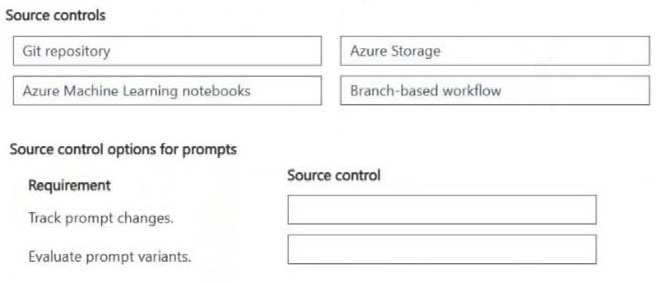
A team iterates prompts used by a generative AI agent. The team must support internal review before releasing changes.
The team must:
1. Track prompt changes with a clear history for audit and rollback. 2. Compare prompt variants in parallel without affecting the prompt used in the production environment.
You need to select the appropriate source control approach for each requirement.
What should you use for each requirement? To answer, move the appropriate source controls to the correct requirements. You may use each source control once, more than once, or not at all. You may need to move the split bar between panes or scroll to view content.
NOTE: Each correct selection is worth one point.
Reveal answer detailsClose answer details
Explanation
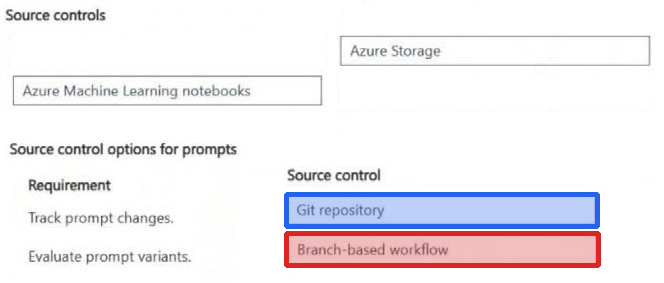
The source-control image maps prompt change tracking to Git and prompt evaluation to a review or comparison workflow before release. Git records history and ownership, while evaluation checks behavior before changes reach users. Other choices may store prompts, but they do not satisfy both traceability and internal review requirements
Question 17
Hotspot
HOTSPOT
You manage an Azure Machine Learning workspace. You configure an automated machine learning regression training job by using the Azure Machine Learning Python SDK v2.
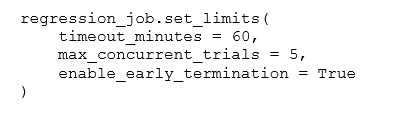
You configure the regression job by using the following script:
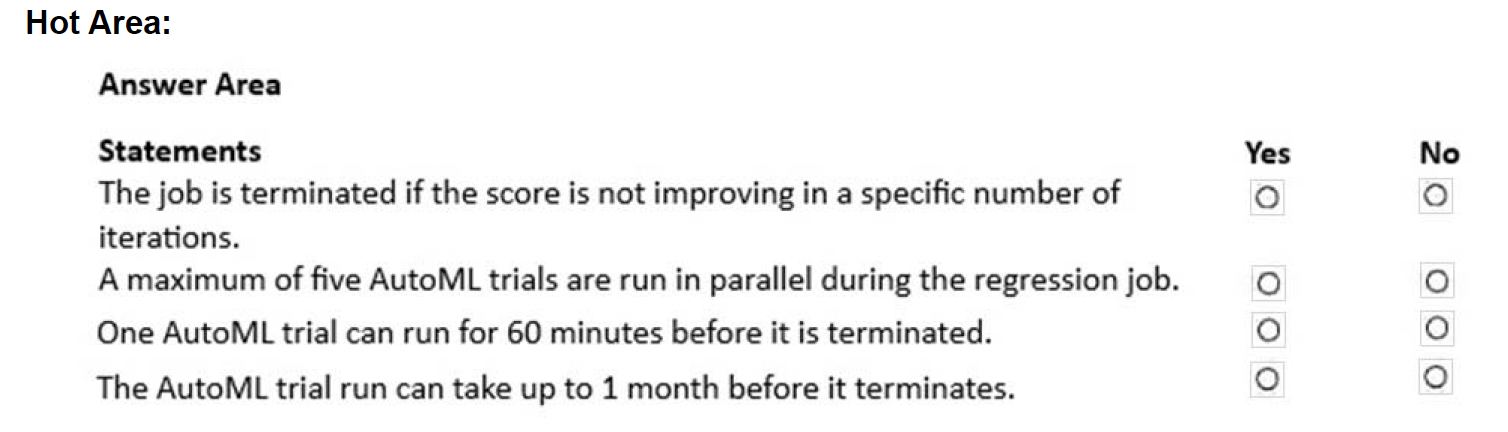
For each of the following statements, select Yes if the statement is true. Otherwise, select No.
NOTE: Each correct selection is worth one point.
Reveal answer detailsClose answer details
Explanation
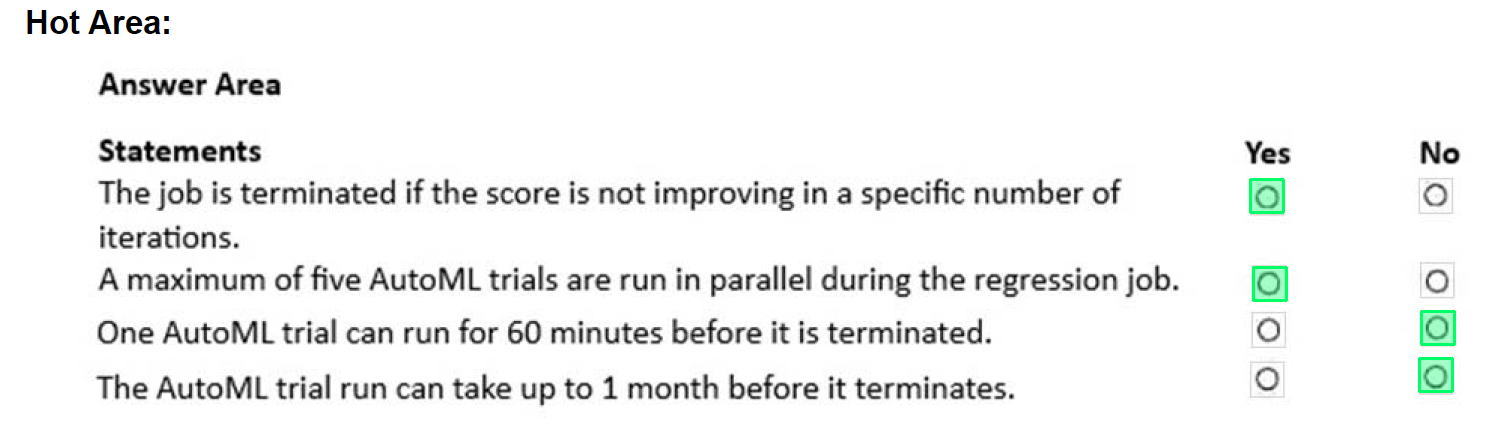
Box 1: Yes Yes, the automated machine learning (AutoML) training job will terminate early if the primary metric score stops improving after a specific number of iterations.
According to the official Microsoft Azure Machine Learning SDK v2 documentation, setting enable_early_termination = True activates the early stopping policy for the overall experiment.
How Early Termination Works in AutoML v2 The internal early stopping logic operates on a built-in schedule to avoid premature termination: First 20 iterations: No early stopping takes place (these serve as landmarks).
From the 21st iteration onward: The early stopping window activates.
Termination trigger: The job will automatically stop if the primary evaluation score fails to improve across 10 consecutive iterations.
Box 2: Yes Yes, a maximum of five trials can run at the same time.
The limit comes from the code settings. The max_concurrent_trials = 5 line tells Azure to run up to five trials at once.
Box 3: No No, a single AutoML trial cannot run for 60 minutes before it is terminated.
Parameter Breakdown In the Azure Machine Learning Python SDK v2, the set_limits() method handles timeouts via two distinct parameters:timeout_minutes = 60: This sets the maximum duration for the entire AutoML job (the experiment as a whole), including data preparation, featurization, and all training trials combined.
trial_timeout_minutes: This parameter governs the maximum time allowed for an individual trial (a single model training run) before termination.
Conclusion Because trial_timeout_minutes is omitted from your script, it defaults to its standard system value (which is typically 20 minutes for tabular datasets). Therefore, an individual trial will time out much earlier than 60 minutes. Additionally, since the entire job terminates at 60 minutes, it is physically impossible for a single trial to consume the full 60 minutes without forcing the termination of the remaining concurrent runs.
Box 4: No No, the AutoML trial cannot take up to 1 month before it terminates. Based on the script parameters, the job will terminate after a maximum of 60 minutes.
You have a deployment of an Azure OpenAI Service base model.
You plan to fine-tune the model.
You need to prepare a file that contains training data.
Which file format should you use?
A
CSV
B
TSV
C
JSONL
D
JSON
Reveal answer detailsClose answer details
Correct answerC
Explanation
Azure OpenAI fine-tuning training examples must be supplied in JSONL format. JSONL stores one complete JSON object on each line, so each training example can be parsed as an independent record. A regular JSON document, CSV file, or TSV file does not provide the required record structure for this fine-tuning input.
Question 19
Single choice
You create a multi-class image classification model with automated machine learning in Azure Machine Learning.
You need to prepare labeled image data as input for model training in the form of an Azure Machine Learning tabular dataset.
Which data format should you use?
A
Pascal VOC
B
COCO
C
JSON
D
JSONL
Reveal answer detailsClose answer details
Correct answerD
Explanation
JSONL represents each labeled image entry as a separate JSON object on its own line, which provides the record-oriented structure required for image classification training data in an Azure Machine Learning tabular dataset. Each record can associate an image reference with its class label, allowing the data to be read as individual labeled training examples.
Question 20
Hotspot
HOTSPOT
A team manages an Azure Machine Learning workspace to train and register machine learning models.
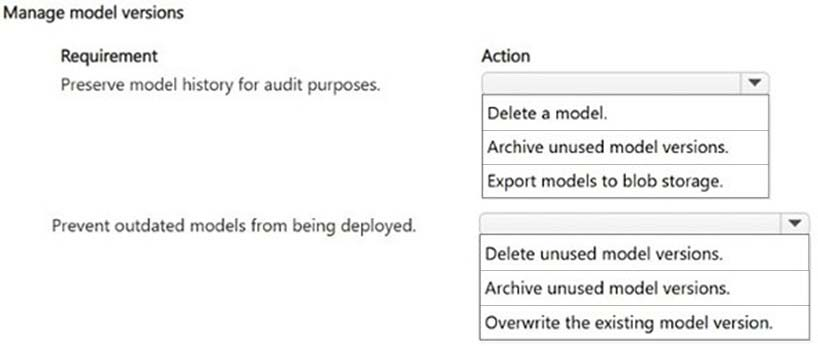
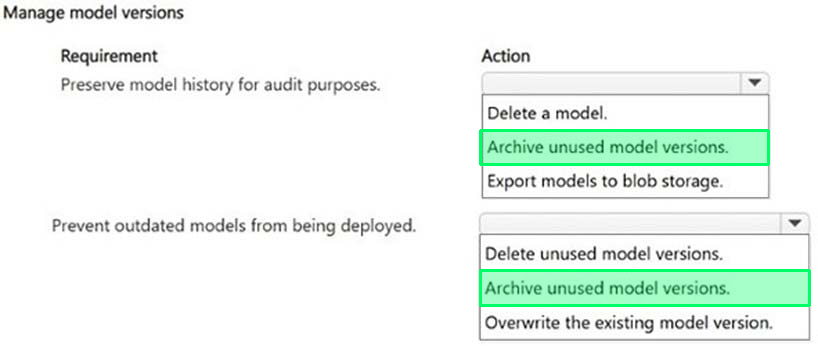
Previous model versions must be retained for audit and rollback purposes but must not be used for new deployments.
You need to manage model versions.
What should you do for each requirement? To answer, select the appropriate options in the answer area.
NOTE: Each correct selection is worth one point.
Reveal answer detailsClose answer details
Explanation
Box 1: Archive unused model versions Preserve Model history for audit purposes.
Archiving unused model versions is highly appropriate and recommended for this scenario.
Archiving hides unused versions from standard queries and clean user interfaces, while fully preserving the underlying artifacts and metadata required for compliance audits and production rollbacks.
Preserves Audit Trails: Archiving does not delete the model. It perfectly retains the model files, lineage, run histories, and regulatory logs required for compliance audits.
Enables Seamless Rollbacks: An archived model version remains active in your workflows. If a rollback becomes necessary, you can directly reference or restore the archived model to standard views via the Azure ML CLI.
Declutters the Registry: Standard commands like az ml model list ignore archived components. This simplifies your view to display only active models without disrupting underlying production pipelines.
Box 2: Archive unused model versions Prevent outdate models from being deployed.
Archiving hides unused versions from standard queries and clean user interfaces, while fully preserving the underlying artifacts and metadata required for compliance audits and production rollbacks.
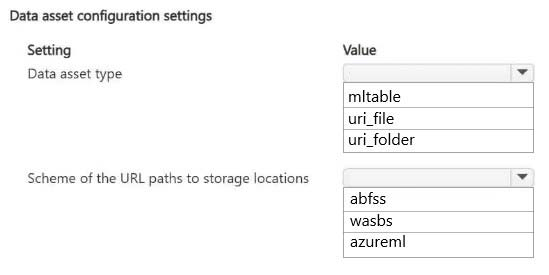
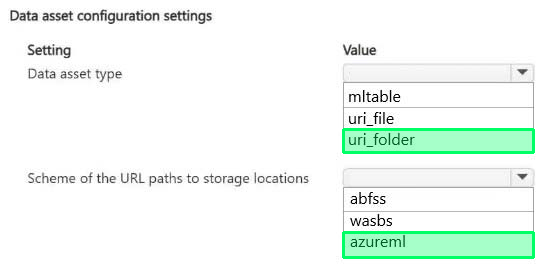
You have an Azure Machine Learning workspace and a collection of image files stored in two Azure Blob Storage accounts.
You need to configure data asset properties.
Which values should you use in your configuration? To answer, select the appropriate options in the answer area.
NOTE: Each correct selection is worth one point.
Reveal answer detailsClose answer details
Explanation
Box 1: uri_folder The best data asset type for this scenario is a File data asset (uri_file or uri_folder).
In Azure Machine Learning, image files used for training computer vision models are best managed as file-based data assets because machine learning frameworks read individual images directly from storage paths rather than tabular rows.
Preserves Formats: Keeps images in their native formats (PNG, JPEG).Direct Access: Allows training scripts to mount or download files easily.
*-> Folder Mapping: A uri_folder references the entire directory containing your images.
Efficiency: Avoids the overhead of parsing unstructured binary data into a table.
Box 2: azureml To point a uri_folder data asset to your Azure Blob Storage locations in Azure Machine Learning, you should use the azureml:// URI scheme.
This is the recommended, modern standard that leverages Azure ML datastores for secure tokenless access. Alternatively, you can use direct Azure Storage URI schemes depending on your configuration
Recommended Scheme: Azure ML Datastore. This scheme abstracts the storage credentials by referencing an Azure ML Datastore.
You run Azure Machine Learning training experiments. The training scripts directory contains 100 files that includes a file named .amlignore. The directory also contains subdirectories named ./outputs and ./logs.
There are 20 files in the training scripts directory that must be excluded from the snapshot to the compute targets. You create a file named .gitignore in the root of the directory. You add the names of the 20 files to the .gitignore file. These 20 files continue to be copied to the compute targets.
You need to exclude the 20 files.
What should you do?
A
Move the file named .gitignore to the ./logs directory.
B
Move the file named .gitignore to the ./outputs directory.
C
Add the contents of the file named .amlignore to the file named .gitignore.
D
Copy the contents of the file named .gitignore to the file named .amlignore.
Reveal answer detailsClose answer details
Correct answerD
Explanation
The presence of .amlignore means Azure Machine Learning uses that file to determine which source files are excluded from the snapshot sent to compute. Entries added only to .gitignore therefore do not change the snapshot. Copying those exclusion patterns into .amlignore applies them to the training source upload and prevents the 20 named files from being copied.
Question 23
Single choice
You are authoring a notebook in Azure Machine Learning studio.
You must install packages from the notebook into the currently running kernel. The installation must be limited to the currently running kernel only.
You need to install the packages.
Which magic function should you use?
A
!pip
B
!conda
C
%load
D
%pip
Reveal answer detailsClose answer details
Correct answerD
Explanation
The %pip magic runs package installation in the context of the notebook's current Python kernel. This keeps the installation aligned with the interpreter that is executing the notebook, which satisfies the kernel-specific requirement. A shell command such as !pip can resolve to a different executable, while %load does not install packages.
Question 24
Single choice
Users report throttling, and a newer model version must be tested without removing the current production version. What should the operations team do?
A
Add application replicas and update the existing model deployment to the newer family version.
B
Change the model version in place, then reduce request concurrency if quality declines.
C
Keep the current deployment and route all requests to an unversioned catalog model for comparison.
D
Check quota, deploy explicit versions with suitable capacity, and evaluate the new deployment before shifting traffic.
Reveal answer detailsClose answer details
Correct answerD
Explanation
Quota and suitable deployment capacity address throttling at the model-serving layer. Deploying explicit versions keeps the current production version intact while creating a distinct candidate whose behavior and capacity can be evaluated. Only after that evaluation should traffic shift, preserving continuity and a rollback path instead of replacing the working version in place.
Question 25
Hotspot
HOTSPOT
You manage an Azure OpenAI deployment of the gpt-4o base model.
You plan to fine-tune the deployed model.
You need to prepare a file that contains training data.
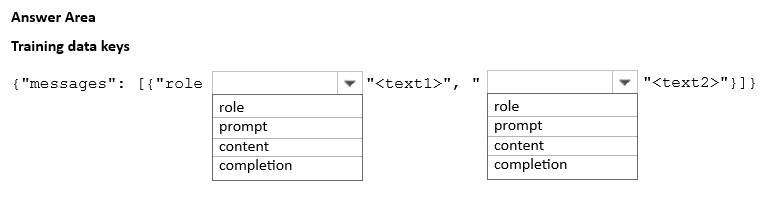
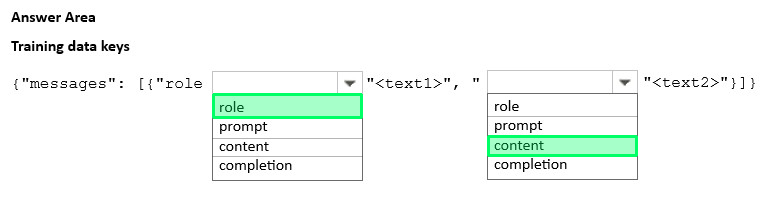
Which keys should you include in each line of the training data file? To answer, select the appropriate options in the answer area.
NOTE: Each correct selection is worth one point.
Reveal answer detailsClose answer details
Explanation
For fine-tuning conversational models like gpt-4o on Azure OpenAI, the training file must be formatted in a JSON Lines (.jsonl) file, where each line represents a single training conversation. Each line must strictly contain a messages key wrapping an array of message objects.
Box 1: role role: Defines the sender of the message. The accepted strings for fine-tuning are "system", "user", or "assistant".
Box 2: content content: Contains the actual text string or multi-modal payload of the message.
To reproduce a prior run exactly after a dataset's contents change, how should the dataset be managed?
A
Keep one friendly asset name and replace its underlying files whenever data changes.
B
Copy the changed files to each compute target and record only the local path in run logs.
C
Publish immutable data asset versions and have reproducible runs reference a pinned version.
D
Resolve the friendly asset name at runtime so the run always receives the newest contents.
Reveal answer detailsClose answer details
Correct answerC
Explanation
An immutable data asset version preserves the exact dataset contents used by a run even after newer data is published. Pinning the run to that version prevents a friendly name from resolving to changed files during reproduction. This stable reference links execution to a specific data snapshot, allowing the prior run to receive the same input rather than the latest contents.
Question 27
Drag & drop
DRAG DROP
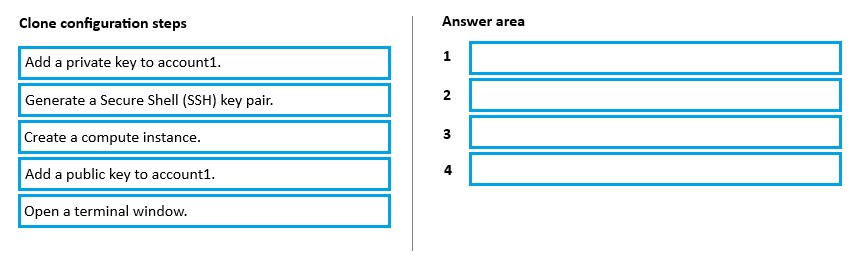
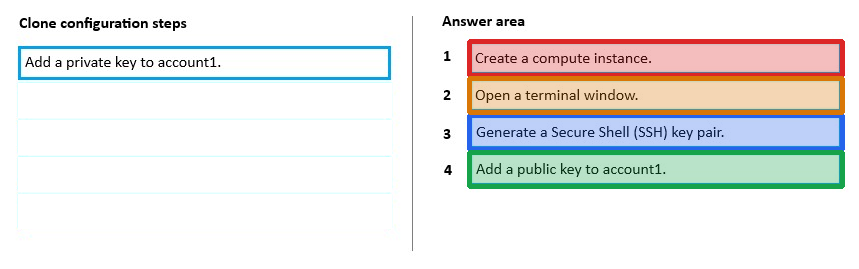
You have an Azure Machine Learning workspace named WS1 and a GitHub account named account1 that hosts a private repository named repo1.
You need to clone repo1 to make it available directly from WS1. The configuration must maximize the performance of the repo1 clone.
Which four actions should you perform in sequence?
Reveal answer detailsClose answer details
Explanation
Step 1: Create a compute instance Git integration for Azure Machine Learning
Clone Git repositories into your workspace file system Azure Machine Learning provides a shared file system for all users in the workspace. To clone a Git repository into this file share, we recommend that you create a compute instance (Step 1) & open a terminal (Step 2). Once the terminal is opened, you have access to a full Git client and can clone and work with Git via the Git CLI experience.
We recommend that you clone the repository into your user directory so that others will not make collisions directly on your working branch.
Step 2: Open a terminal window
Step 3: Generate a Secure Shell (SSH) key pair Authenticate your Git Account with SSH Generate a new SSH key
1. Open the terminal window in the Azure Machine Learning Notebook Tab.
2. Paste the text below, substituting in your email address.
A team is building a Retrieval-Augmented Generation (RAG) system.
The team observes that the retrieved documents are often irrelevant or incomplete.
You need to improve retrieval accuracy.
What should you adjust?
A
Chunk size and overlap
B
Temperature parameter
C
Token limits
D
Embedding strategy
Reveal answer detailsClose answer details
Correct answerA
Explanation
Chunk size determines how much related document content is represented together during indexing and retrieval. Overlap carries context across adjacent chunk boundaries so that information spanning a split is not lost. Adjusting both can reduce incomplete passages and improve how closely retrieved units correspond to a query, directly addressing irrelevant or partial retrieval results.
Question 29
Hotspot
HOTSPOT
A team retrains a machine learning model on a weekly basis by using updated training data.
The team must be able to rerun any previous experiment by using the exact data that was available at the time it was originally run. The solution must preserve historical versions of the data without duplicating training scripts.
You need to manage the data so that experiments can be reproduced reliably.
Which workspace actions should you perform? To answer, select the appropriate options in the answer area.
NOTE: Each correct selection is worth one point.
Reveal answer detailsClose answer details
Explanation
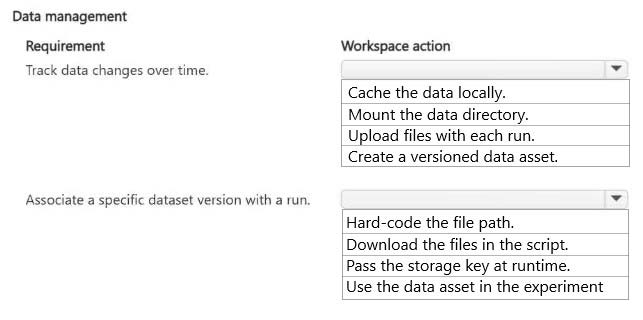
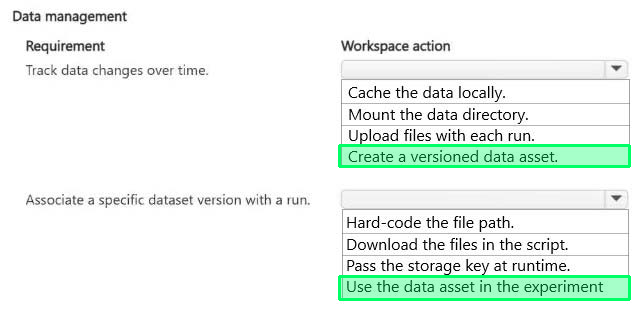
Box 1: Create a versioned dataset Track data changes over time.
Creating a versioned dataset in your machine learning workspace configuration is the correct and industry-standard way to solve this.
Versioned datasets allow you to decouple your training scripts from your data state. This approach satisfies all your constraints without duplicating code or creating messy infrastructure.
Enables Reproducibility: Every time you run a training job, you log the specific dataset version used (e.g., v1, v2, v3). To rerun a historical experiment, you simply call that specific version identifier.
Prevents Code Duplication: Your training scripts remain identical. They accept a dataset version as an input parameter rather than pointing to hardcoded file paths. Tracks Weekly Updates: When the weekly data refresh occurs, you register the new data as v+1 in the workspace registry, keeping a clean chronological ledger.
Box 2: Use the data asset in the experiment Associate a specific dataset version with a run.
To best associate a specific dataset version with a run in the workspace, you should use the data asset in the experiment.
Automatic Lineage: Registering data as a versioned data asset automatically tracks which exact version was used in which specific run.
Exact Reproducibility: You can look back at any historical run and instantly identify or retrieve the precise data state used at that moment.
No Script Duplication: Your training scripts remain decoupled from the data, satisfying your requirement to preserve history without changing code.
Incorrect: [Pass the storage key at runtime] Passing a storage key at runtime only connects the run to a storage location, not a specific, immutable version of the data at a frozen point in time.
You have a deployment of an Azure OpenAI Service base model.
You plan to fine-tune the model.
You need to prepare a file that contains training data for multi-turn chat.
Which file encoding method should you use?
A
ISO-8859-1
B
UTF-16
C
UTF-8
D
ASCII
Reveal answer detailsClose answer details
Correct answerC
Explanation
The multi-turn chat training file must use UTF-8 encoding. UTF-8 represents the JSONL text consistently and supports the full range of characters that can occur in conversation messages. Using UTF-16, ISO-8859-1, or ASCII would not satisfy the required encoding for the fine-tuning data.
Question 31
Single choice
Note: This question is part of a series of questions that present the same scenario. Each question in the series contains a unique solution that might meet the stated goals. Some question sets might have more than one correct solution, while others might not have a correct solution.
After you answer a question in this section, you will NOT be able to return to it. As a result, these questions will not appear on the review screen.
You work in Microsoft Foundry with a prompt flow.
You must manually evaluate prompts and compare results across prompt variants.
You need to capture the inputs, outputs, token usage, and latencies for each flow run for the evaluation.
Solution: Create prompt variants and compare their outputs in the Evaluation experience.
Does the solution meet the goal?
A
Yes
B
No
Reveal answer detailsClose answer details
Correct answerB
Explanation
Creating prompt variants and comparing their generated outputs supports manual quality comparison, but that action alone does not capture the complete per-run operational record required here. Inputs, outputs, token usage, and latency must be recorded for each flow execution. The proposed Evaluation experience comparison therefore leaves required run details uncollected.
Question 32
Single choice
Note: This question is part of a series of questions that present the same scenario. Each question in the series contains a unique solution that might meet the stated goals. Some question sets might have more than one correct solution, while others might not have a correct solution.
After you answer a question in this section, you will NOT be able to return to it. As a result, these questions will not appear in the review screen.
You have an Azure Machine Learning workspace. You connect to a terminal session from the Notebooks page in Azure Machine Learning studio.
You plan to add a new Jupyter kernel that will be accessible from the same terminal session.
You need to perform the task that must be completed before you can add the new kernel.
Solution: Delete the Python 3.6 - AzureML kernel.
Does the solution meet the goal?
A
Yes
B
No
Reveal answer detailsClose answer details
Correct answerB
Explanation
Removing the Python 3.6 - AzureML kernel is not a prerequisite for adding another Jupyter kernel. Existing kernels can remain available independently, and deleting one neither creates the dependency environment for the new kernel nor registers that kernel with Jupyter. The proposed deletion therefore does not perform the required preparatory task.
MICROSOFT
Microsoft Certified: Machine Learning Operations (MLOps) Engineer Associate
You complete the fine-tuning of a generative model in Microsoft Foundry. The fine-tuned model now appears as a new model variant in your development environment.
The deployment process must ensure that proper validation and control is maintained.
You need to promote the fine-tuned model from development to production.
Which three actions should you perform in sequence? To answer, move the appropriate actions from the list of actions to the answer area and arrange them in the correct order.
Correct Answer:
Explanation
Explanation/Reference:
Step 1: Register the fine-tuned model version. If Using Microsoft Azure AI Foundry
Microsoft Azure AI Foundry manages fine-tuned generative models using a centralized registry, cloud evaluation metrics, and secure gateway deployments.
1. Register the Fine-Tuned Model Variant Capture Artifacts: Ensure your successful fine-tuning job is officially registered in your project's model catalog. Create a Asset Version: Save the specific iteration with strict version tags (e.g., v1.0.0-gold) to serve as an immutable reference asset.
Step 2: Evaluate and validate the model.
2. Evaluate for Production Readiness Run Evaluation Pipelines: Navigate to the Evaluation tab to execute automated testing using a golden dataset (a ground-truth reference dataset).Assess Generative Metrics: Measure quality parameters like groundedness, relevance, coherence, and fluency.
Validate Safety Boundaries: Run built-in evaluations for content safety, checking for leaks of personally identifiable information (PII) or harmful content generation.
Step 3: Create a Global Standard deployment 3. Promote fine-tuned models to production in Microsoft Foundry by using the promote feature in the AI Foundry SDK, or by manually recreating the agent configuration in a production-isolated project. Deploy to the Global Standard Tier for your production environment, as it includes strict SLAs, data residency guarantees, and quota limits required for live traffic.
An organization runs a customer-facing generative AI application built by using Microsoft Foundry. The application uses multiple prompts linked to multiple workflows to generate responses in production.
The application occasionally returns incomplete responses. The model call succeeds, but the final message sometimes stops early.
The issue cannot be reproduced reliably in development.
You need to identify where and why response generation is terminating early in production.
Which approach should you use?
A.
Run a pre-release evaluation workflow to score groundedness and relevance on a test dataset.
B.
Enable tracing and logging so that each workflow can be inspected.
C.
Increase max_tokens and temperature to reduce the chance of early termination.
D.
Replace the deployed model with a smaller model to reduce variability across responses.
Correct Answer: B
Explanation
Explanation/Reference:
Tracing preserves the sequence of operations across the prompts, model call, and linked workflows, while structured logging records the relevant state and completion details at each step. This makes it possible to locate the exact production stage where output stops and distinguish workflow termination from a successful model invocation. Offline quality scoring would not diagnose an intermittent execution path.
QUESTION 3
DRAG DROP
A team deploys a classification model to production and scores incoming customer data daily.
After several weeks, business stakeholders report unexpected changes in prediction behavior, even though the endpoint remains healthy.
You need to determine whether data drift is occurring and if it is, identify the appropriate actions.
Which action should you perform for each observed signal? To answer, move the appropriate actions to the correct observed signals. You may use each action once, more than once, or not at all. You may need to move the split bar between panes or scroll to view content.
NOTE: Each correct selection is worth one point.
Correct Answer:
Explanation
Explanation/Reference:
Box 1: Analyze dataset drift metrics Input feature distributions differ from training data.
The direct action you must take when input feature distributions differ from the training data is to retrain the model using the updated data distribution.
This scenario describes a classic case of data drift (also known as covariate shift). While the endpoint infrastructure remains perfectly healthy, the statistical properties of the production data have shifted away from the baseline training data, leading to a degradation in predictive behavior.
Box 2: Analyze dataset drift metrics
Model accuracy drops without code changes. You should analyze dataset drift metrics to identify why the model accuracy dropped without any changes to the code. In production machine learning, dataset drift occurs when the statistical properties of the input data change over time. Even if your Azure Machine Learning endpoint remains perfectly healthy and functional, changes in the real-world data distribution will cause the model's predictive performance to degrade. This phenomenon is often referred to as data drift or concept drift.
Box 3: Investigate scaling and infrastructure metrics Endpoint latency increases under load.
You should immediately investigate infrastructure metrics, as latency spikes under load typically indicate resource exhaustion.
You manage a Retrieval-Augmented Generation (RAG) system that uses Azure AI Search to retrieve documents from an indexed knowledge base.
The system must support the following retrieval requirements:
1. Queries that include exact policy identifiers must return matching documents even when semantic similarity is low. 2. Natural-language questions must prioritize semantically relevant documents even when keywords are not an exact match.
You need to configure the retrieval approach to meet the requirements.
How should you configure the retrieval behavior for each requirement? To answer, select the appropriate
options in the answer area.
NOTE: Each correct selection is worth one point.
Correct Answer:
Explanation
Explanation/Reference:
The image maps exact identifier matching to keyword-style retrieval and natural-language relevance to semantic or vector retrieval. Hybrid search combines these approaches so identifiers can be matched precisely while conceptual queries still retrieve relevant passages. Other single-mode retrieval choices would miss one side of the requirement and reduce RAG quality.
QUESTION 5
DRAG DROP
You are fine-tuning an LLM base model by using Microsoft Foundry. You have a labeled dataset of customer emails.
You need to improve task-specific prediction accuracy so that the model can be tested and deployed later.
Which three actions should you perform in sequence? To answer, move the appropriate actions from the list of actions to the answer area and arrange them in the correct order.
Correct Answer:
Explanation
Explanation/Reference:
Step 1: Upload and format the training dataset in JSON format. Upload and Format Training Data (JSONL) You need to format your labeled emails so the model can learn from them.
Format Requirements: In Microsoft Foundry, training and validation files must be prepared in a JSONL (JSON Lines) format.
Structure: Each line should represent a single conversation or input-output pair. For email tasks (like classification, summarization, or routing), this usually consists of a messages array.
Step 2: Start the fine-tuning jobs in Microsoft Foundry. Start Supervised Fine-Tuning (SFT) Jobs
Once your data is uploaded to a private Azure storage account or directly through the UI, you will initiate the training process.
Technique: Choose Supervised Fine-Tuning (SFT). SFT is designed for teaching models specific tasks (like specific tone alignment or labeling) on labeled data.
Execution: Through the Azure AI Foundry Model Catalog, select your base model (e.g., GPT-4o-mini or Llama Scout), upload your train/validation JSONL files, and submit the job.
Experimentation: Foundry also supports hyperparameter settings (like learning rates and batch sizes) which you can tweak if needed.
Step 3: Evaluate the performance of the model on a validation dataset. Evaluate and Deploy
Fine-tuning is an iterative process. Before deploying to a production environment, you must evaluate the model to ensure it meets your specific task accuracy goals.
Evaluation: Use Foundry's built-in evaluation tools and your validation dataset to benchmark the fine-tuned student model against the baseline base model.
Deployment: Once task-specific prediction accuracy is confirmed using validation metrics, you can host and deploy the model directly on Azure AI Foundry for your applications to consume.
You have several machine learning models registered in an Azure Machine Learning workspace.
You must use the Fairlearn dashboard to assess fairness in a selected model.
Which three actions should you perform in sequence? To answer, move the appropriate actions from the list of actions to the answer area and arrange them in the correct order.
Correct Answer:
Explanation
Explanation/Reference:
Step 1: Select a metric to measured You need to choose a baseline performance or fairness metric (such as accuracy rate, precision, or demographic parity) along which the dashboard evaluates the model's overall behavior and cross-group disparities.
Step 2: Select a model feature to evaluated You must specify a sensitive feature (such as age, gender, or race) to split the data into different subgroups and evaluate potential disparities across them.
Step 3: Select a binary classification or regression model The Fairlearn package is specifically designed to assess and mitigate unfairness in binary classification and regression tasks. It does not natively support clustering or multiclass models for group fairness assessments in this wizard.
You use Azure Machine Learning to implement hyperparameter tuning for an Azure ML Python SDK v2- based model training.
Training runs must terminate when the primary metric is lowered by 25 percent or more compared to the best performing run.
You need to configure an early termination policy to terminate training jobs.
Which values should you use? To answer, select the appropriate options in the answer area. NOTE: Each correct selection is worth one point. Hot Area:
Correct Answer:
Explanation
Explanation/Reference:
Box 1: Bandit The Bandit policy is the best termination policy type for this requirement.
Within Azure Machine Learning (Python SDK v2), a Bandit Policy terminates ongoing training runs if the primary performance metric drops below a specified threshold relative to the top-performing run to date.
Box 2: slack_factor To achieve this configuration, you should define the slack_factor parameter.
In the Azure Machine Learning Python SDK v2, the BanditPolicy class allows you to specify a drop-off threshold using either a relative ratio or an absolute value:
slack_factor: Specifies the allowable slack as a ratio or percentage relative to the best performing run. slack_amount: Specifies the allowable slack as an absolute distance or amount.Because your threshold requirement states that the primary metric cannot drop by a relative percentage (25% or more compared to the best run), you must use the ratio-based parameter. To configure a 25% allowable drop, you would set the slack_factor to 0.25.
You need to refine a GPT-5 model so that its performance and behavior align with the technical and business requirements of Fabrikam Inc.
Which two Foundry strategies should you apply? Each correct answer presents a complete solution. Choose two.
NOTE: Each correct selection is worth one point.
A.
Supervised fine-tuning
B.
Evaluations
C.
Guardrails
D.
Synthetic data generation
Correct Answer: AB
Explanation
Explanation/Reference:
Evaluations measure the model's current performance and behavior against Fabrikam's technical and business criteria, exposing the gaps that need correction. Supervised fine-tuning then uses curated input-output examples to adjust the model toward the required responses. Repeating the evaluations after tuning verifies whether that behavioral refinement achieved the intended alignment.
QUESTION 9
Note: This question is part of a series of questions that present the same scenario. Each question in the series contains a unique solution that might meet the stated goals. Some question sets might have more than one correct solution, while others might not have a correct solution.
After you answer a question in this section, you will NOT be able to return to it. As a result, these questions will not appear on the review screen.
An organization provisions Azure Machine Learning workspaces for development, test, and production environments.
Each environment must be deployed consistently and updated through source control. The deployment process must be automated, repeatable, and auditable.
You need to deploy Azure Machine Learning resources in a consistent and controlled manner.
Solution: Clone an existing Azure Machine Learning workspace to create additional environments.
Does the solution meet the goal?
A.
Yes
B.
No
Correct Answer: B
Explanation
Explanation/Reference:
Cloning an existing workspace copies a current resource state, but it does not establish a versioned declaration that can be reviewed and reapplied consistently. Subsequent updates across development, test, and production would still lack an automated source-controlled deployment process. Consequently, cloning does not satisfy the repeatability and auditability requirements.
QUESTION 10
DRAG DROP
A company plans to deploy a foundation model in Microsoft Foundry.
The mode must support the following workloads:
1. A customer support workload used across multiple regions 2. A marketing workload that must remain within a specific region due to data residency requirements.
You need to select the deployment type.
Which deployment type should you use for each workload? To answer, move the appropriate deployment types to the correct requirements. You may use each deployment type once, more than once, or not at all. You may need to move the split bar between panes or scroll to view content.
NOTE: Each correct selection is worth one point.
Correct Answer:
Explanation
Explanation/Reference:
The deployment image maps the multi-region customer support workload to a global deployment type and the data-residency marketing workload to a regional deployment type. Global deployment supports broad availability, while a regional deployment keeps processing within the chosen region. Other deployment choices would either over-constrain the global workload or violate the residency requirement.
QUESTION 11
HOTSPOT
You manage an Azure Machine Learning workspace named workspace1 by using the Python SDK v2.
The default datastore of workspace1 contains a folder named sample_data. The folder structure contains the following content:
You write Python SDK v2 code to materialize the data from the files in the sample_data folder into a Pandas data frame.
You need to complete the Python SDK v2 code to use the MLTable folder as the materialization blueprint.
How should you complete the code? To answer, select the appropriate options in the answer area.
NOTE: Each correct selection is worth one point
Correct Answer:
Explanation
Explanation/Reference:
The answer uses the MLTable folder rather than an individual text file. In Azure Machine Learning, an MLTable is loaded from the folder that contains the MLTable metadata, so the path should target the sample_data directory. Other paths would either point to raw files or wildcard file matches and would not load the table definition required by the requirement.
QUESTION 12
You manage an Azure Machine Learning workspace. You have a folder that contains a CSV file. The folder is registered as a folder data asset.
You plan to use the folder data asset for data wrangling during interactive development.
You need to access and load the folder data asset into a Pandas data frame.
Which method should you use to achieve this goal?
A.
mltable.load()
B.
mltable.from_delimited_files()
C.
mltable.from_parquet_files()
D.
mltable.from_delta_lake()
Correct Answer: B
Explanation
Explanation/Reference:
A CSV file is delimited data, so mltable.from_delimited_files() creates an MLTable definition from the file path or files contained in the registered folder. That table can then be materialized as a Pandas data frame during interactive work. The parquet and Delta Lake methods expect different storage formats, while mltable.load() loads an existing MLTable definition.
QUESTION 13
An Azure Machine Learning workspace contains multiple registered versions of a model that is used in production.
An older model version must no longer be deployable, but it must remain available for compliance review and potential rollback.
You need to change the state of the model version to meet the requirements.
What should you do?
A.
Archive the training dataset for the model version.
B.
Delete the model version.
C.
Archive the model version.
D.
Unregister the model version.
Correct Answer: C
Explanation
Explanation/Reference:
Archiving the model version changes its lifecycle state so it is not offered for ordinary new deployment use, while retaining the registered version and its history. That preservation satisfies compliance review and keeps the version available if rollback is required. Deleting or unregistering it would conflict with the requirement to retain it.
QUESTION 14
An Azure Machine Learning workspace processes sensitive training data. The workspace must NOT be accessible from the public internet.
You need to restrict network access.
Which configuration should you implement?
A.
Azure Firewall rules
B.
Private endpoints
C.
Network security groups
D.
Service endpoints
Correct Answer: B
Explanation
Explanation/Reference:
Private endpoints give the Azure Machine Learning workspace a private network path instead of exposing workspace access through the public internet. Clients can reach the workspace through private addressing within the configured network. Firewall rules, network security groups, and service endpoints alone do not replace the workspace's public access path with a private endpoint.
QUESTION 15
You manage a Microsoft Foundry project. You build a multi-turn chatbot application.
You plan to filter your traces to identify issues while observing how the application is responding.
The solution must not use an external knowledge base.
You need to select an evaluation metric.
Which built-in evaluator should you use?
A.
RelevanceEvaluator
B.
SimilarityEvaluator
C.
QAEvaluator
D.
CoherenceEvaluator
Correct Answer: D
Explanation
Explanation/Reference:
CoherenceEvaluator evaluates whether a chatbot response is logically structured, clear, and consistent within the conversation. It is suitable for assessing multi-turn responses when the goal is to identify quality issues without comparing the output against external knowledge or reference data. This makes coherence an appropriate metric for observing how the application responds across conversational turns.
QUESTION 16
DRAG DROP
A team iterates prompts used by a generative AI agent. The team must support internal review before releasing changes.
The team must:
1. Track prompt changes with a clear history for audit and rollback. 2. Compare prompt variants in parallel without affecting the prompt used in the production environment.
You need to select the appropriate source control approach for each requirement.
What should you use for each requirement? To answer, move the appropriate source controls to the correct requirements. You may use each source control once, more than once, or not at all. You may need to move the split bar between panes or scroll to view content.
NOTE: Each correct selection is worth one point.
Correct Answer:
Explanation
Explanation/Reference:
The source-control image maps prompt change tracking to Git and prompt evaluation to a review or comparison workflow before release. Git records history and ownership, while evaluation checks behavior before changes reach users. Other choices may store prompts, but they do not satisfy both traceability and internal review requirements
QUESTION 17
HOTSPOT
You manage an Azure Machine Learning workspace. You configure an automated machine learning regression training job by using the Azure Machine Learning Python SDK v2.
You configure the regression job by using the following script:
For each of the following statements, select Yes if the statement is true. Otherwise, select No.
NOTE: Each correct selection is worth one point.
Correct Answer:
Explanation
Explanation/Reference:
Box 1: Yes Yes, the automated machine learning (AutoML) training job will terminate early if the primary metric score stops improving after a specific number of iterations.
According to the official Microsoft Azure Machine Learning SDK v2 documentation, setting enable_early_termination = True activates the early stopping policy for the overall experiment.
How Early Termination Works in AutoML v2 The internal early stopping logic operates on a built-in schedule to avoid premature termination: First 20 iterations: No early stopping takes place (these serve as landmarks).
From the 21st iteration onward: The early stopping window activates.
Termination trigger: The job will automatically stop if the primary evaluation score fails to improve across 10 consecutive iterations.
Box 2: Yes Yes, a maximum of five trials can run at the same time.
The limit comes from the code settings. The max_concurrent_trials = 5 line tells Azure to run up to five trials at once.
Box 3: No No, a single AutoML trial cannot run for 60 minutes before it is terminated.
Parameter Breakdown In the Azure Machine Learning Python SDK v2, the set_limits() method handles timeouts via two distinct parameters:timeout_minutes = 60: This sets the maximum duration for the entire AutoML job (the experiment as a whole), including data preparation, featurization, and all training trials combined.
trial_timeout_minutes: This parameter governs the maximum time allowed for an individual trial (a single model training run) before termination.
Conclusion Because trial_timeout_minutes is omitted from your script, it defaults to its standard system value (which is typically 20 minutes for tabular datasets). Therefore, an individual trial will time out much earlier than 60 minutes. Additionally, since the entire job terminates at 60 minutes, it is physically impossible for a single trial to consume the full 60 minutes without forcing the termination of the remaining concurrent runs.
Box 4: No No, the AutoML trial cannot take up to 1 month before it terminates. Based on the script parameters, the job will terminate after a maximum of 60 minutes.
You have a deployment of an Azure OpenAI Service base model.
You plan to fine-tune the model.
You need to prepare a file that contains training data.
Which file format should you use?
A.
CSV
B.
TSV
C.
JSONL
D.
JSON
Correct Answer: C
Explanation
Explanation/Reference:
Azure OpenAI fine-tuning training examples must be supplied in JSONL format. JSONL stores one complete JSON object on each line, so each training example can be parsed as an independent record. A regular JSON document, CSV file, or TSV file does not provide the required record structure for this fine-tuning input.
QUESTION 19
You create a multi-class image classification model with automated machine learning in Azure Machine Learning.
You need to prepare labeled image data as input for model training in the form of an Azure Machine Learning tabular dataset.
Which data format should you use?
A.
Pascal VOC
B.
COCO
C.
JSON
D.
JSONL
Correct Answer: D
Explanation
Explanation/Reference:
JSONL represents each labeled image entry as a separate JSON object on its own line, which provides the record-oriented structure required for image classification training data in an Azure Machine Learning tabular dataset. Each record can associate an image reference with its class label, allowing the data to be read as individual labeled training examples.
QUESTION 20
HOTSPOT
A team manages an Azure Machine Learning workspace to train and register machine learning models.
Previous model versions must be retained for audit and rollback purposes but must not be used for new deployments.
You need to manage model versions.
What should you do for each requirement? To answer, select the appropriate options in the answer area.
NOTE: Each correct selection is worth one point.
Correct Answer:
Explanation
Explanation/Reference:
Box 1: Archive unused model versions Preserve Model history for audit purposes.
Archiving unused model versions is highly appropriate and recommended for this scenario.
Archiving hides unused versions from standard queries and clean user interfaces, while fully preserving the underlying artifacts and metadata required for compliance audits and production rollbacks.
Preserves Audit Trails: Archiving does not delete the model. It perfectly retains the model files, lineage, run histories, and regulatory logs required for compliance audits.
Enables Seamless Rollbacks: An archived model version remains active in your workflows. If a rollback becomes necessary, you can directly reference or restore the archived model to standard views via the Azure ML CLI.
Declutters the Registry: Standard commands like az ml model list ignore archived components. This simplifies your view to display only active models without disrupting underlying production pipelines.
Box 2: Archive unused model versions Prevent outdate models from being deployed.
Archiving hides unused versions from standard queries and clean user interfaces, while fully preserving the underlying artifacts and metadata required for compliance audits and production rollbacks.
You have an Azure Machine Learning workspace and a collection of image files stored in two Azure Blob Storage accounts.
You need to configure data asset properties.
Which values should you use in your configuration? To answer, select the appropriate options in the answer area.
NOTE: Each correct selection is worth one point.
Correct Answer:
Explanation
Explanation/Reference:
Box 1: uri_folder The best data asset type for this scenario is a File data asset (uri_file or uri_folder).
In Azure Machine Learning, image files used for training computer vision models are best managed as file-based data assets because machine learning frameworks read individual images directly from storage paths rather than tabular rows.
Preserves Formats: Keeps images in their native formats (PNG, JPEG).Direct Access: Allows training scripts to mount or download files easily.
*-> Folder Mapping: A uri_folder references the entire directory containing your images.
Efficiency: Avoids the overhead of parsing unstructured binary data into a table.
Box 2: azureml To point a uri_folder data asset to your Azure Blob Storage locations in Azure Machine Learning, you should use the azureml:// URI scheme.
This is the recommended, modern standard that leverages Azure ML datastores for secure tokenless access. Alternatively, you can use direct Azure Storage URI schemes depending on your configuration
Recommended Scheme: Azure ML Datastore. This scheme abstracts the storage credentials by referencing an Azure ML Datastore.
You run Azure Machine Learning training experiments. The training scripts directory contains 100 files that includes a file named .amlignore. The directory also contains subdirectories named ./outputs and ./logs.
There are 20 files in the training scripts directory that must be excluded from the snapshot to the compute targets. You create a file named .gitignore in the root of the directory. You add the names of the 20 files to the .gitignore file. These 20 files continue to be copied to the compute targets.
You need to exclude the 20 files.
What should you do?
A.
Move the file named .gitignore to the ./logs directory.
B.
Move the file named .gitignore to the ./outputs directory.
C.
Add the contents of the file named .amlignore to the file named .gitignore.
D.
Copy the contents of the file named .gitignore to the file named .amlignore.
Correct Answer: D
Explanation
Explanation/Reference:
The presence of .amlignore means Azure Machine Learning uses that file to determine which source files are excluded from the snapshot sent to compute. Entries added only to .gitignore therefore do not change the snapshot. Copying those exclusion patterns into .amlignore applies them to the training source upload and prevents the 20 named files from being copied.
QUESTION 23
You are authoring a notebook in Azure Machine Learning studio.
You must install packages from the notebook into the currently running kernel. The installation must be limited to the currently running kernel only.
You need to install the packages.
Which magic function should you use?
A.
!pip
B.
!conda
C.
%load
D.
%pip
Correct Answer: D
Explanation
Explanation/Reference:
The %pip magic runs package installation in the context of the notebook's current Python kernel. This keeps the installation aligned with the interpreter that is executing the notebook, which satisfies the kernel-specific requirement. A shell command such as !pip can resolve to a different executable, while %load does not install packages.
QUESTION 24
Users report throttling, and a newer model version must be tested without removing the current production version. What should the operations team do?
A.
Add application replicas and update the existing model deployment to the newer family version.
B.
Change the model version in place, then reduce request concurrency if quality declines.
C.
Keep the current deployment and route all requests to an unversioned catalog model for comparison.
D.
Check quota, deploy explicit versions with suitable capacity, and evaluate the new deployment before shifting traffic.
Correct Answer: D
Explanation
Explanation/Reference:
Quota and suitable deployment capacity address throttling at the model-serving layer. Deploying explicit versions keeps the current production version intact while creating a distinct candidate whose behavior and capacity can be evaluated. Only after that evaluation should traffic shift, preserving continuity and a rollback path instead of replacing the working version in place.
QUESTION 25
HOTSPOT
You manage an Azure OpenAI deployment of the gpt-4o base model.
You plan to fine-tune the deployed model.
You need to prepare a file that contains training data.
Which keys should you include in each line of the training data file? To answer, select the appropriate options in the answer area.
NOTE: Each correct selection is worth one point.
Correct Answer:
Explanation
Explanation/Reference:
For fine-tuning conversational models like gpt-4o on Azure OpenAI, the training file must be formatted in a JSON Lines (.jsonl) file, where each line represents a single training conversation. Each line must strictly contain a messages key wrapping an array of message objects.
Box 1: role role: Defines the sender of the message. The accepted strings for fine-tuning are "system", "user", or "assistant".
Box 2: content content: Contains the actual text string or multi-modal payload of the message.
To reproduce a prior run exactly after a dataset's contents change, how should the dataset be managed?
A.
Keep one friendly asset name and replace its underlying files whenever data changes.
B.
Copy the changed files to each compute target and record only the local path in run logs.
C.
Publish immutable data asset versions and have reproducible runs reference a pinned version.
D.
Resolve the friendly asset name at runtime so the run always receives the newest contents.
Correct Answer: C
Explanation
Explanation/Reference:
An immutable data asset version preserves the exact dataset contents used by a run even after newer data is published. Pinning the run to that version prevents a friendly name from resolving to changed files during reproduction. This stable reference links execution to a specific data snapshot, allowing the prior run to receive the same input rather than the latest contents.
QUESTION 27
DRAG DROP
You have an Azure Machine Learning workspace named WS1 and a GitHub account named account1 that hosts a private repository named repo1.
You need to clone repo1 to make it available directly from WS1. The configuration must maximize the performance of the repo1 clone.
Which four actions should you perform in sequence?
Correct Answer:
Explanation
Explanation/Reference:
Step 1: Create a compute instance Git integration for Azure Machine Learning
Clone Git repositories into your workspace file system Azure Machine Learning provides a shared file system for all users in the workspace. To clone a Git repository into this file share, we recommend that you create a compute instance (Step 1) & open a terminal (Step 2). Once the terminal is opened, you have access to a full Git client and can clone and work with Git via the Git CLI experience.
We recommend that you clone the repository into your user directory so that others will not make collisions directly on your working branch.
Step 2: Open a terminal window
Step 3: Generate a Secure Shell (SSH) key pair Authenticate your Git Account with SSH Generate a new SSH key
1. Open the terminal window in the Azure Machine Learning Notebook Tab.
2. Paste the text below, substituting in your email address.
A team is building a Retrieval-Augmented Generation (RAG) system.
The team observes that the retrieved documents are often irrelevant or incomplete.
You need to improve retrieval accuracy.
What should you adjust?
A.
Chunk size and overlap
B.
Temperature parameter
C.
Token limits
D.
Embedding strategy
Correct Answer: A
Explanation
Explanation/Reference:
Chunk size determines how much related document content is represented together during indexing and retrieval. Overlap carries context across adjacent chunk boundaries so that information spanning a split is not lost. Adjusting both can reduce incomplete passages and improve how closely retrieved units correspond to a query, directly addressing irrelevant or partial retrieval results.
QUESTION 29
HOTSPOT
A team retrains a machine learning model on a weekly basis by using updated training data.
The team must be able to rerun any previous experiment by using the exact data that was available at the time it was originally run. The solution must preserve historical versions of the data without duplicating training scripts.
You need to manage the data so that experiments can be reproduced reliably.
Which workspace actions should you perform? To answer, select the appropriate options in the answer area.
NOTE: Each correct selection is worth one point.
Correct Answer:
Explanation
Explanation/Reference:
Box 1: Create a versioned dataset Track data changes over time.
Creating a versioned dataset in your machine learning workspace configuration is the correct and industry-standard way to solve this.
Versioned datasets allow you to decouple your training scripts from your data state. This approach satisfies all your constraints without duplicating code or creating messy infrastructure.
Enables Reproducibility: Every time you run a training job, you log the specific dataset version used (e.g., v1, v2, v3). To rerun a historical experiment, you simply call that specific version identifier.
Prevents Code Duplication: Your training scripts remain identical. They accept a dataset version as an input parameter rather than pointing to hardcoded file paths. Tracks Weekly Updates: When the weekly data refresh occurs, you register the new data as v+1 in the workspace registry, keeping a clean chronological ledger.
Box 2: Use the data asset in the experiment Associate a specific dataset version with a run.
To best associate a specific dataset version with a run in the workspace, you should use the data asset in the experiment.
Automatic Lineage: Registering data as a versioned data asset automatically tracks which exact version was used in which specific run.
Exact Reproducibility: You can look back at any historical run and instantly identify or retrieve the precise data state used at that moment.
No Script Duplication: Your training scripts remain decoupled from the data, satisfying your requirement to preserve history without changing code.
Incorrect: [Pass the storage key at runtime] Passing a storage key at runtime only connects the run to a storage location, not a specific, immutable version of the data at a frozen point in time.
You have a deployment of an Azure OpenAI Service base model.
You plan to fine-tune the model.
You need to prepare a file that contains training data for multi-turn chat.
Which file encoding method should you use?
A.
ISO-8859-1
B.
UTF-16
C.
UTF-8
D.
ASCII
Correct Answer: C
Explanation
Explanation/Reference:
The multi-turn chat training file must use UTF-8 encoding. UTF-8 represents the JSONL text consistently and supports the full range of characters that can occur in conversation messages. Using UTF-16, ISO-8859-1, or ASCII would not satisfy the required encoding for the fine-tuning data.
QUESTION 31
Note: This question is part of a series of questions that present the same scenario. Each question in the series contains a unique solution that might meet the stated goals. Some question sets might have more than one correct solution, while others might not have a correct solution.
After you answer a question in this section, you will NOT be able to return to it. As a result, these questions will not appear on the review screen.
You work in Microsoft Foundry with a prompt flow.
You must manually evaluate prompts and compare results across prompt variants.
You need to capture the inputs, outputs, token usage, and latencies for each flow run for the evaluation.
Solution: Create prompt variants and compare their outputs in the Evaluation experience.
Does the solution meet the goal?
A.
Yes
B.
No
Correct Answer: B
Explanation
Explanation/Reference:
Creating prompt variants and comparing their generated outputs supports manual quality comparison, but that action alone does not capture the complete per-run operational record required here. Inputs, outputs, token usage, and latency must be recorded for each flow execution. The proposed Evaluation experience comparison therefore leaves required run details uncollected.
QUESTION 32
Note: This question is part of a series of questions that present the same scenario. Each question in the series contains a unique solution that might meet the stated goals. Some question sets might have more than one correct solution, while others might not have a correct solution.
After you answer a question in this section, you will NOT be able to return to it. As a result, these questions will not appear in the review screen.
You have an Azure Machine Learning workspace. You connect to a terminal session from the Notebooks page in Azure Machine Learning studio.
You plan to add a new Jupyter kernel that will be accessible from the same terminal session.
You need to perform the task that must be completed before you can add the new kernel.
Solution: Delete the Python 3.6 - AzureML kernel.
Does the solution meet the goal?
A.
Yes
B.
No
Correct Answer: B
Explanation
Explanation/Reference:
Removing the Python 3.6 - AzureML kernel is not a prerequisite for adding another Jupyter kernel. Existing kernels can remain available independently, and deleting one neither creates the dependency environment for the new kernel nor registers that kernel with Jupyter. The proposed deletion therefore does not perform the required preparatory task.