Question 1
Fill in the blank
Identify the signs and symptoms of generalized hypothermia and how you would assess a patient experiencing hypothermia.
Reveal answer details
Close answer details
Accepted answerCold or cool skin temperature. Place the back of the hand between the clothing and the patient's abdomen to assess the general temperature of the patient. The patient experiencing a generalized cold emergency will present with cold abdominal skin temperature; a decreasing mental status or motor function, which directly correlates with a degree of hypothermia.
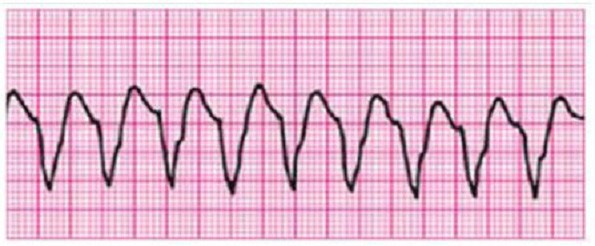 You are monitoring a patient. Chest discomfort has been relieved with sublingual nitrates and morphine sulfate 4 mg IV. He suddenly has the above persistent rhythm. You ask about symptoms and he reports mild palpitations, but otherwise he is clinically stable with unchanged vital signs. Your next action is:
-
A
Give sedation and perform synchronized cardioversion
-
B
Administer amiodarone 150 mg over 10 minutes; seek expert consultation
-
C
Give immediate synchronized shock
-
D
Give immediate unsynchronized shock
-
E
Administer magnesium sulfate 1 to 2 g IV diluted in 10 mL D5W given over 5 to 20 minutes
Reveal answer details
Close answer details
T/F: DNR orders require a written order from a physician.
-
A
-
B
Reveal answer details
Close answer details
What are the end points of a procainamide loading infusion in the non-arrest situation?
-
A
pretreatment QRS complex is widened by 50%
-
B
-
C
17 mg/kg drug has been injected
-
D
the dysrhythmia is suppressed
-
E
Reveal answer details
Close answer details
Question 5
Fill in the blank
What is the treatment for verapamil overdose?
Reveal answer details
Close answer details
Accepted answerCalcium chloride.
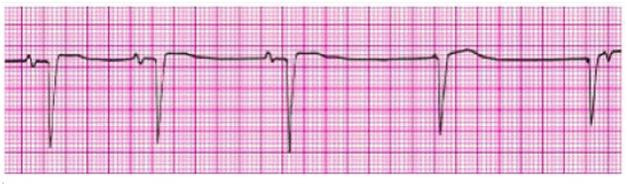 A patient becomes unresponsive and you are uncertain if a faint pulse is present with the above rhythm.
You next action is
-
A
Start an IV and give epinephrine 1 mg IV
-
B
Consider causes for pulseless electrical activity
-
C
Start an IV and give atropine 1 mg
-
D
Order transcutaneous pacing
-
E
Begin CPR with high-quality chest compressions
Reveal answer details
Close answer details
Question 7
Fill in the blank
What precautions should you take in ventilating a patient with suspected trauma or neck injury?
Reveal answer details
Close answer details
Accepted answerImmobilize the head and neck. Have an assistant immobilize or immobilize between your knees.
Question 8
Fill in the blank
If while ventilating a patient the chest does not rise and fall, what should you do after repositioning the head?
Reveal answer details
Close answer details
Accepted answerIf air is escaping from under the mask, reposition fingers and mask.
Question 9
Fill in the blank
How does the trachea in an adult and child differ?
Reveal answer details
Close answer details
Accepted answerInfants and children have narrower tracheas that are obstructed more easily by swelling, and the trachea is also softer and more flexible. The cricoid cartilage is less developed and less rigid, and is the narrowest portion of the child's airway.
Question 10
Single choice
A patient complains of shortness of breath and chest pain radiating to the neck. Blood pressure is 80/50 mm Hg and the respiratory rate is 40 per minute. Oxygen and an IV has been started. The monitor shows the following rhythm. What should the next treatment be? 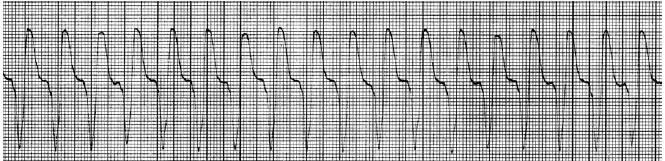
-
A
-
B
-
C
sedation, then synchronized cardioversion
-
D
Reveal answer details
Close answer details
Question 11
Multiple choice
Bag-valve-mask devices (Choose two.):
-
A
may be used by untrained individuals
-
B
with high flow and a reservoir deliver close to 100% oxygen
-
C
aredifficultfor one person to use effectively
-
D
usually provide greater tidal volume than mouth-to-mask ventilation
Reveal answer details
Close answer details
Question 12
Fill in the blank
What is the appropriate dose of a medication given by endotracheal tube?
Reveal answer details
Close answer details
Accepted answerIdioventricular rhythm or complete heart block
Question 13
Fill in the blank
What is the most common dangerous rhythm following the onset of atraumatic cardiac arrest in adults?
Reveal answer details
Close answer details
Accepted answerVentricular fibrillation
Question 14
Fill in the blank
In what type of rhythm may lidocaine be lethal?
Reveal answer details
Close answer details
Accepted answerIdioventricular rhythm or complete heart block
Question 15
Single choice
A 70-kg emergency department patient has pulseless electrical activity. An IV is started and a saline infusion is begun. What should the first treatment be?
-
A
-
B
-
C
-
D
sodium bicarbonate 1 ampule
Reveal answer details
Close answer details
Question 16
Single choice
Endotracheal intubation complications include:
Vocal cord injury, dental damage, esophageal intubation, and right main bronchus intubation. In a patient refractory to atropine, when is external pacing indicated?
-
A
pulseless electrical activity
-
B
-
C
-
D
symptomatic ventricular fibrillation
Reveal answer details
Close answer details
Question 17
Single choice
A patient with a possible acute coronary syndrome has ongoing chest discomfort unresponsive to 3 sublingual nitroglycerin tablets. There are no contraindications and 4 mg of morphine sulfate was administered. Shortly, blood pressure falls to 88/60 mmHg and the patient complains of increased chest discomfort. You would:
-
A
Give nitroglycerin 0.4 mg sublingually
-
B
Give normal saline 250 ml_to 500 ml_fluid bolus
-
C
Start dopamine at 2 ug/kg per minute and titrate to BP 100 mmHg systolic
-
D
Give an additional 2 mg of morphine sulfate
Reveal answer details
Close answer details
Question 18
Multiple choice
After placement of an endotracheal tube, ventilate (Choose two.):
-
A
at 10-15 breaths per minute
-
B
after the 5th compression
-
C
asynchronously to cardiac compressions
-
D
Reveal answer details
Close answer details
Question 19
Fill in the blank
Identify the respiratory variations that may be seen in both the early and late hypothermic patient.
Reveal answer details
Close answer details
Accepted answerA patient suffering from early signs of hypothermia will experience rapid breathing. Patients suffering from late hypothermia may experience shallow, slow, or even absent breathing.
Question 20
Multiple choice
Drugs useful in the treatment of cardiogenic pulmonary edema include (Choose three.)
-
A
-
B
-
C
-
D
-
E
Reveal answer details
Close answer details
Question 21
Fill in the blank
What complications can arise from a tracheostomy tube?
Reveal answer details
Close answer details
Accepted answerDisplacement, obstruction, bleeding, infection, air leakage
Question 22
Fill in the blank
A 5-year-old child is evaluated by paramedics for "difficulty breathing." Paramedics find the child is not breathing, is pulseless, and apneic. The monitor shows a bradyarrhythmia at 30 beats/min. What should be the first intervention?
Reveal answer details
Close answer details
Accepted answerCheck the airway.
Question 23
Single choice
A patient has the following rhythm refractory to adenosine IV and verapamil IV. Before treatment, the heart rate was 200 beats/min and his blood pressure was 110/70 mm Hg. After treatment, the heart rate remains at 200 beats/minute and the blood pressure is 60 mm Hg systolic. What should the immediate treatment be? 
-
A
-
B
-
C
synchronized cardioversion at 50-100 J
-
D
verapamil 10 mg IV over 1-2 minutes
Reveal answer details
Close answer details
Question 24
Single choice
T/F: In a hypothermic patient, endotracheal intubation should be withheld as it may precipitate cardiac arrest.
-
A
-
B
Reveal answer details
Close answer details
Question 25
Multiple choice
Greater defibrillating current is expected with which of the following? (Choose three.)
-
A
-
B
-
C
-
D
Reveal answer details
Close answer details
Question 26
Single choice
A patient is in pulseless ventricular tachycardia. Two shocks and one dose of epinephrine have been given. The next drug/dose to anticipate to administer is
-
A
-
B
-
C
-
D
-
E
Reveal answer details
Close answer details
Question 27
Single choice
T/F: Ventricular fibrillation produces no cardiac output.
-
A
-
B
Reveal answer details
Close answer details
Question 28
Fill in the blank
Describe the function of the arteries that are located within the body.
Reveal answer details
Close answer details
Accepted answerArteries carry blood from the heart to the rest of the body.
Question 29
Fill in the blank
Describe the major function of the aorta.
Reveal answer details
Close answer details
Accepted answerThe aorta is the major artery originating from the heart and lying in front of the spine in the thoracic and abdominal cavities. This provides blood flow to the rest of the vascular system in the body.
Question 30
Fill in the blank
What sizes of masks should you carry for the bag-valve-mask?
Reveal answer details
Close answer details
Accepted answerInfant, child, and adult.
Question 31
Single choice
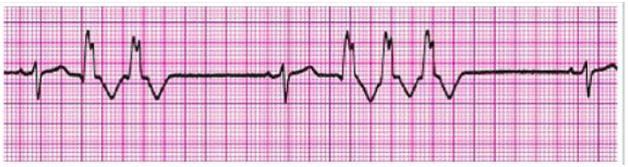 A patient has been resuscitated from cardiac arrest and is being prepared for transport. She is incubated and is receiving 100% oxygen. During the resuscitation she received 2 doses of epinephrine 1 mg, atropine 1 mg. and lidocaine 100 mg IV. You now observe the above rhythm on the cardiac monitor. The rhythm abnormality is becoming more frequent and increasing in number. You should order:
-
A
Give amiodarone 300 mg IV, start infusion
-
B
Give lidocaine 1 to 1.5 mg IV
-
C
Repeat epinephrine 1 mg IV
-
D
Give lidocaine 0.5 to 0.75 mg/kg IV, start lidocaine infusion
-
E
Give amiodarone 150 mg IV, start infusion
Reveal answer details
Close answer details
Question 32
Single choice
Expansion of circulating fluid volume with normal saline is recommended in all cardiac arrests.
-
A
-
B
Reveal answer details
Close answer details
Question 33
Single choice
-
A
-
B
-
C
-
D
Reveal answer details
Close answer details
Question 34
Fill in the blank
In addition to a pressure relief valve, what safety features should a flow-restricted oxygen-powered ventilation device have?
Reveal answer details
Close answer details
Accepted answerAn audible alarm that sounds whenever the relief-valve pressure is exceeded.
Question 35
Multiple choice
Regarding epinephrine, which of the following statements are true? (Choose three.)
-
A
increases coronary perfusion
-
B
IV bolus dose is 1 mg q 3? minutes
-
C
treatment for hypotensive ventricular tachycardia
-
D
increases cerebral blood flow during CPR
Reveal answer details
Close answer details
Question 36
Fill in the blank
In order to obtain expressed consent from a patient, that patient must . . .
Reveal answer details
Close answer details
Accepted answerBe of legal age, be able to make rational decisions, and must be informed of the steps of the procedures and all related risks.
Question 37
Single choice
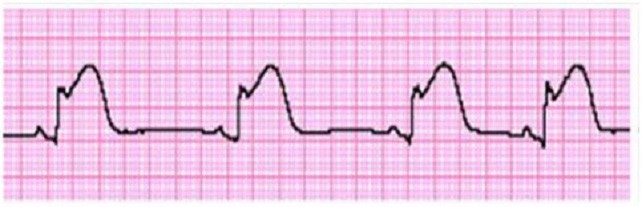 You arrive on-scene and find a 56-year-old diabetic woman complaining of chest discomfort. She is pale and diaphoretic, complaining of lightheadedness. Her blood pressure is 80/60 mmHg. The cardiac monitor documents the rhythm above. She is receiving oxygen at 4 L/min by nasal cannula, and an IV has been established. Transcutaneous pacing has been requested but is not yet available. Your next order is
-
A
Give morphine sulfate 4 mg IV
-
B
Start dopamine at 2 to 10 ug/kg per minute
-
C
-
D
-
E
Give nitroglycerin 0.4 mg SL
Reveal answer details
Close answer details
Question 38
Fill in the blank
What is the most common cause of electrical activity without measurable blood pressure?
Reveal answer details
Close answer details
Accepted answerHypovolemia. Diagnose by history and look for flat neck veins.
Question 39
Fill in the blank
Breath sounds cannot be heard following endotracheal intubation. What is the most likely problem?
Reveal answer details
Close answer details
Accepted answerEsophageal intubation
Question 40
Fill in the blank
A 60-year-old patient presents with a blood pressure of 80/40, heart rate 200, and respiratory rate 24. The nurse has placed oxygen on the patient. The following rhythm is seen on the monitor. What is the treatment? 
Reveal answer details
Close answer details
Accepted answerSynchronized cardioversion Synchronized cardioversion. (The rhythm seen above shows supraventricular tachycardia.)
Question 41
Fill in the blank
How should the trigger be positioned on a flow-restricted oxygen-powered ventilation device?
Reveal answer details
Close answer details
Accepted answerIn such a way that both hands of the EMT can remain on the mask to hold it in position.
Question 42
Fill in the blank
Identify those questions that are important to ask regarding a patient suffering from exposure to the environment.
Reveal answer details
Close answer details
Accepted answerWhat is the source of their exposure? What particular environment where they in? Have they experienced any loss of consciousness? What effects are they feeling in their body?
Question 43
Single choice
T/F: Endotracheal intubation reduces the risk of aspiration of gastric contents.
-
A
-
B
Reveal answer details
Close answer details
Question 44
Fill in the blank
Describe the function of platelets within the cardiovascular system.
Reveal answer details
Close answer details
Accepted answerPlatelets are essential for the formation of blood clots.
Question 45
Single choice
T/F: In order for there to be a duty to act, a contractual or legal obligation must exist.
-
A
-
B
Reveal answer details
Close answer details
Question 46
Single choice
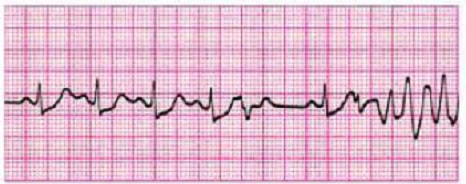 Identify the rhythm by selecting the best single answer:
-
A
-
B
-
C
-
D
Reentry supraventricular tachycardia
-
E
-
F
Second-degree AV Block (Mobitz 1 Wenckebach)
-
G
Second-degree AV Block (Mobitz II Block)
-
H
-
I
-
J
-
K
Monomorphic ventricular tachycardia
-
L
Polymorphic ventricular tachycardia
-
M
Coarse ventricular fibrillation
-
N
Fine ventricular fibrillation
-
O
-
P
Pulseless electrical activity
Reveal answer details
Close answer details
|