Preview real exam questions, verified answers and available explanations before choosing a study plan.
Question 1
Single choice
You have 5 applications on your Appian platform in production. Users are now beginning to use multiple applications across the platform, and the client wants to ensure a consistent user experience across all applications You notice that some applications use rich text some use section layouts, and others use box layouts. The result is that each application has a different color and size for the header.
What would you recommend to ensure consistency across the platform?
A
Create constants for text size and color, and update each section lo reference these values.
B
In the common application, create a rule that can be used across the platform for section headers, and update each application to reference this new rule
C
In the common application, create one rule for each application, and update each application to reference its respective rule
D
In each individual application, create a rule that can be used lot tot section headers, and update each application lo reference its respective rule
Reveal answer detailsClose answer details
Correct answerB
Explanation
The best way to ensure consistency across the platform is to create a rule that can be used across the platform for section headers. This rule can be created in the common application, and then each application can be updated to reference this rule. This will ensure that all of the applications use the same color and size for the header, which will provide a consistent user experience. The other options are not as effective. Option A, creating constants for text size and color, and updating each section to reference these values, would require updating each section in each application. This would be a lot of work, and it would be easy to make mistakes. Option C, creating one rule for each application, would also require updating each application. This would be less work than option A, but it would still be a lot of work, and it would be easy to make mistakes. Option D, creating a rule in each individual application, would not ensure consistency across the platform. Each application would have its own rule, and the rules could be different. This would not provide a consistent user experience. Best Practices: When designing a platform, it is important to consider the user experience. A consistent user experience will make it easier for users to learn and use the platform. When creating rules, it is important to use them consistently across the platform. This will ensure that the platform has a consistent look and feel. When updating the platform, it is important to test the changes to ensure that they do not break the user experience.
Question 2
Hotspot
HOTSPOT
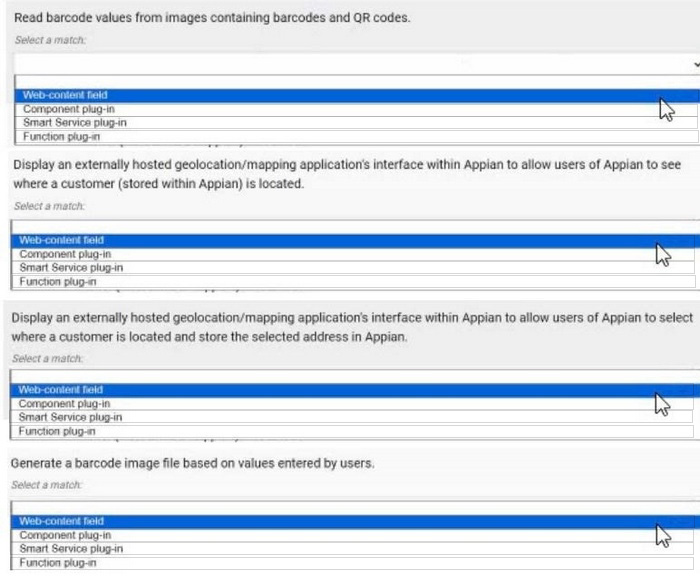
For each requirement, match the most appropriate approach to creating or utilizing plug-ins Each approach will be used once.
Note: To change your responses, you may deselect your response by clicking the blank space at the top of the selection list.
Reveal answer detailsClose answer details
Explanation
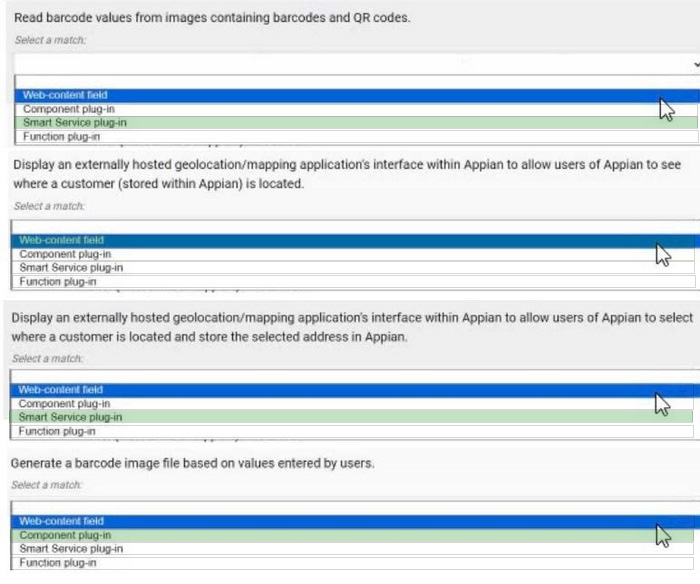
Requirement: Read barcode values from images containing barcodes and QR codes. Correct approach: C. Smart Service plug-in Exact explanation of correct approach taken from Appian Documentation: A smart service plug-in is a type of plug-in that allows you to create custom smart services that can be used in process models. A smart service can perform complex logic, interact with external systems, or manipulate data in Appian. A smart service plug-in can also leverage Java code to implement the functionality of the smart service. A smart service plug-in would be suitable for reading barcode values from images, as it can use Java libraries or APIs that can scan and decode barcodes and QR codes from image files. A smart service plug-in can also return the barcode values as outputs that can be used by other nodes or processes in Appian. A smart service plug-in can also be configured with input parameters, such as the image file, the barcode type, or the output format, that can customize the behavior of the smart service. A smart service plug-in can also have error handling and logging features that can handle any exceptions or failures that might occur during the barcode reading process. Requirement: Display an externally hosted geolocation mapping applications interface within Appian to allow users of Appian to see where a customer (stored within Appian)is located. Correct approach: A. Web-content field Exact explanation of correct approach taken from Appian Documentation: A web-content field is a type of user interface component that allows you to display web content from an external source in a SAIL interface. A web-content field would be suitable for displaying an externally hosted geolocation mapping applications interface, as it can embed the web content in an iframe and render it within the Appian interface. You can also pass parameters to the web content, such as the customer's location, using the url parameter of the web-content field. A web-content field can also interact with other components in the Appian interface, such as buttons, grids, or forms, using the postMessage API. This way, you can create a seamless user experience that integrates the external geolocation mapping applications interface with the Appian functionality. Requirement: Display an externally hosted geolocation mapping applications interface within Appian to allow users of Appian to select where a customer is located and store the selected address in Appian. Correct approach: A. Web-content field and C. Smart Service plug-in Exact explanation of correct approach taken from Appian Documentation: A web-content field and a smart service plug-in would be suitable for displaying an externally hosted geolocation mapping applications interface within Appian to allow users of Appian to select where a customer is located and store the selected address in Appian. A web-content field would be suitable for displaying the external geolocation mapping applications interface, as explained above. A smart service plug-in would be suitable for storing the selected address in Appian, as it can use Java code to receive the address data from the web content, validate it, and write it to a data store entity or a process variable. Requirement: Generate a barcode image file based on values entered by users. Correct approach: B. Component plug-in Exact explanation of correct approach taken from Appian Documentation: A component plug-in is a type of plug-in that allows you to create custom user interface components that can be used in SAIL interfaces. A component plug-in can also leverage Java code to implement the functionality of the component. A component plug-in would be suitable for generating a barcode image file, as it can use Java libraries or APIs that can encode values into barcode formats and generate image files. A component plug-in can also display the barcode image file in the Appian interface and allow users to download or print it. A component plug-in can also interact with other components in the Appian interface, such as text fields, buttons, or forms, using the a!refreshVariable() function. This way, you can create a dynamic user experience that updates the barcode image file based on the values entered by users.
Question 3
Single choice
You are taskedto build a large scale acquisition application for a prominent customer. The acquisition process tracks the time it takes is fulfill a purchase request with an award.
The customer has structured the contract so that there are multiple application dev teams.
How should you design for multiple processes and forms, while minimizing repeated code?
A
Create a Center of Excellence (CoE)
B
Create a common objects application.
C
Create a Scrum of Scrums sprint meeting for the team leads
D
Create duplicate processes and forms as needed
Reveal answer detailsClose answer details
Correct answerB
Explanation
To build a large scale acquisition application for a prominent customer, you should design for multiple processes and forms, while minimizing repeated code. One way to do this is to create a common objects application, which is a shared application that contains reusable components, such as rules, constants, interfaces, integrations, or data types, that can be used by multiple applications. This way, you can avoid duplication and inconsistency of code, and make it easier to maintain and update your applications. You can also use the common objects application to define common standards and best practices for your application development teams, such as naming conventions, coding styles, or documentation guidelines. References: [Appian Best Practices], [Appian Design Guidance]
Question 4
Multiple choice
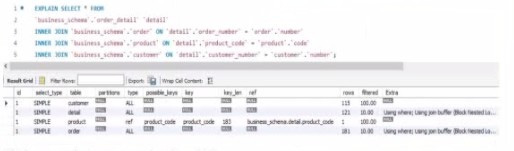
Review the following resultof an explain statement:
Which two conclusions can you draw from this?
A
The request is good enough to support a high volume of data. but could demonstrate some limitations if the developer queries information related to the product
B
The worst join isthe one between the table order_detail and order.
C
The join between the tables order_detail, order and customerneeds to be tine-tuned due to indices.
D
The join between the tables 0rder_detail and productneeds to be fine-tuned due to Indices
E
The worst join is the one between the table order_detail and customer
Reveal answer detailsClose answer details
Correct answersD, E
Explanation
D. The join between the tables order_detail and product needs to be fine-tuned due to Indices. This is correct because the result of the explain statement showsthat the join between these two tables has a high cost of 0.99, which indicates that it is inefficient and needs to be fine-tuned. One possible reason for the high cost is that there are no indices on the columns that are used for joining these two tables, which leads to a full table scan. Therefore, creating indices on these columns could improve the performance of this join. E. The worst join is the one between the table order_detail and customer. This is correct because the result of the explain statement shows that the join between these two tables has a very high cost of 1.00, which indicates that it is the worst join in terms of efficiency and needs to be fine-tuned. One possible reason for the high cost is that there are no indices on the columns that are used for joining these two tables, which leads to a full table scan. Therefore, creating indices on these columns could improve the performance of this join. The other options are incorrect for the following reasons: A. The request is good enough to support a high volume of data, but could demonstrate some limitations if the developer queries information related to the product. This is incorrect because the request is not good enough to support a high volume of data, as it has two joins with very high costs that need to be fine-tuned. Moreover, querying information related to the product would not necessarily cause any limitations, as long as the join between order_detail and product is optimized. B. The worst join is the one between the table order_detail and order. This is incorrect because the result of the explain statement shows that the join between these two tables has a low cost of 0.01, which indicates that it is efficient and does not need to be fine-tuned. C. The join between the tables order_detail, order and customer needs to be fine-tuned due to indices. This is incorrect because there is no such join between three tables in the result of the explain statement. There are only two joins: one between order_detail and order, and another between order_detail and customer. Each of these joins needs to be fine-tuned separately due to indices.
Question 5
Single choice
You are required to create an integration from your Appian cloud instance to an application hosted within a customers self-managed environment.
The customers IT team has provided you with a REST API endpoint to test with; httpsV/lnternal networkVapi/api /ping
Which recommendation should you make to progress this integration?
A
Expose the API as a SOAP-basedweb service.
B
Deploy the API / service into Appian Cloud
C
Add Appian Cloud's IP address ranges lo the customer network's allowed IP listing
D
Set up a VPN tunnel
Reveal answer detailsClose answer details
Correct answerD
Explanation
To create an integration from your Appian cloud instance to an application hosted within a customer's self-managed environment, you need to ensure that there is a secure and reliable connection between the two systems. One way to do this is to set up a VPN tunnel, which is a virtual private network that encrypts and transports data over the internet. A VPN tunnel allows you to access the customer's internal network and API endpoint from your Appian cloud instance, without exposing them to the public internet. This way, you can ensure the security and privacy of the data that is exchanged between the two systems. Verified References: [Appian Cloud VPN], [Appian Integration Guide]
Question 6
Single choice
You are on a protect with an application that has been deployed to Production and is live with users. The client wishes to increase the number of active users.
You need to conduct load testing to ensure Production can handle the increased usage
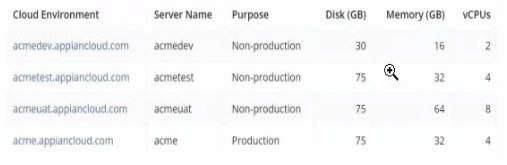
Review the specs for four environments in the following image.
Which environment should you use for load testing7
A
acmeuat
B
acmedev
C
acme
D
acmetest
Reveal answer detailsClose answer details
Correct answerC
Explanation
The best environment to use for load testing is acme, which is the production environment. This is because load testing should be performed on an environment that is as close as possible to the actual production environment, in terms of hardware, software, configuration, data, and user behavior. This way, the results of the load testing will be more realistic and reliable, and can help to identify and resolve any performance issues or bottlenecks before increasing the number of active users. Verified References: Appian Documentation, section "Load Testing".
You have 5 applications on your Appian platform in production. Users are now beginning to use multiple applications across the platform, and the client wants to ensure a consistent user experience across all applications You notice that some applications use rich text some use section layouts, and others use box layouts. The result is that each application has a different color and size for the header.
What would you recommend to ensure consistency across the platform?
A.
Create constants for text size and color, and update each section lo reference these values.
B.
In the common application, create a rule that can be used across the platform for section headers, and update each application to reference this new rule
C.
In the common application, create one rule for each application, and update each application to reference its respective rule
D.
In each individual application, create a rule that can be used lot tot section headers, and update each application lo reference its respective rule
Correct Answer: B
Explanation
Explanation/Reference:
The best way to ensure consistency across the platform is to create a rule that can be used across the platform for section headers. This rule can be created in the common application, and then each application can be updated to reference this rule. This will ensure that all of the applications use the same color and size for the header, which will provide a consistent user experience. The other options are not as effective. Option A, creating constants for text size and color, and updating each section to reference these values, would require updating each section in each application. This would be a lot of work, and it would be easy to make mistakes. Option C, creating one rule for each application, would also require updating each application. This would be less work than option A, but it would still be a lot of work, and it would be easy to make mistakes. Option D, creating a rule in each individual application, would not ensure consistency across the platform. Each application would have its own rule, and the rules could be different. This would not provide a consistent user experience. Best Practices: When designing a platform, it is important to consider the user experience. A consistent user experience will make it easier for users to learn and use the platform. When creating rules, it is important to use them consistently across the platform. This will ensure that the platform has a consistent look and feel. When updating the platform, it is important to test the changes to ensure that they do not break the user experience.
QUESTION 2
HOTSPOT
For each requirement, match the most appropriate approach to creating or utilizing plug-ins Each approach will be used once.
Note: To change your responses, you may deselect your response by clicking the blank space at the top of the selection list.
Correct Answer:
Explanation
Explanation/Reference:
Requirement: Read barcode values from images containing barcodes and QR codes. Correct approach: C. Smart Service plug-in Exact explanation of correct approach taken from Appian Documentation: A smart service plug-in is a type of plug-in that allows you to create custom smart services that can be used in process models. A smart service can perform complex logic, interact with external systems, or manipulate data in Appian. A smart service plug-in can also leverage Java code to implement the functionality of the smart service. A smart service plug-in would be suitable for reading barcode values from images, as it can use Java libraries or APIs that can scan and decode barcodes and QR codes from image files. A smart service plug-in can also return the barcode values as outputs that can be used by other nodes or processes in Appian. A smart service plug-in can also be configured with input parameters, such as the image file, the barcode type, or the output format, that can customize the behavior of the smart service. A smart service plug-in can also have error handling and logging features that can handle any exceptions or failures that might occur during the barcode reading process. Requirement: Display an externally hosted geolocation mapping applications interface within Appian to allow users of Appian to see where a customer (stored within Appian)is located. Correct approach: A. Web-content field Exact explanation of correct approach taken from Appian Documentation: A web-content field is a type of user interface component that allows you to display web content from an external source in a SAIL interface. A web-content field would be suitable for displaying an externally hosted geolocation mapping applications interface, as it can embed the web content in an iframe and render it within the Appian interface. You can also pass parameters to the web content, such as the customer's location, using the url parameter of the web-content field. A web-content field can also interact with other components in the Appian interface, such as buttons, grids, or forms, using the postMessage API. This way, you can create a seamless user experience that integrates the external geolocation mapping applications interface with the Appian functionality. Requirement: Display an externally hosted geolocation mapping applications interface within Appian to allow users of Appian to select where a customer is located and store the selected address in Appian. Correct approach: A. Web-content field and C. Smart Service plug-in Exact explanation of correct approach taken from Appian Documentation: A web-content field and a smart service plug-in would be suitable for displaying an externally hosted geolocation mapping applications interface within Appian to allow users of Appian to select where a customer is located and store the selected address in Appian. A web-content field would be suitable for displaying the external geolocation mapping applications interface, as explained above. A smart service plug-in would be suitable for storing the selected address in Appian, as it can use Java code to receive the address data from the web content, validate it, and write it to a data store entity or a process variable. Requirement: Generate a barcode image file based on values entered by users. Correct approach: B. Component plug-in Exact explanation of correct approach taken from Appian Documentation: A component plug-in is a type of plug-in that allows you to create custom user interface components that can be used in SAIL interfaces. A component plug-in can also leverage Java code to implement the functionality of the component. A component plug-in would be suitable for generating a barcode image file, as it can use Java libraries or APIs that can encode values into barcode formats and generate image files. A component plug-in can also display the barcode image file in the Appian interface and allow users to download or print it. A component plug-in can also interact with other components in the Appian interface, such as text fields, buttons, or forms, using the a!refreshVariable() function. This way, you can create a dynamic user experience that updates the barcode image file based on the values entered by users.
QUESTION 3
You are taskedto build a large scale acquisition application for a prominent customer. The acquisition process tracks the time it takes is fulfill a purchase request with an award.
The customer has structured the contract so that there are multiple application dev teams.
How should you design for multiple processes and forms, while minimizing repeated code?
A.
Create a Center of Excellence (CoE)
B.
Create a common objects application.
C.
Create a Scrum of Scrums sprint meeting for the team leads
D.
Create duplicate processes and forms as needed
Correct Answer: B
Explanation
Explanation/Reference:
To build a large scale acquisition application for a prominent customer, you should design for multiple processes and forms, while minimizing repeated code. One way to do this is to create a common objects application, which is a shared application that contains reusable components, such as rules, constants, interfaces, integrations, or data types, that can be used by multiple applications. This way, you can avoid duplication and inconsistency of code, and make it easier to maintain and update your applications. You can also use the common objects application to define common standards and best practices for your application development teams, such as naming conventions, coding styles, or documentation guidelines. References: [Appian Best Practices], [Appian Design Guidance]
QUESTION 4
Review the following resultof an explain statement:
Which two conclusions can you draw from this?
A.
The request is good enough to support a high volume of data. but could demonstrate some limitations if the developer queries information related to the product
B.
The worst join isthe one between the table order_detail and order.
C.
The join between the tables order_detail, order and customerneeds to be tine-tuned due to indices.
D.
The join between the tables 0rder_detail and productneeds to be fine-tuned due to Indices
E.
The worst join is the one between the table order_detail and customer
Correct Answer: DE
Explanation
Explanation/Reference:
D. The join between the tables order_detail and product needs to be fine-tuned due to Indices. This is correct because the result of the explain statement showsthat the join between these two tables has a high cost of 0.99, which indicates that it is inefficient and needs to be fine-tuned. One possible reason for the high cost is that there are no indices on the columns that are used for joining these two tables, which leads to a full table scan. Therefore, creating indices on these columns could improve the performance of this join. E. The worst join is the one between the table order_detail and customer. This is correct because the result of the explain statement shows that the join between these two tables has a very high cost of 1.00, which indicates that it is the worst join in terms of efficiency and needs to be fine-tuned. One possible reason for the high cost is that there are no indices on the columns that are used for joining these two tables, which leads to a full table scan. Therefore, creating indices on these columns could improve the performance of this join. The other options are incorrect for the following reasons: A. The request is good enough to support a high volume of data, but could demonstrate some limitations if the developer queries information related to the product. This is incorrect because the request is not good enough to support a high volume of data, as it has two joins with very high costs that need to be fine-tuned. Moreover, querying information related to the product would not necessarily cause any limitations, as long as the join between order_detail and product is optimized. B. The worst join is the one between the table order_detail and order. This is incorrect because the result of the explain statement shows that the join between these two tables has a low cost of 0.01, which indicates that it is efficient and does not need to be fine-tuned. C. The join between the tables order_detail, order and customer needs to be fine-tuned due to indices. This is incorrect because there is no such join between three tables in the result of the explain statement. There are only two joins: one between order_detail and order, and another between order_detail and customer. Each of these joins needs to be fine-tuned separately due to indices.
QUESTION 5
You are required to create an integration from your Appian cloud instance to an application hosted within a customers self-managed environment.
The customers IT team has provided you with a REST API endpoint to test with; httpsV/lnternal networkVapi/api /ping
Which recommendation should you make to progress this integration?
A.
Expose the API as a SOAP-basedweb service.
B.
Deploy the API / service into Appian Cloud
C.
Add Appian Cloud's IP address ranges lo the customer network's allowed IP listing
D.
Set up a VPN tunnel
Correct Answer: D
Explanation
Explanation/Reference:
To create an integration from your Appian cloud instance to an application hosted within a customer's self-managed environment, you need to ensure that there is a secure and reliable connection between the two systems. One way to do this is to set up a VPN tunnel, which is a virtual private network that encrypts and transports data over the internet. A VPN tunnel allows you to access the customer's internal network and API endpoint from your Appian cloud instance, without exposing them to the public internet. This way, you can ensure the security and privacy of the data that is exchanged between the two systems. Verified References: [Appian Cloud VPN], [Appian Integration Guide]
QUESTION 6
You are on a protect with an application that has been deployed to Production and is live with users. The client wishes to increase the number of active users.
You need to conduct load testing to ensure Production can handle the increased usage
Review the specs for four environments in the following image.
Which environment should you use for load testing7
A.
acmeuat
B.
acmedev
C.
acme
D.
acmetest
Correct Answer: C
Explanation
Explanation/Reference:
The best environment to use for load testing is acme, which is the production environment. This is because load testing should be performed on an environment that is as close as possible to the actual production environment, in terms of hardware, software, configuration, data, and user behavior. This way, the results of the load testing will be more realistic and reliable, and can help to identify and resolve any performance issues or bottlenecks before increasing the number of active users. Verified References: Appian Documentation, section "Load Testing".