Preview real exam questions, verified answers and available explanations before choosing a study plan.
Question 1
Single choice
A company has an AI solution named Solution1 that is deployed to the production environment. Solution1 uses an Azure OpenAI model to generate marketing emails for existing customers.
During an internal review, you identify that Solution1 creates different emails depending on the customers' traits.
You need to recommend a strategy to mitigate the bias. The strategy must adhere to Microsoft responsible AI principles.
What should you recommend?
A
Modify Solution1 to randomly generate emails for different traits.
B
Modify the system instructions of Solution1.
C
Retrain the model by using a larger dataset.
D
Modify the contents of the training dataset.
Reveal answer detailsClose answer details
Correct answerB
Explanation
Modifying the system instructions of Solution1 is the right remediation when the generated marketing emails violate internal policy. System instructions define the agent or solution's behavioral constraints and can direct the model away from prohibited claims, tone, or content. Changing only monitoring or deployment settings would not change the generated text behavior. Policy-related generation issues should be corrected in the controlling instructions and then retested.
Question 2
Hotspot
HOTSPOT
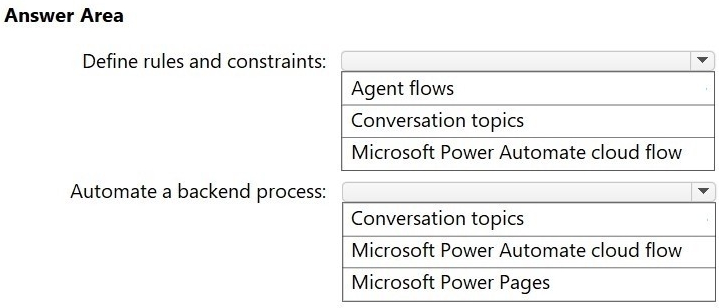
You need to design a multi-agent solution that will include a custom agent. The solution must meet the following requirements:
1. Define the rules and constraints that the agent must follow.
2. Automate a backend process that involves data movement between services and runs independently of the agent's reasoning steps.
What should you include in the design for each requirement? To answer, select the appropriate options in the answer area.
NOTE: Each correct selection is worth one point.
Reveal answer detailsClose answer details
Explanation
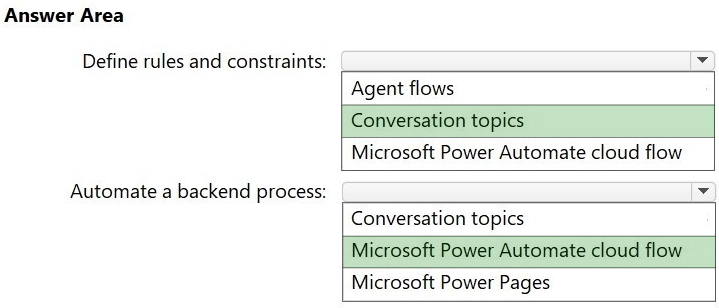
The completed hotspot uses conversation topics to define the agent's rules and constraints and a Microsoft Power Automate cloud flow to automate the backend process. The answer image separates conversational design from process automation. Topics control how the agent behaves in the conversation, while cloud flows execute reusable backend work across services. Agent flows may be useful in some designs, but the listed backend automation requirement is best matched to Power Automate.
Question 3
Multiple choice
A company has an AI solution built by using Microsoft Copilot Studio and Power Platform. The solution is used by the company's sales, marketing, and customer service teams.
You are performing a return on AI investment (ROAI) analysis to evaluate the impact of the solution.
You need to identify which measurable business drivers to include in the analysis.
Which two business drivers should you identify? Each correct answer presents part of the solution.
NOTE: Each correct selection is worth one point.
A
the reduced average case resolution time
B
market capitalization
C
economic market predictability
D
increased employee productivity
E
brand awareness
Reveal answer detailsClose answer details
Correct answersA, D
Explanation
Reduced average case resolution time and increased employee productivity are measurable business drivers for ROAI. They connect directly to time savings, labor efficiency, and improved support throughput. Market capitalization, market predictability, and brand awareness may be influenced indirectly, but they are not practical direct drivers for evaluating this Power Platform AI solution. ROAI should use measurable operational benefits.
Question 4
Single choice
A company has an AI agent that automates the review of customer feedback stored in a cloud database.
You plan to generate monthly reports from the agent's output to provide insights into customer sentiment and guide product development and marketing.
You need to ensure that the data ingested by the agent is clean and suitable for the intended use.
What should you do to prepare the data?
A
Create a workflow in Microsoft Power Automate.
B
Identify and address biased data.
C
Create an agent flow in Microsoft Copilot Studio.
D
Sort the database by customer last name.
Reveal answer detailsClose answer details
Correct answerC
Explanation
Creating an agent flow in Copilot Studio is appropriate because the monthly report requires an automated process based on the agent's output. Agent flows can coordinate deterministic actions and backend work that an agent invokes or uses as part of a business process. A prompt alone would not create a reusable reporting process. The key distinction is that generated insights may come from AI, but scheduled or repeatable downstream processing belongs in a flow.
Question 5
Single choice
A company is designing a Microsoft Power Platform solution to reduce the manual steps of a business process by deploying an existing AI model.
You need to calculate the return on AI investment (ROAI) by identifying the metadata and telemetry of the solution.
What should you use?
A
Microsoft Power Platform admin center
B
Success by Design
C
the Business value toolkit
D
Microsoft Cloud Adoption Framework for Azure
Reveal answer detailsClose answer details
Correct answerC
Explanation
The Business value toolkit helps identify and quantify business value drivers for ROAI. It supports structured value estimation instead of relying only on technical metrics. The requirement is to calculate return by identifying benefits from reduced manual process steps, so a value toolkit is a better fit than monitoring or infrastructure tools. For Power Platform and AI business cases, use business value tooling to connect solution capabilities to measurable outcomes.
Question 6
Single choice
A company has a Microsoft Power Platform solution that contains the following components:
1. Microsoft Dataverse tables 2. A Microsoft Power BI workspace named WS1 3. A canvas app named App1 that uses Dataverse 4. A Power BI semantic model that connects to Dataverse by using DirectQuery.
You plan to use generative AI to provide answers to queries based on a subset of corporate data.
You need to ensure that the data is available as a grounding data source for AI systems.
What should you do?
A
Populate a Dataverse table.
B
Share WS1.
C
Endorse the semantic model.
D
Export the semantic model.
Reveal answer detailsClose answer details
Correct answerC
Explanation
Endorsing the semantic model is the right governance step because Power BI assets that are reused across the organization need trust and discoverability. Endorsement identifies data models that have been promoted or certified for broader use. It does not package Power Platform solution components, but it does support trusted reporting and reuse for the workspace component. Use endorsement when the requirement concerns trusted BI model consumption.
Question 7
Single choice
A retail company plans to deploy Microsoft Copilot Studio agents to support:
1. Microsoft Dynamics 365 Commerce scenarios. 2. A Microsoft Power Apps inventory management solution.
You need to recommend a solution to organize product catalog data as a consistent source for multiple AI systems.
What should you recommend?
A
Let each agent scrape product details from Microsoft SharePoint Online libraries.
B
Store the product catalog data in a separate custom table for each agent.
C
Configure prompts to pull product details from the PDFs of external vendors.
D
Centralize the product catalog data in Microsoft Dataverse and expose the data to both agents.
Reveal answer detailsClose answer details
Correct answerD
Explanation
Centralizing the product catalog in Dataverse gives both the Dynamics 365 Commerce scenario and the Power Apps inventory solution a shared, governed data source. This avoids inconsistent catalog copies and lets both agents use the same business records. A separate integration for each agent would increase duplication and maintenance. The design principle is to ground multiple Power Platform and Dynamics experiences in a common business data platform when they share the same entity set.
Question 8
Drag & drop
DRAG DROP
A company plans to implement an AI business solution for a consumer goods company.
You need to create agents that meet the following requirements:
1. Orchestrate the sales order fulfillment and shipping of goods to customers. 2. Analyze historical data and trends to replenish stock.
Which type of agent should you use for each requirement? To answer, drag the appropriate agent types to the correct requirements. Each agent type may be used once, more than once, or not at all. You may need to drag the split bar between panes or scroll to view content.
NOTE: Each correct selection is worth one point.
Reveal answer detailsClose answer details
Explanation
The completed drag-and-drop maps both sales order fulfillment with shipping and historical trend analysis to autonomous agents. The answer image shows autonomous agents because both requirements involve acting across processes or analyzing data without waiting for a single prompt-and-response interaction. Orchestrating fulfillment and shipping is an event-driven business operation, and trend analysis for replenishment can also run as an autonomous decision-support process. Task agents are more bounded, while prompt-and-response agents mainly answer direct user questions.
Case study
Case Study 1
Overview
Contoso, Ltd. is a high-tech manufacturing company that uses Microsoft Dynamics 365 Finance. Dynamics 365 Supply Chain Management, and Dynamics 365 Commerce for its North American operations. The company designs and develops innovative products that have many patents and proprietary technologies. The patents and engineering designs are closely guarded secrets.
Contoso executives want to integrate and adopt AI solutions to help scale the company in preparation for an anticipated period of rapid growth.
The company has multiple legal entities and Azure subscriptions that will be used in the adopted AI solutions.
Requirements
AI Adoption
The following executives will have specific responsibilities in the overall AI adoption:
1. Chief Technology Officer (CTO): Select one Dynamics 365 Finance, Dynamics 365 Supply Chain Management, or Dynamics 365 Commerce prebuilt AI agent and one custom Microsoft Copilot Studio AI agent to prioritize and deploy during the initial AI adoption phase. 2. Chief Information Officer (CIO): Ensure that appropriate sensitivity labels are assigned to the data used by the AI agents. 3. Chief Financial Officer (CFO): Analyze the return on investment (ROI) for the AI agents being deployed. 4. Chief Information Security Officer (CISO): Discover and inventory AI resources for auditing. 5. Chief Executive Officer (CEO): Ensure that all solutions adhere to industry-standard responsible AI practices.
All AI initiatives and agents will have a detailed business use case, a defined audience profile, and an estimated ROI that compares the cost savings of the current process against the estimated costs of using the new AI solutions.
The company's research and development (R&D) department already has a custom Model Context Protocol (MCP) server that contains comprehensive product specifications and compliance data.
Prebuilt AI Agent
The CTO has NOT yet selected which prebuilt AI agent to use in Dynamics 365 Supply Chain Management. The CTO wants to view available agent templates to identify which agent will add the most business value.
Depending on which high-priority AI agents are identified, the agents' capabilities must be previewed in a discovery meeting with the relevant business operations stakeholders.
Custom AI Agent
Contoso has identified the following custom AI agent requirements:
1. The custom AI agent will be a low-code solution that uses data from Dynamics 365 Supply Chain Management to answer questions for the manufacturing team. 2. The custom AI agent will be accessible from within Microsoft Teams. 3. The custom AI agent must be designed to eventually connect to other agents that can be selected based on their descriptions. 4. The topics used in the custom AI agent will be selected based NOT on a trigger phrase, but on a description of the purpose of the query, to make the interactions more conversational. 5. The custom AI agent must be able to answer questions about product specifications by using existing technologies. The product specifications are maintained by the R&D department. 6. The custom AI agent must be integrated with and accessible from Dynamics 365 Supply Chain Management. 7. The custom AI agent must be able to use Dynamics 365 Supply Chain Management business logic that is stored outside the application.
Analysis, Reporting, and Troubleshooting
Contoso has identified the following analysis, reporting, and troubleshooting requirements:
1. The CISO will audit all the AI solutions monthly for compliance and security. 2. The CFO will analyze all the AI solutions quarterly to compare the estimated ROI against actual measured efficiencies and adoption. The CFO will use the Copilot Studio agent usage estimator to perform this analysis. 3. The CISO wants to identify how much sensitive data was accessed for a given AI agent run and who accessed the data. A high volume of sensitive data accessed by a single user might indicate a high security risk. 4. The CTO wants to track user feedback on the quality of AI agent responses during user interactions with the agents. Consistently poor feedback will trigger an escalated reengineering discussion. 5. The CEO wants a quarterly assessment of all the required metrics for the CEO's specific responsibilities. The tools used for the assessments must be Microsoft-recommended and must verify reliability, interpretability, fairness, and compliance. 6. The CFO wants to identify how many sessions with the AI agents are abandoned on a given day compared to resolved sessions. Too many abandoned sessions might indicate that Copilot Credits are being used inefficiently by end users.
Question 9
Testlet 1Drag & drop
DRAG DROP
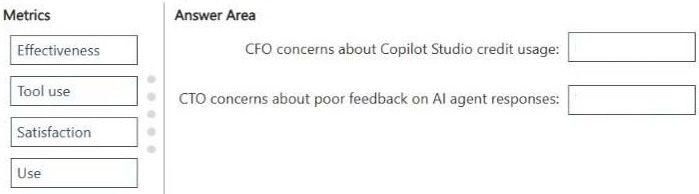
Which Copilot Studio analytics metrics should you recommend to assist the executives with their specific responsibilities? To answer, drag the appropriate metrics to the correct executives. Each metric may be used once, more than once, or not at all. You may need to drag the split bar between panes or scroll to view content.
NOTE: Each correct selection is worth one point.
Reveal answer detailsClose answer details
Explanation
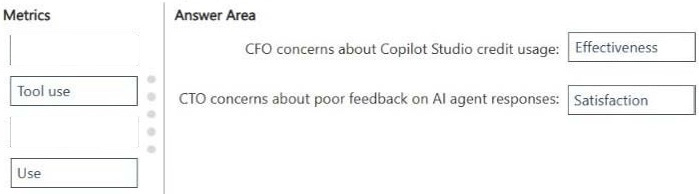
The answer-area image maps the CFO's concern about Copilot Studio credit usage to Effectiveness and maps the CTO's concern about poor feedback on AI agent responses to Satisfaction. Effectiveness analytics include conversation outcomes such as resolved, escalated, and abandoned sessions, which directly supports the CFO's need to compare abandoned sessions with resolved sessions and identify inefficient credit usage. Satisfaction analytics track user feedback, such as satisfaction ratings and comments, which directly supports the CTO's need to monitor poor feedback on response quality. Tool use would help analyze whether tools are being invoked and succeeding, but it does not directly answer the abandoned-versus-resolved concern. Use is broader activity volume and does not target the response-quality feedback issue as directly as Satisfaction.
Question 10
Multiple choice
A company deployed several Copilot Studio agents. You need to identify which agents have low engagement, high escalation, and poor answer quality so that the team can tune topics and knowledge sources.
Which two activities should you include in the monitoring process? Each correct answer presents part of the solution.
A
Review agent analytics and performance metrics.
B
Delete low-performing topics before reviewing transcripts.
C
Interpret telemetry and user feedback to identify tuning opportunities.
D
Turn off all knowledge sources and rely on the model's general knowledge.
E
Replace every agent with a custom model before collecting metrics.
Reveal answer detailsClose answer details
Correct answersA, C
Explanation
Agent analytics and performance metrics show which agents have low engagement, high escalation, or poor answer quality, and telemetry plus user feedback helps interpret why those patterns occur. The requirement is to identify tuning opportunities across several deployed agents. Raw transcripts alone can help investigate individual sessions, but aggregate metrics and feedback make the weak agents visible first. Start with analytics, then drill into the causes.
Case study
Case Study 1
Overview
Contoso, Ltd. is a high-tech manufacturing company that uses Microsoft Dynamics 365 Finance. Dynamics 365 Supply Chain Management, and Dynamics 365 Commerce for its North American operations. The company designs and develops innovative products that have many patents and proprietary technologies. The patents and engineering designs are closely guarded secrets.
Contoso executives want to integrate and adopt AI solutions to help scale the company in preparation for an anticipated period of rapid growth.
The company has multiple legal entities and Azure subscriptions that will be used in the adopted AI solutions.
Requirements
AI Adoption
The following executives will have specific responsibilities in the overall AI adoption:
1. Chief Technology Officer (CTO): Select one Dynamics 365 Finance, Dynamics 365 Supply Chain Management, or Dynamics 365 Commerce prebuilt AI agent and one custom Microsoft Copilot Studio AI agent to prioritize and deploy during the initial AI adoption phase. 2. Chief Information Officer (CIO): Ensure that appropriate sensitivity labels are assigned to the data used by the AI agents. 3. Chief Financial Officer (CFO): Analyze the return on investment (ROI) for the AI agents being deployed. 4. Chief Information Security Officer (CISO): Discover and inventory AI resources for auditing. 5. Chief Executive Officer (CEO): Ensure that all solutions adhere to industry-standard responsible AI practices.
All AI initiatives and agents will have a detailed business use case, a defined audience profile, and an estimated ROI that compares the cost savings of the current process against the estimated costs of using the new AI solutions.
The company's research and development (R&D) department already has a custom Model Context Protocol (MCP) server that contains comprehensive product specifications and compliance data.
Prebuilt AI Agent
The CTO has NOT yet selected which prebuilt AI agent to use in Dynamics 365 Supply Chain Management. The CTO wants to view available agent templates to identify which agent will add the most business value.
Depending on which high-priority AI agents are identified, the agents' capabilities must be previewed in a discovery meeting with the relevant business operations stakeholders.
Custom AI Agent
Contoso has identified the following custom AI agent requirements:
1. The custom AI agent will be a low-code solution that uses data from Dynamics 365 Supply Chain Management to answer questions for the manufacturing team. 2. The custom AI agent will be accessible from within Microsoft Teams. 3. The custom AI agent must be designed to eventually connect to other agents that can be selected based on their descriptions. 4. The topics used in the custom AI agent will be selected based NOT on a trigger phrase, but on a description of the purpose of the query, to make the interactions more conversational. 5. The custom AI agent must be able to answer questions about product specifications by using existing technologies. The product specifications are maintained by the R&D department. 6. The custom AI agent must be integrated with and accessible from Dynamics 365 Supply Chain Management. 7. The custom AI agent must be able to use Dynamics 365 Supply Chain Management business logic that is stored outside the application.
Analysis, Reporting, and Troubleshooting
Contoso has identified the following analysis, reporting, and troubleshooting requirements:
1. The CISO will audit all the AI solutions monthly for compliance and security. 2. The CFO will analyze all the AI solutions quarterly to compare the estimated ROI against actual measured efficiencies and adoption. The CFO will use the Copilot Studio agent usage estimator to perform this analysis. 3. The CISO wants to identify how much sensitive data was accessed for a given AI agent run and who accessed the data. A high volume of sensitive data accessed by a single user might indicate a high security risk. 4. The CTO wants to track user feedback on the quality of AI agent responses during user interactions with the agents. Consistently poor feedback will trigger an escalated reengineering discussion. 5. The CEO wants a quarterly assessment of all the required metrics for the CEO's specific responsibilities. The tools used for the assessments must be Microsoft-recommended and must verify reliability, interpretability, fairness, and compliance. 6. The CFO wants to identify how many sessions with the AI agents are abandoned on a given day compared to resolved sessions. Too many abandoned sessions might indicate that Copilot Credits are being used inefficiently by end users.
Question 11
Testlet 1Single choice
What should you recommend to assist the CTO with the prebuilt agent selection process?
A
Agent management
B
Copilot Studio
C
Lifecycle Services (LCS)
D
Immersive Home
Reveal answer detailsClose answer details
Correct answerA
Explanation
The CTO needs to view available prebuilt agent templates and identify which Dynamics 365 Supply Chain Management agent adds the most business value. In finance and operations apps, the Agent management feature includes an Agents page with a Library tab for browsing available agent templates, previewing agent capabilities, and selecting agents for deployment. That directly matches the prebuilt agent selection task. Copilot Studio is the low-code authoring environment for the custom agent, but the question is about discovering and selecting Dynamics 365 prebuilt agent templates. Lifecycle Services supports environment and implementation lifecycle activities, and Immersive Home is a navigation hub, but Agent management is the feature that provides the library and management experience for agents.
Question 12
Single choice
A company has a Microsoft Foundry generative AI model.
You need to evaluate the model's output to measure the overall quality and coherence of generated responses. The evaluation must use GPT-4o as a judge and return a numeric score for each output.
Which type of metric should you use?
A
AI quality (NLP)
B
risk and safety
C
Groundedness
D
AI quality (AI assisted)
Reveal answer detailsClose answer details
Correct answerD
Explanation
AI quality with AI-assisted evaluation uses a judge model such as GPT-4o to score outputs for quality dimensions like coherence. That matches the requirement for a numeric score produced by a model evaluator. NLP metrics and groundedness cover narrower or different checks, and risk and safety metrics focus on harmful content. Use AI-assisted quality metrics when a judge model evaluates generated text quality.
Question 13
Single choice
A customer support agent must transfer a conversation to a human representative when the user requests escalation. The representative must receive the conversation history and variables collected by the agent.
What should you configure?
A
A file group with instructions
B
Handoff to a live agent through an engagement hub
C
A model router with a balanced routing profile
D
A Dataverse search index
Reveal answer detailsClose answer details
Correct answerB
Explanation
Handoff to a live agent through an engagement hub meets the requirement because the representative must receive the conversation history and variables collected by the agent. This is a contact-center handoff scenario, not merely a notification or backend workflow. The engagement hub provides the channel where a human representative can continue the conversation. For escalation, preserve context and route to the live-agent experience.
Question 14
Hotspot
HOTSPOT
A company has a Microsoft Copilot Studio agent for customer support.
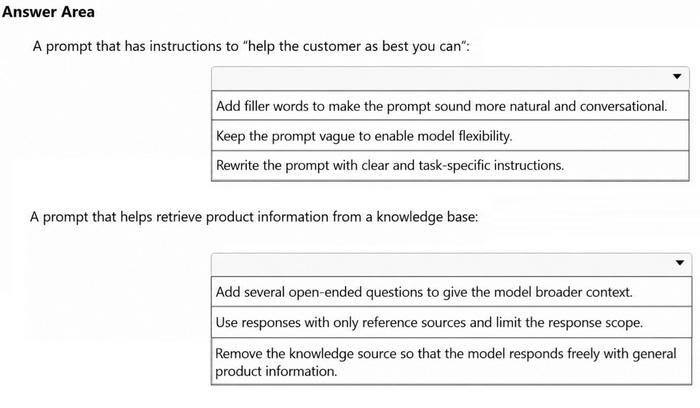
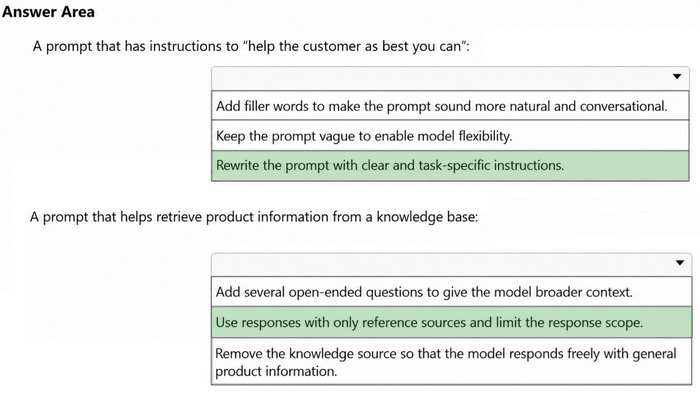
You are reviewing and validating the following prompts:
1. A prompt that has instructions to "help the customer as best you can" 2. A prompt that helps retrieve product information from a knowledge base.
You need to ensure that the agent delivers consistent and accurate responses.
What should you do for each prompt? To answer, select the appropriate options in the answer area.
NOTE: Each correct selection is worth one point.
Reveal answer detailsClose answer details
Explanation
The completed hotspot should rewrite the vague customer-help prompt with clear, task-specific instructions and use only referenced sources with a limited response scope for the knowledge-base prompt. The answer image highlights prompt specificity and grounded response boundaries. Vague wording such as help the customer as best you can gives the model too much freedom, while removing the knowledge source would increase the risk of unsupported answers. Strong prompts define the task, source boundaries, and expected output.
Question 15
Single choice
You are evaluating a Microsoft Copilot Studio agent that supports Microsoft Dynamics 365 Customer Service representatives.
You need to recommend a testing solution that meets the following requirements:
Evaluates agent effectiveness during active sessions Validates whether the agent delivers accurate and helpful responses Provides measurable, actionable insights for continuous improvement.
What should you recommend?
A
Track resolution, deflection, and accuracy by using dashboards and use scripts to ensure consistent responses.
B
Perform load testing to validate how the agent scales under a high chat volume.
C
Review historical tickets to find agents that have the shortest resolution times.
D
Measure uptime and page load times.
Reveal answer detailsClose answer details
Correct answerA
Explanation
Tracking resolution, deflection, and accuracy with dashboards, and using scripts for consistent response validation, meets the testing requirements. The solution evaluates active-session effectiveness and turns the results into measurable improvement data. Load tests and uptime checks are useful operational tests, but they do not prove answer helpfulness or agent effectiveness. For support-agent quality, combine outcome dashboards with repeatable scripted response checks.
Question 16
Single choice
A company has Microsoft Foundry agents that generate responses by using Azure OpenAI resources. The agents are deployed to both the United States and Europe.
A company mandate states that the agents and their grounding data must adhere to data residency and movement regulations.
You need to recommend a governance solution for the agents.
What should you include in the recommendation?
A
Microsoft Defender for Cloud
B
Azure Policy
C
Azure Monitor
D
Microsoft Purview
Reveal answer detailsClose answer details
Correct answerD
Explanation
Microsoft Purview is the governance choice for data residency and data movement concerns because it provides data governance, classification, compliance, and audit capabilities across the estate. Azure Monitor observes resources, Defender focuses on security posture, and Azure Policy can enforce resource configuration, but Purview is the broader data governance service. The mandate is about grounding data and regulatory movement, so the data governance layer matters most. Use Purview when the question emphasizes data compliance rather than only resource health.
Question 17
Single choice
You are designing a Copilot Studio agent that must route short, predictable customer utterances to authored conversation paths. The business wants the behavior to be deterministic and based on a small set of sample phrases for each path.
What should you configure?
A
Classic orchestration with topics that have trigger phrases
B
Generative orchestration with only agent-level instructions
C
An MCP server that exposes each conversation path as a tool
D
A model router deployment in Microsoft Foundry
Reveal answer detailsClose answer details
Correct answerA
Explanation
Classic orchestration with authored topics and trigger phrases is best for short, predictable utterances that must follow deterministic paths. The business wants a small set of controlled requests, so manually designed topics provide predictable routing. Generative orchestration is better when the agent must decide among many tools, knowledge sources, or topics dynamically. Use classic orchestration when control and repeatability are more important than open-ended reasoning.
Question 18
Drag & drop
DRAG DROP
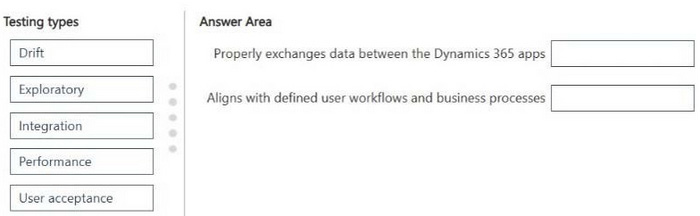
You are designing end-to-end test scenarios for a business solution that uses Microsoft Dynamics 365 Sales and Dynamics 365 Finance.
You need to ensure that the business solution meets the following test requirements:
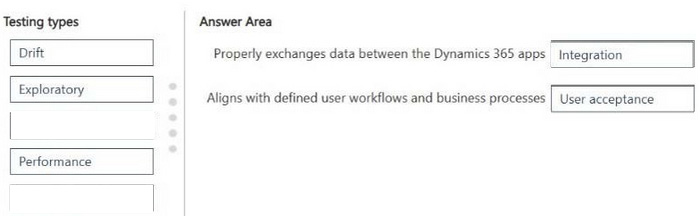
1. Properly exchanges data between the Dynamics 365 apps 2. Aligns with defined user workflows and business processes.
Which type of testing should you use for each requirement? To answer, drag the appropriate testing types to the correct requirements. Each testing type may be used once, more than once, or not at all. You may need to drag the split bar between panes or scroll to view content.
NOTE: Each correct selection is worth one point.
Reveal answer detailsClose answer details
Explanation
The completed drag-and-drop uses integration testing to verify that the Dynamics 365 apps exchange data properly and user acceptance testing to verify alignment with workflows and business processes. The answer image distinguishes technical interoperability from business validation. Integration testing proves that Sales and Finance pass data correctly, while user acceptance testing confirms that the process works for real users. This is the expected split for end-to-end business solution testing.
Question 19
Single choice
A company wants an agent to react when a new high-value account is added to Dataverse. The agent should evaluate the account, check for duplicates, and create a follow-up task without waiting for a user chat message.
Which design should you recommend?
A
A prompt-and-response agent that only answers manual questions
B
A classic topic that requires the user to type a trigger phrase
C
An autonomous agent that uses an event trigger and generative orchestration
D
A static file group with no tools
Reveal answer detailsClose answer details
Correct answerC
Explanation
An autonomous agent with an event trigger and generative orchestration fits because the work starts when a Dataverse event occurs and should run without waiting for a chat user. The agent must evaluate a new high-value account, check duplicates, and create a follow-up task. A prompt-and-response agent would require a user request, and a simple flow would not provide the same agentic reasoning. Use autonomous agents for event-driven business actions.
Question 20
Single choice
A company has a Microsoft Foundry agent that summarizes customer feedback and recommends products to customers. The agent references data from multiple knowledge sources.
Users report that the agent response time is slow.
Telemetry data shows that the agent frequently reaches its token usage limit.
You need to recommend a solution to reduce token usage without degrading the quality of the generated responses.
What should you recommend?
A
Chunk documents during indexing.
B
Reduce the number of knowledge sources used by the agent.
C
Reconfigure the prompts to limit the amount of retrieved content from the knowledge sources.
D
Lower the maximum token usage limit for the responses.
Reveal answer detailsClose answer details
Correct answerC
Explanation
Limiting the amount of retrieved content in prompts reduces token usage while preserving the quality of the most relevant context. The telemetry shows that the agent reaches token limits, so the issue is too much context being sent to the model. Removing knowledge sources could reduce quality, and lowering the token limit may truncate useful answers. Tune retrieval scope before removing sources or reducing output capacity.
Question 21
Single choice
Note: This section contains one or more sets of questions with the same scenario and problem. Each question presents a unique solution to the problem. You must determine whether the solution meets the stated goals. More than one solution in the set might solve the problem. It is also possible that none of the solutions in the set solve the problem.
After you answer a question in this section, you will NOT be able to return. As a result, these questions do not appear on the Review Screen.
A company uses Microsoft 365 and Dynamics 365.
You need to recommend a solution to automatically summarize email threads, generate suggested replies in Microsoft Outlook, and provide meeting preparation summaries that include relevant customer relationship management (CRM) data.
Solution: You recommend a Microsoft 365 Copilot agent template.
Does this meet the goal?
A
Yes
B
No
Reveal answer detailsClose answer details
Correct answerB
Explanation
A Microsoft 365 Copilot agent template does not meet the full goal because the scenario specifically requires sales email and meeting assistance tied to Dynamics 365 CRM data. A template can start a custom agent, but it does not automatically provide the Copilot for Sales experiences in Outlook and Teams. The goal is an existing product capability, not a generic agent shell. When the requirements name sales emails, suggested replies, and CRM meeting preparation, Copilot for Sales is the fit.
A company has an AI solution named Solution1 that is deployed to the production environment. Solution1 uses an Azure OpenAI model to generate marketing emails for existing customers.
During an internal review, you identify that Solution1 creates different emails depending on the customers' traits.
You need to recommend a strategy to mitigate the bias. The strategy must adhere to Microsoft responsible AI principles.
What should you recommend?
A.
Modify Solution1 to randomly generate emails for different traits.
B.
Modify the system instructions of Solution1.
C.
Retrain the model by using a larger dataset.
D.
Modify the contents of the training dataset.
Correct Answer: B
Explanation
Explanation/Reference:
Modifying the system instructions of Solution1 is the right remediation when the generated marketing emails violate internal policy. System instructions define the agent or solution's behavioral constraints and can direct the model away from prohibited claims, tone, or content. Changing only monitoring or deployment settings would not change the generated text behavior. Policy-related generation issues should be corrected in the controlling instructions and then retested.
QUESTION 2
HOTSPOT
You need to design a multi-agent solution that will include a custom agent. The solution must meet the following requirements:
1. Define the rules and constraints that the agent must follow.
2. Automate a backend process that involves data movement between services and runs independently of the agent's reasoning steps.
What should you include in the design for each requirement? To answer, select the appropriate options in the answer area.
NOTE: Each correct selection is worth one point.
Correct Answer:
Explanation
Explanation/Reference:
The completed hotspot uses conversation topics to define the agent's rules and constraints and a Microsoft Power Automate cloud flow to automate the backend process. The answer image separates conversational design from process automation. Topics control how the agent behaves in the conversation, while cloud flows execute reusable backend work across services. Agent flows may be useful in some designs, but the listed backend automation requirement is best matched to Power Automate.
QUESTION 3
A company has an AI solution built by using Microsoft Copilot Studio and Power Platform. The solution is used by the company's sales, marketing, and customer service teams.
You are performing a return on AI investment (ROAI) analysis to evaluate the impact of the solution.
You need to identify which measurable business drivers to include in the analysis.
Which two business drivers should you identify? Each correct answer presents part of the solution.
NOTE: Each correct selection is worth one point.
A.
the reduced average case resolution time
B.
market capitalization
C.
economic market predictability
D.
increased employee productivity
E.
brand awareness
Correct Answer: AD
Explanation
Explanation/Reference:
Reduced average case resolution time and increased employee productivity are measurable business drivers for ROAI. They connect directly to time savings, labor efficiency, and improved support throughput. Market capitalization, market predictability, and brand awareness may be influenced indirectly, but they are not practical direct drivers for evaluating this Power Platform AI solution. ROAI should use measurable operational benefits.
QUESTION 4
A company has an AI agent that automates the review of customer feedback stored in a cloud database.
You plan to generate monthly reports from the agent's output to provide insights into customer sentiment and guide product development and marketing.
You need to ensure that the data ingested by the agent is clean and suitable for the intended use.
What should you do to prepare the data?
A.
Create a workflow in Microsoft Power Automate.
B.
Identify and address biased data.
C.
Create an agent flow in Microsoft Copilot Studio.
D.
Sort the database by customer last name.
Correct Answer: C
Explanation
Explanation/Reference:
Creating an agent flow in Copilot Studio is appropriate because the monthly report requires an automated process based on the agent's output. Agent flows can coordinate deterministic actions and backend work that an agent invokes or uses as part of a business process. A prompt alone would not create a reusable reporting process. The key distinction is that generated insights may come from AI, but scheduled or repeatable downstream processing belongs in a flow.
QUESTION 5
A company is designing a Microsoft Power Platform solution to reduce the manual steps of a business process by deploying an existing AI model.
You need to calculate the return on AI investment (ROAI) by identifying the metadata and telemetry of the solution.
What should you use?
A.
Microsoft Power Platform admin center
B.
Success by Design
C.
the Business value toolkit
D.
Microsoft Cloud Adoption Framework for Azure
Correct Answer: C
Explanation
Explanation/Reference:
The Business value toolkit helps identify and quantify business value drivers for ROAI. It supports structured value estimation instead of relying only on technical metrics. The requirement is to calculate return by identifying benefits from reduced manual process steps, so a value toolkit is a better fit than monitoring or infrastructure tools. For Power Platform and AI business cases, use business value tooling to connect solution capabilities to measurable outcomes.
QUESTION 6
A company has a Microsoft Power Platform solution that contains the following components:
1. Microsoft Dataverse tables 2. A Microsoft Power BI workspace named WS1 3. A canvas app named App1 that uses Dataverse 4. A Power BI semantic model that connects to Dataverse by using DirectQuery.
You plan to use generative AI to provide answers to queries based on a subset of corporate data.
You need to ensure that the data is available as a grounding data source for AI systems.
What should you do?
A.
Populate a Dataverse table.
B.
Share WS1.
C.
Endorse the semantic model.
D.
Export the semantic model.
Correct Answer: C
Explanation
Explanation/Reference:
Endorsing the semantic model is the right governance step because Power BI assets that are reused across the organization need trust and discoverability. Endorsement identifies data models that have been promoted or certified for broader use. It does not package Power Platform solution components, but it does support trusted reporting and reuse for the workspace component. Use endorsement when the requirement concerns trusted BI model consumption.
QUESTION 7
A retail company plans to deploy Microsoft Copilot Studio agents to support:
1. Microsoft Dynamics 365 Commerce scenarios. 2. A Microsoft Power Apps inventory management solution.
You need to recommend a solution to organize product catalog data as a consistent source for multiple AI systems.
What should you recommend?
A.
Let each agent scrape product details from Microsoft SharePoint Online libraries.
B.
Store the product catalog data in a separate custom table for each agent.
C.
Configure prompts to pull product details from the PDFs of external vendors.
D.
Centralize the product catalog data in Microsoft Dataverse and expose the data to both agents.
Correct Answer: D
Explanation
Explanation/Reference:
Centralizing the product catalog in Dataverse gives both the Dynamics 365 Commerce scenario and the Power Apps inventory solution a shared, governed data source. This avoids inconsistent catalog copies and lets both agents use the same business records. A separate integration for each agent would increase duplication and maintenance. The design principle is to ground multiple Power Platform and Dynamics experiences in a common business data platform when they share the same entity set.
QUESTION 8
DRAG DROP
A company plans to implement an AI business solution for a consumer goods company.
You need to create agents that meet the following requirements:
1. Orchestrate the sales order fulfillment and shipping of goods to customers. 2. Analyze historical data and trends to replenish stock.
Which type of agent should you use for each requirement? To answer, drag the appropriate agent types to the correct requirements. Each agent type may be used once, more than once, or not at all. You may need to drag the split bar between panes or scroll to view content.
NOTE: Each correct selection is worth one point.
Correct Answer:
Explanation
Explanation/Reference:
The completed drag-and-drop maps both sales order fulfillment with shipping and historical trend analysis to autonomous agents. The answer image shows autonomous agents because both requirements involve acting across processes or analyzing data without waiting for a single prompt-and-response interaction. Orchestrating fulfillment and shipping is an event-driven business operation, and trend analysis for replenishment can also run as an autonomous decision-support process. Task agents are more bounded, while prompt-and-response agents mainly answer direct user questions.
Case Study 1
Case Study Questions
Overview
Contoso, Ltd. is a high-tech manufacturing company that uses Microsoft Dynamics 365 Finance. Dynamics 365 Supply Chain Management, and Dynamics 365 Commerce for its North American operations. The company designs and develops innovative products that have many patents and proprietary technologies. The patents and engineering designs are closely guarded secrets.
Contoso executives want to integrate and adopt AI solutions to help scale the company in preparation for an anticipated period of rapid growth.
The company has multiple legal entities and Azure subscriptions that will be used in the adopted AI solutions.
Requirements
AI Adoption
The following executives will have specific responsibilities in the overall AI adoption:
1. Chief Technology Officer (CTO): Select one Dynamics 365 Finance, Dynamics 365 Supply Chain Management, or Dynamics 365 Commerce prebuilt AI agent and one custom Microsoft Copilot Studio AI agent to prioritize and deploy during the initial AI adoption phase. 2. Chief Information Officer (CIO): Ensure that appropriate sensitivity labels are assigned to the data used by the AI agents. 3. Chief Financial Officer (CFO): Analyze the return on investment (ROI) for the AI agents being deployed. 4. Chief Information Security Officer (CISO): Discover and inventory AI resources for auditing. 5. Chief Executive Officer (CEO): Ensure that all solutions adhere to industry-standard responsible AI practices.
All AI initiatives and agents will have a detailed business use case, a defined audience profile, and an estimated ROI that compares the cost savings of the current process against the estimated costs of using the new AI solutions.
The company's research and development (R&D) department already has a custom Model Context Protocol (MCP) server that contains comprehensive product specifications and compliance data.
Prebuilt AI Agent
The CTO has NOT yet selected which prebuilt AI agent to use in Dynamics 365 Supply Chain Management. The CTO wants to view available agent templates to identify which agent will add the most business value.
Depending on which high-priority AI agents are identified, the agents' capabilities must be previewed in a discovery meeting with the relevant business operations stakeholders.
Custom AI Agent
Contoso has identified the following custom AI agent requirements:
1. The custom AI agent will be a low-code solution that uses data from Dynamics 365 Supply Chain Management to answer questions for the manufacturing team. 2. The custom AI agent will be accessible from within Microsoft Teams. 3. The custom AI agent must be designed to eventually connect to other agents that can be selected based on their descriptions. 4. The topics used in the custom AI agent will be selected based NOT on a trigger phrase, but on a description of the purpose of the query, to make the interactions more conversational. 5. The custom AI agent must be able to answer questions about product specifications by using existing technologies. The product specifications are maintained by the R&D department. 6. The custom AI agent must be integrated with and accessible from Dynamics 365 Supply Chain Management. 7. The custom AI agent must be able to use Dynamics 365 Supply Chain Management business logic that is stored outside the application.
Analysis, Reporting, and Troubleshooting
Contoso has identified the following analysis, reporting, and troubleshooting requirements:
1. The CISO will audit all the AI solutions monthly for compliance and security. 2. The CFO will analyze all the AI solutions quarterly to compare the estimated ROI against actual measured efficiencies and adoption. The CFO will use the Copilot Studio agent usage estimator to perform this analysis. 3. The CISO wants to identify how much sensitive data was accessed for a given AI agent run and who accessed the data. A high volume of sensitive data accessed by a single user might indicate a high security risk. 4. The CTO wants to track user feedback on the quality of AI agent responses during user interactions with the agents. Consistently poor feedback will trigger an escalated reengineering discussion. 5. The CEO wants a quarterly assessment of all the required metrics for the CEO's specific responsibilities. The tools used for the assessments must be Microsoft-recommended and must verify reliability, interpretability, fairness, and compliance. 6. The CFO wants to identify how many sessions with the AI agents are abandoned on a given day compared to resolved sessions. Too many abandoned sessions might indicate that Copilot Credits are being used inefficiently by end users.
QUESTION 9
DRAG DROP
Which Copilot Studio analytics metrics should you recommend to assist the executives with their specific responsibilities? To answer, drag the appropriate metrics to the correct executives. Each metric may be used once, more than once, or not at all. You may need to drag the split bar between panes or scroll to view content.
NOTE: Each correct selection is worth one point.
Correct Answer:
Explanation
Explanation/Reference:
The answer-area image maps the CFO's concern about Copilot Studio credit usage to Effectiveness and maps the CTO's concern about poor feedback on AI agent responses to Satisfaction. Effectiveness analytics include conversation outcomes such as resolved, escalated, and abandoned sessions, which directly supports the CFO's need to compare abandoned sessions with resolved sessions and identify inefficient credit usage. Satisfaction analytics track user feedback, such as satisfaction ratings and comments, which directly supports the CTO's need to monitor poor feedback on response quality. Tool use would help analyze whether tools are being invoked and succeeding, but it does not directly answer the abandoned-versus-resolved concern. Use is broader activity volume and does not target the response-quality feedback issue as directly as Satisfaction.
QUESTION 10
A company deployed several Copilot Studio agents. You need to identify which agents have low engagement, high escalation, and poor answer quality so that the team can tune topics and knowledge sources.
Which two activities should you include in the monitoring process? Each correct answer presents part of the solution.
A.
Review agent analytics and performance metrics.
B.
Delete low-performing topics before reviewing transcripts.
C.
Interpret telemetry and user feedback to identify tuning opportunities.
D.
Turn off all knowledge sources and rely on the model's general knowledge.
E.
Replace every agent with a custom model before collecting metrics.
Correct Answer: AC
Explanation
Explanation/Reference:
Agent analytics and performance metrics show which agents have low engagement, high escalation, or poor answer quality, and telemetry plus user feedback helps interpret why those patterns occur. The requirement is to identify tuning opportunities across several deployed agents. Raw transcripts alone can help investigate individual sessions, but aggregate metrics and feedback make the weak agents visible first. Start with analytics, then drill into the causes.
Case Study 1
Case Study Questions
Overview
Contoso, Ltd. is a high-tech manufacturing company that uses Microsoft Dynamics 365 Finance. Dynamics 365 Supply Chain Management, and Dynamics 365 Commerce for its North American operations. The company designs and develops innovative products that have many patents and proprietary technologies. The patents and engineering designs are closely guarded secrets.
Contoso executives want to integrate and adopt AI solutions to help scale the company in preparation for an anticipated period of rapid growth.
The company has multiple legal entities and Azure subscriptions that will be used in the adopted AI solutions.
Requirements
AI Adoption
The following executives will have specific responsibilities in the overall AI adoption:
1. Chief Technology Officer (CTO): Select one Dynamics 365 Finance, Dynamics 365 Supply Chain Management, or Dynamics 365 Commerce prebuilt AI agent and one custom Microsoft Copilot Studio AI agent to prioritize and deploy during the initial AI adoption phase. 2. Chief Information Officer (CIO): Ensure that appropriate sensitivity labels are assigned to the data used by the AI agents. 3. Chief Financial Officer (CFO): Analyze the return on investment (ROI) for the AI agents being deployed. 4. Chief Information Security Officer (CISO): Discover and inventory AI resources for auditing. 5. Chief Executive Officer (CEO): Ensure that all solutions adhere to industry-standard responsible AI practices.
All AI initiatives and agents will have a detailed business use case, a defined audience profile, and an estimated ROI that compares the cost savings of the current process against the estimated costs of using the new AI solutions.
The company's research and development (R&D) department already has a custom Model Context Protocol (MCP) server that contains comprehensive product specifications and compliance data.
Prebuilt AI Agent
The CTO has NOT yet selected which prebuilt AI agent to use in Dynamics 365 Supply Chain Management. The CTO wants to view available agent templates to identify which agent will add the most business value.
Depending on which high-priority AI agents are identified, the agents' capabilities must be previewed in a discovery meeting with the relevant business operations stakeholders.
Custom AI Agent
Contoso has identified the following custom AI agent requirements:
1. The custom AI agent will be a low-code solution that uses data from Dynamics 365 Supply Chain Management to answer questions for the manufacturing team. 2. The custom AI agent will be accessible from within Microsoft Teams. 3. The custom AI agent must be designed to eventually connect to other agents that can be selected based on their descriptions. 4. The topics used in the custom AI agent will be selected based NOT on a trigger phrase, but on a description of the purpose of the query, to make the interactions more conversational. 5. The custom AI agent must be able to answer questions about product specifications by using existing technologies. The product specifications are maintained by the R&D department. 6. The custom AI agent must be integrated with and accessible from Dynamics 365 Supply Chain Management. 7. The custom AI agent must be able to use Dynamics 365 Supply Chain Management business logic that is stored outside the application.
Analysis, Reporting, and Troubleshooting
Contoso has identified the following analysis, reporting, and troubleshooting requirements:
1. The CISO will audit all the AI solutions monthly for compliance and security. 2. The CFO will analyze all the AI solutions quarterly to compare the estimated ROI against actual measured efficiencies and adoption. The CFO will use the Copilot Studio agent usage estimator to perform this analysis. 3. The CISO wants to identify how much sensitive data was accessed for a given AI agent run and who accessed the data. A high volume of sensitive data accessed by a single user might indicate a high security risk. 4. The CTO wants to track user feedback on the quality of AI agent responses during user interactions with the agents. Consistently poor feedback will trigger an escalated reengineering discussion. 5. The CEO wants a quarterly assessment of all the required metrics for the CEO's specific responsibilities. The tools used for the assessments must be Microsoft-recommended and must verify reliability, interpretability, fairness, and compliance. 6. The CFO wants to identify how many sessions with the AI agents are abandoned on a given day compared to resolved sessions. Too many abandoned sessions might indicate that Copilot Credits are being used inefficiently by end users.
QUESTION 11
What should you recommend to assist the CTO with the prebuilt agent selection process?
A.
Agent management
B.
Copilot Studio
C.
Lifecycle Services (LCS)
D.
Immersive Home
Correct Answer: A
Explanation
Explanation/Reference:
The CTO needs to view available prebuilt agent templates and identify which Dynamics 365 Supply Chain Management agent adds the most business value. In finance and operations apps, the Agent management feature includes an Agents page with a Library tab for browsing available agent templates, previewing agent capabilities, and selecting agents for deployment. That directly matches the prebuilt agent selection task. Copilot Studio is the low-code authoring environment for the custom agent, but the question is about discovering and selecting Dynamics 365 prebuilt agent templates. Lifecycle Services supports environment and implementation lifecycle activities, and Immersive Home is a navigation hub, but Agent management is the feature that provides the library and management experience for agents.
QUESTION 12
A company has a Microsoft Foundry generative AI model.
You need to evaluate the model's output to measure the overall quality and coherence of generated responses. The evaluation must use GPT-4o as a judge and return a numeric score for each output.
Which type of metric should you use?
A.
AI quality (NLP)
B.
risk and safety
C.
Groundedness
D.
AI quality (AI assisted)
Correct Answer: D
Explanation
Explanation/Reference:
AI quality with AI-assisted evaluation uses a judge model such as GPT-4o to score outputs for quality dimensions like coherence. That matches the requirement for a numeric score produced by a model evaluator. NLP metrics and groundedness cover narrower or different checks, and risk and safety metrics focus on harmful content. Use AI-assisted quality metrics when a judge model evaluates generated text quality.
QUESTION 13
A customer support agent must transfer a conversation to a human representative when the user requests escalation. The representative must receive the conversation history and variables collected by the agent.
What should you configure?
A.
A file group with instructions
B.
Handoff to a live agent through an engagement hub
C.
A model router with a balanced routing profile
D.
A Dataverse search index
Correct Answer: B
Explanation
Explanation/Reference:
Handoff to a live agent through an engagement hub meets the requirement because the representative must receive the conversation history and variables collected by the agent. This is a contact-center handoff scenario, not merely a notification or backend workflow. The engagement hub provides the channel where a human representative can continue the conversation. For escalation, preserve context and route to the live-agent experience.
QUESTION 14
HOTSPOT
A company has a Microsoft Copilot Studio agent for customer support.
You are reviewing and validating the following prompts:
1. A prompt that has instructions to "help the customer as best you can" 2. A prompt that helps retrieve product information from a knowledge base.
You need to ensure that the agent delivers consistent and accurate responses.
What should you do for each prompt? To answer, select the appropriate options in the answer area.
NOTE: Each correct selection is worth one point.
Correct Answer:
Explanation
Explanation/Reference:
The completed hotspot should rewrite the vague customer-help prompt with clear, task-specific instructions and use only referenced sources with a limited response scope for the knowledge-base prompt. The answer image highlights prompt specificity and grounded response boundaries. Vague wording such as help the customer as best you can gives the model too much freedom, while removing the knowledge source would increase the risk of unsupported answers. Strong prompts define the task, source boundaries, and expected output.
QUESTION 15
You are evaluating a Microsoft Copilot Studio agent that supports Microsoft Dynamics 365 Customer Service representatives.
You need to recommend a testing solution that meets the following requirements:
Evaluates agent effectiveness during active sessions Validates whether the agent delivers accurate and helpful responses Provides measurable, actionable insights for continuous improvement.
What should you recommend?
A.
Track resolution, deflection, and accuracy by using dashboards and use scripts to ensure consistent responses.
B.
Perform load testing to validate how the agent scales under a high chat volume.
C.
Review historical tickets to find agents that have the shortest resolution times.
D.
Measure uptime and page load times.
Correct Answer: A
Explanation
Explanation/Reference:
Tracking resolution, deflection, and accuracy with dashboards, and using scripts for consistent response validation, meets the testing requirements. The solution evaluates active-session effectiveness and turns the results into measurable improvement data. Load tests and uptime checks are useful operational tests, but they do not prove answer helpfulness or agent effectiveness. For support-agent quality, combine outcome dashboards with repeatable scripted response checks.
QUESTION 16
A company has Microsoft Foundry agents that generate responses by using Azure OpenAI resources. The agents are deployed to both the United States and Europe.
A company mandate states that the agents and their grounding data must adhere to data residency and movement regulations.
You need to recommend a governance solution for the agents.
What should you include in the recommendation?
A.
Microsoft Defender for Cloud
B.
Azure Policy
C.
Azure Monitor
D.
Microsoft Purview
Correct Answer: D
Explanation
Explanation/Reference:
Microsoft Purview is the governance choice for data residency and data movement concerns because it provides data governance, classification, compliance, and audit capabilities across the estate. Azure Monitor observes resources, Defender focuses on security posture, and Azure Policy can enforce resource configuration, but Purview is the broader data governance service. The mandate is about grounding data and regulatory movement, so the data governance layer matters most. Use Purview when the question emphasizes data compliance rather than only resource health.
QUESTION 17
You are designing a Copilot Studio agent that must route short, predictable customer utterances to authored conversation paths. The business wants the behavior to be deterministic and based on a small set of sample phrases for each path.
What should you configure?
A.
Classic orchestration with topics that have trigger phrases
B.
Generative orchestration with only agent-level instructions
C.
An MCP server that exposes each conversation path as a tool
D.
A model router deployment in Microsoft Foundry
Correct Answer: A
Explanation
Explanation/Reference:
Classic orchestration with authored topics and trigger phrases is best for short, predictable utterances that must follow deterministic paths. The business wants a small set of controlled requests, so manually designed topics provide predictable routing. Generative orchestration is better when the agent must decide among many tools, knowledge sources, or topics dynamically. Use classic orchestration when control and repeatability are more important than open-ended reasoning.
QUESTION 18
DRAG DROP
You are designing end-to-end test scenarios for a business solution that uses Microsoft Dynamics 365 Sales and Dynamics 365 Finance.
You need to ensure that the business solution meets the following test requirements:
1. Properly exchanges data between the Dynamics 365 apps 2. Aligns with defined user workflows and business processes.
Which type of testing should you use for each requirement? To answer, drag the appropriate testing types to the correct requirements. Each testing type may be used once, more than once, or not at all. You may need to drag the split bar between panes or scroll to view content.
NOTE: Each correct selection is worth one point.
Correct Answer:
Explanation
Explanation/Reference:
The completed drag-and-drop uses integration testing to verify that the Dynamics 365 apps exchange data properly and user acceptance testing to verify alignment with workflows and business processes. The answer image distinguishes technical interoperability from business validation. Integration testing proves that Sales and Finance pass data correctly, while user acceptance testing confirms that the process works for real users. This is the expected split for end-to-end business solution testing.
QUESTION 19
A company wants an agent to react when a new high-value account is added to Dataverse. The agent should evaluate the account, check for duplicates, and create a follow-up task without waiting for a user chat message.
Which design should you recommend?
A.
A prompt-and-response agent that only answers manual questions
B.
A classic topic that requires the user to type a trigger phrase
C.
An autonomous agent that uses an event trigger and generative orchestration
D.
A static file group with no tools
Correct Answer: C
Explanation
Explanation/Reference:
An autonomous agent with an event trigger and generative orchestration fits because the work starts when a Dataverse event occurs and should run without waiting for a chat user. The agent must evaluate a new high-value account, check duplicates, and create a follow-up task. A prompt-and-response agent would require a user request, and a simple flow would not provide the same agentic reasoning. Use autonomous agents for event-driven business actions.
QUESTION 20
A company has a Microsoft Foundry agent that summarizes customer feedback and recommends products to customers. The agent references data from multiple knowledge sources.
Users report that the agent response time is slow.
Telemetry data shows that the agent frequently reaches its token usage limit.
You need to recommend a solution to reduce token usage without degrading the quality of the generated responses.
What should you recommend?
A.
Chunk documents during indexing.
B.
Reduce the number of knowledge sources used by the agent.
C.
Reconfigure the prompts to limit the amount of retrieved content from the knowledge sources.
D.
Lower the maximum token usage limit for the responses.
Correct Answer: C
Explanation
Explanation/Reference:
Limiting the amount of retrieved content in prompts reduces token usage while preserving the quality of the most relevant context. The telemetry shows that the agent reaches token limits, so the issue is too much context being sent to the model. Removing knowledge sources could reduce quality, and lowering the token limit may truncate useful answers. Tune retrieval scope before removing sources or reducing output capacity.
QUESTION 21
Note: This section contains one or more sets of questions with the same scenario and problem. Each question presents a unique solution to the problem. You must determine whether the solution meets the stated goals. More than one solution in the set might solve the problem. It is also possible that none of the solutions in the set solve the problem.
After you answer a question in this section, you will NOT be able to return. As a result, these questions do not appear on the Review Screen.
A company uses Microsoft 365 and Dynamics 365.
You need to recommend a solution to automatically summarize email threads, generate suggested replies in Microsoft Outlook, and provide meeting preparation summaries that include relevant customer relationship management (CRM) data.
Solution: You recommend a Microsoft 365 Copilot agent template.
Does this meet the goal?
A.
Yes
B.
No
Correct Answer: B
Explanation
Explanation/Reference:
A Microsoft 365 Copilot agent template does not meet the full goal because the scenario specifically requires sales email and meeting assistance tied to Dynamics 365 CRM data. A template can start a custom agent, but it does not automatically provide the Copilot for Sales experiences in Outlook and Teams. The goal is an existing product capability, not a generic agent shell. When the requirements name sales emails, suggested replies, and CRM meeting preparation, Copilot for Sales is the fit.