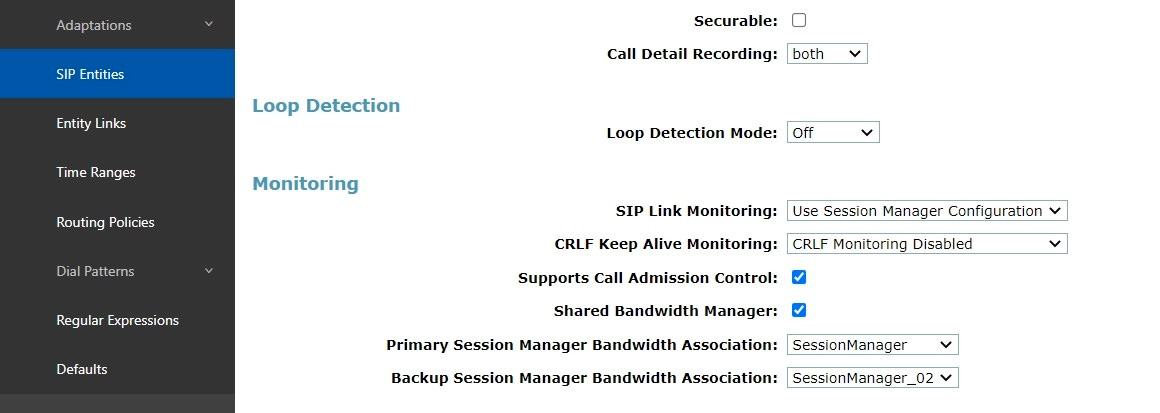
A customer wants to implement CAC Sharing between the Session Manager (SM) in Main office and Communication Manager located in a branch location. What are the steps involved in implementing CAC Sharing?
-
A
Configure Network Regions and Network Regions Group in Communication Manager, assign Bandwidth limits to the location, enable Shared Bandwidth Management for CM SIP entity in Session Manager.
-
B
Configure Network Regions and Network Regions Group in Communication Manager, assign Bandwidth limits to the Entity Link, enable Shared Bandwidth Management for CM SIP entity in Session Manager.
-
C
Configure Network Regions and Network Regions Group in Communication Manager, enable Shared Bandwidth Management, assign Bandwidth limits to the location, enable Shared Bandwidth Management for CM SIP entity in Session Manager.
-
D
Configure Network Regions and Shared Bandwidth Management Groups in Communication Manager, assign Bandwidth limits to the location, enable Shared Bandwidth Management for CM SIP entity in Session Manager.
-
E
Configure Network Regions and Shared Bandwidth Management Groups in Communication Manager, enable Shared Bandwidth Management, assign Bandwidth limits to the location, enable Shared Bandwidth Management for Network Region SIP entity in Session Manager.
Reveal answer details
Close answer details
What is the correct statement about Interfaces and IP addresses on an Avaya Session Border Controller for Enterprise (SBCE) used for SIP-Trunking and Remote Worker services?
-
A
SIP-Trunking and Remote Worker services must use different IP addresses configured on separate interfaces.
-
B
SIP-Trunking and Remote Worker services can share the same IP address on the same interface.
-
C
Only one IP-address should be configured for both SIP-Trunking and Remote Worker services.
-
D
SBCE should not be used for both SIP-Trunking and Remote Worker services simultaneously.
-
E
Reveal answer details
Close answer details
Correct answerB
ExplanationSource:
https://support.avaya.com/ext/index?page=content&id=SOLN341386
Question 3
Multiple choice
When one entity is marked as down on the Session Manager dashboard, which two of the following troubleshooting tools can be used to investigate the problem?
-
A
List trace station on Avaya Aura Communication Manager
-
B
statapp on the Command Line Interface of Avaya Aura Session Manager
-
C
traceSM on the Command Line Interface of Avaya Aura Session Manager
-
D
the replication page in Avaya Aura System Manager
-
E
Avaya Aura Session Manager Entity Link Connection Status page in Avaya Aura System Manager
-
F
Wireshark on the network switch
Reveal answer details
Close answer details
When comparing two Remote Worker SIP clients, one is an Avaya Communicator soft client and the other is a 96X1SIP hardphone, which statement is true?
-
A
Both Avaya Communicator and 96X1SIP clients register with SM via SBCE and receive their SIP Controller List by PPM download.
-
B
The Avaya Communicator receives its SIP Controller List via 46xxsettings.txt file download, whereas the 96x1 receives its SIP Controller List by PPM download.
-
C
If required, Avaya Communicator and 96X1SIP clients will automatically upgrade themselves from software stored on the SBCE.
-
D
Avaya Communicator registers with SM via SBCE whereas the 96X1SIP telephone registers with CM via SBCE.
-
E
Avaya Communicator registers with CM via SBCE whereas the 96X1SIP telephone registers with SM via SBCE.
Reveal answer details
Close answer details
Question 5
Multiple choice
A customer reports that when they make a call from an H.323 endpoint at the Main office to an H.323 telephone at the Branch office across the WAN, the call fails due to codec mismatch. Which five Avaya Aura Communication Manager (CM) System Administration Terminal (SAT) forms can be used to troubleshoot this problem? (Choose five.)
-
A
-
B
-
C
-
D
-
E
-
F
-
G
Reveal answer details
Close answer details
Correct answersA, B, C, D
When a call is made between two Avaya SIP Telephones (AST) users, Session Manager processes the call through various phases. What is the maximum number of phase tags that Session Manager uses, and what are they called?
-
A
Three - ingress, process, egress
-
B
Two - imsorig and imsterm
-
C
Two - origappseq and termappseq
-
D
Four - imsorig, origdone, imsterm, termdone
-
E
Five - start, connect, progress, alert, end
Reveal answer details
Close answer details
Question 7
Multiple choice
In Avaya Aura Communication Manager (CM), what are the three valid formats of the list trace command? (Choose three.)
-
A
-
B
List trace ras ip-address 135.60.232.213
-
C
-
D
-
E
-
F
Reveal answer details
Close answer details
After completing Discipline 2 ?
Describe the Problem of the 8D Troubleshooting Methodology, what are the next two disciplines to be completed in sequence?
-
A
Discipline 3 - Prevent Recurrences, Discipline 4 -Determine Root Cause
-
B
Discipline 3 - Develop Interim Containment Actions, Discipline 4 -Determine Root Cause
-
C
Discipline 3 - Implement Corrective Actions, Discipline 4 -Determine Root Cause
-
D
Discipline 3 - Implement a Work-around, Discipline 4 -Determine Root Cause
-
E
Discipline 3 - Develop Interim Containment Actions, Discipline 5 -Choose and Verify Corrective Actions
Reveal answer details
Close answer details
What are the three types of certificates used in the Avaya Aura server?
-
A
Root or a Certificate Authority (CA) certificate and Server Identity certificates
-
B
Root or a Certificate Authority (CA) and SIP default certificates
-
C
Site Root certificates and Security certificates
-
D
Backup server and default certificates
-
E
Intermediate certificates and Domain certificates
Reveal answer details
Close answer details
Correct answerA
ExplanationSource:
https://downloads.avaya.com/css/P8/documents/100181346
Question 10
Multiple choice
Which statements describe the 8D Troubleshooting Methodology? (Choose three.)
-
A
It is eight steps that guarantee a logical way to isolate an issue.
-
B
It is eight steps that guarantee a thorough analysis of a failure, containment actions, full resolution, prevention for the future.
-
C
It is eight steps that define how to escalate third-party integration issues.
-
D
It is eight steps that used to guarantee systems are operational after an implementation.
-
E
It is eight steps that ensure a faster time to resolution.
-
F
It is eight steps that are only applicable to hardware issues.
Reveal answer details
Close answer details
Question 11
Single choice
A customer called Avaya Support stating that shortly after some maintenance work was done, they cannot make or receive calls. Which command in Avaya Aura Communication Manager (CM) can the administrator execute to determine if the H.248 Gateways were placed in a maintenance busy state?
-
A
-
B
-
C
-
D
-
E
Reveal answer details
Close answer details
Question 12
Multiple choice
Which three statements describe steps for searching for an Avaya Aura System Manager (SMGR) log containing the phrase 'down'? (Choose three.)
-
A
Export the entire log file to your local PC, and then locally search with an application.
-
B
Navigate to Home / Services / Events / Logs / Log Viewer, then click on Filter, then Enable, and type
'down' into the Message box, then click on Apply.
-
C
Navigate to Home / Services / Events / Logs / Log Harvester, then click on Harvest logs, then type
'down' into the text contains box, then click on Apply.
-
D
Navigate to Home / Services / Events / Logs / Log Settings, then click on 'text search' and then type 'down' into the text search box, then click on Apply.
-
E
Navigate to Home / Services / Events / Logs / Log Viewer, then click on Filter, then Enable, and type '- m down' into the Message box, then click on Apply.
-
F
Use the Linux command grep -iR "down" /var/log/avaya
Reveal answer details
Close answer details
Question 13
Single choice
When retrieving a message from Avaya Aura Messenger (AAM), what is the purpose of the RE-INVITE message?
-
A
The RE-INVITE message is sent to establish a media path for the message retrieval process.
-
B
The RE-INVITE message is used to retry the initial INVITE message if it was not transmitted successfully.
-
C
The RE-INVITE message is used to authenticate the user before message retrieval can begin.
-
D
The RE-INVITE message is sent to connect the voice port to the caller.
Reveal answer details
Close answer details
Question 14
Single choice
What is the function of a Virtual Network Region?
-
A
It allows one Network Region to temporarily use bandwidth allocated to another Network Region if it runs out of bandwidth.
-
B
It makes DSP resources available in other Network Regions.
-
C
It allows Inter-Gateway Alternate Routing (IGAR).
-
D
It prevents oversubscription of WAN links for interconnecting Network Regions with different bandwidth limitations.
-
E
It enables the use of different codecs between Network Regions.
Reveal answer details
Close answer details
Question 15
Multiple choice
Which five statements about media-processing resources (DSPs) are true? (Choose five.)
-
A
Two-party calls originated by SIP stations or trunks, and terminated by H.323 trunks, media gateways, or other vendors' H.323 stations, will typically shuffle if CM is configured to do so.
-
B
Two-party calls originated by H.323 stations, trunks, or media gateways, and terminated by SIP stations or trunks, cannot shuffle.
-
C
SIP-SIP two-party calls will always use SIP Direct Media if Communication Manager (CM) is configured to do so.
-
D
H.323-H.323 two-party calls will always shuffle to establish a direct media path if CM is configured to do so.
-
E
If a direct media path cannot be established between two IP endpoints, the call will fail from release
7.0.
-
F
CM can use DSP resources for features such as conferencing, music-on-hold, and voice messaging.
-
G
SIP-SIP multi-party calls will shuffle to establish a direct media path if CM is configured to do so.
Reveal answer details
Close answer details
Correct answersB, C, D, E, F
|