Preview real exam questions, verified answers and available explanations before choosing a study plan.
Question 1
Single choice
The design requires integrated logical networking, richer isolation, and placement across two real infrastructure failure domains. Which choice satisfies these requirements?
A
Use VDS-backed networking and create two zone labels on the same failure domain.
B
Use VDS-backed networking because it has the same logical objects as NSX.
C
Use NSX-backed networking and treat zone names as sufficient physical isolation.
D
Use NSX-backed networking and align each zone with an actual failure domain.
Reveal answer detailsClose answer details
Correct answerD
Explanation
NSX-backed networking supplies the integrated logical networking and richer isolation required by the design. Availability across two failure domains also requires each logical zone to map to genuinely separate infrastructure. Zone names alone do not create physical independence, so aligning every zone with an actual failure domain is necessary for meaningful placement resilience.
Question 2
Multiple choice
A cloud operations team is managing multiple Supervisor Clusters across two regions. Each region hosts its own vSphere Kubernetes clusters, integrated through a federated service mesh to enable consistent service connectivity and policy enforcement across environments.
The application team wants to expose a multi-tier microservice named "GovApp", which includes front-end, API, and database services distributed between the two regions. Uniform traffic routing, identity, and security policies are also needed for these workloads regardless of the cluster or region in which they are deployed.
To meet these requirements, the architects decide to create a Global Namespace that spans both Supervisor Clusters.
Which two statements describe the requirements for a Global Namespace in a vSphere Kubernetes Service Mesh deployment? (Choose two.)
A
Applies a single policy to multiple namespaces across multiple clusters.
B
Defines an application boundary across multiple clusters.
C
Provides distributed Ingress and egress services to support multiple namespaces across multiple clusters.
D
Enables automatic placement of workloads to any global cluster based on traffic demand.
E
Provides centralized logging for Service Mesh traffic.
Reveal answer detailsClose answer details
Correct answersA, B
Explanation
A Global Namespace defines one logical application boundary that can span namespaces in multiple clusters, allowing the distributed GovApp services to be treated as one application scope. It also applies a single policy across those member namespaces and clusters, which provides the required consistency for identity, security, and traffic behavior across both regions.
Question 3
Single choice
A remote site has a requirement for VMware vSphere Kubernetes Service (VKS). The environment has minimal storage available.
Which action ensures the Content Library does not consume all available space on the datastore?
A
Select theDownload contentoption and chooseWhen needed.
B
Use a local datastore on one of the ESXi hosts.
C
Create a scheduled task to download the images that are needed.
D
Select theDownload contentoption and chooseImmediately.
Reveal answer detailsClose answer details
Correct answerA
Explanation
Setting Download content to When needed avoids downloading every library item in advance. Content is retrieved only when it is required, so unused images do not immediately occupy the remote site's limited datastore capacity. Choosing Immediately would consume space up front, while changing datastores or scheduling downloads does not provide the same demand-based behavior.
Question 4
Single choice
Which four capabilities are provided by a VMware Kubernetes Service (VKS) cluster?
A
Authentication, storage integration, pod networking, and load balancing.
B
Identity federation, persistent logging, firewall services, and monitoring.
C
Identity federation, external storage, virtual machine networking, and DNS services.
D
Authentication, backup services, VLAN segmentation, and DHCP.
Reveal answer detailsClose answer details
Correct answerA
Explanation
A VKS cluster includes authentication for controlling access, storage integration for persistent workload data, pod networking for communication among workloads, and load balancing for distributing traffic to exposed services. Together these cover identity, data, internal connectivity, and traffic delivery. The other sets mix in functions that are not the four core cluster capabilities requested.
Question 5
Multiple choice
Which two package management tools can be used to configure and install applications on VMware vSphere Kubernetes Service (VKS)? (Choose two.)
A
Fluent Bit
B
Multus
C
Helm
D
Grafana
E
Carvel
Reveal answer detailsClose answer details
Correct answersC, E
Explanation
Helm packages Kubernetes resources into charts and supports configurable application installation and lifecycle operations. Carvel provides a collection of tools for packaging, configuring, and deploying applications to Kubernetes. Fluent Bit handles log processing, Multus supplies additional network interfaces, and Grafana presents monitoring data rather than managing application packages.
Question 6
Single choice
An administrator is tasked with installing Istio Service Mesh for VMware vSphere Kubernetes Service (VKS).
Which command installs Istio?
A
Use curl to download and install Istio.
B
Use vcf package install to install the Istio package.
C
Use kubectl istioctl install.
D
Use docker build istioctl.
Reveal answer detailsClose answer details
Correct answerB
Explanation
Istio is installed in this VKS environment as a managed package through vcf package install. Using that command follows the package mechanism and installs the Istio package into the intended environment. Downloading arbitrary files with curl, building a container image, or combining kubectl with an istioctl subcommand does not use the specified VCF package installation path.
Question 7
Drag & drop
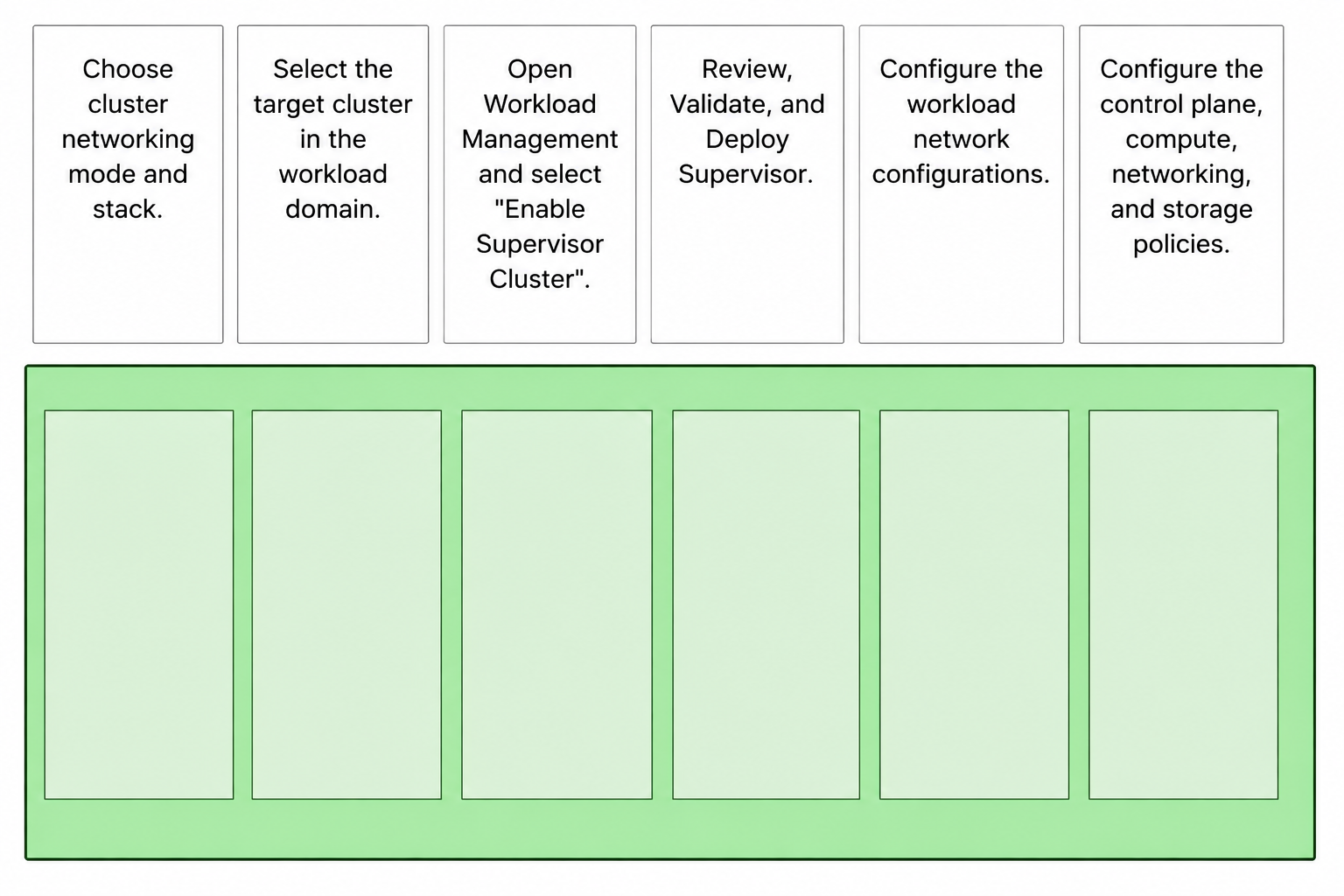
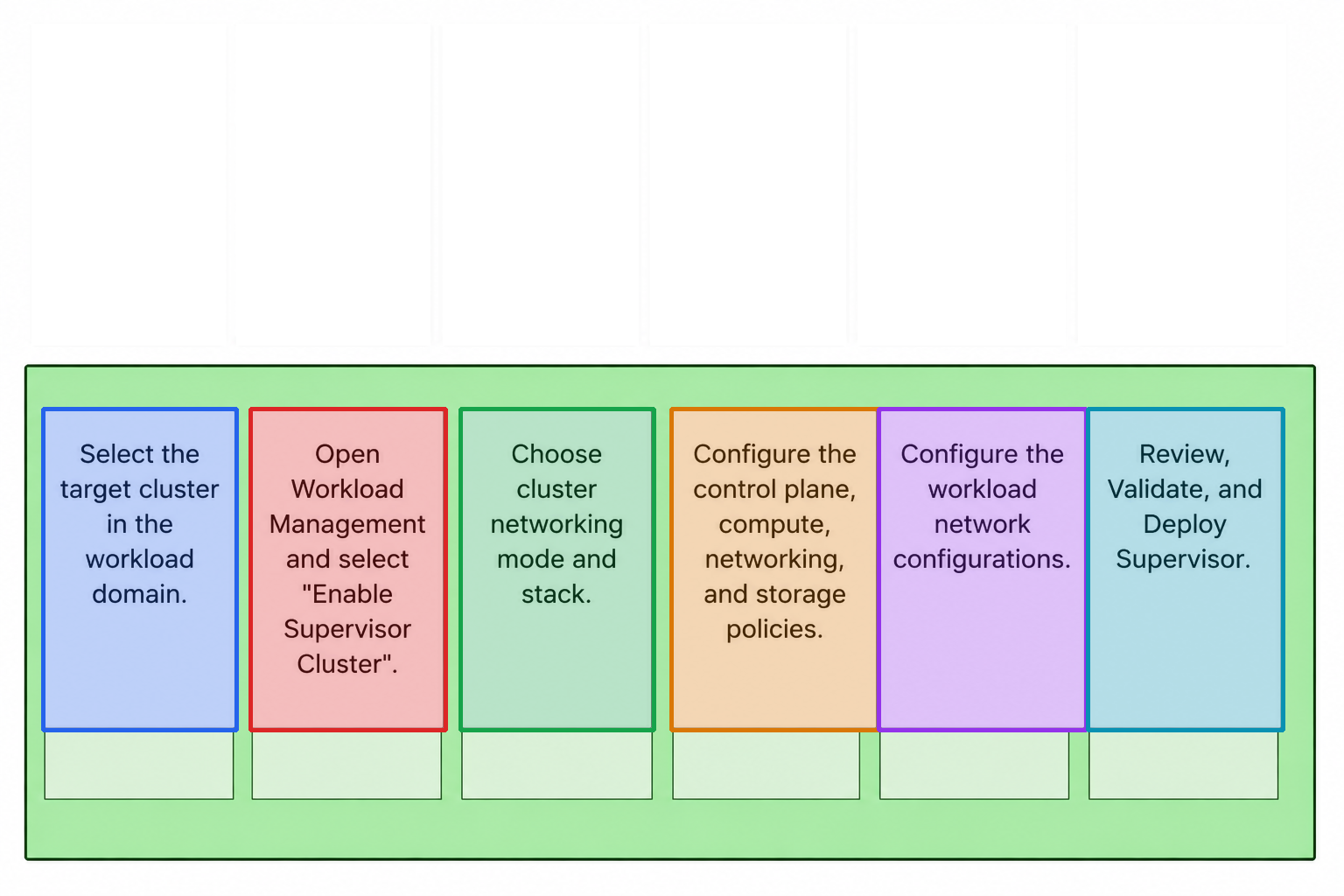
An administrator is tasked with enabling a Supervisor cluster in VMware Cloud Foundation (VCF). Arrange the steps below In the correct order to complete the process of enabling a Supervisor In the environment.
Reveal answer detailsClose answer details
Explanation
Answer (Correct Order): Select the target cluster in the workload domain. Open Workload Management and select "Enable Supervisor Cluster".
Choose cluster networking mode and stack. Configure the control plane compute, networking, and storage policies. Configure the workload network configurations. Review, Validate, and Deploy Supervisor.
You start by selecting theexact vSphere cluster(in the workload domain) that will host the Supervisor, because Supervisor enablement is performedagainst a specific cluster. From there you launch the enablement workflow inWorkload Management("Enable Supervisor Cluster"). Early in the wizard you must decide thenetworking mode(for example, VDS-based vs NSX-backed) and theIP stack, because those choices drive the remaining configuration screens and what inputs are required. Next you define theSupervisor control plane settings-compute sizing and the core policies the Supervisor will use (including storage policy selections and related defaults). After the control plane foundation is defined, you configure theworkload networkingused by namespaces and Kubernetes workloads (IP ranges, routing/LB integration depending on the selected mode). Finally, youreview/validateall inputs anddeployso the platform can create and configure the Supervisor control plane and supporting components.
Question 8
Single choice
An organization has standardized on the following configurations: vSphere Kubernetes Services upgrade is separate from vCenter upgrades. A private registry will be utilized.
What is the recommended solution to adhere to these standards?
A
Issue a kubectl command pointing service definition to the private registry.
B
Issue a PowerCLI command to point to the private registry.
C
When uploading the service definition, choose Asynchronous Public.
D
When uploading the service definition, choose Asynchronous Private.
Reveal answer detailsClose answer details
Correct answerD
Explanation
The service lifecycle must remain independent of vCenter upgrades while obtaining content from the organization's private registry. When uploading the service definition, choosing Asynchronous Private establishes that private, asynchronously managed source. A kubectl or PowerCLI redirection is not the service-definition setting described by these standards.
Question 9
Multiple choice
An administrator is deploying vSphere Kubernetes Service (VKS) on a VMware Cloud Foundation workload domain to support a new internal AI and data analytics platform. The environment must host both virtual machine (VM) applications and containerized workloads while maintaining a unified networking and security model through NSX. The design documentation outlines the requirements for the Supervisor infrastructure components.
What three components form the foundation of a VMware vSphere Kubernetes Service (VKS) Supervisor deployment? (Choose three.)
The Supervisor control plane virtual machine supplies the Kubernetes control plane for the deployment. The NSX Manager virtual machine provides the NSX management foundation required by the stated unified networking and security design. The NSX Advanced Load Balancer Controller virtual machine supplies the load-balancing control component, completing the three infrastructure elements.
Question 10
Single choice
An administrator has been tasked with enabling backup for a vSphere Kubernetes cluster.
How does the administrator configure a backup?
A
Set the BackupStorageLocation in Velero to an S3-compatible object store.
B
Set the BackupStorageLocation in Velero to use the storage allocated to the namespace for the cluster.
C
Use vSphere Replication to back up the virtual machines the cluster is deployed on.
D
Take a vSAN snapshot of the virtual machines the cluster is deployed on.
Reveal answer detailsClose answer details
Correct answerA
Explanation
Velero needs a backup destination that is separate from the workload resources being protected. Configuring BackupStorageLocation with an S3-compatible object store provides that destination for cluster backup data. Namespace storage is not the specified Velero backup target, while VM replication or snapshots do not configure a Kubernetes-aware Velero backup.
Question 11
Single choice
A user can authenticate and has access to the required vSphere Namespace, but an attempt to create Deployments is denied by the Kubernetes API. What should be configured?
A
A Role with the required verbs and a RoleBinding for the user
B
A trusted endpoint certificate issued for the user's identity
C
A vSphere storage policy with permission to create Deployments
D
An image-pull secret assigned to the user's service account
Reveal answer detailsClose answer details
Correct answerA
Explanation
Authentication and namespace access establish identity and entry to the environment, but they do not grant permission to create every Kubernetes resource. A Role must allow the required Deployment verbs in the namespace, and a RoleBinding must associate those rules with the user. That RBAC combination authorizes the Kubernetes API operation that is currently denied.
Question 12
Single choice
An administrator is updating a VMware vSphere Kubernetes Service (VKS) cluster by editing the cluster manifest.
When saving, there is no indication that the edit was successful. Based on the scenario, what action should the administrator take to edit and apply changes to the manifest?
A
Define the KUBE_EDITOR or EDITOR environment variable.
B
Verify the account editing the cluster manifest has appropriate permissions.
C
Ensure the file permissions are set to read-write.
D
Restart the VKS services and edit the file again.
Reveal answer detailsClose answer details
Correct answerA
Explanation
An interactive manifest edit requires kubectl to know which text editor to launch. Defining KUBE_EDITOR or EDITOR supplies that editor choice. After the administrator saves and exits the configured editor, kubectl can submit the modified manifest to the API, so the intended declarative changes enter reconciliation.
Question 13
Drag & drop
DRAG DROP
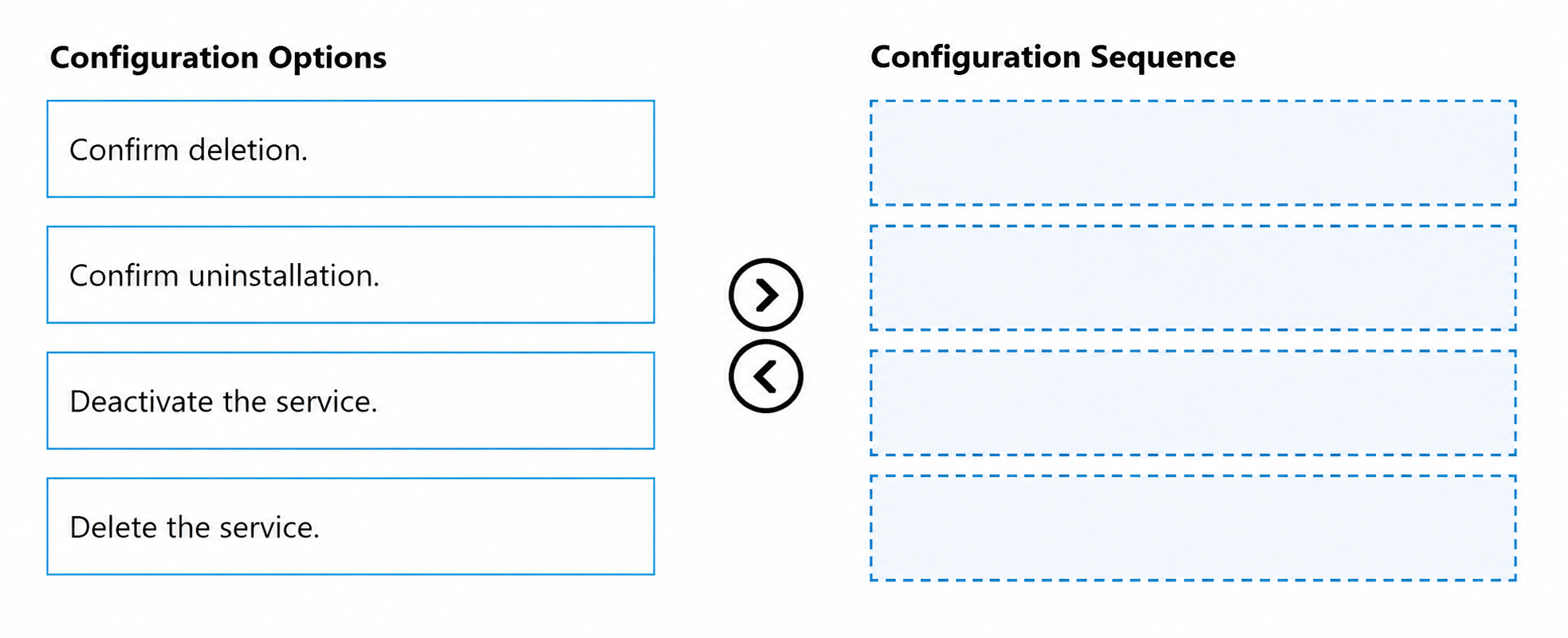
The administrator has completed a proof of concept for using Harbor as a container registry part of the Supervisor services and you are tasked for cleaning up the environment, starting with the unlnstall of the Harbor Supervisor service.
Drag and drop the four tasks into the correct order from Configuration Options on the left and place them into the Configuration Sequence on the right. (Choose four)
Reveal answer detailsClose answer details
Explanation
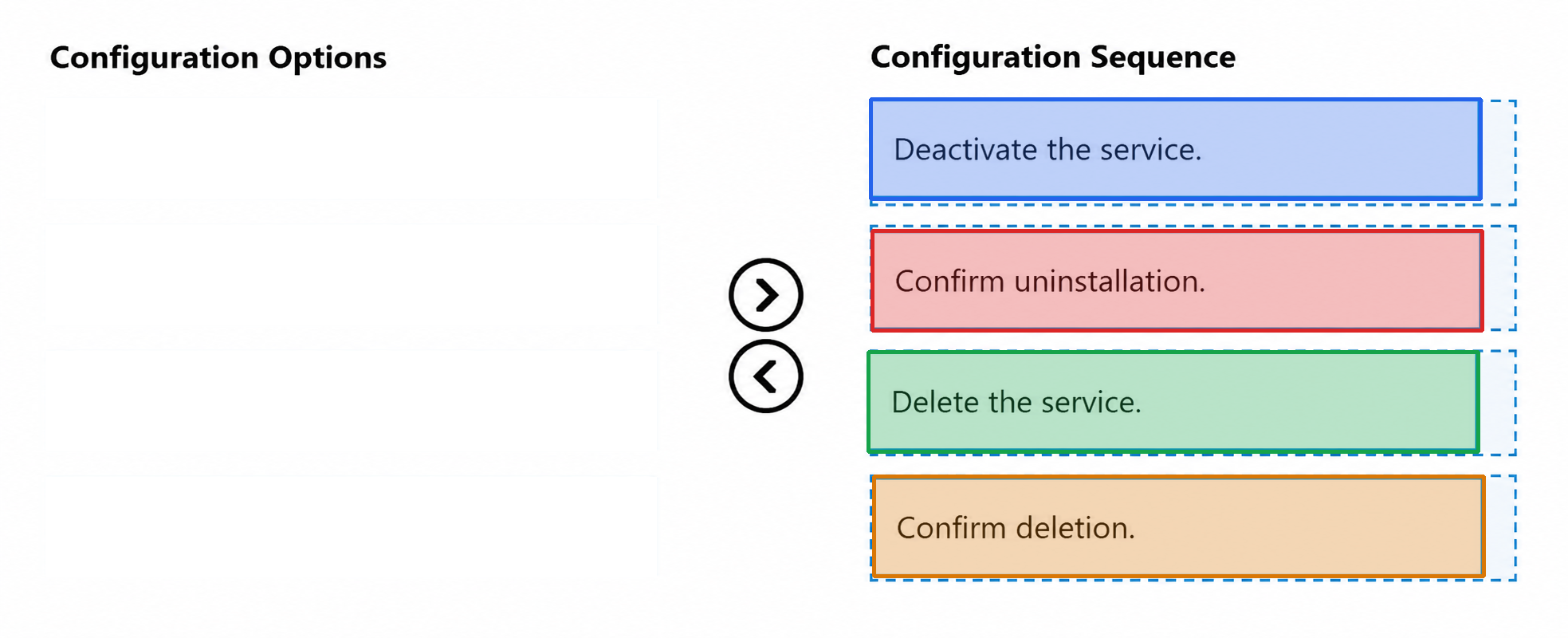
Configuration Sequence (in order): Deactivate the service. Confirm uninstallation. Delete the service. Confirm deletion. Uninstalling a Supervisor Service cleanly follows a "stop/remove/cleanup" pattern to avoid orphaned components and to ensure the Supervisor isn't still reconciling the service while you remove it. First, youDeactivate the serviceso the Supervisor stops managing and running the Harbor service components. This prevents new service resources from being created while you are attempting to remove them and allows the platform to transition the service into a non-operational state safely.
Next, youConfirm uninstallationto initiate the removal workflow. This step acknowledges that the service's deployed components (such as pods, controllers, and any associated objects) will be removed from the Supervisor-managed environment. After the uninstall workflow is initiated and the service is no longer active, you proceed toDelete the serviceto remove the Harbor service registration/entry from the Supervisor Services list, ensuring it is no longer available to namespaces or consumers. Finally, youConfirm deletionas the last safeguard, since deletion is typically destructive and removes the service definition from the environment's available services catalog.
Question 14
Single choice
How should an administrator enable autoscaling for a vSphere Kubernetes Service (VKS) cluster?
A
Update the NodePool YAML to enable the autoscaling feature.
B
Create a VKS cluster with autoscaler annotations.
C
Create a NodePool with autoscaling enabled.
D
Install the Cluster Autoscaler (standard package) for the cluster environment.
Reveal answer detailsClose answer details
Correct answerD
Explanation
Autoscaling is provided by installing the Cluster Autoscaler standard package in the cluster environment. That component evaluates cluster capacity needs and adjusts eligible node resources through the supported integration. Merely adding an annotation or changing a NodePool YAML field does not install the controller that performs the autoscaling decisions and actions.
Question 15
Multiple choice
Which three objects or object types are within the scope of a cluster backup for VMware vSphere Kubernetes Service (VKS)? (Choose three.)
A
Objects identified by a label selector
B
Cluster
C
Application
D
Service
E
Objects identified by a tag
F
Namespace
Reveal answer detailsClose answer details
Correct answersA, B, F
Explanation
Cluster backup scope can be defined at three levels of granularity. Selecting the cluster covers the cluster-wide scope, selecting a namespace limits the scope to that namespace, and using a label selector includes the objects that match the label criteria. These choices provide whole-cluster, namespace-bounded, and filtered-object coverage.
Question 16
Single choice
What component is used to provision VMware vSphere Kubernetes Service (VKS) service mesh workload clusters?
A
Harbor
B
Cert-manager
C
Carvel
D
Cluster API
Reveal answer detailsClose answer details
Correct answerD
Explanation
Cluster API is the component used to provision the workload clusters that participate in the VKS service mesh. It represents cluster infrastructure and desired lifecycle state as Kubernetes resources, then uses controllers to reconcile that state. Harbor manages artifacts, cert-manager manages certificates, and Carvel manages application packages rather than provisioning these clusters.
Question 17
Single choice
Which statement correctly maps Kubernetes persistent-storage abstractions?
A
A claim requests storage, a volume represents capacity, and a class guides provisioning.
B
A volume requests storage, a class represents capacity, and a claim selects pods.
C
A class stores application data, a claim supplies hardware, and a volume schedules pods.
D
A claim is a physical device, a volume is a policy, and a class is an image.
Reveal answer detailsClose answer details
Correct answerA
Explanation
A PersistentVolumeClaim expresses a workload's request for storage with specified characteristics. A PersistentVolume represents storage capacity that can satisfy a claim. A StorageClass describes a provisioning class and guides how suitable storage is dynamically created. These three abstractions separate consumption requests, available capacity, and provisioning policy.
VMWARE
Advanced VMware Cloud Foundation 9.0 vSphere Kubernetes Service
The design requires integrated logical networking, richer isolation, and placement across two real infrastructure failure domains. Which choice satisfies these requirements?
A.
Use VDS-backed networking and create two zone labels on the same failure domain.
B.
Use VDS-backed networking because it has the same logical objects as NSX.
C.
Use NSX-backed networking and treat zone names as sufficient physical isolation.
D.
Use NSX-backed networking and align each zone with an actual failure domain.
Correct Answer: D
Explanation
Explanation/Reference:
NSX-backed networking supplies the integrated logical networking and richer isolation required by the design. Availability across two failure domains also requires each logical zone to map to genuinely separate infrastructure. Zone names alone do not create physical independence, so aligning every zone with an actual failure domain is necessary for meaningful placement resilience.
QUESTION 2
A cloud operations team is managing multiple Supervisor Clusters across two regions. Each region hosts its own vSphere Kubernetes clusters, integrated through a federated service mesh to enable consistent service connectivity and policy enforcement across environments.
The application team wants to expose a multi-tier microservice named "GovApp", which includes front-end, API, and database services distributed between the two regions. Uniform traffic routing, identity, and security policies are also needed for these workloads regardless of the cluster or region in which they are deployed.
To meet these requirements, the architects decide to create a Global Namespace that spans both Supervisor Clusters.
Which two statements describe the requirements for a Global Namespace in a vSphere Kubernetes Service Mesh deployment? (Choose two.)
A.
Applies a single policy to multiple namespaces across multiple clusters.
B.
Defines an application boundary across multiple clusters.
C.
Provides distributed Ingress and egress services to support multiple namespaces across multiple clusters.
D.
Enables automatic placement of workloads to any global cluster based on traffic demand.
E.
Provides centralized logging for Service Mesh traffic.
Correct Answer: AB
Explanation
Explanation/Reference:
A Global Namespace defines one logical application boundary that can span namespaces in multiple clusters, allowing the distributed GovApp services to be treated as one application scope. It also applies a single policy across those member namespaces and clusters, which provides the required consistency for identity, security, and traffic behavior across both regions.
QUESTION 3
A remote site has a requirement for VMware vSphere Kubernetes Service (VKS). The environment has minimal storage available.
Which action ensures the Content Library does not consume all available space on the datastore?
A.
Select theDownload contentoption and chooseWhen needed.
B.
Use a local datastore on one of the ESXi hosts.
C.
Create a scheduled task to download the images that are needed.
D.
Select theDownload contentoption and chooseImmediately.
Correct Answer: A
Explanation
Explanation/Reference:
Setting Download content to When needed avoids downloading every library item in advance. Content is retrieved only when it is required, so unused images do not immediately occupy the remote site's limited datastore capacity. Choosing Immediately would consume space up front, while changing datastores or scheduling downloads does not provide the same demand-based behavior.
QUESTION 4
Which four capabilities are provided by a VMware Kubernetes Service (VKS) cluster?
A.
Authentication, storage integration, pod networking, and load balancing.
B.
Identity federation, persistent logging, firewall services, and monitoring.
C.
Identity federation, external storage, virtual machine networking, and DNS services.
D.
Authentication, backup services, VLAN segmentation, and DHCP.
Correct Answer: A
Explanation
Explanation/Reference:
A VKS cluster includes authentication for controlling access, storage integration for persistent workload data, pod networking for communication among workloads, and load balancing for distributing traffic to exposed services. Together these cover identity, data, internal connectivity, and traffic delivery. The other sets mix in functions that are not the four core cluster capabilities requested.
QUESTION 5
Which two package management tools can be used to configure and install applications on VMware vSphere Kubernetes Service (VKS)? (Choose two.)
A.
Fluent Bit
B.
Multus
C.
Helm
D.
Grafana
E.
Carvel
Correct Answer: CE
Explanation
Explanation/Reference:
Helm packages Kubernetes resources into charts and supports configurable application installation and lifecycle operations. Carvel provides a collection of tools for packaging, configuring, and deploying applications to Kubernetes. Fluent Bit handles log processing, Multus supplies additional network interfaces, and Grafana presents monitoring data rather than managing application packages.
QUESTION 6
An administrator is tasked with installing Istio Service Mesh for VMware vSphere Kubernetes Service (VKS).
Which command installs Istio?
A.
Use curl to download and install Istio.
B.
Use vcf package install to install the Istio package.
C.
Use kubectl istioctl install.
D.
Use docker build istioctl.
Correct Answer: B
Explanation
Explanation/Reference:
Istio is installed in this VKS environment as a managed package through vcf package install. Using that command follows the package mechanism and installs the Istio package into the intended environment. Downloading arbitrary files with curl, building a container image, or combining kubectl with an istioctl subcommand does not use the specified VCF package installation path.
QUESTION 7
An administrator is tasked with enabling a Supervisor cluster in VMware Cloud Foundation (VCF). Arrange the steps below In the correct order to complete the process of enabling a Supervisor In the environment.
Correct Answer:
Explanation
Explanation/Reference:
Answer (Correct Order): Select the target cluster in the workload domain. Open Workload Management and select "Enable Supervisor Cluster".
Choose cluster networking mode and stack. Configure the control plane compute, networking, and storage policies. Configure the workload network configurations. Review, Validate, and Deploy Supervisor.
You start by selecting theexact vSphere cluster(in the workload domain) that will host the Supervisor, because Supervisor enablement is performedagainst a specific cluster. From there you launch the enablement workflow inWorkload Management("Enable Supervisor Cluster"). Early in the wizard you must decide thenetworking mode(for example, VDS-based vs NSX-backed) and theIP stack, because those choices drive the remaining configuration screens and what inputs are required. Next you define theSupervisor control plane settings-compute sizing and the core policies the Supervisor will use (including storage policy selections and related defaults). After the control plane foundation is defined, you configure theworkload networkingused by namespaces and Kubernetes workloads (IP ranges, routing/LB integration depending on the selected mode). Finally, youreview/validateall inputs anddeployso the platform can create and configure the Supervisor control plane and supporting components.
QUESTION 8
An organization has standardized on the following configurations: vSphere Kubernetes Services upgrade is separate from vCenter upgrades. A private registry will be utilized.
What is the recommended solution to adhere to these standards?
A.
Issue a kubectl command pointing service definition to the private registry.
B.
Issue a PowerCLI command to point to the private registry.
C.
When uploading the service definition, choose Asynchronous Public.
D.
When uploading the service definition, choose Asynchronous Private.
Correct Answer: D
Explanation
Explanation/Reference:
The service lifecycle must remain independent of vCenter upgrades while obtaining content from the organization's private registry. When uploading the service definition, choosing Asynchronous Private establishes that private, asynchronously managed source. A kubectl or PowerCLI redirection is not the service-definition setting described by these standards.
QUESTION 9
An administrator is deploying vSphere Kubernetes Service (VKS) on a VMware Cloud Foundation workload domain to support a new internal AI and data analytics platform. The environment must host both virtual machine (VM) applications and containerized workloads while maintaining a unified networking and security model through NSX. The design documentation outlines the requirements for the Supervisor infrastructure components.
What three components form the foundation of a VMware vSphere Kubernetes Service (VKS) Supervisor deployment? (Choose three.)
The Supervisor control plane virtual machine supplies the Kubernetes control plane for the deployment. The NSX Manager virtual machine provides the NSX management foundation required by the stated unified networking and security design. The NSX Advanced Load Balancer Controller virtual machine supplies the load-balancing control component, completing the three infrastructure elements.
QUESTION 10
An administrator has been tasked with enabling backup for a vSphere Kubernetes cluster.
How does the administrator configure a backup?
A.
Set the BackupStorageLocation in Velero to an S3-compatible object store.
B.
Set the BackupStorageLocation in Velero to use the storage allocated to the namespace for the cluster.
C.
Use vSphere Replication to back up the virtual machines the cluster is deployed on.
D.
Take a vSAN snapshot of the virtual machines the cluster is deployed on.
Correct Answer: A
Explanation
Explanation/Reference:
Velero needs a backup destination that is separate from the workload resources being protected. Configuring BackupStorageLocation with an S3-compatible object store provides that destination for cluster backup data. Namespace storage is not the specified Velero backup target, while VM replication or snapshots do not configure a Kubernetes-aware Velero backup.
QUESTION 11
A user can authenticate and has access to the required vSphere Namespace, but an attempt to create Deployments is denied by the Kubernetes API. What should be configured?
A.
A Role with the required verbs and a RoleBinding for the user
B.
A trusted endpoint certificate issued for the user's identity
C.
A vSphere storage policy with permission to create Deployments
D.
An image-pull secret assigned to the user's service account
Correct Answer: A
Explanation
Explanation/Reference:
Authentication and namespace access establish identity and entry to the environment, but they do not grant permission to create every Kubernetes resource. A Role must allow the required Deployment verbs in the namespace, and a RoleBinding must associate those rules with the user. That RBAC combination authorizes the Kubernetes API operation that is currently denied.
QUESTION 12
An administrator is updating a VMware vSphere Kubernetes Service (VKS) cluster by editing the cluster manifest.
When saving, there is no indication that the edit was successful. Based on the scenario, what action should the administrator take to edit and apply changes to the manifest?
A.
Define the KUBE_EDITOR or EDITOR environment variable.
B.
Verify the account editing the cluster manifest has appropriate permissions.
C.
Ensure the file permissions are set to read-write.
D.
Restart the VKS services and edit the file again.
Correct Answer: A
Explanation
Explanation/Reference:
An interactive manifest edit requires kubectl to know which text editor to launch. Defining KUBE_EDITOR or EDITOR supplies that editor choice. After the administrator saves and exits the configured editor, kubectl can submit the modified manifest to the API, so the intended declarative changes enter reconciliation.
QUESTION 13
DRAG DROP
The administrator has completed a proof of concept for using Harbor as a container registry part of the Supervisor services and you are tasked for cleaning up the environment, starting with the unlnstall of the Harbor Supervisor service.
Drag and drop the four tasks into the correct order from Configuration Options on the left and place them into the Configuration Sequence on the right. (Choose four)
Correct Answer:
Explanation
Explanation/Reference:
Configuration Sequence (in order): Deactivate the service. Confirm uninstallation. Delete the service. Confirm deletion. Uninstalling a Supervisor Service cleanly follows a "stop/remove/cleanup" pattern to avoid orphaned components and to ensure the Supervisor isn't still reconciling the service while you remove it. First, youDeactivate the serviceso the Supervisor stops managing and running the Harbor service components. This prevents new service resources from being created while you are attempting to remove them and allows the platform to transition the service into a non-operational state safely.
Next, youConfirm uninstallationto initiate the removal workflow. This step acknowledges that the service's deployed components (such as pods, controllers, and any associated objects) will be removed from the Supervisor-managed environment. After the uninstall workflow is initiated and the service is no longer active, you proceed toDelete the serviceto remove the Harbor service registration/entry from the Supervisor Services list, ensuring it is no longer available to namespaces or consumers. Finally, youConfirm deletionas the last safeguard, since deletion is typically destructive and removes the service definition from the environment's available services catalog.
QUESTION 14
How should an administrator enable autoscaling for a vSphere Kubernetes Service (VKS) cluster?
A.
Update the NodePool YAML to enable the autoscaling feature.
B.
Create a VKS cluster with autoscaler annotations.
C.
Create a NodePool with autoscaling enabled.
D.
Install the Cluster Autoscaler (standard package) for the cluster environment.
Correct Answer: D
Explanation
Explanation/Reference:
Autoscaling is provided by installing the Cluster Autoscaler standard package in the cluster environment. That component evaluates cluster capacity needs and adjusts eligible node resources through the supported integration. Merely adding an annotation or changing a NodePool YAML field does not install the controller that performs the autoscaling decisions and actions.
QUESTION 15
Which three objects or object types are within the scope of a cluster backup for VMware vSphere Kubernetes Service (VKS)? (Choose three.)
A.
Objects identified by a label selector
B.
Cluster
C.
Application
D.
Service
E.
Objects identified by a tag
F.
Namespace
Correct Answer: ABF
Explanation
Explanation/Reference:
Cluster backup scope can be defined at three levels of granularity. Selecting the cluster covers the cluster-wide scope, selecting a namespace limits the scope to that namespace, and using a label selector includes the objects that match the label criteria. These choices provide whole-cluster, namespace-bounded, and filtered-object coverage.
QUESTION 16
What component is used to provision VMware vSphere Kubernetes Service (VKS) service mesh workload clusters?
A.
Harbor
B.
Cert-manager
C.
Carvel
D.
Cluster API
Correct Answer: D
Explanation
Explanation/Reference:
Cluster API is the component used to provision the workload clusters that participate in the VKS service mesh. It represents cluster infrastructure and desired lifecycle state as Kubernetes resources, then uses controllers to reconcile that state. Harbor manages artifacts, cert-manager manages certificates, and Carvel manages application packages rather than provisioning these clusters.
QUESTION 17
Which statement correctly maps Kubernetes persistent-storage abstractions?
A.
A claim requests storage, a volume represents capacity, and a class guides provisioning.
B.
A volume requests storage, a class represents capacity, and a claim selects pods.
C.
A class stores application data, a claim supplies hardware, and a volume schedules pods.
D.
A claim is a physical device, a volume is a policy, and a class is an image.
Correct Answer: A
Explanation
Explanation/Reference:
A PersistentVolumeClaim expresses a workload's request for storage with specified characteristics. A PersistentVolume represents storage capacity that can satisfy a claim. A StorageClass describes a provisioning class and guides how suitable storage is dynamically created. These three abstractions separate consumption requests, available capacity, and provisioning policy.