An engineering team must implement Unified MPLS to scale an MPLS network. Devices in the core layer use different IGPs, so the team decided to split the network into different areas. The team plans to keep the MPLS services as they are and introduce greater scalability. Which additional action must the engineers take to implement the Unified MPLS?
-
A
Redistribute the IGP prefixes from one IGP into the other routers to ensure end-to-end LSPs.
-
B
Configure the ABR routers as route reflectors that redistribute IGP into BGP.
-
C
Redistribute the IGP prefixes into another IGP to ensure end-to-end LSPs.
-
D
Move the IGP prefixes into IS-IS as the loopback prefixes of the PE routers to distribute the prefixes to other routers to create end-to-end LSPs.
Reveal answer details
Close answer details
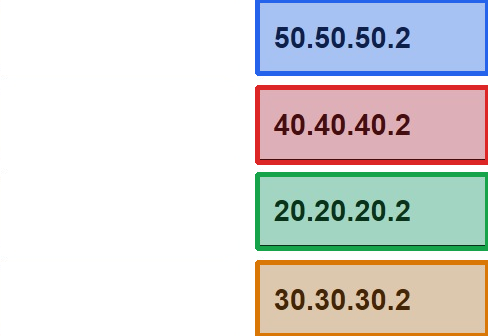
DRAG DROP Refer to the exhibit. 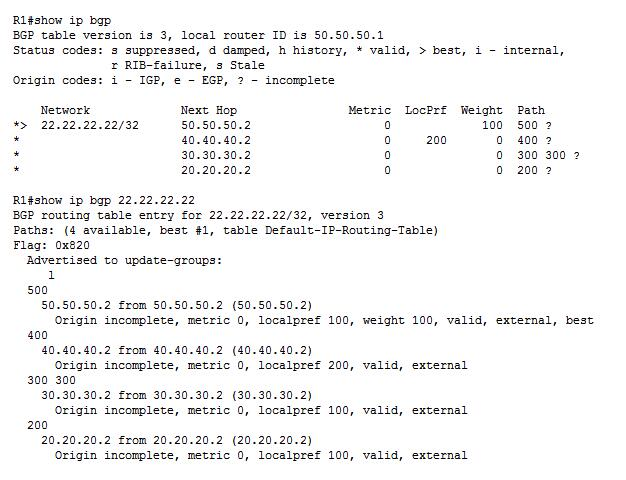 An engineer wants to determine which paths are best, second best, third best, and fourth best. Drag and drop the peer addresses on the left to the corresponding BGP best-path selection order on the right. 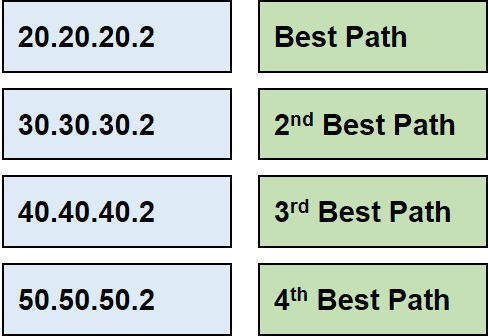
Reveal answer details
Close answer details
Refer to the exhibit. 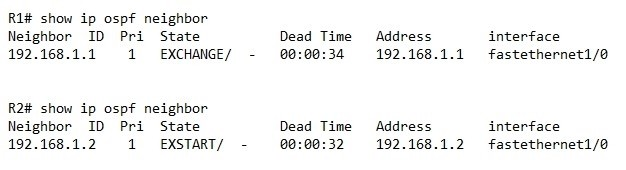 A company recently deployed a new network using OSPF in the core to share routes. The network administrator selected OSPF as the routing protocol because of its ability to maintain a route database.
When the new network was started up, all routers booted normally, but the link between routers R1 and R2 failed to come up. The two routers are located in the same rack at the data center. Which task should an engineer perform to correct the problem?
-
A
Synchronize the dead timers.
-
B
Change one of the OSPF router IDs so that the router IDs are in different subnets
-
C
Change the OSPF process ID on one of the devices so that the two IDs match
-
D
Configure the MTUs on the interface to match.
Reveal answer details
Close answer details
Correct answerD
ExplanationWhen OSPF routers establish adjacency, they must agree on the MTU size on the connecting interface. If the MTUs do not match, the routers will not form an OSPF adjacency, and the link between them will not come up. Therefore, configuring the MTUs on the interfaces to match is essential for the OSPF network to function correctly. Implementing and Operating Cisco Service Provider Network Core Technologies (SPCOR)
Refer to the exhibit. R1
interface gigabitethernet1/0/0
ipv6 enable ipv6 ospf 1 area 1
interface gigabitethernet2/0/0
ipv6 enable ipv6 ospf 1 area 2 An engineer implemented OSPF neighbor relationship on an IOS device. Which configuration must be applied to get the OR/BOR election removed from interfaces running OSPF?
-
A
ip ospf network broadcast on interfaces running OSPF
-
B
ip ospf network point-to-point on interfaces running OSPF
-
C
ip ospf network multipoint-point on interfaces running OSPF
-
D
ip ospf network non-broadcast on n:erfaces running OSPF
Reveal answer details
Close answer details
Refer to the exhibit. 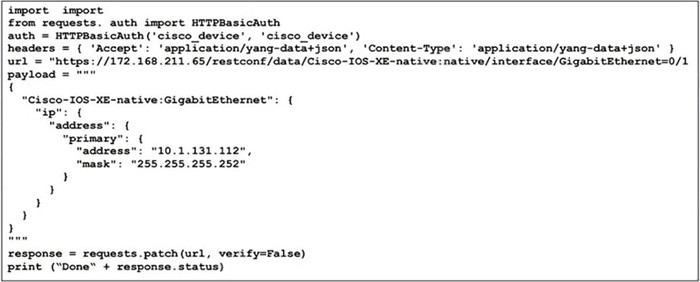 To optimize network operations, the senior architect created this Python 3.9 script for network automation tasks and to leverage Ansible 4.0 playbooks. Devices in the network support only RFC 2617-based authentication. What does the script do?
-
A
The script performs a configuration sanity check on the device with IP address 172.168.211.65 via HTTP and returns an alert if the payload field fails to match.
-
B
The script leverages REST API calls and configures interface GigabitEthernet0/1 with IP address
10.1.131.112/30.
-
C
The script parses the JSON response from the router at IP address 172.168 211.65 and checks if the interface GigabitEthernet0/1 with IP address 10.1.131.112 exists on the router.
-
D
The script logs in via SSH and configures interface GigabitEthernet0/1 with IP address 10
1.131.112/30.
Reveal answer details
Close answer details
Correct answerB
ExplanationThe script is designed to leverage REST API calls for network configuration tasks. It uses the requests library in Python to send a PATCH request to the device with IP address 172.168.211.65. The script includes RFC 2617-based authentication, which is used for HTTP, indicating that it's not using SSH for login. The payload of the REST API call specifies the configuration for the interface GigabitEthernet0/1 with the IP address 10.1.131.112/30. Therefore, the script is performing option B, configuring the interface via REST API calls.
The explanation is based on general knowledge of Python scripting for network automation and REST API interactions as typically covered in network automation sections of Cisco Service Provider courses and documentation.
Which protocol in the IPv6 stack does the MLD protocol use to carry its messages?
-
A
-
B
-
C
-
D
-
E
Reveal answer details
Close answer details
Refer to the exhibit. 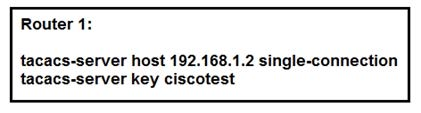 Router1:
tacacs-server host 192.168.1.2 single-connection
tacacs-server key ciscotest What is the result of this configuration?
-
A
Router 1 opens and closes a TCP connection to the TACACS+ server every time a user requires authorization.
-
B
Router 1 and the TACACS+ server maintain one open connection between them only when network administrator is accessing the router with password ciscotest.
-
C
Router 1 and the TACACS+ server maintain one open connection between them.
-
D
Router 1 opens and closes a TCP connection to the TACACS+ server every time a user requires authentication.
Reveal answer details
Close answer details
Correct answerC
Explanationhttps://www.ccexpert.us/cisco-secure/configuring-tacacs-on-cisco-ios.html
single-connection (Optional) Used to specify a single connection. Rather than have the router open and close a TCP connection to the daemon each time it must communicate, the single-connection option maintains a single open connection between the router and the daemon. This is more efficient because it allows the daemon to handle a higher number of TACACS operations.
Question 8
Lab simulation
Simulation  Guidelines This is a lab item in which tasks will be performed on virtual devices. 1. Refer to the Tasks tab to view the tasks for this lab item.
2. Refer to the Topology tab to access the device console(s) and perform the tasks.
3. Console access is available for all required devices by clicking the device icon or using the tab(s) above the console window.
4. All necessary preconfigurations have been applied.
5. Do not change the enable password or hostname for any device.
6. Save your configurations to NVRAM before moving to the next item.
7. Click Next at the bottom of the screen to submit this lab and move to the next question.
8. When Next is clicked, the lab closes and cannot be reopened. Topology 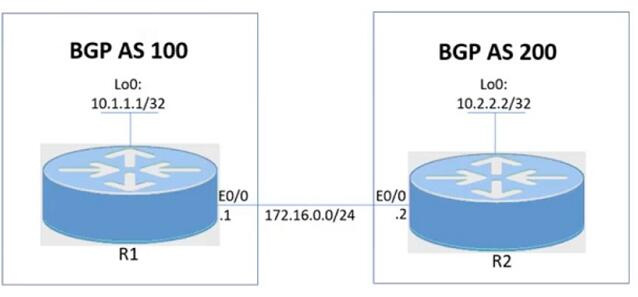 Tasks R1 and R2 currently have an eBGP connection. Configure and verify these tasks on R1 and R2: 1. Apply the preconfigured route map R1-TO-R2 on R1 to receive the R2 Loopback address on R1.
2. Apply the preconfigured route map R2-TO-R1 on R2 to receive the R1 Loopback address on R2.
3. R1 must advertise network 10.1.1.1/32 toward R2. Redistribution is not allowed.
4. R2 must advertise network 10.2.2.2/32 toward R1. Redistribution is not allowed.
Reveal model answer
Close model answer
R1
router bgp 100
address-family ipv4 nei 172.16.0.2 route-map R1-TO-R2 in network 10.1.1.1 mask 255.255.255.255 copy run start R2
router bgp 200
address-family ipv4
network 10.2.2.2 mask 255.255.255.255 nei 172.16.0.1 route-map R2-TO-R1 in copy run start
What is the difference between SNMP and model-driven telemetry?
-
A
SNMP uses the YANG data modeling language.
-
B
Telemetry uses traps and inform messages to deliver data to a network administrator on a polling basis.
-
C
Telemetry allows for modeled network data to be pushed to the network administrator on an as-needed basis.
-
D
SNMP pushes network data to the network administrator whenever it is queried.
Reveal answer details
Close answer details
Correct answerC
ExplanationThe difference between SNMP (Simple Network Management Protocol) and model-driven telemetry lies in their data delivery mechanisms. Telemetry allows for modeled network data to be pushed to network administrators on an as-needed basis, providing real-time insights into network performance and health.
On the other hand, SNMP typically relies on polling mechanisms where network administrators request data at specific intervals.
References:
Implementing and Operating Cisco Service Provider Network Core Technologies source documents or study guide
Question 10
Single choice
Refer to the exhibit. 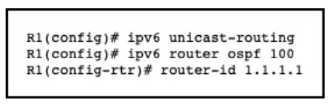 An engineer is configuring router R1 for OSPFv3 as shown. Which additional configuration must be performed so that the three active interfaces on the router will advertise routes and participate in OSPF IPv6 processes?
-
A
R1(config)# interface Ethernet1/1
R1(config-if)# ipv6 ospf 100 area 0
R1(config)# interface Ethernet1/2
R1(config-if)# ipv6 ospf 100 area 10
R1(config)# interface Ethernet1/3
R1(config-if)# ipv6 ospf 100 area 20
-
B
R1(config)# interface Ethernet1/1
R1(config-if)# ip ospf hello-interval 1
R1(config-if)# ipv6 ospf 100 area 0
R1(config)# interface Ethernet1/2
R1(config-if)# ip ospf hello-interval 1
R1(config-if)# ipv6 ospf 100 area 10
R1(config)# interface Ethernet1/3
R1(config-if)# ip ospf hello-interval 1
R1(config-if)# ipv6 ospf 100 area 20
-
C
R1(config)# interface Ethernet1/1
R1(config-if)# ipv6 ospf 1 area 0
R1(config)# interface Ethernet1/2
R1(config-if)# ipv6 ospf 1 area 10
R1(config)# interface Ethernet1/3
R1(config-if)# ipv6 ospf 1 area 20
Reveal answer details
Close answer details
Question 11
Single choice
In an EVPN operation how does the PE determine and advertise Ethernet segment reachability?
-
A
The PE discovers and shares routing information for the B-MAC addresses associated with local Ethernet segments.
-
B
The PE discovers remote ESIs and determines their redundancy mode.
-
C
The PE discovers the remote PEs in the EVI and builds a flood list linked with the EVI.
-
D
The PE discovers other PEs in the same Ethernet segment and elects a DF.
Reveal answer details
Close answer details
Question 12
Single choice
What is the maximum capacity of a single Cisco CRS-1?
-
A
-
B
-
C
-
D
-
E
Reveal answer details
Close answer details
Question 13
Multiple choice
You are configuring MPLS traffic-engineering tunnels in the core. Which two ways exist for the tunnel path across the core? (Choose two )
-
A
Tunnel links inherit IGP metrics by default unless overridden
-
B
Tunnels can be configured with dynamic path or explicitly defined path
-
C
A zero bandwidth tunnel is not a valid option
-
D
The bandwidth statement creates a "hard" reservation on the link-The dynamic path option is supported
only with IS-IS
Reveal answer details
Close answer details
Question 14
Single choice
Refer to the exhibit. 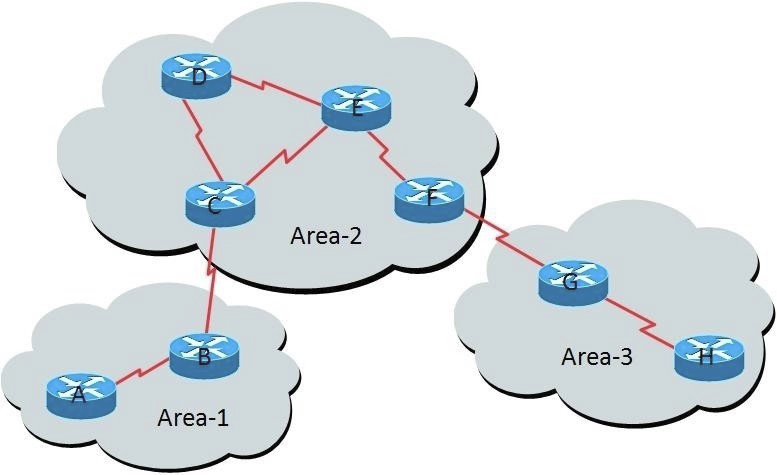 All routers are running IS-IS. Which routers must be Level 2 routers?
-
A
-
B
-
C
-
D
-
E
Reveal answer details
Close answer details
Question 15
Single choice
Which option is the Cisco cloud management platform that is designed for enterprise and public sector IT organizations to help build private and hybrid clouds?
-
A
-
B
-
C
-
D
Cisco Intelligent Automation for Cloud
Reveal answer details
Close answer details
Question 16
Single choice
Refer to the exhibit. 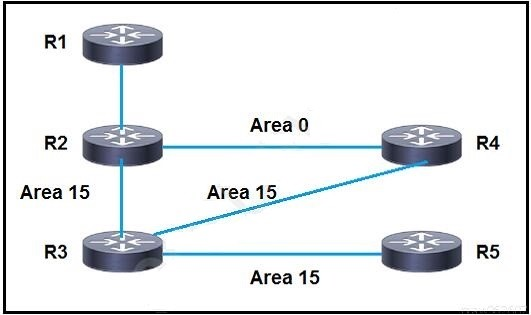 An engineer has started to configure a router for OSPF, as shown. Which configuration must an engineer apply on the network so that area 15 traffic from R5 to R1 will prefer the route through R4?
-
A
Implement a sham link on the link between R3 and R2 to extend area 0 over area 15.
-
B
Implement a multiarea adjacency on the link between R2 and R4, with the cost manipulated to make the path through R4 preferred.
-
C
Place the link between R3 and R5 in a stub area to force traffic to use the route through R4.
-
D
Increase the cost on the link between R2 and R3 to a value higher than the link between R2 and R4, to influence the path over R3 and R4.
Reveal answer details
Close answer details
Correct answerB
ExplanationAfter doing an easy lab I can say for certain that the answer is B. To add some more information to clarify, R3 wil ALWAYS prefer the INTRA-area link to R2, no matter the cost assigned to the interface. So it is until the inter-area 0 link between R2-R4 is configured as multiarea also in area 15, that the cost of the interface comes into play. https://www.cisco.com/c/en/us/support/docs/ip/open-shortest-path-first-ospf/118879-configure-ospf-00.html
Question 17
Single choice
Which protocol functions as the transfer protocol between the Cisco Open SDN Controller and forwarding devices?
-
A
-
B
-
C
-
D
Reveal answer details
Close answer details
Question 18
Single choice
Refer to the exhibit. 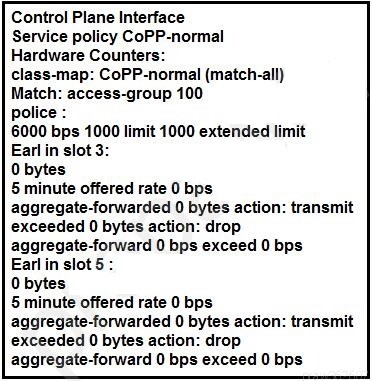 Which show command shows statistics for the control plane policy and is used to troubleshoot?
-
A
-
B
show policy control-plane
-
C
-
D
show policy-map control-plane
Reveal answer details
Close answer details
Correct answerD
ExplanationThe command "show policy-map control-plane" is used to display the control plane policies applied on a Cisco device, including the statistics related to packets matched by the class-maps of the policy-map. In this context, it helps in troubleshooting by providing detailed insights into how different types of traffic are being processed and controlled as they pass through the control plane. Implementing and Operating Cisco Service Provider Network Core Technologies (SPCOR) official course materials available on Cisco's website.
Question 19
Single choice
Refer to the exhibit.  Routers R1 and R2 support traffic between multiple departments at a company's remote office and exchange routes using OSPF. The link between R1 and R2 has been providing inconsistent performance, particularly during times of peak usage. To help identify the cause, an engineer was asked to implement BFD to detect failures on the link. Which task must the engineer perform?
-
A
Configure the session parameters individually on each interface.
-
B
Configure IS-IS to share routes between the routers.
-
C
Change the network between R1 and R2 to a /30 prefix.
-
D
Configure echo mode on both devices to support asymmetry.
Reveal answer details
Close answer details
Question 20
Single choice
Refer to the exhibit. 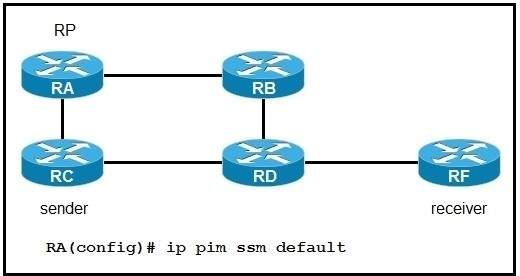 If router RA is configured as shown, which IPv4 multicast address space does it use?
-
A
-
B
-
C
-
D
Reveal answer details
Close answer details
Correct answerC
ExplanationThe router RA is configured with the command "ip pim ssm default". This configuration enables Source-
Specific Multicast (SSM) for the default range of 232.0.0.0/8, which is the IPv4 multicast address space reserved for SSM by IANA (Internet Assigned Numbers Authority). In SSM, data traffic is delivered to a specific group of subscribers identified by the combination of both source and multicast addresses, enhancing efficiency and security. References:
https://www.cisco.com/c/en/us/td/docs/switches/lan/catalyst3850/software/release/3se/multicast/configuration_guide/b_mc_3se_3850_cg/b_mc_3se_3850_cg_chapter_01011.html
Question 21
Single choice
An engineer must implement QoS to prioritize traffic that requires better service throughout the network.
The engineer started by configuring a class map to identify the high-priority traffic. Which additional tasks must the engineer perform to implement the new QoS policy?
-
A
Attach the class map to a policy map that sets the minimum bandwidth allocated to the classified traffic and designates the action to be taken on the traffic.
-
B
Attach the class map to a policy map that designates the action to be taken on the classified traffic and then attach the policy map to an interface using a service policy.
-
C
Attach the class map to a policy map within a VRF to segregate the high-priority traffic and then attach the policy map to an interface in another VRF.
-
D
Create a route map to manipulate the routes that are entered into the routing table and then attach the route map to an interface using a service policy.
Reveal answer details
Close answer details
Question 22
Single choice
Refer to the exhibit. 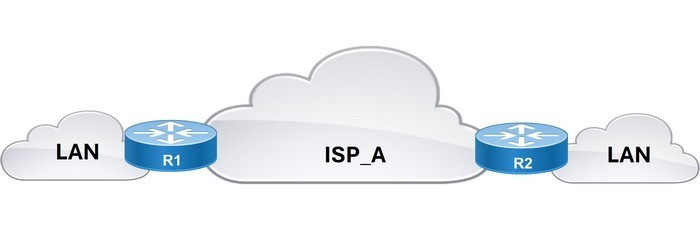 R1#show running-config
--
interface GigabitEthernet0/0
ip address 192.168.1.1 255.255.255.0
!
router ospf 1
router-id 1.1.1.1
network 192.168.1.0 0.0.0.255 area 0 R2#show running-config
--
interface GigabitEthernet0/0
ip address 192.168.1.2 255.255.255.0
!
router ospf 1
router-id 2.2.2.2
network 192.168.1.0 0.0.0.255 area 0 A growing company with an increasing international presence requires a secure and scalable solution for inter-office data transfer across their geographically dispersed locations. To ensure departmental privacy, the network must enforce granular access control. BGP is running in the network, and two VRF instances with unique route distinguishers and route targets have been configured to segregate critical financial data from regular network traffic. A network engineer with an employee ID: 5086:72:617 must find a solution that allows for future network expansion while maintaining robust security and data privacy between departments. The solution must comply with the RFC 4364 standard. Which action must the engineer take to meet the requirements?
-
A
Configure a GRE tunnel in AH mode between the two routers.
-
B
Configure MPLS in L3VPN mode between the two routers.
-
C
Configure a DMVPN connection between the two routers with Phase 2 mode enabled.
-
D
Configure an IPsec VPN connection between the two routers with ESP protocol enabled.
Reveal answer details
Close answer details
Question 23
Single choice
Which additional feature does MPLS DiffServ tunneling support?
-
A
matching EXP and DSCP values
-
B
-
C
using GRE tunnels to hide markings
-
D
interaction between MPLS and IGP
Reveal answer details
Close answer details
Correct answerB
ExplanationReferences:
https://www.cisco.com/c/en/us/td/docs/ios-xml/ios/mp_te_diffserv/configuration/15-mt/mp-te-diffserv-15-mt-book/mp-diffserv-tun-mode.html
Question 24
Single choice
Refer to the exhibit 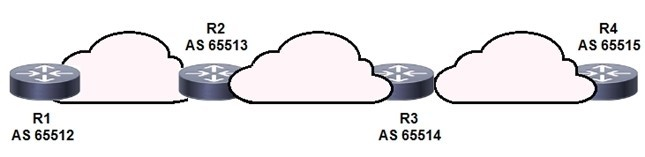 BGPsec is implemented on R1, R2, R3, and R4. BGP peering is established between neighboring autonomous systems. Which statement about implementation is true?
-
A
BGP updates from the iBGP peers are appended with a community of local-as.
-
B
BGP updates from the all BGP peers are appended with a community of no-export.
-
C
BGP updates from the eBGP peers are appended with an additional AS path value that is statically set by the domain administrator.
-
D
BGP updates from the eBGP peers are appended with a BGPsec attribute sequence that includes a public key hash and digital signature.
Reveal answer details
Close answer details
Correct answerD
ExplanationBGPsec enhances BGP by adding a layer of security for the AS path attribute. When BGPsec is implemented, updates from eBGP peers include a BGPsec attribute sequence with a public key hash and digital signature. This ensures the authenticity and integrity of the AS path, preventing unauthorized AS numbers from being inserted.
References:
Implementing and Operating Cisco Service Provider Network Core Technologies course materials.
Question 25
Single choice
Which action does the ingress VTEP perform on traffic between EVPN VXLAN overlays?
-
A
routing and tunneling when doing symmetric IRB
-
B
routing when doing asymmetric IRB
-
C
routing and bridging when doing asymmetric IRB
-
D
bridging when doing symmetric IRB
Reveal answer details
Close answer details
Correct answerC
Explanationhttps://www.cisco.com/c/en/us/products/collateral/switches/nexus-9000-series-switches/guide-c07-
734107. html
Question 26
Single choice
Refer to the exhibit. 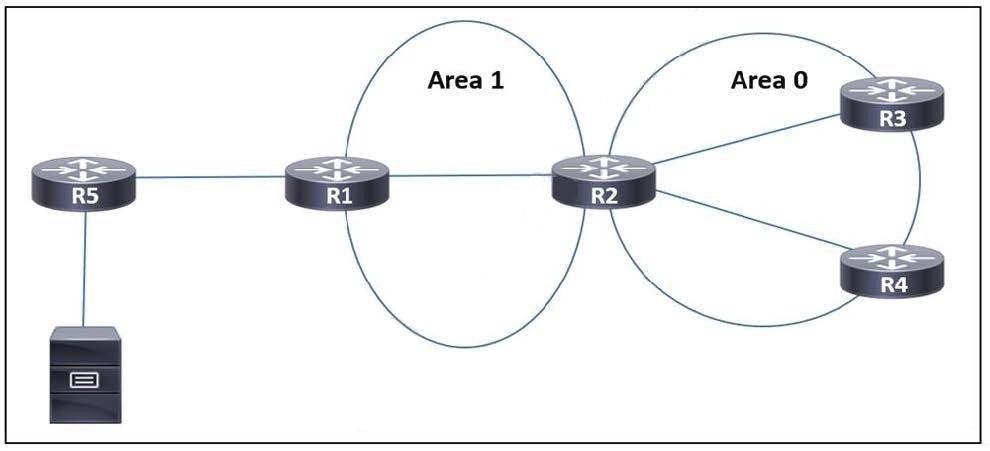 EIGRP is running between routers R5 and R1, and OSPF is used in the rest of the network. Users in a network attached to router R3 need to access a server connected to R5. Which task must the engineer perform so that only the users attached to R3 are able to access the server, but no other network is shared to OSPF?
-
A
Configure redistribution using route maps to filter the routes that are shared
-
B
Configure redistribution using an offset list to filter the routes that are shared.
-
C
Configure an OSPF virtual link between R1 and R3 to route traffic between the two areas.
-
D
Configure R1 as a stub router for EIGRP and OSPF so that only the default route is shared
Reveal answer details
Close answer details
Question 27
Single choice
Refer to the exhibit. An engineer working for a private telecommunication company with an employee Id: 4065:96:080 upgrades the WAN link between routers ASBR-101 and ASBR- 201 to 1Gb by Installing a new physical connection between the Gi3 Interfaces. 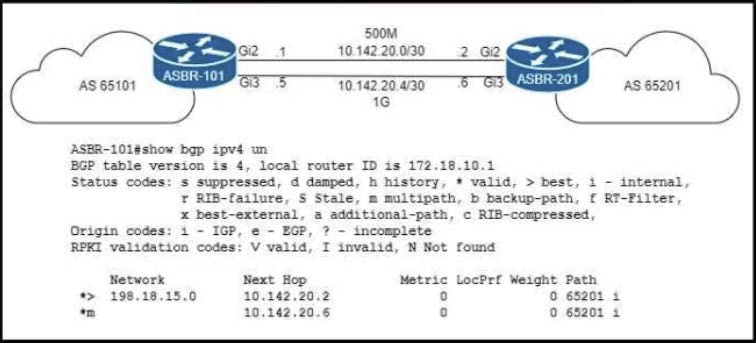 Which BGP attribute must the engineer configure on ASBR-201 so that the existing WAN link on Gi2 Is maintained as a backup? 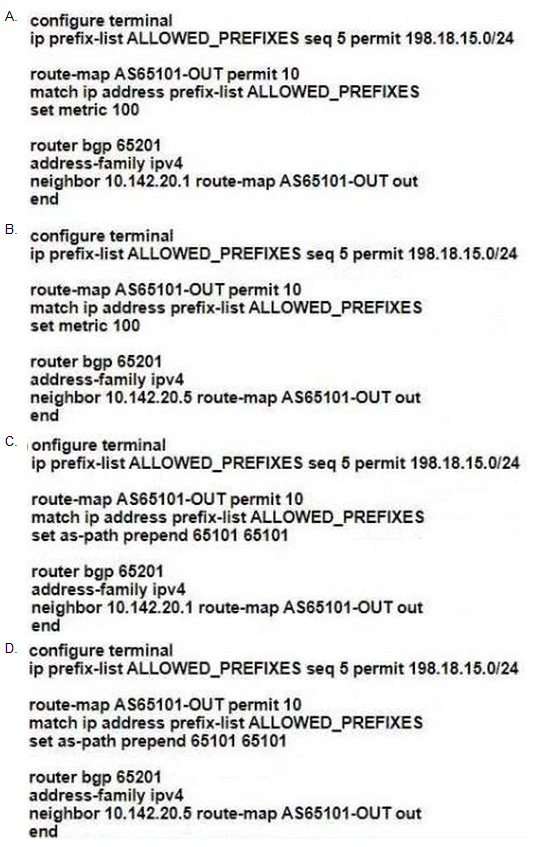
-
A
-
B
-
C
-
D
Reveal answer details
Close answer details
Question 28
Single choice
How does Inter-AS Option-A function when two PE routers in different autonomous systems are directly connected?
-
A
The two routers share all Inter-AS VPNv4 routes and redistribute routes within an IBGP session to provide end-to-end reach.
-
B
The two routers establish an MP-EBGP session to share their customers' respective VPNv4 routes.
-
C
The two routers treat one another as CE routers and advertise unlabeled IPv4 routes through an EBGP session.
-
D
The two routers share VPNv4 routes over a multihop EBGP session and set up an Inter-AS tunnel
using one another's label.
Reveal answer details
Close answer details
Question 29
Single choice
Refer to the exhibit. 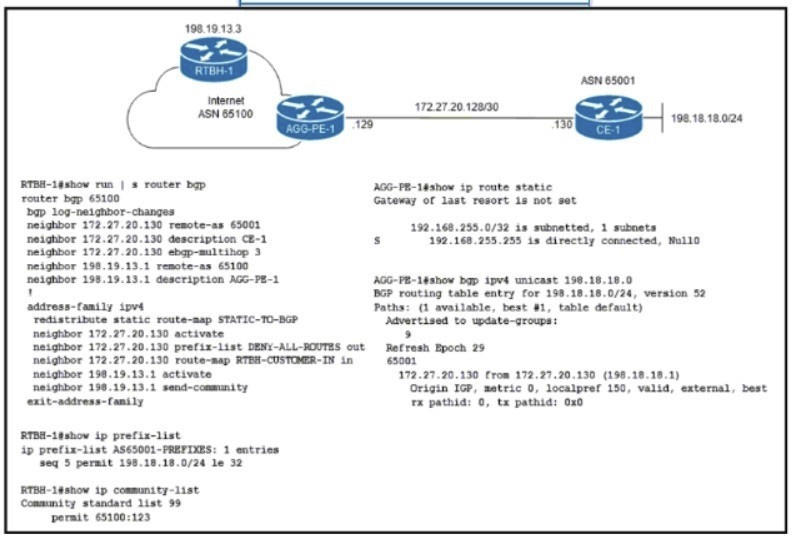 ISP ASN 65100 provides internet services to router CE-1 and receives customer prefix 198.18 18.0/24 via EBGP. An administrator for the ISP Is now provisioning RTBH services to provide on-demand data-plane security for the customer s IP space. Which route-map configuration must the administrator apply to router RTBH-1 to complete the implementation of RTBH services to CE-1?
-
A
route-map RTBH-CUSTOMER-IN permit 10
description AS65001
match ip address prefix-list AS65001-PREFIXES match community 99 set local-preference 200
set community no-export additive
set ip next-hop 192.168.255.255
route-map RTBH-CUSTOMER-IN deny 65535
description DEFAULT DENY
-
B
route-map RTBH-CUSTOMER-IN permit 10 description AS65001
match ip address prefix-list AS65001-PREFIXES match community 99 set local-preference 200 set community local-as additive
set ip next-hop 192.168.255.255
route-map RTBH-CUSTOMER-IN deny 65535
description DEFAULT DENY
-
C
route-map RTBH-CUSTOMER-IN permit 10
description AS65001
match ip address prefixlist AS65001-PREFIXES match community 99 set local-preference 200
set community no-advertise additive
set ip next-hop local-address
route-map RTBH-CUSTOMER-IN deny 65535
description DEFAULT DENY
-
D
route-map RTBH-CUSTOMER-IN permit 10
description AS65001
match ip address prefix-list AS65001-PREFIXES match community 99 set local-preference 200
set community no-advertise additive
set ip next-hop 192.168.255.255
route-map RTBH-CUSTOMER-IN deny 65535
description DEFAULT DENY
Reveal answer details
Close answer details
Question 30
Multiple choice
What are two features of stateful NAT64? (Choose two.)
-
A
It uses address overloading.
-
B
It provides 1:N translations, so it supports an unlimited number of endpoints.
-
C
It requires IPv4-translatable IPv6 address assignments.
-
D
It requires the IPv6 hosts to use either DHCPv6-based address assignments or manual address assignments.
-
E
It provides 1:1 translation, so it supports a limited number of endpoints.
Reveal answer details
Close answer details
Correct answersA, B
ExplanationReferences:
https://www.cisco.com/c/en/us/td/docs/ios-xml/ios/ipaddr_nat/configuration/xe-16/nat-xe-16-book/iadnat-stateful-nat64.html
Question 31
Single choice
Refer to the exhibit. 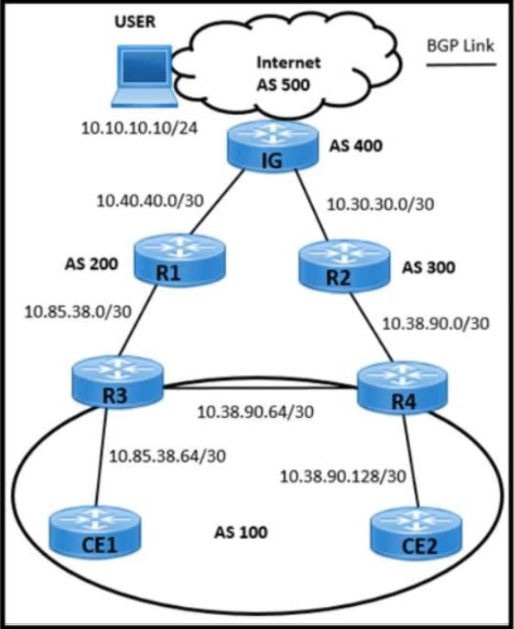 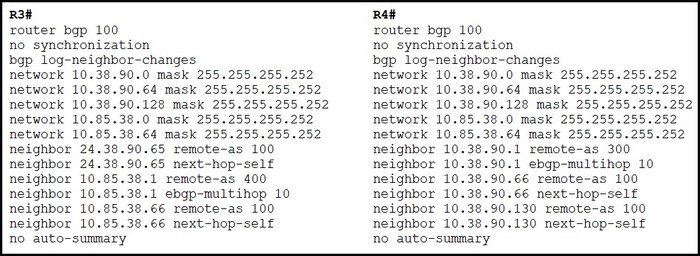 The USER that is connecting an application on an Internet connection in AS 100 is facing these issues:
1. The USER lost the connection to the application during a failure between IG and R2.
2. Router R2 configuration is lost due to a power outage.
3. The application the USER is connecting to is hosted behind CE2. What action resolves the issues on R3 and R4 routers?
-
A
Apply low Local Preference on R4 toward R2.
-
B
Apply high Local Preference on R3 toward R1.
-
C
Set R4 as a route reflector for R3 and CE2.
-
D
Set R3 as a route reflector for R4 and CE1.
Reveal answer details
Close answer details
Question 32
Multiple choice
Refer to the exhibit. 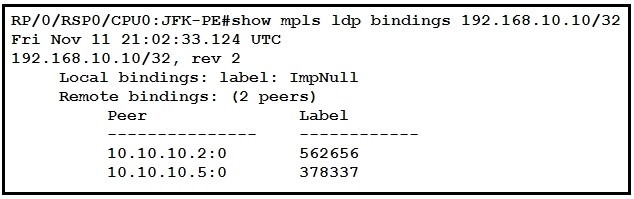 After implementing a new design for the network, a technician reviews the pictures CLI output as part of the MOP. Which two elements describe what the technician can ascertain from the ImpNull output? (Choose two.)
-
A
Ultimate Hop Popping is in use for the prefix displayed.
-
B
Penultimate Hop Popping is in use for the prefix displayed.
-
C
Label 0 is used for the prefix displayed, but will not be part of the MPLS label stack for packets destined for 192.168.10.10.
-
D
Label 3 is in use for the prefix displayed and will be part of the MPLS label stack for packets destined for 192.168.10.10.
-
E
Label 0 is used for the prefix displayed and will be part of the MPLS label stack for packets destined for
192.168.10.10.
Reveal answer details
Close answer details
Correct answersB, D
ExplanationImplicit null is by default which means penultimate router should only send IP packet thus it pops the label (popping the label known as PHP and this is done to reduce the load on last hop router) References:
https://community.cisco.com/t5/mpls/implicit-null-and-explicit-null/td-p/1496792
https://networkzblogger.com/2017/03/21/mpls-explicit-and-implicit-null-label/
Question 33
Single choice
What is a feature of model-driven telemetry?
-
A
It occasionally streams to multiple servers in the network.
-
B
It is less secure because it uses community strings.
-
C
It uses the pull model to send requested data to a client when polled.
-
D
It uses the push model to stream data to desired destinations.
Reveal answer details
Close answer details
Question 34
Single choice
Refer to the exhibit. R1# show ip ospf interface gig 2
GigabitEthernet2 is up, line protocol is up
Internet Address 172.20.1.12/31, Area 0.0.1.255, Attached via Interface enable
Process ID 1, Router ID 10.255.255.1, Network Type Point_to_point, cost:1
Topology-MTID : 0
Cost : 1
Dsiabled : No
Shutdown : No
Topology Name : Base
Enabled by interface config, including secondary ip addresses Transmit delay is 1 sec, state point_to_point
Timer intervals configured, Hello 10, Dead 40, wait 40, Retransmit 5 R1# show ip interface gig 2
GigabitEthernet2 is up, line protocol is up
Internet Address 172.20.1.12/31
MTU is 9216 bytes R2# show ip ospf interface gig 2
GigabitEthernet2 is up, line protocol is up
Internet Address 172.20.1.13/31, Area 511, Attached via Interface enable
Process ID 1, Router ID 10.255.255.2, Network Type Point_to_multipoint, cost:1
Topology-MTID : 0
Cost : 1
Dsiabled : No
Shutdown : No
Topology Name : Base
Enabled by interface config, including secondary ip addresses Transmit delay is 1 sec, state point_to_multipoint
Timer intervals configured, Hello 10, Dead 40, wait 40, Retransmit 5 R2# show ip interface gig 2
GigabitEthernet2 is up, line protocol is up
Internet Address 172.20.1.13/31
MTU is 1500 bytes 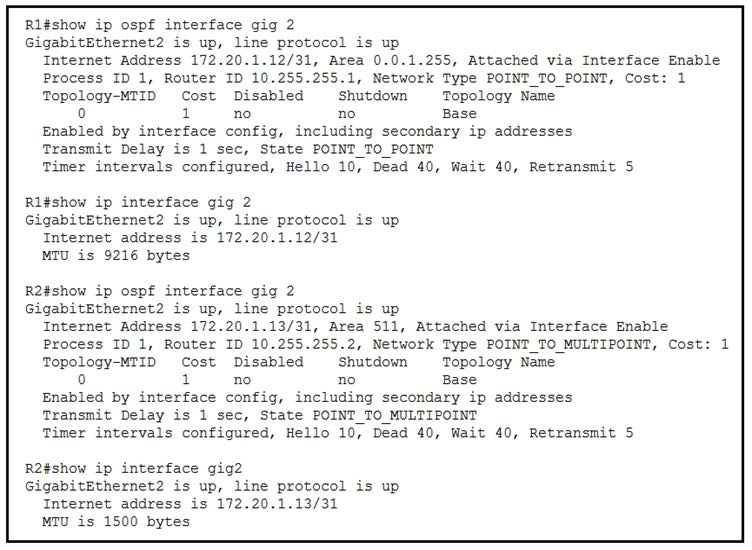 While troubleshooting the OSPF adjacency between routers R1 and R2 an engineer noticed that both routers are stuck in the EXCHANGE/EXSTART state. What should the engineer fix to solve the ongoing issue?
-
A
-
B
-
C
-
D
Reveal answer details
Close answer details
Correct answerD
ExplanationIn OSPF, for two routers to form an adjacency, they must have matching MTU sizes on their connecting interfaces. If the MTUs are mismatched, OSPF adjacency will be stuck in the EXSTART/EXCHANGE state because OSPF hello packets will not be exchanged between the routers. In this case, both routers R1 and R2 are stuck in EXCHANGE/EXSTART state due to mismatched MTU sizes as indicated in the exhibit.
Question 35
Single choice
Which protocol does a Cisco MPLS TE tunnel use to maintain paths within the core?
-
A
-
B
-
C
-
D
Reveal answer details
Close answer details
Correct answerA
ExplanationRSVP (Resource Reservation Protocol) is used in MPLS Traffic Engineering (TE) tunnels to establish and maintain paths within the core network. It helps in reserving resources across an IP network and plays a crucial role in ensuring that the network can handle the traffic load efficiently, providing optimal data transfer paths while maximizing network resource utilization and quality of service. References:
Implementing and Operating Cisco Service Provider Network Core Technologies source
documents or study guide
Question 36
Single choice
Refer to the exhibit. 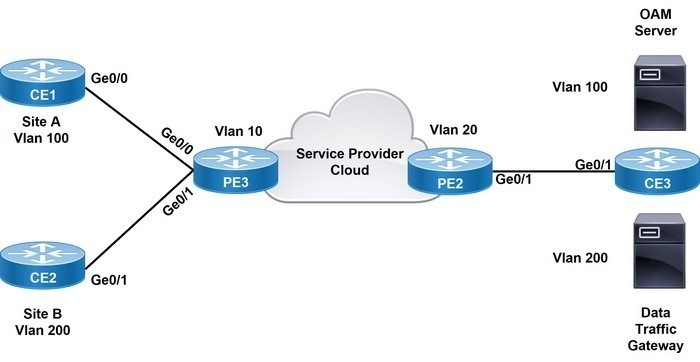 A network engineer with an employee ID: 5086:72:817 is configuring a connection to manage CE1 from the OAM server on VLAN 100. PE1 must push S-VLAN tag 10 toward PE2 while forwarding traffic from CE1 to the OAM server. PE1 must push S-VLAN tag 20 toward PE2 while forwarding traffic from CE2 to the data traffic gateway. Which configuration must the engineer implement on PE2?
-
A
interface GigE0/1
encapsulation dot1q 100
rewrite ingress tag pop 10
rewrite ingress tag push 20
-
B
interface Ge0/0
encapsulation dot1q 100
rewrite ingress tag push dot1q 10 symmetric
interface Ge0/1
encapsulation dot1q 200
rewrite ingress tag push dot1q 20 symmetric
-
C
interface GigE0/1
encapsulation dot1q 10
rewrite ingress tag push dot1q 10 symmetric
Interface Ge0/0
encapsulation dot1q 20
rewrite ingress tag push dot1q 20 symmetric
-
D
Interface Ge0/1
encapsulation dot1q 100
Reveal answer details
Close answer details
Question 37
Single choice
Refer to the exhibit. 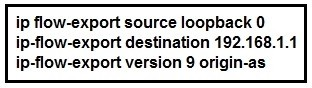 Export statistics received do not include the BGP next hop. Which statement about the NetFlow export statistics is true?
-
A
Loopback 0 must be participating in BGP for it to be included in the export statistics.
-
B
To include the BGP next hop in the export statistics, those keywords must be included with the version
9 entry.
-
C
The origin AS and the peer-as will be included in the export statistics.
-
D
Only the origin AS of the source router will be included in the export statistics.
Reveal answer details
Close answer details
Correct answerB
ExplanationIn NetFlow export statistics, the BGP next hop information is not included by default. To include the BGP next hop in the export statistics, specific keywords related to BGP next hop must be configured with the version 9 NetFlow entry. This configuration allows for the measurement of network traffic on a per-BGP next hop basis, which is essential for detailed traffic analysis and accounting.
References:
https://www.cisco.com/c/en/us/td/docs/ios-xml/ios/netflow/configuration/xe-16-12/nf-xe-16-12-book/cfg-nflow-data-expt-xe.html
Question 38
Multiple choice
Which two IS-IS parameters must match before two Level 2 peers can form an adjacency? (Choose two.)
-
A
-
B
-
C
-
D
-
E
Reveal answer details
Close answer details
Correct answersB, E
ExplanationReferences:
https://www.cisco.com/c/en/us/support/docs/ip/integrated-intermediate-system-to-intermediate-system-is-is/200293-IS-IS-Adjacency-and-Area-Types.html
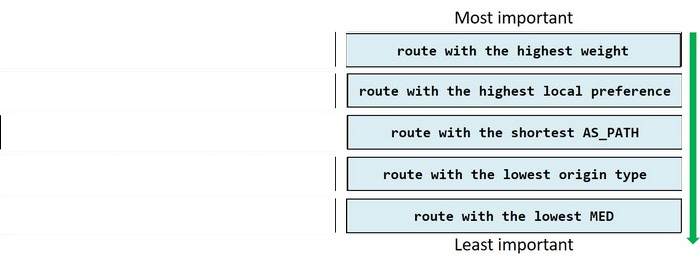
DRAG DROP Drag and drop the BGP Best Path Algorithm rules from the left into the corresponding order of importance on the right. 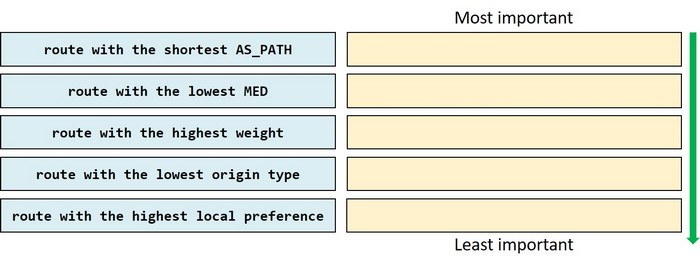
Reveal answer details
Close answer details
Question 40
Single choice
Which option is the main goal of the OSPF SPF Prefix Prioritization feature?
-
A
to provide capability of computing a network path or route based on a network graph and applying computational constraints for traffic engineering
-
B
to only prioritize host prefixes to be installed into the RIB during SPF calculations, /32 for IPv4 and /128 for IPv6
-
C
to provide fast rerouting capability by using IP forwarding and routing
-
D
to provide ability of prioritizing important prefixes to be installed into the RIB during SPF calculations
Reveal answer details
Close answer details
Correct answerD
ExplanationReferences:
https://www.cisco.com/c/en/us/td/docs/routers/asr9000/software/asr9k_r4-2/routing/configuration/guide/b_routing_cg42asr9k/b_routing_cg42asr9k_chapter_011.html
Question 41
Single choice
Which statement about Network Services Orchestrator (NSO) is true?
-
A
It must use SDN as an overlay for addressing.
-
B
It uses YANG modeling language to automate devices.
-
C
It is used only in service provider environments.
-
D
It can be used only with XML coding.
Reveal answer details
Close answer details
Correct answerB
ExplanationNetwork Services Orchestrator (NSO) uses the YANG (Yet Another Next Generation) modeling language to provide a standardized way to automate network devices. YANG provides a powerful schema to model configuration and state data for network elements, which NSO leverages for service automation and orchestration.
Question 42
Single choice
Refer to the exhibit. 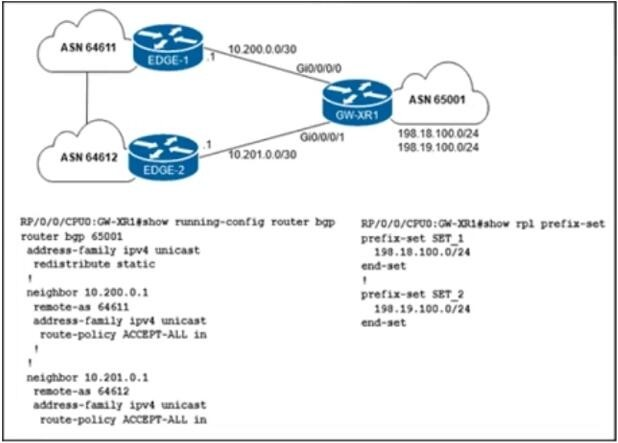 The network engineer who manages ASN 65001 must configure a BGP routing policy on GW-XR1 with these requirements: 1. Advertise locally-originated routes and /24 prefixes assigned within the 198.18.0.0/15 range. All other prefixes must be dropped.
2. Reachability to 198.18.100.0/24 must be preferred via the EDGE-1 connection.
3. Reachability to 198.19.100.0/24 must be preferred via the EDGE-2 connection. Which configuration must the network engineer implement on GW-XR1? 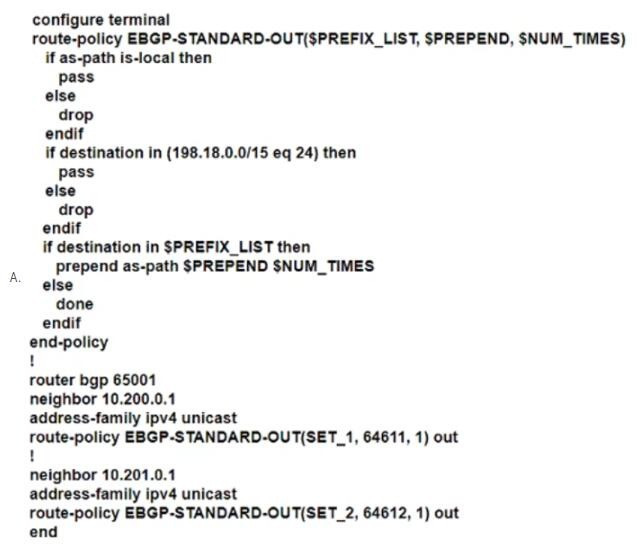 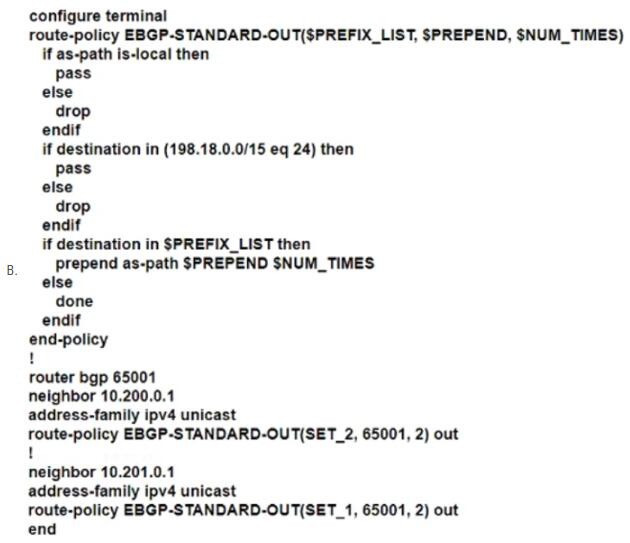 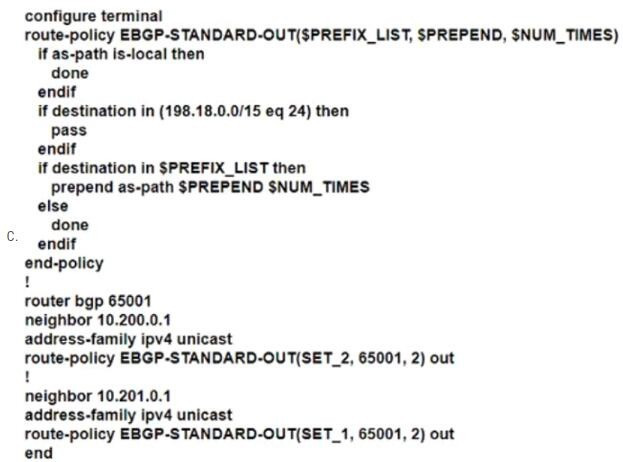 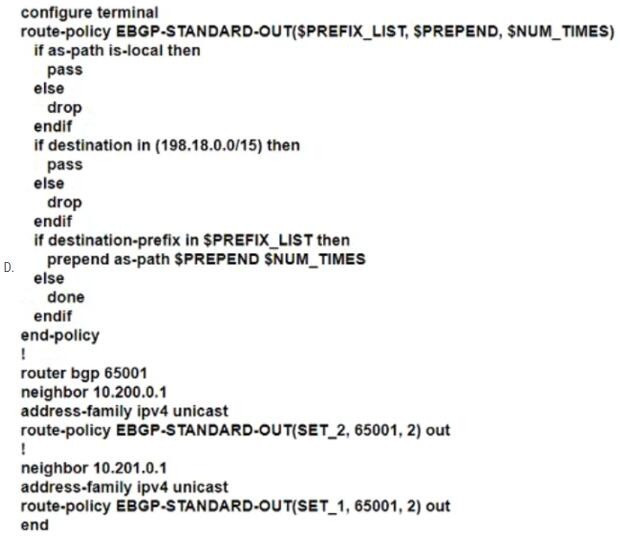
-
A
-
B
-
C
-
D
Reveal answer details
Close answer details
Question 43
Multiple choice
A network operator needs to implement PIM-SSM multicast configuration on a customer's network so that users in different domains are able to access and stream live traffic. Which two actions must the engineer perform on the network to make the streaming work? (Choose two.)
-
A
Enable IGMP version 3 at the interface level.
-
B
Enable PIM dense mode on the device.
-
C
Enable PIM sparse mode on the device.
-
D
Enable IGMP version 2 at the interface level.
-
E
Configure at least one MSDP peer on the network.
Reveal answer details
Close answer details
Question 44
Single choice
The NOC team must update the BGP forwarding configuration on the network with these requirements: 1. BGP peers must establish a neighborship with NSF capability and restart the session for the capability to be exchanged after 120 seconds.
2. BGP peers must delete routes after 360 seconds of inactivity. Which action meets these requirements?
-
A
Set the BGP restart-time to 120 seconds and the BGP ha-mode sso to 360 seconds.
-
B
Set the stalepath-time to 120 seconds and the BGP restart-time to 360 seconds.
-
C
Set the BGP ha-mode sso to 120 seconds and the BGP restart-time to 360 seconds.
-
D
Set the BGP restart-time to 120 seconds and the stalepath-time to 360 seconds.
Reveal answer details
Close answer details
Question 45
Single choice
Refer to the exhibit. 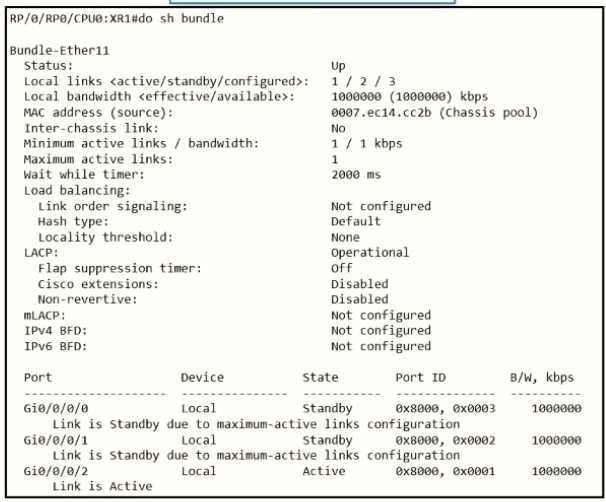 A network operator needs to shut down interface Gi0/0/0/2 for maintenance. What occurs to the interface states of Gi0/0/0/0 and Gi0/0/0/1?
-
A
Gi0/0/0/1 and Gi0/0/0/0 become active
-
B
Gi0/0/0/1 and Gi0//0/0 remains standby
-
C
Gi0/0/0/0 becomes active. Gi0/00/1 remains standby
-
D
Gi0/0/0/1 becomes active Gi0/0/0/0 remains standby
Reveal answer details
Close answer details
Correct answerD
ExplanationThe priority is 0x8000 an the lower Port ID wins
https://www.cisco.com/c/en/us/td/docs/routers/xr12000/software/xr12k_r4-1/interfaces/command/reference/interfaces_cr41xr12k_chapter8.html#wp948389616
Question 46
Single choice
What is the purpose of RSVP tear messages?
-
A
to inform the headend router of LSP issues
-
B
to confirm successful end-to-end resource allocation
-
C
to reuse router resources for other reservation requests
-
D
to notify the tail-end router of resource unavailability on the transit router
Reveal answer details
Close answer details
Correct answerC
ExplanationRSVP tear messages are used to clear the PATH or RESERVATION states on a router instantaneously, which enables the reuse of resources on the router for other requests. This is essential in MPLS Traffic Engineering where efficient resource management is crucial for maintaining network performance and stability.
Question 47
Single choice
Refer to the exhibit. RP/0/0/CPU0:BRDR-1#show route ipv4 0.0.0.0
Routing entry for 0.0.0.0/0
Known via "bgp 65001", distance 20, metric 0, candidate default path
Tag 65002, type external
Installed Apr 21 06:50:55.997 for 00:03:18
Routing Descriptor Blocks
100.65.19.1, from 100.65.19.1, BGP external
Route metric is 0
No advertising protos. RP/0/0/CPU0:BRDR-1#show run router ospf
router ospf 1
redistribute bgp 65001 route-policy BGP-TO-OSPF
Area 0
mpls traffic-eng
interface Loopback0
interface GigabitEthernet0/0/0/0
interface GigabitEthernet0/0/0/0.3232
mpls traffic-eng router-id Loopback0 RP/0/0/CPU0:BRDR-1#show rpl route-policy BGP-TO-OSPF
route-policy BGP-TO-OSPF if destination in (0.0.0.0/0) then
set metric-type type-1
endif
set metric-type type-2 100
set ospf-metric 100
end-policy Router BRDR-1 is configured to receive the 0.0.0.0/0 and 172.17.1.0/24 network via BGP and advertise then into OSPF area 0. An engineer has noticed that the OSPF domain is receiving only the 172.17.1.0/24 route and default router
0.0.0.0/0 is still missing. Which configuration must an engineer apply to resolve this problem?
-
A
router ospf 1
default-information originate always
end
-
B
router ospf 1
redistribute bgp 65001 metric 100 route-policy BGP-TO-OSPF end
-
C
router ospf 1
default-metric 100
end
-
D
router ospf 1
default-information originate
end
Reveal answer details
Close answer details
Correct answerA
ExplanationThe issue of the OSPF domain receiving only the 172.17.1.0/24 route and not the default route 0.0.0.0/0 can be resolved by configuring OSPF to propagate default routes. Let's take a look at the options: Option A: The configuration includes the following commands:
router ospf 1
default-information originate
end This configuration generates a default route into the OSPF domain, which is missing in this scenario.
Question 48
Single choice
Refer to the exhibit. 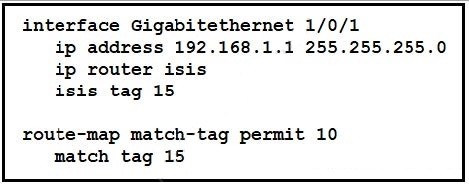 A large organization is merging the network assets of a recently acquired competitor with one of its own satellite offices in the same geographic area. The newly acquired network is running a different routing protocol than the company's primary network. As part of the merger, a network engineer implemented this route map. Which task must the engineer perform to complete the implementation?
-
A
Attach the route map to the redistribution command to manipulate the routes as they are shared.
-
B
Enable metric-style wide to allow the use of extended metrics from the protocols.
-
C
Configure an additional route map sequence to override the implicit deny at the end of the route map.
-
D
Attach the route map to an IS-IS network statement to advertise the routes learned on this interface to IS-IS.
Reveal answer details
Close answer details
Question 49
Single choice
Refer to the exhibit. 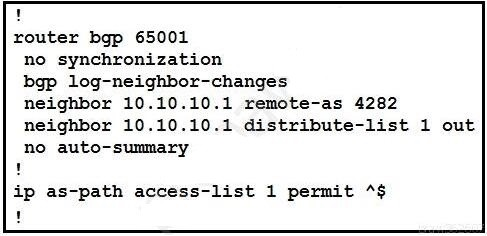 An engineer is reviewing the BGP configuration. Which routes must be advertised to 10.10.10.1?
-
A
Local routes are permitted, and routes from other ASNs are denied.
-
B
All routes whether local or from other ASNs are denied.
-
C
Local routes are denied, and routes from other ASNs are permitted.
-
D
All routes whether local or from other ASNs are permitted.
Reveal answer details
Close answer details
Question 50
Single choice
Refer to the exhibit. router[config]# router ospf 11
router[config-if]# passive-interface default An engineer started lo configure a router for OSPF. Which configuration must me engineer perform on me router without changing any interface configuration so that the router establishes an OSPF neighbor relationship with its peer?
-
A
router(config)# router ospf 11
router(config-if)# no passive-interface ethernet 1/1
-
B
router(config)# interface ethernet 1/1
router(config-if)# no shutdown
-
C
router(config)# interface ethernet 1/1
router(config-if)# ip ospaf hello-interval
-
D
router(config)# interface ethernet 1/1
router(config-if)# ip ospf priority 0
Reveal answer details
Close answer details
Question 51
Single choice
The administrator of a small company network notices that intermittent network issues occasionally cause inbound notifications to its SNMP servers to be lost. Which configuration must the administrator apply so that the SNMP servers acknowledge the notifications that they receive?
-
A
snmp-server community ciscotest rw 10
-
B
snmp-server host tests.cisco.com public
snmp-server community ciscotest rw 10
-
C
snmp-server enable traps bgp
snmp-server host 192.169.2.1 Informs
-
D
snmp-server enable traps snmp
Reveal answer details
Close answer details
Correct answerC
ExplanationThe correct configuration to ensure that SNMP servers acknowledge the notifications they receive is to use the snmp-server host command with the Informs keyword. This configuration sends Inform requests instead of Trap messages. Unlike Traps, Inform requests are acknowledged by the receiving SNMP server, ensuring that the notification has been received. If an Inform request is not acknowledged, the SNMP agent resends the notification. The information is based on the Implementing and Operating Cisco Service Provider Network Core Technologies (SPCOR) training, which teaches how to configure, verify, troubleshoot, and optimize next- generation, Service Provider IP network infrastructures.
Question 52
Multiple choice
Which are the two limitations of the predefined NAT solution? (Choose two)
-
A
Only the port-presentation option is available
-
B
NetFlow and syslog are not supported
-
C
The predefined mode cannot be turned on or off during the active translations
-
D
Port allocation must be uniform for all subscribers
-
E
The global port limit parameter is not available for the predefined mode
Reveal answer details
Close answer details
Question 53
Single choice
Which type of attack is a Protocol attack?
-
A
-
B
-
C
-
D
Reveal answer details
Close answer details
Correct answerC
ExplanationA SYN flood is a type of denial-of-service (DoS) attack where an attacker sends a large number of SYN requests to a target server, overwhelming its resources and preventing legitimate connections. The attacker does not complete the TCP handshake, leaving the server in a half-open state.
Question 54
Single choice
Refer to the exhibit. 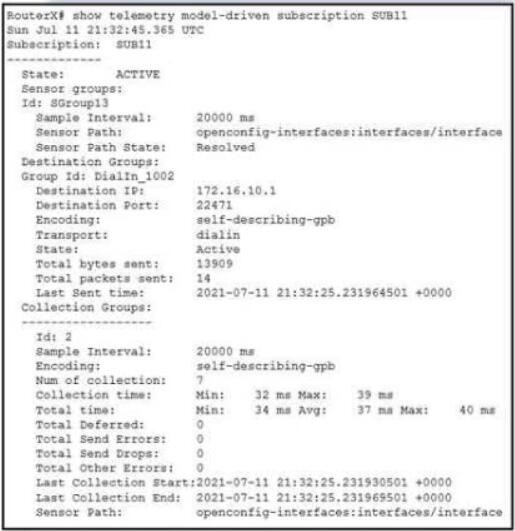 An engineer ran this show telemetry command to view subscription SUB11 on RouterX. The engineer then decided that RouterY should provide the same output for sensor group SGroup13 as RouterX. The engineer cannot access RouterX to copy its configuration No access lists on the router block user access. Which configuration must the engineer apply on RouterY to provide the same output from the show telemetry command?
-
A
RouterY(config)# telemetry model-driven
RouterY(config-model-driven)# subscription SGroup13
RouterY(config-model-driven-subs)# sensor-group-id SGroup13 sample-interval 20000
-
B
RouterY(config)# telemetry model-driven
RouterY(config-model-driven)# sensor-group SGroup13
RouterY(config-model-driven-snsr-grp)# sensor-path openconfig-interfaces:interfaces/interface
-
C
RouterY(config)# telemetry model-driven
RouterY(config-model-driven)# destination-group SUB11
RouterY(config-model-driven-dest)# address family ipv4 172.16.10.1 port 22471
RouterY(config-model-driven-dest-addr)# encoding self-describing-gpb
RouterY(config-model-driven-dest-addr)# protocol tcp
-
D
RouterY(config)# telemetry model-driven
RouterY(config-model-driven)# subscription SUB11
RouterY(config-model-driven-subs)# sensor-group-id SGroup13 sample-interval 20000
RouterY(config-model-driven-subs)# destination-id DGroup1
Reveal answer details
Close answer details
Question 55
Single choice
What is a characteristic of prefix segment identifier?
-
A
It contains the interface address of the device per each link.
-
B
It contains a router to a neighbor.
-
C
-
D
Reveal answer details
Close answer details
Correct answerD
ExplanationThe PSID plays a crucial role in segment routing, allowing efficient forwarding of packets along predefined paths. For more detailed information, please refer to the official Cisco documentation on Segment Routing and IPv6 . Unfortunately, I cannot directly cite specific pages from the provided resources, but you can find relevant details in the Cisco documentation.
Question 56
Multiple choice
Refer to the exhibit. 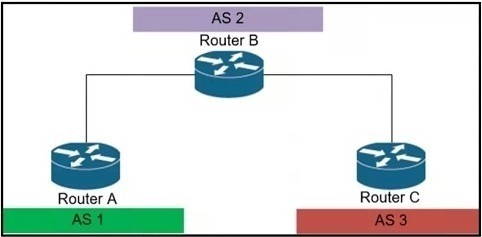 An engineer working for private Service Provider with employee id: 3948:11:613 is configuring the BGPsec framework. Which two conditions must the engineer take into account? (Choose two.)
-
A
BGPsec uses IPsec tunnel for security.
-
B
The BGPsec framework secures the AS path.
-
C
In BGPsec. all route advertisements are given an expiry time by the originator of the route.
-
D
Private keys are part of the router key pair used to sign route updates.
-
E
In BGPsec. route advertisements are not given an expiration time by the originator of the route.
Reveal answer details
Close answer details
Correct answersB, C
Explanationhttps://tools.ietf.org/html/rfc8374#section-3.2
Question 57
Single choice
Refer to the exhibit. R5#show run | s router ospf
router ospf 1
router-id 172.16.0.5
network 192.168.0.0 0.0.63.255 area 0 R5#show run int GigabitEthernet1.58
Building configuration....
Current configuration: 245 bytes
interface GigabitEthernet1.58
description LINK TO R8 Gi1.58 encapsulation dot1Q 58
ip address 192.168.58.5 255.255.255.0
ip mtu 1600
ip ospf network point-to-point
ip ospf 1 area 0.0.0.2
end Which configuration must be implemented on router R8 so that it will establish OSPF adjacency with R5?
-
A
router ospf 1
network 192.168.58.0 0.0.0.255 area 0.0.0.2
interface GigabitEthernet 1.58
ip mtu 1600
ip ospf network point-to-multipoint
-
B
router ospf 1
network 192.168.58.0 0.0.0.255 area 2
interface GigabitEthernet 1.58
ip mtu 1600
-
C
router ospf 1
network 192.168.58.0 0.0.0.255 area 0.0.0.2
interface GigabitEthernet 1.58
ip ospf network point-to-point
-
D
router ospf 1
network 192.168.58.0 0.0.0.255 area 0.0.0.2
interface GigabitEthernet 1.58
ip mtu 1600
ip ospf network point-to-point
ip ospf 1 area 0
Reveal answer details
Close answer details
Correct answerA
ExplanationOSPF adjacency is established when two OSPF routers have matching interface parameters. This includes the OSPF router ID, network address, area ID, and other OSPF-specific configurations such as MTU size and network type. For example, the configuration commands provided in the image description suggest setting the OSPF router ID, network address with a wildcard mask, and specifying the OSPF area.
Additionally, the interface is set to a point-to-point network type with a specific MTU size, which is important for OSPF adjacency as mismatched MTU sizes can prevent OSPF neighbors from forming an adjacency.
Question 58
Single choice
An engineer is moving all of an organization's Cisco IOS XE BGP routers to the address-family identifier format. Which command should be used to perform this upgrade quickly with the minimum service disruption?
-
A
-
B
-
C
-
D
ip bgp-community new-format
Reveal answer details
Close answer details
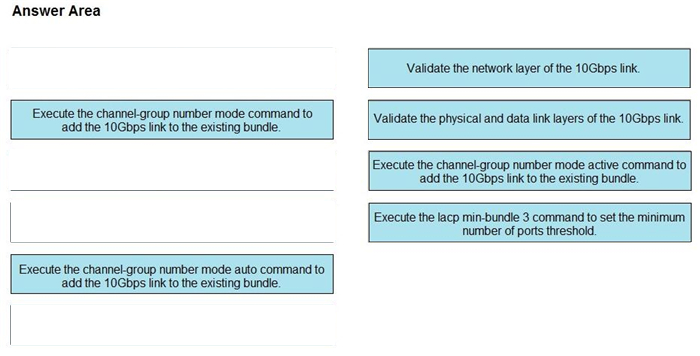
DRAG DROP A network engineer is adding an additional 10Gbps link to an existing 2x10Gdps LACP-based LAG to augment its capacity. Network standards require a bundle interface to be taken out of service if one of its member links goes down, and the new link must be added with minimal impact to the production network.
Drag and drop the tasks that the engineer must perform from the left into the sequence on the right. Not all options are used. 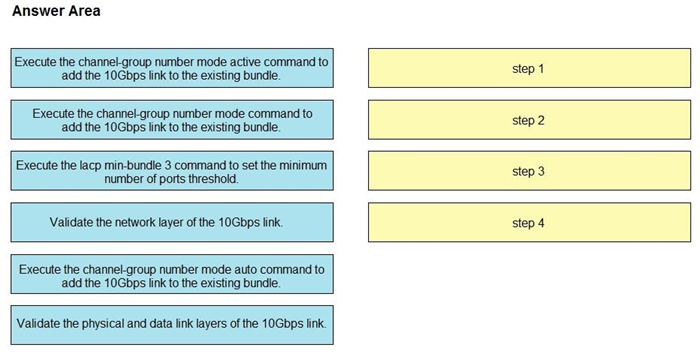
Reveal answer details
Close answer details
Question 60
Single choice
What is one of the functions of a LISP ingress tunnel router?
-
A
Ability to integrity-check LISP site registration messages using a SHA2-based HMAC algorithm
-
B
Responsible for finding EID-to-RLOC mappings for all traffic destined for LISP-capable sites
-
C
Accept encapsulation Map-request messages, decapsulate them to the MS responsible for the ETR authoritative for the requested EIDs
-
D
Allows EIDs and RLOCs to communicate in a LISP site that contains EIDs in one address family and RLOCs in a different address family
Reveal answer details
Close answer details
Question 61
Single choice
Refer to the exhibit. 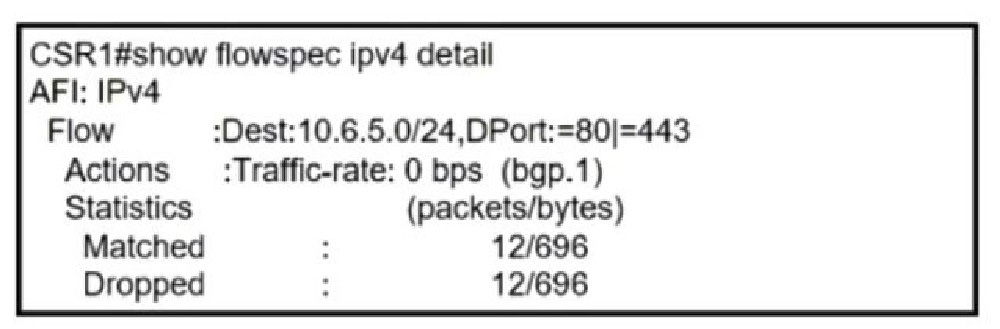 A network operator recently configured BGP FlowSpec for me internal IT network What will be inferred from the configuration deployed on me network?
-
A
The policy is configured locally on CSRl and drops all traffic for TCP ports 80 and 443
-
B
The policy is learned via BGP FlowSpec and drops all traffic for TCP ports 80 and 443
-
C
The policy is warned via BC FlowSpec aid has active traffic
-
D
The policy is configured locally on CSR1 and currently has no active traffic
Reveal answer details
Close answer details
Question 62
Single choice
Refer to the exhibit. 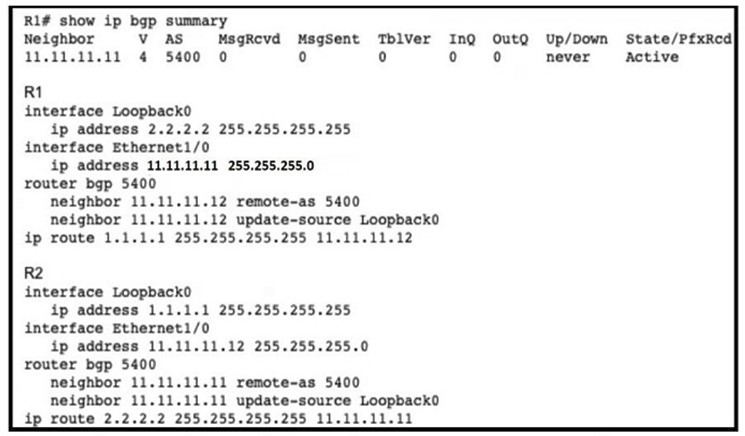 Router R1 is reporting that its BGP neighbor adjacency to router R2 is down, but its state is Active as shown. Which configuration must be applied to routers R1 and R2 to fix the problem?
-
A
R1
router bgp 5400
neighbor 11.11.11.11 remote-as 5400
neighbor 11.11.11.11 update-source Loopback0
R2
router bgp 5400
neighbor 11.11.11.12 remote-as 5400
neighbor 11.11.11.12 update-source Loopback0
-
B
R1
router bgp 5400
neighbor 2.2.2.2 remote-as 5400
neighbor 2.2.2.2 update-source Loopback0
R2
router bgp 5400
neighbor 1.1.1.1 remote-as 5400
neighbor 1.1.1.1 update-source Loopback0
-
C
R1
router bgp 5400
neighbor 2.2.2.2 remote-as 5400
R2
router bgp 5400
neighbor 1.1.1.1 remote-as 5400
-
D
R1
router bgp 5400
neighbor 1.1.1.1 remote-as 5400
neighbor 1.1.1.1 update-source Loopback0
R2 router bgp 5400
neighbor 2.2.2.2 remote-as 5400
neighbor 2.2.2.2 update-source Loopback0
Reveal answer details
Close answer details
Question 63
Single choice
What is one of the differences between Ansible and Chef?
-
A
Ansible uses YAML and Chef uses Ruby.
-
B
Chef requires the use of Windows in the environment and Ansible requires Linux.
-
C
Chef is highly scalable and Ansible is highly secure.
-
D
Ansible uses Ruby and Chef uses Python.
Reveal answer details
Close answer details
Question 64
Single choice
ASN 65001 is peering with ASN 65002 to exchange IPv6 BGP routes. All routes that originate in ASN 65001 have a standard community value of 65001:100, and ASN 65002 is allowed to advertise only 2001
:db8:aaaa::/48. An engineer needs to update the ASN 65001 route-filtering configuration to meet these
conditions: 1. Looped routes into ASN 65001 and routes that have traversed 10 or more ASNs must be denied.
2. Routes accepted into ASN 65001 must be assigned a community value of 65001:200. Which configuration must the engineer apply to the ASN 65001 border router?
-
A
router-policy PEER-AS65002-IN
if as-path length ge 10 and as-path passes-through '65001' or community matches-any (65001:100) then drop endif
if destination in (2001:db8:aaaa::/48) then
done
else
drop
endif
set community (65001:200)
end-policy
-
B
router-policy PEER-AS65002-IN
if as-path length ge 10 and as-path passes-through '65001' or community matches-any (65001:100) then drop endif
if destination in (2001:db8:aaaa::/48) then
pass
endif
set community (65001:200)
end-policy
-
C
router-policy PEER-AS65002-IN if as-path length ge 10 then drop endif if as-path passes-through '65001' or community matches-any (65001:100) then drop endif
if destination in (2001:db8:aaaa::/48) then
pass
endif
set community (65001:200)
end-policy
-
D
router-policy PEER-AS65002-IN
if as-path length ge 10 then drop endif if as-path passes-through '65001' or community matches-any (65001:100) then drop endif
if destination in (2001:db8:aaaa::/48) then
set community (65001:200)
-
E
router-policy PEER-AS65002-IN
if as-path length ge 10 then drop endif if as-path passes-through '65001' or community matches-any (65001:100) then drop endif
if destination in (2001:db8:aaaa::/48) then
set community (65001:200)
else
drop
endif
end-policy
Reveal answer details
Close answer details
Question 65
Single choice
Which QoS model allows hosts to report their OoS needs to the network?
-
A
-
B
-
C
-
D
Reveal answer details
Close answer details
Question 66
Single choice
What occurs when a high bandwidth multicast stream is sent over an MVPN using Cisco hardware?
-
A
The traffic uses the default MDT to transmit the data only if it is a (S, G) multicast route entry.
-
B
A data MDT is created to if it is a (*, G) multicast route entries.
-
C
A data and default MDT are created to flood the multicast stream out of all PIM-SM neighbors.
-
D
A data MDT is created to allow for the best transmission through the core for (S, G) multicast route entries.
Reveal answer details
Close answer details
Correct answerD
ExplanationIn Cisco hardware, when a high bandwidth multicast stream is sent over a Multicast VPN (MVPN), a data Multicast Distribution Tree (MDT) is specifically created for that stream. This data MDT is used in addition to the default MDT, which is used for lower-bandwidth or control traffic. The purpose of the data MDT is to optimize the transmission of high-bandwidth streams through the core of the network, ensuring that the multicast traffic is only sent to those PE routers that have local receivers for the multicast group in question. This mechanism helps in efficiently using network resources and provides a scalable solution for transmitting high-bandwidth multicast streams. The explanation is based on the concepts outlined in the Implementing and Operating Cisco Service Provider Network Core Technologies (SPCOR) course, which covers the configuration, verification, troubleshooting, and optimization of Service Provider IP network infrastructures, including advanced topics like MVPN and MDTs
Question 67
Lab simulation
Simulation Guidelines This is a lab item in which tasks will be performed on virtual devices. 1. Refer to the Tasks tab to view the tasks for this lab item.
2. Refer to the Topology tab to access the device console(s) and perform the tasks.
3. Console access is available for all required devices by clicking the device icon or using the tab(s) above the console window.
4. All necessary preconfigurations have been applied.
5. Do not change the enable password or hostname for any device.
6. Save your configurations to NVRAM before moving to the next item. 7. Click Next at the bottom of the screen to submit this lab and move to the next question.
8. When Next is clicked, the lab closes and cannot be reopened. Topology 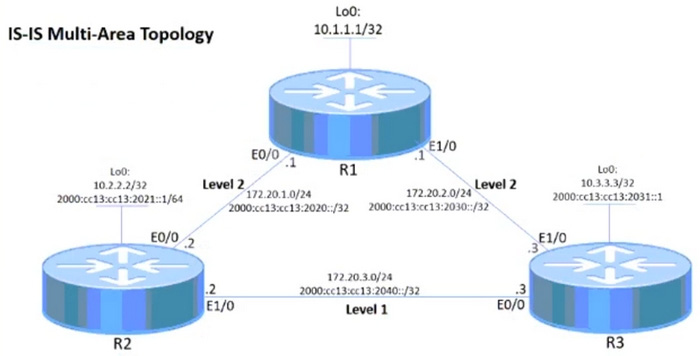 Tasks Configure the IS-IS routing protocol for R1, R2, and R3 according to the topology to achieve these goals: 1. Configure HMAC-MD5 authentication for R1, R2, and R3 links that form the IS-IS adjacency using the ISIS commands on the interfaces using these parameters:
key-chain name: AUTH_ISIS
key ID: 2
password: C1sc0! 2. Configure ISIS metric on R1, R2, and R3 to: 15 for each level on all interfaces that form adjacency on router R1 20 for each level on all interfaces that form adjacency on router R2 25 for each level on all interface that form adjacency on R3 3. Configure IS-IS route redistribution for all static routes and connected interfaces on R1, R2, and R3.
Reveal model answer
Close model answer
R1:
Key chain AUTH_ISIS
Key 2
Key-string C1sc0! Router isis authentication mode md5 authentication key-chain AUTH_ISIS
redistribute static
redistribute connected Interface E0/0
isis authentication mode md5
isis metric 20 level-2 Interface E1/0
isis authentication mode md5
isis metric 25 level-2 R2:
Key chain AUTH_ISIS
Key 2
Key-string C1sc0! Router isis
authentication mode md5 authentication key-chain AUTH_ISIS
redistribute static
redistribute connected Interface E0/0
isis authentication mode md5
isis metric 15 level-2 Interface E1/0
isis authentication mode md5
isis metric 25 level-1 R3:
Key chain AUTH_ISIS
Key 2
Key-string C1sc0! Router isis
authentication mode md5 authentication key-chain AUTH_ISIS
redistribute static
redistribute connected Interface E0/0
isis authentication mode md5
isis metric 20 level-1 Interface E1/0
isis authentication mode md5
isis metric 15 level-2
Question 68
Single choice
A network engineer must enable multicast on the network to support a new series of webcasts. The PIM protocol has been enabled on the LAN side, with PIM and MSDP capabilities on edge router R1. The multicast source has been configured with IP address FF3A:121, and IP protocol 58 has been enabled and successfully tested in the network. Due to the limitations of some devices on the network, the data flow should take the most efficient path. Which task must the engineer perform to achieve the goal?
-
A
-
B
Implement Anycast RP on R1.
-
C
Implement PIM-SM in the LAN.
-
D
Enable PIM-SSM across the network.
Reveal answer details
Close answer details
Question 69
Multiple choice
A network engineer must collect traffic statistics for an internal LAN toward the internet. The sample must include the source and destination IP addresses the destination ports, the total number of bytes from each flow using a 64-bit counter and all transport flag information. Because of CPU limits, the flow collector processes samples that are a maximum of 20 seconds long. Which two configurations must the network engineer apply to the router? (Choose two.) 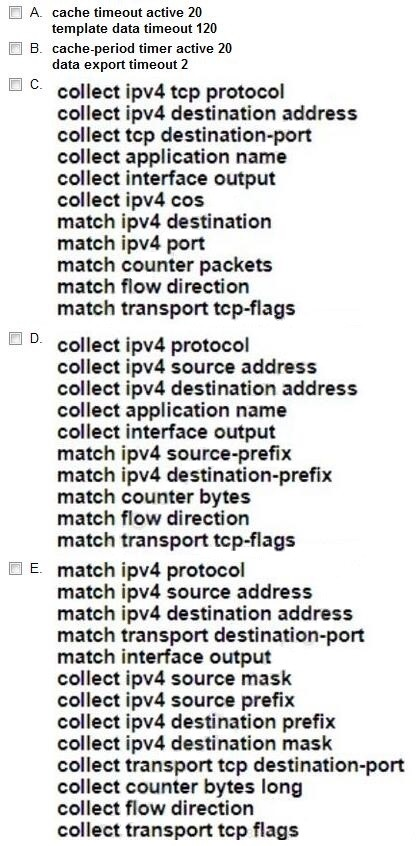
-
A
-
B
-
C
-
D
-
E
Reveal answer details
Close answer details
Question 70
Single choice
Refer to the exhibit. 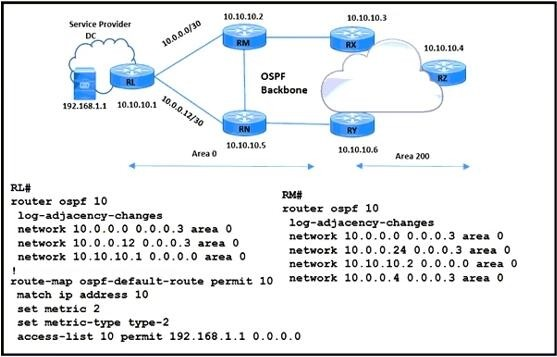 The operations team for a service provider network is implementing a route map policy. OSPF area 0 should originate the default route with a type 2 metric of 2 when the application server on the connected
interface (192.168.1.1) is up.
Routers RL and RM have set up OSPF peering with other adjacent routers. Which action meets this requirement?
-
A
Apply default-information originate route-map ospf-default-route on router RL.
-
B
Apply default-information originate route-map ospf-default-route on router RM.
-
C
Configure distribute-list route-map ospf-default-route out on router RM.
-
D
Configure distribute-list route-map ospf-default-route out on router RL.
Reveal answer details
Close answer details
Correct answerA
ExplanationTo achieve the origination of a default route based on the condition of the application server being up, a route map policy needs to be applied. This policy should match the condition of the server's status and then use the default-information originate command to originate the default route with the specified metric type and value on router RL. Implementing and Operating Cisco Service Provider Network Core Technologies (SPCOR) - OSPF Route
Map Policy section.
Question 71
Single choice
Refer to the exhibit. 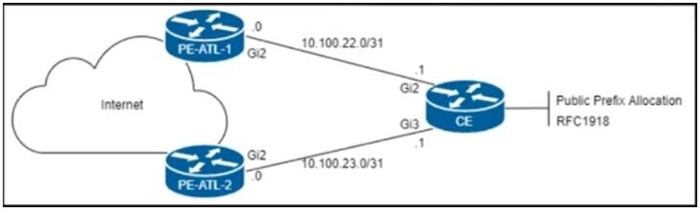 The CE router is peering with both PE routers and advertising a public prefix to the internet. Routing to and from this prefix will be asymmetric under certain network conditions, but packets must not be discarded. Which configuration must an engineer apply to the two PE routers so that they validate reverse packet forwarding for packets entering their Gi2 interfaces and drop traffic from the RFC1918 space?
-
A
ip verify unicast source reachable-via rx allow-default
-
B
interface GigabitEthernet 2
ip verify unicast source reachable-via rx
-
C
ip verify unicast source reachable-via any allow-default
interface GigabitEthernet 2
-
D
ip verify unicast source reachable-via any
Reveal answer details
Close answer details
Question 72
Single choice
The network-engineering team of a service provider is integrating several recently acquired networks into a more scalable common Unified MPLS architecture. The new network architecture will support end-to-end VPNv4 and VPNv6 services with these requirements: 1. The IGP of the core layer is IS-IS in Area 0.
2. The IGP of the aggregation layers is OSPF in Area 0.
3. The LDP protocol is used to distribute label bindings within each IGP domain. Which task must the network engineer perform when implementing this new architecture?
-
A
Configure a BGP session between the ABR routers of each IGP domain to exchange VPNv4 or VPNv6 prefixes.
-
B
Configure mutual redistribution of each IGP domain's loopback prefix to provide end-to-end LDP LSP.
-
C
Configure the ABR in each IGP domain to preserve next-hop information on all VPNv4 and VPNv6 prefixes advertised by the PE.
-
D
Configure BGP-LU between ABR routers of each IGP domain to carry MPLS label information in NLRI.
Reveal answer details
Close answer details
Question 73
Single choice
Refer to the exhibit. 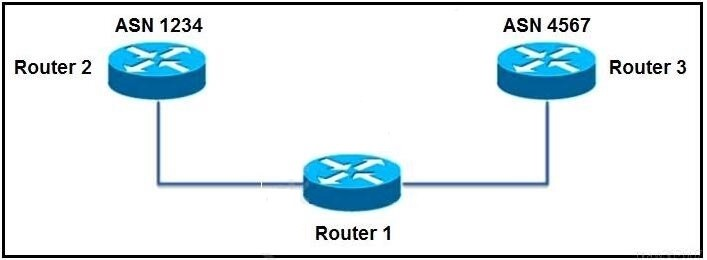 An engineer is configuring path selection on router R1 for two ASNs as shown. Which additional task must the engineer perform on Router 1 so that all outbound traffic utilizes the link between R1 and R3 to reach ASN 4567?
-
A
Configure a low weight on the peer to ASN 4567.
-
B
Configure a high weight on the peer to ASN 4567.
-
C
Configure an AS path prepend on the peer to ASN 4567.
-
D
Configure a high med on the peer to ASN 4567.
Reveal answer details
Close answer details
Correct answerB
ExplanationIn Cisco's path selection process, the weight attribute is the first criterion for selecting a path. It is a Cisco-specific parameter, local to the router, and it is not propagated in routing updates. The path with the highest weight is preferred. Therefore, configuring a high weight on the peer to ASN 4567 will make Router
R1 prefer this path for all outbound traffic directed towards ASN 4567. References:
Implementing and Operating Cisco Service Provider Network Core Technologies (SPCOR) -
Cisco SPCOR Training & Certification
Question 74
Single choice
What do Chef and Puppet have in common?
-
A
-
B
require modules to be created from scratch
-
C
-
D
manage agents referred to as minions
Reveal answer details
Close answer details
Correct answerC
ExplanationBoth Chef and Puppet are configuration management platforms that aim to configure and manage servers and other IT infrastructure. They operate in the same infrastructure management space and share several similarities: Use a master-client architecture: Chef functions with a master-client architecture, where the server runs on the master machine, and the client runs as an agent on every client machine. Similarly, Puppet follows a similar setup. Manage devices or nodes to be configured: Both Chef and Puppet manage the configuration of devices or nodes within an infrastructure. Leverage a pull model: Both tools use a pull model, where the configuration is pulled from a central server to the managed nodes.
Question 75
Single choice
In an MPLS network, which protocol can be used to distribute a Segment Prefix?
-
A
-
B
-
C
-
D
Reveal answer details
Close answer details
Correct answerC
ExplanationIn an MPLS network, the Label Distribution Protocol (LDP) is used to distribute labels which can include segment prefixes. LDP is a protocol that automatically generates and exchanges labels between routers, allowing for the forwarding of packets along a predetermined path without the need for complex lookups in a routing table at every hop. Segment Routing Overview and Migration Guidelines
Question 76
Single choice
Refer to the exhibit 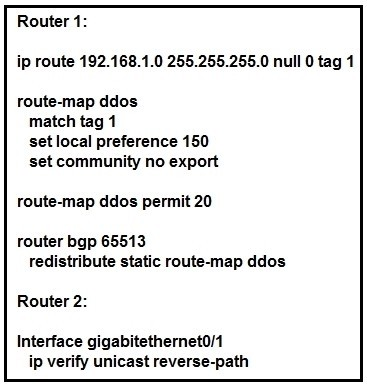 An engineer is preparing to implement data plane security configuration. Which statement about this configuration is true?
-
A
Router 2 is the router receiving the DDoS attack.
-
B
Router 1 must be configured with uRPF for the RTBH implementation to be effective.
-
C
Router 1 is the trigger router in a RTBH implementation.
-
D
Router 2 must configure a route to null 0 for network 192.168.1.0/24 for the RTBH implementation to be complete.
Reveal answer details
Close answer details
Correct answerC
ExplanationRouter 1 is the trigger router in a Remote Triggered Black Hole (RTBH) implementation. In the configuration provided, Router 1 has a static route to null0 for network 192.168.1.0/24 with a tag of 1, which is used to drop traffic destined to this network, effectively mitigating DDoS attacks. The route-map
"ddos" matches this tag and sets local preference and community accordingly. The BGP process redistributes this static route based on the "ddos" route-map, signaling other routers in the network to drop traffic destined for the attacked network.
Question 77
Single choice
Which capability does RSVP provide in an MPLS network?
-
A
signaling a primary path for LSP tunnels
-
B
reserving up to 75% of interface bandwidth by default
-
C
reserving bandwidth for multicast flows
-
D
supporting interoperability between IntServ and DiffServ architecture models
Reveal answer details
Close answer details
Question 78
Single choice
Refer to the exhibit. Router 1:
router isis
net 49.0011.0000.0000.0001.00 Router2:
net 49.0001.0000.0000.0001.00 Router3: router isis
net49.0011.0000.0000.0002.00 Router 4 is added to the network and must be in the same area as router 1. 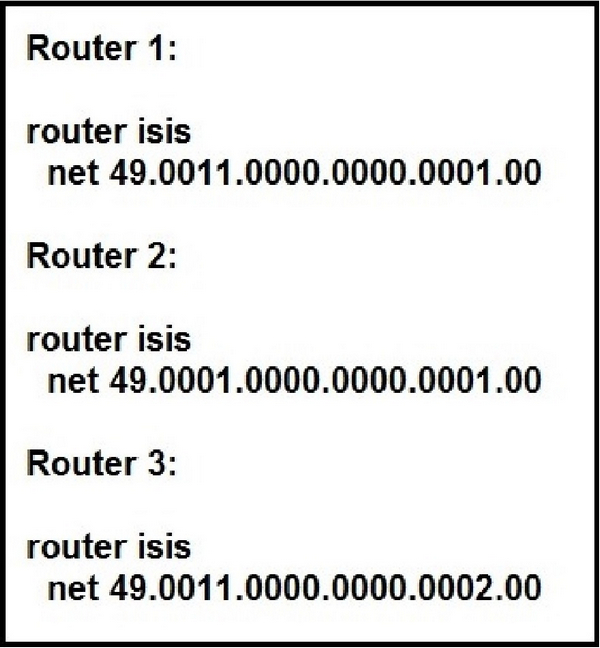 Which NET should the engineer assign?
-
A
49.0001.0000.0000.0004.00
-
B
49.0111.0000.0000.0001.00
-
C
49.0011.0000.0000.0003.00
-
D
49.0011.0000.0000.0002.00
Reveal answer details
Close answer details
Question 79
Single choice
Refer to the exhibit. 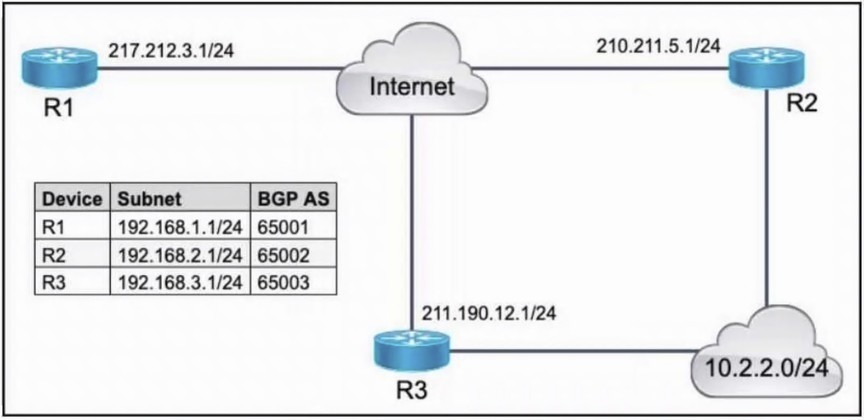 A growing company wants to ensure high availability and redundancy for its critical web servers, which are located in an offsite data center. The network architect decided to implement BGP so that the network can use redundant paths for
outbound traffic toward the destination subnet 10.2.2.0/24. A network engineer already configured basic BGP settings on edge router R1, which is a Cisco ASR-
1001X router. The engineer also confirmed loopback reachability to routers R2 and R3, and the AS path length toward the destination is the same via R2 and R3. Which action must the engineer take on R1 to complete the implementation?
-
A
Implement as-path multipath under the BGP neighbor configuration.
-
B
Implement maximum-paths ibgp 2 under the BGP neighbor configuration.
-
C
Implement maximum-paths 2 under the BGP global configuration.
-
D
Implement bestpath as-path multipath-relax under the BGP global configuration.
Reveal answer details
Close answer details
Question 80
Single choice
Refer to the exhibit. 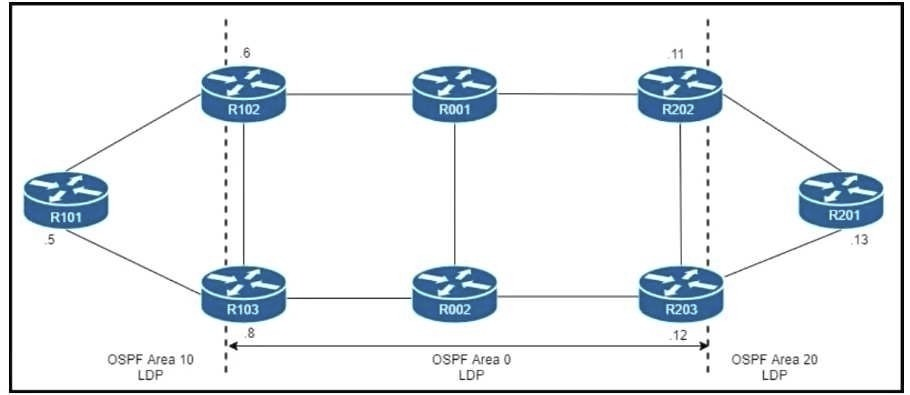 R101 is peering with R102 and R103, and R201 is peering with R202 and R203 using iBGP Labeled Unicast address families. The OSPF area 0 border routers are in a full iBGP Labeled Unicast mesh, and VPNv4 routes are exchanged directly between PE routers R101 and R201 through iBGP Which address family-level configuration must be applied on ABR R102 on ABR R102 to support a Unified MPLS routing architecture with partitioned IGP domains? 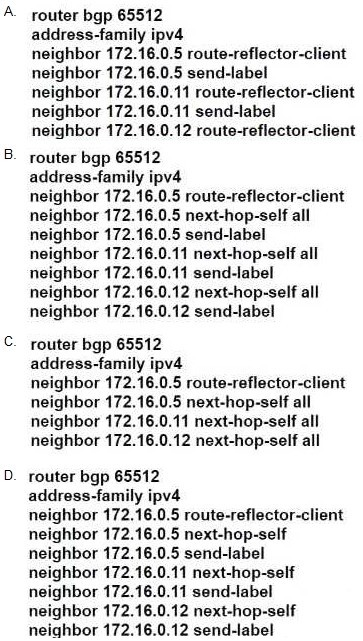
-
A
-
B
-
C
-
D
Reveal answer details
Close answer details
Question 81
Single choice
Refer to the exhibit. 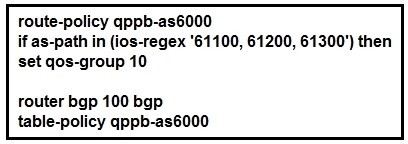 Which statement supports QPPB implementation?
-
A
QPPB policies affect only egress traffic.
-
B
QoS policies rely exclusively on BGP attributes to manipulate traffic.
-
C
QoS policies are identified in the MPLS forwarding table.
-
D
QoS policies use BGP to gain full coverage on the network.
Reveal answer details
Close answer details
Correct answerB
ExplanationThe QoS Policy Propagation via BGP feature allows you to classify packets by IP precedence based on the Border Gateway Protocol (BGP) Attributes like community lists, BGP autonomous system paths, and access lists.
Question 82
Single choice
Which statement about LDP Session Protection and LDP-IGP sync is true?
-
A
Both LDP features cannot be used at the same time in a MPLS LDP enabled network
-
B
LDP Session Protection re-exchanges label information when a down-up event occurs; LDP-IGP sync
keeps the adjacency and label information in a down-up event
-
C
LDP-IGP sync re-exchanges label information when a down-up event occurs; LDP Session Protection
keeps the adjacency and label information in a down-up event
-
D
Both LDP features must be used together to increase fast convergence on an MPLS LDP-enabled network
Reveal answer details
Close answer details
Question 83
Single choice
A network engineer must enable the helper router to terminate the OSPF graceful restart process if it detects any changes in the LSA. Which command enables this feature?
-
A
-
B
-
C
nsf ietf helper strict-lsa-checking
-
D
Reveal answer details
Close answer details
Correct answerC
ExplanationThe command nsf ietf helper strict-lsa-checking is used to configure the router to terminate the OSPF graceful restart process if it detects any changes in the LSA during the restart. This ensures that the network remains stable and consistent by preventing the use of outdated or incorrect routing information. References:
https://www.cisco.com/c/en/us/td/docs/ios/12_4t/ip_route/configuration/guide/tgrhelp.html
Question 84
Single choice
Refer to the exhibit. 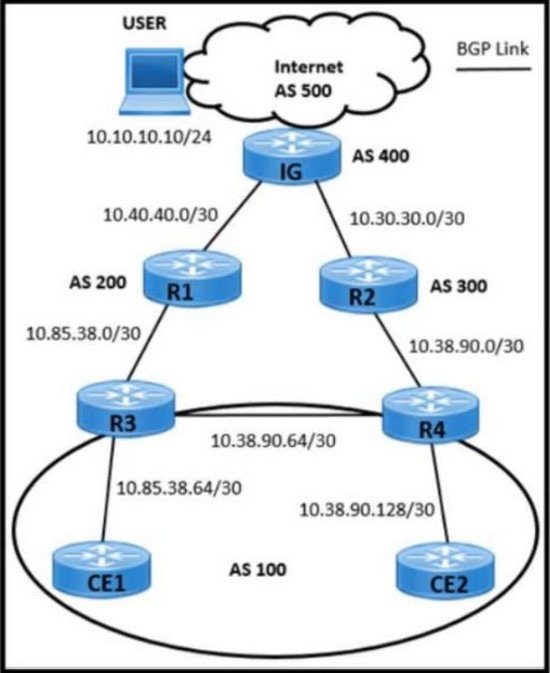 R3#
router bgp 100
no synchronization
bgp log-neighbor-changes
network 10.38.90.0 mask 255.255.255.252
network 10.38.90.64 mask 255.255.255.252
network 10.38.90.128 mask 255.255.255.252
network 10.85.38.0 mask 255.255.255.252
network 10.85.38.64 mask 255.255.255.252
neighbor 24.38.90.65 remote-as 250
neighbor 24.38.90.65 next-hop-self
neighbor 10.85.38.1 remote-as 400
neighbor 10.85.38.1 ebgp-multihop 10
neighbor 10.85.38.66 remote-as 100
neighbor 10.85.38.66 next-hop-self
no auto-summary R4# router bgp 100
no synchronization
bgp log-neighbor-changes
network 10.38.90.0 mask 255.255.255.252
network 10.38.90.64 mask 255.255.255.252
network 10.38.90.128 mask 255.255.255.252
network 10.85.38.0 mask 255.255.255.252
network 10.85.38.64 mask 255.255.255.252
neighbor 10.38.90.1 remote-as 300
neighbor 10.38.90.1 ebgp-multihop 10
neighbor 10.38.90.66 remote-as 100
neighbor 10.38.90.66 next-hop-self
neighbor 10.38.90.130 remote-as 100
neighbor 10.38.90.130 next-hop-self
no auto-summary The USER mat is connecting an application on an Internet connection in AS 100 is facing these issues: 1. The USER lost the connection to the application during a failure Between IG and R2.
2. Router R2 configuration a lost due to a power outage.
3. The application the USER is connecting to a hosted behind CE2. What action resolves the issues on R3 and R4 routers?
-
A
Set R4 as a route reflector for R3 and CE2
-
B
Apply high Local Preference on R3 toward R1
-
C
Set R3 as a route reflector for R4 and CE1
-
D
Apply low Local Preference on R4 toward R2.
Reveal answer details
Close answer details
Question 85
Single choice
Refer to the exhibit. 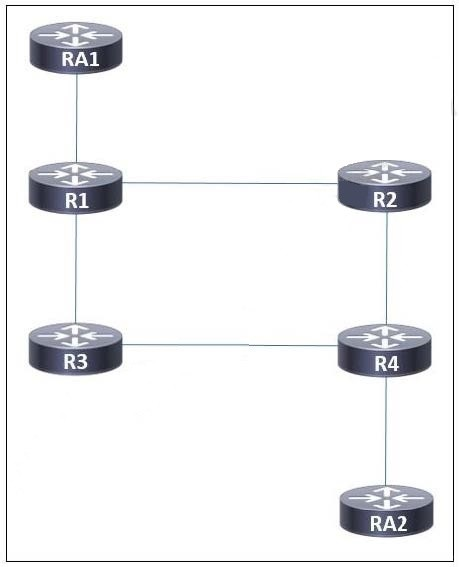 A network administrator implemented MPLS routing between routers R1, R2, R3, and R4. AToM is configured between R1 and R4 to allow Layer 2 traffic from hosts on RA1 and RA2. A targeted MPLS session is established between R1 and R4. Which additional action must the administrator take on all routers so that LDP synchronization occurs between connected LDP sessions?
-
A
Disable the MPLS LDP IGP sync holddown.
-
B
Configure OSPF or IS-IS as the routing protocol.
-
C
Configure EIGRP as the routing protocol using stub areas only.
-
D
Enable MPLS LDP sync delay timers.
Reveal answer details
Close answer details
Question 86
Single choice
Which benefit is provided by FRR?
-
A
It provides fast forwarding path failure detection times for all media.
-
B
It provides rapid failure detection between forwarding engines.
-
C
It provides performance data for the service provider network.
-
D
It protects Cisco MPLS TE LSPs from link and node failures.
Reveal answer details
Close answer details
Correct answerD
ExplanationReferences:
https://www.cisco.com/c/en/us/td/docs/ios-xml/ios/mp_te_path_protect/configuration/xe-16-11/mp-te-path-protect-xe-16-11-book/mpls-traffic-engineering-fast-reroute-link-and-node-protection.html
|