Refer to the exhibit. 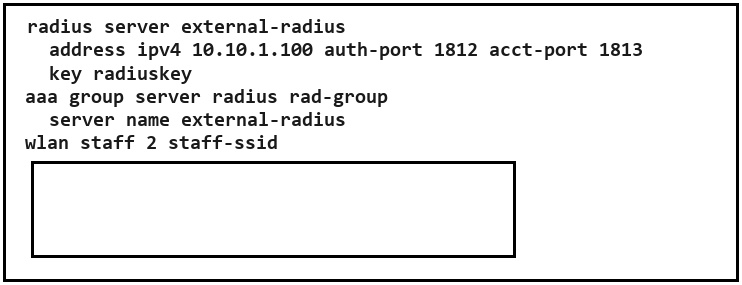 A network administrator is working on a Cisco Catalyst 9800 WLC running Cisco IOS XE Software to enable user access for staff smartphones using WPA2-Enterprise with RADIUS. The administrator verifies the external authentication configuration and plans to test network connectivity. Which configuration command must be added to the box in the code to configure the WLC to support authentication with an external server?
-
A
-
B
security dot1x authentication-list rad-group
-
C
security dot1x method-list rad-group
-
D
security wpa wpa2 akm dot1x
Reveal answer details
Close answer details
Correct answerD
Explanationsecurity wpa wpa2 akm dot1x is preferred because it changes the behavior described here: A network administrator is working on a Cisco Catalyst 9800 WLC running Cisco IOS XE Software to enable user access for staff smartphones using WPA2-Enterprise with RADIUS. The administrator verifies the external authentication configuration and plans to test network connectivity. Security questions should separate authentication, authorization, and policy enforcement. The WLAN security method gets the client on the network, while RADIUS and policy attributes decide what access the client receives. The selected mechanism is the piece that enables or applies that security behavior; the
other choices either skip the external method, use the wrong authentication model, or affect a separate policy area. security wpa enable is too broad or aimed at the wrong layer for this scenario. security dot1x authentication-list rad-group does not provide the specific RF, security, forwarding, management, or automation behavior that is required. security dot1x method-list rad-group would be considered only for a different symptom or design goal. For exam purposes, separate association, authentication, authorization, forwarding, RF behavior, and management visibility before selecting a command or feature.
A wireless administrator must configure detailed and comprehensive monitoring for client devices across branch locations. The team wants to streamline operations for faster response during performance degradation. To support the organization's growth, the administrator needs a centralized reporting platform that displays aggregated data. Which solution must the administrator use to monitor the clients in the network?
-
A
Implement central syslog server.
-
B
Use Cisco Catalyst Center Assurance.
-
C
Run show logging on WLC CLI.
-
D
Reveal answer details
Close answer details
Correct answerB
ExplanationA direct reading of the item leads to Use Cisco Catalyst Center Assurance., because the stated requirement is A wireless administrator must configure detailed and comprehensive monitoring for client devices across branch locations. The team wants to streamline operations for faster response during performance degradation. To support the organization's growth. Branch designs usually test the difference between central management and local data handling.
FlexConnect behavior is chosen when the AP must keep useful service at the site while still being managed by the controller. The chosen setting fits that branch requirement because it changes forwarding or authentication behavior at the AP site rather than relying on an always-available central path. Implement central syslog server. changes an adjacent setting instead of the mechanism that produces the required result. Run show logging on WLC CLI. addresses a different failure domain, so it would not close the gap described here. Use the WLC dashboard. is too broad or aimed at the wrong layer for this scenario. This keeps the reasoning tied to the implementation detail rather than to broad wireless terminology.
Question 3
Multiple choice
A guest WLAN uses central web authentication with Cisco ISE. Before authentication, clients must be redirected to the portal but must still reach DHCP, DNS, and the ISE portal. Which two configurations are required? (Choose two.)
-
A
Apply a preauthentication redirect ACL that permits required services.
-
B
Use an 802.1X-only WLAN with no web policy.
-
C
Reference the web authentication policy or parameter map for the WLAN.
-
D
Disable all ACLs on the guest WLAN.
-
E
Place guest clients in the same VLAN as employees.
Reveal answer details
Close answer details
Correct answersA, C
ExplanationIn this case, the decisive fact is A guest WLAN uses central web authentication with Cisco ISE. Before authentication, clients must be redirected to the portal but must still reach DHCP, DNS, and the ISE portal.
Which two configurations are required? (Choose two.) Apply a preauthentication redirect ACL that permits required services.; Reference the web authentication policy or parameter map for the WLAN. addresses
that fact directly. Security questions should separate authentication, authorization, and policy enforcement. The WLAN security method gets the client on the network, while RADIUS and policy attributes decide what access the client receives. The selected mechanism is the piece that enables or applies that security behavior; the
other choices either skip the external method, use the wrong authentication model, or affect a separate policy area. Use an 802.1X-only WLAN with no web policy. is too broad or aimed at the wrong layer for this scenario.
Disable all ACLs on the guest WLAN. does not provide the specific RF, security, forwarding, management, or automation behavior that is required. Place guest clients in the same VLAN as employees. would be considered only for a different symptom or design goal. For exam purposes, separate association, authentication, authorization, forwarding, RF behavior, and management visibility before selecting a command or feature.
Which 802.11ax technology allows an AP to divide a channel into smaller resource units so that multiple clients can transmit or receive during the same transmission opportunity?
-
A
-
B
-
C
-
D
Reveal answer details
Close answer details
Correct answerC
ExplanationThe requirement can be read as follows: Which 802.11ax technology allows an AP to divide a channel into smaller resource units so that multiple clients can transmit or receive during the same transmission opportunity? The matching behavior is OFDMA. Protocol questions depend on the exact 802.11 function involved. Airtime scheduling, frame exchange, channel behavior, and secure roaming each solve a different problem. This choice maps to the protocol mechanism described by the stem rather than to a controller administration task or a general monitoring feature. DSSS omits the part of the configuration that actually enforces the requested outcome. CCK shifts attention away from the condition that the client, AP, or controller must satisfy. WEP belongs to a different workflow and would leave the stated condition unresolved. The key lesson is that Cisco wireless features are usually scoped tightly, and the scope determines whether a choice is usable. That reading also helps with the distractors: they may name real wireless concepts, but they do not calculate, configure, or enforce the specific behavior requested here. In review, ask whether applying the choice would immediately change the failure, measurement, policy, or workflow in the stem; if it would not,
it should be eliminated.
A network engineer is integrating Cisco ISE with a wireless controller for 802.1X authentication. The controller is registered with Cisco ISE as a network device. To secure communication, the engineer must configure a shared secret for RADIUS authentication. Which CLI command on the WLC accomplishes this task?
-
A
9800(config-radius-server)# radius enable authentication MySecretKey123
-
B
9800(config-radius-server)# radius-server shared-secret MySecretKey123
-
C
9800(config-radius-server)# ISE MySecretKey123
-
D
9800(config-radius-server)# key 0 MySecretKey123
Reveal answer details
Close answer details
Correct answerD
ExplanationThe useful clue is this requirement: A network engineer is integrating Cisco ISE with a wireless controller for 802.1X authentication. The controller is registered with Cisco ISE as a network device. To secure communication, the engineer must configure a shared secret for RADIUS authentication. That clue points to 9800(config-radius-server)# key 0 MySecretKey123. Security questions should separate authentication, authorization, and policy enforcement. The WLAN security method gets the client on the network, while RADIUS and policy attributes decide what access the client receives. The chosen behavior is the piece that enables or applies that security behavior; the other
choices either skip the external method, use the wrong authentication model, or affect a separate policy area. 9800(config-radius-server)# radius enable authentication MySecretKey123 can sound related, but it does not own the behavior being tested. 9800(config-radius-server)# radius-server shared-secret
MySecretKey123 omits the part of the configuration that actually enforces the requested outcome. 9800 (config-radius-server)# ISE MySecretKey123 shifts attention away from the condition that the client, AP, or controller must satisfy. In production troubleshooting, that distinction matters because changing the wrong layer can leave the original failure untouched.
Which condition is required for a line-of-sight RF connection?
-
A
Wireless multipath signal propagation to the client
-
B
MIMO connection support on both wireless radios
-
C
Delay on wireless signal delivery introduced by reflection
-
D
No physical objects between the transmitter and receiver
Reveal answer details
Close answer details
Correct answerD
ExplanationWhen the stem is reduced to Which condition is required for a line-of-sight RF connection?, No physical objects between the transmitter and receiver is the choice that remains technically aligned. The scenario narrows the issue to: Which condition is required for a line-of-sight RF connection? That makes No physical objects between the transmitter and receiver the best fit, because it changes the same control point named by the stem. RF questions should be solved from measurable behavior. Signal level, noise, channel restrictions, interference classification, and propagation effects determine whether a link is stable and compliant. That selection is tied to that RF behavior, so it explains the observed result without changing unrelated WLAN security or management settings. Wireless multipath signal propagation to the client is too broad or aimed at the wrong layer for this scenario. MIMO connection support on both wireless radios does not provide the specific RF, security, forwarding, management, or automation behavior that is required. Delay on wireless signal delivery introduced by reflection would be considered only for a different symptom or design goal. For exam purposes, separate association, authentication, authorization, forwarding, RF behavior, and management visibility before selecting a command or feature.
A company wants wireless access decisions to include user identity and endpoint posture, while operations staff need location analytics for wireless devices. Which integration set best meets the requirement?
-
A
DNS only for identity, local WLC users for posture, and syslog for location analytics
-
B
Cisco ISE for identity and posture, MDM for device compliance, and Cisco Spaces for location analytics
-
C
SNMP polling for posture, DHCP option 43 for identity, and NTP for location analytics
-
D
WPA2-PSK for identity, static VLANs for posture, and AP console logs for location analytics
Reveal answer details
Close answer details
Correct answerB
ExplanationThe useful clue is this requirement: A company wants wireless access decisions to include user identity and endpoint posture, while operations staff need location analytics for wireless devices. Which integration set best meets the requirement? That clue points to Cisco ISE for identity and posture, MDM for device compliance, and Cisco Spaces for location analytics. Security questions should separate authentication, authorization, and policy enforcement. The WLAN security method gets the client on the network, while RADIUS and policy attributes decide what access the client receives. The chosen setting is the piece that enables or applies that security behavior; the other
choices either skip the external method, use the wrong authentication model, or affect a separate policy area. DNS only for identity, local WLC users for posture, and syslog for location analytics belongs to a different workflow and would leave the stated condition unresolved. SNMP polling for posture, DHCP option 43 for identity, and NTP for location analytics may be useful elsewhere, but it does not apply the control that the stem is asking for. WPA2-PSK for identity, static VLANs for posture, and AP console logs for location analytics changes an adjacent setting instead of the mechanism that produces the required result. The tested habit is to avoid picking a familiar wireless term unless it changes the exact condition in the question.
Which process allows continuous IP address retention in a wireless network during roaming?
-
A
static VLAN assignment policy
-
B
-
C
deferred probe response technique
-
D
redundant RF profile mapping
Reveal answer details
Close answer details
Correct answerB
ExplanationA direct reading of the item leads to Layer 3 roaming, because the stated requirement is Which process allows continuous IP address retention in a wireless network during roaming? Protocol questions depend on the exact 802.11 function involved. Airtime scheduling, frame exchange, channel behavior, and secure roaming each solve a different problem. The selected mechanism maps to the protocol mechanism described by the stem rather than to a controller administration task or a general monitoring feature. static VLAN assignment policy does not provide the specific RF, security, forwarding, management, or automation behavior that is required. deferred probe response technique would be considered only for a different symptom or design goal. redundant RF profile mapping can sound related, but it does not own the behavior being tested. A good review method is to ask whether the choice would still solve the issue if every unrelated setting remained unchanged. A complete review also checks whether the choice would still solve the problem if all other settings stayed the same. That test favors the correct choice because it changes the feature, protocol, or policy named by the question. The distractors may be legitimate Cisco wireless concepts, but they would send the engineer toward a different task and leave the stated requirement unresolved.
What is a benefit of applying TACACS authentication for device access?
-
A
static user grouping without role differentiation
-
B
fragmented statistics across controllers and devices
-
C
streamlined administrator access across platforms
-
D
single user for device and network access
Reveal answer details
Close answer details
Correct answerC
Explanationstreamlined administrator access across platforms fits because the item is asking about this condition: What is a benefit of applying TACACS authentication for device access? This question is testing whether the requirement is matched to the feature that actually owns it. Many Cisco wireless terms are related, but only one usually changes the described behavior. The selected mechanism is preferred because it applies to the exact condition in the stem, while the remaining choices solve different operational or configuration problems. static user grouping without role differentiation changes an adjacent setting instead of the mechanism that produces the required result. fragmented statistics across controllers and devices addresses a different failure domain, so it would not close the gap described here. single user for device and network access is too broad or aimed at the wrong layer for this scenario. This keeps the reasoning tied to the implementation detail rather than to broad wireless terminology. That reading also helps with the distractors: they may name real wireless concepts, but they do not calculate, configure, or enforce the specific behavior requested here. In review, ask whether applying the choice would immediately change the failure, measurement, policy, or workflow in the stem; if it would not,
it should be eliminated.
Question 10
Single choice
Which CleanAir feature is used to avoid channels with interference from devices such as outdoor bridges and microwave ovens?
-
A
Persistent Device Avoidance
-
B
-
C
-
D
Reveal answer details
Close answer details
Correct answerA
ExplanationThe answer follows from the requirement itself: Which CleanAir feature is used to avoid channels with interference from devices such as outdoor bridges and microwave ovens? Persistent Device Avoidance is the response that matches that requirement. RF questions should be solved from measurable behavior. Signal level, noise, channel restrictions, interference classification, and propagation effects determine whether a link is stable and compliant. That configuration is tied to that RF behavior, so it explains the observed result without changing unrelated WLAN security or management settings. Spectrum Analysis would be considered only for a different symptom or design goal. Air Quality Index can sound related, but it does not own the behavior being tested. Channel Utilization omits the part of the configuration that actually enforces the requested outcome. The distractors are plausible only if the problem is misread as a different workflow. A complete review also checks whether the choice would still solve the problem if all other settings stayed the same. That test favors the correct choice because it changes the feature, protocol, or policy named by the question. The distractors may be legitimate Cisco wireless concepts, but they would send the engineer toward a different task and leave the stated requirement unresolved.
Question 11
Single choice
How does the optimized roaming function operate in a WLC implementation?
-
A
It disassociates clients when the RSSI is lower than the set threshold.
-
B
It is integrated with external services for client wireless experience.
-
C
Device locations are determined through peer-to-peer beacons.
-
D
Load balancing is statically defined for all locations.
Reveal answer details
Close answer details
Correct answerA
ExplanationThis scenario centers on How does the optimized roaming function operate in a WLC implementation? The response It disassociates clients when the RSSI is lower than the set threshold. works at that same control point. RF questions should be solved from measurable behavior. Signal level, noise, channel restrictions, interference classification, and propagation effects determine whether a link is stable and compliant. That configuration is tied to that RF behavior, so it explains the observed result without changing unrelated WLAN security or management settings. It is integrated with external services for client wireless experience. shifts attention away from the condition that the client, AP, or controller must satisfy. Device locations are determined through peer-to-peer beacons. belongs to a different workflow and would leave the stated condition unresolved. Load balancing is statically defined for all locations. may be useful elsewhere, but it does not apply the control that the stem is asking for. The same logic applies on real deployments: fix the component that owns the failure domain first, then validate adjacent services.
Question 12
Single choice
Refer to the exhibit. 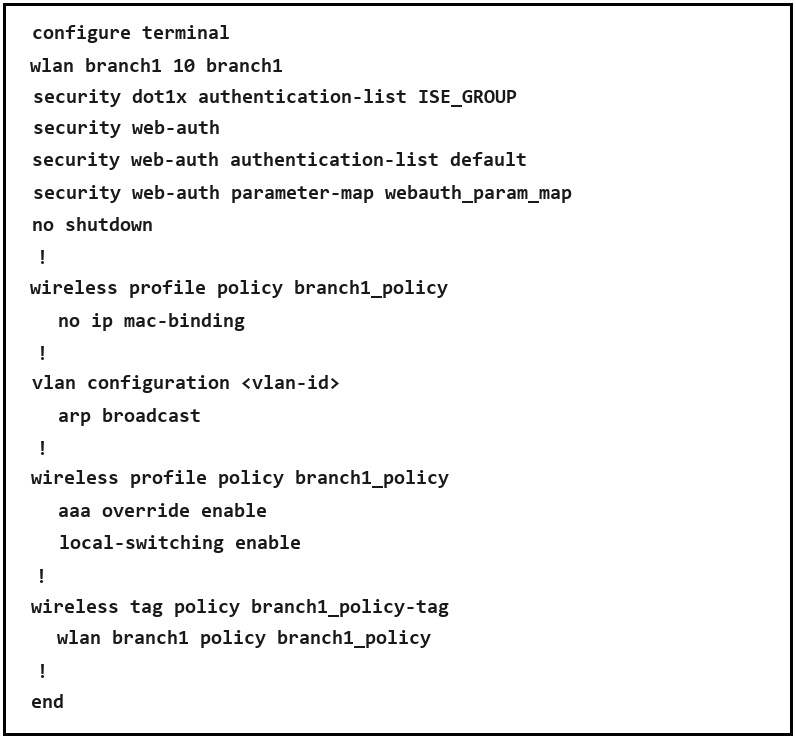 A wireless controller is deployed at a branch location to facilitate secure client connectivity. A network engineer configures a WLAN using 802.1X to align with company security policies. Which configuration enables client authentication for this WLAN?
-
A
-
B
security dot1x authentication-list ISE_GROUP
-
C
-
D
wlan branch1 policy branch1_policy
Reveal answer details
Close answer details
Correct answerB
ExplanationThe requirement can be read as follows: A wireless controller is deployed at a branch location to facilitate secure client connectivity. A network engineer configures a WLAN using 802.1X to align with company security policies. Which configuration enables client authentication for this WLAN? The matching behavior is security dot1x authentication-list ISE_GROUP.
Security questions should separate authentication, authorization, and policy enforcement. The WLAN security method gets the client on the network, while RADIUS and policy attributes decide what access the client receives. This choice is the piece that enables or applies that security behavior; the other choices
either skip the external method, use the wrong authentication model, or affect a separate policy area. no ip mac-binding can sound related, but it does not own the behavior being tested. aaa override enable omits the part of the configuration that actually enforces the requested outcome. wlan branch1 policy branch1_policy shifts attention away from the condition that the client, AP, or controller must satisfy. In production troubleshooting, that distinction matters because changing the wrong layer can leave the original failure untouched.
Question 13
Single choice
An IT team is deploying Meraki APs at a remote branch and must ensure that they are automatically assigned to the correct network in the Meraki dashboard. The branch is scheduled to receive 20 new APs, and site connectivity to headquarters was set up. Before shipping the APs, the team must make sure that each one is claimed by the intended network for management and monitoring. Which deployment action must they take before physically connecting the APs?
-
A
Activate mesh networking mode for all the new APs before installation.
-
B
Add the AP serial numbers to the required network within the Meraki dashboard.
-
C
Preconfigure SSID names and VLAN tags on the local page of each AP in the Meraki dashboard.
-
D
Create a separate DHCP scope for all the new APs on the local server.
Reveal answer details
Close answer details
Correct answerB
ExplanationAdd the AP serial numbers to the required network within the Meraki dashboard. fits because the item is asking about this condition: An IT team is deploying Meraki APs at a remote branch and must ensure that they are automatically assigned to the correct network in the Meraki dashboard. The branch is scheduled to receive 20 new APs, and site connectivity to headquarters was set up. Before shipping the APs. Branch designs usually test the difference between central management and local data handling.
FlexConnect behavior is chosen when the AP must keep useful service at the site while still being managed by the controller. This feature fits that branch requirement because it changes forwarding or authentication behavior at the AP site rather than relying on an always-available central path. Activate mesh networking mode for all the new APs before installation. addresses a different failure domain, so it would not close the gap described here. Preconfigure SSID names and VLAN tags on the local page of each AP in the Meraki dashboard. is too broad or aimed at the wrong layer for this scenario.
Create a separate DHCP scope for all the new APs on the local server. does not provide the specific RF, security, forwarding, management, or automation behavior that is required. The answer should therefore be evaluated by effect, not by how recognizable the command or platform name appears.
Question 14
Single choice
A wireless engineer must manage scheduled maintenance for a guest WLAN that uses Cisco Catalyst Center as the primary monitoring solution. The engineer must coordinate downtime and verify that all services resume as intended after planned tasks are complete. The network supports multiple high-availability configurations and relies heavily on consistent visibility into device health. Event logging and alerting must be ensured throughout maintenance windows, and the maintenance process must be centrally managed. Which process meets the requirements?
-
A
Monitor the Device 360 dashboard.
-
B
Monitor the device in Cisco Spaces.
-
C
-
D
Use scheduled maintenance for the device.
Reveal answer details
Close answer details
Correct answerD
ExplanationThe answer follows from the requirement itself: A wireless engineer must manage scheduled maintenance for a guest WLAN that uses Cisco Catalyst Center as the primary monitoring solution. The engineer must coordinate downtime and verify that all services resume as intended after planned tasks are complete. Use scheduled maintenance for the device. is the response that matches that requirement. Guest wireless designs must combine onboarding with isolation. The portal, redirect ACL, policy profile, VLAN mapping, and peer blocking controls serve different parts of that design. The chosen behavior satisfies the guest access requirement because it supports the requested user flow or segmentation instead of merely changing a generic WLAN parameter. Monitor the Device 360 dashboard. does not provide the specific RF, security, forwarding, management, or automation behavior that is required. Monitor the device in Cisco Spaces. would be considered only for a different symptom or design goal. Use the WLC dashboard. can sound related, but it does not own the behavior being tested. A good review method is to ask whether the choice would still solve the issue if every unrelated setting remained unchanged.
Question 15
Single choice
An access point is operating on a 5 GHz DFS channel. The AP detects radar activity on that channel. What must the AP do to remain compliant?
-
A
Continue transmitting and lower the beacon interval.
-
B
Move away from the affected channel.
-
C
Convert the WLAN to WPA3-Personal.
-
D
Disable all 2.4 GHz radios in the same site.
Reveal answer details
Close answer details
Correct answerB
ExplanationIn this case, the decisive fact is An access point is operating on a 5 GHz DFS channel. The AP detects radar activity on that channel. What must the AP do to remain compliant? Move away from the affected channel. addresses that fact directly. The selection Move away from the affected channel. should be read against the core requirement: An access point is operating on a 5 GHz DFS channel. The AP detects radar activity on that channel. What must the AP do to remain compliant? It is the only response that works at the same layer as that requirement. RF questions should be solved from measurable behavior. Signal level, noise, channel restrictions, interference classification, and propagation effects determine whether a link is stable and compliant. That selection is tied to that RF behavior, so it explains the observed result without changing unrelated WLAN security or management settings. Continue transmitting and lower the beacon interval. can sound related, but it does not own the behavior being tested. Convert the WLAN to WPA3-Personal. omits the part of the configuration that actually enforces the requested outcome. Disable all 2.4 GHz radios in the same site. shifts attention away from the condition that the client, AP, or controller must satisfy. In production troubleshooting, that distinction matters because changing the wrong layer can leave the original failure untouched.
Question 16
Single choice
Which function does FRA use to optimize client experience and network coverage?
-
A
Monitoring on the physical interface level in the AP
-
B
Enhances roaming by redirecting the client to move to the appropriate AP
-
C
Implementation by local data path control
-
D
Dynamically adapts the roles of dual-band radios in an AP
Reveal answer details
Close answer details
Correct answerB
ExplanationFor this scenario, Enhances roaming by redirecting the client to move to the appropriate AP is not just related terminology; it is the part that satisfies.
Which function does FRA use to optimize client experience
and network coverage?
Protocol questions depend on the exact 802.11 function involved. Airtime scheduling, frame exchange, channel behavior, and secure roaming each solve a different problem. That configuration maps to the protocol mechanism described by the stem rather than to a controller administration task or a general monitoring feature. Monitoring on the physical interface level in the AP may be useful elsewhere, but it does not apply the control that the stem is asking for. Implementation by local data path control changes an adjacent setting instead of the mechanism that produces the required result. Dynamically adapts the roles of dual-band radios in an AP addresses a different failure domain, so it would not close the gap described here. That is why the correct selection follows the requirement directly instead of merely belonging to the same Cisco wireless product family.
Question 17
Single choice
What does a low SNR value result in?
-
A
Scheduling of firmware maintenance windows
-
B
Activation of automatic failover features
-
C
Improved channel reliability
-
D
Decreased data integrity with possible errors
Reveal answer details
Close answer details
Correct answerD
ExplanationDecreased data integrity with possible errors is the practical selection once the question is reduced to its main requirement: What does a low SNR value result in? RF questions should be solved from measurable behavior. Signal level, noise, channel restrictions, interference classification, and propagation effects determine whether a link is stable and compliant. The selected mechanism is tied to that RF behavior, so it explains the observed result without changing unrelated WLAN security or management settings.
Scheduling of firmware maintenance windows omits the part of the configuration that actually enforces the requested outcome. Activation of automatic failover features shifts attention away from the condition that the client, AP, or controller must satisfy. Improved channel reliability belongs to a different workflow and would leave the stated condition unresolved. The key lesson is that Cisco wireless features are usually scoped tightly, and the scope determines whether a choice is usable. That reading also helps with the distractors: they may name real wireless concepts, but they do not calculate, configure, or enforce the specific behavior requested here. In review, ask whether applying the choice would immediately change the failure, measurement, policy, or workflow in the stem; if it would not,
it should be eliminated.
Question 18
Single choice
Which hierarchy in a YANG data modeling approach describes a relationship in the context of NETCONF device configuration?
-
A
object and attribute model
-
B
child and parent structure
-
C
-
D
tree and leaf-based structure
Reveal answer details
Close answer details
Correct answerD
ExplanationThe answer follows from the requirement itself: Which hierarchy in a YANG data modeling approach describes a relationship in the context of NETCONF device configuration? tree and leaf-based structure is the response that matches that requirement. Automation questions are best answered by separating transport, model, and parsing roles. NETCONF transports operations, YANG defines the data structure, JSON parsing creates usable objects, and code methods retrieve values. This feature performs the role named in the question; the alternatives are
different programming or automation concepts and would not produce the requested result. object and attribute model changes an adjacent setting instead of the mechanism that produces the required result. child and parent structure addresses a different failure domain, so it would not close the gap described here. hub and spoke model is too broad or aimed at the wrong layer for this scenario. This keeps the reasoning tied to the implementation detail rather than to broad wireless terminology.
Question 19
Single choice
Refer to the exhibit. 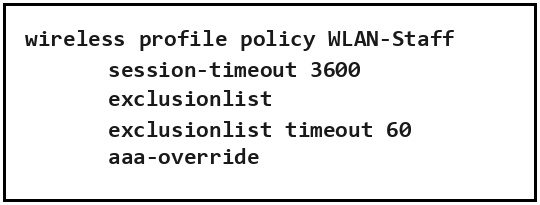 A network administrator must configure a client management parameter for a wireless deployment in a multi-site enterprise. The enterprise is using Cisco ISE as the management platform to oversee wireless access policies. To meet the organization's compliance requirements, all wireless endpoints must be evaluated against a
posture policy before gaining access. Which configuration change must be applied on the WLAN level of the WLC to meet the requirement?
-
A
config wlan WLAN-staff enable aaa-override
-
B
wireless profile policy WLAN-Staffnac
-
C
config wlan WLAN-StaffWLAN-staff radius enable
-
D
wireless profile policy WLAN-Staff config wlan 5 enable radius
Reveal answer details
Close answer details
Correct answerA
Explanationconfig wlan WLAN-staff enable aaa-override is preferred because it changes the behavior described here: A network administrator must configure a client management parameter for a wireless deployment in a multi-site enterprise. The enterprise is using Cisco ISE as the management platform to oversee wireless access policies. To meet the organization's compliance requirements. Security questions should separate authentication, authorization, and policy enforcement. The WLAN security method gets the client on the network, while RADIUS and policy attributes decide what access the client receives. This choice is the piece that enables or applies that security behavior; the other choices
either skip the external method, use the wrong authentication model, or affect a separate policy area. wireless profile policy WLAN-Staffnac addresses a different failure domain, so it would not close the gap described here. config wlan WLAN-StaffWLAN-staff radius enable is too broad or aimed at the wrong layer for this scenario. wireless profile policy WLAN-Staff config wlan 5 enable radius does not provide the specific RF, security, forwarding, management, or automation behavior that is required. The answer should therefore be evaluated by effect, not by how recognizable the command or platform name appears.
Question 20
Single choice
Which solution enables a seamless user experience when roaming in a wireless network?
-
A
-
B
-
C
-
D
Reveal answer details
Close answer details
Correct answerD
Explanationfast transition is preferred because it changes the behavior described here: Which solution enables a seamless user experience when roaming in a wireless network? Protocol questions depend on the exact 802.11 function involved. Airtime scheduling, frame exchange, channel behavior, and secure roaming each solve a different problem. The chosen setting maps to the protocol mechanism described by the stem rather than to a controller administration task or a general monitoring feature. static VLAN policy may be useful elsewhere, but it does not apply the control that the stem is asking for. optimized roaming changes an adjacent setting instead of the mechanism that produces the required result. redundant RF profile addresses a different failure domain, so it would not close the gap described here. That is why the correct selection follows the requirement directly instead of merely belonging to the same Cisco wireless product family. A complete review also checks whether the choice would still solve the problem if all other settings stayed the same. That test favors the correct choice because it changes the feature, protocol, or policy named by the question. The distractors may be legitimate Cisco wireless concepts, but they would send the engineer toward a different task and leave the stated requirement unresolved.
Question 21
Single choice
Refer to the exhibit. 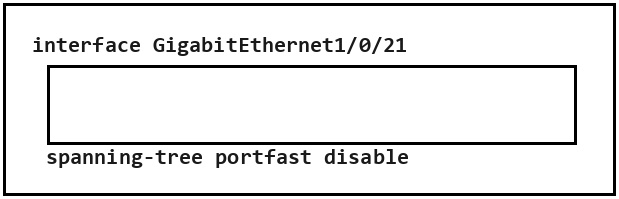 An engineer is configuring a switch port for a Cisco Spaces deployment at a new branch site. The Spaces connector requires access to the management VLAN 30. The network team plans to add more analytics services in the future, so the configuration must also allow for easy scalability and avoid service interruption for currently connected devices and default switch VLAN settings. Which set of commands must be added to the box in the CLI to complete the configuration?
-
A
switchport mode accessswitchport access vlan 30
-
B
switchport mode accessswitchport trunk allowed vlan 30switchport access native vlan
-
C
switchport mode accessswitchport trunk allowed vlan 30switchport trunk native vlan none
-
D
switchport mode trunkswitchport trunk allowed vlan 30
Reveal answer details
Close answer details
Correct answerD
ExplanationThe answer follows from the requirement itself: An engineer is configuring a switch port for a Cisco Spaces deployment at a new branch site. The Spaces connector requires access to the management VLAN 30.
The network team plans to add more analytics services in the future. switchport mode trunkswitchport trunk allowed vlan 30 is the response that matches that requirement. The Spaces connector requires access to the management VLAN 30. That points to switchport mode trunkswitchport trunk allowed vlan 30. Branch designs usually test the difference between central management and local data handling. FlexConnect behavior is chosen when the AP must keep useful service at the site while still being managed by the controller. That selection fits that branch requirement because it changes forwarding or authentication behavior at the AP site rather than relying on an always- available central path. switchport mode accessswitchport access vlan 30 addresses a different failure
domain, so it would not close the gap described here. switchport mode accessswitchport trunk allowed vlan 30switchport access native vlan is too broad or aimed at the wrong layer for this scenario. switchport mode accessswitchport trunk allowed vlan 30switchport trunk native vlan none does not provide the specific RF, security, forwarding, management, or automation behavior that is required. The answer should therefore be evaluated by effect, not by how recognizable the command or platform name appears.
|