An enterprise is deploying Hybrid Data Security to retain full control over encryption keys while using Webex cloud services for messaging and meetings. An engineer must ensure that: - All message content is encrypted end-to-end.
- The Key Management Server is hosted on-premises.
- Compliance officers can still perform eDiscovery.
- The deployment integrates with Control Hub for user and policy management. Which action must be taken to meet the requirements?
-
A
Deploy Expressway-C/E and enable TLS for signaling and media encryption.
-
B
Enable Webex Calling Dedicated Instance and configure LDAP sync for identity management.
-
C
Configure Webex Edge Connect and route traffic through a secure tunnel.
-
D
Install the HDS node on-premises and register it with Control Hub using a secure token.
Reveal answer details
Close answer details
Correct answerD
ExplanationAn on-premises HDS node places the key-management function under enterprise control while Webex cloud services continue to support messaging and meetings. Registering that node with Control Hub using a secure token associates it with the organization so users and policies can be managed through Control Hub.
When an Expressway-E is configured for static NAT, which Session Description Protocol attribute is modified to reflect the NAT address?
-
A
-
B
-
C
-
D
Reveal answer details
Close answer details
Correct answerC
ExplanationThe SDP c-line carries connection data, including the address to which media is sent. When Expressway-E uses static NAT, it rewrites this connection address to reflect the NAT address that the remote party can reach. The b-line describes bandwidth and the m-line describes media and ports, so neither is the address-bearing field at issue.
In Cisco Expressway, which information from an incoming search request does the pre-search transform configuration allow to be modified?
-
A
-
B
-
C
-
D
Reveal answer details
Close answer details
Correct answerB
ExplanationA pre-search transform operates on the destination alias before Expressway applies search rules and selects a route. The modifiable field from the incoming search request is therefore the called address. Rewriting that address can normalize domains or dialed strings for later routing, whereas the calling party, source IP address, and CUD are outside this transform's target.
Question 4
Multiple choice
What are two reasons why port 8443 is unreachable from the Internet to the Expressway- E? (Choose two.)
-
A
The MRA license is missing on the Expressway-E.
-
B
The Unified Communications zone is down.
-
C
Transform is not configured on Expressway-E.
-
D
The SRV record for_cisco-uds is misconfigured.
-
E
The firewall is blocking the port.
Reveal answer details
Close answer details
Correct answersB, E
ExplanationPort 8443 must be reachable through the firewall, so a rule that blocks that port prevents the Internet-side connection from reaching Expressway-E. The Unified Communications zone must also be operational because it provides the communication path used by Mobile and Remote Access. A down zone or a blocked port therefore makes the service unreachable.
Cisco media traversal technology has enabled a secure environment where internal video endpoints call and receive calls from external video endpoints. How does the Expressway- C and Expressway-E communicate?
-
A
Expressway-C establishes an outgoing request to Expressway-E, enabling the Expressway-E in the DMZ to notify the internal Expressway-C of an incoming call from an external endpoint.
-
B
Internal endpoints are registered to Expressway-E in the DMZ. Expressway-C, which is also in the DMZ, will receive and make calls on behalf of Expressway-E because they are in the same network.
-
C
Expressway-E establishes an outgoing request to Expressway-C, enabling the Expressway-C in the DMZ to notify the internal Expressway-E of an incoming call from an external endpoint.
-
D
Internal endpoints are registered to Expressway-C in the DMZ. Expressway-E, which is also in the DMZ, will receive and make calls on behalf of Expressway-C because they are in the same network.
Reveal answer details
Close answer details
Correct answerA
ExplanationExpressway-C establishes an outgoing request to Expressway-E, creating the secure traversal relationship from the internal side toward the DMZ. Because that relationship already exists, Expressway-E can use it to notify the internal Expressway-C when an incoming call arrives from an external endpoint. The DMZ component does not initiate an unsolicited connection inward.
A collaboration engineer is configuring Cisco Webex Edge for video conferencing devices to provide support for Cisco Webex Control Hub configuration management. Which configuration control mode must be set on Cisco UCM for Control Hub to manage the on-premises device configuration?
-
A
-
B
-
C
-
D
Reveal answer details
Close answer details
Correct answerC
ExplanationControl Hub management of an on-premises video device requires the configuration-control mode that includes both sides of the deployment. Selecting Cisco UCM and endpoint permits configuration control to cover the UCM-managed environment and the endpoint connected through Webex Edge. A mode limited to only one side would not provide that combined management path.
Which configuration in a local gateway registered to Webex is required so that SRV queries are formatted as Secure SIP for the access SBC?
-
A
-
B
session transport tcp tls
-
C
-
D
Reveal answer details
Close answer details
Correct answerA
ExplanationThe url sips configuration makes the local gateway use the secure SIP URI scheme when constructing the service lookup. That scheme causes the related SRV query to be formatted for Secure SIP toward the access SBC; a transport setting alone does not define the URI scheme used for the query.
A technical support team is deploying a new Cisco Desk Pro endpoint for a user. The device has been physically connected to the network, received an IP address, and can successfully ping general internet websites. However, when attempting to activate the device using the activation code from Webex Control Hub, the Desk Pro shows a Registration Failed message, and its status in Control Hub remains Unregistered. What is the cause of the registration failure?
-
A
The 24-hour window of the Activation code has passed, after which the code returns invalid_error.
-
B
The endpoint's system time is significantly out of sync with Network Time Protocol servers.
-
C
A room OS device can be added only using its MAC address. The activation code from Control Hub ends up in failed registration.
-
D
The organization's firewall or proxy server is blocking specific ports or URLs required for Webex Cloud service communication.
Reveal answer details
Close answer details
Correct answerD
ExplanationReceiving an IP address and reaching general internet sites verifies basic connectivity but does not prove access to the Webex cloud services used for activation. If the organization's firewall or proxy blocks the specific required ports or URLs, the Desk Pro cannot complete registration and remains unregistered in Control Hub.
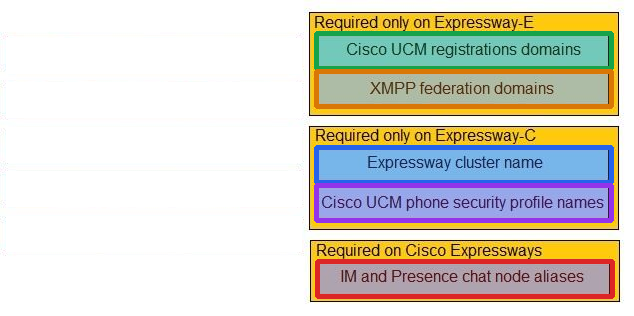
DRAG DROP Drag and drop the required SAN field items from the left onto the features within the server categories on the right. 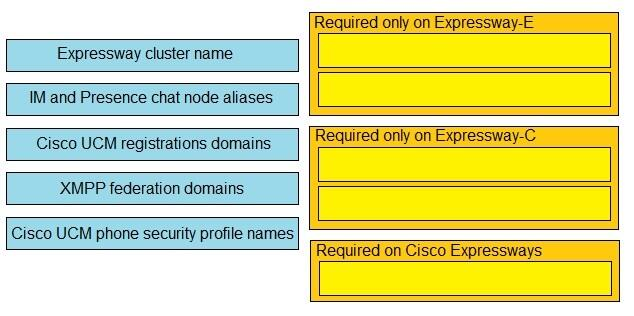
Reveal answer details
Close answer details
Question 10
Single choice
A company has enabled ICE to optimize call flows and improve video quality between their Cisco Collaboration endpoints internally and externally. For which reason would you see activity on the TURN server when a call is established between two external endpoints?
-
A
The video call is using encryption, which is not supported by ICE with CUCM 12.5
-
B
ICE cannot reduce the packet loss on the link
-
C
A STUN cannot punch holes in the firewall
-
D
The video call is using 4K resolution, which is not supported by ICE with CUCM 12.5
Reveal answer details
Close answer details
Correct answerC
ExplanationICE first attempts to establish a direct media path between the two external endpoints. STUN assists that attempt by discovering addressing and testing whether the intervening firewall or NAT permits the path. If STUN cannot punch the necessary holes in the firewall, direct connectivity fails and the media uses the TURN server as a relay, producing TURN activity.
Question 11
Multiple choice
Which two statements about Cisco Webex Video Mesh Nodes are true? (Choose two.)
-
A
When Expressway Core works with VMN clusters, Expressway Core decides which VMN is used for signaling/media connection.
-
B
Cloud-registered devices choose a VMN cluster based on the lowest STUN round trip delay.
-
C
The cascading traffic between VMN must bypass the firewall.
-
D
When Cisco Unified Communications Manager works with multiple VMNs, Cisco Unified CM decides which VMN is used for signaling connection.
-
E
A VMN can terminate a media connection while operating in maintenance mode.
Reveal answer details
Close answer details
Correct answersB, D
ExplanationCloud-registered devices compare STUN round-trip delay and choose the Video Mesh Node cluster with the lowest value, giving them a network-based cluster selection mechanism. In a Cisco Unified CM deployment with multiple VMNs, Cisco Unified CM selects which VMN receives the signaling connection. These statements describe separate selection roles for cloud devices and on-premises call control.
Question 12
Single choice
Refer to the exhibit. 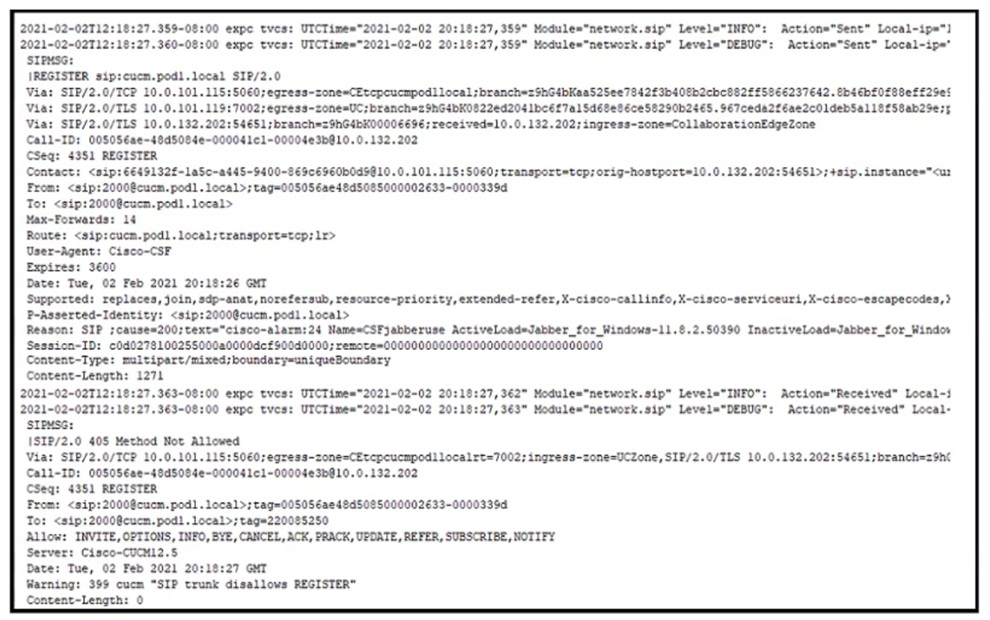 An engineer is deploying mobile and remote access in an environment that already had functioning Business to Business calling. Mobile and remote access SIP registrations are failing. To troubleshoot, SIP logs were collected. How is this issue resolved?
-
A
Change the SIP profile on the SIP trunk for the Expressway-E to Standard SIP Profile for TelePresence Endpoint
-
B
Change the Incoming Port in the SIP Trunk Security Profile for the Expressway-C to not match SIP line registrations
-
C
Enable autoregistration for the appropriate DN range on the Cisco UCM servers running the CallManager service
-
D
Write a custom normalization script since the vcs-interop normalization script does not allow registrations
Reveal answer details
Close answer details
Correct answerB
ExplanationCisco UCM receives the REGISTER on a SIP trunk and returns 405 Method Not Allowed with the warning that the SIP trunk disallows REGISTER. The registration is being classified as trunk traffic because the incoming port conflicts with SIP line registration handling. Changing the Expressway-C SIP Trunk Security Profile incoming port so it does not match the line-registration port removes that collision.
Question 13
Single choice
A company is installing Cisco Collaboration infrastructure and one of the requirements is that they must be able to communicate with many external parties that are using H.323 and SIP. Internally they want to register the endpoints only on SIP. Which functionality would describe the feature that needs to be enabled and where to achieve this?
-
A
Interworking in Expressway-C
-
B
Transcoding in Cisco Unified Communications Manager
-
C
Transcoding in Expressway-C
-
D
Interworking in Cisco Unified Communications Manager
Reveal answer details
Close answer details
Correct answerA
ExplanationThe endpoints remain registered internally with SIP, while external parties may communicate through either SIP or H.323. Interworking on Expressway-C converts signaling between those protocol environments so calls can cross the boundary. Transcoding changes media codecs and does not solve a SIP-to-H.323 signaling mismatch, and Cisco Unified CM is not the stated interworking point.
Question 14
Single choice
A video device registered with Cisco UCM failed to make an outbound B2B call. From Expressway-C diagnostic logs, an engineer found that the destination pattern is "[email protected]:5061", and the call was dropped with a 404 response code from Expressway-C. The search rule intended for this call-in Expressway-C is configured for Alias Pattern Match, Pattern type "Suffix," and Pattern "example.com". How must the configuration be changed to allow the call?
-
A
Update the route pattern in Cisco UCM to send calls to "example.com" to the correct port.
-
B
Create a transform on Expressway-C to strip port numbers.
-
C
Create a call policy rule on Expressway-E to allow calls to port 5061.
-
D
Update the call policy list in Expressway-C to allow calls to "example.com".
Reveal answer details
Close answer details
Correct answerB
ExplanationThe suffix rule expects the alias to end with example.com, but [email protected]:5061 ends with the port number and therefore does not match. A transform on Expressway-C must strip port numbers before search-rule evaluation. After removing :5061, the normalized destination ends in example.com and can match the intended suffix rule.
Question 15
Single choice
When determining why Mobile and Remote Access to Cisco TelePresence equipment does not work anymore for an organization. There are several administrators and configuration changes could have happened without anyone knowing. Internal communication seems to be working, but no external system can register or call anywhere. Gathering symptoms, you also discover that no internal systems can call out either. What is TraversalZone missing that causes this issue?
-
A
-
B
-
C
SIP trunk to the DefaultZone
-
D
route pattern to the DefaultZone
Reveal answer details
Close answer details
Correct answerA
ExplanationInternal communication still works, so local call processing is intact. Both inbound external access and outbound calls fail because the traversal path is disconnected from the general zone-routing path. Restoring the link between TraversalZone and DefaultZone reconnects those paths. A pipe controls bandwidth and does not create this zone relationship.
Question 16
Single choice
A network engineer is configuring Mobile and Remote Access for the environment and must add the Certificate Authority into the Expressways. How does the engineer perform this action?
-
A
Go to Maintenance > Trusted CA certificate > Security and upload the trusted Certificate Authority certificates.
-
B
Go to Maintenance > Security > Trusted CA certificate and upload the trusted Certificate Authority certificates.
-
C
Go to Maintenance > Tools > Security > Certificates > Trusted CA certificate and upload the trusted Certificate Authority certificates.
-
D
Go to Maintenance > Tools > Security > Trusted CA certificate and upload the trusted Certificate Authority certificates.
Reveal answer details
Close answer details
Correct answerB
ExplanationTrusted Certificate Authority certificates are installed from Maintenance > Security > Trusted CA certificate. Uploading the CA certificates there adds the issuers that Expressway uses when validating certificates presented by its peers. The other menu sequences place Security and Trusted CA certificate in the wrong hierarchy or add a Tools level that is not part of the required path.
Question 17
Single choice
What allows endpoints behind a NAT to discover the paths through which they will pass media?
-
A
-
B
-
C
-
D
Reveal answer details
Close answer details
Correct answerD
ExplanationICE allows endpoints behind NAT to gather candidate media addresses, test connectivity across the available candidates, and discover the path through which media can pass. RTP carries media after a path is chosen, TLS protects signaling, and SNMP supports management. None of those protocols performs the NAT-aware media-path discovery provided by ICE.
Question 18
Single choice
Secure signaling to a certificate-authenticated local gateway fails because the certificate identity does not match the public name in the cloud trunk definition. What corrects the trust failure?
-
A
Align the reachable DNS name, certificate identity and chain, trunk identity, and secure transport.
-
B
Replace certificate authentication with cloud-issued registration credentials on the same trunk.
-
C
Change route-group priority so the certificate subject is no longer checked.
-
D
Install a self-signed certificate whose subject differs from the gateway DNS name.
Reveal answer details
Close answer details
Correct answerA
ExplanationCertificate authentication succeeds only when the gateway reached by the trunk presents an identity that matches the configured public name and chains to a trusted authority. The trunk identity, reachable DNS name, certificate identity and chain, and secure transport must therefore be aligned so signaling can establish trust.
Question 19
Single choice
Which action is required when using Cisco Jabber for Cloud with Cisco Webex Messenger?
-
A
Configure, extend, and connect.
-
B
-
C
Configure service discovery for remote access.
-
D
Configure desk phone control.
Reveal answer details
Close answer details
Correct answerB
ExplanationCisco Jabber for Cloud with Cisco Webex Messenger requires policies that define and enable the applicable user services and behavior. Configuring those policies is therefore part of establishing the cloud messaging deployment. Remote-access service discovery and desk-phone control concern separate Jabber capabilities and do not replace the Messenger policy configuration.
Question 20
Single choice
When does the Webex App Endpoint send media to the Video Mesh cluster during a meeting?
-
A
when the Webex cloud media services are offline
-
B
when there is insufficient bandwidth at the MPLS WAN edge.
-
C
when the round-trip delay to the Video Mesh cluster is shorter than the round-trip delay to the Webex cloud media services
-
D
when there is insufficient bandwidth at the internet edge
Reveal answer details
Close answer details
Correct answerC
ExplanationThe endpoint compares its media path to the local Video Mesh cluster with its path to Webex cloud media services. It sends meeting media to Video Mesh when the round-trip delay to that cluster is shorter, because the local path then offers the better media route. Internet or MPLS bandwidth conditions alone are not the stated selection criterion.
Question 21
Single choice
Which configuration is required when implementing Mobile and Remote Access on Cisco Expressway?
-
A
-
B
-
C
Cisco Unified CM publisher address
-
D
Reveal answer details
Close answer details
Correct answerC
ExplanationMobile and Remote Access must integrate Expressway-C with the internal call-control environment. Configuring the Cisco Unified CM publisher address gives Expressway-C the required location of that cluster for the deployment. SAML authentication and SSO are optional authentication designs, while IPS is not the required call-control configuration.
Question 22
Single choice
An Expressway-E is configured using a single NIC with NAT. How must the Expressway-C traversal client zone be configured to connect to the Expressway-E?
-
A
TLS verify must be enabled.
-
B
The zone profile must be set to default.
-
C
The peer address must be the Expressway-E NAT address.
-
D
The peer address must be the Expressway-E LAN 1 IP address.
Reveal answer details
Close answer details
Correct answerD
ExplanationWith single-NIC NAT, the traversal connection is configured against the Expressway-E interface that owns the internal traversal service. Expressway-C therefore uses the LAN 1 IP address as the peer address. The external NAT address represents the translated internet-facing identity, not the peer value for this traversal-client zone.
Question 23
Single choice
Where are voice calls handled in a Cisco Jabber hybrid cloud-based deployment with Cisco Webex Platform Service?
-
A
Voice calls use Webex Calling platform for call control and use hybrid media nodes for local conferencing.
-
B
Voice calls use local media nodes to keep traffic internal for internal traffic and use Webex Calling for external calls.
-
C
Voice call use Cisco Unified Communications Manager for local calls and Webex Calling for external calls.
-
D
Voice calls use local Cisco Unified Communications Manager for all calls.
Reveal answer details
Close answer details
Correct answerD
ExplanationIn this Jabber hybrid cloud-based design, the Webex Platform Service supplies cloud collaboration capabilities, but voice call control remains on premises. Local Cisco Unified Communications Manager handles all voice calls rather than splitting internal and external calls between different call-control platforms. The cloud component does not move those calls to Webex Calling.
Question 24
Single choice
-
A
-
B
-
C
-
D
Reveal answer details
Close answer details
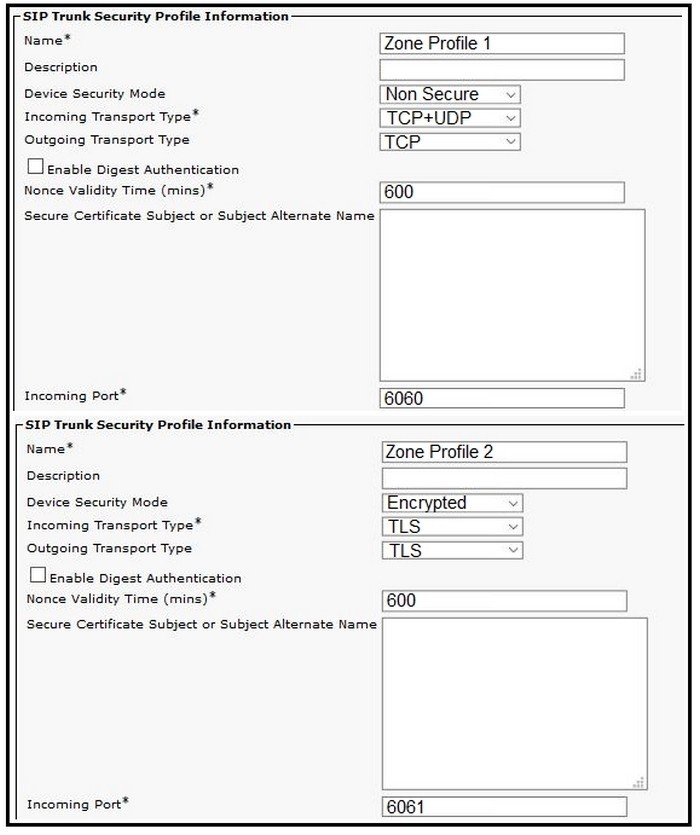
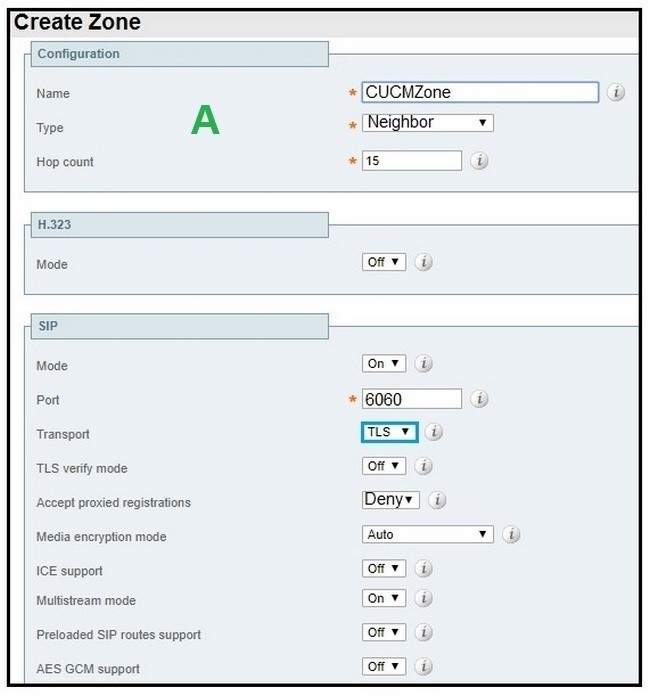
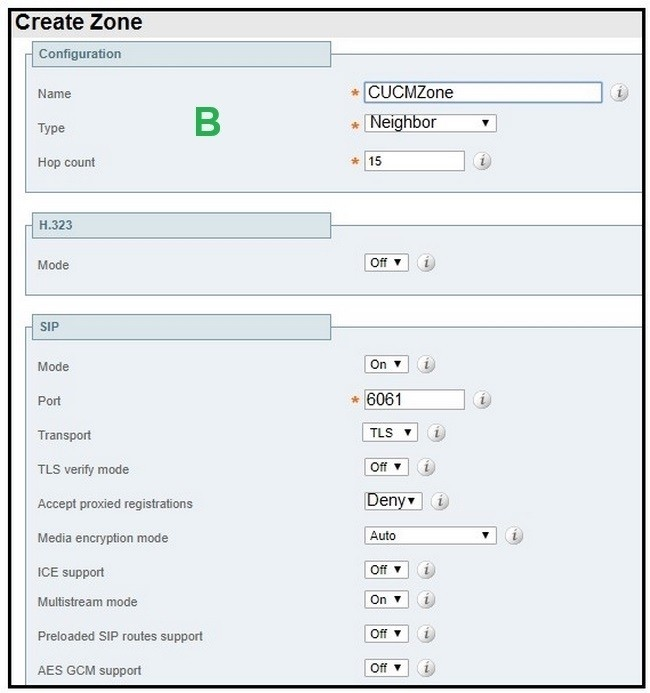
Correct answerC
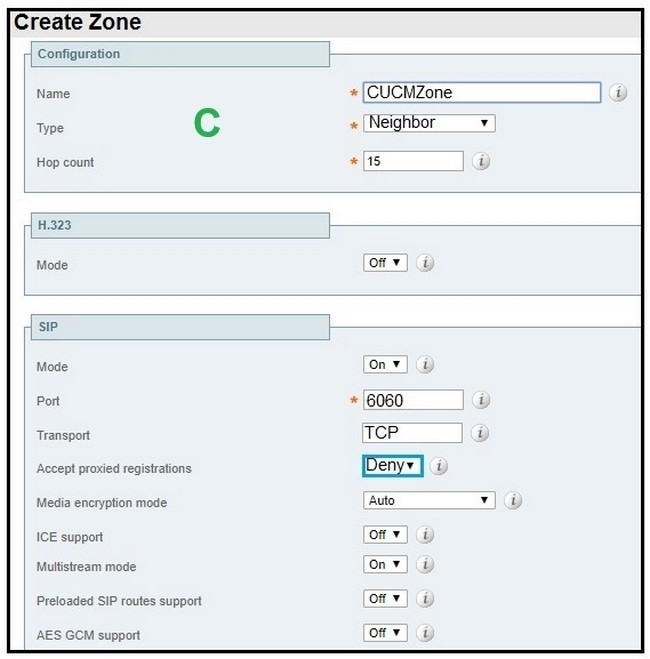
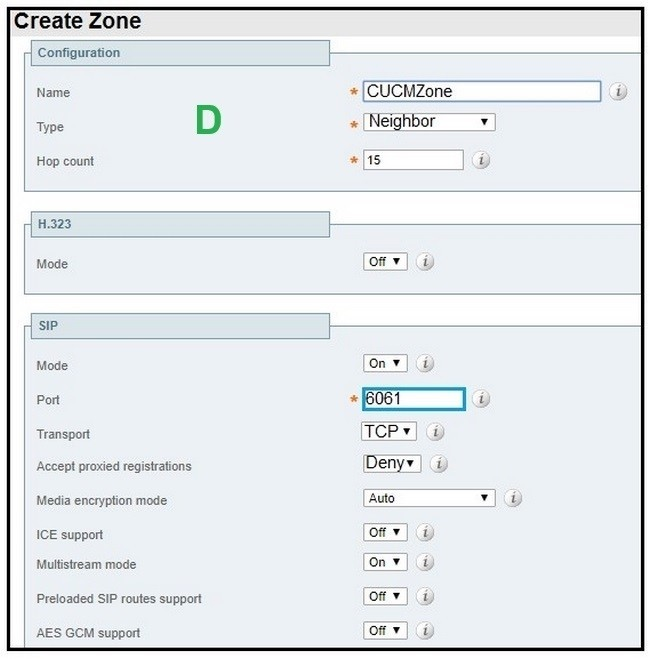
ExplanationThe Cisco UCM profile for unencrypted connectivity is non-secure, uses TCP and UDP for incoming traffic, TCP for outgoing traffic, and listens on port 6060. Option C configures the Expressway neighbor zone with SIP enabled, TCP transport, and port 6060. That matches the required unencrypted signaling path between Expressway-C and Cisco UCM.
Question 25
Single choice
Refer to the exhibit. 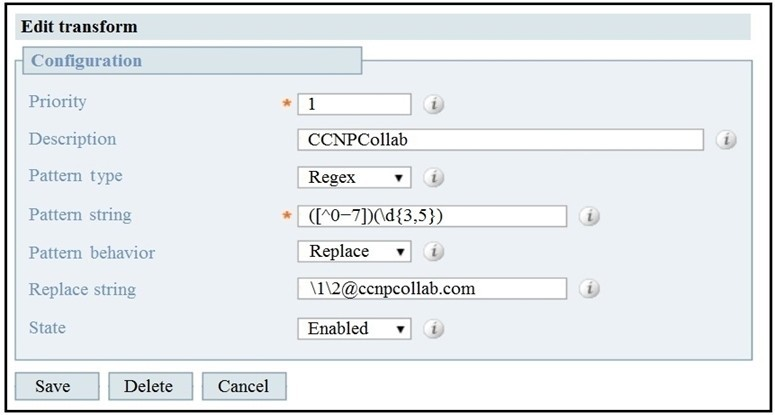 What is the result of a transformation applied to alias 88514?
-
A
-
B
-
C
-
D
Reveal answer details
Close answer details
Correct answerC
ExplanationThe regex divides 88514 into two captures: the first 8 matches the character outside the 0-7 range, and 8514 matches the following three-to-five digits. The replacement concatenates captures \1 and \2 without changing them, then appends @ccnpcollab.com. The transformed alias is therefore [email protected].
Question 26
Single choice
An external Jabber device cannot register. While troubleshooting this issue, the engineer discovers that privately signed certificates are being used on Expressway-C and Expressway-E. What action will resolve this issue?
-
A
The private CA certificate must be placed in the phone trust store.
-
B
The Jabber client must register to the Cisco UCM internally before it will register externally.
-
C
The device running the Jabber client must use a VPN to register.
-
D
The device running the Jabber client must download and trust the private CA certificate.
Reveal answer details
Close answer details
Correct answerD
ExplanationA privately signed Expressway certificate is trusted only by devices that trust the issuing private CA. The device running Jabber must download and install that private CA certificate so it can validate the certificate chain presented during the secure connection. Without that trust anchor, certificate validation fails and external registration cannot complete.
Question 27
Single choice
Which mode should be used when Call Policy is configured on Expressways?
-
A
-
B
local CPL, policy service, and off
-
C
-
D
Reveal answer details
Close answer details
Correct answerB
ExplanationExpressway Call Policy supports the modes local CPL, policy service, and off. Local CPL applies policy held on the Expressway, policy service delegates the decision to the configured service, and off disables Call Policy evaluation. "On," "extended CPL," and "remote CPL" do not represent the applicable set of Call Policy mode choices.
Question 28
Single choice
Which technique can be used to have media flow directly between two endpoints that have a NAT between them?
-
A
The endpoints can use a Cisco router API to disable NAT temporarily.
-
B
Cisco Mobile and Remote Access allows for media traffic directly between two internal endpoints.
-
C
Cisco access protocol can make a direct path between endpoints on an internal network.
-
D
STUN makes UDP connections through NAT devices.
Reveal answer details
Close answer details
Correct answerD
ExplanationSTUN allows an endpoint to discover the public address and UDP port mapping created by a NAT device. Endpoints can exchange those discovered candidates and attempt a direct UDP media path through the existing mappings. This enables direct media without temporarily disabling NAT or relying on an unrelated internal access protocol.
Question 29
Single choice
A company has decided to enable Single Sign-On in Webex using an external identity provider (IdP). The Webex administrator must configure SSO for the organization in Control Hub. Requirements:
- The IdP metadata file has already been exported from the IdP.
- The correct configuration flow must be applied in Control Hub.
- End users should authenticate only through the IdP once SSO is enabled. What is the next action the administrator must take in Control Hub to correctly configure SSO?
-
A
Direct end users to authenticate via Webex default login until SSO is confirmed.
-
B
Assign SSO permissions manually to each user in the Control Hub user list.
-
C
Push the IdP metadata file to user accounts individually.
-
D
Import the IdP metadata into Control Hub and validate the connection.
Reveal answer details
Close answer details
Correct answerD
ExplanationThe exported IdP metadata contains the federation information that Control Hub needs to trust and communicate with the identity provider. Importing that metadata establishes the SSO configuration, and validating the connection confirms that IdP authentication works before users are required to use it.
Question 30
Single choice
Refer to the exhibit. 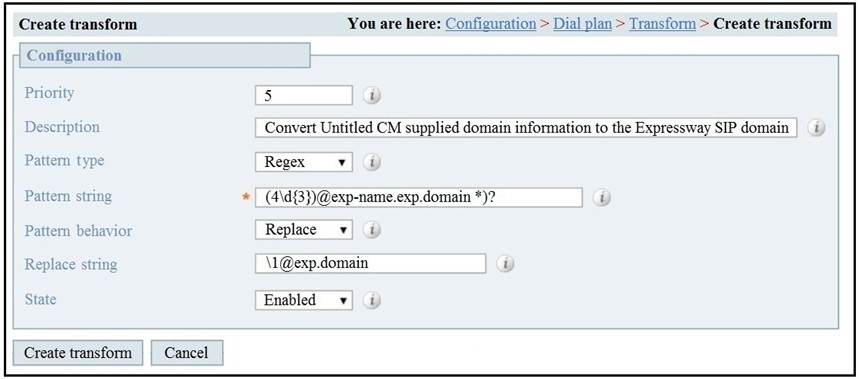 Which description of the transformation is true?
-
A
-
B
It changes all patterns that begin with [email protected]:<port> to [email protected]
-
C
-
D
Reveal answer details
Close answer details
Correct answerA
ExplanationThe regular expression captures a four-digit number beginning with 4 and matches the exp-name.exp.domain portion, with an optional trailing port portion. The replacement string uses \1, so the captured digits are retained, and substitutes @exp.domain for the original domain. Consequently, [email protected] with a port becomes [email protected].
Question 31
Single choice
To simplify onboarding new devices from a home office, an engineer decides to configure a method to activate devices using an activation code. The environment consists of a Cisco UCM cluster and Cisco Expressways for external communications. All have been upgraded from version 11 to be 12.5 and higher to support this function. Currently, the setup has been used only for internal systems and internal Cisco Jabber clients calling B2B. What must the engineer configure for this feature to function?
-
A
Cisco Expressway-E to accept incoming connections on port 443 for Mobile and Remote Access
-
B
Cisco Expressway-E to accept a mutual SIP authentication token
-
C
DNS to have a sips DNS SRV record
-
D
DNS to have a Collab-edge DNS SRV record
Reveal answer details
Close answer details
Correct answerD
ExplanationActivation-code onboarding from a home office requires the device to discover the external collaboration service. A Collab-edge DNS SRV record provides that discovery path through the Cisco Expressway deployment, allowing the phone to locate the service needed to continue activation from outside the internal network.
Question 32
Single choice
What is the default DSCP value for video traffic that is routed through an Expressway server?
-
A
-
B
-
C
-
D
Reveal answer details
Close answer details
Correct answerD
ExplanationVideo traffic routed through an Expressway server uses a default DSCP value of 34. This marking identifies the forwarding treatment assigned to that media traffic as it crosses the network. The value is the Expressway video default itself; changing it would require an explicit quality-of-service configuration rather than relying on the default behavior.
Question 33
Single choice
Which part of a hybrid cloud-based deployment with Cisco Webex Messenger Service is used for meeting capabilities?
-
A
Cisco Unified CM is always used for meeting capabilities.
-
B
Depending on the media flow, the Webex Meeting Center or local Cisco Unified CM meeting resources are used for meeting capabilities.
-
C
Depending on the origin of the user, the Webex Meeting Center or local Cisco Unified Communications Manager meeting resources are used for meeting capabilities.
-
D
Cisco Webex Meeting Center is always used for meeting capabilities.
Reveal answer details
Close answer details
Correct answerD
ExplanationIn the hybrid deployment described, meeting capabilities remain a cloud function provided by Cisco Webex Meeting Center. Local Cisco Unified Communications Manager continues to serve its call-control role, but the meeting resource does not switch according to media flow or user origin. Cisco Webex Meeting Center is therefore always used for these meeting capabilities.
Question 34
Single choice
An engineer wants to configure a zone on the Expressway-E to receive communications from the Expressway-C in order to allow inbound and outbound calls. How is the peer address configured on the Expressway-C when Expressway-E has only one NIC enabled and is using static NAT mode?
-
A
-
B
-
C
-
D
Reveal answer details
Close answer details
Correct answerA
ExplanationWith one Expressway-E interface and static NAT, Expressway-C identifies its traversal peer by the Expressway-E FQDN. The peer is the Expressway-E, not Cisco Unified CM, and DHCP is an address-assignment method rather than a peer identity. Using the FQDN also provides the named identity expected for the server connection.
Question 35
Single choice
What is the purpose of a transform in the Expressway server?
-
A
A transform has the function as a neighbor zone in the Expressway. It creates a connection with another server.
-
B
A transform changes the audio codec when the call goes through the Expressway.
-
C
A transform is used to route calls to a destination.
-
D
A transform changes an alias that matches certain criteria into another alias.
Reveal answer details
Close answer details
Correct answerD
ExplanationA transform performs alias rewriting before routing decisions are completed. It tests an alias against configured criteria, such as a pattern or regular expression, and replaces the matching content to produce another alias. Establishing a server relationship belongs to zone configuration, and selecting a destination belongs to search rules rather than transforms.
Question 36
Single choice
A MRA deployment is being configured where one of the requirements is for registered Jabber users to pull directory photos from an internal server. What should be configured on the Expressway-C so that MRA registered clients reach this server?
-
A
A search rule must be created to route the requests to Cisco UCM.
-
B
The directory photo server must be added to the HTTP allow list.
-
C
A neighbor zone must be created to the directory photo server.
-
D
The directory photo server FQDN must be added to the Expressway-C certificate.
Reveal answer details
Close answer details
Correct answerB
ExplanationThe Jabber clients already register through Mobile and Remote Access; the missing function is access to an internal HTTP resource containing directory photos. Adding the directory photo server to the HTTP allow list authorizes Expressway-C to proxy those requests. A SIP search rule or neighbor zone would address call routing, not HTTP content access.
Question 37
Single choice
During loss of cloud reachability, site endpoints cannot place supported local calls even though the local gateway remains operational. What capability is missing from the design?
-
A
A policy that preserves every cloud feature during the outage
-
B
A higher-priority cloud route for the disconnected endpoints
-
C
An auto attendant that permanently owns each endpoint number
-
D
A local fallback registration and calling path
Reveal answer details
Close answer details
Correct answerD
ExplanationAn operational local gateway alone cannot preserve calls if endpoints lose their cloud registration and have no alternate control path. The design needs local fallback registration so endpoints remain registered during lost cloud reachability, plus a local calling path that can carry the supported calls through resources still available at the site.
Question 38
Single choice
Holiday callers hear the normal open-hours greeting because only the weekly business schedule was configured. What change addresses the problem?
-
A
Add the auto attendant to a route group so the trunk supplies holiday treatment.
-
B
Enable hot desking so a user identity controls the greeting during holidays.
-
C
Reassign the business number for each holiday and restore it on the next workday.
-
D
Associate a holiday schedule with the intended holiday treatment.
Reveal answer details
Close answer details
Correct answerD
ExplanationA weekly business schedule distinguishes normal open and closed hours but does not identify special holiday dates. Associating a holiday schedule supplies that missing date condition, and linking it to the intended holiday treatment makes the auto attendant choose the holiday greeting or action when those dates occur instead of applying ordinary open-hours behavior.
Question 39
Single choice
What is the default file extension for saving Cisco Expressway-C backups when using the Google Chrome browser?
-
A
-
B
-
C
-
D
Reveal answer details
Close answer details
Correct answerB
ExplanationThe question asks for the browser-specific saved suffix rather than a generic archive format. With Google Chrome, an Expressway-C backup is saved with the exact ending .tar.tar.gz. Both tar components are retained before the final gz component, which distinguishes this filename from the other listed archive endings.
Question 40
Single choice
In a larger Cisco Collaboration deployment, a user requires the advanced file transfer function in Cisco Jabber while the client is using Mobile and Remote Access. The deployment has multiple Expressway clusters and internal Cisco UCM clusters. Which configuration must be applied on Cisco Expressway-C for this function to be available?
-
A
The HTTP Allow List must be manual or use Automatic inbound rules updated to include all Cisco IM and Presence servers.
-
B
The HTTPS Allow List must be manual or use Automatic inbound rules updated to include all Cisco IM and Presence servers.
-
C
The HTTP Allow List must use Automatic update rules to include all Cisco UCM servers.
-
D
The HTTP Allow List must use Automatic update rules to include all Cisco IM and Presence servers.
Reveal answer details
Close answer details
Correct answerA
ExplanationAdvanced file transfer requires Expressway-C to permit HTTP access to every Cisco IM and Presence server that may handle the service. In a deployment with multiple clusters, the HTTP Allow List must therefore be maintained manually or populated through Automatic inbound rules that are updated to include all such servers. Limiting coverage to Cisco UCM servers would omit the file-transfer service targets.
Question 41
Single choice
Refer to the exhibit.  A manager asks an engineer to create a CSV file for the HTTP allow list on the Expressway deployment. The engineer wrote the script shown and uploaded it to the Expressway, but it is not being accepted. Which action resolves the issue?
-
A
Add the command POST at the end on this line:
"http://myServer4/myPath4,block,,,POST".
-
B
Remove the method “PUT” from:
"http://myServer2:8000/myPath2,allow,"my deployment","an allow test",PUT".
-
C
Remove the line:
"https://myServer4/myPath4,allow,,,GET".
-
D
Nothing is wrong, but the file type is most likely not XML.
Reveal answer details
Close answer details
Correct answerA
ExplanationThe CSV header includes an HttpMethod field, and the final block entry leaves that field empty. Add the command POST at the end of the block row so it has a method in the same final column used by the preceding records. Completing that field gives the row the expected CSV structure and allows the HTTP allow-list file to be accepted.
Question 42
Multiple choice
Refer to the exhibit. 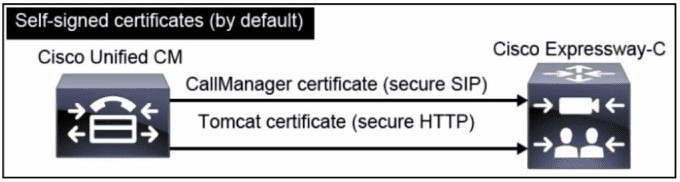 A Cisco UCM cluster in mixed mode is integrated with Cisco Expressway-C for Mobile and Remote Access endpoint registration. TLS verify mode is enabled and self-signed certificates with the same common name for Cisco Tomcat and Cisco Call Manager are uploaded to Expressway-C. A Cisco Jabber client fails to register using secure SIP. Which two configurations are the cause of the issue? (Choose two.)
-
A
The Tomcat certificate has the incorrect FQDN for the Cisco UCM server.
-
B
The Jabber client cannot connect to its associated phone device by using Cisco Computer Telephony Integration.
-
C
The incorrect secure device profile was applied to the Jabber client.
-
D
The Expressway-C does not allow two self-signed certificates with the same CN to be trusted.
-
E
The Call Manager certificate is causing a conflict.
Reveal answer details
Close answer details
Correct answersD, E
ExplanationExpressway-C must be able to distinguish and trust the certificate identities used for secure SIP and secure HTTP. Two self-signed certificates with the same common name cannot both be trusted as separate identities in this configuration. The CallManager certificate therefore conflicts with the Tomcat certificate, preventing successful secure SIP registration through Expressway-C.
Question 43
Multiple choice
Which two items are configured when deploying a B2B collaboration solution? (Choose two.)
-
A
SIP trunk between Cisco Unified Communications Manager and Cisco Expressway-C
-
B
search rules in Cisco Expressway-E
-
C
SIP trunk between Cisco Unified Communications Manager and Cisco Expressway-E
-
D
traversal client on a Cisco Expressway-E
-
E
DNS zone on a Cisco Expressway-C
Reveal answer details
Close answer details
Correct answersA, B
ExplanationThe SIP trunk between Cisco Unified Communications Manager and Cisco Expressway-C carries B2B signaling between internal call control and the Expressway solution. Search rules on Cisco Expressway-E then match external destinations and direct calls toward the appropriate target. A direct UCM-to-Expressway-E trunk would bypass the internal Expressway-C role.
Question 44
Single choice
An engineer must configure Mobile and Remote Access. One of the requirements is to expect Cisco Jabber users to enter [email protected] as the login userid. Which DNS record must the engineer modify to start implementing this requirement?
-
A
-
B
_collab-edge._tls.cisco.com
-
C
_cisco-uds._tls.cisco.com
-
D
_cisco-uds._tcp.cisco.com
Reveal answer details
Close answer details
Correct answerB
ExplanationThe domain portion of [email protected] drives external Mobile and Remote Access discovery. The engineer must begin with the _collab-edge._tls.cisco.com SRV record so clients using that domain can locate the edge service. The _cisco-uds records serve internal service discovery and do not start the Internet-side MRA lookup.
Question 45
Multiple choice
Which two statements about Expressway media traversal are true? (Choose two.)
-
A
Expressway Control is the traversal server installed in the DMZ.
-
B
The Expressway Edge must be put in a firewall DMZ segment.
-
C
Cisco Unified Communications Manager zone can be either traversal server or client.
-
D
The Unified Communications traversal zone can be used for Mobile and Remote Access.
-
E
Both Expressway Edge interfaces can be NATed.
Reveal answer details
Close answer details
Correct answersB, D
ExplanationExpressway-E is the edge component exposed toward external networks, so placing it in a firewall DMZ segment provides the required security boundary. The Unified Communications traversal zone links the Expressway pair for Mobile and Remote Access traffic. Together, the DMZ placement and traversal zone support secure access from remote clients.
Question 46
Single choice
An engineer noticed that internal participants using Full HD endpoints are joining meetings hosted in the Video Mesh node. The quality of the calls is 720p. What must the engineer configure to support 1080p quality?
-
A
Set the "Enhanced Layout Experience" within the Video Mesh settings in Cisco Webex Control Hub to 1080P HD video.
-
B
Set the "Received Video Resolution" on the Video Mesh node to maximum.
-
C
Turn on the "Enable 1080P HD video for all participants hosted on on-premises Video Mesh nodes" setting in the Cisco Webex Control Hub.
-
D
Turn on the "Highest Detail, Best Motion: 1080P" setting in the Cisco Webex Control Hub.
Reveal answer details
Close answer details
Correct answerC
ExplanationFull HD capability on an endpoint does not by itself enable a Video Mesh node to host all participants at 1080p. The organization must turn on "Enable 1080P HD video for all participants hosted on on-premises Video Mesh nodes" in Cisco Webex Control Hub. That setting applies the requested resolution to meetings whose participants are hosted by those nodes.
|