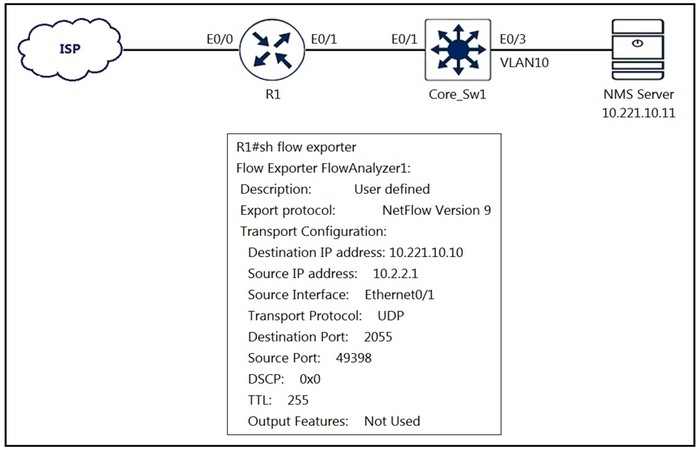
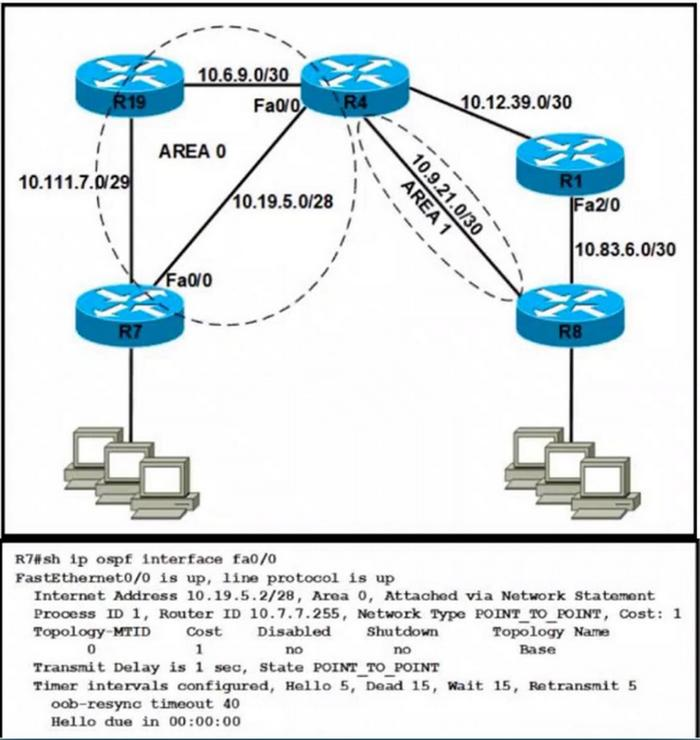
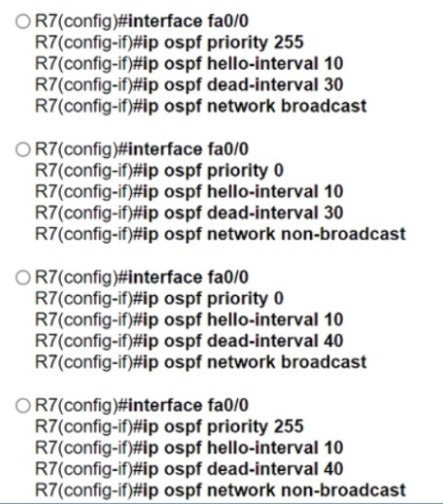
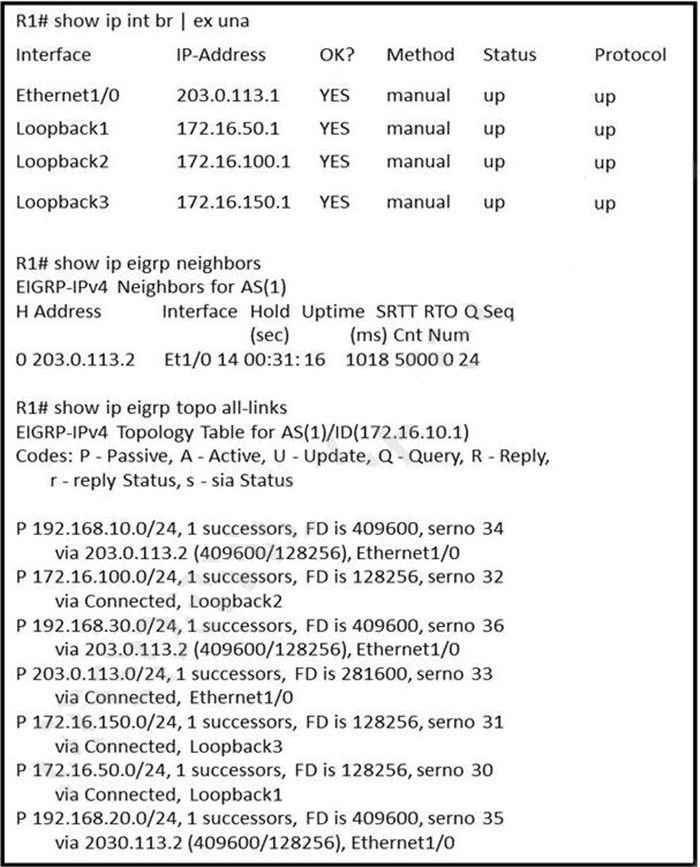
Preview real exam questions, verified answers and available explanations before choosing a study plan.
Question 1
Multiple choice
When the log keyword is added to an access list statement, CPU utilization increases.
What is the source of the increased CPU utilization? (Choose all that apply.)
A
the process switching of packets that match the ACE
B
the incrementing of the match counter every 60 seconds
C
the generation and transmission of log messages
D
the CEF switching of packets that match the ACE
Reveal answer detailsClose answer details
Correct answersA, C
Explanation
The source of the increased CPU utilization will have two sources. First is the process switching of each packet that matches the ACE, which is a slower switching method than CEF switching. The second is the generation and transmission of the log messages. Both effects can be mitigated by adjusting the logging interval and the message interval.
The CPU utilization does NOT increase from the incrementing of the match counter every 60 seconds. The match counter increments every 5 minutes by default.
The CPU utilization does NOT increase from the CEF switching of packets that match the ACE. Those packets will be process switched, which is a much slower process than CEF switching.
Objective: Infrastructure Security Sub-Objective: Configure and verify router security features
References:
Understanding Access Control List Logging
Cisco > Cisco IOS Security Command Commands D to L > ip access-list log-update Cisco > Cisco IOS
Broadband Access Aggregation and DSL Command Reference > logging rate-limit
Question 2
Multiple choice
With Internal BGP, there is a requirement for all peers to be logically fully meshed, where all IBGP routers must peer with all other IBGP routers. For scaling purposes, there are two mechanisms that were developed to bypass this requirement.
What are they? (Choose two.)
A
Confederations
B
IBGP to EBGP route redistribution
C
BGP peer filtering
D
Route reflectors.
Reveal answer detailsClose answer details
Correct answersA, D
Question 3
Single choice
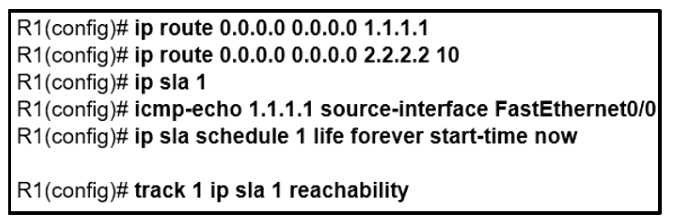
Refer to the exhibit.
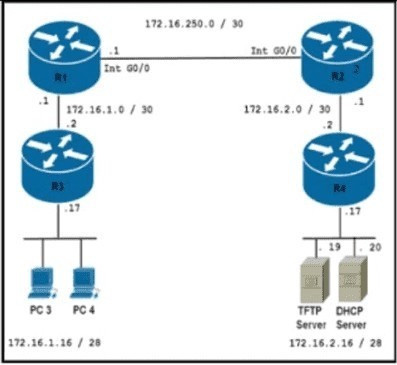
An IP SLA is configured to use the backup default route when the primary is down, but it is not working as desired.
Which command fixes the issue?
A
R1(config)# ip route 0.0.0.0.0.0.0.0.2.2.2.2 10 track 1
B
R1(config)# ip route 0.0.0.0.0.0.0.0.2.2.2.2
C
R1(config)#ip sla track 1
D
R1(config)# ip route 0.0.0.0.0.0.0.0.1.1.1.1 track 1
Reveal answer detailsClose answer details
Correct answerD
Explanation
Note: By default Static Router AD value-1 hence ip route 0.0.0.0. 0.0.0.0. 1.1.1.1 track 1 means AD-1 which must be less than of back up route AD. Define the backup route to use when the tracked object is unavailable. !--- The administrative distance of the backup route must be greater than !--- the administrative distance of the tracked route. !--- If the primary gateway is unreachable, that route is removed !--- and the backup route is installed in the routing table !--- instead of the tracked route. References: https://www.cisco.com/c/en/us/support/docs/ip/ip-routing/200785-ISP-Failover-with-default-routes-using-I.html https://www.cisco.com/c/en/us/support/docs/security/asa-5500-x-series-next-generation-firewalls/118962-configure-asa-00.html
Question 4
Single choice
Which mechanism provides traffic segmentation within a DMVPN network?
A
BGP
B
IPsec
C
MPLS
D
RSVP
Reveal answer detailsClose answer details
Correct answerC
Explanation
To use the DMPVN Traffic Segmentation Within DMVPN feature you must configure Multiprotocol Label Switching (MPLS) by using the mpls ip command.
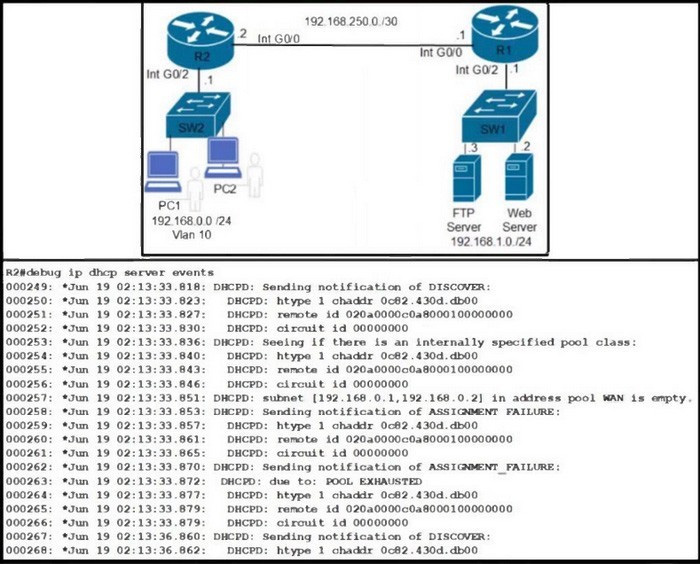
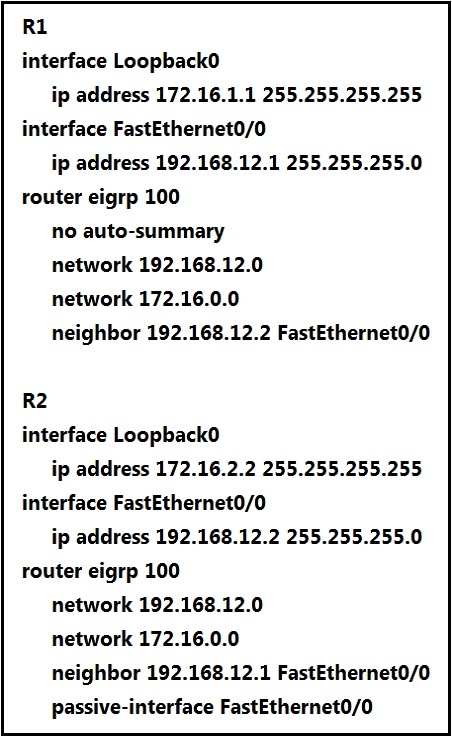
Router R2 VLAN 10 users cannot get dynamic IP addresses from R1.
Which action resolves the issue?
A
Eliminate the port security feature on the ports of switch SW2.
B
Identify the host with the duplicate IP address.
C
Configure the IP helper feature on the Interface GigabitEthernet 0/2 of router R2.
D
Expand the address scope of VLAN 10.
Reveal answer detailsClose answer details
Correct answerD
Question 7
Single choice
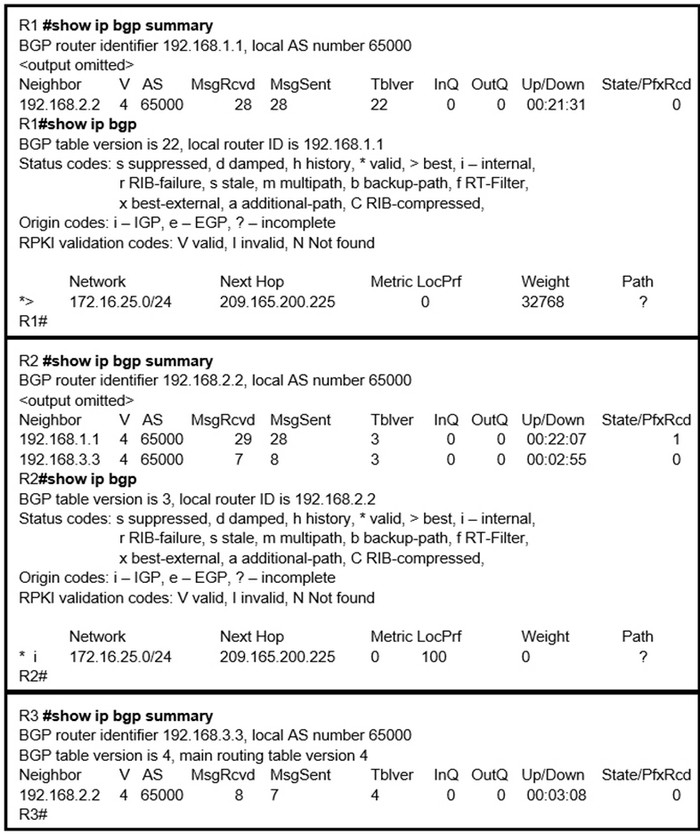
Refer to the exhibit. R2 is a route reflector, and R1 and R3 are route reflector clients. The route reflector learns the route to 172.16.25.0/24 from R1, but it does not advertise to R3.
What is the reason the route is not advertised?
A
R2 does not have a route to the next hop, so R2 does not advertise the prefix to other clients.
B
Route reflector setup requires full IBGP mesh between the routers.
C
In route reflector setup, only classful prefixes are advertised to other clients.
D
In route reflector setups, prefixes are not advertised from one client to another.
Reveal answer detailsClose answer details
Correct answerA
Question 8
Single choice
Refer to the exhibit.
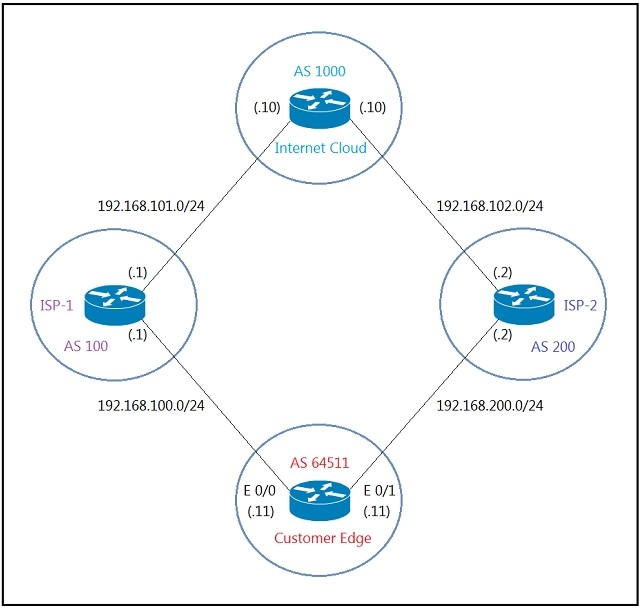
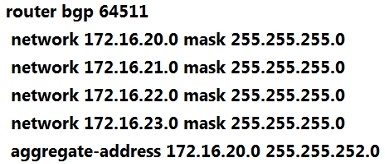
The network administrator has configured the Customer Edge router (AS 64511) to send only summarized routes toward ISP-1 (AS 100) and ISP-2 (AS 200).
After this configuration, ISP-1 and ISP-2 continue to receive the specific routes and the summary route.
interface E 0/0 ip bgp suppress-map BLOCK_SPECIFIC ! interface E 0/1 ip bgp suppress-map BLOCK_SPECIFIC ! ip prefix-list PL_BLOCK_SPECIFIC permit 172.16.20.0/22 ge 24 ! route-map BLOCK_SPECIFIC permit 10 match ip address prefix-list PL_BLOCK_SPECIFIC
D
ip prefix-list PL_BLOCK_SPECIFIC deny 172.16.20.0/22 ge 22 ip prefix-list PL BLOCK SPECIFIC permit 172.16.20.0/22 ! route-map BLOCK_SPECIFIC permit 10 match ip address prefix-list PL_BLOCK_SPECIFIC ! router bgp 64511 aggregate-address 172.16.20.0 255 255.252.0 suppress-map BLOCKSPECIFIC
Reveal answer detailsClose answer details
Correct answerA
Explanation
When the aggregate-address command is used within BGP routing, the aggregated address is advertised, along with the more specific routes. The exception to this rule is through the use of the summary-only command. The "summary-only" keyword suppresses the more specific routes and announces only the summarized route.
Question 9
Single choice
Refer to the exhibit.
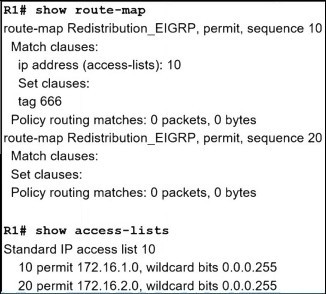
The router is redistributing a prefix 172.16.10.0/24 that should have been filtered.
Which action resolves the issue?
A
Add the route in access-list 10.
B
Match the tag 666 for the route in the route map.
C
Remove route-map sequence 20.
D
Permit the route in route-map sequence 20.
Reveal answer detailsClose answer details
Correct answerC
Question 10
Single choice
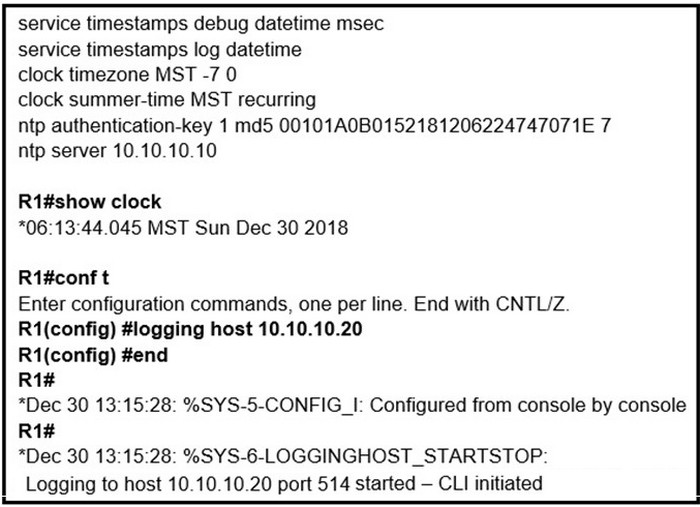
A network engineer is investigating a flapping (up/down) interface issue on a core switch that is synchronized to an NTP server. Log output currently does not show the time of the flap.
Which command allows the logging on the switch to show the time of the flap according to the clock on the device?
A
service timestamps log uptime
B
clock summer-time mst recurring 2 Sunday mar 2:00 1 Sunday nov 2:00
C
service timestamps log datetime localtime show-timezone
D
clock calendar-valid
Reveal answer detailsClose answer details
Correct answerC
Explanation
By default, Catalyst switches add a simple uptime timestamp to logging messages. This is a cumulative counter that shows the hours, minutes, and seconds since the switch has been booted up
Question 11
Single choice
Which command is the proper command for allowing RIP routing updates to be received on an interface while not allowing them to be sent out of the same interface?
A
Router(config)# passive-interface e0/0
B
Router(config-if)# passive-interface
C
Router(config-if)# interface passive
D
Router(config-router)# passive-interface e0/0
E
Router(config-router)# interface passive e0/0
Reveal answer detailsClose answer details
Correct answerD
Explanation
The correct answer is as follows:
Router(config-router)# passive-interface e0/0
The effect of the passive-interface command is dependent on the routing protocol running on the interface. For EIGRP, the router will not only stop sending routing updates, but also hellos, which means that it will not form a neighbor relationship with another EIGRP router on that interface. This is also the case with OSPF and IS-IS. With RIP, however, the router will continue to send hellos even as it stops sending routing updates, and it will still receive routing updates.
The passive-interface command issued at the router configuration mode will prevent routing updates from being sent out on a specific interface while still allowing the interface to receive updates. This command can be used in any situation where you want the router to receive routing updates on a particular interface but not send any updates. This is helpful for security purposes, for preventing routing loops, or to control routing update traffic.
The other options either use improper syntax or are executed at an incorrect prompt.
References:
Cisco > Home > Support > Technology Support > IP > IP Routing > Design > Design Technotes > How
Does the Passive Interface Feature Work in EIGRP? Cisco > Cisco IOS IP Routing: Protocol-Independent
Command Reference > passive-interface
Question 12
Single choice
Which commands will prevent the local router from advertising the 139.10.0.0 network out of the Ethernet 0/0 interface, while allowing all other networks to be advertised?
The following command set will prevent the local router from advertising the 139.10.0.0 network out of the Ethernet 0/0 interface, while allowing all other networks to be advertised:
The distribute-list command allows you to apply a basic access list to a routing process. Just like applying an access list to an interface, when you apply it to a routing process, the permit statements determine what networks may be advertised out the interface. The deny statements determine what networks are not allowed to be advertised out the interface. Instead of applying the access list to an interface, you use the distribute-list command in router configuration mode to apply it to the particular routing process. By specifying an interface and a direction (in or out) in the distribute-list command, you can indicate where the advertisements will be blocked and in what direction.
Keep in mind that when applied this way, the access list does not affect what data traffic passes through the interface. It only affects what networks that the routing protocol will advertise. In the scenario here, RIP will not send advertisements for the 139.10.0.0 network out Ethernet 0/0, but traffic coming from or going to that network is still allowed through the interface in either direction unless there is an access list applied to the interface that will block it.
Conversely, if you applied an access-list to the interface that blocked traffic to or from the 139.10.0.0 network, but permitted all other traffic, it would not stop the routing updates about the 139.10.0.0 from passing through.
Note: The last command in the sequence, RouterA(config)#access-list 10 permit any, is VERY important. If that line is missing, any route not specified with an allow statement will be denied. For example, if you wanted to only allow one network to be advertised, you could configure an allow statement for that network and leave off the permit any parameter. It would block all advertisements with the exception of the one specified by the allow statement.
The following command set is incorrect because the distribute list is applied inbound, which would prevent the reception of updates concerning the 139.10.0.0/16 but would not prevent them from being advertised:
The following command set is incorrect because it applies an access list to the interface instead of a distribute list. The effect would be to block all traffic for that network, but allow routing updates:
Objective: Layer 3 Technologies Sub-Objective: Configure and verify filtering with any protocol
References:
Cisco > Cisco IOS IP Configuration Guide, Release 12.2 > Configuring IP Routing Protocol-Independent
Features > Filtering Routing Information Cisco > Cisco IOS IP Routing: Protocol-Independent Command
Reference > distribute-list out (IP)
Question 13
Single choice
Refer to the exhibit.
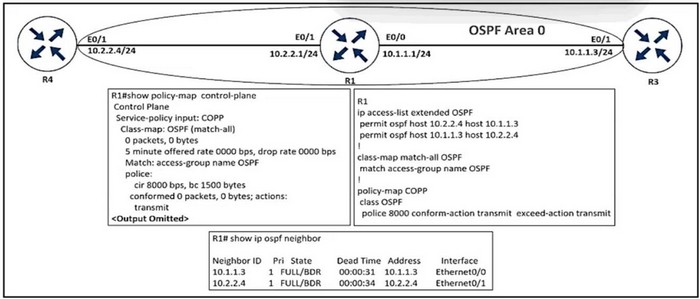
An engineer implemented CoPP but did not see OSPF traffic going through it.
Which configuration resolves the issue?
A
control-plane service-policy input COPP
B
policy-map COPP class OSFP police 8000 conform-action transmit exceed-action transmit violate-action drop
C
ip access-list extended OSFP permit ospf any any
D
class-map match-all OSFP match access-group name OSFP
Reveal answer detailsClose answer details
Correct answerC
Question 14
Single choice
You recently implemented SNMPv3 to increase the security of your network management system. A partial output of the show run command displays the following output that relates to SNMP.
<output omitted>
snmp-server group NORMAL v3 noauth read NORMAL write NORMAL
Which of the following statements is true of this configuration?
A
it provides encryption, but it does not provide authentication
B
it provides neither authentication nor encryption
C
it provides authentication, but it does not provide encryption
D
it provides both authentication and encryption
Reveal answer detailsClose answer details
Correct answerB
Explanation
It provides neither authentication nor encryption. In SNMPv3 there are three combinations of security that can be used: noAuthNoPriv-no authentication and no encryption noauth keyword in the configuration AuthNoPriv - messages are authenticated but not encrypted auth keyword in the configuration AuthPriv - messages are authenticated and encrypted priv keyword in the configuration In this case, the keyword noauth in the configuration indicates that no authentication and no encryption are provided. This makes the implementation no more secure than SNMPv1 or SNMPv2.
In SNMPv1 and SNMPv2, authentication is performed using a community string. When you implement SNMP using the noauth keyword, it does not use community strings for authentication. Instead it uses the configured user or group name (in this case NORMAL). Regardless, it does not provide either authentication or encryption. Objective: Infrastructure Services Sub-Objective: Configure and verify SNMP
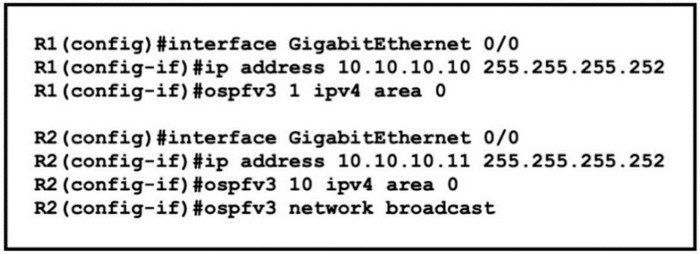
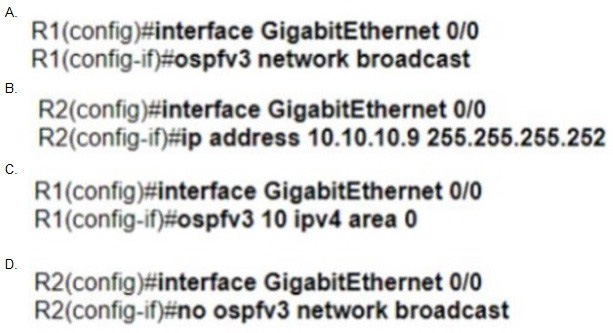
An engineer is troubleshooting an OSPF adjacency issue between directly connected routers R1 and R2
Which configuration resolves the issue?
A
Option A
B
Option B
C
Option C
D
Option D
Reveal answer detailsClose answer details
Correct answerB
Question 16
Single choice
Which of the following commands should you use to determine both the feasible successors and the non-feasible successors to a given destination network?
A
show ip route eigrp
B
show ip eigrp topology
C
show ip eigrp topology all-links
D
show ip eigrp topology zero-successors
Reveal answer detailsClose answer details
Correct answerC
Explanation
The show ip eigrp topology all-links command displays both feasible successors and non-feasible successors to a given destination network. This command displays the contents of the topology table and shows all the routes available for a given destination network.
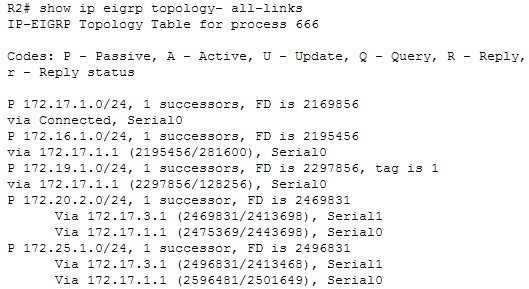
An example of partial output of the command is below:
The 172.20.2.0/24 network has a feasible successor. This can be determined by looking at the values in the parenthesis next to each route. The second value after the / is the advertised distance from the successor. This value must be less than the value of the feasible distance for a route to be considered a feasible successor. There are two routes for 172.20.2.0/24. The first route listed, via 172.17.3.1, is the successor route. Its cost is 246983122, which matches the feasible distance (FD). The second route, via 172.17.1.1, has an advertised distance of 2443698 (the second value in the parentheses after the /).
Because this value is less than the FD (2413698), it qualifies as a feasible successor.
The 172.25.1.0/24 network does not have a feasible successor. The second route listed via 172.17.1.1 has an advertised distance of 2501649, which is greater than the value of the FD, (2416381). Therefore, it is not a feasible successor.
You should not use the show ip route eigrp command. This command displays only the best metric routes (successors) to a given destination network. A route has the best metric if it has the least feasible distance, which refers to the sum of the metric from a given neighbor to a destination network and the metric to reach that neighbor.
You should not use the show ip eigrp topology command without the all-links parameter. This command displays only the feasible successors to a given destination network.
You should not use the show ip eigrp topology zero-successors command because this command lists those routes that do not have a valid successor.
Objective: Layer 3 Technologies Sub-Objective: Configure and verify policy-based routing
References: Cisco IOS IP Routing: EIGRP Command Reference > show ip eigrp topology
Question 17
Single choice
Which command is NOT mandatory for inclusion in a plan to implement IP Service Level Agreements (SLAs) to monitor IP connections and traffic?
A
ip sla
B
ip sla schedule
C
ip sla reset
D
icmp-echo
Reveal answer detailsClose answer details
Correct answerC
Explanation
The ip sla reset command is not mandatory for an implementation plan to configure IP SLAs for monitoring IP connections and traffic. This command causes the IP SLA engine to either restart or shutdown. As a result, all IP SLAs operations are stopped, IP SLA configuration information is erased, and IP SLAs are restarted. The IP SLAs configuration information will need to be reloaded to the engine.
The following commands are essential to the implementation plan:
ip sla ip sla schedule icmp-echo The ip sla command allows you to configure IP SLAs operations. When you execute this command in the global configuration mode, it enables the IP SLA configuration mode. In the IP SLA configuration mode, you can configure different IP SLA operations. You can configure up to 2000 operations for a given IP SLA ID number.
The icmp-echo command allows you to monitor IP connections and traffic on routers by creating an IP SLA ICMP Echo operation. This operation monitors end-to-end response times between routers.
The ip sla schedule command allows you to schedule the IP SLA operation that has been configured. With this command, you can specify when the operation starts, how long the operation runs, and the how long the operation gathers information. For example, if you execute the ip sla schedule 40 start-time now life forever command, the IP SLA operation with the identification number 40 immediately starts running. This is because the now keyword is specified for the start-time parameter. The forever keyword with the life parameter indicates that the operation keeps collecting information indefinitely. Note that you cannot re-configure the IP SLA operation after you have executed the ip sla schedule command.
The information gathered by an IP SLA operation is typically stored in RTTMON-MIB. A Management Information Base (MIB) is a database hosting information required for the management of routers or network devices. The RTTMON-MIB is a Cisco-defined MIB intended for Cisco IOS IP SLAs. RTTMON MIB acts as an interface between the Network Management System (NMS) applications and the Cisco IOS IP SLAs operations.
Objective: Infrastructure Services Sub-Objective: Configure and verify IP SLA
References:
Cisco > Support > Technology Support > IP > IP Application Services > Technology Information >
Technology White Paper > Cisco IOS IP Service Level Agreements User Guide Cisco IOS IP SLAs
Command Reference > icmp-echo through probe-packet priority > ip sla Cisco IOS IP SLAs Command
Reference > icmp-echo through probe-packet priority > ip sla schedule Cisco > Cisco IOS IP SLAs
Command Reference > icmp-echo
Question 18
Lab simulation
Simulation
Guidelines
This is a lab item in which tasks will be performed on virtual devices.
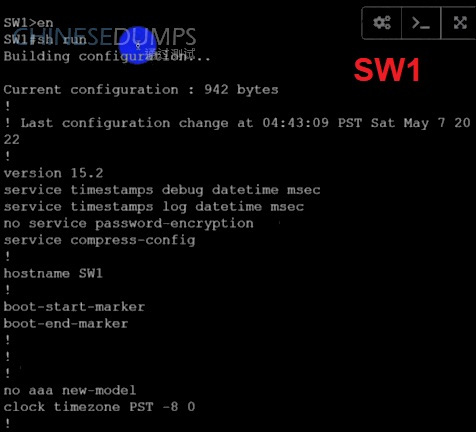
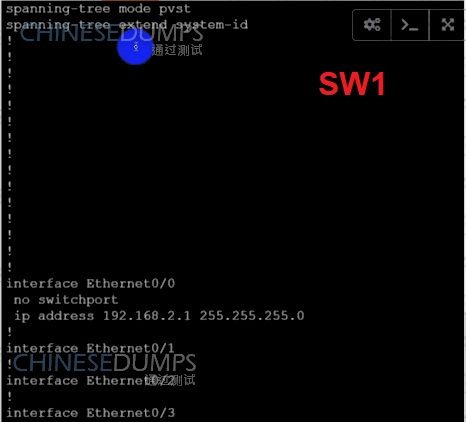
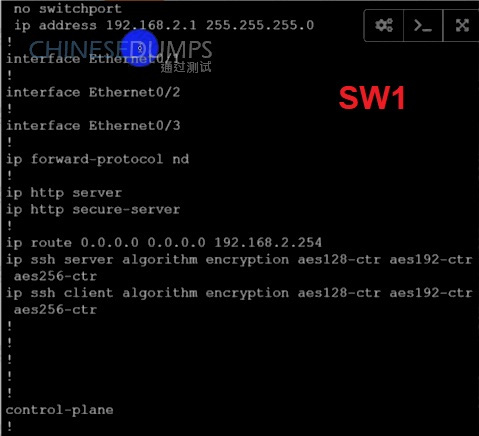
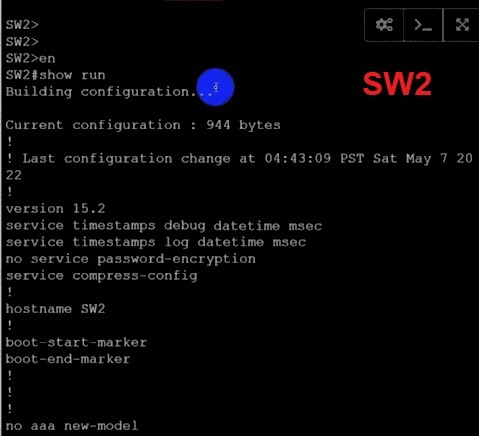
1. Refer to the Tasks tab to view the tasks for this lab item. 2. Refer to the Topology tab to access the device console(s) and perform the tasks. 3. Console access is available for all required devices by clicking the device icon or using the tab(s) above the console window. 4. All necessary preconfigurations have been applied. 5. Do not change the enable password or hostname for any device. 6. Do not replace existing routing policies or configurations. 7. Save your configurations to NVRAM before moving to the next item. 8. Click Next at the bottom of the screen to submit this lab and move to the next question. 9. When Next is clicked, the lab closes and cannot be reopened.
Topology
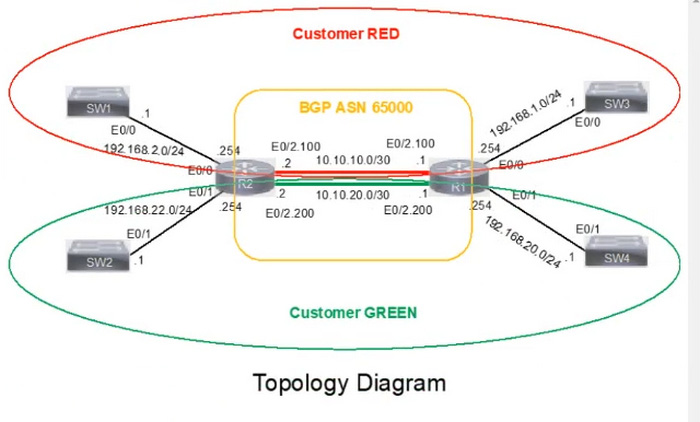
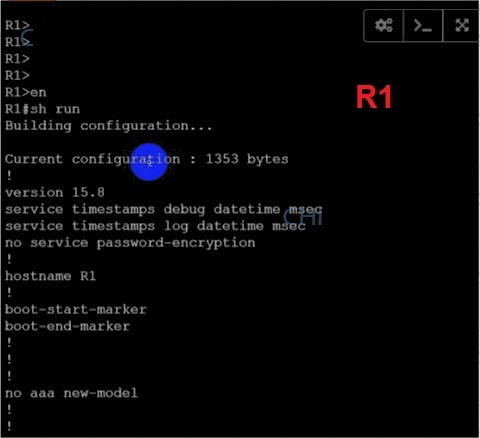
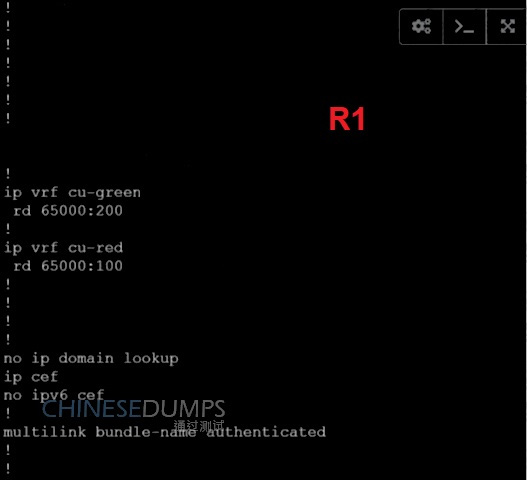
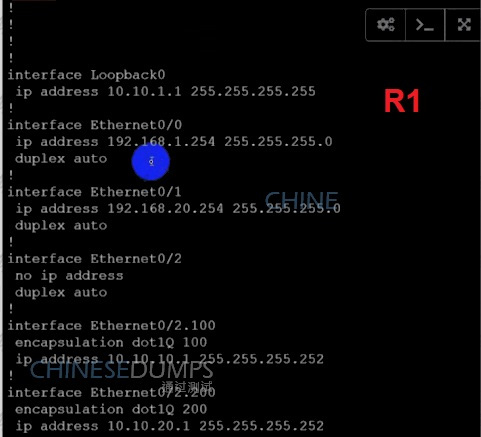
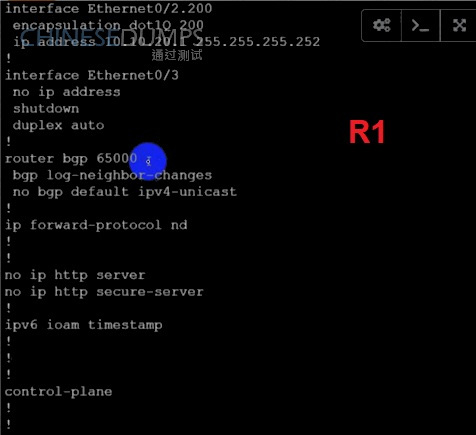
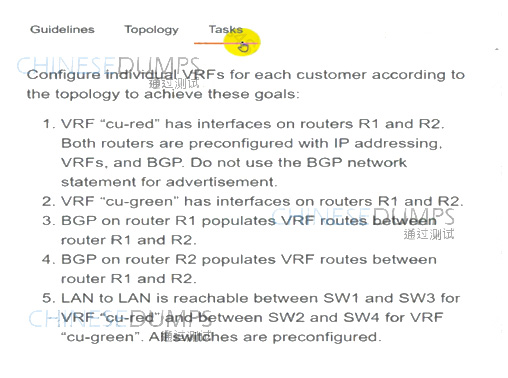
Configure individual VRFs for each customer according to the topology to achieve these goals :
Tasks
Configure individual VRFs for each customer according to the topology to achieve these goals:
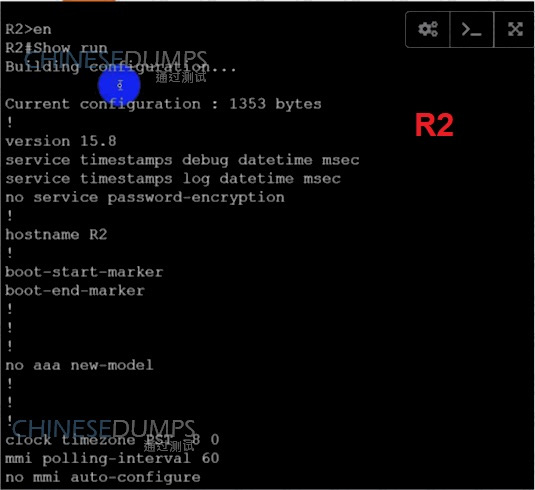
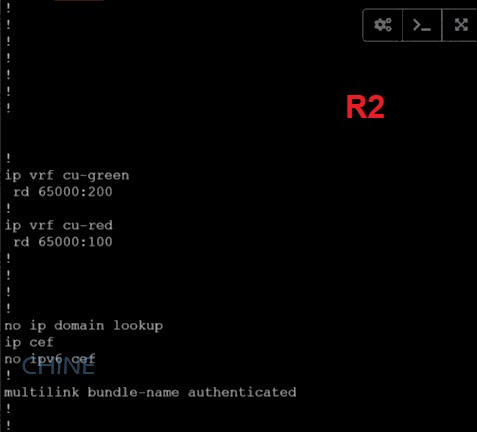
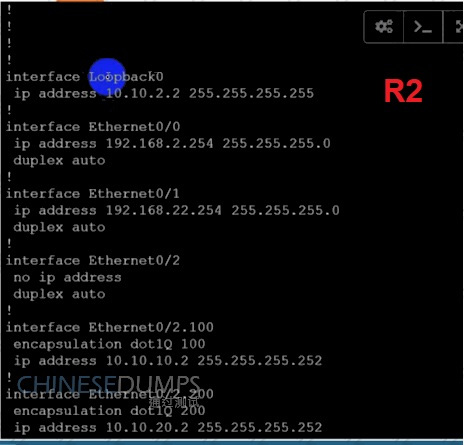
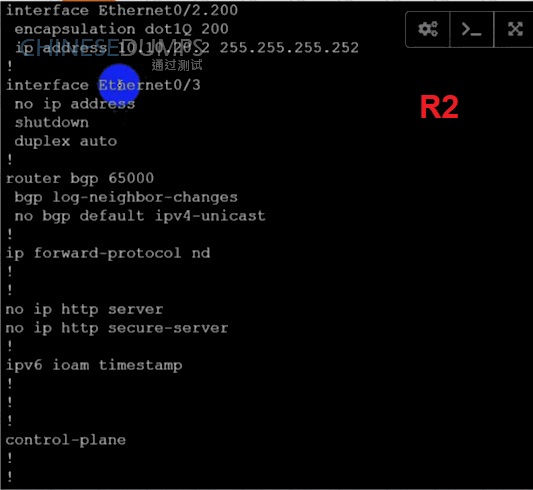
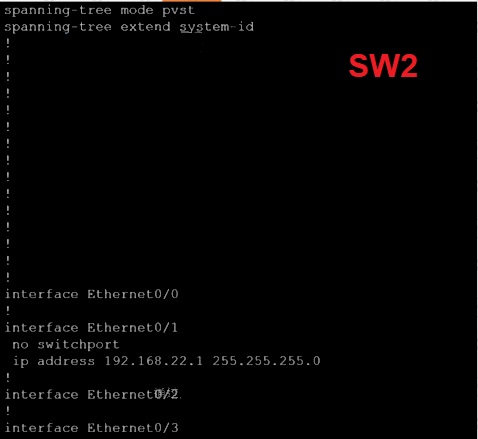
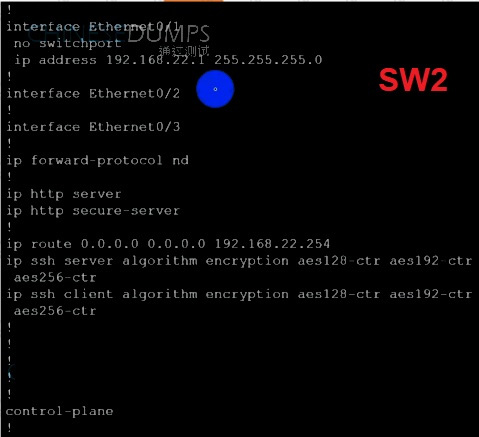
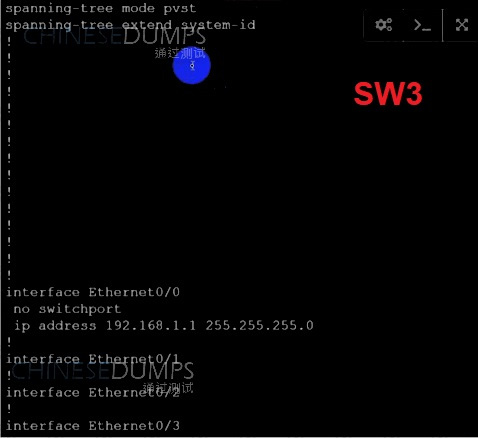
1. VRF "cu-red" has interfaces on routers R1 and R2. Both routers are preconfigured with IP addressing, VRFs, and BGP. Do not use the BGP network statement for advertisement. 2. VRF "cu-green" has interfaces on routers R1 and R2. 3. BGP on router R1 populates VRF routes between router R1 and R2. 4. BGP on router R2 populates VRF routes between router R1 and R2. 5. LAN to LAN is reachable between SW1 and SW3 for VRF "cu-red" and between SW2 and SW4 for VRF
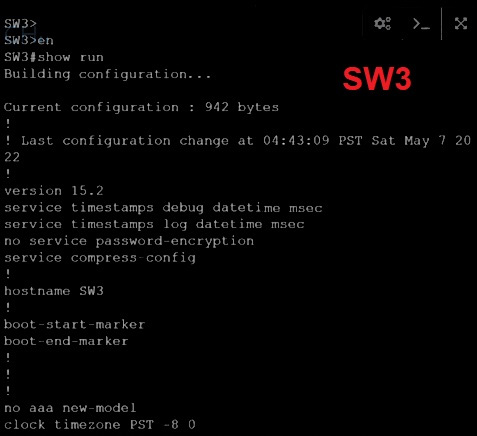
"cu-green"'. All switches are preconfigured.
Reveal model answerClose model answer
>>> Use cu-red under interfaces facing SW1 & SW3:
On R1: interface Ethernet0/0 ip vrf forwarding cu-red ip address 192.168.1.254 255.255.255.0
Check reachability to SW1: R1#ping vrf cu-red 192.168.1.1 Type escape sequence to abort. Sending 5, 100-byte ICMP Echos to 192.168.2.1, timeout is 2 seconds: !!!!! Success rate is 100 percent (5/5), round-trip min/avg/max = 1/1/1 ms
On R2: interface Ethernet0/0 ip vrf forwarding cu-red ip address 192.168.2.254 255.255.255.0 Check reachability to SW3: R2#ping vrf cu-red 192.168.2.1 Type escape sequence to abort. Sending 5, 100-byte ICMP Echos to 192.168.1.1, timeout is 2 seconds: !!!!!
>>> Use vrf cu-green for SW2 & SW4:
On R1: interface Ethernet0/1 ip vrf forwarding cu-green ip address 192.168.20.254 255.255.255.0 Test reachability to SW2: R1#ping vrf cu-green 192.168.20.1 Type escape sequence to abort. Sending 5, 100-byte ICMP Echos to 192.168.22.1, timeout is 2 seconds: !!!!! Success rate is 100 percent (5/5), round-trip min/avg/max = 1/1/1 ms
On R2: interface Ethernet0/1 ip vrf forwarding cu-green ip address 192.168.22.254 255.255.255.0 Test reachability to SW4: R2#ping vrf cu-green 192.168.22.1 Type escape sequence to abort. Sending 5, 100-byte ICMP Echos to 192.168.20.1, timeout is 2 seconds: !!!!! Success rate is 100 percent (5/5), round-trip min/avg/max = 1/1/1 ms
>>> On R1 interface Ethernet0/2.100 mpls ip ! interface Ethernet0/2.200 mpls ip !
From SW1 to SW3: SW1#ping 192.168.1.1 Type escape sequence to abort. Sending 5, 100-byte ICMP Echos to 192.168.1.1, timeout is 2 seconds: !!!!! Success rate is 100 percent (5/5), round-trip min/avg/max = 1/1/1 ms But can't Reach SW2 or SW4 in VRF cu-green: SW1#ping 192.168.22.1 Type escape sequence to abort. Sending 5, 100-byte ICMP Echos to 192.168.22.1, timeout is 2 seconds: U.U.U Success rate is 0 percent (0/5) SW1#ping 192.168.20.1 Type escape sequence to abort. Sending 5, 100-byte ICMP Echos to 192.168.20.1, timeout is 2 seconds: U.U.U Success rate is 0 percent (0/5)
Same Test for SW2: From SW2 to SW4: SW2#ping 192.168.20.1 Type escape sequence to abort. Sending 5, 100-byte ICMP Echos to 192.168.20.1, timeout is 2 seconds: !!!!! Success rate is 100 percent (5/5), round-trip min/avg/max = 1/1/1 ms But can't Reach SW3 or SW1 in VRF cu-red: SW2#ping 192.168.1.1 Type escape sequence to abort. Sending 5, 100-byte ICMP Echos to 192.168.1.1, timeout is 2 seconds: U.U.U Success rate is 0 percent (0/5) SW2#ping 192.168.2.1 Type escape sequence to abort. Sending 5, 100-byte ICMP Echos to 192.168.2.1, timeout is 2 seconds: U.U.U Success rate is 0 percent (0/5) Both R1 & R2 has separate tables for VRFs cu-red and cu-green.
Question 19
Drag & drop
DRAG DROP
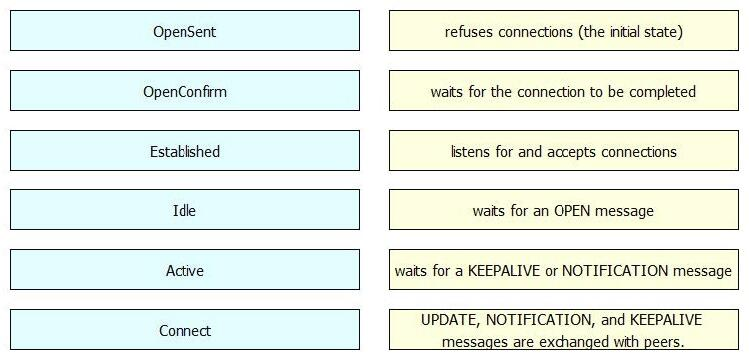
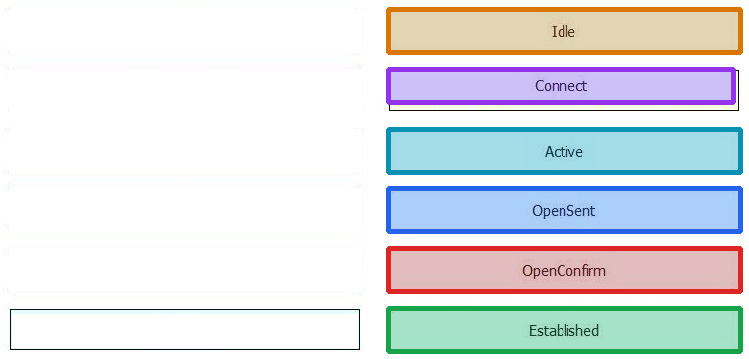
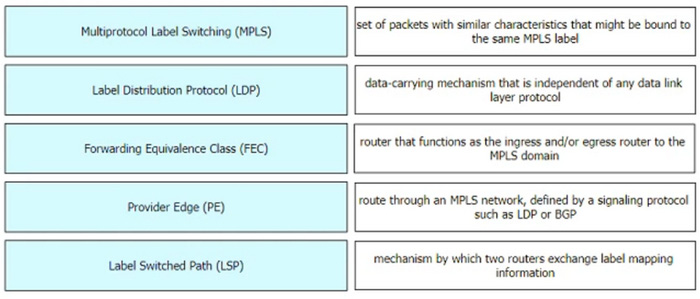
Drag and drop the BGP states from the left to the matching definitions on the right.
Reveal answer detailsClose answer details
Explanation
Question 20
Single choice
Refer to the exhibit. An engineer must advertise routes into IPv6 MP-BGP and failed.
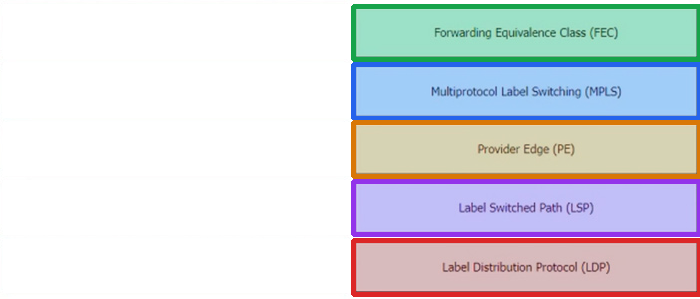
Drag and drop the terminology from the left onto the corresponding definitions on the right.
Reveal answer detailsClose answer details
Question 22
Multiple choice
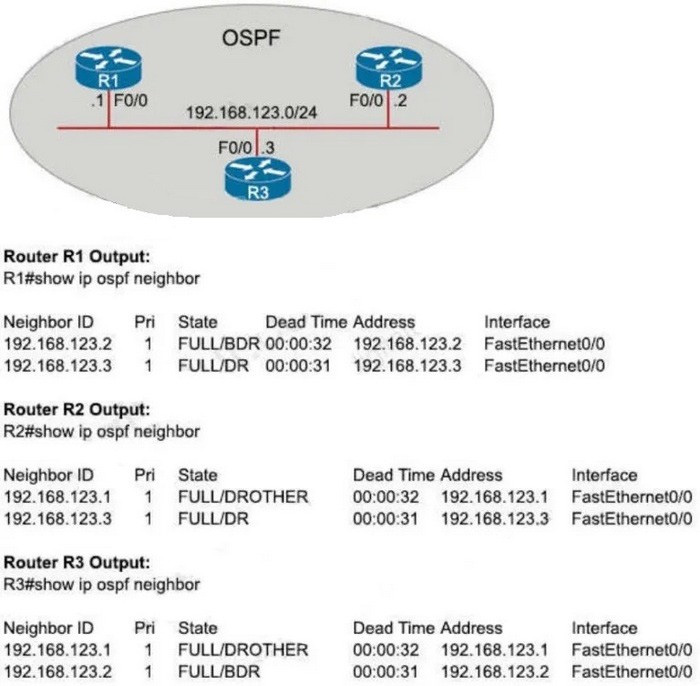
Refer to the exhibit. An administrator wanted to make R1 always elected as DR, R2 as BDR, and R3 as DROTHER but could not achieve the desired results.
Which two configurations resolve the issue? (Choose two)
A
On the R2 F0/0 interface, configure OSPF priority to 200
B
On the R1 F0/0 interface, configure OSPF priority to 202
C
On the R2 F0/0 interface, configure OSPF priority to 201
D
On the R1 F0/0 interface, configure OSPF priority to 255
E
On the R3 F0/0 interface, configure OSPF priority to 201
Reveal answer detailsClose answer details
Correct answersC, D
Question 23
Single choice
Refer to the exhibit.
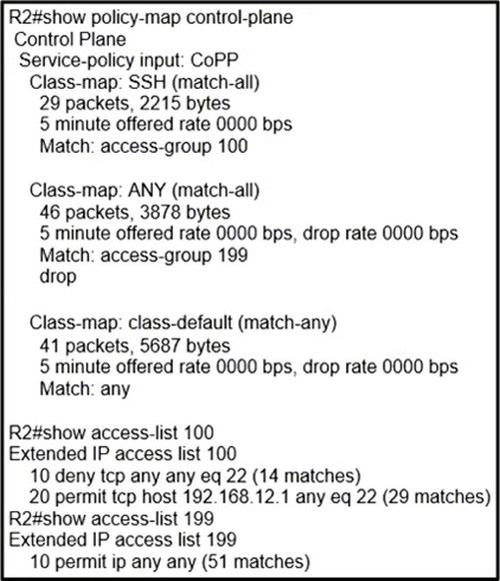
Which action limits the access to R2 from 192.168.12.1?
A
Swap sequence 10 with sequence 20 in access-list 100.
B
Modify sequence 20 to permit tcp host 192.168.12.1 eq 22 any to access-list 100
C
Swap sequence 20 with sequence 10 in access-list 100
D
Modify sequence 10 to deny tcp any eq 22 any to access-list 100.
Reveal answer detailsClose answer details
Correct answerA
Question 24
Single choice
Which security feature can protect DMVPN tunnels?
A
IPsec
B
TACACS+
C
RTBH
D
RADIUS
Reveal answer detailsClose answer details
Correct answerA
Question 25
Single choice
Refer to the exhibit.
A network is under a cyberattack. A network engineer connected to R1 by SSH and enabled the terminal monitor via SSH session to find the source and destination of the attack. The session was flooded with messages, which made it impossible for the engineer to troubleshoot the issue.
Which command resolves this issue on R1?
A
#terminal no monitor
B
(config)#terminal no monitor
C
#no terminal monitor
D
(config)#no terminal monitor
Reveal answer detailsClose answer details
Correct answerA
Question 26
Single choice
Refer to the exhibit.
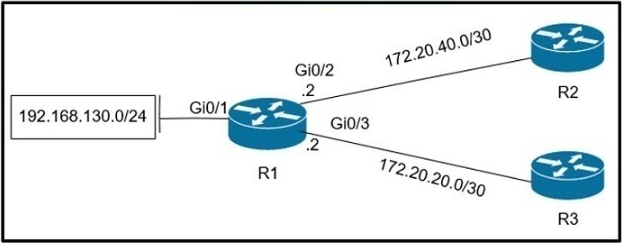
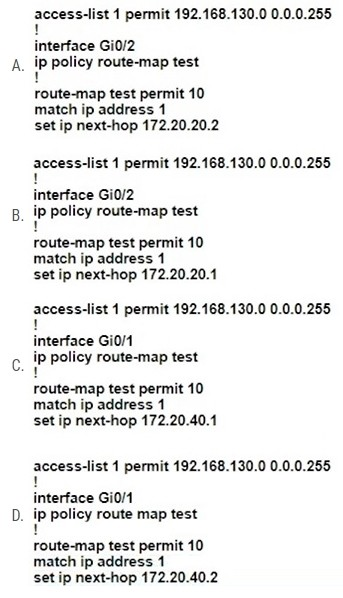
Which policy configuration on R1 forwards any traffic that is sourced from the 192 168 130 0'24 network to R2?
A
Option A
B
Option B
C
Option C
D
Option D
Reveal answer detailsClose answer details
Correct answerC
Question 27
Single choice
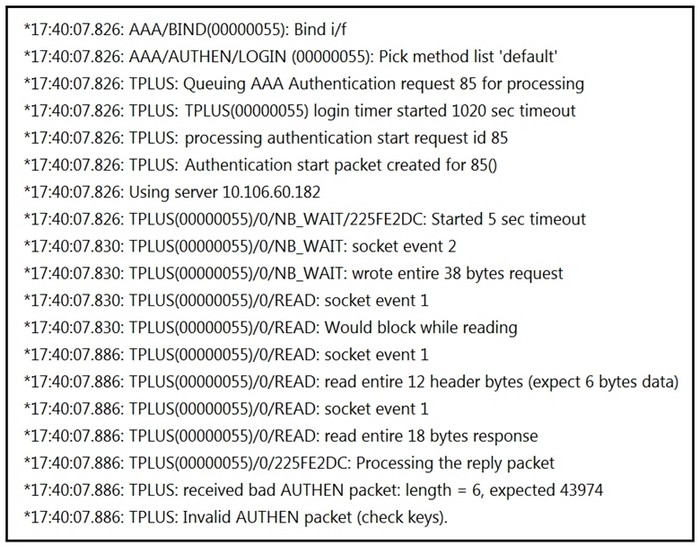
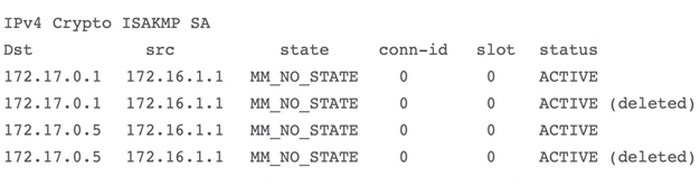
An administrator is setting up a DMVPN tunnel between their offices and he is getting below output when he is running the command "show crypto isakmp sa":
What command will you run to identify the issue?
A
Debug ip icmp
B
Debug crypto isakmp
C
Debug crypto ipsec sa
D
Debug ssh
Reveal answer detailsClose answer details
Correct answerB
Question 28
Single choice
Which protocol supports labeled paths between PE routers in an MPLS network?
A
LDP
B
RSVP
C
MP-BGP
D
IGP
Reveal answer detailsClose answer details
Correct answerC
Explanation
In an MPLS network, Service Provider Edge (PE) routers use Multiprotocol Border Gateway Protocol (MP-BGP) to exchange label and route information with each other. MP-BGP is the routing protocol used to create and distribute labels between service provider edge routers on an MPLS network.
Question 29
Single choice
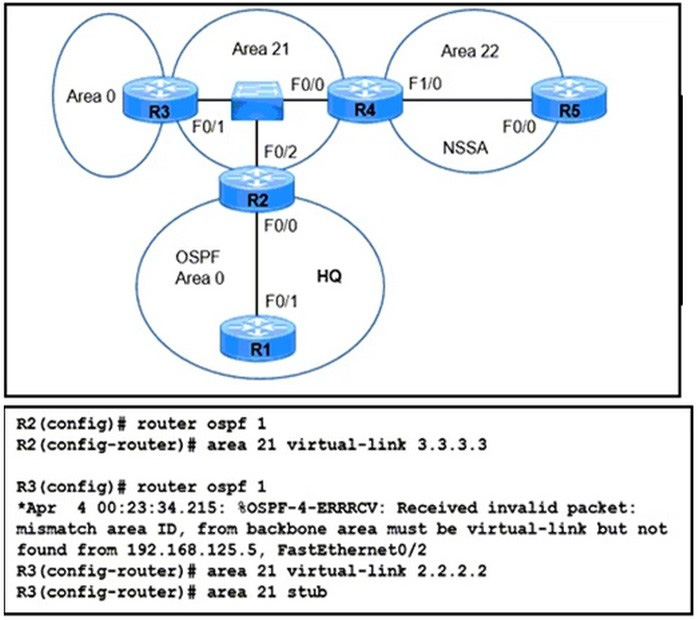
Refer to the exhibit.
A network engineer is troubleshooting a failed link between R2 and R3. No traffic loss is reported from router R5 to HQ.
The error log is printed prior configuring the virtual link and the stub area. The log actually confirms the fact that r2 tried to establish a virtual link with r3. The 192.168.125.5 is the source IP of the packet that triggered the error and belongs to R2. it is not necessarily the same as the Router ID. Anyway, if the virtual link endpoints are in the stub area, then connectivity between the two routers could be lost. To allow a virtual link to exist through a stub area you should use "virtual-link stub".
Question 30
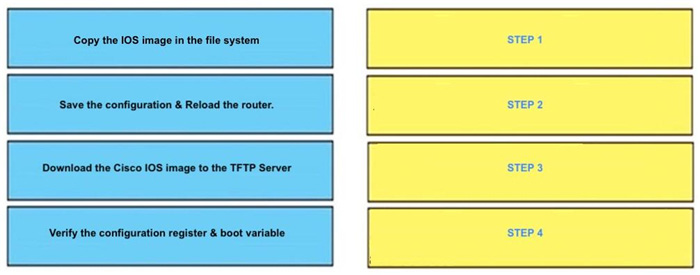
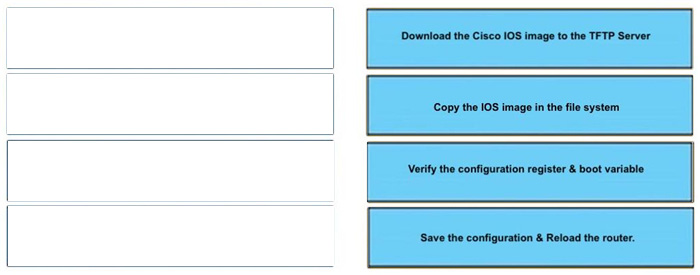
Drag & drop
DRAG DROP
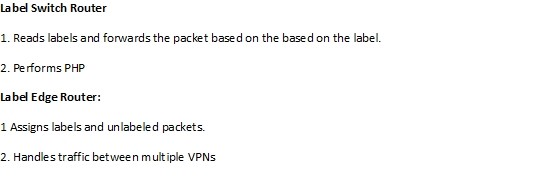
Arrange the below as per the recommended steps:
Reveal answer detailsClose answer details
Question 31
Single choice
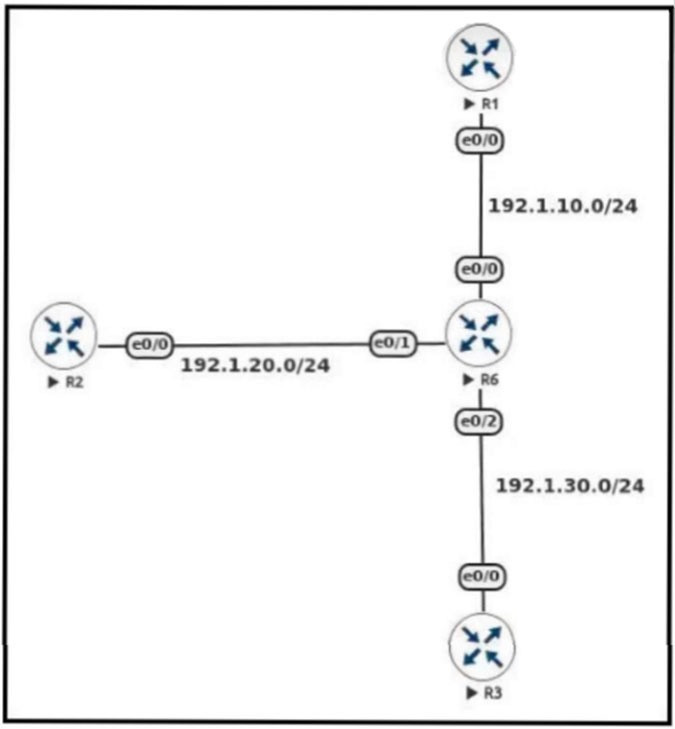
Refer to the exhibit.
An engineer must configure DMVPN Phase 3 hub-and-spoke topology to enable a spoke-to-spoke tunnel.
Which NHRP configuration meets the requirement on R6?
A
interface Tunnel1 ip nhrp authentication Cisco123 ip nhrp map multicast dynamic ip nhrp network-id 1 ip nhrp holdtime 300 ip nhrp redirect
B
interface Tunnel 1 ip address 192.168.1.1 255.255.255.0 tunnel source e 0/1 tunnel mode gre multipoint ip nhrp network-id 1 ip nhrp map 192.168.1.2 192.1.20.2
C
interface Tunnel1 ip nhrp authentication Cisco123 ip nhrp map multicast dynamic ip nhrp network-id 1 ip nhrp holdtime 300 ip nhrp shortcut
D
Interface Tunnel 1 ip address 192.168.1.1 255.255.255.0 tunnel source e 0/0 tunnel mode gre multipoint ip nhrp network-id 1
Reveal answer detailsClose answer details
Correct answerA
Question 32
Single choice
A Cisco router has just been configured for NTP and is synchronized with the configured NTP server. However, log messages still show an incorrect time.
What else should be done to match the log messages time stamps with the NTP based time?
A
Wait a bit longer for the synchronized time to get applied to new log messages.
B
Configure the "service timestamps log datetime localtime" command in global mode.
C
Configure the "service timestamps log datetime synchronize" command globally
D
Configure the "service timestamps log ntp" command in global config mode.
Reveal answer detailsClose answer details
Correct answerB
Question 33
Single choice
You have been alerted that TCP traffic leaving an interface has been reduced to near zero, while UDP traffic is steadily increasing at the same time.
What is this behavior called and what causes it?
A
jitter, caused by lack of QoS
B
latency, caused by the MTU
C
starvation, caused improper configuration of QoS queues
D
windowing, caused by network congestion
Reveal answer detailsClose answer details
Correct answerC
Explanation
This behavior is called starvation and is caused by improper configuration of QoS queues. When TCP and UDP flows are assigned to the same QoS queue, they compete with one another. This is not a fair competition because the TCP packets will react to packet drops by throttling back TCP traffic, while UDP packets are oblivious to drops and will take up the slack created by the diminishing TCP traffic. The results from mixing UDP and TCP traffic in the same queue are: Starvation Latency Lower throughput
While it is true that jitter can be caused by a lack of QoS, jitter is not what is being described in the scenario. Jitter is the variation in latency as measured in the variability over time of the packet latency across a network. This phenomenon seriously impacts time-sensitive traffic, such as VoIP, and can be prevented by placing this traffic in a high-priority QoS queue.
While latency can be caused by the maximum transmission unit (MTU) in the network, this is not a case of latency, although latency may be one of the perceived effects of starvation. Latency is the delay in reception of packets. The MTU is the largest packet size allowed to be transmitted, and an MTU that is set too large can result in latency.
While windowing can be caused by network congestion, this is not a case of windowing. This is a technique used to adjust the number of packets that can acknowledged at once by a receiving computer in a transmission. In times of congestion the window, or number of packets that can be acknowledged at a time, will be small. Later, when congestion goes down, the window size can be increased.
References: Design Guide > Service Provider Quality of Service > CE Guidelines for Collapsing Enterprise Classes > Mixing TCP with UDP
Question 34
Single choice
Refer to the exhibit.
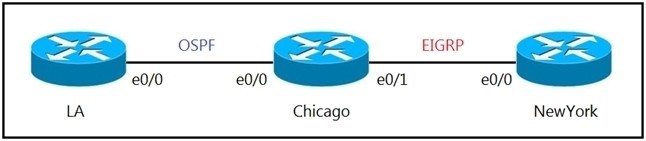
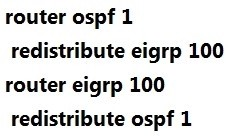
The network administrator must mutually redistribute routes at the Chicago router to the LA and NewYork routers. The configuration of the Chicago router is this:
After the configuration, the LA router receives all the NewYork routes, but NewYork router does not receive any LA routes.
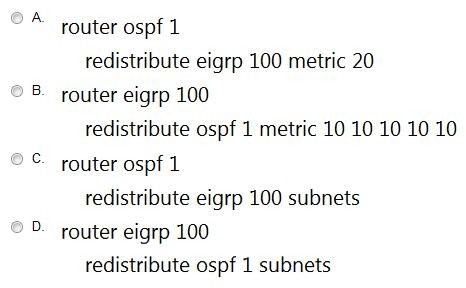
Which set of configurations fixes the problem on the Chicago router?
A
Option A
B
Option B
C
Option C
D
Option D
Reveal answer detailsClose answer details
Correct answerB
Explanation
"LA router receives all the NewYork routes but it does not receive any LA routes" because when redistrubuting into EIGRP, we must configure the default metric.
Question 35
Single choice
An associate of yours configured a PPPoE connection. You have been alerted by a vulnerability tester that
by using a sniffer, he was able to learn the connection credentials.
What type of authentication must your associate have configured on the connection?
A
PAP
B
802.1x
C
CHAP
D
IPsec
Reveal answer detailsClose answer details
Correct answerA
Explanation
The method used must have been Password Authentication Protocol (PAP). This method transmits the credentials in clear text, which makes it a poor choice.
There are only two methods available to authenticate a PPP connection, PAP and Challenge-Handshake Authentication Protocol (CHAP). CHAP never sends the password across the link. Rather, the authenticating end of the connection sends random text and other information to the requester. The requester encrypts this data with its password and sends it back. The authenticating end of the connection reverses the encryption using the same password and compares the result with what was originally sent. If it matches, the authenticating end of the connection is assured that the requesting end knows the password.
The connection could not have used either 802.1x or IPsec, as neither method would transmit the credentials in clear text.
The connection could not have used CHAP. If it had, the credentials could not have been captured with a sniffer.
Objective: Layer 2 Technologies Sub-Objective: Configure and verify PPP
References:
Cisco > Authentication, Authorization, and Accounting Configuration Guide, Cisco IOS Release 15M&T >
Configuring Authentication > Non-AAA Authentication Methods > Enabling CHAP or PAP Authentication
Cisco > Authentication, Authorization, and Accounting Configuration Guide, Cisco IOS Release 15M&T
(PDF)
Question 36
Single choice
Which configuration adds an IPv4 interface to an OSPFv3 process in OSPFv3 address family configuration?
A
router ospfv3 1 address-family ipv4
B
Router(config-router)#ospfv3 1 ipv4 area 0
C
Router(config-if)#ospfv3 1 ipv4 area 0
D
router ospfv3 1 address-family ipv4 unicast
Reveal answer detailsClose answer details
Correct answerC
Question 37
Single choice
You execute the following command.
router(config-if)#ip helper-address 172.20.14.225
Which of the following traffic types will NOT be forwarded to the IP address 172.20.14.225?
A
TFTP
B
SMTP
C
DNS
D
TACACS
Reveal answer detailsClose answer details
Correct answerB
Explanation
While the ip helper address command is typically used to forward DHCP broadcasts to a DHCP server located in a remote subnet, it will also forward the following broadcast packets by default as well: TFTP - UDP port 69 Domain Name System (DNS) UDP port 53 Time service - port 37 NetBIOS Name Server - port137 NetBIOS Datagram Server - port 138 Bootstrap Protocol (BOOTP) - port 67 TACACS UDP port 49 Objective: Infrastructure Services Sub-Objective: Configure and verify IPv4 and IPv6 DHCP
References: Cisco IOS IP Application Services Command Reference > ip accounting through ip sctp authenticate > ip helper-address
Question 38
Single choice
Refer to the exhibit. An timestamps on the system logs did not match the clock.
What is the reason for this error?
A
An authentication error with the NTP server results in an incorrect timestamp.
B
The keyword localtime is not defined on the timestamp service command.
C
The NTP server is in a different time zone.
D
The system clock is set incorrectly to summer-time hours.
Reveal answer detailsClose answer details
Correct answerB
Question 39
Single choice
Refer to the exhibit.
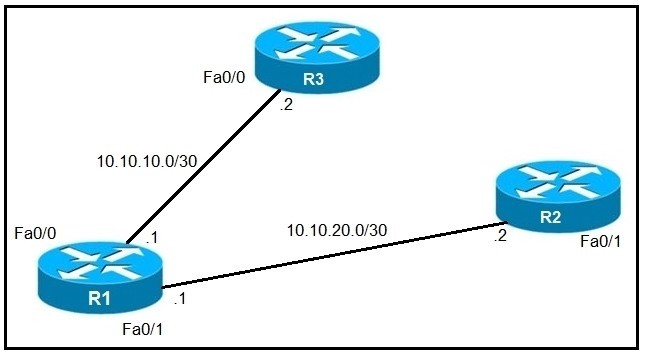
An IP SLA was configured on router R1 that allows the default route to be modified in the event that Fa0/0 loses reachability with the router R3 Fa0/0 interface. The route has changed to flow through router R2.
Which debug command is used to troubleshoot this issue?
A
debug ip flow
B
debug ip sla error
C
debug ip routing
D
debug ip packet
Reveal answer detailsClose answer details
Correct answerC
Explanation
debug ip routing This command enables debugging messages related to the routing table.
Question 40
Single choice
Refer to the exhibit.
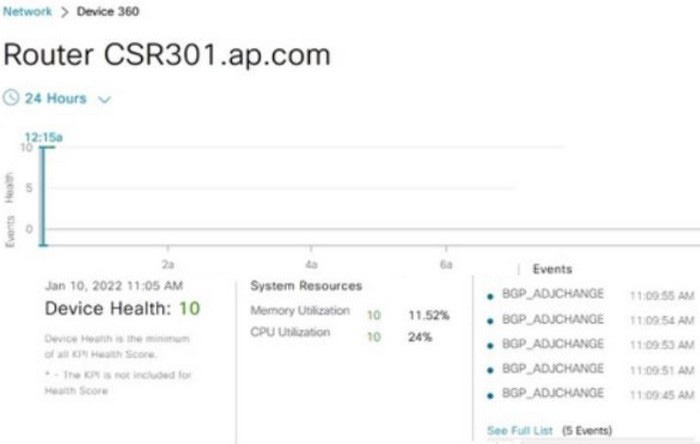
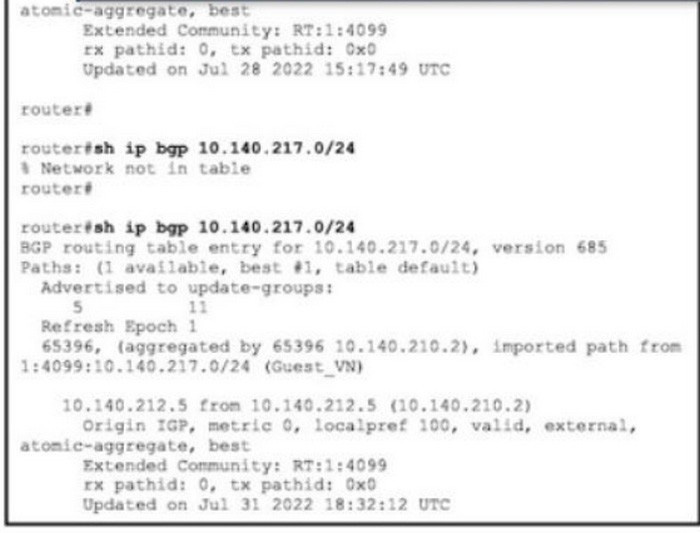
In Cisco DNA Center, a network engineer identifies that BGP-learned networks are repeatedly withdrawn from peers.
Which configuration must the engineer apply to resolve the issue?
A
router bgp 100 bgp graceful-restart
B
router bgp 100 bgp dampening
C
route-map Dampening permit 10 set dampening 15 750 2000 60 router bgp 100 neighbor 10.140.212.5 route-map Dampening in
D
route-map Dampening permit 10 set dampening 15 750 2000 60 router bgp 100 neighbor 10.140.212.5 route-map Dampening out
Reveal answer detailsClose answer details
Correct answerB
Question 41
Single choice
Reler Iothe exhibit.
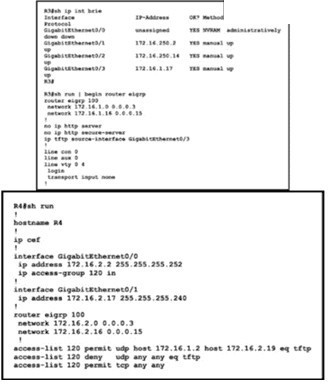
The engineer is trying to transfer the new IOS file to the router R3 but is getting an error.
Which configuration achieves the file transfer?
A
R4(config)# no access-list 120 permit udp host 172.16.1.2 host 172.16.2.19 eq 69 R3(config)# no ip tftp source-interface GigabitEthernet0/3
B
R4(config)# no access-list 120 permit udp host 172.16.1.2 host 172.16.2.19 eq 69 R4(config)# access-list 120 permit udp host 172.16.1.17 host 172.16.2.19 eq 69 R4(config)# access-list 120 permit tcp any any
R4(config)# no access-list 120 deny udp any any eq tftp R4(config)# access-list 120 permit tcp any any
D
R4(config)# no access-list 120 permit udp host 172.16.1.2 host 172.16.2.19 eq 69 R4(config)# access-list 120 permit tcp host 172.16.1.17 host 172.16.2.19 eq 69 R4(config)# access-list 120 permit tcp any any
Reveal answer detailsClose answer details
Correct answerB
Question 42
Single choice
Which dialer interface command sets the maximum size of IP packets to 1492?
A
router(config-if)# mtu 1492
B
router(config-if)# ip ppp 1492
C
router(config-if)# ip 1492
D
router(config-if)# ip mtu 1492
Reveal answer detailsClose answer details
Correct answerD
Explanation
The correct interface command to set the maximum size of IP packets (maximum transmission unit or MTU size) to 1492 is router(config-if)# ip mtu 1492. This command is required because RFC 2516 states the maximum receive unit (MRU) must not be negotiated larger than 1492 bytes.
All other answers are invalid commands due to incorrect syntax.
References:
Cisco > Cisco IOS IP Application Services Command Reference > idle (firewall farm datagram protocol)
through ip slb natpool > ip mtu
Question 43
Multiple choice
An engineer configured a leak-map command to summarize EIGRP routes and advertise specifically loopback 0 with an IP of 10.1.1.1.255.255.255.252 along with the summary route. After finishing configuration, the customer complained not receiving summary route with specific loopback address.
Which two configurations will fix it? (Choose two.)
router eigrp 1 ! route-map Leak-Route deny 10
! interface Serial 0/0 ip summary-address eigrp 1 10.0.0.0 255.0.0.0 leak-map Leak-Route
Configure access-list 1 and match under route-map Leak-Route.
D
Configure route-map Leak-Route permit 10 and match access-list 1.
E
Configure route-map Leak-Route permit 20.
Reveal answer detailsClose answer details
Correct answersA, D
Explanation
When you configure an EIGRP summary route, all networks that fall within the range of your summary are suppressed and no longer advertised on the interface. Only the summary route is advertised. But if we want to advertise a network that has been suppressed along with the summary route then we can use leak-map feature. The below commands will fix the configuration in this question: R1(config)#access-list 1 permit 10.1.1.0 0.0.0.3 R1(config)#route-map Leak-Route permit 10 // this command will also remove the "route_map Leak-Route deny 10" command. R1(config-route-map)#match ip address 1
Question 44
Single choice
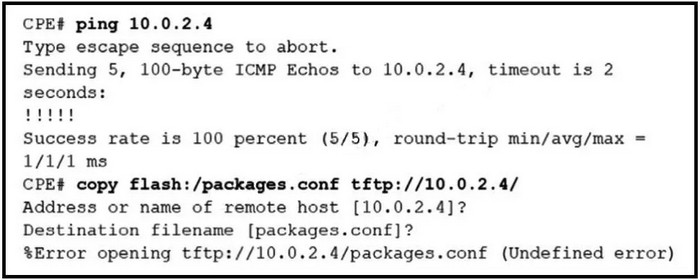
Refer to the exhibit. The administrator is trying to overwrite an existing file on the TFTP server that was previously uploaded by another router. However, the attempt to update the file fails.
Which action resolves this issue?
A
Make the packages.conf file executable by all on the TFTP server
B
Make the packages.conf file writable by all on the TFTP server
C
Make sure to run the TFTP service on the TFTP server
D
Make the TFTP folder writable by all on the TFTP server
Reveal answer detailsClose answer details
Correct answerB
Question 45
Single choice
What is a function of an end device configured with DHCPv6 guard?
A
If it is configured as a server, only prefix assignments are permitted.
B
If it is configured as a relay agent, only prefix assignments are permitted.
C
If it is configured as a client, messages are switched regardless of the assigned role.
D
If it is configured as a client, only DHCP requests are permitted.
Reveal answer detailsClose answer details
Correct answerC
Explanation
The DHCPv6 Guard feature blocks reply and advertisement messages that come from unauthorized DHCP servers and relay agents. Packets are classified into one of the three DHCP type messages. All client messages are always switched regardless of device role. DHCP server messages are only processed further if the device role is set to server. Further processing of server messages includes DHCP server advertisements (for source validation and server preference) and DHCP server replies (for permitted prefixes). If the device is configured as a DHCP server, all the messages need to be switched, regardless of the device role configuration.
Question 46
Single choice
What is the purpose of an OSPF sham-link?
A
to allow inter-area routing when OSPF is used as the PE-CE connection protocol in an MPLS VPN network
B
to allow intra-area routing when OSPF is used as the PE-CE connection protocol in an MPLS VPN network
C
to correct OSPF backdoor routing when OSPF is used as the PE-CE connection protocol in an MPLS VPN network
D
to correct OSPF backdoor routing when OSPF is used as the PE-PE connection protocol in an MPLS VPN network
Reveal answer detailsClose answer details
Correct answerC
Explanation
"Although OSPF PE-CE connections assume that the only path between two client sites is across the MPLS VPN backbone, backdoor paths between VPN sites (shown in grey in the figure below) may exist. If these sites belong to the same OSPF area, the path over a backdoor link will always be selected because OSPF prefers intraarea paths to interarea paths. (PE routers advertise OSPF routes learned over the VPN backbone as interarea paths.) For this reason, OSPF backdoor links between VPN sites must be taken into account so that routing is performed based on policy. "
Question 47
Single choice
Refer to the exhibit.
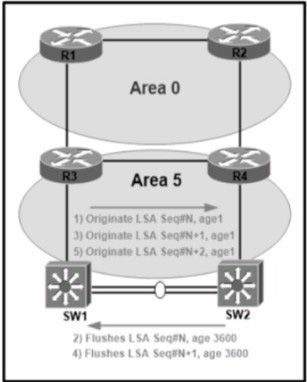
An error message "an OSPF-4-FLOOD_WAR" is received on SW2 from SW1. SW2 is repeatedly receiving its own link-state advertisement and flushes it from the network.
Which action resolves the issue?
A
Change area 5 to a normal area from a nonstub area
B
Resolve different subnet mask issue on the link
C
Configure Layer 3 port channel on interfaces between switches
D
Resolve duplicate IP address issue in the network
Reveal answer detailsClose answer details
Correct answerD
Question 48
Multiple choice
Which of the following are valid restrictions when configuring Control Plane Policing (CoPP) on Cisco devices? (Choose two.)
A
You cannot use the "log" keyword with CoPP on the access list entries
B
CEF must be disabled
C
The only match types supported with CoPP is ip precedence, ip dscp, and access-group
D
Only standard access-lists are supported.
Reveal answer detailsClose answer details
Correct answersA, C
Question 49
Lab simulation
Simulation
Guidelines
This is a lab item in which tasks will be performed on virtual devices.
1. Refer to the Tasks tab to view the tasks for this lab item. 2. Refer to the Topology tab to access the device console(s) and perform the tasks. 3. Console access is available for all required devices by clicking the device icon or using the tab(s) above the console window. 4. All necessary preconfigurations have been applied. 5. Do not change the enable password or hostname for any device. 6. Save your configurations to NVRAM before moving to the next item. 7. Click Next at the bottom of the screen to submit this lab and move to the next question. 8. When Next is clicked, the lab closes and cannot be reopened.
Topology
Tasks
Troubleshoot and resolve the issues to achieve these goals:
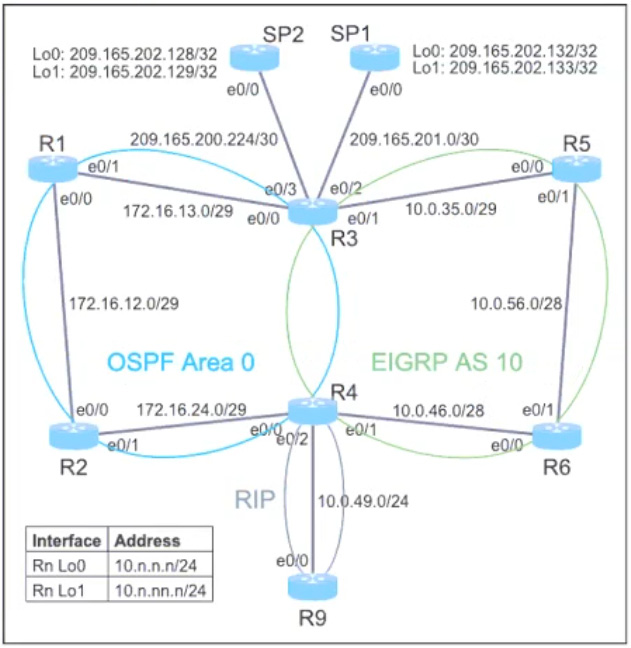
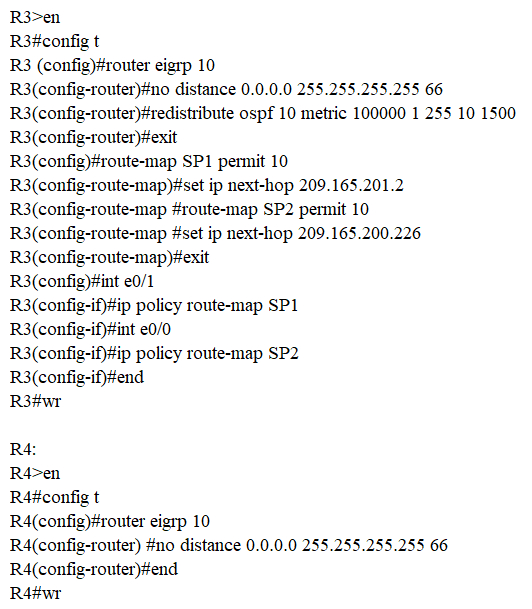
1. Ensure that R1 reaches the prefix 10.6.66.6 without any single point of failure in the path. Do not use a static route or policy-based routing to accomplish this. 2. Ensure that R1 loopback 1 reaches to R6's loopback 1 by following the path through R1, R3, R5 to R6 and vice versa. Use metric values K1 = 100000, K2=1, K3=255, K4=10, K5=1500 to modify the default metric in EIGRP if required. Do not use a route-map. 3. Ensure that on R3, prefix 10.0.56.6/32 uses the SP1 to route to the Internet, whereas prefix 172.16.12.2/32 uses the SP2 to route to the Internet. Do not use BGP to accomplish this. Use the pre-configured route-maps SP1 and SP2 and modify to accomplish the task if required. Use the ping and trace commands from R6 and R2 to prefixes 209.165.202.132 and 209.165.202.128, respectively to verify the results.
Reveal model answerClose model answer
Question 50
Single choice
An engineer configured Reverse Path Forwarding on an interface and noticed that the routes are dropped when a route lookup fails on that interface for a prefix that is available in the routing table
Which interface configuration resolves the issue?
A
ip verify unicast source reachable-via rx
B
ip verify unicast source reachable-via any
C
ip verify unicast source reachable-via allow-default
D
ip verify unicast source reachable-via 12-src
Reveal answer detailsClose answer details
Correct answerB
Explanation
According to this question, uRPF is running in strict mode because packets are dropped even when that route exists in the routing table. Maybe packets are dropped because the receiving interface is different from the interface the local router uses to send packets to that destination. The ip verify unicast source reachable-via rx command enables Unicast RPF in strict mode. To enable loose mode, administrators can use the any option (ip verify unicast source reachable-via any). In loose mode, it doesn't matter if we use this interface to reach the source or not.
The allow-default option allows the use of the default route in the source verification process.
Question 51
Single choice
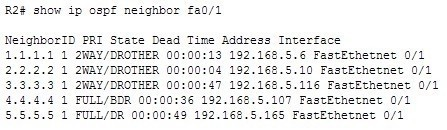
Router R2 operates in a broadcast, multi-access network. Examine the following output of the show ip ospf neighbor command.
Based on the output, with which routers can R2 establish a full adjacency?
A
the neighbor at 192.168.5.6
B
the neighbor at 192.168.5.10
C
the neighbor at 192.168.5.116
D
the neighbor at 192.168.5.107
Reveal answer detailsClose answer details
Correct answerD
Explanation
R2 can establish a full adjacency with the neighbor at 192.168.5.107 and the neighbor at 192.168.5.165. In a broadcast, multi-access network OSPF network, full adjacencies can only be established with a designated router (DR) or a backup designated router (BDR).
Objective: Layer 3 Technologies Sub-Objective: Configure and verify OSPF neighbor relationship and authentication
References:
Home.Support > Technology Support > IP > IP Routing > Design > Design Technotes > What does the
show ip ospf neighbors command reveal? Cisco > Cisco IOS IP Routing: OSPF Command Reference >
show ip ospf neighbor
It identifies the seed metric associated with OSPF routes that are redistributed into EIGRP.
B
It identifies the seed metric associated with EIGRP routes that are redistributed into OSPF.
C
It identifies the amount that the existing EIGRP metric will increment as it is redistributed into OSPF.
D
It specifies that routes that contain metrics of less than 30 will be redistributed from OSPF into EIGRP.
Reveal answer detailsClose answer details
Correct answerB
Explanation
The value 30 represents the seed metric for routes that are redistributed from EIGRP into OSPF.
When configuring the OSPF process, the redistribute command is used to identify the source protocol, its AS or process ID, and several other optional parameters, such as metric. The default seed metric for all routing protocols except BGP is 20. When redistributing BGP, the default seed metric is 1.
It does not identify the seed metric associated with OSPF routes that are redistributed into EIGRP. The command is redistributing EIGRP into OSPF, not OSPF into EIGRP.
It does not identify the amount that the existing EIGRP metric will increment as it is redistributed into OSPF. A seed metric value is an absolute value not incremental.
It does not specify that routes that contain metrics of less than 30 will be redistributed from OSPF into EIGRP. It not used to filter routes.
Objective:
Layer 3 Technologies Sub-Objective:
Configure and verify redistribution between any routing protocols or routing sources
References:
Cisco > Cisco IOS IP Routing: Protocol-Independent Command Reference > redistribute (ip)
Question 53
Single choice
Refer to the exhibit.
Which action resolves the adjacency issue?
A
Configure the same EIGRP process IDs.
B
Match the authentication keys.
C
Match the hello interval timers.
D
Configure the same autonomous system numbers
Reveal answer detailsClose answer details
Correct answerD
Question 54
Single choice
Refer to the exhibit.
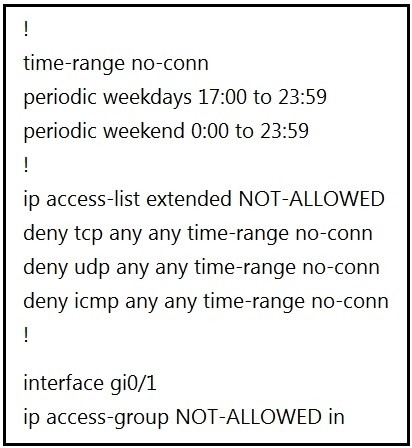
A network administrator wants to block all traffic toward the Internet after business hours and on weekends. When the administrator applies an access list on interface Gi0/1, all traffic is blocked and there is no access to the Internet at any time.
Which action resolves the issue?
A
Add the permit ip any any time-range no-conn statement after the deny udp any any time-range no-conn command in the access list.
B
Add the permit ip any any statement after the deny icmp any any time-range no-conn command in the access list.
C
Add the permit allowed time-range no-conn statement after the deny icmp any any time-range no-conn command in the access list.
D
Add the permit ip any any time-range no-conn statement after the deny icmp any any time-range no-conn command in the access list.
Reveal answer detailsClose answer details
Correct answerB
Question 55
Drag & drop
DRAG DROP
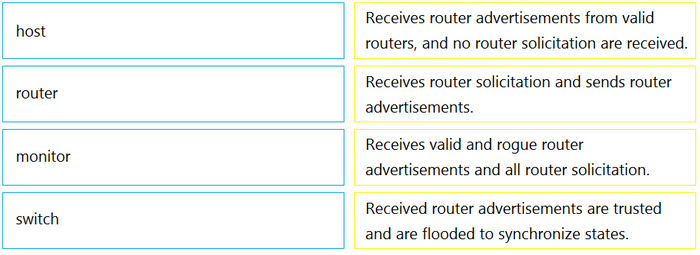
Drag and drop the IPv6 first hop security device roles from the left onto the corresponding descriptions on the right.
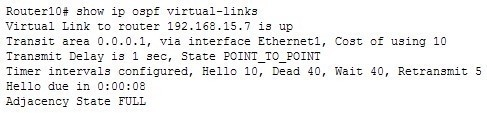
Which command can you use to display information about OSPF virtual links?
A
debug ip ospf adj
B
show ip ospf [process-id]
C
show ip ospf virtual-links
D
show ip ospf border-routers
Reveal answer detailsClose answer details
Correct answerC
Explanation
The correct answer is show ip ospf virtual-links. The show ip ospf virtual-links command displays the current state of OSPF virtual links, as shown below.
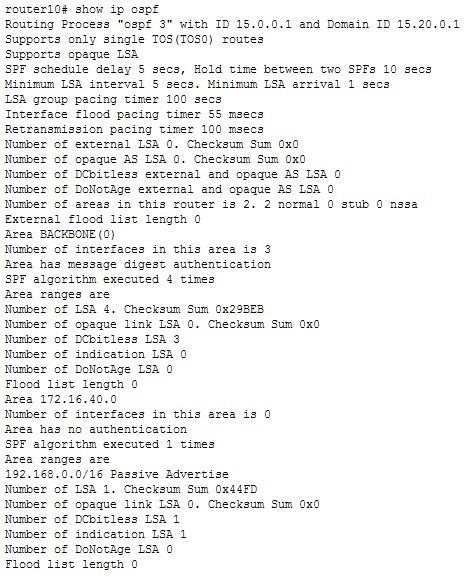
The following additional commands are available to verify OSPF configurations: show ip ospf border-routers, debug ip ospf adj, and show ip ospf.
The show ip ospf border-routers command displays internal OSPF routing table entries for an ABR, as shown below.
router10#show ip ospf border-routers Codes: i - Intra-area route, I-Inter-area route
Type Dest Address Cost NextHop Interface ABR ASBR Area SPF i 2.2.2.2 10 192.1.1.199 Ethernet 2 TRUE FALSE 0 3 i 3.2.2.2 10 192.1.1.200 Ethernet 2 TRUE FALSE 0 3
The show ip ospf command displays information about the router's role and each area to which the router is connected, as shown below.
The debug ip ospf adj command displays information about the state of neighbor adjacencies, as shown below.
R3#debug ip ospf adj OSPF adjacency events debugging is on
00:54:04: OSPF: Rcv pkt from 172.12.23.2, Ethernet0, area 0.0.0.1 : src not on the same network
In the above example, either the IP address or the subnet mask is misconfigured on either this router or the neighbor.
Objective: Layer 3 Technologies Sub-Objective: Configure and verify network types, area types, and router types
References:
Cisco > Cisco IOS IP Routing Protocols Command Reference > IP Routing Protocol-Independent
Commands:
S through T > show ip ospf virtual-links
Question 57
Single choice
The network administrator configured the router for Control Plane Policrg so that inbound SSH traffic is policed to 500 kbps This policy must apply to traffic coming in from 101010 0<24 and 192 168 10.0/24
networks
access-list 100 permit ip 10.10.10.0 0.0.0.255 any access-list 100 permit tcp 192.168.10.0 0.0.0.255 any eq 23 ! class-map CLASS-SSH match access-group 100 ! policy-map PM-COPP class CLASS-SSH police 500000 conform-action transmit ! interface E0/0 service-policy input PM-COPP ! interface E0/1 service-policy input PM-COPP
The Control Rane Policing is not applied to SSH traffic and SSH is open to use any bandwidth available.
Which configuration resolves this issue?
A
no access-list 100 access-list 100 permit tcp 10.10.10.0 0.0.0.255 any eq 22 access-list 100 permit tcp 192.168.10.0 0.0.0.255 any eq 22
B
interface E0/0 no service-policy input PM-COPP ! interface E0/1 no service-policy input PM-COPP ! control-plane service-policy input PM-COPP
C
no access-list 100 access-list 100 permit tcp 10.10.10.0 0.0.0.255 any eq 22 access-list 100 permit tcp 192.168.10.0 0.0.0.255 any eq 22 ! policy-map PM-COPP class CLASS-SSH no police 500000 conform-action transmit police 500000 conform-action transmit exceed-action drop
D
no access-list 100 access-list 100 permit tcp 10.10.10.0 0.0.0.255 any eq 22 access-list 100 permit tcp 192.168.10.0 0.0.0.255 any eq 22 ! interface E0/0 no service-policy input PM-COPP ! interface E0/1 no service-policy input PM-COPP ! control-plane service-policy input PM-COPP
Reveal answer detailsClose answer details
Correct answerD
Question 58
Single choice
Which of the following commands would reveal the K values configured on an EIGRP router?
A
debug ip eigrp
B
debug eigrp packet
C
show ip eigrp traffic
D
show ip protocols
Reveal answer detailsClose answer details
Correct answerD
Explanation
The show ip protocols command gives information about any dynamic routing protocol, including EIGRP. With respect to EIGRP, it will show the K values as a part of the output. A sample is shown below:
Routing Protocol is "eigrp 77" Outgoing update filter list for all interfaces is not set Incoming update filter list for all interfaces is not set Default networks flagged in outgoing updates Default networks accepted from incoming updates EIGRP metric weight K1=1,K2=0,K3=1,K4=0,K5=0 EIGRP maximum, hopcount 100 <output omitted> The debug ip eigrp command displays real-time information about EIGRP packets that are received and sent. It does not contain K values. A single line of this command output is shown below:
Router# debug ip eigrp
IP-EIGRP: Processing incoming UPDATE packet IP-EIGRP: Ext 192.168.5.0 255.255.255.0 M 386560 - 256000 130560 SM 360960 - 256000 104960
<output omitted>
The debug eigrp packet command displays general debug information, but not K values. A sample of this command output is shown below:
Router# debug eigrp packet EIGRP: Sending HELLO on Ethernet0/1 AS 109, Flags 0x0, Seq 0, Ack 0 EIGRP: Received UPDATE on Ethernet0/1 from 192.195.78.24, AS 109, Flags 0x1, Seq 1, Ack 0 <output omitted>
The show ip eigrp traffic command displays packets received, as well as statistics on hello packets, updates, queries, and acknowledgments, but not K values. Partial output of this command is shown below:
Router# show ip eigrp traffic IP-EIGRP Traffic Statistics for process 151
Hellos sent/received: 220/205
Updates sent/received: 7/29
Queries sent/received: 2/0
Replies sent/received: 0/2
Acks sent/received: 29/14
Objective: Layer 3 Technologies Sub-Objective: Describe and optimize EIGRP metrics
References: Cisco IOS Master Command List, Release 12.4T > sa ipsec through show ip route dhcp > show ip protocols
Question 59
Multiple choice
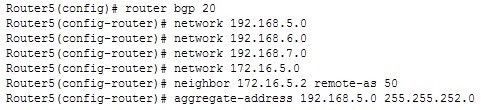
Router 5 has four interfaces. The networks hosted on each interface are as follows:
After this command sequence is executed, what routes will be present in the routing table of the router at 172.16.5.2? (Choose all that apply.)
A
192.168.5.4/29
B
172.16.5.0/24
C
192.168.6.0/24
D
192.168.7.0/24
E
none of these will be present
F
only network addresses beginning with 192 will be present
Reveal answer detailsClose answer details
Correct answersA, B, C, D
Explanation
Despite the inclusion of the command aggregate-address 192.168.5.0 255.255.252.0, all subnets of the aggregate route will also be placed in the routing updates because of the omission of the summary-only keyword. Therefore, 192.168.5.4/29, 172.16.5.0/16, 192.168.6.0/24 and 192.168.7.0/24 will be present.
Had the following command been executed, the subnet addresses would not appear in the routing table of the router at 172.16.5.2:
Which two actions restrict access to router R1 by SSH? (Choose two.)
A
Remove class-map ANY from service-policy CoPP.
B
Configure transport output ssh on line vty and remove sequence 20 from access list 100.
C
Configure transport input ssh on line vty and remove sequence 30 from access list 100.
D
Remove sequence 10 from access list 100 and add sequence 20 deny tcp any any eq telnet to access list 199.
E
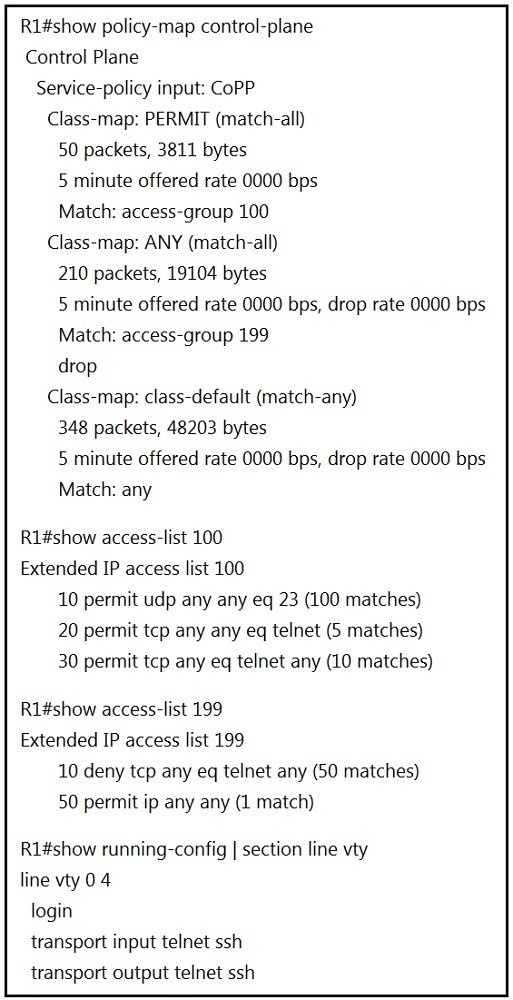
Configure transport output ssh on line vty and remove sequence 10 from access list 199.
Reveal answer detailsClose answer details
Correct answersA, C
Question 61
Single choice
Refer to the exhibit.
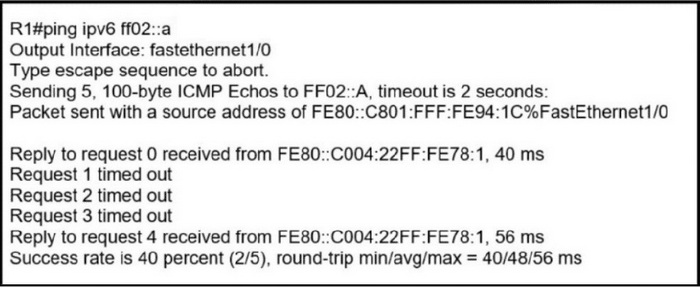
An engineer investigates an IPv6 EIGRP neighbor adjacency issue where the neighbors are flapping and issues a ping from R1 to its directly connected neighbor. The link between the switches is stable at Layer 2, and other connected devices are also functioning.
Which action resolves the issue?
A
The switch between the two neighbors is not IPv6 compatible and must be replaced with an IPv6- compatible device.
B
Data is not reliably transmitted between the dynamically assigned link-local addresses of the routers and must be manually assigned.
C
Multicast packets are not reliably transmitted over the link, and the switch must be replaced.
D
The switch between the two neighbors is not configured for IPv6 multicast and must be configured for IPv6 multicast.
Reveal answer detailsClose answer details
Correct answerC
Question 62
Single choice
Refer to the exhibit.
Jun 24 08:54:51.530: IF-EvO(GigabitEthemet0/0): IP Routing reports state transition from DOWN to DOWN Jun 24 08:54:52.525: %1INEPROTO-5-UPDOWN: Line protocol on Interface GigabitEthemet0/0, changed state to down Jun 24 08:54:52.528: IF-EvD(GigabitEthernet0/0): IP Routing reports state transition from DOWN to DOWN Jun 24 08:54:53 215: IF-EvD(GigabitEthernet0/0): IP Routing reports state transition from DOWN to DOWN Jun 24 08:54:54.998: %LINK-3-UPDOWN: Interface GigabitEthemet0/0, changed state to up Jun 24 08:54:55.006: IF-EvO(GigabitEthernet0/0): IP Routing reports state transition from DOWN to UP Jun 24 08:54:55.998: %LINEPROTO-5-UPDOWN: Line protocol on Interface GigabitEthernet0/0, changed state to up R1 is connected with R2 via GigabitEthernet0/0, and R2 cannot ping R1.
What action will fix the issue?
A
Fix route dampening configured on the router
B
Replace the SFP module because it is not supported.
C
Fix IP Event Dampening configured on the interface.
D
Correct the IP SLA probe that failed.
Reveal answer detailsClose answer details
Correct answerC
Explanation
The IP Event Dampening feature introduces a configurable exponential decay mechanism to suppress the effects of excessive interface flapping events on routing protocols and routing tables in the network. This feature allows the network operator to configure a router to automatically identify and selectively dampen a local interface that is flapping.
Question 63
Multiple choice
Refer to Exhibit.
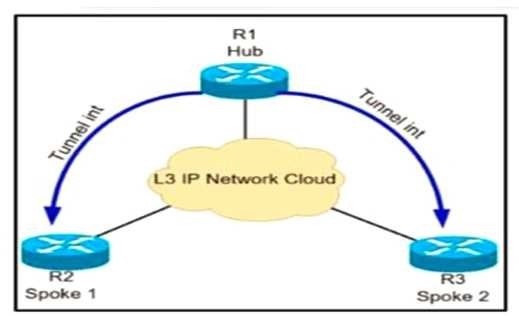
A network administrator has successfully configured DMVPN topology between a hub and two spoke routers. Which two configuration commands should establish direct communications between spoke 1 and spoke 2 without going through the hub? (Choose two).
A
At the hub router, configure the ip nhrp shortcut command.
B
At the spoke routers, configure the ip nhrp spoke-tunnel command.
C
At the hub router, configure ip nhrp redirect the command
D
At the spoke routers, configure the ip nhrp shortcut command.
E
At the hub router, configure tne Ip nhrp spoke-tunnel command
Reveal answer detailsClose answer details
Correct answersC, D
Explanation
To configure Spoke to Spoke communication we can configure DMVPN Phase II or Phase III. But in Phase II, the first few packets would go through Hub. In order tototally ignore the hub, we have to use DMVPN Phase III: DMVPN Phase III is same as Phase 2 but removes some restrictions and complexities of Phase 2. Also allows greater variety of DMVPN network designs we use: + ip nhrp redirect in hub: tells the initiator spoke to look for a better path to the destination spoke than through the Hub. Upon receiving the NHRP redirect message thespokes communicate with each other over the hub and they have their NHRP replies for the NHRP Resolution Requests that they sent out. + ip nhrp shortcut in spokes: overwrite the CEF table on the spoke. It basically overrides the next-hop value for a remote spoke network from the default initial hubtunnel IP address to the NHRP resolved remote spoke tunnel IP address)
Question 64
Single choice
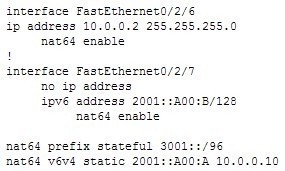
You are configuring NAT64 to allow communication between a host running IPv6 and a server running IPv4. The router R1 sits between the host and the server. The router's Fa0/2/7 interface is connected to the IPv6 host, and the Fa0/2/6 interface is connected to the IPv4 server.
The IPv6 host has an IPv6 address of 2001::a00:1/128 and the IPv4 server is at 10.0.0.1. Below is the relevant configuration on R1:
When the IPv4 server responds to the IPv6 host, what IPv6 address will be in the source address in the packet?
A
2001::a001
B
2001::A00:B
C
3001::a00:1
D
2001::A00:A
Reveal answer detailsClose answer details
Correct answerC
Explanation
NAT64 is a solution when IPv6 hosts need to communicate with IPv4-only servers. When the translation occur on the router the IPv4 address 10.0.0.1 will converted to hex as a00:1 and will be attached to the end of the stateful prefix of 3001::/96 that was configured on the router interface connected to the IPv4 server. The result will be 3001::a00:1.
The address will not be 2001::a001. The prefix that will be attached to the hex version of 10.0.0.1 will not be that of the interface fa0/2/7 but will be the prefix that was configured on that interface for nat64 translation which is 3301::/96. The address will not be 2001::a00:b. That is the IPv6 address on the interface connected to the IPv6 host, but that address is not used for IPv4 to IPv6 communication. A translated address will be generated by converting the IPv4 address of the IPv4 host to hex and attaching it to the IPv6 prefix configured on the interface connected to the IPv4 server.
The address will not be 2001::A00:A. That is the IPv6 address of the IPv6 host. That was statically mapped to 10.0.0.10 in the configuration and as such will be the IPv4 address used by the IPv6 host on the IPv4 side of the router.
An engineer must override the normal routing behavior of a router for Telnet traffic that is destined to 10.10.10.10 from 10.10.1.0/24 via a next hop of 10.4.4.4. which is directly connected to the router that is
connected to the 10.1.1.0/24 subnet
Which configuration reroutes traffic according to this requirement?
A
access-list 100 deny tcp 10.10.1.0 0.0.0.255 host 10.10.10.10 eq 23 ! route-map POLICY permit 10 match ip address 100 set ip next-hop 10.4.4.4 route-map POLICY permit 20
B
access-list 100 permit tcp 10.10.1.0 0.0.0.255 host 10.10.10.10 eq 23 ! route-map POLICY permit 10 match ip address 100 set ip next-hop 10.4.4.4 route-map POLICY permit 20
C
access-list 100 permit tcp 10.10.1.0 0.0.0.255 host 10.10.10.10 eq 23 ! route-map POLICY permit 10 match ip address 100 set ip next-hop recursive 10.4.4.4 route-map POLICY permit 20
D
access-list 100 permit tcp 10.10.1.0 0.0.0.255 host 10.10.10.10 eq 23 ! route-map POLICY permit 10 match ip address 100 set ip next-hop recursive 10.4.4.4
Reveal answer detailsClose answer details
Correct answerD
Question 66
Single choice
Refer to the exhibit.
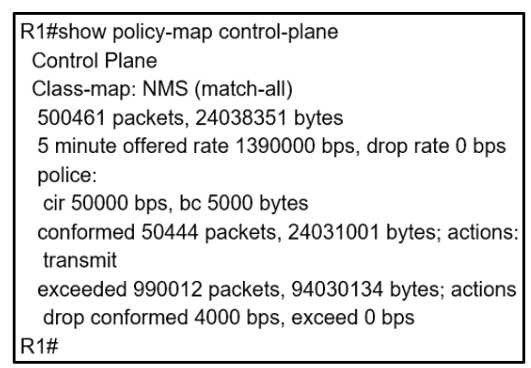
A company is evaluating multiple network management system tools. Trending graphs generated by SNMP data are returned by the NMS and appear to have multiple gaps. While troubleshooting the issue, an engineer noticed the relevant output.
What solves the gaps in the graphs?
A
Remove the exceed-rate command in the class map.
B
Remove the class map NMS from being part of control plane policing.
C
Configure the CIR rate to a lower value that accommodates all the NMS tools
D
Separate the NMS class map in multiple class maps based on the specific protocols with appropriate CoPP actions
Reveal answer detailsClose answer details
Correct answerD
Explanation
The class-map NMS in the exhibit did not classify traffic into specific protocols so many packets were dropped. We should create some class-map to classify the receiving traffic. It is also a recommendation of CoPP/CPP policy: "Developing a CPP policy starts with the classification of the control plane traffic. To that end, the control plane traffic needs to be first identified and separated into different class maps."
The network administrator must implement IPv6 in the network to allow only devices that not only have registered IP addresses but are also connecting from assigned locations.
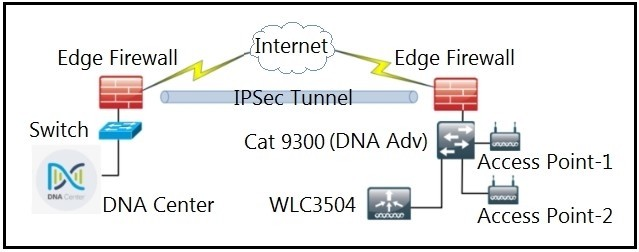
A network administrator is discovering a Cisco Catalyst 9300 and a Cisco WLC 3504 in Cisco DNA Center. The Catalyst 9300 is added successfully. However, the WLC is showing error "uncontactable" when the administrator tries to add if in Cisco DNA Center.
Which action discovers WLC in Cisco DNA Center successfully?
A
Delete the WLC 3504 from Cisco DNA Center and add it to Cisco DNA Center again.
B
Add the WLC 3504 under the hierarchy of the Catalyst 9300 connected devices.
C
Copy the .cert file from the Cisco DNA Center on the USB and upload it to the WLC 3504.
D
Copy the .pem file from the Cisco DNA Center on the USB and upload it to the WLC 3504.
Remove the current autonomous system number on one of the routers and change to a different value.
B
Remove the passive-interface command from the R2 configuration so that it matches the R1 configuration.
C
Add the no auto-summary command to the R2 configuration so that it matches the R1 configuration.
D
Add the passive-interface command to the R1 configuration so that it matches the R2 configuration.
Reveal answer detailsClose answer details
Correct answerB
Question 72
Single choice
Refer to the exhibit. A network administrator logs into the router using TACACS+ username and password credentials, but the administrator cannot run any privileged commands
Which action resolves the issue?
A
Configure TACACS+ synchronization with the Active Directory admin group
B
Configure the username from a local database
C
Configure full access for the username from TACACS+ server
D
Configure an authorized IP address for this user to access this router
Reveal answer detailsClose answer details
Correct answerC
Question 73
Single choice
You need to resolve a route-selection problem in a redistributed network by increasing the administrative distance to several networks for a protocol, other than EIGRP or BGP, so that these routes will not be used. You create access list 5 to identify the relevant networks, and access the routing protocol configuration prompt.
Which command will set the administrative distance to these networks to 220 for the selected protocol?
Router(config-router)# increase 0.0.0.0 255.255.255.255 admin 220 list 5
Reveal answer detailsClose answer details
Correct answerC
Explanation
The correct command is Router(config-router)# distance 220 0.0.0.0 255.255.255.255 5. This command instructs the router to change the AD for any networks specified in the access list 5 to 220. The correct syntax for the distance command is shown below:
The 0.0.0.0 255.255.255.255 portion included with the distance command could hold an address/mask combination for a single address, but it is more common to use an access list.
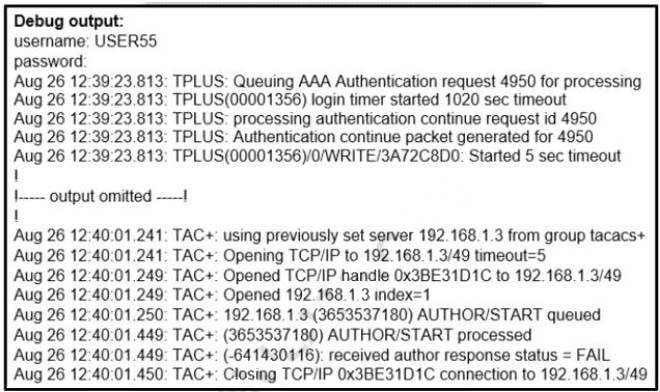
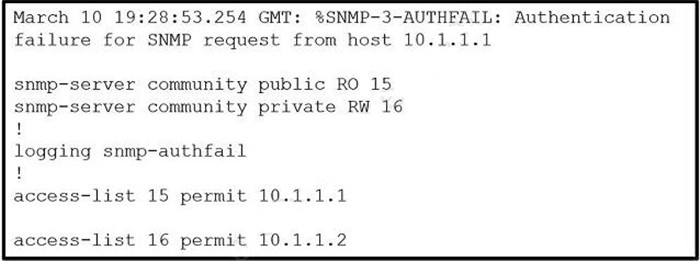
Looking at the configuration, it seems that there are two SNMP community strings configured, "public" and "private". However, the configuration does not specify which community string is being used by the host with IP address 10.1.1.1.
The correct action to resolve this issue would be to configure a valid SNMP community string on the device from which the SNMP request is being made, and ensure that it matches the community string configured on the router.
Question 75
Single choice
When configuring a DMVPN solution, which of the following technologies makes it possible for the spoke routers to use dynamic IP addressing?
A
IPsec
B
mGRE
C
NHRP
D
Dynamic routing protocols
Reveal answer detailsClose answer details
Correct answerC
Explanation
Next Hop Resolution Protocol (NHRP) allows the spoke routers to register their IP addresses with the NHRP server, which is the hub router. It also allows the spoke routers to then learn the physical IP addresses of the other spoke routers from the hub router, allowing for GRE links to be built dynamically as needed between the spokes. This eliminates the need for the traffic to go through the hub router.
Dynamic Multipoint VPN (DMVPN) technology leverages the following associated technologies: IPsec mGRE Dynamic routing protocols NHRP Cisco Express Forwarding
It makes it possible to build the hub router once, and add spokes later, making no additional changes to the hub. The spokes are able to register with the hub and dynamically build their own connections to other spokes using the IP addresses learned from the hub using NHRP. DMVPN also allows IPsec point-to-point GRE tunnels to be built to new spokes with no IPsec peering configuration. The multipoint GRE technology (mGRE) allows a single physical interface on the hub to be used for all spoke connections.
Finally, the routing protocols used by DMVPN allow the routers to share routing information, while Cisco Express Forwarding (CEF) is a switching technology that improves performance while reducing the load on the CPUs of the routers.
A network administrator opens a telnet connection to the router and gets the message:
R1#telnet 10.1.1.2
Trying 10 1.1 2 Open
(Connection to 10.1.1.2 closed by foreign host)
Router R2 is configured with enable secret and password commands.
Which action resolves the issue?
A
Configure the logging synchronous command on line vty.
B
Configure the exec command on line vty.
C
Configure the login local command on line vty
D
Configure the enable password command on line vty.
Reveal answer detailsClose answer details
Correct answerC
Question 77
Single choice
You have implemented the following IP SLA configuration, as shown in the following partial output of the show run command:
ip sla 1 dns cow.cisco.com name-server 10.52.128.30 ip sla schedule 1 start-time now
Which of the following statements is true of this configuration?
A
it will find the response time to resolve the DNS name cow.cisco.com
B
it will find the response time to connect to the DNS server at 10.52.128.30
C
it will start in one minute
D
it will gather data from one minute
Reveal answer detailsClose answer details
Correct answerA
Explanation
It will find the response time to resolve the DNS name cow.cisco.com. Domain Name System (DNS) response time is computed by calculating the difference between the time taken to send a DNS request and the time a reply is received. The Cisco IOS IP SLAs DNS operation queries for an IP address if the user specifies a hostname, or queries for a hostname if the user specifies an IP address.
It will not find the response time to connect to the DNS server at 10.52.128.30. That is the IP address of the DNS server being used for the operation (10.52.128.30). However, it will measure the response time to resolve the DNS name cow.cisco.com.
It will not start in one minute. It will start immediately, as indicated by the start-time now parameter.
It will not gather data for one minute. The numeral 1 in the first line refers to the IP SLA number, and the numeral 1 in the last line refers to the IP SLA number to be scheduled.
Objective: Infrastructure Services Sub-Objective: Configure and verify IP SLA
References:
Home > Support > Technology support > IP > IP application services > Technology information >
Technology white paper > Cisco IOS IP Service Level Agreements User Guide
Question 78
Multiple choice
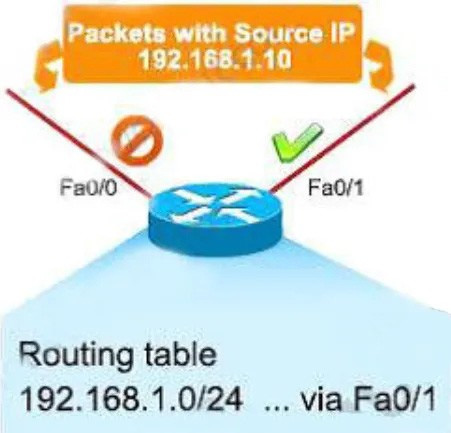
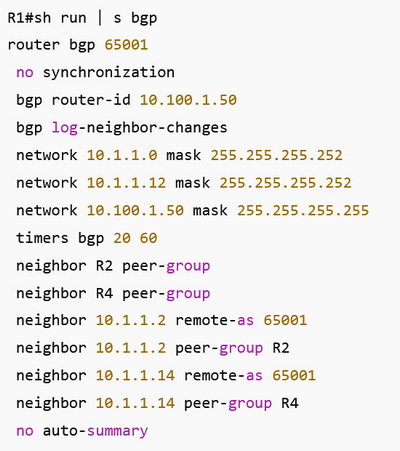
Refer to the exhibit. While troubleshooting a BGP route reflector configuration, an engineer notices that reflected routes are missing from neighboring routers.
Which two BGP configurations are needed to resolve the issue? (Choose two)
A
neighbor 10.1.1.14 route-reflector-client
B
neighbor R2 route-reflector-client
C
neighbor 10.1.1.2 allowas-in
D
neighbor R4 route-reflector-client
E
neighbor 10.1.1.2 route-reflector-client
Reveal answer detailsClose answer details
Correct answersA, E
Question 79
Single choice
A network administrator successfully established a DMVPN tunnel with one hub and two spokes using EIGRP. One of the requirements was to enable spoke-to-spoke tunnels through the hub router using EIGRP.
Which configuration command must the engineer configure to meet the requirement?
A
no ip eigrp 1 mode multipoint
B
no ip eigrp 1 split-horizon
C
no ip eigrp 1 tunnel-redirect
D
no ip eigrp 1 mode mgre
Reveal answer detailsClose answer details
Correct answerB
Question 80
Single choice
What must be configured by the network engineer to circumvent AS_PATH loop prevention mechanism in IP/VPN Hub and Spoke deployment scenarios?
A
Use as-override at the PE_Hub.
B
Use allows-in and as-override at all PEs.
C
Use allows-in and as-override at the PE_Hub.
D
Use allows-in at the PE_Hub.
Reveal answer detailsClose answer details
Correct answerA
Question 81
Single choice
Refer to the exhibit.
An engineer configures DMVPN and receives the hub location prefix of 10.1.1.0724 on R2 and R3 The R3 prefix of 10 1.3.0/24 is not received on R2. and the R2 prefix 10.1,2.0/24 is not received on R3.
Which action reserves the issue?
A
Split horizon prevents the routes from being advertised between spoke routers it should be disabled
with the command no ip split-horizon eigrp 10 on the tunnel interface of R1
B
There is no spoke-to-spoke connection DMVPN configuration should be modified to enable a tunnel connection between R2 and R3 and neighbor relationship confirmed by use of the show ip eigrp neighbor command
C
Split horizon prevents the routes from being advertised between spoke routers it should be disabled with the no ip split-horizon eigrp 10 command on the Gi0/0 interface of R1.
D
There is no spoke-to-spoke connection DMVPN configuration should be modified with a manual neighbor relationship configured between R2 and R3 and confirmed bb use of the show ip eigrp neighbor command.
Reveal answer detailsClose answer details
Correct answerA
Explanation
In this topology, the Hub router will receive advertisements from R2 Spoke router on its tunnel interface. The problem here is that it also has a connection with R3 Spoke on that same tunnel interface. If we don't disable split-horizon, then the Hub will not relay routes from R2 to R3 and the other way around.That is because it received those routes on the same interface tunnel and therefore it cannot advertise back out that same interface (split-horizon rule). Therefore we must disable splithorizon on the Hub router to make sure the Spokes know about each other.
Question 82
Single choice
Examine the following output of the show ip ospf interface command.
What would be the effect of executing the auto-cost reference bandwidth 2000 command on Router43 in router OSPF mode?
A
the cost of the Serial interface would increase to 20
B
the cost of the FastEthernet interfaces would increase to 2000
C
the cost of the Serial interface would increase to 647
D
the cost of the FastEthernet interfaces would increase to 20
Reveal answer detailsClose answer details
Correct answerD
Explanation
If the auto-cost reference bandwidth 2000 command is executed in router OSPF mode it will result in a cost to the FastEthernet interfaces of 20. The formula for arriving at the cost is: reference bandwidth / interface bandwidth = cost The default reference bandwidth for FastEthernet is 100 Mbps. If the reference bandwidth is set at 2000 Mbps using the auto-cost reference command, and the FastEthernet interface has a bandwidth of 100 Mbps, the resulting cost is 20 (2000 / 100 = 20).
The auto-cost reference bandwidth command is executed in router OSPF mode to affect all interfaces. Alternatively, the cost of each interface can be set separately with the ip ospf cost command issued in interface configuration mode. The two commands can also be used in combination: you can set all interfaces with the auto-cost reference bandwidth command, and then set a single interface to a different cost with the ip ospf cost command.
The command would not result in the cost of the Serial interface increasing to 20 or to 647. With a reference bandwidth of 2000 Mbps and interface bandwidth of 1544 kbps (the default bandwidth of a serial interface), the resulting cost would be 1294.
References:
Cisco > Home > Support > Technology Support > IP > IP Routing > Technology Information > Technology
White Paper > OSPF Design Guide > OSPF Cost Cisco > Cisco IOS IP Routing: OSPF Command
Reference > show ip ospf interface Cisco > Cisco IOS IP Routing: OSPF Command Reference > auto-cost
Question 83
Single choice
Refer to the exhibit.
Which interface configuration must be configured on the spoke A router to enable a dynamic DMVPN tunnel with the spoke B router?
A
Option A
B
Option B
C
Option C
D
Option D
Reveal answer detailsClose answer details
Correct answerB
Explanation
The command ip nhrp map multicast dynamic should be only used on Hub router, not spoke. If we are running dynamic routing protocols based on multicast (like RIP, OSPF, EIGRP ...) we have to add the command ip nhrp map multicast dynamic in Hub to replicate all multicast traffic to all dynamic entries in the NHRP table (multicast will be proceeded as unicast traffic) - The tunnel source FastEthernet0/0 is equivalent to tunnel source 172.17.0.2, which is the NBMA address of Spoke A.
Question 84
Single choice
Refer to the exhibit.
Which subnet is redistributed from EIGRP to OSPF routing protocols?
A
10.2.2.0/24
B
10.1.4.0/26
C
10.1.2.0/24
D
10.2.3.0/26
Reveal answer detailsClose answer details
Correct answerA
Question 85
Single choice
Refer to the following set of commands:
Which of the following statements is TRUE about the given set of commands?
A
IPv4 and IPv6 are running simultaneously on rtrA
B
The IPv4 address is translated to an IPv6 address
C
The IPv6 address is an IPv4-compatible address
D
A tunnel is created for the interoperability of the IPv4 and IPv6 addresses
Reveal answer detailsClose answer details
Correct answerA
Explanation
The correct answer is that IPv4 and IPv6 are running simultaneously on rtrA. The set of commands enables IPv6 on the rtrA router and assigns an IPv4 address and an IPv6 address to the Fa0/0 interface. This indicates that the router is a dual-stack router on which both IPv4 and IPv6 are running simultaneously.
The IPv4 address is not translated to the IPv6 address by the given set of commands because NAT-PT is not enabled on the router. To enable NAT-PT on a router, you need to use the ipv6 nat command. In addition, the ipv6 nat prefix command should be used to specify an IPv6 prefix.
The IPv6 address is not an IPv4-compatible address. IPv4-compatible IPv6 addresses are used in automatic IPv4-compatible IPv6 tunnels. These addresses refer to those IPv6 unicast addresses that have zeros in the first 96 bits and an IPv4 address in the last 32 bits. For example, 0:0:0:0:0:0:192.156.10.67 is an IPv4- compatible IPv6 address where 192.156.10.67 is an IPv4 address. The IPv6 address (2001:0:1:1:D52::F3C/64), in this case, is not an IPv4-compatible IPv6 address.
A tunnel is not created for the interoperability of the IPv4 and IPv6 addresses because the given set of commands configures the router as a dual-stack router. There are no commands for configuring a tunnel on the router.
Objective: Network Principles Sub-Objective: Recognize proposed changes to the network
Boston Router router ospf 1 auto-cost reference-bandwidth 1000
D
All Routers router ospf 1 auto-cost reference-bandwidth 1000
Reveal answer detailsClose answer details
Correct answerD
Explanation
R1(config-router)#auto-cost reference-bandwidth ? <1-4294967> The reference bandwidth in terms of Mbits per second R1(config-router)#auto-cost reference-bandwidth
Question 87
Single choice
Refer to the exhibit.
An administrator is attempting to disable the automatic logout after a period of inactivity. After logging out, the console stopped responding to all keyboard inputs. Remote access through SSH still works.
Which action resolves the issue?
A
Configure the no exec-timeout command on line con 0.
B
Configure the absolute-timeout command on line con 0.
C
Configure the exec command on line con 0.
D
Configure the default exec-timeout command on line con 0
What would be a use case for the HSRP configuration below?
A
used to switch the active role to the other router in the HSRP group during a maintenance window
B
used to prevent this router from ever relinquishing the active role
C
used to prevent this router from ever performing the active role
D
used to allow preemption over multiple peers
Reveal answer detailsClose answer details
Correct answerA
Explanation
By tracking the loopback interface and decrementing the priority if it goes down, technicians would have a method of moving the active role to the other router by disabling the loopback interface. This method is less disruptive than disabling any of the physical interfaces. Although no decrement value has been specified, a default decrement of 10 will occur.
This configuration would not be used to prevent this router from ever relinquishing the active role. That would defeat the purpose of Hot Standby Routing Protocol (HSRP), which is to provide failover by relinquishing the active role to the other router.
This configuration would not be used to prevent this router from ever performing the active role. That would defeat the purpose of HSRP which is to provide failover by this router taking the active role when there is an issue with the other router.
This configuration would not be used to allow preemption over multiple peers. When more than two routers are in an HSRP group, the active router is allowed preemption over multiple peers by default.
Objective: Infrastructure Services Sub-Objective: Configure and verify tracking objects
References: Home > Support > Technology support > IP > IP application services > Troubleshoot and alerts > Troubleshooting Technotes > How to use the standby preempt and standby track commands
Question 89
Single choice
You have a Frame Relay topology that is currently a hub and spoke using a single physical serial interface on the hub router with the default network type. OSPF is also running on the interface.
You execute the following command:
ip ospf network point-to-point
What would be the effect of executing this command on the serial interface of the hub router?
A
The hello interval for OSPF will change to 30 seconds
B
The dead interval for OSPF will change to 40 seconds
C
There will now be a DR election
D
The hub router must now be configured with a router ID
Reveal answer detailsClose answer details
Correct answerB
Explanation
The dead interval for OSPF will change to 40 seconds. By default, a Frame Relay connection that uses a physical interface is designated a non-broadcast network for purposes of determining the OSPF hello and dead intervals. There are four possible network types for Frame Relay, and they use different values for the OSPF hello and dead intervals. The values are shown below:
When the ip ospf network point-to-point command is executed, it will change the network type from the default of non-broadcast to point-to-point. This alteration will change the hello and dead intervals to 10 and 40 seconds, respectively.
The hello interval for OSPF will not change to 30 seconds. That is the value for non-broadcast and point-to- multipoint networks.
There will not be a designated router (DR) election. DRs are not elected on a point-to-point network. The hub router does not need to be configured with a router ID. In OSPF for IPv4, the router can create its own by using one of the IP addresses of its interfaces.
References:
Home > Support > Technology support > Initial Configurations for OSPF over Frame Relay Subinterfaces
Question 90
Single choice
You have applied the following configuration to Router71, as indicated in the following partial output of the show run command:
Which of the following statements is true of this configuration?
A
This is a GLBP configuration
B
171.16.6.100 is the IP address of the HSRP group
C
The numeral 1 is the number of the HSRP group
D
This router will be prevented from taking back over as active router when it recovers from a loss of its Serial0 interface
Reveal answer detailsClose answer details
Correct answerC
Explanation
One is the number of the HSRP group. Hot Standby Routing Protocol (HSRP) can be used to provide default gateway redundancy for computers sharing the same gateway. At least two routers are gathered into a routing group, which in this case is numbered 1. One of the routers will answer ARP requests for the standby IP address (in this case 171.16.6.100), which is the address the computers will have configured as their default gateway. That router is called the active router. If that router goes down, then the other router will start answering ARP requests for the standby IP address.
This is not a Gateway Load Balancing Protocol configuration. That is an alternative to HSRP which allows both routers to be used while still providing backup to one another. That configuration would be different in that it uses GLBP groups rather than standby groups, among other differences.
This router will be not prevented from taking back over as active router when it recovers from an outage of its Serial 0 interface. The presence of the command standby 1 preempt indicates that the router can take back over or preempt the other router when it recovers from an outage of its Serial 0 interface. The command standby 1 track Serial0 tells the router to track the up/down state of its Serial 0 interface. If it goes down, it knows to decrement its HSRP priority by 10 (the decrement value). This will drop its HSRP priority to 95. We do not see the priority of the other router in the group, but if for example its priority is 100, this configuration would allow it to take over as active router.
Objective: Infrastructure Services Sub-Objective: Configure and verify tracking objects
References: Home > Support > Technology support > IP > IP application services > Troubleshoot and alerts > Troubleshooting Technotes > How to Use the standby preempt and standby track Commands
Question 91
Single choice
Refer to the exhibit.
An engineer configured NetFlow on R1, but the NMS server cannot see the flow from R1.
From the output we notice that the destination IP address is not correct. The NMS server IP address should be 10.221.10.11, not 10.221.10.10. Therefore we have to change this information under "flow exporter ..."configuration. NetFlow configuration reference: https://www.cisco.com/c/en/us/td/docs/iosxml/ios/fnetflow/configuration/15-mt/fnf-15-mt-book/cfg-de-fnflow-exprts.html
Question 92
Single choice
Your network team is assessing options available to translate IPv6 address to IPv4 addresses.
Which of the following is an advantage of NAT64 over NAT-PT as a translation option?
A
DNS64 and NAT64 functions are completely separated
B
DNS64 and NAT64 functions are completely integrated
C
NAT64 only works over an Ethernet network
D
NAT64 will be unable to reconstruct fragments packets if they are fragmented by an intermediate IPv4 router
Reveal answer detailsClose answer details
Correct answerA
Explanation
DNS64 and NAT64 functions are completely separated when using NAT64. In NAT-PT these two functions are tightly coupled, which reduces flexibility and is why NAT-PT has been deprecated, with the IETF proposing NAT64 as its viable successor.
DNS64 and NAT64 functions are not completely integrated in NAT64, so this is not an advantage of NAT64 over NAT-PT as a translation option.
NAT64 works over non-Ethernet networks. It is NAT-PT that does only works on Ethernet networks. Therefore, this is not an advantage of NAT 64 over NAT-PT.
NAT64 can reconstruct fragments packets if they are fragmented by an intermediate IPv4 router. It is NAT-PT that will be unable to reconstruct fragments packets if they are fragmented by an intermediate IPv4 router, so this is not an advantage of NAT 64 over NAT-PT.
References:
Home > Products & services > Cisco IOS and NX-OS software > Cisco IOS technologies > Enterprise IPv6
solution > Data sheets and literature > White papers > NAT64 Technology: Connecting IPv6 and IPv4
Networks > Technologies Facilitating IPv6/IPv4 Translation
Question 93
Single choice
Refer to the exhibit.
Router R4 is configured correctly with default OSPF values. A network engineer configured R7 for OSPF. R7 must not be elected as a DR for the segment between R4-R7. The adjacency between R4 and R7 failed to form.
Which configuration resolves the issue?
A
Option A
B
Option B
C
Option C
D
Option D
Reveal answer detailsClose answer details
Correct answerC
Question 94
Single choice
A customer requested a GRE tunnel through the provider network between two customer sites using loopback to hide internal networks.
Which configuration on R2 establishes the tunnel with R1?
Routers R1 and R2 have established a network adjacency using EIGRP, and both routers are advertising subnets to its neighbor. After issuing the show ip EIGRP topology all-links command in R1, some prefixes are not showing R2 as a successor.
Which action resolves the issue?
A
Configure the network statement on the neighbor.
B
Rectify the incorrect router ID in R2.
C
Resolve the incorrect metric on the link.
D
Enable split-horizon.
Reveal answer detailsClose answer details
Correct answerA
Question 96
Single choice
Refer to the exhibit.
The administrator successfully logs into R1 but cannot access privileged mode commands.what should be configured to resolve the issue ?
A
aaa authorization reverse-access
B
secret cisco 123! at the end of the username command instead of password cisco123!
C
matching password on vty lines as cisco123!
D
enable secret or enable password commands to enter into privileged mode
Reveal answer detailsClose answer details
Correct answerD
Question 97
Single choice
Refer to the exhibit. Although summarization is configured for R1 to receive 10.0.0.0/8. more specific routes are received by R1.
How should the 10.0.0.0/8 summary route be received from the neighbor, attached to R1 via Fast Ethernet0/0 interface?
A
R1 should configure the ip summary-address eigrp <AS number> 10.0.0.0.255.0.0.0 command under the Fast Ethernet 0/0 interface.
B
The summarization condition is not met Router 10.1.100.10 requires a route for 10 0.0.0/8 that points to null 0
C
The summarization condition is not met. The network 10.1.100.0/24 should be changed to 172.16.0.0/24.
D
R1 should configure the ip summary-address eigrp <AS number> 10.0.0.0 0.0.0.255 command under the Fast Ethernet 0/0 interface.
Reveal answer detailsClose answer details
Correct answerD
Question 98
Single choice
Which command enables NAT-PT on an IPv6 interface?
A
IPv6 nat-pt enable
B
ipv6 nat
C
ipv6 nat-pt
D
ipv6 nat enable
Reveal answer detailsClose answer details
Correct answerB
Question 99
Single choice
Refer to the exhibit.
An engineer must filter incoming EIGRP updates to allow only a set of specific prefixes. The distribute list is tested, and it filters out all routes except network 10.10.10.0/24.
How should the engineer temporarily allow all prefixes to be learned by the router again without adjusting the existing access list?
A
A permit any statement should be added before completing the ACL with the required prefixes, and then the permit any statement can be removed.
B
A permit 20 statement should be added before completing the ACL with the required prefixes, and then the permit 20 statement can be removed.
C
A continue statement should be added within the permit 10 statement before completing the ACL with the required prefixes, and then the continue statement can be removed.
D
An extended access list must be used instead of a standard access list to accomplish the task.
Reveal answer detailsClose answer details
Correct answerB
Question 100
Multiple choice
Which of the following are valid TFTP error codes? (Choose two.)
A
Error Code 1 - File not found
B
Error Code 2 - Unknown error
C
Error code 3 - Invalid user
D
Error code 6 - File already exists
E
Error code 8 - Undefined error
Reveal answer detailsClose answer details
Correct answersA, D
CISCO
Implementing Cisco Enterprise Advanced Routing and Services (ENARSI)
When the log keyword is added to an access list statement, CPU utilization increases.
What is the source of the increased CPU utilization? (Choose all that apply.)
A.
the process switching of packets that match the ACE
B.
the incrementing of the match counter every 60 seconds
C.
the generation and transmission of log messages
D.
the CEF switching of packets that match the ACE
Correct Answer: AC
Explanation
Explanation/Reference:
The source of the increased CPU utilization will have two sources. First is the process switching of each packet that matches the ACE, which is a slower switching method than CEF switching. The second is the generation and transmission of the log messages. Both effects can be mitigated by adjusting the logging interval and the message interval.
The CPU utilization does NOT increase from the incrementing of the match counter every 60 seconds. The match counter increments every 5 minutes by default.
The CPU utilization does NOT increase from the CEF switching of packets that match the ACE. Those packets will be process switched, which is a much slower process than CEF switching.
Objective: Infrastructure Security Sub-Objective: Configure and verify router security features
References:
Understanding Access Control List Logging
Cisco > Cisco IOS Security Command Commands D to L > ip access-list log-update Cisco > Cisco IOS
Broadband Access Aggregation and DSL Command Reference > logging rate-limit
QUESTION 2
With Internal BGP, there is a requirement for all peers to be logically fully meshed, where all IBGP routers must peer with all other IBGP routers. For scaling purposes, there are two mechanisms that were developed to bypass this requirement.
What are they? (Choose two.)
A.
Confederations
B.
IBGP to EBGP route redistribution
C.
BGP peer filtering
D.
Route reflectors.
Correct Answer: AD
QUESTION 3
Refer to the exhibit.
An IP SLA is configured to use the backup default route when the primary is down, but it is not working as desired.
Which command fixes the issue?
A.
R1(config)# ip route 0.0.0.0.0.0.0.0.2.2.2.2 10 track 1
B.
R1(config)# ip route 0.0.0.0.0.0.0.0.2.2.2.2
C.
R1(config)#ip sla track 1
D.
R1(config)# ip route 0.0.0.0.0.0.0.0.1.1.1.1 track 1
Correct Answer: D
Explanation
Explanation/Reference:
Note: By default Static Router AD value-1 hence ip route 0.0.0.0. 0.0.0.0. 1.1.1.1 track 1 means AD-1 which must be less than of back up route AD. Define the backup route to use when the tracked object is unavailable. !--- The administrative distance of the backup route must be greater than !--- the administrative distance of the tracked route. !--- If the primary gateway is unreachable, that route is removed !--- and the backup route is installed in the routing table !--- instead of the tracked route. References: https://www.cisco.com/c/en/us/support/docs/ip/ip-routing/200785-ISP-Failover-with-default-routes-using-I.html https://www.cisco.com/c/en/us/support/docs/security/asa-5500-x-series-next-generation-firewalls/118962-configure-asa-00.html
QUESTION 4
Which mechanism provides traffic segmentation within a DMVPN network?
A.
BGP
B.
IPsec
C.
MPLS
D.
RSVP
Correct Answer: C
Explanation
Explanation/Reference:
To use the DMPVN Traffic Segmentation Within DMVPN feature you must configure Multiprotocol Label Switching (MPLS) by using the mpls ip command.
Router R2 VLAN 10 users cannot get dynamic IP addresses from R1.
Which action resolves the issue?
A.
Eliminate the port security feature on the ports of switch SW2.
B.
Identify the host with the duplicate IP address.
C.
Configure the IP helper feature on the Interface GigabitEthernet 0/2 of router R2.
D.
Expand the address scope of VLAN 10.
Correct Answer: D
QUESTION 7
Refer to the exhibit. R2 is a route reflector, and R1 and R3 are route reflector clients. The route reflector learns the route to 172.16.25.0/24 from R1, but it does not advertise to R3.
What is the reason the route is not advertised?
A.
R2 does not have a route to the next hop, so R2 does not advertise the prefix to other clients.
B.
Route reflector setup requires full IBGP mesh between the routers.
C.
In route reflector setup, only classful prefixes are advertised to other clients.
D.
In route reflector setups, prefixes are not advertised from one client to another.
Correct Answer: A
QUESTION 8
Refer to the exhibit.
The network administrator has configured the Customer Edge router (AS 64511) to send only summarized routes toward ISP-1 (AS 100) and ISP-2 (AS 200).
After this configuration, ISP-1 and ISP-2 continue to receive the specific routes and the summary route.
interface E 0/0 ip bgp suppress-map BLOCK_SPECIFIC ! interface E 0/1 ip bgp suppress-map BLOCK_SPECIFIC ! ip prefix-list PL_BLOCK_SPECIFIC permit 172.16.20.0/22 ge 24 ! route-map BLOCK_SPECIFIC permit 10 match ip address prefix-list PL_BLOCK_SPECIFIC
D.
ip prefix-list PL_BLOCK_SPECIFIC deny 172.16.20.0/22 ge 22 ip prefix-list PL BLOCK SPECIFIC permit 172.16.20.0/22 ! route-map BLOCK_SPECIFIC permit 10 match ip address prefix-list PL_BLOCK_SPECIFIC ! router bgp 64511 aggregate-address 172.16.20.0 255 255.252.0 suppress-map BLOCKSPECIFIC
Correct Answer: A
Explanation
Explanation/Reference:
When the aggregate-address command is used within BGP routing, the aggregated address is advertised, along with the more specific routes. The exception to this rule is through the use of the summary-only command. The "summary-only" keyword suppresses the more specific routes and announces only the summarized route.
QUESTION 9
Refer to the exhibit.
The router is redistributing a prefix 172.16.10.0/24 that should have been filtered.
Which action resolves the issue?
A.
Add the route in access-list 10.
B.
Match the tag 666 for the route in the route map.
C.
Remove route-map sequence 20.
D.
Permit the route in route-map sequence 20.
Correct Answer: C
QUESTION 10
A network engineer is investigating a flapping (up/down) interface issue on a core switch that is synchronized to an NTP server. Log output currently does not show the time of the flap.
Which command allows the logging on the switch to show the time of the flap according to the clock on the device?
A.
service timestamps log uptime
B.
clock summer-time mst recurring 2 Sunday mar 2:00 1 Sunday nov 2:00
C.
service timestamps log datetime localtime show-timezone
D.
clock calendar-valid
Correct Answer: C
Explanation
Explanation/Reference:
By default, Catalyst switches add a simple uptime timestamp to logging messages. This is a cumulative counter that shows the hours, minutes, and seconds since the switch has been booted up
QUESTION 11
Which command is the proper command for allowing RIP routing updates to be received on an interface while not allowing them to be sent out of the same interface?
A.
Router(config)# passive-interface e0/0
B.
Router(config-if)# passive-interface
C.
Router(config-if)# interface passive
D.
Router(config-router)# passive-interface e0/0
E.
Router(config-router)# interface passive e0/0
Correct Answer: D
Explanation
Explanation/Reference:
The correct answer is as follows:
Router(config-router)# passive-interface e0/0
The effect of the passive-interface command is dependent on the routing protocol running on the interface. For EIGRP, the router will not only stop sending routing updates, but also hellos, which means that it will not form a neighbor relationship with another EIGRP router on that interface. This is also the case with OSPF and IS-IS. With RIP, however, the router will continue to send hellos even as it stops sending routing updates, and it will still receive routing updates.
The passive-interface command issued at the router configuration mode will prevent routing updates from being sent out on a specific interface while still allowing the interface to receive updates. This command can be used in any situation where you want the router to receive routing updates on a particular interface but not send any updates. This is helpful for security purposes, for preventing routing loops, or to control routing update traffic.
The other options either use improper syntax or are executed at an incorrect prompt.
References:
Cisco > Home > Support > Technology Support > IP > IP Routing > Design > Design Technotes > How
Does the Passive Interface Feature Work in EIGRP? Cisco > Cisco IOS IP Routing: Protocol-Independent
Command Reference > passive-interface
QUESTION 12
Which commands will prevent the local router from advertising the 139.10.0.0 network out of the Ethernet 0/0 interface, while allowing all other networks to be advertised?
The following command set will prevent the local router from advertising the 139.10.0.0 network out of the Ethernet 0/0 interface, while allowing all other networks to be advertised:
The distribute-list command allows you to apply a basic access list to a routing process. Just like applying an access list to an interface, when you apply it to a routing process, the permit statements determine what networks may be advertised out the interface. The deny statements determine what networks are not allowed to be advertised out the interface. Instead of applying the access list to an interface, you use the distribute-list command in router configuration mode to apply it to the particular routing process. By specifying an interface and a direction (in or out) in the distribute-list command, you can indicate where the advertisements will be blocked and in what direction.
Keep in mind that when applied this way, the access list does not affect what data traffic passes through the interface. It only affects what networks that the routing protocol will advertise. In the scenario here, RIP will not send advertisements for the 139.10.0.0 network out Ethernet 0/0, but traffic coming from or going to that network is still allowed through the interface in either direction unless there is an access list applied to the interface that will block it.
Conversely, if you applied an access-list to the interface that blocked traffic to or from the 139.10.0.0 network, but permitted all other traffic, it would not stop the routing updates about the 139.10.0.0 from passing through.
Note: The last command in the sequence, RouterA(config)#access-list 10 permit any, is VERY important. If that line is missing, any route not specified with an allow statement will be denied. For example, if you wanted to only allow one network to be advertised, you could configure an allow statement for that network and leave off the permit any parameter. It would block all advertisements with the exception of the one specified by the allow statement.
The following command set is incorrect because the distribute list is applied inbound, which would prevent the reception of updates concerning the 139.10.0.0/16 but would not prevent them from being advertised:
The following command set is incorrect because it applies an access list to the interface instead of a distribute list. The effect would be to block all traffic for that network, but allow routing updates:
Objective: Layer 3 Technologies Sub-Objective: Configure and verify filtering with any protocol
References:
Cisco > Cisco IOS IP Configuration Guide, Release 12.2 > Configuring IP Routing Protocol-Independent
Features > Filtering Routing Information Cisco > Cisco IOS IP Routing: Protocol-Independent Command
Reference > distribute-list out (IP)
QUESTION 13
Refer to the exhibit.
An engineer implemented CoPP but did not see OSPF traffic going through it.
Which configuration resolves the issue?
A.
control-plane service-policy input COPP
B.
policy-map COPP class OSFP police 8000 conform-action transmit exceed-action transmit violate-action drop
C.
ip access-list extended OSFP permit ospf any any
D.
class-map match-all OSFP match access-group name OSFP
Correct Answer: C
QUESTION 14
You recently implemented SNMPv3 to increase the security of your network management system. A partial output of the show run command displays the following output that relates to SNMP.
<output omitted>
snmp-server group NORMAL v3 noauth read NORMAL write NORMAL
Which of the following statements is true of this configuration?
A.
it provides encryption, but it does not provide authentication
B.
it provides neither authentication nor encryption
C.
it provides authentication, but it does not provide encryption
D.
it provides both authentication and encryption
Correct Answer: B
Explanation
Explanation/Reference:
It provides neither authentication nor encryption. In SNMPv3 there are three combinations of security that can be used: noAuthNoPriv-no authentication and no encryption noauth keyword in the configuration AuthNoPriv - messages are authenticated but not encrypted auth keyword in the configuration AuthPriv - messages are authenticated and encrypted priv keyword in the configuration In this case, the keyword noauth in the configuration indicates that no authentication and no encryption are provided. This makes the implementation no more secure than SNMPv1 or SNMPv2.
In SNMPv1 and SNMPv2, authentication is performed using a community string. When you implement SNMP using the noauth keyword, it does not use community strings for authentication. Instead it uses the configured user or group name (in this case NORMAL). Regardless, it does not provide either authentication or encryption. Objective: Infrastructure Services Sub-Objective: Configure and verify SNMP
An engineer is troubleshooting an OSPF adjacency issue between directly connected routers R1 and R2
Which configuration resolves the issue?
A.
Option A
B.
Option B
C.
Option C
D.
Option D
Correct Answer: B
QUESTION 16
Which of the following commands should you use to determine both the feasible successors and the non-feasible successors to a given destination network?
A.
show ip route eigrp
B.
show ip eigrp topology
C.
show ip eigrp topology all-links
D.
show ip eigrp topology zero-successors
Correct Answer: C
Explanation
Explanation/Reference:
The show ip eigrp topology all-links command displays both feasible successors and non-feasible successors to a given destination network. This command displays the contents of the topology table and shows all the routes available for a given destination network.
An example of partial output of the command is below:
The 172.20.2.0/24 network has a feasible successor. This can be determined by looking at the values in the parenthesis next to each route. The second value after the / is the advertised distance from the successor. This value must be less than the value of the feasible distance for a route to be considered a feasible successor. There are two routes for 172.20.2.0/24. The first route listed, via 172.17.3.1, is the successor route. Its cost is 246983122, which matches the feasible distance (FD). The second route, via 172.17.1.1, has an advertised distance of 2443698 (the second value in the parentheses after the /).
Because this value is less than the FD (2413698), it qualifies as a feasible successor.
The 172.25.1.0/24 network does not have a feasible successor. The second route listed via 172.17.1.1 has an advertised distance of 2501649, which is greater than the value of the FD, (2416381). Therefore, it is not a feasible successor.
You should not use the show ip route eigrp command. This command displays only the best metric routes (successors) to a given destination network. A route has the best metric if it has the least feasible distance, which refers to the sum of the metric from a given neighbor to a destination network and the metric to reach that neighbor.
You should not use the show ip eigrp topology command without the all-links parameter. This command displays only the feasible successors to a given destination network.
You should not use the show ip eigrp topology zero-successors command because this command lists those routes that do not have a valid successor.
Objective: Layer 3 Technologies Sub-Objective: Configure and verify policy-based routing
References: Cisco IOS IP Routing: EIGRP Command Reference > show ip eigrp topology
QUESTION 17
Which command is NOT mandatory for inclusion in a plan to implement IP Service Level Agreements (SLAs) to monitor IP connections and traffic?
A.
ip sla
B.
ip sla schedule
C.
ip sla reset
D.
icmp-echo
Correct Answer: C
Explanation
Explanation/Reference:
The ip sla reset command is not mandatory for an implementation plan to configure IP SLAs for monitoring IP connections and traffic. This command causes the IP SLA engine to either restart or shutdown. As a result, all IP SLAs operations are stopped, IP SLA configuration information is erased, and IP SLAs are restarted. The IP SLAs configuration information will need to be reloaded to the engine.
The following commands are essential to the implementation plan:
ip sla ip sla schedule icmp-echo The ip sla command allows you to configure IP SLAs operations. When you execute this command in the global configuration mode, it enables the IP SLA configuration mode. In the IP SLA configuration mode, you can configure different IP SLA operations. You can configure up to 2000 operations for a given IP SLA ID number.
The icmp-echo command allows you to monitor IP connections and traffic on routers by creating an IP SLA ICMP Echo operation. This operation monitors end-to-end response times between routers.
The ip sla schedule command allows you to schedule the IP SLA operation that has been configured. With this command, you can specify when the operation starts, how long the operation runs, and the how long the operation gathers information. For example, if you execute the ip sla schedule 40 start-time now life forever command, the IP SLA operation with the identification number 40 immediately starts running. This is because the now keyword is specified for the start-time parameter. The forever keyword with the life parameter indicates that the operation keeps collecting information indefinitely. Note that you cannot re-configure the IP SLA operation after you have executed the ip sla schedule command.
The information gathered by an IP SLA operation is typically stored in RTTMON-MIB. A Management Information Base (MIB) is a database hosting information required for the management of routers or network devices. The RTTMON-MIB is a Cisco-defined MIB intended for Cisco IOS IP SLAs. RTTMON MIB acts as an interface between the Network Management System (NMS) applications and the Cisco IOS IP SLAs operations.
Objective: Infrastructure Services Sub-Objective: Configure and verify IP SLA
References:
Cisco > Support > Technology Support > IP > IP Application Services > Technology Information >
Technology White Paper > Cisco IOS IP Service Level Agreements User Guide Cisco IOS IP SLAs
Command Reference > icmp-echo through probe-packet priority > ip sla Cisco IOS IP SLAs Command
Reference > icmp-echo through probe-packet priority > ip sla schedule Cisco > Cisco IOS IP SLAs
Command Reference > icmp-echo
QUESTION 18
Simulation
Guidelines
This is a lab item in which tasks will be performed on virtual devices.
1. Refer to the Tasks tab to view the tasks for this lab item. 2. Refer to the Topology tab to access the device console(s) and perform the tasks. 3. Console access is available for all required devices by clicking the device icon or using the tab(s) above the console window. 4. All necessary preconfigurations have been applied. 5. Do not change the enable password or hostname for any device. 6. Do not replace existing routing policies or configurations. 7. Save your configurations to NVRAM before moving to the next item. 8. Click Next at the bottom of the screen to submit this lab and move to the next question. 9. When Next is clicked, the lab closes and cannot be reopened.
Topology
Configure individual VRFs for each customer according to the topology to achieve these goals :
Tasks
Configure individual VRFs for each customer according to the topology to achieve these goals:
1. VRF "cu-red" has interfaces on routers R1 and R2. Both routers are preconfigured with IP addressing, VRFs, and BGP. Do not use the BGP network statement for advertisement. 2. VRF "cu-green" has interfaces on routers R1 and R2. 3. BGP on router R1 populates VRF routes between router R1 and R2. 4. BGP on router R2 populates VRF routes between router R1 and R2. 5. LAN to LAN is reachable between SW1 and SW3 for VRF "cu-red" and between SW2 and SW4 for VRF
"cu-green"'. All switches are preconfigured.
Correct Answer:
>>> Use cu-red under interfaces facing SW1 & SW3:
On R1: interface Ethernet0/0 ip vrf forwarding cu-red ip address 192.168.1.254 255.255.255.0
Check reachability to SW1: R1#ping vrf cu-red 192.168.1.1 Type escape sequence to abort. Sending 5, 100-byte ICMP Echos to 192.168.2.1, timeout is 2 seconds: !!!!! Success rate is 100 percent (5/5), round-trip min/avg/max = 1/1/1 ms
On R2: interface Ethernet0/0 ip vrf forwarding cu-red ip address 192.168.2.254 255.255.255.0 Check reachability to SW3: R2#ping vrf cu-red 192.168.2.1 Type escape sequence to abort. Sending 5, 100-byte ICMP Echos to 192.168.1.1, timeout is 2 seconds: !!!!!
>>> Use vrf cu-green for SW2 & SW4:
On R1: interface Ethernet0/1 ip vrf forwarding cu-green ip address 192.168.20.254 255.255.255.0 Test reachability to SW2: R1#ping vrf cu-green 192.168.20.1 Type escape sequence to abort. Sending 5, 100-byte ICMP Echos to 192.168.22.1, timeout is 2 seconds: !!!!! Success rate is 100 percent (5/5), round-trip min/avg/max = 1/1/1 ms
On R2: interface Ethernet0/1 ip vrf forwarding cu-green ip address 192.168.22.254 255.255.255.0 Test reachability to SW4: R2#ping vrf cu-green 192.168.22.1 Type escape sequence to abort. Sending 5, 100-byte ICMP Echos to 192.168.20.1, timeout is 2 seconds: !!!!! Success rate is 100 percent (5/5), round-trip min/avg/max = 1/1/1 ms
>>> On R1 interface Ethernet0/2.100 mpls ip ! interface Ethernet0/2.200 mpls ip !
From SW1 to SW3: SW1#ping 192.168.1.1 Type escape sequence to abort. Sending 5, 100-byte ICMP Echos to 192.168.1.1, timeout is 2 seconds: !!!!! Success rate is 100 percent (5/5), round-trip min/avg/max = 1/1/1 ms But can't Reach SW2 or SW4 in VRF cu-green: SW1#ping 192.168.22.1 Type escape sequence to abort. Sending 5, 100-byte ICMP Echos to 192.168.22.1, timeout is 2 seconds: U.U.U Success rate is 0 percent (0/5) SW1#ping 192.168.20.1 Type escape sequence to abort. Sending 5, 100-byte ICMP Echos to 192.168.20.1, timeout is 2 seconds: U.U.U Success rate is 0 percent (0/5)
Same Test for SW2: From SW2 to SW4: SW2#ping 192.168.20.1 Type escape sequence to abort. Sending 5, 100-byte ICMP Echos to 192.168.20.1, timeout is 2 seconds: !!!!! Success rate is 100 percent (5/5), round-trip min/avg/max = 1/1/1 ms But can't Reach SW3 or SW1 in VRF cu-red: SW2#ping 192.168.1.1 Type escape sequence to abort. Sending 5, 100-byte ICMP Echos to 192.168.1.1, timeout is 2 seconds: U.U.U Success rate is 0 percent (0/5) SW2#ping 192.168.2.1 Type escape sequence to abort. Sending 5, 100-byte ICMP Echos to 192.168.2.1, timeout is 2 seconds: U.U.U Success rate is 0 percent (0/5) Both R1 & R2 has separate tables for VRFs cu-red and cu-green.
QUESTION 19
DRAG DROP
Drag and drop the BGP states from the left to the matching definitions on the right.
Correct Answer:
Explanation
Explanation/Reference:
QUESTION 20
Refer to the exhibit. An engineer must advertise routes into IPv6 MP-BGP and failed.
Drag and drop the terminology from the left onto the corresponding definitions on the right.
Correct Answer:
QUESTION 22
Refer to the exhibit. An administrator wanted to make R1 always elected as DR, R2 as BDR, and R3 as DROTHER but could not achieve the desired results.
Which two configurations resolve the issue? (Choose two)
A.
On the R2 F0/0 interface, configure OSPF priority to 200
B.
On the R1 F0/0 interface, configure OSPF priority to 202
C.
On the R2 F0/0 interface, configure OSPF priority to 201
D.
On the R1 F0/0 interface, configure OSPF priority to 255
E.
On the R3 F0/0 interface, configure OSPF priority to 201
Correct Answer: CD
QUESTION 23
Refer to the exhibit.
Which action limits the access to R2 from 192.168.12.1?
A.
Swap sequence 10 with sequence 20 in access-list 100.
B.
Modify sequence 20 to permit tcp host 192.168.12.1 eq 22 any to access-list 100
C.
Swap sequence 20 with sequence 10 in access-list 100
D.
Modify sequence 10 to deny tcp any eq 22 any to access-list 100.
Correct Answer: A
QUESTION 24
Which security feature can protect DMVPN tunnels?
A.
IPsec
B.
TACACS+
C.
RTBH
D.
RADIUS
Correct Answer: A
QUESTION 25
Refer to the exhibit.
A network is under a cyberattack. A network engineer connected to R1 by SSH and enabled the terminal monitor via SSH session to find the source and destination of the attack. The session was flooded with messages, which made it impossible for the engineer to troubleshoot the issue.
Which command resolves this issue on R1?
A.
#terminal no monitor
B.
(config)#terminal no monitor
C.
#no terminal monitor
D.
(config)#no terminal monitor
Correct Answer: A
QUESTION 26
Refer to the exhibit.
Which policy configuration on R1 forwards any traffic that is sourced from the 192 168 130 0'24 network to R2?
A.
Option A
B.
Option B
C.
Option C
D.
Option D
Correct Answer: C
QUESTION 27
An administrator is setting up a DMVPN tunnel between their offices and he is getting below output when he is running the command "show crypto isakmp sa":
What command will you run to identify the issue?
A.
Debug ip icmp
B.
Debug crypto isakmp
C.
Debug crypto ipsec sa
D.
Debug ssh
Correct Answer: B
QUESTION 28
Which protocol supports labeled paths between PE routers in an MPLS network?
A.
LDP
B.
RSVP
C.
MP-BGP
D.
IGP
Correct Answer: C
Explanation
Explanation/Reference:
In an MPLS network, Service Provider Edge (PE) routers use Multiprotocol Border Gateway Protocol (MP-BGP) to exchange label and route information with each other. MP-BGP is the routing protocol used to create and distribute labels between service provider edge routers on an MPLS network.
QUESTION 29
Refer to the exhibit.
A network engineer is troubleshooting a failed link between R2 and R3. No traffic loss is reported from router R5 to HQ.
The error log is printed prior configuring the virtual link and the stub area. The log actually confirms the fact that r2 tried to establish a virtual link with r3. The 192.168.125.5 is the source IP of the packet that triggered the error and belongs to R2. it is not necessarily the same as the Router ID. Anyway, if the virtual link endpoints are in the stub area, then connectivity between the two routers could be lost. To allow a virtual link to exist through a stub area you should use "virtual-link stub".
QUESTION 30
DRAG DROP
Arrange the below as per the recommended steps:
Correct Answer:
QUESTION 31
Refer to the exhibit.
An engineer must configure DMVPN Phase 3 hub-and-spoke topology to enable a spoke-to-spoke tunnel.
Which NHRP configuration meets the requirement on R6?
A.
interface Tunnel1 ip nhrp authentication Cisco123 ip nhrp map multicast dynamic ip nhrp network-id 1 ip nhrp holdtime 300 ip nhrp redirect
B.
interface Tunnel 1 ip address 192.168.1.1 255.255.255.0 tunnel source e 0/1 tunnel mode gre multipoint ip nhrp network-id 1 ip nhrp map 192.168.1.2 192.1.20.2
C.
interface Tunnel1 ip nhrp authentication Cisco123 ip nhrp map multicast dynamic ip nhrp network-id 1 ip nhrp holdtime 300 ip nhrp shortcut
D.
Interface Tunnel 1 ip address 192.168.1.1 255.255.255.0 tunnel source e 0/0 tunnel mode gre multipoint ip nhrp network-id 1
Correct Answer: A
QUESTION 32
A Cisco router has just been configured for NTP and is synchronized with the configured NTP server. However, log messages still show an incorrect time.
What else should be done to match the log messages time stamps with the NTP based time?
A.
Wait a bit longer for the synchronized time to get applied to new log messages.
B.
Configure the "service timestamps log datetime localtime" command in global mode.
C.
Configure the "service timestamps log datetime synchronize" command globally
D.
Configure the "service timestamps log ntp" command in global config mode.
Correct Answer: B
QUESTION 33
You have been alerted that TCP traffic leaving an interface has been reduced to near zero, while UDP traffic is steadily increasing at the same time.
What is this behavior called and what causes it?
A.
jitter, caused by lack of QoS
B.
latency, caused by the MTU
C.
starvation, caused improper configuration of QoS queues
D.
windowing, caused by network congestion
Correct Answer: C
Explanation
Explanation/Reference:
This behavior is called starvation and is caused by improper configuration of QoS queues. When TCP and UDP flows are assigned to the same QoS queue, they compete with one another. This is not a fair competition because the TCP packets will react to packet drops by throttling back TCP traffic, while UDP packets are oblivious to drops and will take up the slack created by the diminishing TCP traffic. The results from mixing UDP and TCP traffic in the same queue are: Starvation Latency Lower throughput
While it is true that jitter can be caused by a lack of QoS, jitter is not what is being described in the scenario. Jitter is the variation in latency as measured in the variability over time of the packet latency across a network. This phenomenon seriously impacts time-sensitive traffic, such as VoIP, and can be prevented by placing this traffic in a high-priority QoS queue.
While latency can be caused by the maximum transmission unit (MTU) in the network, this is not a case of latency, although latency may be one of the perceived effects of starvation. Latency is the delay in reception of packets. The MTU is the largest packet size allowed to be transmitted, and an MTU that is set too large can result in latency.
While windowing can be caused by network congestion, this is not a case of windowing. This is a technique used to adjust the number of packets that can acknowledged at once by a receiving computer in a transmission. In times of congestion the window, or number of packets that can be acknowledged at a time, will be small. Later, when congestion goes down, the window size can be increased.
References: Design Guide > Service Provider Quality of Service > CE Guidelines for Collapsing Enterprise Classes > Mixing TCP with UDP
QUESTION 34
Refer to the exhibit.
The network administrator must mutually redistribute routes at the Chicago router to the LA and NewYork routers. The configuration of the Chicago router is this:
After the configuration, the LA router receives all the NewYork routes, but NewYork router does not receive any LA routes.
Which set of configurations fixes the problem on the Chicago router?
A.
Option A
B.
Option B
C.
Option C
D.
Option D
Correct Answer: B
Explanation
Explanation/Reference:
"LA router receives all the NewYork routes but it does not receive any LA routes" because when redistrubuting into EIGRP, we must configure the default metric.
QUESTION 35
An associate of yours configured a PPPoE connection. You have been alerted by a vulnerability tester that
by using a sniffer, he was able to learn the connection credentials.
What type of authentication must your associate have configured on the connection?
A.
PAP
B.
802.1x
C.
CHAP
D.
IPsec
Correct Answer: A
Explanation
Explanation/Reference:
The method used must have been Password Authentication Protocol (PAP). This method transmits the credentials in clear text, which makes it a poor choice.
There are only two methods available to authenticate a PPP connection, PAP and Challenge-Handshake Authentication Protocol (CHAP). CHAP never sends the password across the link. Rather, the authenticating end of the connection sends random text and other information to the requester. The requester encrypts this data with its password and sends it back. The authenticating end of the connection reverses the encryption using the same password and compares the result with what was originally sent. If it matches, the authenticating end of the connection is assured that the requesting end knows the password.
The connection could not have used either 802.1x or IPsec, as neither method would transmit the credentials in clear text.
The connection could not have used CHAP. If it had, the credentials could not have been captured with a sniffer.
Objective: Layer 2 Technologies Sub-Objective: Configure and verify PPP
References:
Cisco > Authentication, Authorization, and Accounting Configuration Guide, Cisco IOS Release 15M&T >
Configuring Authentication > Non-AAA Authentication Methods > Enabling CHAP or PAP Authentication
Cisco > Authentication, Authorization, and Accounting Configuration Guide, Cisco IOS Release 15M&T
(PDF)
QUESTION 36
Which configuration adds an IPv4 interface to an OSPFv3 process in OSPFv3 address family configuration?
A.
router ospfv3 1 address-family ipv4
B.
Router(config-router)#ospfv3 1 ipv4 area 0
C.
Router(config-if)#ospfv3 1 ipv4 area 0
D.
router ospfv3 1 address-family ipv4 unicast
Correct Answer: C
QUESTION 37
You execute the following command.
router(config-if)#ip helper-address 172.20.14.225
Which of the following traffic types will NOT be forwarded to the IP address 172.20.14.225?
A.
TFTP
B.
SMTP
C.
DNS
D.
TACACS
Correct Answer: B
Explanation
Explanation/Reference:
While the ip helper address command is typically used to forward DHCP broadcasts to a DHCP server located in a remote subnet, it will also forward the following broadcast packets by default as well: TFTP - UDP port 69 Domain Name System (DNS) UDP port 53 Time service - port 37 NetBIOS Name Server - port137 NetBIOS Datagram Server - port 138 Bootstrap Protocol (BOOTP) - port 67 TACACS UDP port 49 Objective: Infrastructure Services Sub-Objective: Configure and verify IPv4 and IPv6 DHCP
References: Cisco IOS IP Application Services Command Reference > ip accounting through ip sctp authenticate > ip helper-address
QUESTION 38
Refer to the exhibit. An timestamps on the system logs did not match the clock.
What is the reason for this error?
A.
An authentication error with the NTP server results in an incorrect timestamp.
B.
The keyword localtime is not defined on the timestamp service command.
C.
The NTP server is in a different time zone.
D.
The system clock is set incorrectly to summer-time hours.
Correct Answer: B
QUESTION 39
Refer to the exhibit.
An IP SLA was configured on router R1 that allows the default route to be modified in the event that Fa0/0 loses reachability with the router R3 Fa0/0 interface. The route has changed to flow through router R2.
Which debug command is used to troubleshoot this issue?
A.
debug ip flow
B.
debug ip sla error
C.
debug ip routing
D.
debug ip packet
Correct Answer: C
Explanation
Explanation/Reference:
debug ip routing This command enables debugging messages related to the routing table.
QUESTION 40
Refer to the exhibit.
In Cisco DNA Center, a network engineer identifies that BGP-learned networks are repeatedly withdrawn from peers.
Which configuration must the engineer apply to resolve the issue?
A.
router bgp 100 bgp graceful-restart
B.
router bgp 100 bgp dampening
C.
route-map Dampening permit 10 set dampening 15 750 2000 60 router bgp 100 neighbor 10.140.212.5 route-map Dampening in
D.
route-map Dampening permit 10 set dampening 15 750 2000 60 router bgp 100 neighbor 10.140.212.5 route-map Dampening out
Correct Answer: B
QUESTION 41
Reler Iothe exhibit.
The engineer is trying to transfer the new IOS file to the router R3 but is getting an error.
Which configuration achieves the file transfer?
A.
R4(config)# no access-list 120 permit udp host 172.16.1.2 host 172.16.2.19 eq 69 R3(config)# no ip tftp source-interface GigabitEthernet0/3
B.
R4(config)# no access-list 120 permit udp host 172.16.1.2 host 172.16.2.19 eq 69 R4(config)# access-list 120 permit udp host 172.16.1.17 host 172.16.2.19 eq 69 R4(config)# access-list 120 permit tcp any any
R4(config)# no access-list 120 deny udp any any eq tftp R4(config)# access-list 120 permit tcp any any
D.
R4(config)# no access-list 120 permit udp host 172.16.1.2 host 172.16.2.19 eq 69 R4(config)# access-list 120 permit tcp host 172.16.1.17 host 172.16.2.19 eq 69 R4(config)# access-list 120 permit tcp any any
Correct Answer: B
QUESTION 42
Which dialer interface command sets the maximum size of IP packets to 1492?
A.
router(config-if)# mtu 1492
B.
router(config-if)# ip ppp 1492
C.
router(config-if)# ip 1492
D.
router(config-if)# ip mtu 1492
Correct Answer: D
Explanation
Explanation/Reference:
The correct interface command to set the maximum size of IP packets (maximum transmission unit or MTU size) to 1492 is router(config-if)# ip mtu 1492. This command is required because RFC 2516 states the maximum receive unit (MRU) must not be negotiated larger than 1492 bytes.
All other answers are invalid commands due to incorrect syntax.
References:
Cisco > Cisco IOS IP Application Services Command Reference > idle (firewall farm datagram protocol)
through ip slb natpool > ip mtu
QUESTION 43
An engineer configured a leak-map command to summarize EIGRP routes and advertise specifically loopback 0 with an IP of 10.1.1.1.255.255.255.252 along with the summary route. After finishing configuration, the customer complained not receiving summary route with specific loopback address.
Which two configurations will fix it? (Choose two.)
router eigrp 1 ! route-map Leak-Route deny 10
! interface Serial 0/0 ip summary-address eigrp 1 10.0.0.0 255.0.0.0 leak-map Leak-Route
Configure access-list 1 and match under route-map Leak-Route.
D.
Configure route-map Leak-Route permit 10 and match access-list 1.
E.
Configure route-map Leak-Route permit 20.
Correct Answer: AD
Explanation
Explanation/Reference:
When you configure an EIGRP summary route, all networks that fall within the range of your summary are suppressed and no longer advertised on the interface. Only the summary route is advertised. But if we want to advertise a network that has been suppressed along with the summary route then we can use leak-map feature. The below commands will fix the configuration in this question: R1(config)#access-list 1 permit 10.1.1.0 0.0.0.3 R1(config)#route-map Leak-Route permit 10 // this command will also remove the "route_map Leak-Route deny 10" command. R1(config-route-map)#match ip address 1
QUESTION 44
Refer to the exhibit. The administrator is trying to overwrite an existing file on the TFTP server that was previously uploaded by another router. However, the attempt to update the file fails.
Which action resolves this issue?
A.
Make the packages.conf file executable by all on the TFTP server
B.
Make the packages.conf file writable by all on the TFTP server
C.
Make sure to run the TFTP service on the TFTP server
D.
Make the TFTP folder writable by all on the TFTP server
Correct Answer: B
QUESTION 45
What is a function of an end device configured with DHCPv6 guard?
A.
If it is configured as a server, only prefix assignments are permitted.
B.
If it is configured as a relay agent, only prefix assignments are permitted.
C.
If it is configured as a client, messages are switched regardless of the assigned role.
D.
If it is configured as a client, only DHCP requests are permitted.
Correct Answer: C
Explanation
Explanation/Reference:
The DHCPv6 Guard feature blocks reply and advertisement messages that come from unauthorized DHCP servers and relay agents. Packets are classified into one of the three DHCP type messages. All client messages are always switched regardless of device role. DHCP server messages are only processed further if the device role is set to server. Further processing of server messages includes DHCP server advertisements (for source validation and server preference) and DHCP server replies (for permitted prefixes). If the device is configured as a DHCP server, all the messages need to be switched, regardless of the device role configuration.
QUESTION 46
What is the purpose of an OSPF sham-link?
A.
to allow inter-area routing when OSPF is used as the PE-CE connection protocol in an MPLS VPN network
B.
to allow intra-area routing when OSPF is used as the PE-CE connection protocol in an MPLS VPN network
C.
to correct OSPF backdoor routing when OSPF is used as the PE-CE connection protocol in an MPLS VPN network
D.
to correct OSPF backdoor routing when OSPF is used as the PE-PE connection protocol in an MPLS VPN network
Correct Answer: C
Explanation
Explanation/Reference:
"Although OSPF PE-CE connections assume that the only path between two client sites is across the MPLS VPN backbone, backdoor paths between VPN sites (shown in grey in the figure below) may exist. If these sites belong to the same OSPF area, the path over a backdoor link will always be selected because OSPF prefers intraarea paths to interarea paths. (PE routers advertise OSPF routes learned over the VPN backbone as interarea paths.) For this reason, OSPF backdoor links between VPN sites must be taken into account so that routing is performed based on policy. "
QUESTION 47
Refer to the exhibit.
An error message "an OSPF-4-FLOOD_WAR" is received on SW2 from SW1. SW2 is repeatedly receiving its own link-state advertisement and flushes it from the network.
Which action resolves the issue?
A.
Change area 5 to a normal area from a nonstub area
B.
Resolve different subnet mask issue on the link
C.
Configure Layer 3 port channel on interfaces between switches
D.
Resolve duplicate IP address issue in the network
Correct Answer: D
QUESTION 48
Which of the following are valid restrictions when configuring Control Plane Policing (CoPP) on Cisco devices? (Choose two.)
A.
You cannot use the "log" keyword with CoPP on the access list entries
B.
CEF must be disabled
C.
The only match types supported with CoPP is ip precedence, ip dscp, and access-group
D.
Only standard access-lists are supported.
Correct Answer: AC
QUESTION 49
Simulation
Guidelines
This is a lab item in which tasks will be performed on virtual devices.
1. Refer to the Tasks tab to view the tasks for this lab item. 2. Refer to the Topology tab to access the device console(s) and perform the tasks. 3. Console access is available for all required devices by clicking the device icon or using the tab(s) above the console window. 4. All necessary preconfigurations have been applied. 5. Do not change the enable password or hostname for any device. 6. Save your configurations to NVRAM before moving to the next item. 7. Click Next at the bottom of the screen to submit this lab and move to the next question. 8. When Next is clicked, the lab closes and cannot be reopened.
Topology
Tasks
Troubleshoot and resolve the issues to achieve these goals:
1. Ensure that R1 reaches the prefix 10.6.66.6 without any single point of failure in the path. Do not use a static route or policy-based routing to accomplish this. 2. Ensure that R1 loopback 1 reaches to R6's loopback 1 by following the path through R1, R3, R5 to R6 and vice versa. Use metric values K1 = 100000, K2=1, K3=255, K4=10, K5=1500 to modify the default metric in EIGRP if required. Do not use a route-map. 3. Ensure that on R3, prefix 10.0.56.6/32 uses the SP1 to route to the Internet, whereas prefix 172.16.12.2/32 uses the SP2 to route to the Internet. Do not use BGP to accomplish this. Use the pre-configured route-maps SP1 and SP2 and modify to accomplish the task if required. Use the ping and trace commands from R6 and R2 to prefixes 209.165.202.132 and 209.165.202.128, respectively to verify the results.
Correct Answer:
QUESTION 50
An engineer configured Reverse Path Forwarding on an interface and noticed that the routes are dropped when a route lookup fails on that interface for a prefix that is available in the routing table
Which interface configuration resolves the issue?
A.
ip verify unicast source reachable-via rx
B.
ip verify unicast source reachable-via any
C.
ip verify unicast source reachable-via allow-default
D.
ip verify unicast source reachable-via 12-src
Correct Answer: B
Explanation
Explanation/Reference:
According to this question, uRPF is running in strict mode because packets are dropped even when that route exists in the routing table. Maybe packets are dropped because the receiving interface is different from the interface the local router uses to send packets to that destination. The ip verify unicast source reachable-via rx command enables Unicast RPF in strict mode. To enable loose mode, administrators can use the any option (ip verify unicast source reachable-via any). In loose mode, it doesn't matter if we use this interface to reach the source or not.
The allow-default option allows the use of the default route in the source verification process.
QUESTION 51
Router R2 operates in a broadcast, multi-access network. Examine the following output of the show ip ospf neighbor command.
Based on the output, with which routers can R2 establish a full adjacency?
A.
the neighbor at 192.168.5.6
B.
the neighbor at 192.168.5.10
C.
the neighbor at 192.168.5.116
D.
the neighbor at 192.168.5.107
Correct Answer: D
Explanation
Explanation/Reference:
R2 can establish a full adjacency with the neighbor at 192.168.5.107 and the neighbor at 192.168.5.165. In a broadcast, multi-access network OSPF network, full adjacencies can only be established with a designated router (DR) or a backup designated router (BDR).
Objective: Layer 3 Technologies Sub-Objective: Configure and verify OSPF neighbor relationship and authentication
References:
Home.Support > Technology Support > IP > IP Routing > Design > Design Technotes > What does the
show ip ospf neighbors command reveal? Cisco > Cisco IOS IP Routing: OSPF Command Reference >
show ip ospf neighbor
It identifies the seed metric associated with OSPF routes that are redistributed into EIGRP.
B.
It identifies the seed metric associated with EIGRP routes that are redistributed into OSPF.
C.
It identifies the amount that the existing EIGRP metric will increment as it is redistributed into OSPF.
D.
It specifies that routes that contain metrics of less than 30 will be redistributed from OSPF into EIGRP.
Correct Answer: B
Explanation
Explanation/Reference:
The value 30 represents the seed metric for routes that are redistributed from EIGRP into OSPF.
When configuring the OSPF process, the redistribute command is used to identify the source protocol, its AS or process ID, and several other optional parameters, such as metric. The default seed metric for all routing protocols except BGP is 20. When redistributing BGP, the default seed metric is 1.
It does not identify the seed metric associated with OSPF routes that are redistributed into EIGRP. The command is redistributing EIGRP into OSPF, not OSPF into EIGRP.
It does not identify the amount that the existing EIGRP metric will increment as it is redistributed into OSPF. A seed metric value is an absolute value not incremental.
It does not specify that routes that contain metrics of less than 30 will be redistributed from OSPF into EIGRP. It not used to filter routes.
Objective:
Layer 3 Technologies Sub-Objective:
Configure and verify redistribution between any routing protocols or routing sources
References:
Cisco > Cisco IOS IP Routing: Protocol-Independent Command Reference > redistribute (ip)
QUESTION 53
Refer to the exhibit.
Which action resolves the adjacency issue?
A.
Configure the same EIGRP process IDs.
B.
Match the authentication keys.
C.
Match the hello interval timers.
D.
Configure the same autonomous system numbers
Correct Answer: D
QUESTION 54
Refer to the exhibit.
A network administrator wants to block all traffic toward the Internet after business hours and on weekends. When the administrator applies an access list on interface Gi0/1, all traffic is blocked and there is no access to the Internet at any time.
Which action resolves the issue?
A.
Add the permit ip any any time-range no-conn statement after the deny udp any any time-range no-conn command in the access list.
B.
Add the permit ip any any statement after the deny icmp any any time-range no-conn command in the access list.
C.
Add the permit allowed time-range no-conn statement after the deny icmp any any time-range no-conn command in the access list.
D.
Add the permit ip any any time-range no-conn statement after the deny icmp any any time-range no-conn command in the access list.
Correct Answer: B
QUESTION 55
DRAG DROP
Drag and drop the IPv6 first hop security device roles from the left onto the corresponding descriptions on the right.
Which command can you use to display information about OSPF virtual links?
A.
debug ip ospf adj
B.
show ip ospf [process-id]
C.
show ip ospf virtual-links
D.
show ip ospf border-routers
Correct Answer: C
Explanation
Explanation/Reference:
The correct answer is show ip ospf virtual-links. The show ip ospf virtual-links command displays the current state of OSPF virtual links, as shown below.
The following additional commands are available to verify OSPF configurations: show ip ospf border-routers, debug ip ospf adj, and show ip ospf.
The show ip ospf border-routers command displays internal OSPF routing table entries for an ABR, as shown below.
router10#show ip ospf border-routers Codes: i - Intra-area route, I-Inter-area route
Type Dest Address Cost NextHop Interface ABR ASBR Area SPF i 2.2.2.2 10 192.1.1.199 Ethernet 2 TRUE FALSE 0 3 i 3.2.2.2 10 192.1.1.200 Ethernet 2 TRUE FALSE 0 3
The show ip ospf command displays information about the router's role and each area to which the router is connected, as shown below.
The debug ip ospf adj command displays information about the state of neighbor adjacencies, as shown below.
R3#debug ip ospf adj OSPF adjacency events debugging is on
00:54:04: OSPF: Rcv pkt from 172.12.23.2, Ethernet0, area 0.0.0.1 : src not on the same network
In the above example, either the IP address or the subnet mask is misconfigured on either this router or the neighbor.
Objective: Layer 3 Technologies Sub-Objective: Configure and verify network types, area types, and router types
References:
Cisco > Cisco IOS IP Routing Protocols Command Reference > IP Routing Protocol-Independent
Commands:
S through T > show ip ospf virtual-links
QUESTION 57
The network administrator configured the router for Control Plane Policrg so that inbound SSH traffic is policed to 500 kbps This policy must apply to traffic coming in from 101010 0<24 and 192 168 10.0/24
networks
access-list 100 permit ip 10.10.10.0 0.0.0.255 any access-list 100 permit tcp 192.168.10.0 0.0.0.255 any eq 23 ! class-map CLASS-SSH match access-group 100 ! policy-map PM-COPP class CLASS-SSH police 500000 conform-action transmit ! interface E0/0 service-policy input PM-COPP ! interface E0/1 service-policy input PM-COPP
The Control Rane Policing is not applied to SSH traffic and SSH is open to use any bandwidth available.
Which configuration resolves this issue?
A.
no access-list 100 access-list 100 permit tcp 10.10.10.0 0.0.0.255 any eq 22 access-list 100 permit tcp 192.168.10.0 0.0.0.255 any eq 22
B.
interface E0/0 no service-policy input PM-COPP ! interface E0/1 no service-policy input PM-COPP ! control-plane service-policy input PM-COPP
C.
no access-list 100 access-list 100 permit tcp 10.10.10.0 0.0.0.255 any eq 22 access-list 100 permit tcp 192.168.10.0 0.0.0.255 any eq 22 ! policy-map PM-COPP class CLASS-SSH no police 500000 conform-action transmit police 500000 conform-action transmit exceed-action drop
D.
no access-list 100 access-list 100 permit tcp 10.10.10.0 0.0.0.255 any eq 22 access-list 100 permit tcp 192.168.10.0 0.0.0.255 any eq 22 ! interface E0/0 no service-policy input PM-COPP ! interface E0/1 no service-policy input PM-COPP ! control-plane service-policy input PM-COPP
Correct Answer: D
QUESTION 58
Which of the following commands would reveal the K values configured on an EIGRP router?
A.
debug ip eigrp
B.
debug eigrp packet
C.
show ip eigrp traffic
D.
show ip protocols
Correct Answer: D
Explanation
Explanation/Reference:
The show ip protocols command gives information about any dynamic routing protocol, including EIGRP. With respect to EIGRP, it will show the K values as a part of the output. A sample is shown below:
Routing Protocol is "eigrp 77" Outgoing update filter list for all interfaces is not set Incoming update filter list for all interfaces is not set Default networks flagged in outgoing updates Default networks accepted from incoming updates EIGRP metric weight K1=1,K2=0,K3=1,K4=0,K5=0 EIGRP maximum, hopcount 100 <output omitted> The debug ip eigrp command displays real-time information about EIGRP packets that are received and sent. It does not contain K values. A single line of this command output is shown below:
Router# debug ip eigrp
IP-EIGRP: Processing incoming UPDATE packet IP-EIGRP: Ext 192.168.5.0 255.255.255.0 M 386560 - 256000 130560 SM 360960 - 256000 104960
<output omitted>
The debug eigrp packet command displays general debug information, but not K values. A sample of this command output is shown below:
Router# debug eigrp packet EIGRP: Sending HELLO on Ethernet0/1 AS 109, Flags 0x0, Seq 0, Ack 0 EIGRP: Received UPDATE on Ethernet0/1 from 192.195.78.24, AS 109, Flags 0x1, Seq 1, Ack 0 <output omitted>
The show ip eigrp traffic command displays packets received, as well as statistics on hello packets, updates, queries, and acknowledgments, but not K values. Partial output of this command is shown below:
Router# show ip eigrp traffic IP-EIGRP Traffic Statistics for process 151
Hellos sent/received: 220/205
Updates sent/received: 7/29
Queries sent/received: 2/0
Replies sent/received: 0/2
Acks sent/received: 29/14
Objective: Layer 3 Technologies Sub-Objective: Describe and optimize EIGRP metrics
References: Cisco IOS Master Command List, Release 12.4T > sa ipsec through show ip route dhcp > show ip protocols
QUESTION 59
Router 5 has four interfaces. The networks hosted on each interface are as follows:
After this command sequence is executed, what routes will be present in the routing table of the router at 172.16.5.2? (Choose all that apply.)
A.
192.168.5.4/29
B.
172.16.5.0/24
C.
192.168.6.0/24
D.
192.168.7.0/24
E.
none of these will be present
F.
only network addresses beginning with 192 will be present
Correct Answer: ABCD
Explanation
Explanation/Reference:
Despite the inclusion of the command aggregate-address 192.168.5.0 255.255.252.0, all subnets of the aggregate route will also be placed in the routing updates because of the omission of the summary-only keyword. Therefore, 192.168.5.4/29, 172.16.5.0/16, 192.168.6.0/24 and 192.168.7.0/24 will be present.
Had the following command been executed, the subnet addresses would not appear in the routing table of the router at 172.16.5.2:
Which two actions restrict access to router R1 by SSH? (Choose two.)
A.
Remove class-map ANY from service-policy CoPP.
B.
Configure transport output ssh on line vty and remove sequence 20 from access list 100.
C.
Configure transport input ssh on line vty and remove sequence 30 from access list 100.
D.
Remove sequence 10 from access list 100 and add sequence 20 deny tcp any any eq telnet to access list 199.
E.
Configure transport output ssh on line vty and remove sequence 10 from access list 199.
Correct Answer: AC
QUESTION 61
Refer to the exhibit.
An engineer investigates an IPv6 EIGRP neighbor adjacency issue where the neighbors are flapping and issues a ping from R1 to its directly connected neighbor. The link between the switches is stable at Layer 2, and other connected devices are also functioning.
Which action resolves the issue?
A.
The switch between the two neighbors is not IPv6 compatible and must be replaced with an IPv6- compatible device.
B.
Data is not reliably transmitted between the dynamically assigned link-local addresses of the routers and must be manually assigned.
C.
Multicast packets are not reliably transmitted over the link, and the switch must be replaced.
D.
The switch between the two neighbors is not configured for IPv6 multicast and must be configured for IPv6 multicast.
Correct Answer: C
QUESTION 62
Refer to the exhibit.
Jun 24 08:54:51.530: IF-EvO(GigabitEthemet0/0): IP Routing reports state transition from DOWN to DOWN Jun 24 08:54:52.525: %1INEPROTO-5-UPDOWN: Line protocol on Interface GigabitEthemet0/0, changed state to down Jun 24 08:54:52.528: IF-EvD(GigabitEthernet0/0): IP Routing reports state transition from DOWN to DOWN Jun 24 08:54:53 215: IF-EvD(GigabitEthernet0/0): IP Routing reports state transition from DOWN to DOWN Jun 24 08:54:54.998: %LINK-3-UPDOWN: Interface GigabitEthemet0/0, changed state to up Jun 24 08:54:55.006: IF-EvO(GigabitEthernet0/0): IP Routing reports state transition from DOWN to UP Jun 24 08:54:55.998: %LINEPROTO-5-UPDOWN: Line protocol on Interface GigabitEthernet0/0, changed state to up R1 is connected with R2 via GigabitEthernet0/0, and R2 cannot ping R1.
What action will fix the issue?
A.
Fix route dampening configured on the router
B.
Replace the SFP module because it is not supported.
C.
Fix IP Event Dampening configured on the interface.
D.
Correct the IP SLA probe that failed.
Correct Answer: C
Explanation
Explanation/Reference:
The IP Event Dampening feature introduces a configurable exponential decay mechanism to suppress the effects of excessive interface flapping events on routing protocols and routing tables in the network. This feature allows the network operator to configure a router to automatically identify and selectively dampen a local interface that is flapping.
QUESTION 63
Refer to Exhibit.
A network administrator has successfully configured DMVPN topology between a hub and two spoke routers. Which two configuration commands should establish direct communications between spoke 1 and spoke 2 without going through the hub? (Choose two).
A.
At the hub router, configure the ip nhrp shortcut command.
B.
At the spoke routers, configure the ip nhrp spoke-tunnel command.
C.
At the hub router, configure ip nhrp redirect the command
D.
At the spoke routers, configure the ip nhrp shortcut command.
E.
At the hub router, configure tne Ip nhrp spoke-tunnel command
Correct Answer: CD
Explanation
Explanation/Reference:
To configure Spoke to Spoke communication we can configure DMVPN Phase II or Phase III. But in Phase II, the first few packets would go through Hub. In order tototally ignore the hub, we have to use DMVPN Phase III: DMVPN Phase III is same as Phase 2 but removes some restrictions and complexities of Phase 2. Also allows greater variety of DMVPN network designs we use: + ip nhrp redirect in hub: tells the initiator spoke to look for a better path to the destination spoke than through the Hub. Upon receiving the NHRP redirect message thespokes communicate with each other over the hub and they have their NHRP replies for the NHRP Resolution Requests that they sent out. + ip nhrp shortcut in spokes: overwrite the CEF table on the spoke. It basically overrides the next-hop value for a remote spoke network from the default initial hubtunnel IP address to the NHRP resolved remote spoke tunnel IP address)
QUESTION 64
You are configuring NAT64 to allow communication between a host running IPv6 and a server running IPv4. The router R1 sits between the host and the server. The router's Fa0/2/7 interface is connected to the IPv6 host, and the Fa0/2/6 interface is connected to the IPv4 server.
The IPv6 host has an IPv6 address of 2001::a00:1/128 and the IPv4 server is at 10.0.0.1. Below is the relevant configuration on R1:
When the IPv4 server responds to the IPv6 host, what IPv6 address will be in the source address in the packet?
A.
2001::a001
B.
2001::A00:B
C.
3001::a00:1
D.
2001::A00:A
Correct Answer: C
Explanation
Explanation/Reference:
NAT64 is a solution when IPv6 hosts need to communicate with IPv4-only servers. When the translation occur on the router the IPv4 address 10.0.0.1 will converted to hex as a00:1 and will be attached to the end of the stateful prefix of 3001::/96 that was configured on the router interface connected to the IPv4 server. The result will be 3001::a00:1.
The address will not be 2001::a001. The prefix that will be attached to the hex version of 10.0.0.1 will not be that of the interface fa0/2/7 but will be the prefix that was configured on that interface for nat64 translation which is 3301::/96. The address will not be 2001::a00:b. That is the IPv6 address on the interface connected to the IPv6 host, but that address is not used for IPv4 to IPv6 communication. A translated address will be generated by converting the IPv4 address of the IPv4 host to hex and attaching it to the IPv6 prefix configured on the interface connected to the IPv4 server.
The address will not be 2001::A00:A. That is the IPv6 address of the IPv6 host. That was statically mapped to 10.0.0.10 in the configuration and as such will be the IPv4 address used by the IPv6 host on the IPv4 side of the router.
An engineer must override the normal routing behavior of a router for Telnet traffic that is destined to 10.10.10.10 from 10.10.1.0/24 via a next hop of 10.4.4.4. which is directly connected to the router that is
connected to the 10.1.1.0/24 subnet
Which configuration reroutes traffic according to this requirement?
A.
access-list 100 deny tcp 10.10.1.0 0.0.0.255 host 10.10.10.10 eq 23 ! route-map POLICY permit 10 match ip address 100 set ip next-hop 10.4.4.4 route-map POLICY permit 20
B.
access-list 100 permit tcp 10.10.1.0 0.0.0.255 host 10.10.10.10 eq 23 ! route-map POLICY permit 10 match ip address 100 set ip next-hop 10.4.4.4 route-map POLICY permit 20
C.
access-list 100 permit tcp 10.10.1.0 0.0.0.255 host 10.10.10.10 eq 23 ! route-map POLICY permit 10 match ip address 100 set ip next-hop recursive 10.4.4.4 route-map POLICY permit 20
D.
access-list 100 permit tcp 10.10.1.0 0.0.0.255 host 10.10.10.10 eq 23 ! route-map POLICY permit 10 match ip address 100 set ip next-hop recursive 10.4.4.4
Correct Answer: D
QUESTION 66
Refer to the exhibit.
A company is evaluating multiple network management system tools. Trending graphs generated by SNMP data are returned by the NMS and appear to have multiple gaps. While troubleshooting the issue, an engineer noticed the relevant output.
What solves the gaps in the graphs?
A.
Remove the exceed-rate command in the class map.
B.
Remove the class map NMS from being part of control plane policing.
C.
Configure the CIR rate to a lower value that accommodates all the NMS tools
D.
Separate the NMS class map in multiple class maps based on the specific protocols with appropriate CoPP actions
Correct Answer: D
Explanation
Explanation/Reference:
The class-map NMS in the exhibit did not classify traffic into specific protocols so many packets were dropped. We should create some class-map to classify the receiving traffic. It is also a recommendation of CoPP/CPP policy: "Developing a CPP policy starts with the classification of the control plane traffic. To that end, the control plane traffic needs to be first identified and separated into different class maps."
The network administrator must implement IPv6 in the network to allow only devices that not only have registered IP addresses but are also connecting from assigned locations.
A network administrator is discovering a Cisco Catalyst 9300 and a Cisco WLC 3504 in Cisco DNA Center. The Catalyst 9300 is added successfully. However, the WLC is showing error "uncontactable" when the administrator tries to add if in Cisco DNA Center.
Which action discovers WLC in Cisco DNA Center successfully?
A.
Delete the WLC 3504 from Cisco DNA Center and add it to Cisco DNA Center again.
B.
Add the WLC 3504 under the hierarchy of the Catalyst 9300 connected devices.
C.
Copy the .cert file from the Cisco DNA Center on the USB and upload it to the WLC 3504.
D.
Copy the .pem file from the Cisco DNA Center on the USB and upload it to the WLC 3504.
Remove the current autonomous system number on one of the routers and change to a different value.
B.
Remove the passive-interface command from the R2 configuration so that it matches the R1 configuration.
C.
Add the no auto-summary command to the R2 configuration so that it matches the R1 configuration.
D.
Add the passive-interface command to the R1 configuration so that it matches the R2 configuration.
Correct Answer: B
QUESTION 72
Refer to the exhibit. A network administrator logs into the router using TACACS+ username and password credentials, but the administrator cannot run any privileged commands
Which action resolves the issue?
A.
Configure TACACS+ synchronization with the Active Directory admin group
B.
Configure the username from a local database
C.
Configure full access for the username from TACACS+ server
D.
Configure an authorized IP address for this user to access this router
Correct Answer: C
QUESTION 73
You need to resolve a route-selection problem in a redistributed network by increasing the administrative distance to several networks for a protocol, other than EIGRP or BGP, so that these routes will not be used. You create access list 5 to identify the relevant networks, and access the routing protocol configuration prompt.
Which command will set the administrative distance to these networks to 220 for the selected protocol?
Router(config-router)# increase 0.0.0.0 255.255.255.255 admin 220 list 5
Correct Answer: C
Explanation
Explanation/Reference:
The correct command is Router(config-router)# distance 220 0.0.0.0 255.255.255.255 5. This command instructs the router to change the AD for any networks specified in the access list 5 to 220. The correct syntax for the distance command is shown below:
The 0.0.0.0 255.255.255.255 portion included with the distance command could hold an address/mask combination for a single address, but it is more common to use an access list.
Looking at the configuration, it seems that there are two SNMP community strings configured, "public" and "private". However, the configuration does not specify which community string is being used by the host with IP address 10.1.1.1.
The correct action to resolve this issue would be to configure a valid SNMP community string on the device from which the SNMP request is being made, and ensure that it matches the community string configured on the router.
QUESTION 75
When configuring a DMVPN solution, which of the following technologies makes it possible for the spoke routers to use dynamic IP addressing?
A.
IPsec
B.
mGRE
C.
NHRP
D.
Dynamic routing protocols
Correct Answer: C
Explanation
Explanation/Reference:
Next Hop Resolution Protocol (NHRP) allows the spoke routers to register their IP addresses with the NHRP server, which is the hub router. It also allows the spoke routers to then learn the physical IP addresses of the other spoke routers from the hub router, allowing for GRE links to be built dynamically as needed between the spokes. This eliminates the need for the traffic to go through the hub router.
Dynamic Multipoint VPN (DMVPN) technology leverages the following associated technologies: IPsec mGRE Dynamic routing protocols NHRP Cisco Express Forwarding
It makes it possible to build the hub router once, and add spokes later, making no additional changes to the hub. The spokes are able to register with the hub and dynamically build their own connections to other spokes using the IP addresses learned from the hub using NHRP. DMVPN also allows IPsec point-to-point GRE tunnels to be built to new spokes with no IPsec peering configuration. The multipoint GRE technology (mGRE) allows a single physical interface on the hub to be used for all spoke connections.
Finally, the routing protocols used by DMVPN allow the routers to share routing information, while Cisco Express Forwarding (CEF) is a switching technology that improves performance while reducing the load on the CPUs of the routers.
A network administrator opens a telnet connection to the router and gets the message:
R1#telnet 10.1.1.2
Trying 10 1.1 2 Open
(Connection to 10.1.1.2 closed by foreign host)
Router R2 is configured with enable secret and password commands.
Which action resolves the issue?
A.
Configure the logging synchronous command on line vty.
B.
Configure the exec command on line vty.
C.
Configure the login local command on line vty
D.
Configure the enable password command on line vty.
Correct Answer: C
QUESTION 77
You have implemented the following IP SLA configuration, as shown in the following partial output of the show run command:
ip sla 1 dns cow.cisco.com name-server 10.52.128.30 ip sla schedule 1 start-time now
Which of the following statements is true of this configuration?
A.
it will find the response time to resolve the DNS name cow.cisco.com
B.
it will find the response time to connect to the DNS server at 10.52.128.30
C.
it will start in one minute
D.
it will gather data from one minute
Correct Answer: A
Explanation
Explanation/Reference:
It will find the response time to resolve the DNS name cow.cisco.com. Domain Name System (DNS) response time is computed by calculating the difference between the time taken to send a DNS request and the time a reply is received. The Cisco IOS IP SLAs DNS operation queries for an IP address if the user specifies a hostname, or queries for a hostname if the user specifies an IP address.
It will not find the response time to connect to the DNS server at 10.52.128.30. That is the IP address of the DNS server being used for the operation (10.52.128.30). However, it will measure the response time to resolve the DNS name cow.cisco.com.
It will not start in one minute. It will start immediately, as indicated by the start-time now parameter.
It will not gather data for one minute. The numeral 1 in the first line refers to the IP SLA number, and the numeral 1 in the last line refers to the IP SLA number to be scheduled.
Objective: Infrastructure Services Sub-Objective: Configure and verify IP SLA
References:
Home > Support > Technology support > IP > IP application services > Technology information >
Technology white paper > Cisco IOS IP Service Level Agreements User Guide
QUESTION 78
Refer to the exhibit. While troubleshooting a BGP route reflector configuration, an engineer notices that reflected routes are missing from neighboring routers.
Which two BGP configurations are needed to resolve the issue? (Choose two)
A.
neighbor 10.1.1.14 route-reflector-client
B.
neighbor R2 route-reflector-client
C.
neighbor 10.1.1.2 allowas-in
D.
neighbor R4 route-reflector-client
E.
neighbor 10.1.1.2 route-reflector-client
Correct Answer: AE
QUESTION 79
A network administrator successfully established a DMVPN tunnel with one hub and two spokes using EIGRP. One of the requirements was to enable spoke-to-spoke tunnels through the hub router using EIGRP.
Which configuration command must the engineer configure to meet the requirement?
A.
no ip eigrp 1 mode multipoint
B.
no ip eigrp 1 split-horizon
C.
no ip eigrp 1 tunnel-redirect
D.
no ip eigrp 1 mode mgre
Correct Answer: B
QUESTION 80
What must be configured by the network engineer to circumvent AS_PATH loop prevention mechanism in IP/VPN Hub and Spoke deployment scenarios?
A.
Use as-override at the PE_Hub.
B.
Use allows-in and as-override at all PEs.
C.
Use allows-in and as-override at the PE_Hub.
D.
Use allows-in at the PE_Hub.
Correct Answer: A
QUESTION 81
Refer to the exhibit.
An engineer configures DMVPN and receives the hub location prefix of 10.1.1.0724 on R2 and R3 The R3 prefix of 10 1.3.0/24 is not received on R2. and the R2 prefix 10.1,2.0/24 is not received on R3.
Which action reserves the issue?
A.
Split horizon prevents the routes from being advertised between spoke routers it should be disabled
with the command no ip split-horizon eigrp 10 on the tunnel interface of R1
B.
There is no spoke-to-spoke connection DMVPN configuration should be modified to enable a tunnel connection between R2 and R3 and neighbor relationship confirmed by use of the show ip eigrp neighbor command
C.
Split horizon prevents the routes from being advertised between spoke routers it should be disabled with the no ip split-horizon eigrp 10 command on the Gi0/0 interface of R1.
D.
There is no spoke-to-spoke connection DMVPN configuration should be modified with a manual neighbor relationship configured between R2 and R3 and confirmed bb use of the show ip eigrp neighbor command.
Correct Answer: A
Explanation
Explanation/Reference:
In this topology, the Hub router will receive advertisements from R2 Spoke router on its tunnel interface. The problem here is that it also has a connection with R3 Spoke on that same tunnel interface. If we don't disable split-horizon, then the Hub will not relay routes from R2 to R3 and the other way around.That is because it received those routes on the same interface tunnel and therefore it cannot advertise back out that same interface (split-horizon rule). Therefore we must disable splithorizon on the Hub router to make sure the Spokes know about each other.
QUESTION 82
Examine the following output of the show ip ospf interface command.
What would be the effect of executing the auto-cost reference bandwidth 2000 command on Router43 in router OSPF mode?
A.
the cost of the Serial interface would increase to 20
B.
the cost of the FastEthernet interfaces would increase to 2000
C.
the cost of the Serial interface would increase to 647
D.
the cost of the FastEthernet interfaces would increase to 20
Correct Answer: D
Explanation
Explanation/Reference:
If the auto-cost reference bandwidth 2000 command is executed in router OSPF mode it will result in a cost to the FastEthernet interfaces of 20. The formula for arriving at the cost is: reference bandwidth / interface bandwidth = cost The default reference bandwidth for FastEthernet is 100 Mbps. If the reference bandwidth is set at 2000 Mbps using the auto-cost reference command, and the FastEthernet interface has a bandwidth of 100 Mbps, the resulting cost is 20 (2000 / 100 = 20).
The auto-cost reference bandwidth command is executed in router OSPF mode to affect all interfaces. Alternatively, the cost of each interface can be set separately with the ip ospf cost command issued in interface configuration mode. The two commands can also be used in combination: you can set all interfaces with the auto-cost reference bandwidth command, and then set a single interface to a different cost with the ip ospf cost command.
The command would not result in the cost of the Serial interface increasing to 20 or to 647. With a reference bandwidth of 2000 Mbps and interface bandwidth of 1544 kbps (the default bandwidth of a serial interface), the resulting cost would be 1294.
References:
Cisco > Home > Support > Technology Support > IP > IP Routing > Technology Information > Technology
White Paper > OSPF Design Guide > OSPF Cost Cisco > Cisco IOS IP Routing: OSPF Command
Reference > show ip ospf interface Cisco > Cisco IOS IP Routing: OSPF Command Reference > auto-cost
QUESTION 83
Refer to the exhibit.
Which interface configuration must be configured on the spoke A router to enable a dynamic DMVPN tunnel with the spoke B router?
A.
Option A
B.
Option B
C.
Option C
D.
Option D
Correct Answer: B
Explanation
Explanation/Reference:
The command ip nhrp map multicast dynamic should be only used on Hub router, not spoke. If we are running dynamic routing protocols based on multicast (like RIP, OSPF, EIGRP ...) we have to add the command ip nhrp map multicast dynamic in Hub to replicate all multicast traffic to all dynamic entries in the NHRP table (multicast will be proceeded as unicast traffic) - The tunnel source FastEthernet0/0 is equivalent to tunnel source 172.17.0.2, which is the NBMA address of Spoke A.
QUESTION 84
Refer to the exhibit.
Which subnet is redistributed from EIGRP to OSPF routing protocols?
A.
10.2.2.0/24
B.
10.1.4.0/26
C.
10.1.2.0/24
D.
10.2.3.0/26
Correct Answer: A
QUESTION 85
Refer to the following set of commands:
Which of the following statements is TRUE about the given set of commands?
A.
IPv4 and IPv6 are running simultaneously on rtrA
B.
The IPv4 address is translated to an IPv6 address
C.
The IPv6 address is an IPv4-compatible address
D.
A tunnel is created for the interoperability of the IPv4 and IPv6 addresses
Correct Answer: A
Explanation
Explanation/Reference:
The correct answer is that IPv4 and IPv6 are running simultaneously on rtrA. The set of commands enables IPv6 on the rtrA router and assigns an IPv4 address and an IPv6 address to the Fa0/0 interface. This indicates that the router is a dual-stack router on which both IPv4 and IPv6 are running simultaneously.
The IPv4 address is not translated to the IPv6 address by the given set of commands because NAT-PT is not enabled on the router. To enable NAT-PT on a router, you need to use the ipv6 nat command. In addition, the ipv6 nat prefix command should be used to specify an IPv6 prefix.
The IPv6 address is not an IPv4-compatible address. IPv4-compatible IPv6 addresses are used in automatic IPv4-compatible IPv6 tunnels. These addresses refer to those IPv6 unicast addresses that have zeros in the first 96 bits and an IPv4 address in the last 32 bits. For example, 0:0:0:0:0:0:192.156.10.67 is an IPv4- compatible IPv6 address where 192.156.10.67 is an IPv4 address. The IPv6 address (2001:0:1:1:D52::F3C/64), in this case, is not an IPv4-compatible IPv6 address.
A tunnel is not created for the interoperability of the IPv4 and IPv6 addresses because the given set of commands configures the router as a dual-stack router. There are no commands for configuring a tunnel on the router.
Objective: Network Principles Sub-Objective: Recognize proposed changes to the network
Boston Router router ospf 1 auto-cost reference-bandwidth 1000
D.
All Routers router ospf 1 auto-cost reference-bandwidth 1000
Correct Answer: D
Explanation
Explanation/Reference:
R1(config-router)#auto-cost reference-bandwidth ? <1-4294967> The reference bandwidth in terms of Mbits per second R1(config-router)#auto-cost reference-bandwidth
QUESTION 87
Refer to the exhibit.
An administrator is attempting to disable the automatic logout after a period of inactivity. After logging out, the console stopped responding to all keyboard inputs. Remote access through SSH still works.
Which action resolves the issue?
A.
Configure the no exec-timeout command on line con 0.
B.
Configure the absolute-timeout command on line con 0.
C.
Configure the exec command on line con 0.
D.
Configure the default exec-timeout command on line con 0
What would be a use case for the HSRP configuration below?
A.
used to switch the active role to the other router in the HSRP group during a maintenance window
B.
used to prevent this router from ever relinquishing the active role
C.
used to prevent this router from ever performing the active role
D.
used to allow preemption over multiple peers
Correct Answer: A
Explanation
Explanation/Reference:
By tracking the loopback interface and decrementing the priority if it goes down, technicians would have a method of moving the active role to the other router by disabling the loopback interface. This method is less disruptive than disabling any of the physical interfaces. Although no decrement value has been specified, a default decrement of 10 will occur.
This configuration would not be used to prevent this router from ever relinquishing the active role. That would defeat the purpose of Hot Standby Routing Protocol (HSRP), which is to provide failover by relinquishing the active role to the other router.
This configuration would not be used to prevent this router from ever performing the active role. That would defeat the purpose of HSRP which is to provide failover by this router taking the active role when there is an issue with the other router.
This configuration would not be used to allow preemption over multiple peers. When more than two routers are in an HSRP group, the active router is allowed preemption over multiple peers by default.
Objective: Infrastructure Services Sub-Objective: Configure and verify tracking objects
References: Home > Support > Technology support > IP > IP application services > Troubleshoot and alerts > Troubleshooting Technotes > How to use the standby preempt and standby track commands
QUESTION 89
You have a Frame Relay topology that is currently a hub and spoke using a single physical serial interface on the hub router with the default network type. OSPF is also running on the interface.
You execute the following command:
ip ospf network point-to-point
What would be the effect of executing this command on the serial interface of the hub router?
A.
The hello interval for OSPF will change to 30 seconds
B.
The dead interval for OSPF will change to 40 seconds
C.
There will now be a DR election
D.
The hub router must now be configured with a router ID
Correct Answer: B
Explanation
Explanation/Reference:
The dead interval for OSPF will change to 40 seconds. By default, a Frame Relay connection that uses a physical interface is designated a non-broadcast network for purposes of determining the OSPF hello and dead intervals. There are four possible network types for Frame Relay, and they use different values for the OSPF hello and dead intervals. The values are shown below:
When the ip ospf network point-to-point command is executed, it will change the network type from the default of non-broadcast to point-to-point. This alteration will change the hello and dead intervals to 10 and 40 seconds, respectively.
The hello interval for OSPF will not change to 30 seconds. That is the value for non-broadcast and point-to- multipoint networks.
There will not be a designated router (DR) election. DRs are not elected on a point-to-point network. The hub router does not need to be configured with a router ID. In OSPF for IPv4, the router can create its own by using one of the IP addresses of its interfaces.
References:
Home > Support > Technology support > Initial Configurations for OSPF over Frame Relay Subinterfaces
QUESTION 90
You have applied the following configuration to Router71, as indicated in the following partial output of the show run command:
Which of the following statements is true of this configuration?
A.
This is a GLBP configuration
B.
171.16.6.100 is the IP address of the HSRP group
C.
The numeral 1 is the number of the HSRP group
D.
This router will be prevented from taking back over as active router when it recovers from a loss of its Serial0 interface
Correct Answer: C
Explanation
Explanation/Reference:
One is the number of the HSRP group. Hot Standby Routing Protocol (HSRP) can be used to provide default gateway redundancy for computers sharing the same gateway. At least two routers are gathered into a routing group, which in this case is numbered 1. One of the routers will answer ARP requests for the standby IP address (in this case 171.16.6.100), which is the address the computers will have configured as their default gateway. That router is called the active router. If that router goes down, then the other router will start answering ARP requests for the standby IP address.
This is not a Gateway Load Balancing Protocol configuration. That is an alternative to HSRP which allows both routers to be used while still providing backup to one another. That configuration would be different in that it uses GLBP groups rather than standby groups, among other differences.
This router will be not prevented from taking back over as active router when it recovers from an outage of its Serial 0 interface. The presence of the command standby 1 preempt indicates that the router can take back over or preempt the other router when it recovers from an outage of its Serial 0 interface. The command standby 1 track Serial0 tells the router to track the up/down state of its Serial 0 interface. If it goes down, it knows to decrement its HSRP priority by 10 (the decrement value). This will drop its HSRP priority to 95. We do not see the priority of the other router in the group, but if for example its priority is 100, this configuration would allow it to take over as active router.
Objective: Infrastructure Services Sub-Objective: Configure and verify tracking objects
References: Home > Support > Technology support > IP > IP application services > Troubleshoot and alerts > Troubleshooting Technotes > How to Use the standby preempt and standby track Commands
QUESTION 91
Refer to the exhibit.
An engineer configured NetFlow on R1, but the NMS server cannot see the flow from R1.
From the output we notice that the destination IP address is not correct. The NMS server IP address should be 10.221.10.11, not 10.221.10.10. Therefore we have to change this information under "flow exporter ..."configuration. NetFlow configuration reference: https://www.cisco.com/c/en/us/td/docs/iosxml/ios/fnetflow/configuration/15-mt/fnf-15-mt-book/cfg-de-fnflow-exprts.html
QUESTION 92
Your network team is assessing options available to translate IPv6 address to IPv4 addresses.
Which of the following is an advantage of NAT64 over NAT-PT as a translation option?
A.
DNS64 and NAT64 functions are completely separated
B.
DNS64 and NAT64 functions are completely integrated
C.
NAT64 only works over an Ethernet network
D.
NAT64 will be unable to reconstruct fragments packets if they are fragmented by an intermediate IPv4 router
Correct Answer: A
Explanation
Explanation/Reference:
DNS64 and NAT64 functions are completely separated when using NAT64. In NAT-PT these two functions are tightly coupled, which reduces flexibility and is why NAT-PT has been deprecated, with the IETF proposing NAT64 as its viable successor.
DNS64 and NAT64 functions are not completely integrated in NAT64, so this is not an advantage of NAT64 over NAT-PT as a translation option.
NAT64 works over non-Ethernet networks. It is NAT-PT that does only works on Ethernet networks. Therefore, this is not an advantage of NAT 64 over NAT-PT.
NAT64 can reconstruct fragments packets if they are fragmented by an intermediate IPv4 router. It is NAT-PT that will be unable to reconstruct fragments packets if they are fragmented by an intermediate IPv4 router, so this is not an advantage of NAT 64 over NAT-PT.
References:
Home > Products & services > Cisco IOS and NX-OS software > Cisco IOS technologies > Enterprise IPv6
solution > Data sheets and literature > White papers > NAT64 Technology: Connecting IPv6 and IPv4
Networks > Technologies Facilitating IPv6/IPv4 Translation
QUESTION 93
Refer to the exhibit.
Router R4 is configured correctly with default OSPF values. A network engineer configured R7 for OSPF. R7 must not be elected as a DR for the segment between R4-R7. The adjacency between R4 and R7 failed to form.
Which configuration resolves the issue?
A.
Option A
B.
Option B
C.
Option C
D.
Option D
Correct Answer: C
QUESTION 94
A customer requested a GRE tunnel through the provider network between two customer sites using loopback to hide internal networks.
Which configuration on R2 establishes the tunnel with R1?
Routers R1 and R2 have established a network adjacency using EIGRP, and both routers are advertising subnets to its neighbor. After issuing the show ip EIGRP topology all-links command in R1, some prefixes are not showing R2 as a successor.
Which action resolves the issue?
A.
Configure the network statement on the neighbor.
B.
Rectify the incorrect router ID in R2.
C.
Resolve the incorrect metric on the link.
D.
Enable split-horizon.
Correct Answer: A
QUESTION 96
Refer to the exhibit.
The administrator successfully logs into R1 but cannot access privileged mode commands.what should be configured to resolve the issue ?
A.
aaa authorization reverse-access
B.
secret cisco 123! at the end of the username command instead of password cisco123!
C.
matching password on vty lines as cisco123!
D.
enable secret or enable password commands to enter into privileged mode
Correct Answer: D
QUESTION 97
Refer to the exhibit. Although summarization is configured for R1 to receive 10.0.0.0/8. more specific routes are received by R1.
How should the 10.0.0.0/8 summary route be received from the neighbor, attached to R1 via Fast Ethernet0/0 interface?
A.
R1 should configure the ip summary-address eigrp <AS number> 10.0.0.0.255.0.0.0 command under the Fast Ethernet 0/0 interface.
B.
The summarization condition is not met Router 10.1.100.10 requires a route for 10 0.0.0/8 that points to null 0
C.
The summarization condition is not met. The network 10.1.100.0/24 should be changed to 172.16.0.0/24.
D.
R1 should configure the ip summary-address eigrp <AS number> 10.0.0.0 0.0.0.255 command under the Fast Ethernet 0/0 interface.
Correct Answer: D
QUESTION 98
Which command enables NAT-PT on an IPv6 interface?
A.
IPv6 nat-pt enable
B.
ipv6 nat
C.
ipv6 nat-pt
D.
ipv6 nat enable
Correct Answer: B
QUESTION 99
Refer to the exhibit.
An engineer must filter incoming EIGRP updates to allow only a set of specific prefixes. The distribute list is tested, and it filters out all routes except network 10.10.10.0/24.
How should the engineer temporarily allow all prefixes to be learned by the router again without adjusting the existing access list?
A.
A permit any statement should be added before completing the ACL with the required prefixes, and then the permit any statement can be removed.
B.
A permit 20 statement should be added before completing the ACL with the required prefixes, and then the permit 20 statement can be removed.
C.
A continue statement should be added within the permit 10 statement before completing the ACL with the required prefixes, and then the continue statement can be removed.
D.
An extended access list must be used instead of a standard access list to accomplish the task.
Correct Answer: B
QUESTION 100
Which of the following are valid TFTP error codes? (Choose two.)