Question 1
Multiple choice
An engineer is investigating a ticket from the accounting department in which a user discovered an unexpected application on their workstation. Several alerts are seen from the intrusion detection system of unknown outgoing internet traffic from this workstation. The engineer also notices a degraded processing capability, which complicates the analysis process. Which two actions should the engineer take? (Choose two.)
-
A
Restore to a system recovery point.
-
B
-
C
Disconnect from the network.
-
D
Format the workstation drives.
-
E
Take an image of the workstation.
Reveal answer details
Close answer details
Correct answersC, E
ExplanationWhen suspicious activity is detected on a workstation, immediate steps need to be taken to preserve evidence and prevent further compromise: Disconnecting the system from the network (C)is crucial to stop potential exfiltration of data or ongoing communications with a command-and-control server. This isolation prevents further spread or damage while preserving the state of the compromised system for further investigation. Taking an image of the workstation (E)is part of the forensics acquisition process. It involves creating a bit-by-bit copy of the system's disk, which preserves all evidence in its current state. This allows for thorough forensic analysis without affecting the original evidence. These steps align with the best practices outlined in the incident response and forensics processes (as described in theCyberOps Technologies (CBRFIR) 300-215 study guide). Specifically, in theIdentification and Containment phases of the incident response cycle, it's emphasized that isolating the system and preserving evidence through imaging are critical to ensuring both containment of the threat and successful forensic investigation.
References:
CyberOps Technologies (CBRFIR) 300-215 study guide, Chapter:
Understanding the Security Incident Response Process, Identification and Containment Phases, page 102-
104 .
An investigator notices that GRE packets are going undetected over the public network. What is occurring?
-
A
-
B
-
C
-
D
Reveal answer details
Close answer details
Correct answerB
ExplanationGeneric Routing Encapsulation (GRE) is a tunneling protocol used to encapsulate a wide variety of network layer protocols inside point-to-point connections. If packets encapsulated with GRE are bypassing monitoring tools, it's likely due to tunneling--where payloads are hidden within another protocol. Tunneling can obscure malicious content or lateral movement in a network and is a common method used in data exfiltration.
What can the blue team achieve by using Hex Fiend against a piece of malware?
-
A
Use the hex data to define patterns in VARA rules.
-
B
Read the hex data and transmognify into a readable ELF format
-
C
Use the hex data to modify BE header to read the file.
-
D
Read the hex data and decrypt payload via access key.
Reveal answer details
Close answer details
Correct answerA
ExplanationHex Fiend is a hex editor that allows analysts to examine the raw byte content of files. One key use case is identifying and extracting byte-level patterns or signatures that can be translated into YARA rules for detecting malware. These hex patterns can be used to define precise signature-based detections.
A threat actor has successfully attacked an organization and gained access to confidential files on a laptop. What plan should the organization initiate to contain the attack and prevent it from spreading to other network devices?
-
A
-
B
-
C
-
D
Reveal answer details
Close answer details
Correct answerC
ExplanationOnce an incident has occurred, the appropriate course of action is to engage the organization's Incident Response (IR) plan. This is a structured approach to contain, analyze, and eradicate threats before they spread across the network.
The Cisco CyberOps Associate study guide emphasizes: "Incident response and handling are essential within an organization... The main objective of implementing an incident handling process is to reduce the impact of a cyber-attack, ensure the damages caused are assessed, and implement recovery procedures". In particular, the containment phase of IR is focused on isolating the threat and preventing lateral movement or further compromise. Options such as "root cause" or "attack surface" are relevant at later stages of analysis and mitigation, not immediate containment. Therefore, the correct answer is C.
DRAG DROP Drag and drop the capabilities on the left onto the Cisco security solutions on the right. 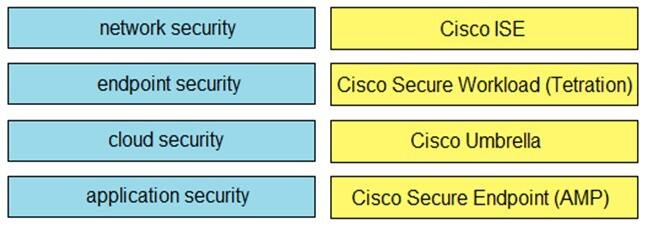
Reveal answer details
Close answer details
During a routine inspection of system logs, a security analyst notices an entry where Microsoft Word initiated a PowerShell command with encoded arguments.
Given that the user's role does not involve scripting or advanced document processing, which action should the analyst take to analyze this output for potential indicators of compromise?
-
A
Monitor the Microsoft Word startup times to ensure they align with business hours.
-
B
Confirm that the Microsoft Word license is valid and the application is updated to the latest version.
-
C
Validate the frequency of PowerShell usage across all hosts to establish a baseline.
-
D
Review the encoded PowerShell arguments to decode and determine the intent of the script.
Reveal answer details
Close answer details
Correct answerD
ExplanationAccording to theCyberOps Technologies (CBRFIR) 300-215 study guidecurriculum, when analyzing suspicious behavior--especially when scripts or shell commands are executed from applications like Word (which is uncommon)--the encoded PowerShell payload must be decoded to determine if malicious intent is present. Deobfuscation is a critical step in identifying command-and-control behavior, persistence, or malware execution paths.
A cybersecurity analyst detects fileless malware activity on secure endpoints. What should be done next?
-
A
Immediately quarantine the endpoints containing the suspicious files and consider the issue resolved
-
B
Isolate the affected endpoints and conduct a detailed memory analysis to identify fileless malware execution.
-
C
Delete the suspicious files and monitor the endpoints for any further signs of compromise.
-
D
Share the findings with other government agencies for collaborative threat analysis and response.
Reveal answer details
Close answer details
Correct answerB
ExplanationFileless malware resides in memory and does not leave traditional file artifacts, making it difficult for antivirus solutions to detect. The most effective next step is to isolate the endpoints to prevent lateral movement and perform memory forensics to capture volatile data and identify any running malicious processes.
Refer to the exhibit.  What is occurring within the exhibit?
-
A
Source 10.1.21.101 sends HTTP requests with the size of 302 kb.
-
B
Host 209.141.51.196 redirects the client request from /Lk9tdZ to /files/1.bin.
-
C
Host 209.141.51.196 redirects the client request to port 49723.
-
D
Source 10.1.21.101 is communicating with 209.141.51.196 over an encrypted channel.
Reveal answer details
Close answer details
Correct answerB
ExplanationThe Wireshark capture shows a series of HTTP requests and responses: The client (10.1.21.101) sends a GET request for/Lk9tdZ. The server (209.141.51.196) responds withHTTP/1.1 302 Found, which is a standard HTTP status code indicating a redirection. The subsequent GET request from the client is for/files/1.bin, which indicates it followed the redirect. This behavior confirms that the server is issuing an HTTP 302 redirect from the initial request path/
Lk9tdZto /files/1.bin. This is often observed in malware command-and-control behavior or file download staging. Option A is incorrect: 302 is a status code, not a data size. Option C is incorrect: port 49723 is a source/destination ephemeral port, not a redirect target. Option D is incorrect: communication is over HTTP, not HTTPS (which would indicate encryption). References:
CyberOps Technologies (CBRFIR) 300-215 study guide, Chapter on Network Traffic Analysis
and HTTP Status Code Interpretation.
A network host is infected with malware by an attacker who uses the host to make calls for files and shuttle traffic to bots. This attack went undetected and resulted in a significant loss. The organization wants to ensure this does not happen in the future and needs a security solution that will generate alerts when command and control communication from an infected device is detected. Which network security solution should be recommended?
-
A
Cisco Secure Firewall ASA
-
B
Cisco Secure Firewall Threat Defense (Firepower)
-
C
Cisco Secure Email Gateway (ESA)
-
D
Cisco Secure Web Appliance (WSA)
Reveal answer details
Close answer details
Correct answerB
ExplanationThe Cisco Secure Firewall Threat Defense (Firepower) includes advanced capabilities such as intrusion prevention, URL filtering, and deep packet inspection. According to the CyberOps guide, it can detect and block C2 communications by analyzing traffic patterns and comparing them to threat intelligence data. The guide specifically states: "Advanced solutions such as Firepower provide detection capabilities for command and control (C2) traffic by identifying unusual outbound connections and behavioral anomalies".
Question 10
Single choice
Over the last year, an organization's HR department has accessed data from its legal department on the last day of each month to create a monthly activity report. An engineer is analyzing suspicious activity alerted by a threat intelligence platform that an authorized user in the HR department has accessed legal data daily for the last week. The engineer pulled the network data from the legal department's shared folders and discovered above average-size data dumps. Which threat actor is implied from these artifacts?
-
A
-
B
-
C
-
D
Reveal answer details
Close answer details
Correct answerC
ExplanationA "malicious insider" is someone within the organization who has authorized access but intentionally misuses that access to extract or exfiltrate data. In this case: The HR user has legitimate access but deviates from their normal behavior pattern (accessing legal data daily instead of monthly). The presence of large data dumps and the alert from a threat intelligence platform suggest intentional misuse rather than accidental behavior. According to the Cisco CyberOps Associate guide, insider threats are identified by behavioral anomalies, especially involving sensitive data access patterns inconsistent with role-based access and historical usage profiles.
Question 11
Single choice
An organization recovered from a recent ransomware outbreak that resulted in significant business damage. Leadership requested a report that identifies the problems that triggered the incident and the security team's approach to address these problems to prevent a reoccurrence. Which components of the incident should an engineer analyze first for this report?
-
A
-
B
-
C
-
D
Reveal answer details
Close answer details
Correct answerB
ExplanationTo prepare a post-incident report, the cause of the incident (what enabled it) and the effect (what damage was done) are the primary components analyzed first. This allows teams to understand vulnerabilities exploited and the consequences, forming the basis for corrective action. The Cisco CyberOps guide recommends beginning with root cause analysis followed by impact assessment to guide future prevention strategies.
Question 12
Single choice
An investigator is analyzing an attack in which malicious files were loaded on the network and were undetected. Several of the images received during the attack include repetitive patterns. Which anti-forensic technique was used?
-
A
-
B
-
C
-
D
Reveal answer details
Close answer details
Correct answerD
ExplanationThe use of repetitive patterns in images is a known indicator of steganography, which is an anti-forensics technique used to hide malicious code or files inside seemingly benign content such as image or audio files. The repetitive patterns suggest that the image may contain embedded hidden data. This technique is particularly difficult to detect through conventional scanning or antivirus software. According to theCyberOps Technologies (CBRFIR) 300-215 study guide, steganography is defined as "concealing malicious content or instructions within ordinary files such as .jpg, .png, or audio files, allowing the content to bypass security filters and reach the target system without detection".
Question 13
Multiple choice
A security team received reports of users receiving emails linked to external or unknown URLs that are non-returnable and non-deliverable. The ISP also reported a 500% increase in the amount of ingress and egress email traffic received. After detecting the problem, the security team moves to the recovery phase in their incident response plan. Which two actions should be taken in the recovery phase of this incident? (Choose two.)
-
A
verify the breadth of the attack
-
B
-
C
-
D
-
E
scan hosts with updated signatures
Reveal answer details
Close answer details
Correct answersD, E
ExplanationIn the recovery phase , the goal is to restore affected systems to normal operations and ensure the threat has been completely eradicated. According to the CyberOps Associate guide: "This phase may include restoring data from clean backups, replacing compromised systems, and the re-installation of the Operating System (OS) and applications".
Question 14
Single choice
A cybersecurity analyst is analyzing a complex set of threat intelligence data from internal and external sources. Among the data, they discover a series of indicators, including patterns of unusual network traffic, a sudden increase in failed login attempts, and multiple instances of suspicious file access on the company's internal servers. Additionally, an external threat feed highlights that threat actors are actively targeting organizations in the same industry using ransomware. Which action should the analyst recommend?
-
A
Advise on monitoring the situation passively because network traffic anomalies are coincidental and unrelated to the ransomware threat.
-
B
Propose isolation of affected systems and activating the incident response plan because the organization is likely under attack by the new ransomware strain.
-
C
Advocate providing additional training on secure login practices because the increase in failed login attempts is likely a result of employee error.
-
D
Notify of no requirement for immediate action because the suspicious file access incidents are normal operational activities and do not indicate an ongoing threat.
Reveal answer details
Close answer details
Correct answerB
ExplanationThe described scenario includes both internal alerts (unusual network traffic, failed logins, suspicious file access) and external intelligence indicating active ransomware campaigns in the same industry. This constitutes a strong combination of precursors and indicators, as defined in the NIST SP 800-61 incident handling model and reinforced in the Cisco CyberOps Associate curriculum. According to the Cisco guide: "Once an incident has occurred, the IR team needs to contain it quickly before it affects other systems and networks within the organization." "The containment phase is crucial in stopping the threat from spreading and compromising more systems". Given these indicators and the high-value nature of the data involved, it is essential to proactively isolate suspected systems and activate the incident response plan to prevent damage from potential ransomware.
Question 15
Single choice
Refer to the exhibit. 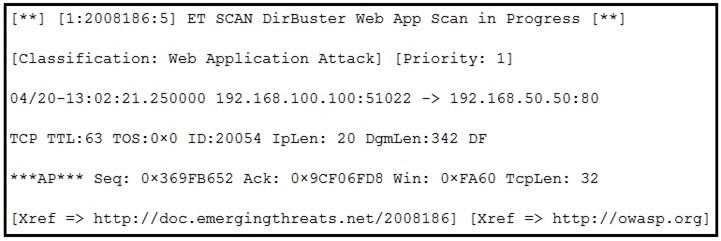 According to the SNORT alert, what is the attacker performing?
-
A
brute-force attack against the web application user accounts
-
B
XSS attack against the target webserver
-
C
brute-force attack against directories and files on the target webserver
-
D
SQL injection attack against the target webserver
Reveal answer details
Close answer details
Correct answerC
ExplanationThe alert clearly identifies ET SCAN DirBuster Web App Scan in Progress, referencing SID 2008186 , which is a Snort signature that specifically detects DirBuster activity. DirBuster is a well-known tool used for brute-forcing hidden directories and files on web servers. The Cisco CyberOps Associate guide and OWASP both identify directory brute-forcing as a reconnaissance technique to find unprotected or misconfigured endpoints on web applications, typically prior to launching deeper attacks. Therefore, the correct interpretation of the alert is: C. brute-force attack against directories and files on the target webserver.
Question 16
Single choice
Refer to the exhibit. 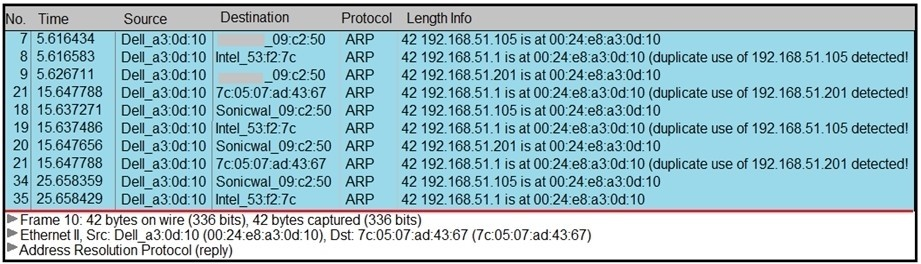 A security analyst notices unusual connections while monitoring traffic. What is the attack vector, and which action should be taken to prevent this type of event?
-
A
DNS spoofing; encrypt communication protocols
-
B
SYN flooding; block malicious packets
-
C
ARP spoofing; configure port security
-
D
MAC flooding; assign static entries
Reveal answer details
Close answer details
Correct answerC
ExplanationThe exhibit shows multiple ARP reply packets with the same IP addresses (192.168.51.105and192. 168.51.201) being mapped to different MAC addresses , which triggers the message: "duplicate use of [IP] detected". This is a strong indicator of an ARP spoofing (or poisoning) attack. ARP spoofing occurs when a malicious actor sends falsified ARP messages to associate their MAC address with the IP address of another host. This misleads other devices on the network and allows interception or redirection of traffic. The Cisco CyberOps Associate guide specifically recommends configuring port security on switches as a method to mitigate ARP spoofing , by limiting the number of MAC addresses allowed per port or statically assigning legitimate MAC addresses to switch ports.
Question 17
Single choice
Refer to the exhibit. 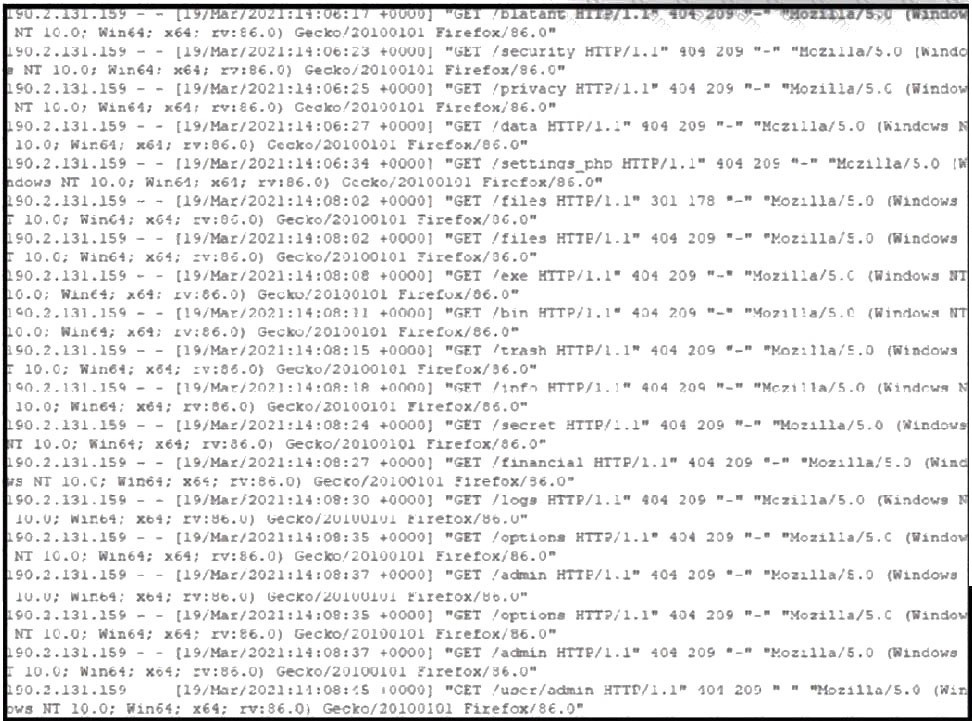 A security analyst notices that a web application running on NGINX is generating an unusual number of log messages. The application is operational and reachable. What is the cause of this activity?
-
A
-
B
-
C
-
D
Reveal answer details
Close answer details
Question 18
Single choice
What is the steganography anti-forensics technique?
-
A
hiding a section of a malicious file in unused areas of a file
-
B
changing the file header of a malicious file to another file type
-
C
sending malicious files over a public network by encapsulation
-
D
concealing malicious files in ordinary or unsuspecting places
Reveal answer details
Close answer details
Correct answerD
ExplanationSteganography is the anti-forensics technique of hiding malicious content within seemingly innocent files, such as image, audio, or video files. The goal is to conceal data or code in a way that avoids suspicion and detection, thereby making traditional security inspection tools ineffective unless they are explicitly designed to detect hidden data within media files. Steganography differs from encryption because it does not simply make data unreadable; it hides the existence of the data itself. It is commonly used in cyber operations to hide command-and-control instructions or to exfiltrate sensitive information in covert ways. References:
CyberOps Technologies (CBRFIR) 300-215 study guide, Chapter on Evasion and Obfuscation
Techniques, Anti-Forensics, Steganography Section.
|