A cloud administrator Is tasked with creating a new network segment In the software-defined data center that utilizes the corporate DHCP server to provide IP addresses. What is the proper sequence to create the required network segments?
-
A
1- Create a new segment attached to the Tler-0 gateway
2. Configure the segment DHCP Ip-helper
-
B
1. Create a DHCP server profile
2. Create a new segment attached to the Tler-0 gateway
3. Configure the segment DHCP config to utilize the new DHCP server profile
-
C
1. Create a new segment attached to the Tier-1 gateway
2. Configure the segment DHCP ip-helper
-
D
1. Create a DHCP relay profile
2. Create a new segment attached to the Tler-1 gateway
3. Configure the segment DHCP config to utilize the new DHCP relay profile
Reveal answer details
Close answer details
Correct answerB
Explanationhttps://docs.vmware.com/en/VMware-NSX-T-Data-Center/3.1/administration/GUID-BF536EEF-7AC3-47D0-B4E6-E24B591530AA.html
According to the VMware Exam Guide for Cloud Professional Exam (
https://mylearn.vmware.com/mgrreg/
courses.cfm?ui=www_edu&a=one&id_subject=45954 ),"To create a new network segment that utilizes the corporate DHCP server to provide IP addresses, the following sequence should be used: Create a DHCP server profile, create a new segment attached to the Tler-0 gateway, and configure the segment DHCP config to utilize the new DHCP server profile."
When configuring Hybrid Linked Mode, what is the maximum supported latency between an on-premises environment and a VMware Cloud on AWS software-defined data center (SDDC)?
-
A
200 milliseconds round trip
-
B
250 milliseconds round trip
-
C
150 milliseconds round trip
-
D
100 milliseconds round trip
Reveal answer details
Close answer details
Correct answerD
ExplanationHybrid Linked Mode can tolerate a time skew of up to ten minutes between the on-premises data center and the cloud SDDC. The maximum latency between your cloud SDDC and on-premises data center
cannot exceed 100 msec roundtrip. https://docs.vmware.com/en/VMware-Cloud-on-AWS/services/com.vmware.vsphere.vmc-aws-manage-data-center-vms.doc/GUID-BE75F0F1-2864-4926-97FE-37E635471C43.html
Question 3
Multiple choice
A cloud administrator wants to migrate a virtual machine using VMware vSphere vMotlon from their on-premises data center to their VMware Cloud on AWS software-defined data center (SDDC), using an existing private line to the cloud SDDC. Which two requirements must be met before the migration can occur? (Choose two.)
-
A
The versions of VMware vSphere need to match between the on-premises data center and the cloud SDDC.
-
B
A Layer 2 connection is configured between the on-premises data center and the cloud SDDC.
-
C
AWS Direct Connect is configured between the on-premises data center and the cloud SDDC.
-
D
IPsec VPN is configured between the on-premises data center and the cloud SDDC.
-
E
Cluster-level Enhanced vMotion Compatibility (EVC) is configured in the on-premises data center and the cloud SDDC.
Reveal answer details
Close answer details
Correct answersC, D
Explanationhttps://docs.vmware.com/en/VMware-Cloud-on-AWS/services/com.vmware.vmc-aws-operations/GUID-
1A175E91-2317-4261-A63E-B398D92ECE8D.htmlvMotion Requirements for SDDCs With NSX:Networking speed and latency: Migration with vMotion requires sustained minimum bandwidth of 250
Mbps between source and destination vMotion vMkernel interfaces, and a maximum latency of 100 ms round trip between source and destination.
On-premises vSphere version: Your on-premises vSphere installation must be vSphere 6.7U2 or higher.
See VMware Knowledge Base article 56991 for more information.
On-premises DVS version: 6.0 or higher.
On-premises NSX version: any Note: SDDCs configured with NSX do not support hot vMotion to or from on-premises VXLAN encapsulated networks (NSX for vSphere) or Geneve Datacenter Overlay networks (NSX).
IPsec VPN: Configure an IPsec VPN for the management gateway. See Configure a VPN Connection Between Your SDDC and On-Premises Data Center in the VMware Cloud on AWS Networking and Security guide. Direct Connect: Direct Connect over a private virtual interface between your on-premise data center and your VMware Cloud on AWS SDDC is required for migration with vMotion. See Using AWS Direct Connect with VMware Cloud on AWS. Hybrid Linked Mode: Hybrid Linked Mode is required to initiate migration from the vSphere Client. It is not required to initiate migration using the API or PowerCLI.
See "Hybrid Linked Mode" in Managing the VMware Cloud on AWS Data Center. L2 VPN: Configure a Layer 2 VPN to extend virtual machine networks between your on-premises data center and cloud SDDC.
Routed networks are not supported. See VMware Cloud on AWS Networking and Security. VMware Cloud on AWS firewall rules Ensure that you have created the necessary firewall rules as described in Required Firewall Rules for vMotion.
On-premises firewall rules: Ensure that you have created the necessary firewall rules as described in Required Firewall Rules for vMotion.
Virtual machine hardware and settings: Ensure that these requirements are met for virtual machine hardware. Virtual machine hardware version 9 or later is required for migration with vMotion from the on-premises data center to the cloud SDDC. EVC is not supported in the VMware Cloud on AWS SDDC. VMs that are created in the cloud SDDC or that have been power-cycled after migration to the cloud SDDC can't be migrated back to the on-premises data centerwith vMotion unless the on-premises EVC baseline is Broadwell. You can relocate these VMs after powering them off, as long as their virtual machine hardware version is compatible with the on-premises data center. Migration of VMs with DRS or HA VM overrides is not supported. For more information on VM overrides, see Customize an Individual Virtual Machine. Important: Source switch configurations (including NIOC, spoofguard, distributed firewall, and Switch Security) and runtime state are not applied at the destination as part of migration in either direction. Before you initiate vMotion, apply the source switch configuration to the destination network. In order for a virtual machine to be migrated using VMware vSphere vMotion, the versions of VMware vSphere need to match between the on-premises data center and the cloud SDDC, and a Layer 2 connection needs to be configured between them. Additionally, cluster-level Enhanced vMotion Compatibility (EVC) must be configured in both the on-premises data center and the cloud SDDC. IPsec VPN and AWS Direct Connect do not need to be configured for the migration to occur.
What is a key driver behind the multi-cloud journey?
-
A
Facilitate disaster recovery
-
B
Application modernization
-
C
-
D
Reveal answer details
Close answer details
Correct answerC
ExplanationA key driver behind the multi-cloud journey is digital transformation, which is the process of using technology to optimize existing processes and systems in order to improve customer experiences, increase operational efficiency, and accelerate business growth. Multi-cloud solutions can help organizations modernize their applications and services, reduce costs, increase agility, and support digital transformation initiatives. For more information, please refer to the official VMware Cloud on AWS documentation at:
https://docs.vmware.com/en/VMware-Cloud-on-AWS/index.html.
Question 5
Multiple choice
A cloud administrator is responsible for managing a VMware Cloud solution and would like to ensure that I/
O-intensive workloads run in the most optimum way possible. Which two steps should the administrator complete on I/O-intensive workloads to meet this requirement? (Choose two.)
-
A
Ensure that the VMware hardware version is 7 or later.
-
B
Enable the memory hot-add feature.
-
C
Configure the LSI Logic Parallel SCSI controller.
-
D
Configure the VMware Paravirtual SCSI (PVSCSI) adapter.
-
E
Configure a maximum of two CPU cores per socket.
Reveal answer details
Close answer details
Correct answersA, D
ExplanationThe two steps that the cloud administrator should complete on I/O-intensive workloads to ensure the best performance possible are to configure the VMware Paravirtual SCSI (PVSCSI) adapter and to ensure that the VMware hardware version is 7 or later. The PVSCSI adapter provides improved performance and scalability compared to the LSI Logic Parallel SCSI controller. Additionally, the hardware version should be 7 or later to ensure that the virtual machine is able to take advantage of the latest features and enhancements. Enabling the memory hot-add feature and configuring a maximum of two CPU cores per socket will not improve the performance of I/O-intensive workloads. Why does VMware refuse to educate their customers ... - VMware ...
https://communities.vmware.com/t5/VMware-Education-Services/Why-does-VMware-refuse-to-educate-their-customers/td-p/2005973 VMware Technical Support Guide
https://www.vmware.com/pdf/techsupportguide.pdf Publishing Applications with VMware Horizon 7
https://vcdx.vmware.com/content/dam/digitalmarketing/vmware/ru/pdf/techpaper/vmware-horizon-7-application-publishing.pdf 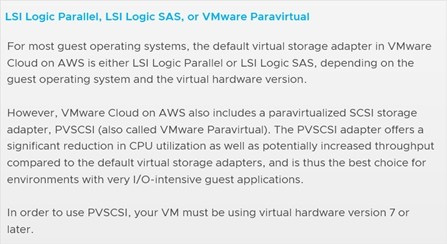 https://docs.vmware.com/en/VMware-Cloud-on-AWS/services/vmc-aws-performance.pdf
Question 6
Multiple choice
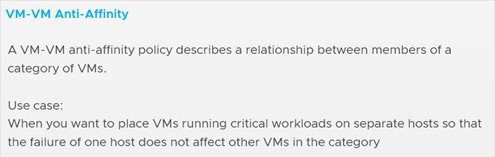
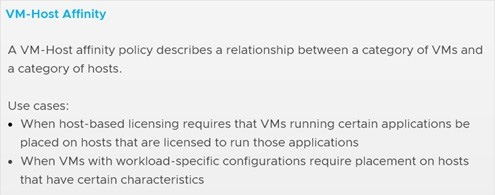
A cloud administrator Is tasked with deploying two virtual machines (APP01 and APP02) to a software-defined data center (SDDC) with multiple clusters hosted In VMware Cloud on AWS based on the following requirements: 1. APP01 and APP02 should NOT run on the same host.
2. Only three hosts in the SDDC are entitled to run the software installed on these servers.
3. All entitled hosts are in cluster 1. Which two actions should the administrator take to meet these requirements? (Choose two)
-
A
Create a Disable DRS vMotion policy.
-
B
Create a VM-VM anti-affinity policy.
-
C
Deploy APP01 to Cluster 1 and APP02 to cluster 2. a Create a VM-Host anti-affinity policy.
-
D
Create a VM-Host affinity policy.
Reveal answer details
Close answer details
A cloud administrator is managing a Google Cloud VMware Engine environment with a single cluster consisting of 28 Hosts. The Administrator and, based on estimates from the application team, requires seven additional hosts. What should the administrator do?
-
A
Add seven hosts to the existing cluster.
-
B
Provision a new private cloud.
-
C
-
D
Nothing; the cluster will scale automatically.
Reveal answer details
Close answer details
Correct answerC
Explanationhttps://cloud.google.com/vmware-engine/docs/concepts-vmware-componentsNode
Considerations You can specify the number of hosts to add or remove to or from their cluster. Private cloud initial setup happens in ~30 minutes.
Additional hosts can be added in ~15 minutes.
A three-node cluster is the minimum for production.
You can have up to 32 hosts per cluster.
You can have up to 64 hosts per private cloud. References:
https://cloud.google.com/vmware-engine/docs/concepts-vmware-components
What is a benefit of public cloud computing?
-
A
Full control over physical data location
-
B
Full control over software versions and software lifecycle
-
C
Highly customizable and configurable hardware options
-
D
Cost savings on capital hardware expenses
Reveal answer details
Close answer details
Correct answerD
ExplanationOne benefit of public cloud computing is cost savings on capital hardware expenses. Since the cloud provider owns and manages the hardware, the customer does not need to invest in the purchase and maintenance of physical hardware, resulting in significant cost savings. Additionally, public cloud services often provide scalability and can be accessed from anywhere with an internet connection.
Question 9
Multiple choice
Which two statements depict the VMWare Multi-cloud Vision? (Choose two)
-
A
Deliver a consistent management and operations layer across any cloud
-
B
Run the workloads in the cloud to eliminate security issues.
-
C
Standardize at the DevSecOps and infrastructure level.
-
D
Reduce the number of developers to increase productivity
-
E
Modernize applications in the cloud of choice using the cloud-native services of that cloud provider
Reveal answer details
Close answer details
Correct answersA, E
ExplanationVMware Multi-Cloud Vision enables customers to deliver a consistent management and operations layer across any cloud, and to modernize applications in the cloud of choice using the cloud-native services of that cloud provider. It does not run workloads in the cloud to eliminate security issues, standardize at the DevSecOps and infrastructure level, or reduce the number of developers to increase productivity.
Question 10
Single choice
A cloud administrator wants to enable administrator wants to enable Enterprise Federation to the Cloud Services Portal in order to be able to authenticate with the on-premises Active Directory. The Administrator Already deployed the on-premises VMware Workspace One Access Connector.
Through which port does the Cloud Service Portal communicate with Workspace ONE Access Connector?
-
A
-
B
-
C
-
D
Reveal answer details
Close answer details
Correct answerC
Explanationhttps://docs.vmware.com/en/VMware-Workspace-ONE-Access/20.10/workspace_one_access_install/
GUID-E81B6B1B-A3D1-40D0-806A-3D31502C53A5.html The Cloud Services Portal communicates with the Workspace ONE Access Connector via port 443 (HTTPS). According to the VMware documentation [1], the Cloud Services Portal connects to the Access Connector on port 443 to authenticate users and authorize access to the cloud service. The Access Connector listens on port 443 and communicates with the Active Directory using LDAP over TLS (LDAPS) on port 636.
References:
https://docs.vmware.com/en/VMware-Workspace-ONE-Access/services/com.vmware.access.admin.configure.doc/GUID-F5C6FD9E-36DA-4B1F-A7E7-CF8F64A81D78.html
Question 11
Multiple choice
Which two features of the VMware cloud on AWS platform are part of service management process? (Choose two.)
-
A
-
B
Microsoft licensing management
-
C
-
D
-
E
Reveal answer details
Close answer details
Correct answersC, E
ExplanationIncident Management is responsible for handling customer incidents and ensuring customer satisfaction.
Capacity Management is responsible for ensuring that the service is sized appropriately for customer needs and that the capacity is monitored to ensure that it meets customer requirements. VMware Tools management, Microsoft licensing management, and workload OS management are not part of the service management process. What is a Hypervisor? | VMware Glossary
https://www.vmware.com/topics/glossary/content/hypervisor.html VMware Cloud on AWS Operations Guide
https://docs.vmware.com/en/VMware-Cloud-on-AWS/services/vmc-aws-operations.pdf What is a Bare Metal Hypervisor?| VMware Glossary
https://www.vmware.com/topics/glossary/content/bare-metal-hypervisor.html
Question 12
Single choice
What must a cloud administrator configure in order to allow a company's on-premises data center to access the VMware Cloud on AWS vCenter Server.
-
A
Management network segment
-
B
-
C
Management gateway firewall
-
D
Reveal answer details
Close answer details
Correct answerC
Explanationhttps://docs.vmware.com/en/VMware-Cloud-on-AWS/services/com.vmware.vmc-aws-networking-security/
GUID-2D31A9A6-4A80-4B5B-A382-2C5B591F6AEB.html
Question 13
Single choice
A cloud administrator requires an external secure connection into their data center to use Border Gateway Protocol (BGP). Which connection type can they use to connect to an Instance of VMware Cloud?
-
A
Policy-based virtual private network (VPN)
-
B
Public IPs over the Internet
-
C
Private L2 virtual private network (VPN)
-
D
Route-based virtual private network (VPN)
Reveal answer details
Close answer details
Correct answerD
Explanationhttps://docs.vmware.com/en/VMware-Cloud-Disaster-Recovery/services/vmware-cloud-dr-security-best-practices/GUID-BCC03463-437B-4DBE-BE21-0D43D5BA5776.html A cloud administrator requires an external secure connection into their data center to use Border Gateway Protocol (BGP). The best connection type to use for this purpose is a Route-based virtual private network (VPN). This type of VPN is secure, as it uses encryption and authentication to protect the data transmitted over the connection. Additionally, it allows for the configuration of BGP to ensure that the data traffic is routed to the desired destination. PREPARING FOR VMWARE CLOUD ON AWS
https://www.vmware.com/content/dam/digitalmarketing/vmware/en/pdf/products/vmc-aws/preparing-for-vmware-cloud-on-aws.pdf Publishing Applications with VMware Horizon 7
https://vcdx.vmware.com/content/dam/digitalmarketing/vmware/ru/pdf/techpaper/vmware-horizon-7-application-publishing.pdf What is Network Virtualization? | VMware Glossary
https://www.vmware.com/topics/glossary/content/network-virtualization.html
Question 14
Single choice
A Cloud administrator is starting to plan a workload migration and wants to estimate the cost of running those workloads on VMware Cloud. Which VMware Cloud service should the administrator use to achieve this goal?
-
A
VMware vRealize Network Insight Cloud
-
B
VMware vRealize Operations Cloud
-
C
VMware vRealize Log Insight Cloud
-
D
VMware vRealize Automation Cloud
Reveal answer details
Close answer details
Correct answerB
ExplanationManaging Costs:
With its capacity and cost management features, vRealize Operations Cloud can predict future demand and provide actionable recommendations to help in managing costs.
Reclamation of Existing Resources: Assess workload status and resource contention in data centers across your environment: Determine the time remaining until CPU, memory, or storage resources run out. Realize cost savings when underutilized VMs are identified and reclaimed to be deployed more effectively.
Future Infrastructure Requirements Run what-if scenarios: Identify how much capacity remains after you add or remove VMs or hosts.
Add hyperconverged infrastructure (HCI) nodes.
Get a recommendation based on the cost relative to workload placement on different hosts, clusters, data centers, and even different clouds.
Cloud Migration Planning:
Migration planning shows you the capacity and cost information after the migration to a cloud-based infrastructure.
Cost Overview vRealize Operations Cloud supports costing for private clouds, public clouds, and VMware Cloud infrastructure.
You can track expenses for a single virtual machine, and identify how these expenses attribute to the overall cost associated with your private cloud accounts and VMware Cloud infrastructure accounts. On the Cost Overview home page in vRealize Operations Cloud, you can find details about the costs associated with your VMware Cloud infrastructure accounts, public cloud accounts, and your private cloud accounts.  You can view the Total Cost of Ownership, Potential Savings, and Realized Savings for your VMware Cloud infrastructure cloud accounts and vSphere private cloud accounts, and Total Cost of Ownership for
your private cloud accounts.
References:
https://docs.vmware.com/en/vRealize-Business/7.6/vRBforCloud.user.doc/GUID-AA3C209A-2DFA-433F-BD57-67E66A598E5D.html
Question 15
Single choice
With which solution is the cloud administrator interfacing when defining storage policies in a VMware Cloud software-defined data center (SDDC)?
-
A
VMware Virtual Volumes (vVols)
-
B
-
C
-
D
VMware Virtual Machine File System (VMFS)
Reveal answer details
Close answer details
Correct answerB
ExplanationVMware vSAN is a distributed storage platform that is integrated into the VMware Cloud software-defined data center (SDDC). It provides policy-based storage management, allowing cloud administrators to define storage policies that can be applied to virtual machines and other workloads. These policies govern how data is stored, replicated, and secured, and are used to ensure that data is stored in a consistent and compliant manner. https://docs.vmware.com/en/VMware-Cloud-on-AWS/services/com.vmware.vsphere.vmc-aws-manage-data-center-vms.doc/GUID-EDBB551B-51B0-421B-9C44-6ECB66ED660B.html
Question 16
Multiple choice
Which use cases apply to NSX logical routing? (Select two options)
-
A
You must provide external connectivity to VMs and containers.
-
B
Your organization must provide connectivity between VMs and containers that are connected to different segments.
-
C
You want to provide layer 2 connectivity between VMs and microservices.
-
D
You require intrinsic security for VMs connected to different segments.
Reveal answer details
Close answer details
Correct answersA, B
ExplanationThe two use cases that apply to NSX logical routing are
A. You must provide external connectivity to VMs and containers, and
B. Your organization must provide connectivity between VMs and containers that are connected to different segments. NSX logical routing allows you to provide external connectivity to VMs and containers, and to provide layer 3 connectivity between VMs and containers that are connected to different segments. It does not provide layer 2 connectivity between VMs and microservices or intrinsic security for VMs connected to different segments.
Question 17
Single choice
Which hyperscaler partner is best suited for customers who need 100 GB bandwidth between SDDCs in the cloud? (Select one option)
-
A
-
B
-
C
Oracle Cloud VMware Solution
-
D
Google Cloud VMware Engine
Reveal answer details
Close answer details
Correct answerA
ExplanationVMware Cloud on AWS provides the highest level of performance, reliability, and scalability for customers who need to move large amounts of data between their SDDCs in the cloud. It is also the only hyperscaler partner that has the ability to quickly and easily provision entire SDDCs in the cloud. In addition, VMware Cloud on AWS offers the most comprehensive enterprise-grade features, such as automated backups and disaster recovery, which provide customers with peace of mind that their data is always secure and protected.
Question 18
Single choice
Which VMware Cloud tool would an administrator use to forward all the monitored traffic to a network appliance for analysis and remediation?
-
A
-
B
-
C
-
D
Reveal answer details
Close answer details
Correct answerC
ExplanationPort mirroring is a VMware Cloud tool that an administrator can use to forward all the monitored traffic to a network appliance for analysis and remediation. The network appliance can then analyze the mirrored traffic and take the appropriate remedial action. Port mirroring can also be used to identify and troubleshoot network issues, as well as monitor network activities.
Port mirroring lets you replicate and redirect all of the traffic coming from a source. The mirrored traffic is sent encapsulated within a Generic Routing Encapsulation (GRE) tunnel to a collector so that all of the original packet information is preserved while traversing the network to a remote destination.
Port mirroring is used in the following scenarios: Troubleshooting - Analyze the traffic to detect intrusion and debug and diagnose errors on a network.
Compliance and monitoring - Forward all of the monitored traffic to a network appliance for analysis and remediation.
Port mirroring includes a source group where the data is monitored and a destination group where the collected data is copied to. The source group membership criteria require VMs to be grouped based on the workload such as web group or application group. The destination group membership criteria require VMs to be grouped based on IP addresses. Port mirroring has one enforcement point, where you can apply policy rules to your SDDC environment.
The traffic direction for port mirroring is Ingress, Egress, or Bi Directional traffic: Ingress is the outbound network traffic from the VM to the logical network. Egress is the inbound network traffic from the logical network to the VM. Bi Directional is the traffic from the VM to the logical network and from the logical network to the VM. This is the default option.
https://docs.vmware.com/en/VMware-Cloud-on-AWS/services/com.vmware.vmc-aws-networking-security/
GUID-3268A0D3-89D0-406F-B44F-156DD1A30E00.html
Question 19
Multiple choice
Which four steps must a cloud administrator take to deploy a new private cloud In Azure VMware Solution? (Choose four.)
-
A
Identify the maximum number of hosts needed for future capacity.
-
B
Identify the desired availability zone.
-
C
Identify a management CIDR of size /22.
-
D
Open a support request with Microsoft Azure requesting capacity.
-
E
Identify a management CIDR of size /20.
-
F
Identify the desired region.
-
G
Identify the current number of hosts needed.
Reveal answer details
Close answer details
Correct answersB, C, D, G
ExplanationIdentify the desired region. This determines where your private cloud will be deployed and which Azure services are available.
Identify a management CIDR of size /22. This determines the IP address range for your private cloud management components such as vCenter Server, NSX Manager, etc.
Open a support request with Microsoft Azure requesting capacity. This ensures that there are enough hosts available for your private cloud deployment. Identify the current number of hosts needed. This determines how many hosts will be provisioned initially for your private cloud cluster.
https://vmc.techzone.vmware.com/resource/avs-planning-and-deployment-guide
|