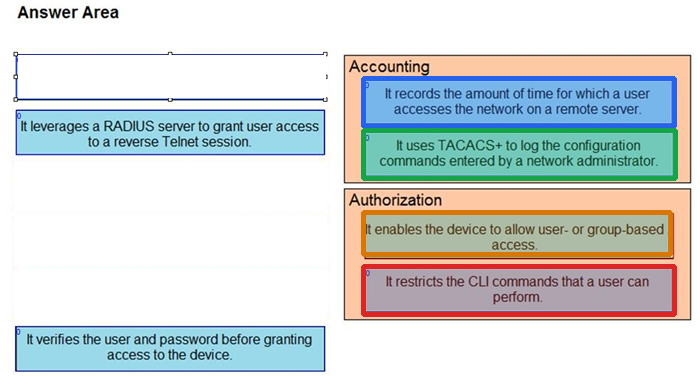
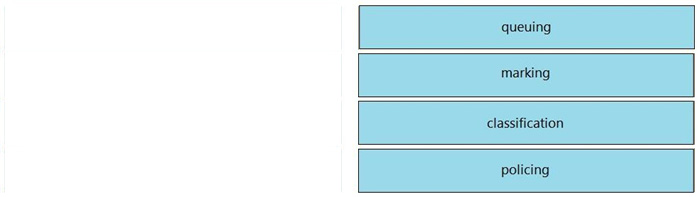
What is a similarly between 1000BASE-LX and 1000BASE-T standards?
-
A
Both use the same data-link header and trailer formats
-
B
Both cable types support LP connectors
-
C
Both cable types support Rj-45 connectors
-
D
Both support up to 550 meters between nodes
Reveal answer details
Close answer details
Correct answerA
ExplanationIn computer networking, Gigabit Ethernet (GbE or 1 GigE) is the term applied to transmitting Ethernet frames at a rate of a gigabit per second." Both standards use Ethernet framing (same headers and trailers)
Refer to the exhibit. 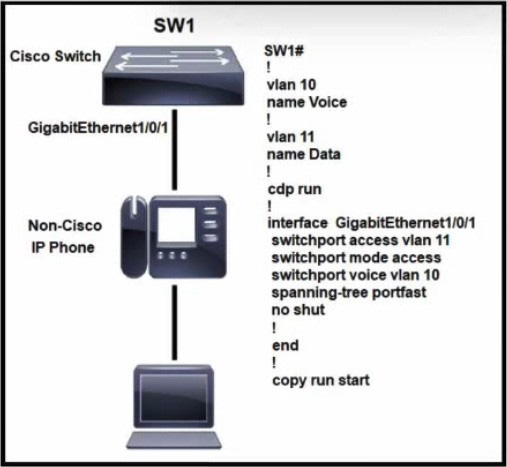 A multivendor network exists and the company is implementing VoIP over the network for the first time. Which configuration is needed to implement the neighbor discovery protocol on the interface and allow it to remain off for the remaining interfaces? 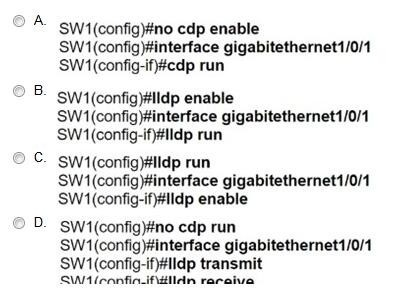
-
A
-
B
-
C
-
D
Reveal answer details
Close answer details
Correct answerC
ExplanationCDP and LLDP can coexist, or be used at the same time, especially if your network environment is made up of devices from different vendors. The majority of Cisco devices will also support LLDP, as this allows them to interoperate with other vendors. However, in those devices, LLDP is off by default.
Which type of IPv4 address type helps to conserve the globally unique address classes?
-
A
-
B
-
C
-
D
Reveal answer details
Close answer details
Correct answerB
ExplanationThe term "private" in the context of IPv4 addresses refers to address ranges that are reserved for use within private networks and are not globally routable on the internet. Private IPv4 addresses help conserve the globally unique address classes by allowing organizations to use these addresses internally, without requiring unique public IP addresses for every device on their network.
Refer to the exhibit. 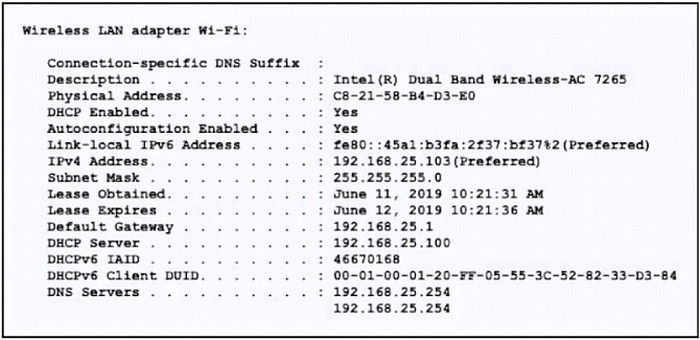 Which address will the client contact to renew their IP address when the current lease expires?
-
A
-
B
-
C
-
D
Reveal answer details
Close answer details
Which network action occurs within the data plane?
-
A
compare the destination IP address to the IP routing table.
-
B
run routing protocols (OSPF, EIGRP, RIP, BGP)
-
C
make a configuration change from an incoming NETCONF RPC
-
D
reply to an incoming ICMP echo request
Reveal answer details
Close answer details
Correct answerA
ExplanationExtracted from Book #2, page 359:
"... the following list details some of the more common actions that a networking device does that fit into the data plane: - De-encapsulating and re-encapsulating a packet in a data-link frame (routers, layer 3 switches).
- Adding or removing an 802.1Q trunking header (routers and switches).
- Matching an ethernet frame's destination MAC address to the MAC address table (layer 2 switches).
- Matching an IP packet's destination IP address to the IP routing table (routers, layer 3 switches).
- Encrypting the data and adding a new IP header (for VPN processing).
- Changing the source or destination IP address (for NAT) processing).
- Discarding a message due to a filter (ACLs, port security). All the items in the list make up the data plane, because the data plane includes all actions done per message."
Question 6
Multiple choice
When configuring IPv6 on an interface, which two IPv6 multicast groups are joined? (Choose two.)
-
A
-
B
-
C
-
D
-
E
Reveal answer details
Close answer details
Correct answersD, E
ExplanationWhen an interface is configured with IPv6 address, it automatically joins the all nodes (FF02::1) and solicited-node (FF02::1:FFxx:xxxx) multicast groups. The all-node group is used to communicate with all
interfaces on the local link, and the solicited-nodes multicast group is required for link-layer address resolution. Routers also join a third multicast group, the all-routers group (FF02::2). References:
https://www.cisco.com/c/en/us/td/docs/ios-xml/ios/ipv6/configuration/xe-3s/ipv6-xe-36s-book/ip6-multicast.html
You have configured a router with an OSPF router ID, but its IP address still reflects the physical interface. Which action can you take to correct the problem in the least disruptive way?
-
A
-
B
Specify a loopback address
-
C
-
D
Save the router configuration
Reveal answer details
Close answer details
Correct answerA
ExplanationOnce an OSPF Router ID selection is done, it remains there even if you remove it or configure another OSPF Router ID. So the least disruptive way is to correct it using the command "clear ip ospf process".
Which switching feature removes unused MAC addresses from the MAC address table, which allows new MAC addresses to be added?
-
A
-
B
-
C
-
D
dynamic MAC address learning
Reveal answer details
Close answer details
Correct answerA
ExplanationMAC address aging is a switching feature that removes unused MAC addresses from the MAC address table after a certain period of inactivity. This frees up space in the MAC address table, allowing new MAC addresses to be added when new devices are connected to the network. The aging time determines how long a MAC address can remain in the table without any activity before it is considered unused and eligible for removal. This feature helps optimize the usage of MAC address table resources in a switch.
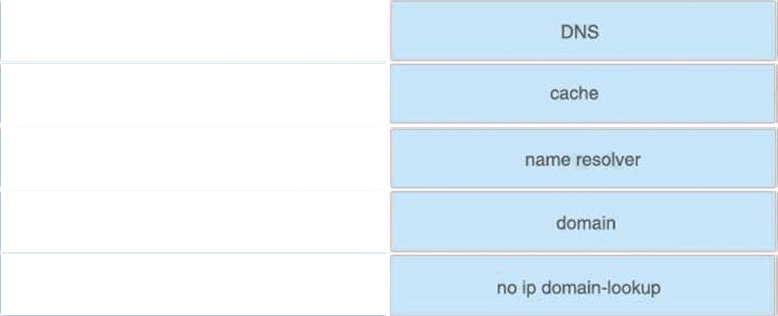
DRAG DROP Drag and drop the DNS lookup components from the left onto the functions on the right. 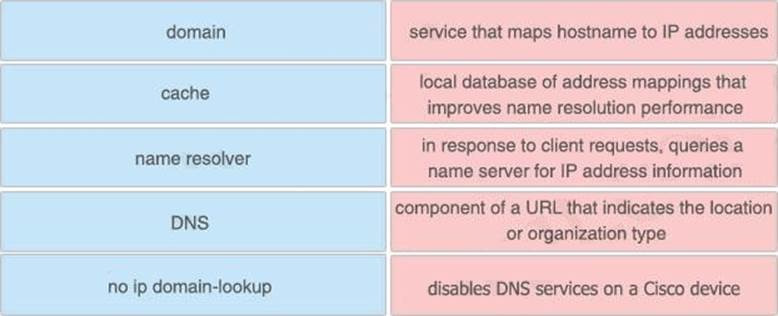
Reveal answer details
Close answer details
Question 10
Multiple choice
A network engineer is replacing the switches that belong to a managed-services client with new Cisco Catalyst switches. The new switches will be configured for updated security standards, including replacing Telnet services with encrypted connections and doubling the modulus size from 1024. Which two commands must the engineer configure on the new switches? (Choose two.)
-
A
crypto key generate rsa general-keys modulus 1024
-
B
-
C
crypto key generate rsa usage-keys
-
D
crypto key generate rsa modulus 2048
-
E
Reveal answer details
Close answer details
Correct answersD, E
ExplanationReplacing telnet with encrypted connections requires the use of SSH, which is done in the vty section of the configuration using the transport input ssh command.
Question 11
Single choice
Which interface condition is occurring in this output? 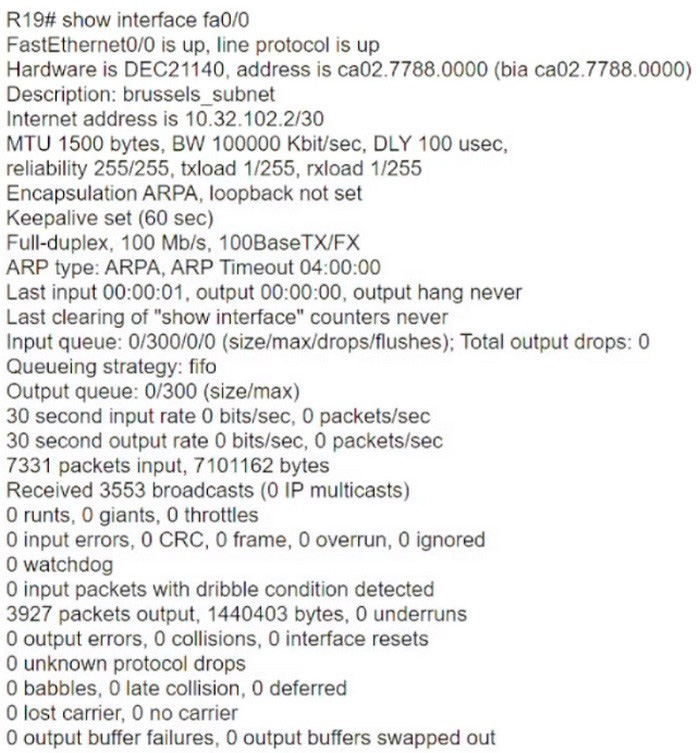
-
A
-
B
-
C
-
D
Reveal answer details
Close answer details
Question 12
Single choice
Refer to the exhibit. 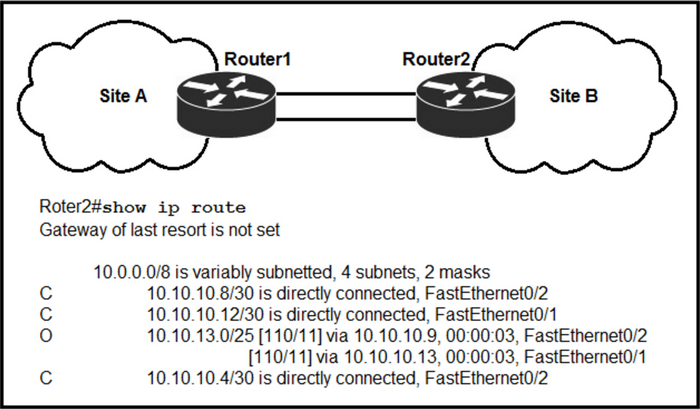 If OSPF is running on this network, how does Router 2 handle traffic from Site B to 10.10.13.128/25 at Site A?
-
A
It sends packets out of interface Fa0/1 only.
-
B
It sends packets out of interface Fa0/2 only.
-
C
It load-balances traffic out of Fa0/1 and Fa0/2.
-
D
It cannot send packets to 10.10.13.128/25.
Reveal answer details
Close answer details
Correct answerD
ExplanationRouter2 does not have an entry for the subnet 10.10.13.128/25. It only has an entry for 10.10.13.0/25, which ranges from 10.10.13.0 to 10.10.13.127
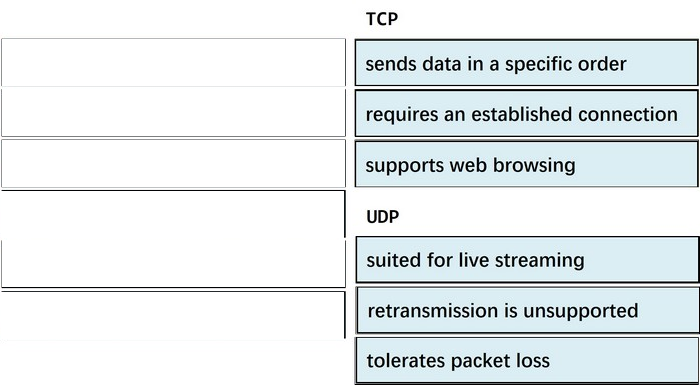
DRAG DROP Drag and drop the TCP and UDP characteristics from the lett onto the corresponding protocols on the right. 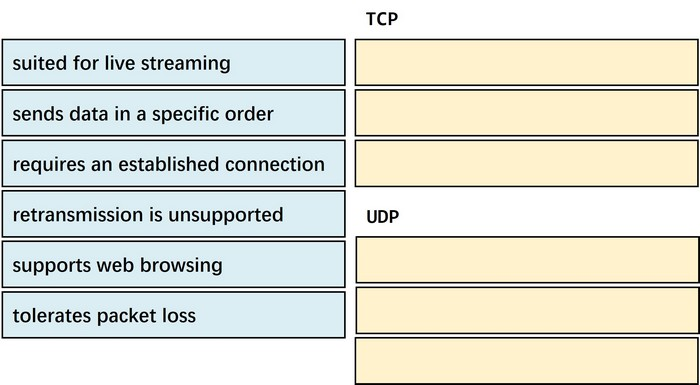
Reveal answer details
Close answer details
Question 14
Single choice
Which command automatically generates an IPv6 address from a specified IPv6 prefix and MAC address of an interface?
-
A
-
B
ipv6 address 2001:DB8:5:112::/64 eui-64
-
C
-
D
ipv6 address 2001:DB8:5:112::2/64 link-local
Reveal answer details
Close answer details
Correct answerB
ExplanationThe command "ipv6 address 2001:DB8:5:112::/64 eui-64" automatically generates an IPv6 address from a specified IPv6 prefix and MAC address of an interface using the EUI-64 method. The EUI-64 method uses the MAC address of the interface to create an interface identifier (IID) that is used to complete the IPv6 address. Option A ("ipv6 address dhcp") configures an interface to obtain an IPv6 address through DHCPv6. Option C ("ipv6 address autoconfig") configures an interface to automatically obtain an IPv6 address using Stateless Address Autoconfiguration (SLAAC). Option D ("ipv6 address 2001:DB8:5:112::2/64 link-local") configures an IPv6 link-local address on the
interface. The EUI-64 method uses the MAC (Media Access Control) address of the network interface to generate a unique 64-bit identifier. The MAC address is a unique identifier assigned to the network interface by the manufacturer and is usually 48 bits long. The EUI-64 method takes the MAC address and adds a 16-bit value to create a 64-bit identifier.
Question 15
Single choice
An organization developed new security policies and decided to print the policies and distribute them to all personnel so that employees review and apply the policies. Which element of a security program is the organization implementing?
-
A
-
B
-
C
-
D
Reveal answer details
Close answer details
Question 16
Single choice
Refer to the exhibit. 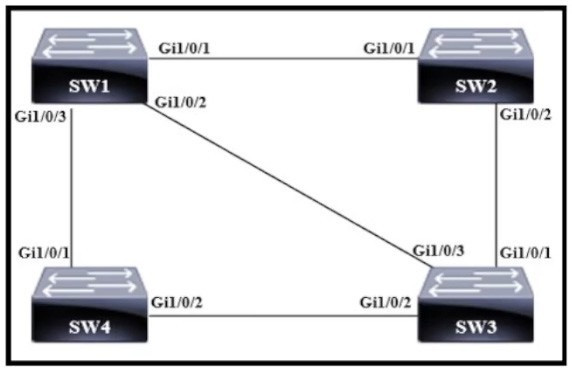 Which switch becomes the root bridge?
-
A
SW 1 Bridge Priority - 32768
mac-address 0f:d7:9e:13:ab:82
-
B
SW 2
Bridge Priority - 40960
mac-address 05:d8:33:09:8f:89
-
C
SW 3
Bridge Priority - 32768
mac-address 01:1c:6c:66:b7:70
-
D
SW 4
Bridge Priority - 40960
mac-address 04:44:97:51:63:17
Reveal answer details
Close answer details
Correct answerC
Explanationlowest priority, and lowest MAC address
Question 17
Single choice
Refer to the exhibit. The DHCP server and clients are connected to the same switch. What is the next step to complete the DHCP configuration to allow clients on VLAN 1 to receive addresses from the DHCP server? 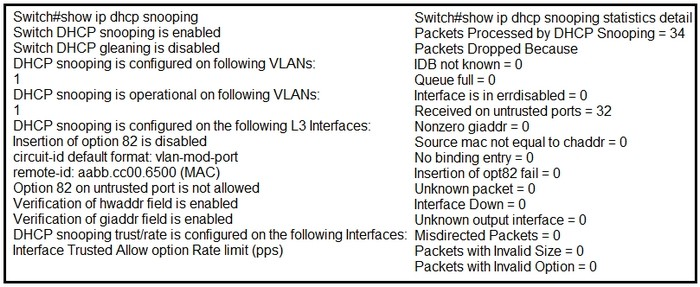
-
A
Configure the ip dhcp snooping trust command on the interlace that is connected to the DHCP client.
-
B
Configure the ip dhcp relay information option command on the interface that is connected to the DHCP client.
-
C
Configure the ip dhcp snooping trust command on the interface that is connected to the DHCP server.
-
D
Configure the Ip dhcp relay information option command on the interface that is connected to the DHCP server.
Reveal answer details
Close answer details
Correct answerC
ExplanationIf a Layer 2 LAN port is connected to a DHCP server, configure the port as trusted by entering the ip dhcp snooping trust interface configuration command.
https://www.cisco.com/en/US/docs/general/Test/dwerblo/broken_guide/snoodhcp.html#wp1073367
Question 18
Single choice
Which network allows devices to communicate without the need to access the Internet?
-
A
-
B
-
C
-
D
Reveal answer details
Close answer details
Correct answerB
ExplanationThis question asks about the private ranges of IPv4 addresses. The private ranges of each class of IPv4 are listed below: 1. Class A private IP address ranges from 10.0.0.0 to 10.255.255.255 2. Class B private IP address ranges from 172.16.0.0 to 172.31.255.255
3. Class C private IP address ranges from 192.168.0.0 to 192.168.255.255 Only the network 172.28.0.0/16 belongs to the private IP address (of class B).
Question 19
Single choice
What is a reason to implement IPv4 private addressing?
-
A
Reduce the risk of a network security breach
-
B
Comply with PCI regulations
-
C
-
D
Reduce the size of the forwarding table on network routers
Reveal answer details
Close answer details
Question 20
Single choice
Refer to the exhibit. 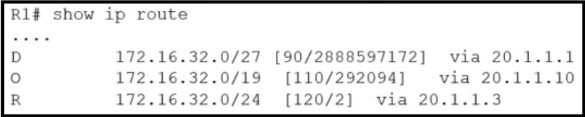 An engineer executed the script and added commands that were not necessary for SSH and now must remove the commands. Which routing attribute determines the best path when multiple routes to the same destination exist?
-
A
-
B
-
C
-
D
Reveal answer details
Close answer details
Question 21
Single choice
Which combination of methods satisfies the minimum security requirements when a new multifactor authentication solution is deployed?
-
A
password of 8 to 15 characters and personal 12-diglt PIN
-
B
authorized USB dongle and mobile phone
-
C
fingerprint scanning and facial recognition
-
D
complex password and time-based one-time password
Reveal answer details
Close answer details
Question 22
Single choice
When a WPA2-PSK WLAN is configured in the Wireless LAN Controller, what is the minimum number of characters that is required in ASCII formar?
-
A
-
B
-
C
-
D
Reveal answer details
Close answer details
Correct answerB
ExplanationWPA preshared keys must contain 8 to 63 ASCII text characters or 64 hexadecimal characters.
Question 23
Single choice
What is the difference in data transmission delivery and reliability between TCP and UDP?
-
A
TCP transmits data at a higher rate and ensures packet delivery. UDP retransmits lost data to ensure applications receive the data on the remote end.
-
B
UDP sets up a connection between both devices before transmitting data. TCP uses the three-way handshake to transmit data with a reliable connection.
-
C
UDP is used for multicast and broadcast communication. TCP is used for unicast communication and transmits data at a higher rate with error checking.
-
D
TCP requires the connection to be established before transmitting data. UDP transmits data at a higher rate without ensuring packet delivery.
Reveal answer details
Close answer details
Correct answerD
ExplanationUDP speeds up transmissions by enabling the transfer of data before an agreement is provided by the receiving party. As a result, UDP is beneficial in time-sensitive communications, including voice over IP (VoIP), domain name system (DNS) lookup, and video or audio playback.
Question 24
Single choice
A WLC sends alarms about a rogue AP, and the network administrator verifies that the alarms are caused by a legitimate autonomous AP.
-
A
Place the AP into manual containment.
-
B
Remove the AP from WLC management.
-
C
Manually remove the AP from Pending state.
-
D
Set the AP Class Type to Friendly.
Reveal answer details
Close answer details
Correct answerD
ExplanationA WLC will send alarms about a rogue AP when it detects an AP that is not under its management. This can happen when a legitimate autonomous AP is installed on the network. To stop the alarms, the network administrator must set the AP Class Type to Friendly. This will tell the WLC that the AP is a legitimate AP and that it should not send alarms about it. The other options are incorrect for the following reasons: Removing the AP from WLC management will stop the alarms, but it will also prevent the WLC from managing the AP. This is not necessary, since the AP is a legitimate AP. Placing the AP into manual containment will stop the alarms, but it will also prevent the AP from being used by clients. This is not necessary, since the AP is a legitimate AP. Manually removing the AP from Pending state will not stop the alarms. The WLC will continue to send alarms about the AP until the AP Class Type is set to Friendly.
Question 25
Single choice
A Cisco engineer must configure a single switch interface to meet these requirements 1. accept untagged frames and place them in VLAN 20
2. accept tagged frames in VLAN 30 when CDP detects a Cisco IP phone Which command set must the engineer apply?
-
A
switchport mode dynamic desirable
switchport access vlan 20
switchport trunk allowed vlan 30
switchport voice vlan 30
-
B
switchport mode dynamic auto
switchport trunk native vlan 20
switchport trunk allowed vlan 30
switchport voice vlan 30
-
C
switchport mode access
switchport access vlan 20
switchport voice vlan 30
-
D
switchport mode trunk
switchport access vlan 20 switchport voice vlan 30
Reveal answer details
Close answer details
Correct answerC
ExplanationThe data vlan is connected to the IP phone. Data VLANs connected to the IP phones are untagged by default.
The IP phone connected to a switchport should learn its vlan using cdp. To configure this, the command is
"switchport voice Vlan 30" https://www.practicalnetworking.net/stand-alone/voice-vlan-auxiliary-vlan/
https://docs.nvidia.com/networking-ethernet-software/cumulus-linux-40/Layer-2/Link-Layer-Discovery-Protocol/Voice-VLAN/
Question 26
Single choice
Where does a switch maintain DHCP snooping information?
-
A
-
B
-
C
-
D
in the frame forwarding database
Reveal answer details
Close answer details
Correct answerC
ExplanationThe DHCP snooping binding database is also referred to as the DHCP snooping binding table.The DHCP snooping feature dynamically builds and maintains the database using information extracted from intercepted DHCP messages. The database contains an entry for each untrusted host with a leased IP address if the host is associated with a VLAN that has DHCP snooping enabled. The database does not contain entries for hosts connected through trusted interface
Question 27
Single choice
Refer to the exhibit. An administrator must turn off the Cisco Discovery Protocol on the port configured with address last usable address in the 10.0.0.0/30 subnet. Which command set meets the requirement? 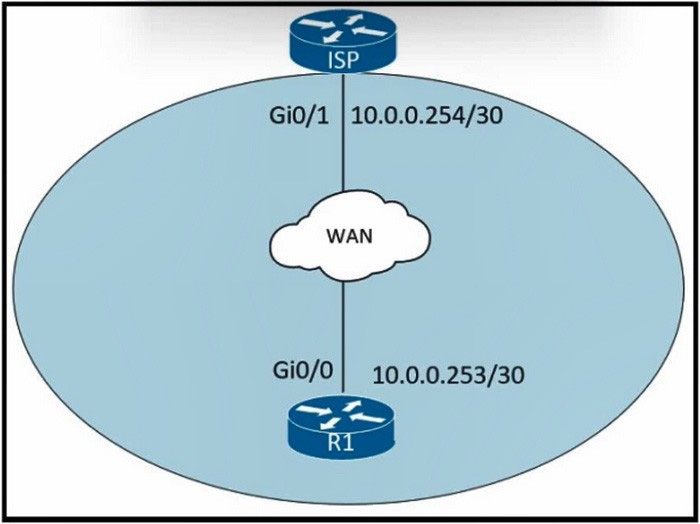
-
A
interface gi0/1
no cdp enable
-
B
interface gi0/1
clear cdp table
-
C
interface gi0/0
no cdp advertise-v2
-
D
interface gi0/0
no cdp run
Reveal answer details
Close answer details
Correct answerA
Explanation254 is last usable address and no cdp run is not a valid interface command so it can't be B anyway. [no] cdp run is a global command. The valid config-if command is no cdp enable
Question 28
Single choice
Refer to the exhibit. A network engineer must configure R1 so that it sends all packets destined to the 10.0.0.0/24 network to R3, and all packets destined to PC1 to R2. Which configuration must the engineer implement? 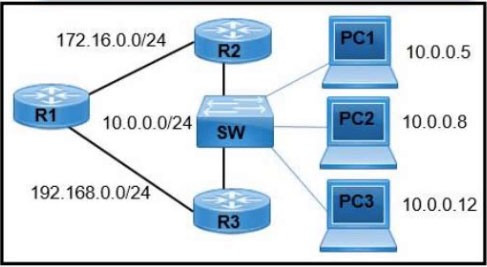
-
A
R1(config)#ip route 10.0.0.0 255.255.255.0 172.16.0.2
R1(config)#ip route 10.0.0.5 255.255.255.255 192.168.0.2
-
B
R1(config)#ip route 10.0.0.0 255.255.0.0 172.16.0.2
R1(config)#ip route 10.0.0.5 255.255.255.255 192.168.0.2
-
C
R1(config)#ip route 10.0.0.0 255.255.255.0 192.168.0.2
R1(config)#ip route 10.0.0.5 255.255.255.255 172.16.0.2
-
D
R1(config)#ip route 10.0.0.0 255.255.0.0 192.168.0.2
R1(config)#ip route 10.0.0.5 255.255.255.0 172.16.0.2
Reveal answer details
Close answer details
Question 29
Single choice
A Cisco IP phone receives untagged data traffic from an attached PC. Which action is taken by the phone?
-
A
-
B
It allows the traffic to pass through unchanged.
-
C
It tags the traffic with the native VLAN.
-
D
It tags the traffic with the default VLAN.
Reveal answer details
Close answer details
Correct answerB
ExplanationUntagged traffic from the device attached to the Cisco IP Phone passes through the phone unchanged, regardless of the trust state of the access port on the phone. References:
https://www.cisco.com/c/en/us/td/docs/switches/lan/catalyst2960x/software/15-0_2_EX/vlan/configuration_guide/b_vlan_152ex_2960-x_cg/b_vlan_152ex_2960-x_cg_chapter_0110.pdf
Question 30
Single choice
Which AP mode is used for capturing wireless traffic and forwarding that traffic to a PC that is running a packet analyzer?
-
A
-
B
-
C
-
D
Reveal answer details
Close answer details
Correct answerD
ExplanationThe controller enables you to configure an access point as a network "sniffer", which captures and forwards all the packets on a particular channel to a remote machine that runs packet analyzer software.
These packets contain information on time stamps, signal strength, packet sizes, and so on.
Question 31
Single choice
Why would a network administrator choose to implement RFC 1918 address space?
-
A
to route traffic on the internet
-
B
to provide flexibility in the IP network design
-
C
to provide overlapping address space with another network
-
D
to limit the number of hosts on the network
Reveal answer details
Close answer details
Question 32
Single choice
Which type of ipv6 address is publicly routable in the same way as ipv4 public addresses?
-
A
-
B
-
C
-
D
Reveal answer details
Close answer details
Correct answerD
ExplanationThe type of IPv6 address that is publicly routable in the same way as IPv4 public addresses is a global unicast address. Global unicast addresses are unique, globally reachable addresses that are assigned to devices that need to communicate with other devices over the Internet. They are similar to IPv4 public addresses in that they can be used to reach devices on other networks, but they are structured differently and use a different address space. Global unicast addresses are identified by the prefix "2000::/3" and are assigned to devices by their network administrator or by an Internet service provider (ISP). They are used for communication between devices on different networks, such as between a device on a LAN and a device on the Internet. It's important to note that global unicast addresses are not the same as link-local addresses, which are used for communication within a single network segment or link and are not intended to be routable over the Internet. Link-local addresses are identified by the prefix "FE80::/10" and are automatically generated
by the device when it is connected to a network.
Question 33
Single choice
Refer to the exhibit. 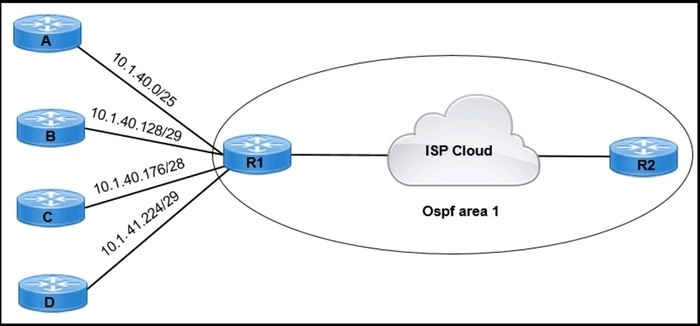 Router R1 receives static routing updates from routers A, B, C, and D. The network engineer wants R1 to advertise static routes in OSPF area 1. Which summary address must be advertised in OSPF?
-
A
-
B
-
C
-
D
Reveal answer details
Close answer details
Question 34
Single choice
Refer to the exhibit. 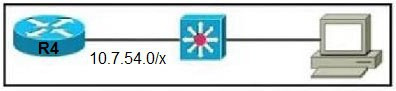 The router has been configured with a supernet to accommodate the requirement for 380 users on a subnet The requirement already considers 30% future growth. Which configuration verifies the IP subnet on router R4?
-
A
Subnet: 10.7.54.0
Subnet mask: 255.255 254.0
Broadcast address: 10.7.54.255
Usable IP address range: 10.7.54.1 10.7.55.254
-
B
Subnet: 10.7.54.0
Subnet mask: 255.255.254.0
Broadcast address: 10.7.55.255
Usable IP address range: 10.7.54.1 10.7.55.254
-
C
Subnet: 10.7.54.0
Subnet mask: 255.255.128.0
Broadcast address: 10.7.55.255
Usable IP address range: 10.7.54.1 10.7.55.254
-
D
Subnet: 10.7.54.0
Subnet mask: 255.255.255.0
Broadcast address: 10.7.54.255
Usable IP address range: 10.7.54.1 10.7.55.254
Reveal answer details
Close answer details
Question 35
Single choice
Which command is used to verify the DHCP relay agent address that has been set up on your Cisco IOS router?
-
A
-
B
-
C
-
D
-
E
-
F
Reveal answer details
Close answer details
Correct answerD
ExplanationWith that command you can see if the helper address (dhcp relay) is configured. Router1#sh ip interface g0/0
GigabitEthernet0/0 is up, line protocol is up (connected)
Internet address is 10.0.0.1/30
Broadcast address is 255.255.255.255
Address determined by setup command
MTU is 1500 bytes
Helper address is 192.168.4.2
Question 36
Single choice
What is a characteristic of encryption in wireless networks?
-
A
intercepts data threats before they attack a network
-
B
uses policies to prevent unauthorized users
-
C
must include a combination of letters and numbers
-
D
encodes and decodes data for authorized users
Reveal answer details
Close answer details
Question 37
Single choice
Refer to the exhibit. 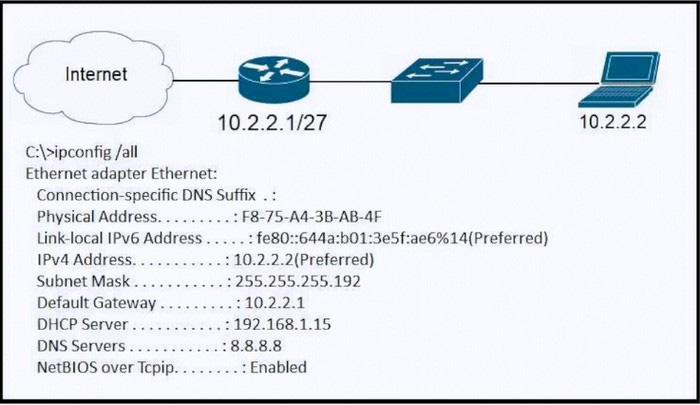 A newly configured PC fails to connect to the internet by using TCP port 80 to www.cisco.com. Which setting must be modified for the connection to work?
-
A
-
B
-
C
-
D
Reveal answer details
Close answer details
Question 38
Single choice
Which security program element involves installing badge readers on data-center doors to allow workers to enter and exit based on their job roles?
-
A
role-based access control
-
B
-
C
multifactor authentication
-
D
Reveal answer details
Close answer details
Question 39
Single choice
What is a difference between an IPv6 multicast address and an IPv6 anycast address?
-
A
An IPv6 multicast address uses the prefix 2002::/15 and forwards to one destination, and an IPv6
anycast address uses the prefix ff00:/8 and forwards to any destination in a group.
-
B
A packet sent to an IPv6 multicast address is delivered to one or more destinations at once, but a packet sent to an IPv6 anycast address is routed to the closest interface with that address.
-
C
IPV6 multicast addresses are used to transition from IPv4 to IPv6, and IPv6 anycast addresses are used for address aggregation in an IPv6-only environment.
-
D
An IPV6 multicast address is assigned to numerous interfaces within a subnet, but an IPv6 anycast address is used for a predefined group of nodes in an all-IPv6 routers group.
Reveal answer details
Close answer details
Question 40
Single choice
Refer to the exhibit. Which configuration issue is preventing the OSPF neighbor from being established between the two routers? 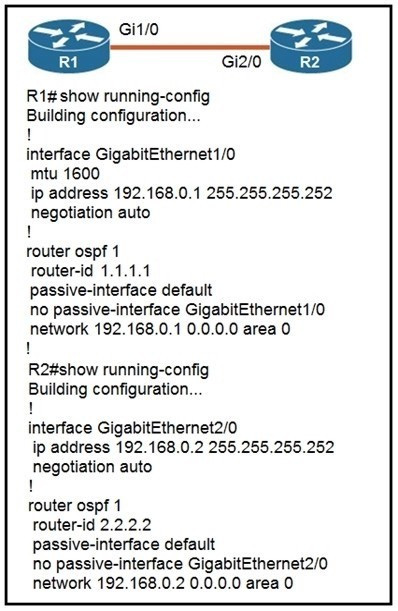
-
A
R1 has an incorrect network command for interface Gi1/0.
-
B
R2 should have its network command in area 1.
-
C
R1 interface Gi1/0 has a larger MTU size.
-
D
R2 is using the passive-interface default command.
Reveal answer details
Close answer details
Correct answerC
ExplanationIf the Interface MTU field in the Database Description packet indicates an IP datagram size that is larger than the router can accept on the receiving interface without fragmentation, the Database Description packet is rejected. The default MTU on an interface is 1500.
Question 41
Single choice
What is the primary effect of the spanning-tree portfast command?
-
A
It immediately enables the port in the listening state.
-
B
It immediately puts the port into the forwarding state when the switch is reloaded.
-
C
It enabled BPDU messages.
-
D
It minimizes spanning-tree convergence time.
Reveal answer details
Close answer details
Correct answerD
ExplanationReferences:
https://www.cisco.com/c/en/us/td/docs/switches/lan/catalyst3560/software/release/12-2_55_se/configuration/guide/3560_scg/swstpopt.html
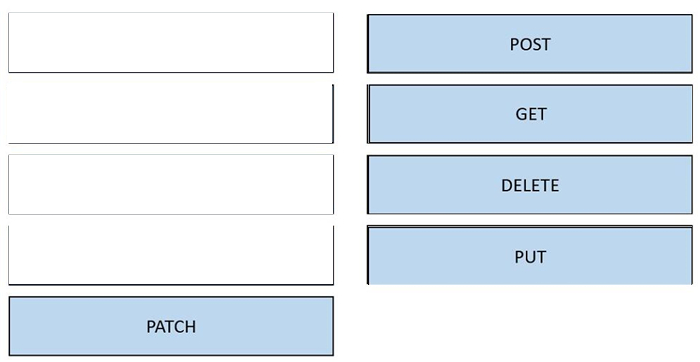
DRAG DROP Drag and drop the REST API call methods for HTTP from the left onto the actions they perform on the right. Not all methods are used. 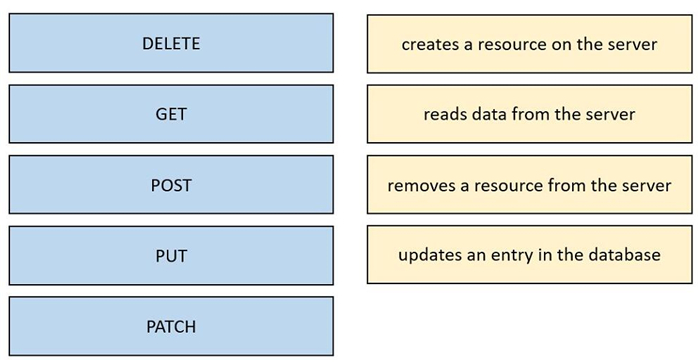
Reveal answer details
Close answer details
Question 43
Single choice
Refer to the exhibit. 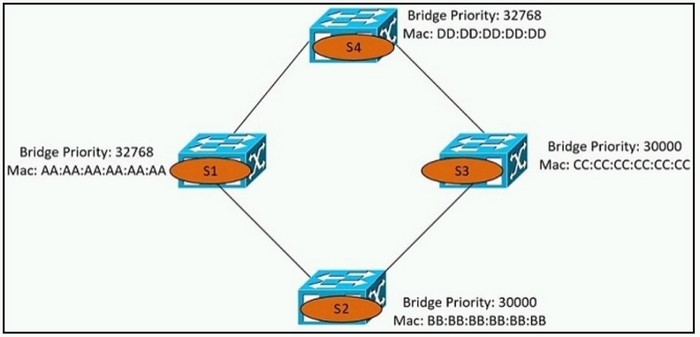 Which switch becomes the root bridge?
-
A
-
B
-
C
-
D
Reveal answer details
Close answer details
Question 44
Single choice
An engineer is configuring NAT to translate the source subnet of 10.10.0.0/24 to any one of three addresses: 192.168.3.1, 192.168.3.2, or 192.168.3.3. Which configuration should be used? 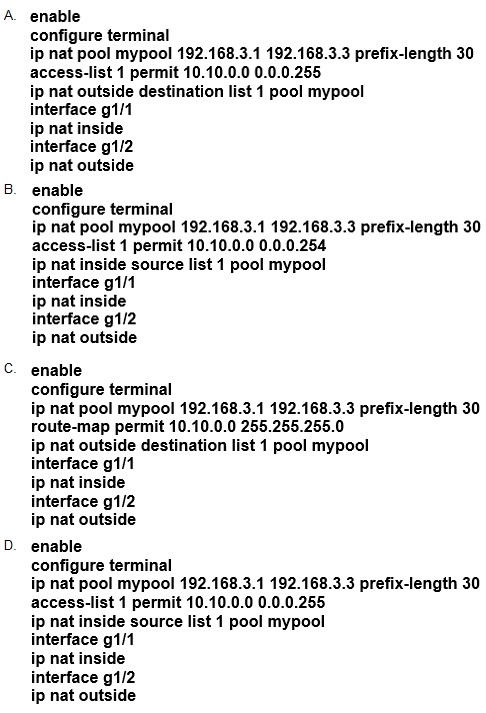
-
A
-
B
-
C
-
D
Reveal answer details
Close answer details
Question 45
Single choice
What software defined architecture plane assists network devices with making packet-forwarding decisions by providing Layer 2 reachability and Layer 3 routing information?
-
A
-
B
-
C
-
D
Reveal answer details
Close answer details
Correct answerB
ExplanationThe control plane PROVIDE the layer 2 reachability and layer 3 routing information to assist the forwarding decisions in the data plane. It doesn't mean that the control plane MAKE the forwarding decision, only provide the tables and databases to data plane.
Question 46
Single choice
Which switching method verifies the frame check sequence before forwarding frames?
-
A
-
B
-
C
-
D
Reveal answer details
Close answer details
Correct answerC
ExplanationStore-and-forward switching receives the entire frame and verifies the Frame Check Sequence (FCS) before forwarding it. This method ensures that corrupted frames are not propagated through the network.
Question 47
Single choice
What is the primary purpose of a recursive query in DNS?
-
A
to perform a reverse DNS lookup
-
B
to update DNS records on a server
-
C
to refresh the TTL of specific DNS records
-
D
to resolve domain names via multiple DNS servers
Reveal answer details
Close answer details
Correct answerD
ExplanationIn a recursive DNS query, the client (usually a user's device or application) asks a DNS resolver (like a local DNS server) to resolve a domain name. The DNS resolver takes on the responsibility of performing all the necessary queries to other DNS servers (including root, TLD, and authoritative servers) until it finds the IP address for the requested domain. The recursive DNS resolver then returns the final result (the IP address) to the client.
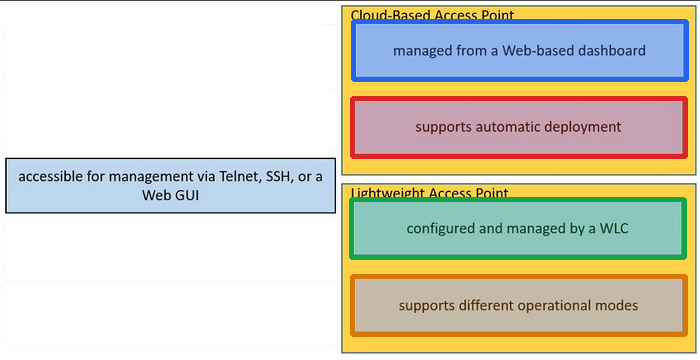
DRAG DROP Drag and drop the facts about wireless architectures from the left onto the types of access point on the right. Not all options are used. 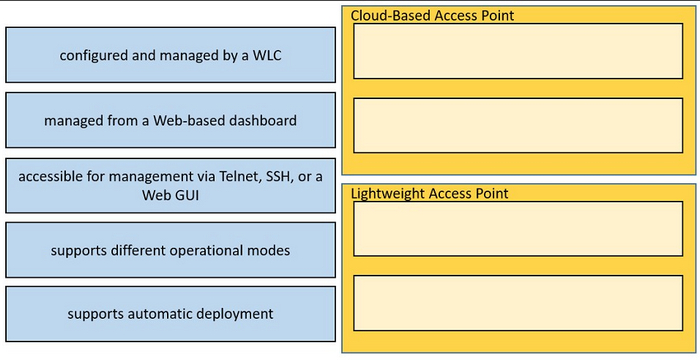
Reveal answer details
Close answer details
Question 49
Single choice
What is an expected outcome when network management automation is deployed?
-
A
A distributed management plane must be used.
-
B
Software upgrades are performed from a central controller
-
C
Complexity increases when new device configurations are added
-
D
Custom applications are needed to configure network devices
Reveal answer details
Close answer details
Correct answerB
ExplanationNetwork management automation is the use of software tools and techniques to automate the process of managing and configuring network devices. Some expected outcomes when network management automation is deployed include: 1. Improved efficiency and accuracy: Network management automation can help to reduce the time and effort required to manage and configure network devices, as well as reduce the risk of errors.
2. Enhanced security: Network management automation can help to ensure that devices are configured correctly and consistently, which can help to reduce the risk of security vulnerabilities.
3. Improved visibility and control: Network management automation can provide a centralised view of the network and enable administrators to manage and configure devices from a central location.
4. Simplified software upgrades: Network management automation can enable software upgrades to be performed from a central controller, rather than having to be performed manually on each device. In summary, an expected outcome when network management automation is deployed is that software upgrades are performed from a central controller.
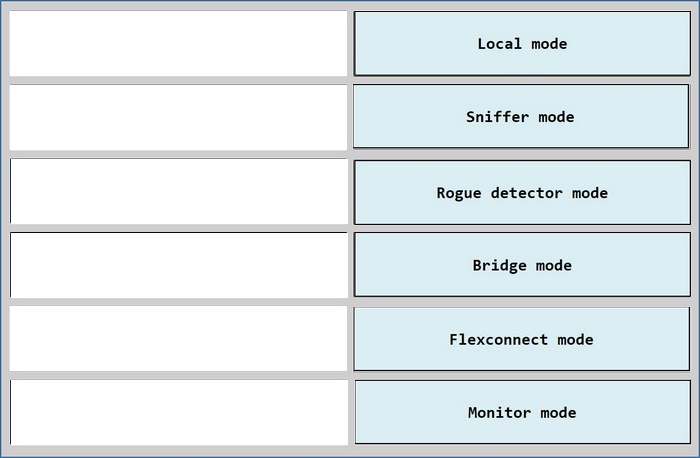
DRAG DROP Drag and drop the lightweight access point operation modes from the left onto the descriptions on the right 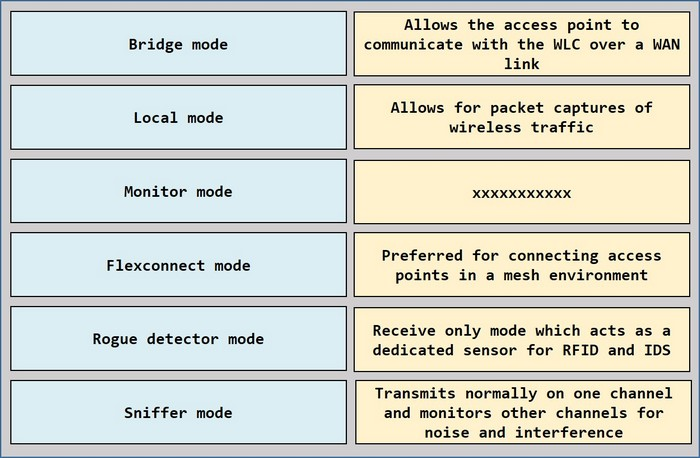
Reveal answer details
Close answer details
Question 51
Single choice
By default, how does EIGRP determine the metric of a route for the routing table?
-
A
It uses the bandwidth and delay values of the path to calculate the route metric.
-
B
It uses a default metric of 10 for all routes that are learned by the router.
-
C
It counts the number of hops between the receiving and destination routers and uses that value as the metric.
-
D
It uses a reference bandwidth and the actual bandwidth of the connected link to calculate the route metric.
Reveal answer details
Close answer details
Question 52
Single choice
Which access point mode relies on a centralized controller for management, roaming, and SSID configuration?
-
A
-
B
-
C
-
D
Reveal answer details
Close answer details
Question 53
Single choice
Refer to the exhibit. 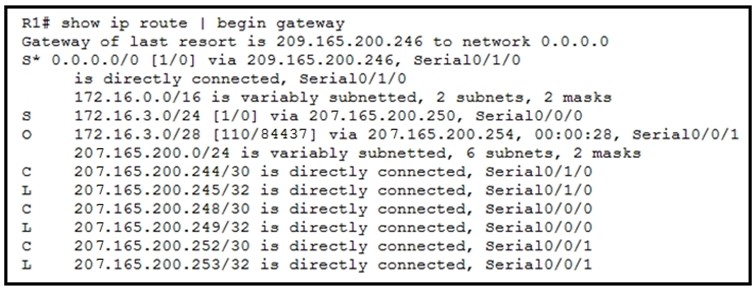 A packet is being sent across router R1 to host 172.16.3.14.
To which destination does the router send the packet?
-
A
207.165.200.246 via Serial0/1/0
-
B
207.165.200.254 via Serial0/0/0
-
C
207.165 200.254 via Serial0/0/1
-
D
207.165.200.250 via Serial0/0/0
Reveal answer details
Close answer details
Correct answerC
ExplanationThe longest matching route to 172.16.3.14 is the 182.16.3.0/28 route, using Serial 0/0/1 with a next hop of
207.165.200.254.
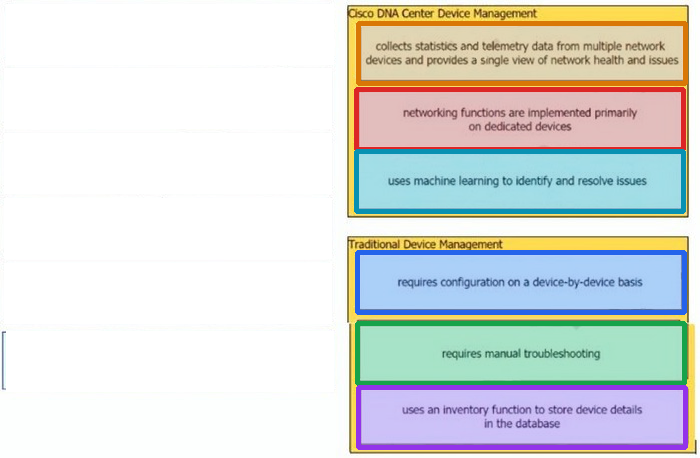
DRAG DROP Drag the descriptions of device management from the left onto the types of device management on the right. 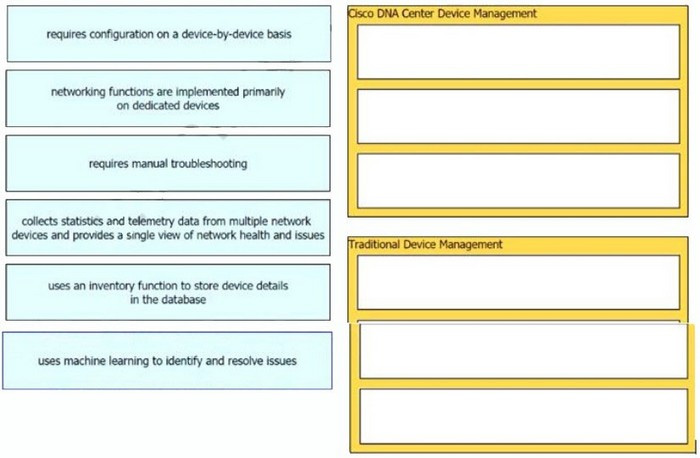
Reveal answer details
Close answer details
Question 55
Single choice
Refer to the exhibit. 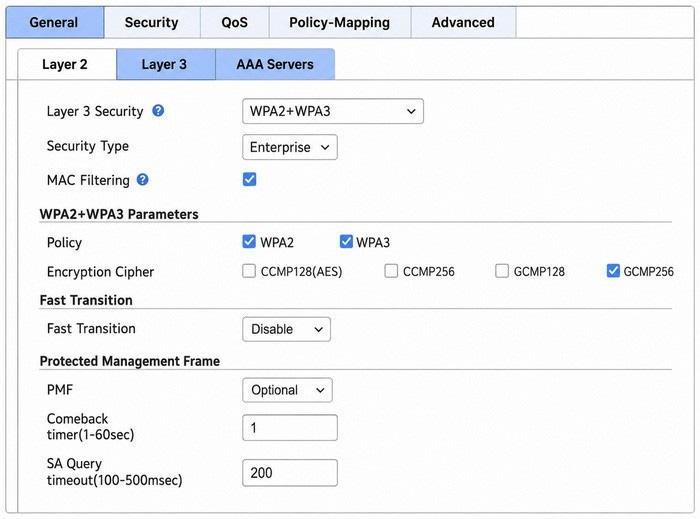 An engineer must document all Wi-Fi services on a new wireless LAN controller. The Wi-Fi SSID "
Office_WLan " has Layer 2 Security. What is determined by this configuration?
-
A
There is a strong mutual authentication used between NAC and the network devices using x.509 standard.
-
B
There is an extra layer of security that ensures only authorized devices with known MAC addresses connect to the network.
-
C
There is a robust security mechanism configured to protect against various Layer 2 and Layer 3 attacks.
-
D
There is Galois cache algorithm configured that provides strong encryption and authentication.
Reveal answer details
Close answer details
Question 56
Single choice
An administrator must secure the WLC from receiving spoofed association requests. Which steps must be taken to configure the WLC to restrict the requests and force the user to wait 10 ms to retry an association request?
-
A
Enable Security Association Teardown Protection and set the SA Query timeout to 10
-
B
Enable MAC filtering and set the SA Query timeout to 10
-
C
Enable 802.1x Layer 2 security and set me Comeback timer to 10
-
D
Enable the Protected Management Frame service and set the Comeback timer to 10
Reveal answer details
Close answer details
Correct answerD
Explanation"You then need to specify the comeback timer and SA query timeout. The comeback timer specifies the time that an associated client must wait before the association can be tried again..."
https://www.cisco.com/c/en/us/support/docs/wireless-mobility/wireless-lan-wlan/212576-configure-802-11w-management-frame-prote.html
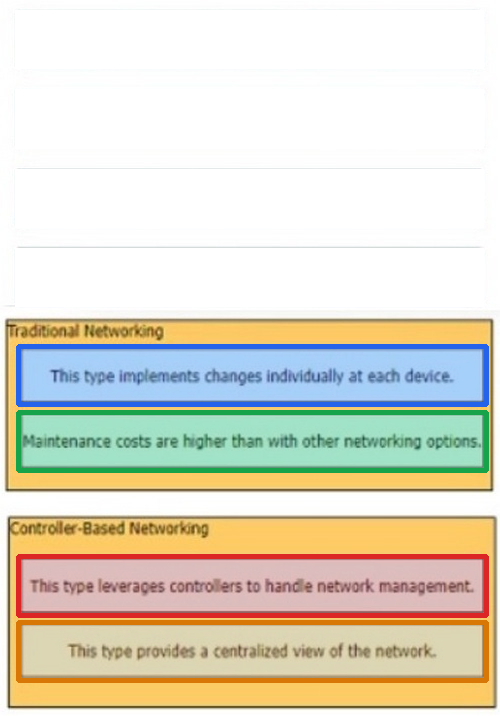
DRAG DROP Drag and drop the statements about networking from me left onto the corresponding networking types on the right 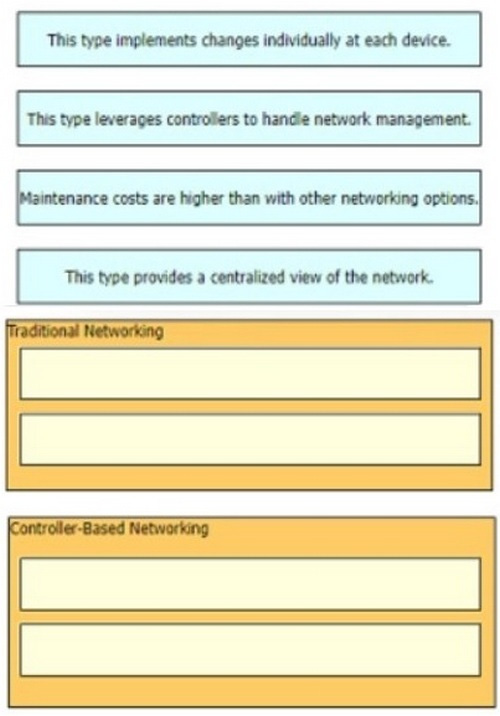
Reveal answer details
Close answer details
Question 58
Single choice
Refer to the exhibit. 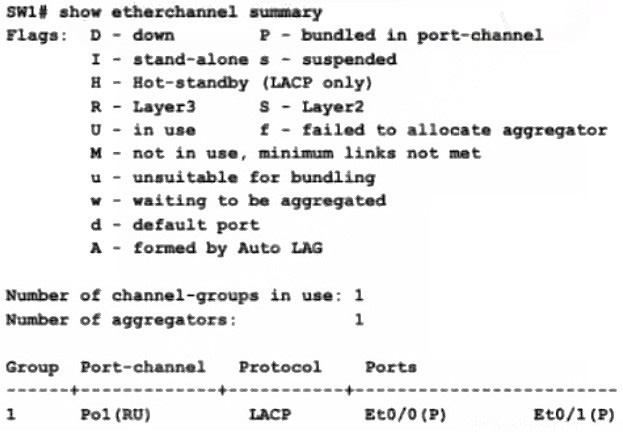 A network engineer is adding another physical interface as a new member to the existing Port-Channel1 bundle. Which command set must be configured on the new interface to complete the process?
-
A
no switchport
channel group 1 mode active
-
B
no switchport
channel-group 1 mode on
-
C
switchport mode trunk
channel-group 1 mode active
-
D
switchport
switchport mode trunk
Reveal answer details
Close answer details
Correct answerA
Explanationbecause it says"R" we know its a layer three port channel meaning we need the no swtchport command and this is a Lacp so it would us active / passive
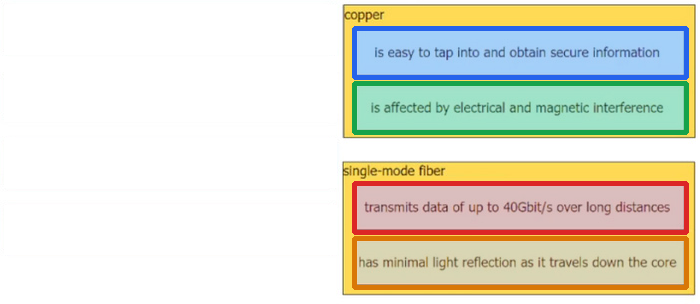
DRAG DROP Drag and drop the characteristic from the left onto the cable type on the right. 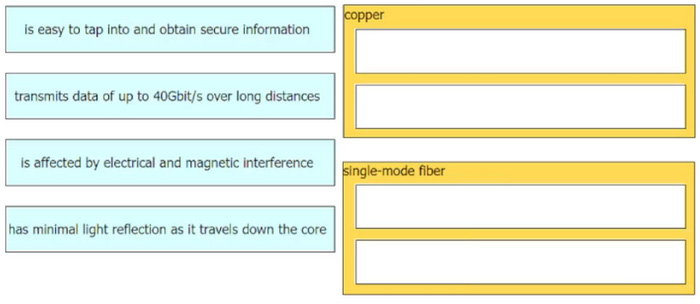
Reveal answer details
Close answer details
DRAG DROP Drag and drop the AAA features from the left onto the corresponding AAA security services on the right.
Not all options are used. 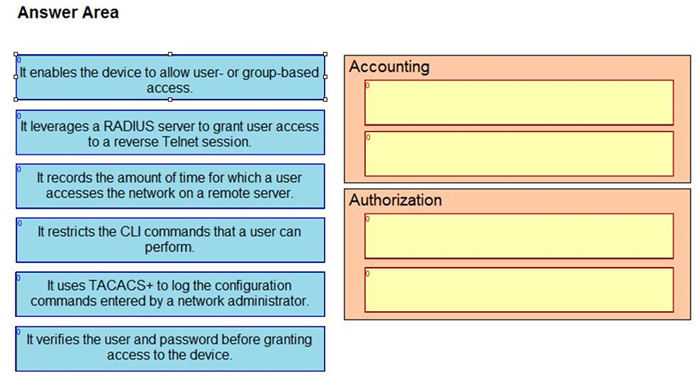
Reveal answer details
Close answer details
Question 61
Single choice
Refer to the exhibit. Which address and mask combination represents a summary of the routes learned by EIGRP? 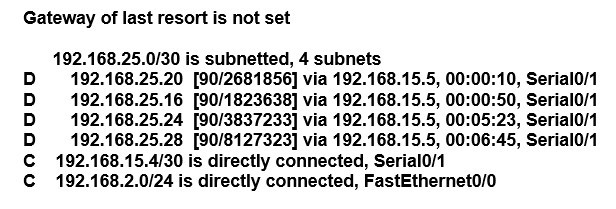
-
A
192.168.25.0 255.255.255.240
-
B
192.168.25.0 255.255.255.252
-
C
192.168.25.16 255.255.255.240
-
D
192.168.25.16 255.255.255.252
-
E
192.168.25.28 255.255.255.240
-
F
192.168.25.28 255.255.255.252
Reveal answer details
Close answer details
Correct answerC
ExplanationThe binary version of 20 is 10100.
The binary version of 16 is 10000.
The binary version of 24 is 11000.
The binary version of 28 is 11100.
The subnet mask is /28. The mask is 255.255.255.240.
Note:
From the output above, EIGRP learned 4 routes and we need to find out the summary of them:
1. 192.168.25.16
2. 192.168.25.20
3. 192.168.25.24
4. 192.168.25.28
-> The increment should be 28 ?16 = 12 but 12 is not an exponentiation of 2; so we must choose 16 (24).
Therefore the subnet mask is /28 (=1111 1111.1111 1111.1111 1111.11110000) = 255.255.255.240.
So the best answer should be 192.168.25.16 255.255.255.240.
Question 62
Lab simulation
Simulation Guidelines This is a lab item in which tasks will be performed on virtual devices. 1. Refer to the Tasks tab to view the tasks for this lab item.
2. Refer to the Topology tab to access the device console(s) and perform the tasks.
3. Console access is available for all required devices by clicking the device icon or using the tab(s) above the console window.
4. All necessary pre-configurations have been applied.
5. Do not remove any existing configurations from the devices, only those necessary to make the appropriate changes required to fulfill the listed tasks.
6. Do not change the enable password or hostname for any device.
7. Save your configurations to NVRAM before moving to the next item.
8. Click Next at the bottom of the screen to submit this lab and move to the next question.
9. When Next is clicked, the lab closes and cannot be reopened. Topology 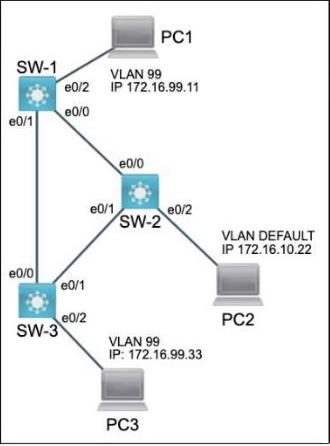 Tasks
All physical cabling is in place and verified. Connectivity for PC1, PC2 and PC3 must be established to the switches. Each port connecting to the PCs must be configured as an end-user port and only allow the designated VLAN. 1. Configure VLAN 99 on all three switches and label it exactly as FINANCIAL
2. Configure the switch ports connecting to PC1, PC2 and PC3
3. Cisco's neighbor discovery protocol has been disabled on SW-1 and must be re-enabled
4. PC1 must not be able to discover SW-1
Reveal model answer
Close model answer
Task 1:
SW-1(config)# vlan 99 SW-1(config-vlan)# name FINANCIAL
SW-1(config-vlan)# exit
SW-2(config)# vlan 99 SW-2(config-vlan)# name FINANCIAL
SW-2(config-vlan)# exit SW-3(config)# vlan 99 SW-3(config-vlan)# name FINANCIAL
SW-3(config-vlan)# exit Task 2:
SW-1(config)# interface e0/2
SW-1(config-if)# switchport mode access SW-1(config-if)# switchport access vlan 99
SW-1(config-if)# exit SW-2(config)# interface e0/2
SW-2(config-if)# switchport mode access SW-2(config-if)# switchport access vlan 99
SW-2(config-if)# exit SW-3(config)# interface e0/2
SW-3(config-if)# switchport mode access SW-3(config-if)# switchport access vlan 99
SW-3(config-if)# exit Task 3:
SW-1(config)# cdp run Task 4:
SW-1(config)# interface e0/2
SW-1(config-if)# no cdp enable
Question 63
Single choice
Refer to the exhibit. 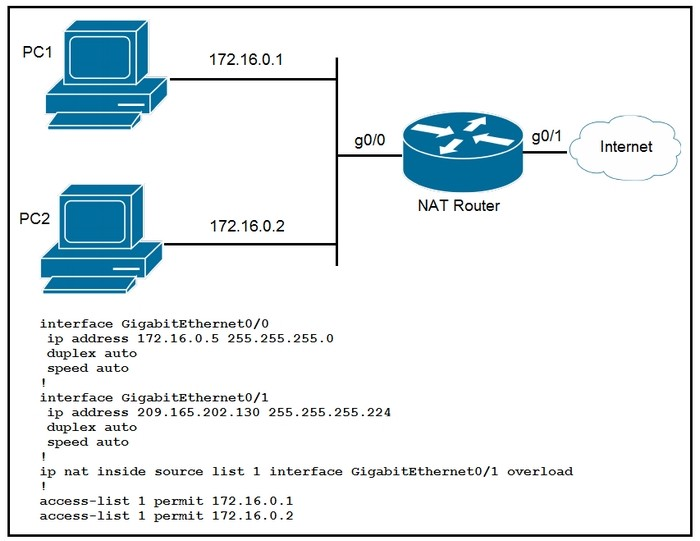 How should the configuration be updated to allow PC1 and PC2 access to the Internet?
-
A
Modify the configured number of the second access list.
-
B
Add either the ip nat {inside|outside} command under both interfaces.
-
C
Remove the overload keyword from the ip nat inside source command.
-
D
Change the ip nat inside source command to use interface GigabitEthernet0/0.
Reveal answer details
Close answer details
Correct answerB
Explanationip nat inside source list INSIDE-NET pool SHARED-IP (g0/1)overload (in this case G0/1).
Only inside/outside on the interfaces is missing.
Question 64
Multiple choice
What are two behaviors of a point-to-point WAN topology? (Choose two.)
-
A
It leverages a dedicated connection.
-
B
It provides direct connections betwaen each router in the topology.
-
C
It delivers redundancy between the central office and branch offices.
-
D
It uses a single router to route traffic between sites.
-
E
It connects remote networks through a single line.
Reveal answer details
Close answer details
Correct answersA, E
ExplanationA point-to-point WAN topology uses a dedicated line or circuit to connect two network devices, such as routers or switches, over a long distance. This dedicated connection is typically established by a service provider and provides a direct link between the two devices, with no intermediary network devices in between. This topology is often used to connect remote sites or branch offices to a central office or data center, and can be used for various WAN technologies such as T1/E1 lines, leased lines, or MPLS circuits. Option B is incorrect because a point-to-point topology only provides a direct connection between the two devices at each end of the link, not between each router in the topology. Option C is incorrect because point-to-point topologies typically do not provide redundancy between sites, as there is only one dedicated line or circuit connecting the two devices. Option D is incorrect because point-to-point topologies require two routers or devices, one at each end of the dedicated line or circuit, to route traffic between the sites.
Question 65
Single choice
What happens when a switch receives a frame with a destination MAC address that recently aged out?
-
A
The switch floods the frame to all ports in all VLANs except the port that received the frame.
-
B
The switch floods the frame to all ports in the VLAN except the port that received the frame.
-
C
The switch references the MAC address aging table for historical addresses on the port that received the frame.
-
D
The switch drops the frame and learns the destination MAC address again from the port that received the frame.
Reveal answer details
Close answer details
Question 66
Single choice
Which switch concept is used to create separate broadcast domains?
-
A
-
B
-
C
-
D
Reveal answer details
Close answer details
Question 67
Lab simulation
Simulation Guidelines This is a lab item in which tasks will be performed on virtual devices. 1. Refer to the Tasks tab to view the tasks for this lab item.
2. Refer to the Topology tab to access the device console(s) and perform the tasks.
3. Console access is available for all required devices by clicking the device icon or using the tab(s) above the console window.
4. All necessary pre-configurations have been applied.
5. Do not remove any existing configurations from the devices, only those necessary to make the appropriate changes required to fulfill the listed tasks.
6. Do not change the enable password or hostname for any device.
7. Save your configurations to NVRAM before moving to the next item.
8. Click Next at the bottom of the screen to submit this lab and move to the next question.
9. When Next is clicked, the lab closes and cannot be reopened. Topology 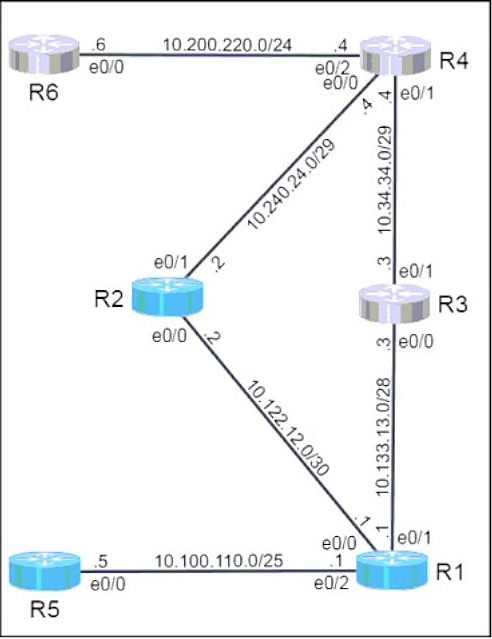 Tasks Task 1
1. Configure a host route on R5 for the destination of 10.200.220.6.
2. Configure a static default route on R1 preferring the path through R3 towards R6.
3. From R5, use traceroute and ping to verify the path towards and reachability of R6. Task 2
1. Configure a floating static default route on R1, preferring the path through R2 towards R6 if the link to R3 should fail.
2. Configure the administrative distance for 225.
3. Configure a static route on R2 to forward the return traffic towards 10.100.110.0/25.
4. After shutting interface e0/1 on R1, use traceroute and ping from R5 to verify path towards and reachability of R6.
Reveal model answer
Close model answer
Task 1:
R5(c0nfig)# ip route 10.200.220.6 255.255.255.255 10.100.110.1
R1(config)# ip route 0.0.0.0 0.0.0.0 10.133.13.2
R5#traceroute10.200.220.6
R5# ping 10.200.220.6
Task 2:
R1(config)# ip route 0.0.0.0 0.0.0.0 10.122.12.2 225
R2(config)# ip route 10.100.110.0 255.255.255.128 10.122.12.1
Rl(config)# interface e0/1
R1(config-if)# shutdown
R5# traceroute 10.200.220.6
R5# ping 10.200.220.6
Question 68
Multiple choice
Which two IPv6 addresses are used to provide connectivity between two routers on a shared link? (Choose two)
-
A
-
B
ff06:bb43:cc13:dd16:1bb:ff14:7545:234d
-
C
2002::512:1204b:1111::1/64
-
D
-
E
Reveal answer details
Close answer details
Correct answersD, E
Explanationthe IPv6 address "::ffff:10.14.101.1/96" is a valid representation of an IPv6 address with an embedded IPv4 address. This format is known as IPv4-mapped IPv6 address. In this case, "::ffff:10.14.101.1" represents the IPv4 address "10.14.101.1" embedded within an IPv6 address. The "::ffff:" prefix indicates that the following part of the address is an IPv4 address. The "/96"
suffix indicates the network prefix length, specifying that the first 96 bits represent the network portion of the address.
Question 69
Single choice
Which statement describes the purpose of a wireless beacon frame?
-
A
It authenticates clients before association
-
B
It advertises the capabilities of a wireless network
-
C
It encrypts management traffic between APs
-
D
It negotiates encryption keys with clients
Reveal answer details
Close answer details
Correct answerB
ExplanationBeacon frames are periodically transmitted by wireless access points to announce the presence of a WLAN. They contain essential information such as the SSID, supported data rates, security capabilities, and channel information. Clients use beacon frames to discover available wireless networks before initiating authentication and association. Beacon frames do not perform authentication, encryption, or key negotiation.
Question 70
Single choice
Why does an administrator choose to implement a remote access IPsec VPN?
-
A
to establish an encrypted tunnel between a remote user and a private network over the internet
-
B
to allow access to an enterprise network using any internet-enabled location via a web browser using
SSL
-
C
to provide a secure link between an HTTPS server, authentication subsystem, and an end-user
-
D
to use cryptography for authentication between a device and user over a negotiated VPN gateway
Reveal answer details
Close answer details
Question 71
Single choice
Refer to the exhibit. 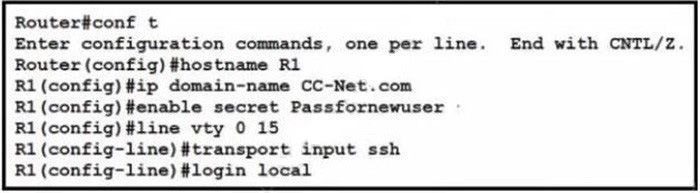 A network administrator is configuring a router for user access via SSH. The service-password encryption command has been issued. The configuration must meet these requirements: 1. Create the username as CCUser.
2. Create the password as NA!2$cc.
3. Encrypt the user password. What must be configured to meet the requirements?
-
A
username CCUser privilege 10 password NA!2$cc
-
B
username CCUser privilege 15 password NA!2$cc
enable secret 0 NA!2$cc
-
C
username CCUser secret NA!2Sce
-
D
username CCUser password NA!2$cc
enable password level 5 NA!2$cc
Reveal answer details
Close answer details
Correct answerC
ExplanationTo create the username as CCUser, create the password as NA!2$cc, and encrypt the user password, option C is the correct configuration. Option A only creates the user and sets a plain-text password.
Option B sets a privileged level password for enable mode, but it does not create the user or encrypt the password.
Option D creates the user and sets a plain-text password but does not encrypt the password.
Option C creates the user, sets an encrypted password, and meets all the specified requirements.
Question 72
Single choice
Which feature or protocol is required for an IP SLA to measure UDP jitter?
-
A
-
B
-
C
-
D
Reveal answer details
Close answer details
Correct answerD
ExplanationIP SLA (Internet Protocol Service Level Agreement) is a feature in Cisco IOS that allows administrators to measure and monitor network performance. One of the types of performance measurements that can be performed using IP SLA is UDP jitter, which is a measure of the variability in the delay of UDP packets. To measure UDP jitter using IP SLA, the NTP (Network Time Protocol) feature must be enabled on the device. NTP is used to synchronize the device's clock with a reference time source, which is necessary to accurately measure the delay of UDP packets. Without NTP, the device's clock may drift over time, leading to inaccurate jitter measurements.
Question 73
Single choice
What is the role of a firewall in an enterprise network?
-
A
Forwards packets based on stateless packet inspection
-
B
Processes unauthorized packets and allows passage to less secure segments of the network
-
C
determines which packets are allowed to cross from unsecured to secured networks
-
D
explicitly denies all packets from entering an administrative domain
Reveal answer details
Close answer details
Correct answerC
ExplanationThe role of a firewall in an enterprise network is to determine which packets are allowed to cross from unsecured to secured networks.
Question 74
Single choice
Refer to the exhibit. What is the subnet mask for route 172.16.4.0? 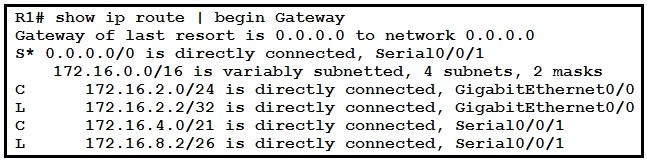
-
A
-
B
-
C
-
D
Reveal answer details
Close answer details
DRAG DROP Drag and drop the Qos features from the left onto the corresponding statements on the right. 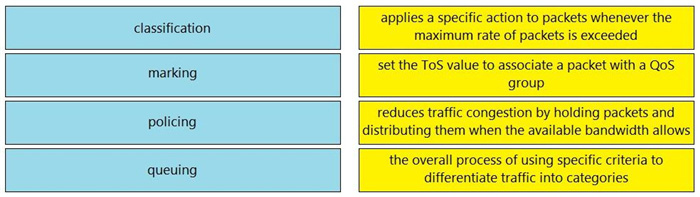
Reveal answer details
Close answer details
Question 76
Single choice
Refer to the exhibit. 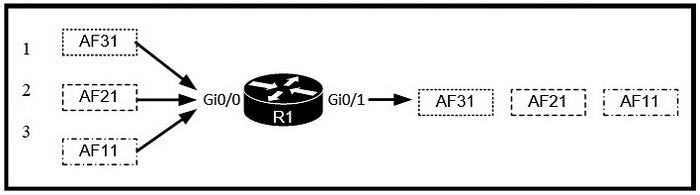 Which per-hop QoS behavior is R1 applying to incoming packets?
-
A
-
B
-
C
-
D
Reveal answer details
Close answer details
Question 77
Multiple choice
Which two statements about exterior routing protocols are true? (Choose two.)
-
A
They determine the optimal within an autonomous system.
-
B
They determine the optimal path between autonomous systems.
-
C
BGP is the current standard exterior routing protocol.
-
D
Most modern networking supports both EGP and BGP for external routing.
-
E
Most modern network routers support both EGP and EIGRP for external routing.
Reveal answer details
Close answer details
Correct answersB, C
ExplanationExterior Gateway Protocols (EGP): Used for routing between autonomous systems. It is also referred to as inter-AS routing. Service providers and large companies may interconnect using an EGP. The Border Gateway Protocol (BGP) is the only currently viable EGP and is the official routing protocol used by the Internet. NOTE Because BGP is the only EGP available, the term EGP is rarely used; instead, most engineers simply refer
to BGP. https://www.ciscopress.com/articles/article.asp?p=2180210&seqNum=7
Question 78
Single choice
Which device protects an internal network from the Internet?
-
A
-
B
-
C
-
D
Reveal answer details
Close answer details
Question 79
Multiple choice
A network administrator enters the following command on a router: logging trap 3. What are three message types that will be sent to the Syslog server? (Choose three.)
-
A
-
B
-
C
-
D
-
E
-
F
Reveal answer details
Close answer details
Question 80
Single choice
Why are API keys used to enforce rate limiting?
-
A
to encrypt data to prevent excessive usage
-
B
to track the geographical location of each request
-
C
to uniquely identify clients to monitor their usage patterns
-
D
to contain embedded permissions that automatically expire
Reveal answer details
Close answer details
Correct answerC
ExplanationAPI keys are unique identifiers assigned to clients or applications making requests to an API. These keys allow the server to track and monitor each client's usage patterns. By doing so, the server can enforce rate limiting, which restricts the number of requests a client can make in a certain period of time. This helps prevent abuse, ensure fair resource allocation, and maintain the performance of the API.
Question 81
Lab simulation
Simulation Guidelines This is a lab item in which tasks will be performed on virtual devices 1. Refer to the Tasks tab to view the tasks for this lab item.
2. Refer to the Topology tab to access the device console(s) and perform the tasks
3. Console access is available for all required devices by clicking the device icon or using the tab(s) above the console window
4. All necessary preconfigurations have been applied
5. Do not change the enable password or hostname for any device
6. Save your configurations to NVRAM before moving to the next item
7. Click Next at the bottom of the screen to submit this lab and move to the next question
8. When Next is clicked, the lab closes and cannot be reopened Connectivity between four routers has been established. IP connectivity must be configured in the order presented to complete the implementation. No dynamic routing protocols are included. 1. Configure static routing using host routes to establish connectivity from router R3 to the router R1
Loopback address using the source IP of 209.165.200.230.
2. Configure an IPv4 default route on router R2 destined for router R4.
3. Configure an IPv6 default router on router R2 destined for router R4. 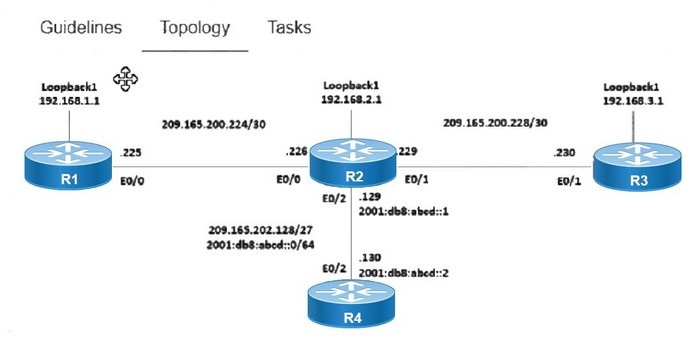 
Reveal model answer
Close model answer
1.- on R3
config terminal
ip route 192.168.1.1 255.255.255.255 209.165.200.229
end
copy running start 2.- on R2
config terminal
ip route 0.0.0.0 0.0.0.0 209.165.202.130
end
copy running start 3.- on R2
config terminal
ipv6 route ::/0 2001:db8:abcd::2
end
copy running start
Question 82
Single choice
What is the difference between controller-based networks and traditional networks as they relate to control-plane and/or data-plane functions?
-
A
Controller-based networks centralize all important data-plane functions, and traditional networks
distribute data-plane functions.
-
B
Traditional networks centralize all important control-plane functions, and controller-based networks
distribute control-plane functions.
-
C
Traditional networks centralize all important data-plane functions, and controller-based networks
distribute data-plane functions.
-
D
Controller-based networks centralize all important control-plane functions, and traditional networks
distribute control-plane functions.
Reveal answer details
Close answer details
Question 83
Single choice
What does a router do when it is configured with the default DNS lookup settings, and a URL is entered on the CLI?
-
A
It continuously attempts to resolve the URL until the command is cancelled.
-
B
It initiates a ping request to the URL.
-
C
It prompts the user to specify the desired IP address.
-
D
It attempts to query a DNS server on the network.
Reveal answer details
Close answer details
Question 84
Single choice
Refer to the exhibit. 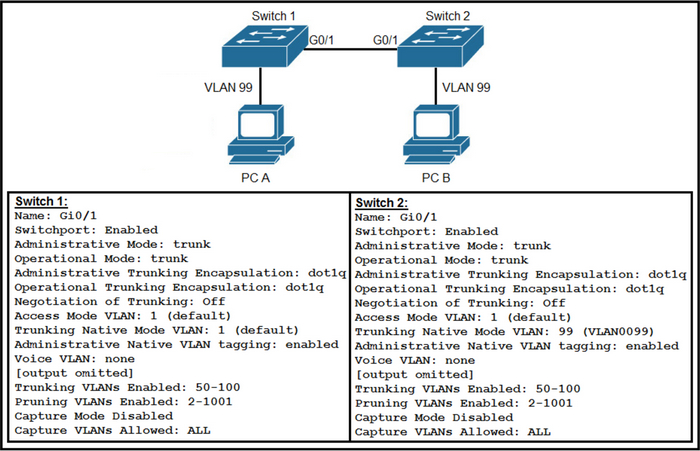 After the switch configuration, the ping test fails between PC A and PC B.
Based on the output for switch 1, which error must be corrected?
-
A
The PCs are in the incorrect VLAN.
-
B
All VLANs are not enabled on the trunk.
-
C
Access mode is configured on the switch ports.
-
D
There is a native VLAN mismatch.
Reveal answer details
Close answer details
Correct answerD
ExplanationThere is VLAN Mismatch. Remember there is no any intervlan routing on the two sitches thus minimising the chance of communication.
https://www.youtube.com/watch?v=klqpX6U-_JY
Question 85
Single choice
Refer to the exhibit. Which action must be taken to ensure that router A is elected as the DR for OSPF area 0? 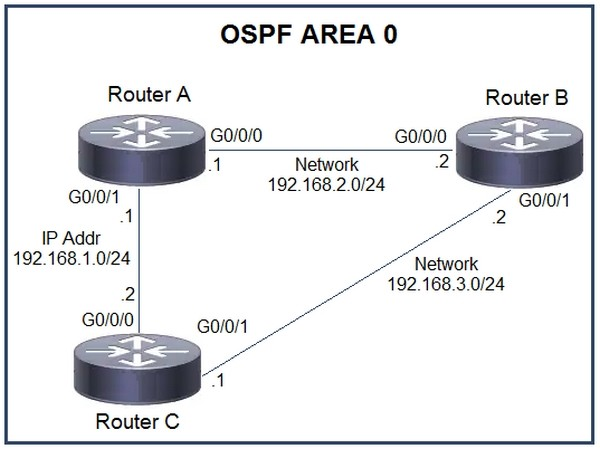
-
A
Configure the OSPF priority on router A with the lowest value between the three routers.
-
B
Configure router B and router C as OSPF neighbors of router A.
-
C
Configure the router A interfaces with the highest OSPF priority value within the area.
-
D
Configure router A with a fixed OSPF router ID
Reveal answer details
Close answer details
Question 86
Single choice
How does network automation help reduce network downtime?
-
A
Changes can be implemented in parallel across multiple devices at once, which increases the speed of the change rate.
-
B
By using automation platforms with intent-based configuration, all changes are checked for possible outages before being implemented.
-
C
Emails can be generated based on when a network admin performs a network change, which increases visibility.
-
D
Configuration templates and testing can be built into implementation, which increases the success rate of a network change.
Reveal answer details
Close answer details
Question 87
Single choice
How is AI used to identify issues within network traffic?
-
A
It analyzes patterns for anomaly detection.
-
B
It enhances data packet delivery speeds.
-
C
It simplifies traffic route mapping.
-
D
It exclusively predicts device malfunctions.
Reveal answer details
Close answer details
Correct answerA
ExplanationAI and machine learning are employed in network traffic analysis to learn normal traffic patterns and behaviors. Once these baseline patterns are established, AI systems can detect anomalies or unusual behavior, such as traffic spikes, irregular access patterns, or potential security threats. This capability helps in identifying issues like network congestion, intrusions, or other irregularities that could lead to performance degradation or security breaches.
Question 88
Single choice
Which command displays the MAC address table on a Cisco switch?
-
A
-
B
-
C
-
D
Reveal answer details
Close answer details
Correct answerC
ExplanationThe show mac address-table command displays the switch's MAC address table, including learned MAC addresses, associated VLANs, and the ports on which the addresses were learned. This command is essential for troubleshooting Layer 2 forwarding behavior.
Question 89
Single choice
Which command must you enter to configure a DHCP relay?
-
A
-
B
-
C
-
D
Reveal answer details
Close answer details
Question 90
Single choice
What is the difference between SNMP traps and SNMP polling?
-
A
SNMP traps send periodic updates via the MIB, and SNMP polling sends data on demand.
-
B
SNMP traps are initiated using a push model at the network device, and SNMP polling is initiated at the server.
-
C
SNMP traps are used for proactive monitoring, and SNMP polling is used for reactive monitoring.
-
D
SNMP traps are initiated by the network management system, and network devices initiate SNMP polling.
Reveal answer details
Close answer details
Correct answerB
ExplanationSNMP traps: These are notifications sent by network devices (e.g., routers, switches) to the network management system (NMS) without a request. When certain predefined events or thresholds are reached, the device pushes the information to the NMS. This enables proactive notification of issues or significant events, such as link failures or threshold breaches. SNMP traps: These are notifications sent by network devices (e.g., routers, switches) to the network management system (NMS) without a request. When certain predefined events or thresholds are reached, the device pushes the information to the NMS. This enables proactive notification of issues or significant events, such as link failures or threshold breaches.
Question 91
Single choice
A user configured OSPF in a single area between two routers. A serial interface connecting R1 and R2 is running encapsulation PPP.
By default, which OSPF network type is seen on this interface when the user types show ip ospf interface on R1 and R2?
-
A
-
B
-
C
-
D
Reveal answer details
Close answer details
Correct answerB
ExplanationThe default OSPF network type for HDLC and PPP on Serial link is point-to-point (while the default OSPF network type for Ethernet link is Broadcast).
Question 92
Multiple choice
Which two IP addressing schemes provide internet access to users on the network while preserving the public IPv4 address space? (Choose two.)
-
A
-
B
PAT with private internal addressing
-
C
single public Class A network
-
D
-
E
custom addresses from ARIN
Reveal answer details
Close answer details
Question 93
Single choice
When deploying syslog, which severity level logs informational message?
-
A
-
B
-
C
-
D
Reveal answer details
Close answer details
Correct answerD
ExplanationReferences:
https://en.wikipedia.org/wiki/Syslog
Question 94
Multiple choice
Which two features are provided by Ansible in network automation? (Choose two.)
-
A
supplying network credentials
-
B
role-based access control
-
C
-
D
-
E
launching job templates using version control
Reveal answer details
Close answer details
Question 95
Single choice
What is a service that is provided by a wireless controller?
-
A
It mitigates threats from the internet.
-
B
It manages interference in a dense network.
-
C
It provides Layer 3 routing between wired and wireless devices.
-
D
It issues IP addresses to wired devices.
Reveal answer details
Close answer details
Question 96
Lab simulation
Simulation Guidelines This is a lab item in which tasks will be performed on virtual devices. 1.
Refer to the Tasks tab to view the tasks for this lab item.
2.
Refer to the Topology tab to access the device console(s) and perform the tasks.
3.
Console access is available for all required devices by clicking the device icon or using the tab(s) above the console window.
4.
All necessary preconfigurations have been applied.
5.
Do not change the enable password or hostname for any device.
6.
Save your configurations to NVRAM before moving to the next item.
7.
Click Next at the bottom of the screen to submit this lab and move to the next question.
8.
When Next is clicked, the lab doses and cannot be reopened. Topology 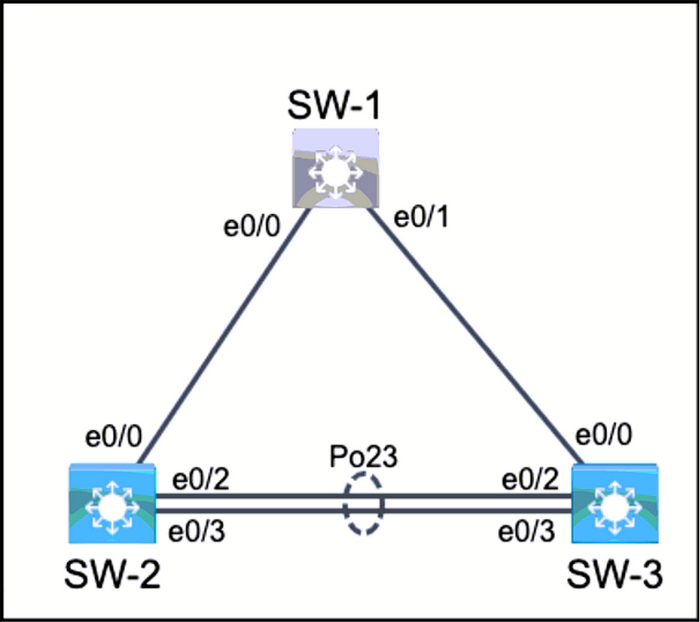 All physical cabling is in place and verified. Switch SW-1 is pre-configured and inaccessible. SW-2 and SW-3 ports must be configured and operational to complete the configuration. 1. Configure SW-2 and SW-3 ports E0/0 to use the industry standard encapsulation method for trunking and only tag VLAN 10
2. Configure SW-2 and SW-3 ports E0/0 to send and receive untagged traffic over VLAN 11
3. Configure SW-2 and SW-3 ports E0/2 and E0/3 to use the industry standard encapsulation method for trunking and tag all VLANS
4. Configure SW-2 and SW-3 ports E0/2 and E0/3 for link aggregation using the industry standard protocol with the following requirements:
SW-2 ports must not initiate the negotiation for the aggregation protocol SW-3 ports must immediately negotiate the aggregation protocol
Use the designated number assignment
Reveal model answer
Close model answer
SW-2 Config t
Interface e0/0
switchport mode trunk switchport trunk encapsulation dot1q
switchport access vlan 10
switchport trunk native vlan 11 Interface e0/2
switchport mode trunk switchport trunk encapsulation dot1q
channel-group 23 mode passive Interface e0/3
switchport mode trunk switchport trunk encapsulation dot1q
channel-group 23 mode passive interface port-channel 23
switchport mode trunk switchport trunk encapsulation dot1q SW-3 Config t
Interface e0/0
switchport mode trunk switchport trunk encapsulation dot1q
switchport access vlan 10
switchport trunk native vlan 11 Interface e0/2
switchport mode trunk switchport trunk encapsulation dot1q
channel-group 23 mode active Interface e0/3
switchport mode trunk switchport trunk encapsulation dot1q
channel-group 23 mode active interface port-channel 23
switchport mode trunk switchport trunk encapsulation dot1q
Question 97
Single choice
Which element of a virtualization solution manages virtualized services and enables connections between virtualized services and external interfaces?
-
A
-
B
-
C
-
D
Reveal answer details
Close answer details
Correct answerA
Explanation"Virtualization software - A hypervisor provides management for virtualized services. It enables connections between virtual services and external interfaces."
https://www.cisco.com/c/en/us/solutions/enterprise-networks/what-is-virtualization.html#~how-it-works
Question 98
Single choice
Refer to the exhibit. 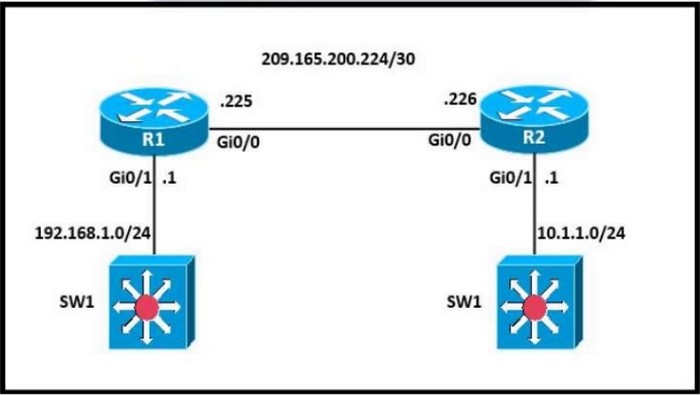 A network engineer is in the process of establishing IP connectivity between two sites. Routers R1 and R2 are partially configured with IP addressing. Both routers have the ability to access devices on their respective LANs. Which command set configures the IP connectivity between devices located on both LANs in each site?
-
A
R1
ip route 192.168.1.1 255.255.255.0 GigabitEthernet0/1
R2
ip route 10.1.1.1 255.255.255.0 GigabitEthernet0/1
-
B
R1
ip route 192.168.1.0 255.255.255.0 GigabitEthernet0/0
R2
ip route 10.1.1.1 255.255.255.0 GigabitEthernet0/0
-
C
R1
ip route 0.0.0.0 0.0.0.0 209.165.200.225
R2
ip route 0.0.0.0 0.0.0.0 209.165.200.226
-
D
R1
ip route 0.0.0.0 0.0.0.0 209.165.200.226
R2
ip route 0.0.0.0 0.0.0.0 209.165.200.225
Reveal answer details
Close answer details
Correct answerD
ExplanationRouter(config)#ip route 0.0.0.0 0.0.0.0 [exit-interface or IP address of the next-hop]
Question 99
Single choice
Which protocol is used for secure remote CLI access?
-
A
-
B
-
C
-
D
Reveal answer details
Close answer details
Question 100
Single choice
Which command creates a static NAT binding for a PC address of 10.1.1.1 to the public routable address 209.165.200.225 assigned to the PC?
-
A
R1(config)#ip nat inside source static 10.1.1.1 209.165.200.225
-
B
R1(config)#ip nat outside source static 209.165.200.225 10.1.1.1
-
C
R1(config)#ip nat inside source static 209.165.200.225 10.1.1.1
-
D
R1(config)#ip nat outside source static 10.1.1.1 209.165.200.225
Reveal answer details
Close answer details
|