Question 1
Multiple choice
You have designed and deployed your Autonomous Data Warehouse (ADW) such that it is accessible from your on-premises data center and servers running on both private and public networks in Oracle Cloud Infrastructure (OCI). 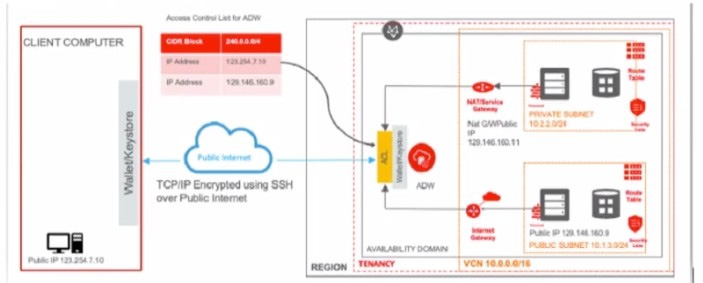 As you are testing the connectivity to your ADW database from the different access paths, you notice that the server running on the private network is unable to connect to ADW. Which two steps do you need to take to enable connectivity from the server on the private network to ADW? (Choose two.)
-
A
Add an entry in the Security List of the ADW allowing ingress traffic for C10R block 10.2.2.0/24
-
B
Add an entry in the route table (associated with the private subnet) with destination of 0.0.0.0/: target type of NAT Gateway, add a stateful egress rule to the security list (associated with the private subnet) with destination of 0.0.0.0./0 and for all IP protocols.
-
C
Add an entry in the access table list of ASW for CIDR block 10.2.2.0/24.
-
D
Add an entry in the route table (associated with the private subnet) with destination of 0.0.0.0./0; target
type of internet Gateway, add a stateful egress in the security list (associated with the private subnet) with destination of 0.0.0.0/0 and for all IP protocols.
-
E
Add an entry in the access control list of ADW for IP address 129.146.160.11
Reveal answer details
Close answer details
Correct answersB, E
ExplanationThere are 3 connections to ADW 1- Connecting to (ADW) from Public Internet 2- Connecting to ADW (via NAT or Service Gateway) from a server running on a private subnet in OCI (in the same tenancy) 3- Connecting to ADW (via internet Gateway) from a server running on a public subnet in OCI (in the same tenancy
Your organization is planning on using Oracle Cloud Infrastructure (OCI) File Storage Service (FSS). You will be deploying multiple compute instance in Oracle Cloud Infrastructure (OCI) and mounting the file system to these compute instances. The file system will hold payment data processed by a Database instance and utilized by compute instances to create a overall inventory report. You need to restrict access to this data for specific compute instances and must be allowed/blocked per compute instance's CIDR block. Which option can you use to secure access?
-
A
Use stateless Security List rule to restrict access from known IP addresses only.
-
B
Create a new VCN security list, choose SOURCE TYPE as Service and SOURCE SERVICE as FSS.
Add stateless ingress and egress rules for specific P address and CIDR blocks.
-
C
Use 'Export option' feature of FSS to restrict access to the mounted file systems.
-
D
Create and configure OCI Web Application Firewall service with built in DNS based intelligent routing.
Reveal answer details
Close answer details
Correct answerC
ExplanationNFS export options enable you to create more granular access control than is possible using just security list rules to limit VCN access. You can use NFS export options to specify access levels for IP addresses or CIDR blocks connecting to file systems through exports in a mount target. Access can be restricted so that each client's file system is inaccessible and invisible to the other, providing better security controls in multi-tenant environments.
Using NFS export option access controls, you can limit clients' ability to connect to the file system and view or write data. For example, if you want to allow clients to consume but not update resources in your file system, you can set access to Read Only. You can also reduce client root access to your file systems and map specified User IDs (UIDs) and Group IDs (GIDs) to an anonymous UID/GID of your choice. For more information about how NFS export options work with other security layers
A global media organization is working on a project which lets users upload their videos to the site. After upload is complete, the video should be automatically processed by an Al algorithm. The algorithm will try to recognize certain actions in the videos so that it can be used to show related advertisements in future.
The development team wants to focus on writing Al code and not worry about underlying infrastructure for high availability, scalability, security and monitoring. Which Oracle Cloud Infrastructure (OCI) services would meet these requirements?
-
A
OCI Object Storage, OCI Events service and OCI Functions.
-
B
Oracle Container Engine for Kubernetes, OCI Notifications and OCI Object Storage.
-
C
OCI Events, Oracle Container Engine for Kubernetes and OCI Digital Assistant.
-
D
OCI Resource Manager, OCI Functions and OCI Events service.
Reveal answer details
Close answer details
You are a Lead Architect at one of the leading consulting firms. Your firm has workloads deployed in both Oracle Cloud Infrastructure (OCI) and Microsoft Azure. You are asked to design a solution where workloads on both clouds can communicate directly and efficiently. You would like to set up a private interconnection between OCI and Microsoft Azure. What are the steps you need to perform on the OCI side to set up the interconnection?
-
A
Create a VCN with subnets and attach a DRG to the VCN. Create a FastConnect connection of the connection type "FastConnect Partner" and select "Microsoft Azure: ExpressRoute" as the Partner. Create a public virtual circuit, provide details of the DRG and add the "partner connection key" provided by Microsoft Azure. Configure OCI VCN Security Lists and Route Tables.
-
B
Create a Virtual Cloud Network (VCN) with subnets and attach a Virtual Network Gateway to the VCN.
Create a FastConnect connection of the connection type "FastConnect Partner" and select "Microsoft Azure: ExpressRoute" as the Partner. Create a private virtual circuit, provide details of the Dynamic Routing Gateway (DRG) and add the "partner interconnect key" provided by Microsoft Azure. Provide
the BGP IP addresses.
Configure OCI VCN Security Lists and Route Tables.
-
C
Create a VCN with subnets and attach a DRG to the VCN. Create a FastConnect connection of the connection type "FastConnect Direct". Create a Cross-Connect Group, provide details of the DRG and add the "partner secret key" provided by Microsoft Azure.
Provide the BGP IP addresses, Configure OCI VCN Security Lists and Route Tables.
-
D
Create a VCN with subnets and attach a DRG to the VCN. Create a FastConnect connection of the connection type "FastConnect Partner" and select "Microsoft Azure: ExpressRoute" as the Partner. Create a private virtual circuit, provide details of the DRG and add the "partner service key" provided by Microsoft Azure. Provide the BGP IP addresses, Configure OCI VCN Security Lists and Route Tables.
Reveal answer details
Close answer details
You are creating a compute instance using Oracle Cloud Infrastructure (OCI) Console. You decide to use Oracle provided image for the compute instance launch. Which option is TRUE when using Oracle provided images?
-
A
On Windows images, custom user data scripts are executed using cloud-init to perform various tasks such as enabling GPU support.
-
B
Oracle provided images do not support the ability to supply a custom metadata during instance launch.
-
C
For a Linux based image, access to host over the internet is permitted only via SSH protocol and all other remote access is disabled.
-
D
If you choose a non-Windows image, the only way to download and update packages is by running apt or yum commands.
Reveal answer details
Close answer details
Correct answerC
ExplanationExplanation:
https://blogs.oracle.com/developers/post/working-with-oracle-cloud-infrastructure-custom-compute-images
https://docs.oracle.com/en-us/iaas/Content/Compute/Tasks/managingcustomimages.htm
You are working on the migration of the web application infrastructure of your company from on-premises to Oracle Cloud Infrastructure. You need to ensure that the DNS cache entries of external clients will not direct them to the on-premises infrastructure after switching to the new infrastructure. Which of the following options will minimize this problem?
-
A
Reduce the TTL of the DNS records after the switch.
-
B
DNS changes propagate fast enough that it is not necessary to take any action.
-
C
Increase the TTL of the DNS records before the switch.
-
D
Increase the TTL of the DNS records after the switch.
-
E
Reduce the TTL of the DNS records before the switch.
Reveal answer details
Close answer details
Question 7
Multiple choice
You are responsible for migrating your on premises legacy databases on 11.2.0.4 version to Autonomous Transaction Processing Dedicated (ATP-D) In Oracle Cloud Infrastructure (OCI). As a solution architect, you need to plan your migration approach. Which two options do you need to implement together to migrate your on premises databases to OCI?
-
A
Use Oracle Data Guard to keep on premises database always active during migration
-
B
Retain changes to Oracle shipped privileges, stored procedures or views In the on-premises databases.
-
C
Use Oracle GoldenGate replication to keep on premises database online during migration.
-
D
Convert on-premises databases to PDB, upgrade to 19c, and encrypt Migration.
-
E
Retain all legacy structures and unsupported features (e.g. taw U>Bs) In the onuses databases for
migration.
Reveal answer details
Close answer details
Correct answersC, D
ExplanationAutonomous Database is an Oracle Managed and Secure environment. A physical database can't simply be migrated to autonomous because:
- Database must be converted to PDB, upgraded to 19c, and encrypted
- Any changes to Oracle shipped privileges, stored procedures or views must be removed
- All legacy structures and unsupported features must be removed (e.g. legacy LOBs) GoldenGate replication can be used to keep database online during migration
All three Data Guard Configuration are fully supported on Oracle Cloud infrastructure (OCI). You want to deploy a maximum availability architecture (MAA) for database workload. Which option should you consider while designing your Data Guard configuration to ensure best RTO and PRO without causing any data loss?
-
A
Configure "Maximum Protection" mode which provides zero data loss If the primary database fails.
-
B
Configure "Maximum Performance" mode In SYNC mode between two availability domains (same region) which provides, the highest level of data protection that is possible without affecting the performance of the primary database.
-
C
Configure ''Maximum Scalability" mode which provides the highest level of scalability without compromising the availability of the primary database.
-
D
Configure ''Maximum Availability" mode in SYNC mode between two availability domains (same region), and use the Maximum Availability mode in SYNC mode between two regions.
Reveal answer details
Close answer details
Correct answerD
ExplanationExplanation:
https://docs.cloud.oracle.com/en-us/iaas/Content/Resources/Assets/whitepapers/best-practices-for-dr-on-oci.pdf All three Data Guard configurations are fully supported on Oracle Cloud Infrastructure. However, because of a high risk of production outage, we don't recommend using the maximum protection mode for your Data Guard configuration. We recommend using the maximum availability mode in SYNC mode between two availability domains (same region), and using the maximum availability mode in ASYNC mode between two regions. This architecture provides you the best RTO and RPO without causing any data loss.
We recommend building this architecture in daisy-chain mode: the primary database ships redo logs to the first standby database in another availability domain in SYNC mode, and then the first standby database ships the redo logs to another region in ASYNC mode. This method ensures that your primary database is not doing the double work of shipping redo logs, which can cause performance impact on a production workload. 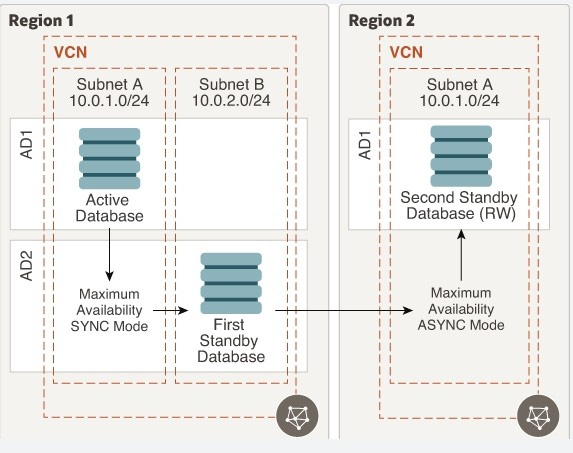 This configuration offers the following benefits: No data loss within a region.
No overhead on the production database to maintain standbys in another region. Option to configure lagging on the DR site if needed for business reasons. Option to configure multiple standbys in different regions without any additional overhead on the production database. A typical use case is a CDN application Bottom of Form
Question 9
Multiple choice
You are creating an Oracle Cloud Infrastructure Dynamic Group. To determine the members of this group you are defining a set of matching rules. Which of the following are the supported variables to define conditions in the matching rules? (Choose
Two)
-
A
instance.compartment.id -the OCID of the compartment where the instance resides.
-
B
instance.tenancy.id -the OCID of the tenancy where the instance resides.
-
C
tag.<tagnamespace>.<tagkey>.value -the tag namespace and tag key.
-
D
iam.policy.id - the OCID of the IAM policy to apply to the group.
Reveal answer details
Close answer details
Question 10
Single choice
A small business specializing in video processing wants to leverage cloud storage in order to lower its costs. They are looking to backup all video data generated, from an existing on-premises file server to Oracle Cloud Infrastructure (OCI). The requirement is to setup continuous data sync as changes are made to on-premises file server. What is the most cost effective solution for this scenario?
-
A
Set up a Fastconnect virtual Circuit and nightly back up all videos to OCI Archive Storage.
-
B
Set up file storage service on OCI and mount the file system to an instance running on-premises.
Move all the data to this on-premises instance and then sync the videos to the shared file system.
-
C
Set up a VPN connect connection and back up all videos to Object storage standard bucket. Create a lifecycle policy to move files older than 30 days to Archive Storage.
-
D
Setup an on-premises OCI Storage Gateway Cloud Sync to back up videos to OCI Object Storage Archive tier.
Reveal answer details
Close answer details
Question 11
Single choice
Your company needs to migrate a business critical application from your data center to Oracle Cloud Infrastructure (OCI). The application runs on Oracle Database and both the application and database servers run on Oracle Linux version 7. The application server is WebLogic server running on multiple 4-core servers and the database is deployed as an Oracle Database Enterprise Edition RAC database on 2 servers (4-cores each). Which method of database migration should you choose so that the application has minimal impact? (Choose the best answer.)
-
A
Deploy Virtual Machine RAC DB system on OCI and use the Oracle Database Backup module with RMAN to migrate the data from customer on-premises to OCI.
-
B
Deploy Virtual Machine RAC DB system on OCI and use the ZDM tool for the database migration.
-
C
Deploy Autonomous Transaction Processing Database on OCI and use the MV2ADB tool for the database migration.
-
D
Deploy Exadata Cloud Service Base rack and use Oracle Data Pump tool to migrate the data from customer on-premises to OCI.
Reveal answer details
Close answer details
Correct answerB
Explanationhttps://docs.oracle.com/en/database/oracle/zero-downtime-migration/19.2/zdmug/introduction-to-zero-downtime-migration.html#GUID-FF4CA22F-CC83-4118-AF26-6E7BE224717F
Question 12
Single choice
A retail company has several on-premise data centers which span multiple geographical locations. They plan to move many of their business critical applications to Oracle Cloud Infrastructure (OCI). These applications require highly available network connections between on-premises and OCI. Which option provides the highest level of redundancy?
-
A
Set up both Site-to-Site VPN and Fast Connect connections from OCI to separate edge devices on-premises.
-
B
Set up Site-to-Site VPN connection with two redundant tunnels from the on-premises edge device to
OCI.
-
C
Use either a Site-to-Site VPN or FastConnect connection to connect to an on-premises edge device, since OCI provides network redundancy by default.
-
D
Set up Fast Connect with the colocation with Oracle option, and a compatible edge device on-premises.
-
E
Use transit routing by deploying a hub Virtual Cloud Network (VCN) in OCI peered with application VCNs as spokes, and with an on-premises edge device with two redundant tunnels in Site-to-Site VPN.
Reveal answer details
Close answer details
Question 13
Single choice
You have two Virtual Cloud Networks (VCN) that need to be peered. The set up is as follows: The VCNs are in different tenancies. Peering has to be via Local Peering Gateway (LPG) because one of the VCNs needs to be added to an existing Hub and Spoke configuration that consists of a hub and two spokes. There is a CIDR overlap. The VCN that serves as the Hub VCN has a 172.19.0.0/16 CIDR prefix. The other VCN to be added as a Spoke VCN has a 172.19.128.0/17 CIDR prefix. The other two spokes have 10.0.0.0/16 and 192.168.0.0/16 prefixes, respectively. What is a possible solution to this problem?
-
A
Use Dynamic Routing Gateway (DRG) instead.
-
B
Add another CIDR prefix to the VCN that is integrating with the Hub and Spoke and does not overlap.
Use that CIDR for the LPG connection.
-
C
Review the subnets in the hub VCN. If they all have the third octet under 128, change the VCN prefix to
/17.
-
D
Review the subnets in the hub VCN. If they all have the third octet above 128, change the VCN prefix to /17.
-
E
Review all subnets in the hub VCN. If one of them has the third octet at 128, change the VCN prefix to /17.
Reveal answer details
Close answer details
Question 14
Single choice
You developed a microservices based application that runs on Oracle Cloud Infrastructure (OCI) Container Engine for Kubernetes (OKE). It has multiple endpoints that needs to be exposed to the public internet. What Is the most cost-effective way to expose multiple application endpoints without adding complexity to the application?
-
A
Use clusterlP service type in Kubernetesfor each of yourservice endpointand use a load balancerto expose the endpoints.
-
B
Use separate load balancerinstancefor each service but use the 100 Mbps loadbalanceroption.
-
C
Deploy an Ingress controllerand use it to expose each endpointwith its own routing endpoint.
-
D
Use NodePort service type in Kubernetesfor each of yourservice endpointand use node's public IP address to acccess the applications.
Reveal answer details
Close answer details
Question 15
Single choice
A consulting company that employs Oracle Cloud Infrastructure (OCI) architects has successfully completed resource migration from Microsoft Azure to OCI, and no longer requires the OCI FastConnect circuit to Azure. The project manager has asked you to delete all resources involved in this inter-cloud connectivity. From the Azure side, you delete the Resource Group. After a while, you notice that all Azure resources have been deleted, except for the Azure ExpressRoute circuit. What could be a potential reason for this issue?
-
A
You need to first delete the OCI FastConnect circuit for the ExpressRoute circuit to be decommissioned, and then you can delete the ExpressRoute virtual circuit.
-
B
Your bill from the OCI side needs to be paid in full before you can remove the Azure ExpressRoute circuit.
-
C
You need to remove all routes that point to the inter-cloud connection on both OCI and Azure before you can delete the circuit.
-
D
You need to remove the Azure ExpressRoute Partner Service Key from the OCI FastConnect circuit, and then you can delete the ExpressRoute virtual circuit.
Reveal answer details
Close answer details
Question 16
Single choice
You are trying to troubleshoot the configuration of your Oracle Cloud Infrastructure (OCI) Load Balancing service. You have a backend HTTP service for which you have created a backend set in the load balancer.
You have configured health checks for the backend set. Although the health checks appear good,
customers sometimes experience transaction failures. Which of the following options will definitely lead to this problem?
-
A
You are NOT using regional subnets in your Virtual Cloud Network. With Availability Domain (AD) specific subnet. the compute instances of the backend service running in the subnet have issues when the AD is down.
-
B
You are using OCI Domain Name System. You have misconfigured the 'A' record with the wrong IP address leading to requests not getting routed correctly.
-
C
You are using iSCI for block volume attachment to the compute instances in your backed HTTP service. TCP/IP configuration of your block volume attachment is not configured correctly, leading to issues in your backend service.
-
D
You are running a TCP-level health check against your HTTP service. The TCP handshake can succeed and indicate that the service is up even when the HTTP service has issues.
Reveal answer details
Close answer details
Question 17
Multiple choice
After performing maintenance on an Oracle Linux compute instance the system is returned to a running state You attempt to connect using SSH t to do so. You decide to create an instance console connection to troubleshoot the issue. Which three tasks would enable you to connect to the console connection and begin troubleshooting?
-
A
Use SSH to connect to the public: IP address of the compute Instance and provide the console connection OCID as the username.
-
B
edit the Linux boot menu to enable access to console.
-
C
Use SSH to connect to the service endpoint of the console connection service
-
D
Reboot the compute instance using the Oracle Cloud Infrastructure (OCI) Management Console
-
E
Upload an API signing key for console connection authentication.
-
F
Stop the compute Instance using the Oracle cloud Infrastructure (OCI) Command Line interface (CLI).
Reveal answer details
Close answer details
Correct answersB, C, D
ExplanationThe Oracle Cloud Infrastructure Compute service provides console connections that enable you to remotely troubleshoot malfunctioning instances, such as: An imported or customized image that does not complete a successful boot. A previously working instance that stops responding. the steps to connect to console and troubleshoot the OS Issue 1- Before you can connect to the serial console you need to create the instance console connection.
Open the navigation menu. Under Core Infrastructure, go to Compute and click Instances.
Click the instance that you're interested in.
Under Resources, click Console Connections.
Click Create Console Connection.
Upload the public key (.pub) portion for the SSH key. You can browse to a public key file on your computer or paste your public key into the text box.
Click Create Console Connection.
When the console connection has been created and is available, the status changes to ACTIVE. 2- Connecting to the Serial Console you can connect to the serial console by using a Secure Shell (SSH) connection to the service endpoint of the console connection service Open the navigation menu. Under Core Infrastructure, go to Compute and click Instances.
Click the instance that you're interested in.
Under Resources, click Console Connections.
Click the Actions icon (three dots), and then click Copy Serial Console Connection for Linux/Mac.
Paste the connection string copied from the previous step to a terminal window on a Mac OS X or Linux system, and then press Enter to connect to the console. If you are not using the default SSH key or ssh-agent, you can modify the serial console connection string to include the identity file flag, -i , to specify the SSH key to use. You must specify this for both the SSH connection and the SSH ProxyCommand, as shown in the following line:
ssh -i /<path>/<ssh_key> -o ProxyCommand='ssh -i /<path>/<ssh_key> -W %h:%p -p 443...
Press Enter again to activate the console. 3- Troubleshooting Instances from Instance Console Connections To boot into maintenance mode Reboot the instance from the Console.
When the reboot process starts, switch back to the terminal window, and you see Console messages start to appear in the window. As soon as you see the GRUB boot menu appear, use the up/down arrow key to stop the automatic boot process, enabling you to use the boot menu. In the boot menu, highlight the top item in the menu, and type e to edit the boot entry. In edit mode, use the down arrow key to scroll down through the entries until you reach the line that starts with either linuxefi for instances running Oracle Autonomous Linux 7.x or Oracle Linux 7.x, or kernel for instances running Oracle Linux 6.x.
At the end of that line, add the following: init=/bin/bash
Reboot the instance from the terminal window by entering the keyboard shortcut CTRL+X.
Question 18
Multiple choice
You are creating an Oracle Cloud Infrastructure Dynamic Group. To determine the members of this group you are defining a set of matching rules. Which of the following are the supported variables to define conditions in the matching rules? (Choose
Two)
-
A
iam.policy.id - the OCID of the IAM policy to apply to the group.
-
B
instance.tenancy.id - the OCID of the tenancy where the instance resides.
-
C
tag.<tagnamespace>.<tagkey>.value - the tag namespace and tag key.
-
D
instance.compartment.id - the OCID of the compartment where the instance resides.
Reveal answer details
Close answer details
Correct answersC, D
ExplanationYou can define the members of the dynamic group based on the following:
- compartment ID
- instance ID
- tag namespace and tag key - tag namespace, tag key, and tag value
Supported variables are:
instance.compartment.id - the OCID of the compartment where the instance resides instance.id - the OCID of the instance tag.<tagnamespace>.<tagkey>.value - the tag namespace and tag key. For example,
tag.department.operations.value .
tag.<tagnamespace>.<tagkey>.value='<tagvalue>' - the tag namespace, tag key, and tag value. For example, tag.department.operations.value='45'
Question 19
Single choice
As part of planning the network design on Oracle Cloud Infrastructure, you have been asked to create an Oracle Cloud Infrastructure Virtual Cloud Network (VCN) with 3 subnets, one in each Availability Domain.
Each subnet needs to have a minimum of 64 usable IP addresses. What is the smallest subnet and VCN size you should use to implement this design?
-
A
122 for the VCN; 124 for the subnets
-
B
/23 for the VCN; /25 for the subnets
-
C
/24 for the VCN; /24 for the subnets
-
D
/22 for the VCN; /25 for the subnets
Reveal answer details
Close answer details
Question 20
Single choice
A FinTech startup is developing a new blockchain based application to provide Smart Contracts using micro-services architecture. The development team is planning to deploy the application using containers and looking for a reliable way to build, deploy and manage their cloud-native application. Additionally, they need an easy way to store, share and manage their application artifacts. Which option should you recommend for this application?
-
A
Install and manage a Kubernetes cluster on OCI Compute Instances and use OCI Resource Manager for management of application artifacts
-
B
Use and OCI Resource Manager to manage cloud-native application and make the application artifacts
available using OCI Functions
-
C
Use Oracle Container Engine for Kubernetes (OKE) to manage of cloud-native applications and OCI Registry for application artifacts
-
D
Use Oracle Container Engine for Kubernetes (OKE) to manage the deployment environment and OCI Functions for application artifacts
Reveal answer details
Close answer details
Correct answerC
ExplanationOracle Cloud Infrastructure Container Engine for Kubernetes is a fully-managed, scalable, and highly available service that you can use to deploy your containerized applications to the cloud. Use Container Engine for Kubernetes (sometimes abbreviated to just OKE) when your development team wants to reliably build, deploy, and manage cloud-native applications. You specify the compute resources that your applications require, and Container Engine for Kubernetes provisions them on Oracle Cloud Infrastructure in an existing OCI tenancy. Oracle Cloud Infrastructure Registry is an Oracle-managed registry that enables you to simplify your development to production workflow. Oracle Cloud Infrastructure Registry makes it easy for you as a developer to store, share, and manage development artifacts like Docker images. And the highly available and scalable architecture of Oracle Cloud Infrastructure ensures you can reliably deploy your applications. So you don't have to worry about operational issues, or scaling the underlying infrastructure.
Question 21
Single choice
To serve web traffic for a popular product, your cloud engineer has provisioned four BM.Standard2.52 instances, event spread across two availability domains in the us-asburn- 1 region: LoadBalancer is used to deliver the traffic across instances. After several months, the product grows even more popular and you need additional compute capacity. As a result, an engineer provisioned two additional VM.Standard2.8 instances. You register the two VM. Standard2. 8 Instances with your load Balancer Backend sot and quickly find that the VM Standard2.8 Instances running at 100% of CPU utilization but the BM.Standard2 .52 instances have significant CPU capacity that's unused. Which option is the most cost effective and uses instances capacity most effectively?
-
A
Configure your Load Balance, with weighted round robin policy to distribute traffic to the compute instances, with more weight assigned to bare metal instances.
-
B
Configure Autoscaling instance pool with LoadBalancer to add up to 3 more BM.Standard2.52
Instances when triggered. Shut off VM.Standard2.8 instances.
-
C
Route traffic to BM.Standard2.52 and VM Standard2.8 instances directly using DNS and Health Checks. Shut off the load Balances.
-
D
Configure LoadBalancer with two VM Standard2.8 instances and use Autoscalling.
Instant pool to add up to two additional VM instances. Shut off BM.Standard2.52 instances.
Reveal answer details
Close answer details
Correct answerA
ExplanationCustomer have 4 BM.Standard2.52 and After several months he need additional compute capacity customer find The VM Standard2.8 Instances running at 100% of CPU utilization but the BM.Standard2 .52 instances have significant CPU capacity that unused. so the customer need to check the Load balance policy to make sure the 4 BM and VM is utilize correctly
Question 22
Single choice
A global media organization is working on a project which lets users upload their videos on their site. After upload is complete, the video should be automatically processed by an Al algorithm. The algorithm will try to recognize actions in the videos so that it can be used to show related advertisements in future. The development team wants to focus on writing Al code and don't want to worry about underlying infrastructure for high-availability, scalability, security and monitoring. Which OCI services should you recommend for this project?
-
A
Use OCI Events service for triggering automatic processing of video, Oracle Container Engine for Kubernetes (OKE) and OCI Digital Assistant
-
B
Use Oracle Container Engine for Kubernetes (OKE) for deployment of Al Code, OCI Notifications and Object Storage
-
C
Use OCI Resource Manager to manage the underlying infrastructure, OCI Functions and OCI Events service.
-
D
Use Object Storage for storing videos, OCI Events service and OCI Functions
Reveal answer details
Close answer details
Correct answerD
ExplanationOracle Functions is a fully managed, multi-tenant, highly scalable, on-demand, Functions-as-a-Service platform. It is built on enterprise-grade Oracle Cloud Infrastructure and powered by the Fn Project open source engine. Use Oracle Functions (sometimes abbreviated to just Functions) when you want to focus on writing code to meet business needs. The serverless and elastic architecture of Oracle Functions means there's no infrastructure administration or software administration for you to perform. You don't provision or maintain compute instances, and operating system software patches and upgrades are applied automatically. Oracle Functions simply ensures your app is highly-available, scalable, secure, and monitored. With Oracle Functions, you can write code in Java, Python, Node, Go, and Ruby (and for advanced use cases, bring your own Dockerfile, and Graal VM). You can then deploy your code, call it directly or trigger it in response to events, and get billed only for the resources consumed during the execution. You can create automation based on state changes for your Oracle Cloud Infrastructure resources by using event types, rules, and actions. When the function is executing inside the container, the function can read from and write to other resources and services running in the same subnet (for example, Database as a Service). The function can also read from and write to other shared resources (for example, Object Storage), and other Oracle Cloud Services.
Question 23
Single choice
Your customer recently ordered for a 1-Gbps Fast Connect connection In ap-tokyo-1 region of Oracle Cloud Infrastructure (OCI).
They will us this to one Virtual cloud Network (VCN) in their production (OC1) tenancy and VCN In their development OC1 tenancy As a Solution Architect, how should yon configure and architect the connectivity between on premises and VCNs In OCI?
-
A
Create two private virtual circuits on the FastConnect link. Create two Dynamic Routing Gateways, one for each VCNs. Attach the virtual circuits to the dynamic routing gateways.
-
B
You cannot achieve connectivity using single FastConnect link as the production and the development VCNs-are in separate tenancies. Request one more FastConnect connection.
-
C
Create a single private virtual circuit over FastConnect and attach fastConnect to either of the VCN's
Dynamic Routing Gateway. Use Remote Peering to peer production and development VCNs.
-
D
Create a hub-VCN that uses Dynamic Routing Gateway (DRG) to communicate with on-premises network over FastConnect. Connect the hub-VCN to the production VCN spoke and with development VCN spoke, each peered via their respective local Peering Gateway (LPG)
Reveal answer details
Close answer details
Correct answerD
ExplanationThere's an advanced routing scenario called transit routing that enables communication between an onpremises network and multiple VCNs over a single Oracle Cloud Infrastructure FastConnect or IPSec
VPN.
The VCNs must be in the same region and locally peered in a hub-and-spoke layout. As part of the scenario, the VCN that is acting as the hub has a route table associated with each LPG (typically route tables are associated with a VCN's subnets). 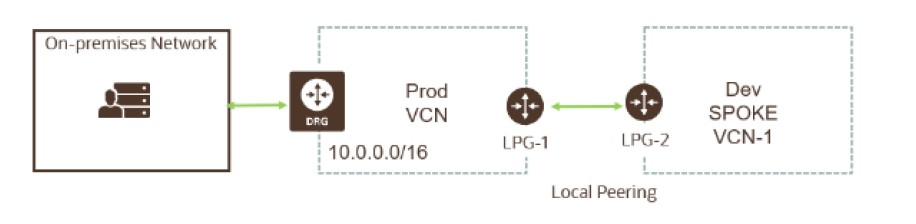
Question 24
Single choice
An online gaming application is deployed to multiple Availability Domains in the Oracle Cloud Infrastructure (OCI) us-ashburn-1 region. Considering the high volume of traffic that the gaming application handles, the company has hired you to ensure that the data stored by the application is scalable, highly available, and disaster resilient. In the event of failure, the Recovery Time Objective (RTO) and Recovery Point Objective (RPO) must be less than 2 hours. Which Disaster Recovery strategy should be used to achieve the RTO and RPO requirements in the event of a system failure?
-
A
Configure hourly block volumes backups using the OCI Command Line Interface (CLI).
-
B
Create a user defined backup policy with a schedule of generating daily backups for block volumes.
-
C
Configure hourly block volumes backups through the OCI Storage Gateway service.
-
D
Create a user defined backup policy with a schedule of generating hourly backups for block volumes.
Reveal answer details
Close answer details
Question 25
Single choice
An Oracle Cloud Infrastructure (OCI) Public Load Balancer's SSL certificate is expiring soon. You noticed the Load Balancer is configured with SSL Termination only. When the certificate expires, data traffic can be interrupted and security compromised. What steps do you need to take to prevent this situation?
-
A
Add the new SSL certificate to the Load Balancer, update backend servers to work with a new certificate and edit listeners so they can use the new certificate bundle.
-
B
Add the new SSL certificate to the Load Balancer, update listeners and backend sets so they can use the new certificate bundle.
-
C
Add the new SSL certificate to the Load Balancer and implement end to end SSL so it can encrypt the traffic from clients all the way to the backend servers.
-
D
Add the new SSL certificate to the Load Balancer and update backend servers to use the new certificate bundle.
-
E
Add the new SSL certificate to the Load Balancer and update listeners to use the new certificate bundle.
Reveal answer details
Close answer details
Correct answerC
ExplanationExplanation:
https://docs.cloud.oracle.com/en-us/iaas/Content/Balance/Tasks/managingcertificates.htm
|