An Oracle Cloud Infrastructure (OCI) Public Load Balancer's SSL certificate is expiring soon. You noticed the Load Balancer is configured with SSL Termination only. When the certificate expires, data traffic can be interrupted and security compromised. What steps do you need to take to prevent this situation?
-
A
Add the new SSL certificate to the Load Balancer, update backend servers to work with a new certificate and edit listeners so they can use the new certificate bundle.
-
B
Add the new SSL certificate to the Load Balancer, update listeners and backend sets so they can use the new certificate bundle.
-
C
Add the new SSL certificate to the Load Balancer and implement end to end SSL so it can encrypt the traffic from clients all the way to the backend servers.
-
D
Add the new SSL certificate to the Load Balancer and update backend servers to use the new certificate bundle.
-
E
Add the new SSL certificate to the Load Balancer and update listeners to use the new certificate bundle.
Reveal answer details
Close answer details
Correct answerA
Explanationhttps://docs.cloud.oracle.com/en-us/iaas/Content/Balance/Tasks/managingcertificates.htm
You are tasked with building a highly available, fault tolerant web application for your current employer.
The security team is concerned about an increase in malicious web-based attacks across the internet and asked what you can do to add a higher level of security to the website.
How should you architect the solution on Oracle Cloud Infrastructure (OCI) to meet all requirements defined by your organization?
(Choose the best answer.)
-
A
Deploy at least 3 web application servers, each in a different fault domain, using a regional private subnet. Place a public load balancer in a regional public subnet and create a backend set for all of the web application servers. Deploy a Web Application Firewall (WAF) and configure the load balancer public IP address as the origin.
-
B
Deploy at least 3 web application servers, each in a different fault domain, using a regional private subnet. Place a public load balancer in a regional public subnet and create a backend set for all of the web application servers. Create a Geolocation steering policy in Traffic Management and add an answer pool that directs to the public IP address of the load balancer. Configure a global catch-all rule to use this answer pool.
-
C
Deploy at least 3 web application servers, each in a different fault domain, using a regional public subnet. Ensure that each web application server is assigned a public IP address. Deploy a Web Application Firewall (WAF) and configure one Origin for each public IP address.
-
D
Deploy at least 3 web application servers, each in a different fault domain, using a regional public subnet. Use the OCI Traffic Management service to create a load balancing policy that will resolve DNS
evenly between all web servers.
Reveal answer details
Close answer details
Which of the following is NOT a good use case for the Oracle Cloud Infrastructure (OCI) Streaming service?
-
A
Meeting compliance requirements for data to remain unchanged over a long time, so that it can be retrieved for audit purposes.
-
B
Messaging with a pull-based communication model and the ability to feed multiple consumers with the same data independently.
-
C
Ingesting metric and log data to help make critical operational data more quickly available for indexing, analysis, and visualization.
-
D
Providing a unified entry point for cloud components to report their life cycle events for audit, accounting, and related activities.
Reveal answer details
Close answer details
Question 4
Multiple choice
You are currently working for a public health care company based in the United Stats. Their existing patient records runs in an on-premises data center and the customer is sending tape backups offsite as part of their recovery planning.
You have developed an alternative archival solution using Oracle Cloud Infrastructure (OCI) that will save the company a significant amount of mom on a yearly basis. The solution involves storing data in an OCI Object Storage bucket After reviewing your solution with the customer global Compliance (GRC) team they have highlighted the following security requirements: All data less than 1 year old must be accessible within 2 hour.
All data must be retained for at least 10 years and be accessible within 48 hours AH data must be encrypted at rest
No data may be transmitted across the public Internet Which two options meet the requirements outlined by the customer GRC team?
-
A
Provision a FastConnect link to the closest OCI region and configure a private peering virtual circuit.
-
B
Create an OCI Object Storage Standard tier bucket Configure a lifecycle policy to archive any object that Is older than 365 days
-
C
Create a VPN connection between your on premises data center and OCI. Create a Virtual Cloud Network (VCN) along with an OCI Service Gateway for OCI Object Storage.
-
D
Provision a FastConnect link to the closest OCI region and configure a public peering virtual circuit
-
E
Create an OCI Object Storage Standard tier bucket. Configure a lifecycle policy to delete any object that is older than 7 years
Reveal answer details
Close answer details
Correct answersB, D
ExplanationThe Oracle Services Network is a conceptual network in Oracle Cloud Infrastructure that is reserved for Oracle services. These services have public IP addresses that you typically reach over the internet.
However, you can access the Oracle Services Network without the traffic going over the internet.
There are different ways, depending on which of your hosts need the access: Hosts in your on-premises network:
- Private access through a VCN with FastConnect private peering or VPN Connect: The on-premises hosts use private IP addresses and reach the Oracle Services Network by way of the VCN and the VCN's service gateway.
- Public access with FastConnect public peering: The on-premises hosts use public IP addresses.
regarding which Fastconnect Public peering: To access public services in Oracle Cloud Infrastructure without using the internet. For example, Object Storage, the Oracle Cloud Infrastructure Console and APIs, or public load balancers in your VCN. Communication across the connection is with IPv4 public IP addresses. Without FastConnect, the traffic destined for public IP addresses would be routed over the internet. With FastConnect, that traffic goes over your private physical connection. so Answer 4 will be the best answer that meets the customer requirement A service gateway lets your virtual cloud network (VCN) privately access specific Oracle services without exposing the data to the public internet. No internet gateway or NAT is required to reach those specific services. The resources in the VCN can be in a private subnet and use only private IP addresses. The traffic from the VCN to the Oracle service travels over the Oracle network fabric and never traverses the internet.
Object Lifecycle Management lets you automatically manage the archiving and deletion of objects. By using Object Lifecycle Management to manage your Object Storage and Archive Storage data, you can reduce your storage costs and the amount of time you spend managing data.
A data analytics company has been building Its now generation big data and analytics platform on Oracle Cloud Infrastructure (OCI). They need a storage service that provide the scale and performance that their big data applications require such as high throughput to compute nodes with low latency file operations in addition, their data needs to be stored redundantly across multiple nodes In a single availability domain and allows concurrent connections from multiple compute Instances hosted on multiple availability domains. Which OCI storage service can you use to meet i his requirement?
-
A
-
B
-
C
-
D
Reveal answer details
Close answer details
Correct answerB
ExplanationOracle Cloud Infrastructure File Storage service provides a durable, scalable, secure, enterprise-grade network file system. You can connect to a File Storage service file system from any bare metal, virtual machine, or container instance in your Virtual Cloud Network (VCN). You can also access a file system from outside the VCN using Oracle Cloud Infrastructure FastConnect and Internet Protocol security (IPSec) virtual private network (VPN).
Use the File Storage service when your application or workload includes big data and analytics, media processing, or content management, and you require Portable Operating System Interface (POSIX)- compliant file system access semantics and concurrently accessible storage. The File Storage service is designed to meet the needs of applications and users that need an enterprise file system across a wide range of use cases
As a solution architect, you are designing a web application to be deployed across multiple Oracle Cloud Infrastructures (OCI) regions for a global audience. Your goal is that users from each region should access the application web servers deployed in their own geographical OCI location. Which OCI feature can be used to achieve this?
-
A
OCI Traffic Management IP Prefix steering policy
-
B
OCI Global Load balancers
-
C
OCI Public Load Balancers
-
D
OCI Traffic Management GeoLocation steering policy
Reveal answer details
Close answer details
Question 7
Multiple choice
You are responsible for migrating your on premises legacy databases on 11.2.0.4 version to Autonomous Transaction Processing Dedicated (ATP-D) In Oracle Cloud Infrastructure (OCI). As a solution architect, you need to plan your migration approach. Which two options do you need to implement together to migrate your on premises databases to OCI?
-
A
Use Oracle Data Guard to keep on premises database always active during migration
-
B
Retain changes to Oracle shipped privileges, stored procedures or views In the on-premises databases.
-
C
Use Oracle GoldenGate replication to keep on premises database online during migration.
-
D
Convert on-premises databases to PDB, upgrade to 19c, and encrypt Migration.
-
E
Retain all legacy structures and unsupported features (e.g. taw U>Bs) In the onuses databases for
migration.
Reveal answer details
Close answer details
Correct answersC, D
ExplanationAutonomous Database is an Oracle Managed and Secure environment. A physical database can't simply be migrated to autonomous because:
- Database must be converted to PDB, upgraded to 19c, and encrypted
- Any changes to Oracle shipped privileges, stored procedures or views must be removed
- All legacy structures and unsupported features must be removed (e.g. legacy LOBs) GoldenGate replication can be used to keep database online during migration
Question 8
Multiple choice
You work for a large bank where security and compliance are critical. As part of the security overview meeting, your company decided to minimize the installation of local tools on your laptop. You have been running Ansible and kubectl to spin up Oracle Container Engine for Kubernetes (OKE) clusters and deployed your application.
For authentication, you are using an Oracle Cloud Infrastructure (OCI) CLI config file that contains OCIDs, Fingerprint, and a locally stored PEM file. Your security team doesn't want you to store any local API key and certificate, or any other local tools. Which two actions should you perform to spin up the OKE cluster and interact with it? (Choose two.)
-
A
Create a developer workstation on OCI. Install Ansible and kubectl on it. Use resource principal to authenticate against OCI API and create the OKE Cluster.
-
B
Develop your own code using OCI SDK to deploy the OKE cluster.
-
C
Work on OCI Cloud Shell to use built-in Ansible and kubectl to deploy the OKE cluster. Use OCI_CLI_AUTH=instance_obo_user environment variable to authenticate using built-in token.
-
D
Work on OCI Cloud Shell to use built-in Ansible and kubectl to deploy the OKE cluster. Bring in your own config file and certificate to authenticate against OCI API.
-
E
Create a developer workstation on OCI. Install Ansible and kubectl on it. Use instance principal to authenticate against OCI API and create the OKE Cluster.
Reveal answer details
Close answer details
Correct answersC, E
Explanationhttps://docs.cloud.oracle.com/en-us/iaas/tools/oci-cli/2.12.4/oci_cli_docs/oci.html
Question 9
Multiple choice
You work for a German company as the Lead Oracle Cloud Infrastructure architect. You have designed a highly scalable architecture for your company's business critical application which uses the Load Balancer service auto which uses the Load Balancer service, autoscaling configuration for the application servers and a 2 Node VM Oracle RAC database. During the peak utilization period of the-application yon notice that the application is running slow and customers are complaining. This is resulting in support tickets being created for API timeouts and negative sentiment from the customer base. What are two possible reasons for this application slowness?
-
A
Autoscaling configuration for the application servers didn't happen due to IAM policy that's blocking access to the application server compartment
-
B
The Load Balancer configuration is not sending traffic to the listener of the application servers.
-
C
Autoscaling configuration for the application servers didn't happen due to compartment quota breach of the VM shapes used by the application servers.
-
D
Autoscaling configuration for the application servers didn't happen due to service limit breach of the VM shapes used by the application servers
-
E
The Load Balancer doesn't have a Network Security Group to allow traffic to the application servers.
Reveal answer details
Close answer details
Correct answersC, D
ExplanationAutoscaling
Autoscaling enables you to automatically adjust the number of Compute instances in an instance pool based on performance metrics such as CPU utilization. This helps you provide consistent performance for your end users during periods of high demand, and helps you reduce your costs during periods of low demand.
Prerequisites
- You have an instance pool. Optionally, you can attach a load balancer to the instance pool. For steps to create an instance pool and attach a load balancer, see Creating an Instance Pool.
- Monitoring is enabled on the instances in the instance pool. For steps to enable monitoring, see Enabling
Monitoring for Compute Instances.
- The instance pool supports the maximum number of instances that you want to scale to. This limit is determined by your tenancy's service limits.
About Service Limits and Usage When you sign up for Oracle Cloud Infrastructure, a set of service limits are configured for your tenancy.
The service limit is the quota or allowance set on a resource. For example, your tenancy is allowed a maximum number of compute instances per availability domain. These limits are generally established with your Oracle sales representative when you purchase Oracle Cloud Infrastructure.
Compartment Quotas
Compartment quotas are similar to service limits; the biggest difference is that service limits are set by Oracle, and compartment quotas are set by administrators, using policies that allow them to allocate resources with a high level of flexibility.
Question 10
Single choice
You are trying to troubleshoot the configuration of your Oracle Cloud Infrastructure (OCI) Load Balancing service. You have a backend HTTP service for which you have created a backend set in the load balancer.
You have configured health checks for the backend set. Although the health checks appear good, customers sometimes experience transaction failures. Which of the following options will definitely lead to this problem?
-
A
You are NOT using regional subnets in your Virtual Cloud Network. With Availability Domain (AD) specific subnet. the compute instances of the backend service running in the subnet have issues when the AD is down.
-
B
You are using OCI Domain Name System. You have misconfigured the 'A' record with the wrong IP address leading to requests not getting routed correctly.
-
C
You are using iSCI for block volume attachment to the compute instances in your backed HTTP service. TCP/IP configuration of your block volume attachment is not configured correctly, leading to issues in your backend service.
-
D
You are running a TCP-level health check against your HTTP service. The TCP handshake can succeed and indicate that the service is up even when the HTTP service has issues.
Reveal answer details
Close answer details
Question 11
Single choice
A global retailer has decided to re-design its e-commerce platform to have a micro-services architecture.
They would like to decouple application architecture into smaller, independent services using Oracle Cloud Infrastructure (OCI). They have decided to use both containers and servers technologies to run these application instances. Which option should you recommend to build this new platform?
-
A
Install a kubernetes cluster on OCI and use OCI event service.
-
B
Use Oracle Container Engine for kubernetes, OCI Registry and OCI Functions.
-
C
Use OCI Resource Manager to automate compute Instances provisioning and use OCI Streaming service.
-
D
Use OCI functions, OCI object storage and OCI event service.
Reveal answer details
Close answer details
Correct answerB
ExplanationOracle Functions is a fully managed, multi-tenant, highly scalable, on-demand, Functions-as-a- Service platform. It is built on enterprise-grade Oracle Cloud Infrastructure and powered by the Fn Project open source engine. Use Oracle Functions (sometimes abbreviated to just Functions) when you want to focus on writing code to meet business needs. 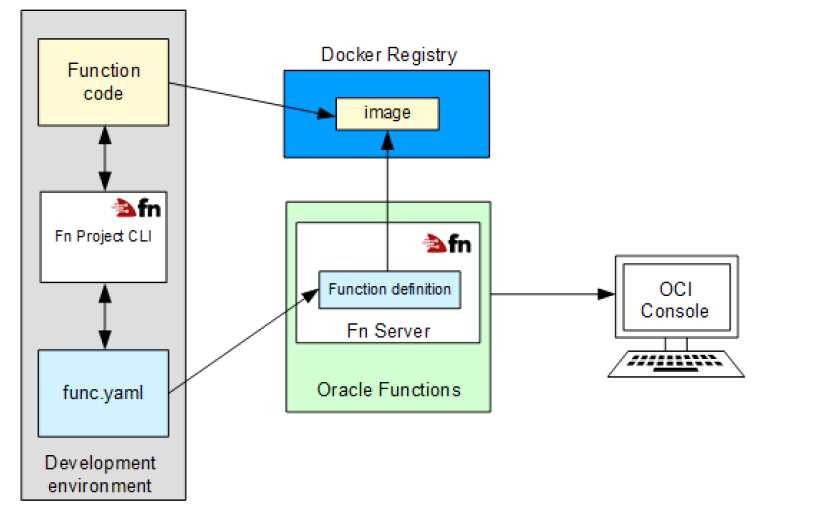 Oracle Cloud Infrastructure Container Engine for Kubernetes is a fully-managed, scalable, and highly available service that you can use to deploy your containerized applications to the cloud. Use Container Engine for Kubernetes (sometimes abbreviated to just OKE) when your development team wants to reliably build, deploy, and manage cloud-native applications. You specify the compute resources that your applications require, and Container Engine for Kubernetes provisions them on Oracle Cloud Infrastructure in an existing OCI tenancy.
Question 12
Multiple choice
Your customer has gone through a recent departmental re structure. As part of this change, they are organizing their Oracle Cloud Infrastructure (OCI) compartment structure to align with the company's new organizational structure.
They have made the following change: Compartment x Is moved, and its parent compartment is now compartment c. 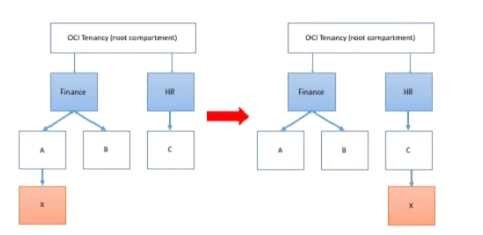 Policy defined in compartment A: Allow group networkadmins to manage subnets in compartment X Policy defined in root compartment: Allow group admins to read subnets in compartment Finance:A:X After you move the compartment, which two IAM policies would be required to ensure both groups retain the same permissions to compartment X that they had before? (Choose two.)
-
A
Define a policy in the root compartment as follows: Allow group admins to manage subnets in compartment Finance:A:X
-
B
Define a policy in compartment HR as follows: Allow group networkadmins to manage subnets in compartment C:X.
-
C
Define a policy in the root compartment as follows: Allow group admins to read subnets in compartment
HR:C:X
-
D
Define a policy in compartment C as follows: Allow group networkadmins to read subnets in compartment X
Reveal answer details
Close answer details
Question 13
Single choice
You are developing a Serverless function for your company's IoT project. This function should access Oracle Cloud Infrastructure (OCI) Object Storage to store some files. You choose Oracle Functions to deploy this function on OCI. However, your security team doesn't allow you to carry any API Token or RSA Key to authenticate the function against the OCI API to access the Object Storage.
What should you do to get this function to access OCI Object Storage without carrying any static authentication files?
(Choose the best answer.) 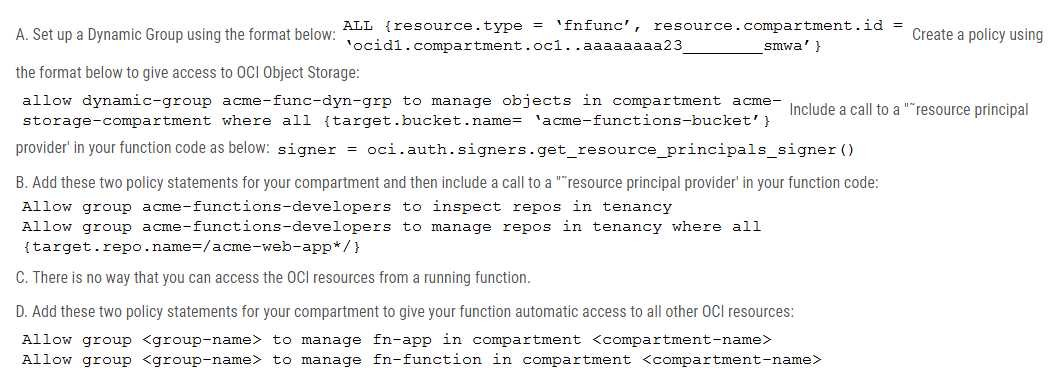
-
A
-
B
-
C
-
D
Reveal answer details
Close answer details
Correct answerA
Explanationhttps://blogs.oracle.com/cloud-infrastructure/getting-started-with-oracle-functions-and-object-
storage
Question 14
Single choice
A civil engineering company is running an online portal In which engineers can upload there constructions photos, videos, and other digital files. There is a new requirement for you to implement: the online portal must offload the digital content to an Object Storage bucket for a period of 72 hours. After the provided time limit has elapsed, the portal will hold all the digital content locally and wait for the next offload period. Which option fulfills this requirement?
-
A
Create a pre-authenticated URL for the entire Object Storage bucket to read and list the content with an expiration of 72 hours.
-
B
Create a pre authenticated URL lot each object that Is uploaded to the Object Storage bucket with an expiration of 72 hours.
-
C
Create a Dynamic Group with matching rule for the portal compute Instance and grant access to the Object Storage bucket for 72 hours.
-
D
Create a pre authenticated URL for the entire Object Storage bucket to write content with an expiration of 72 hours.
Reveal answer details
Close answer details
Correct answerD
ExplanationPre-authenticated requests provide a way to let users access a bucket or an object without having their own credentials, as long as the request creator has permission to access those objects. For example, you can create a request that lets operations support user upload backups to a bucket without owning API keys. Or, you can create a request that lets a business partner update shared data in a bucket without owning API keys.
When creating a pre-authenticated request, you have the following options: You can specify the name of a bucket that a pre-authenticated request user has write access to and can upload one or more objects to.
You can specify the name of an object that a pre-authenticated request user can read from, write to, or read from and write to.
Scope and Constraints
Understand the following scope and constraints regarding pre-authenticated requests: Users can't list bucket contents.
You can create an unlimited number of pre-authenticated requests. There is no time limit to the expiration date that you can set. You can't edit a pre-authenticated request. If you want to change user access options in response to changing requirements, you must create a new pre-authenticated request. The target and actions for a pre-authenticated request are based on the creator's permissions. The request is not, however, bound to the creator's account login credentials. If the creator's login credentials change, a pre-authenticated request is not affected. You cannot delete a bucket that has a pre-authenticated request associated with that bucket or with an object in that bucket.
Question 15
Single choice
Your customer has gone through a recent reorganization. As part of this change, they are organizing their Oracle Cloud Infrastructure (OCI) compartment structure to align with the company's new organizational structure. (Refer to the exhibit) 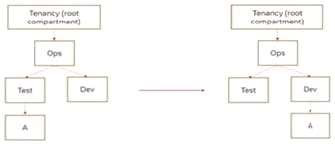 They have made the following change: Compartment A is moved, and its new parent compartment is compartment Dev.
Policy defined in compartment A: Allow group G1 to manage instance-family in compartment A Policy defined in root compartment: Allow group admins to manage instance-family in compartment Ops: Test: A After the compartment move, which action will provide users of group G1 and admins with similar privileges as before the move?
-
A
Define the following policy in compartment Dev: Allow group G1 to manage instance-family in compartment A
-
B
Define the following policies in compartment Dev: Allow group G1 to manage instance-family in compartment A Allow group admins to manage instance-family in compartment Ops: Dev: A
-
C
Define the following policy in compartment: Dev: Allow group admins to manage instance-family in compartment Ops: Dev: A
-
D
Mo change in any policy statement is required as all the policies associated with a compartment being moved is automatically updated
Reveal answer details
Close answer details
Question 16
Single choice
You are working as a solution architect for a customer in Frankfurt, which uses multiple compute instance VMs spread among three Availability Domains in the Oracle Cloud Infrastructure (OCI) eu-frankfurt-1 region. The compute instances do not have public IP addresses and are running in private subnets inside a Virtual Cloud Network (VCN). You have set up OCI Autoscaling feature for the compute instances, but find out that instances cannot be auto scaled. You have enabled monitoring on the instances. What could be wrong in this situation?
-
A
You need to assign a reserved public IP address to the compute instances.
-
B
You need to set up a Service Gateway to send metrics to the OCI Monitoring service.
-
C
Autoscaling only works for instances with public IP addresses.
-
D
Autoscaling only works with single availability domains.
Reveal answer details
Close answer details
Question 17
Single choice
You want to automate the processing of new image files to generate thumbnails. The expected rate is 10
new files every hour. Which of the following is the most cost effective option to meet this requirement in Oracle Cloud Infrastructure (OCI)?
-
A
Upload all files to an Oracle Streaming Service (OSS) stream. Setup a cron job to invoke a function in Oracle Functions to fetch data from the stream. Invoke another function to process the image files and generate thumbnails.
Store thumbnails in another OSS stream.
-
B
Upload files to an OCI Object storage bucket. Every time a file is uploaded, an event is emitted.
Write a rule to filter these events with an action to trigger a function in Oracle Functions. The function processes the image in the file and stores the thumbnails back in an Object storage bucket.
-
C
Build a web application to ingest the files and save them to a NoSQL Database. Configure OCI Events service to trigger a notification using Oracle Notification Service (ONS). ONS invokes a custom application to process the image files to generate thumbnails. Store thumbnails in a NoSQL Database table.
-
D
Upload files to an OCI Object storage bucket. Every time a file is uploaded, trigger an event with an action to provision a compute instance with a cloud-init script to access the file, process it and store it back in an Object storage bucket. Terminate the instance using Autoscaling policy after the processing is finished.
Reveal answer details
Close answer details
Question 18
Single choice
A retail company has several on-premises data centers which span multiple geographical locations. They plan to move some of their applications from on-premises data centers to Oracle Cloud Infrastructure (OCI). For these applications running in OCI, they still need to interact with applications running on their on-premises data centers to Oracle Cloud Infrastructure (OCI). for these applications running in OCI. they still need to interact with applications running on their on-premises data centers. These applications require highly available, fault-tolerant network connections between on premises data centers and OCI. Which option should you recommend to provide the highest level of redundancy?
-
A
Oracle cloud Infrastructure provides network redundancy by default so that no other operations are required
-
B
If your data centers span multiple, geographical locations, use only the specific IP address as a static route for the specific geographical location
-
C
Set up both IPSec VPN and FastConnect to connect your on premises data centers to Oracle Cloud Infrastructure.
-
D
Use FastConnect private peering only to ensure secure access from your data center to Oracle Cloud Infrastructure
-
E
Set up a single IPSec VPN connection (rom your data center to Oracle Cloud Infrastructure since It is cost effective
Reveal answer details
Close answer details
Correct answerB
ExplanationIf your data centers span multiple geographical locations, we recommend using a broad CIDR (0.0.0.0/0) as a static route in addition to the CIDR of the specific geographical location. This broad CIDR provides high availability and flexibility to your network design. For instance, the following diagram shows two networks in separate geographical areas that each connect to Oracle Cloud Infrastructure. Each area has a single on-premises router, so two IPSec VPN connections can be created. Note that each IPSec VPN connection has two static routes: one for the CIDR of the particular geographical area, and a broad
0.0.0.0/0 static route. 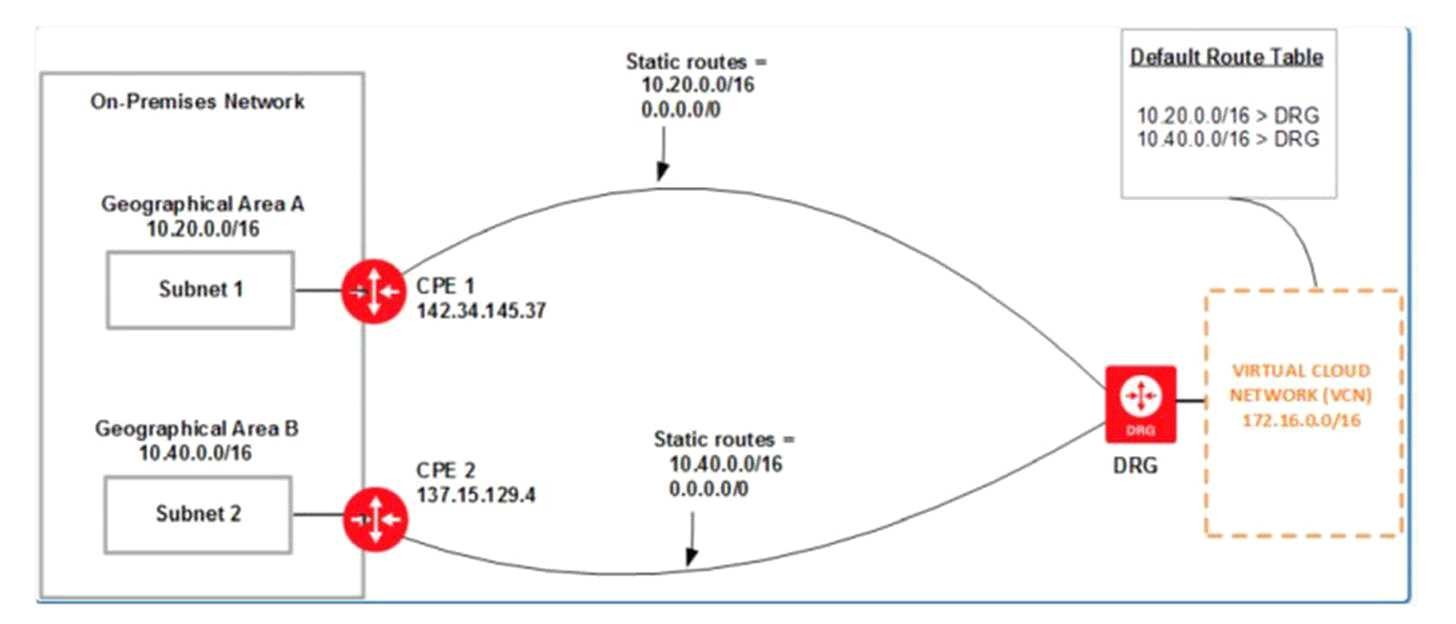
Question 19
Multiple choice
You have designed and deployed your Autonomous Data Warehouse (ADW) such that it is accessible from your on-premises data center and servers running on both private and public networks in Oracle Cloud Infrastructure (OCI). 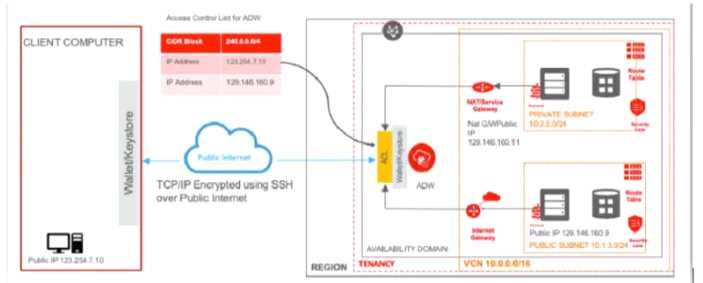 As you are testing the connectivity to your ADW database from the different access paths, you notice that the server running on the private network is unable to connect to ADW. Which two steps do you need to take to enable connectivity from the server on the private network to ADW? (Choose two.)
-
A
Add an entry in the Security List of the ADW allowing ingress traffic for C10R block 10.2.2.0/24
-
B
Add an entry in the route table (associated with the private subnet) with destination of 0.0.0.0/: target type of NAT Gateway, add a stateful egress rule to the security list (associated with the private subnet) with destination of 0.0.0.0./0 and for all IP protocols.
-
C
Add an entry in the access table list of ASW for CIDR block 10.2.2.0/24.
-
D
Add an entry in the route table (associated with the private subnet) with destination of 0.0.0.0./0; target
type of internet Gateway, add a stateful egress in the security list (associated with the private subnet) with destination of 0.0.0.0/0 and for all IP protocols.
-
E
Add an entry in the access control list of ADW for IP address 129.146.160.11
Reveal answer details
Close answer details
Correct answersB, E
ExplanationThere are 3 connections to ADW 1- Connecting to (ADW) from Public Internet 2- Connecting to ADW (via NAT or Service Gateway) from a server running on a private subnet in OCI (in the same tenancy) 3- Connecting to ADW (via internet Gateway) from a server running on a public subnet in OCI (in the same tenancy
Question 20
Single choice
Your team is conducting a root analysis (RCA) following a recent, unplanned outage. One of the block volumes attached to your production WebLogic server was deleted and you have tasked with identifying the source of the action. You search the Audit logs and find several Delete actions that occurred in the previous 24 hours. Given the sample of this event. 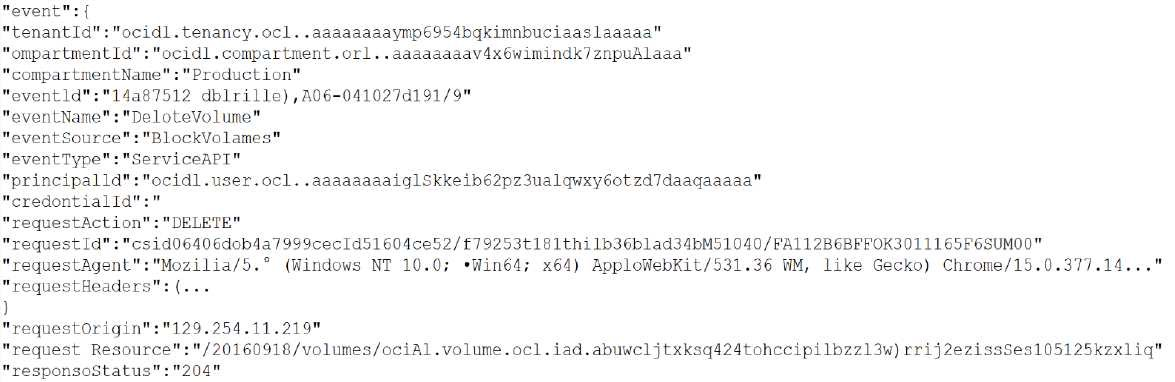 Which item from the event log helps you identify the individual or service that initiated the DeleteVolume API call?
-
A
-
B
-
C
-
D
-
E
Reveal answer details
Close answer details
Correct answerC
ExplanationThe Oracle Cloud Infrastructure Audit service automatically records calls to all supported Oracle Cloud Infrastructure public application programming interface (API) endpoints as log events.
Currently, all services support logging by Audit.
Every audit log event includes two main parts:
Envelopes that act as a container for all event messages Payloads that contain data from the resource emitting the event message The identity object contains the following attributes. data.identity.authType.
The type of authentication used. data.identity.principalId.
The OCID of the principal. data.identity.principalName.
The name of the user or service. This value is the friendly name associated with principalId .
Question 21
Multiple choice
You have been asked to create a mobile application which will be used for submitting orders by users of a popular E-Commerce site. The application is built to work with Autonomous Transaction Processing -
Serverless (ATP-S) database as the backend and HTML5 on Oracle Application Express as the front end.
During the peak usage of the application you notice that the application response time is very slow. ATP-S database is deployed with 3 CPU cores and 1 TB of memory. Which two options are expensive or impractical ways to improve the application response times?
-
A
Identify the maximum memory capacity needed for peak times and scale the memory for the ATP- S database to that number. ATP-S will scale the memory down when not needed.
-
B
Use the Machine Learning (ML) feature of the ATP-S database iteratively to tune the SQL queries used by the application.
-
C
Scale up CPU core count and memory during peak times.
-
D
Enable auto scaling for CPU cores on ATP-S database.
-
E
Identify the maximum CPU capacity needed for peak times and scale the CPU core count for the ATP-
S database to that number. ATP-S will scale the CPU core count down when not needed.
Reveal answer details
Close answer details
|