Question 1
Multiple choice
A large financial services company has used 2 types of Oracle DB Systems. In Oracle Cloud Infrastructure (OCI) to store user data. One is running on a VM.Standard2.8 shape and the other on a VM.Standard 2.4 shape. As business grows, data is growing rapidly on both the databases and performance is also degrading. The company wants to address this problem with a viable and economical solution. As the solution architect for that company you have suggested that they move their databases to Autonomous Transaction Processing Serverless (ATP-S) database. Which two factors should you consider before you arrived at that recommendation?
-
A
You verified that ATP S supports the database features and options currently being used by the 2 databases.
-
B
Validate that ATP-S will support the storage and processing requirements for the 2 databases over the life cycle of the business applications.
-
C
Confirm that ATP-S allows customers to compress tablespaces to reduce storage costs
-
D
Upon provisioning, ATP-S automatically scales up CPU to meet the application's processing requirements.
Reveal answer details
Close answer details
Correct answersA, B
ExplanationNot all features present in Oracle Database Enterprise Edition are available in ATP, and some some Oracle Database features are restricted, for example, database features designed for administration are not available. so you need to validate it first, You can find a complete list of the features that are not supported,
https://docs.oracle.com/en/cloud/paas/atp-cloud/atpug/experienced-database-users.html#GUID-58EE6599-6DB4-4F8E-816D-0422377857E5Also,youmustspecifytheinitialstorage
required for your database but ADB is elastic, so it is possible to grow or shrink your database as needed.
You are a solution architect working with a startup that has decided to move their workload to Oracle Cloud Infrastructure. Since their workload is small, upon architecting, you decide its sufficient to use 8 compute instances to run their workload. The company wants to use a common storage for their instances. So, you propose the idea of attaching a block volume to multiple instances to provide a common storage. Which of the below option is NOT true for such a solution?
-
A
If the block volume is already attached to an instance as read/write non-shareable you can't attach it to another instance until you detach it from the first instance.
-
B
Block volumes attached as read-only are configured as shareable by default.
-
C
You can delete a block volume from one instance without detaching it from all other instances there by
keeping other instance's storage intact.
-
D
Once you attach a block volume to an instance as read-only, it can only be attached to other instances as read-only.
Reveal answer details
Close answer details
You have multiple IAM users who launch different types of compute Instances and block volumes every day. As a result, your Oracle cloud Infrastructure (OCF) tenancy quickly hit the service limit and you can no longer create any new instances. As you are cleaning up environment, you notice that the majority of the Instances and block volumes are untagged. Therefore, It is difficult to pinpoint the owner of these resources verify if they are safe to terminate. Because of this, your company has issued a new mandate, which requires adding compute instances. Which option is the simplest way to implement this new requirement?
-
A
Create a policy to automatically tag a resource with the user name.
-
B
Create a policy using IAM requiring users to tag specific resources. This will allow a user to launch compute instances on\y if certain tags were defined.
-
C
Create tag variables to automatically tag a resource with the user name.
-
D
Create a default tag for each compartment, which ensure that appropriate tags are applied at resource creation
-
E
Create tag variables for each compartment to automatically tag a resource with the user name.
Reveal answer details
Close answer details
Correct answerC
ExplanationTag Variables
You can use a variable to set the value of a defined tag. When you add the tag to a resource, the variable resolves to the data it represents. You can use tag variables in defined tags and default tags.
Supported Tag Variables
The following tag variables are supported.
${iam.principal.name} The name of the principal that tagged the resource ${iam.principal.type} The type of principal that tagged the resource. ${oci.datetime} The date and time that the tag was created.
Consider the following example: Operations.CostCenter=" ${iam.principal.name} at ${oci.datetime} " Operations is the namespace, CostCenter is the tag key, and the tag value contains two tag
variables ${iam.principal.name} and ${oci.datetime} . When you add this tag to a resource, the variable resolves to your user name (the name of the principal that applied the tag) and a time date stamp for when you added the tag. user_name at 2019-06-18T18:00:57.604Z
The variable is replaced with data at the time you apply the tag. If you later edit the tag, the variable is gone and only the data remains. You can edit the tag value in all the ways you would edit any other tag value. To create a tag variable, you must use a specific format. ${<variable>} Type a dollar sign followed
by open and close curly brackets. The tag variable goes between the curly brackets. You can use tag variables with other tag variables and with string values. Tag defaults let you specify tags to be applied automatically to all resources, at the time of creation, in a specific compartment. This feature allows you to ensure that appropriate tags are applied at resource creation without requiring the user who is creating the resource to have access to the tag namespaces.
https://docs.cloud.oracle.com/en-us/iaas/Content/Tagging/Tasks/managingtagdefaults.htm
Question 4
Multiple choice
You are currently working for a public health care company based in the United Stats. Their existing patient records runs in an on-premises data center and the customer is sending tape backups offsite as part of their recovery planning. You have developed an alternative archival solution using Oracle Cloud Infrastructure (OCI) that will save the company a significant amount of mom on a yearly basis. The solution involves storing data in an OCI Object Storage bucket After reviewing your solution with the customer global Compliance (GRC) team they have highlighted the following security requirements: All data less than 1 year old must be accessible within 2 hour.
All data must be retained for at least 10 years and be accessible within 48 hours AH data must be encrypted at rest
No data may be transmitted across the public Internet Which two options meet the requirements outlined by the customer GRC team?
-
A
Provision a FastConnect link to the closest OCI region and configure a private peering virtual circuit.
-
B
Create an OCI Object Storage Standard tier bucket Configure a lifecycle policy to archive any object that Is older than 365 days
-
C
Create a VPN connection between your on premises data center and OCI. Create a Virtual Cloud Network (VCN) along with an OCI Service Gateway for OCI Object Storage.
-
D
Provision a FastConnect link to the closest OCI region and configure a public peering virtual circuit
-
E
Create an OCI Object Storage Standard tier bucket. Configure a lifecycle policy to delete any object that is older than 7 years
Reveal answer details
Close answer details
Correct answersB, D
ExplanationThe Oracle Services Network is a conceptual network in Oracle Cloud Infrastructure that is reserved for Oracle services. These services have public IP addresses that you typically reach over the internet.
However, you can access the Oracle Services Network without the traffic going over the internet. There are different ways, depending on which of your hosts need the access: Hosts in your on-premises network:
- Private access through a VCN with FastConnect private peering or VPN Connect: The on-premises
hosts use private IP addresses and reach the Oracle Services Network by way of the VCN and the VCN's service gateway.
- Public access with FastConnect public peering: The on-premises hosts use public IP addresses.
regarding which Fastconnect Public peering: To access public services in Oracle Cloud Infrastructure without using the internet. For example, Object Storage, the Oracle Cloud Infrastructure Console and APIs, or public load balancers in your VCN. Communication across the connection is with IPv4 public IP addresses. Without FastConnect, the traffic destined for public IP addresses would be routed over the internet. With FastConnect, that traffic goes over your private physical connection. so Answer 4 will be the best answer that meets the customer requirement A service gateway lets your virtual cloud network (VCN) privately access specific Oracle services without exposing the data to the public internet. No internet gateway or NAT is required to reach those specific services. The resources in the VCN can be in a private subnet and use only private IP addresses. The traffic from the VCN to the Oracle service travels over the Oracle network fabric and never traverses the internet.
Object Lifecycle Management lets you automatically manage the archiving and deletion of objects. By using Object Lifecycle Management to manage your Object Storage and Archive Storage data, you can reduce your storage costs and the amount of time you spend managing data.
As part of planning the network design on Oracle Cloud Infrastructure, you have been asked to create an Oracle Cloud Infrastructure Virtual Cloud Network (VCN) with 3 subnets, one in each Availability Domain.
Each subnet needs to have a minimum of 64 usable IP addresses. What is the smallest subnet and VCN size you should use to implement this design?
-
A
122 for the VCN; 124 for the subnets
-
B
/23 for the VCN; /25 for the subnets
-
C
/24 for the VCN; /24 for the subnets
-
D
/22 for the VCN; /25 for the subnets
Reveal answer details
Close answer details
Question 6
Multiple choice
You work for a bank as the lead Oracle Cloud Infrastructure architect. You designed a highly scalable solution for your company's banking application. The architecture includes a load balancer, application servers with autoscaling configuration based on CPU utilization, and an Autonomous Database with Transaction Processing workload type running in a Virtual Cloud Network (VCN). During the peak utilization period, the application users complain that the application runs slow. What are two possible reasons for the application running slow at times? (Choose two.)
-
A
The VCN does not have a Network Security Group configured to allow traffic from the load balancer to all the application servers in the backend set.
-
B
Instance pool in autoscaling configuration for the application servers did not scale out due to compartment quota breach of the VM shapes used by the application servers.
-
C
The load balancer is not configured correctly to send traffic to all the listeners of the application servers in the backend set.
-
D
Instance pool in autoscaling configuration for the Autonomous Database did not scale out due to misconfigured scaling policy.
-
E
Instance pool in autoscaling configuration for the application servers did not scale out due to service limit breach of the VM shapes used by the application servers.
Reveal answer details
Close answer details
An Oracle Cloud Infrastructure (OCI) Public Load Balancer's SSL certificate is expiring soon. You noticed the Load Balancer is configured with SSL Termination only. When the certificate expires, data traffic can be interrupted and security compromised. What steps do you need to take to prevent this situation?
-
A
Add the new SSL certificate to the Load Balancer, update backend servers to work with a new certificate and edit listeners so they can use the new certificate bundle.
-
B
Add the new SSL certificate to the Load Balancer, update listeners and backend sets so they can use the new certificate bundle.
-
C
Add the new SSL certificate to the Load Balancer and implement end to end SSL so it can encrypt the traffic from clients all the way to the backend servers.
-
D
Add the new SSL certificate to the Load Balancer and update backend servers to use the new certificate bundle.
-
E
Add the new SSL certificate to the Load Balancer and update listeners to use the new certificate bundle.
Reveal answer details
Close answer details
Correct answerC
ExplanationExplanation:
https://docs.cloud.oracle.com/en-us/iaas/Content/Balance/Tasks/managingcertificates.htm
As an administrator you want to give users of ObjectWriters group full access to bucket Bucket-A and its objects in compartment comp-images. You want users of ObjectWriters to not be able to access or modify properties of any other buckets and its objects in the compartment comp-images. Select the statement(s) below that will best define your IAM policies.
-
A
Allow group ObjectWriters to mange buckets in compartment comp-images Allow group ObjectWriters to manage objects in compartment comp-images where target.bucket.name= 'Eucket-A'
-
B
Allow group ObjectWriters to manage buckets in compartment comp-images where target.bucket.name=' Bucket-A'
-
C
Allow group ObjectWriters to inspect buckets in compartment comp-images Allow group ObjectWriters to read buckets in compartment comp-images where target.bucket.name='
Bucket-A"
Allow group ObjectWriters to manage objects in compartment comp-images where target.bucket.name=' Bucket-A'
-
D
Allow group ObjectWritexs to read buckets in compartmentcomp-images Allow group ObjectWriters to manage objects in compartment comp-images where target.bucket.name= 'Bucket-A'
Reveal answer details
Close answer details
You have 10 Oracle Linux Compute instances within the ociarchpro compartment running in Oracle Cloud Infrastructure (OCI). The instances are placed in a private subnet inside a Virtual Cloud Network (VCN).
You plan to leverage the Oracle Vulnerability Scanning service to gain visibility into potential vulnerabilities.
Your goal is to improve the overall security posture. You create a Scan recipe with the following settings: Type: Compute - Name: ociproscanrecipe - CIS benchmark scanning: Enabled - CIS benchmark profile: Medium (More than 40% of the benchmarks failing is a high risk) Schedule: Daily - You create a target with the following settings: Type: Compute - Compartment: ociarchpro - Scan recipe: ociproscanrecipe - Targets: All compute instances in the selected target compartment and its sub-compartments However, you are not able to see the result of host scans for the compute target. For the given scenario, which is NOT a valid troubleshooting task?
-
A
Check whether the target was created less than 24 hours ago.
-
B
Enable the scanning plugin on the Oracle Cloud Agent if you manually disabled it on the target compute instances.
-
C
Create a service gateway for the Virtual Cloud Network (VCN) and configure a route rule.
-
D
Disable agent-based scanning in the recipe.
Reveal answer details
Close answer details
Question 10
Single choice
You are part of a project team working in the development environment created in Oracle Cloud Infrastructure (OCI). You realize that the CIDR block specified for one of the subnets in a Virtual Cloud Network (VCN) is not correct and want to delete the subnet. While deleting you get an error indicating that there are still resources that you must delete first. The error includes the OCID of the VNIC that is in the subnet. Which of the following action you will take to troubleshoot this issue?
-
A
Use OCI CLI to call "network vnic" and "compute vnic-attachment" operations to find out the parent resource of the VNIC.
-
B
Use OCI CLI to delete the VNIC first and then delete the subnet.
-
C
Use OCI CLI to delete the subnet using -force option.
-
D
Copy and paste OCID of the VNIC in the search box of the OCI Console to find out the parent resource of the VNIC.
Reveal answer details
Close answer details
Question 11
Single choice
You developed a microservices based application that runs on Oracle Cloud Infrastructure (OCI) Container Engine for Kubernetes (OKE). Your security team wants to use SSL termination for this application. What should you do to create a secure SSL termination for this application using fewest steps?
-
A
Create a self-signed certificate and it's corresponding key. Create a Kubernetes secret using the certificate and the key. Then add these an notations to the Kubernetes service: annotations:
service.beta.kubernetes.io/oci-load-balancer-ssl-ports: "443" service.beta.kubernetes.io/oci-load-
balancer-security-list-management-mode:"Frontend"
-
B
Generate a self-signed certificate using Let's Encrypt. Use that certificate on OCI Load Balancer.
Create the Kubernetes service usingthis load balancer.
-
C
Add these annotationsto the Kubernetes service: annotations:
service.beta.kubernetes.io/oci-load-balancer-ssl-ports: "443" service.beta.kubernetes.io/oci-load-
balancer-ssl-secret-key: ssl-secret-key
-
D
Create a self-signed certificate and it's corresponding key. Create a Kubernetes secret using then add these annotationsto the Kubernetes service.
Service.beta.kubernete.io/oci-load-balancer-ssl-ports: "443" Service.beta.kubernete.io/oci-load-
balancer-tls-secret:SSL-CERTIFICATE-SECRET
Reveal answer details
Close answer details
Question 12
Single choice
Your team is conducting a root analysis (RCA) following a recent, unplanned outage. One of the block volumes attached to your production WebLogic server was deleted and you have tasked with identifying the source of the action. You search the Audit logs and find several Delete actions that occurred in the previous 24 hours. Given the sample of this event. 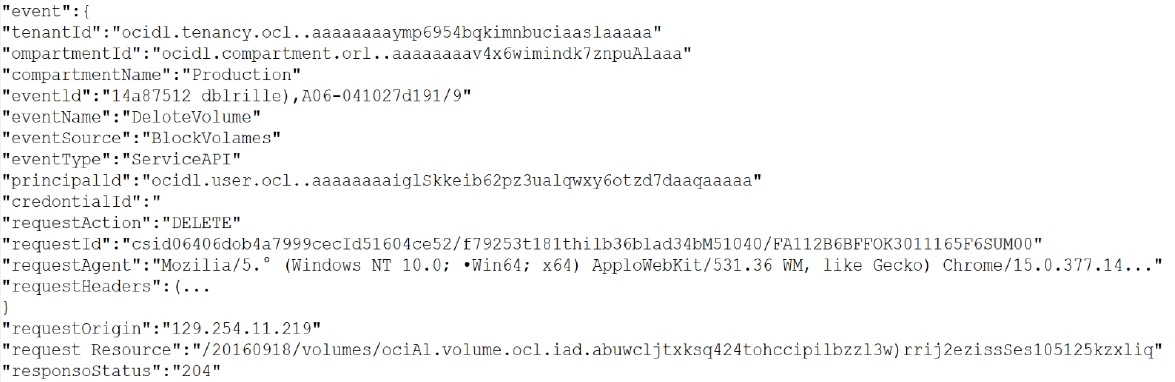 Which item from the event log helps you identify the individual or service that initiated the DeleteVolume API call?
-
A
-
B
-
C
-
D
-
E
Reveal answer details
Close answer details
Correct answerC
ExplanationThe Oracle Cloud Infrastructure Audit service automatically records calls to all supported Oracle Cloud Infrastructure public application programming interface (API) endpoints as log events. Currently, all services support logging by Audit.
Every audit log event includes two main parts:
Envelopes that act as a container for all event messages Payloads that contain data from the resource emitting the event message The identity object contains the following attributes. data.identity.authType.
The type of authentication used. data.identity.principalId.
The OCID of the principal. data.identity.principalName
The name of the user or service. This value is the friendly name associated with principalId .
Question 13
Multiple choice
A manufacturing company is planning to migrate their on-premises database to OCI and has hired you for the migration. Customer has provided following information regarding their existing onpremises database: Database version, host operating system and version, database character set, storage for data staging, acceptable length of system outage. What additional information do you need from customer in order to recommend a suitable migration method? Choose two
-
A
Elapsed time since database was last patched
-
B
On-premises host operating system and version
-
C
Number of active connections
-
D
Data types used in the on-premises database
-
E
Top 5 longest running queries
Reveal answer details
Close answer details
Correct answersB, D
ExplanationNot all migration methods apply to all migration scenarios. Many of the migration methods apply only if specific characteristics of the source and destination databases match or are compatible.
Moreover, additional factors can affect which method you choose for your migration from among the methods that are technically applicable to your migration scenario. Some of the characteristics and factors to consider when choosing a migration method are: On-premises database version Database service database version
On-premises host operating system and version On-premises database character set Quantity of data, including indexes Data types used in the on-premises database Storage for data staging Acceptable length of system outage Network bandwidth
Question 14
Multiple choice
After performing maintenance on an Oracle Linux compute instance the system is returned to a running state You attempt to connect using SSH t to do so. You decide to create an instance console connection to troubleshoot the issue. Which three tasks would enable you to connect to the console connection and begin troubleshooting?
-
A
Use SSH to connect to the public: IP address of the compute Instance and provide the console connection OCID as the username.
-
B
edit the Linux boot menu to enable access to console.
-
C
Use SSH to connect to the service endpoint of the console connection service
-
D
Reboot the compute instance using the Oracle Cloud Infrastructure (OCI) Management Console
-
E
Upload an API signing key for console connection authentication.
-
F
Stop the compute Instance using the Oracle cloud Infrastructure (OCI) Command Line interface (CLI).
Reveal answer details
Close answer details
Correct answersB, C, D
ExplanationThe Oracle Cloud Infrastructure Compute service provides console connections that enable you to remotely troubleshoot malfunctioning instances, such as: An imported or customized image that does not complete a successful boot. A previously working instance that stops responding. the steps to connect to console and troubleshoot the OS Issue 1- Before you can connect to the serial console you need to create the instance console connection.
Open the navigation menu. Under Core Infrastructure, go to Compute and click Instances.
Click the instance that you're interested in.
Under Resources, click Console Connections.
Click Create Console Connection.
Upload the public key (.pub) portion for the SSH key. You can browse to a public key file on your computer or paste your public key into the text box.
Click Create Console Connection.
When the console connection has been created and is available, the status changes to ACTIVE. 2- Connecting to the Serial Console you can connect to the serial console by using a Secure Shell (SSH) connection to the service endpoint of the console connection service Open the navigation menu. Under Core Infrastructure, go to Compute and click Instances.
Click the instance that you're interested in.
Under Resources, click Console Connections.
Click the Actions icon (three dots), and then click Copy Serial Console Connection for Linux/Mac.
Paste the connection string copied from the previous step to a terminal window on a Mac OS X or Linux system, and then press Enter to connect to the console. If you are not using the default SSH key or ssh-agent, you can modify the serial console connection string to include the identity file flag, -i , to specify the SSH key to use. You must specify this for both the SSH connection and the SSH ProxyCommand, as shown in the following line:
ssh -i /<path>/<ssh_key> -o ProxyCommand='ssh -i /<path>/<ssh_key> -W %h:%p -p 443...
Press Enter again to activate the console. 3- Troubleshooting Instances from Instance Console Connections To boot into maintenance mode Reboot the instance from the Console.
When the reboot process starts, switch back to the terminal window, and you see Console messages start to appear in the window. As soon as you see the GRUB boot menu appear, use the up/down arrow key to stop the automatic boot process, enabling you to use the boot menu. In the boot menu, highlight the top item in the menu, and type e to edit the boot entry. In edit mode, use the down arrow key to scroll down through the entries until you reach the line that starts with either linuxefi for instances running Oracle Autonomous Linux 7.x or Oracle Linux 7.x, or kernel for instances running Oracle Linux 6.x.
At the end of that line, add the following: init=/bin/bash
Reboot the instance from the terminal window by entering the keyboard shortcut CTRL+X.
Question 15
Multiple choice
An upcoming e-commerce company has deployed their online shopping application on OCI. The application was deployed on compute instances with autoscaling configuration for application servers fronted by a load balancer and OCI Autonomous Transaction Processing (ATP) in the backend. In order to promote their e-commerce platform 50% discount was announced on all the products for a limited period. During the day 1 of promotional period it was observed that the application is running slow and company's hotline is flooded with complaints. What could be two possible reasons for this situation?
-
A
The health check on some of the backend servers has failed and the load balancer has taken those servers temporarily out of rotation
-
B
As part of autoscaling, the load balancer shape has dynamically changed to a larger shape to handle more incoming traffic and the system was slow for a short time during this change
-
C
The health check on some of the backend servers has failed and the load balancer was rebooting these servers.
-
D
The autoscaling has already scaled to the maximum number of instances specified in the configuration and there is no room of scaling
Reveal answer details
Close answer details
Question 16
Multiple choice
A fast growing E-commerce company has deployed their online shopping application on Oracle Cloud Infrastructure. The application was deployed on compute instances with Autoscaling configuration for application servers fronted by a load balancer and OCI Autonomous Transaction Processing (ATP) in the backend. In order to promote their e- commerce platform 50% discount was announced on all the products for a limited period. During the day 1 of promotional period it was observed that the application is running slow and company's hotline is flooded with complaints. What could be two possible reasons for this situation?
-
A
The health check on some of the backend servers has failed and the load balancer has taken those servers temporarily out of rotation.
-
B
As part of Autoscaling, the load balancer shape has dynamically changed to a larger shape to handle more incoming traffic and the system was slow for a short time during this change.
-
C
The health check on some of the backend servers has failed and the load balancer was rebooting these servers.
-
D
Autoscaling has already scaled to the maximum number of instances specified in the configuration and there is no room for scaling further.
Reveal answer details
Close answer details
Question 17
Single choice
A global media organization is working on a project which lets users upload their videos to the site. After upload is complete, the video should be automatically processed by an Al algorithm. The algorithm will try to recognize certain actions in the videos so that it can be used to show related advertisements in future.
The development team wants to focus on writing Al code and not worry about underlying infrastructure for high availability, scalability, security and monitoring. Which Oracle Cloud Infrastructure (OCI) services would meet these requirements?
-
A
OCI Object Storage, OCI Events service and OCI Functions.
-
B
Oracle Container Engine for Kubernetes, OCI Notifications and OCI Object Storage.
-
C
OCI Events, Oracle Container Engine for Kubernetes and OCI Digital Assistant.
-
D
OCI Resource Manager, OCI Functions and OCI Events service.
Reveal answer details
Close answer details
Question 18
Single choice
All three Data Guard Configuration are fully supported on Oracle Cloud infrastructure (OCI). You want to deploy a maximum availability architecture (MAA) for database workload. Which option should you consider while designing your Data Guard configuration to ensure best RTO and PRO without causing any data loss?
-
A
Configure "Maximum Protection" mode which provides zero data loss If the primary database fails.
-
B
Configure "Maximum Performance" mode In SYNC mode between two availability domains (same region) which provides, the highest level of data protection that is possible without affecting the performance of the primary database.
-
C
Configure ''Maximum Scalability" mode which provides the highest level of scalability without compromising the availability of the primary database.
-
D
Configure ''Maximum Availability" mode in SYNC mode between two availability domains (same region), and use the Maximum Availability mode in SYNC mode between two regions.
Reveal answer details
Close answer details
Correct answerD
ExplanationExplanation:
https://docs.cloud.oracle.com/en-us/iaas/Content/Resources/Assets/whitepapers/best-practices-for-dr-on-oci.pdf All three Data Guard configurations are fully supported on Oracle Cloud Infrastructure. However, because of a high risk of production outage, we don't recommend using the maximum protection mode for your Data Guard configuration. We recommend using the maximum availability mode in SYNC mode between two availability domains (same region), and using the maximum availability mode in ASYNC mode between two regions. This architecture provides you the best RTO and RPO without causing any data loss.
We recommend building this architecture in daisy-chain mode: the primary database ships redo logs to the first standby database in another availability domain in SYNC mode, and then the first standby database ships the redo logs to another region in ASYNC mode. This method ensures that your primary database is not doing the double work of shipping redo logs, which can cause performance impact on a production workload. 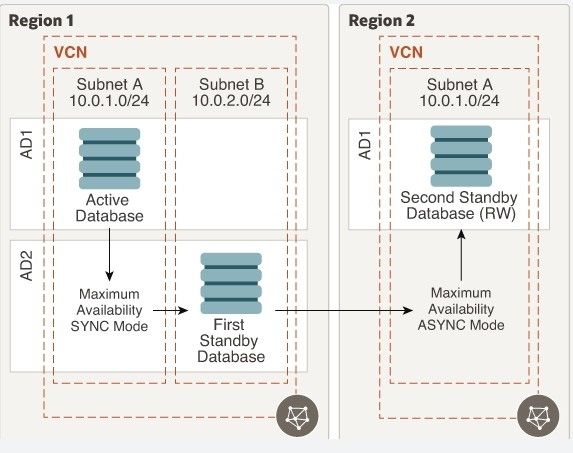 This configuration offers the following benefits: No data loss within a region.
No overhead on the production database to maintain standbys in another region. Option to configure lagging on the DR site if needed for business reasons. Option to configure multiple standbys in different regions without any additional overhead on the production database. A typical use case is a CDN application Bottom of Form
Question 19
Single choice
You have created compartment called Dev for developers. There are two IAM groups for developers: group-devl and group-dev2. You need to write an Identity and Access Management (IAM) policy to give users in these groups access to manage all resources in the compartment Dev. Which of the following IAM policy will accomplish this?
-
A
Allow any-user to manage all resources in compartment Dev where request.group= /group-dev*/
-
B
Allow group group-devl group-dev2 to manage all resources in compartment Dev
-
C
Allow group /group-dev*/ to manage all resources in compartment Dev
-
D
Allow any-user to manage all resources in tenancy where target.comparment= Dev
Reveal answer details
Close answer details
Question 20
Single choice
You work for a retail company and they developed a Microservices based shopping application that needs to access Oracle Autonomous Database from the application. As an Architect, you have been tasked to treat all of the application components as Kubernetes native objects, such as the microservices, Oracle Autonomous database, Kubernetes services, etc. What should you do to make sure that you can use Kubernetes constructs to manage the life cycle of the application components, including Oracle Autonomous Database? (Choose the best answer.)
-
A
Create an Oracle Cloud Infrastructure (OCI) Service Gateway and connect to the Oracle Autonomous Database using the private IP address from the microservice.
-
B
Provision an Oracle Autonomous Database and then use OCI Service Broker to access the database as a native component to your Kubernetes cluster.
-
C
Create a service from the Kubernetes cluster and point to the Oracle Autonomous Database using its FQDN.
-
D
Install and secure the OCI Service Broker for Kubernetes. Then provision and bind to the required Oracle Cloud Infrastructure services.
Reveal answer details
Close answer details
Correct answerD
ExplanationOCI Service Broker for Kubernetes is an implementation of the Open Service Broker API. OCI Service Broker for Kubernetes is specifically for interacting with Oracle Cloud Infrastructure services from Kubernetes clusters. It includes three service broker adapters to bind to the following Oracle Cloud Infrastructure services: Object Storage Autonomous Transaction Processing Autonomous Data Warehouse
Question 21
Single choice
A civil engineering company is running an online portal In which engineers can upload there constructions photos, videos, and other digital files. There is a new requirement for you to implement: the online portal must offload the digital content to an Object Storage bucket for a period of 72 hours. After the provided time limit has elapsed, the portal will hold all the digital content locally and wait for the next offload period. Which option fulfills this requirement?
-
A
Create a pre-authenticated URL for the entire Object Storage bucket to read and list the content with an expiration of 72 hours.
-
B
Create a pre authenticated URL lot each object that Is uploaded to the Object Storage bucket with an expiration of 72 hours.
-
C
Create a Dynamic Group with matching rule for the portal compute Instance and grant access to the Object Storage bucket for 72 hours.
-
D
Create a pre authenticated URL for the entire Object Storage bucket to write content with an expiration of 72 hours.
Reveal answer details
Close answer details
Correct answerD
ExplanationPre-authenticated requests provide a way to let users access a bucket or an object without having their own credentials, as long as the request creator has permission to access those objects.
For example, you can create a request that lets operations support user upload backups to a bucket without owning API keys. Or, you can create a request that lets a business partner update shared data in a bucket without owning API keys. When creating a pre-authenticated request, you have the following options: You can specify the name of a bucket that a pre-authenticated request user has write access to and can upload one or more objects to.
You can specify the name of an object that a pre-authenticated request user can read from, write to, or read from and write to.
Scope and Constraints
Understand the following scope and constraints regarding pre-authenticated requests: Users can't list bucket contents.
You can create an unlimited number of pre-authenticated requests. There is no time limit to the expiration date that you can set. You can't edit a pre-authenticated request. If you want to change user access options in response to changing requirements, you must create a new pre-authenticated request. The target and actions for a pre-authenticated request are based on the creator's permissions. The request is not, however, bound to the creator's account login credentials. If the creator's login credentials change, a pre-authenticated request is not affected. You cannot delete a bucket that has a pre-authenticated request associated with that bucket or with an object in that bucket.
Question 22
Multiple choice
You are responsible for migrating your on-premises legacy databases on 11.2.0.4 version to Autonomous Transaction Processing - Dedicated (ATP-D) in Oracle Cloud Infrastructure (OCI). As a solution architect, you need to plan your migration approach. Which three options do you need to implement together to migrate your on-premises databases to OCI?
-
A
Retain all legacy structures and unsupported features (e.g. legacy LOBs) in the on-premises databases for migration.
-
B
Use Oracle Data Guard to keep on-premises database always active during migration.
-
C
Launch Autonomous Transaction Processing - Dedicated database in OCI.
-
D
Retain changes to Oracle shipped privileges, stored procedures or views in the on-premises databases.
-
E
Convert on-premises databases to PDB, upgrade to 19c, and encrypt.
-
F
Use Oracle GoldenGate replication to keep on-premises database online during migration.
Reveal answer details
Close answer details
Question 23
Single choice
You are working with a social media company as a solution architect. The media company wants to collect and analyze large amounts of data being generated from their websites and social media feeds to gain insights and continuously improve the user experience. In order to meet this requirement, you have developed a microservices application hosted on Oracle Container Engine for Kubernetes. The application will process the data and store the result to an Autonomous Data Warehouse (ADW) instance. Which Oracle Cloud Infrastructure (OCI) service can you use to collect and process a large volume of unstructured data in real time?
-
A
-
B
-
C
-
D
Reveal answer details
Close answer details
Question 24
Single choice
You have two Virtual Cloud Networks (VCN) that need to be peered. The set up is as follows: The VCNs are in different tenancies. Peering has to be via Local Peering Gateway (LPG) because one of the VCNs needs to be added to an existing Hub and Spoke configuration that consists of a hub and two spokes. There is a CIDR overlap. The VCN that serves as the Hub VCN has a 172.19.0.0/16 CIDR prefix. The other VCN to be added as a Spoke VCN has a 172.19.128.0/17 CIDR prefix. The other two spokes have 10.0.0.0/16 and 192.168.0.0/16 prefixes, respectively. What is a possible solution to this problem?
-
A
Use Dynamic Routing Gateway (DRG) instead.
-
B
Add another CIDR prefix to the VCN that is integrating with the Hub and Spoke and does not overlap.
Use that CIDR for the LPG connection.
-
C
Review the subnets in the hub VCN. If they all have the third octet under 128, change the VCN prefix to
/17.
-
D
Review the subnets in the hub VCN. If they all have the third octet above 128, change the VCN prefix to /17.
-
E
Review all subnets in the hub VCN. If one of them has the third octet at 128, change the VCN prefix to /17.
Reveal answer details
Close answer details
Question 25
Single choice
A retail company has several on-premises data centers which span multiple geographical locations. They plan to move some of their applications from on-premises data centers to Oracle Cloud Infrastructure (OCI). For these applications running in OCI, they still need to interact with applications running on their on-premises data centers to Oracle Cloud Infrastructure (OCI). for these applications running in OCI. they still need to interact with applications running on their on-premises data centers. These applications require highly available, fault-tolerant network connections between on premises data centers and OCI. Which option should you recommend to provide the highest level of redundancy?
-
A
Oracle cloud Infrastructure provides network redundancy by default so that no other operations are required
-
B
If your data centers span multiple, geographical locations, use only the specific IP address as a static route for the specific geographical location
-
C
Set up both IPSec VPN and FastConnect to connect your on premises data centers to Oracle Cloud Infrastructure.
-
D
Use FastConnect private peering only to ensure secure access from your data center to Oracle Cloud Infrastructure
-
E
Set up a single IPSec VPN connection (rom your data center to Oracle Cloud Infrastructure since It is cost effective
Reveal answer details
Close answer details
Correct answerB
ExplanationIf your data centers span multiple geographical locations, we recommend using a broad CIDR (0.0.0.0/0) as a static route in addition to the CIDR of the specific geographical location. This broad CIDR provides high availability and flexibility to your network design. For instance, the following diagram shows two networks in separate geographical areas that each connect to Oracle Cloud Infrastructure. Each area has a single on-premises router, so two IPSec VPN connections can be created. Note that each IPSec VPN connection has two static routes: one for the CIDR of the particular geographical area, and a broad
0.0.0.0/0 static route. 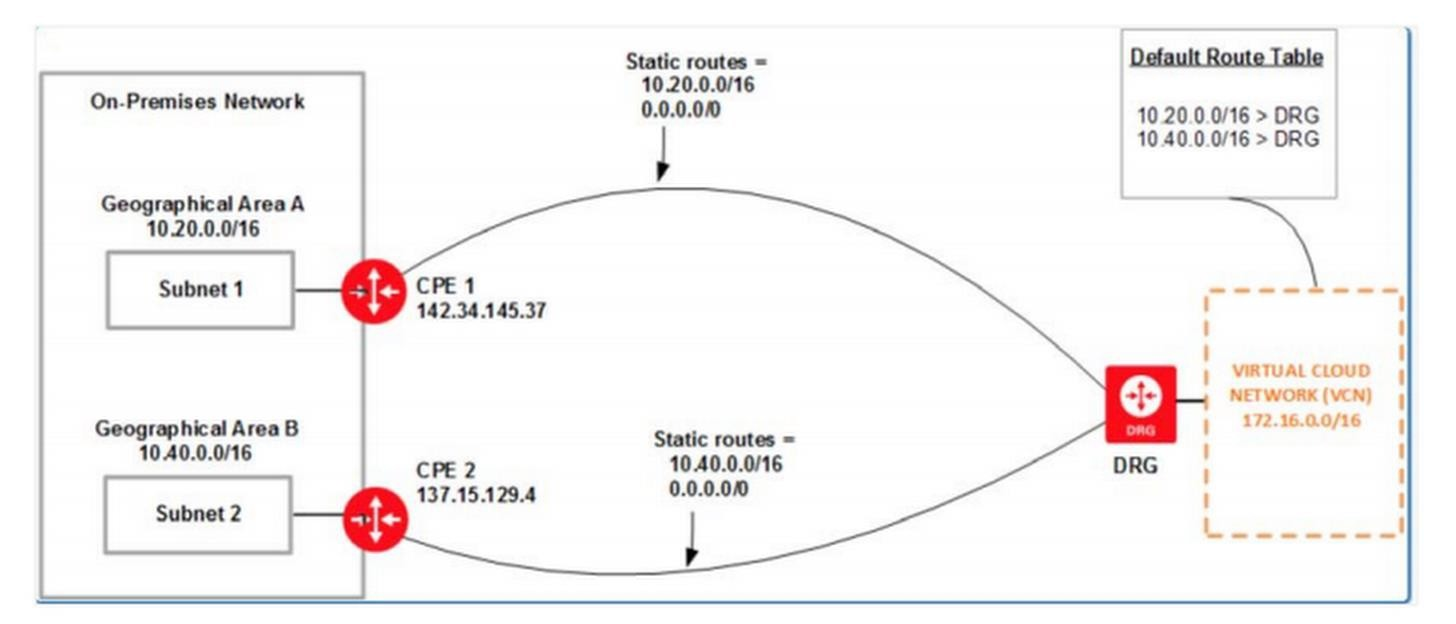
|