Question 1
Multiple choice
Which two are implemented using the Internet Control Message Protocol (ICMP)?
-
A
-
B
-
C
-
D
-
E
-
F
Reveal answer details
Close answer details
Correct answersA, F
ExplanationThe Internet Control Message Protocol (ICMP) is one of the core protocols of the Internet Protocol Suite.
ICMP differs from transport protocols such as TCP and UDP in that it is not typically used to exchange data between systems, nor is it regularly employed by end-user network applications (with the exception of some diagnostic tools like ping and traceroute).
The interface net3 should be operating, but is not. Command:  Which command should you enter next?
-
A
-
B
-
C
-
D
Reveal answer details
Close answer details
Correct answerB
ExplanationEnable-if -t interface Enables the given interface by reading the configuration from the persistent store. All the persistent interface properties, if any, are applied and all the persistent addresses, if any, on the given interface will be enabled.
-t, --temporary Specifies that the enable is temporary and changes apply only to the active configuration.
Which best describes the svc:/system/boot-config service?
-
A
It is used to change the milestone on a system.
-
B
It is used to set the default run level of the system.
-
C
It provides the parameters used to set the system to automatically perform a fast or slow reboot.
-
D
When the service is enabled, the system performs a fast reboot by default; when it is disable the
system performs a slow reboot by default.
Reveal answer details
Close answer details
Correct answerC
ExplanationStarting with the Oracle Solaris 11 Express release, Fast Reboot is supported on the SPARC platform, as well as the x86 platform. On both platforms, this feature is controlled by the SMF and implemented through a boot configuration service, svc:/system/boot-config. The boot-config service provides a means for setting or changing the default boot configuration parameters. The fastreboot_default property of the boot-config service enables an automatic fast reboot of the system when either the reboot or the init 6 command is used. When the config/fastreboot_default property is set to true the system automatically performs a fast reboot, without the need to use the reboot -f command. By default, this property's value is set to false on the SPARC platform and to true on the x86 platform.
You want the system to generate an email notification each time one of the services has changed its state. Which option would send an email message to the system administrator whenever a service changes to the maintenance state?
-
A
Use the setsc command in ALOM to enable the mail alerts to be sent to a specified email address whenever the fault management facility detects a service change to the maintenance state.
-
B
Make an entry in the /etc/syslog.conf file to instruct syslogd to send an email alert when it receives a message from the SMF facility that a service has changed to the maintenance state.
-
C
Use the svccfg setnotify command to create a notification and send an email when a service enters the maintenance state.
-
D
Use the scvadm command to enable the notification service. Set the maintenance option on the netnotify service to send an email when a service enters the maintenance state.
Reveal answer details
Close answer details
Correct answerC
ExplanationThis procedure causes the system to generate an email notification each time one of the services or a selected service has a change in state. You can choose to use either SMTP or SNMP. Normally, you would only select SNMP if you already have SNMP configured for some other reason. By default, SNMP traps are sent on maintenance transitions. If you use SNMP for monitoring, you can configure additional traps for other state transitions. 1. Become an administrator or assume a role that includes the Service Management rights profile.
2. Set notification parameters. Example:
The following command creates a notification that sends email when transactions go into the maintenance state
# /usr/sbin/svccfg setnotify -g maintenance mailto:[email protected]
On server A, you enter the following command to add a static route to serverA route -p add -host
192.168.1.101 192.168.1.101 -static What is the purpose of this command?
-
A
to temporarily bypass IP Filter rules
-
B
to specify an IPMP target IP address to in.mpathd
-
C
to specify routing to an adjacent network when in.rdisc is not used
-
D
to specify routing to an adjacent network when in.routed is not used
-
E
to ensure the IP address for serverB is not flushed from the ARP cache
-
F
to optimize link aggregation using a direct connection between two systems
Reveal answer details
Close answer details
Correct answerB
ExplanationNote: # route -p add -host destination-IP gateway-IP -static where destination-IP and gateway-IP are IPv4 addresses of the host to be used as a target. For example, you would type the following to specify the target system 192.168.10.137, which is on the same subnet as the interfaces in IPMP group itops0: $ route -p add -host 192.168.10.137 192.168.10.137 -static This new route will be automatically configured every time the system is restarted. If you want to define only a temporary route to a target system for probe-based failure detection, then do not use the -p option.
A user on the system has started a process, but it needs to be terminated. The process ID was determined as follows: pgrep userprogram l5317 The user attempted to terminate the program as follows: pkill 15317 This command runs without an error message, and the process continues to run. What is the issue?
-
A
You need to run the pkill command with the process name.
-
B
You need to switch to super user to kill the process.
-
C
You need to run the ps command to get more information.
-
D
You need to run the prstat command to get more information.
Reveal answer details
Close answer details
Correct answerB
ExplanationYou can use the pgrep and pkill commands to identify and stop command processes that you no longer want to run. These commands are useful when you mistakenly start a process that takes a long time to run. To terminate a process: Type pgrep to find out the PID(s) for the process(es). Type pkill followed by the PID(s). You can kill any process that you own. Superuser can kill any process in the system except for those processes with process IDs of 0, 1, 2, 3, and 4. Killing these processes most likely will crash the system.
Question 7
Multiple choice
New features wore added to ZFS in Oracle Solaris11. Your justification to upgrade from Solaris10 to oracle Solaris11 is that it will be possible to take advantage of the enhancements that were made to ZFS. Identify the three ZFS functions and features that are included in Oracle Solaris 11, but not in Solaris 10.
-
A
-
B
Ability for ZFS to detect and remove redundant data from the tile system
-
C
-
D
Ability to split a mirrored ZFS storage pool
-
E
Ability to use ZFS on the boot drive and boot to a ZFS root file system.
-
F
elimination of the swap file system when using ZFS on the root disk
Reveal answer details
Close answer details
Correct answersA, B, C
Explanationhttp://www.oracle.com/technetwork/server-storage/solaris11/overview/solaris-matrix-
1549264.html
Question 8
Multiple choice
The following image properties are displayed on your system: 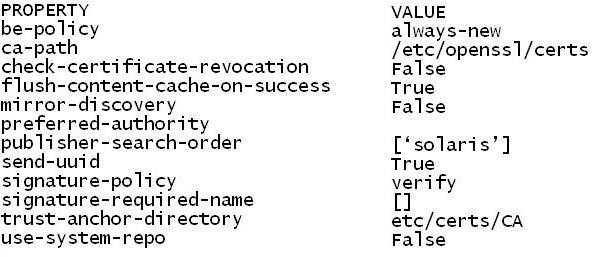 Which two options describe the boot environment policy property that is currently set for this image?
-
A
All package operations are performed in a new BE set as active on the next boot.
-
B
Do not create a new BE. The install, update, uninstall, or revert operation is not performed if a new BE is required.
-
C
If a BE is created, do not set it as the active BE on the next boot
-
D
A reboot is required for all package operations
-
E
A reboot is not required after a package operation.
-
F
For package operations that require a reboot, this policy creates a new BE set as active on the next boot.
Reveal answer details
Close answer details
Correct answersD, F
ExplanationImage properties described below. * be-policy
Specifies when a boot environment is created during packaging operations. The following values are allowed:
/ default
Apply the default BE creation policy: create-backup. / always-new (D, F)
Require a reboot for all package operations (D) by performing them in a new BE set as active on the next boot (F). A backup BE is not created unless explicitly requested. This policy is the safest, but is more strict than most sites need since no packages can be added without a reboot.
In an effort to reduce storage space on your server, you would like to eliminate duplicate copies of data in
your server's ZFS file systems. How do you specify that pool1/data should not contain duplicate data blocks (redundant data) on write operations?
-
A
zfs create - o compression=on pool1/data
-
B
zpool create -o deduplication =on pool1; zfs create pool1/data
-
C
zfs create - o deduplication=on pool1; zfs create pool1/data
-
D
zfs create - o dedupratio=2 pool1/data
-
E
zfs create - o dedup=on pool1/data
Reveal answer details
Close answer details
Correct answerE
ExplanationZFS Deduplication Property
Solaris Express Community Edition, build 129: In this Solaris release, you can use the deduplication property to remove redundant data from your ZFS file systems. If a file system has the dedup property enabled, duplicate data blocks are removed synchronously. The result is that only unique data is stored and common components are shared between files. You can enable this property as follows: # zfs set dedup=on tank/home
Question 10
Single choice
View the following information for a software package: 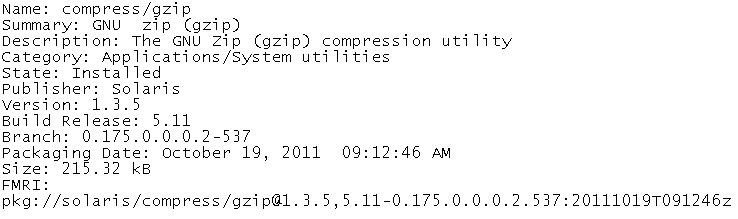 Which command would you use to display this information for a software package that is not currently installed on your system?
-
A
-
B
-
C
-
D
-
E
Reveal answer details
Close answer details
Correct answerB
ExplanationBy default, the pkg info command only lists information about installed packages on the system; however, we can use a similar command to look up information about uninstalled packages, as shown in here: Example: Listing Information About an Uninstalled Package
# pkg info -r php-52
Name: web/php-52
Summary: PHP Server 5.2
Description: PHP Server 5.2
Category: Development/PHP
State: Not Installed
Publisher: solaris
Version: 5.2.17
Build Release: 5.11
Branch: 0.175.0.0.0.1.530
Packaging Date: Wed Oct 12 14:01:41 2011
Size: 44.47 MB
FMRI: pkg://solaris/web/[email protected], 5.11-0.175.0.0.0.1.530:20111012T140141Z Note: pkg info command displays information about packages in a human-readable form. Multiple FMRI patterns may be specified; with no patterns, display information on all installed packages in the image. With -l, use the data available from locally installed packages.
This is the default. With -r, retrieve the data from the repositories of the image's configured publishers. Note that you must specify one or more package patterns in this case.
Question 11
Single choice
You are executing this command in the default shell: sleep 5000 & The system displays a number. This value is______.
-
A
the priority of the /usr/bin/sleep process
-
B
the process ID of the /usr/bin/sleep process
-
C
the process ID of the shell spawned to execute /usr/bin/sleep
-
D
the process group ID that includes the /usr/bin/sleep process
-
E
the amount of memory allocated to the /usr/bin/sleep process
-
F
the current number of instances of the /usr/bin/sleep process
Reveal answer details
Close answer details
Correct answerC
ExplanationIf a command is terminated by the control operator `&', the shell executes the command asynchronously in a subshell. This is known as executing the command in the background. The shell does not wait for the command to finish, and the return status is 0 (true).
Question 12
Multiple choice
You are setting up an automated installer (AI) install server and issue the following command: installadm create-service -n prod_ai -s /repo/prod_ai.iso \ -i 192.168.1.100 -c 5 -d /export/repo Which four options describe the install server that you have configured?
-
A
The service name is prod_ai.
-
B
DHCP base IP address is 192.168.1.100
-
C
The initial IP address for the install clients will be 192.168.1.100. This IP address is temporary. After the client is booted, it will use IP addresses in the following range: 192.168.1.101-105.
-
D
Five IP addresses are allocated for DHCP clients, starting with 192.168.1.100.
-
E
The Install server will support up to five clients.
-
F
The AI net image ISO file is located in /repo/prod and the net image ISO will be unpacked in /export/ repo.
-
G
The AI net image ISO file is located in /repo/repo and is named /repo/prod/_ai.iso.
Reveal answer details
Close answer details
Correct answersA, B, D, F
ExplanationA: -n <svcname>
Uses this install service name instead of default service name. B: -i <dhcp_ip_start>
Sets up a new DHCP server. The IP addresses, starting from dhcp_address_start, are set up.
D: -c <count_of_ipaddr>
Sets up a total number of IP addresses in the DHCP table equal to the value of the count_of_ipaddr. The first IP address is the value of dhcp_ip_start that is provided by the -i option. F: -s <srcimage>
Specifies location of AI ISO image to use for setting up the install service. <targetdir> Required: Specifies location to set up net image.
Question 13
Multiple choice
Which two options accurately describe the network characteristics of a zone?
-
A
DHCP address assignment cannot be configured in a shared IP zone.
-
B
Shared IP is the default type of network configuration.
-
C
Exclusive IP is the default type of network configuration.
-
D
By default, all IP addresses, netmasks, and routes are set by the global zone and cannot be altered in a non global zone.
-
E
IPMP cannot be managed within the non-global zone.
-
F
Commands such as snoop and dladm cannot be used on datalinks that are in use by a running zone.
Reveal answer details
Close answer details
Correct answersA, B
ExplanationA: Non-global zones can not utilize DHCP (neither client nor server). B (not C): By default, non-global zones will be configured with a shared IP functionality. What this means is that IP layer configuration and state is shared between the zone you're creating and the global zone. This usually implies both zones being on the same IP subnet for each given NIC. Note: A zone is a virtual operating system abstraction that provides a protected environment in which applications run. The applications are protected from each other to provide software fault isolation. To ease the labor of managing multiple applications and their environments, they co-exist within one operating system instance, and are usually managed as one entity. The original operating environment, before any zones are created, is also called the "global zone" to distinguish it from non-global zones, The global zone is the operating system instance. Incorrect answer:
E: Exclusive-IP zones can use IPMP. IPMP is configured the same way in an exclusive-IP zone as it is on a system not using zones.
For shared-IP zones, IPMP can be configured in the global zone.
F: Full IP-level functionality is available in an exclusive-IP zone.
An exclusive-IP zone has its own IP-related state.
An exclusive-IP zone is assigned its own set of data-links using the zonecfg command. The zone is given a data-link name such as xge0, e1000g1, or bge32001, using the physical property of the net resource. The address property of the net resource is not set. Note that the assigned data-link enables the snoop command to be used. The dladm command can be used with the show-linkprop subcommand to show the assignment of data-links to running exclusive-IP zones.
Question 14
Single choice
You attempted to reboot a system via the init command, however the system did not perform boot sequence into the Oracle Solaris Operating Environment. You are presented with a prompt from the OpenBoot PROM. Which command would you enter, to boot the system from the default device?
-
A
-
B
-
C
-
D
Reveal answer details
Close answer details
Correct answerB
ExplanationBoot
With this form, boot loads and executes the program specified by the default boot arguments from the default boot device Note: boot has the following general format:
boot [device-specifier] [arguments]
where device-specifier and arguments are optional.
Question 15
Single choice
When speaking to an Oracle Support Engineer, you are asked to verify the version of the Solaris 11 build currently running on your system. Which command would display the Solaris 11 build version currently running on your system?
-
A
-
B
-
C
-
D
-
E
Reveal answer details
Close answer details
Correct answerB
ExplanationWhich Solaris release you are running on your system can be determined using the following command: cat /etc/release This will tell you which release you are running and when it was released. The more recent your system, the more info is contained in this file. Example:
# cat /etc/release
Oracle Solaris 10 8/11 s10s_u10wos_17b SPARC
Copyright (c) 1983, 2011, Oracle and/or its affiliates. All rights reserved.
Assembled 23 August 2011
Question 16
Single choice
Your server has one zone named dbzone (hat has been configured, but not yet installed). Which command would you use to view all the options that were used to configure this zone?
-
A
-
B
zones tat -c summary dbzone
-
C
-
D
Reveal answer details
Close answer details
Correct answerC
Explanationzonecfg info
Display information about the current configuration. If resource-type is specified, displays only information about resources of the relevant type. If any property-name value pairs are specified, displays only information about resources meeting the given criteria. In the resource scope, any arguments are ignored, and info displays information about the resource which is currently being added or modified. Note:
zonecfg -z zonename. Specify the name of a zone. Zone names are case sensitive. Zone names must begin with an alphanumeric character and can contain alphanumeric characters, the underscore (_) the hyphen (-), and the dot (.). The name global and all names beginning with SUNW are reserved and cannot be used. Incorrect answer:
A: The zoneadm utility is used to administer system zones. A zone is an application container that is maintained by the operating system runtime. list option: Display the name of the current zones, or the specified zone if indicated.
B: No such command.
D: no such options zonecfg -icv
Question 17
Multiple choice
You want to deploy Oracle Solaris 11 with the Automated Installer (AI). You need to make sure that your server and network meet the requirements for using AI. Identify two requirements for using AI.
-
A
You should set up DHCP. The DHCP server and AI install server can be the same machine or two different machines.
-
B
You can create only one manifest per install service. If you need more than one manifest, you should
create multiple install services.
-
C
The minimum requirement to operate as an AI install server is 1 GB of memory.
-
D
If two client machines have different architectures and need to be installed with the same version of the Oracle Solaris 11 OS, then you should create two AI manifests and a single install service.
Reveal answer details
Close answer details
Correct answersA, D
ExplanationA: An automated installation of a client over the network consists of the following high-level steps: Step 1. The client system boots over the network and gets its network configuration and the location of the install server from the DHCP server. Step 2: The install server provides a boot image to the client.
Etc.
D: If two client machines need to be installed with the same version of the Oracle Solaris 11 OS but need to be installed differently in other ways, then create two AI manifests for the AI install service. The different AI manifests can specify different packages to install or a different slice as the install target, for example.
Question 18
Single choice
View the Exhibit. 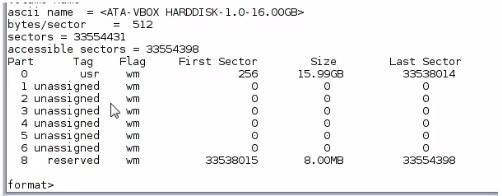 Which is true regarding the disk drive?
-
A
This disk configuration could be used as a ZFS root disk.
-
B
This disk contains an SMI disk label.
-
C
Slice 7 represents the entire disk and cannot be used as a slice for a file system
-
D
The disk contains an EFI disk label.
Reveal answer details
Close answer details
Correct answerA
ExplanationInstalling a ZFS Root Pool
The installer searches for a disk based on a recommended size of approximately 13 GB.
Question 19
Multiple choice
You are planning group names for a new system. You decide to use a numbering convention that includes the year and month the project began, to form the group number and name for work associated with that project. So, for example, a project targeted to begin in January, 2013 would have the number (name): 201301(Pr20l301) What are the two problems with your plan?
-
A
Group names may not contain a numeric character
-
B
Group names may be no longer than 7 characters.
-
C
Group numbers should not be larger than 60000.
-
D
Group names should be all lowercase.
Reveal answer details
Close answer details
Correct answersC, D
ExplanationC: The Group ID (GID) field contains the group's numerical ID. GIDs can be assigned whole numbers between 100 and 60000.
D: Group names contain only lowercase characters and numbers.
Question 20
Single choice
You want to display network interface information. Which command should you use?
-
A
-
B
-
C
-
D
Reveal answer details
Close answer details
Question 21
Single choice
You have a ZFS file system named /dbase/oral and you want to guarantee that 10 GB of storage space is available to that dataset for all data, snapshots, and clones. Which option would you choose?
-
A
zfs set refreservation=10g dbase/oral
-
B
zfs set quota=10g dbase/oral
-
C
zfs set refquota=10g dbase/oral
-
D
zfs set reservation=10g dbase/oral
Reveal answer details
Close answer details
Correct answerD
ExplanationA ZFS reservation is an allocation of disk space from the pool that is guaranteed to be available to a dataset. As such, you cannot reserve disk space for a dataset if that space is not currently available in the pool. The total amount of all outstanding, unconsumed reservations cannot exceed the amount of unused disk space in the pool. ZFS reservations can be set and displayed by using the zfs set and zfs get commands. For example: # zfs set reservation=5G tank/home/bill
# zfs get reservation tank/home/bill
NAME PROPERTY VALUE SOURCE
tank/home/bill reservation 5G local
Question 22
Single choice
The current ZFS configuration on server is: 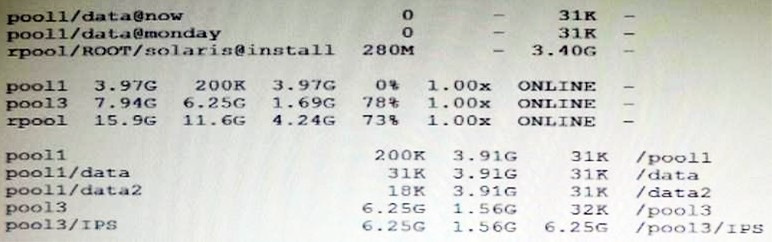 You need to backup the /data file system while the file system is active. Select the option that creates a full backup of the /data file system and stores the backup on server in the pool named backup.
-
A
Mount -F nfs system: /backup / mntzfs snapshot pool/data@monday>/mnt/Monday
-
B
Mount -F nfs systemB: /backup/mntzfs snapshot pool1/data@Mondayzfs clone pool1/data@monday/
mnt/Monday
-
C
Zfs send pool1/data@Monday | ssh system zfs recv backup/monday
-
D
Zfs snapshot pool1/data@Monday | ssh system zfs recv backup/monday
Reveal answer details
Close answer details
Correct answerC
Explanationhttp://docs.oracle.com/cd/E23823_01/html/819-5461/ghzvz.html
Question 23
Single choice
You have been asked to do an orderly shutdown on a process with a PID of 1234, with the kill command. Which command is best?
-
A
-
B
-
C
-
D
Reveal answer details
Close answer details
Correct answerB
ExplanationOn POSIX-compliant platforms, SIGTERM is the signal sent to a process to request its termination. The symbolic constant for SIGTERM is defined in the header file signal.h. Symbolic signal names are used because signal numbers can vary across platforms, however on the vast majority of systems, SIGTERM is
signal #15. SIGTERM is the default signal sent to a process by the kill or killall commands. It causes the termination of a process, but unlike the SIGKILL signal, it can be caught and interpreted (or ignored) by the process.
Therefore, SIGTERM is akin to asking a process to terminate nicely, allowing cleanup and closure of files.
For this reason, on many Unix systems during shutdown, init issues SIGTERM to all processes that are not essential to powering off, waits a few seconds, and then issues SIGKILL to forcibly terminate any such processes that remain.
Question 24
Single choice
You have been tasked with creating a dedicated virtual network between two local zones within a single system, in order to isolate the network traffic from other zones on that system. To accomplish this, you will create_____.
-
A
-
B
-
C
-
D
a virtual network interface
-
E
nothing, because a virtual switch is automatically created when the virtual network interfaces are created
Reveal answer details
Close answer details
Correct answerD
ExplanationFirst create a virtual switch, then create a virtual network interface.
Question 25
Single choice
User jack on host solaris attempts to use ssh to log in to host oracle and receives this message: jack@solaris:~$ ssh oracle ssh: connect to host oracle port 22: connection refused What is the problem?
-
A
Host oracle does not have a valid host public key.
-
B
Host oracle does not have a valid host private key.
-
C
Host solaris does not have a valid host public key.
-
D
Host does not have a valid host private key.
-
E
Host solaris is not configured for host-based authentication.
-
F
Host oracle is not configured for host-based authentication.
-
G
Host oracle is not running the ssh service.
-
H
Host solaris is not running the ssh service.
Reveal answer details
Close answer details
Correct answerG
ExplanationThe host he is trying to connect to (oracle) is not running the required service (ssh).
Question 26
Single choice
You notice that the /var/.dm/messages file has become very large. Typically, this is managed by a crontab entry. Which entry should be in the root's crontab file?
-
A
10 3 * * * /usr/adm/messages
-
B
10 3 * * * /usr/sbin/logadm
-
C
10 3 * * * /usr/sbin/syslogrotate
-
D
10 3 * * * /usi/sbin/logrotate
-
E
10 3 * * * /usr/sbin/messages
Reveal answer details
Close answer details
Correct answerB
ExplanationThis example shows how to display the default root crontab file. $ suPassword:
# crontab -l
#ident "@(#)root 1.19 98/07/06 SMI" /* SVr4.0 1.1.3.1 */ #
# The root crontab should be used to perform accounting data collection.
#
#
10 3 * * * /usr/sbin/logadm 15 3 * * 0 /usr/lib/fs/nfs/nfsfind
30 3 * * * [ -x /usr/lib/gss/gsscred_clean ] && /usr/lib/gss/gsscred_clean #10 3 * * * /usr/lib/krb5/
kprop_script ___slave_kdcs___
Question 27
Single choice
User jack, whose account is configured to use the korn shell, logs in and examines the value of his PATH environment variable: 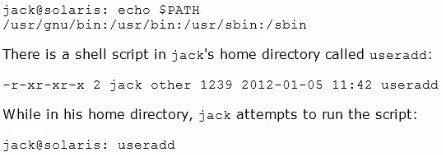 What will happen, and why?
-
A
He will get a "file not found" error, because the current directory is not in his seaech path.
-
B
He will get a "file not found" error, because his home directory is not in his search path.
-
C
The useradd script will execute, because jack is in the same directory that the script is located in.
-
D
The command /user/sbin/useradd will execute, because it is the last match in the search path.
-
E
The command /user/sbin/useradd will execute, because it is the first match in the search path.
Reveal answer details
Close answer details
Question 28
Multiple choice
The COMSTAR framework provides support for the iSCSI protocol. Select three options that correctly describe the COMSTAR framework.
-
A
iSCSI devices can be used as dump devices.
-
B
SCSI commands are carried over IP networks and enable you to mount disk devices from across the network onto your local system.
-
C
Large amounts of data can be transferred over an IP network with very little network degradation.
-
D
COMSTAR allows you to convert any Solaris11 host into a SCSI target device that can be accessed over a storage network.
-
E
One IP port can handle multiple ISCSI target devices.
Reveal answer details
Close answer details
Correct answersB, D, E
ExplanationB: By carrying SCSI commands over IP networks, the iSCSI protocol enables you to access block devices from across the network as if they were connected to the local system. COMSTAR provides an easier way to manage these iSCSI target devices.
D: Common Multiprotocol SCSI TARget, or COMSTAR, a software framework that enables you to convert any Oracle Solaris 11 host into a SCSI target device that can be accessed over a storage network by initiator hosts.
E: One IP port can handle multiple iSCSI target devices.
Question 29
Multiple choice
You need to make sure that all of the software packages on your server are up to date. Without installing any updates, which two commands would display .
my software updates that are available in the default Oracle repository?
-
A
-
B
-
C
-
D
-
E
-
F
Reveal answer details
Close answer details
Correct answersA, D
ExplanationA: the pgk list command display a list of packages in the current image, including state and other information. By default, package variants for a different architecture or zone type are excluded.
D: pkginfo displays information about software packages that are installed on the system (with the first synopsis, with -l) or that reside on a particular device or directory (with the second synopsis, with -r). Without options, pkginfo lists the primary category, package instance, and the names of all completely installed and partially installed packages. It displays one line for each package selected. With -r, retrieve the data from the repositories of the image's configured publishers. Note that you must specify one or more package patterns in this case.
Question 30
Single choice
You want to delete the IPv4 address on the interface net3. Which command should you use?
-
A
-
B
-
C
-
D
-
E
ipadm delete-addr net3/v4
-
F
ipadm deiete-ipv4 ner3/v4
Reveal answer details
Close answer details
Correct answerE
ExplanationThe ipadm delete-addr subcommand removes addresses from interfaces. To remove an address from the IPMP group, type the following command: # ipadm delete-addr addrobj
The addrobj uses the naming convention inder-interface/user-string.
Question 31
Single choice
Your server has a ZFS storage pool that is configured as follows: 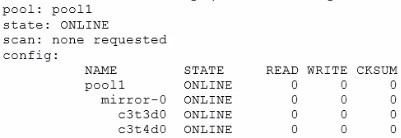 The server has two spare 146-GB disk drives: c3t5d0 c3t6d0 You need to add more space to the pool1 storage pool. Which command would add more mirrored storage to the pool1 storage pool?
-
A
zpool add pool1 mirror c3t5d0 c3t6d0
-
B
zpool attach pool1 mirror c3t5d0 c3t6d0
-
C
zpool attach pool1 c3r3d0 c3r5d0; zpool attach pool1 c3r4d0 c3r6d0
-
D
zpool add pool1 c3r3d0 c3r5d0; zpool add pool1 c3r4d0 c3r6d0
Reveal answer details
Close answer details
Question 32
Single choice
User1 is attempting to assist user2 with terminating user2's process 1234. User1 entered the following: kill -9 1234 Why does the process continue to run?
-
A
You can kill a process only if you are root.
-
B
You can kill only a process that you own.
-
C
You can kill the process only with the pkill command.
-
D
You need to kill the process with a stronger kill signal.
Reveal answer details
Close answer details
Correct answerB
ExplanationKill -9
Kill (terminates without cleanup)
Only works if issued by process owner or super user (root) The program cannot respond to this signal; it
must terminate Note: Unix provides security mechanisms to prevent unauthorized users from killing other processes.
Essentially, for a process to send a signal to another, the owner of the signaling process must be the same as the owner of the receiving process or be the superuser.
Question 33
Single choice
user1, while in his home directory, is attempting to run the following command in his home directory: cp bigfile verybig The system displays the following error: cp: cannot create verybig: Disc quota exceeded Your initial troubleshooting shows that the df -h command indicates he is at 100% capacity. What command would you use to increase the disk space available to the user?
-
A
zfs get quota rpool/export/home/user1
-
B
-
C
zfs quota=none /rpool/export/home/user1
-
D
-
E
zfs set quota=none /rpool/export/home/user1
Reveal answer details
Close answer details
Correct answerE
ExplanationZFS quotas can be set and displayed by using the zfs set and zfs get commands. We can remove the quota restriction by setting to quota to none.
Question 34
Single choice
Server A, Server B, and Server C are connected to the same network switch and are on the sari Each server has a single network interface, net0. You received a tech support call that Server B has lost network connectivity. Your troubleshooting has discovered: Server A can ping Server C, but not Server B. Server B can ping localhost, but not Server A or C. Server C can ping Server A, but not Server B. On Server F3, you enter the following command: dladm show-phys | grep net0 Response: net0/v4 Ethernet down 0 unknown el00gl What is the next logical troubleshooting action?
-
A
Run arp -a on all servers.
-
B
Confirm that the router is working.
-
C
Confirm that the power light of the network switch is on.
-
D
Confirm that the physical network connections are intact.
-
E
On Server A and C, run tranceroute -n server.
-
F
On Server B, run tranceroute -n servera and tranceroute -n serverc.
Reveal answer details
Close answer details
Correct answerD
ExplanationCheck the physical connection.
Question 35
Single choice
The /etc/hosts file can be best described as______.
-
A
a local database of host names for rlogin, rsh, and rep
-
B
the configuration file for the host name of the system
-
C
a local database of information for the uname command
-
D
the configuration file for the Domain Name Service (DNS)
-
E
a local database of host names and their associated IP addresses
Reveal answer details
Close answer details
Correct answerE
ExplanationAs your machine gets started, it will need to know the mapping of some hostnames to IP addresses before DNS can be referenced. This mapping is kept in the /etc/hosts file. In the absence of a name server, any network program on your system consults this file to determine the IP address that corresponds to a host name.
Question 36
Single choice
In a default standalone installation of Oracle Solaris 11, what is the default minimum length in characters of a user password, and where is the minimum password length defined?
-
A
Default minimum length is 8, and is defined in /etc/default/password.
-
B
Default minimum length is 6, and is defined in /etc/default/password.
-
C
Default minimum length is 8, and is defined in /etc/shadow.
-
D
Default minimum length is 6, and is defined in /etc/shadow.
-
E
Default minimum length is 8, and is defined in /usr/sadm/defadduser.
-
F
Default minimum length is 6, and is defined in /usr/sadm/defadduser.
Reveal answer details
Close answer details
Correct answerB
ExplanationBy default, the passwd command assumes a minimum length of six characters. You can use the PASSLENGTH default in the /etc/defaults/passwd files to change that by setting the minimum number of characters that a user's password must contain to some other number.
Question 37
Single choice
Identify the correct description of an IPS image.
-
A
An ISO image of the Solaris media DVD
-
B
-
C
A depot location or source where Solaris packages can be installed from
-
D
A location where packages can be installed, for example, your Solaris instance
Reveal answer details
Close answer details
Correct answerD
ExplanationAn image is a location where packages can be installed.
An image can be one of three types:
* Full images are capable of providing a complete system.
* Partial images are linked to a full image (the parent image), but do not provide a complete system on
their own.
* User images contain only relocatable packages.
|