Question 1
Multiple choice
Which of the following statements are true?
-
A
When a DMZis used, all components of the architecture are deployed into the demilitarized zone.
-
B
Secure Internet protocols, such as HTTPS, enable the deployment of the full UI stack without the use of a firewall.
-
C
Traditional "fat client" applications may be deployed across the Internet along with browsers and mobile devices.
-
D
The ORA UI architecture may be deployed in a cloud environment by using virtual servers.
Reveal answer details
Close answer details
Question 2
Multiple choice
Which of the following are the three major tiers of the Logical view of the Oracle Management Reference Architecture?
-
A
-
B
-
C
-
D
-
E
Reveal answer details
Close answer details
Correct answersB, C, E
ExplanationExplanation:
* The Client Tier represents access to management content and operations as well as end users accessing the appropriate business solution. Administrators utilize a browser based console to perform their management tasks using a standard browser interface. The management console which is lightweight, easy to access and firewall friendly, enables administrators to centrally manage their entire environment.
* The Management Tier renders the content and interface for the management console that gives access to management operations such as monitoring, administration, configuration, central policy setting, and security. The Management Tier controls the accessing and uploading of management information.
* The Managed Target Tier contains the named infrastructure components that are required to be managed and monitored. It is common to utilize a combination of agent based and gateway (a.k.a. proxy) patterns to monitor and manage hosted and non-hosted targets. 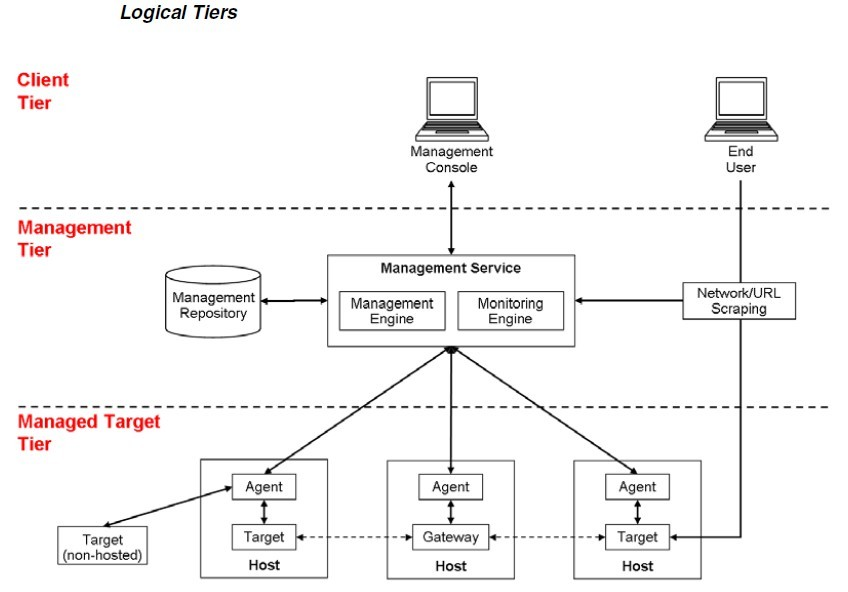
Question 3
Multiple choice
Which of the following are ORA Engineering logical categories?
-
A
Integrated Development Environment
-
B
-
C
-
D
Monitoring and Management
Reveal answer details
Close answer details
Correct answersA, B
ExplanationExplanation:
The Engineering logical view shows the logical components of the Engineering environment and show how they are connected to each other. T
The primary logical categories as shown are:
*Modeler
*Integrated Development Environment (IDE)
*Quality Manager
*Deployment Manager
*Metadata Repository
*Asset Repository References:
A customer with an existing WebCenter portal wants to expand his client device list to include a variety of mobile devices beyond basic browser support. What Oracle products are available to enable this expansion?
-
A
OWC, OHS, ADF Mobile, and Java ME
-
B
OWCA, ADF Mobile, OPSS, and Java ME
-
C
-
D
OWCIC, ADF Mobile, and Java ME
Reveal answer details
Close answer details
Correct answerA
ExplanationExplanation:
Oracle HTTP Server (OHS) - provides a HTTP listener for Oracle WebLogic Server and the framework for hosting static content, dynamic content, and applications over the Web. Java Platform, Micro Edition (Java ME)(not C):meets the needs of developers creating applications for the consumer and embedded markets. No other technology provides such robust applications across so many types of size-constrained wireless and wireline devices, from mobile phones and PDAs to set-top boxes and vehicle telematics.c References:
Question 5
Multiple choice
Which of the following are phases of Service Management?
-
A
-
B
-
C
-
D
-
E
Reveal answer details
Close answer details
Correct answersA, B, D, E
ExplanationExplanation:
There are four Service Management Phases:
* Define
* Enforce and execute
* Monitor
* Report References:
Which statement best describes the role of the Data Normalization Layer within the Logical view of the Service-Oriented Integration (SOI) architecture?
-
A
The Data Normalization Layer converts all data formats to third normal form to facilitate database access.
-
B
The Data Normalization Layer converts all data formats to XML to facilitate platform independent.
-
C
The Data Normalization Layer hides the complexity of the multiple data formats used by back end systems by converting data to standardized formats.
-
D
The Data Normalization Layer stores persistent data in a normalized format.
-
E
The Data Normalization Layer provides normalized access to all databasesiIncluded as back-end systems in the architecture.
Reveal answer details
Close answer details
Correct answerC
ExplanationExplanation:
The Data Normalization Layer provides a standardized format for data entities. Each EIS stores data in its own (usually proprietary) format. This layer transforms the data to a form that is readily consumable by the upper layers in the architecture. The primary purpose of this layer in the architecture is to encapsulate and hide the complexity of the data models and formats used by the back-end systems. This allows the upper layers in the architecture to operate on data entities that match the needs of the business rather than operating on data that match the storage approach of the back-end systems.
References:
Question 7
Multiple choice
The Oracle Reference Architecture (ORA) contains both horizontal and vertical architectural layers. Which statements best describe the layers within ORA?
-
A
Lavers only provide a means to partition the capabilities encompassed by ORA and have no significance.
-
B
Horizontal layers are used to depict that upper layers build on the capabilities provided by lower layers
-
C
Vertical layers are used to depict capabilities applied across all the horizontal layers.
-
D
Horizontal layers are used to signify that the lower layers can be accessed only via the upper layers.
-
E
Vertical layers are used to depict enterprise-wide capabilities, whereas horizontal layers departmental capabilities.
-
F
Horizontal layers are stateful, whereas vertical layers are stateless.
Reveal answer details
Close answer details
Correct answersB, C
ExplanationExplanation:
B: The horizontal layers illustrate that upper layers build upon or use the capabilities of lower layers.
Examples: Shared Infrastructure, Information Management, Information Assets, Application Infrastructure
C:Layers depicted vertically are orthogonal to the horizontal layers and apply across the entire platform, working in conjunction with horizontal layers to provide a complete solution. Examples: Enterprise Development, Enterprise Security, Enterprise Management Note: In order to promote modularity and encapsulation, an architecture will usually be divided into layers.
Each layer has a specific purpose and leverages technologies, standards, and products designed specifically to address that purpose. Layers generally build upon the layers below and provide benefits and capabilities to the layers above.
The ORA diagram in the figure below illustrates the many aspects of enterprise computing in the form of horizontal and vertical layers 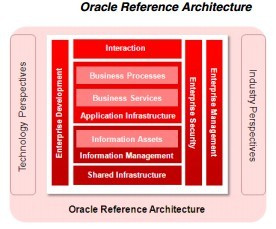
Question 8
Multiple choice
Which of the following Oracle products provides a comprehensive Integrated Development Environment (IDE)?
-
A
Oracle Enterprise Pack for Eclipse
-
B
-
C
-
D
Reveal answer details
Close answer details
Correct answersA, B
ExplanationExplanation:
A: Oracle Enterprise Pack for Eclipse is a free set of certified plug-ins, enabling WebLogic developers to support Java EE and Web Service standards. Oracle Enterprise Pack for Eclipse supports development with technologies including Database, Java SE, Java EE, Web Services, XML, Spring Framework and Oracle Fusion Middleware.
B: Oracle JDeveloper is a free integrated development environment that simplifies the development of Java-based SOA applications and user interfaces with support for the full development life cycle. Incorrect answers
Oracle Service Registry and Enterprise Manager are not development tools.
Question 9
Multiple choice
Which of the following are strategies for alert management with Oracle Enterprise Manager?
-
A
controlling the volume of alerts
-
B
-
C
centralized filtering of alerts
-
D
automating fix for common alerts
Reveal answer details
Close answer details
Correct answersB, D
ExplanationExplanation:
B: New in Enterprise Manager 10g Release 5 (10.2.0.5)
Alert Management Enhancements: Administrators can better manage their log-based alerts (e.g., alert log alerts) by setting duration-based notification rules that clear such alerts on a periodic basis, or by using new EMCLI verbs that support bulk clearing of such alerts.
D: New in Enterprise Manager 10g Release 5 (10.2.0.5)
Alert Management Enhancements: On-demand evaluation of alerts allow administrators to quickly verify whether the fixes implemented for alerts result in clearing of the alert. Note: Advanced alert management
Question 10
Multiple choice
What capabilities are provided by Oracle Enterprise Repository (OER)?
-
A
-
B
-
C
-
D
Reveal answer details
Close answer details
Correct answersA, C
ExplanationExplanation:
The primary focus of the Metadata Repository (aka Enterprise Metadata Repository or Enterprise Repository) is design-time, and it usually has no role in the runtime environment of most SOA deployments.
The metadata repository is primarily a human interface for asset capture and presentment. It has integration with the service registry to promote the service interfaces and with the security framework for repository security like authentication and access control. Core capabilities of the metadata repository include:
* Asset Management
* Asset Lifecycle Management
* Usage Tracking
* Service Discovery
* Version Management (C)
* Service Taxonomy
* Dependency Analysis (A)
* Portfolio Management References:
Question 11
Multiple choice
The Oracle Reference Architecture (ORA) includes the central layers as well as Technology Perspectives and Industry perspectives. Which statements best describe how these are related within ORA?
-
A
The Technology Perspectives are reference architectures incorporating specific technologies, products, and standards.
-
B
The Technology Perspectives provide a view of ORA focused on specific technologies, product and standards.
-
C
The Industry Perspectives are reference architectures for specificindustries, for example, Telco, Pharma.
-
D
The Industry Perspectives extend the central layers of ORA toincludeindustry-specific capabilities, components, and so on.
-
E
ORA is a collection of reference architectures, some based on technology (Technology Perspectives), and some based on industry verticals (Industry Perspectives).
Reveal answer details
Close answer details
Correct answersB, D
ExplanationExplanation:
The core ORA material is extended via architecture perspectives. There are two types of perspectives: Technology and Industry(not E). B:Technology perspectives extend the core material by adding the unique capabilities, components, standards, and approaches that a specific technology strategy offers. SOA, BPM, EPM/BI, and EDA are examples of perspectives for ORA. Each technology strategy presents unique requirements to architecture that includes specific capabilities, principles, components, technologies, standards, etc. Rather than create another reference architecture for each strategy, ORA was designed to be extensible to incorporate new computing strategies as they emerge in the industry In order to present the reference architecture in the most effective manner, each new technology strategy adds a perspective to ORA. This enables the reference architecture to evolve holistically. New computing strategies extend the core material, providing further insight and detail as needed.
A perspective extends the ORA core collateral by providing views, principles, patterns, and guidelines that are significant to that technology domain yet cohesive with the overall ORA. Industry perspectives extend the core material by adding the business functions, business processes, data entities, software capabilities and components that an industry vertical requires. Retail, Financial, Telco, and Pharma are examples of industry perspectives for ORA. References:
Question 12
Single choice
A customer has two separate lines of business and each has its own unique resources that are controlled independently. The customer wants to provide a single user interface at the enterprise level that, at least from the user's perspective, unifies the separate lines of business and presents a single consistent view. What is the most suitable architectural arrangement for such a federated deployment?
-
A
The enterprise implements full client stack and part of the service stack while each LoB deploys the remaining part of the service tierin order to expose uniform interface elements.
-
B
The client tier assimilates the data from the resource stack of each line of business.
-
C
The enterprise implements full client and service stacks while each LoB deploys a partial service. sufficient to expose uniform interface elements.
-
D
The client tier assimilates the data from the service stack of each line of business.
Reveal answer details
Close answer details
Correct answerA
ExplanationExplanation:
Each line of business has its own resources that are unique to the line of business and are controlled by that line of business. The enterprise wants to provide a single user interface that, at least from the user's perspective, unifies the separate lines of business.
In this example, the enterprise wide user interface deployment is a full featured user interaction architecture (i.e. it contains all of the capabilities defined in the Logical View). Each line of business deploys limited functionality since the only functionality required is the functionality to create interface elements exposing the resources of that line of business. The enterprise wide user interface then uses the interface elements provided by the lines of business to create a unified user experience. The interface elements provided by the lines of business are Remote Providers to the enterprise user interface. This deployment allows the lines of business to maintain control of their respective resources since the only access to the resources is via the interface elements that they create. References:
Question 13
Single choice
The Conceptual, Logical, and Product Mapping architecture views are core to the documents within the Oracle Reference Architecture (ORA) library- Which statement best describes the relationship between these three architectural views?
-
A
The Conceptual view lists the concepts behind the architecture, the Logical view describes the rationale for the architecture, and the Product Mapping view Identifies the Oracle products required.
-
B
The Conceptual view defines the architecture in less technical terms, the Logical view provides Increasing detail by using more technical terms, and the Product Mapping view maps Oracle products onto the Logical view.
-
C
The Conceptual view is a high-level description of the architecture, the Logical view is a detailed description of the architecture, and the Product Mapping view illustrates the deployment of Oracle products.
-
D
Each architecture view is designed to communicate to a specific stakeholder and there is no defined relationship between the views.
-
E
Each architecture view is a description of the components within the architecture, the logical view describes the runtime interactions between the components, and the product mapping view illustrates the deployment of Oracle products.
Reveal answer details
Close answer details
Question 14
Multiple choice
What are the benefits of the browser over traditional user Interfaces (for example, client-server GUI)?
-
A
HTML provides a richer interface for end users.
-
B
Development, maintenance, and support costs are reduced.
-
C
The browser simplifies application deployment compared to dedicated client server GUI applications.
-
D
There is more variety among browsers than among client-server GUIs.
-
E
The browser provides a richer graphical environment than client-server GUIs.
-
F
Browsers can support more diverse devices than dedicated client-server GUI application.
Reveal answer details
Close answer details
Question 15
Multiple choice
Oracle Entitlements Server (OES) provides fine grained authorization capabilities that, along with Oracle Access Manager (OAM), comprise the XACML based Authorization Service. What factors should be considered when choosing how to specify and deploy OES policy decision points (PDPs)?
-
A
If a policy enforcement point exists in the DMZ, then a remote PDP should be deployed behind the inner firewall.
-
B
If both OAM and OES are used, then OES should be configured to use the PDP embeddedin OAM.
-
C
OES includes a security provider for Oracle WebLogic Server that will handle policy decisions locally.
-
D
Oracle Advanced Security includes a universal stand-alone PDP that provides access for Java, NET, and SOAP clients.
-
E
It is best to use a local PDP whenever possible to avoid network calls between the PEP and PDP. A remote PDP ran be used when a local PDP is not available for the client technology, or for other various exceptional cases.
Reveal answer details
Close answer details
Correct answersA, C, E
ExplanationExplanation:
A, E:Policy decision points (PDPs) for computingnodes located outside the secure environment. For example, web servers located in theDMZ might leverage a central PDP, deployed behind a firewall.
Policy enforcement is still local to the web servers but decisions are made remotely.
C: OES integrates with OPSS (and other security platforms) to enable the use of local PEPs and PDPs.
OPSS is a standards-based Java framework of plug-in security services and APIs. It provides the platform security for Oracle WebLogic Server. Note: OES is a fine-grained authorization engine that simplifies the management of complex entitlement policies. The authorization engine includes both local and centralized PDPs. OES integrates with OPSS (and other security platforms) to enable the use of local PEPs and PDPs. Policy administration is centralized, providing a broad perspective of access privileges, yet delegated, enabling multiple stakeholders to maintain the policies that affect them. Note 2: PDP - Policy Decision Point, where policy is evaluated and a decision is made. PDPs may be distributed throughout the IT environment and physically co-located with PEPs to avoid network latency. Note 3: PEP - Policy Enforcement Point, where permit/deny access decisions are enforced. This is generally included in SOA Service or application infrastructure, such as J2EE containers that manage security. It may also be represented as custom code within a SOA Service or application, providing fine grained entitlements evaluation. References:
Question 16
Single choice
Which statement best describes the relationship between the Oracle Reference Architecture (ORA) and Service-Oriented Architecture (SOA)?
-
A
ORAincludes many different technology perspectives (for example, BPM, BI) Including SOA. The SOA perspective provides a view of ORA focused on the products and technology applicable to SOA.
-
B
ORA embraces service orientation as a core tenet to consistently and uniformly deal with the complexity of a heterogeneous computing environment common to enterprise IT.
-
C
ORA embraces SOA as a core tenet; therefore, adopting ORA means that SOAis adopted as well.
-
D
ORA is a reference architecture based on architecture principles and best practices. SOA is a marketing term that has become widely and ambiguously used within the industry.
-
E
SOAis an architectural approach that isproduct-and vendor-independent,ORA is essentially a SOA implemented using Oracle products and technology.
Reveal answer details
Close answer details
Correct answerB
ExplanationExplanation:
ORA does have a special relationship with SOA. ORA embraces service-orientation as a core tenet to improve agility, rationalize functions and data, and promote reuse in an effective manner. The entire strategy of SOA is not core to ORA (not C), but the concept of exposing data and functionality as interoperable SOA Services is core to ORA.
ORA must provide interoperability across all Oracle products and must also effectively deal with the heterogeneity that exists in IT environments. SOA Services provide a clean, consistent approach to deal with both of these complexities. This is the reason that ORA includes service orientation as a core tenet. Stated as an architecture principle, this becomes:
* The architecture embraces services as the primary mechanism for interoperability and integration. References:
Question 17
Multiple choice
Which of the following is not a key function of an identity management system?
-
A
-
B
password maintenance and self-service
-
C
-
D
-
E
Reveal answer details
Close answer details
Question 18
Single choice
Your company has decided to create an Enterprise Architecture following. The Open Group Architecture Framework (TOGAF). Which option best describes how the IT Strategies from Oracle (ITSO) library of material relates to this TOGAF-based Initiative?
-
A
ITSO has minimal applicability because TOGAF is a complete architecture framework.
-
B
The ITSO material can be used as reference material within the TOGAF approach.
-
C
The TOGAF approach will need to be modified (customized) to incorporate the ITSO material.
-
D
The ITSO material will need to be adapted to the TOGAF approach.
-
E
TOGAF and ITSO are mutually exclusive. One or the other must be chosen as the basis for the
company's Enterprise Architecture.
Reveal answer details
Close answer details
Correct answerA
ExplanationExplanation:
The ITSO, and, being part of it, the Oracle Reference Architecture is not an Architecture Framework. For this, many solutions are already available, of which TOGAF andOracle's Enterprise Architecture Framework (OEAF) are good examples. The ORA can be perfectly integrated in any of the currently available frameworks. Note: The IT Strategies from Oracle give you a whole library of whitepapers, not only to develop a Reference Architecture for your own, by adapting the ORA to your needs, but it also focuses on the surrounding Enterprise Technology Strategies and Enterprise Solution Designs. In other words, ITSO covers both the horizontal technology perspectives (SOA, BPM, EDA, etc.), but also the vertical business perspectives (Utilities, Government, etc.).Now, in case you think that this is all about Oracle Technology products, you might be surprised: the whole ITSO / Oracle Reference Architecture is Vendor-Neutral. It is only scoped to Oracle's product portfolio. Now, one might ask themselves: what technology product area's doesn't Oracle have products for, so that shouldn't be too much of an issue as far as completeness is concerned.ITSO can help you organizing complex product landscapes, by means of a holistic approach to technology adoption. By covering the technology as a whole, you can reduce risk and become more in control of your IT solutions.
Question 19
Single choice
Which statement most accurately describes the purpose of the Process view of User Interaction?
-
A
The Process view describes the sequence of activities In the development to deployment life cycle of the UI application.
-
B
The Process view describes the workflow of the user Interaction with the application from screen to screen.
-
C
The Process view describes the computer processes incorporated into the architecture and illustrates the interactions between the various components in the architecture.
-
D
The Process view describes the business processes that are implemented In the UI applications.
Reveal answer details
Close answer details
Correct answerC
ExplanationExplanation:
The Process View describes the computer processes incorporated into the architecture and illustrates the interactions between the various components in the architecture. References:
Question 20
Single choice
Which of the following is not a valid type of SAML assertion?
-
A
-
B
authorization decision assertion
-
C
-
D
Reveal answer details
Close answer details
Correct answerC
ExplanationExplanation:
SAML defines the syntax and semantics for creating XML-encoded assertions to describe authentication, attribute, and authorization (entitlement) information, and for the protocol messages to carry this information between systems. A brief description of the three SAML assertions is provided below.
* Authentication Assertion (not A) - Generated by the authority when a subject successfully authenticates.
It includes identity of the issuer and the principal, time of authentication, and how long it is valid. Many authentication methods are supported, including: passwords, Kerberos, hardware tokens, certificate-based client authentication (SSL/TLS), X.509 public key, PGP, XML digital signature, etc.
* Authorization Decision Assertion (not B) - Issued by a policy decision point (PDP) containing the result of an access control decision. Authentication and attribute assertions may be provided in order to make authorization decisions. The resulting authorization assertion is used to claim access to protected resources. It includes the decision (Permit or Deny), along with the resource URI being accessed, and the action that the principal is authorized to perform.
* Attribute Assertion (not D)- Generally issued by the authority in response to a request containing an authentication assertion. It contains a collection of attribute name/value pairs, in addition to identity and other elements. Attribute assertions can be passed to the authority when authorization decisions need to be made. References:
Question 21
Multiple choice
Which of the following statements are true concerning, data formats used In Service-Oriented Integration (SOI)?
-
A
SOA Services used in SOI should use application-specific data formats to ensure accurate transmission of data entities from the source systems.
-
B
A single, canonical data model must be created to successfully build an enterprise-wide SOI.
-
C
Data formats should be based on logical representations of business-level entities to facilitate composite application assembly.
-
D
Application-specific data formats should be translated to and from normalized data formats.
-
E
Data formats should use third normal form because this is the most efficient format for transmitting data.
-
F
Binary data formats should not be used because they are costly and difficult to maintain.
-
G
XML data formats should not be used because they are too verbose and result in poor performance.
Reveal answer details
Close answer details
Correct answersC, D, F
ExplanationExplanation:
C:Logical Data Representations
Message and data formats should be based on logical representations of business objects rather than native application data structures. D: Providing consumer representations and reading from and writing to multiple source systems leads to the issue of data format transformations. For a very small number of source systems, point-to-point transformations can be used by the SOA Services. However, this approach becomes untenable as the number of source systems increases. Thus, a better approach is to create a normalized format for the data entities and then provide transformations to and from the normalized format for each source system. Normalized Data Formats
Data transformations are to and from normalized formats. Normalized data formats facilitate composition and reduce the number of transformations that must be created and maintained. F: Binary data formats would be awkward. References:
Question 22
Multiple choice
Which statements are true with regard to authorization checks being done in the Mediation Layer?
-
A
Performing authorization checksin the Mediation Layer provides a centralized approach to securing
SOA Services.
-
B
Performing authorization checks in the Mediation Layer requires that all secured SOA Services be accessed via the same protocol.
-
C
Performing authorization checks in the Mediation Layer requires that all secured SOA Services be accessed only via the Mediation Layer.
-
D
Performing authorization checks in the Mediation Layer eliminates the need for role-based authentication.
-
E
Performing authorization checks in the Mediation Layer requires that user authentication be based on username and password.
Reveal answer details
Close answer details
Correct answersA, D
ExplanationExplanation:
Mediation is a key component in the overall architecture providing the decoupling between consumers and providers. A: Although not always required, leveraging the authorization capability within the Mediation Layer provides a centralized approach to securing SOA Services. Note:
In addition to run time Service endpoint discovery, SOA infrastructure can provide additional value by acting as an intermediary and mediator between consumers and providers. For example, intermediaries can bridge the technology gaps between the two parties. Among their many capabilities are:
* Translate (map) security credentials between different users/groups/roles or between different credential
types
* Translate, or transform request and response messages
* Accept requests via one transport or protocol and forward them on using a different transport or protocol
(not B)
* Route messages based on content within the request message (Content-based routing)
* Route messages based on security policies
* Add or remove security measures such as encryption and certificates
* Invoke multiple Service providers as part of a single Service request
* Audit and/or log requests
* Deny requests based on access policies (SLAs, Usage Agreements)
* Capture response time metrics and usage metrics
* Monitor and report on error conditions References:
Question 23
Single choice
ORA defines the concept of Data Grid. Which of the following is the most accurate definition of Data Grid?
-
A
A Data Grid is a cluster of databases providing scalability and high availability.
-
B
A Data Grid is a system composed of multiple servers that work together to manage Information and related operations such as computations in a distributed environment.
-
C
A Data Grid is used for data mirroring and data replication.
-
D
A Data Grid is a tool used to perform ETL (Extract-Transform-Load).
Reveal answer details
Close answer details
Correct answerB
ExplanationExplanation:
A Data Grid is a system composed of multiple servers that work together to manage information and related operations such as computations in a distributed environment. Note: An In-Memory Data Grid is a Data Grid that stores the information in memory to achieve very high performance, and uses redundancy by keeping copies of that information synchronized across multiple servers to ensure the resiliency of the system and the availability of the data in the event of server failure. References:
Question 24
Single choice
The three common goals of Information security are known as the CIA triad. CIA stands for:
-
A
Confidentiality, Integrity and Auditing
-
B
Confidentiality, Integrity and Availability
-
C
Confidentiality, Integrity and Access Control
-
D
Confidentiality, Integrity and Authentication
-
E
Confidentiality,Integrity and Authorization
Reveal answer details
Close answer details
Correct answerB
ExplanationExplanation:
For over twenty years, information security has held confidentiality, integrity and availability (known as the CIA triad) to be the core principles of information security. There is continuous debate about extending this classic trio. Note:
Confidentiality is the term used to prevent the disclosure of information to unauthorized individuals or systems. In information security, integrity means that data cannot be modified undetectably. For any information system to serve its purpose, the information must be available when it is needed.
Question 25
Single choice
Select the most appropriate reason why three-tier architecture is a better architectural choice than simple client-server architecture for complex enterprise applications.
-
A
Three-tier architecture uses three threads to run the applications, so performance is better.
-
B
Three-tier architecture combines presentation, business logic, and data processing of business logic, data, and presentation. This allows the tiers to be independently scaled to maximize the investment.
-
C
Three-tier architecture combines presentation, business logic, and data processing into a single layer to eliminate network latencies.
-
D
Three-tier architecture moves all processing to the client, thereby reducing the load on the server.
Reveal answer details
Close answer details
Correct answerB
ExplanationExplanation:
Three-tier architecture allows the data tier and middle tier to scale independently. It also allows multiple clients to share the business logic running in the middle tier. This makes distribution of the application a lot easier. Since security, transactions management, and connection management are handled in the middle tier, it gives better control of the resources. Three-tier architecture is more scalable than the simple client-server model and requires less powerful client side machines. Due to these characteristics this architecture is suitable for small to medium enterprise deployments. Note: Distributed programming typically falls into one of several basic architectures or categories such as Client-server, three-tier architecture, and N-tier architecture. In the three tier architecture, business logic is handled in the middle tier, presentation rendering is handled on the client and data management is handled in the backend. This architecture allows multiple clients to access centrally deployed business logic components. This allows centralized distribution and management of resources. References:
Question 26
Single choice
What does the Identity Asserter do in a J2EE framework?
-
A
It informs the container of the client identity of an inbound request.
-
B
It Inserts identity into Web Service credentials used for outbound service requests.
-
C
It determines a user's identity based on a given set of security roles and asserts it to the container.
-
D
It resolves Identity conflicts when multiple LDAPs are used.
Reveal answer details
Close answer details
Correct answerB
ExplanationExplanation:
Like the Authenticator, theIdentity Assertersecurity provider uses Oracle Access Manager authentication services to validate already-authenticated Oracle Access Manager users using the ObSSOCookie and to create a WebLogic-authenticated session. Note: If authentication is successful, the identity asserter creates a Subject, which is used to identify the user. Actions performed by the user will be associated with the Subject so that the caller's identity will be known. If outbound requests are made by the business logic, identity can be included by the container based on the Subject.
Question 27
Single choice
Which of the following environments are typically clustered?
-
A
-
B
User Acceptance Testing (UAT) Environment
-
C
-
D
Nonfunctional Testing Environment
Reveal answer details
Close answer details
Correct answerB
ExplanationExplanation:
UAT (also known as beta testing) : Formal testing with respect to user needs, requirements, and business processes conducted to determine whether or not a system satisfies the acceptance criteria and to enable the user, customers or other authorized entity to determine whether or not to accept the system. Incorrect answer:
The staging tier is a environment that is as identical to the production environment as possible. The purpose of the Staging environment is to simulate as much of the Production environment as possible. The Staging environment can also double as a Demonstration/Training environment. References:
|