The ASMlib on Linux us designed to ___________.
-
A
Make managing ASM volume easier.
-
B
Make managing ASM volumes easier and provide a performance improvement over ASM volumes alone.
-
C
Provide load balancing across multiple volumes.
-
D
Allow the user to list contents of the volume from the OS command line.
Reveal answer details
Close answer details
Correct answerB
ExplanationASMLib is an optional support library for the Automatic Storage Management feature of the Oracle Database.
ASMLib allows an Oracle Database using ASM more efficient and capable access to the disk groups it is using.
Question 2
Multiple choice
You have successfully installed the uptrack tool on servers you will be using ksplice kernel updates. Which two options are correct descriptions of commands you can run?
-
A
"uptrack-show": list the active Oracle Ksplice updates in your running kernel.
-
B
"uptrack-upgrade": connect to the Uptrack update server, check and apply new updates when available.
-
C
"uptrack-upgrade": connect to the Uptrack update server, check and download a new update to the uptrack tool.
-
D
"uptrack-show <key>": list the servers that have the uptrack tool installed using the current key.
Reveal answer details
Close answer details
Correct answersA, B
ExplanationA: uptrack-show You can see what updates have been installed by running uptrack-show: B: uptrack-upgrade Ksplice updates are the same security and bugfix updates you would get from your Linux vendor, packaged in a special rebootless form. To apply Ksplice updates, just run uptrack-upgrade.
You have to collect information about your Oracle Linux 6 system, such as hardware configuration, installed software packages, configuration, and operational state send it to Oracle Support. Which tool will help you gather this information for sending it to Oracle Support?
-
A
-
B
-
C
-
D
-
E
Reveal answer details
Close answer details
Correct answerA
Explanationsosreport - Generate debugging information for this system sosreport generates a compressed tarball of debugging information for the system it is run on that can be sent to technical support reps that will give them a more complete view of the overall system status. Incorrect:
Not B: The iostat command is used for monitoring system input/output device loading by observing the time the devices are active in relation to their average transfer rates. The iostat command generates reports that can be used to change system configuration to better balance the input/output load between physical disks. Not C: kdump.conf is a configuration file for the kdump kernel crash collection service. kdump.conf provides post-kexec instructions to the kdump kernel. It is stored in the initrd file managed by the kdump service. If you change this file and do not want to restart before it takes effect, restart the kdump service to rebuild to initrd.
Not D: strace - trace system calls and signals
Question 4
Multiple choice
Which two statements are correct about the Oracle ASMLib library?
-
A
Oracle ASMLib is an optional support library for the Automatic Storage Management (ASM) feature.
-
B
To use ASMLib library, you have to recompile it first for the Unbreakable Enterprise Kernel.
-
C
Oracle Automatic Storage management (ASM) requires Oracle ASMLib library to function completely.
-
D
Oracle ASMLib kernel driver is included in the Unbreakable Kernel.
Reveal answer details
Close answer details
Correct answersA, D
ExplanationA (not C): ASMLib is an optional support library for the Automatic Storage Management feature of the Oracle Database.
ASMLib allows an Oracle Database using ASM more efficient and capable access to the disk groups it is using.
D (not B): The Oracle ASMLib kernel driver is now included in the Unbreakable Enterprise Kernel. No driver package needs to be installed when using this kernel.
View the following GRUB command or the output of fixing the GRUB boot problem: 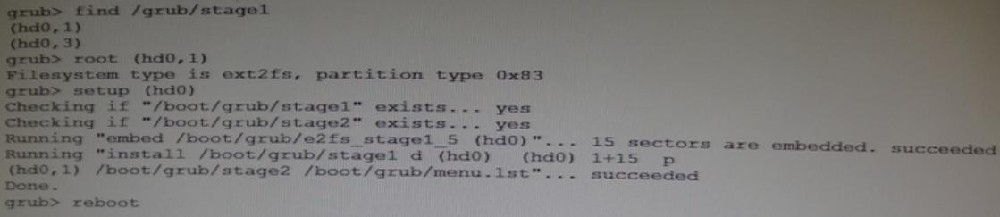 Based on the output, which statement is true?
-
A
The GRUB command sequence restores GRUB from the first partition on the second hard disk.
-
B
The GRUB command sequence does not restore GRUB.
-
C
GRUB command sequence restores GRUB from the second partition on the first hard disk.
-
D
The GRUB command sequence verifies the stage1 on the first partition on first hard disk.
Reveal answer details
Close answer details
Correct answerC
Explanationhd0,1 indicates the first hard drive and the second partition. Note:
* grub - the grub shell
Enter the GRand Unified Bootloader command shell. * In the following example we assume that the boot partition is located at /dev/hda5 and that GRUB must be installed on the first disk's MBR. grub> root (hd0,4)
Filesystem type is ext2fs, partition type 0x83
grub> setup (hd0)
Checking if "/boot/grub/stage1" exists... yes Checking if "/boot/grub/stage2" exists... yes Checking if "/boot/grub/e2fs_stage1_5" exists... yes Running "embed /boot/grub/e2fs_stage1_5 (hd0)"... 23 sectors are embedded. succeeded
Running "install /boot/grub/stage1 (hd0) (hd0)1+23 p (hd0,4)/boot/grub/stage2 /boot/grub/menu.lst"...
succeeded
Done.
grub> quit
The first command includes the location of the boot partition, thus indicating where the boot loader files are located. The second command installs GRUB on the MBR. For this purpose, a file called stage1_5 is used to grant GRUB access to the file system on the boot partition.
Question 6
Multiple choice
Which three things does oracle-edbms-server-11gR2-preinstall RPM package do to simplify the installation of Oracle Database on Oracle Linux 6 systems?
-
A
Downloads and installs various software packages and specific versions needed for Oracle database installation
-
B
Downloads and installs packages required for Oracle Database installation, runs the runInstaller utility to install the database, and then starts the database
-
C
Creates the Oracle user and the oinstall and dba groups, which are the default user and groups used
during Oracle database installation
-
D
Modifies and sets kernel parameters in /etc/sysctl.conf and sets shell resource limits in /etc/security/ limits.conf based on the Oracle Database Server installation requirements
-
E
Checks whether all packages are installed to support RDBMS and then calls the Oracle Universal Installer utility to install RDBMS and then calls the Oracle Universal Installer utility to install RDBMS
Reveal answer details
Close answer details
Correct answersA, C, D
ExplanationIn order to install the Oracle Database 11g R2 on Oracle Linux 6, your system needs to meet a few prerequisites, as outlined in the Linux Installation Guides. Using the Oracle RDBMS Server 11gR2 Pre-install RPM, you can complete most of the pre-installation configuration tasks. The package: * (A) Causes the download and installation of various software packages and specific versions needed for database installation, with package dependencies resolved via yum
* (C) Creates the user oracle and the groups oinstall and dba, which are the defaults used during database
installation
* (D) Modifies kernel parameters in /etc/sysctl.conf to change settings for shared memory, semaphores, the maximum number of file descriptors, and so on
* (D) Sets hard and soft shell resource limits in /etc/security/limits.conf, such as the number of open files, the number of processes, and stack size to the minimum required based on the Oracle Database 11g
Release 2 Server installation requirements
* Sets numa=off in the kernel boot parameters for x86_64 machines
Question 7
Multiple choice
Which three steps are involved in the installing Ksplice on servers that will be updated?
-
A
You have to be logged as user "ksplice" on the server you want to prepare and install Oracle Ksplice on.
-
B
The Uptrack package needs access directly or through a proxy to the Oracle public yum repository (http://public-yum.oracle.com/) to download the required packages for the uptrack-* utilities to be able to work correctly.
-
C
Download the install-uptrack script using the "wget N http://www.ksplice.com/uptrack/install-uptrack" command.
-
D
You have to be logged in as user "root" on the server you want to prepare and install Oracle ksplice on.
-
E
The uptrack package will set up a yum repository (/etc/yum.repos.d/ksplice-uptrack.repo) and download the required package for the uptrack-* utilities to be able to work correctly.
-
F
Download the ksplice ISO image from https://edelivery.oracle.com/linux and then run the "sh install-uptrack" script from the ISO image.
Reveal answer details
Close answer details
Correct answersB, C, D
ExplanationB: Your system must have access to the internet to install Ksplice. If you are using a proxy, set the proxy in your shell: export http_proxy=
http://proxy.company.com:port
export https_proxy=
http://proxy.company.com:port CD: Once you have an access key run the following commands as root, replacing YOUR_ACCESS_KEY with the access key you received upon sign-up: wget -N
https://www.ksplice.com/uptrack/install-uptrack
sh install-uptrack YOUR_ACCESS_KEY
uptrack-upgrade y E: If you'd like Ksplice Uptrack to automatically install updates as they become available, run: sh install-uptrack YOUR_ACCESS_KEY --autoinstall in place of the above install-uptrack command, or set "autoinstall = yes" in your /etc/uptrack/uptrack.conf after installation. References:
Ksplice, Installation instructions
Question 8
Multiple choice
Examine the following kernel boot command-line parameters. kernel /vmlinuz-2.6.32-220.e16 ro root = /dev/VolGroup00/LogVol00 init = /bin/bash ether = 0, 0, eth1 rhgb
quiet Which two statements are true?
-
A
An unrecognized kernel boot command-line parameter has been used.
-
B
The system will boot without password.
-
C
Boot argument ether will force probing for a second ethernet card (NIC).
-
D
It will not probe for any hard drive.
Reveal answer details
Close answer details
Correct answersC, D
ExplanationC: Ether parameter:
The most common use of this parameter is to force probing for a second ethercard, as the default is to only probe for one (with 2.4 and older kernels). This can be accomplished with a simple: ether=0,0,eth1 Note:
* rhgb stands for redhat graphical boot. This is a GUI mode booting screen with most of the information
hidden.
* quiet parameter hides the majority of the boot messages before rhgb starts.
What does the following btrfs command do? $ sudo btrfs subvolume snapshot src src-01
-
A
Creates snapshots of the src src-01 subvolumes
-
B
Creates a snapshot of the src-01 subvolumes in src
-
C
Creates the src and src-01 subvolumes and takes a snapshot of these subvolumes
-
D
Creates a snapshot of the src subvolumes in src-01
Reveal answer details
Close answer details
Correct answerD
Explanation* To create a snapshot use sudo btrfs subvolume snapshot /mnt/@ /mnt/@_snapshot
this will create a snapshot of the @ subvolume named @_snapshot located also in the top of the btrfs tree. * btrfs subvolume snapshot <source> [<dest>/]<name>
Create a writable snapshot of the subvolume <source> with the name <name> in the <dest> directory.
Question 10
Multiple choice
DTrace is being ported from Solaris to Oracle Linux. Which three statements are true for the DTrace tool?
-
A
DTrace allows static and dynamic tracing of your applications and your kernel.
-
B
DTrace tool is used to compile debug kernel modules and device drivers
-
C
DTrace allows you to dynamically define probe points on the fly.
-
D
DTrace probes and probe points are usually defined by the user using scripts written in a language called D.
-
E
DTrace tool is based on the strace Linux tool and includes both user and kernel strace features.
Reveal answer details
Close answer details
Correct answersA, C, D
ExplanationA: DTrace is a comprehensive dynamic tracing framework created by Sun Microsystems for troubleshooting kernel and application problems on production systems in real time. C: Key benefits and features of DTrace on Oracle Linux include: / Designed to work on finding performance bottlenecks / (C) Dynamically enables the kernel with a number of probe points, improving ability to service software
/ Enables maximum resource utilization and application performance / Fast and easy to use, even on complex systems with multiple layers of software D: Testers write tracing programs (also referred to as scripts) using the D programming language (not to be confused with other programming languages named "D"). The language, a subset of C, includes added functions and variables specific to tracing. D programs resemble awk programs in structure; they consist of
a list of one or more probes (instrumentation points), and each probe is associated with an action. These probes are comparable to a pointcut in aspect-oriented programming.
Question 11
Single choice
As a root user, you executed the following command on your Oracle Linux 6 server: [root@host] # strace - o /tmp/diag.out sh diag.sh Which statement describes the purpose of this command?
-
A
It collects the memory and swap space metrics when the diag.sh scripts runs.
-
B
It collects the operating system metrics when the diag.sh script runs.
-
C
It records the memory usage and CPU usage information of the processes when the diah.sh script runs.
-
D
It records the system calls, which are called by the processes when the diag.sh script runs.
Reveal answer details
Close answer details
Correct answerD
Explanation* strace - trace system calls and signals In the simplest case strace runs the specified command until it exits. It intercepts and records the system calls which are called by a process and the signals which are received by a process. The name of each system call, its arguments and its return value are printed on standard error or to the file specified with the
-o option. * strace is a useful diagnostic, instructional, and debugging tool. System administrators, diagnosticians and trouble-shooters will find it invaluable for solving problems with programs for which the source is not readily available since they do not need to be recompiled in order to trace them. Students, hackers and the overly-curious will find that a great deal can be learned about a system and its system calls by tracing even ordinary programs. And programmers will find that since system calls and signals are events that happen at the user/kernel interface, a close examination of this boundary is very useful for bug isolation, sanity checking and attempting to capture race conditions. Each line in the trace contains the system call name, followed by its arguments in parentheses and its return value. An example from stracing the command ''cat /dev/null'' is: open("/dev/null", O_RDONLY) = 3
Errors (typically a return value of -1) have the errno symbol and error string appended. open("/foo/bar", O_RDONLY) = -1 ENOENT (No such file or directory) Signals are printed as a signal symbol and a signal string. An excerpt from stracing and interrupting the command ''sleep 666'' is:
sigsuspend([] <unfinished ...>
--- SIGINT (Interrupt) ---
+++ killed by SIGINT +++ Reference: man strace
|