Which SLA type is not offered by Oracle Cloud Infrastructure compute service?
-
A
-
B
-
C
-
D
Reveal answer details
Close answer details
Correct answerC
ExplanationService Plane is NOT an SLA provided by OCI. See the table below: 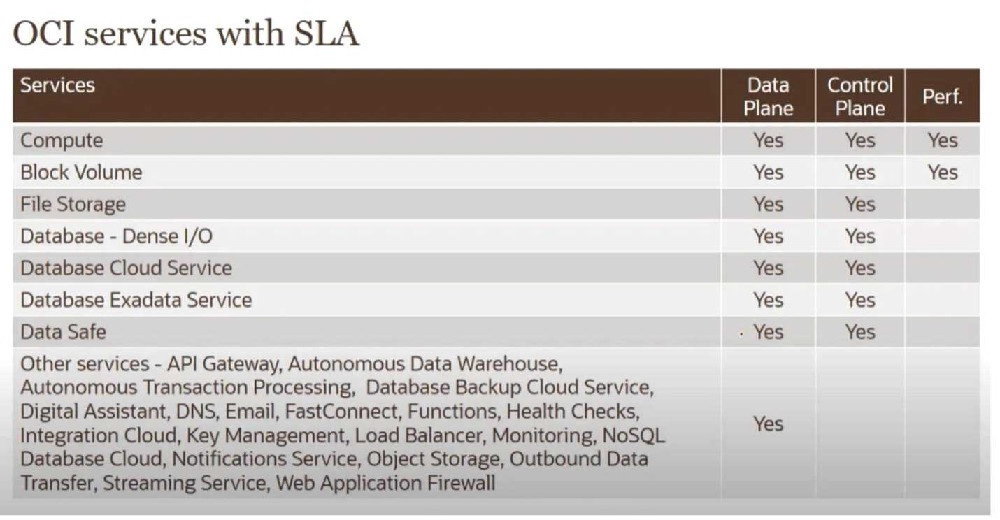 References:
https://k21academy.com/1z0-1085/service-level-agreement-sla-in-oracle-cloud-oci/
Which describes a key benefit of using Oracle Cloud Infrastructure (OCI)?
-
A
With OCI, you can only run Java based workloads on bare metal.
-
B
With OCI, you can run only cloud-native workloads.
-
C
Only bare metal workloads are supported on OCI.
-
D
OCI offers consistent performance with a predictable pricing model.
Reveal answer details
Close answer details
Correct answerD
Explanationhttps://www.oracle.com/in/cloud/pricing.html
- OCI offers consistent performance with a predictable pricing model - is the best suited answer.
- Only bare metal workloads are supported in OCI - False, since you can work with VMs etc too
- With OCI, you can run cloud native workloads - False, since you can work with on-premise by connecting it to OCI too.
- With OCI, you can only run Java based workloads on bare metal - False since Java is not the only programming language supported by OCI.
In Oracle Cloud Infrastructure, who is responsible for securing the workloads and configuring the cloud resources?
-
A
Third-party security services
-
B
-
C
-
D
Both Oracle and the customer
Reveal answer details
Close answer details
Correct answerD
ExplanationBoth Oracle and the customer share the responsibility for securing workloads and configuring cloud resources. Oracle provides the foundational security infrastructure, while customers are responsible for implementing security measures within their applications and data.
Which option provides the best performance for running OTLP workloads in Oracle Cloud Infrastructure (OCI)?
-
A
OCI Autonomous Data Warehouse
-
B
OCI Virtual Machine Instance
-
C
OCI Dedicated Virtual Host
-
D
OCI Autonomous Transaction Processing
Reveal answer details
Close answer details
Correct answerD
Explanationhttps://docs.oracle.com/en/cloud/paas/atp-cloud/index.html
Which feature is NOT provided by Oracle Cloud Infrastructure Security Zones?
-
A
Restricting resource creation based on predefined security policies
-
B
Automatically enforcing security best practices
-
C
Storing and managing encryption keys and secrets
-
D
Continuous monitoring of security posture
Reveal answer details
Close answer details
Correct answerC
ExplanationStoring and managing encryption keys and secrets is not a feature provided by Oracle Cloud Infrastructure Security Zones. This functionality is typically handled by other services such as Oracle Key Management Service (KMS) or Vault.
Which CANNOT be used with My Oracle Support (MOS)?
-
A
Add or change a tenancy administrator
-
B
Request a Service Limit increase
-
C
Reset the password or unlock the account for the tenancy administrator
-
D
Troubleshoot your resources in an Oracle Cloud Infrastructure Free Trial account
Reveal answer details
Close answer details
Correct answerD
ExplanationOpen a support service request with MOS option is available to paid accounts. Customers using only Always Free resources are not eligible for Oracle Support. Limited support is available to Free Tier accounts with Free Trial credits. After you use all of your credits or after your trial period ends (whichever comes first), you must upgrade to a paid account to access Oracle Support. If you choose not to upgrade and continue to use Always Free Services, you will not be eligible to raise a service request in My Oracle Support.
In addition to support for technical issues, use My Oracle Support if you need to:
1. Reset the password or unlock the account for the tenancy administrator 2. Add or change a tenancy administrator
3. Request a service limit increase References:
https://docs.cloud.oracle.com/en-us/iaas/Content/GSG/Tasks/contactingsupport.htm
Which workload type is NOT optimized for Oracle Autonomous Database on Shared ExadataInfrastructure?
-
A
-
B
-
C
-
D
High-performance computing
Reveal answer details
Close answer details
Correct answerD
ExplanationHigh-performance computing (HPC) typically involves complex calculations and processing, which are not optimized for Oracle Autonomous Database on Shared Exadata Infrastructure. HPC often requires specialized hardware and configurations for optimal performance.
A company has developed an eCommerce web application In Oracle Cloud Infrastructure. What should they do to ensure that the application has the highest level of resilience?
-
A
Deploy the application across multiple Regions and Availability Domains.
-
B
Deploy the application across multiple Availability Domains and subnet.
-
C
Deploy the application across multiple Virtual Cloud Networks.
-
D
Deploy the application across multiple Availability Domains and Fault Domains.
Reveal answer details
Close answer details
Correct answerA
ExplanationFor highest level of resilience you can deploy the application between regions and distribute on availability domain and fault domains. References:
https://www.oracle.com/cloud/iaas/faq.html
Which capability enables you to search, purchase, and start using software in your Oracle Cloud Infrastructure (OCI) tenancy?
-
A
-
B
-
C
-
D
Reveal answer details
Close answer details
Correct answerA
ExplanationOracle Cloud Infrastructure Marketplace is an online store that offers solutions specifically for customers of Oracle Cloud Infrastructure. In the Oracle Cloud Infrastructure Marketplace catalog, you can find listings for two types of solutions from Oracle and trusted partners: images and stacks. These listing types include different categories of applications. Also, some listings are free and others require payment. Images are templates of virtual hard drives that determine the operating system and software to run on an instance.
You can deploy image listings on an Oracle Cloud Infrastructure Compute instance. Marketplace also offers stack listings. Stacks represent definitions of groups of Oracle Cloud Infrastructure resources that you can act on as a group. Each stack has a configuration consisting of one or more declarative configuration files. With an image or a stack, you have a customized, more streamlined way of getting started with a publisher's software. References:
https://docs.cloud.oracle.com/en-us/iaas/Content/Marketplace/Concepts/marketoverview.htm
Question 10
Single choice
Which feature is NOT a component of Oracle Cloud Infrastructure (OCI) Identity and Access management service?
-
A
-
B
-
C
-
D
Reveal answer details
Close answer details
Question 11
Single choice
Which is NOT a type of instance offered by the Oracle Cloud Infrastructure Compute service?
-
A
-
B
-
C
Dedicated Virtual Machine Host
-
D
Reveal answer details
Close answer details
Correct answerD
ExplanationNano instances are not offered by OCI. The compute service provides other instance types like Virtual Machines, Bare Metal, and Dedicated Hosts but does not include Nano instances.
Question 12
Single choice
Which is NOT a valid business benefit for a customer considering migrating their infrastructure and apps to Oracle Cloud Infrastructure (OCI)?
-
A
-
B
Capital Expenditure to Operational Expenditure conversion
-
C
-
D
Increased Total Cost of Ownership (TCO)
Reveal answer details
Close answer details
Correct answerD
ExplanationOracle Cloud Infrastructure is a set of complementary cloud services that enable you to build and run a wide range of applications and services in a highly available hosted environment. Oracle Cloud Infrastructure offers high-performance compute capabilities (as physical hardware instances) and storage capacity in a flexible overlay virtual network that is securely accessible from your on-premises network.
References:
https://docs.cloud.oracle.com/en-us/iaas/Content/GSG/Concepts/baremetalintro.htm
One of the major benefits of cloud computing is REDUCED TCO. Therefore, Increased TCO is the incorrect option. (https://www.oracle.com/partners/en/partner-with-oracle/develop-solutions/why/increase-value-)
reduce-cost-3907933.pdf
Question 13
Single choice
Which Oracle Cloud Infrastructure (OCI) service can be used to protect sensitive and regulated data in OCI database services?
-
A
-
B
-
C
-
D
Reveal answer details
Close answer details
Correct answerC
ExplanationOracle Data Safe is a unified control center for your Oracle databases which helps you understand the sensitivity of your data, evaluate risks to data, mask sensitive data, implement and monitor security controls, assess user security, monitor user activity, and address data security compliance requirements.
Whether you're using an Autonomous Database or an Oracle DB system, Oracle Data Safe delivers essential data security capabilities as a service on Oracle Cloud Infrastructure.
Features of Oracle Data Safe: Oracle Data Safe provides the following set of features for protecting sensitive and regulated data in Oracle Cloud databases, all in a single, easy-to-use management console:
1) Security Assessment helps you assess the security of your cloud database configurations. It analyzes database configurations, user accounts, and security controls, and then reports the findings with recommendations for remediation activities that follow best practices to reduce or mitigate risk.
2) User Assessment helps you assess the security of your database users and identify high risk users. It reviews information about your users in the data dictionary on your target databases, and calculates a risk score for each user. For example, it evaluates the user types, how users are authenticated, the password policies assigned to each user, and how long it has been since each user has changed their password. It also provides a direct link to audit records related to each user. With this information, you can then deploy appropriate security controls and policies. 3) Data Discovery helps you find sensitive data in your cloud databases. You tell Data Discovery what kind of sensitive data to search for, and it inspects the actual data in your database and its data dictionary, and then returns to you a list of sensitive columns. By default, Data Discovery can search for a wide variety of sensitive data pertaining to identification, biographic, IT, financial, healthcare, employment, and academic information.
4) Data Masking provides a way for you to mask sensitive data so that the data is safe for non-production purposes. For example, organizations often need to create copies of their production data to support development and test activities. Simply copying the production data exposes sensitive data to new users.
To avoid a security risk, you can use Data Masking to replace the sensitive data with realistic, but fictitious data.
5) Activity Auditing lets you audit user activity on your databases so you can monitor database usage and be alerted of unusual database activities.
References:
https://docs.cloud.oracle.com/en-us/iaas/data-safe/doc/oracle-data-safe-overview.html
Question 14
Multiple choice
Which two situations incur costs in Oracle Cloud Infrastructure (OCI)?
-
A
Data ingress from the internet
-
B
Transferring data across regions
-
C
Transferring data from one instance to another in the same Availibility Domain
-
D
Data egress to the internet
-
E
Transferring data from one instance to another across different Availibility Domains in a Region
Reveal answer details
Close answer details
Question 15
Single choice
Which of the following services can you control access to via IAM?
-
A
-
B
-
C
All services including IAM
-
D
Reveal answer details
Close answer details
Question 16
Single choice
Which statement is true for an oracle cloud Infrastructure (OCI) compute instance?
-
A
Compute instance always get a public IP address
-
B
Compute instance does not use a boot volume
-
C
Compute instance cannot leverage auto scaling feature
-
D
Compute instance always get a private IP address
Reveal answer details
Close answer details
Correct answerD
ExplanationWhen you create an instance, the instance is automatically attached to a virtual network interface card (VNIC) in the cloud network's subnet and given a private IP address from the subnet's CIDR. You can let the IP address be automatically assigned, or you can specify a particular address of your choice. The private IP address lets instances within the cloud network communicate with each other. References:
https://docs.cloud.oracle.com/en-us/iaas/Content/Compute/Tasks/launchinginstance.htm
Instances use IP addresses for communication. Each instance has at least one private IP address and optionally one or more public IP addresses. A private IP address enables the instance to communicate with other instances inside the VCN, or with hosts in your on-premises network (via an IPSec VPN or Oracle Cloud Infrastructure FastConnect). A public IP address enables the instance to communicate with hosts on the internet. Reference: (https://docs.cloud.oracle.com/en-us/iaas/Content/Network/Tasks/managingIPaddresses.htm)
Question 17
Single choice
Which feature is not component of Oracle cloud Infrastructure identity and Access management service?
-
A
-
B
-
C
-
D
Reveal answer details
Close answer details
Correct answerC
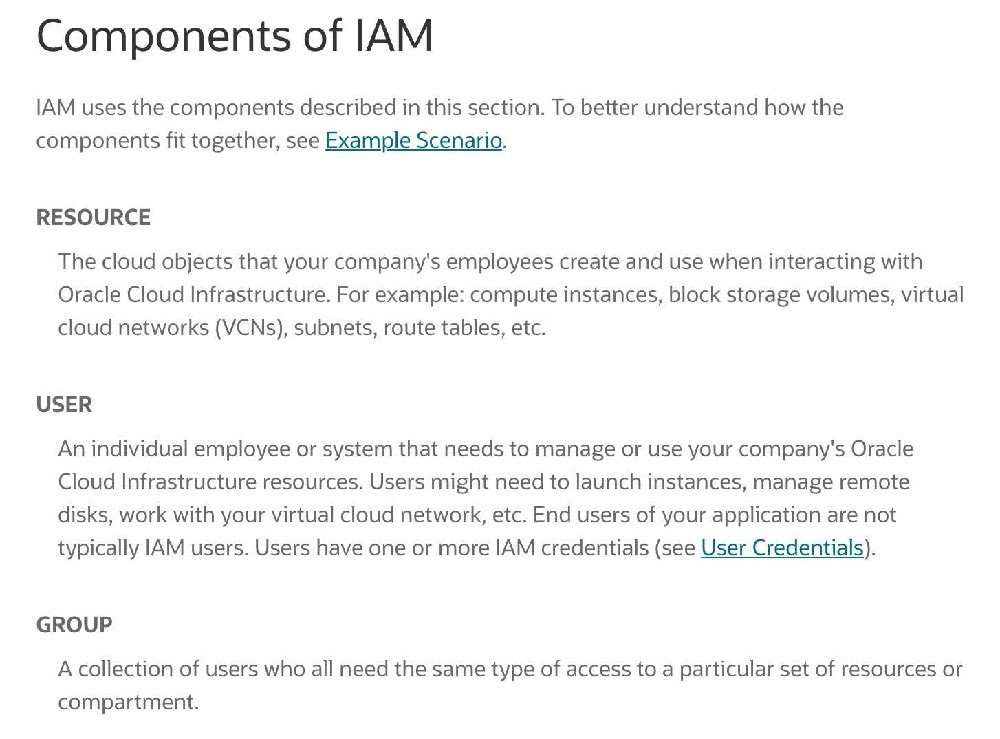
ExplanationComponents of IAM
RESOURCE
The cloud objects that your company's employees create and use when interacting with Oracle Cloud Infrastructure. For example: compute instances, block storage volumes, virtual cloud networks (VCNs),
subnets, route tables, etc.
USER
An individual employee or system that needs to manage or use your company's Oracle Cloud Infrastructure resources. Users might need to launch instances, manage remote disks, work with your virtual cloud network, etc. End users of your application are not typically IAM users. Users have one or more IAM credentials (see User Credentials).
GROUP
A collection of users who all need the same type of access to a particular set of resources or compartment.
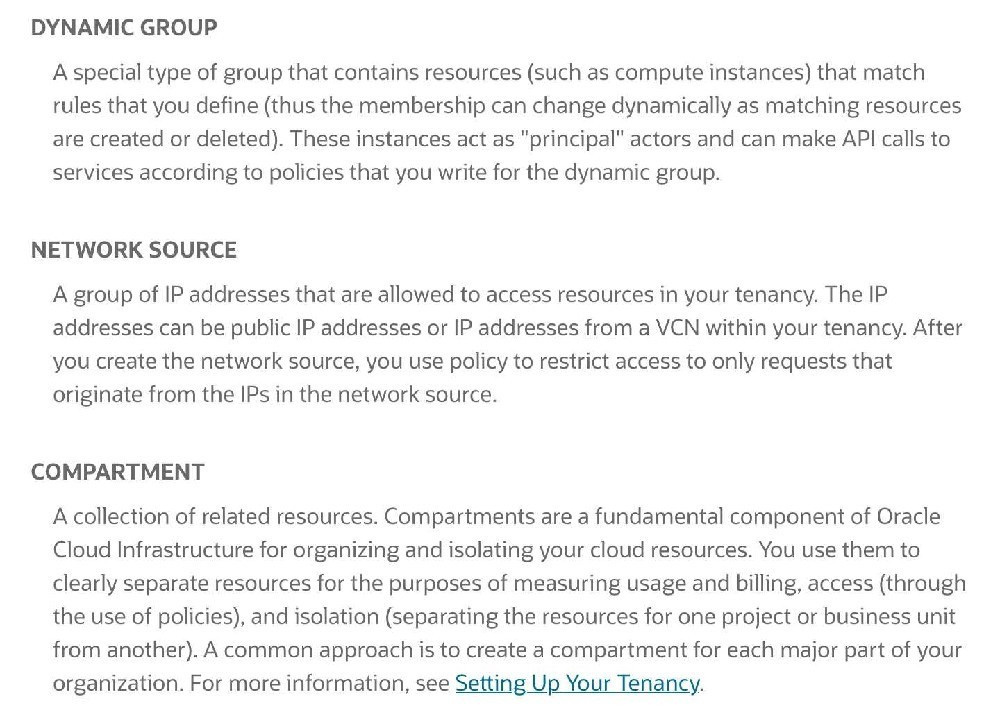
DYNAMIC GROUP
A special type of group that contains resources (such as compute instances) that match rules that you define (thus the membership can change dynamically as matching resources are created or deleted).
These instances act as "principal" actors and can make API calls to services according to policies that you write for the dynamic group.
NETWORK SOURCE
A group of IP addresses that are allowed to access resources in your tenancy. The IP addresses can be public IP addresses or IP addresses from a VCN within your tenancy. After you create the network source, you use policy to restrict access to only requests that originate from the IPs in the network source.
COMPARTMENT
A collection of related resources. Compartments are a fundamental component of Oracle Cloud Infrastructure for organizing and isolating your cloud resources. You use them to clearly separate resources for the purposes of measuring usage and billing, access (through the use of policies), and isolation (separating the resources for one project or business unit from another). A common approach is to create a compartment for each major part of your organization. For more information, see Setting Up
Your Tenancy.
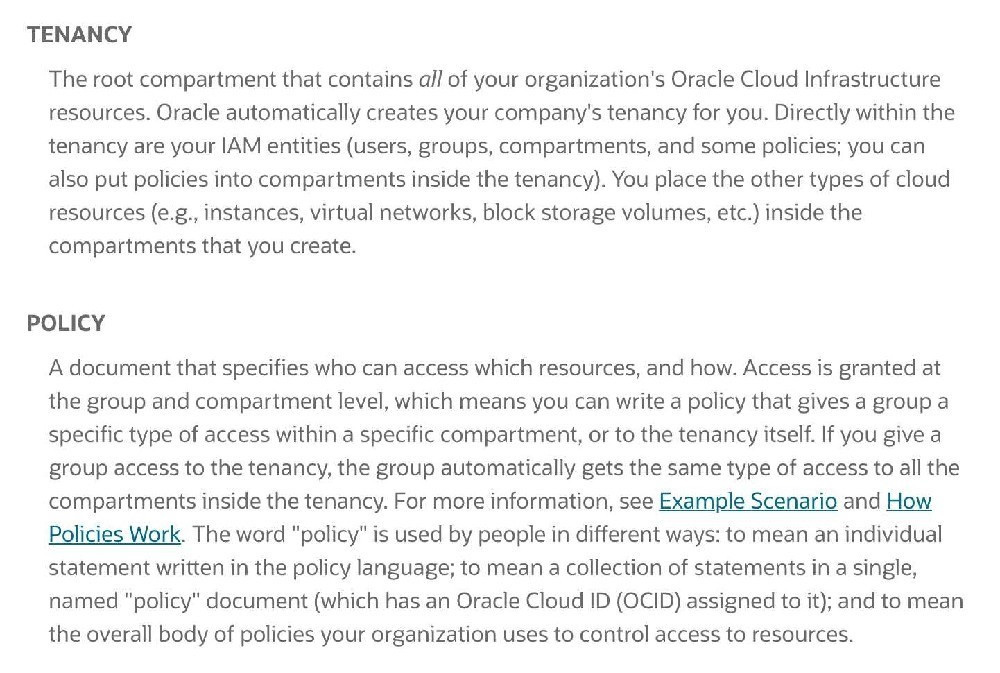
TENANCY
The root compartment that contains all of your organization's Oracle Cloud Infrastructure resources. Oracle automatically creates your company's tenancy for you. Directly within the tenancy are your IAM entities (users, groups, compartments, and some policies; you can also put policies into compartments inside the
tenancy). You place the other types of cloud resources (e.g., instances, virtual networks, block storage volumes, etc.) inside the compartments that you create.
POLICY
A document that specifies who can access which resources, and how. Access is granted at the group and compartment level, which means you can write a policy that gives a group a specific type of access within a specific compartment, or to the tenancy itself. If you give a group access to the tenancy, the group automatically gets the same type of access to all the compartments inside the tenancy. For more information, see Example Scenario and How Policies Work. The word "policy" is used by people in different ways: to mean an individual statement written in the policy language; to mean a collection of
statements in a single, named "policy" document (which has an Oracle Cloud ID (OCID) assigned to it);
and to mean the overall body of policies your organization uses to control access to resources.
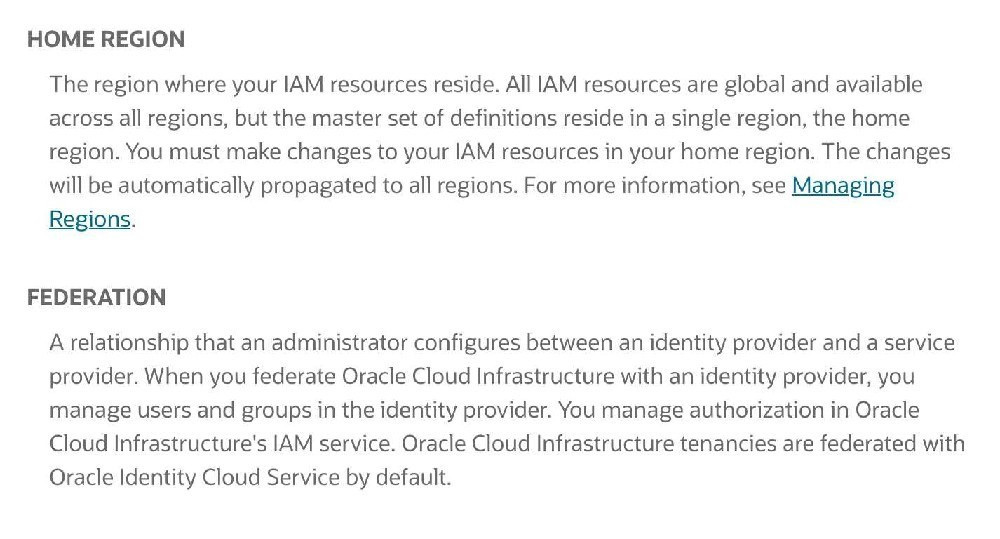
HOME REGION
The region where your IAM resources reside. All IAM resources are global and available across all regions, but the master set of definitions reside in a single region, the home region. You must make changes to your IAM resources in your home region. The changes will be automatically propagated to all regions. For more information, see Managing Regions.
FEDERATION
A relationship that an administrator configures between an identity provider and a service provider. When you federate Oracle Cloud Infrastructure with an identity provider, you manage users and groups in the identity provider. You manage authorization in Oracle Cloud Infrastructure's IAM service. Oracle Cloud Infrastructure tenancies are federated with Oracle Identity Cloud Service by default.
References:
https://docs.cloud.oracle.com/en-us/iaas/Content/Identity/Concepts/overview.htm
Question 18
Single choice
Which Oracle Cloud Infrastructure service allows you to run code without provisioning any underlying infrastructure resources?
-
A
-
B
-
C
Oracle Container Engine for Kubernetes
-
D
Reveal answer details
Close answer details
Correct answerD
ExplanationOracle Functions is a fully managed, multi-tenant, highly scalable, on-demand, Functions-as-a- Service platform. It is built on enterprise-grade Oracle Cloud Infrastructure and powered by the Fn Project open source engine. Use Oracle Functions (sometimes abbreviated to just Functions) when you want to focus on writing code to meet business needs. The serverless and elastic architecture of Oracle Functions means there's no infrastructure administration or software administration for you to perform. You don't provision or maintain compute instances, and operating system software patches and upgrades are applied automatically. Oracle Functions simply ensures your app is highly-available, scalable, secure, and monitored. With Oracle Functions, you can write code in Java, Python, Node, Go, and Ruby (and for advanced use cases, bring your own Dockerfile, and Graal VM). You can then deploy your code, call it directly or trigger it in response to events, and get billed only for the resources consumed during the execution. 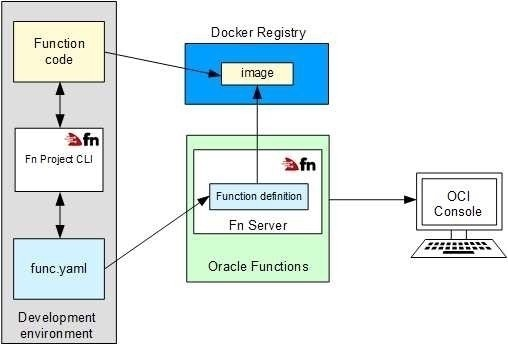 References:
https://docs.cloud.oracle.com/en-us/iaas/Content/Functions/Concepts/functionsoverview.htm
Question 19
Single choice
Which component of the Oracle Cloud Infrastructure Networking service allows resources in a VCN to access Oracle Cloud services without traversing the public Internet?
-
A
Network Address Translation (NAT) Gateway
-
B
Dynamic Routing Gateway (DRG)
-
C
-
D
Reveal answer details
Close answer details
Correct answerC
ExplanationA Service Gateway provides secure access to Oracle Cloud services from within a VCN without the need to traverse the public Internet. It facilitates private and efficient communication between resources and cloud services.
Question 20
Single choice
Which is NOT covered by Oracle Cloud Infrastructure (OCI) Service Level Agreement (SLA)?
-
A
-
B
-
C
-
D
Reveal answer details
Close answer details
Correct answerC
Explanationhttps://www.oracle.com/assets/paas-iaas-pub-cld-srvs-pillar-4021422.pdf
Enterprises demand more than just availability from their cloud infrastructure. Mission-critical workloads also require consistent performance, and the ability to manage, monitor, and modify resources running in the cloud at any time.
Only Oracle offers end-to-end SLAs covering performance, availability, manageability of services. 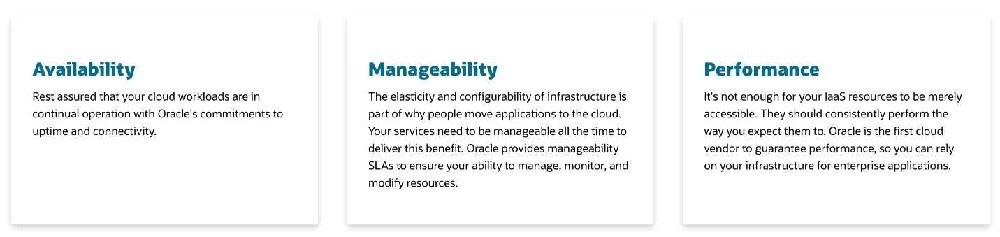 References:
https://www.oracle.com/in/cloud/iaas/sla.html
Question 21
Single choice
A new customer has logged into Oracle Cloud Infrastructure (OCI) as an administrator for the first time.
The admin would like to deploy infrastructure. What is the first step they must take in order to accomplish this task?
-
A
File a service request for access to each additional region.
-
B
Use API endpoints to create resources in the desired region.
-
C
Subscribe to the desired region.
-
D
Navigate to the desired region and begin creating resources.
Reveal answer details
Close answer details
Correct answerC
ExplanationWhen you sign up for Oracle Cloud Infrastructure, Oracle creates a tenancy for you in one region. This is your home region. Your home region is where your IAM resources are defined. When you subscribe to another region, your IAM resources are available in the new region, however, the master definitions reside in your home region and can only be changed there. When you subscribe your tenancy to a new region, all the policies from your home region are enforced in the new region. If you want to limit access for groups of users to specific regions, you can write policies to grant access to specific regions only. References:
https://docs.cloud.oracle.com/en-us/iaas/Content/Identity/Tasks/managingregions.htm
|