What is a key benefit of Oracle Cloud Infrastructure (OCI) Virtual Machine DB Systems?
-
A
Support for RAC DB systems
-
B
No need to create database Indices
-
C
Automated backups to OCI Block Volume
-
D
Automated disaster recovery
Reveal answer details
Close answer details
Correct answerA
ExplanationThere are two types of DB systems on virtual machines: A 1-node virtual machine DB system consists of one virtual machine.
A 2-node virtual machine DB system consists of two virtual machines. (RAC) A virtual machine DB system database uses Oracle Cloud Infrastructure block storage instead of local storage. You specify a storage size when you launch the DB system, and you can scale up the storage as needed at any time. For 1-node virtual machine DB systems, Oracle Cloud Infrastructure provides have a "fast provisioning" option that allows you to create your DB system using Logical Volume Manager as your storage management software. Oracle Cloud Infrastructure offers single-node DB systems on either bare metal or virtual machines, and 2-node RAC DB systems on virtual machines. If you need to provision a DB system for development or testing purposes, then a special fast provisioning single-node virtual machine system is available.
You can manage these systems by using the Console, the API, the Oracle Cloud Infrastructure CLI, the Database CLI (DBCLI), Enterprise Manager, Enterprise Manager Express, or SQL Developer. 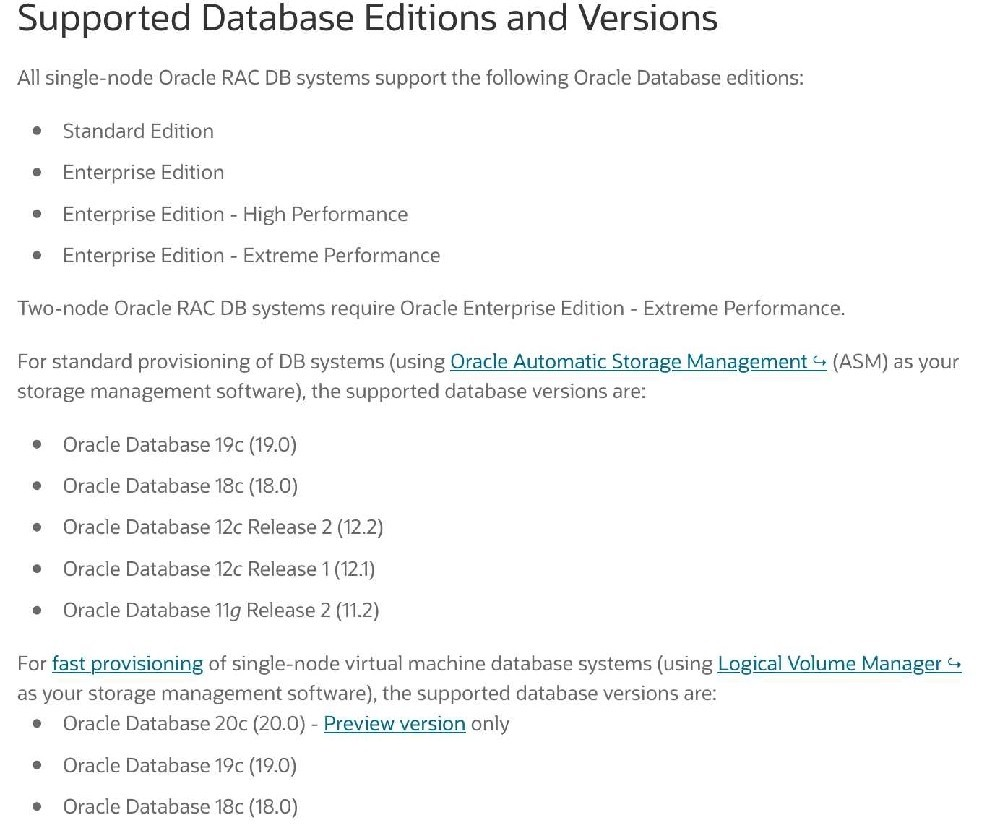 References:
https://docs.cloud.oracle.com/en-us/iaas/Content/Database/Concepts/overview.htm
Which Oracle Cloud Infrastructure service can you use to assess user security of your Oracle databases?
-
A
-
B
-
C
Audit Vault and Database Firewall option for Oracle Database Enterprise Edition
-
D
Reveal answer details
Close answer details
Correct answerA
ExplanationOracle Data Safe is a unified control center for your Oracle databases which helps you understand the sensitivity of your data, evaluate risks to data, mask sensitive data, implement and monitor security controls, assess user security, monitor user activity, and address data security compliance requirements. Whether you're using an Autonomous Database or an Oracle DB system, Oracle Data Safe delivers essential data security capabilities as a service on Oracle Cloud Infrastructure.
References:
https://docs.cloud.oracle.com/en-us/iaas/data-safe/doc/oracle-data-safe-overview.html
Which OCI storage service does not provide encryption for data at rest?
-
A
-
B
-
C
-
D
Reveal answer details
Close answer details
Correct answerC
ExplanationNVMe stands for non-volatile memory express. It is a storage protocol created to fasten the transfer of data between enterprise and client systems and solid-state drives (SSDs) over a computer's high-speed Peripheral Component Interconnect Express bus. The characteristics are:
1) Local NVMe is NVMe SSD-based temporary storage.
2) It is the locally-attached NVMe devices to the OCI compute instance 3) It is used very high storage performance requirements, lots of throughput, lots of IOPS, local storage
and when you don't want to go out on network 4) Oracle does not protect in any way through RAID, or snapshots, or backup out of the box and data is not
encrypted at rest. References:
https://techgoeasy.com/local-nvme-storage-oci/
Question 4
Multiple choice
Which two should be considered when designing a fault tolerant solution in Oracle Cloud Infrastructure (OCI)?
-
A
ensuring your solution components are distributed across OCI Fault Domains
-
B
performing data integrity check when using OCI File Storage Service
-
C
writing custom scripts that will monitor your solution
-
D
using multiple OCI Availability Domains (AD), where available, to deploy your solution
-
E
creating a manual cluster of compute instances
Reveal answer details
Close answer details
Correct answersA, D
ExplanationCreating a manual cluster of compute instances, and Writing custom scripts that will monitor your solution are not valid ways to ensure fault tolerance at all. Also, Performing Data Integrity check when using OCI File Storage Service is not valid since OCI takes care of it.
Therefore, we are left with:
1) Using multiple OCI Availibility Domains (AD), where available, to deploy your solution - Which is excellent because we have multiple AD's so that if one fails, we have a backup AD!
2) Ensuring your solution components are distributed across OCI Fault Domains - So that we can protect our deployment against unexpected power failures, AD failure etc.
References:
https://blogs.oracle.com/cloud-infrastructure/using-availibility-domains-and-fault-domains-to-
improve-application-resiliency
Question 5
Multiple choice
Which two Oracle Cloud Infrastructure resources can be used to group/categorize expenses?
-
A
-
B
-
C
-
D
-
E
Reveal answer details
Close answer details
Correct answersB, D
ExplanationYou can do Costs Analysis in OCI and you can group and filter the cost by Tags or compartments To filter costs by dates
To filter costs by tags
To filter costs by compartments
To remove a compartment or tag filter
Which Oracle Cloud Infrastructure (OCI) database solution will be most economical for a customer looking to have the elasticity of the cloud with minimal administration and maintenance effort for their DBA team?
-
A
OCI Bare Metal DB Systems
-
B
OCI Virtual Machine DB Systems
-
C
-
D
Reveal answer details
Close answer details
Correct answerC
ExplanationExadata DB systems allow you to leverage the power of Exadata within the Oracle Cloud Infrastructure. An Exadata DB system consists of a base system, quarter rack, half rack, or full rack of compute nodes and storage servers, tied together by a high-speed, low-latency InfiniBand network and intelligent Exadata software. You can configure automatic backups, optimize for different workloads, and scale up the system to meet increased demands. Oracle now offers the Zero Downtime Migration service, a quick and easy way to move on-premises Oracle Databases and Oracle Cloud Infrastructure Classic databases to Oracle Cloud Infrastructure. You can migrate databases to the following types of Oracle Cloud Infrastructure systems: Exadata, Exadata Cloud@Customer, bare metal, and virtual machine. Zero Downtime Migration leverages Oracle Active Data Guard to create a standby instance of your database in an Oracle Cloud Infrastructure system. You switch over only when you are ready, and your source database remains available as a standby. Use the Zero Downtime Migration service to migrate databases individually or at the fleet level. See Move to Oracle Cloud Using Zero Downtime Migration for more information.
References:
https://docs.cloud.oracle.com/en-us/iaas/Content/Database/Concepts/exaoverview.htm
Question 7
Multiple choice
What two statements regarding the Virtual Cloud Network (VCN) are true?
-
A
A single VCN can contain both private and public Subnets.
-
B
VCN is a regional resource that span across all the Availability Domains in a Region.
-
C
You can only create one VCN per region.
-
D
The VCN is the IPSec-based connection with a remote on premises location.
-
E
VCN is a global resource that span across all the Regions
Reveal answer details
Close answer details
Correct answersA, B
ExplanationWhen you work with Oracle Cloud Infrastructure, one of the first steps is to set up a virtual cloud network (VCN) for your cloud resources.
VIRTUAL CLOUD NETWORK (VCN) :
A virtual, private network that you set up in Oracle data centers. It closely resembles a traditional network, with firewall rules and specific types of communication gateways that you can choose to use. A VCN resides in a single Oracle Cloud Infrastructure region and covers a single, contiguous IPv4 CIDR block of your choice. See Allowed VCN Size and Address Ranges. The terms virtual cloud network, VCN, and cloud network are used interchangeably in this documentation.
For more information, see VCNs and Subnets.
SUBNETS :
Subdivisions you define in a VCN (for example, 10.0.0.0/24 and 10.0.1.0/24). Subnets contain virtual network interface cards (VNICs), which attach to instances. Each subnet consists of a contiguous range of IP addresses that do not overlap with other subnets in the VCN. You can designate a subnet to exist either in a single availability domainavailability domain or across an entire region (regional subnets are recommended). Subnets act as a unit of configuration within the VCN: All VNICs in a given subnet use the same route table, security lists, and DHCP options (see the definitions that follow). You can designate a subnet as either public or private when you create it. Private means VNICs in the subnet can't have public IP addresses. Public means VNICs in the subnet can have public IP addresses at your discretion. See Access to the Internet. References:
https://docs.cloud.oracle.com/en-us/iaas/Content/Network/Concepts/overview.htm
Which is NOT considered a security resource within Oracle Cloud Infrastructure?
-
A
-
B
-
C
-
D
Reveal answer details
Close answer details
Correct answerC
ExplanationOracle Cloud Infrastructure File Storage service provides a durable, scalable, secure, enterprise-grade network file system. You can connect to a File Storage service file system from any bare metal, virtual machine, or container instance in your Virtual Cloud Network (VCN). You can control the access of the file system from FSS by applying some security rules and others but the services it self not related to security but it related to shared storage References:
https://docs.cloud.oracle.com/en-us/iaas/Content/File/Concepts/filestorageoverview.htm
Which capability enables you to search, purchase, and start using software in your Oracle Cloud Infrastructure (OCI) tenancy?
-
A
-
B
-
C
-
D
Reveal answer details
Close answer details
Correct answerA
ExplanationOracle Cloud Infrastructure Marketplace is an online store that offers solutions specifically for customers of Oracle Cloud Infrastructure. In the Oracle Cloud Infrastructure Marketplace catalog, you can find listings for two types of solutions from Oracle and trusted partners: images and stacks. These listing types include different categories of applications. Also, some listings are free and others require payment. Images are templates of virtual hard drives that determine the operating system and software to run on an instance.
You can deploy image listings on an Oracle Cloud Infrastructure Compute instance. Marketplace also offers stack listings. Stacks represent definitions of groups of Oracle Cloud Infrastructure resources that you can act on as a group. Each stack has a configuration consisting of one or more declarative configuration files. With an image or a stack, you have a customized, more streamlined way of getting started with a publisher's software. References:
https://docs.cloud.oracle.com/en-us/iaas/Content/Marketplace/Concepts/marketoverview.htm
Question 10
Single choice
You are required to host several files in a location that can be publicly accessible from anywhere in the world. Which Oracle Cloud Infrastructure (OCI) service should you use?
-
A
-
B
-
C
-
D
-
E
Reveal answer details
Close answer details
Question 11
Multiple choice
OCI budgets can be set on which two options?
-
A
-
B
-
C
-
D
-
E
Reveal answer details
Close answer details
Correct answersA, C
ExplanationIn OCI a budget can be used to set soft limits on your Oracle Cloud Infrastructure spending. You can set alerts on your budget to let you know when you might exceed your budget, and you can view all of your budgets and spending from one single place in the Oracle Cloud Infrastructure console.
Budgets are set on
1. Cost-tracking tags 2. Compartments (including the root compartment) References:
https://docs.cloud.oracle.com/en-us/iaas/Content/Billing/Concepts/budgetsoverview.htm
Question 12
Single choice
Which service is the most effective for moving large amounts of data from your on-premises to Oracle Cloud Infrastructure (OCI)?
-
A
-
B
-
C
-
D
Reveal answer details
Close answer details
Correct answerC
ExplanationAPPLIANCE-BASED DATA TRANSFER
You send your data as files on secure, high-capacity, Oracle-supplied storage appliances to an Oracle transfer site. Operators at the Oracle transfer site upload the data into your designated Object Storage bucket in your tenancy. This solution supports data transfer when you are migrating a large volume of data and when using disks is not a practical alternative. You do not need to write any code or purchase any hardware. Oracle supplies the transfer appliance and software required to manage the transfer.
https://docs.cloud.oracle.com/en-us/iaas/Content/DataTransfer/Concepts/overview.htmOracleCloud
Infrastructure Data Transfer Appliance securely moves terabytes or petabytes data between on-premise data centers and the cloud. The service reduces data migration times from weeks or months to just hours and is available for data import to the cloud and data export from the cloud. 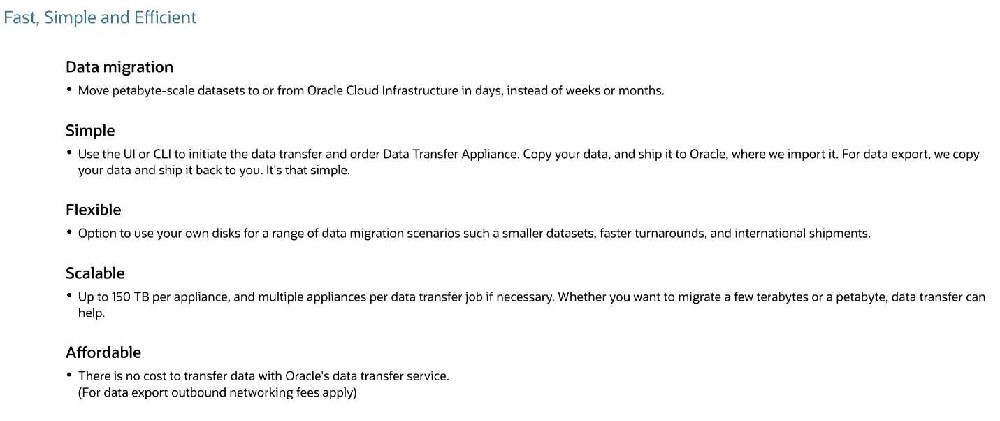 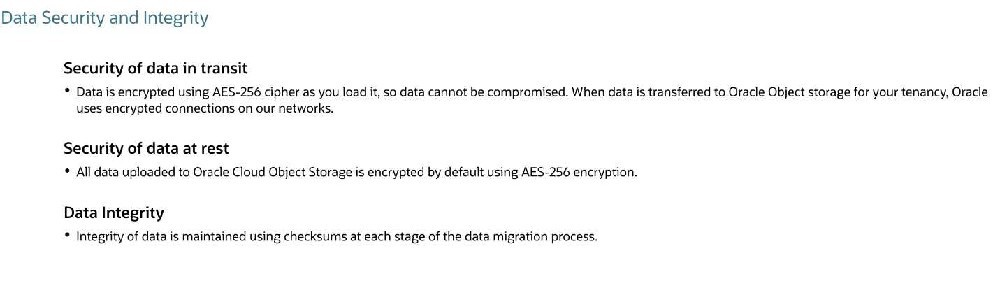 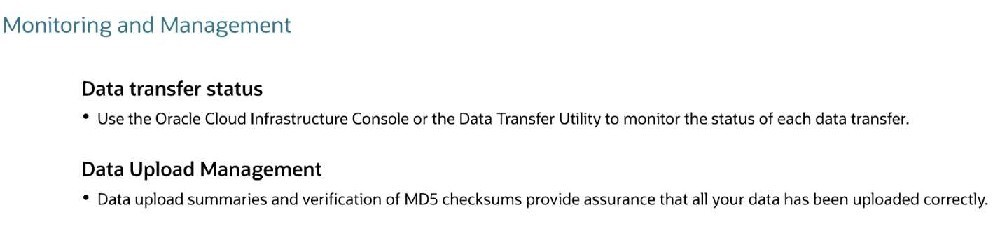 References:
https://www.oracle.com/in/cloud/storage/data-transfer.html
Question 13
Single choice
What does compute instance vertical scaling mean?
-
A
Providing Fault tolerance
-
B
Adding additional compute instances
-
C
Enabling Disaster recovery
-
D
Changing to a large or smaller shape
Reveal answer details
Close answer details
Correct answerD
ExplanationChanging the Shape of an Instance (Horizontal Scaling) You can change the shape of a virtual machine (VM) instance without having to rebuild your instances or redeploy your applications. This lets you scale up your Compute resources for increased performance, or scale down to reduce cost.Autoscaling (vertical scaling)
Autoscaling lets you automatically adjust the number of Compute instances in an instance pool based on performance metrics such as CPU utilization. This helps you provide consistent performance for your end users during periods of high demand, and helps you reduce your costs during periods of low demand.
As load increases, instances are automatically provisioned: the instance pool scales out. As load decreases, instances are automatically removed: the instance pool scales in. 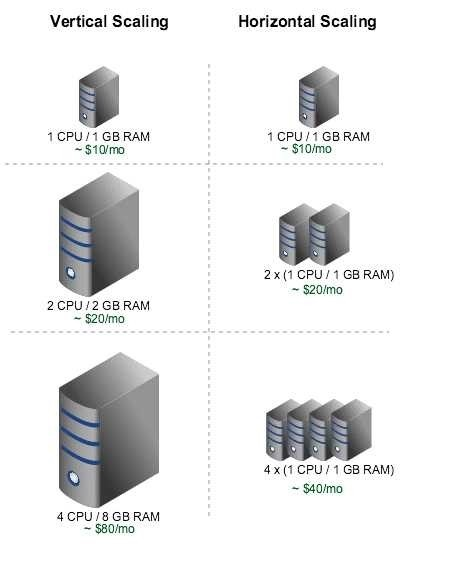 https://docs.cloud.oracle.com/en-us/iaas/Content/Compute/Tasks/resizinginstances.htm
Question 14
Multiple choice
You were recently assigned to manage a project to deploy Oracle E-Business Suite on Oracle Cloud Infrastructure (OCI). The application will require a database, several servers, and a shared file system. Which three OCI services are best suited for this project?
-
A
OCI virtual or Bare Metal DB Systems
-
B
-
C
-
D
Virtual Machine (VM) or Bare Metal (BM) compute Instances
-
E
-
F
Oracle Container Engine for Kubernetes
Reveal answer details
Close answer details
Correct answersA, D, E
Explanationhttps://docs.oracle.com/en/solutions/deploy-ebusiness-suite-oci/index.html#GUID-0CA881FD-
D96F-4885-BC77-62E3A66EFF95
Question 15
Single choice
Which of the following is an example of an edge service in OCI?
-
A
-
B
-
C
-
D
Reveal answer details
Close answer details
Correct answerA
ExplanationThe Oracle Cloud Infrastructure Domain Name System (DNS) service lets you create and manage your DNS zones. You can create zones, add records to zones, and allow Oracle Cloud Infrastructure's edge network to handle your domain's DNS queries. 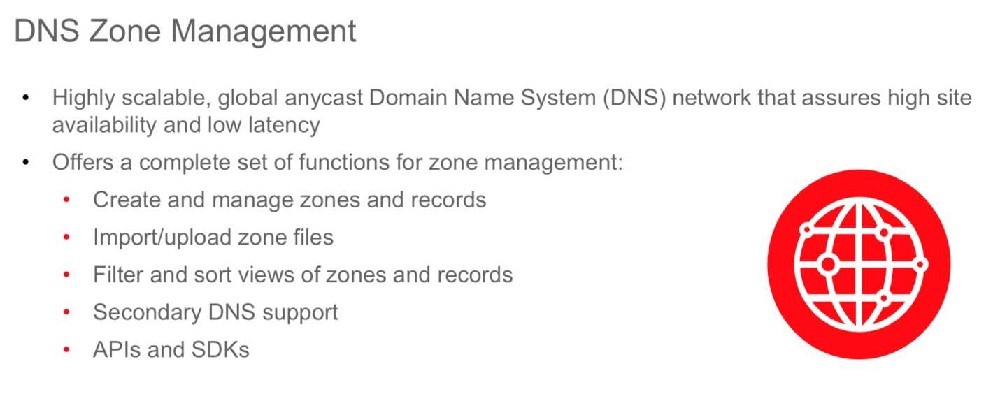 References:
https://www.oracle.com/a/ocom/docs/cloud/edge-services-100.pdf
|