As a cloud-native developer, you are designing an application that depends on Oracle Cloud Infrastructure (OCI) Object Storage wherever the application is running. Therefore, provisioning of storage buckets should be part of your Kubernetes deployment process for the application. Which should you leverage to meet this requirement?
-
A
OCI Service Broker for Kubernetes
-
B
OCI Container Engine for Kubernetes
-
C
-
D
Reveal answer details
Close answer details
Correct answerA
Explanationhttps://blogs.oracle.com/cloud-infrastructure/introducing-service-broker-for-kubernetes
OCI Service Broker for Kubernetes is an implementation of the Open Service Broker API. OCI Service Broker for Kubernetes is specifically for interacting with Oracle Cloud Infrastructure services from Kubernetes clusters. It includes three service broker adapters to bind to the following Oracle Cloud Infrastructure services: Object Storage Autonomous Transaction Processing Autonomous Data Warehouse
You are developing a polyglot serverless application using Oracle Functions. Which language cannot be used to write your function code?
-
A
-
B
-
C
-
D
Reveal answer details
Close answer details
Correct answerA
ExplanationThe serverless and elastic architecture of Oracle Functions means there's no infrastructure administration or software administration for you to perform. You don't provision or maintain compute instances, and operating system software patches and upgrades are applied automatically. Oracle Functions simply ensures your app is highly-available, scalable, secure, and monitored. With Oracle Functions, you can write code in Java, Python, Node, Go, and Ruby (and for advanced use cases, bring your own Dockerfile, and Graal VM). You can then deploy your code, call it directly or trigger it in response to events, and get billed only for the resources consumed during the execution.
What is the minimum amount of storage that a persistent volume claim can obtain In Oracle Cloud Infrastructure Container Engine for Kubemetes (OKE)?
-
A
-
B
-
C
-
D
Reveal answer details
Close answer details
Correct answerD
Explanationhttps://docs.cloud.oracle.com/en-us/iaas/Content/ContEng/Concepts/contengprerequisites.htm
Given a service deployed on Oracle Cloud Infrastructure Container Engine far Kubernetes (OKE), which annotation should you add in the sample manifest file below to specify a 400 Mbps load balancer? 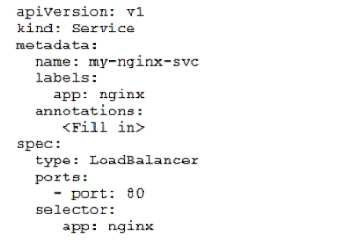
-
A
service.beta.kubernetes.io/oci-load-balancer-value: 400Mbps
-
B
service.beta.kubernetes.io/oci-load-balancer-size: 400Mbps
-
C
service.beta.kubernetes.io/oci-load--balancer-shape: 4 00Mbps
-
D
service, beta, kubernetes . io/oci-load--balancer-kind: 400Mbps
Reveal answer details
Close answer details
You have a containerized app that requires an Autonomous Transaction Processing (ATP) Database. Which option is not valid for o from a container in Kubernetes?
-
A
Enable Oracle REST Data Services for the required schemas and connect via HTTPS.
-
B
Create a Kubernetes secret with contents from the instance Wallet files. Use this secret to create a volume mounted to the appropriate path in the application deployment manifest.
-
C
Use Kubernetes secrets to configure environment variables on the container with ATP instance OCID, and OCI API credentials. Then use the CreateConnection API endpoint from the service runtime.
-
D
Install the Oracle Cloud Infrastructure Service Broker on the Kubernetes cluster and deploy serviceinstance and serviceBinding resources for ATP. Then use the specified binding name as a volume in the application deployment manifest.
Reveal answer details
Close answer details
Correct answerA
Explanationhttps://blogs.oracle.com/developers/creating-an-atp-instance-with-the-oci-service-broker
https://blogs.oracle.com/cloud-infrastructure/integrating-oci-service-broker-with-autonomous-
transaction-processing-in-the-real-world
What is the difference between blue/green and canary deployment strategies?
-
A
In blue/green, application Is deployed In minor increments to a select group of people. In canary, both old and new applications are simultaneously in production.
-
B
In blue/green, both old and new applications are in production at the same time. In canary, application is deployed Incrementally to a select group of people.
-
C
In blue/green, current applications are slowly replaced with new ones. In < MW y, Application ll
deployed incrementally to a select group of people.
-
D
In blue/green, current applications are slowly replaced with new ones. In canary, both old and new applications are In production at the same time.
Reveal answer details
Close answer details
Correct answerB
ExplanationBlue-green deployment is a technique that reduces downtime and risk by running two identical production environments called Blue and Green. At any time, only one of the environments is live, with the live environment serving all production traffic. For this example, Blue is currently live and Green is idle.
https://docs.cloudfoundry.org/devguide/deploy-apps/blue-green.html
Canary deployments are a pattern for rolling out releases to a subset of users or servers. The idea is to first deploy the change to a small subset of servers, test it, and then roll the change out to the rest of the servers. ... Canaries were once regularly used in coal mining as an early warning system.
https://octopus.com/docs/deployment-patterns/canary-deployments
Which testing approaches is a must for achieving high velocity of deployments and release of cloud-native applications?
-
A
-
B
-
C
-
D
Reveal answer details
Close answer details
Correct answerC
ExplanationOracle Cloud Infrastructure provides a number of DevOps tools and plug-ins for working with Oracle Cloud Infrastructure services. These can simplify provisioning and managing infrastructure or enable automated testing and continuous delivery.
A/B Testing
While A/B testing can be combined with either canary or blue-green deployments, it is a very different thing. A/B testing really targets testing the usage behavior of a service or feature and is typically used to validate a hypothesis or to measure two versions of a service or feature and how they stack up against each other in terms of performance, discoverability and usability. A/B testing often leverages feature flags (feature toggles), which allow you to dynamically turn features on and off.
Integration Testing
Integration tests are also known as end-to-end (e2e) tests. These are long-running tests that exercise the system in the way it is intended to be used in production. These are the most valuable tests in demonstrating reliability and thus increasing confidence.
Penetration Testing
Oracle regularly performs penetration and vulnerability testing and security assessments against the Oracle cloud infrastructure, platforms, and applications. These tests are intended to validate and improve the overall security of Oracle Cloud Services.
How can you find details of the tolerations field for the sample YAML file below? 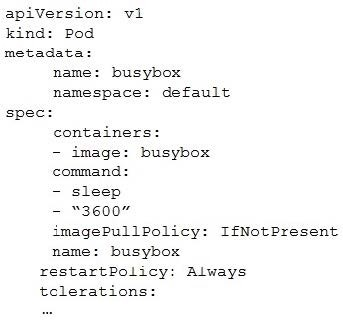
-
A
kubectl list pod.spec.tolerations
-
B
kubectl explain pod.spec.tolerations
-
C
kubectl describe pod.spec tolerations
-
D
kubectl get pod.spec.tolerations
Reveal answer details
Close answer details
Correct answerB
Explanationkubectl explain to List the fields for supported resources
https://kubernetes.io/docs/reference/generated/kubectl/kubectl-commands#explain
Which statements is incorrect with regards to the Oracle Cloud Infrastructure (OCI) Notifications service?
-
A
Notification topics may be assigned as the action performed by an OCI Events configuration.
-
B
OCI Alarms can be configured to publish to a notification topic when triggered.
-
C
An OCI function may subscribe to a notification topic.
-
D
A subscription can forward notifications to an HTTPS endpoint.
-
E
A subscription can integrate with PagerDuty events.
-
F
It may be used to receive an email each time an OCI Autonomous Database backup is completed.
Reveal answer details
Close answer details
Question 10
Single choice
You are building a cloud native, serverless travel application with multiple Oracle Functions in Java, Python and Node.js. You need to build and deploy these functions to a single applications named travel-app. Which command will help you complete this task successfully?
-
A
oci fn function deploy --ap travel-ap --all
-
B
fn deploy --ap travel-ap -- all
-
C
oci fn application --application-name-ap deploy --all
-
D
fn function deploy --all --application-name travel-ap
Reveal answer details
Close answer details
Correct answerB
Explanationcheck the steps for Creating, Deploying, and Invoking a Helloworld Function https://docs.cloud.oracle.com/en-us/iaas/Content/Functions/Tasks/functionscreatingfirst.htm in step 7 that will deploy the funcation 7-
Enter the following single Fn Project command to build the function and its dependencies as a Docker image called helloworld-func, push the image to the specified Docker registry, and deploy the function to Oracle Functions in the helloworld-app:
$ fn -v deploy --app helloworld-app The -v option simply shows more detail about what Fn Project commands are doing (see Using the Fn Project CLI with Oracle Functions).
Question 11
Single choice
You are deploying an API via Oracle Cloud Infrastructure (OCI) API Gateway and you want to implement request policies to control access Which is NOT available in OCI API Gateway?
-
A
Limiting the number of requests sent to backend services
-
B
Enabling CORS (Cross-Origin Resource Sharing) support
-
C
Providing authentication and authorization
-
D
Controlling access to OCI resources
Reveal answer details
Close answer details
Correct answerD
ExplanationIn the API Gateway service, there are two types of policy:
- a request policy describes actions to be performed on an incoming request from a caller before it is sent to a back end
- a response policy describes actions to be performed on a response returned from a back end before it is sent to a caller You can use request policies to:
- limit the number of requests sent to back-end services
- enable CORS (Cross-Origin Resource Sharing) support
- provide authentication and authorization
|