You are developing a serverless application with Oracle Functions. Your function needs to store state in a database. Your corporate security Standards mandate encryption of secret information like database passwords.
As a function developer, which approach should you follow to satisfy this security requirement?
-
A
Use the Oracle Cloud Infrastructure Console and enter the password in the function configuration section in the provided input field.
-
B
Use Oracle Cloud Infrastructure Key Management to auto-encrypt the password. It will inject the auto-
decrypted password inside your function container.
-
C
Encrypt the password using Oracle Cloud Infrastructure Key Management. Decrypt this password in your function code with the generated key.
-
D
All function configuration variables are automatically encrypted by Oracle Functions.
Reveal answer details
Close answer details
Correct answerA
ExplanationPassing Custom Configuration Parameters to Functions he code in functions you deploy to Oracle Functions will typically require values for different parameters.
Some pre-defined parameters are available to your functions as environment variables. But you'll often want your functions to use parameters that you've defined yourself. For example, you might create a function that reads from and writes to a database. The function will require a database connect string, comprising a username, password, and hostname. You'll probably want to define username, password, and hostname as parameters that are passed to the function when it's invoked.
Using the Console
To specify custom configuration parameters to pass to functions using the Console: Log in to the Console as a functions developer.
In the Console, open the navigation menu. Under Solutions and Platform, go to Developer Services and click Functions.
Select the region you are using with Oracle Functions. Oracle recommends that you use the same region as the Docker registry that's specified in the Fn Project CLI context (see 6. Create an Fn Project CLI Context to Connect to Oracle Cloud Infrastructure). Select the compartment specified in the Fn Project CLI context (see 6. Create an Fn Project CLI Context to Connect to Oracle Cloud Infrastructure). The Applications page shows the applications defined in the compartment. Click the name of the application containing functions to which you want to pass custom configuration parameters: To pass one or more custom configuration parameters to every function in the application, click Configuration to see the Configuration section for the application. To pass one or more custom configuration parameters to a particular function, click the function's name to see the Configuration section for the function. In the Configuration section, specify details for the first custom configuration parameter: Key: The name of the custom configuration parameter. The name must only contain alphanumeric characters and underscores, and must not start with a number. For example, username Value: A value for the custom configuration parameter.
The value must only contain printable unicode characters. For example, jdoe Click the plus button to save the new custom configuration parameter. Oracle Functions combines the key-value pairs for all the custom configuration parameters (both application-wide and function-specific) in the application into a single, serially-encoded configuration object with a maximum allowable size of 4Kb. You cannot save the new custom configuration parameter if the size of the serially-encoded configuration object would be greater than 4Kb. (Optional) Enter additional custom configuration parameters as required.
A programmer Is developing a Node is application which will run in a Linux server on their on-premises data center. This application will access various Oracle Cloud Infrastructure (OC1) services using OCI SDKs. What is the secure way to access OCI services with OCI Identity and Access Management (JAM)?
-
A
Create a new OCI IAM user associated with a dynamic group and a policy that grants the desired permissions to OCI services. Add the on-premises Linux server in the dynamic group.
-
B
Create an OCI IAM policy with the appropriate permissions to access the required OCI services and assign the policy to the on-premises Linux server.
-
C
Create a new OCI IAM user, add the user to a group associated with a policy that grants the desired permissions to OCI services. In the on-premises Linux server, generate the keypair used for signing API requests and upload the public key to the IAM user.
-
D
Create a new OCI IAM user, add the user to a group associated with a policy that grants the desired permissions to OCI services. In the on-premises Linux server, add the user name and password to a file used by Node.js authentication.
Reveal answer details
Close answer details
Correct answerC
ExplanationBefore using Oracle Functions, you have to set up an Oracle Cloud Infrastructure API signing key.
The instructions in this topic assume:
- you are using Linux
- you are following Oracle's recommendation to provide a passphrase to encrypt the private key For more
Detials
Set up an Oracle Cloud Infrastructure API Signing Key for Use with Oracle Functions
https://docs.cloud.oracle.com/en-us/iaas/Content/Functions/Tasks/functionssetupapikey.htm
Question 3
Multiple choice
Which two "Action Type" options are NOT available in an Oracle Cloud Infrastructure (OCI) Events rule definition?
-
A
-
B
-
C
-
D
-
E
Reveal answer details
Close answer details
Correct answersD, E
Explanationhttps://docs.cloud.oracle.com/en-us/iaas/Content/Events/Concepts/eventsoverview.htm
ACTIONS
Event Rules must also specify an action to trigger when the filter finds a matching event. Actions are responses you define for event matches. You set up select Oracle Cloud Infrastructure services that the Events service has established as actions. The resources for these services act as destinations for matching events. When the filter in the rule finds a match, the Events service delivers the matching event to one or more of the destinations you identified in the rule. The destination service that receives the event then processes the event in whatever manner you defined. This delivery provides the automation in your environment. You can only deliver events to certain Oracle Cloud Infrastructure services with a rule. Use the following services to create actions: Notifications Streaming Functions
What is one of the differences between a microservice and a serverless function?
-
A
Microservices are used for long running operations and serverless functions for short running operations.
-
B
Microservices always use a data store and serverless functions never use a data store.
-
C
Microservices are stateless and serverless functions are stateful.
-
D
Microservices are triggered by events and serverless functions are not.
Reveal answer details
Close answer details
Correct answerA
Explanationmicroservice is larger and can do more than a function. A function is a relatively small bit of code that performs only one action in response to an event. In many cases, microservices can be decomposed into a number of smaller stateless functions. The difference between microservices and functions is not simply the size. Functions are stateless, and they require no knowledge about or configuration of the underlying server--hence, the term serverless.
https://developer.oracle.com/java/fn-project-introduction.html
Which concept is NOT related to Oracle Cloud Infrastructure Resource Manager?
-
A
-
B
-
C
-
D
Reveal answer details
Close answer details
Correct answerC
Explanationhttps://docs.cloud.oracle.com/en-us/iaas/Content/ResourceManager/Concepts/resourcemanager.htm
Following are brief descriptions of key concepts and the main components of Resource Manager.
CONFIGURATION
Information to codify your infrastructure. A Terraform configuration can be either a solution or a file that you write and upload.
JOB
Instructions to perform the actions defined in your configuration. Only one job at a time can run on a given stack; further, you can have only one set of Oracle Cloud Infrastructure resources on a given stack. To
provision a different set of resources, you must create a separate stack and use a different configuration.
Resource Manager provides the following job types: Plan: Parses your Terraform configuration and creates an execution plan for the associated stack. The execution plan lists the sequence of specific actions planned to provision your Oracle Cloud Infrastructure resources. The execution plan is handed off to the apply job, which then executes the instructions.
Apply. Applies the execution plan to the associated stack to create (or modify) your Oracle Cloud Infrastructure resources. Depending on the number and type of resources specified, a given apply job can take some time. You can check status while the job runs. Destroy. Releases resources associated with a stack. Released resources are not deleted. For example, terminates a Compute instance controlled by a stack. The stack's job history and state remain after running a destroy job. You can monitor the status and review the results of a destroy job by inspecting the stack's log files.
Import State. Sets the provided Terraform state file as the current state of the stack. Use this job to migrate local Terraform environments to Resource Manager.
STACK
The collection of Oracle Cloud Infrastructure resources corresponding to a given Terraform configuration.
Each stack resides in the compartment you specify, in a single region; however, resources on a given stack can be deployed across multiple regions. An OCID is assigned to each stack.
You are using Oracle Cloud Infrastructure (0CI) Resource Manager to manage your infrastructure lifecycle and wish to receive an email each time a Terraform action begins. How should you use the OCI Events service to do this without writing any code?
-
A
Create an OCI Notifications topic and email subscription with the destination email address. Then create an OCI Events rule matching "Resource Manager Stack - Update" condition, and select the notification topic for the corresponding action.
-
B
Create an OCI Notification topic and email subscription with the destination email address. Then create an OCI Events rule matching "Resource Manager job - Create" condition, and select the notification topic for the corresponding action.
-
C
Create a rule in OCI Events service matching the "Resource Manager Stack - Update" condition.Then select "Action Type: Email" and provide the destination email address.
-
D
Create an OCI Email Delivery configuration with the destination email address. Then create an OCI Events rule matching "Resource Manager Job - Create" condition, and select the email configuration for the corresponding action.
Reveal answer details
Close answer details
Correct answerB
Explanation1. Create Notifications Topic and Subscription
If a suitable Notifications topic doesn't already exist, then you must log in to the Console as a tenancy administrator and create it. Whether you use an existing topic or create a new one, add an email address as a subscription so that you can monitor that email account for notifications 2. Using the Console to Create a Rule
Use the Console to create a rule with a pattern that matches bucket creation events emitted by Object Storage. Specify the Notifications topic you created as an action to deliver matching events. To test your rule, create a bucket. Object Storage emits an event which triggers the action. Check the email specified in the subscription to receive your notification
https://docs.cloud.oracle.com/en-us/iaas/Content/Events/Concepts/eventsgetstarted.htm
https://docs.cloud.oracle.com/en-us/iaas/Content/Events/Concepts/filterevents.htm
Question 7
Multiple choice
Which two are characteristics of microservices?
-
A
Microservices are hard to test in isolation.
-
B
Microservices can be independently deployed.
-
C
All microservices share a data store.
-
D
Microservices can be implemented in limited number of programming languages.
-
E
Microservices communicate over lightweight APIs.
Reveal answer details
Close answer details
Correct answersB, E
Explanationhttps://www.techjini.com/blog/microservices/
Which Oracle Cloud Infrastructure (OCI) load balancer shape is used by default in OCI container Engineer for Kubernetes?
-
A
-
B
-
C
There is no default. The shape has to be specified.
-
D
Reveal answer details
Close answer details
Correct answerD
ExplanationSpecifying Alternative Load Balancer Shapes
The shape of an Oracle Cloud Infrastructure load balancer specifies its maximum total bandwidth (that is, ingress plus egress). By default, load balancers are created with a shape of 100Mbps. Other shapes are available, including 400Mbps and 8000Mbps.
https://docs.cloud.oracle.com/en-us/iaas/Content/ContEng/Tasks/contengcreatingloadbalancer.htm
Question 9
Multiple choice
Which two statements accurately describe an Oracle Functions application?
-
A
A small block of code invoked in response to an Oracle Cloud Infrastructure (OCI) Events service
-
B
A Docker image containing all the functions that share the same configuration
-
C
An application based on Oracle Functions, Oracle Cloud Infrastructure (OCI) Events and OCI API Gateway services
-
D
A common context to store configuration variables that are available to all functions in the application
-
E
A logical group of functions
Reveal answer details
Close answer details
Correct answersD, E
ExplanationApplications in the Function services
In Oracle Functions, an application is:
1. a logical grouping of functions 2. a common context to store configuration variables that are available to all functions in the application
When you define an application in Oracle Functions, you specify the subnets in which to run the functions in the application.
Question 10
Single choice
What is the minimum amount of storage that a persistent volume claim can obtain In Oracle Cloud Infrastructure Container Engine for Kubemetes (OKE)?
-
A
-
B
-
C
-
D
Reveal answer details
Close answer details
Correct answerD
Explanationhttps://docs.cloud.oracle.com/en-us/iaas/Content/ContEng/Concepts/contengprerequisites.htm
Question 11
Single choice
In the sample Kubernetes manifest file below, what annotations should you add to create a private load balancer In oracle Cloud infrastructure Container Engine for Kubermetes? 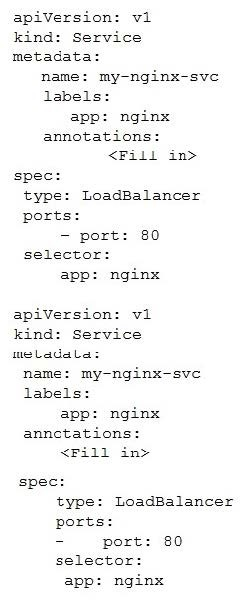
-
A
service.beta.kubernetes.io/oci-load-balancer-private:"true"
-
B
service.beta.kubernetes.io/oci-load-balancer-private: "true"
service.beta.kubernetes.io/oci-load-balancer-subnet1: "ocid1.subnet.oc1..aaaaa....vdfw"
-
C
service.beta.kubernetes.io/oci-load-balancer-internal: "true"
-
D
service.beta.kubernetes.io/oci-load-balancer-internal: "true"
service.beta.kubernetes.io/oci-load-balancer-subnet1: "ocid1.subnet.oc1..aaaaa....vdfw"
Reveal answer details
Close answer details
Correct answerD
Explanationhttps://docs.cloud.oracle.com/en-us/iaas/Content/ContEng/Tasks/contengcreatingloadbalancer.htm?TocPath=Services%7CExample%20Network%20Resource%20Configuration%7CUpgrading%20the%20Version%20of%20Kubernetes%20Running%20on%20a%20Master%20Node%7C_____2 Creating Internal Load Balancers in Public and Private Subnets You can create Oracle Cloud Infrastructure load balancers to control access to services running on a cluster: When you create a 'custom' cluster, you select an existing VCN that contains the network resources to be used by the new cluster. If you want to use load balancers to control traffic into the VCN, you select existing public or private subnets in that VCN to host the load balancers. When you create a 'quick cluster', the VCN that's automatically created contains a public regional subnet to host a load balancer. If you want to host load balancers in private subnets, you can add private subnets to the VCN later. Alternatively, you can create an internal load balancer service in a cluster to enable other programs running in the same VCN as the cluster to access services in the cluster. You can host internal load balancers in public subnets and private subnets.
To create an internal load balancer hosted on a public subnet, add the following annotation in the metadata section of the manifest file:
service.beta.kubernetes.io/oci-load-balancer-internal: "true"
To create an internal load balancer hosted on a private subnet, add both following annotations in the metadata section of the manifest file:
service.beta.kubernetes.io/oci-load-balancer-internal: "true" service.beta.kubernetes.io/oci-load-balancer- subnet1: "ocid1.subnet.oc1..aaaaaa....vdfw" where ocid1.subnet.oc1..aaaaaa....vdfw is the OCID of the private subnet.
|