You have an external facing web server running in the Oracle Cloud Infrastructure (OCI) London region.
You are notified that customers in North America and Australia are facing high latency while connecting to your web server. Which services are available on OCI that can help you get current latency statistics to your web server from these markets?
-
A
Use DNS Zone Management service to check latency over that connection
-
B
Setup an IPsec VPN with customers in those markets and check latency over that connection
-
C
Use the Internet Intelligence tool. Run tests using the web server's public IP address and review
traceroute details from different vantage points
-
D
Setup a FastConnect with customers in those markets and check latency over that connection
Reveal answer details
Close answer details
Correct answerC
ExplanationThe second tool, OCI IP Troubleshooting, helps troubleshoot issues with public facing IP addresses. This feature is also part of our Internet Intelligence toolset, providing analytical insight to help network operations teams reduce the time it takes to troubleshoot an issue by providing awareness of availability and latency across the Internet.
Ref:
https://blogs.oracle.com/cloud-infrastructure/internet-intelligence,-now-available-in-the-oracle-cloud-infrastructure-console
Which service is NOT supported by Oracle Cloud Infrastructure CLI?
-
A
-
B
-
C
-
D
Reveal answer details
Close answer details
Correct answerD
ExplanationReferences:
https://docs.cloud.oracle.com/iaas/Content/API/Concepts/cliconcepts.htm#services
You are designing a two-tier web application in Oracle Cloud Infrastructure (OCI). Your clients want to access the web servers from anywhere, but want to prevent access to the database servers from the Internet. Which is the recommended way to design the network architecture?
-
A
Create public subnets for web servers and private subnets for database servers in your virtual cloud network (VCN), and associate separate internet gateways for each subnet.
-
B
Create public subnets for web servers and associate a dynamic routing gateway with that subnet, and a private subnet for database servers with no association to dynamic gateway.
-
C
Create public subnets for web servers and private subnets for database servers in your VCN, and associate separate security lists and route tables for each subnet.
-
D
Create a single public subnet for your web servers and database servers, and associate only your web servers to internet gateway.
Reveal answer details
Close answer details
Correct answerC
ExplanationWhen you create a subnet, by default it's considered public, which means instances in that subnet are allowed to have public IP addresses. Whoever launches the instance chooses whether it will have a public IP address. You can override that behavior when creating the subnet and request that it be private, which means instances launched in the subnet are prohibited from having public IP addresses. Network administrators can therefore ensure that instances in the subnet have no internet access, even if the VCN has a working internet gateway, and security rules and firewall rules allow the traffic.
There are two optional gateways (virtual routers) that you can add to your VCN depending on the type of
internet access you need:
Internet gateway: For resources with public IP addresses that need to be reached from the internet (example: a web server) or need to initiate connections to the internet. NAT gateway: For resources without public IP addresses that need to initiate connections to the internet (example: for software updates) but need to be protected from inbound connections from the internet.
Just having an internet gateway alone does not expose the instances in the VCN's subnets directly to the internet. The following requirements must also be met: The internet gateway must be enabled (by default, the internet gateway is enabled upon creation).
The subnet must be public.
The subnet must have a route rule that directs traffic to the internet gateway. The subnet must have security list rules that allow the traffic (and each instance's firewall must allow the traffic).
The instance must have a public IP address.
Which does NOT set a variable in Terraform?
-
A
Passing the variable with a var statement to Terraform
-
B
Setting the variable as key value pairs in a file in a subdirectory named tfvar
-
C
A default value in the variable declaration within a TF plan file
-
D
Setting the environment variable using a TF_VAR_predicate in front of the variable name
Reveal answer details
Close answer details
You have an Oracle Cloud Infrastructure (OCI) load balancer distributing traffic via an evenly-weighted round robin policy to your backend web servers. You notice that one of your web servers is receiving more traffic than other web servers. How can you resolve this imbalance?
-
A
Check security lists and route tables of your virtual cloud network (VCN) and fix any issues associated with the rules
-
B
Create separate listeners for each backend web server
-
C
Delete and re-create your OCI load balancer
-
D
Disable session persistence on your backend set
Reveal answer details
Close answer details
Correct answerD
ExplanationSession persistence is a method to direct all requests originating from a single logical client to a single backend web server. Backend servers that use caching to improve performance, or to enable log-in sessions or shopping carts, can benefit from session persistence
Question 6
Multiple choice
Which two options are available when setting up DNS for your bare metal and virtual machine DB Systems? (Choose two.)
-
A
Internet and custom resolver
-
B
-
C
-
D
Internet and virtual cloud network (VCN) resolver
Reveal answer details
Close answer details
When creating a subnet, one or more placeholder security lists are often associated with the subnet. Why?
-
A
Each operator needs its own security list.
-
B
Each protocol needs its own security list.
-
C
Each network endpoint or instance in the subnet needs its own security list.
-
D
It is not possible to add or remove security lists after a subnet is created.
Reveal answer details
Close answer details
Correct answerC
ExplanationReferences:
https://docs.cloud.oracle.com/iaas/Content/Network/Concepts/securitylists.htm?tocpath=Services%7CNetworking%7CAccess%20and%20Security%7C_____3
Question 8
Multiple choice
Which two statements are true about the Oracle Cloud Infrastructure Object Storage Service? (Choose two.)
-
A
It provides higher IOPS than Block Storage.
-
B
It can be directly attached or detached from a compute instance.
-
C
Data is stored redundantly only in a single AD.
-
D
Data is stored redundantly across multiple availability domains (ADs) in a multi-AD region.
-
E
It provides strong consistency.
Reveal answer details
Close answer details
Correct answersD, E
ExplanationSTRONG CONSISTENCY
When a read request is made, Object Storage always serves the most recent copy of the data that was written to the system.
DURABILITY
Object Storage is a regional service. Data is stored redundantly across multiple storage servers. Object Storage actively monitors data integrity using checksums and automatically detects and repairs corrupt data. Object Storage actively monitors and ensures data redundancy. If a redundancy loss is detected, Object Storage automatically creates more data copies. For more details about Object Storage durability, see the Oracle Cloud Infrastructure Object Storage FAQ.
CUSTOM METADATA
You can define your own extensive metadata as key-value pairs for any purpose. For example, you can create descriptive tags for objects, retrieve those tags, and sort through the data. You can assign custom metadata to objects and buckets using the Oracle Cloud Infrastructure CLI or SDK. See Software Development Kits and Command Line Interface for details.
ENCRYPTION
Object Storage employs 256-bit Advanced Encryption Standard (AES-256) to encrypt object data on the server. Each object is encrypted with its own key. Data encryption keys are encrypted with a master encryption key that is frequently rotated. Encryption is enabled by default and cannot be turned off.
You have a shared file system between two web servers using File Storage Service (FSS) and you were tasked to create a backup plan for this environment to protect the data placed into the shared file system. What is the recommended approach to create this backup using FSS features?
-
A
Implement a backup policy to execute a snapshot of the shared volume.
-
B
Implement a backup policy to copy data from the shared volume to object storage.
-
C
Compress the data that is in the shared volume and copy it into a different folder on the boot volume disk.
-
D
Use the rsync tool to send data from the shared volume to a boot volume disk.
-
E
Use the rsync tool to send data from the shared volume to a block volume.
Reveal answer details
Close answer details
Question 10
Single choice
You need to set up instance principals so that an application running on an instance can call Oracle Cloud Infrastructure (OCI) public services, without the need to configure user credentials. A developer in your team has already configured the application built using an OCI SDK to authenticate using the instance principals provider. Which is NOT a necessary step to complete this set up?
-
A
Create a dynamic group with matching rules to specify which instances you want to allow to make API calls against services.
-
B
Generate Auth Tokens to enable instances in the dynamic group to authenticate with APIs.
-
C
Create a policy granting permissions to the dynamic group to access services in your compartment or tenancy.
-
D
Deploy the application and the SDK to all the instances that belong to the dynamic group.
Reveal answer details
Close answer details
Correct answerD
ExplanationReferences:
https://blogs.oracle.com/cloud-infrastructure/announcing-instance-principals-for-identity-
andaccess-management
Question 11
Single choice
You create an autoscaling configuration of Linux compute instances in Oracle Cloud Infrastructure (OCI).
You noticed that your application is running slow. After checking your compute instances, you noticed that autoscaling is not launching additional instances, even though the existing compute instances already have high memory usage. How can you resolve this issue?
-
A
Modify the scaling policy to monitor memory usage and scale up the number of instances when it meets the threshold.
-
B
Modify the scaling policy to monitor CPU usage and scale up the number of instances when it meets the threshold.
-
C
Install the monitoring agent to all compute instances which will trigger the autoscaling group.
-
D
Install OCI SDK in all compute instances and create a script that will trigger the autoscaling event if there is high memory usage.
Reveal answer details
Close answer details
Question 12
Multiple choice
Which two choices are true for Oracle Autonomous Database with Shared Exadata Infrastructure?
-
A
Billing for storage usage continues when autonomous database is stopped.
-
B
Billing stops for both CPU and storage usage when autonomous database is stopped.
-
C
Billing for compute usage stops when autonomous database is stopped.
-
D
Autonomous database does not support per-second billing.
-
E
Billing does not stop when autonomous database is terminated.
Reveal answer details
Close answer details
Question 13
Single choice
You have five different company locations spread across the US. For a proof-of-concept (POC) you need to setup secure and encrypted connectivity to your workloads running in a single virtual cloud network (VCN) in the Oracle Cloud Infrastructure Ashburn region from all company locations. What would meet this requirement?
-
A
Create five internet gateways in your VCN and have separate route table for each internet gateway.
-
B
Create five virtual circuits using FastConnect for each company location and terminate those connections on a single dynamic routing gateway (DRG). Attach that DRG to your VCN.
-
C
Create five IPsec connections with each company location and terminate those connections on a single
DRG. Attach that DRG to your VCN.
-
D
Create five IPsec VPN connections with each company location and terminate those connections on five separate DRGs. Attach those DRGs to your VCN.
Reveal answer details
Close answer details
Correct answerC
ExplanationAccess to Your On-Premises Network There are two ways to connect your on-premises network to Oracle Cloud Infrastructure: VPN Connect: Offers multiple IPSec tunnels between your existing network's edge and your VCN, by way of a DRG that you create and attach to your VCN.
Oracle Cloud Infrastructure FastConnect: Offers a private connection between your existing network's edge and Oracle Cloud Infrastructure. Traffic does not traverse the internet. Both private peering and public peering are supported. That means your on-premises hosts can access private IPv4 addresses in your VCN as well as regional public IPv4 addresses in Oracle Cloud Infrastructure (for example, Object Storage or public load balancers in your VCN).
You can use one or both types of the preceding connections. If you use both, you can use them simultaneously, or in a redundant configuration. These connections come to your VCN by way of a single DRG that you create and attach to your VCN. Without that DRG attachment and a route rule for the DRG, traffic does not flow between your VCN and on-premises network. At any time, you can detach the DRG from your VCN but maintain all the remaining components that form the rest of the connection. You could then reattach the DRG again, or attach it to another VCN.
Question 14
Single choice
A new employee has just started working for your company. You create an Oracle Cloud Infrastructure user account for this employee, following which they are able to log in, but still cannot create any resources. What should you do to resolve this?
-
A
Send the employee API Signing Keys to log in.
-
B
Delete the account and create another one.
-
C
Make sure that the employee is logging in to the Oracle Cloud Infrastructure account from your corporate network only.
-
D
Add the employee to a group with policies to grant access to relevant resources.
Reveal answer details
Close answer details
Question 15
Multiple choice
You are the Cloud Architect of a company, and are designing a solution on Oracle Cloud Infrastructure where you want to have all your compute instances resistant to hardware failure. Which two are recommended best practices to achieve the requirement on Oracle Cloud Infrastructure? (Choose two.)
-
A
Create a custom image of your system drive each time you change the image.
-
B
Attach block volumes from different Availability Domains to compute instances in different Availability Domains for high availability.
-
C
Design your system with redundant compute modes in different Availability Domains to support the failover capability.
-
D
Create backups of your block volumes that are associated with compute instances in different regions.
Reveal answer details
Close answer details
Correct answersA, C
ExplanationReferences:
https://docs.cloud.oracle.com/iaas/Content/Compute/References/bestpracticescompute.htm
System Resilience Oracle Cloud Infrastructure runs on Oracle's high-quality Sun servers. However, any hardware can experience a failure. Follow industry-wide hardware failure best practices to ensure the resilience of your solution. Some best practices include: Design your system with redundant compute nodes in different availability domains to support fail-over capability. Create a custom image of your system drive each time you change the image. Back up your data drives, or sync to spare drives, regularly. If you experience a hardware failure and have followed these practices, you can terminate the failed instance, launch your custom image to create a new instance, and then apply the backup data.
Question 16
Single choice
A customer has launched a compute Instance in the Virtual Cloud Network (VCN), which has an Internet gateway, a service gateway, a default security lists and a default route table. Customer has opened up
Port 22 in the security lists attached to the compute instance subnet, however is still unable to connect to
compute instances using ssh. Which option would remedy this situation?
-
A
Modify the route table associated with the VCN subnet in which the instance resides. Add a following route to the route table.
Destination CIDR: 0.0.0.0/0
Target: Internet Gateway (IGW)
-
B
Modify the security list associated with the VCN subnet in which the instance resides. Add a stateful egress rule to allow icmp traffic in addition to the port 22.
-
C
Modify the route table associated with the VCN subnet in which the instance resides. Add a following route to the route table.
Destination CIDR: 0.0.0.0/0
Target: Dynamic Routing Gateway (DRG)
-
D
Modify the route table associated with the VCN subnet in which the instance resides. Add a following route to the route table.
Destination CIDR: 0.0.0.0/0
Target: Service Gateway (SGW)
Reveal answer details
Close answer details
Correct answerA
ExplanationYou create an internet gateway in the context of a specific VCN. In other words, the internet gateway is automatically attached to a VCN. However, you can disable and re-enable the internet gateway at any time.
For traffic to flow between a subnet and an internet gateway, you must create a route rule accordingly in the subnet's route table (for example, destination CIDR = 0.0.0.0/0 and target = internet gateway). If the internet gateway is disabled, that means no traffic will flow to or from the internet even if there's a route rule that enables that traffic. For the purposes of access control, you must specify the compartment where you want the internet gateway to reside. If you're not sure which compartment to use, put the internet gateway in the same compartment as the cloud network.
Question 17
Multiple choice
Which three actions need to be performed before attempting a data transfer service job?
-
A
Obtain an available host machine which can run the dts utility on-premise with SATA or USB drives attached for the transfer job.
-
B
Get access to a high-speed internet connection
-
C
Data Transfer Service and Storage Service Limits should be checked and raised if required.
-
D
Set up SSH access to a host on OCI to coordinate the transfer job.
-
E
Create an object bucket to receive the job.
Reveal answer details
Close answer details
Question 18
Single choice
Given: When creating multiple subnets within a Virtual Cloud Network (VCN), security lists are often made to group common services, for example, SSH and RDP (remote access), 80 and 443 (HTTP), and so on.
By default, what is the maximum number of security lists that can be associated with a subnet upon creation?
-
A
-
B
-
C
-
D
Reveal answer details
Close answer details
Question 19
Single choice
What is the maximum number of security lists that can be associated with a subnet?
-
A
-
B
-
C
-
D
Reveal answer details
Close answer details
Correct answerC
Explanationyou may optionally specify one or more security lists for the subnet to use (up to five). If you don't specify any, the subnet uses the cloud network's default security list. You can change which security list the subnet uses at any time.
https://docs.cloud.oracle.com/iaas/Content/Network/Tasks/managingVCNs.htm
Question 20
Single choice
Which statement Is true about Data Guard implementation in Oracle Cloud Infrastructure (OCI) bare metal and virtual machine database systems?
-
A
Primary and standby databases must be in the same OCI region.
-
B
Both database systems must be in the same compartment.
-
C
Database systems need not be the same shape type (e.g, primary database can be a virtual machine, and standby database a bare metal shape, and vice versa).
-
D
Primary and standby database versions and editions need not be Identical.
Reveal answer details
Close answer details
Correct answerB
ExplanationReferences:
https://docs.cloud.oracle.com/en-us/iaas/Content/Database/Tasks/exausingdataguard.htm
Question 21
Single choice
Which statement is true about Oracle Cloud Infrastructure (OCI) object storage support for server-side encryption?
-
A
You must manually enable server-side encryption for each object as you upload to OCI object storage
-
B
Objects are automatically encrypted as they are uploaded to object storage and decrypted upon retrieval
-
C
You must manually decrypt the data when retrieving from OCI object storage
-
D
Only the object data is encrypted and the user-defined metadata that is associated with the object is not encrypted
Reveal answer details
Close answer details
Correct answerB
ExplanationReferences:
https://www.oracle.com/cloud/storage/object-storage-faq.html
- Oracle Object Storage supports server-side encryption. All data stored in Oracle Object Storage is automatically encrypted - Encryption is automatically enabled for all data with no action required on the part of customers. - Oracle encrypt both the object data and the user-defined metadata associated with the object.
Question 22
Multiple choice
Which three can you achieve by using Terraform? (Choose three.)
-
A
Create resources in the right order without regard to the order in the terraform plan file.
-
B
Automatically re-provision the resources that are tainted or whose configuration has changed.
-
C
Automatically translate a deployed infrastructure and create a plan.
-
D
Automatically destroy all the resources that are in tenancy.
-
E
Continuously maintain the configuration files in an instance.
Reveal answer details
Close answer details
Question 23
Multiple choice
When you try to create an instance on Oracle Cloud Infrastructure (OCI), what are three valid sources to choose the image from?
-
A
-
B
-
C
-
D
-
E
-
F
-
G
Reveal answer details
Close answer details
Correct answersD, E, F
ExplanationReferences:
https://docs.cloud.oracle.com/en-us/iaas/Content/Compute/Tasks/launchinginstance.htm
Question 24
Single choice
You need to transfer over 12 TB of data from on-premises to your cloud account. You started copying this data over the internet and noticed that it will take too long to complete.
Without increasing the costs of your subscription, what is the recommended way to send this amount of data to your cloud account?
-
A
Use Data Transfer Service to send your data.
-
B
Split the data into multiple parts and use the multipart tool.
-
C
Use a 10 GB FastConnect line to send the data.
-
D
Send the data over a VPN IPsec tunnel.
-
E
Compress the data and use the multipart tool.
Reveal answer details
Close answer details
Correct answerA
ExplanationReferences:
Overview of Data Transfer Service Oracle offers offline data transfer solutions that let you migrate data to Oracle Cloud Infrastructure. Moving data over the public internet is not always feasible due to high network costs, unreliable network connectivity, long transfer times, and security concerns. Our transfer solutions address these pain points, are easy to use, and provide significantly faster data upload compared to over-the-wire data transfer. (https://docs.cloud.oracle.com/iaas/Content/DataTransfer/Concepts/overview.htm)
Question 25
Multiple choice
You provisioned an Oracle Autonomous Data Warehouse (ADW) on Oracle Cloud Infrastructure (OCI) and imported data into ADW.
You want to give your business analyst the ability to connect to the ADW database and run queries. Which two actions can help you meet this requirement? (Choose two.)
-
A
Create a database user account for the business analyst.
-
B
Grant the predefined database role DWROLE to the database user.
-
C
Grant unlimited tablespace privilege to the database user.
-
D
Grant the predefined database role DWADW to the database user.
-
E
Grant the predefined database role DWUSER to the database user.
Reveal answer details
Close answer details
Correct answersB, C
ExplanationReferences:
https://oracle.github.io/learning-library/oci-library/L100-LAB/Autonomous_Data_Warehouse/ADW_HOL.html
Question 26
Single choice
You have hired a new employee to run reports from the Autonomous Data Warehouse (ADW) and are not confident in their SQL writing ability.
Into which consumer group will you assign this individual to minimize the impact of their code?
-
A
-
B
-
C
-
D
-
E
Reveal answer details
Close answer details
Correct answerE
Explanationin ADW, The tnsnames.ora file provided with the credentials zip file contains three database service names identifiable as high, medium, and low. The predefined service names provide different levels of performance and concurrency for Autonomous Data Warehouse. high: The High database service provides the highest level of resources to each SQL statement resulting in the highest performance, but supports the fewest number of concurrent SQL statements. Any SQL statement in this service can use all the CPU and IO resources in your database. The number of concurrent SQL statements that can be run in this service is 3, this number is independent of the number of OCPUs in your database. medium: The Medium database service provides a lower level of resources to each SQL statement potentially resulting a lower level of performance, but supports more concurrent SQL statements. Any SQL statement in this service can use multiple CPU and IO resources in your database. The number of concurrent SQL statements that can be run in this service depends on the number of OCPUs in your database. low: The Low database service provides the least level of resources to each SQL statement, but supports the most number of concurrent SQL statements. Any SQL statement in this service can use a single CPU and multiple IO resources in your database. The number of concurrent SQL statements that can be run in this service can be up to 300 times the number of OCPUs. The predefined service names provide different levels of performance and concurrency for Autonomous DB
Choose whichever database service offers the best balance of performance and concurrency. Use the low database service name. to minimize the impact of their SQLs to by low consumer group
Question 27
Single choice
Which statement is true about Oracle Cloud Infrastructure Object Storage Service?
-
A
An Archive Object Storage tier bucket can be upgraded to the Standard Object Storage tier.
-
B
You cannot directly download an object from an Archive Object Storage bucket.
-
C
An existing Standard Object Storage tier bucket can be downgraded to the Archive Object Storage tier.
-
D
Data retrieval in Archive Object Storage is instantaneous.
Reveal answer details
Close answer details
Question 28
Single choice
Which statement is true about a pre-authenticated request in Oracle Cloud Infrastructure Object Storage?
-
A
You can create only 1, 000 pre-authenticated requests per bucket.
-
B
You can create a pre-authenticated request only for public buckets.
-
C
You cannot retire a pre-authenticated request before it expires.
-
D
You cannot extend the expiration date on a pre-authenticated request.
Reveal answer details
Close answer details
Correct answerD
Explanationhttps://docs.cloud.oracle.com/iaas/Content/Object/Tasks/usingpreauthenticatedrequests.htm
You can create an unlimited number of pre-authenticated requests. You can't edit a pre-authenticated request. If you want to change user access options in response to changing requirements, you must create a new
pre-authenticated request. URL:
https://docs.cloud.oracle.com/iaas/Content/Object/Tasks/
managingbuckets.htm You can change a bucket's access from public to private or from private to public.
Changing the type of access doesn't affect existing pre-authenticated requests. Existing pre-authenticated requests still work.
Question 29
Multiple choice
Which two statements about fault domains are true? (Choose two.)
-
A
A fault domain is a grouping of hardware and infrastructure within an availability domain
-
B
Each availability domain contains three fault domains
-
C
A failed instance in a fault domain is automatically relaunched
-
D
A fault domain is selected automatically based on usage data
Reveal answer details
Close answer details
Correct answersA, B
ExplanationReferences:
A fault domain is a grouping of hardware and infrastructure within an availability domain. Each availability
domain contains three fault domains. Fault domains provide anti-affinity: they let you distribute your
instances so that the instances are not on the same physical hardware within a single availability domain.
Question 30
Multiple choice
Which three types of credentials are used to manage Oracle Cloud Infrastructure Identity and Access Management (IAM)? (Choose three.)
-
A
-
B
-
C
-
D
-
E
Reveal answer details
Close answer details
Correct answersB, C, E
ExplanationReferences:
https://cloud.oracle.com/iaas/whitepapers/best-practices-for-iam-on-oci.pdf
You manage the following types of credentials with Oracle Cloud Infrastructure IAM: Console password: For signing in to the Console, which is the user interface for interacting with Oracle Cloud Infrastructure API signing key (in PEM format): For sending API requests, which require authentication Swift password: For using a Swift client with Recovery Manager (RMAN) to back up an Oracle Database System (DB System) database to Object Storage
Question 31
Multiple choice
Which three load-balancing policies can be used with a back end set? (Choose three.)
-
A
-
B
-
C
-
D
-
E
Reveal answer details
Close answer details
Correct answersB, C, E
ExplanationReferences:
After you create a load balancer, you can apply policies to control traffic distribution to your backend servers. The Load Balancing service supports three primary policy types: Round Robin Least Connections
IP Hash
Question 32
Multiple choice
The Oracle Cloud Infrastructure Block Volume service lets you expand the size of block and boot volumes. Which three options below can you use to increase the size of your block volumes?
-
A
Clone an existing volume to a new, larger volume
-
B
You can only expand block volumes and not boot volumes
-
C
Expand an existing volume in place with offline resizing
-
D
Take a backup of your existing volume and restore from the volume backup to a larger volume
-
E
Expand an existing volume in place with online resizing
Reveal answer details
Close answer details
Correct answersA, C, D
ExplanationThe Oracle Cloud Infrastructure Block Volume service lets you expand the size of block volumes and boot volumes. You have three options to increase the size of your volumes: Expand an existing volume in place with offline resizing. See Resizing a Volume Using the Console for the steps to do this.
Restore from a volume backup to a larger volume. See Restoring a Backup to a New Volume and Restoring a Boot Volume.
Clone an existing volume to a new, larger volume. See Cloning a Volume and Cloning a Boot Volume.
Question 33
Single choice
What is the default backup location for database backup on Database Cloud Service (DBCS)?
-
A
Object Storage on Oracle Cloud Infrastructure
-
B
-
C
-
D
locally attached NVMe on Virtual Machine
Reveal answer details
Close answer details
Correct answerA
ExplanationReferences:
https://docs.oracle.com/en/cloud/paas/database-dbaas-cloud/csdbi/backing.html
Question 34
Single choice
You have the following compartment structure in your tenancy. Root compartment->Training- >Training- subl ->Training-sub2 You create a policy in the root compartment to allow the default admin for the account
(Administrators) to manage block volumes in compartment Training-sub2. What policy would you write to meet this requirement?
-
A
Allow group Administrators to manage volume-family in root compartment
-
B
Allow group Administrators to manage volume-family in compartment Training-sub1 :Training- sub2
-
C
Allow group Administrators to manage volume-family in compartment Training: Training-sub 1
:Training-sub2
-
D
Allow group Administrators to manage volume-family in compartment Training-sub2
Reveal answer details
Close answer details
Correct answerC
Explanationa policy statement must specify the compartment for which access is being granted (or the tenancy).
Where you create the policy determines who can update the policy. If you attach the policy to the compartment or its parent, you can simply specify the compartment name. If you attach the policy further up the hierarchy, you must specify the path. The format of the path is each compartment name (or OCID) in the path, separated by a colon:
<compartment_level_1>:<compartment_level_2>: . . . <compartment_level_n> For example, assume you have a three-level compartment hierarchy, shown here: 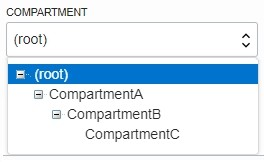 You want to create a policy to allow NetworkAdmins to manage VCNs in CompartmentC. If you want to attach this policy to CompartmentC or to its parent, CompartmentB, write this policy statement: Allow group NewtworkAdmins to manage virtual-network-family in compartment CompartmentC.
However, if you want to attach this policy to CompartmentA (so that only administrators of CompartmentA can modify it), write this policy statement that specifies the path: Allow group NewtworkAdmins to manage virtual-network-family in compartment CompartmentB:CompartmentC
To attach this policy to the tenancy, write this policy statement that specifies the path from CompartmentA to CompartmentC: Allow group NewtworkAdmins to manage virtual-network-family in compartment CompartmentA:CompartmentB:CompartmentC
Question 35
Single choice
For a compute instance that is launched in a private subnet in a Virtual Cloud Network (VCN), which action needs to be performed to connect to the Internet, assuming that the required security list is properly set up?
-
A
Assign a Public IP address to the compute instance.
-
B
Create and configure Network Address Translation (NAT) in a public subnet and route all traffic to it.
-
C
There is no way for an instance in a private subnet to connect to the Internet.
-
D
Create a default route entry in the route table to forward all traffic to the Internet gateway.
Reveal answer details
Close answer details
Question 36
Single choice
What does Terraform use to create, manage, and manipulate infrastructure resources?
-
A
-
B
-
C
-
D
Reveal answer details
Close answer details
Correct answerD
ExplanationThe Oracle Cloud Infrastructure provider is used to interact with the many resources supported by the Oracle Cloud Infrastructure. The provider needs to be configured with credentials for the Oracle Cloud Infrastructure account.
|