You have the following compartment structure in your tenancy. Root compartment->Training- >Training- subl ->Training-sub2 You create a policy in the root compartment to allow the default admin for the account
(Administrators) to manage block volumes in compartment Training-sub2. What policy would you write to meet this requirement?
-
A
Allow group Administrators to manage volume-family in root compartment
-
B
Allow group Administrators to manage volume-family in compartment Training-sub1 :Training- sub2
-
C
Allow group Administrators to manage volume-family in compartment Training: Training-sub 1
:Training-sub2
-
D
Allow group Administrators to manage volume-family in compartment Training-sub2
Reveal answer details
Close answer details
Correct answerC
Explanationa policy statement must specify the compartment for which access is being granted (or the tenancy).
Where you create the policy determines who can update the policy. If you attach the policy to the compartment or its parent, you can simply specify the compartment name. If you attach the policy further up the hierarchy, you must specify the path. The format of the path is each compartment name (or OCID) in the path, separated by a colon:
<compartment_level_1>:<compartment_level_2>: . . . <compartment_level_n> For example, assume you have a three-level compartment hierarchy, shown here: 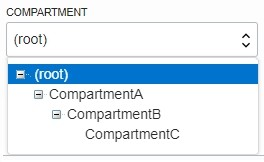 You want to create a policy to allow NetworkAdmins to manage VCNs in CompartmentC. If you want to attach this policy to CompartmentC or to its parent, CompartmentB, write this policy statement: Allow group NewtworkAdmins to manage virtual-network-family in compartment CompartmentC.
However, if you want to attach this policy to CompartmentA (so that only administrators of CompartmentA can modify it), write this policy statement that specifies the path: Allow group NewtworkAdmins to manage virtual-network-family in compartment CompartmentB:CompartmentC
To attach this policy to the tenancy, write this policy statement that specifies the path from CompartmentA to CompartmentC: Allow group NewtworkAdmins to manage virtual-network-family in compartment CompartmentA:CompartmentB:CompartmentC
When terminating a compute instance, which statement is true?
-
A
The instance needs to be stopped first, and then terminated.
-
B
The boot volume is always deleted.
-
C
All block volumes attached to the instance are terminated.
-
D
Users can preserve the boot volume associated with the instance.
Reveal answer details
Close answer details
Correct answerD
ExplanationYou can permanently terminate (delete) instances that you no longer need. Any attached VNICs and volumes are automatically detached when the instance terminates. Eventually, the instance's public and private IP addresses are released and become available for other instances. By default, the instance's boot volume is deleted when you terminate the instance, however you can preserve the boot volume associated with the instance, so that you can attach it to a different instance as a data volume, or use it to launch a new instance.
Question 3
Multiple choice
You are the Cloud Architect of a company, and are designing a solution on Oracle Cloud Infrastructure where you want to have all your compute instances resistant to hardware failure. Which two are recommended best practices to achieve the requirement on Oracle Cloud Infrastructure? (Choose two.)
-
A
Create a custom image of your system drive each time you change the image.
-
B
Attach block volumes from different Availability Domains to compute instances in different Availability Domains for high availability.
-
C
Design your system with redundant compute modes in different Availability Domains to support the failover capability.
-
D
Create backups of your block volumes that are associated with compute instances in different regions.
Reveal answer details
Close answer details
Correct answersA, C
ExplanationReferences:
https://docs.cloud.oracle.com/iaas/Content/Compute/References/bestpracticescompute.htm
System Resilience Oracle Cloud Infrastructure runs on Oracle's high-quality Sun servers. However, any hardware can experience a failure. Follow industry-wide hardware failure best practices to ensure the resilience of your solution. Some best practices include: Design your system with redundant compute nodes in different availability domains to support fail-over capability. Create a custom image of your system drive each time you change the image. Back up your data drives, or sync to spare drives, regularly. If you experience a hardware failure and have followed these practices, you can terminate the failed instance, launch your custom image to create a new instance, and then apply the backup data.
Question 4
Multiple choice
You have an application running on Oracle Cloud Infrastructure. You Identified that the read and write operations are slowing your application down enough to impair user access. The application is currently using a VM.Standard2.1 compute without any block storage attached to it. Which two options allow you to increase disk IOPS performance?
-
A
Terminate the compute instance preserving the boot volume. Create a new compute instance using the VM.DenseI02.8 shape using the boot volume preserved and use the NVMe devices to host your application.
-
B
Terminate the compute instance preserving the boot volume. Create a new compute instance using the VM.Standard2.2 shape using the boot volume preserved and attach a new block volume to host your application.
-
C
Terminate the compute instance preserving the boot volume. Create a new compute instance using the VM.Standard2.2 shape using the boot volume preserved, but no block volume attached.
-
D
Terminate the compute instance preserving the boot volume. Create a new compute instance using the BM.GPU2.2 shape using the boot volume preserved, but no block volume attached.
Reveal answer details
Close answer details
Question 5
Multiple choice
Which three must be configured for a load balancer to accept incoming traffic? (Choose two.)
-
A
-
B
-
C
-
D
a security list that is open on a listener port
-
E
Reveal answer details
Close answer details
Correct answersA, B, C
Explanationhttps://docs.cloud.oracle.com/iaas/Content/Balance/Tasks/managingloadbalancer.htm?tocpath=Services%7CLoad%20Balancing%7C_____5Theessentialcomponentsforloadbalancinginclude:?Aloadbalancerwithpre-provisionedbandwidth.?Abackendsetwithahealthcheckpolicy.SeeManagingBackendSets.?Backendserversforyourbackendset.SeeManagingBackendServers.?Oneormorelisteners.SeeManagingLoadBalancerListeners.?Loadbalancersubnetsecurityrulestoallowtheintendedtraffic.Tolearnmoreaboutthese
rules, see Security Rules.
?Optionally, you can associate your listeners with SSL server certificate bundles to manage how your system handles SSL traffic. See Managing SSL Certificates
Question 6
Multiple choice
Which two tagging related items are valid attributes that may be included in payload of an audit log event? (Choose two.)
-
A
-
B
-
C
-
D
-
E
-
F
Reveal answer details
Close answer details
Correct answersB, D
ExplanationReferences:
https://docs.cloud.oracle.com/en-us/iaas/Content/Audit/Reference/logeventreference.htm#payload
Question 7
Multiple choice
Which two identity providers can your administrator federate with Oracle Cloud Infrastructure? (Choose two.)
-
A
Microsoft Active Directory
-
B
Oracle Identity Cloud Services
-
C
-
D
Google Directory Federation Services
Reveal answer details
Close answer details
Correct answersA, B
ExplanationReferences:
Oracle Cloud Infrastructure supports federation with Oracle Identity Cloud Service and Microsoft Active Directory (via Active Directory Federation Services (AD FS)), and any identity provider that supports the Security Assertion Markup Language (SAML) 2.0 protocol.
You have created a new compartment called Production to host some production apps. You have also created users in your tenancy and added them to a Group called "production group". Your users are still unable to access the Production compartment. How can you resolve this situation?
-
A
Every compartment you create comes with a predefined set of policies, so no further action is needed
-
B
Your users get automatic access to all compartments, so no further action is needed
-
C
Write an IAM Policy for each specific user granting them access to the production compartment
-
D
Write an IAM Policy for "production_group" granting it access to the production compartment
Reveal answer details
Close answer details
Correct answerD
ExplanationWhen creating a compartment, you must provide a name for it (maximum 100 characters, including letters, numbers, periods, hyphens, and underscores) that is unique within its parent compartment. You must also provide a description, which is a non-unique, changeable description for the compartment, from 1 through
400 characters.
After creating a compartment, you need to write at least one policy for it, otherwise no one can access it (except administrators or users who have permissions set at the tenancy level). When creating a compartment inside another compartment, the compartment inherits access permissions from compartments higher up its hierarchy.
When you create an access policy, you need to specify which compartment to attach it to. This controls who can later modify or delete the policy. Depending on how you've designed your compartment hierarchy, you might attach it to the tenancy, a parent, or to the specific compartment itself.
Question 9
Multiple choice
In what two ways does Oracle Cloud Infrastructure (OCI) file storage service differ from OCI object storage and block volume services?
-
A
You can move object storage buckets, block volumes and file storage mount targets between compartments.
-
B
File Storage uses the network file system (NFS) protocol, whereas block volume uses iSCSI.
-
C
Block volume service Is NVMe based, while file storage service is not.
-
D
File storage mount target does not provide a private IP address, while the object storage bucket provides one.
Reveal answer details
Close answer details
Correct answersA, B
ExplanationThe mount target provides the IP address or DNS name that is used together with a unique export path to mount the file system.
You can move mount targets from one compartment to another.
Question 10
Single choice
What is a "transfer package" when transferring data to OCI via the OCI Data Transfer Service?
-
A
A transfer package is the logical representation of the physical shipment containing the HDD transfer devices that you ship to Oracle to upload to OCI.
-
B
A transfer package is the software Oracle provides for you to prepare transfer devices for shipment to Oracle
-
C
A transfer package contains the physical devices.
-
D
A transfer package is the archive file that the Data Transfer Service Utility (dts) writes to the transfer device.
Reveal answer details
Close answer details
Correct answerA
ExplanationReferences:
https://blogs.oracle.com/cloud-infrastructure/introducing-oracle-cloud-infrastructure-data-transfer-
service
Question 11
Multiple choice
Which two options are available when configuring DNS resolution for your virtual cloud network? (Choose two.)
-
A
Internet and custom resolver
-
B
-
C
-
D
Internet and virtual cloud network (VCN) resolver
Reveal answer details
Close answer details
Correct answersC, D
ExplanationReferences:
https://docs.cloud.oracle.com/iaas/Content/Database/Tasks/launchingDB.htm
Question 12
Single choice
You are managing a tier-1 OLTP application on an Autonomous Transaction Processing (ATP) database.
Your business needs to run hourly batch processes on this ATP database that may consume more CPUs than what is available on the server. How can you limit these batch processes to not interfere with the OLTP transactions?
-
A
Configure ATP resource management rules to change CPU/IO shares for the consumer group of batch processes.
-
B
Copy OLTP data into new tables in a new table space and run batch processes against these new tables.
-
C
Disable automated backup during the batch process operations.
-
D
ATP is designed for OLTP workload only, you cannot run batch processes on ATP.
Reveal answer details
Close answer details
Correct answerA
ExplanationAutonomous Transaction Processing comes with predefined CPU/IO shares assigned to different consumer groups. You can modify these predefined CPU/IO shares if your workload requires different
CPU/IO resource allocations.
By default, the CPU/IO shares assigned to the consumer groups TPURGENT, TP, HIGH, MEDIUM, and LOW are 12, 8, 4, 2, and 1, respectively. The shares determine how much CPU/IO resources a consumer group can use with respect to the other consumer groups. With the default settings the consumer group TPURGENT will be able to use 12 times more CPU/IO resources compared to LOW, when needed. The consumer group TP will be able to use 4 times more CPU/IO resources compared to MEDIUM, when needed.
Question 13
Multiple choice
Which two options are valid for loading data directly into Autonomous Data Warehouse (ADW)? (Choose two.)
-
A
-
B
-
C
-
D
Reveal answer details
Close answer details
Question 14
Single choice
What is the default backup location for database backup on Database Cloud Service (DBCS)?
-
A
Object Storage on Oracle Cloud Infrastructure
-
B
-
C
-
D
locally attached NVMe on Virtual Machine
Reveal answer details
Close answer details
Correct answerA
ExplanationReferences:
https://docs.oracle.com/en/cloud/paas/database-dbaas-cloud/csdbi/backing.html
Question 15
Multiple choice
Which two statements are true about Oracle Cloud Infrastructure (OCI) DB Systems?
-
A
Customers have no control over database patching.
-
B
The database and backups are encrypted by default.
-
C
Customers can consolidate multiple database homes on a single virtual machine database host.
-
D
Customers can manage the TDE Wallet after DB Systems is provisioned.
Reveal answer details
Close answer details
Correct answersB, D
ExplanationAll databases created in Oracle Cloud Infrastructure are encrypted using transparent data encryption (TDE).
Oracle Cloud Infrastructure encrypts all managed backups in the object store. Oracle uses the Database Transparent Encryption feature by default for encrypting the backups. and the customers can manage the TDE Wallet after DB Systems are provisioned.
Question 16
Single choice
Where is the tenancy Oracle Cloud Identifier (OCID) located?
-
A
given by support on account creation
-
B
at the bottom of every console page
-
C
on the Identity ?Users page
-
D
contained within the compartment OCID
Reveal answer details
Close answer details
Correct answerD
ExplanationIdentity > Compartments >(The root Compartment of the tenancy)
Question 17
Single choice
Which service is NOT supported by Oracle Cloud Infrastructure CLI?
-
A
-
B
-
C
-
D
Reveal answer details
Close answer details
Correct answerD
ExplanationReferences:
https://docs.cloud.oracle.com/iaas/Content/API/Concepts/cliconcepts.htm#services
Question 18
Multiple choice
Which three load-balancing policies can be used with a back end set? (Choose three.)
-
A
-
B
-
C
-
D
-
E
Reveal answer details
Close answer details
Correct answersB, C, E
ExplanationReferences:
After you create a load balancer, you can apply policies to control traffic distribution to your backend servers. The Load Balancing service supports three primary policy types: Round Robin Least Connections
IP Hash
Question 19
Single choice
You have setup your environment as shown below with the Mount Target "MT" successfully mounted on both compute instances CLIENT-X and CLIENT-Y.
For security reasons you want to control the access to the File System A in such a way that CLIENT-X has READ/WRITE and CLIENT-Y has READ only permission. 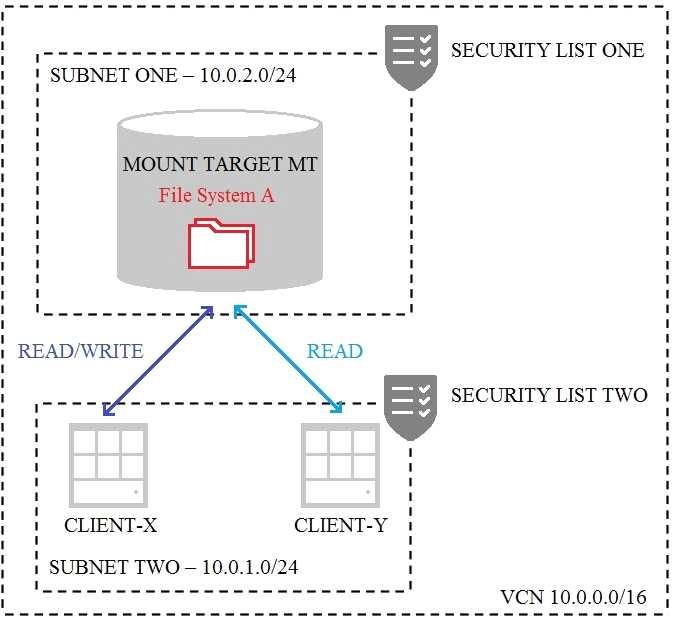 What you should do?
-
A
Update the OS firewall in CLIENT-X to allow READ/WRITE access.
-
B
Update the security list TWO to restrict CLIENT-Y access to read-only.
-
C
Update the mount target export options to restrict CLIENT-Y access to read-only.
-
D
Update the security list ONE to restrict CLIENT-Y access to read only.
Reveal answer details
Close answer details
Question 20
Multiple choice
Which two methods are supported for migrating your on-premises Oracle database to an Oracle Autonomous Transaction Processing (ATP) database in Oracle Cloud Infrastructure? (Choose two.)
-
A
Load text files into ATP using SQL Developer.
-
B
-
C
-
D
Transfer the physical database files and re-create the database.
-
E
Use database backup and restore.
Reveal answer details
Close answer details
Correct answersC, D
ExplanationReferences:
https://docs.oracle.com/en/solutions/migrate-to-atp/index.html#GUID-28E5A683-6DC6-4A07-
BB1C-55F020D4C1CD
Question 21
Single choice
You want an instance in your compartment to make API calls to other services within Oracle Cloud Infrastructure without storing credentials in a configuration file. What do you need to do?
-
A
No action is required. By default, all VM instances are created with an Instance Principal.
-
B
Instances cannot access services outside their compartment.
-
C
VM instances are treated as users. Create a user and assign the user to that VM instance.
-
D
Create appropriate matching rules in the Dynamic Group to create an Instance Principal.
Reveal answer details
Close answer details
Correct answerD
ExplanationReferences:
https://docs.cloud.oracle.com/iaas/Content/Identity/Tasks/managingdynamicgroups.htm
Question 22
Single choice
Which certificate format is used with the load balancer?
-
A
-
B
-
C
-
D
Reveal answer details
Close answer details
Correct answerB
Explanationhttps://docs.cloud.oracle.com/iaas/Content/Balance/Tasks/managingcertificates.htm
Question 23
Multiple choice
Which three components can you configure in Oracle Infrastructure Identity and Access Management? (Choose three.)
-
A
-
B
-
C
-
D
-
E
Reveal answer details
Close answer details
Correct answersA, B, D
ExplanationReferences:
https://cloud.oracle.com/governance/identity/faq
Question 24
Multiple choice
Which two choices are true for Autonomous Data Warehouse (ADW)? (Choose two.)
-
A
Billing stops only when the ADW is terminated
-
B
Billing stops for both CPU usage and storage usage when ADW is stopped
-
C
Billing for compute stops when ADW is stopped
-
D
Billing for storage continues when ADW is stopped
Reveal answer details
Close answer details
Correct answersC, D
ExplanationWhen Autonomous Databas instance is stopped, CPU billing is halted based on full-hour cycles of usage Billing for storage continues as long as the service instance exists. and When Autonomous Database instance is started, the CPU billing is initiated
Question 25
Single choice
You are deploying a highly available web application in Oracle Cloud Infrastructure and have decided to use a public load balancer. The back-end web servers will be distributed across all three availability domains (ADs). How many subnets should you create to deliver a secure highly available application?
-
A
three subnets in total; one subnet in each AD
-
B
five subnets in total; two subnets each in the first and second AD with a single subnet in the third AD
-
C
six subnets in total; two subnets in each AD; one for the load balancer and one for the web servers
-
D
four subnets in total; one subnet in each AD for the web servers and a single subnet in any one AD for
the load balancer
Reveal answer details
Close answer details
Question 26
Multiple choice
Which two are valid options when migrating a database from on-premise to Oracle Cloud Infrastructure? (Choose two.)
-
A
snapping or cloning storage form on-premise to Oracle Cloud Infrastructure
-
B
performing a backup to Oracle Cloud Infrastructure Object Storage, and then restoring to a database server on Oracle Cloud Infrastructure
-
C
performing RMAN backup to an on-premise storage device, and then shipping to Oracle Cloud Infrastructure
-
D
converting the Oracle database to a NoSQL database and migrating to Oracle Cloud Infrastructure by
using rsync file copy
Reveal answer details
Close answer details
Question 27
Multiple choice
You have an AI/ML application running on Oracle Cloud Infrastructure. You identified that the application needs GPU and at least 20Gbps Network throughput. The application is currently using a VM.Standard2.1 compute without any block storage attached to it. Which two options allow you to get your required performance for your application? (Choose two.)
-
A
Terminate the compute instance preserving the boot volume. Create a new compute instance using the BM.GPU2.2 shape using the boot volume preserved, but no block volume attached.
-
B
Terminate the compute instance preserving the boot volume. Create a new compute instance using the VM.Standard2.2 shape using the boot volume preserved, but no block volume attached.
-
C
Terminate the compute instance preserving the boot volume. Create a new compute instance using the VM.GPU3.4 shape using the boot volume preserved and use the NVMe devices to host your application.
-
D
Terminate the compute instance preserving the boot volume. Create a new compute instance using the BM.HPC2.36 shape using the boot volume preserved and use the NVMe devices to host your application.
-
E
Terminate the compute instance preserving the boot volume. Create a new compute instance using the BM.GPU2.2 shape using the boot volume preserved and attach a new block volume to host your application.
Reveal answer details
Close answer details
Question 28
Single choice
You have two NFS clients running in two different subnets within the same Oracle Cloud Infrastructure (OCI) Virtual Cloud Network (VCN). You have created a shared file system for the two NFS clients who want to connect to the same file system, but you want to restrict one of the clients to have READ access while the other has READ/Write access. Which OCr feature would you leverage to meet this requirement?
-
A
Use VCN security rules to control access for the NFS clients
-
B
Use OCI Identity Access Management to control access for the NFS clients
-
C
Use File Storage NFS Export Options to control access for the NFS clients
-
D
Use NFS security to control access for the NES clients
Reveal answer details
Close answer details
Correct answerC
ExplanationOracle Cloud Infrastructure File Storage service provides a durable, scalable, secure, enterprise-grade network file system. You can connect to a File Storage service file system from any bare metal, virtual machine, or container instance in your Virtual Cloud Network (VCN). You can also access a file system from outside the VCN using Oracle Cloud Infrastructure FastConnect and Internet Protocol security (IPSec) virtual private network (VPN).
EXPORT
Exports control how NFS clients access file systems when they connect to a mount target. File systems are exported (made available) through mount targets. Each mount target maintains an export set which contains one or many exports. A file system must have at least one export in one mount target in order for instances to mount the file system. The information used by an export includes the file system OCID, mount target OCID, export set OCID, export path, and client export options. For more information, see Managing Mount Targets.
EXPORT SET
Collection of one or more exports that control what file systems the mount target exports using NFSv3 protocol and how those file systems are found using the NFS mount protocol. Each mount target has an export set. Each file system associated with the mount target has at least one export in the export set.
EXPORT PATH
A path that is specified when an export is created. It uniquely identifies the file system within the mount target, letting you associate up to 100 file systems to a single mount target. This path is unrelated to any path within the file system itself, or the client mount point path.
EXPORT OPTIONS NFS export options are a set of parameters within the export that specify the level of access granted to NFS clients when they connect to a mount target. An NFS export options entry within an export defines access for a single IP address or CIDR block range. For more information, see Working with NFS Export Options.
Question 29
Multiple choice
The Oracle Cloud Infrastructure Block Volume service lets you expand the size of block and boot volumes. Which three options below can you use to increase the size of your block volumes?
-
A
Clone an existing volume to a new, larger volume
-
B
You can only expand block volumes and not boot volumes
-
C
Expand an existing volume in place with offline resizing
-
D
Take a backup of your existing volume and restore from the volume backup to a larger volume
-
E
Expand an existing volume in place with online resizing
Reveal answer details
Close answer details
Correct answersA, C, D
ExplanationThe Oracle Cloud Infrastructure Block Volume service lets you expand the size of block volumes and boot volumes. You have three options to increase the size of your volumes: Expand an existing volume in place with offline resizing. See Resizing a Volume Using the Console for the steps to do this.
Restore from a volume backup to a larger volume. See Restoring a Backup to a New Volume and Restoring a Boot Volume.
Clone an existing volume to a new, larger volume. See Cloning a Volume and Cloning a Boot Volume.
Question 30
Multiple choice
Which two statements are true about policies?
-
A
You can use read, write, manage, and inspect as verbs for defining a policy.
-
B
A policy is a document that specifies who can access which Oracle Cloud Infrastructure resources that your company has, and how.
-
C
Users need not do anything but still have to be added to a group with appropriate policies defined.
-
D
You can deny access to a group via policies.
Reveal answer details
Close answer details
Question 31
Multiple choice
Which three methods can you use to manage Oracle Cloud Infrastructure services? (Choose three.)
-
A
Oracle Cloud Infrastructure Desktop Client
-
B
Oracle Cloud Infrastructure Console
-
C
-
D
-
E
Reveal answer details
Close answer details
Correct answersB, D, E
Explanationhttps://docs.cloud.oracle.com/iaas/Content/GSG/Concepts/baremetalintro.htm
Question 32
Multiple choice
In which two ways does Oracle Cloud Infrastructure (OCI) file storage (FSS) differ from OCI object storage and block volume services? (Choose two.)
-
A
Block volume service is NVMe based, while FSS is not
-
B
Object storage and block volume services offer default encryption, but FSS does not
-
C
A file system is created within an availability domain, whereas object storage buckets exist at the region level
-
D
FSS uses the network file system (NFS) protocol, whereas block volume uses iSCSI
Reveal answer details
Close answer details
Question 33
Single choice
A company currently uses Microsoft Active Directory as its identity provider. The company recently purchased Oracle Cloud Infrastructure (OCI) to leverage the cloud platform for its test and development operations. As the administrator, you are now tasked with giving access only to developers so that they can start creating resources in their OCI accounts. Which step will you perform to achieve this requirement?
-
A
Create a group for developers on OCI and map the group to a similar group in Microsoft Active Directory during the federation process.
-
B
Federate all Microsoft Active Directory groups with OCI to allow users to use their existing credentials.
-
C
Create a new user account for each user, and then create policies to provide access to developers.
-
D
Create a group for developers on OCI, export all the developers from Microsoft Active Directory, and then import them into the Identity and Access Management (IAM) group.
Reveal answer details
Close answer details
Question 34
Multiple choice
Which two statements are true about the Oracle Cloud Infrastructure Object Storage Service? (Choose two.)
-
A
It provides higher IOPS than Block Storage.
-
B
It can be directly attached or detached from a compute instance.
-
C
Data is stored redundantly only in a single AD.
-
D
Data is stored redundantly across multiple availability domains (ADs) in a multi-AD region.
-
E
It provides strong consistency.
Reveal answer details
Close answer details
Correct answersD, E
ExplanationSTRONG CONSISTENCY
When a read request is made, Object Storage always serves the most recent copy of the data that was written to the system.
DURABILITY
Object Storage is a regional service. Data is stored redundantly across multiple storage servers. Object Storage actively monitors data integrity using checksums and automatically detects and repairs corrupt data. Object Storage actively monitors and ensures data redundancy. If a redundancy loss is detected, Object Storage automatically creates more data copies. For more details about Object Storage durability, see the Oracle Cloud Infrastructure Object Storage FAQ.
CUSTOM METADATA
You can define your own extensive metadata as key-value pairs for any purpose. For example, you can create descriptive tags for objects, retrieve those tags, and sort through the data. You can assign custom metadata to objects and buckets using the Oracle Cloud Infrastructure CLI or SDK. See Software Development Kits and Command Line Interface for details.
ENCRYPTION
Object Storage employs 256-bit Advanced Encryption Standard (AES-256) to encrypt object data on the server. Each object is encrypted with its own key. Data encryption keys are encrypted with a master encryption key that is frequently rotated. Encryption is enabled by default and cannot be turned off.
Question 35
Single choice
You have an instance running in a development compartment that needs to make API calls against other OCI services, but you do not want to configure user credentials or a store a configuration file on the instance. How can you meet this requirement?
-
A
Create a dynamic group with matching rules to include your instance
-
B
Instances can automatically make calls to other OCI services
-
C
Instances are secure and cannot make calls to other OCI services
-
D
Create a dynamic group with matching rules to include your instance and write a policy for this dynamic group
Reveal answer details
Close answer details
Correct answerD
ExplanationDynamic groups allow you to group Oracle Cloud Infrastructure computer instances as "principal" actors (similar to user groups).
When you create a dynamic group, rather than adding members explicitly to the group, you instead define a set of matching rules to define the group members. For example, a rule could specify that all instances in a particular compartment are members of the dynamic group. The members can change dynamically as instances are launched and terminated in that compartment. A dynamic group has no permissions until you write at least one policy that gives that dynamic group permission to either the tenancy or a compartment.
When writing the policy, you can specify the dynamic group by using either the unique name or the dynamic group's OCID. Per the preceding note, even if you specify the dynamic group name in the policy, IAM internally uses the OCID to determine the dynamic group.
Question 36
Multiple choice
You are designing a networking infrastructure in multiple Oracle Cloud Infrastructure regions and require connectivity between workloads in each region. You have created a dynamic routing gateway (DRG) and a remote peering connection. However, your workloads are unable to communicate with each other. What are two reasons for this? (Choose two.)
-
A
The security lists associated with subnets in each virtual cloud network (VCN) do not have the appropriate ingress rules
-
B
Identity and Access Management (IAM) policies have not been defined to allow connectivity across the two VCNs in different regions
-
C
A local peering gateway needs to be created in each VCN with a default route rule added in the route table forwarding the traffic to the local peering gateway
-
D
An Internet gateway needs to be created in each VCN with a default route rule added in the route table forwarding the traffic to the Internet Gateway
-
E
The route table associated with subnets in each VCN do not have a route rule defined to forward the traffic to their respective DRGs
Reveal answer details
Close answer details
Correct answersA, E
ExplanationSetting Up a Remote Peering Create the RPCs: Each VCN administrator creates an RPC for their own VCN's DRG. Share information: The administrators share the basic required information. Set up the required IAM policies for the connection: The administrators set up IAM policies to enable the connection to be established.
Establish the connection: The requestor connects the two RPCs (see Important Remote Peering Concepts for the definition of the requestor and acceptor). Update route tables: Each administrator updates their VCN's route tables to enable traffic between the peered VCNs as desired.
Update security rules: Each administrator updates their VCN's security rules to enable traffic between the peered VCNs as desired.
|