Question 1
Multiple choice
What two job roles are required to access information within Functional Setup Manager? (Choose two.)
-
A
Application Implementation Manager
-
B
-
C
Application Implementation Consultant
-
D
Functional Setup Manager Superuser
-
E
Reveal answer details
Close answer details
Correct answersA, C
ExplanationProvision the implementation user with the Application Implementation Manager job role or the Application Implementation Consultant job role by usingthe Security Console Users tab.
References:
https://docs.oracle.com/cloud/latest/financialscs_gs/FACSF/FACSF1004385.htm
An installment for $1,000 USD is due for payment on January 10, 2019. The installment has two discounts: the first discount date is December 5, 2018 for $150 USD and the second discount date is December 20, 2018 for $50 USD. The Pay Date Basis on the supplier site is Discount. You submit a Payment Process Request with the following criteria: Payment Date = December 5, 2018
Pay Through Date = December 25, 2018
Date Basis = Pay Date
Always Take Discount option is enabled What will be the resulting status of the installment and discount?
-
A
The installment is selected and a discount of $50 USD (the second discount) is applied.
-
B
The installment is selected and a discount of $200 USD ($150 + $50) is applied.
-
C
The installment is selected and a discount of $150 USD is applied because the Always Take Discount option was enabled.
-
D
The installment is selected but no discount is applied because the payment date is after the discount dates.
-
E
The installment is not selected because the first discount date is before the Pay Through Date.
Reveal answer details
Close answer details
Correct answerC
ExplanationDiscount Taken Amount is 150 USD. Although the Payment Date is after the discount dates, the first discount is taken because the option Always take discount is enabled.
References:
https://docs.oracle.com/cloud/farel8/financialscs_gs/FAPPP/F1011879AN17393.htm
Which statement is true about selecting a bank account on the Create Payment page?
-
A
LE on the bank account should be different from the LE on the invoice.
-
B
Bank account must match the supplier's bank account.
-
C
Users can pick any bank account as long as the bank account is tried to the business unit.
-
D
There is no relationship between the business unit, bank, and LE. Users can pick any bank account that is setup in their system.
-
E
LE on the bank account should be equal to LE on the invoice.
Reveal answer details
Close answer details
You have just imported invoices from a spreadsheet. What is the validation status of the imported invoices?
-
A
-
B
-
C
-
D
-
E
Reveal answer details
Close answer details
Correct answerD
ExplanationAfter the import process builds the invoices, the invoices can be viewed, modified, and validated on the Manage Invoices page.
References:
https://fusionhelp.oracle.com/helpPortal/topic/TopicId_P_A149B7BD08207B6DE040D30
A68816335
A Bill Payable document was paid but has not yet matured. What is the status of the payment?
-
A
-
B
-
C
-
D
Reveal answer details
Close answer details
An Office supplies company requires an advance payment of $8000 for the office supplies you wish to order. You enter and pay a prepayment type invoice for $8000. You enter the standard invoice to book the expense which totals $10000 and you apply the prepayment to the standard invoice. What are the accounting entries for that standard invoice with the prepayment application?
-
A
Invoice accounting - Dr Prepayment Account 10000 Cr AP Liability Account 10000.The prepayment application has no impact on the Invoice.
-
B
Invoice accounting - Dr Expense Account 10000 Cr AP Liability Account 10000.Prepayment application
- Dr AP Liability 8000 Cr Prepayment Account 8000.
-
C
Invoice Accounting - Dr Prepayment Account 10000 Cr AP Liability Account 10000.Prepayment
application - Dr Expense Account 8000 Cr Prepayment Account 8000.
-
D
Invoice accounting - Dr Expense Account 10000 Cr AP Liability Account 10000.Prepayment application
- Dr AP Liability Account 2000 Cr Prepayment Account 2000.
Reveal answer details
Close answer details
You have created an approval rule as follows: Rule 1: If the invoice amount > $1000, route it to User 1. Rule 2: If the invoice amount < $1000, auto
approve it. Now, the user creates an invoice for $1000 and routes it for approval. What will happen?
-
A
Invoice will not be processed.
-
B
The system will issue an error message after the approval has been initiated.
-
C
Invoice will be sent to User 1 for approval.
-
D
Invoice will be auto-approved.
Reveal answer details
Close answer details
XYZ Supplier has third party relationships defined with ABC Supplier and ACME Corporation. However, when reviewing the invoice installments for XYZ Supplier the payables specialist is unable to override the remit-to supplier name and address on the Invoice installments. What is the reason for this?
-
A
The option 'Allow remit-to supplier override for third-party payments' is not checked in the Invoice Options page for the business unit.
-
B
The option 'Allow remit-to supplier override for third-party payments' is not checked in the Common Options for Payables and Procurement page for the business unit.
-
C
The option 'Allow remit-to supplier override for third-party payments' is not checked in the Payment Options page for the business unit.
-
D
The option 'Allow remit-to supplier override for third-party payments' is not checked in the Disbursement System Options page for the business unit.
Reveal answer details
Close answer details
Question 9
Multiple choice
An installment meets all of the selection criteria of a Payment Process Request but it still did not get selected for payment processing. Identify two reasons for this.
-
A
The pay-through date is in a closed Payables period.
-
B
The pay-through date is in a future period.
-
C
The invoices need revalidation.
-
D
The invoice has not been accounted.
-
E
The installment was manually removed.
Reveal answer details
Close answer details
Correct answersA, C
ExplanationAn installment can meet the selection criteria of a payment process request, yet not get selected for payment for one or more reasons.
You can review installments that were not selected for payment, along with the reasons they were not selected, on the Not Selected tab of the Review Installments page.
The reasons are as follows:
References:
https://docs.oracle.com/cd/E37017_01/doc.1115/e22897/F438410AN16238.htm
Question 10
Single choice
You need to enter a high volume of users into the system. What is Oracle's recommendation to do this?
-
A
Use the Enter a Supplier user interface and enter each user manually.
-
B
Use the Hire an Employee user interface and enter each user manually.
-
C
Use the spreadsheet templates available in Oracle Enterprise Repository (OER) and then import users into Cloud Applications.
-
D
use the spreadsheet of Oracle Identity Manager (OIM) to import users.
Reveal answer details
Close answer details
Correct answerC
ExplanationIf you have batch of users that have to be created, the Oracle team can bulk load the users into the OIM Application.
References:
http://docs.oracle.com/cd/E79623_01/rms/pdf/160C/html/admin_guide/tasks.htm
Answer:
Question 11
Single choice
You applied a prepayment amount of $5,000 USD to a $10,000 USD invoice. At the time of prepayment,
the applicable tax rate was 5% ($250 USD); at the time of invoice creation, the tax rate is 10%. When you
set up taxes, you choose to Recalculate Taxes for the Applied Amount Handling option. How will the resulting tax be calculated?
-
A
The tax for the prepayment is recalculated and the generated tax line amount will be $250 USD (5% *
10,000-5000).
-
B
The tax for the prepayment is recalculated to use the new invoice tax rate that is also used for the invoice line amount. The two generated tax lines show $1,000 USD (10% * 10,000) for the invoice line tax amount and a prepayment tax line of -500 USD (10% * -5000).
-
C
The tax calculation creates two tax lines: one for the invoice line amount and one for the prepayment with a negative amount. The two generated tax lines show $1,000 USD (10% * 10,000) for the invoice line tax amount and a prepayment tax line of -250 USD (5% * -5000).
-
D
The tax calculated on the prepayment is reversed completely and the tax rateapplied to the invoice line is retained.
Reveal answer details
Close answer details
Correct answerB
ExplanationWhen you apply a prepayment to an invoice, the tax rate at the time of prepayment may differ from the tax rate at the time that the prepayment is applied to an invoice. Oracle Fusion Tax considers the tax calculated on the prepayment according to the value assigned to the Applied Amount Handling option in the tax record. The values are Recalculated and Prorated. For example, you apply a prepayment amount of 5,000 USD to an invoice with a total amount of10,000 USD. At the time of prepayment, the applicable
tax rate was 5% (250 USD tax on the prepayment); at the time of invoice creation, the applicable tax rate is 10%. Tax is calculated in this way:
* Recalculated: The tax is recalculated on the prepayment using the invoice tax rate and the same tax rate is applied to the invoice line amount. The tax calculation creates two tax lines: one for the invoice line amount and one for the prepayment with a negative amount. In the invoice example, the calculationcreates an invoice line amount tax line of 1,000 USD (10% * 10,000 USD) and a prepayment tax line of -500 USD (10% * -5000 USD). This reverses tax calculated on the invoice for the prepayment amount applied. The tax calculated on the prepayment is retained.
* Prorated:Etc.
References:
https://docs.oracle.com/cloud/farel8/financialscs_gs/FAFTT/F1006655AN242EE.htm
Question 12
Multiple choice
Select three reasons why you cannot close your Payables period. (Choose three.)
-
A
open intercompany transactions
-
B
-
C
suppliers on payment holds
-
D
bills payable requiring maturity
-
E
unaccounted invoices and payments
Reveal answer details
Close answer details
Correct answersA, D, E
ExplanationThe types of exceptions reported are:
References:
https://fusionhelp.oracle.com/helpPortal/topic/TopicId_P_9DE8D32BDBE0FBADE040D30
A688146CA
Question 13
Multiple choice
You are using both Procurement and Financials. You want the system to automatically accrue uninvoiced
receipts. Select two true statements. (Choose two.)
-
A
For period end accruals, accounting is created at material receipt or at delivery to a final destination.
-
B
For period end accruals, the invoice accounting debits the expense account and credits the liability account.
-
C
For perpetual accruals, the invoice accounting debits the accrual account and credits the liability account.
-
D
For period end accruals, the invoice accounting for inventory items debits receipt inventory and credits the uninvoiced receipts.
Reveal answer details
Close answer details
Question 14
Single choice
You have successfully processed the expense reports for reimbursement and have transferred the information to Payables. What is the next step before you can pay them?
-
A
Transfer the data to General Ledger.
-
B
Validate the invoice in Payables.
-
C
Create a payment process request in Payments.
-
D
Create Accounting for the invoice in Payables.
Reveal answer details
Close answer details
Correct answerC
ExplanationOracle Fusion Expenses provides reimbursement functionality that ensures corporate card issuers and employees are reimbursed for business expenses. Expenses uses Oracle Fusion Payables to process expense reports for reimbursement. To reimburse card issuers and employees, the expense auditor runs the Process Expense Reimbursement process and the corporate card administrator runs the process, Create Corporate Card Issuer Payment Requests. After payment requests are created in Payables, corporate card issuers and employees are paid by Oracle Fusion Payments. Thisfigure shows the flow of data when the expense auditor runs the Process Expense Reimbursement program.
Question 15
Single choice
Which invoice types can be included in the Create Payment flow?
-
A
Standard, Credit Memo and Debit Memo
-
B
Standard, Credit Memo and Customer Refund
-
C
Standard, Credit Memo, and Invoice Request
-
D
Standard, Debit Memo and Customer Refund
Reveal answer details
Close answer details
Question 16
Multiple choice
The expense auditor has chosen to Request More Information for an expense report. Select two ways the system processes this action. (Choose two.)
-
A
The expense report status remains Pending Payables Approval.
-
B
The expense report is routed back to the approvers.
-
C
The audit can be completed before the requested information is received from the employee.
-
D
The employee must resubmit the expense report.
Reveal answer details
Close answer details
Correct answersA, B
ExplanationTo request more information for an expense report, select the Request More Information option from the Actions menu in theheader of the Audit Expense Report page. The employee receives a notification that includes the reason for the request, specific instructions, and any additional instructions from you.
Selecting the Request More Information action results in the following:
References:
https://docs.oracle.com/cd/E60665_01/financialscs_gs/FAWDE.pdf
Question 17
Single choice
Your customer has an electronic payment format program in use and wants all the documents to use the pay group "Domestic". What should you do to achieve this?
-
A
Define a user validation at the format program to include: Field "Document pay group", condition "Equal to String", value "Domestic", and Field "Document pay group", condition "Required" and value ?not applicable.
-
B
Define a user validation at the format program to include: Field "Document pay group", condition "Equal to String", and value "Domestic".
-
C
Modify your template to hard code the value "Domestic" for the pay group position.
-
D
Define a user validation at the formatprogram to include: Field "Document pay group", condition "Equal to String", value "Domestic", and Field "Format Program Code", condition "Equal to String" and value ? as desired.
Reveal answer details
Close answer details
Correct answerB
ExplanationUser-Defined Validation That Checks a Specific Condition and Value 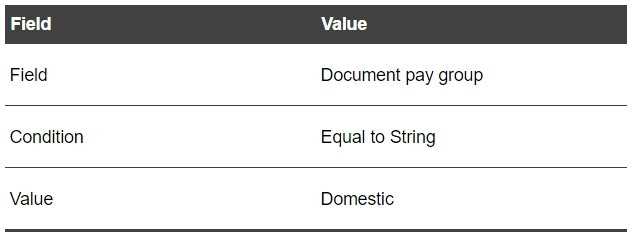 References:
https://docs.oracle.com/cloud/farel9/financialscs_gs/FAIPP/F1469799AN17B6B.htm
|