Question 1
Multiple choice
Examine the dtrace command. dtrace -n `proc:::exec {trace(execname);trace(pid);trace(stringof(arg0));}' Which two statements are true?
-
A
The trace(execname) action causes the called program name to be printed.
-
B
The trace(pid) action causes the calling program's process to be printed
-
C
The trace(stringof(arg0)) action causes the called program's first argument to be printed.
-
D
-
E
The probe function is not specified.
Reveal answer details
Close answer details
Correct answersC, E
ExplanationReferences:
http://docs.oracle.com/cd/E19253-01/819-5488/gbxwv/index.html
Question 2
Multiple choice
You want to configure networking on a host and have these requirements: 1. A cache only nameserver is to be used.
2. DHCP is used to obtain an IP address.
3. DHCP must not overwrite nameserver details contained in the /etc/resolv.conf file.
4. The nameserver must be activated automatically at system startup.
5. There are two network adaptors, eth0 and eth1. The bind package has already been installed and the network service stopped. Which four actions must be performed to implement this requirement?
-
A
Add lines with PEERDNS=no and BOOTPROTO=dhcp to the /etc/sysconfig/network-scripts/ifcfg-eth0 file.
-
B
Add a line with PEERDNS=no to the /etc/resolv.conf file.
-
C
Add a line with nameserver 127.0.0.1 to the /etc/resolv.conf file.
-
D
The network and bind services must be started automatically by using chkconfig for those services at the appropriate run levels.
-
E
Add lines with PEERDNS=no and BOOTPROTO=dhcp to the /etc/sysconfig/network-scripts/ifcfg-eth1 file.
-
F
Start the network service only automatically by using chkconfig for those services at the appropriate run levels.
-
G
Start the bind service only automatically by using chkconfig for those services at the appropriate run levels.
Reveal answer details
Close answer details
Correct answersB, C, D, F
Question 3
Multiple choice
After creating empty mount point /xfs1, you execute the command: # mkfs -t xfs -L /xfs1 -l logdev=/dev/sdd1 /dev/sdh1 Which two statements are true about the effects of executing the mkfs command?
-
A
It fails if there is an existing XFS file system on /dev/sdh1.
-
B
It fails if there is an existing XFS log on /dev/sdd1.
-
C
It fails if there is an existing XFS file system on /dev/sdd1.
-
D
It fails because there is no size specified for the XFS log.
-
E
The xfs1 file system is mounted automatically during system startup.
-
F
It creates and mounts the /xfs1 file system.
Reveal answer details
Close answer details
Examine the current SELinux status: 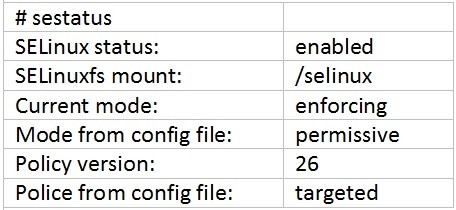 You have to meet these requirements:
1. Network services must run in a confined domain.
2. The guest user must be confined.
3. The guest user must not be allowed from using the su command.
4. Access to files and directories must be granted based only of the SELinux contexts.
5. The SELinux configuration must be persistent across system restarts.
6. Users must be able to publish private HTML content. You issued these commands:
# setenforce enforcing
# semanage login -d -s guest_u guest
# setsebool -P httpd_enabled_homedirs on Which requirements do you meet?
-
A
-
B
-
C
-
D
-
E
-
F
Reveal answer details
Close answer details
Which command would you use to start a container in the background so that it does not use the current terminal as its console?
-
A
lxc-start-daemon -n <container name>
-
B
lxc-start -n <container name> --daemon
-
C
lxc-start -n <container name> --detach
-
D
lxc-start -n <container name> &
Reveal answer details
Close answer details
Correct answerD
ExplanationReferences:
https://webcache.googleusercontent.com/search?q=cache:E9i3rUE3cLwJ:https://wiki.debian.org/LXC+&cd=1&hl=en&ct=clnk&gl=pk&client=opera
Question 6
Multiple choice
Which three statements are true about accessing Windows shares from Linux with SAMBA on Oracle Linux?
-
A
The findsmb utility queries a file to find SAMBA servers.
-
B
The username required to access the SAMBA shares on Windows may be specified in the mount command.
-
C
FTP may be used to access SAMBA shares on Windows.
-
D
The password required to access SAMBA shares on Windows may be specified in the mount command.
-
E
The smbtree utility queries a file to find SAMBA servers.
-
F
The smbclient utility uses a lowercase version of the environment variable USER or LOGNAME if the username is not provided on the command line.
-
G
The username and password required to access SAMBA shares on Windows may be specified in /etc/ fstab.
Reveal answer details
Close answer details
Correct answersA, E, F
ExplanationReferences:
http://docs.oracle.com/cd/E37670_01/E41138/html/ol_about_samba.html#idm139784792480512
Which statement describes the hardware required to support iSCSI connections?
-
A
A combination of generic ethernet and/or dedicated iSCSI hardware ethernet devices can be used to successfully deploy iSCSI.
-
B
Either dedicated iSCSI hardware ethernet controller devices or a restricted list of generic ethernet devices (due to limitations of the iSCSI driver) are required.
-
C
Specific iSCSI hardware is required to operate iSCSI services in an ethernet environment.
-
D
Only generic ethernet devices can be used to establish an iSCSI environment.
Reveal answer details
Close answer details
Which statement is true about BTRFS RAID?
-
A
Btrfs RAID is a multi-disk software RAID providing the same functionality as a software RAID created using the mdadm command.
-
B
Btrfs RAID is block device RAID.
-
C
Btrfs RAID is mirroring block devices.
-
D
Btrfs RAID just ensures that for every block, there are "x" number of copies.
Reveal answer details
Close answer details
Examine the udevadm command: udevadm info --query=all --name=/dev/sdb What does this command display?
-
A
the device tree, and all properties maintained in sysfs for all parent devices in the device tree for the /
dev/sdb disk device
-
B
all properties maintained in sysfs for the /dev/sdb kernel device, excluding parent devices
-
C
all properties maintained in devfs for the /dev/sdb kernel device, excluding parent devices
-
D
the device tree, and all properties maintained in devfs for the /dev/sdb device, including properties of all parent devices in the device tree for the /dev/sdb disk device
Reveal answer details
Close answer details
Question 10
Single choice
Which statement is true about the configuration of udev?
-
A
udev kernel device naming is based on default rules in /etc/udev/rules.d, which can be customized.
-
B
udev kernel device naming is dynamic and based on hard-coded rules biult into the udev kernel
module; these rules can be customized to yield persistent names by creating custom rules in the /etc/
sysconfig/udev file.
-
C
udev kernel device naming is based on default rules in /etc/udev/rules.d and customizations in /var/lib/ udev/rules.d.
-
D
udev kernel device naming is based on default rules, /lib/udev/rules.d, and customizations in /etc/udev/ rules.d.
Reveal answer details
Close answer details
Question 11
Multiple choice
What are two ways to invoke the rescue procedure for Oracle Linux while booting from the installation media?
-
A
Press the Esc key on the Oracle Linux Boot Menu screen.
-
B
Press the Esc key on the grub loader menu.
-
C
selecting "Rescue Installed System" on the Oracle Linux Boot Menu screen.
-
D
selecting "Rescue Installed System" on the grub loader menu.
-
E
Press the Shift+Ctrl keys on the grub loader menu.
-
F
Press the Shift+Ctrl keys on the Oracle Linux Boot Menu screen.
Reveal answer details
Close answer details
Question 12
Single choice
Identify the minimum required steps to configure postfix on a client system to relay outbound emails to an SMTP server.
Note: The postfix package is already installed and running on the system.
1. Install the postfix-cf package.
2. Set the myorigin parameter to $mydomain in /etc/postfix/main.cf.
3. Set the relayhost parameter to the desired SMTP server in /etc/postfix/main.cf.
4. Restart mail services by using: service postfix restart.
-
A
-
B
-
C
-
D
-
E
-
F
Reveal answer details
Close answer details
Question 13
Single choice
Examine the contents of the /etc/ocfs2/cluster.conf file: node: name = exam2 cluster = mycluster number = 0
ip_address = 192.168.56.106
ip_port = 7777 node:
name = exam3 cluster = mycluster
number = 1
ip_address = 192.168.56.107
ip_port = 7777
clustr:
name = mycluster
heartbeat_mode = local
node_count = 2 Identify the minimum number of commands issued, in the correct order, to create this file.
1. o2cb add-cluster --heartbeat_mode local mycluster
2. o2cb add-node --ip 192.168.56.107 --number 1 mycluster exam3
3. o2cb add-cluster mycluster
4. o2cb add-node --ip 192.168.56.106 -- number 0 mycluster exam2
5. o0cb config-cluster -node_count 2 mycluster
6. o2cb configure
-
A
-
B
-
C
-
D
-
E
-
F
Reveal answer details
Close answer details
Question 14
Multiple choice
Which two commands can be used to find the cgroup to which a given process with PID belongs?
-
A
-
B
-
C
-
D
Reveal answer details
Close answer details
Correct answersB, C
ExplanationReferences:
https://access.redhat.com/documentation/en-US/Red_Hat_Enterprise_Linux/6/html-single/Resource_Management_Guide/
Question 15
Single choice
You dynamically configure a system to concurrently run tasks A1 and A2 using these commands: # mkdir /cgroup/cpu # mount -t cgroup -o cpu cpu /cgroup/cpu
# mkdir /cgroup/cpu/A1
# mkdir /cgroup/cpu/A2
# echo 5 > /cgroup/cpu/A1/cpu.shares
# echo 5 > /cgroup/cpu/A2/cpu.shares
# mkdir /cgroup/cpuacct
# mount -t cgroup -o cpuacct cpuacct /cgroup/cpuacct You want to generate a /etc/cgconfig.conf configuration fail that contains the current cgroup configuration on the system. Which command would you use?
-
A
-
B
-
C
-
D
-
E
Reveal answer details
Close answer details
Question 16
Single choice
Examine the command sequence and the output produced:  Which statement is true?
-
A
The tgtadm commands succeed and effect both the configuration in /etc/tgt/targets.conf and the running configuration.
-
B
Both tgtadm commands succeed. No changes are made to the configuration file.
-
C
Only one tgtadm command succeed. The deletion of target 1 fails because LUN 0 has not been deleted.
-
D
Both tgtadm commands succeed. The tgtadm commands issued affects the ctatic configuration only and do not affect currently accessed target/LUN combinations.
Reveal answer details
Close answer details
Question 17
Multiple choice
You run the crash utility on an Oracle Linux system after a kernel panic and use the bt -a command as shown:
crash> bt a crash> bt -a PID: 286 TASK: c0b3a000 CPU: 0 COMMAND: "in.rlogind" #0 [c0b3be90] crash_save_current_state at c011aed0
#1 [c0b3bea4] panic at c011367c
#2 [c0b3bee8] tulip_interrupt at c01bc820
#3 [c0b3bf08] handle_IRQ_event at c010a551
#4 [c0b3bf2c] do_8259A_IRQ at c010a319
#5 [c0b3bf3c] do_IRQ at c010a653
#6 [c0b3bfbc] ret_from_intr at c0109634  #7 [c0b3bfbc] sys_select at c012f803
#8 [c0b3bfc0] system_call at c0109598  Which two statements are true about the purpose of the bt a command?
-
A
It shows stack traces of all tasks and threads.
-
B
It shows stack traces of the active task on each CPU.
-
C
The output of each CPU must be requested separately.
-
D
It may help show a relationship between panicking tasks on one CPU and tasks on other CPUs.
Reveal answer details
Close answer details
Question 18
Single choice
You must configure DHCPD on a system with three network interfaces, each on a separate subnet, so that DHCPD listens on only one of the three statements. Which method would you use to meet this requirement?
-
A
Specify subnet declarations without a RANGE specification in /etc/dhcp/dhcpd.conf for the subnets on which DHCPD should not listen.
-
B
Omit subnet declarations in /etc/dhcpd.conf for the subnets on which DHCPD should not listen.
-
C
Specify empty subnet declarations /etc/dhcp/dhcpd.conf for the subnets on which DHCPD should not listen.
-
D
Specify the interface name on which DHCPD should listen in /etc/sysconfig/dhcpd.
Reveal answer details
Close answer details
Question 19
Single choice
Examine the D scrypt: syscall::read:entry,
syscall::write:entry
/pid == $1/
{
ts[probefunc] = timestamp;
}
syscall::read:return,
syscall::write:return
/pid == $1 && ts[probefunc] != 0/
{
printf("%d nsecs", timestamp ?ts[probefunc]);
} Which statement is true about this script?
-
A
It produces aggregations of system calls made by the process whose PID is passed as a command-line argument represented by $1. You see which system calls are issued, and how many times, over a fixed interval.
-
B
It produces elapsed times for reads and writes to the entry and returns DTrace probes for the process whose PID is passed as a command-line argument represented by $1.
-
C
It produces elapsed times between entry and return of read and write system calls for the process whose PID is passed as the first command-line argument to the D script, represented by $1.
-
D
It produces a measure of useful time spent in read and write system calls for the process whose PID is passed as a command-line argument represented by $1.
Reveal answer details
Close answer details
Question 20
Single choice
Which statement is true about udev?
-
A
It is static kernel device naming scheme based on devfs.
-
B
It prevents device renaming upon reboot by default.
-
C
The udev configuration file is /etc/udev.conf.
-
D
It is a dynamic kernel device naming scheme based on sysfs.
Reveal answer details
Close answer details
Correct answerC
Explanationudev expects its main configuration file at /etc/udev/udev.conf. The file consists of a set of variables and values allowing the user to override default udev values.
Question 21
Single choice
Examine this command and its output: # yum history list
Loaded plugins: security  history list Which command must you use to undo the last two yum transactions?
-
A
-
B
-
C
# yum history undo last-1
-
D
# yum history undo last-3
Reveal answer details
Close answer details
Question 22
Single choice
Consider the steps to enable the Pluggable Authentication Module (PAM) to use cgroup rules for a 64-bit system: 1. Install the libcgroup-pam software package.
2. Ensure that the PAM module has been installed and exists: /lib64/security/pam_cgroup.so.
3. Edit the /ets/pam.d/su configuration file and add a line: session optional pam_cgroup.so.
4. Edit the /ets/pam.d/su configuration file and add a line: auth sufficient pam_cgroup.so.
5. Configure /etc/cgconfig.conf.
6. Configure /etc/cgrules.conf.
7. Log out all users that are affected by the cgroup settings in the /etc/cgrules.conf file.
8. Enable and start the cgred service.
9. Reboot the system. Which option represents the steps in the correct order to enable PAM to use cgroup rules for a logged-in user?
-
A
-
B
-
C
-
D
-
E
Reveal answer details
Close answer details
Question 23
Single choice
Which statement is true about configuring a nameserver in Oracle Linux?
-
A
If it is a primary nameserver, it must be an authoritative nameserver for all zones.
-
B
If it is a recursive nameserver, it must be a cache-only nameserver for all zones.
-
C
It may be authoritative for some zones and cache-only for other zones.
-
D
If it is a secondary nameserver, it must be an authoritative nameserver for all zones.
-
E
If it is a secondary nameserver, it must copy zone data from a primary nameserver.
Reveal answer details
Close answer details
Question 24
Multiple choice
Which three statements are true about the Kickstart installation method?
-
A
It always requires a Kickstart file.
-
B
The system must be booted manually with the ks= option.
-
C
It automates the installation of Oracle Linux.
-
D
It creates a Kickstart file.
-
E
It requires local access to the installation media.
-
F
It requires a PXE boot from the network.
Reveal answer details
Close answer details
Correct answersC, E, F
ExplanationReferences:
http://docs.oracle.com/cd/E37670_01/E41137/html/ch03s02.html
Question 25
Single choice
Which statement is true about a Kickstart file that is used for a complete unattended installation?
-
A
The command, %packages, and %pre sections are required.
-
B
Only the command section is required.
-
C
All sections are required.
-
D
The command and %packages sections are required.
-
E
The command, %packages, %pre, and %post sections are required.
Reveal answer details
Close answer details
Correct answerD
ExplanationReferences:
https://access.redhat.com/documentation/en-us/red_hat_enterprise_linux/7/html/installation_guide/sect-kickstart-howto
Question 26
Multiple choice
Which two must be provided on the Windows client when accessing Linux shares from Windows when using SAMBA on Oracle Linux? (Choose two.)
-
A
-
B
-
C
-
D
-
E
Reveal answer details
Close answer details
|