You have opened a terminal window (or a Window command prompt) to run a WLST script named weeklydeployer.py. You enter the following command: Java weblogic.WLST weeklydeployer.py Instead of the WLST initializing and the script running, however, you receive the NoClassDefFoundError java exception for weblogic/WLST. What is the problem?
-
A
You forgot to set PATH to include the java executable.
-
B
There is an error in the code of the script.
-
C
You forgot to set CLASSPATH to include weblogic.jar.
-
D
You are not in the directory where weeklydeployer.py resides.
-
E
You should have omitted the ".py" in the file name; it is assumed by WLST.
-
F
You forgot to set PATH to include the WLST executable.
Reveal answer details
Close answer details
Correct answerC
ExplanationTo set up your environment for WLST:
1. Install and configure the WebLogic Server software 2. Add WebLogic Server classes to the CLASSPATH environment variable Note: Although the process should be able to build the correct classpath by default, you might hit this issue in some cases. To overcome the problem, you must explicitly set the classpath in the admin console accordingly.
References:
WebLogic Scripting Tool, Using the WebLogic Scripting Tool
Question 2
Multiple choice
When installing Oracle Weblogic Server 11g with the graphical installer, which three statements are true?
-
A
You must choose either a typical or a custom installation.
-
B
You install under Microsoft Windows because the graphical installer is available only for Window
-
C
You may create a new middleware home directory or choose an existing one.
-
D
You must register for critical security updates.
-
E
You may install a JDK or choose one that was previously installed.
Reveal answer details
Close answer details
Correct answersA, C, E
ExplanationTasks WebLogic Server Product Installation Procedure
Step 1 - Obtain the appropriate installation file for your platform Step 2 - Complete the installation planning requirements Ensure that your system environment meets the requirements for the installation. Also determine your Oracle Middleware home directory, and product installation home directories. (C) When you are installing WebLogic Server, you are prompted to choose an existing Middleware home directory or specify a path to create a new Middleware home directory. If you choose to create a new directory, the installation program automatically creates it for you. Step 3 - Determine the appropriate installation mode for your situation Step 4 - Determine the type of installation (A) There are two types of installation Typical or Custom. The type of installation depends on the products and sub-components you want to install.
Step 5 - Install the software Step 6 - Create a WebLogic domain E: The JDK selection screen.
This screen is displayed only if you selected a Custom installation. It is not displayed if you are running an Upgrade installer.
This screen displays a list of JDKs. This list contains JDKs that are available for (and common across) previous installations of all the selected WebLogic Server components. Select the JDK that you want to install with the product. Incorrect answers:
B: There are different platforms on which Weblogic can be installed. Such as Windows, Linux, and UNIX.
D: To receive updates you must register. However, you do not do that during the graphic installation phase.
Note: You must have an active My Oracle Support account in order to download an Upgrade installer.
You can also install patch releases using the Smart Update tool, which is included with WebLogic Server. Smart Update requires that you have an active My
Oracle Support account. If a patch release or patch set is available for your current WebLogic Server installation, you can download an Upgrade installer from My Oracle Support. Upgrade installers let you install an available patch release or patch set onto an existing WebLogic Server installation. References:
Oracle Fusion Middleware Installation Guide for Oracle WebLogic Server 11g Release 1, Running the Installation Program in Graphical Mode
Reference: Oracle Fusion Middleware Installation Guide for Oracle WebLogic Server 11g Release 1, Installation Overview
Your task is to create and start a managed server on a "remote" computer (a computer other than the one where the domain has been created and the Administration server is currently running). So far you have:
1. Created the managed server, called startmanaged1, in the administration console
2. Created a managed server" JAR file template by using the pack command or, the Administration server computer. Which order of steps on the remote computer will successfully finish your task?
-
A
3. Copy the JAR file from the Administration Server computer.
4. Run the unpack command on the JAR file.
5. In the new domain folder created by the command, start managed: by using the startManagedWebLogic. sh script (. cmd in Windows), which is found under its bin directory
-
B
3. Install WebLogic Server.
4. Copy the JAR file from the Administration Server computer.
5. Run the unpack command on the JAR file.
6. In the administration console, under the Control tab, select managed1 and click the Start button.
-
C
3. Install WebLogic Server.
4. Copy the JAR file from the Administration Server computer.
5. Run the unpack command on the JAR file.
6. In the new domain folder created by the command, start managed1 by using the Logic. sh script (. cmd in Windows), which is found under its bin directory.
-
D
3. Install WebLogic Server.
4. Copy the JAR file from the Administration Server computer. 5. Run the unpack command on the JAR file.
6. In the new domain folder created by the command, startmanaged1 by using the startManagedWeblogic.sh script (. cmd in Windows), which is found under its bin directory.
Reveal answer details
Close answer details
Correct answerD
ExplanationCreating a Managed Server on a Remote Machine (Step 3) * Install WebLogic Server on the machines on which you want to host Managed Servers for the WebLogic domain.
* Establish a session with the remote machine. You may use any valid method, such as telnet, to do so.
Step 4:
* Copy the Managed Server template to the remote machine.
* On the remote machine, navigate to the WLS_HOME\common\bin directory.
* (Step 5) Run the following command: unpack -domain=domain -template=template.jar Starting Managed Servers on a Remote Machine
* Start the Administration Server for the WebLogic domain
* On the remote machine, navigate to the directory for the WebLogic domain that you created *(Step 6) Start the Managed Server on the remote machine.
On a Windows system, run one of the following commands at the DOS prompt: startmy_managed_server startManagedWebLogic my_managed_server admin-url
On a UNIX system, run one of the following commands:
./startmy_managed_server.sh
./startManagedWebLogic.sh my_managed_server admin-url
References:
Oracle Fusion Middleware Oracle WebLogic Server Administration Console Online Help 11g Release 1, Reference: Creating and Starting a Managed
Server on a Remote Machine
Question 4
Multiple choice
Which four statements are true about WLST?
-
A
You can create a domain with WLST.
-
B
WLST commands are case-insensitive.
-
C
You can shut down servers with WLST.
-
D
All WLST commands include parentheses.
-
E
WLST is based on the Perl scripting language.
-
F
You can connect to any server through WLST.
-
G
The Administration Server needs to be running to use WLST.
Reveal answer details
Close answer details
Correct answersA, B, C, D
ExplanationA: WLST enables you to create a new domain or update an existing domain without connecting to a running WebLogic Server (that is, using WLST offline)-- supporting the same functionality as the Configuration Wizard.
B: WLST command names and arguments are case sensitive.
C: The WLST shutdown command Gracefully shuts down a running server instance or a cluster. The shutdown command waits for all the in-process work to be completed before shutting down the server or cluster. You shut down a server to which WLST is connected by entering the shutdown command without any arguments.
D: All WLST commands include parentheses.
Example: exit(),startApplication(appName, [options]) Incorrect answers:
E: WLST is based on the Java scripting interpreter, Jython.
F: The WLST connect command only to a WebLogic Server instance.
G: Without connecting to a running WebLogic Server instance, you can use WLST to create domain templates, create a new domain based on existing templates, or extend an existing, inactive domain. You cannot use WLST offline to view performance data about resources in a domain or modify security data (such as adding or removing users). WLST offline provides read and write access to the configuration data that is persisted in the domain's config directory or in a domain template JAR created using Template Builder. References:
Documentation Home > BEA WebLogic Server 9.2 Documentation > WebLogic Scripting Tool > WLST Command and Variable Reference
You have successfully created a global data source and connection pool via the administration console. In which directory relative to the domain will this new data source and connection pool definition located?
-
A
in a directory named config/dataSource
-
B
in a directory named config/connPool
-
C
in a directory named config/resources
-
D
in a directory named config/jdbc
-
E
in a directory named config
Reveal answer details
Close answer details
Correct answerD
ExplanationWhen you create a JDBC resource (data source or multi data source) using the Administration Console or using the WebLogic Scripting Tool (WLST), WebLogic Server creates a JDBC module in the config/jdbc subdirectory of the domain directory, and adds a reference to the module in the domain's config.xml file. References:
Configuring WebLogic JDBC Resources
Question 6
Multiple choice
You are creating a new domain by using the Configuration Wizard, based solely on the Basic WebLogic Server Domain product (no template). Select three resources that you can create while still in the Configuration Wizard.
-
A
-
B
-
C
-
D
-
E
-
F
Reveal answer details
Close answer details
Correct answersA, B, E
ExplanationA: The Configure the Administration Server window prompts you to define the configuration information for the Administration Server, including: Administration Server name Listen address Nonsecure and secure (optional) listen ports
B: The Configure Managed Servers window prompts you to define the configuration information for one or more Managed Servers, including: Managed Server name Listen address Nonsecure and secure (optional) listen ports
E: The Configure Clusters window prompts you to define the configuration information for one or more clusters, including: Cluster name Multicast address and port Cluster address that identifies the Managed Servers in the cluster Frontend host if you are using a proxy server or a firewall. Frontend HTTP port if you are using a proxy server or a firewall.
References:
To create a custom domain with Managed Servers, a cluster, and application services (http://docs.oracle.com/cd/E13196_01/platform/docs81/confgwiz/tutorials.html)
Consider a single JMS module that includes a connection factory as well as queue. Based on your system's requirements, the connection factory needs to be made available to all servers in the domain. The queue, on the other hand, can be targeted to only a single JMS server domain. What is the best way to achieve the desired JMS setup?
-
A
Create two subdeployments within the JMS module.
-
B
Target the JMS server to the JMS module.
-
C
Target the JMS module to the entire domain.
-
D
Replace the queue with a topic.
Reveal answer details
Close answer details
Correct answerA
ExplanationA subdeployment is a mechanism by which JMS module resources (such as queues, topics, and connection factories) are grouped and targeted to a server resource (such as JMS servers, server instances, SAF agents, or a cluster).
For example, you can group a connection factory with stand-alone queues or topics in a subdeployment targeted to a specific JMS server, which guarantees that all these resources are co-located to avoid extra network traffic. Another advantage of such a configuration would be if the targeted JMS server needs to be migrated to another WebLogic server instance, then the connection factory and all its connections will also migrate along with the JMS server's destinations.
However, when stand-alone queues or topics are members of a subdeployment, a connection factory can only be targeted to the same JMS server. References:
Oracle Fusion Middleware Oracle WebLogic Server Administration Console Online Help 11g Release 1, Configure subdeployments in JMS system
modules
Question 8
Multiple choice
Which two statements are true about a WebLogic domain?
-
A
It is the basic administrative unit of WebLogic Server.
-
B
It is an optional administrative construct to organize groups of WebLogic
-
C
Administration Servers are defined within a domain, but Managed Servers
-
D
You must first have a domain to define a WebLogic Server cluster.
-
E
Every domain has one Administration Server and at least one managed server
Reveal answer details
Close answer details
Correct answersA, D
ExplanationA: A domain is the basic administration unit for WebLogic Server instances.
D: To define a WebLogic Server cluster there must be a domain: Note: Before you start the Managed Servers in a domain, start the Administration Server. When you start a standalone or clustered Managed Server, it contacts the Administration Server for its configuration information. In this way, the Administration Server operates as the central control entity for the configuration of the entire domain. References:
Configuring and Managing WebLogic Server (http://docs.oracle.com/cd/E13222_01/wls/docs81/adminguide/overview_domain.html)
Question 9
Multiple choice
Which three statements are true about the administration console?
-
A
The administration console cannot be disabled.
-
B
The context path of the administration console may be changed.
-
C
The administration console may be extended.
-
D
If a domain is in Development Mode, the administration console no longer requires an administration-level user when logging in.
-
E
If a domain is in Production Mode, access to the administration console must be made through secure port.
-
F
If the domain's Administration Port is enabled, access to the administration console must be made only through that port.
Reveal answer details
Close answer details
Correct answersB, C, F
ExplanationB: The Console Context Path is an advance configuration option. The context path that you want to use in URLs that specify the Administration Console. Note: Create a new WebLogic Server domain based on a template. Templates allow you to re-create an existing do-main for use in another context, such as migrating a domain containing an application under development to a pro-duction environment. C: An Administration Console extension is a WAR file that contains the resources for a section of a WebLogic Portal Web application. When you deploy the extension, the Administration Console creates an in-memory union of the files and directories in its WAR file with the files and directories in the extension WAR file. Once the extension has been deployed, it is a full member of the Administration Console: it is secured by the WebLogic Server security realm, it can navigate to other sections of the Administration Console, and if the extension modifies WebLogic Server resources, it participates in the change control process. Incorrect answers:
A: Exposing the console in your production environment might be security issue. In those cases you can either dis-able the console or hide it. Needless to say if you disable the console then your only option is to depend on com-mand-line and scripting tools for any other administration activity or to even enable the console back. But hiding will provide a level or security. To disable the console:
In the admin console navigate to --> General --> Advanced Options --> Console Enabled. De-select that option to disable console (restart required).
To hide the cosole: E: Access through a secure port is recommended, but not required: The administration port requires all communication to be secured using SSL. By default, all servers in a do-main use demonstration certificate files for SSL, but these certificates are not appropriate for a production environment. References:
Administration Console Online Help, Advanced Configuration Options Reference: Extending the Administration Console for Oracle WebLogic Server
11g Release 1
Question 10
Single choice
Your production JMS server and/or its consumers are not able to handle the incoming message workload. The number of messages on the server never stabilizes and the server eventually becomes overload. Which JMS server attribute will best help prevent the JMS server from being overloaded by producers?
-
A
-
B
-
C
-
D
-
E
Reveal answer details
Close answer details
Correct answerB
ExplanationJMS Configuration option ' Messages Threshold High':
The upper threshold (number of messages stored in this JMS server) that triggers flow control and logging events. A value of -1 disables the events for this JMS server. If the number of messages exceeds this threshold, the triggered events are:
Log Messages
- A message is logged on the server indicating a high threshold condition.
Flow Control
- If flow control is enabled, the JMS server becomes armed and instructs producers to begin decreasing their message flow. References:
Administration Console Online Help, JMS Server: Configuration: Thresholds and Quotas
Question 11
Single choice
You wish to provide failover for HTTP sessions within a cluster. However, you are limited by the following constraints: 1. While under load, your servers have very little free memory. 2. you do not have appropriate access rights to modify your company's database. Which is the best option, given these restrictions?
-
A
-
B
-
C
-
D
-
E
Reveal answer details
Close answer details
Correct answerC
ExplanationFile persistence use less memory than in-memory replication, and does not need access rights to the company's database. Note:
You use session persistence to permanently store data from an HTTP session object to enable failover and load balancing across a cluster of WebLogic Servers.
When your applications stores data in an HTTP session object, the data must be serializable. There are five different implementations of session persistence:
* Memory (single-server, non-replicated)
* File system persistence
* JDBC persistence
* Cookie-based session persistence
* In-memory replication (across a cluster) Incorrect answers:
A: Using in-memory replication, WebLogic Server copies a session state from one server instance to another. The primary server creates a primary session state on the server to which the client first connects, and a secondary replica on another WebLogic Server instance in the cluster. The replica is kept up-to-date so that it may be used if the server that hosts the servlet fails. D: JDBC persistence stores session data in a database table using a schema provided for this purpose. You can use any database for which you have a JDBC driver. You configure database access by using connection pools. Note: When you use memory-based storage, all session information is stored in memory and is lost when you stop and restart WebLogic Server. References:
Oracle Fusion Middleware Developing Web Applications, Servlets, and JSPs for Oracle WebLogic Server, Using Sessions and Session Persistence
Question 12
Single choice
Within your data center, the Administration and Managed Servers utilize a shared, central storage device, which server's access via NFS. In this scenario, your application files no longer need to be copied to servers across the network. Which server attribute allows you to override this behavior?
-
A
-
B
-
C
-
D
Reveal answer details
Close answer details
Correct answerB
ExplanationThe server staging mode specifies the default deployment mode for a server if none is specified at deployment time. For example, the server staging mode is used if you deploy an application or module using weblogic.Deployer and you do not specify a staging mode.
References:
http://docs.oracle.com/cd/E12840_01/wls/docs103/ConsoleHelp/taskhelp/deployment/SetAServe
rStagingMode.html
Question 13
Multiple choice
Which three statements are true about the Node Manager?
-
A
The Node Manager can restart the Managed Serves that have failed.
-
B
The Node Manager should be run as either a daemon or a service so that if the host computer is rebooted, the Node Manager will also be automatically started.
-
C
The Node Manager runs on a different host from the Managed Server it is controlling.
-
D
The Node Manager can start a Managed Server the first time the Managed Server starts if the Administration Server is unavailable because MSI mode is enabled by default.
-
E
The Node Manager allows you to start Managed Servers from the administration console.
Reveal answer details
Close answer details
Correct answersA, B, E
ExplanationA, E: Node Manager enables you to perform these tasks:
* Start and stop remote Managed Servers. (E)
* Monitor the self-reported health of Managed Servers and automatically kill server instances whose health state is "failed".
* Automatically restart Managed Servers that have the "failed" health state, or have shut down unexpectedly due to a system crash or reboot. (A) B: The WebLogic Server installation process installs Node Manager to run as an operating system service: a daemon on UNIX machines, or a Windows service on Windows-based machines. An operating system service starts up automatically each time the operating system boots.
A key Node Manager feature is the ability to restart Managed Servers after a failure. If the failure is a machine crash, running Node Manager as a service ensures that Node Manager starts up automatically when the machine reboots, and is available to restart Managed Servers on that machine. E: Requests from the Administration Console (or JMX utilities such as weblogic.Admin) to start a Managed Server using Node Manager are issued to the Administration Server for the domain that contains the Managed Server. References:
Configuring and Managing WebLogic Server, Overview of Node Manager
Question 14
Single choice
You run the following WLST script and it completes successfully. Which statement best describes what the script created? 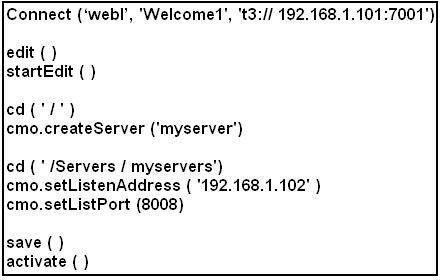
-
A
A CMO named myserver with the listen address 192.168.1.102 and port 8008
-
B
A Managed Server named myserver with the listen address 192.168.1.102 and port 7001
-
C
A Managed Server named myserver with listen address 192.168.1.102 and port 8008
-
D
An Administration Server named myserver with the listen address 092.168.1.102 and port
Reveal answer details
Close answer details
Correct answerC
ExplanationA managed server (not a CMO, not an administration server) is created.
Port is 8008. Note: Listing: Creating a Managed Server connect("username","password") edit() startEdit()
svr = cmo.createServer("managedServer")
svr.setListenPort(8001)
svr.setListenAddress("my-address")
save() References:
WebLogic Scripting Tool, Using WLST Online to Update an Existing Domain
Question 15
Multiple choice
Identify three attributes of a WebLogic cluster.
-
A
-
B
-
C
-
D
-
E
-
F
Reveal answer details
Close answer details
Correct answersB, D, E
ExplanationWebLogic Cluster Attributes includes:
B: * ClusterAddress
Defines the address to be used by clients to connect to this cluster. This address may be either a DNS host name that maps to multiple IP addresses or a comma separated list of single address host names or IP addresses. If network channels are configured, it is possible to set the cluster address on a per channel basis.
D: The Message Mode of a cluster can be either Unicast or multicast.
E: Managed Servers are included in a WebLogic cluster. Note: The config.xml file is an XML document that describes the configuration of a WebLogic Server domain. config.xml consists of a series of XML elements. The Domain element is the top-level element, and all elements in the Domain descend from the Domain element. The Domain element includes child elements, such as the Server, Cluster, and Application elements. These child elements may have children of their own. For example, the Server element includes the child elements WebServer, SSL and Log. The Application element includes the child elements EJBComponent and WebAppComponent. Each element has one or more configurable attributes. An attribute defined in config.dtd has a corresponding attribute in the configuration API. For example, the Server element has a ListenPort attribute, and likewise, the weblogic.management.configuration.ServerMBean has a ListenPort attribute. Configurable attributes are readable and writable, that is, ServerMBean has a getListenPort and a setListenPort method. References:
WebLogic Server Configuration Reference, Cluster attributes (http://docs.oracle.com/cd/E13222_01/wls/docs81/config_xml/Cluster.html#447012)
Question 16
Multiple choice
Identify two methods for utilizing WebLogic Server's production redeployment feature.
-
A
Specify a version identifier when deploying the application.
-
B
Include a version identifier in the application's manifest file.
-
C
Provide a version identifier when running the Plan Generator tool.
-
D
Include a unique context root in the application's descriptor files.
Reveal answer details
Close answer details
Correct answersA, B
ExplanationA: If you are testing the production redeployment feature, or you want to use production redeployment with an application that does not include a version string in the manifest file, specify a unique version string by using the -appversion option when deploying or redeploying an application
B: To assign a version identifier to an application, BEA recommends that you store a unique version string directly in the MANIFEST.MF file of the EAR or WAR being deployed. References:
Redeploying Applications in a Production Environment, Specifying an application version identifier (http://docs.oracle.com/cd/E11035_01/wls100/deployment/redeploy.html#wp1020276)
Question 17
Single choice
You have made several changes to variable attributes on a managed server within a domain. You first locked the console, made some nondynamic changes, made some dynamic changes as well, and then activated your changes. Which statement is true?
-
A
All the changes that you made on the server will take effect immediately.
-
B
The dynamic changes that you made will take effect immediately and the changes that are nondynamic will take effect after the server is restarted.
-
C
The changes that you made on the server will not take effect until you restart the server.
-
D
You will receive an error because you cannot make dynamic and nondynamic changes to a server at the same time.
Reveal answer details
Close answer details
Correct answerC
ExplanationIf a change is made to a non-dynamic configuration setting, no changes to dynamic configuration settings will take effect until after restart. This is to assure that a batch of updates having a combination of dynamic and non-dynamic attribute edits will not be partially activated. Note: Some changes you make in the Administration Console take place immediately when you activate them. Other changes require you to restart the server or module affected by the change.
These latter changes are called non-dynamic changes. Changes to dynamic configuration attributes become available once they are activated, without restarting the affected server or system restart. These changes are made available to the server and runtime hierarchies once they are activated. Changes to non-dynamic configuration attributes require that the affected servers or system resources be restarted before they become effective. References:
Overview of the Administration Console, Dynamic and Non-Dynamic Changes
|