Question 1
Multiple choice
Examine this command: $ rhpctl move database -sourcehome Oracle_home_path -destinationhome Oracle_home_path For which two purposes can you use this command? (Choose two.)
-
A
to switch an existing Oracle Database home to a newer release of Oracle software on the same server
-
B
to switch to a read-only Oracle home
-
C
to switch back to the previous Oracle home as part of a rollback operation
-
D
to switch the Oracle Database home when using a centralized Rapid Home Provisioning server
-
E
to switch to a patched Oracle Database home
Reveal answer details
Close answer details
Correct answersC, E
ExplanationYou can use rhpctl move gihome command with the same syntax to switch from the current Oracle Grid Infrastructure home to a patched home.
The rhpctl command enables you to switch from your current Oracle Grid Infrastructure or Oracle Database home to patched Oracle home so that you can provision the new Oracle home as gold image.
You can also use the rhpctl command to switch back to the old Oracle home, if you want to roll back the operation.
Correct Answer: CE References:
https://docs.oracle.com/en/database/oracle/oracle-database/18/cwadd/rapid-home-provisioning.html#GUID-856C7378-2510-4B3E-8BE1-B4D79DF4FE8B
Which operating system group is NOT needed to perform an Oracle Database installation?
-
A
-
B
-
C
-
D
-
E
Reveal answer details
Close answer details
Correct answerA
ExplanationReferences:
https://docs.oracle.com/database/121/LADBI/usr_grps.htm#LADBI2820
You execute this command successfully: SQL> ALTER DATABASE BACKUP CONTROLFILE TO TRACE; What is the outcome?
-
A
It creates a binary backup of the control file.
-
B
It updates the alert log with the location and contents of the control file
-
C
It creates a file that contains SQL statements to re-create the control file.
-
D
It creates a file that contains RMAN scripts to create a duplicate database.
-
E
It creates a copy of the control file in the fast recovery area (FRA).
Reveal answer details
Close answer details
Question 4
Multiple choice
Which two are prerequisites for performing Flashback Transaction?
-
A
Flashback Database must be enabled.
-
B
Undo retention guarantee for the database must be configured.
-
C
EXECUTE privilege on the DBMS_FLASHBACK package must be granted to the user flashing back transaction.
-
D
Supplemental logging must be enabled.
-
E
Recycle bin must be enabled for the database.
-
F
Block change tracking must be enabled tor the database.
Reveal answer details
Close answer details
Question 5
Multiple choice
Examine these queries and their output: 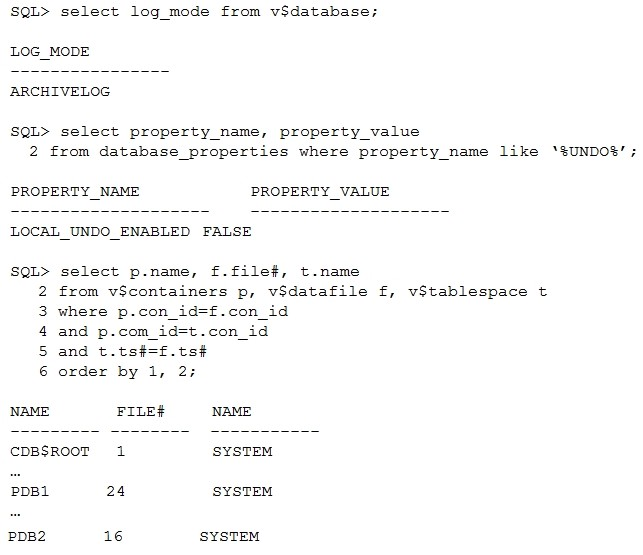 After a system crash, an instance restart and an attempted opening of the PDBs result in: 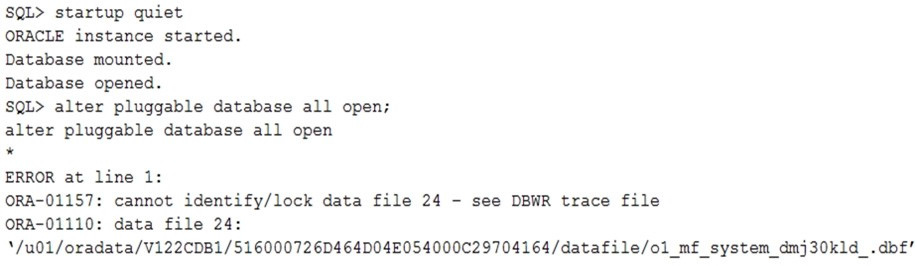 Which two are true? (Choose two.)
-
A
Data file 24 can be recovered while PDB2 is opened.
-
B
Data file 24 must be recovered while the CDB is opened.
-
C
Data file 24 can be recovered while CDB$ROOT and PDB$SEED are opened.
-
D
Data file 24 cannot be recovered while the CDB is opened.
-
E
Data file 24 must be recovered while PDB2 is closed.
Reveal answer details
Close answer details
Correct answersA, C
ExplanationDatafile 24 belongs to PDB1.
A. It can be recovered while CDB while PDB2 is opened, as it belongs to PDB1.
C. the datafile belongs to PDB1 and CAN be recovered while CDB is opened or in mount state.
Question 6
Multiple choice
You execute the following piece of code with appropriate privileges: 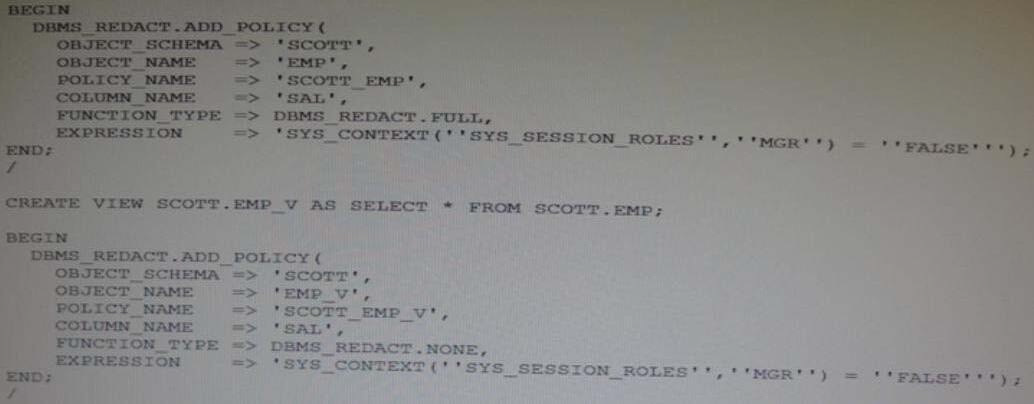 User SCOTT has been granted the CREATE SESSION privilege and the MGR role. Which two statements are true when a session logged in as SCOTT queries the SAL column in the view and the table?
-
A
DataisredactedfortheEMP.SALcolumnonlyiftheSCOTTsessiondoesnothavetheMGR role set.
-
B
DataisredactedforEMP.SALcolumnonlyiftheSCOTTsessionhastheMGRroleset.
-
C
Data is never redacted for the EMP_VW.SAL column.
-
D
Data is redacted for the EMP_V.SAL column only if the SCOTT session has the MGR role set.
-
E
Data is redacted for the EMP_V.SAL column only if the SCOTT session does not have the MGR role set. Correct
Reveal answer details
Close answer details
Correct answersA, C
ExplanationNote:
* DBMS_REDACT.FULL completely redacts the column data.
* DBMS_REDACT.NONE applies no redaction on the column data. Use this function for development testing purposes. LOB columns are not supported.
* The DBMS_REDACT package provides an interface to Oracle Data Redaction, which enables you to mask (redact) data that is returned from queries issued by low-privileged users or an application.
* If you create a view chain (that is, a view based on another view), then the Data Redaction policy also applies throughout this view chain. The policies remain in effect all of the way up through this view chain, but if another policy is created for one of these views, then for the columns affected in the subsequent views, this new policy takes precedence.
Examine this configuration: 1. CDB1 is an Oracle Database 12c Release 2 container database (CDB).
2. PDB1 and PDB2 are two pluggable databases (PDBs) in CDB1. After successfully performing all the preupgrade tasks, you execute these commands from the Oracle Database 18c environment: 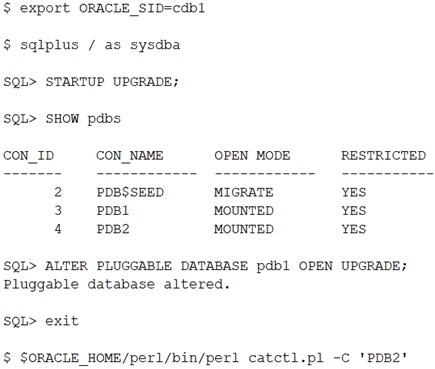 What is the outcome?
-
A
It fails because PDB$SEED is in MIGRATE state.
-
B
Only CDB$ROOT, PDB$SEED, and PDB2 are upgraded.
-
C
Only CDB$ROOT, PDB$SEED, and PDB1 are upgraded.
-
D
CDB$ROOT, PDB$SEED, PDB1, and PDB2 are upgraded.
-
E
Only CDB$ROOT and PDB$SEED are upgraded.
-
F
It fails because PDB2 is not in UPGRADE state.
Reveal answer details
Close answer details
Correct answerC
ExplanationC. Only CDB$ROOT, PDB$SEED, and PDB1 are upgraded. CDB$ROOT - In Upgrade MOde PDB$SEED - in Upgrade Mode PDB1 - In Upgrade Mode (Alter .. Open Upgrade) PDB2 - Excluded A - Incorrect
When a PDB is in open migrate mode, you can run database upgrade scripts on the PDB F-Incorrect -it's excluded.
Question 8
Multiple choice
Which two are true about the Automatic Database Diagnostic Monitor?
(ADDM)? (Choose two.)
-
A
When ADDM reports multiple findings, summing all their impacts can yield to more than 100% of DB time.
-
B
It runs automatically after each AWR snapshot.
-
C
By default it analyzes a period of time corresponding to the last 4 hours of activity.
-
D
Results are written to the alert log.
-
E
By default it analyzes a period of time corresponding to the last 24 hours of activity.
Reveal answer details
Close answer details
You plan to create a database by using the Database Configuration Assistant (DBCA), with t he following specifications: Applications will connect to the database via a middle tier. The number of concurrent user connections will be high. The database will have mixed workload, with t he execution of complex BI queries scheduled at night. Which DBCA option must you choose to create the database?
-
A
a General Purpose database template with default memory allocation
-
B
a Data Warehouse database template, with t he dedicated server mode option and AMM enabled
-
C
a General Purpose database template, with the shared server mode option and Automatic Memory Management (AMM) enabled
-
D
a default database configuration
Reveal answer details
Close answer details
Question 10
Multiple choice
You are managing this configuration: 1. CDB1 is a container database.
2. PDB1 and PDB2 are two pluggable databases in CDB1.
3. USER1.EMP is a table in PDB1 and USER2.DEPT is a table in PDB2. CDB1 user SYS executes these commands after connecting successfully to PDB2: 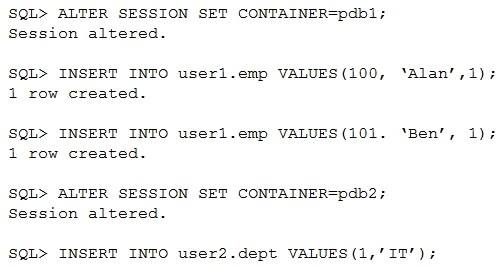 Which two are true? (Choose two.)
-
A
The inserts on USER1.EMP remain uncommitted when the session connected to PDB2.
-
B
The inserts on USER1.EMP were committed when the session inserted a row into USER2.DEPT.
-
C
The insert on USER2.DEPT fails because of the active transaction in the parent container.
-
D
The insert on USER2.DEPT is a recursive autonomous transaction by the child session and is committed.
-
E
The inserts on USER1.EMP were rolled back when the session connected to PDB2.
-
F
The insert on USER2.DEPT is uncommitted.
-
G
The inserts on USER1.EMP were committed when the session connected to PDB2.
Reveal answer details
Close answer details
Correct answersA, C
Explanationother session to check any transaction Version 19.5.0.0.0 SQL> SQL> alter session set container=ELC20MIG; Session altered. SQL> select * from user1.emp; no rows selected
Question 11
Multiple choice
Which two statements are true when row-archival management is enabled? (Choose two).
-
A
The ORA_ARCHIVE_STATE column may only be queried by users with the DBA role set.
-
B
The ORA_ARCHIVE_STATE column is visible if referenced in the select list of a query.
-
C
The ROW ARCHIVAL VISIBILITY session parameter defaults to active rows only.
-
D
The ORA_ARCHIVE_STATE column may only be updated by users with the DBA role set.
-
E
The ORA_ARCHIVE_STATE column is updated in an overnight maintenance job based on activity tracking.
Reveal answer details
Close answer details
Question 12
Multiple choice
Which two are true about Oracle instance recovery? (Choose two.)
-
A
Recovery begins from the beginning of the CURRENT redo log group.
-
B
Recovery begins from the last checkpoint position that was calculated by the Database Writer before instance failure.
-
C
Recovery begins from the start of any ACTIVE redo log group or the start of the CURRENT log group if no other group is ACTIVE.
-
D
Recovery reads redo until the end of the redo thread. SMON rolls back any dead transactions, and then the datanase is opened.
-
E
Recovery begins from the last checkpoint position that was recorded in the control file by the checkpoint process (CKPT).
-
F
Recovery reads redo until the end of the redo thread, and then opens the database. SMON then rolls
back any dead transactions.
Reveal answer details
Close answer details
Question 13
Multiple choice
RMAN has just been connected to a target database and the recovery catalog database. In which two cases would an automatic full resynchronization occur between this target database's control file and the RMAN recovery catalog? (Choose two.)
-
A
when control file metadata for archive log backups or image copies has been overwritten in the target database's control file due to being older than CONTROL_FILE_RECORD_KEEP_TIME
-
B
when control file metadata for data file backups or image copies has been overwritten in the target database's control file due to being older than CONTROL_FILE_RECORD_KEEP_TIME
-
C
when a new tablespace is added to a registered target database
-
D
when a backup of the current control file is created
-
E
when the target is first registered
Reveal answer details
Close answer details
Correct answersC, E
ExplanationIn a full resynchronization, RMAN updates all changed records, including those for the database schema.
RMAN performs a full resynchronization after structural changes to database (adding or dropping database files, creating new incarnation, and so on) or after changes to the RMAN persistent configuration. When a database is registered with a recovery catalog for the first time a full catalog synchronization is performed
https://docs.oracle.com/en/database/oracle/oracle-database/19/bradv/managing-recovery-catalog.html#GUID-6B077FE7-8E10-4603-8FDB-CAE3357E85C9 https://www.oracledistilled.com/oracle-database/backup-and-recovery/registering-a-database-with-a-recovery-catalog/#:~:text=Using%20RMAN%2C%20connect%20to%20both,register)%20and%20the%20recovery%20catalog.&text=Next%20issue%20the%20REGISTER%20DATABASE%20command%20to%20register%20the%20database.&text=When%20a%20database%20is%20registered,is%20performed%20(%20RESYNC%20CATALOG%20).
Question 14
Multiple choice
Which three are true about patchsets? (Choose three.)
-
A
They can be applied in a rolling fashion for Clusterware and the databases.
-
B
They can introduce new features.
-
C
They are installed via OPatch or OPatchAuto.
-
D
Installing a patchset is considered an "upgrade".
-
E
They are only released quarterly.
-
F
A base release is not needed to install patchsets.
Reveal answer details
Close answer details
Correct answersB, D, F
ExplanationBDF
A. They can be applied in a rolling fashion for Clusterware and the databases.
False - Can be applied rolling for clusterware only, because that's the only one we have multiple environments. Not for databases. B. They can introduce new features.
Correct C. They are installed via OPatch or OPatchAuto.
False - We can install via the OUI, the Oracle Universal Installer D. Installing a patchset is considered an upgrade.
Correct - We can install via the OUI, the Oracle Universal Installer, considered an upgrade for that. E. They are only released quarterly.
False - Its about PSU . They are released quarterly. Apply it on top of any given patch set. So they are cumulative patches. F. A base release is not needed to install patchsets. Correct - Full releases start with 11g R2. Don't carry a base release
Question 15
Single choice
Oracle Data Redaction is active on the SCOTT.EMP table.
You queried the table twice.
SQL> SELECT ENAME, SAL, COMM, MGR, HIREDATE FROM EMP WHERE DEPTNO=30; 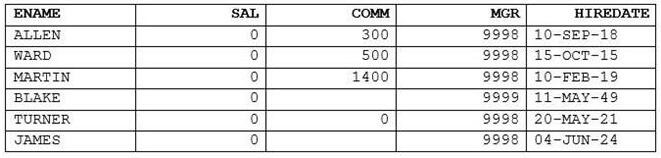 SQL> SELECT ENAME, SAL, COMM, MGR, HIREDATE FROM EMP WHERE DEPTNO=30; 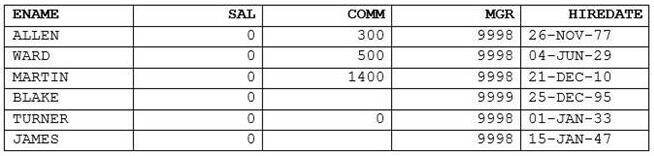 Which is guaranteed to be true concerning the redaction policy?
-
A
FULL redaction is active on the SAL column
-
B
RANDOM redaction is active on the MGR column
-
C
RANDOM redaction is active on the HIREDATE column
-
D
PARTIAL redaction is active on the MGR column.
-
E
PARTIAL redaction is active of the HIREDATE column.
Reveal answer details
Close answer details
Question 16
Multiple choice
You want to install Oracle Grid Infrastructure for a Standalone Server using Oracle Universal Installer (OUI). There is no existing Oracle installation on the server.
Which two are prerequisites?
(Choose two).
-
A
an operating system user to own this installation
-
B
the Oracle Inventory group oinstall
-
C
an operating system account called grid
-
D
-
E
the installation of Oracle ASMLIB
Reveal answer details
Close answer details
Question 17
Multiple choice
Your SALES_ROOT application container has two application PDBs. The SALES_APP application has a common table, FIN.REVENUE, in the two PDBs. Examine this query and its output:  Which two are true? (Choose two.)
-
A
The CONTAINERS clause cannot be used in queries on the REVENUE table.
-
B
The REVENUE table must be a list-partitioned table.
-
C
The MAPTABLE tables defines a logical partition key on a commonly used column for the REVENUE table.
-
D
The MAPTABLE table is a metadata-linked table.
-
E
A container map exists for the REVENUE table, but is not enabled.
-
F
The REVENUE table partitions are not pruned across the PDBs automatically.
Reveal answer details
Close answer details
Correct answersC, F
ExplanationC and F are correct.
Tested in lab with exact same setting like in the output shown. A. -> incorrect - The CONTAINERS clause can be used.
B. -> incorrect - It can be also a range based.
C. -> CORRECT -
https://docs.oracle.com/en/database/oracle/oracle-database/19/multi/administering-application-containers-with-sql-plus.html#GUID-AAF93A02-7C70-4024-8758-E351C213543E
D. -> incorrect - Regular table
E. -> incorrect - shown in the output CONTAINER_MAP = YES
F. -> CORRECT - because CONTAINERS_DEFAULT is not enabled for the revenue table.
Question 18
Multiple choice
Which three are true about requirements for various FLASHBACK operations? (Choose three.)
-
A
FLASHBACK transaction query requires undo to retrieve all versions of a row that existed between two points in time.
-
B
FLASHBACK drop requires that the RECYCLEBIN parameter be set to ON.
-
C
FLASHBACK version query requires that the RECYCLEBIN parameter be set to ON.
-
D
FLASHBACK DATA ARCHIVE requires undo to store all versions of all rows of a table being tracked.
-
E
FLASHBACK drop requires undo to retrieve all versions of a row that existed between two points in time.
-
F
FLASHBACK version query requires undo to retrieve all versions of a row that existed between two points in time.
Reveal answer details
Close answer details
Correct answersB, D, F
ExplanationA is incorrect. Although the statement "FLASHBACK transaction query requires undo" is true, it is asking to retrieve all versions of a row instead. The correct answer should be F which is FLASHBACK version query to retrieve versions between two point in time from undo. A. FLASHBACK transaction query requires undo to retrieve all versions of a row that existed between two
points in time.
F. FLASHBACK version query requires undo to retrieve all versions of a row that existed between two
points in time. References:
https://books.google.com.pk/books?id=0iwrL9P25Z0C&pg=PA35&lpg=PA35&dq=FLASHBACK
+transaction+query+requires+undo+to+retrieve+all+versions+of+a+row+that+existed+between+two +points+in +time&source=bl&ots=MJnYl5CZ1u&sig=ACfU3U0dWP-NPd- U8uu3zbaoi3YZzT0FTQ&hl=en&sa=X&ved=2ahUKEwigi5_Jl9joAhXzUBUIHUh4DksQ6AEwAnoECAsQJg #v=onepage&q=FLASHBACK%20transaction%20query%20requires%20undo%20to%20retrieve%20all% 20versions%20of%20a%20row%20that%20existed%20between%20two%20points%20in%20time&f=false (https://docs.oracle.com/cd/E18283_01/server.112/e17120/tables011.htm)
Question 19
Multiple choice
Which two statements are true about Resource Manager plans for individual pluggable databases (PDB plans) in a multitenant container database (CDB)?
-
A
If no PDB plan is enabled for a pluggable database, then all sessions for that PDB are treated to an equal degree of the resource share of that PDB.
-
B
In a PDB plan, subplans may be used with up to eight consumer groups.
-
C
If a PDB plan is enabled for a pluggable database, then resources are allocated to consumer groups across all PDBs in the CDB.
-
D
If no PDB plan is enabled for a pluggable database, then the PDB share in the CDB plan is dynamically calculated.
-
E
If a PDB plan is enabled for a pluggable database, then resources are allocated to consumer groups based on the shares provided to the PDB in the CDB plan and the shares provided to the consumer groups in the PDB plan.
Reveal answer details
Close answer details
Correct answersA, E
ExplanationA: Setting a PDB resource plan is optional. If not specified, all sessions within the PDB are treated equally.
In a non-CDB database, workloads within a database are managed with resource plans.
In a PDB, workloads are also managed with resource plans, also called PDB resource plans.
The functionality is similar except for the following differences: Non-CDB Database Multi-level resource plans
Up to 32 consumer groups Subplans PDB Database
Single-level resource plans only
Up to 8 consumer groups
(Not B) No subplans
Question 20
Multiple choice
Examine this configuration: 1. CDB1 is a container database.
2. PDB1 and PDB2 are pluggable databases in CDB1.
3. PDB1 and PDB2 are OPEN in READ WRITE mode. You execute these commands successfully: 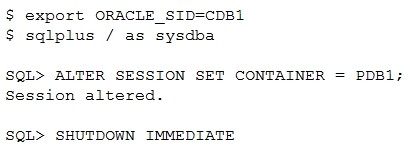 Which two are true? (Choose two.)
-
A
Uncommitted transactions in PDB1 have been rolled back.
-
B
-
C
Uncommitted transactions in CDB1 and PDB1 have been rolled back.
-
D
-
E
Reveal answer details
Close answer details
Question 21
Multiple choice
Which three statements are true about the key store storage framework for transparent data encryption?
-
A
It facilitates and helps to enforce keystore backup requirements.
-
B
It handles encrypted data without modifying applications.
-
C
It enables a keystore to be stored only in a file on a file system.
-
D
It enables separation of duties between the database administrator and the security administrator.
-
E
It transparently decrypts data for the database users and applications that access this data.
-
F
It helps to track encryption keys and implement requirements such as keystore password rotation and master encryption key reset or re-key operations.
Reveal answer details
Close answer details
Correct answersA, D, F
ExplanationReferences:
http://oradb-srv.wlv.ac.uk/E16655_01/network.121/e17729/asotrans.htm#CHDEABCA
(benefits of the keystore storage framework)
Question 22
Multiple choice
Which two are true about the Automatic Database Diasnostic Monitor (ADDM)? (Choose two.)
-
A
It analyzes a period of time corresponding to the 12 hours of activity.
-
B
It runs automatically after each AWR snapshot.
-
C
A DBA can run it manually.
-
D
Results are written to the alert log.
-
E
It analyzes a period of time corresponding to the last day of activity.
Reveal answer details
Close answer details
Correct answersB, C
ExplanationResults are written to the alert log. -Incorrect .. stores in AWR not in alert logfile.
Question 23
Multiple choice
Which three are true about the Oracle Optimizer? (Choose three.)
-
A
-
B
It considers the filters in WHERE clauses when generating execution plans for SQL statements.
-
C
It can re-optimize execution plans after previous executions detect suboptimal plans.
-
D
It considers object statistics when generating execution plans for SQL statements.
-
E
It updates stale object statistics in the Data Dictionary.
-
F
It can only use SQL Plan Directives tied to the SQL statement for which a plan is being generated.
Reveal answer details
Close answer details
Question 24
Multiple choice
Which three statements are true about Flashback Data Archive?
-
A
To use Flashback Data Archive, users must have unlimited quota on the Flashback Data Archive tablespace.
-
B
To enable Flashback Data Archive for a table, it is mandatory to have a default Flashback Data Archive for a database
-
C
While enabling Flashback Data Archive for a table, if no name is provided for Flashback Data Archive, it is enabled using the default Flashback Data Archive.
-
D
A table enabled for Flashback Data Archive cannot be dropped unless Flashback Data Archive is disabled or disassociated first.
-
E
Flashback Data Archive prevents flashback queries from getting a snapshot-too-old error.
Reveal answer details
Close answer details
Question 25
Single choice
Unified auditing is enabled in your database. The HR_ADMIN and OE_ADMIN roles exist and are granted system privileges. You execute the command: SQL>CREATE AUDIT POLICY tab1e_aud PRIVILEGES CREATE ANY TABLE, DROP ANY TABLE
ROLES hr_admin, oe_admin; Which statement is true?
-
A
It succeeds and needs to be enabled to capture all SQL statements that require either the specified privileges or any privilege granted to the HR_ADMIN or OE_ADMIN role.
-
B
It fails because the command does notspecify when the unified audit policy should be enforced.
-
C
It succeeds and starts capturing only successful SQL statements for all users who have either the specified privileges or roles granted to them.
-
D
It fails because system privileges cannot be granted with roles in the same audit policy.
Reveal answer details
Close answer details
Correct answerA
ExplanationAfter you create the policy, you must enable it by using the AUDIT statement.
AUDIT POLICY { policy_auditing }
[WHENEVER [NOT] SUCCESSFUL];
Question 26
Multiple choice
Which two are true about automatic block repair? (Choose two.)
-
A
Automatic block repair can repair blocks with no standby database if DB_BLOCK_CHECKING = TRUE.
-
B
Real-Time Query must be enabled on a physical standby database for automatic block repair to be done on that physical standby database.
-
C
Real-Time Query must be enabled on a primary database for automatic block repair to be done on any of its physical standby databases.
-
D
It is not possible for media corrupt blocks.
-
E
Real-Time Query must be enabled on a physical standby database for automatic block repair to be done on its primary database.
Reveal answer details
Close answer details
Correct answersB, E
ExplanationBE -> In both cases to repair (Primary or Physical Databases) you must enable RTQ on the Physical
Database.
Question 27
Multiple choice
A container database (CDB) contains two pluggable databases PDB1 and PDB2. The LOCAL_UNDO_ENABLED database property is set to FALSE in the CDB. Data file 24 of PDB2 was deleted and you need to restore and recover it. The only RMAN backup that exists was created with the BACKUP DATABASE command while connected to CDB$ROOT. Which three are true? (Choose three.)
-
A
Data file 24 can be recovered only while connected to PDB2.
-
B
Data file 24 can be restored and recovered while connected to CDB$ROOT.
-
C
Data file 24 can be restored only while connected to CDB$ROOT.
-
D
Data file 24 can be restored only while connected to PDB2.
-
E
Data file 24 can be recovered while connected to PDB2.
-
F
Data file 24 can be recovered while connected to CDB$ROOT.
Reveal answer details
Close answer details
Correct answersB, E, F
ExplanationRestoration AND recovery can be done by CDB$ROOT. Recovery can be done by CDB$ROOT or the
PDB in question.
Question 28
Single choice
Examine the RMAN command: RMAN> RUN {
ALLOCATE CHANNEL c1 DEVICE TYPE sbt;
ALLOCATE CHANNEL c2 DEVICE TYPE sbt;
ALLOCATE CHANNEL c3 DEVICE TYPE sbt;
BACKUP
INCREMENTAL LEVEL = 0
(DATAFILE 1,4,5 CHANNEL c1)
(DATAFILE 2,3,9 CHANNEL c2)
(DATAFILE 6,7,8 CHANNEL c3);
SQL 'ALTER SYSTEM ARCHIVE LOG CURRENT';
}Which statement is true about the command?
-
A
The RMAN multiplexing level is 4.
-
B
It is the use of asynchronous I/O by RMAN.
-
C
It is a case of parallelization of the backup set.
-
D
It is an implementation of a multisection backup.
Reveal answer details
Close answer details
Question 29
Multiple choice
(Choose two) You configured the Fast Recovery Area (FRA) for your database. The database instance is in ARCHIVELOG mode. The default location for the archived redo log files is the FRA. Which two files are removed automatically if space is required in the FRA as per the retention policy?
-
A
user-managed backups of data files and control files
-
B
-
C
RMAN backups that are obsolete
-
D
archived redo log files that have multiple copies in a different archive location
Reveal answer details
Close answer details
Question 30
Multiple choice
Which three statements are true about Automatic Workload Repository (AWR)?
-
A
All AWR tables belong to the SYSTEM schema.
-
B
The AWR data is stored in memory and in the database.
-
C
The snapshots collected by AWR are used by the self-tuning components in the database
-
D
AWR computes time model statistics based on time usage for activities, which are displayed in the v$SYS time model and V$SESS_TIME_MODEL views.
-
E
AWR contains system wide tracing and logging information.
Reveal answer details
Close answer details
Question 31
Multiple choice
Which two are true about an Oracle gold image-based installation in Oracle 18c and later releases? (Choose two.)
-
A
It can be used for both Oracle Database and Oracle Grid Infrastructure installation.
-
B
It can only install and configure Oracle Database software. The database has to be created separately.
-
C
It does not require the setup wizard.
-
D
It uses a single RPM that automatically extracts and installs the Oracle Database software.
-
E
It can be used to install and upgrade Oracle Database for single-instance and cluster configurations.
Reveal answer details
Close answer details
Question 32
Single choice
You notice performance degradation in your production Oracle 12c database. You want to know what caused this performance difference. Which method or feature should you use?
-
A
-
B
Automatic Database Diagnostic Monitor (ADDM) Compare Period report
-
C
Active Session History (ASH) report
-
D
Reveal answer details
Close answer details
Question 33
Multiple choice
Which two are true about OS groups and users for Oracle Grid Infrastructure and the Oracle Relational Database Management System (RDBMS)? (Choose two.)
-
A
By default, members of the OSASM group can access Automatic Storage Management and RDBMS instances.
-
B
The primary group for the Oracle Grid Infrastructure and Oracle Database owners must be the Oracle Inventory group.
-
C
The Oracle Grid Infrastructure installation must be owned by the grid user.
-
D
The Oracle Grid Infrastructure owner owns Oracle Restart and Oracle Automatic Storage Management binaries.
-
E
The Oracle Grid Infrastructure owner must have OSOPER, OSBACKUPDBA, and OSKMDBA as secondary groups.
-
F
The same OSDBA group must be used for Automatic Storage Management and the Oracle Database.
Reveal answer details
Close answer details
Correct answersB, D
ExplanationA - false - Members of this group are granted the SYSASM system privilege to administer Oracle ASM.SYSASM system privileges do not grant access privileges on an Oracle Database instance.
B- Correct -
C - false Only if you wish to define role separation but is not a must
D - correct
E- false OSOPER is optional is not a must F - the same OSDBA could be used but is not a must ( usually SYSDBA and SYSASM are used for separation us duties ) References:
https://docs.oracle.com/database/121/CWWIN/usrgrps.htm#CWWIN-GUID-6FD3C6AE-5A99-4C6D-85D6-868CBA6F5DAE
Question 34
Multiple choice
Which three are true about backing up the control file? (Choose three).
-
A
It cannot be backed up manually as a binary copy.
-
B
It gets backed up automatically by RMAN as a trace file containing SQL statements for control file recreation when a database backup occurs.
-
C
It can be backed up manually as a binary copy.
-
D
It can get backed up automatically as a binary copy.
-
E
It gets backed up automatically by RMAN when the BACKUP SPFILE command is used.
-
F
It can be backed up manually as a trace file containing SQL statements for control file recreation.
Reveal answer details
Close answer details
Question 35
Multiple choice
Which two are true about Oracle Flashback features? (Choose two.)
-
A
FLASHBACK QUERY can retrieve REDO records from ONLINE and ARCHIVED REDO LOG files.
-
B
FLASHBACK VERSION QUERY can retrieve REDO records from ONLINE and ARCHIVED REDO
LOG files.
-
C
FLASHBACK TABLE can undrop a column.
-
D
FLASHBACK DROP can undrop an index when undropping a table.
-
E
After a database is restored from flashback logs using the FLASHBACK DATABASE command, it is
sometimes rolled forward using redo logs.
Reveal answer details
Close answer details
Correct answersD, E
ExplanationA, B are Wrong. Flashback Query & Version Query need Undo not Redo
C is Wrong.
D is Correct. Assuming that an index is not dropped before dropping a table.
E is Correct
Question 36
Multiple choice
Which three are true about Automatic Workload Repository (AWR) snapshots? (Choose three.)
-
A
They are generated if STATISTICS_LEVEL is set to TYPICAL.
-
B
They are generated if STATISTICS_LEVEL is set to ALL.
-
C
They are always created automatically.
-
D
They are always created manually.
-
E
They can be retained forever.
-
F
They are generated if STATISTICS_LEVEL is set to BASIC.
Reveal answer details
Close answer details
Correct answersA, B, E
ExplanationA - TRUE. Only STATISTICS_LEVEL=BASIC stops them being generated
B - TRUE. Only STATISTICS_LEVEL=BASIC stops them being generated
C - FALSE. You can create them manually.
D - FALSE. The DB will, by default, create them automatically every hour
E - TRUE. You can setup AWR Warehouse, allowing these reports to be kept, and queried, forever.
F - FALSE. STATISTICS_LEVEL=BASIC stops them being generated So, ABE is correct. Ref:
https://docs.oracle.com/en/database/oracle/oracle-database/19/refrn/STATISTICS_LEVEL.html
Question 37
Multiple choice
Which three are true about managing memory components in an Oracle database instance? (Choose three.)
-
A
With Automatic Shared Memory Management, the database instance can increase the Large Pool size by reducing the Shared Pool size.
-
B
With Automatic Memory Management, the database instance can increase the System Global Area size by reducing the Program Global Area size.
-
C
Automatically tuned and resized System Global Area components will always revert to their initial sizes after an instance restart.
-
D
Automatic Memory Management must be used together with locking the System Global Area into physical memory.
-
E
With Automatic Shared Memory Management, the database instance can increase the Program Global Area size by reducing the System Global Area size.
-
F
On Line Transaction Processing systems often use less Program Global Area than Decision Support Systems.
Reveal answer details
Close answer details
Correct answersA, B, F
Explanationin AMM the instance exchanges memory between the SGA and the instance PGA as needed (B is correct)
In ASMM the instance automatically distributes this memory among the various SGA components (JUST SGA) (A is correct, E incorrect)
After a restart the instance return to the SGA values before the shutdown (not the initial values) (C incorrect)
https://docs.oracle.com/en/database/oracle/oracle-database/19/admin/managing-memory.html#GUID-8F54391B-D42A-4FDA-9D12-E1F81FD113EA F is also correct: For OLTP systems, the PGA memory typically makes up a small fraction of the available memory, leaving most of the remaining memory for the SGA.
For DSS systems running large, memory-intensive queries, PGA memory can typically use up to 70% of the available memory. References:
https://docs.oracle.com/database/121/TGDBA/tune_shared_pool.htm
https://docs.oracle.com/database/121/TGDBA/tune_pga.htm#TGDBA472
Question 38
Multiple choice
Which three are true about unified auditing in full mode? (Choose three)
-
A
The unified audit trail is written to a read-only table.
-
B
The unified audit trail is written to a read-only external file.
-
C
Audit records are created for COMMIT, ROLLBACK, and SAVEPOINT statements.
-
D
Audit records are created for SYS.
-
E
Audit records are created for non-sys users.
Reveal answer details
Close answer details
Question 39
Single choice
On the 10th of August, you implement an incremental database backup strategy and configure a recovery window of five days. Level 0 backups are taken on the 10th, 17th, and 24th of August. Differential level 1 incremental backups are taken daily between the level 0 backups. Today is the 26th of August. Which backups will be obsolete?
-
A
all backups prior to 10th of August
-
B
all backups prior to 22nd of August
-
C
all backups prior to 24th of August
-
D
all backups prior to 20th of August
-
E
all backups prior to 17th of August
Reveal answer details
Close answer details
Question 40
Multiple choice
Which three capabilities require the use of the RMAN recovery catalog? (Choose three.)
-
A
using the KEEP FOREVER clause with the BACKUP command
-
B
using RMAN stored scripts
-
C
using the REPORT SCHEMA command to list a database's current data files and tablespaces
-
D
creating customized reports about a single database's backups
-
E
creating encrypted backups
-
F
using the REPORT SCHEMA command to list a database's data files and tablespaces at times in the past
Reveal answer details
Close answer details
Correct answersA, B, F
ExplanationA is correct:
https://docs.oracle.com/en/database/oracle/oracle-database/19/rcmrf/keepOption.html
"Specifies that the backup or copy never becomes obsolete (see Example 2-27). A recovery catalog is required when FOREVER is specified because the backup records eventually age out of the control file." B is correct:
https://docs.oracle.com/database/121/RCMRF/rcmsynta013.htm
"Execute CREATE SCRIPT only at the RMAN prompt. RMAN must be connected to a target database and a recovery catalog." F is correct:
https://docs.oracle.com/en/database/oracle/oracle-database/19/rcmrf/REPORT.html
"atClause This subclause specifies a point in time as a time, SCN, or log sequence number. You must be connected to a recovery catalog when issuing a REPORT SCHEMA command with an AT clause." References:
https://docs.oracle.com/en/database/oracle/oracle-database/19/bradv/managing-recovery-catalog.html#GUID-2491887B-D9AC-48BE-914D-CB0341A77057
Question 41
Multiple choice
The CATDB12c database contains an Oracle Database version 12c catalog schema owned by the RC12C user. The RCAT11 database contains an Oracle Database version 11g catalog schema owned by the RC11 user in which several databases are registered. Both the databases are open. You execute the RMAN commands: RMAN> CONNECT CATALOG rc12c/pass12c@catdb12c
RMAN> IMPORT CATALOG rc11/pwdcat11@ract11 Which two tasks are performed as part of the import? (Choose two.)
-
A
Databases from the RC12C catalog are implicitly unregistered if the RC11 catalog has registered databases with same name.
-
B
Recovery catalog is resynchronized with the control files of the registered databases.
-
C
Imported databases are unregistered from the RC11 catalog.
-
D
Local and global stored scripts that have the same name as existing scripts in the RC12C catalog are automatically renamed.
-
E
All databases registered in the RC11 catalog are registered in the RC12C catalog.
Reveal answer details
Close answer details
Correct answersC, E
ExplanationBy default, the imported database IDs are unregistered from the source recovery catalog schema after a successful import. It is possible for global scripts, but not local scripts, to have name conflicts during import because the destination schema contains an object with the same name. In this case, RMAN renames the global script name to COPY OF script_name.
For example, RMAN renames bp_cmd to COPY OF bp_cmd
https://docs.oracle.com/database/121/RCMRF/rcmsynta026.htm#RCMRF198
|