Question 1
Multiple choice
Examine the description of the customers table: 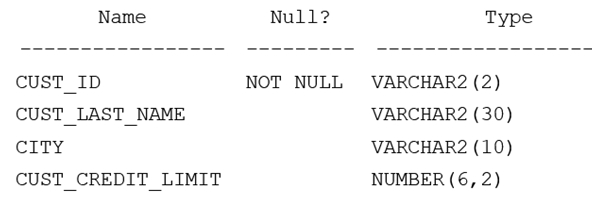 You need to display last names and credit limits of all customers whose last name starts with A or B in lower or upper case, and whose credit limit Is below 1000. Examine this partial query: SELECT cust_last_name, cust_credit_limit FROM customers Which two where conditions give the required result? 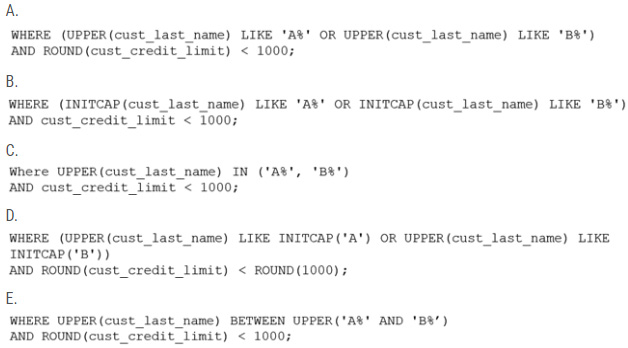
-
A
-
B
-
C
-
D
-
E
Reveal answer details
Close answer details
Question 2
Multiple choice
Examine the description of the members table: 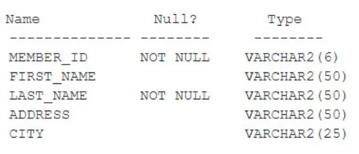 Examine the partial query: SELECT city, last_name LNAME FROM members ...; You want to display all cities that contain the string an. The cities must be returned in ascending order, with the last names further sorted in descending order. Which two clauses must you add to the query?
-
A
-
B
-
C
-
D
-
E
-
F
ORDER BY last_name DESC, city ASC
Reveal answer details
Close answer details
Question 3
Multiple choice
Which three actions are ways to apply the principle of least privilege? (Choose three.)
-
A
setting the O7_DICTIONARY_ACCESSIBILITY parameter to true
-
B
setting the REMOTE_OS_AUTHENT parameter to true
-
C
revoking execute privilege on UTL_SMTP, UTL_TCP, UTL_HTTP, and UTL_FILE from the SYSTEM
user
-
D
enabling Unified Auditing
-
E
using Access Control Lists (ACLs)
-
F
revoking execute privilege on UTL_SMTP, UTL_TCP, UTL_HTTP, and UTL_FILE from the public user
Reveal answer details
Close answer details
Question 4
Multiple choice
Which two statements are true about UNDO and REDO? (Choose two.)
-
A
The generation of UNDO generates REDO
-
B
DML modifies Oracle database objects and only generates UNDO
-
C
The generation of REDO generates UNDO
-
D
DML modifies Oracle database objects and only generates REDO
-
E
DML modifies Oracle database objects and generates UNDO and REDO
Reveal answer details
Close answer details
Correct answersA, E
Explanation... undo is stored in redo logs also. During roll forward phase of instance/media recovery, as changes (redo in redo logs) are applied to datafiles, undo stored in redo logs is used to generate undo segments. These segments are subsequently used to rollback uncommitted changes during rollback phase of instance/ media recovery. https://www.experts-exchange.com/articles/13880/UNDO-AND-REDO-IN-ORACLE.html
Question 5
Multiple choice
Examine these statements executed in a single Oracle session: 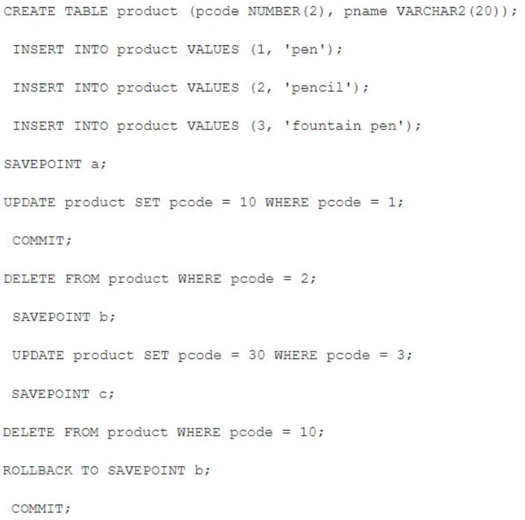 Which three statements are true? (Choose three.)
-
A
-
B
There is no row containing fountain pen.
-
C
There is no row containing pen.
-
D
The code for fountain pen is 3.
-
E
-
F
There is no row containing pencil.
Reveal answer details
Close answer details
Question 6
Multiple choice
Examine the description of the CUSTOMERS table: 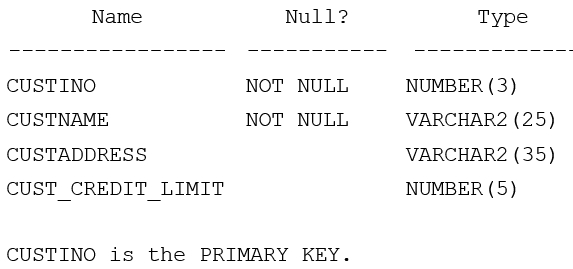 You must determine if any customers' details have been entered more than once using a different CUSTINO, by listing all duplicate names. Which two methods can you use to get the required result? (Choose two.)
-
A
-
B
-
C
LEFT OUTER JOIN with self join
-
D
RIGHT OUTER JOIN With self join
-
E
FULL OUTER JOIN with self join
Reveal answer details
Close answer details
Question 7
Multiple choice
Which three statements are true about the tools used to configure Oracle Net Services? (Choose three.)
-
A
The Oracle Net Configuration Assistant is only used when running the Oracle installer
-
B
Oracle Net Manager can be used to centrally configure listeners on any database server target
-
C
The lsnrctl utility requires a listener.ora file to exist before it is started
-
D
Oracle Net Manager can be used to locally configure naming methods on a database server
-
E
Enterprise Manager Cloud Control can be used to centrally configure listeners on any managed database server
-
F
Enterprise Manager Cloud Control can be used to centrally configure net service names for any database server target
Reveal answer details
Close answer details
Correct answersD, E, F
ExplanationOracle Net Manager to locally control and Enterprise Manager Cloud Control to centrally control.
https://docs.oracle.com/en/database/oracle/oracle-database/19/netag/introducing-oracle-net-services.html#GUID-6B1F0584-887D-4D2A-B982-40ACF15DF985
1. Oracle Enterprise Manager Cloud Control combines configuration functionality across multiple file systems, along with listener administrative control to provide an integrated environment for configuring and managing Oracle Net Services.
2. Oracle Net Manager provides configuration functionality for an Oracle home on a local client or server host.
Question 8
Multiple choice
Which two are true about shrinking a segment online? (Choose two.)
-
A
It is not possible to shrink either indexes or Index Organized Tables (IOTs)
-
B
It always eliminates all migrated rows if any exist in the table
-
C
To shrink a table it must have a PRIMARY KEY constraint
-
D
To shrink a table it must have a UNIQUE KEY constraint
-
E
To shrink a table it must have row movement enabled
-
F
It must be in a tablespace that uses Automatic Segment Space Management (ASSM)
Reveal answer details
Close answer details
Correct answersE, F
ExplanationReferences:
https://docs.oracle.com/cd/B19306_01/server.102/b14200/statements_3001.htm
Question 9
Multiple choice
Which two statements are true about Enterprise Manager (EM) Express?
-
A
You can use a single instance of EM Express to manage multiple database running on the same server.
-
B
EM Express uses a separate repository database to store target database metadata.
-
C
By default, EM express is available for a database after database creation using DBCA.
-
D
You can shut down a database instance using EM Express.
-
E
You cannot start up a database instance using EM Express.
Reveal answer details
Close answer details
Question 10
Multiple choice
Which two statements are true about undo segments and the use of undo by transactions in an Oracle database instance? (Choose two.)
-
A
Undo segments can be stored in the SYSAUX tablespace.
-
B
Undo segments can wrap around to the first extent when a transaction fills the last extend of the undo segment.
-
C
A single transaction may use multiple undo segments simultaneously.
-
D
Undo segments can extend when a transaction fills the last extent of the undo segment.
-
E
Undo segments can be stored in the SYSTEM tablespace.
Reveal answer details
Close answer details
Question 11
Multiple choice
Examine these commands: 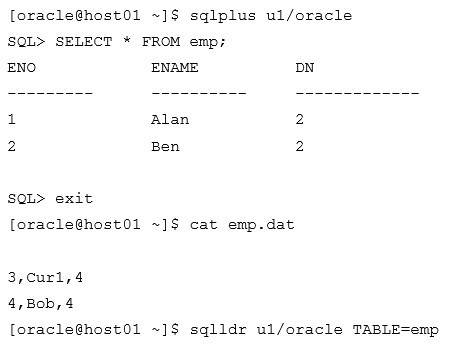 Which two statements are true about the sqlldr execution? (Choose two.)
-
A
It overwrites data in EMP with data in EMP.DAT
-
B
It uses the database buffer cache to load data
-
C
It generates a log that contains control file entries, which can be used with normal SQL*Loader operations
-
D
It generates a sql script that it uses to load data from EMP.DAT to EMP
-
E
It appends data from EMP.DAT to EMP
Reveal answer details
Close answer details
Correct answersC, E
ExplanationOption C & E are correct - ..."SQL*Loader express mode generates a log file that includes a SQL*Loader control file. The log file also contains SQL scripts for creating the external table and performing the load using a SQL INSERT AS SELECT statement. Neither the control file nor the SQL scripts are used by SQL*Loader express mode. They are made available to you in case you want to use them as a starting point to perform operations using regular SQL*Loader or standalone external tables; the control file is for
use with SQL*Loader, whereas the SQL scripts are for use with standalone external tables operations."
Question 12
Multiple choice
Which two statements are true about the rules of precedence for operators? (Choose two.)
-
A
The concatenation operator | | is always evaluated before addition and subtraction in an expression
-
B
NULLS influence the precedence of operators in an expression
-
C
The + binary operator has the highest precedence in an expression in a SQL statement
-
D
Arithmetic operators with equal precedence are evaluated from left to right within an expression
-
E
Multiple parentheses can be used to override the default precedence of operators in an expression
Reveal answer details
Close answer details
Correct answersD, E
ExplanationReferences:
https://docs.oracle.com/cd/B19306_01/server.102/b14200/operators001.htm
https://docs.oracle.com/cd/A87860_01/doc/server.817/a85397/operator.htm
Precedence is the order in which Oracle evaluates different operators in the same expression. When evaluating an expression containing multiple operators, Oracle evaluates operators with higher precedence before evaluating those with lower precedence. Oracle evaluates operators with equal precedence from left to right within an expression.
Question 13
Multiple choice
Which two statements are true about UNDO and UNDO tablespaces? (Choose two.)
-
A
There can be only one UNDO tablespace created in a database.
-
B
An instance will crash if the active undo tablespace is lost.
-
C
An UNDO tablespace may be owned by only one instance.
-
D
UNDO segments are owned by SYSTEM.
-
E
UNDO segments are owned by SYSBACKUP.
Reveal answer details
Close answer details
Question 14
Multiple choice
Which three statements are true concerning logical and physical database structures? (Choose three.)
-
A
All tablespaces may have one or more data files
-
B
The extents of a segment must always reside in the same datafile
-
C
A smallfile tablespace might be bigger than a bigfile tablespace
-
D
A segment can span multiple data files in some tablespaces
-
E
A segment's blocks can be of different sizes
-
F
A segment might have only one extent
-
G
Segments can span multiple tablespaces
Reveal answer details
Close answer details
Question 15
Multiple choice
Which two statements are true about the ORDER BY clause? (Choose two.)
-
A
Only columns that are specified in the SELECT list can be used in the ORDER BY clause.
-
B
Numeric values are displayed in descending order if they have decimal positions.
-
C
NULLS are not included in the sort operation.
-
D
Column aliases can be used in the ORDER BY clause.
-
E
In a character sort, the values are case-sensitive.
Reveal answer details
Close answer details
Question 16
Multiple choice
While one of your databases was in mount state, the datafiles were renamed because they had been moved to a new file system. The database was then opened. Which two statements are true?
-
A
DBA_DATA_FILES displays the original name for the data files.
-
B
V$DATAFILE displays the new names for the data files.
-
C
DBA_DATA_FILES displays both the new name and the old name for the data files.
-
D
DBA_DATA_FILES displays the new name for the data files.
-
E
DBA_DATA_FILES must be resynchronized manually with the control file an order to have it display the new file names.
Reveal answer details
Close answer details
Question 17
Single choice
Which statement is true about aggregate functions?
-
A
Aggregate functions can be nested to any number of levels
-
B
The AVG function implicitly converts NULLS to zero
-
C
Aggregate functions can be used in any clause of a SELECT statement
-
D
The MAX and MIN functions can be used on columns with character data types
Reveal answer details
Close answer details
Question 18
Multiple choice
Which three are benefits of using temp UNDO when performing DML on global temporary tables? (Choose three.)
-
A
It reduces the amount of redo generated.
-
B
It permits DML on Global temporary tables even if the database is opened read only.
-
C
It reduces I/Os to the SYSAUX tablespace.
-
D
It reduces I/Os to the SYSTEM tablespace.
-
E
It reduces the amount of UNDO stored in the UNDO tablespace.
Reveal answer details
Close answer details
Question 19
Multiple choice
The orders table has a column ORDER_DATE of data type DATE. The default display format for a date is DD-MON-RR. Which two WHERE conditions demonstrate the correct usage of conversion functions? (Choose two.)
-
A
WHERE order_date > TO_DATE(ADD_MONTHS(SYSDATE, 6), 'MON DD YYYY')
-
B
WHERE order dare > TO DATE('JUL 10 2018', 'MON DD YYYY')
-
C
WHERE TO_CHAR(order date, 'MON DD YYYY') = 'JAN 20 2019'
-
D
WHERE order_date > TO_CHAR(ADD_MONTHS(SYSDATE, 6), 'MON DD YYYY')
-
E
WHERE order_date IN (TO_DATE('Oct 21 2018', 'Mon DD YYYY'), TO_CHAR('Nov 21 2018', 'Mon DD
YYYY'))
Reveal answer details
Close answer details
Question 20
Multiple choice
Which three statements are true about the DESCRIBE command? (Choose three.)
-
A
It displays the PRIMARY KEY constraint for any column or columns that have that constraint
-
B
It can be used from SQL Developer
-
C
It displays the NOT NULL constraint for any columns that have that constraint
-
D
It can be used to display the structure of an existing view
-
E
It displays all constraints that are defined for each column
-
F
It can be used only from SQL*Plus
Reveal answer details
Close answer details
Question 21
Multiple choice
Which three statements are true about undo segments and the use of undo by transactions in an Oracle database instance? (Choose three.)
-
A
An undo segment may be used by multiple transactions simultaneously
-
B
Undo segments can wrap around to the first extent when a transaction fills the last extend of the undo segment
-
C
Undo segments have a minimum of three extents
-
D
Undo segments can extend when a transaction fills the last extent of the undo segment
-
E
A single transaction may use multiple undo segments simultaneously
-
F
Undo segments must be stored in a BIGFILE tablespace
-
G
Undo segments must be stored in a SMALLFILE tablespace
Reveal answer details
Close answer details
Question 22
Multiple choice
Which two statements are true about views used for viewing tablespace and datafile information? (Choose two.)
-
A
Tablespace free space can be viewed in V$TABLESPACE
-
B
V$TABLESPACE displays information that is contained in the controlfile about tablespaces
-
C
V$TABLESPACE displays information about tablespaces contained in the data dictionary
-
D
Tablespace free space can be viewed in DBA_TABLESPACES
-
E
A datafile can be renamed when the database is in MOUNT state and the new file name is displayed when querying DBA_DATA_FILES after the database is opened
Reveal answer details
Close answer details
Correct answersB, E
ExplanationSQL> shutdown immediate;
Database closed. Option E is correct.
Database dismounted.
ORACLE instance shut down.
SQL> startup mount;
ORACLE instance started. Total System Global Area 1375731600 bytes
Fixed Size 8896400 bytes
Variable Size 838860800 bytes
Database Buffers 520093696 bytes
Redo Buffers 7880704 bytes
Database mounted.
SQL> alter database move datafile '/oradata/ORA19/testing1.dbf' to '/oradata/ORA19/testing01.dbf';
Question 23
Multiple choice
Which three statements are true about inner and outer joins? (Choose three.)
-
A
A full outer join returns matched and unmatched rows
-
B
An inner join returns matched rows
-
C
Outer joins can only be used between two tables per query
-
D
A full outer join must use Oracle syntax
-
E
Outer joins can be used when there are multiple join conditions on two tables
-
F
A left or right outer join returns only unmatched rows
Reveal answer details
Close answer details
Correct answersA, B, E
ExplanationOption E. Outer joins can be used when there are multiple join conditions on two tables can be like following query:
- select * from table a left join table1 b on a.col1 = b.col1 and a.col2=b.col2; References:
https://www.studytonight.com/dbms/joining-in-sql.php
Question 24
Multiple choice
Examine the description of the SALES table: 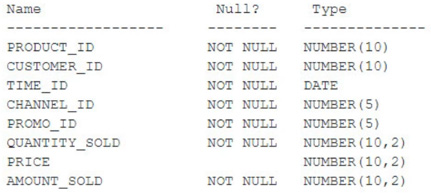 The SALES table has 55,000 rows. Examine this statement:  Which two statements are true? (Choose two.)
-
A
SALES1 has NOT NULL constraints on any selected columns which had those constraints in the SALES table.
-
B
SALES1 has primary KEY and UNIQUE constraints on any selected columns which had those constraints in the SALES table.
-
C
SALES1 is created with 55,000 rows.
-
D
SALES1 is created with no rows.
-
E
SALES1 is created with 1 row.
Reveal answer details
Close answer details
Question 25
Multiple choice
Evaluate these commands which execute successfully: 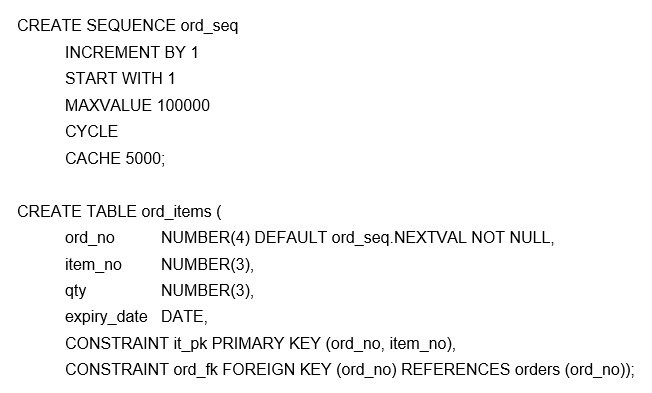 Which two statements are true about the ORD_ITEMS table and the ORD_SEQ sequence? (Choose two.)
-
A
If sequence ORD_SEQ is dropped then the default value for column ORD_NO will be NULL for rows
inserted into ORD_ITEMS
-
B
Any user inserting rows into table ORD_ITEMS must have been granted access to sequence ORD_SEQ
-
C
Column ORD_NO gets the next number from sequence ORD_SEQ whenever a row is inserted into ORD_ITEMS and no explicit value is given for ORD_NO
-
D
Sequence ORD_SEQ cycles back to 1 after every 5000 numbers and can cycle 20 times
-
E
Sequence ORD_SEQ is guaranteed not to generate duplicate numbers
Reveal answer details
Close answer details
Question 26
Multiple choice
Which three statements are true about external tables in Oracle 18c and later releases? (Choose three.)
-
A
External table files can be used for other external tables in a different database
-
B
The ORACLE_LOADER access driver can be used to unload data from a database into an external table
-
C
The ORACLE_DATAPUMP access driver can be used to unload data from a database into an external table
-
D
They cannot be partitioned
-
E
The ORACLE_DATAPUMP access driver can be used to load data into a database from an external table
-
F
They support UPDATEs but not INSERTs and DELETEs
Reveal answer details
Close answer details
Correct answersA, C, E
Explanationhttps://docs.oracle.com/cd/B19306_01/server.102/b14215/et_concepts.htm
Option B - Incorrect
The ORACLE_LOADER access driver is the default. It can perform only data loads, and the data must come from text datafiles
Option C and
Option E - Correct
The ORACLE_DATAPUMP access driver can perform both loads and unloads.
Option F - Incorrect
https://docs.oracle.com/en/database/oracle/oracle-database/18/admin/managing-tables.html#GUID-697B86CC-875C-4F68-AF80-49B41F33AE45
You can, for example, select, join, or sort external table data. You can also create views and synonyms for external tables. However, no DML operations (UPDATE, INSERT, or DELETE) are possible, and no indexes can be created, on external tables.
Option D - Incorrect
Partitioned external tables were introduced in Oracle Database 12c Release 2 (12.2), allowing external tables to benefit from partition pruning and partition-wise.
https://oracle-base.com/articles/12c/partitioned-external-tables-12cr2#:~:text=Partitioned%20external%20tables%20were%20introduced,are%20supported%20with%20some%20restrictions.
Question 27
Multiple choice
Which two statements are true regarding Oracle database space management within blocks managed by Automatic Segment Space Management (ASSM)? (Choose two.)
-
A
PCTFREE defaults to 10% for all blocks in all segments for all compression methods
-
B
ASSM assigns blocks to one of four fullness categories based on what percentage of the block is allocated for rows
-
C
Update operations always attempt to find blocks with free space appropriate to the length of the row being updated
-
D
Insert operations always attempt to find blocks with free space appropriate to the length of the row being inserted
-
E
A block will always be eligible for inserts if the row is short enough to fit into the block
Reveal answer details
Close answer details
Correct answersB, D
ExplanationCharacteristics of Bitmap Segment Management Bitmap space management uses four bits inside each data block header to indicate the amount of available space in the data block. Unlike traditional space management with a fixed relink and unlink threshold, bitmap space managements allow Oracle to compare the actual row space for an INSERT with the actual available space on the data block. This enables better reuse of the available free space especially for objects with rows of highly varying size. Here are the values inside the four-bit space:
1. Value Meaning
2. 0000 Unformatted Block
3. 0001 Block is logically full
4. 0010 <25% free space
5. 0011 >25% but <50% free space
6. 0100 > 50% but <75% free space
7. 0101 >75% free space Table 1: Bitmap value meanings.
|