Question 1
Multiple choice
You need to perform a block media recovery on the tools01.dbf data file in your database by using Recovery Manager (RMAN). Which two are prerequisites for performing this operation? (Choose two.)
-
A
You must configure a block change tracking file.
-
B
You must use an incremental level-1 backup to restore blocks.
-
C
You must ensure that the database is mounted or open.
-
D
You must have full or level-0 backups to restore blocks.
-
E
You must take the tools01.dbf data file offline.
Reveal answer details
Close answer details
Correct answersC, D
ExplanationThe target database must run in ARCHIVELOG mode and be open or mounted with a current control file. The backups of the data files containing the corrupt blocks must be full or level 0 backups. They cannot be proxy copies or incremental backups. References:
Oracle Database, Backup and Recovery User's Guide, 12 Release 2 (January 2017), page
19-4
Which statement is true about the loss or damage of a temp file that belongs to the temporary tablespace of a pluggable database (PDB)?
-
A
The PDB is closed and the temp file is re-created automatically when the PDB is opened.
-
B
The PDB is closed and requires media recovery at the PDB level.
-
C
The PDB does not close and the temp file is re-created automatically whenever the container database (CDB) is opened.
-
D
The PDB does not close and starts by using the default temporary tablespace defined for the CD.
Reveal answer details
Close answer details
You execute the RMAN commands: RMAN> CONFIGURE DEFAULT DEVICE TYPE TO disk;
RMAN> CONFIGURE DEVICE TYPE disk PARALLELISM 2;
RMAN> CONFIGURE CHANNEL 1 DEVICE TYPE DISK FORMAT `/disk1/%U';
RMAN> CONFIGURE CHANNEL 2 DEVICE TYPE DISK FORMAT `/disk2/%U';
RMAN> BACKUP DATABASE; Which statement is true about the backup set created by the BACKUP command?
-
A
The default channel is allocated and the backup set is created in only one destination.
-
B
Two channels are allocated and a copy of the backup set is taken in the location specified by CHANNEL 2.
-
C
Two channels are allocated and backup pieces for the backup set are created in both the specified destinations.
-
D
Two channels are allocated and two copies of the backup set are taken in parallel in both locations.
Reveal answer details
Close answer details
Question 4
Multiple choice
Which two statements are true about Flashback Version Query? (Choose two.)
-
A
The result of a query can be used as part of a DML statement.
-
B
It can be used to create views.
-
C
It can be used only if Flashback Data Archive is enabled for a table.
-
D
It retrieves all versions of rows that exist in a time interval, including the start time and end time.
-
E
It can be used to retrieve the SQL that is required to undo a row change and the user responsible for the change.
Reveal answer details
Close answer details
Examine the probable steps involved in the basic backup process of RMAN and Oracle Secure Backup (OSB): 1. RMAN initiates backup and passes the database backup storage selector to OSB.
2. RMAN creates the backup job.
3. OSB creates the backup job with an OSB user.
4. RMAN updates its repository.
5. RMAN executes the job and transfers data from a client to media.
6. OSB executes the job and transfers data from a client to media.
7. OSB updates its repository. Identify the required steps in the correct order.
-
A
-
B
-
C
-
D
Reveal answer details
Close answer details
Correct answerA
ExplanationThe storage selector act as a layer between RMAN, which accesses the database, and the Oracle Secure Backup software, which manages the backup media. For backups, Oracle Secure Backup stores metadata about RMAN backup pieces in the Oracle Secure Backup catalog.
The Oracle Secure Backup catalog is stored and managed completely separately from the RMAN recovery catalog. Oracle Secure Backup stores each backup piece and corresponding metadata about the piece. References:
https://docs.oracle.com/cd/E16926_01/doc.121/e16564/osb_rman_backup.htm
You want to create a database with a block size other than the default 8 KB by using the Database Configuration Assistant (DBCA). Which option should you use?
-
A
A custom database template
-
B
A Data Warehouse database template
-
C
Automatic Storage Management (ASM) for storage of data files
-
D
A file system for storage of data files
Reveal answer details
Close answer details
You enable Flashback Data Archive for a table for which you want to track and save all transactions for four years. After some time, the requirement changes for keeping transactions from four to two years.
You execute the following command to change the requirement:
SQL> ALTER FLASHBACK ARCHIVE fda1 MODIFY RETENTION 2 YEAR; What is the outcome?
-
A
An error is returned because the retention period cannot be reduced.
-
B
All historical data older than two years, if any, is archived to flashback logs and the flashback archive is set to new retention time.
-
C
All historical data older than two years, if any, is purged from the flashback archive FDA1.
-
D
All the flashback data archives are purged and the subsequently created flashback archives are maintained for two years.
Reveal answer details
Close answer details
Question 8
Multiple choice
Automatic Undo Management is enabled for your database. You want a user to retrieve metadata and historical data for a given transaction or for transactions in a given time interval. Which three are prerequisites to fulfill this requirement? (Choose three.)
-
A
Minimal supplemental logging must be enabled.
-
B
The database must be running in archivelog mode.
-
C
Flashback Data Archive must be created and the flashback archive administer system privilege must be granted to the user.
-
D
The flashback any table privilege must be granted to the user.
-
E
The select any transaction privilege must be granted to the user.
-
F
The recycle bin parameter must be set to on.
Reveal answer details
Close answer details
Your database instance is abnormally terminated because of a power outage.
At the next startup, from which point in the redo log does the recovery start?
-
A
from the last complete checkpoint position
-
B
from the beginning of the current redo log file until the instance failure
-
C
from the last committed transaction
-
D
from the beginning of the current redo log file to the checkpoint position
-
E
from the most recent incremental checkpoint
Reveal answer details
Close answer details
Question 10
Single choice
The HR user updates the salary of one of the employees in the EMPLOYEES table, but does not commit the transaction. Which type of lock would this scenario lead to?
-
A
Exclusive table-level lock on the EMPLOYEES table
-
B
Row-exclusive lock on the row being updated
-
C
Null lock on the EMPLOYEES table
-
D
Null lock on the row being updated
Reveal answer details
Close answer details
Question 11
Multiple choice
Which three statements are true about using RMAN without a recovery catalog? (Choose three.)
-
A
No archive log deletion policies will be possible.
-
B
The REPORT SCHEMA command will report only the current database schema.
-
C
CONTROL_FILE_RECORD_KEEP_TIME may need to be increased.
-
D
The RMAN backup retention can only be configured to use a redundancy based policy.
-
E
Database duplication will require a connection to the target.
-
F
CONTROL_FILE_RECORD_KEEP_TIME may need to be decreased.
Reveal answer details
Close answer details
Question 12
Multiple choice
Which two statements are true about recovering logically corrupted tables or table partitions from an RMAN backup? (Choose two.)
-
A
Tables or table partitions can be recovered by using an auxiliary instance only.
-
B
Tables or table partitions with a foreign key cannot be recovered.
-
C
Tables or table partitions can be recovered only when the database is in mount state.
-
D
Tables or table partitions from the system and sysaux tablespaces cannot be recovered.
-
E
Tables with not null constraints cannot be recovered.
Reveal answer details
Close answer details
Correct answersA, D
ExplanationReferences:
http://docs.oracle.com/database/121/BRADV/rcmresind.htm#BRADV695
(Limitations of Recovering Tables and Table Partitions from RMAN Backups)
Question 13
Multiple choice
Which three types of failures are detected by the Data Recovery Advisor (DRA)? (Choose three.)
-
A
loss of a non-critical data file
-
B
-
C
physical data block corruption
-
D
logical data block corruption
-
E
loss of an archived redo log
Reveal answer details
Close answer details
Correct answersB, C, E
ExplanationReferences:
http://docs.oracle.com/cd/B28359_01/backup.111/b28270/rcmrepai.htm#BRADV89728
Question 14
Single choice
One of your database runs in ARCHIVELOG mode. Examine these initialization parameter settings:  Which statement is true based on these settings?
-
A
An online redo log will not be overwritten only if an archived log cannot be created in at least two of the
non-mandatory destinations and LOG_ARCHIVE_DEST_4.
-
B
An online redo log will not be overwritten only if an archived log cannot be created in at least two of the non-mandatory destinations.
-
C
An online redo log will not be overwritten only if an archived log cannot be created in at least one of the
non-mandatory destinations and LOG_ARCHIVE_DEST_4.
-
D
An online redo log will not be overwritten only if an archived log cannot be created in LOG_ARCHIVE_DEST_4.
Reveal answer details
Close answer details
Question 15
Multiple choice
A user issues a query on the sales table and receives the following error: ERROR at line 1: ORA-01565: error in identifying file '/u0l/app/oracle/oradata/ORCL/temp01. dbf' ORA-27037: unable to obtain file status Which two actions would you take to recover the temporary tablespace? (Choose two.)
-
A
Drop the tenp01.dbf file, and then re-create the temp file.
-
B
Add a new temp file to the temporary tablespace and drop the temp01.dbf file.
-
C
Shut down the database instance, start up the database instance in mount state, create a new temporary tablespace, and then open the database.
-
D
Take the temporary tablespace offline, recover the missing temp file, and then bring the temporary tablespace online.
-
E
Create a new temporary tablespace and assign it as the default to the user.
Reveal answer details
Close answer details
Question 16
Single choice
LDAP_DIRECTORY_SYSAUTH is set to YES. Users requiring DBAs access have been granted the sysdba enterprise role in Oracle Internet Directory (OID). SSL has been configured for the database and OID and the password file has been configured for the database. User scott with sysdba privilege tries to connect remotely using this command: $sqlplusscott/tiger@DB0l As sysdba where DB01 is the net service name. Which authentication method will be attempted first?
-
A
authentication by password file
-
B
authentication by using certificates over SSL
-
C
authentication by using the Oracle Internet Directory
-
D
authentication by using the local OS of the database server
Reveal answer details
Close answer details
Question 17
Single choice
Examine the RMAN commands: RMAN> CONNECT TARGET "sbu@prod AS SYSBACKUP"; RMAN> CONNECT AUXILIARY "sbu@dup_db AS SYSBACKUP"; RMAN> DUPLICATE TARGET DATABASE TO dup_db
FROM ACTIVE DATABASE
PASSWORD FILE
SECTION SIZE 400M; Which statement is true about the DUPLICATE command?
-
A
It fails because there is no connection to a recovery catalog.
-
B
It succeeds only if the target database is in MOUNT state.
-
C
It succeeds and creates multisection backup sets that are used for active database duplication.
-
D
It fails because no parallel channels are allocated for the auxiliary database.
Reveal answer details
Close answer details
Question 18
Multiple choice
Which two statements are true when row-archival management is enabled? (Choose two.)
-
A
Visibility of the ORA_ARCHIVE_STATE column is controlled by the row archival visibility session parameter.
-
B
The ORA_ARCHIVE_STATE column is updated manually or by a program that can reference activity tracking columns, to indicate that a row is no longer considered active.
-
C
The row archival visibility session parameter defaults to all rows.
-
D
The ORA_ARCHIVE_STATE column is visible if it is referenced in the select list of a query.
-
E
The ORA_ARCHIVE_STATE column is updated automatically by the database based on activity tracking columns, to indicate that a row is no longer considered active.
Reveal answer details
Close answer details
Question 19
Single choice
A telecom company wishes to generate monthly bills to include details of customer calls, listed in order of time of call. Which table organization allows for generating the bills with minimum degree of row sorting?
-
A
-
B
-
C
-
D
-
E
a heap table with a rowid column
Reveal answer details
Close answer details
Question 20
Single choice
A database instance uses an SPFILE. Examine the parameter: 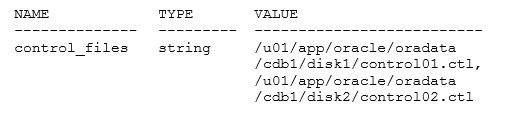 You plan to multiplex the control file to a new location, parallelization for the backup
set./u01/app/oracle/oradata/cdb1/disk3/control03.ctl/. Examine the possible steps that are in random order: 1. Shut down the database instance.
2.Issue ALTER SYSTEM SET CONTROL_FILES= `/u01/app/oracle/oradata/cdb1/disk1/control01.ctl, /u01/
app/oracle/oradata/cdb1/disk2/control02, ctl, /u01/app/oracle/oradata/cdb1/disk3/control03.ctl'
SCOPE=SPFILE;.
3. Issue ALTER SYSTEM SET CONTROL_FILES=
`/u01/app/oracle/oradata/cdb1/disk1/control01.ctl, /u01/app/oracle/oradata/cdb1/disk2/control02.ctl, /u01/
app/oracle/oradata/cdb1/disk3/control03.ctl';.
4. Copy the control file from the existing location to `/u01/app/oracle/oradata/cdb1/disk3/control03.ctl'.
5. Mount the database.
6. Open the database. Identify the required steps in the correct order to accomplish the task.
-
A
-
B
-
C
-
D
-
E
Reveal answer details
Close answer details
Question 21
Single choice
Which Oracle Database component is audited by default if the Unified Auditing option is enabled?
-
A
-
B
Oracle Recovery Manager (RMAN)
-
C
-
D
-
E
Oracle Real Application Security
Reveal answer details
Close answer details
Question 22
Multiple choice
Which three statements are true about Oracle Restart? (Choose three.)
-
A
It can be configured to automatically attempt to restart various components after a hardware or software failure.
-
B
While starting any components, it automatically attempts to start all dependencies first and in proper order.
-
C
It can be configured to automatically restart a database in case of normal shutdown of the database instance.
-
D
It can be used to only start Oracle components.
-
E
It runs periodic check operations to monitor the health of Oracle components.
Reveal answer details
Close answer details
Correct answersA, B, E
ExplanationReferences:
http://docs.oracle.com/cd/E18283_01/server.112/e17120/restart001.htm
Question 23
Multiple choice
Examine the commands executed to monitor database operations: $> conn sys/oracle@prod as sysdba
SQL> VAR eid NUMBER
SQL>EXEC :eid := DBMS_SQL_MONITOR.BEGlN_OPERATION('batch_job',FORCED_TRACKING=>'Y');Which two statements are true? (Choose two.)
-
A
Database operations will be monitored only when they consume a significant amount of resource.
-
B
Database operations for all sessions will be monitored.
-
C
Database operations will be monitored only if the STATISTICS_LEVEL parameter is set to TYPICAL
and CONTROL_MANAGEMENT_PACK_ACCESS is set DIAGNISTIC + TUNING.
-
D
Only DML and DDL statements will be monitored for the session.
-
E
All subsequent statements in the session will be treated as one database operation and will be monitored.
Reveal answer details
Close answer details
Correct answersC, E
ExplanationC: Setting the CONTROL_MANAGEMENT_PACK_ACCESS initialization parameter to DIAGNOSTIC
+TUNING (default) enables monitoring of database operations. Real-Time SQL Monitoring is a feature of the Oracle Database Tuning Pack.
Note:
* The DBMS_SQL_MONITOR package provides information about Real-time SQL Monitoring and Real-
time Database Operation Monitoring.
*(not B) BEGIN_OPERATION Function starts a composite database operation in the current session.
/ (E) FORCE_TRACKING - forces the composite database operation to be tracked when the operation starts. You can also use the string variable 'Y'. / (not A) NO_FORCE_TRACKING - the operation will be tracked only when it has consumed at least 5 seconds of CPU or I/O time. You can also use the string variable 'N'.
Question 24
Multiple choice
You want to consolidate backup information and centrally manage backup and recovery scripts for multiple databases running in your organization. Which two backup solutions can be used? (Choose two.)
-
A
-
B
RMAN Media Management Library
-
C
Enterprise Manager Cloud Control
-
D
Enterprise Manager Database Express
-
E
Reveal answer details
Close answer details
Question 25
Multiple choice
One of your databases supports a data warehousing workload and is in NOARCHIVELOG mode. You perform RMAN level 0 backup on Sundays and level 1 incremental backups on other days. One data file is corrupt and the current online redo log is missing due to media failure. Which four actions must you take for recovery? (Choose four.)
-
A
Restore the missing data file.
-
B
Recover the database by using RECOVER DATABASE NOREDO;
-
C
Recover the database by using RECOVER DATABASE;
-
D
Restore the control file.
-
E
Open the database by using the RESETLOGS option.
-
F
Recover the corrupt file by using RECOVER DATAFILE.
-
G
Reveal answer details
Close answer details
Correct answersB, D, E, G
Question 26
Multiple choice
In which three situations must you use a recovery catalog? (Choose three.)
-
A
when you want to store RMAN global scripts that can be used across multiple databases
-
B
when you want to restrict the amount of space used by backups
-
C
when you want to perform incremental backups by using a block change tracking file
-
D
when you want to list data files that were in a target database at a given time by using the AT clause with the REPORT SCHEMA command
-
E
when you want to maintain backup metadata longer than the period specified by the CONTROL_FILE_RECORD_KEEP_TIME parameter
Reveal answer details
Close answer details
Correct answersA, D, E
ExplanationA: Some RMAN features function only when you use a recovery catalog. For example, you can store RMAN scripts in a recovery catalog. The chief advantage of a stored script is that it is available to any RMAN client that can connect to the target database and recovery catalog. Command files are only available if the RMAN client has access to the file system on which they are stored. A local stored script is associated with the target database to which RMAN is connected when the script is created, and can only be executed when you are connected to this target database. A global stored script can be run against any database registered in the recovery catalog. D: If you use a recovery catalog, then you can use the atClause to specify a past time, SCN, or log sequence number, as shown in these examples of the command: RMAN> REPORT SCHEMA AT TIME 'SYSDATE-14'; # schema 14 days ago RMAN> REPORT SCHEMA AT SCN 1000; # schema at scn 1000
RMAN> REPORT SCHEMA AT SEQUENCE 100 THREAD 1; # schema at sequence 100 RMAN> REPORT SCHEMA FOR DB_UNIQUE_NAME standby1; E: The CONTROL_FILE_RECORD_KEEP_TIME initialization parameter determines the minimum number of days that records are retained in the control file before they are candidates for being overwritten. Thus, you must ensure that you resynchronize the recovery catalog with the control file records before these records are erased. References:
https://docs.oracle.com/cd/B28359_01/backup.111/b28270/rcmcatdb.htm
https://docs.oracle.com/database/121/BRADV/rcmreprt.htm#BRADV90911
Question 27
Multiple choice
Which three statements are true about automated maintenance tasks? (Choose three.)
-
A
Predefined maintenance tasks consist of automatic optimizer statistics collection, running Automatic Segment Advisor, and running Automatic SQL Tuning Advisor.
-
B
A repository is maintained in the SYSTEM tablespace to store the history of execution of all tasks.
-
C
They run at predefined time intervals that are intended to occur during a period of low system loads.
-
D
An Oracle Scheduler job is created for each maintenance tasks that is scheduled to run in a maintenance window.
-
E
A maintenance window is automatically extended until all the maintenance tasks defined are completed.
Reveal answer details
Close answer details
Question 28
Single choice
Examine the following steps of privilege analysis for checking and revoking excessive, unused privileges granted to users: 1. Create a policy to capture the privileges used by a user for privilege analysis.
2. Generate a report with the data captured for a specified privilege capture.
3. Start analyzing the data captured by the policy.
4. Revoke the unused privileges.
5. Compare the used and unused privileges' lists.
6. Stop analyzing the data. Identify the correct sequence of steps.
-
A
-
B
-
C
-
D
Reveal answer details
Close answer details
Correct answerB
Explanation1. Create a policy to capture the privilege used by a user for privilege analysis.
3. Start analyzing the data captured by the policy.
6. Stop analyzing the data.
2. Generate a report with the data captured for a specified privilege capture.
5. Compare the used and unused privileges' lists.
4. Revoke the unused privileges.
Question 29
Multiple choice
Which three statements are true about the SQL*Loader utility? (Choose three.)
-
A
It can be used to load data from multiple external files into multiple tables.
-
B
It can be used to extract and reorganize data from external files, and then load it into a table.
-
C
It can be used to load data from external files using direct path only.
-
D
It can be used to create tables using data that is stored in external files.
-
E
It can be used to generate unique sequential values in specified columns while loading data.
Reveal answer details
Close answer details
Question 30
Single choice
After implementing full Oracle Data Redaction, you change the default value for the number data type as follows: SQL> SELECT NUMBER_VALUE FROM REDACTION_VALUES_FOR_TYPE_FULL; NUMBER_VALUE
-------------------------
SQL> EXEC DBMS_REDACT.UPDATE_FULL_REDACTI0N_VALUES(-1)
PL/SQL procedure successfully completed. SQL> select number_value from redaction_values_for_type_full;
NUMBER VALUE
------------------------
After changing the value, you notice that FULL redaction continues to redact numeric data with a zero. What must you do to activate the new default value for numeric full redaction?
-
A
Re-enable redaction policies that use FULL data redaction.
-
B
Re-create redaction policies that use FULL data redaction.
-
C
Re-connect the sessions that access objects with redaction policies defined on them.
-
D
-
E
Restart the database instance.
Reveal answer details
Close answer details
Correct answerE
ExplanationAbout Altering the Default Full Data Redaction Value
You can alter the default displayed values for full Data Redaction polices. By default, 0 is the redacted value when Oracle Database performs full redaction (DBMS_REDACT.FULL) on a column of the NUMBER data type. If you want to change it to another value (for example, 7), then you can run the DBMS_REDACT.UPDATE_FULL_REDACTION_VALUES procedure to modify this value. The modification applies to all of the Data Redaction policies in the current database instance. After you modify a value, you must restart the database for it to take effect.
Question 31
Multiple choice
Examine this query: SELECT cust_name, amt_due
FROM customers
AS OF TIMESTAMP (SYSTIMESTAMP - INTERVAL '6' MINUTE)
WHERE cust_no = 'AYR2011'; Which two requirements guarantee that the query will execute successfully? (Choose two.)
-
A
Row movement must be enabled for CUSTOMERS.
-
B
Automatic Undo Management must be configured.
-
C
FLASHBACK must be ON for the database.
-
D
Undo retention guarantee must be enabled.
-
E
The database must be in ARCHIVELOG mode.
-
F
Supplemental logging must be enabled.
Reveal answer details
Close answer details
Correct answersB, C
ExplanationReference
https://docs.oracle.com/cd/B12037_01/appdev.101/b10795/adfns_fl.htm
Question 32
Multiple choice
Identify three benefits of unified auditing. (Choose three.)
-
A
It helps to reduce disk space used to store an audit trail in a database.
-
B
It guarantees zero-loss auditing.
-
C
It reduces overhead on a database caused by auditing, by having a single audit trail.
-
D
An audit trail cannot be modified because it is read-only.
-
E
It automatically audits Recovery Manager (RMAN) events.
Reveal answer details
Close answer details
Question 33
Multiple choice
Examine this parameter in a database's PFILE: DB_CREATE_FILE_DEST = '/u01/app/oracle/oradata/' You execute this command: 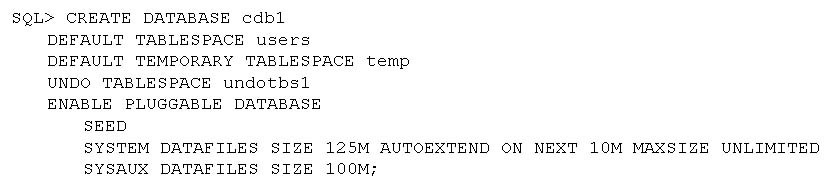 Which three are true after successful database creation? (Choose three.)
-
A
-
B
The files created for both the root and seed databases use Oracle Managed Files (OMF).
-
C
PDB$SEED is open read-only.
-
D
-
E
USERS will be the default tablespace for PDB$SEED.
-
F
CDB$ROOT is open read/write.
Reveal answer details
Close answer details
Question 34
Multiple choice
A complete database backup to media is taken for your database every day. Which three actions would you take to improve backup performance? (Choose three.)
-
A
Set the backup_tape_io_slaves parameter to true.
-
B
Set the dbwr_io_slaves parameter to a nonzero value if synchronous I/O is in use.
-
C
Configure large pool if not already done.
-
D
Remove the rate parameter, if specified, in the allocate channel command.
-
E
Always use RMAN compression for tape backups rather than the compression provided by media manager.
-
F
Always use synchronous I/O for the database.
Reveal answer details
Close answer details
Correct answersB, C, D
ExplanationReferences:
http://docs.oracle.com/cd/B19306_01/backup.102/b14191/rcmtunin.htm
Question 35
Single choice
You want to export the pluggable database (PDB) HR_PDB1 from the multitenant container database
(CDB) CDB1 and import it into the CDB2 CDB as the EMP_PDB1 PDB. Examine the list of possible steps required to perform the task: 1. Create a PDB named EMP_PDB1.
2. Export the HR_PDB1 PDB by using the FULL clause.
3. Open the EMP_PDB1 PDB.
4. Mount the EMP_PDB1 PDB.
5. Synchronize the EMP_PDB1 PDB in restricted mode.
6. Copy the dump file to the Data Pump directory.
7. Create a Data Pump directory in the EMP_PDB1 PDB.
8. Import data into EMP_PDB1 with the FULL and REMAP clauses.
9. Create the same tablespaces in EMP_PDB1 as in HR_PDB1 for new local user objects. Identify the required steps in the correct order.
-
A
-
B
2, 1, 4, 5, 3, 7, 6, 9, and 8
-
C
-
D
Reveal answer details
Close answer details
Question 36
Multiple choice
Which two are true about RMAN image copies? (Choose two.)
-
A
The can only be written to disk.
-
B
They are the only backup option available for database in NOARCHIVELOG mode.
-
C
They can be encrypted using Transparent Data Encryption (TDE).
-
D
They can be used as a level 0 incremental backup.
Reveal answer details
Close answer details
Correct answersA, D
ExplanationReferences:
https://docs.oracle.com/database/121/BRADV/rcmcncpt.htm
Question 37
Single choice
Examine the following set of RMAN commands:  Which statement is true about the RMAN run block execution?
-
A
The script is executed and both DC1 and CH1 channels are used for script execution.
-
B
The execution of the script fails because multiple channels cannot exist simultaneously.
-
C
The persistent configuration parameter, DC1, is overridden because a new channel is allocated in the RMAN RUN block.
-
D
The new channel, CH1, is ignored because a channel has been configured already.
Reveal answer details
Close answer details
Question 38
Multiple choice
Which three RMAN persistent settings can be set explicitly? (Choose three.)
-
A
archivelog deletion policy
-
B
-
C
-
D
archivelog backup duplexing
-
E
redo log backup duplexing
-
F
controlfile autobackup formats
Reveal answer details
Close answer details
Question 39
Single choice
You create two Resource Manager plans, one for night time workloads, the other for day time. How would you make the plans switch automatically?
-
A
-
B
-
C
Use the mapping rule for the consumer groups.
-
D
Set the switch_time plan directive for both plans.
-
E
Reveal answer details
Close answer details
Question 40
Multiple choice
Which two methods can be used to create a PDB from a non-CDB Oracle 12c Database? (Choose two.)
-
A
use the CREATE PLUGGABLE DATABASE command across a database link from CDB$ROOT to the non-CDB.
-
B
Use Data Pump to export the non-CDB and import it into a newly created, empty PDB.
-
C
Use only the DBMS_PDB package.
-
D
Use the CREATE DATABASE command with an XML file created by executing DBMS_PDB in the non-
CDB.
-
E
Use only the DUPLICATE DATABASE command.
Reveal answer details
Close answer details
Correct answersA, C
ExplanationReferences:
https://docs.oracle.com/en/database/oracle/oracle-database/18/spucs/create-pdb-using-a-non-cdb.html#GUID-5DBBD832-B8D5-42CE-8D5C-986037656A7E
Question 41
Multiple choice
Identify three reasons for using a recovery catalog with Recovery Manager (RMAN). (Choose three.)
-
A
to store backup information of multiple databases in one place
-
B
to restrict the amount of space that is used by backups
-
C
to maintain a backup for an indefinite period of time by using the KEEP FOREVER clause
-
D
to store RMAN scripts that are available to any RMAN client that can connect to target databasesregistered in the recovery catalog
-
E
to automatically delete obsolete backups after a specified period of time
Reveal answer details
Close answer details
Question 42
Single choice
Your multitenant container database (CDB) cdb1 that is running in archivelog mode contains two pluggable databases (PDBs), pdb2_1 and pdb2_2. RMAN is connected to the target database pdb2_1. Examine the command executed to back up pdb2_1: RMAN> BACKUP DATABASE PLUS ARCHIVELOG; Which statement is true about the execution of this command?
-
A
It fails because archive log files cannot be backed up using a connection to a PDB.
-
B
It succeeds but only the data files belonging to the pdb2_1 pluggable database are backed up.
-
C
It succeeds and all data files belonging to PD32_1 are backed up along with the archive log files.
-
D
It fails because the pluggable clause is missing.
Reveal answer details
Close answer details
|