Question 1
Multiple choice
Which two statements are true about Enterprise Manager (EM) express in Oracle Database 12c? (Choose two.)
-
A
By default, EM express is available for a database after database creation.
-
B
Multiple databases on the same node (or host) may each be individually managed by using EM
Express.
-
C
You can perform basic administrative tasks for pluggable databases by using the EM express interface.
-
D
You cannot start up or shut down a database instance by using EM express.
-
E
You can create and configure pluggable databases by using EM express.
Reveal answer details
Close answer details
Correct answersB, D
ExplanationO12c is integrated in database don't have his own agent like in O11G then you cannot start up or shut down a database.
Question 2
Multiple choice
Which two statement are true about the installation modes in Oracle Database 12c? (Choose two.)
-
A
In silent mode installation, you can validate the parameter values on installation screens for which you have provided information in the response file.
-
B
In interactive mode, parameter values are read from a response file and can be changed during installation.
-
C
Response file mode is useful when you require multiple Oracle Homes with variation in some of the installation parameters for each home.
-
D
In response file mode, you can include responses for some or all prompts.
Reveal answer details
Close answer details
Question 3
Multiple choice
Examine the details of the Top 5 Timed Events in the following Automatic Workloads Repository (AWR) report: 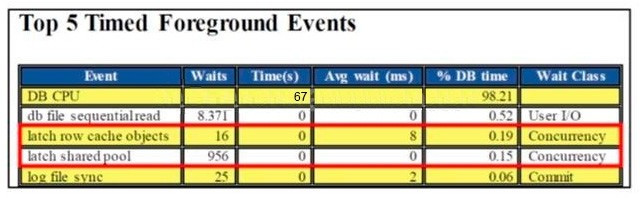 What are three possible causes for the latch-related wait events?
-
A
The size of the shared pool is too small.
-
B
Cursors are not being shared.
-
C
A large number COMMITS are being performed.
-
D
There are frequent logons and logoffs.
-
E
The buffers are being read into the buffer cache, but some other session is changing the buffers.
Reveal answer details
Close answer details
Question 4
Multiple choice
Examine the commands executed to monitor database operations: $> conn sys oracle/oracle@prod as sysdba
SQL > VAR eid NUMBER
SQL > EXEC: eid:= DBMS_SQL_MONITOR.BEGIN_OPERATION ('batch_job', FORCED_TRACKING =>
'Y');Which two statements are true? (Choose two.)
-
A
Database operations will be monitored only when they consume a significant amount of resources.
-
B
Database operations for all sessions will be monitored.
-
C
Database operations will be monitored only if the STATISTICS_LEVEL parameter is set to TYPICAL
and CONTROL_MANAGEMENT_PACK_ACCESS is set to DIAGNISTIC + TUNING.
-
D
Only DML and DDL statements will be monitored for the session.
-
E
All subsequent statements in the session will be treated as one database operation and will be monitored.
Reveal answer details
Close answer details
Correct answersC, E
ExplanationC: Setting the CONTROL_MANAGEMENT_PACK_ACCESS initialization parameter to DIAGNOSTIC
+TUNING (default) enables monitoring of database operations. Real-Time SQL Monitoring is a feature of the Oracle Database Tuning Pack. Note:
* The DBMS_SQL_MONITOR package provides information about Real-time SQL Monitoring and Real-
time Database Operation Monitoring.
*(not B) BEGIN_OPERATION Function starts a composite database operation in the current session. / (E) FORCE_TRACKING - forces the composite database operation to be tracked when the operation starts. You can also use the string variable 'Y'. / (not A) NO_FORCE_TRACKING - the operation will be tracked only when it has consumed at least 5 seconds of CPU or I/O time. You can also use the string variable 'N'.
Which statement is true about Enterprise Manager (EM) express in Oracle Database 12c?
-
A
By default, EM express is available for a database after database creation.
-
B
You can use EM express to manage multiple databases running on the same server.
-
C
You can perform basic administrative tasks for pluggable databases by using the EM express interface.
-
D
You cannot start up or shut down a database instance by using EM express.
-
E
You can create and configure pluggable databases by using EM express.
Reveal answer details
Close answer details
Correct answerD
ExplanationO12c is integrated in database don't have his own agent like in O11G then you cannot start up or shut down a database.
You install a non-RAC Oracle Database. During Installation, the Oracle Universal Installer (OUI) prompts you to enter the path of the Inventory directory and also to specify an operating system group name. Which statement is true?
-
A
The ORACLE_BASE base parameter is not set.
-
B
The installation is being performed by the root user.
-
C
The operating system group that is specified should have the root user as its member.
-
D
The operating system group that is specified must have permission to write to the inventory directory.
Reveal answer details
Close answer details
Correct answerD
ExplanationNote:
Providing a UNIX Group Name If you are installing a product on a UNIX system, the Installer will also prompt you to provide the name of the group which should own the base directory. You must choose a UNIX group name which will have permissions to update, install, and deinstall Oracle software. Members of this group must have write permissions to the base directory chosen.
Only users who belong to this group are able to install or deinstall software on this machine.
You are required to migrate your 11.2.0.3 database as a pluggable database (PDB) to a multitenant container database (CDB). The following are the possible steps to accomplish this task: 1. Place all the user-defined tablespace in read-only mode on the source database.
2. Upgrade the source database to a 12c version.
3. Create a new PDB in the target container database.
4. Perform a full transportable export on the source database with the VERSION parameter set to 12 using the expdp utility.
5. Copy the associated data files and export the dump file to the desired location in the target database.
6. Invoke the Data Pump import utility on the new PDB database as a user with the DATAPUMP_IMP_FULL_DATABASE role and specify the full transportable import options.
7. Synchronize the PDB on the target container database by using the DBMS_PDS.SYNC_ODB function. Identify the correct order of the required steps.
-
A
-
B
-
C
-
D
-
E
Reveal answer details
Close answer details
Correct answerC
Explanation1. Set user tablespaces in the source database to READ ONLY.
2. From the Oracle Database 11g Release 2 {11.2.0.3) environment, export the metadata and any data residing in administrative tablespaces from the source database using the FULL=Y and TRANSPORTABLE=ALWAYS parameters. Note that the VER$ION=12 parameter is required only when exporting from an Oracle Database llg Release 2 database:
3. Copy the tablespace data files from the source system to the destination system. Note that the log file from the export operation will list the data files required to be moved.
4. Create a COB on the destination system, including a PDB into which you will import the source database.
5. In the Oracle Database 12c environment, connect to the pre-created PDB and import the dump file. The act of importing the dump file will plug the tablespace data files into the destination PDB Oracle White
Paper - Upgrading to Oracle Database 12c -August 2013
Examine these parameters settings:  What is true about the control file?
-
A
The control file is multiplexed in the locations specified by DB_CREATE_ONLINE_LOG_DEST_1 and DB_CREATE_ONLINE_LOG_DEST_2.
-
B
Only a single control file exists in the location specified by DB_CREATE_FILE_DEST.
-
C
The control file is multiplexed in the locations specified by DB_CREATE_FILE_DEST and DB_RECOVERY_FILE_DEST.
-
D
Only a single control file exists in the location specified by DB_RECOVERY_FILE_DEST.
-
E
The control file is multiplexed in the locations specified by DB_CREATE_FILE_DEST and DB_CREATE_ONLINE_LOG_DEST_1.
Reveal answer details
Close answer details
Correct answerA
ExplanationReferences:
https://docs.oracle.com/cd/E18283_01/server.112/e17120/omf005.htm
Question 9
Multiple choice
Which two statements are true about the RMAN VALIDATE DATABASE command? (Choose two.)
-
A
It checks the database for intrablock corruptions.
-
B
It can detect corrupt pfiles.
-
C
It can detect corrupt spfiles.
-
D
It checks the database for interblock corruptions.
-
E
It can detect corrupt block change tracking files.
Reveal answer details
Close answer details
Correct answersA, C
ExplanationBlock corruptions can be divided Into Interblock corruption and intrablock corruption. In intrablock corruption. th?corruption occurs within the block itself and can be either physical or logical corruption. In interblock corruption, the corruption occurs between blocks and can only be logical corruption. (key word) * The VALIDATE command checks for intrablock corruptions only. Only DBVERIFY and the ANALYZE statement detect Interblock corruption.
VALIDATE Command Output --> List of Control File and SPFILE.
File TYPE >»» SPFILE or Control File.
Status >»» OK if no corruption, or FAILED If block corruption is found.
Blocks Failing »»» The number of blocks that fail the corruption check. These blocks are newly corrupt.
Blocks Examined »»» Total number of blocks in the file.
Oracle' Database Backup and Recovery User's Guide 12c Release 1 (12.1) - 16 Validating Database Files and Backups
Question 10
Multiple choice
Which two are prerequisites for performing a flashback transaction? (Choose two.)
-
A
Flashback Database must be enabled.
-
B
Undo retention guarantee for the database must be configured.
-
C
EXECUTE privilege on the DBMS_FLASHBACK package must be granted to the user flashing back transaction.
-
D
Supplemental logging must be enabled.
-
E
Recycle bin must be enabled for the database.
-
F
Block change tracking must be enabled for the database.
Reveal answer details
Close answer details
Correct answersC, D
ExplanationTo configure your database for the Flashback Transaction feature, you or your database administrator must: With the database mounted but not open, enable ARCHIVELOG: ALTER DATABASE ARCHIVELOG; Open at least one archive log: ALTER SYSTEM ARCHIVE LOG CURRENT; If not done, enable minimal and primary key supplemental logging: ALTER DATABASE ADD SUPPLEMENTAL LOG DATA;
ALTER DATABASE ADD SUPPLEMENTAL LOG DATA (PRIMARY KEY) COLUMNS;
If you want to track foreign key dependencies, enable foreign key supplemental logging: ALTER DATABASE ADD SUPPLEMENTAL LOG DATA (FOREIGN KEY) COLUMNS; References:
http://docs.oracle.com/cd/E11882_01/appdev.112/e41502/adfns_flashback.htm#ADFNS611
Question 11
Multiple choice
Which three statements are true about adaptive SQL plan management?
-
A
It automatically performs verification or evolves non-accepted plans, in COMPREHENSIVE mode when they perform better than existing accepted plans.
-
B
The optimizer always uses the fixed plan, if the fixed plan exists in the plan baseline.
-
C
It adds new, bettor plans automatically as fixed plans to the baseline.
-
D
The non-accepted plans are automatically accepted and become usable by the optimizer if they perform better than the existing accepted plans.
-
E
The non-accepted plans in a SQL plan baseline are automatically evolved, in COMPREHENSIVE mode, during the nightly maintenance window and a persistent verification report is generated.
Reveal answer details
Close answer details
Correct answersA, D, E
ExplanationWith adaptive SQL plan management, DBAs no longer have to manually run the verification or evolve process for non-accepted plans. When automatic SQL tuning is in COMPREHENSIVE mode, it runs a verification or evolve process for all SQL statements that have non-accepted plans during the nightly maintenance window. If the non-accepted plan performs better than the existing accepted plan (or plans) in the SQL plan baseline, then the plan is automatically accepted and becomes usable by the optimizer.
After the verification is complete, a persistent report is generated detailing how the non-accepted plan performs compared to the accepted plan performance. Because the evolve process is now an AUTOTASK, DBAs can also schedule their own evolve job at end time. Note:
* The optimizer is able to adapt plans on the fly by predetermining multiple subplans for portions of the
plan.
* Adaptive plans, introduced in Oracle Database 12c, enable the optimizer to defer the final plan decision for a statement until execution time. The optimizer instruments its chosen plan (the default plan) with statistics collectors so that it can detect at runtime, if its cardinality estimates differ greatly from the actual number of rows seen by the operations in the plan. If there is a significant difference, then the plan or a portion of it will be automatically adapted to avoid suboptimal performance on the first execution of a SQL statement.
Question 12
Single choice
Your database is running in ARCHIVELOG mode. You back up the control file by executing ALTER DATABASE BACKUP CONTROL TO TRACE NORESETLOGS, whenever you make structural changes to the database. A media failure has damaged all the control files, but the online redo log files are intact. You
issue a SHUTDOWN ABORT. How should you recover the control file to its default location?
-
A
Restore the backup control file to all the locations specified in the CONTROL_FILES parameter file, start a new instance and mount the database, recover the database, and then open the database with the RESETLOGS option.
-
B
Issue the STARTUP NOMOUNT command, restore the backup control file only to the default location,
issue RECOVER DATABASE USING BACKUP CONTROLFILE UNTIL CANCEL, and open the
database with the RESETLOGS option.
-
C
Issue the STARTUP MOUNT command, restore the backup control file to all the locations specified in
the CONTROL_FILES parameter file, and then issue RECOVER DATABASE USING BACKUP
CONTROLFILE.
-
D
Issue the STARTUP NOMOUNT command, re-create the control file manually by using the CREATE CONTROLFILE command, issue the RECOVER DATABASE command, and then issue the ALTER DATABASE OPEN command.
Reveal answer details
Close answer details
Correct answerB
ExplanationReferences:
https://docs.oracle.com/cd/E28271_01/backup.1111/e10642/osadvsce.htm
Question 13
Single choice
You are connected to a pluggable database (PDB) as a common user with DBA privileges. The STATISTICS_LEVEL parameter is PDB_MODIFIABLE. You execute the following: SQL > ALTER SYSTEM SET STATISTICS_LEVEL = ALL SID = `*' SCOPE = SPFILE; Which is true about the result of this command?
-
A
The STATISTICS_LEVEL parameter is set to all whenever this PDB is re-opened.
-
B
The STATISTICS_LEVEL parameter is set to ALL whenever any PDB is reopened.
-
C
The STATISTICS_LEVEL parameter is set to all whenever the multitenant container database (CDB) is restarted.
-
D
Nothing happens; because there is no SPFILE for each PDB, the statement is ignored.
Reveal answer details
Close answer details
Correct answerA
Explanationhttp://docs.oracle.com/database/121/ADMIN/cdb_pdb_admin.htm#ADMIN14017
Question 14
Multiple choice
Which three statements are true about adaptive SQL plan management?
-
A
It adds new; bettor plans automatically as fixed plans to the baseline.
-
B
The non-accepted plans are automatically accepted and become usable by the optimizer if they perform better than the existing accepted plans.
-
C
It automatically performs verification or evolves non-accepted plans, in COMPREHENSIVE mode when they perform better than existing accepted plans.
-
D
The non-accepted plans in a SQL plan baseline are automatically evolved, in COMPREHENSIVE mode, during the nightly maintenance window and a persistent verification report is generated.
Reveal answer details
Close answer details
Question 15
Multiple choice
You configure your database Instance to support shared server connections. Which two memory areas that are part of PGA are stored in SGA instead, for shared server connection?
-
A
-
B
-
C
-
D
Location of the runtime area for DML and DDL Statements
-
E
Location of a part of the runtime area for SELECT statements
Reveal answer details
Close answer details
Correct answersA, C
ExplanationA: PGA itself is subdivided. The UGA (User Global Area) contains session state information, including stuff like package-level variables, cursor state, etc. Note that, with shared server, the UGA is in the SGA. It has to be, because shared server means that the session state needs to be accessible to all server processes, as any one of them could be assigned a particular session. However, with dedicated server (which likely what you're using), the UGA is allocated in the PGA. C: The Location of a private SQL area depends on the type of connection established for a session. If a session is connected through a dedicated server, private SQL areas are located in the server process' PGA. However, if a session is connected through a shared server, part of the private SQL area is kept in the SGA. Note:
* System global area (SGA)
The SGA is a group of shared memory structures, known as SGA components, that contain data and control information for one Oracle Database instance. The SGA is shared by all server and background processes. Examples of data stored in the SGA include cached data blocks and shared SQL areas. * Program global area (PGA)
A PGA is a memory region that contains data and control information for a server process. It is nonshared memory created by Oracle Database when a server process is started. Access to the PGA is exclusive to the server process. There is one PGA for each server process. Background processes also allocate their own PGAs. The total memory used by all individual PGAs is known as the total instance PGA memory, and the collection of individual PGAs is referred to as the total instance PGA, or just instance PGA. You use database initialization parameters to set the size of the instance PGA, not individual PGAs.
Question 16
Multiple choice
What are two of the benefits of installing Oracle Grid Infrastructure for a stand-alone server before installing and creating an Oracle database on the same server? (Choose two.)
-
A
It is the only way to have "automatic restart in place" after instance failure.
-
B
The Oracle database will be easier to upgrade in the future.
-
C
The Oracle database can be created using Oracle Managed Files.
-
D
The Oracle database can be created using storage managed by ASM.
-
E
The Oracle database will be automatically registered as a resource in Oracle Restart.
Reveal answer details
Close answer details
Correct answersD, E
ExplanationReferences:
https://www.oracle.com/webfolder/technetwork/tutorials/obe/db/11g/r2/prod/install/gridinstss/
gridinstss.htm
Question 17
Single choice
To complete the online redefinition procedure, you execute the following command; EXECUTE DBMS_REDEFINITION.FINISH_REDEF_TABLE(`SH', `SALES', `INT_SALES', 600); What is the significance of the dml_lock_timeout period of 600 seconds in the preceding command?
-
A
All pending DML statements on the SALES table must be committed 600 seconds before the procedure ends gracefully.
-
B
All pending DML statements on the SALES table will wait for 600 seconds before the procedure ends gracefully.
-
C
All pending DML statements on the SALES_INT table must be committed 600 seconds before the procedure ends gracefully.
-
D
It specifies the number of seconds the procedure waits for its required locks before it ends gracefully.
Reveal answer details
Close answer details
Correct answerB
ExplanationWait up to 600 seconds for required locks on SH.SALES: EXECUTE DBMS_REDEFINITION.FINISH_REDEF_TABLE (
'SH', 'SALES', 'INT_SALES', 600);
References:
http://oradb-srv.wlv.ac.uk/E50529_01/ARPLS/d_redefi.htm#ARPLS042
Question 18
Single choice
You find this query being used in your Oracle 12c database: 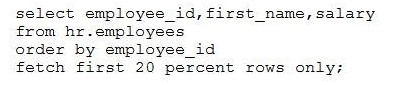 Which method a used by the optimizer to limit the rows being returned?
-
A
A filter is added to the table query dynamically using ROWNUM to limit the rows to 20 percent of the total rows
-
B
All the rows are returned to the client or middle tier but only the first 20 percent are returned to the screen or the application.
-
C
A view is created during execution and a filter on the view limits the rows to 20 percent of the total rows.
-
D
A TOP-N query is created to limit the rows to 20 percent of the total rows
Reveal answer details
Close answer details
Question 19
Multiple choice
You performed an incremental level 0 backup of a database: RMAN > BACKUP INCREMENTAL LEVEL 0 DATABASE; To enable block change tracking after the incremental level 0 backup, you issued this command: SQL > ALTER DATABASE ENABLE BLOCK CHANGE TRACKING USING FILE '/mydir/
rman_change_track.f'; To perform an incremental level 1 cumulative backup, you issued this command: RMAN> BACKUP INCREMENTAL LEVEL 1 CUMULATIVE DATABASE; Which three statements are true? (Choose three.)
-
A
Backup change tracking will sometimes reduce I/O performed during cumulative incremental backups.
-
B
The change tracking file must always be backed up when you perform a full database backup.
-
C
Block change tracking will always reduce I/O performed during cumulative incremental backups.
-
D
More than one database block may be read by an incremental backup for a change made to a single block.
-
E
The incremental level 1 backup that immediately follows the enabling of block change tracking will not read the change tracking file to discover changed blocks.
Reveal answer details
Close answer details
Correct answersA, D, E
ExplanationA: In a cumulative level 1 backup, RMAN backs up all the blocks used since the most recent level 0 incremental backup.
E: Oracle Block Change Tracking
Once enabled; this new 10g feature records the modified since last backup and stores the log of it in a block change tracking file using the CTW (Change Tracking Writer) process. During backups RMAN uses the log file to identify the specific blocks that must be backed up. This improves RMAN's performance as it does not have to scan whole datafiles to detect changed blocks. Logging of changed blocks is performed by the CTRW process which is also responsible for writing data to the block change tracking file. Note:
* An incremental level 0 backup backs up all blocks that have ever been in use in this database.
Question 20
Multiple choice
You executed this command to create a password file: $ orapwd file = orapworcl entries = 10 ignorecase = N Which two statements are true about the password file?
-
A
It will permit the use of uppercase passwords for database users who have been granted the SYSOPER role.
-
B
It contains username and passwords of database users who are members of the OSOPER operating system group.
-
C
It contains usernames and passwords of database users who are members of the OSDBA operating system group.
-
D
It will permit the use of lowercase passwords for database users who have granted the SYSDBA role.
-
E
It will not permit the use of mixed case passwords for the database users who have been granted the SYSDBA role.
Reveal answer details
Close answer details
Correct answersA, D
Explanation* You can create a password file using the password file creation utility, ORAPWD.
* Adding Users to a Password File When you grant SYSDBA or SYSOPER privileges to a user, that user's name and privilege information are added to the password file. If the server does not have an EXCLUSIVE password file (that is, if the initialization parameter REMOTE_LOGIN_PASSWORDFILE is NONE or SHARED, or the password file is missing), Oracle Database issues an error if you attempt to grant these privileges. A user's name remains in the password file only as long as that user has at least one of these two privileges. If you revoke both of these privileges, Oracle Database removes the user from the password file.
* The syntax of the ORAPWD command is as follows: ORAPWD FILE=filename [ENTRIES=numusers]
[FORCE={Y|N}] [IGNORECASE={Y|N}] [NOSYSDBA={Y|N}]
* IGNORECASE
If this argument is set to y, passwords are case-insensitive. That is, case is ignored when comparing the password that the user supplies during login with the password in the password file.
Question 21
Multiple choice
Examine the parameters for your database instance: 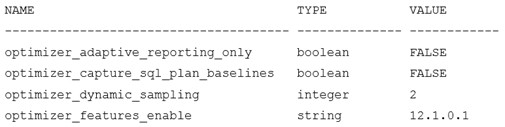 Which three statements are true about the process of automatic optimization by using cardinality feedback?
-
A
The optimizer automatically changes a plan during subsequent execution of a SQL statement if there is a huge difference in optimizer estimates and execution statistics.
-
B
The optimizer can re optimize a query only once using cardinality feedback.
-
C
The optimizer enables monitoring for cardinality feedback after the first execution of a query.
-
D
The optimizer does not monitor cardinality feedback if dynamic sampling and multicolumn statistics are enabled.
-
E
After the optimizer identifies a query as a re-optimization candidate, statistics collected by the collectors are submitted to the optimizer.
Reveal answer details
Close answer details
Correct answersA, C, D
ExplanationC: During the first execution of a SQL statement, an execution plan is generated as usual. D: if multi-column statistics are not present for the relevant combination of columns, the optimizer can fall back on cardinality feedback. (not B)* Cardinality feedback. This feature, enabled by default in 11.2, is intended to improve plans for repeated executions. optimizer_dynamic_sampling
optimizer_features_enable * dynamic sampling or multi-column statistics allow the optimizer to more accurately estimate selectivity of
conjunctive predicates. Note:
* OPTIMIZER_DYNAMIC_SAMPLING controls the level of dynamic sampling performed by the optimizer. Range of values. 0 to 10 * Cardinality feedback was introduced in Oracle Database 11gR2. The purpose of this feature is to automatically improve plans for queries that are executed repeatedly, for which the optimizer does not estimate cardinalities in the plan properly. The optimizer may misestimate cardinalities for a variety of reasons, such as missing or inaccurate statistics, or complex predicates. Whatever the reason for the misestimate, cardinality feedback may be able to help.
Question 22
Single choice
A database is stored in an Automatic Storage Management (ASM) disk group, disk group, DGROUP1 with
SQL:  There is enough free space in the disk group for mirroring to be done. What happens if the CONTROLLER1 failure group becomes unavailable due to error or for maintenance?
-
A
Transactions and queries accessing database objects contained in any tablespace stored in DGROUP1 will fall.
-
B
Mirroring of allocation units will be done to ASM disks in the CONTROLLER2 failure group until the CONTROLLER1 for failure group is brought back online.
-
C
The data in the CONTROLLER1 failure group is copied to the CONTROLLER2 failure group and rebalancing is initiated.
-
D
ASM does not mirror any data until the CONTROLLER1 failure group is brought back online, and newly allocated primary allocation units (AU) are stored in the CONTROLLER2 failure group, without mirroring.
Reveal answer details
Close answer details
Question 23
Multiple choice
You have altered a non-unique index to be invisible to determine if queries execute within an acceptable response time without using this index. Which two are possible if table updates are performed which affect the invisible index columns? (Choose two.)
-
A
The index remains invisible.
-
B
The index is not updated by the DML statements on the indexed table.
-
C
The index automatically becomes visible in order to have it updated by DML on the table.
-
D
The index becomes unusable but the table is updated by the DML.
-
E
The index is updated by the DML on the table.
Reveal answer details
Close answer details
Correct answersA, E
ExplanationUnlike unusable indexes, an invisible index is maintained during DML statements. Note:
* Oracle 11g allows indexes to be marked as invisible. Invisible indexes are maintained like any other index, but they are ignored by the optimizer unless the OPTIMIZER_USE_INVISIBLE_INDEXES parameter is set to TRUE at the instance or session level. Indexes can be created as invisible by using the INVISIBLE keyword, and their visibility can be toggled using the ALTER INDEX command.
Question 24
Multiple choice
Your multitenant container database has three pluggable databases (PDBs): PDB1, PDB2, and PDB3. Which two RMAN commands may be used to back up only the PDB1 pluggable database? (Choose two.)
-
A
BACKUP PLUGGABLE DATABASE PDB1 while connected to the ROOT container
-
B
BACKUP PLUGGABLE DATABASE PDB1 while connected to the PDB1 container
-
C
BACKUP DATABASE while connected to the PDB1 container
-
D
BACKUP DATABASE while connected to the ROOT container
-
E
BACKUP PLUGGABLE DATABASE PDB1 while connected to PDB2
Reveal answer details
Close answer details
Correct answersA, C
ExplanationTo perform operations on a single PDB, you can connect as target either to the root or directly to the PDB. * (A) If you connect to the root, you must use the PLUGGABLE DATABASE syntax in your RMAN commands. For example, to back up a PDB, you use the BACKUP PLUGGABLE DATABASE command. * (C)If instead you connect directly to a PDB, you can use the same commands that you would use when connecting to a non-CDB. For example, to back up a PDB, you would use the BACKUP DATABASE command.
Question 25
Multiple choice
Which three are direct benefits of the multiprocess, multithreaded architecture of Oracle Database 12c when it is enabled?
-
A
-
B
Reduced virtual memory utilization
-
C
Improved parallel Execution performance
-
D
Improved Serial Execution performance
-
E
-
F
Reveal answer details
Close answer details
Correct answersB, C, F
Explanation* Multiprocess and Multithreaded Oracle Database Systems Multiprocess Oracle Database (also called multiuser Oracle Database) uses several processes to run different parts of the Oracle Database code and additional Oracle processes for the users--either one process for each connected user or one or more processes shared by multiple users. Most databases are multiuser because a primary advantage of a database is managing data needed by multiple users simultaneously. Each process in a database instance performs a specific job. By dividing the work of the database and applications into several processes, multiple users and applications can connect to an instance simultaneously while the system gives good performance. * In previous releases, Oracle processes did not run as threads on UNIX and Linux systems. Starting in Oracle Database 12c, the multithreaded Oracle Database model enables Oracle processes to execute as operating system threads in separate address spaces.
Question 26
Multiple choice
You notice a high number of waits for the db file scattered read and db file sequential read events in the recent Automatic Database Diagnostic Monitor (ADDM) report. After further investigation, you find that queries are performing too many full table scans and indexes are not being used even though the filter columns are indexed. Identify three possible reasons for this.
-
A
Missing or stale histogram statistics
-
B
-
C
High clustering factor for the indexes
-
D
High value for the DB_FILE_MULTIBLOCK_READ_COUNT parameter
-
E
Reveal answer details
Close answer details
Correct answersA, C, D
ExplanationD: DB_FILE_MULTIBLOCK_READ_COUNT is one of the parameters you can use to minimize I/O during table scans. It specifies the maximum number of blocks read in one I/O operation during a sequential scan.
The total number of I/Os needed to perform a full table scan depends on such factors as the size of the table, the multiblock read count, and whether parallel execution is being utilized for the operation.
Question 27
Single choice
Your multitenant container database (CDB) contains several pluggable databases (PDBs). A common user C##A_ADMIN, is created with connect privileges. You execute this command from the root container: SQL> GRANT create tablespace to C##A_ADMIN; Which statement is true?
-
A
The command executes successfully, enabling the C##A_ADMIN user to create a tablespace only in the root container.
-
B
The command fails because the CONTAINER=ALL clause is not used.
-
C
The command executes successfully, enabling the C##A_ADMIN user to create tablespaces in the root container as well as in the PDBs.
-
D
The command fails because the CONTAINER=CURRENT clause is not used.
Reveal answer details
Close answer details
Question 28
Single choice
On your Oracle 12c database, you issue the following commands to create indexes: SQL> CREATE INDEX oe.ord_customer_ix1 ON oe.orders (customer_id, sales_rep_id);
SQL> CREATE BITMAP INDEX oe.ord_customer_ix2 ON oe.orders (customer_id, sales_rep_id); Which statement is correct?
-
A
Only the ORD_CUSTOMER_IX1 index is created and it is visible.
-
B
Both the indexes are created and both of them are visible.
-
C
Both the indexes are created; however, only the ORD_CUSTOMER_IX1 index is visible.
-
D
Both the indexes are created; however, only the ORD_CUSTOMER_IX2 index is visible.
Reveal answer details
Close answer details
Question 29
Multiple choice
Your database supports an online transaction processing (OLTP) workload on an SMP machine. The database is stored in ASM. Examine these initialization parameters. 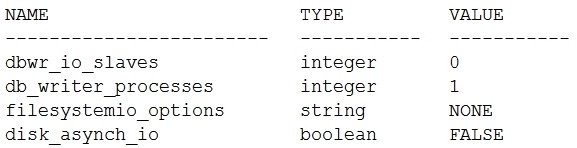 Applications are update intensive using indexed access and modified blocks are written in batches by the DBWR process. You notice a large number of free buffer waits and increase the size of the buffer cache, but eventually the same waits occur. Which two actions would you recommend? (Choose two.)
-
A
decrease the size of the buffer cache
-
B
configure asynchronous I/O
-
C
modifying the ASM disk for the database to use high redundancy
-
D
configure multiple DBWn processes
-
E
configure I/O slaves for the DBWR process
Reveal answer details
Close answer details
Correct answersA, E
ExplanationReferences:
https://docs.oracle.com/cd/B16240_01/doc/doc.102/e16282/oracle_database_help/
oracle_database_wait_bottlenecks_free_buffer_waits_pct.html
Question 30
Multiple choice
Examine the portion of this Active Session History (ASH) report that is marked with a red rectangle: 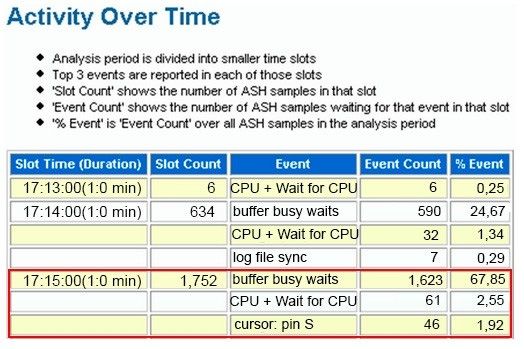 Which two inferences can be drawn from the report?
-
A
Sessions attempting to modify blocks images in the buffer cache are waiting while other sessions are reading the same block images.
-
B
Sessions are waiting to find free buffers in the buffer cache.
-
C
Sessions are waiting for writes of modified block images in the buffer cache to complete
-
D
Sessions are attempting to read blocks images in the buffer cache are waiting while other sessions are reading the same block images.
-
E
Sessions attempting to read blocks images in the buffer cache are waiting while other sessions are modifying the same block images.
Reveal answer details
Close answer details
Question 31
Multiple choice
Identify three benefits of Unified Auditing.
-
A
Decreased use of storage to store audit trail rows in the database.
-
B
It improves overall auditing performance.
-
C
It guarantees zero-loss auditing.
-
D
The audit trail cannot be easily modified because it is read-only.
-
E
It automatically audits Recovery Manager (RMAN) events.
Reveal answer details
Close answer details
Correct answersB, D, E
Explanationhttps://blogs.oracle.com/imc/entry/oracle_database_12c_new_unified
Question 32
Single choice
Your multitenant container database, CDB1, is running in ARCHIVELOG mode and has two pluggable databases, HR_PDB and ACCOUNTS_PDB. An RMAN backup exists for the database. You issue the command to open ACCOUNTS_PDB and find that the USERDATA.DBF data file for the default permanent tablespace USERDATA belonging to ACCOUNTS_PDB is corrupted. What should you do before executing the commands to restore and recover the data file in ACCOUNTS_PDB?
-
A
Place CDB1 in the mount stage and then take the USERDATA tablespace offline in ACCOUNTS_PDB.
-
B
Place CDB1 in the mount stage and issue the ALTER PLUGGABLE DATABASE accounts_pdb CLOSE IMMEDIATE command.
-
C
Issue the ALTER PLUGGABLE DATABASE accounts_pdb OPEN RESTRICTED command.
-
D
Take the USERDATA tablespace offline in ACCOUNTS_PDB.
Reveal answer details
Close answer details
Correct answerD
Explanation* You can take an online tablespace offline so that it is temporarily unavailable for general use. The rest of the database remains open and available for users to access data. Conversely, you can bring an offline tablespace online to make the schema objects within the tablespace available to database users. The database must be open to alter the availability of a tablespace.
Question 33
Single choice
Oracle Grid Infrastructure for a stand-alone server is installed on your production host before installing the Oracle Database server. The database and listener are configured by using Oracle Restart. Examine the following command and its output:  What does this imply?
-
A
When you start an instance on a host with SQL *Plus, dependent listeners and ASM disk groups are automatically started.
-
B
When a database instance is started by using the SRVCTL utility and listener startup fails, the instance is still started.
-
C
When a database is created by using SQL* Plus, it is automatically added to the Oracle Restart configuration.
-
D
When you create a database service by modifying the SERVICE_NAMES initialization parameter, it is automatically added to the Oracle Restart configuration.
Reveal answer details
Close answer details
Correct answerB
ExplanationAbout Startup Dependencies
Oracle Restart ensures that Oracle components are started in the proper order, in accordance with component dependencies. For example, if database files are stored in Oracle ASM disk groups, then before starting the database instance, Oracle Restart ensures that the Oracle ASM instance is started and the required disk groups are mounted. Likewise, if a component must be shut down, Oracle Restart ensures that dependent components are cleanly shut down first. Oracle Restart also manages the weak dependency between database instances and the Oracle Net listener (the listener): When a database instance is started, Oracle Restart attempts to start the listener. If the listener startup fails, then the database is still started. If the listener later fails, Oracle Restart does not shut down and restart any database instances. References:
http://docs.oracle.com/cd/E16655_01/server.121/e17636/restart.htm#ADMIN12710
|