Single choice
Consider the program code in the attached exhibit.
What is the result of executing this program code?
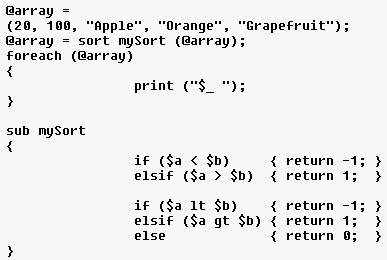
Reveal answer details Close answer details
Correct answerB
CIW · 1D0-437
Preview real exam questions, verified answers and available explanations before choosing a study plan.
|
Single choice
Consider the program code in the attached exhibit. What is the result of executing this program code? Reveal answer details Close answer detailsCorrect answerB
Single choice
Consider the following program code: %employees = ("Lucy", "Accounting", "Armando", "Finance", "Adrienne", "Marketing"); delete($employees{"Lucy"}); Which of the following lines of code has the same effect as the preceding code? Reveal answer details Close answer detailsCorrect answerD
Single choice
Which one of the following statements opens a file for appending? Reveal answer details Close answer detailsCorrect answerC
Single choice
Consider the following program code: 1.$x = 100; 2.$y = 15; 3.$result = $x % $y; 4. 5.print $result; What is the result of executing this program code? Reveal answer details Close answer detailsCorrect answerC
Single choice
Which statement writes data to the filehandle OUTPUT? Reveal answer details Close answer detailsCorrect answerD
Single choice
Consider the following program code: %color = (sun => yellow, apple => red); reverse(%color); @colorKeys = sort(keys(%color)); foreach(@colorKeys) {print($color{$_} . ); } What is the result of executing this program code? Reveal answer details Close answer detailsCorrect answerC
Single choice
Consider the program code in the attached exhibit. What is the result of executing this program code? 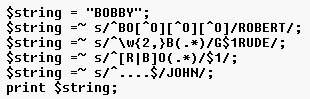 Reveal answer details Close answer detailsCorrect answerB
Single choice
Consider the following program code: $x = 150; $y = "250"; if (($x + 100) == $y) { print("1 "); } if ("250" == $y) { print("2 "); } if ("250" eq $y) { print("3 "); } if ($x lt $y) { print("4 "); } if ($x ge $y) { print("5 "); } What is the result of executing this program code? Reveal answer details Close answer detailsCorrect answerA
Single choice
Which of the following choices demonstrates the correct syntax to pass the argument $arg2 to the subroutine getpass? Reveal answer details Close answer detailsCorrect answerA
Single choice
Consider the following program code: $x = 10; LOOP: while ($x < 15) {print ($x ); if ($x >= 14 && $x <= 20) {$x += 2; redo LOOP; } else {$x++; } What is the result of executing this program code? Reveal answer details Close answer detailsCorrect answerB
Single choice
Which one of the following choices uses the correct syntax for a valid array assignment? Reveal answer details Close answer detailsCorrect answerD
Single choice
Consider the following code block: BEGIN {print ("Jan ");} BEGIN {print ("Feb ");} END {print ("Mar ");} END {print ("Apr ");} Print ("May "); What is the result of this code block? Reveal answer details Close answer detailsCorrect answerA
Single choice
Which of the following choices demonstrates the correct syntax to pass a reference to a subroutine? Reveal answer details Close answer detailsCorrect answerC
Single choice
Which one of the following while statements uses correct syntax and expressions? Reveal answer details Close answer detailsCorrect answerB
Single choice
Which one of the following choices uses the correct syntax for a valid array assignment? Reveal answer details Close answer detailsCorrect answerD
Single choice
Yngve wants to define a character class that includes any alphanumeric word characters. Which one of the following choices is best suited for this requirement? Reveal answer details Close answer detailsCorrect answerA
Single choice
Which one of the following choices lists only valid expression operators? Reveal answer details Close answer detailsCorrect answerC
Single choice
The filehandle INPUT is associated with the file represented by $file. Which statement will close the filehandle INPUT? Reveal answer details Close answer detailsCorrect answerD
Single choice
Consider the following lines of code: ($arg, @args) = @_; foreach $val (@args) { $returnVal .= "$arg, $val\n"; } $returnVal . "" . @args; } print &mySub(1, "a value", "another value", "a parameter", "another parameter"); What is the output of these lines of code? Reveal answer details Close answer detailsCorrect answerA
Single choice
Consider the following program code: 1.$x = 100; 2.$y = "-25"; 3.$sum = $x + $y; 4. 5.print $sum; What is the result of executing this program code? Reveal answer details Close answer detailsCorrect answerB
Single choice
Consider the following program code: @array = (10, Masami, 10..13, Niklas); for ($i = 1; $i < $#array; $i++) {print($array[$i] ); } What is the result of executing this program code? Reveal answer details Close answer detailsCorrect answerA
Single choice
Consider the following code block: BEGIN {print ("Jan ");} BEGIN {print ("Feb ");} END {print ("Mar ");} END {print ("Apr ");} Print ("May "); What is the result of this code block? Reveal answer details Close answer detailsCorrect answerA
Single choice
Consider the following program code: if ("Apple" gt "Pear") {print("True "); } else {print("False "); } if ("Banana" le "Banana") {print("True "); } else {print("False "); } What is the result of executing this program code? Reveal answer details Close answer detailsCorrect answerB |