Preview real exam questions, verified answers and available explanations before choosing a study plan.
Question 1
Single choice
You need a software solution that performs the following tasks:
1. Compiles network data 2. Logs information from many sources 3. Provides orchestration in the form of case management 4. Automates incident response workflows
What product should you use?
A
SIEM
B
SOAR
C
NextGen IPS
D
Snort
Reveal answer detailsClose answer details
Correct answerB
Explanation
The CCST Cybersecurity Study Guide explains that SOAR (Security Orchestration, Automation, and Response) platforms integrate data from multiple tools and sources, support case management, and automate security workflows for faster incident response.
"SOAR solutions provide orchestration, automation, and response capabilities. They collect security data from multiple systems, enable analysts to manage incidents, and automate repetitive tasks in the response process." (CCST Cybersecurity, Incident Handling , Security Automation Tools section, Cisco Networking Academy) A (SIEM) collects and correlates security logs but lacks full orchestration and automated response capabilities. B is correct: SOAR adds orchestration, case management, and automated incident response. C (NextGen IPS) focuses on intrusion prevention, not orchestration. D (Snort) is an open-source intrusion detection/prevention tool, not an orchestration platform.
Question 2
Single choice
An employee accidentally sends an email containing sensitive corporate information to an external email address.
Which type of threat does this scenario describe?
A
Logic bomb
B
Malware
C
Phishing
D
Insider
Reveal answer detailsClose answer details
Correct answerD
Explanation
The CCST Cybersecurity Study Guide explains that an insider threat is any threat to an organization that comes from people within the organization--employees, contractors, or business partners--who have inside information concerning the organization's security practices, data, and systems. Insider threats may be intentional or unintentional.
"An insider threat can be malicious or accidental. Employees may unintentionally cause data breaches by mishandling sensitive information, such as sending it to the wrong recipient." (CCST Cybersecurity, Essential Security Principles , Threat Actor Types section, Cisco Networking Academy) A (Logic bomb) is malicious code triggered by conditions. B (Malware) is malicious software, unrelated to accidental email leaks. C (Phishing) is an external social engineering attack. D is correct: This is an unintentional insider threat .
Question 3
Single choice
Which macOS security feature encrypts the entire macOS volume?
A
FileVault
B
Gatekeeper
C
System Integrity Protection (SIP)
D
XProtect
Reveal answer detailsClose answer details
Correct answerA
Explanation
The CCST Cybersecurity Study Guide highlights FileVault as the macOS full-disk encryption tool.
"FileVault is macOS's built-in full-disk encryption feature. It encrypts the contents of the entire startup disk to help prevent unauthorized access to the information stored on the drive, even if the device is lost or stolen." (CCST Cybersecurity, Endpoint Security Concepts , Disk Encryption section, Cisco Networking Academy) Ais correct: FileVault provides complete volume encryption. B(Gatekeeper) controls app installation by verifying code signatures. C(System Integrity Protection) protects system files from modification. D(XProtect) is macOS's built-in malware detection system.
Question 4
Single choice
You are configuring access control policies on a new firewall. You want to ensure that users can only access the minimum resources required to perform their jobs.
Which security principle are you applying?
A
Defense in depth
B
Least privilege
C
Segmentation
D
Zero trust authentication
Reveal answer detailsClose answer details
Correct answerB
Explanation
The CCST framework emphasizes least privilege as the principle of limiting access to only what is necessary for a user's role. Defense in depth (A) refers to layered security. Segmentation (C) divides networks but does not specify privileges. Zero trust (D) involves continuous verification, not role-restricted access.
Question 5
Single choice
A client cannot connect to the corporate web server. You discover a large number of half-open TCP connections to the server.
What should you do?
A
Take action to stop the TCP SYN flood attack.
B
Change the connection protocol from HTTP to HTTPS.
C
Ignore the half-open connections because this is a normal part of the TCP three-way handshake.
D
Flush the DNS cache information.
Reveal answer detailsClose answer details
Correct answerA
Explanation
The CCST Cybersecurity Study Guide identifies SYN flood attacks as a type of Denial of Service (DoS) attack that exploits the TCP three-way handshake. Attackers send many SYN requests without completing the handshake, leaving the server with numerous half-open connections and exhausting resources.
"A TCP SYN flood attack overwhelms a target server by initiating a high volume of TCP connections but never completing the handshake, resulting in numerous half-open connections that consume system resources and can render the service unavailable." (CCST Cybersecurity, Incident Handling , Denial-of-Service Attacks section, Cisco Networking Academy) A is correct: The proper action is to stop the SYN flood, often using firewalls, intrusion prevention systems, or SYN cookies. B (switching to HTTPS) does not address the flooding issue. C is incorrect because the excessive number of half-open connections indicates an attack, not normal operation. D (flushing DNS cache) is unrelated to this type of attack.
Question 6
Single choice
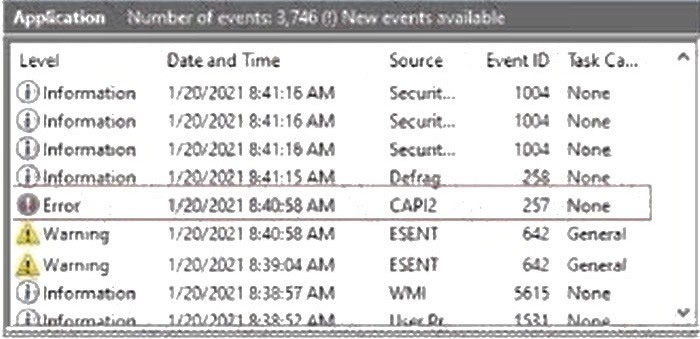
You are reviewing the Application log on a Windows computer. You see an event with an error-level message as shown.
What can you determine about the application that generated the event message?
A
The application is currently running much slower than expected.
B
The application experienced a significant problem that caused it to fail.
C
The application recovered from an event without loss of functionality.
D
The application loaded and ran successfully without issues.
Reveal answer detailsClose answer details
Correct answerB
Explanation
In the CCST Cybersecurity course, Windows Event Viewer Error events in the Application log indicate a severe problem that caused an application or component to fail. This usually requires investigation or repair.
"Error events indicate a significant problem such as a loss of functionality in an application or system component. Errors are often critical and need immediate attention." (CCST Cybersecurity, Incident Handling , Event Logging and Analysis section, Cisco Networking Academy) A is incorrect: Performance slowness would usually generate warnings, not errors. B is correct: An "Error" level in Event Viewer means the application failed in some way. C is incorrect: That describes an "Information" event, not an error. D is incorrect: That also corresponds to an "Information" event.
Question 7
Single choice
You notice that a new CVE has been shared to an email group that you belong to.
What should you do first with the CVE?
A
Look up details of the vulnerability to determine whether it applies to your network.
B
Research measures to prevent the CVE from attacking the network.
C
Record the CVE as part of the disaster recovery plan.
D
Add the CVE to the firewall rules for your organization.
Reveal answer detailsClose answer details
Correct answerA
Explanation
The CCST Cybersecurity material describes that the first step after receiving a new CVE notification is to review its details --such as affected systems, severity, and exploitability--to determine if it is relevant to your organization.
"Upon learning of a new CVE, security teams should analyze the vulnerability description, affected products, and CVSS score to determine applicability and urgency of mitigation." (CCST Cybersecurity, Vulnerability Assessment and Risk Management , Vulnerability Prioritization section, Cisco Networking Academy) A is correct: Confirming applicability avoids unnecessary remediation for irrelevant vulnerabilities. B is done after confirming applicability. C (disaster recovery plan) is unrelated to immediate CVE handling. D (adding to firewall rules) is premature without confirming impact.
Question 8
Single choice
A SOC analyst notices repeated failed login attempts from a foreign IP address followed by a successful login to a privileged account.
What is the most appropriate next step?
A
Reset the affected user's password and investigate the scope of compromise.
B
Block all foreign IP addresses from accessing the network.
C
Run a full vulnerability scan of the corporate network.
D
Ignore the event unless it happens again.
Reveal answer detailsClose answer details
Correct answerA
Explanation
The CCST Cybersecurity course highlights that signs of brute-force attacks followed by successful access require immediate account security actions and an investigation to determine if other systems were accessed.
"When suspicious login activity is detected, immediate containment steps such as password resets and log analysis are necessary to limit damage and identify the extent of the compromise." (CCST Cybersecurity, Incident Handling , Account Compromise Response section, Cisco Networking Academy)
Question 9
Drag & drop
DRAG DROP
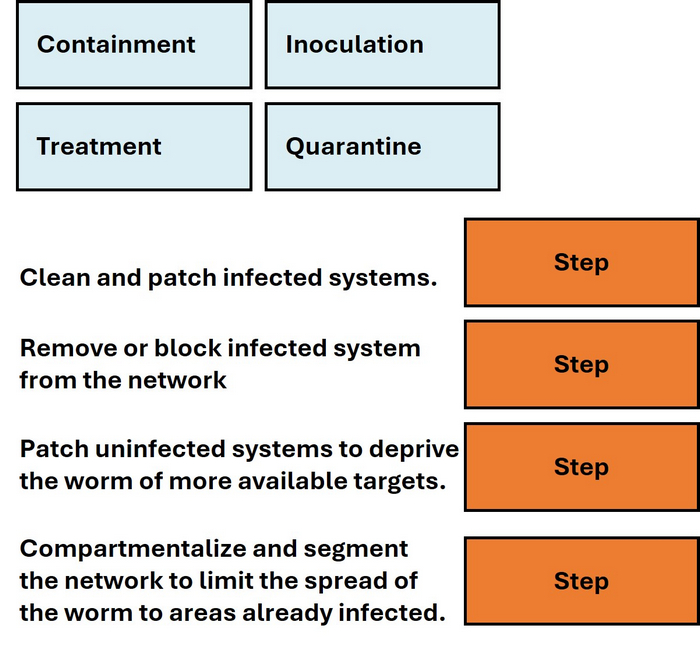
Move each worm mitigation step from the list on the left to the correct description on the right.
Note: You will receive partial credit for each correct answer.
Reveal answer detailsClose answer details
Explanation
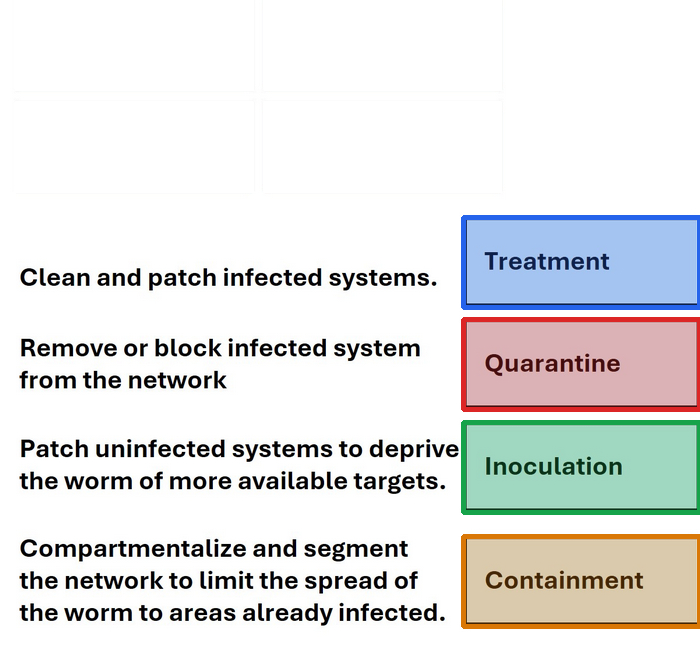
The CCST Cybersecurity Study Guide outlines worm mitigation as a four-step process:
Containment "Limit the spread of the worm by segmenting the network and restricting traffic from infected areas."
Inoculation "Apply patches or updates to uninfected systems to prevent them from being compromised."
Quarantine "Remove or block infected systems from the network to stop further infection."
Treatment "Clean and patch infected systems to remove the worm and fix vulnerabilities." (CCST Cybersecurity, Incident Handling , Malware Mitigation Strategies section, Cisco Networking Academy)
Question 10
Single choice
Which step should be performed immediately after identifying a critical vulnerability affecting internet-facing systems?
A
Document the vulnerability in the annual security report.
B
Apply the vendor patch or mitigation.
C
Schedule a quarterly penetration test.
D
Change the default administrator passwords.
Reveal answer detailsClose answer details
Correct answerB
Explanation
The CCST Cybersecurity Study Guide states that after confirming a vulnerability is relevant and critical, the next step is to apply available patches or mitigations as soon as possible to reduce the attack surface.
"When a critical vulnerability is identified, remediation steps such as applying patches or configuration changes should be implemented immediately to prevent exploitation." (CCST Cybersecurity, Vulnerability Assessment and Risk Management , Vulnerability Remediation section, Cisco Networking Academy)
CISCO
Cisco Certified Support Technician (CCST) Cybersecurity
You need a software solution that performs the following tasks:
1. Compiles network data 2. Logs information from many sources 3. Provides orchestration in the form of case management 4. Automates incident response workflows
What product should you use?
A.
SIEM
B.
SOAR
C.
NextGen IPS
D.
Snort
Correct Answer: B
Explanation
Explanation/Reference:
The CCST Cybersecurity Study Guide explains that SOAR (Security Orchestration, Automation, and Response) platforms integrate data from multiple tools and sources, support case management, and automate security workflows for faster incident response.
"SOAR solutions provide orchestration, automation, and response capabilities. They collect security data from multiple systems, enable analysts to manage incidents, and automate repetitive tasks in the response process." (CCST Cybersecurity, Incident Handling , Security Automation Tools section, Cisco Networking Academy) A (SIEM) collects and correlates security logs but lacks full orchestration and automated response capabilities. B is correct: SOAR adds orchestration, case management, and automated incident response. C (NextGen IPS) focuses on intrusion prevention, not orchestration. D (Snort) is an open-source intrusion detection/prevention tool, not an orchestration platform.
QUESTION 2
An employee accidentally sends an email containing sensitive corporate information to an external email address.
Which type of threat does this scenario describe?
A.
Logic bomb
B.
Malware
C.
Phishing
D.
Insider
Correct Answer: D
Explanation
Explanation/Reference:
The CCST Cybersecurity Study Guide explains that an insider threat is any threat to an organization that comes from people within the organization--employees, contractors, or business partners--who have inside information concerning the organization's security practices, data, and systems. Insider threats may be intentional or unintentional.
"An insider threat can be malicious or accidental. Employees may unintentionally cause data breaches by mishandling sensitive information, such as sending it to the wrong recipient." (CCST Cybersecurity, Essential Security Principles , Threat Actor Types section, Cisco Networking Academy) A (Logic bomb) is malicious code triggered by conditions. B (Malware) is malicious software, unrelated to accidental email leaks. C (Phishing) is an external social engineering attack. D is correct: This is an unintentional insider threat .
QUESTION 3
Which macOS security feature encrypts the entire macOS volume?
A.
FileVault
B.
Gatekeeper
C.
System Integrity Protection (SIP)
D.
XProtect
Correct Answer: A
Explanation
Explanation/Reference:
The CCST Cybersecurity Study Guide highlights FileVault as the macOS full-disk encryption tool.
"FileVault is macOS's built-in full-disk encryption feature. It encrypts the contents of the entire startup disk to help prevent unauthorized access to the information stored on the drive, even if the device is lost or stolen." (CCST Cybersecurity, Endpoint Security Concepts , Disk Encryption section, Cisco Networking Academy) Ais correct: FileVault provides complete volume encryption. B(Gatekeeper) controls app installation by verifying code signatures. C(System Integrity Protection) protects system files from modification. D(XProtect) is macOS's built-in malware detection system.
QUESTION 4
You are configuring access control policies on a new firewall. You want to ensure that users can only access the minimum resources required to perform their jobs.
Which security principle are you applying?
A.
Defense in depth
B.
Least privilege
C.
Segmentation
D.
Zero trust authentication
Correct Answer: B
Explanation
Explanation/Reference:
The CCST framework emphasizes least privilege as the principle of limiting access to only what is necessary for a user's role. Defense in depth (A) refers to layered security. Segmentation (C) divides networks but does not specify privileges. Zero trust (D) involves continuous verification, not role-restricted access.
QUESTION 5
A client cannot connect to the corporate web server. You discover a large number of half-open TCP connections to the server.
What should you do?
A.
Take action to stop the TCP SYN flood attack.
B.
Change the connection protocol from HTTP to HTTPS.
C.
Ignore the half-open connections because this is a normal part of the TCP three-way handshake.
D.
Flush the DNS cache information.
Correct Answer: A
Explanation
Explanation/Reference:
The CCST Cybersecurity Study Guide identifies SYN flood attacks as a type of Denial of Service (DoS) attack that exploits the TCP three-way handshake. Attackers send many SYN requests without completing the handshake, leaving the server with numerous half-open connections and exhausting resources.
"A TCP SYN flood attack overwhelms a target server by initiating a high volume of TCP connections but never completing the handshake, resulting in numerous half-open connections that consume system resources and can render the service unavailable." (CCST Cybersecurity, Incident Handling , Denial-of-Service Attacks section, Cisco Networking Academy) A is correct: The proper action is to stop the SYN flood, often using firewalls, intrusion prevention systems, or SYN cookies. B (switching to HTTPS) does not address the flooding issue. C is incorrect because the excessive number of half-open connections indicates an attack, not normal operation. D (flushing DNS cache) is unrelated to this type of attack.
QUESTION 6
You are reviewing the Application log on a Windows computer. You see an event with an error-level message as shown.
What can you determine about the application that generated the event message?
A.
The application is currently running much slower than expected.
B.
The application experienced a significant problem that caused it to fail.
C.
The application recovered from an event without loss of functionality.
D.
The application loaded and ran successfully without issues.
Correct Answer: B
Explanation
Explanation/Reference:
In the CCST Cybersecurity course, Windows Event Viewer Error events in the Application log indicate a severe problem that caused an application or component to fail. This usually requires investigation or repair.
"Error events indicate a significant problem such as a loss of functionality in an application or system component. Errors are often critical and need immediate attention." (CCST Cybersecurity, Incident Handling , Event Logging and Analysis section, Cisco Networking Academy) A is incorrect: Performance slowness would usually generate warnings, not errors. B is correct: An "Error" level in Event Viewer means the application failed in some way. C is incorrect: That describes an "Information" event, not an error. D is incorrect: That also corresponds to an "Information" event.
QUESTION 7
You notice that a new CVE has been shared to an email group that you belong to.
What should you do first with the CVE?
A.
Look up details of the vulnerability to determine whether it applies to your network.
B.
Research measures to prevent the CVE from attacking the network.
C.
Record the CVE as part of the disaster recovery plan.
D.
Add the CVE to the firewall rules for your organization.
Correct Answer: A
Explanation
Explanation/Reference:
The CCST Cybersecurity material describes that the first step after receiving a new CVE notification is to review its details --such as affected systems, severity, and exploitability--to determine if it is relevant to your organization.
"Upon learning of a new CVE, security teams should analyze the vulnerability description, affected products, and CVSS score to determine applicability and urgency of mitigation." (CCST Cybersecurity, Vulnerability Assessment and Risk Management , Vulnerability Prioritization section, Cisco Networking Academy) A is correct: Confirming applicability avoids unnecessary remediation for irrelevant vulnerabilities. B is done after confirming applicability. C (disaster recovery plan) is unrelated to immediate CVE handling. D (adding to firewall rules) is premature without confirming impact.
QUESTION 8
A SOC analyst notices repeated failed login attempts from a foreign IP address followed by a successful login to a privileged account.
What is the most appropriate next step?
A.
Reset the affected user's password and investigate the scope of compromise.
B.
Block all foreign IP addresses from accessing the network.
C.
Run a full vulnerability scan of the corporate network.
D.
Ignore the event unless it happens again.
Correct Answer: A
Explanation
Explanation/Reference:
The CCST Cybersecurity course highlights that signs of brute-force attacks followed by successful access require immediate account security actions and an investigation to determine if other systems were accessed.
"When suspicious login activity is detected, immediate containment steps such as password resets and log analysis are necessary to limit damage and identify the extent of the compromise." (CCST Cybersecurity, Incident Handling , Account Compromise Response section, Cisco Networking Academy)
QUESTION 9
DRAG DROP
Move each worm mitigation step from the list on the left to the correct description on the right.
Note: You will receive partial credit for each correct answer.
Correct Answer:
Explanation
Explanation/Reference:
The CCST Cybersecurity Study Guide outlines worm mitigation as a four-step process:
Containment "Limit the spread of the worm by segmenting the network and restricting traffic from infected areas."
Inoculation "Apply patches or updates to uninfected systems to prevent them from being compromised."
Quarantine "Remove or block infected systems from the network to stop further infection."
Treatment "Clean and patch infected systems to remove the worm and fix vulnerabilities." (CCST Cybersecurity, Incident Handling , Malware Mitigation Strategies section, Cisco Networking Academy)
QUESTION 10
Which step should be performed immediately after identifying a critical vulnerability affecting internet-facing systems?
A.
Document the vulnerability in the annual security report.
B.
Apply the vendor patch or mitigation.
C.
Schedule a quarterly penetration test.
D.
Change the default administrator passwords.
Correct Answer: B
Explanation
Explanation/Reference:
The CCST Cybersecurity Study Guide states that after confirming a vulnerability is relevant and critical, the next step is to apply available patches or mitigations as soon as possible to reduce the attack surface.
"When a critical vulnerability is identified, remediation steps such as applying patches or configuration changes should be implemented immediately to prevent exploitation." (CCST Cybersecurity, Vulnerability Assessment and Risk Management , Vulnerability Remediation section, Cisco Networking Academy)